
Wholesale Wedding Dress
Wholesale wedding dress purchasing is fundamentally a capital and inventory decision. Boutiques and buyers lock money into seasonal stock that must turn before the next bridal window, while protecting margin against alterations, returns, and markdowns.
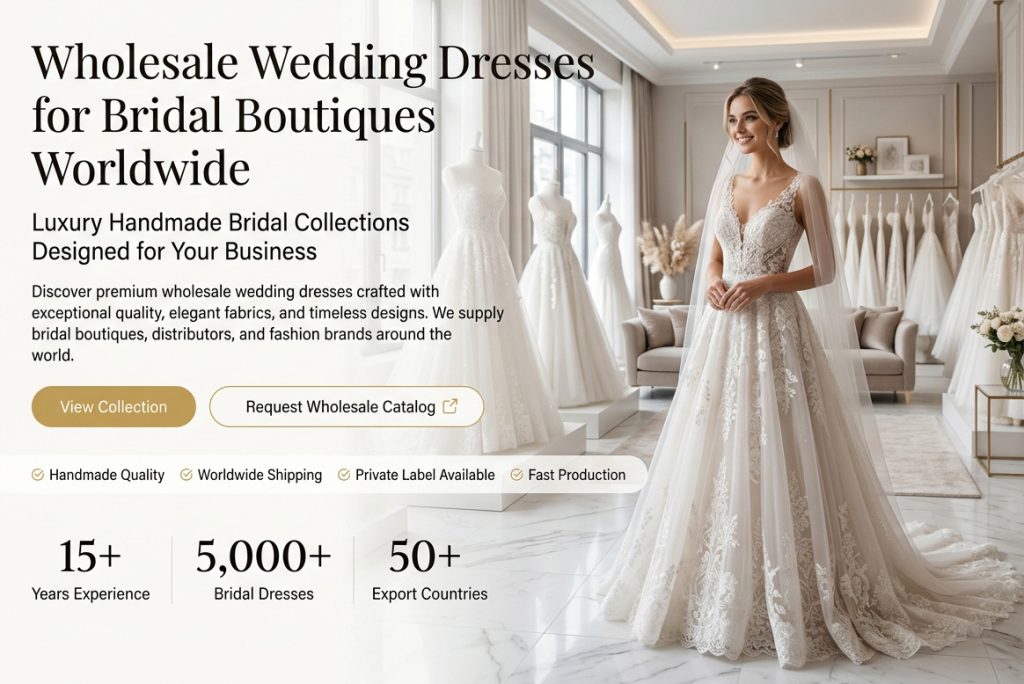
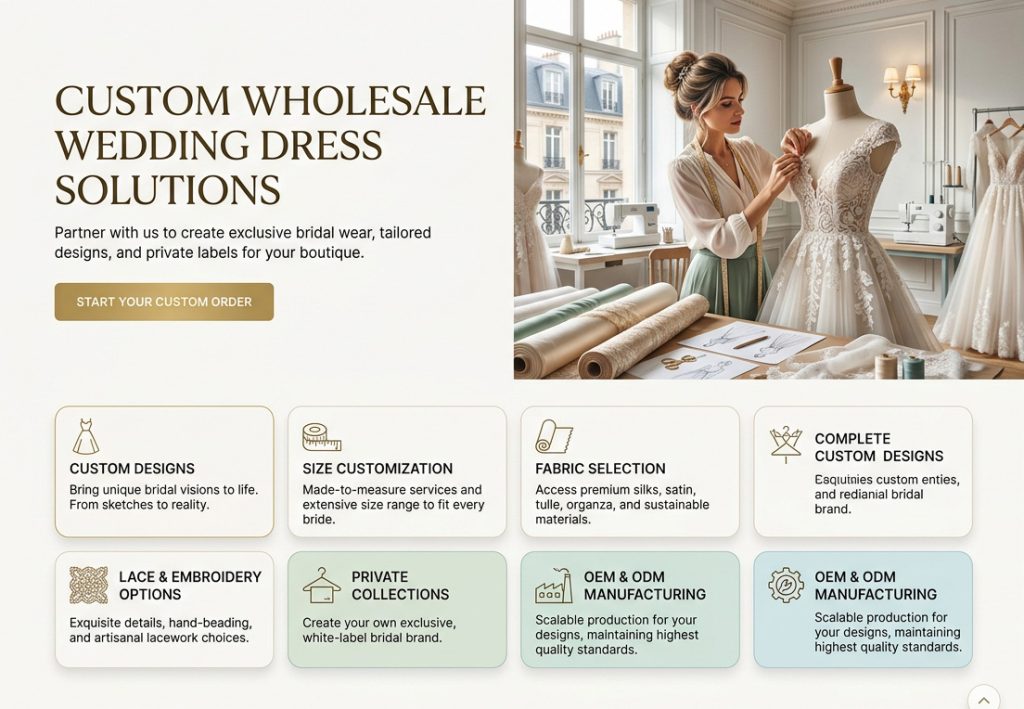
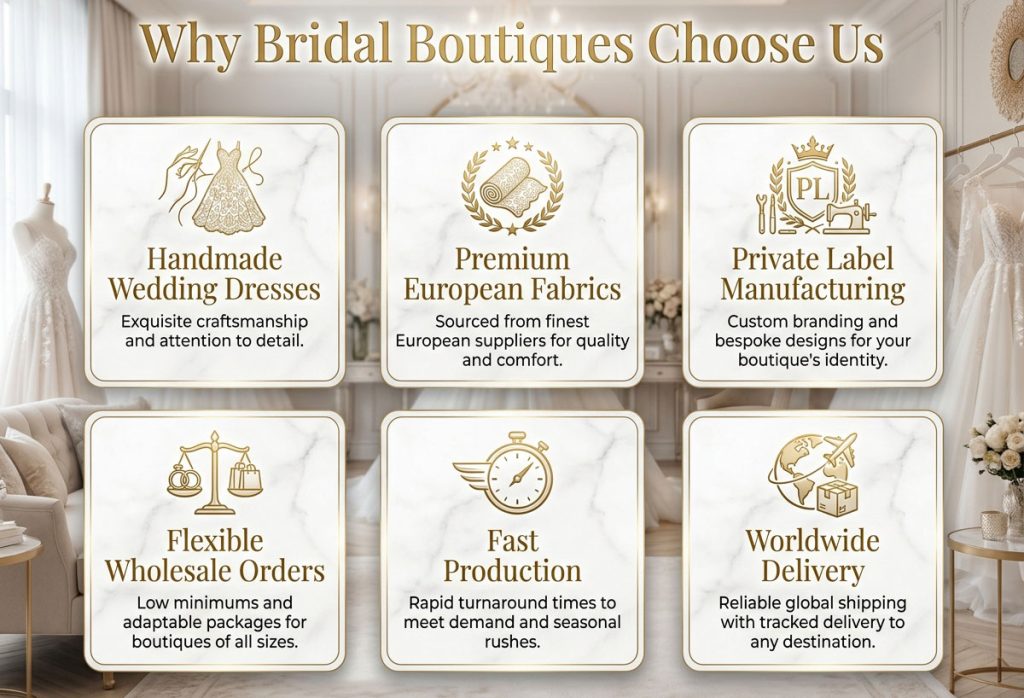
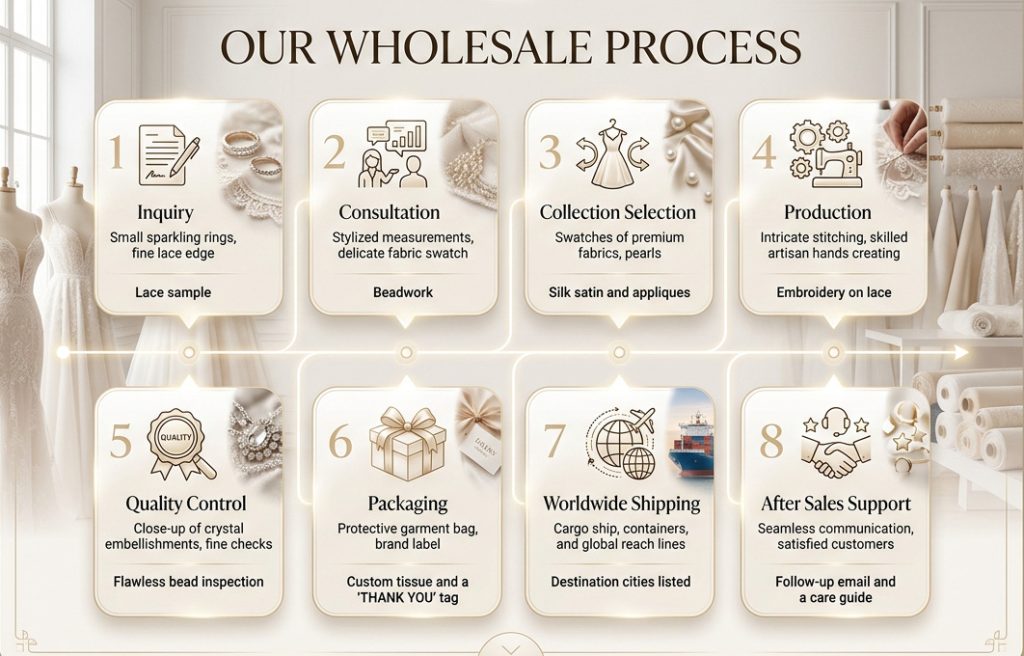
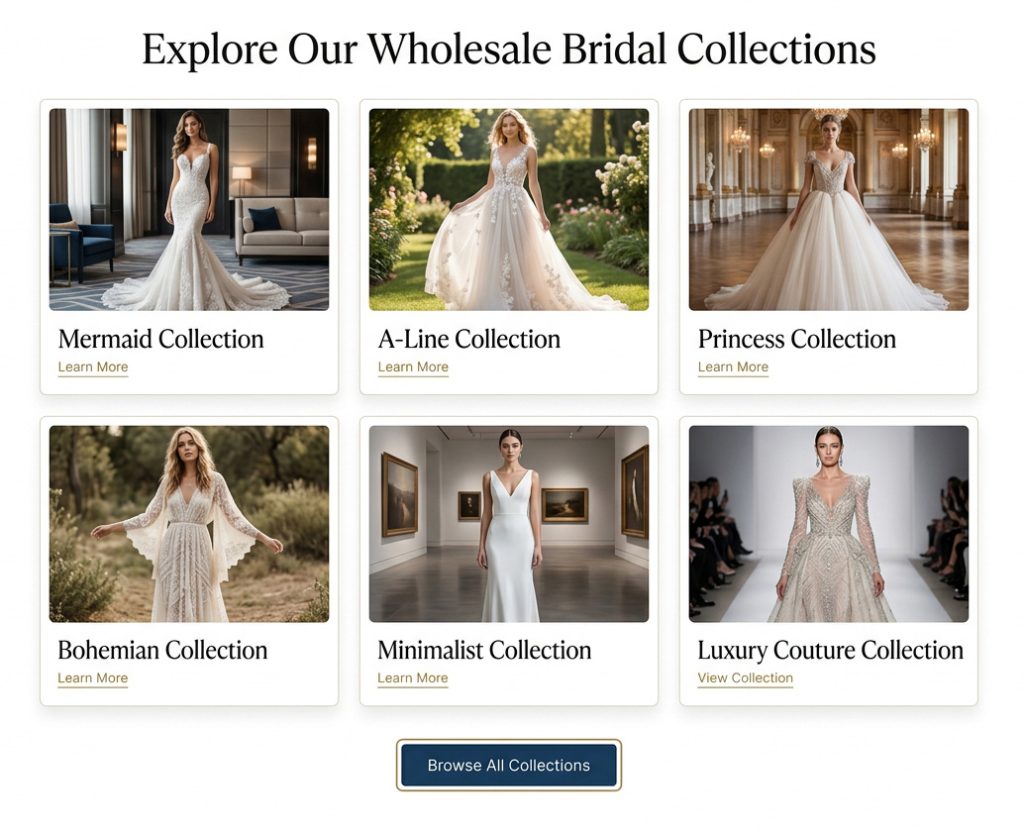


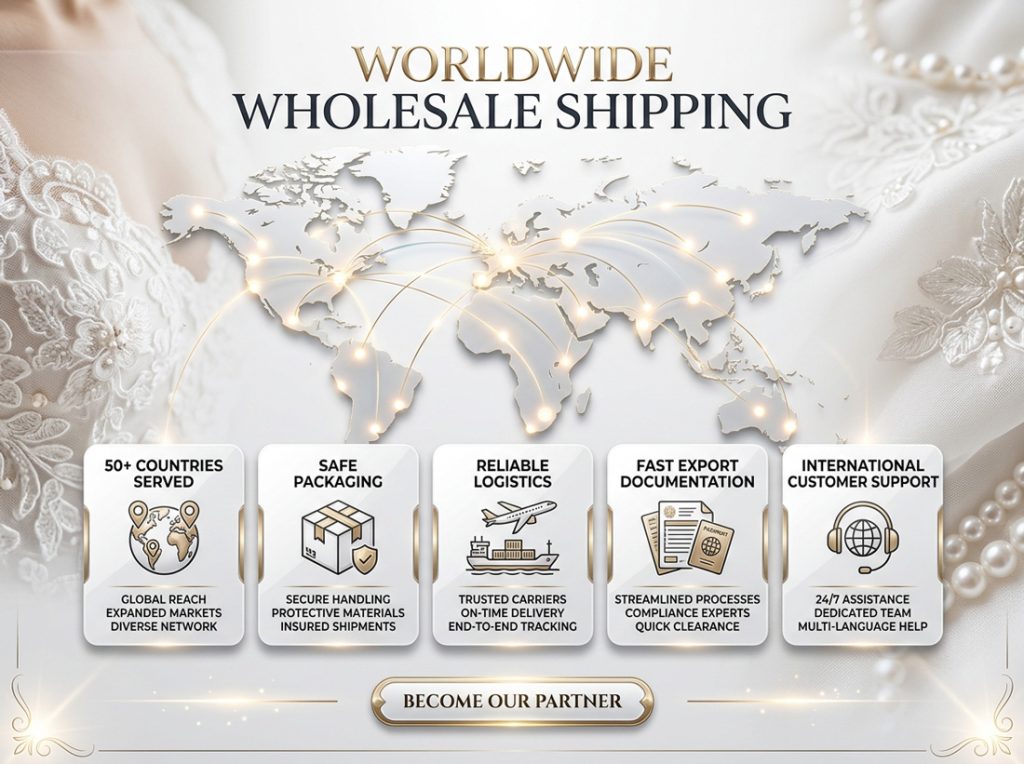
Wholesale wedding dress purchasing succeeds when capital moves quickly into full-price sales and out of corrective costs. Metropol Wedding Dress can be evaluated inside that standard. The operational evidence—flexibility, visibility, material consistency, and reorder capability—determines whether the relationship improves inventory velocity or simply relocates risk.
Metropol Wedding Dress operates as a specialized Turkish manufacturer that supports this layer: flexible wholesale volumes, collaborative private-label options, European-oriented materials, and structured production visibility. For distributors evaluating partners, the critical variables are order flexibility, quality consistency across size runs, lead-time predictability, and the ability to protect exclusive positioning in downstream markets. This guide examines the operational realities of working with a manufacturer that understands distributor economics rather than pure volume shipping.
Detailed Article: Building a Controlled Distribution Model with a Specialized Wedding Dress Manufacturer
Distributors in the bridal category face a distinct set of pressures. They must maintain enough assortment depth to serve multiple retail clients while avoiding the inventory risk that destroys cash flow. They need pricing that leaves room for their own margin and the retailer’s margin. They require product that arrives with predictable quality so that downstream boutiques do not return goods or demand credits. And they operate in a category where style cycles, seasonal peaks, and emotional purchase behavior leave little tolerance for error.
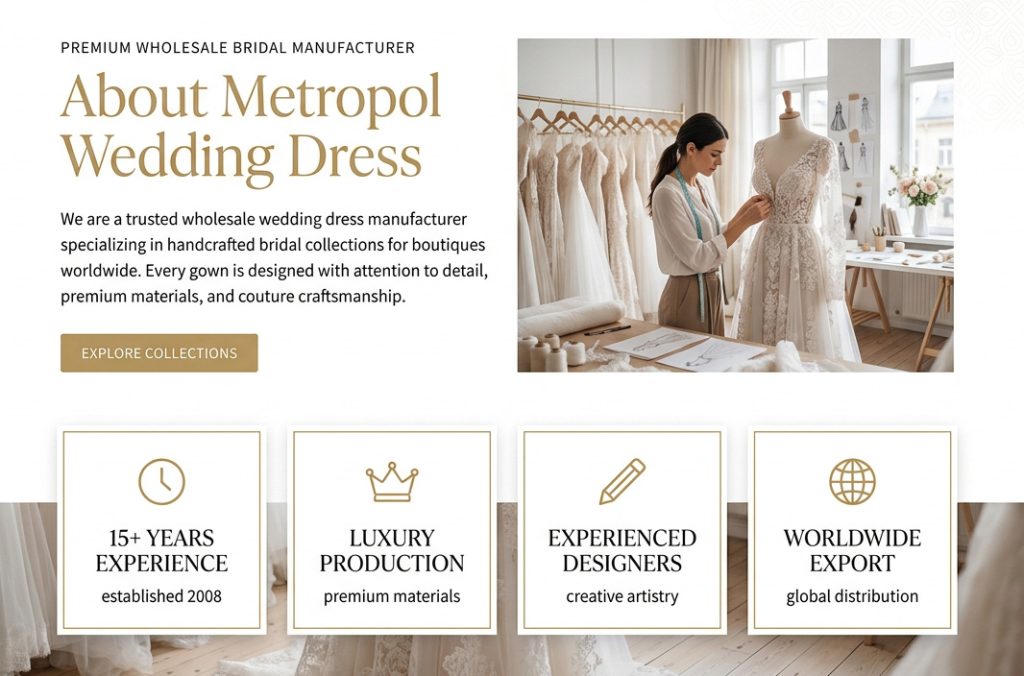
Most manufacturers optimize for either pure volume or pure couture. Few are structured to serve the middle layer of professional distributors who need both flexibility and reliability. Metropol Wedding Dress, based in İzmir, occupies that middle ground. The atelier produces approximately 100 gowns per month from a dedicated workshop, supports custom and wholesale programs, and works with European-oriented fabrics and structured approval processes. For distributors, this profile reduces certain categories of risk that pure high-volume factories frequently transfer downstream.
The Distributor’s Core Economic Problem
A distributor’s profit is the residual after factory cost, logistics, holding costs, markdowns, returns, and the margin required by the retail clients. Every inconsistency in quality or sizing increases alteration pressure on the boutique and raises the probability of returns or credits. Every late or incomplete shipment forces the distributor to scramble or lose seasonal sales. Every style that fails to sell through creates dead stock that must be liquidated at a loss.
The manufacturer that minimizes these residual costs is more valuable than the one that simply quotes the lowest unit price.
Key risk categories for wedding dress distributors
- Quality variance across a size run
- Shade or construction drift between sample and bulk
- Lead-time slippage during peak bridal periods
- Limited ability to protect exclusive styles for key retail accounts
- Inflexible minimums that force over-ordering
- Weak documentation that complicates customs or claims
Metropol’s process design—pattern approval, fabric confirmation, stage photography, and final inspection—directly addresses several of these risks when the distributor enforces the gates.
How a Structured Manufacturer Supports Distributor Assortment Strategy
Distributors typically manage a mix of:
- Core silhouettes that turn repeatedly
- Seasonal or trend-driven styles
- Exclusive or private-label pieces for stronger retail partners
- Limited special orders for individual boutiques
A manufacturer that can handle both repeatable core production and controlled exclusives gives the distributor more strategic options. Metropol’s capacity and collaborative approach allow distributors to develop protected collections for key accounts while maintaining open wholesale styles for broader distribution.
Assortment planning table
| Assortment Type | Distributor Goal | Manufacturer Requirement | Metropol Fit |
|---|---|---|---|
| Core repeating styles | Predictable reorders, stable margin | Retained patterns, consistent materials | Strong |
| Seasonal trend pieces | Freshness without excess risk | Reasonable development speed, flexible volume | Strong |
| Private-label exclusives | Higher margin, account protection | Design collaboration, labeling control, IP clarity | Strong |
| One-off or small custom | Service for important retail clients | Low-MOQ willingness, technical communication | Strong |
The ability to mix these types without forcing the distributor into rigid volume commitments is a practical advantage.
Production Visibility and Risk Transfer
In pure volume relationships the distributor often receives finished goods with limited insight into how they were made. Problems surface only after arrival. Structured manufacturers reverse this by creating sequential decision points:
- Technical package and design confirmation
- Fabric and trim approval
- Pattern and grading sign-off
- In-process photography or reports
- Final inspection before packing
Each gate allows the distributor to intervene or confirm before costs escalate. When these gates are used, quality variance and shade issues become detectable earlier. The residual risk that reaches the distributor’s warehouse is lower.
Expert note Distributors who treat the manufacturer as a pure shipping source absorb more variance. Distributors who treat the relationship as a controlled production partnership—complete briefs, written approvals, measured feedback—transfer less risk downstream to their retail clients and protect their own reputation.
Material and Construction Standards That Protect Downstream Margin
Bridal product that requires heavy alteration after arrival damages the boutique’s economics and, by extension, the distributor’s relationship with that boutique. Fabric stability, motif alignment, structural integrity, and embellishment security are therefore commercial variables, not merely aesthetic ones.
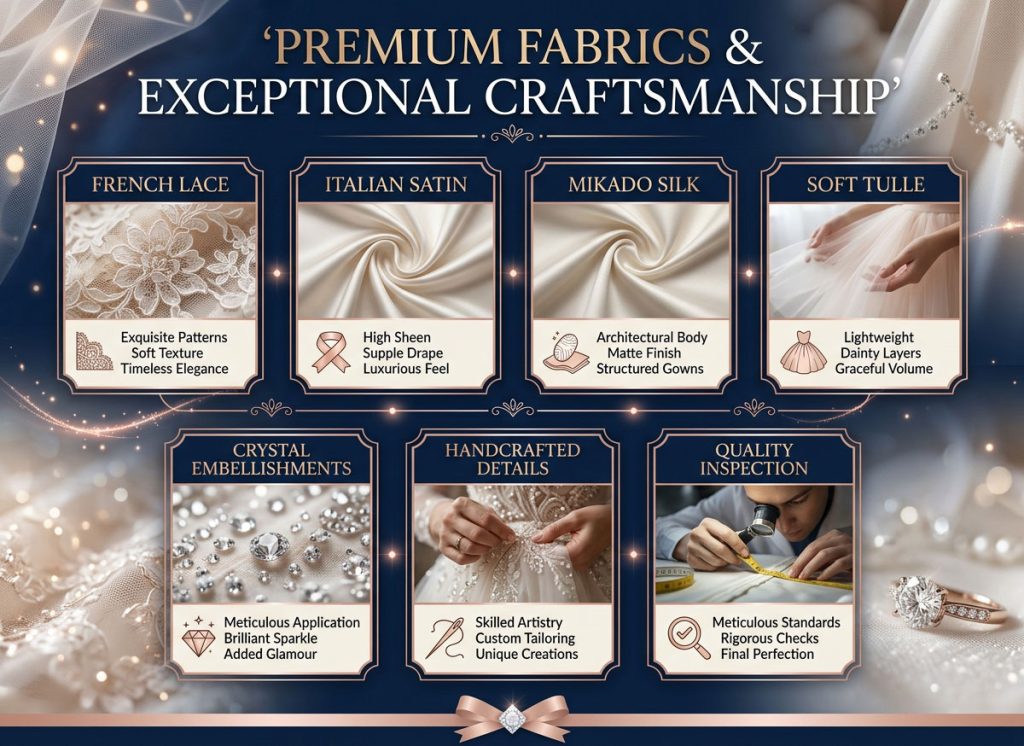
Metropol prioritizes European-oriented lace, quality tulles, satins, and related materials when specified. Pattern work and grading receive technical attention. Embellishment methods aim for durability under handling. These choices raise the unit cost relative to the lowest-tier factories; they also reduce the probability that the distributor’s clients will face systematic fit or finishing problems.
Tip box — Questions distributors should ask any manufacturer
- How do you manage dye-lot consistency across a multi-size wholesale order?
- What is the documented process for pattern approval and grading?
- At which stages can the distributor receive photographic confirmation?
- How are private-label exclusives protected from broader distribution?
- What is the realistic capacity during peak bridal months?
Logistics and Order Structure Considerations
Distributors rarely order single gowns. They order collections or size runs destined for multiple retail points. Shipping terms, packaging standards, documentation accuracy, and the ability to handle consolidated or split shipments affect landed cost and operational smoothness.
Clear Incoterms, accurate commercial documents, and protective packing reduce friction at customs and upon receipt. Lead-time reliability matters more than the absolute shortest possible transit because distributors plan around seasonal windows. Metropol’s export experience supports these requirements; exact schedules and terms are confirmed per order.
Real Distributor Scenarios
Scenario A A regional distributor supplying independent boutiques needed a higher-quality lace collection that previous volume suppliers could not deliver consistently. They developed a protected private-label range with Metropol using staged approvals. Size-run consistency improved. Boutique feedback on alteration time was positive. The distributor was able to maintain stronger pricing and reduce credit requests.
Scenario B A distributor managing both open wholesale and exclusive accounts used the manufacturer’s flexibility to keep core silhouettes in regular production while developing limited seasonal exclusives for top retail partners. Inventory risk remained controlled because order quantities matched actual demand signals rather than rigid factory minimums.
These results depend on the distributor maintaining process discipline. Incomplete measurement packages or late design changes transfer problems back upstream and downstream alike.
Common Errors in Distributor–Manufacturer Relationships
- Selecting solely on unit price without modeling total cost of quality variance
- Failing to define exclusivity terms for private-label styles
- Ordering without retained pattern and fabric references for future reorders
- Treating sample approval as the only quality gate
- Ignoring capacity constraints during peak seasons
- Weak documentation that complicates claims or customs clearance
Each of these is correctable with structured agreements and operational routines.
Control checklist for distributor partnerships
- Written technical package standards
- Pattern and fabric approval gates
- Stage visibility protocol
- Clear exclusivity and private-label terms
- Defined sizing tolerances and acceptance criteria
- Transparent quotation including logistics responsibilities
- Reorder process and lead-time expectations
- Claim and dispute procedure
- Capacity planning calendar for peak periods
Positioning Metropol for Professional Distributors
Metropol is not a pure high-volume shipper. It is a specialized manufacturer with atelier-scale capacity, collaborative development capability, and process visibility. Strengths for distributors include order flexibility, material orientation, private-label support, and structured quality gates. Limitations include finite monthly capacity; very large concurrent programs may require advance scheduling or multi-source strategies.
The partnership works best when the distributor values consistency and controlled exclusivity over absolute minimum unit cost.
Decision Sequence for Distributors Evaluating Upstream Partners
- Map current supply risks against the categories listed earlier.
- Define the assortment mix required (core, seasonal, exclusive).
- Request capability evidence and process documentation from candidate manufacturers.
- Run a controlled pilot collection with full approval gates.
- Measure results on consistency, lead-time reliability, and downstream boutique feedback.
- Scale only the relationships that clear the operational thresholds.
A manufacturer that understands distributor economics protects the entire chain. Metropol Wedding Dress can be evaluated inside that standard. The operational evidence—flexibility, visibility, material standards, and collaborative capacity—determines whether the relationship reduces residual risk or simply relocates it.
For assortment development discussions, private-label capability, or a structured pilot order, contact Metropol Wedding Dress through official channels. Base the decision on verified process and measured commercial outcomes rather than unit price alone.
Frequently Asked Questions
1. What makes a manufacturer suitable for professional wedding dress distributors rather than pure retailers? Order flexibility, process visibility, private-label support, consistent size-run quality, and the ability to protect exclusives for key accounts.
2. How does Metropol support distributor-level assortment planning? Through a mix of repeatable core styles, seasonal development, and collaborative private-label programs with controlled labeling and exclusivity terms.
3. What is the practical monthly capacity? Approximately 100 gowns, with expansion underway. Large concurrent programs require advance planning.
4. How are private-label exclusives protected? Through written agreements covering design ownership, labeling control, and distribution restrictions.
5. What quality gates reduce risk for distributors? Design confirmation, fabric approval, pattern sign-off, stage photography, and final inspection before packing.
6. How should dye-lot consistency be managed on wholesale size runs? Matched lots are preferred. Any variation should be flagged before cutting.
7. Can core styles be reordered reliably? Yes, when patterns and fabric references are retained by the manufacturer.
8. What lead-time realities should distributors plan around? Complexity, fabric availability, and seasonal load determine timelines. Early booking for peak periods improves outcomes.
9. How does material selection affect downstream boutique performance? Higher-stability lace, quality tulles, and proper structure reduce alteration hours and improve client satisfaction at retail.
10. What documentation is required for international distributor shipments? Accurate commercial invoices, packing lists, and any origin or material declarations needed for customs.
11. How are claims handled when product fails agreed standards? Pre-defined acceptance criteria and photographic records form the basis. The procedure should be documented in the trading terms.
12. Is low-MOQ production available for test collections or special accounts? Yes. Flexibility on smaller runs is a practical advantage for distributors managing risk.
13. How should exclusivity territories or accounts be defined? In writing, specifying geographic or account-level restrictions and duration.
14. What is the most common cause of quality variance in wholesale bridal? Incomplete technical packages or skipped approval gates after sample stage.
15. Can the manufacturer support both open wholesale and protected private-label lines simultaneously? Yes, when capacity and exclusivity terms are clearly managed.
16. How does stage photography benefit a distributor? It allows intervention or confirmation before bulk costs are locked and before goods ship.
17. What sizing and grading standards should be confirmed? Documented grading method, size-range experience, and written tolerances.
18. How are peak-season capacity conflicts managed? Through advance calendars and prioritization discussions. Last-minute large orders compete with existing commitments.
19. What logistics terms should be clarified upfront? Incoterms, shipping responsibility, insurance, and packaging standards.
20. Can modest or specialized design requirements be accommodated within distributor programs? Yes, when briefed early enough for pattern and construction decisions.
21. How should a distributor begin a relationship without excessive inventory risk? Define a limited pilot collection, enforce full approval gates, measure results, then expand.
22. What metrics indicate a healthy manufacturer–distributor partnership? Size-run consistency, on-time performance against agreed milestones, low credit/return rates from retail clients, and reliable reorder capability.
23. Are fabric swatches and production references available before bulk commitment? Yes. Actual production materials should be confirmed rather than representative alternatives.
24. How does interior finishing quality affect the distributor’s retail clients? Clean seams, proper support, and durable closures reduce alteration time and improve the boutique’s fitting experience.
25. What happens if design or measurement details change after pattern approval? Changes typically incur additional cost and time. Clear cut-off points protect both parties.
26. Can convertible or multi-function styles be included in distributor assortments? Yes, when structural requirements are addressed during development.
27. How important is technical communication responsiveness? Critical. Distributors need timely answers on measurements, materials, and production status to manage their own client commitments.
28. What role does retained pattern ownership play in long-term partnership value? It enables faster, more consistent reorders and protects the investment in successful styles.
29. Why do some distributors still prefer pure volume factories despite higher residual risk? Short-term unit cost pressure. The longer-term costs of variance, credits, and damaged retail relationships often exceed the initial savings.
30. What single practice most improves outcomes for wedding dress distributors? Treating the manufacturer as a controlled production partner—complete briefs, mandatory gates, and measured feedback—rather than a pure shipping source.
For assortment development, private-label programs, or a structured pilot collection, contact Metropol Wedding Dress through official channels. Evaluate the partnership on risk reduction and commercial consistency across the distribution chain.
Wholesale wedding dress
Metropol Wedding Dress, a specialized Turkish manufacturer in İzmir, supports this reality through flexible order sizes, structured production visibility, European-oriented materials, and the ability to move from controlled test quantities to protected reorders. For purchasing managers, the value of a wholesale partner is measured less by the lowest unit price and more by how effectively it reduces capital lock-up, dead-stock risk, and post-arrival correction costs. This guide examines wholesale bridal buying through the lens of inventory velocity and risk control.
Detailed Article: Wholesale Wedding Dress Buying as Capital and Inventory Management
Bridal retail runs on narrow seasonal windows. Capital tied up in slow-moving or inconsistent stock is capital unavailable for marketing, staffing, or the next collection. Returns and heavy alterations further erode contribution margin. Most wholesale discussions focus on style and price. The more decisive variables are often order flexibility, consistency that reduces corrective labor, and the ability to reorder successful pieces without restarting the entire development cycle.
Metropol Wedding Dress operates an atelier-scale production model in Konak, İzmir. Monthly capacity is calibrated around approximately 100 gowns. The factory supports both custom work and wholesale programs, works with European-oriented fabrics, and maintains sequential approval gates. For buyers managing cash flow and inventory risk, this profile offers practical levers that pure high-volume factories frequently do not.
The Hidden Cost Structure of Wholesale Bridal Inventory
Unit cost is only the first line. Additional costs that determine true profitability include:
- Capital opportunity cost while stock sits
- Storage and insurance
- Alteration labor after arrival
- Markdowns on slow movers
- Return shipping and restocking friction
- Lost sales from size-run inconsistencies or late deliveries
A lower unit price that generates high alteration hours or forces deep discounts can produce a worse net result than a moderately higher unit price that turns cleanly at full price.
Inventory risk categories in wholesale bridal
- Over-commitment on unproven styles
- Under-assortment on proven silhouettes
- Size-run imbalance
- Quality variance that triggers credits or heavy alterations
- Lead-time slippage that misses the selling window
- Inability to reorder winners quickly
Manufacturers that reduce these categories create more value than those that simply ship volume.
Flexibility as a Financial Tool
Rigid minimum order quantities force buyers to over-order in order to access a style or a price tier. The excess becomes dead stock risk. Flexible production allows controlled testing: small initial quantities, rapid feedback from the sales floor, then scaled reorders of the pieces that actually move.
Metropol’s model supports this approach. Low-commitment test orders and collaborative development enable buyers to validate style, fabric, and fit before locking larger capital. Successful styles can then be reordered with retained patterns, shortening the second-cycle lead time and improving inventory velocity.
Order structure comparison
| Approach | Capital Commitment | Dead-Stock Exposure | Reorder Speed | Best Suited For |
|---|---|---|---|---|
| Rigid high-MOQ volume factory | High | High | Variable | Pure volume programs |
| Flexible atelier model (Metropol profile) | Lower initial | Lower | Faster on retained styles | Test-and-scale buying |
| Pure local custom | Low per piece | Low | Slow | One-off service |
The flexible model does not eliminate risk. It relocates risk upstream into process discipline and downstream into measured selling data.
Production Gates That Protect Capital
Once fabric is cut, most costs are sunk. Structured manufacturers insert decision points before that irreversible step:
- Technical package and design confirmation
- Fabric and trim reference approval
- Pattern and grading sign-off
- In-process visibility (photography or reports)
- Final inspection before shipment
Each gate gives the buyer an opportunity to confirm or correct before additional capital is committed. When these gates are enforced, the probability of receiving a size run that requires systematic alteration drops. Capital that would have been spent on corrective labor remains available for other uses.
Expert observation Buyers who treat wholesale as a pure transaction absorb more inventory variance. Buyers who treat it as a controlled production partnership—complete briefs, mandatory gates, and post-arrival measurement of alteration hours and sell-through—convert more of their capital into full-price sales.
Material and Construction Choices That Affect Velocity
Fabric stability, motif alignment, structural integrity, and embellishment security influence how quickly a gown moves from arrival to sold. Gowns that require extensive alteration or generate client complaints turn more slowly and more often at a discount.
Metropol prioritizes European-oriented lace, quality tulles, satins, and related materials when specified. Pattern work receives technical attention. Embellishment methods aim for durability. These choices raise the unit cost relative to the lowest-tier options; they also improve the probability that the stock turns at full price with lower corrective labor.
Tip box — Capital-efficient questions for any wholesale supplier
- What is the realistic minimum for a controlled test order?
- How are patterns and fabric references retained for reorders?
- At which stages can production be confirmed or adjusted before cutting?
- What is the documented approach to size-run consistency?
- How are peak-season capacity and lead times managed?
Real Buying Scenarios Focused on Capital Outcomes
Scenario one A boutique previously ordered full size runs of unproven styles from a high-MOQ source. Several styles underperformed and required heavy markdowns. Switching to a flexible manufacturer allowed small test quantities of new silhouettes. Only the proven pieces were scaled. Capital previously locked in slow stock became available for marketing and the next test cycle. Alteration hours also declined because pattern approval was enforced.
Scenario two A multi-location retailer used retained patterns from an initial successful collection to reorder core styles with shorter lead times. Inventory turns improved because replenishment matched actual sell-through rather than speculative bulk ordering.
These outcomes require the buyer to track sell-through and alteration data and to feed that information back into the next order cycle. The manufacturer cannot compensate for the absence of that discipline.
Frequent Capital and Inventory Errors in Wholesale Bridal
- Ordering full runs of unvalidated styles to meet a minimum
- Skipping pattern and fabric gates because of time pressure
- Failing to retain pattern and material references for reorders
- Measuring success only by unit cost rather than net contribution after alterations and markdowns
- Ignoring peak-season capacity constraints until it is too late
- Treating every style as a one-time purchase instead of building a core of reorderable winners
Each error increases the amount of capital that is either locked or lost.
Control checklist for capital-efficient wholesale buying
- Defined test-order protocol with clear success metrics
- Mandatory pattern and fabric approval before cutting
- Stage visibility for larger commitments
- Written sizing tolerances and acceptance criteria
- Retained pattern and fabric reference process for reorders
- Peak-season capacity calendar agreed in advance
- Post-arrival tracking of alteration hours and sell-through
- Clear terms for changes, claims, and exclusivity if private label is used
Positioning Metropol Inside a Capital-Aware Wholesale Strategy
Metropol is not the lowest-cost volume shipper available. It is a specialized manufacturer with atelier-scale capacity, flexible order structures, process visibility, and collaborative development capability. For buyers whose primary constraint is capital efficiency and inventory velocity rather than absolute minimum unit price, the profile is often advantageous.
Strengths include the ability to start small, validate, and scale; material orientation that supports cleaner sell-through; and retained-pattern reorders that improve second-cycle speed. Limitations include finite monthly capacity; very large concurrent programs require advance scheduling.
Practical Sequence for Purchasing Managers
- Map current inventory and capital pain points (overstock, alteration load, missed reorders).
- Define a test-and-scale protocol with clear metrics.
- Select manufacturers that support low-commitment testing and retained-pattern reorders.
- Enforce approval gates on every order.
- Measure results on net contribution, alteration hours, and inventory turns—not solely on unit cost.
- Expand only the styles and partnerships that clear the financial thresholds.
For test-order discussions, core-style development, or a capital-efficient wholesale program, contact Metropol Wedding Dress through official channels. Base the decision on measured impact on cash flow and inventory performance.
Frequently Asked Questions
1. How does flexible wholesale production improve capital efficiency? It allows small test quantities, rapid validation, and scaled reorders of only the styles that turn, reducing capital locked in unproven stock.
2. What is the practical advantage of retained patterns? Successful styles can be reordered with shorter lead times and higher consistency, improving inventory velocity on proven pieces.
3. How do production approval gates protect capital? They create decision points before fabric is cut, allowing correction or confirmation before major costs are sunk.
4. What monthly capacity should buyers expect? Approximately 100 gowns at Metropol, with ongoing expansion. Large programs require advance planning.
5. How should a first wholesale order be structured to limit risk? Treat it as a controlled test with clear success metrics, full approval gates, and limited quantity.
6. What fabric and construction factors most affect sell-through speed? Stability of lace and base fabrics, accurate grading, structural integrity, and secure embellishment reduce alterations and client complaints.
7. How are size-run inconsistencies minimized? Through technical pattern grading, matched dye lots where possible, and final inspection against agreed tolerances.
8. Can private-label styles be developed within a capital-efficient model? Yes. Controlled exclusives can be tested in small quantities and scaled only if they perform.
9. What lead-time realities affect inventory planning? Complexity, fabric availability, and seasonal load. Early booking for peak periods improves reliability.
10. How should alteration hours be tracked after arrival? As a core performance metric. High alteration load signals process or quality issues that erode margin.
11. What documentation supports clean customs and claims? Accurate commercial invoices, packing lists, and any required origin or material declarations.
12. How are peak-season capacity conflicts handled? Through advance calendars and prioritization. Last-minute large orders compete with existing commitments.
13. What is the most common capital error in wholesale bridal buying? Over-ordering unvalidated styles to meet rigid minimums, creating dead-stock exposure.
14. How does stage photography reduce financial risk? It provides visibility before bulk costs are locked and before goods ship.
15. Can core silhouettes be maintained across multiple seasons? Yes, when patterns and fabric references are retained and sell-through data supports continuation.
16. What role does dye-lot management play in inventory quality? Matched lots reduce shade variation across a size run, protecting the integrity of the delivered stock.
17. How should success of a wholesale partner be measured? Net contribution after alterations and markdowns, inventory turns, reorder reliability, and consistency of size runs.
18. Are low-commitment test orders realistically available? Yes, within the flexible model used by specialized manufacturers such as Metropol.
19. What happens if design or measurement details change after pattern approval? Additional cost and time are typically required. Clear cut-off points protect both parties.
20. How does interior finishing quality affect capital outcomes? Clean, durable construction reduces post-arrival labor and improves the probability of full-price sales.
21. Can modest or specialized design requirements fit a test-and-scale approach? Yes, when briefed early and validated in controlled quantities.
22. What logistics terms should be clarified to protect landed cost? Incoterms, shipping responsibility, insurance, and packaging standards.
23. How important is technical communication speed? Critical for managing timelines and protecting seasonal windows.
24. What single practice most improves inventory velocity? Enforcing pattern and fabric approval gates and measuring post-arrival performance data.
25. How are claims handled when delivered goods fail agreed standards? Pre-defined acceptance criteria and photographic records form the basis. Terms should be set before production.
26. Can convertible or multi-function styles be included in capital-efficient programs? Yes, when structural requirements are addressed during development and validated in test quantities.
27. Why do some buyers still prefer rigid high-MOQ sources? Short-term unit cost pressure. The longer-term costs of dead stock and alterations often exceed the initial savings.
28. How should exclusivity be handled on private-label test styles? In writing, specifying scope and duration before development begins.
29. What capacity planning discipline is required from the buyer? Realistic calendars, early communication of peak needs, and prioritization of proven styles.
30. What ultimately determines whether a wholesale relationship improves capital efficiency? The combination of order flexibility, process visibility, consistent quality, and the buyer’s own discipline in testing, measuring, and reordering only what turns.
“You may also want to take a look at this article.”Bespoke Wedding Dresses
For controlled test orders, core-style development, or a wholesale program designed around inventory velocity, contact Metropol Wedding Dress through official channels. Evaluate the partnership on its impact on capital lock-up, alteration load, and sell-through performance.
Searching for a wedding dress factory requires more than style galleries and price lists. It requires a technical evaluation of production systems: pattern control, fabric handling discipline, skill density on the floor, inspection logic, and the ability to repeat results across size runs. Metropol Wedding Dress operates an atelier-scale factory in İzmir that prioritizes these controllable variables over pure volume. For purchasing managers, the difference between a real manufacturing partner and a trading intermediary appears in process gates, documentation culture, and measurable consistency. This guide frames factory selection as a structured technical audit rather than a catalog comparison.
Detailed Article: Auditing a Wedding Dress Factory — Technical Criteria That Separate Capability from Claims
Most “factory” listings online are not factories. Many are trading companies, showrooms, or small workshops that outsource the actual cutting and sewing. Others are high-volume lines optimized for speed and lowest cost, where process control is secondary. A purchasing manager who needs consistent wholesale results must evaluate the production system itself.
A functional wedding dress factory is defined by the density of skilled labor, the sequence of controlled operations, the quality of decision points before irreversible steps, and the ability to document and repeat outcomes. Metropol Wedding Dress maintains an 800–1,200 m² production workshop in Konak, İzmir, with a monthly output calibrated around approximately 100 gowns. The model is atelier-scale rather than mass-production scale. That scale supports technical attention that pure volume environments often dilute.
Core Technical Dimensions of Factory Capability
Pattern and grading control The pattern is the master document. Inaccurate base patterns or uncontrolled grading produce systematic fit failures across a size run. A capable factory maintains technical pattern development, documented grading rules, and an approval gate before fabric is cut. Weak factories treat grading as approximate scaling.
Fabric handling discipline Lace motifs must be aligned. Directional fabrics must be cut correctly. Shade lots must be managed. Premium materials are wasted when cutting and handling standards are low. A real factory inspects incoming fabric and protects expensive goods during marker making and cutting.
Structural construction standards Bodice support, boning placement, lining integrity, and closure reinforcement determine how the gown behaves under movement and repeated fittings. These elements are engineered, not added as afterthoughts.
Surface work methods Beading, embroidery, and appliqué attachment methods affect both appearance and durability. Hand or specialized techniques are applied after the shell is stable. Density and weight distribution are planned so the silhouette remains balanced.
Inspection logic Inspection must occur at multiple points, not only at final packing. In-process checks catch problems while correction is still possible. Final inspection verifies the agreed standard before shipment.
Metropol organizes production around these dimensions. Design and technical package confirmation precede fabric commitment. Pattern approval is required. Stage documentation is available. Final inspection precedes packing.
Expert note Factories that cannot explain their pattern control, fabric inspection, and in-process check points are usually optimizing for something other than consistent wholesale results.
Workflow Sequence as an Audit Tool
A transparent factory can describe its sequence clearly:
- Technical package receipt and clarification
- Fabric and trim confirmation
- Pattern development or adaptation and grading
- Client approval of pattern and materials
- Precision cutting
- Structural assembly
- Surface embellishment
- Finishing and multi-point inspection
- Packaging and documentation
Each step is a potential failure point or a control point. The more a factory can show how it controls the sequence, the lower the residual risk transferred to the buyer.
Technical comparison table
| Capability Dimension | Trading Company / Weak Workshop | Volume-Optimized Line | Atelier-Scale Factory (Metropol profile) |
|---|---|---|---|
| Pattern ownership & control | Often external or approximate | Standardized but rigid | Technical, approval-gated |
| Fabric inspection | Limited | Speed-focused | Material-protective |
| In-process visibility | Rare | Internal only | Client-accessible stages |
| Size-run consistency | Variable | High volume, variable quality | Monitored through grading & inspection |
| Flexibility on order size | High claims, low reliability | Low | Practical low-to-mid volume |
| Documentation culture | Weak | Internal metrics | Client-facing gates and records |
Skill Density and Labor Reality
Wedding dress construction is skill-intensive. Pattern makers, cutters who respect lace, sewers who can build structured bodices, and embellishment specialists are not interchangeable with general garment labor. Atelier-scale factories concentrate these skills. High-volume lines often dilute them across larger workforces and tighter time standards.
Metropol’s model relies on experienced pattern, construction, and embroidery capacity rather than pure headcount. This supports the technical thresholds required for consistent wholesale results, provided the buyer supplies clear measurement and design data.
“You may also want to take a look at this article.”Custom Wedding Dresses Australia
Tip box — Technical questions that expose real capability
- Who develops and owns the production patterns?
- What is the documented grading method?
- How is incoming fabric inspected and shade-matched?
- At which stages are in-process checks performed and recorded?
- Can the client receive photographic confirmation before irreversible steps?
- How is embellishment attachment strength controlled?
Material Performance as a Factory Responsibility
A factory that accepts responsibility for material performance selects and handles fabrics accordingly. Lace with unstable grounds, lightweight tulles that collapse, or satins that mark easily will fail under real bridal conditions regardless of sewing quality. Capable factories either source materials that meet performance thresholds or clearly communicate limitations when the client specifies lower-grade options.
Metropol prioritizes European-oriented lace, quality tulles, satins, and related fabrics when the brief requires them. The cost difference is visible; the performance difference appears in lower alteration rates and higher sell-through consistency.
Real Audit-Style Scenarios
Scenario one A purchasing manager received attractive samples from multiple “factories.” Only one could provide a clear pattern approval process, fabric lot references, and stage photography protocol. That supplier was selected for a controlled wholesale test. Size-run consistency and finishing quality met the agreed standard. Subsequent orders expanded on the same technical foundation.
Scenario two A buyer previously worked with a high-volume source that could not explain grading rules or provide in-process visibility. Systematic fit drift appeared across sizes. Switching to an atelier-scale factory with documented gates reduced the variance and the associated corrective labor.
These outcomes depend on the buyer treating the relationship as a technical partnership. Vague briefs or skipped gates transfer the failure back to the retailer.
Common Technical Failures in Factory Selection
- Accepting catalog images as proof of process control
- Failing to verify pattern ownership and grading discipline
- Ignoring fabric inspection and shade-lot management
- Treating sample approval as the only quality gate
- Selecting solely on unit price without auditing workflow
- Assuming all “factories” have equivalent skill density
Each failure is detectable in advance with a structured audit approach.
Technical audit checklist for wedding dress factories
- Documented pattern development and grading process
- Fabric inspection and lot-control method
- Clear sequence of production stages with decision gates
- In-process and final inspection protocol
- Client-accessible stage documentation
- Demonstrated experience with the required size range and complexity
- Transparent capacity and lead-time communication
- Written terms for changes, claims, and material responsibility
- Evidence of skill concentration rather than pure headcount claims
Positioning Metropol on Technical Criteria
Metropol scores as an atelier-scale factory with practical control over pattern, fabric handling, construction, and inspection. It is not a pure volume line and not a pure couture house. Strengths for wholesale buyers include technical approval gates, material orientation, flexible order sizes, and collaborative development capability. Limitations include finite monthly capacity; large concurrent programs require prioritization and advance planning.
The factory is suitable for buyers who need measurable process control rather than the absolute lowest unit cost or the highest possible volume.
A wedding dress factory is ultimately a production system. Metropol Wedding Dress can be evaluated as one. The evidence of pattern discipline, material control, stage visibility, and repeatable results determines whether it meets the standard required for reliable wholesale supply.
For process documentation, capability evidence, or a structured technical test order, contact Metropol Wedding Dress through official channels. Base the decision on audited production systems rather than claims or catalogs alone.
Frequently Asked Questions
1. What technical elements define a real wedding dress factory versus a trading company? In-house pattern control, fabric handling discipline, skilled construction capacity, multi-stage inspection, and the ability to document and repeat results.
2. How does Metropol demonstrate factory-level process control? Through technical package confirmation, pattern approval before cutting, fabric reference capability, stage documentation, and final inspection.
3. Why is pattern grading a critical audit point? Uncontrolled grading produces systematic fit failures across size runs, driving high alteration costs and returns.
4. How should incoming fabric quality be verified? Through inspection protocols, lot matching, and the ability to reference the actual production material rather than a similar alternative.
5. What is the realistic monthly output of an atelier-scale factory? Metropol’s capacity is calibrated around approximately 100 gowns. Larger programs require advance scheduling.
6. How do in-process checks differ from final inspection only? In-process checks catch problems while correction is still possible. Final-only inspection discovers problems after costs are largely sunk.
7. Can clients receive production visibility remotely? Yes. Stage photography and documented updates at defined gates are part of a transparent factory model.
8. What skill categories are essential on a wedding dress factory floor? Pattern makers, precision cutters, structured-bodice sewers, and embellishment specialists with bridal-specific experience.
9. How does fabric performance responsibility affect factory selection? Factories that accept responsibility for material behavior select and handle fabrics to performance thresholds rather than lowest cost alone.
10. What documentation should a capable factory provide? Technical responses to briefs, pattern references, fabric lot information, stage records, and accurate commercial shipping documents.
For process documentation, technical capability evidence, or a structured factory test order, contact Metropol Wedding Dress through official channels. Evaluate the partnership on audited production systems and measured consistency.
Wholesale Wedding Dresses: What Boutiques Actually Need From a Supplier — Metropol Wedding Dress
Running a bridal boutique means living with constant tension between what looks beautiful on the rail and what holds up once it leaves the shop. Wholesale wedding dresses sit at the centre of that tension. The right supplier can strengthen a store’s reputation. The wrong one creates alteration headaches, inconsistent sizing, and brides who leave disappointed.
At Metropol Wedding Dress we produce wholesale wedding dresses for retailers who want product they can stand behind. We focus on clean construction, reliable grading, and designs that still make sense when they are tried on repeatedly under real shop conditions. This is not about flooding the market with volume. It is about supplying dresses that behave as well in the fitting room as they do in the lookbook.
The Gap Most Wholesale Ranges Leave
Many wholesale collections are built for speed and margin. Samples arrive looking acceptable. Once orders are placed and dresses start reaching customers, the problems surface: seams that shift, fabrics that crease permanently after light handling, sizing that drifts between batches, or details that look fragile under close inspection. Boutiques then spend time and money correcting issues that should never have left the manufacturer.
A stronger wholesale approach starts further upstream. Patterns need to be graded with real bodies in mind. Fabrics need to be chosen for how they perform after steaming, packing and repeated try-ons. Construction needs to prioritise integrity over the lowest possible cost. These decisions are visible only later — in fewer returns, smoother fittings and greater confidence when a sales consultant recommends a gown.
What We Offer in Wholesale
Metropol’s wholesale ranges are developed with the retailer in mind. Silhouettes are kept clear and wearable. Proportions are tested so they sit reasonably well across a standard size run. Details are chosen to photograph cleanly and to survive the practical demands of a boutique environment. We avoid both excessive embellishment that dates quickly and extreme minimalism that leaves sales teams with little to discuss.
The emphasis is on dresses that give boutiques something coherent to build around. Consistent quality across an order matters more to us than constant novelty. Retailers who already carry strong point-of-view collections tend to prefer this approach: fewer surprises, more reliability.
Consistency Is the Real Product
In wholesale, the sample is only the beginning. What matters is whether the tenth dress in a size run matches the first, whether the fabric reacts the same way to pressing, and whether the internal finishing remains clean when the dress is altered. We treat these points as core manufacturing responsibilities.
Sizing is graded carefully. Fabric behaviour is considered before a design is released into wholesale. Quality checks happen during production, not only at the end. When something needs correction, the preference is to address it before goods ship rather than after they reach the store.
This level of control is slower than pure volume production. It is also the reason boutiques stay with a supplier once they find one that delivers it.
Who This Is For
Our wholesale work is aimed at independent boutiques, multi-brand bridal salons and retailers who want elevated product without managing every garment as a full custom order. It suits stores that value construction quality and are prepared to invest in stock that supports their reputation rather than undermines it.
We are less suited to pure price-driven volume operations. The partnership works best when both sides care about how the dress performs after the sale.
Working Together
The process starts with a direct conversation about the store’s market, price architecture and current gaps. We discuss minimums, lead times, available sizing and the degree of flexibility within the wholesale framework. Sampling is handled so the retailer can evaluate real quality, not just presentation.
Lead times are set honestly. Communication stays factual. Production updates are given without unnecessary polish. The aim is a working relationship that remains clear even when schedules are tight or adjustments are required.
Why the Source Matters
Brides rarely know the name of the wholesale manufacturer. They do know whether the dress they tried on felt secure, whether it needed extensive alteration, and whether it still looked fresh by the end of the appointment. Those impressions attach to the boutique. A reliable wholesale partner protects that relationship.
There is also a practical commercial effect. Dresses that fit more consistently and require fewer corrective alterations improve margin and reduce friction. Over a season the difference becomes noticeable.
A Clearer Standard for Wholesale
Wholesale wedding dresses do not have to mean compromised standards. At Metropol Wedding Dress we manufacture with the same underlying priorities we bring to every garment: accurate patterns, considered materials and construction that holds up. The scale changes. The expectations do not.
If you are looking for a source of wholesale wedding dresses that prioritises consistency and clean execution, we are open to the conversation. The work is detailed, the standards are deliberate, and the goal is product that supports the retailer as much as it serves the bride.
Metropol Wedding Dress Wholesale wedding dresses, produced with precision and care.