
Designer Wedding Dresses
Designer Wedding Dresses A custom (bespoke or fully personalized) wedding dress typically costs $2,500–$8,000 for most brides in 2025–2026, with accessible designer-level custom work starting around $1,500–$3,500 and true couture from $9,000–$25,000+.
The final price is driven by fabric quality and yardage, handwork (beading, embroidery, lace application), design complexity and structure, number of fittings/toiles, labor location, and timeline. Off-the-rack or made-to-order designer gowns average ~$2,100 nationally (The Knot data), but often require $500–$2,000+ in alterations; a well-executed custom piece can deliver better fit and uniqueness at comparable or better total value.
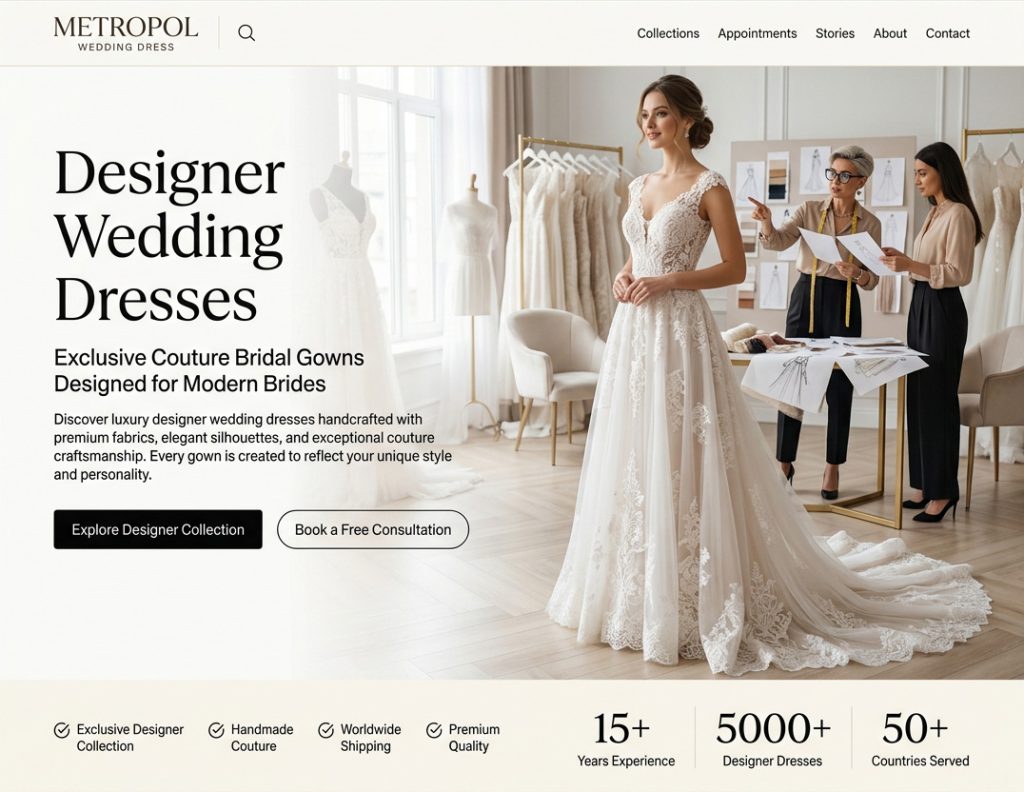
Metropol Wedding Dress (Izmir, Turkey atelier since 2004) specializes in high-quality custom and made-to-measure gowns with transparent production, premium materials, and accessible pricing that brings atelier-level craftsmanship within reach for international brides and boutiques.
The Real Cost of a Custom Designer Wedding Dress: What You Actually Pay For
Most articles list a single average and stop. That number is almost useless. The national average wedding dress sits around $2,100, yet custom work lives in a completely different economy. You are not buying a finished garment off a rack. You are commissioning a one-of-one object that must fit a specific body, express a specific vision, survive a specific day, and photograph under specific light.
Here is the transparent breakdown used by professional ateliers and manufacturers.
Cost Components (Realistic Mid-Tier Custom Gown, $4,000–$7,500 Range)
| Component | Typical Range | What It Covers | How It Moves the Price |
|---|---|---|---|
| Design & Pattern Development | $400–$1,500 | Sketches, body analysis, custom pattern drafting, 1–2 toiles | Higher for complex silhouettes or dramatic changes |
| Fabrics & Trims | $1,000–$4,000+ | Silk, French/Italian lace, tulle, lining, interfacing, buttons, crystals | Silk duchesse or Chantilly lace multiplies cost fast; yardage for trains and layers is the silent killer |
| Labor & Construction | $1,500–$5,000+ | Cutting, sewing, hand-beading, embroidery, internal structure (boning, cups, stays) | Handwork hours dominate; 80–200+ hours is common |
| Fittings & Adjustments | $300–$1,000 | 2–4 fittings, muslin/toile stages, final hemming | Included in most true custom packages; extra if major redesigns occur late |
| Overhead & Atelier Margin | 15–40% | Workspace, skilled staff, quality control, shipping, insurance | Lower with direct manufacturer models |
| Rush / Destination / Special Requests | +15–50% | Compressed timeline, heirloom integration, cultural modifications | Avoidable with 6–9 months lead time |
A simple bias-cut silk slip with clean lines can stay near the lower end. A multi-layer ballgown with hand-applied French lace, crystal scatters, and a cathedral train easily climbs past $10,000 even before couture markups.
Why “Custom” Is Not One Thing
Three distinct levels exist and are frequently confused:
- Made-to-Measure / Made-to-Order Existing designer pattern adjusted to your measurements. Most boutique “designer” gowns fall here. Cost: base price + modest sizing fee. Alterations still often needed.
- Customized Existing design with significant modifications (neckline, sleeves, train length, color, embellishment density). Cost: base + redesign fees.
- True Bespoke / Couture Custom Designed from scratch for your body and vision. New pattern, multiple toiles, full collaboration. This is the highest cost and the highest uniqueness.
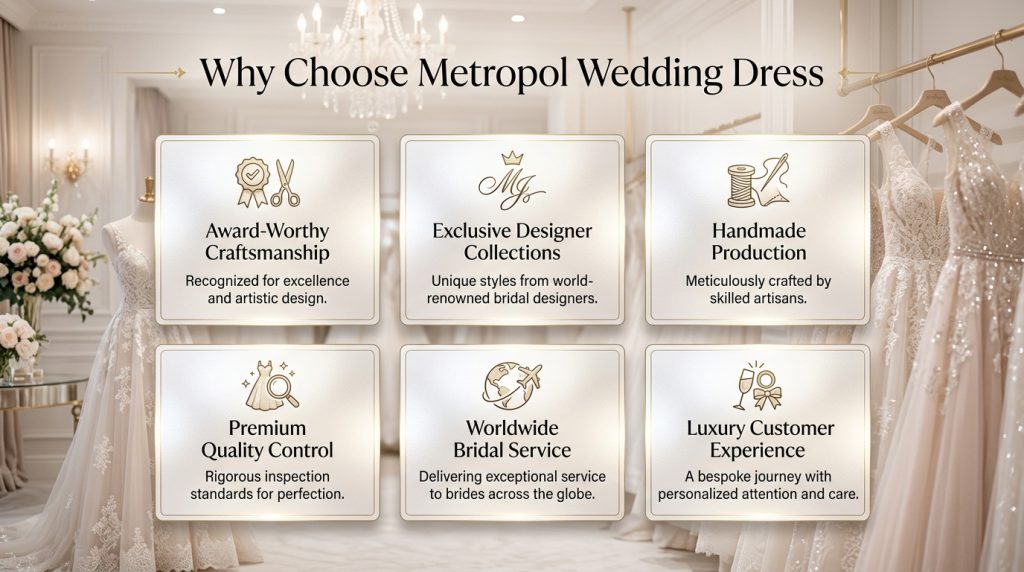
Metropol Wedding Dress operates primarily in the customized-to-bespoke range, offering full personalization of silhouette, fabric, lace placement, and detailing while maintaining efficient production in a 1,200 m² atelier. This model keeps prices accessible relative to Western couture houses while delivering comparable construction quality.
Material Reality Check
Fabric is the single largest controllable cost lever.
- Polyester satin or crepe: lowest
- Silk blends / quality mikado: mid
- Pure silk charmeuse, duchesse, or organza: high
- French or Italian Chantilly, Alençon, or Guipure lace: premium
- Hand-beaded appliqués or Swarovski/crystal work: labor explosion
A full skirt or train can require 12–20+ yards. Pattern matching on lace forces extra yardage. Lightweight destination-friendly fabrics (chiffon, soft tulle) reduce both material and shipping weight but change the structural engineering required.
Labor Geography Matters
Production location dramatically affects price without automatically affecting quality:
- High-cost Western ateliers (US, UK, Western Europe): highest labor rates, prestige premium
- Specialized Turkish, Eastern European, or carefully managed Asian ateliers: skilled labor at more competitive rates, allowing better fabric and handwork for the same budget
Metropol’s Izmir workshop combines traditional hand embroidery and mold-making expertise with modern quality control, producing both individual custom orders and wholesale collections. The result is atelier-level detail at price points that many brides find more realistic than pure Western couture.
Timeline and Hidden Costs
Ideal process: 6–9 months from first consultation to final delivery.
Compressed timelines (under 4–5 months) trigger rush fees and reduce the number of revision rounds. Late design changes after fabric is cut are expensive because both material and labor are already committed. Shipping, customs (for international orders), insurance, and final professional steaming/preservation should be budgeted separately.
Alterations on an off-the-rack gown frequently reach $800–$2,500. A properly fitted custom dress usually requires only minor final adjustments, often included.
Real-World Price Anchors (2025–2026)
- Accessible custom studios (direct-to-consumer or manufacturer models): $1,500–$5,500 (most brides land $2,000–$3,500)
- Established independent designers / mid-tier ateliers: $3,000–$9,000
- Luxury couture houses: $9,000–$25,000+ (and can exceed $50,000 for extreme handwork or rare materials)
- Metropol range (custom & high-quality made-to-measure): designed to deliver strong value within the accessible-to-mid designer bracket, with full personalization options
Prices have risen due to fabric inflation, skilled labor shortages, and (in some markets) tariffs on imported textiles. Planning 12–18 months out still yields the best combination of choice and cost control.
Decision Framework for the Bride (or the Boutique Buyer)
Ask these questions before committing:
- Is the quoted price all-inclusive (design, fabrics, labor, fittings, basic alterations)?
- How many toile/fitting stages are included?
- Who owns the pattern and remaining fabric?
- What is the revision policy after fabric is cut?
- What is the realistic delivery window relative to my wedding date?
- Can I see examples of finished gowns in similar complexity and fabric?
A transparent manufacturer or atelier will answer these clearly. Opacity is a red flag.
Value Perspective
The highest-cost gown is not automatically the best. The best custom dress is the one that fits your body perfectly, matches the emotion and practical demands of your day (movement, climate, photography, cultural requirements), and leaves you feeling completely yourself.
When fabric, construction, and fit are right, a well-made custom piece from a skilled atelier often outperforms a more expensive name-brand made-to-order gown that still needs heavy alterations. That is the quiet advantage of working directly with producers who control the full process from sketch to final stitch.
Metropol Wedding Dress positions itself precisely in this space: over two decades of experience, large-scale workshop capacity, full customization capability, and a focus on delivering high-quality results at realistic price points for both individual brides and international retailers.
If your priority is uniqueness, perfect fit, and intelligent spending rather than pure brand prestige, a thoughtful custom process remains one of the highest-value decisions in wedding planning.
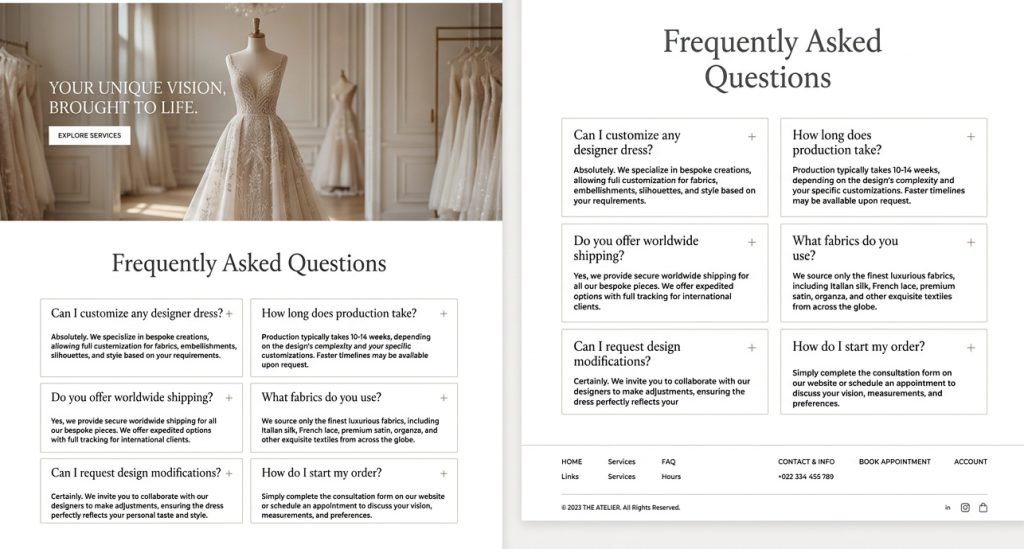
Frequently Asked Questions
1. How much does a truly custom wedding dress cost in 2026? Most range $2,500–$8,000. Entry accessible custom starts ~$1,500–$3,500. True couture begins around $9,000 and climbs with complexity.
2. Is custom always more expensive than a designer off-the-rack or made-to-order gown? Not necessarily. Once alterations ($500–$2,500+) are added to a ready-made designer gown, total cost often equals or exceeds a mid-tier custom piece that already fits.
3. What is the biggest cost driver? Fabric quality + yardage and handwork hours (beading, embroidery, lace application). Structure and train length follow closely.
4. How long does a custom wedding dress take? Ideal: 6–9 months. Minimum viable for quality work is usually 4–5 months with fewer revision rounds.
5. Do I need multiple fittings? Yes. Expect 2–4 stages: measurements/toile, first fabric fitting, second refinement, final check.
6. Can I use heirloom lace or fabric from a family dress? Yes, but it adds complexity and cost because vintage materials require extra handling and often reinforcement.
7. Are there hidden fees? Common ones: rush fees, major late design changes, international shipping/customs, extra fittings beyond the package, and specialized understructure. Always request an all-inclusive quote.
8. How much should I budget for alterations on a custom dress? Often minimal or included. Budget $100–$400 for final hem and minor tweaks if not covered.
9. Does location of the atelier affect quality? Skill and process matter more than geography. Specialized workshops in Turkey and similar regions produce excellent results at more accessible price points than high-cost Western cities.
10. What is the difference between made-to-measure and bespoke? Made-to-measure adjusts an existing pattern. Bespoke creates a new pattern and design from scratch for you.
11. Can I change the design after production starts? Minor adjustments yes; major changes after fabric is cut usually incur significant extra cost and time.
12. How much does fabric alone cost? $1,000–$4,000+ depending on type and quantity. Premium lace and pure silk are the highest.
13. Is a deposit required? Almost always 40–60% non-refundable to cover design, pattern, and fabric purchase.
14. Can custom dresses accommodate different body types and cultural requirements (e.g., hijab-friendly, modest styles)? Yes. True custom is ideal for non-standard proportions, modest coverage, convertible designs, or cultural color/silhouette needs.
15. What about destination weddings and lightweight fabrics? Lighter fabrics (chiffon, soft tulle, crepe) reduce cost and shipping weight but require different structural engineering for support and movement.
16. How do tariffs and import costs affect the final price? They can add 10–40% depending on origin and destination. Direct manufacturer relationships sometimes absorb or minimize this better than multi-layer retail chains.
17. Should I buy from a boutique or go direct to a manufacturer/atelier? Boutiques offer convenience and local fittings. Direct atelier or manufacturer models often deliver better value and more customization for the same budget.
18. What is a realistic budget if I want French lace and some hand-beading? Plan $4,000–$9,000 depending on overall complexity and production location.
19. Can I get a custom dress under $2,000? Possible with simpler silhouettes, carefully chosen fabrics, and efficient producers, but expect trade-offs in embellishment density or fabric prestige.
20. How do I protect myself from quality disappointment? Request process photos at each stage, see previous finished work of similar complexity, clarify fabric sources, and confirm the number of included fittings in writing.
21. Does a longer train significantly increase cost? Yes — more fabric, more construction time, more weight management in the design, and higher shipping/handling costs.
22. Are accessories (veil, overskirt, bolero) included? Rarely. They are usually priced separately but can be designed to match perfectly in a custom process.
23. What happens to leftover fabric? Often offered to the bride for keepsakes, alterations insurance, or small matching pieces. Clarify ownership upfront.
24. Is remote/custom long-distance collaboration realistic? Yes. Many modern ateliers use detailed measurement protocols, video fittings, and progressive photo approvals successfully.
25. How does Metropol Wedding Dress approach custom pricing and process? As a long-established Turkish manufacturer with full atelier capacity, Metropol focuses on transparent collaboration, high-quality materials, and efficient production that keeps custom work accessible while delivering detailed craftsmanship for both individual brides and wholesale partners.
26. Can I start with a sketch or Pinterest board? Yes. Most professional processes begin with visual references and then translate them into a wearable, body-specific design.
27. What is the risk of ordering too early or too late? Too early: possible weight or preference changes. Too late: limited revision rounds and higher stress/rush fees. 8–12 months is the sweet spot for most.
28. Do custom dresses photograph better? Often yes, because fit, proportion, and fabric choice can be optimized for the specific lighting, venue, and movement of the day.
29. Is preservation more expensive for custom gowns? Similar process, but intricate handwork or delicate lace may require specialized cleaning. Budget $200–$400.
30. Final practical advice? Decide your non-negotiables first (fit priority, specific fabric, silhouette, budget ceiling). Then choose the partner whose process and transparency match those priorities rather than chasing the highest price or biggest name.
A custom wedding dress is an investment in fit, identity, and the emotional experience of the day. When the process is clear and the craftsmanship solid, the number on the invoice becomes secondary to how the dress actually feels and performs.
A custom designer wedding dress is not a purchase—it is a collaborative creation process that turns a personal vision into a one-of-a-kind garment engineered for your body, your venue, and your story. At Metropol Wedding Dress, a Turkish bridal atelier established in 2004 with a 1,200-square-meter production facility in İzmir, this experience combines traditional handcraft with modern design flexibility.
Designer Wedding Dresses
Brides and boutiques gain full control over silhouette, fabric, lace, embellishment, and fit while receiving transparent updates and accessible luxury pricing that undercuts many Western couture houses. The result is a gown that fits perfectly, photographs exceptionally, and carries genuine provenance. This guide walks through every stage of that journey so you understand exactly what to expect, what drives cost and timeline, and how to avoid the most common pitfalls.
The Custom Designer Wedding Dress Experience: From Vision to Finished Gown
Most brides begin their search believing a wedding dress is something they will try on, select, and later alter. That model works for many. For others—those with non-standard proportions, strong aesthetic preferences, cultural requirements, or a desire for true originality—it falls short. A fully custom designer wedding dress removes the compromise. You do not adapt yourself to an existing pattern; the pattern is built around you.
Metropol Wedding Dress operates as both a retail atelier and a wholesale manufacturer. This dual identity shapes the client experience. Individual brides receive the same technical process used for boutique orders: design consultation, pattern development, fabric selection, toile (muslin mock-up), progressive construction with photo updates, and final fittings. The scale of the workshop allows consistent quality across one-off commissions and larger production runs without the extreme mark-ups common in pure haute-couture houses.
What “Custom” Actually Means in Practice
Custom work sits on a spectrum:
- Made-to-measure: An existing design is cut to your measurements. Limited design changes.
- Semi-custom: Mix-and-match elements (bodice from one style, skirt from another, added sleeves or train).
- Fully bespoke: Sketch-to-gown creation with original pattern drafting, fabric sourcing, and construction.
Metropol focuses on the upper end of this spectrum while keeping pricing in the accessible luxury range (historically referenced between roughly €300–€2,000 depending on complexity and materials). The process is collaborative rather than top-down. Clients approve the mold before sewing begins and receive visual updates at key stages, including lace application.
The Production Journey: Stage by Stage
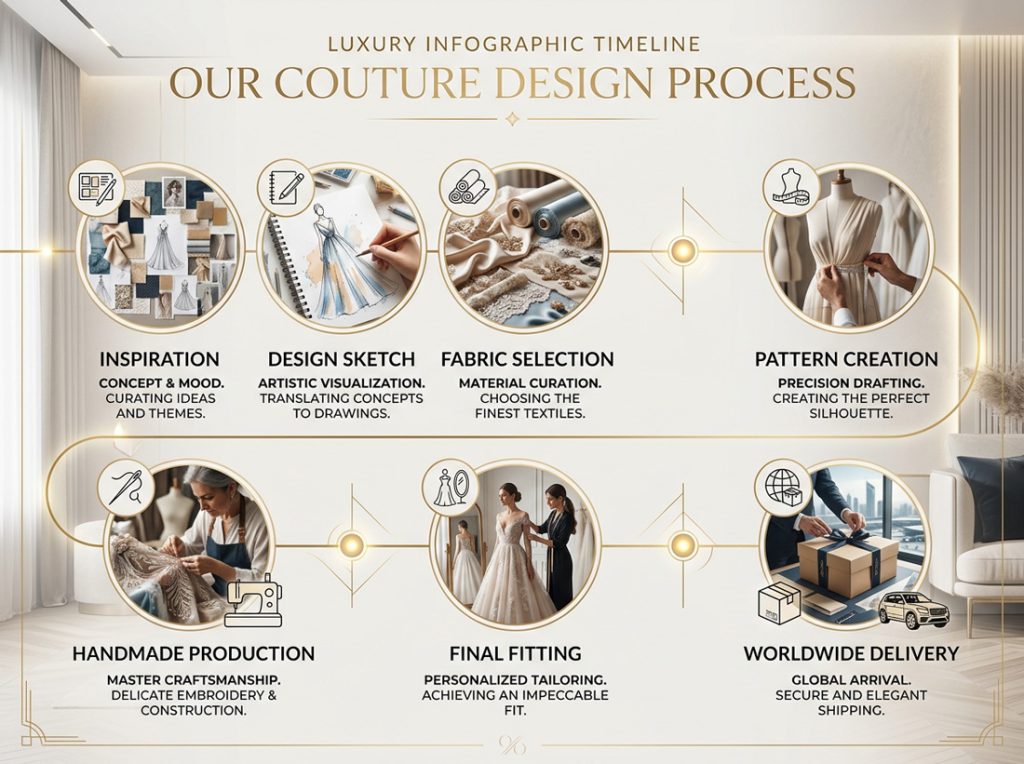
1. Initial Consultation and Vision Mapping Conversation covers wedding date, venue type (indoor formal, outdoor, destination, cultural ceremony), desired silhouette, level of structure or softness, color preference (ivory, pure white, soft blush, or non-traditional), and any non-negotiables (coverage for religious reasons, convertibility for reception, specific family heirloom elements). Inspiration images are useful but not required; many brides arrive with only a feeling (“I want to feel regal but still able to dance”).
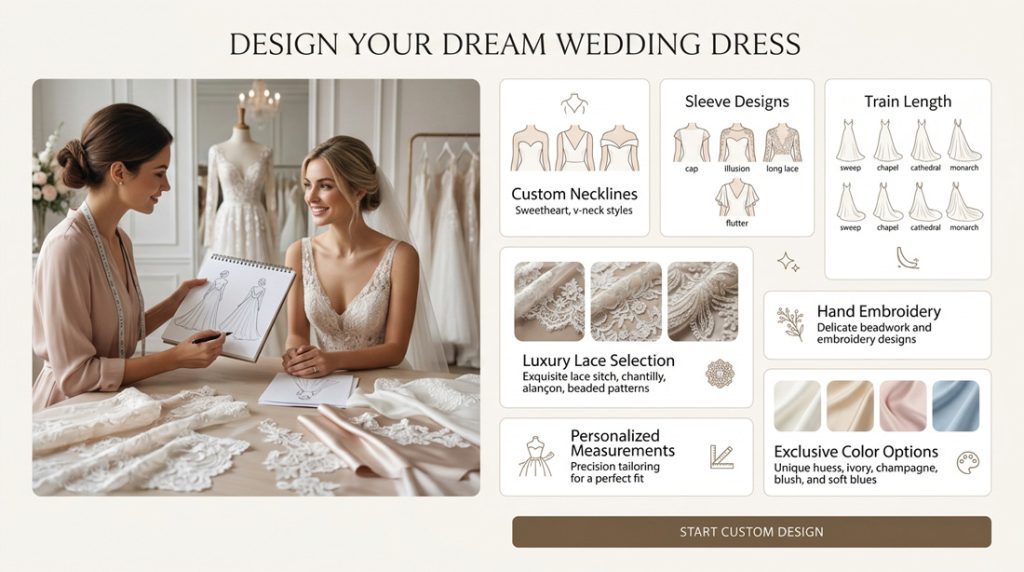
2. Design Development Sketches or digital concepts are produced. Decisions are locked on:
- Silhouette (A-line, mermaid/fit-and-flare, ball gown, column/sheath, drop-waist or basque, two-piece, transformer styles)
- Neckline and back detail
- Sleeve treatment or strap configuration
- Train length and bustle plan
- Embellishment density and placement
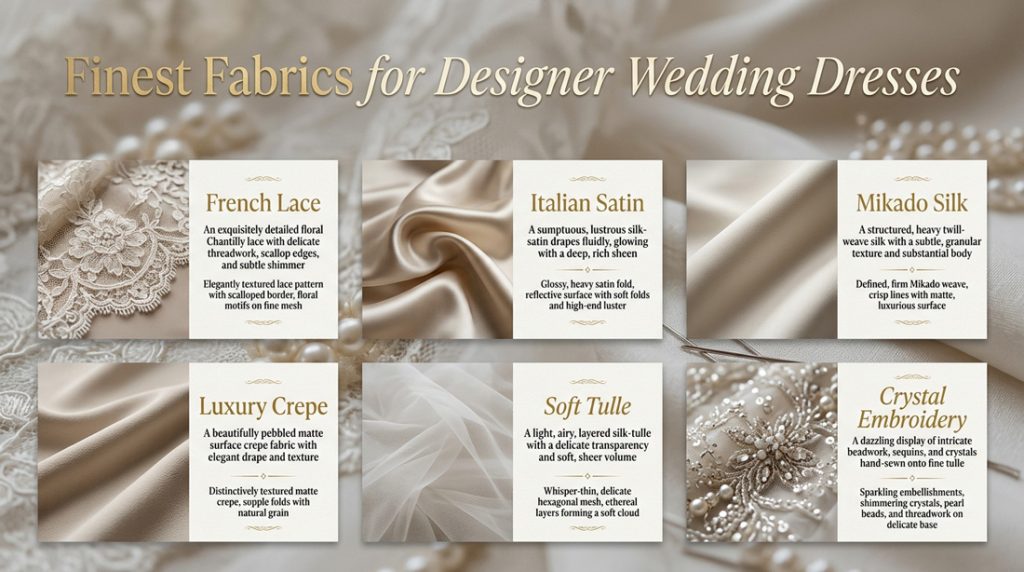
3. Fabric and Material Selection This stage determines both aesthetics and cost more than any other factor. Common high-quality options used in quality ateliers include:
| Fabric / Material | Typical Character | Best For | Relative Cost Impact |
|---|---|---|---|
| Duchess satin | Structured, luminous, holds shape | Formal ball gowns, structured bodices | High |
| Silk mikado / crepe | Matte to soft sheen, excellent drape | Modern columns, clean silhouettes | High–Very High |
| Fine French or Italian lace | Delicate, patterned, often with re-embroidered motifs | Overlays, sleeves, illusion panels | Very High |
| Tulle / soft netting | Lightweight volume, airy movement | Skirts, overskirts, sleeves | Medium |
| Chiffon / georgette | Fluid, soft, travel-friendly | Destination, outdoor, layered looks | Medium |
| Organza | Crisp yet lightweight | Structured yet airy volume | Medium–High |
Additional elements—hand-applied beading, 3D floral appliqués, pearl work, sequins, or crystal—add both visual impact and labor hours. Metropol’s workshop expertise in mold-making, embroidery, and weaving supports precise placement of these details.
4. Pattern Drafting and Toile Fitting A custom pattern is drafted from your measurements. A muslin or similar test garment is constructed so fit, balance, and proportion can be refined before expensive fashion fabric is cut. This is the technical heart of a true custom process and the primary reason custom gowns often require less final alteration than off-the-rack pieces.
“You may also want to take a look at this article.” Wholesale Wedding Dress Manufacturer
5. Construction and Progressive Updates Once the pattern is approved, fashion fabric is cut and the gown is built in stages. Clients typically receive photos after major milestones (bodice structure, lace application, skirt assembly). This transparency reduces anxiety for remote or international clients.
6. Final Fittings and Delivery Two to four fittings are standard depending on complexity and whether the client is local or working remotely. Final adjustments address hem (with the exact shoes), bustle functionality, comfort while sitting and moving, and any last micro-tweaks. Shipping is arranged with protective packaging; international clients should factor customs and possible duty into the total timeline.
Realistic Timeline Expectations
Fully bespoke work generally requires 6–12 months from confirmed design and deposit to finished gown, depending on complexity, fabric availability, and season. Peak bridal periods increase demand. Starting 9–12 months before the wedding date is the safest window for complex pieces. Simpler silhouettes or semi-custom modifications can move faster. Always build a buffer of 4–8 weeks after delivery for final local adjustments if needed.
Compared with many Western couture houses that start in the $9,000–$25,000+ range for true bespoke, Turkish atelier production frequently delivers comparable construction and material quality at a lower total investment. The difference often lies in overhead, brand premium, and labor cost structures rather than inherent quality. Metropol’s dual retail/wholesale model further supports competitive pricing while maintaining workshop standards.
Practical Checklist for Brides Considering Custom
Why Atelier-Scale Production Matters
A 1,200-square-meter workshop with specialized teams for pattern, embroidery, and finishing creates consistency that pure small studios sometimes struggle to maintain under volume, while still preserving the hand-finishing that factory-only production often lacks. Metropol’s history since 2004 and monthly capacity around 100 gowns indicates operational maturity useful for both individual commissions and wholesale partners.
The custom designer wedding dress experience succeeds when the bride feels heard, the technical process is transparent, and the final garment performs as beautifully in movement and photographs as it does on a hanger. That combination of artistry, engineering, and practical collaboration is the core of what a professional bridal atelier delivers.
Frequently Asked Questions
1. How is a fully custom wedding dress different from a made-to-order gown? Fully custom begins with original pattern drafting based on your measurements and design vision. Made-to-order usually starts from an existing pattern adjusted to size.
2. What is the typical starting price range for a custom designer wedding dress at an atelier like Metropol? Accessible luxury ranges often fall between several hundred and a few thousand euros depending on fabric, complexity, and embellishment, significantly below many Western couture starting points.
3. How long does the full custom process usually take? Most fully bespoke gowns require 6–12 months from design confirmation to completion. Simpler modifications can be faster.
4. Can I work with the atelier remotely if I live outside Turkey? Yes. Many international clients complete the process through detailed measurements, photo updates, video calls, and secure shipping.
5. What happens during a toile fitting? A test garment in inexpensive fabric is tried on so fit, proportion, and balance can be perfected before expensive fashion fabric is cut.
6. Which fabrics are most commonly used for high-quality custom bridal gowns? Duchess satin, silk mikado or crepe, fine lace (French/Italian), tulle, organza, and chiffon are frequent choices, selected for drape, structure, and occasion.
7. How many fittings should I expect? Typically two to four, depending on complexity and whether you are local or remote.
8. Can the dress include cultural or religious modifications? Yes. Coverage, hijab-compatible designs, specific color requirements, and modest adaptations are routinely accommodated.
9. What if my weight or measurements change during the process? Communicate early. Significant changes may require pattern adjustments or additional fittings; minor fluctuations are often absorbed in later stages.
10. Are plus-size custom gowns treated the same as standard sizes? Quality ateliers draft patterns to the individual body rather than grading up a standard size, which usually produces better balance and comfort.
11. Can I add a detachable overskirt or transformer elements? Yes. Convertible and multi-look designs are part of modern custom work.
12. How is lace applied in a custom gown? Hand placement and careful matching of motifs is standard for higher-quality work; machine methods may be used for certain effects.
13. What information should I prepare for the first consultation? Wedding date, venue type, preferred silhouette family, coverage needs, inspiration images, and approximate budget range.
14. Is a deposit required, and when is the balance due? Most ateliers require a deposit to begin design and material sourcing, with balance due at or near completion.
15. Can I incorporate family heirloom lace or fabric? Often possible if the material is stable and compatible; the atelier will assess condition and integration method.
16. How do I care for a custom wedding dress after the wedding? Professional cleaning and preservation is recommended. Follow the specific fabric care instructions provided.
17. What is the difference between A-line, mermaid, and ball-gown construction from a technical standpoint? A-line balances fitted bodice with gradual flare; mermaid is closely fitted through hip then flares; ball gown uses structured underlayers for maximum volume.
18. Can the atelier supply matching accessories or a veil? Many offer complementary pieces or can recommend compatible options.
19. How transparent is the production process for remote clients? Photo updates at key stages (after mold approval, lace application, major assembly) are a standard practice at collaborative ateliers.
20. What happens if I need a rush timeline? Rush production is sometimes possible for simpler designs but may limit material options or increase cost; complex handwork is difficult to accelerate without quality risk.
21. Are wholesale custom options available for boutiques? Yes. Metropol serves both individual brides and retail partners seeking exclusive or limited-run pieces.
22. How does Turkish bridal manufacturing compare in quality to European or American couture? Top Turkish ateliers combine skilled handcraft, access to quality European and Asian fabrics, and efficient production systems, often delivering comparable construction at lower overall cost.
23. What should I bring to fittings? The exact shoes, undergarments, and shapewear planned for the wedding day, plus any accessories that attach to the gown.
24. Can the design be changed after the toile is approved? Minor refinements are usually possible; major silhouette or fabric changes after fashion fabric is cut become expensive or impossible.
25. Is the custom process suitable for second marriages or non-traditional ceremonies? Yes. The same technical process adapts to any aesthetic and practical requirements.
26. How important is the bustle design? Critical for train management. It should be planned early and tested at fittings so the dress functions on the day.
27. What role does corsetry or internal structure play? It provides support, shapes the silhouette, and improves comfort and longevity of the fit, especially for strapless or heavy embellished styles.
28. Can I see fabric swatches before deciding? Most ateliers provide or ship swatches so texture, weight, and color can be evaluated in person.
29. How are international shipping and customs handled? The atelier typically arranges secure packaging and shipping; the client is responsible for any import duties or taxes in the destination country.
30. What makes a custom dress “worth it” compared with a high-end ready-to-wear gown? Superior fit to the individual body, original design, reduced need for extensive alterations, and the emotional value of a garment created specifically for one person and one day.
For brides ready to begin, the most effective next step is a detailed conversation about date, vision, and practical constraints. That single discussion usually reveals whether a fully custom path is the right investment and what the realistic parameters will be.
Choosing a custom dress maker is the single most consequential decision in creating a truly original wedding gown. Unlike buying a finished sample and altering it, working with a professional maker means partnering with a team that drafts patterns, sources materials, builds structure, and finishes by hand or precision machine to your exact body and design brief. Metropol Wedding Dress, based in İzmir, Turkey, has operated as a full-scale custom and wholesale bridal maker since 2004 inside a 1,200-square-meter atelier. This guide examines what separates a reliable custom dress maker from a basic alteration service, how production actually flows inside a serious workshop, which material and construction decisions drive quality and cost, and how brides and boutique buyers can evaluate a maker before committing.
“You may also want to take a look at this article.” Bespoke Wedding Dresses
A custom dress maker is not a seamstress who adjusts an existing gown. A true maker owns the entire technical chain: body analysis, original pattern engineering, fabric behavior prediction, internal architecture, surface embellishment strategy, and final wear-testing. The difference appears in the finished garment’s balance, longevity, comfort under movement, and ability to hold its intended silhouette for hours.
Metropol functions as both an individual-order custom maker and a wholesale production house. That dual role forces a higher standard of repeatability and documentation than a pure one-off atelier can usually sustain. Every commission, whether a single bride’s gown or a boutique’s limited run, passes through the same controlled stages.
How a Serious Maker Structures the Technical Process
Stage 1 – Body and Design Intake Measurements are taken or verified with a standardized method. The maker records not only circumference but posture tendencies, shoulder slope, bust apex position, hip-to-waist relationship, and preferred ease. Design parameters are locked: silhouette family, coverage requirements, train weight, convertibility needs, and any cultural constraints.
Stage 2 – Pattern Engineering An original paper or digital pattern is drafted. This is the intellectual core of custom work. Grading an existing commercial pattern is not the same process. True custom pattern work accounts for fabric stretch or non-stretch behavior, seam allowance strategy for later adjustment, and internal support placement.
Stage 3 – Material Selection and Testing Fabric is not chosen by appearance alone. The maker evaluates:
- Drape coefficient
- Recovery after compression
- Opacity under different lighting
- Compatibility with lining and interfacing
- Behavior under beading or lace application
Stage 4 – Toile (Muslin Prototype) A full or partial mock-up is constructed in inexpensive fabric. Fit, proportion, and movement are tested. Adjustments are marked and transferred back to the master pattern before any fashion fabric is cut. Skipping or rushing this stage is the most common source of later disappointment.
Stage 5 – Cutting and Construction Fashion fabric is laid, matched (especially critical with patterned lace), and cut. Construction proceeds in controlled sequence: internal structure first (boning channels, corsetry, stay stitching), then outer shell, then surface work. Photo documentation at key milestones is standard for remote clients.
Stage 6 – Embellishment and Finishing Hand or precision-machine lace application, beading, pearl work, and final pressing occur only after the shell fits correctly. Premature embellishment locks in errors.
Stage 7 – Final Fitting and Wear Validation The completed gown is tried with the exact shoes, undergarments, and planned accessories. Sitting, walking, arm movement, and bustle function are checked. Only then is the piece released.
Material Decisions That Separate Competent Makers from Average Ones
| Decision Point | Lower-Quality Approach | Professional Maker Approach | Long-Term Effect on Gown |
|---|---|---|---|
| Bodice structure | Soft interfacing only | Structured corsetry or boning channels matched to body | Maintains shape through heat and movement |
| Lace application | Machine-stitched over raw edges | Hand-applied with motif matching at seams | Cleaner finish, no bulk, better drape |
| Seam finishes | Overlocked only | French seams or bound seams in visible areas | Comfort against skin, durability |
| Lining choice | Cheap polyester | Breathable, color-matched, appropriate weight | Temperature regulation, opacity |
| Hem construction | Single fold | Horsehair or weighted hem where needed | Clean hang, controlled movement |
| Train attachment | Simple gathering | Engineered weight distribution and bustle points | Functional on the day |
Metropol’s workshop scale allows consistent access to quality European and specialized Asian fabrics while maintaining the hand-finishing capacity that pure factory production often abandons.
When a quote appears unusually low, one of these four is almost always under-resourced. Conversely, extreme premiums in some Western markets often reflect brand positioning and retail rent more than incremental construction quality.
Evaluation Criteria for Selecting a Custom Dress Maker
Metropol’s 1,200-square-meter facility and roughly 100-gown monthly capacity provide measurable operational maturity that smaller studios cannot always match when volume or complexity rises.
“You may also want to take a look at this article.” Bridal Atelier
Country and Supply-Chain Considerations
Turkish bridal manufacturing has developed a particular combination of skills: strong pattern tradition, access to both European specialty fabrics and competitive labor structures, and experience exporting to European, Middle Eastern, and broader markets. For buyers outside Turkey this creates an advantageous middle position—higher technical control than pure low-cost mass production, lower overhead than many Western couture houses. Import formalities, shipping protection, and communication protocols become part of the maker’s service offering rather than an afterthought.
Maintenance Reality After Delivery
A professionally made custom gown still requires correct care. The maker should supply specific cleaning and storage instructions based on the actual materials used. Improper steaming, hanging, or cleaning can reverse months of careful construction. Professional preservation after the wedding remains the standard recommendation for long-term archival quality.
The relationship with a custom dress maker succeeds when both parties treat the project as engineered collaboration rather than simple order fulfillment. Clear technical communication, realistic timelines, and respect for material and labor constraints produce gowns that perform on the day and hold their integrity afterward. Metropol’s dual identity as custom atelier and wholesale producer is built around that operational discipline.
Frequently Asked Questions
1. What is the core difference between a custom dress maker and a bridal alteration specialist? A custom maker creates the original pattern and constructs the entire garment. An alteration specialist modifies an already finished dress.
2. Why does a professional maker insist on a toile stage? The toile reveals fit and proportion problems while corrections are still inexpensive. Skipping it transfers risk into expensive fashion fabric.
3. How does workshop size affect the quality of a custom commission? Larger specialized workshops can maintain dedicated teams for pattern, embroidery, and finishing, producing more consistent results across complex orders.
4. Can a maker working primarily in wholesale still deliver true one-off custom work? Yes, provided the same technical process and quality controls are applied to individual commissions.
5. What measurement data does a serious maker require beyond basic circumferences? Shoulder slope, bust apex position, posture notes, preferred ease, and any asymmetry information.
6. How do makers evaluate whether a requested design is structurally feasible? They assess fabric behavior, weight distribution, support requirements, and movement needs against the proposed silhouette.
7. What is the risk of approving a design sketch without fabric testing? Sketches do not show drape, opacity, or recovery. Fabric testing prevents later disappointment.
8. How should remote clients be measured? Through a standardized guide, video verification, or local professional measurement with maker-supplied protocol.
9. Why do some custom quotes vary so widely for similar-looking designs? Differences in pattern originality, fabric grade, internal structure, handwork density, and overhead allocation.
10. What does progressive photo documentation actually include? Typically mold approval, lace or embellishment application stages, and major assembly checkpoints.
11. Can a maker incorporate client-supplied heirloom lace or fabric? Only after technical assessment of condition, compatibility, and integration method.
12. How does a maker decide between hand and machine lace application? By the complexity of motif matching, desired finish, and fabric delicacy.
13. What internal structures are non-negotiable for certain silhouettes? Boning or corsetry for strapless and heavy-skirt styles; proper stay-stitching and seam reinforcement for fitted mermaid cuts.
14. How long after final fitting should a custom gown be delivered? Ideally with enough buffer for any last micro-adjustments and safe shipping, usually measured in weeks rather than days.
15. What written policies protect both maker and client? Design-change cut-off points, revision fees, measurement responsibility, and shipping/customs allocation.
16. Is wholesale production capability a positive or negative signal for individual custom work? Positive when it demonstrates process discipline and material access; negative only if individual commissions are treated as lower priority.
17. How should a boutique buyer evaluate a custom dress maker for exclusive inventory? By examining pattern originality, limited-run capacity, photo documentation standards, and ability to protect exclusivity in specific markets.
18. What fabric behaviors must a maker predict correctly? Stretch or recovery, opacity, weight under embellishment, and response to heat and humidity.
19. Why do some gowns lose shape during the wedding day? Inadequate internal structure, incorrect ease, or fabric chosen purely for appearance without performance testing.
20. How does a maker handle last-minute weight changes? Through communication protocols and, when possible, built-in adjustment allowances in the pattern.
21. What is the practical difference between French seams and overlocked seams in bridal work? French seams enclose raw edges for comfort and durability in visible or skin-contact areas.
22. Can a custom maker engineer a fully convertible gown (ceremony to reception)? Yes, when detachable elements are designed as part of the original structural system rather than added later.
23. How important is the maker’s experience with specific cultural or modest styles? Critical for correct coverage, proportion, and fabric choices that respect both aesthetics and requirements.
24. What should be included in the final care instructions? Cleaning method, steaming limits, storage recommendations, and any material-specific warnings.
25. How does a maker protect intellectual property on original designs for wholesale clients? Through limited distribution, market exclusivity agreements, and controlled photography rights.
26. Why might a maker refuse a design request? Structural impossibility with chosen fabric, timeline incompatibility with quality standards, or ethical/cultural concerns.
27. What role does pressing and final finishing play in perceived quality? Professional pressing sets the silhouette and reveals any remaining construction issues before the gown leaves the workshop.
28. How can a bride or buyer verify a maker’s claimed capacity? By asking for facility details, team specialization, and realistic monthly output figures rather than marketing claims alone.
29. What is the most reliable early indicator of a competent custom dress maker? Willingness to discuss technical constraints openly and to require a toile stage as standard practice.
30. When is working with a full custom maker clearly the better investment than altering a ready-made gown? When the body, design vision, or performance requirements cannot be satisfied by modifying an existing pattern and construction.
Designer Wedding Dresses: What the Word Should Actually Mean — Metropol Wedding Dress
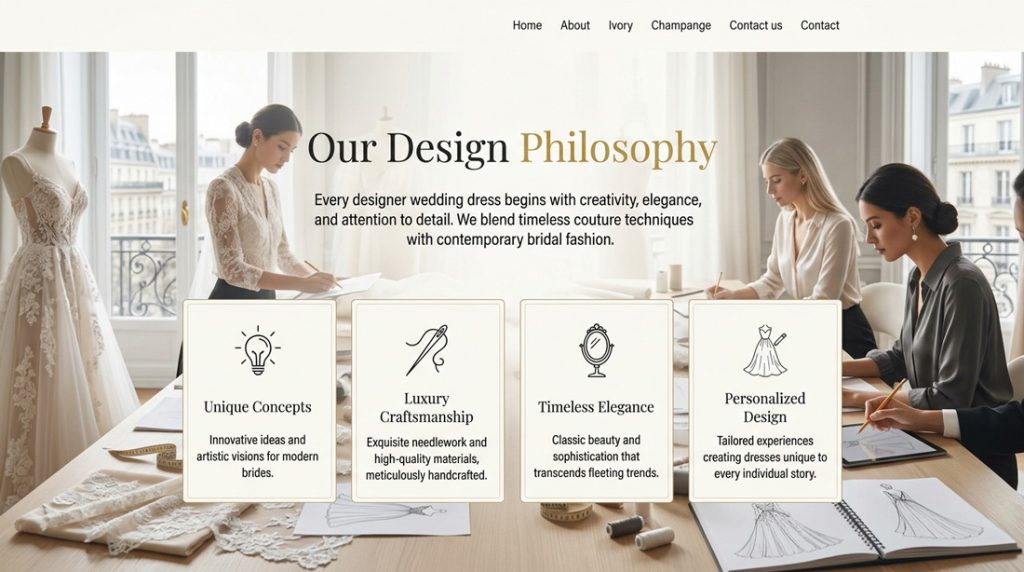
The phrase “designer wedding dress” appears everywhere. It is printed on salon windows, used in social media captions, and attached to gowns that range from thoughtfully made to simply expensive. For many brides the term has become vague, almost decorative. At Metropol Wedding Dress we treat it differently. A designer wedding dress is not defined by a logo or a price tag. It is defined by the presence of design decisions that were made deliberately, for a specific woman and a specific day.
This article explores what that standard looks like in practice, why it matters, and how the process of working with a designer differs from selecting a finished gown off a rail.
Beyond the Label: What Makes a Dress “Designer”
In its strongest sense, a designer wedding dress begins with an idea rather than a production schedule. Someone has considered proportion, balance, fabric behaviour, and how the garment will live on a real body over many hours. The neckline is not copied from last season’s bestseller. The placement of volume is not automatic. The internal structure is planned so the dress supports the wearer instead of relying on her to hold it up.
This kind of work requires time and judgement. It also requires the willingness to say no to details that look impressive in isolation but weaken the overall design. True designer work is often quieter than people expect. The most successful dresses do not announce their effort. They simply look inevitable on the person wearing them.
At Metropol we measure our work against that standard. Every gown, whether fully original or developed from an existing silhouette, is treated as a design problem to be solved rather than a product to be sold.
The Difference Brides Notice
Brides who have spent time in conventional bridal stores often describe the same turning point. They have tried excellent dresses. The construction is competent. The fabrics are attractive. Yet something remains unresolved — a slight imbalance in the shoulders, a waistline that sits in the wrong place, a skirt that fights the body instead of moving with it. These are rarely failures of sewing. They are failures of design applied to the individual.
A designer process addresses those issues at the source. Measurements are taken not simply to choose a size, but to understand proportion. Sketches or adjustments are evaluated for how they will behave in movement and in the actual light of the venue. Fabric is chosen for its character as much as its appearance. The result is a dress that feels resolved rather than adjusted.
Many brides are surprised by how much calmer the experience becomes once the dress is no longer fighting their shape. Confidence in this context is less about drama and more about the absence of distraction.
How Design Work Unfolds at Metropol Wedding Dress
Our process is deliberately unhurried. It begins with conversation rather than inventory. We want to understand the wedding itself: the setting, the season, the expected rhythm of the day, and the way the bride wants to feel. Some arrive with clear visual references. Others bring only a sense of what they do not want. Both are useful starting points.
From there the design work begins. For original commissions we develop the silhouette, the proportions, and the key details in dialogue with the bride. For designs based on existing foundations we examine which elements should remain and which should shift so the dress serves the individual more accurately. In both cases the same questions apply: Does this choice strengthen the overall idea? Will it hold up over the length of the day? Does it respect the body it is being made for?
A toile is frequently used. Seeing the design in three dimensions on the actual body reveals what drawings cannot. Adjustments made at this stage are precise and relatively low-cost. Once the direction is confirmed, the final materials are cut and the dress is built with the same attention to internal structure as to external appearance.
Fittings continue as the gown takes shape. Each one is an opportunity to refine balance, ease, and the quiet details that determine whether a dress feels secure or merely decorative.
Materials and the Discipline of Restraint
Designer work is inseparable from material choice. We select fabrics for how they behave — how they catch light, how they move, how they feel after hours of wear — rather than for trend value alone. High-quality silks, crepes, mikados and laces are chosen with the specific dress and the specific bride in mind.
Restraint is part of the discipline. It is easy to add. It is harder to stop at the point where the design is complete. The most successful gowns often look simpler than the effort required to make them. That simplicity is rarely accidental.
Who Chooses This Route
The brides who commission designer work from us are not a single type. Some want a fully original gown. Others want a strong existing design refined until it feels personal. What they share is a reluctance to accept a near-miss. They are willing to invest time and resources in a process that treats the dress as a designed object rather than a commodity.
They also tend to value longevity of feeling. A dress that was carefully considered is more likely to be remembered with clarity rather than with the faint sense that something was never quite right.
Practical Realities
Designer work requires realistic timelines. Fully original commissions benefit from nine to fourteen months. Refined or personalised designs can sometimes move more quickly, depending on complexity. Clear communication about budget and priorities at the outset prevents later friction. We provide transparent information about what is involved and what the investment covers.
The cost reflects time, skill, and materials. It also reflects the absence of compromise on fit and design integrity. Many brides find that the alternative — purchasing a standard dress and then attempting to alter it into something suitable — often costs more in both money and disappointment than expected.
A Standard Worth Keeping
The word “designer” has been stretched. At Metropol Wedding Dress we prefer to keep it exact. A designer wedding dress is one in which every visible and structural decision has been made with intention, for a particular woman and a particular occasion. The finished gown should feel less like a purchase and more like a conclusion — the point at which the questions about fit, proportion and character have been answered.
If that standard matches what you are looking for, we would be glad to begin the conversation. The work is detailed, the process is collaborative, and the result is a dress that could only have been made for you.
Metropol Wedding Dress Designer wedding dresses, considered from the first decision to the final fitting.