
Made to Measure Wedding Dresses
Made to Measure Wedding Dresses are built from your actual body measurements using an existing design framework that is adjusted for proportion, posture, and silhouette before cutting begins. Unlike off-the-rack dresses that rely on post-purchase alterations or fully bespoke pieces created from a blank pattern, made-to-measure delivers a significantly better starting fit, consistent color and fabric across a bridal party, and lower total cost once alterations are factored in.
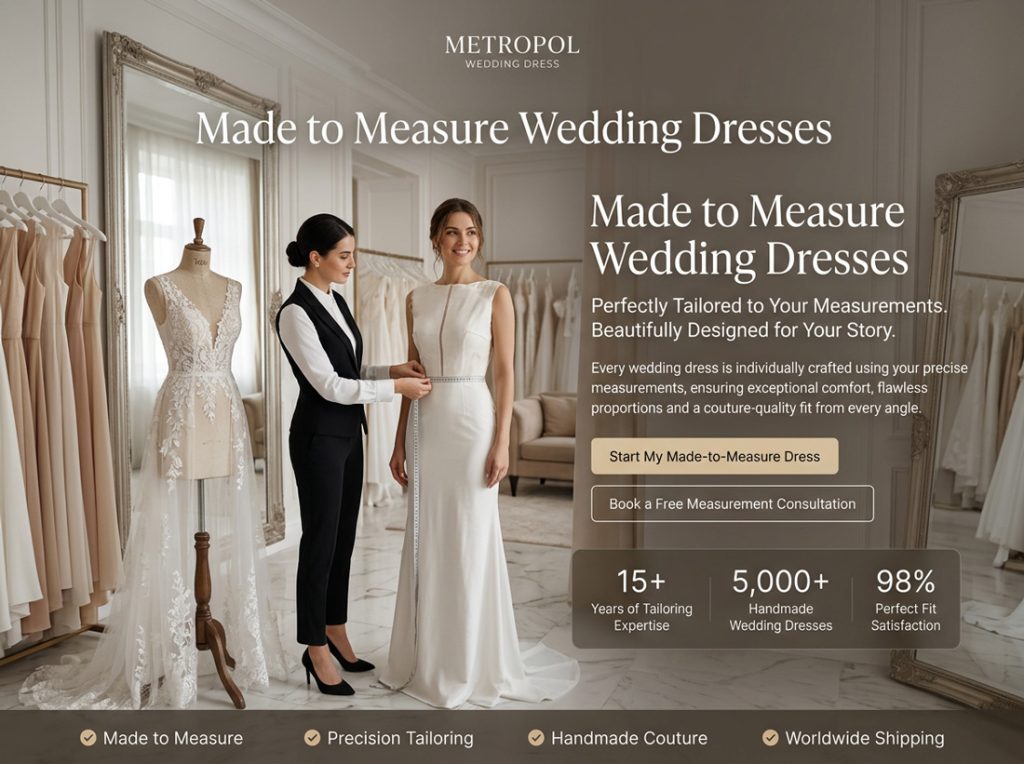
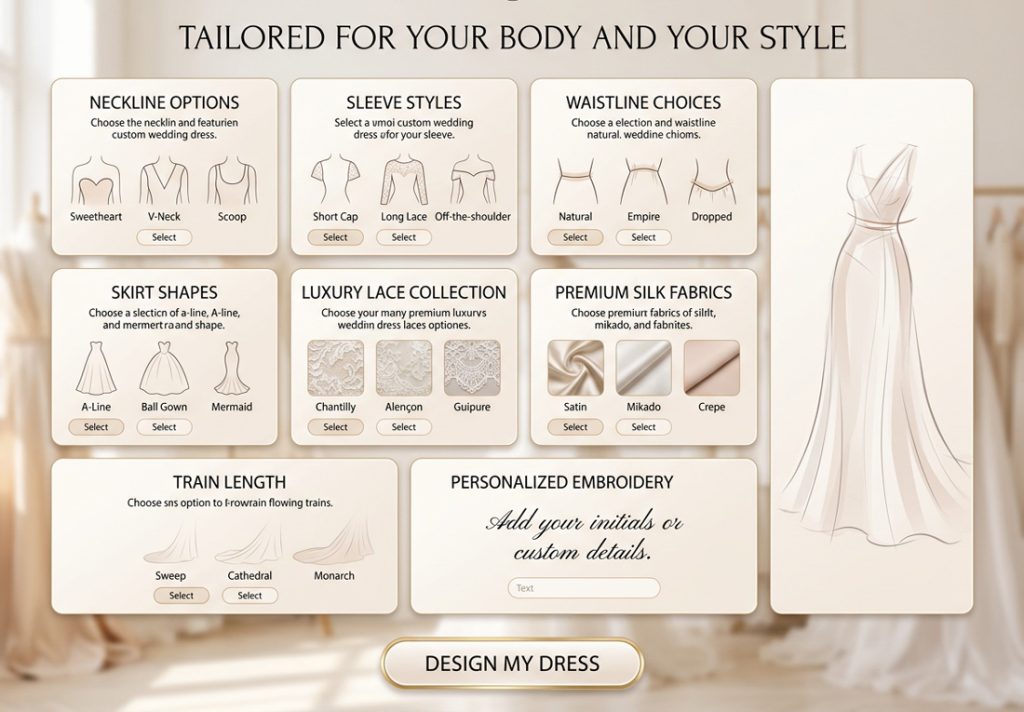
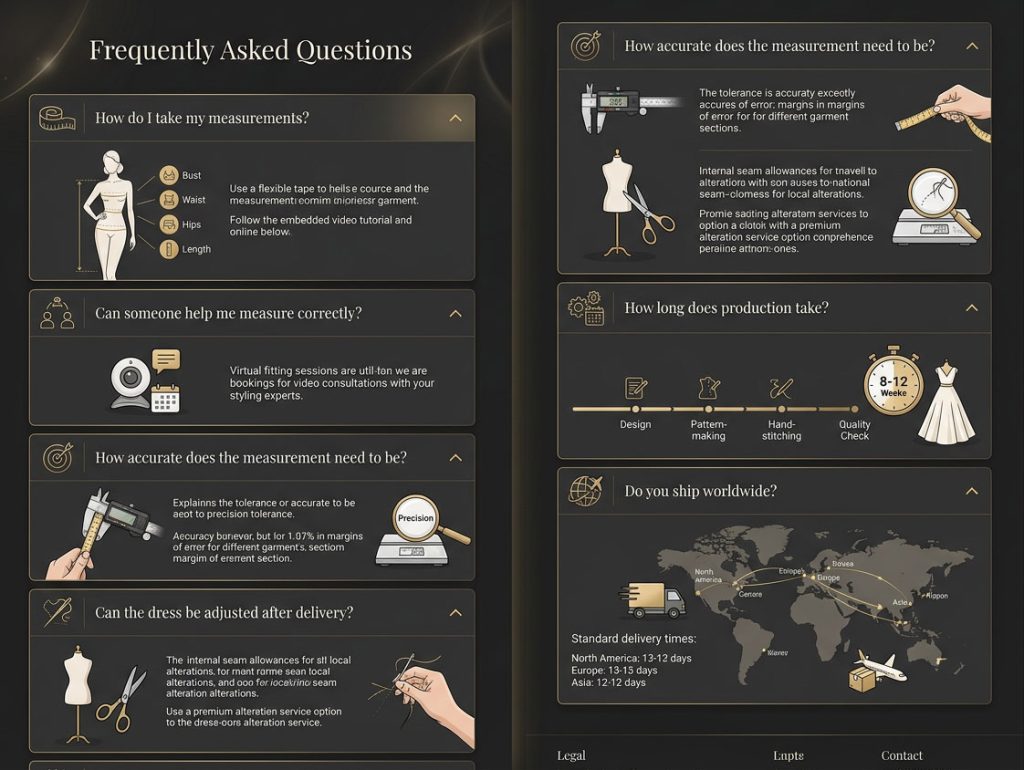
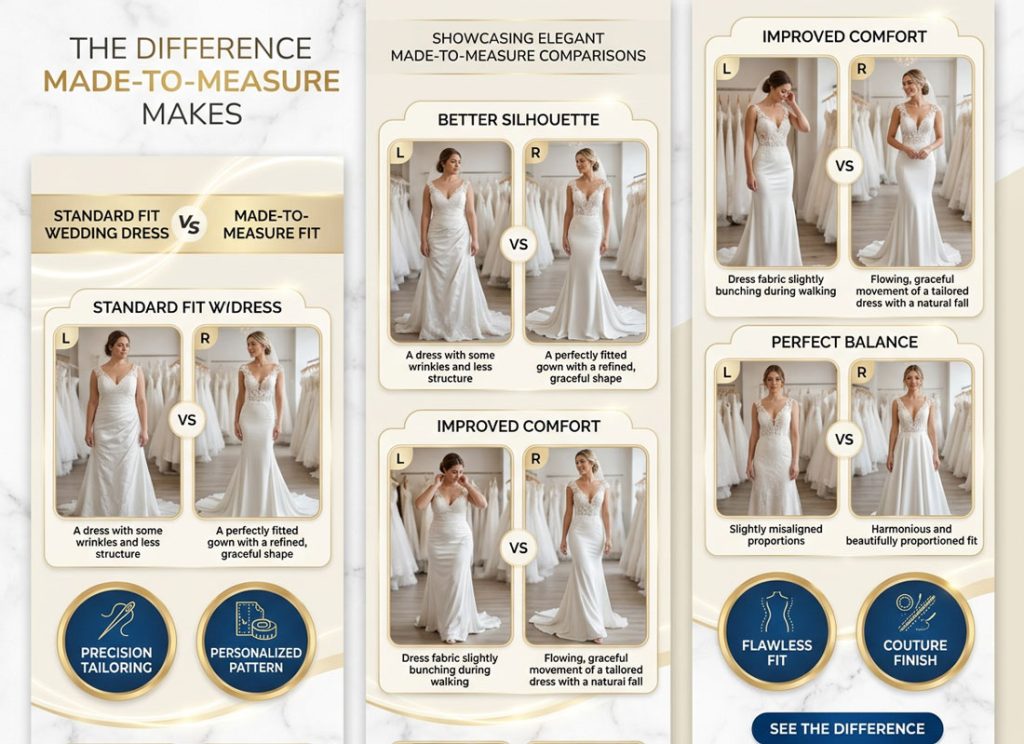
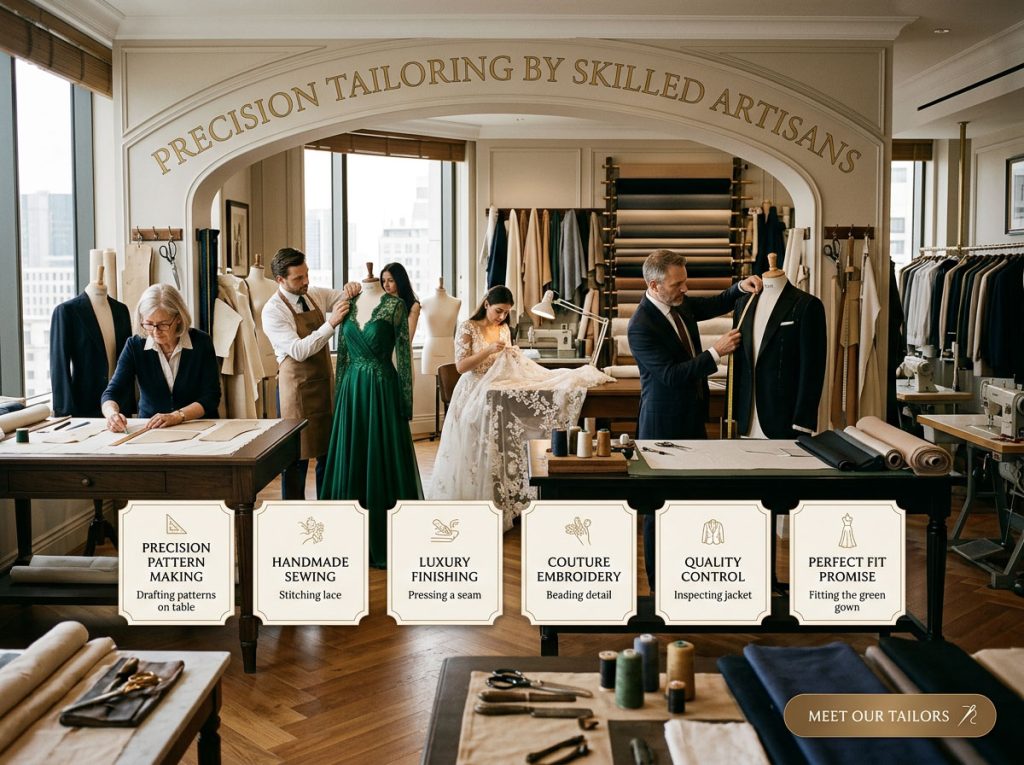
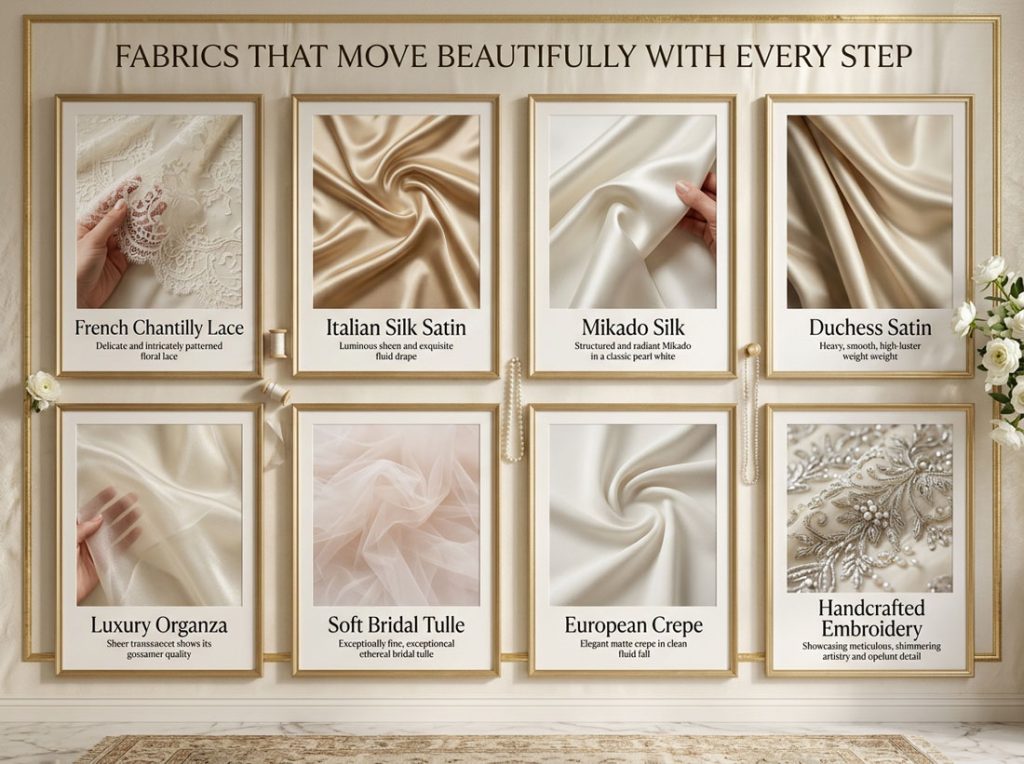
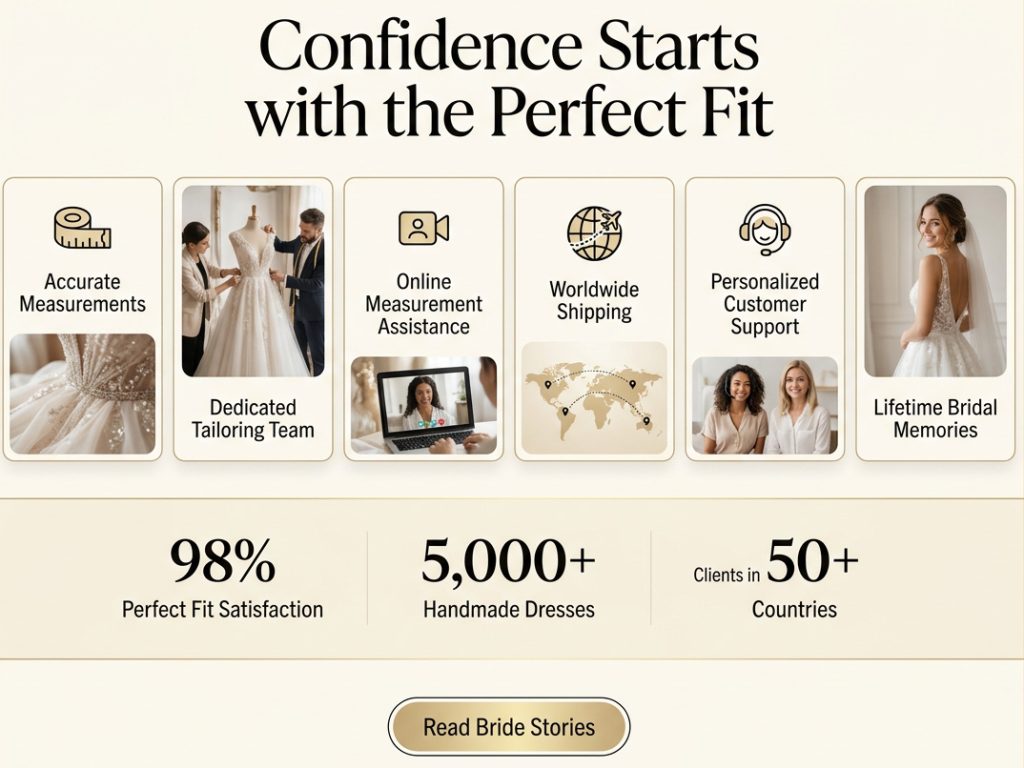
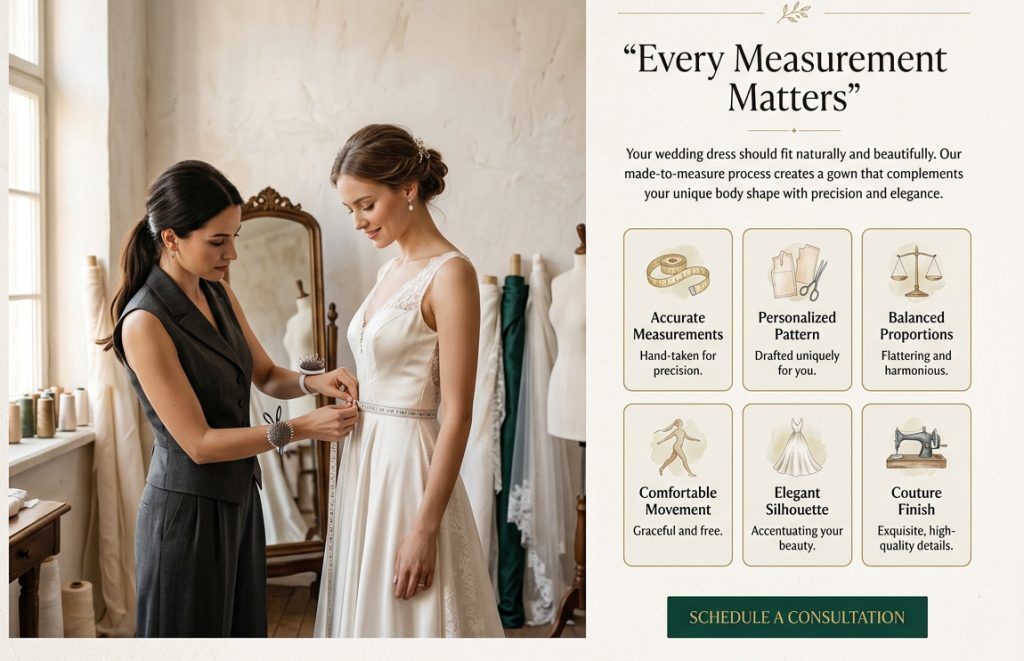
For Metropol Wedding Dress, this process combines precise measurement protocols, premium fabric selection, staged production with photo updates, and multiple fittings so every bride and every bridesmaid receives a gown that looks intentional rather than compromised. The result is cohesive wedding-party aesthetics without forcing identical bodies into identical sizes, realistic timelines of several months, and transparent pricing that often undercuts traditional couture while exceeding ready-to-wear quality.
The Decision Framework: Why Made-to-Measure Changes the Bridal Party Equation
Most wedding planning conversations treat the bride’s gown and the bridesmaid dresses as separate problems. One is emotional and high-stakes; the other is logistical and budget-constrained. Made-to-measure collapses that separation. It treats the entire party as a coordinated system of individual bodies that must still photograph as a unified visual story.
When a bridal party of five or six women ranges from petite to tall, athletic to curvy, the standard size chart fails. One dress will gap at the bust, another will pull across the hips, a third will require expensive hemming that still leaves the waist uneven. Made-to-measure removes the compromise by starting with each person’s measurements and adjusting the base pattern accordingly. The design language stays consistent—same neckline family, same fabric, same level of embellishment—while the structure adapts.
Metropol operates from a production facility designed for this hybrid model. Clients choose or refine a silhouette, select fabric and details, submit measurements (or attend in-person fittings), and receive a garment constructed to those numbers rather than the nearest standard size. Progress photos and staged approvals keep remote clients informed. The outcome is a bridal party that looks intentionally styled rather than forced into uniformity.
Core Technical Distinctions That Matter in Practice
| Approach | Pattern Origin | Fit Starting Point | Design Flexibility | Typical Lead Time | Alteration Load After Delivery | Best Use Case |
|---|---|---|---|---|---|---|
| Off-the-rack / Ready-to-wear | Fixed standard sizes | Closest size + heavy alterations | Limited to what is in stock | Immediate to weeks | High (often $150–400+ per dress) | Last-minute needs |
| Made-to-order | Existing design, standard size | Standard size ordered | Color, some fabric options | 4–12 weeks | Moderate | Consistent color across party |
| Made-to-measure | Existing design adjusted to measurements | Individual measurements from the start | Silhouette tweaks, fabric, details | 3–6+ months | Low to minimal | Fit precision + party cohesion |
| Fully bespoke / Couture | New pattern drafted from scratch | Complete custom drafting | Unlimited | 6–12+ months | Very low | Unique artistic vision |
Made-to-measure sits in the practical middle. It avoids the waste and disappointment of forcing bodies into fixed sizes while remaining more accessible in both time and cost than pure couture. For bridesmaid groups this is especially valuable: the same design language can be scaled across different heights, bust-to-waist ratios, and postures without each woman needing a completely original pattern.
How the Metropol Made-to-Measure Process Actually Works
- Vision and design alignment Consultation (in person, video, or detailed written brief) clarifies silhouette preferences, neckline, sleeve options, train length if any, fabric mood, and level of embellishment. Bridesmaids can share individual comfort priorities—mobility for dancing, coverage preferences, climate considerations—so the final design accommodates the group without sacrificing the bride’s overall aesthetic.
- Measurement protocol Precise measurements are taken or submitted using a clear guide. Key points typically include bust, under-bust, waist, high hip, low hip, hollow-to-hem, shoulder width, arm circumference, and posture notes. For remote clients, a local tailor or careful self-measurement with a helper is used. Metropol’s team reviews the numbers for consistency before cutting.
- Pattern adjustment and fabric selection The base pattern is modified for the individual measurements. Fabric is chosen from premium options—silks, satins, chiffons, laces, tulles—with attention to drape, opacity, and how the material will behave on different body types. Color matching across the party is controlled because all garments are produced in the same dye lot and production run.
- Construction with staged checkpoints Cutting, assembly, and detailing proceed with photo updates at key stages. Clients can request adjustments before irreversible steps such as final beading or lace application.
- Fittings and refinement Multiple fittings (or virtual equivalents with detailed feedback) refine balance, support, movement, and length. Because the garment began closer to the correct proportions, the remaining changes are usually fine-tuning rather than major reconstruction.
- Final delivery and care guidance The finished dresses arrive ready for the last minor adjustments if needed, accompanied by care instructions suited to the specific fabrics and construction.
This sequence reduces the common panic of discovering major fit problems only weeks before the wedding.
Material Reality Check: What Fabrics Actually Do on Different Bodies
Fabric choice is not merely aesthetic. It determines how the dress moves, photographs, and feels after hours of wear.
- Structured satins and mikados hold clean lines and support structured bodices well but can feel less forgiving in heat or for very active dancing.
- Soft chiffons and georgettes drape beautifully and move with the body; they are more forgiving of slight measurement variations but require careful underlining for opacity and support.
- Lace overlays add visual interest and can be engineered for coverage or openness depending on placement. Hand-applied lace and embroidery increase labor time and cost but create the dimension that photographs exceptionally well.
- Stretch elements or strategic lining improve comfort for longer receptions without sacrificing the formal appearance.
Metropol sources materials selected for both beauty and performance under real wedding conditions—outdoor ceremonies, air-conditioned venues, travel, and extended wear. For bridesmaid groups, matching fabric across all dresses eliminates the common problem of one person’s dress looking slightly different in color or sheen under the same lighting.
The hidden cost of the cheaper route is cumulative alterations across a bridal party, potential color mismatches, and the emotional cost of dresses that never quite feel right. Made-to-measure front-loads the precision work so the final outlay is more predictable and the result more reliable.
Transparent conversation at the consultation stage prevents mid-process surprises.
Real-World Scenarios Where Made-to-Measure Solves Specific Problems
Scenario 1 – Height and proportion variance A bridal party includes a 5’1″ maid of honor and a 5’10” bridesmaid. Standard sizing forces one dress into awkward length and the other into excess fabric that still does not balance at the waist. Made-to-measure adjusts hollow-to-hem and vertical proportions individually while keeping the design language identical. Result: both women look balanced in photographs and feel comfortable walking and dancing.
Scenario 2 – Bust support and posture differences One bridesmaid needs substantial structured support; another prefers soft construction. The same external design can receive different internal architecture—boning, cups, or softer lining—because construction begins with individual measurements rather than a single size block.
Scenario 3 – Climate and mobility Destination wedding in a warm climate. Lightweight, breathable fabrics and slightly more ease in the skirt and sleeves are engineered into every dress from the pattern stage. Off-the-rack versions would require after-the-fact modifications that risk altering the intended line.
Scenario 4 – Last-minute body changes A bridesmaid experiences weight fluctuation. Because the pattern was adjusted to her earlier measurements and construction includes reasonable seam allowance, final fittings can accommodate moderate change without redesigning the entire garment.
These are not theoretical advantages. They are the practical reasons many parties choose made-to-measure once they understand the difference between correcting a finished dress and building the dress correctly from the beginning.
Common Failure Points and How to Avoid Them
Expert Practical Advice for Coordinating a Made-to-Measure Bridal Party
Treat the process as project management with aesthetic goals. Appoint one point person (often the maid of honor or wedding planner) for measurement collection and communication logistics while the bride retains final design authority.
Prioritize fabric and color consistency above absolute design identity. Slight variations in neckline depth or sleeve length can still read as intentional when the fabric and overall silhouette remain shared.
Document everything: measurement sheets, approved sketches or photos, fabric swatches, and change requests. This protects both client and atelier.
Build comfort testing into fittings. Sit, walk, raise arms, and simulate dancing. A dress that looks perfect standing still can restrict movement in ways that only become obvious under real conditions.
For Metropol clients, the combination of measurement precision, production transparency, and accessible luxury pricing makes the process particularly suitable for parties seeking elevated results without the full couture price and timeline.
Conclusion: The Quiet Advantage of Building the Dress to the Body
Made-to-measure is not a marketing label. It is a production method that respects the reality of human bodies and the visual requirements of a wedding. When applied to both the bridal gown and the bridesmaid dresses, it delivers better fit, better cohesion, more predictable cost, and fewer last-minute crises.
Metropol Wedding Dress has structured its atelier around this method—measurement-driven construction, premium materials, staged communication, and practical customization. The result is a bridal party that looks and feels intentional rather than approximately correct.
If your priority is dresses that photograph well, move well, and honor every individual body while still serving a single aesthetic vision, made-to-measure is the rational and elegant path.
Frequently Asked Questions
What is the precise difference between made-to-measure and made-to-order for wedding and bridesmaid dresses? Made-to-order usually means a standard-size version of an existing design is produced after purchase. Made-to-measure starts with the client’s actual measurements and adjusts the pattern before cutting so the garment is built closer to the final required proportions.
How many measurements are typically required? Commonly 8–15 key points depending on silhouette complexity. More intricate structured bodices may need additional notes on posture and support needs.
Can every bridesmaid have a slightly different version of the same design? Yes. Neckline depth, sleeve style, skirt length, or internal support can vary while fabric, color, and overall design language remain consistent.
What is a realistic timeline for a full bridal party? Ideally 4–8 months or longer for complex work. Simpler styles can sometimes be completed faster; rush production is possible but may carry additional cost and limited revision windows.
Do made-to-measure dresses still need alterations? Usually far fewer than off-the-rack. Final fittings refine length, minor balance, and any last body changes. Major reconstruction is uncommon when measurements were accurate at the start.
How does color consistency work across multiple dresses? All garments in a party order are typically cut from the same fabric lot and produced in the same run, eliminating the dye-lot variation common with separately ordered ready-to-wear pieces.
What happens if a bridesmaid’s measurements change significantly after ordering? Moderate changes can often be accommodated in later fittings if seam allowance was planned. Dramatic changes may require additional work or, in extreme cases, reconstruction discussion.
Are fabric samples available before committing? Reputable ateliers including Metropol provide swatches or detailed fabric information so clients can evaluate drape, weight, and hand feel.
How are remote or international clients handled? Measurement guides, video consultations, progress photos, and clear shipping/customs timelines make the process workable. Some clients visit for key fittings; others manage entirely remotely.
What is the typical cost range for made-to-measure bridesmaid dresses versus bridal gowns? Bridesmaid pieces are generally lower than full bridal complexity. Bridal made-to-measure often falls in accessible luxury territory relative to traditional high couture. Exact figures depend on fabric, embellishment, and design.
Does made-to-measure include understructure such as boning or cups? Yes when the design and body require it. Support is engineered into the construction rather than added as an afterthought.
Can cultural or modest design requirements be incorporated? Yes. Coverage, sleeve length, neckline height, and silhouette adaptations are standard customization options.
What if the final dress still needs small adjustments after delivery? Most ateliers expect minor final tuning. Clear communication about what is included versus additional alteration work prevents misunderstandings.
How should a bride present the option to her bridal party? Frame it as a fit and comfort advantage rather than an extra cost. Many bridesmaids prefer a dress that actually fits over a cheaper dress that requires expensive alterations and still feels wrong.
Is there a minimum order size for bridal party made-to-measure? Policies vary. Some ateliers welcome single dresses; others may have soft preferences for party coordination. Direct inquiry clarifies.
What documentation should clients keep? Measurement sheets, approved design notes or sketches, fabric confirmations, payment records, and all correspondence regarding changes.
How does the process handle plus-size or petite clients? Made-to-measure is particularly advantageous here because the pattern is adjusted to actual proportions rather than graded from a sample size.
Can existing family heirloom elements be incorporated? Often yes—lace, buttons, or fabric can be integrated into a new construction when discussed early.
What is the policy on design changes after production has started? Early changes are usually straightforward. Later changes may incur fees or timeline extensions depending on how much work has already been completed.
How important is the fitting schedule? Critical. Skipping or delaying fittings compresses the refinement window and increases risk of imperfect final results.
Does made-to-measure work for non-traditional silhouettes or jumpsuits? Yes. The method applies to any formalwear constructed from a base design adjusted to the individual.
What should clients ask during the initial consultation? Production timeline, measurement protocol, revision policy, fabric options and sourcing, payment schedule, what is included in the quoted price, and how progress is communicated.
How does Metropol specifically support made-to-measure bridal parties? Through measurement-driven construction, fabric and color control across orders, staged photo updates, collaborative design refinement, and production capacity suited to both individual and group needs.
Is the process more stressful than buying off-the-rack? It requires earlier decisions and more communication, but it typically reduces late-stage stress because major fit problems are avoided.
What happens to leftover fabric or pattern information? Policies differ. Some ateliers retain patterns for future reference or alterations; excess fabric handling should be clarified if relevant.
Can the same made-to-measure approach be used for mother-of-the-bride or other formal dresses? Yes. The principles of measurement-driven construction apply equally.
How do I evaluate whether an atelier’s “made-to-measure” claim is genuine? Ask specifically whether the pattern is adjusted to individual measurements before cutting, how many fittings are included, and what the process looks like for remote clients. Vague answers are a warning sign.
What is the single most important success factor? Accurate, consistent measurements taken or verified early, combined with realistic timeline planning.
These answers address the practical questions that arise when a bride moves from concept to coordinated execution for an entire wedding party.
Metropol Wedding Dress operates as a dedicated atelier with full pattern-making, fabric control, and staged production. While based in a major production hub, the process is structured for both in-person and remote collaboration, giving clients access to authentic bespoke quality without being limited to whatever happens to sit within a short drive. This guide examines how to evaluate real bespoke capability, what “near me” often obscures, and how to secure a gown built from the ground up for one specific bride.
Why “Near Me” Searches Create a False Sense of Security
Local search results prioritize proximity and review volume. They rarely distinguish between:
- A shop that sells designer samples and offers alterations
- A designer who works from existing base patterns adjusted for measurements
- An atelier that drafts a unique pattern, creates a toile or muslin, and builds the final gown from that individual foundation
The emotional pressure of wedding planning makes proximity feel like safety. In reality, the most important variables are pattern origin, construction method, fabric integrity, communication transparency, and the atelier’s capacity to execute complex work on a realistic timeline. A mediocre local option can cost more in frustration, multiple alteration rounds, and compromised design than a well-run specialized atelier located farther away.
Metropol’s model addresses this gap by combining industrial-scale precision with atelier-level personalization. Clients receive measurement-driven or fully custom pattern work, premium materials, progress documentation, and fittings that can be managed in person or through structured remote protocols.
Defining True Bespoke in Practical Terms
| Element | True Bespoke | Common “Custom” or “Near Me” Offering | Why the Difference Matters |
|---|---|---|---|
| Pattern | Drafted uniquely for the individual body and design | Adjusted from an existing block or standard size | Shoulder balance, posture, and proportion cannot be fully corrected later |
| Toile / Muslin stage | Usually included for complex designs | Rarely offered | Allows major design and fit changes before expensive fabric is cut |
| Fittings | Multiple structured sessions with progressive refinement | One or two basic alterations | Fit evolves with the construction process |
| Fabric decision timing | Selected and often sourced after design agreement | Chosen from limited in-stock options | Drape, weight, and opacity match the final silhouette |
| Embellishment method | Planned and executed as part of construction | Added after the dress is largely finished | Integration and durability improve |
| Ownership of process | Collaborative but atelier-led technical decisions | Client often drives changes without structural understanding | Prevents late-stage structural failures |
When a local search result cannot clearly explain these differences, treat the claim of “bespoke” with caution.
The Procurement Lens: Evaluating an Atelier Like a High-Stakes Purchase
Approach the decision the way a careful buyer evaluates any significant custom commission.
Metropol’s process is built around the green-flag criteria: collaborative design, precise measurements, controlled production stages with visual updates, and construction that begins from the individual rather than a closest standard size.
Geographic Reality Check: Local Versus Destination Atelier
Local advantage is real for frequent in-person fittings and last-minute adjustments. It becomes a disadvantage when the local market lacks deep pattern-making expertise, consistent access to high-grade fabrics, or the capacity for intricate handwork at scale.
A specialized atelier with strong remote systems can deliver superior technical results. Measurement guides, video consultations, progress photography, and clear shipping protocols reduce the friction of distance. Many clients travel once or twice for key fittings and manage the remainder remotely. Others complete the entire process without a physical visit when the measurement and communication systems are robust.
The decision is not “local good, distant bad.” It is “which atelier can actually execute the level of construction and design fidelity required.” For many brides seeking genuine bespoke rather than elevated ready-to-wear, the specialized producer wins on quality, consistency, and often on total cost once multiple local alteration rounds are factored in.
This sequence is labor- and skill-intensive. Ateliers that skip stages or compress them into a few weeks are usually performing a different service under the same label.
Cost Architecture Without the Romance
True bespoke pricing reflects pattern work, skilled labor hours, material quality, and the number of refinement stages. Ranges vary widely by market and complexity, but the structure is more important than any single number.
Typical cost drivers:
- Pattern drafting and any toile stage
- Fabric tier and quantity (especially specialty lace or silk)
- Density and method of embellishment
- Number of structured fittings and any travel logistics
- Internal architecture (boning, support systems, bustles)
- Timeline pressure
A local “custom” dress that requires extensive post-delivery alterations can end up costing as much as, or more than, a properly executed made-to-measure or bespoke gown from a specialized atelier, while delivering inferior structural integrity. Transparent milestone-based payments protect both parties and keep the process accountable.
Material and Construction Realities That Affect Longevity and Photographs
Fabric is not decoration. It determines how the gown hangs, moves, photographs under different lighting, and behaves after hours of wear.
Structured fabrics hold architectural lines but can feel restrictive if the internal balance is wrong. Soft draping fabrics flatter movement and photograph beautifully yet demand careful underlining and support. Lace and embroidery must be applied with understanding of stretch, weight, and stress points; poorly integrated embellishment can tear or distort.
Internal construction—seaming methods, interfacing, boning placement, and lining quality—determines whether the gown maintains its shape through the ceremony, dinner, and dancing. These elements are invisible in marketing photos yet decisive in real use. An atelier that discusses them openly is usually more reliable than one that focuses only on surface beauty.
Practical Decision Checklist for “Bespoke Near Me” Searchers
- Clarify in writing whether a new pattern will be drafted.
- Request a realistic timeline for the level of detail desired.
- Ask how many fittings are included and what each achieves.
- Confirm fabric selection process and whether samples or detailed visuals are available.
- Understand the change-order policy after cutting begins.
- Evaluate communication systems for clients who cannot visit frequently.
- Compare total expected cost including any travel or shipping against purely local options that may require repeated alterations.
- Review previous work for technical consistency, not only aesthetic appeal.
- Verify payment schedule and what happens if the timeline shifts.
- Decide whether proximity or construction quality is the higher priority for your specific design and body.
Expert Perspective on Risk Management
The largest risk in bridal dress procurement is discovering structural or fit problems when there is no longer time or fabric to correct them properly. True bespoke processes front-load the difficult decisions—pattern, proportion, support, and fabric behavior—so later stages refine rather than rescue.
Local convenience reduces some logistical risk but does not automatically reduce construction risk. A specialized atelier with disciplined process management often reduces the more expensive category of risk: the risk of a gown that never quite works.
Metropol’s combination of pattern capability, material control, staged production visibility, and experience with both local and international clients is designed to address exactly this balance.
Conclusion: Choosing the Right Definition of “Near”
“Near me” is a search term, not a quality guarantee. The gown that will be worn on one of the most photographed days of a life needs to be evaluated on pattern integrity, construction method, material honesty, and process transparency. When those criteria are met, geographic distance becomes secondary.
Metropol Wedding Dress provides a structured bespoke pathway—collaborative design, individual pattern consideration, controlled production, and clear communication—so clients can secure the technical and aesthetic result they actually want rather than the nearest available approximation. The goal is not the closest address. The goal is the gown that fits the body, the vision, and the day.
Frequently Asked Questions
What does “bespoke” actually mean when searching for wedding dresses near me? It should mean a unique or heavily individualized pattern created for the specific client, not simply a standard design ordered in a chosen size or lightly adjusted.
How can I tell if a local shop is offering true bespoke or elevated alterations? Ask whether a new pattern is drafted, whether a toile is used, how many progressive fittings occur, and when fabric is selected. Vague answers usually indicate the latter.
Is it realistic to work with an atelier that is not local? Yes, when measurement protocols, video communication, progress photography, and shipping logistics are professional. Many clients manage key fittings in person and the rest remotely.
What is the biggest risk of choosing solely on proximity? Ending up with a dress that requires extensive structural alterations or never achieves proper balance because the underlying pattern was never individualized.
How many fittings should a genuine bespoke process include? Typically several staged fittings. The exact number depends on complexity, but one or two basic sessions is rarely sufficient for true custom construction.
Does Metropol create fully unique patterns or adjust existing ones? The process supports both measurement-driven construction of refined designs and more extensive custom development according to the client’s vision and requirements.
What timeline should I plan for authentic bespoke work? Complex gowns commonly require several months. Rushing the pattern, toile, or fitting stages increases the chance of irreversible problems.
Can cultural or modest design requirements be handled in a bespoke process? Yes. Coverage, sleeve treatment, neckline, and silhouette adaptations are addressed during the design and pattern stages.
How important is the toile or muslin stage? For intricate or high-investment designs it is one of the most valuable risk-reduction tools. It allows major changes before expensive fabric is cut.
What should I bring or prepare for a first consultation? Clear references for silhouette and details, knowledge of the wedding date and venue conditions, honest discussion of fit challenges, and realistic budget parameters.
Are fabric samples or detailed visuals provided? Reputable ateliers supply enough information for informed decisions. Confirm this early.
What happens if my measurements change during the process? Moderate changes can often be absorbed in later fittings if the pattern and seam allowances were planned properly. Large changes require discussion and possible additional work.
How are payments typically structured in serious bespoke work? Milestone-based: deposit to begin, further payments at pattern/fabric confirmation, construction stages, and final delivery. Avoid full prepayment without clear milestones.
Can I incorporate heirloom lace or family elements? Often yes, when discussed at the design stage so the pattern and construction can accommodate them.
What is the difference between bespoke and made-to-measure in this context? Made-to-measure adjusts an existing pattern to measurements. Bespoke creates or extensively develops the pattern for the individual. Both are superior to standard sizing plus alterations; the choice depends on how unique the design needs to be.
How do I evaluate previous work from an atelier? Look for consistency in fit, seaming quality, proportion, and how embellishment is integrated—not only for pretty photographs.
Is remote collaboration less accurate for fit? Not when measurements are taken carefully and progressive feedback is structured. Many technical issues are caught through clear photography and description.
What red flags appear in online reviews of local “bespoke” providers? Praise limited to friendliness or atmosphere, complaints about final fit or needed extra alterations, or silence on technical process.
Can the same atelier handle both the bridal gown and coordinating pieces? When the production capacity and design control exist, yes. Consistency of fabric and finish across related garments is an advantage.
How should I compare total cost between a local option and a specialized atelier? Include all alteration rounds, potential redesign costs, travel if any, and the value of reduced risk of a compromised final result.
What questions protect me during the contract stage? Clarify pattern origin, included fittings, change policy, timeline commitments, what happens with delays, and exact payment triggers.
Does a higher local price guarantee better construction? No. Price reflects many factors. Process transparency and technical capability matter more.
How does Metropol handle clients who cannot visit the atelier frequently? Through detailed measurement guidance, design collaboration tools, progress documentation, and structured remote feedback loops.
What is the single most useful step before paying a deposit? Obtain a clear written or documented explanation of how the pattern will be created and what the fitting sequence will achieve.
Can simple silhouettes still benefit from true bespoke methods? Yes. Even minimal designs gain from correct proportion, support, and fabric behavior engineered for the individual body.
How do seasonal or destination wedding conditions affect the bespoke process? They influence fabric weight, lining, ease of movement, and sometimes internal structure. These factors should be discussed early.
What documentation should I keep throughout the process? Measurement records, approved sketches or notes, fabric confirmations, change requests, and all milestone communications.
Is it possible to achieve bespoke quality on a moderate budget? By focusing on clean construction, excellent fit, and restrained embellishment rather than maximum surface decoration, yes. Complexity drives cost more than the bespoke method itself.
How do I know when to walk away from a local provider? When they cannot clearly explain pattern method, resist discussing construction details, pressure rapid large deposits, or treat fittings as simple alteration sessions.
These questions reflect the practical concerns of clients who begin with a “near me” search and then discover that quality of construction, not geographic convenience, determines the success of a bespoke wedding dress.
Made-to-measure bridesmaid dresses treat every member of the bridal party as an individual production unit while enforcing strict consistency in fabric, color, and design language. The method begins with each woman’s measurements, adjusts a shared base pattern for her proportions and posture, then constructs the garments in a controlled run so dye lots, hand, and finish match across the group.
Metropol Wedding Dress applies this approach inside a production environment built for both single bridal gowns and coordinated party orders. The result is a set of dresses that photograph as a deliberate visual system rather than a collection of separately purchased approximations, with fewer post-delivery alterations and clearer cost predictability.
Project Management Reality: Treating the Bridal Party as a Multi-Unit Custom Order
A bridal party is not five or six separate shopping trips. It is a synchronized production project with shared aesthetic constraints and individual body variables. When dresses are sourced independently from ready-to-wear stock, the variables multiply: different dye lots, slightly different fabric weights, inconsistent construction quality, and alteration outcomes that never quite align.
Made-to-measure collapses those variables. One design language is selected. One fabric and color are locked. Individual measurement sets are collected. Patterns are adjusted. Construction proceeds under the same technical standards. The bride (or her designated coordinator) functions as project manager; the atelier functions as the production partner that absorbs the complexity of human variation while protecting visual unity.
This framing changes every decision that follows.
A single size 8 or 12 cannot serve these differences without compromise. Made-to-measure starts with the actual numbers and modifies the base pattern before any fabric is cut. Vertical seams can be lengthened or shortened independently. Bust darts and princess seams are repositioned. Waist suppression and hip curve are recalculated. Internal support structures are specified per body rather than applied generically.
The external design—neckline shape, sleeve style family, skirt silhouette, embellishment density—remains consistent so the group still reads as coordinated. The internal architecture adapts. That dual control is the technical core of the method.
“You may also want to take a look at this article.” Custom Wedding Dresses Canada
Comparison Table: Consistency Outcomes Across Sourcing Methods
| Variable | Independent Ready-to-Wear Purchases | Separate Made-to-Order Orders | Synchronized Made-to-Measure Party Order |
|---|---|---|---|
| Fabric dye lot | High risk of mismatch | Moderate risk | Controlled single run |
| Fabric hand and weight | Variable | Often variable | Matched |
| Construction standards | Shop-dependent | Brand-dependent | Single technical standard |
| Fit starting point | Nearest standard size | Standard size | Individual measurements |
| Alteration volume after delivery | High | Moderate | Low |
| Visual cohesion in photos | Unpredictable | Improved color, mixed fit | High |
| Timeline synchronization | Difficult | Challenging | Designed into the process |
| Cost predictability | Base price + unknown alterations | Base + alterations | More complete quote |
The synchronized made-to-measure column is the only one that systematically attacks every major source of variance at once.
Metropol’s production capacity and process discipline are structured to support exactly this sequence for both individual and group commissions.
Material Control as a Non-Negotiable
Fabric is the largest single source of visible inconsistency across a bridal party. Even small differences in sheen, drape, or color temperature become obvious in group photographs and under mixed lighting.
Made-to-measure party orders solve this by committing to a single material specification and production run. The atelier selects or sources fabric with awareness of how it will behave on different body types—structured enough for support where needed, fluid enough for movement, opaque enough for confidence. Lining, interfacing, and understructure are specified to match the external fabric so the finished hand remains coherent.
Clients who attempt to match ready-to-wear dresses from different shipments or different seasons routinely discover that “the same color” is not the same fabric. Controlled made-to-measure production removes that discovery from the wedding week.
The shared design layer creates efficiency. The individual construction layer protects fit. Material is the variable most sensitive to design complexity and fabric tier.
When alterations are later required on ready-to-wear pieces, those costs are fragmented, unpredictable, and often higher in aggregate than the incremental cost of measurement-driven construction from the start. A clear quote that separates shared and individual components gives the bride accurate forecasting tools.
Each of these is preventable with disciplined process. The atelier can absorb technical complexity; it cannot absorb organizational chaos originating outside the production environment.
Expert Note on Body Diversity and Inclusive Fit
Standard bridal sizing systems were never designed for the full range of adult female bodies present in a typical friend or family group. Made-to-measure is one of the few production methods that treats that diversity as a technical input rather than a problem to be altered away after the fact.
When the pattern is adjusted for actual proportions, the finished dress requires less aggressive taking-in or letting-out. Seams stay closer to their intended structural positions. Support elements sit where the body needs them. The wearer experiences the garment as designed rather than as a compromised approximation. For the group as a whole, the visual result is a set of women who look comfortable and intentional rather than uniformly constrained by the same size block.
Made to Measure Wedding Dresses: The Precision of a Dress Built Around You — Metropol Wedding Dress
Most brides know the frustration of the almost-perfect dress. It looks right on the hanger. It photographs well on someone else. But on their own body the shoulders gap, the waist sits too high or too low, or the skirt feels either sparse or overwhelming. Standard sizing is an average. Bodies are not. Made to measure exists to close that gap.
At Metropol Wedding Dress, made-to-measure work forms a central part of what we do. We take an existing, well-resolved design and cut it entirely to the bride’s measurements, refining proportions and selected details so the finished gown sits and moves as it should. The result is neither a rigid standard size nor a fully original commission from a blank page. It is a dress that retains the integrity of a considered design while fitting the individual with accuracy.
This article explains what made to measure actually involves, why it delivers a different experience from off-the-rack or heavily altered gowns, and what brides can expect when they choose this route with us.
“You may also want to take a look at this article.” Custom Wedding Dresses Denmark
The Limits of Standard Sizing
Bridal sizing charts are useful for production. They are less useful for real bodies. Two women who wear the same numerical size can differ significantly in shoulder width, torso length, hip-to-waist ratio, or posture. When a dress is cut from a standard pattern, those differences become visible as gapping, pulling, or unbalanced volume. Alterations can improve the situation, but they cannot rewrite the underlying pattern. At a certain point the dress is being forced into a shape it was never drafted to hold.
Made to measure begins further back. The pattern itself is adjusted to the bride’s measurements before the fabric is cut. The bodice length, the placement of the waist, the width across the back, the curve of the hip — these are set correctly from the start. The dress does not need to be rescued later. It is built to fit.
What Made to Measure Means at Metropol Wedding Dress
We define the term carefully so expectations remain clear.
A made-to-measure dress at Metropol starts with one of our existing silhouettes — designs that have already been tested for proportion, balance and wearability. The pattern is then redrafted according to the bride’s measurements. Within that framework we can adjust elements that affect both fit and character: neckline depth, strap or sleeve style, train length, skirt volume, and certain aspects of internal structure. Fabric and colour choices are also open within the range suitable for the design.
What remains constant is the underlying design logic. The dress keeps its coherence. It does not become a collection of unrelated changes. This is the practical advantage of working from a strong foundation rather than inventing every line from scratch.
Fully bespoke work remains available for brides who want an original design developed entirely around their vision. Made to measure sits between that route and standard ready-to-wear. It offers substantial individuality and precise fit while remaining more structured in process and timeline.
How the Process Unfolds
The work begins with conversation. We discuss the wedding date, the venue, the expected conditions, and the bride’s preferences. Measurements are taken with care, noting not only circumference but also length, posture and the way the body moves. These details influence how the pattern is adjusted.
Design refinements are agreed next. Some brides want only the fit corrected. Others wish to modify the neckline, simplify or add sleeves, shorten a train for practical reasons, or adjust the volume of the skirt so it feels balanced on their frame. Each change is evaluated for its effect on the whole.
A toile is often made. Seeing the adjusted design on the body allows both maker and bride to assess proportion and ease before the final fabric is cut. Small corrections at this stage prevent larger problems later. Once the toile is approved, the dress is constructed in the chosen materials, with further fittings as the gown takes shape.
The number of fittings varies with complexity, but the principle remains consistent: the dress is evaluated in movement, not only in stillness. Comfort over many hours is treated as a design requirement.
Why Fit Changes Everything
A dress that sits correctly requires less management. The bodice stays in place. The skirt falls cleanly. The bride is not occupied with small adjustments throughout the day. This has practical consequences for photographs, for moving between locations, and for simply inhabiting the celebration without distraction.
There is also a sensory difference. When the proportions are right, the dress feels quieter on the body. Seams lie where they should. Internal structure supports without restricting. Many brides notice that they stand and breathe differently once the fight between garment and body has been removed.
These outcomes are difficult to achieve through alterations alone. They require the pattern itself to be correct.
Practical Considerations
Made-to-measure work still requires realistic time. While it is often faster than fully original commissions, it is not instantaneous. Pattern adjustment, toile development, construction and fittings all need space. Beginning nine to twelve months before the wedding is generally comfortable. Shorter timelines are sometimes possible depending on the degree of modification and atelier schedule.
The investment reflects individual pattern work, quality materials and skilled construction. It is higher than mass-produced alternatives, yet many brides find it more rational than purchasing a standard dress and then funding extensive alterations that still cannot correct fundamental proportion issues.
We discuss scope, timeline and cost clearly at the outset. There should be no ambiguity about what is included and what the process will involve.
A Dress That Fits Because It Was Made to Fit
The appeal of made to measure is straightforward. The dress is cut for the person who will wear it. The design retains its integrity. The result feels deliberate rather than compromised.
At Metropol Wedding Dress this is the standard we apply. We do not treat made to measure as a minor upgrade to standard sizing. We treat it as a precise method for delivering a gown that sits, moves and photographs as it should — on the individual body it was made for.
If you are looking for a wedding dress that begins with a strong design and is then built accurately around you, we would be glad to begin the conversation. The process is collaborative, the fit is exacting, and the finished gown carries the quiet confidence of having been made to measure.
Metropol Wedding Dress Made to measure wedding dresses, cut for the individual.