
Wholesale Wedding Dress Manufacturer
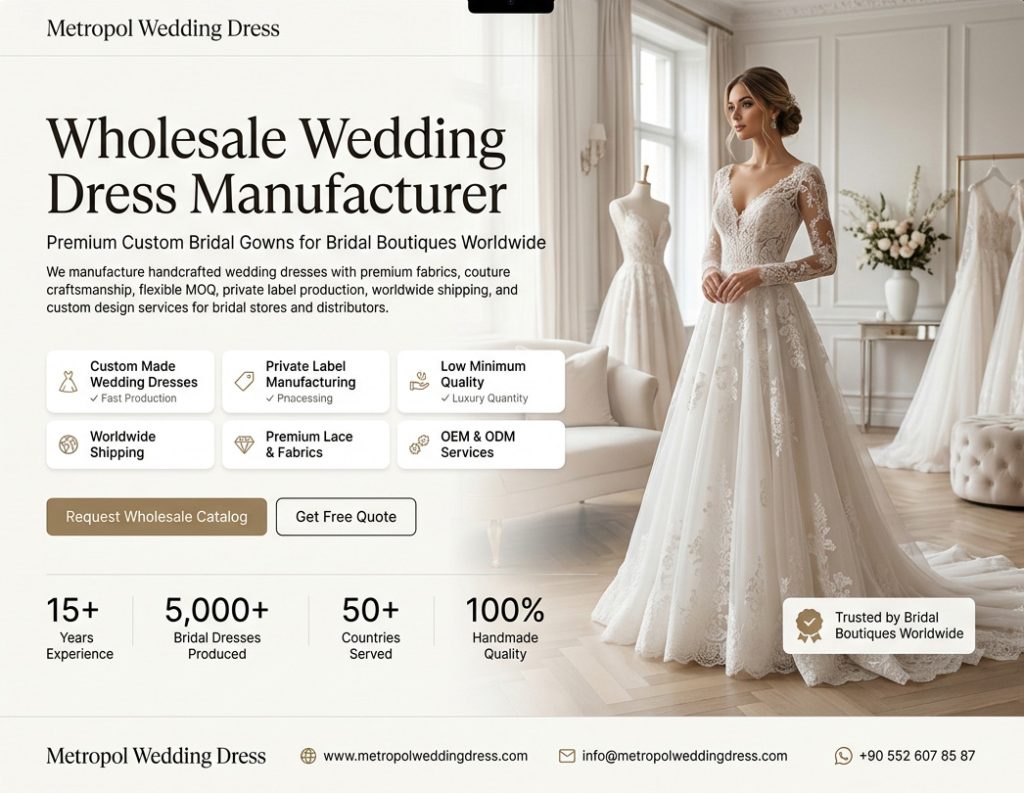
Metropol Wedding Dress is a Turkish wholesale wedding dress manufacturer based in İzmir, operating a dedicated atelier that produces custom and bulk bridal gowns for boutiques, retailers, and private-label clients worldwide. Founded in the mid-2000s and expanded for export, the factory combines European-sourced fabrics, skilled pattern-making, hand embroidery, and flexible low-MOQ production to deliver gowns that support strong retail margins.
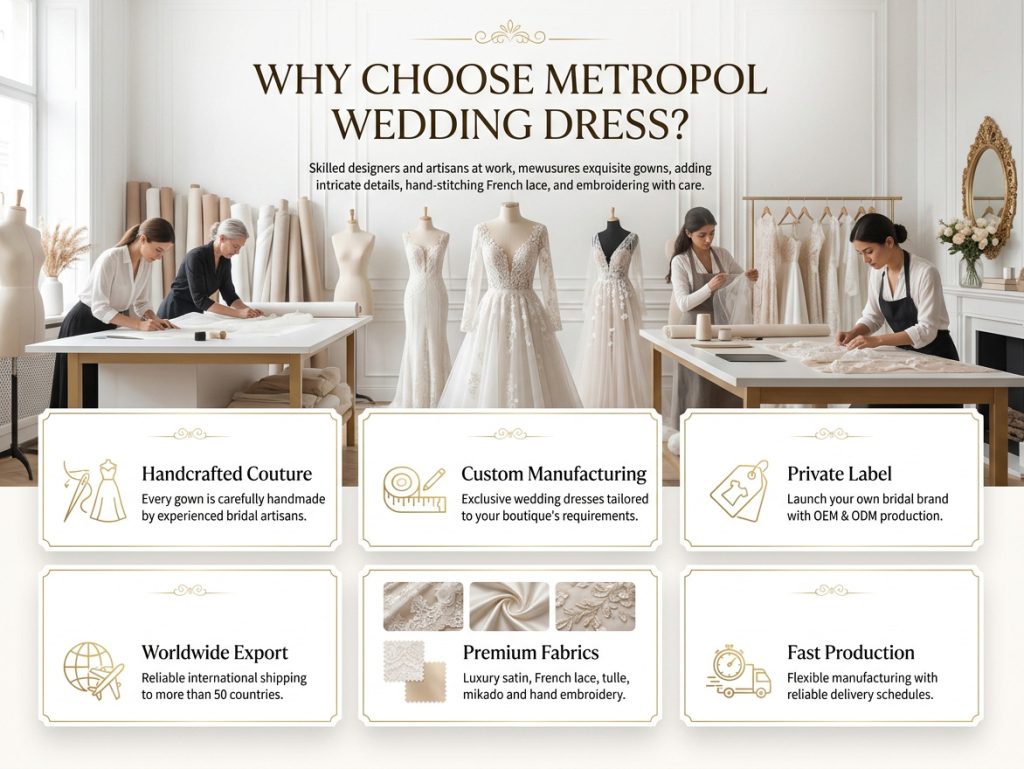
Unlike high-volume Chinese factories focused primarily on speed and lowest cost, Metropol emphasizes craftsmanship transparency, fit precision, and collaborative OEM/ODM work. This makes it a strategic partner for bridal businesses seeking reliable quality, cultural design flexibility (including modest and plus-size options), and reduced supply-chain risk. The content below serves as a practical decision framework for purchasing managers evaluating factory partners.
Detailed Article: Building a Resilient Bridal Supply Chain with a Turkish Wholesale Wedding Dress Manufacturer
Purchasing managers in bridal retail face a recurring tension. Brides expect unique, well-fitting gowns. Margins must remain healthy. Lead times cannot miss peak seasons. Quality failures destroy trust and reviews. Most factories advertise “factory-direct” pricing and “custom capability.” Few deliver consistent results when orders move from sample to production scale.
Metropol Wedding Dress operates from an 800–1,200 m² atelier in Konak, İzmir. The company began in retail and shifted toward wholesale and export after European store partnerships formed. Monthly output sits around 100 dresses with ongoing capacity growth. Production relies on experienced pattern makers, embroiderers, and sewers rather than pure mass-production lines. This profile creates specific advantages and constraints that purchasing teams must evaluate carefully.
Why Geography and Craft Tradition Matter More Than Unit Price
China dominates global bridal volume. Factories in Guangdong and Jiangsu can produce thousands of units monthly at aggressive FOB prices. Turkey occupies a different position. Proximity to European markets shortens shipping windows. Local textile expertise supports higher-end lace, tulle, satin, and mikado. Labor costs sit between low-wage Asian hubs and Western ateliers. EU trade preferences and established logistics corridors reduce some tariff and transit friction compared with certain Asian routes.
For a boutique or multi-store retailer, the calculation is rarely “lowest landed cost.” It is “highest reliable contribution margin after returns, alterations, and reputation risk.” A dress that arrives with consistent sizing, clean finishing, and durable construction generates fewer markdowns and higher full-price sell-through. Metropol’s model targets this equation.
Expert observation: European buyers repeatedly report that Turkish-made gowns require fewer post-arrival alterations on average when measurements and tech packs are followed precisely. The difference compounds across a seasonal collection.
Inside the Production Sequence — What Actually Happens on the Floor
A professional wholesale order does not begin with cutting fabric. It begins with documentation.
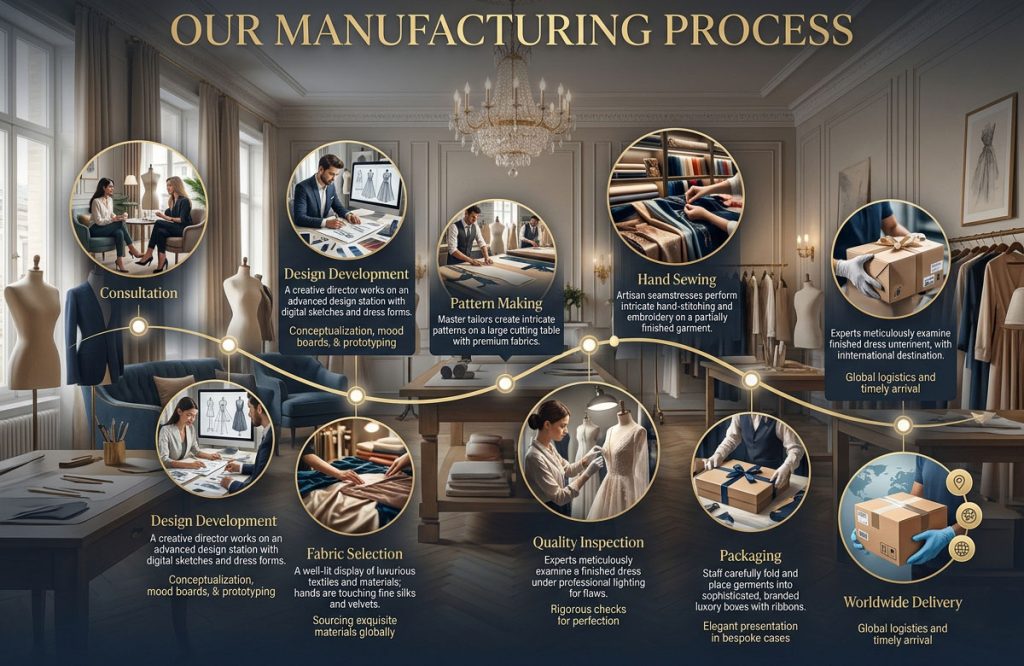
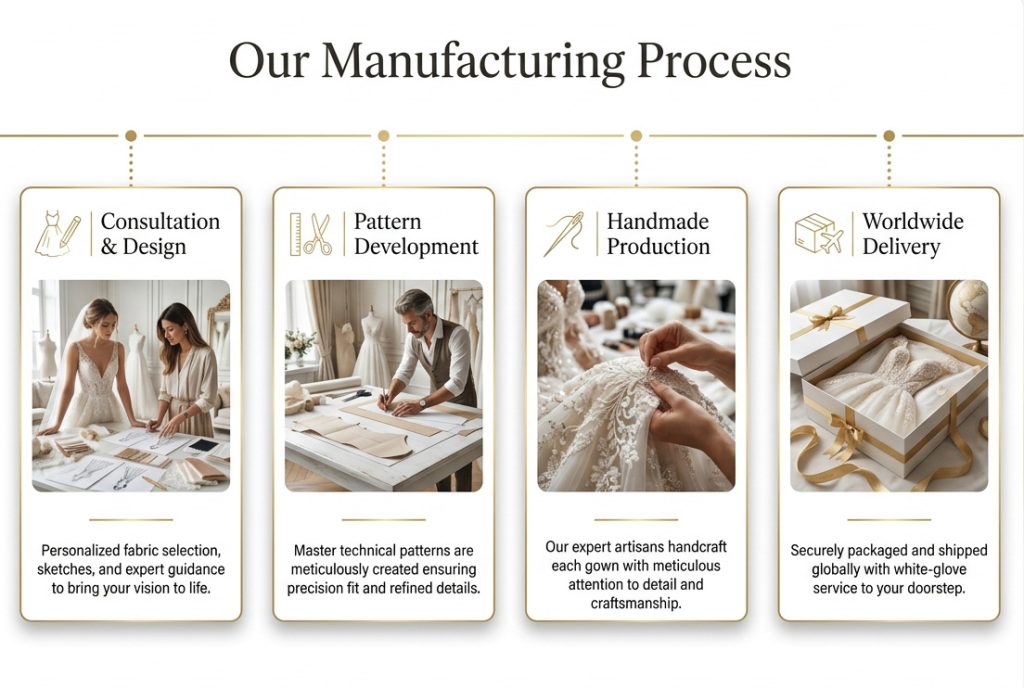
- Design confirmation and tech pack The client supplies sketches, reference images, fabric preferences, silhouette details, and size runs. Metropol’s team produces technical drawings and pattern outlines. Approval gates exist before fabric is committed.
- Fabric and trim sourcing Premium European lace, French and Italian tulle, quality satins, and crystals are prioritized. Stock fabrics accelerate sampling; special-order materials extend timelines. Buyers can request fabric swatches before bulk commitment.
- Pattern making and grading Accurate base patterns are created, then graded across the requested size range. This stage determines fit consistency. Weak pattern work is the most common source of wholesale complaints industry-wide.
- Cutting Hand or guided cutting preserves lace motifs and directional fabrics. Precision here protects expensive materials and ensures symmetry.
- Construction and structure Bodices receive boning, lining, and support layers. Skirts build volume through multiple tulle layers or structured underskirts. Zippers, buttons, and closures are installed to professional standards.
- Embellishment Hand-beading, embroidery, and crystal work occur after the main shell is stable. Complex designs can consume dozens of hours per gown.
- Finishing, pressing, and quality control Final inspection covers seams, symmetry, train drape, and overall appearance. Packaging protects the garment for international transit.
Lead times vary with complexity and order size. Simple silhouettes move faster; heavily beaded or multi-layer designs require more calendar time. Clear communication of seasonal deadlines is essential.
Checklist for buyers before placing the first bulk order
- Confirm written tech-pack approval process
- Request fabric composition and care details in writing
- Agree measurement standards (usually European or client-specified)
- Define acceptable tolerance for sizing and finishing
- Establish photo updates at key production stages
- Clarify packaging and labeling (private label options available)
Material Reality: What Determines Perceived Luxury
Fabric choice drives both cost and customer reaction more than any single design element. Metropol works with:
- Lace (Chantilly, Guipure, embroidered varieties)
- Tulle and illusion nets in multiple densities
- Satin, mikado, crepe, and chiffon
- Structured linings and support fabrics
- Beads, sequins, crystals, and pearls for surface interest
Lower-cost factories sometimes substitute secondary-market or discontinued lace. The visual difference is subtle in photos and obvious under store lighting and bride handling. Turkish access to European mills supports more consistent quality for mid-to-upper collections. Buyers who prioritize long-term brand reputation usually allocate budget to better base materials rather than maximum embellishment on weaker grounds.
Tip box — Fabric decision framework Ask three questions of any factory:
- Can you show the actual roll or swatch that will be used for production, not a similar one?
- What is the origin and approximate GSM or quality grade?
- How do you handle shade variation across a multi-size order?
Cost Structure and Margin Math for Retailers
Wholesale bridal pricing is opaque because complexity varies wildly. Industry ranges for factory-direct gowns typically start in the low hundreds and climb into the low thousands depending on fabric, handwork hours, and order volume. Metropol positions in the quality-conscious segment rather than the absolute lowest-cost tier.
A simplified margin illustration (illustrative only; actual quotes required):
| Cost Element | Approximate Share | Buyer Impact |
|---|---|---|
| Fabric & trims | 40–60% | Quality driver |
| Labor & construction | 25–40% | Fit & durability |
| Overhead & QC | 10–15% | Consistency |
| Factory margin | Variable | Negotiation point |
| Shipping, duties, insurance | Additional | Landed cost |
Retailers commonly achieve 2.5×–4× markup when quality supports full-price selling. High alteration rates or returns erode that multiple quickly. Private-label programs add branding cost but protect exclusivity and perceived value.
“You may also want to take a look at this article.”Bridal Atelier
Comparison table — Strategic positioning
| Factor | High-Volume Asian Factory | Turkish Atelier Model (Metropol profile) | Western Couture Atelier |
|---|---|---|---|
| Unit cost | Lowest | Mid-range | Highest |
| MOQ flexibility | Often higher | Low / flexible | Very low |
| Lead time to Europe | Longer | Shorter | Shortest |
| Design collaboration | Variable | Strong | Strongest |
| Craft consistency | Volume-dependent | Artisan emphasis | Highest |
| Risk of quality drift | Higher at scale | Managed through smaller batches | Lowest |
Mitigation is procedural, not relational. Require staged photo approvals, retain measurement records, use written change orders, and start with smaller test orders before committing seasonal volume. Metropol’s collaborative process (mold approval, stage photos) reduces some of these risks when the buyer enforces the gates.
Real scenario A mid-sized European boutique ordered a 30-piece collection of A-line lace gowns for spring. They supplied detailed measurements and requested private labeling. Production photos were shared at pattern, lace application, and final stages. Two size adjustments were made before cutting. Arrival inspection showed high consistency. Sell-through exceeded the previous season’s Chinese-sourced line by a noticeable margin, primarily because alteration time dropped and customer compliments increased.
Metropol supports custom and private-label work. Success depends on the buyer treating the factory as a production partner rather than a pure vendor. Clear briefs, realistic timelines, and prompt feedback accelerate results.
Sourcing Decision Framework for 2026 and Beyond
Tariffs, shipping volatility, and rising fabric prices have made pure lowest-cost strategies riskier. Diversification across regions is increasingly rational. Turkey offers a mid-tier quality and logistics profile that complements higher-volume Asian production or pure domestic programs.
Metropol’s documented strengths lie in European market experience, flexible order sizes, and emphasis on mold and embroidery quality. Limitations include capacity that is not infinite; very large volume programs may still require multi-factory strategies.
“You may also want to take a look at this article.” Couture Wedding Dresses
Closing Perspective for Purchasing Leaders
A wedding dress is not a commodity. It is a high-emotion, high-visibility product sold under time pressure. The factory that can reliably convert a design brief into consistent, well-finished garments protects the retailer’s reputation and margin more effectively than the factory that merely quotes the lowest number.
Metropol Wedding Dress represents one viable node in a diversified bridal supply strategy: Turkish craftsmanship, European fabric orientation, collaborative customization, and export experience. It will not suit every volume or every price point. For boutiques and retailers who prioritize fit integrity, material honesty, and manageable risk, it warrants serious evaluation through sample orders and process audits.
The next practical step is always the same: request current collections or custom capability details, define a controlled test order, and measure performance against the criteria above. Data from that test, not marketing claims, should drive the long-term decision.
Frequently Asked Questions
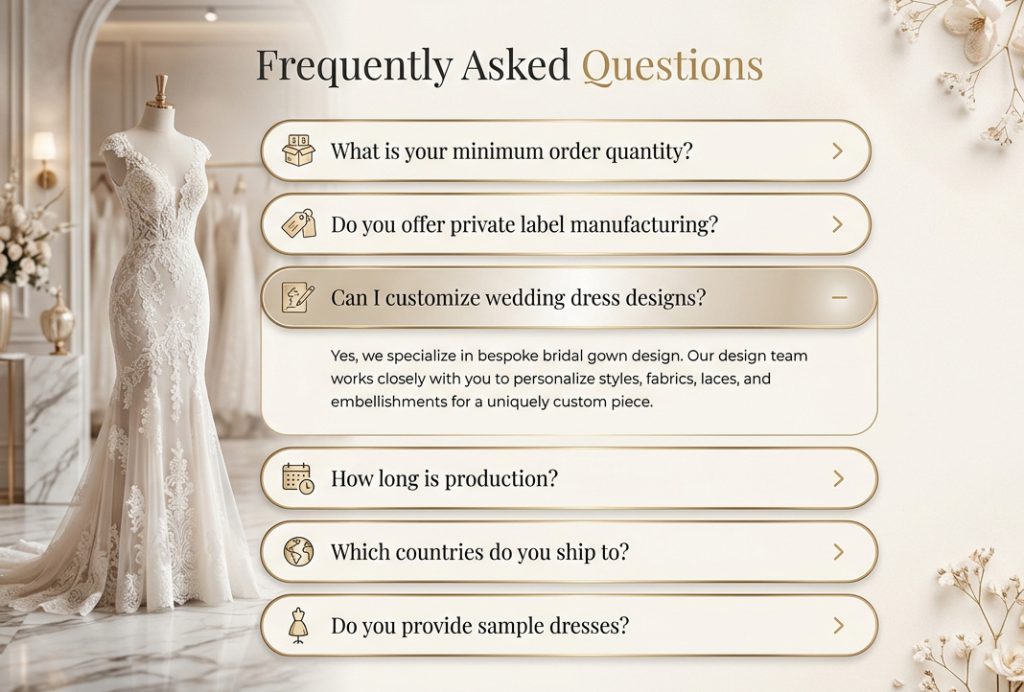
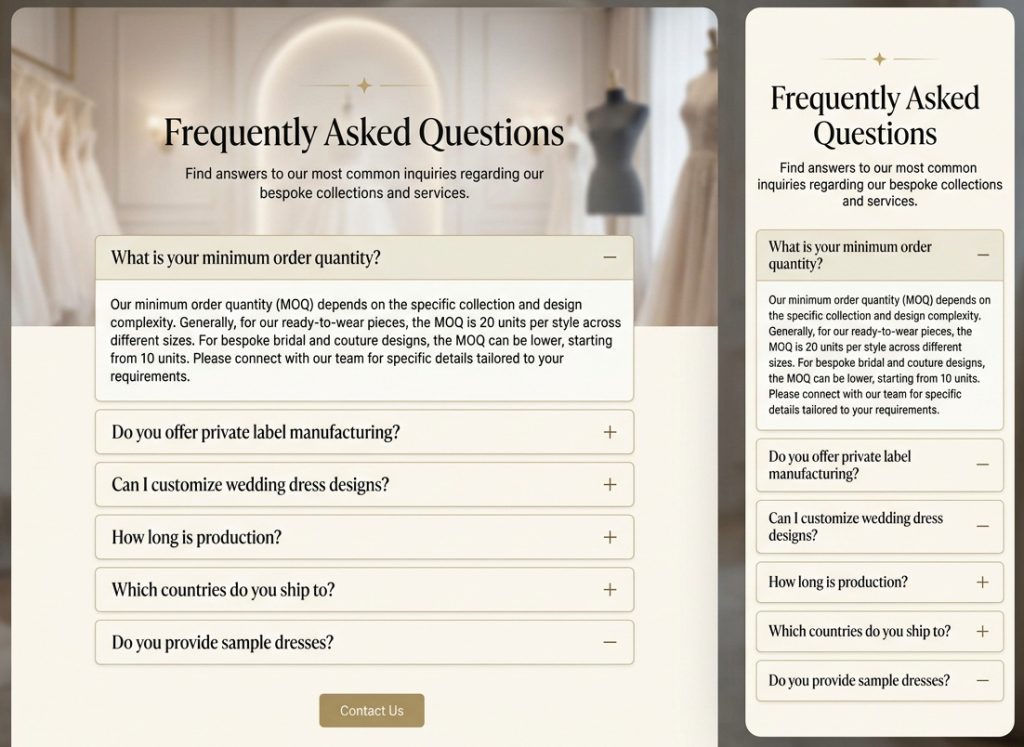
1. What is the typical minimum order quantity at Metropol Wedding Dress? Flexible and often low compared with large Chinese volume factories. Single custom pieces and small wholesale runs are regularly accepted; exact MOQ depends on style complexity and current capacity.
2. How long does production usually take for a wholesale order? Depends on design complexity, fabric availability, and order size. Simple styles move faster; heavily embellished or multi-layer gowns require more time. Seasonal planning with clear deadlines is essential.
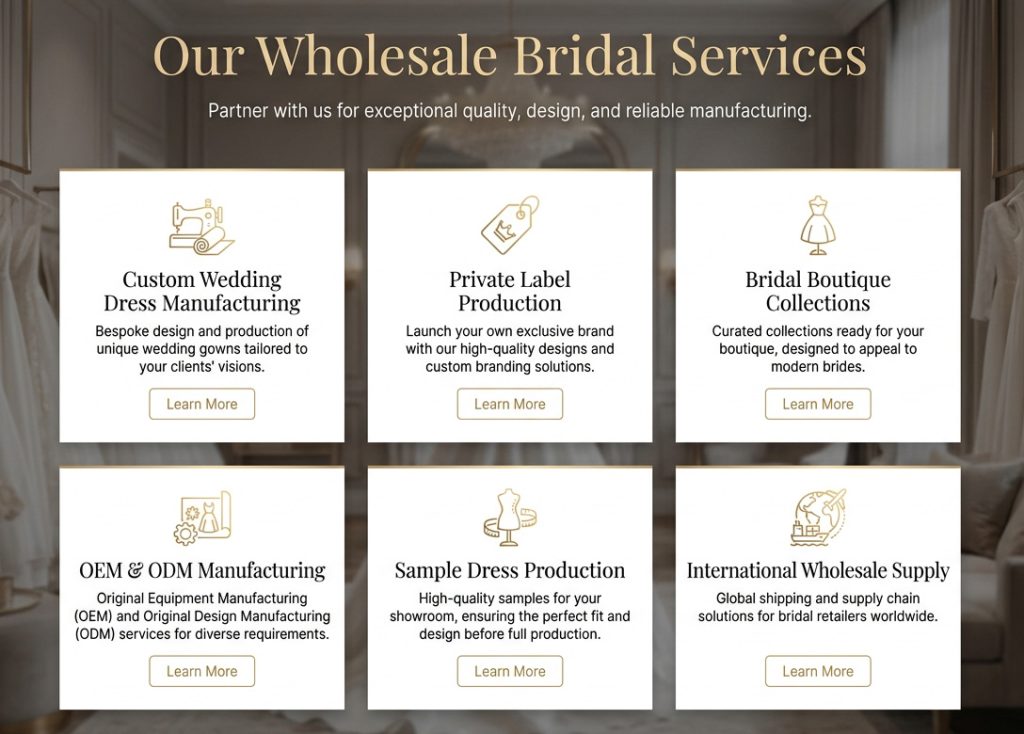
3. Does Metropol offer private label and OEM services? Yes. Clients can develop exclusive designs, apply their own labels, and control packaging within agreed parameters.
4. What fabrics are commonly used? Premium lace varieties, tulle, satin, mikado, crepe, chiffon, and quality linings, with emphasis on European-sourced materials when specified.
5. Can they produce plus-size wedding dresses? Yes. The atelier has experience with extended size ranges and pattern adjustments for different body types.
6. Are modest or hijab-compatible designs available? Yes. Customization for coverage, sleeve styles, and cultural preferences is part of the service range.
7. How does quality control work? Stage inspections including pattern approval, in-process checks, and final inspection before packing. Photo documentation is typically provided at key points.
8. What payment terms are standard? Varies by order size and relationship history. Deposit plus balance before or upon shipment is common; exact terms are negotiated per contract.
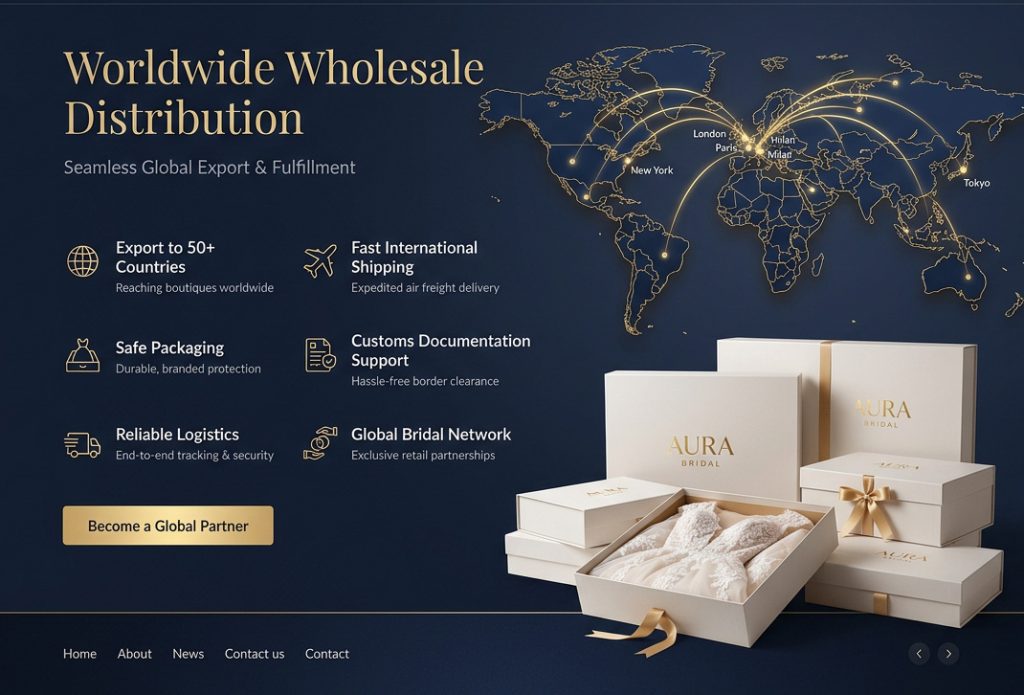
9. How are international shipments handled? Global shipping is supported. Buyers should confirm Incoterms, insurance, and responsibility for duties in the quotation stage.
10. Can I visit the atelier in İzmir? Factory visits are possible by arrangement for serious wholesale partners. Virtual tours and detailed photo documentation are more common for initial evaluation.
11. What is the difference between ready designs and fully custom? Ready or semi-custom styles use existing patterns with modifications. Fully custom starts from client sketches or concepts and requires full pattern development.
12. How are sizing and measurements managed? Clients provide size charts or individual measurements. Accurate grading and written confirmation reduce fit issues.
13. What happens if there is a quality dispute? Clear acceptance criteria and photo records form the basis for resolution. Claims processes should be defined in the purchase agreement.
14. Does Metropol produce accessories such as veils or belts? Focus is primarily on gowns; accessory capability should be confirmed for specific orders.
15. How does Turkish production compare on lead time to China for European buyers? Generally shorter transit times and potentially fewer tariff complications depending on trade agreements and specific routes.
16. Are samples charged? Sample fees are common and often credited against a subsequent bulk order. Confirm policy before requesting.
17. Can designs be protected? Confidentiality and IP clauses should be included in contracts. Sharing unique designs carries inherent risk with any factory.
18. What is the monthly production capacity? Approximately 100 dresses, with ongoing capacity expansion. Large concurrent orders may require scheduling priority discussion.
19. Do they work with bridal boutiques only, or also e-commerce brands? Both traditional retailers and online/private-label brands are served.
20. How should a first-time buyer start? Request current lookbooks or capability statements, place a controlled sample or small test order, evaluate communication and quality, then scale.
21. Are sustainable or eco-preferred materials available? Availability depends on current mill offerings; specific requests should be raised during the design phase.
22. What documentation is provided with shipments? Commercial invoice, packing list, and any required certificates. Confirm origin and material declarations for customs.
23. Can production photos be shared during manufacturing? Yes. Stage photography is a standard transparency practice.
24. How are color and shade consistency managed across sizes? Fabric from the same dye lot is preferred; any unavoidable variation should be flagged before cutting.
25. Is there support for reorders of the same style? Yes, provided patterns and fabric references are retained. Lead times for reorders are often shorter.
26. What are typical price ranges for wholesale gowns? Varies widely with fabric, construction complexity, and embellishment. Request formal quotes based on specific designs rather than relying on broad published ranges.
27. Does the factory handle alterations or only new production? Primary focus is new manufacturing. Post-delivery alterations remain the retailer’s responsibility in most cases.
28. How does Metropol handle peak bridal season demand? Capacity planning and early booking are recommended. Communication of hard deadlines early improves outcomes.
29. Are convertible or multi-way dresses possible? Yes, within the limits of structural engineering and fabric behavior.
30. What makes a successful long-term partnership? Clear briefs, realistic timelines, prompt feedback, written change control, and mutual respect for production realities.
For current collections, custom capability, or a formal quotation, contact Metropol Wedding Dress directly through their official channels. Evaluate with data from samples and process transparency rather than claims alone.
Searching “wholesale wedding dresses near me” usually reveals a limited set of local options: small ateliers with high prices, stock rooms with outdated styles, or middlemen adding layers of cost. True manufacturing capacity is concentrated in specialized hubs. Metropol Wedding Dress, based in İzmir, Turkey, functions as a practical remote factory partner for boutiques and retailers who need reliable wholesale supply without the constraints of purely local production. With an established atelier, flexible order sizes, European-oriented fabrics, and export experience, it removes the false choice between proximity and quality. This guide reframes the “near me” search into a supply-chain decision that prioritizes margin, consistency, and speed-to-floor over geographic convenience alone.
Detailed Article: Why “Wholesale Wedding Dresses Near Me” Rarely Delivers What Boutiques Actually Need
The phrase “wholesale wedding dresses near me” feels logical. Local means faster visits, easier returns, face-to-face negotiation. In practice, most regions contain very few genuine wholesale manufacturers. What appears in local search results is often a retailer posing as a wholesaler, a showroom with limited stock, or a designer atelier that cannot scale beyond a handful of pieces per month.
Bridal retail operates on thin seasonal windows and high emotional stakes. A gown that arrives late, fits inconsistently, or looks cheaper under store lights damages both cash flow and reputation. Geography alone does not solve these problems. Capacity, process discipline, fabric access, and communication do.
Metropol Wedding Dress operates from a dedicated production workshop in Konak, İzmir. The company has moved from local retail roots into export-oriented wholesale and custom work. Monthly output sits in the range of roughly 100 gowns, with capacity expanding. This scale is large enough to support boutique collections yet small enough to retain pattern accuracy and hand-finishing standards that pure volume factories often lose.
The Local Myth Versus Operational Reality
Local search optimizes for distance. Bridal supply optimizes for risk reduction.
A boutique in a secondary city may find one or two nearby suppliers. Those suppliers typically face the same constraints: limited fabric selection, higher labor costs, smaller cutting tables, and pressure to turn inventory quickly. The result is either elevated wholesale prices or compromised construction to protect margin.
Remote specialized manufacturers invert the equation. They concentrate skilled labor, maintain relationships with better lace and tulle mills, and run repeatable quality systems. Shipping adds days or weeks, but the total landed cost plus alteration time frequently favors the specialized factory.
Comparison snapshot
| Factor | Typical Local Supplier | Specialized Remote Factory (Metropol profile) |
|---|---|---|
| Geographic convenience | High | Low |
| Fabric range & quality | Restricted | Broader European-oriented options |
| Pattern & grading consistency | Variable | Structured process |
| Order flexibility | Often rigid or very small | Low MOQ possible |
| Seasonal capacity | Easily saturated | Planned and expandable |
| True wholesale pricing | Rare | Core model |
| Communication transparency | Face-to-face possible | Photo stages + written gates |
The table is not absolute. Excellent local makers exist. They are simply scarce relative to demand. Most “near me” results do not clear the operational bar required for healthy boutique margins.
Metropol’s process is built around these gates. Design or style confirmation precedes fabric commitment. Pattern approval occurs before cutting. Stage photography is available. Final inspection precedes packing. These steps matter more than the ability to drive across town for a meeting.
Expert note Boutiques that treat factories as pure vendors experience higher variance. Boutiques that treat them as production partners—with clear tech packs, measurement standards, and approval checkpoints—experience lower alteration rates and higher full-price sell-through.
Material and Construction Realities That Local Options Often Cannot Match
Wedding dresses are material-intensive. Lace motifs must align. Tulle layers must hold volume without collapsing. Bodice structure must support movement and photography lighting. Crystals and beads must stay attached through fittings and the wedding day.
Specialized ateliers maintain better access to consistent European lace, quality satins, mikado, and support fabrics. Local suppliers frequently work from residual stock or higher-cost small-quantity purchases. The difference appears in drape, opacity, and longevity rather than in catalog photos.
Each stage creates an opportunity for error or for correction. Factories that skip gates or rush to meet artificial local-delivery promises transfer the cost of those errors to the retailer in the form of alterations, returns, or lost sales.
Cost Behavior When Distance Is No Longer the Primary Variable
Wholesale pricing is driven by fabric, handwork hours, and order structure more than by kilometers. A local supplier with high overhead may quote higher than a specialized remote factory even after shipping and duties.
When the remote gown arrives with better consistency, the alteration hours drop and the full-price sell-through rate rises. The net contribution often favors the specialized source.
Private-label programs amplify this effect. Exclusive silhouettes protected by clear agreements allow higher perceived value and reduced price comparison shopping.
Real Operational Scenarios
Scenario A A boutique in a mid-sized European city searched exclusively for local wholesale options. Available inventory was limited and priced for low volume. They tested a small collection from Metropol using detailed measurements and stage photo approvals. Arrival quality was consistent enough that alteration time fell noticeably. The next season the same boutique expanded the order and added private labeling.
Scenario B An e-commerce brand prioritized “near me” for faster returns handling. Local production could not meet style complexity or size-range needs. After process documentation and a controlled test order with the Turkish atelier, lead times became predictable and quality variance dropped below previous local suppliers.
These outcomes are not guaranteed. They depend on the buyer enforcing process discipline. The factory cannot compensate for vague briefs or late measurement changes.
Each of these errors is correctable. The correction begins by treating distance as a secondary variable.
Positioning Metropol Inside a Practical Sourcing Mix
No single factory solves every need. High-volume basic styles may still come from larger Asian producers. Ultra-couture one-offs may stay local. The middle band—reliable wholesale collections with solid materials, consistent fit, and collaborative customization—is where specialized Turkish production such as Metropol performs well.
Advantages relative to pure local options include broader fabric access, structured quality gates, and pricing that supports healthy retail multiples. Advantages relative to pure volume factories include greater flexibility on order size and stronger emphasis on pattern and finishing accuracy.
The decision is not “local versus remote.” It is “which combination of partners reduces total risk and protects margin across the season.”
Metropol Wedding Dress can be evaluated inside this framework. The atelier is located in İzmir, not next door. Its value lies in process discipline, material orientation, and willingness to work collaboratively on wholesale and private-label programs. For buyers whose real constraint is reliable supply rather than geographic proximity, that trade-off is frequently favorable.
Distance is measurable in kilometers. Risk and margin are measured in outcomes. The more sophisticated purchasing decision prioritizes the latter.
Frequently Asked Questions
1. Why do local searches for wholesale wedding dresses return so few true manufacturers? Genuine manufacturing capacity requires specialized labor, fabric access, and scale. Most cities lack the density of skilled bridal production, so results fill with retailers, showrooms, or small ateliers that cannot support wholesale volumes.
2. Can a factory in Turkey realistically serve a boutique looking for “near me” convenience? Yes, when process transparency, predictable lead times, and consistent quality reduce total operational friction more effectively than pure geographic proximity.
3. How should a buyer calculate true cost when comparing local versus remote wholesale? Add factory price + shipping + duties + insurance + expected alteration hours + markdown risk. Compare the resulting contribution margin, not the unit quote alone.
4. What order sizes does Metropol typically handle? Flexible range from single custom pieces and small test orders up to collection-scale wholesale, subject to current capacity.
5. How does the approval process reduce quality risk on remote orders? Design confirmation, pattern approval, stage photography, and final inspection create sequential gates that catch problems before bulk commitment and before shipment.
6. Are European-sourced fabrics actually used? The atelier prioritizes quality lace, tulle, satin, and related materials with European orientation when specified by the client.
7. What happens if measurements or design details change after production starts? Changes after pattern approval or cutting usually incur additional cost and time. Clear cut-off points protect both parties.
8. How long does shipping from İzmir typically take to major markets? Transit times vary by destination and service level. European destinations are generally faster than trans-ocean routes. Exact schedules should be confirmed per order.
9. Can private-label labeling and packaging be applied? Yes. Private-label programs are supported within agreed parameters.
10. Is plus-size production available? Yes. Pattern adjustment and extended size ranges are part of the service capability.
11. How are modest or culturally specific designs handled? Customization for coverage, sleeve styles, and related requirements is routinely accommodated.
12. What documentation accompanies a wholesale shipment? Commercial documents, packing details, and any origin or material declarations required for customs. Confirm specifics in the quotation.
13. How does Metropol manage dye-lot and shade consistency? Preference is given to matched lots. Any unavoidable variation should be flagged before cutting proceeds.
14. Can production progress be monitored remotely? Stage photography and written updates at defined milestones are standard practice.
15. What is the realistic lead time for a first wholesale collection? Depends on complexity, fabric availability, and order volume. Early seasonal planning produces better outcomes than last-minute requests.
16. How should intellectual property be protected on exclusive designs? Written agreements covering confidentiality, design ownership, and non-reproduction terms are essential before sharing unique concepts.
17. Are samples credited against bulk orders? Sample policies vary; many factories credit sample cost against a subsequent production order. Confirm in writing.
18. What is the most common reason remote orders underperform? Vague or incomplete tech packs and late measurement changes. Process discipline on the buyer side is as important as factory capability.
19. Can the same style be reordered later? Yes, when patterns and fabric references are retained. Reorder lead times are often shorter than initial development.
20. How does capacity planning work during peak bridal seasons? Early booking and clear deadline communication improve allocation. Last-minute large orders compete with existing commitments.
21. Is there a difference in quality between local handwork and specialized atelier construction? Quality is determined by skill, process control, and materials—not solely by distance. Specialized environments often maintain higher consistency across multiple pieces.
22. What payment structures are typical? Deposit against order confirmation and balance before or upon shipment is common. Exact terms are negotiated per relationship and order size.
23. How should a boutique begin evaluation without large risk? Request capability information, place a limited test order with full documentation, measure results against the control checklist, then decide on scale.
24. Does Metropol produce only wedding dresses or also related bridal party pieces? Primary focus is wedding gowns; capability for related styles should be confirmed for specific programs.
25. What role does pattern grading play in wholesale success? Accurate grading across the size range is one of the strongest predictors of low alteration rates and customer satisfaction.
26. Can convertible or multi-function designs be produced? Yes, within structural and fabric limitations. Engineering requirements should be discussed early.
27. How are claims handled if a shipment fails quality criteria? Pre-agreed acceptance standards and photographic records form the basis for resolution. The claim process should be defined in the purchase terms.
28. Is sustainability or preferred-material sourcing possible? Availability depends on current mill offerings. Specific requests should be raised during the design and fabric selection phase.
29. Why do some buyers still prefer purely local supply despite higher cost? Speed of physical inspection, simpler returns logistics, and relationship familiarity. These advantages must be weighed against capacity limits and total cost.
30. What single change most improves outcomes with any remote manufacturer? Treating the factory as a production partner rather than a pure vendor—complete briefs, written gates, and measured feedback.
For current collections, custom capability statements, or a controlled test-order discussion, contact Metropol Wedding Dress through official channels. Evaluate on process, consistency, and margin impact rather than search-radius alone.
Premium Bridal Factory
A premium bridal factory is defined by process discipline, material integrity, and finishing standards that survive close inspection under store lights and bride handling—not by marketing language. Metropol Wedding Dress operates as a specialized Turkish atelier in İzmir that targets this higher threshold: European-oriented fabrics, accurate pattern work, hand-level embellishment capability, and flexible production that supports both custom one-offs and boutique-scale wholesale. For purchasing managers evaluating suppliers, the difference between ordinary manufacturing and a true premium bridal factory appears in consistency across size runs, structural longevity, and the ability to protect retail margins through fewer alterations and higher full-price sell-through. This guide examines the operational criteria that separate the two and positions Metropol within that framework.
Detailed Article: The Operational Definition of a Premium Bridal Factory
Most factories claim quality. Few can demonstrate the systems that produce it repeatedly. In bridal manufacturing the gap between adequate and premium is measurable in fabric behavior, seam integrity, motif alignment, support structure, and the absence of post-arrival surprises. Purchasing managers who buy on price or proximity alone frequently discover that gap only after the gowns reach the fitting room.
A premium bridal factory maintains control over the variables that ordinary volume producers often sacrifice for speed or cost. Pattern accuracy is treated as non-negotiable. Fabric selection prioritizes performance under movement and photography lighting. Embellishment density and attachment methods are engineered for durability, not just visual impact on the hanger. Quality gates exist at multiple stages rather than only at final packing.
Metropol Wedding Dress functions inside this higher band. Located in Konak, İzmir, the atelier combines traditional craft skills with structured production for export clients. Workshop space falls in the 800–1,200 m² range. Monthly output is calibrated around approximately 100 gowns, allowing attention to detail that pure high-volume lines struggle to sustain. The company serves both individual custom work and wholesale programs for boutiques seeking elevated collections without full couture pricing.
What “Premium” Actually Requires on the Production Floor
Premium is not a style category. It is a set of thresholds.
Material threshold Lace must hold motif integrity when cut and seamed. Tulle must maintain volume without excessive weight or static cling. Base fabrics (satin, mikado, crepe, chiffon) must drape cleanly and resist premature creasing. Support layers and boning must provide structure without creating pressure points or visible lines. Lower-tier production frequently substitutes secondary-market lace or lighter-weight nets that photograph adequately but collapse or pill under real wear.
Pattern and grading threshold Base patterns are developed with body geometry in mind, then graded across the size range with controlled increments. Drift in grading produces the most expensive post-arrival problem: systematic fit failures that require extensive alteration or returns. Premium factories treat grading as a technical discipline, not an approximate scaling exercise.
Construction threshold Seams are finished to prevent fraying and maintain clean interiors. Zippers and closures are installed with reinforcement. Trains and hems receive consistent treatment. Internal structure is engineered for the silhouette rather than added as an afterthought.
Embellishment threshold Beads, crystals, and embroidery are attached with methods that resist vibration and handling. Density is planned so that weight distribution does not distort the silhouette. Hand work is reserved for areas where machine methods cannot achieve the required precision or softness.
Metropol’s process is organized around these thresholds. Design confirmation and fabric decisions precede cutting. Pattern approval occurs before bulk commitment. Stage documentation allows the buyer to verify progress. Final inspection checks the criteria that matter once the gown reaches the boutique.
Expert observation The highest-margin bridal collections are rarely the cheapest to produce. They are the ones that require the fewest corrective hours after arrival and sell through at full price because the construction and materials meet the bride’s expectations under real conditions.
Each stage creates a decision point. Skipping or compressing stages is the most common pathway from “premium claim” to ordinary result.
Material Performance Under Real Conditions
Bridal gowns face unique stress: repeated fittings, photography lighting, movement on the day, and long-term storage or preservation. Materials that look identical in a quiet showroom can behave differently under these conditions.
Lace with poor ground stability stretches or tears at stress points. Lightweight tulle collapses or generates static that attracts lint. Inferior satins show pressure marks from seating. Weak bead attachment produces losses during the reception. Premium factories select and test materials against these realities rather than catalog appearance alone.
Metropol prioritizes European-oriented lace, quality tulles, satins, and related fabrics when the brief requires them. The cost difference is visible in the quotation; the performance difference appears later in lower alteration rates and higher client satisfaction scores.
Comparison table — Ordinary versus premium production markers
| Marker | Ordinary Volume Factory | Premium Bridal Factory Standard |
|---|---|---|
| Fabric selection | Cost-driven, residual lots common | Performance and origin prioritized |
| Pattern grading | Approximate scaling | Controlled technical grading |
| Seam and interior finish | Functional minimum | Clean, durable, inspection-ready |
| Embellishment method | Speed-oriented | Durability + visual density balanced |
| Size-run consistency | Variable | Monitored and corrected before shipment |
| Client visibility | Limited | Stage documentation available |
| Post-arrival alteration load | Often high | Measurably lower when process is followed |
The resulting wholesale price sits above pure volume production and below full Western couture ateliers. For the boutique the relevant metric is contribution margin after alterations, returns, and markdowns. Collections that clear the premium thresholds frequently generate superior net results even when unit cost is higher.
Private-label programs add a further layer. Exclusive silhouettes and controlled labeling allow the retailer to own the brand perception while leveraging the factory’s technical capacity.
Real Scenarios from the Purchasing Side
Scenario one A multi-store bridal retailer moved a portion of its mid-to-upper collection to a disciplined Turkish atelier after repeated size-run inconsistencies from a previous high-volume source. Pattern approval and stage photography were enforced. Alteration hours dropped. Full-price sell-through improved. The higher unit cost was more than offset by reduced labor and fewer markdowns.
Scenario two An independent boutique sought elevated lace work and modest design options without the lead times and minimums of larger European houses. A controlled test order with Metropol confirmed fabric quality and finishing standards. The subsequent seasonal order expanded both volume and private-label elements.
These outcomes require buyer discipline. Vague briefs or late changes transfer risk back to the retailer regardless of factory capability.
Each error is preventable with a structured evaluation protocol.
Positioning Metropol as a Premium Bridal Factory Option
Metropol occupies the specialized mid-to-upper band: higher process and material standards than pure volume producers, greater flexibility and accessibility than pure couture houses. Strengths include European fabric orientation, collaborative custom and private-label capability, structured approval gates, and experience serving international boutique clients. Capacity is finite; very large concurrent programs may require prioritization or multi-source strategies.
The factory is not the lowest-cost option available globally. It is positioned for buyers whose primary constraint is consistent premium results rather than minimum unit price.
A premium bridal factory is identified by what it refuses to compromise, not by what it claims. Metropol Wedding Dress can be evaluated inside that standard. The operational evidence—pattern discipline, material choices, stage visibility, and finishing consistency—determines whether the designation is earned.
For current collections, technical capability statements, or a structured test-order discussion, contact Metropol Wedding Dress through official channels. Base the decision on verified process and measured results.
Frequently Asked Questions
1. What operational features distinguish a premium bridal factory from ordinary manufacturers? Controlled pattern grading, performance-oriented fabric selection, multi-stage inspection, durable embellishment methods, and consistent size-run results under real handling conditions.
2. How does Metropol demonstrate premium process standards? Through design confirmation, pattern approval before cutting, stage photography, fabric reference capability, and final multi-point inspection before packing.
3. Is higher unit cost inevitable with premium production? Cost is higher than pure volume production because more is allocated to materials, pattern work, skilled labor, and inspection. Net retail margin often improves through lower alterations and higher full-price sell-through.
4. What fabric standards are typically maintained? European-oriented lace, quality tulles, satins, mikado, and support fabrics selected for drape, stability, and longevity rather than lowest purchase price.
5. How critical is pattern grading to premium results? It is one of the strongest predictors of fit consistency across a size run and of post-arrival alteration volume.
For technical capability details, current collections, or a controlled evaluation order, contact Metropol Wedding Dress through official channels. Judge the partnership on verified process standards and measured commercial results.
Wholesale Wedding Dress Manufacturer: Quality That Holds Up Beyond the Sample Room — Metropol Wedding Dress
Most conversations about wedding dresses focus on the bride. Fewer address the businesses that stand between the manufacturer and the final fitting. Bridal boutiques, multi-brand salons and independent retailers need suppliers they can rely on — not only for attractive samples, but for consistent production, honest lead times and garments that maintain their integrity once ordered in quantity. Finding a wholesale wedding dress manufacturer that treats quality as non-negotiable is harder than it should be.
At Metropol Wedding Dress we operate as a manufacturer with a clear position. We produce wedding dresses for wholesale partners who value clean construction, reliable sizing and designs that still look considered when they reach the sales floor. We do not chase the lowest possible price point. We focus on work that holds its shape, photographs cleanly and gives boutiques fewer returns and more confidence when advising brides.
This article outlines what that approach looks like in practice and why it matters for retailers working in a demanding market.
The Problem with Much of Bridal Wholesale
The wholesale bridal market is crowded with options that prioritise speed and margin over lasting quality. Dresses may look acceptable on a sample rail yet reveal weak seams, inconsistent sizing or fabrics that lose freshness after minimal handling. Boutiques then absorb the cost in alterations, customer dissatisfaction and damaged reputation.
A serious wholesale manufacturer has to solve for different priorities: repeatable pattern accuracy, controlled fabric behaviour, finishing that survives shipping and repeated try-ons, and communication that remains clear when orders scale. These are manufacturing disciplines more than marketing claims.
How Metropol Approaches Wholesale Production
We bring the same standards we apply to individual commissions into our wholesale work, adapted for volume without abandoning precision.
Patterns are developed and graded with care so sizing remains consistent across the run. Fabrics are selected for performance as well as appearance — materials that hold their structure, accept pressing cleanly and resist the rapid tiredness that shows up in lower-grade stock. Construction combines machine strength where it is needed with controlled finishing that keeps edges and internal details clean. Quality checks occur at multiple stages rather than only at the end.
We do not claim every dress is made entirely by hand. We do claim that critical stages receive proper attention and that the finished garment reflects deliberate decisions rather than pure efficiency targets.
Design That Serves the Retailer
Wholesale ranges only work if they sell through. Our designs are developed with the boutique in mind: clear silhouettes that photograph well, proportions that suit a range of body types within standard grading, and details that feel current without dating too quickly. We avoid both over-decoration and excessive minimalism. The aim is dresses that give sales teams something coherent to talk about and brides something they can imagine themselves wearing.
Limited, considered collections are preferred over constant high-volume novelty. This helps boutiques manage inventory risk and maintain a distinct point of view on the sales floor.
Working With Wholesale Partners
The process begins with a conversation about the retailer’s market, price architecture and existing gaps. We discuss minimums, lead times, sizing curves and the level of customisation available within wholesale parameters. Clear specifications and sampling protocols are established early so both sides understand what will be delivered.
Communication remains direct. Production updates are factual. When issues arise — and in manufacturing they occasionally do — they are addressed without evasion. Reliable partners prefer accuracy over reassurance.
Lead times are set realistically. We prefer to under-promise and deliver cleanly rather than over-promise and compromise finishing or consistency.
Why Manufacturing Standards Matter to Boutiques
A dress that arrives well-made reduces pressure on the boutique’s alteration team. Consistent sizing lowers the rate of disappointed try-ons. Fabrics that behave predictably make steaming and presentation easier. Over a season these factors affect both margin and reputation.
There is also the longer view. Boutiques that become known for carrying well-constructed dresses tend to attract brides who value substance. That positioning is harder to maintain when the wholesale source treats quality as optional.
A Manufacturer’s Responsibility
Wholesale is not simply a volume channel. It is a responsibility to the retailers who stake their reputation on what they stock, and ultimately to the brides who will wear the dresses. At Metropol Wedding Dress we take that responsibility seriously. We manufacture with the same underlying standards whether the order is for a single bespoke commission or a carefully controlled wholesale run.
If you are a boutique owner or buyer looking for a wholesale wedding dress manufacturer that prioritises consistency, clean construction and honest collaboration, we would be open to a conversation. The work is detailed, the standards are deliberate, and the goal is product that performs as well on the sales floor as it does in the sample room.
Metropol Wedding Dress Wholesale wedding dress manufacturing, built on precision and reliability.