
Bridal Atelier
Bridal Atelier Metropol Wedding Dress operates a true bridal atelier in Turkey where every gown begins as a conversation and ends as a one-of-a-kind piece. The Bridal Collection is not a static catalog of finished dresses; it is a living system of silhouettes, fabrics, construction techniques, and customization pathways designed for individual brides and for boutiques seeking exclusive inventory.
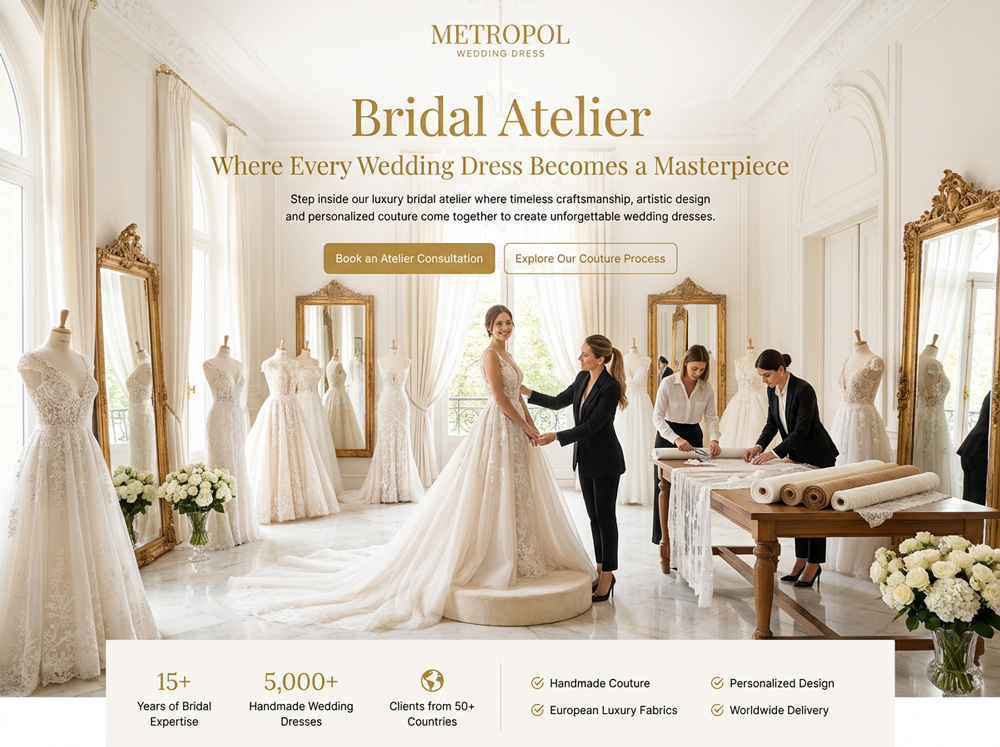
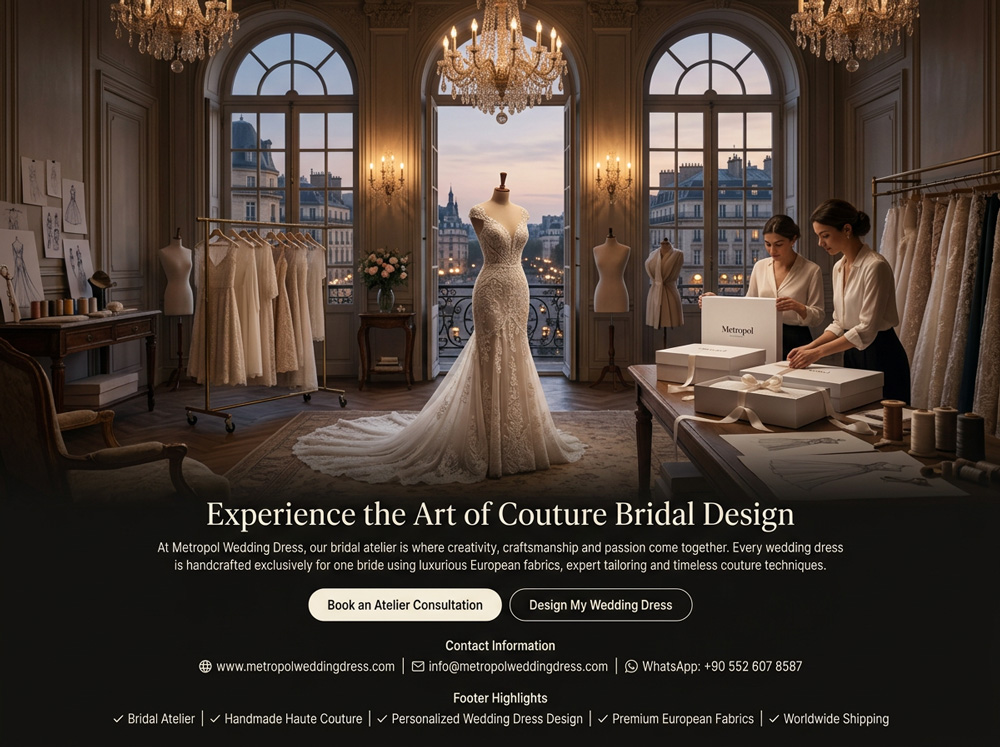
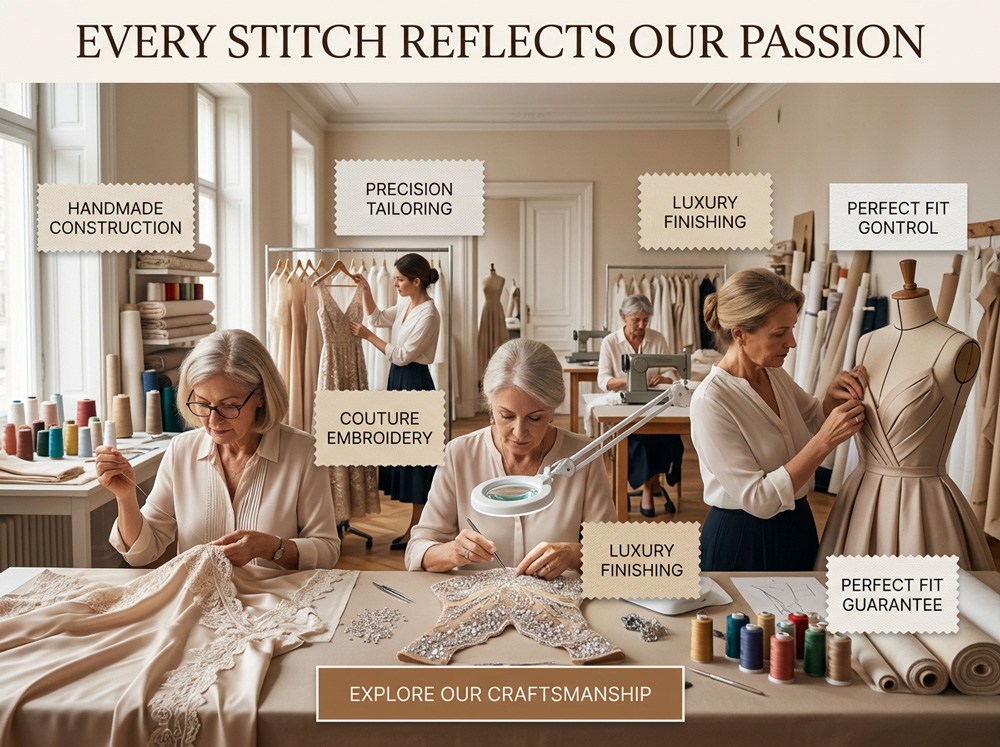
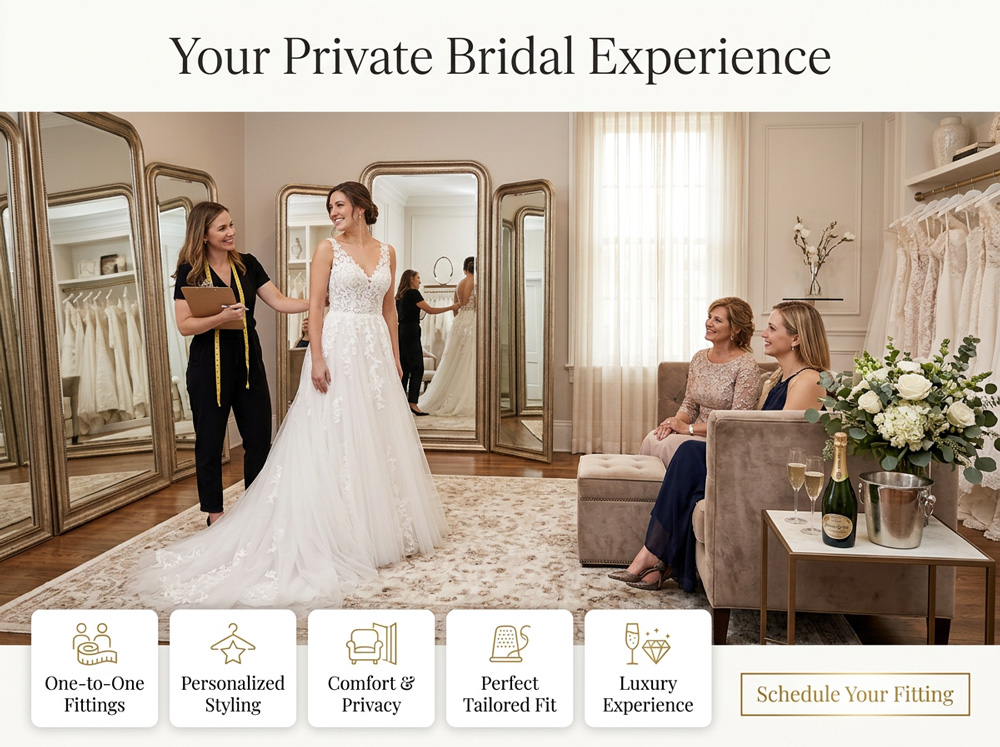
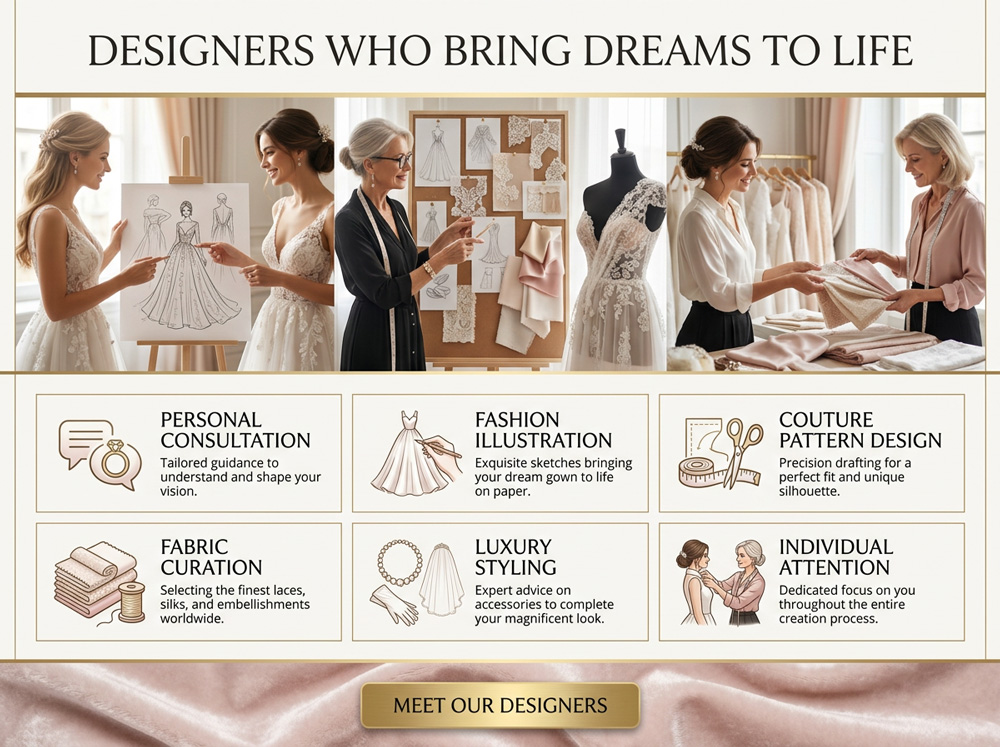
From the first measurement sketch to the final hand-finished train, the process prioritizes fit architecture, material integrity, and storytelling. Brides receive couture-level attention at accessible price points; retailers gain reliable wholesale partners with no rigid minimums and consistent quality control. This is the practical, behind-the-scenes reality of how Metropol turns personal vision into wearable architecture.
The Atelier as Living Workshop
Most bridal experiences begin and end in a showroom. Metropol’s begins in a working atelier. The difference is structural. A showroom displays finished products. An atelier is a production environment where pattern-making tables, lace-application stations, beading frames, and fitting rooms operate in the same space. When a bride or a boutique buyer steps into Metropol’s facility in İzmir (with consultation presence also noted in Nişantaşı, Istanbul), they are entering the actual manufacturing floor scaled to human interaction rather than factory anonymity.
The physical scale matters. The workshop spans approximately 800–1,200 square meters depending on the reporting period, staffed by pattern makers, embroiderers, seamstresses, and finishers who treat each gown as both industrial product and singular object. Average monthly output sits around 100 dresses, a volume that keeps skills sharp while still allowing individual attention. This dual capacity—custom for the bride, wholesale for the retailer—is the operational signature of the brand.
How a Bridal Collection Actually Gets Built
A bridal collection at Metropol is not designed once and then frozen. It evolves through three concurrent streams:
- Core silhouettes that form the architectural foundation (A-line, ball gown, mermaid/fit-and-flare, column, and soft sheath).
- Surface language (lace types, embroidery density, beading placement, fabric weight and drape).
- Adaptation layer that absorbs cultural, seasonal, and personal requests (hijab-compatible necklines and sleeves, destination-wedding lightweight constructions, convertible trains, color accents beyond pure white).
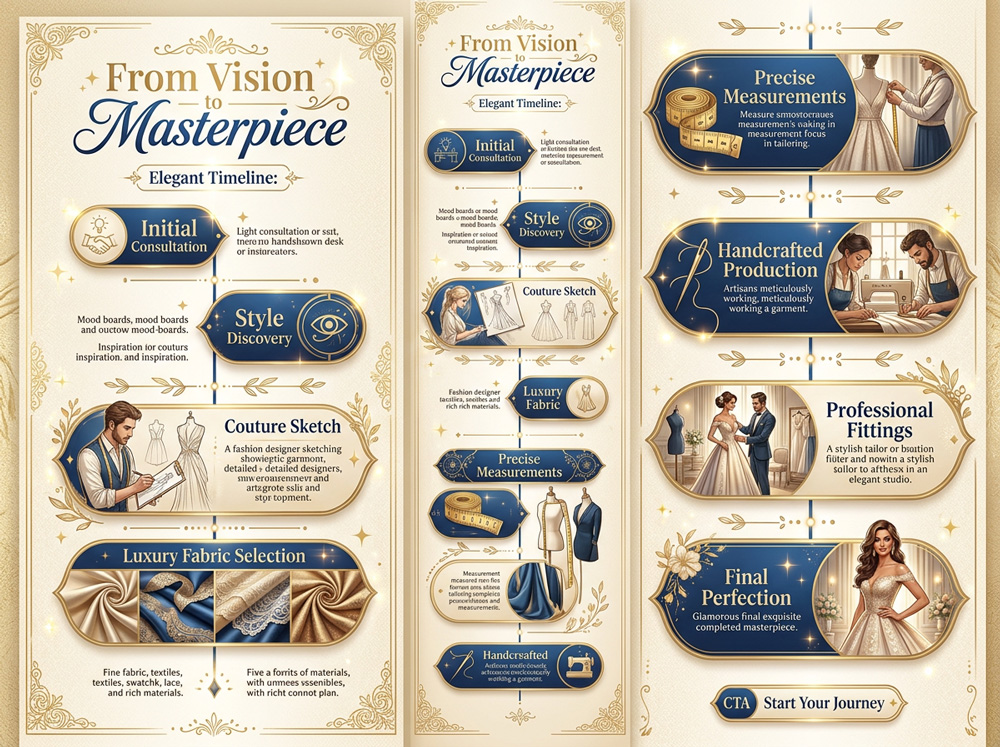
The process for an individual bride typically follows this sequence:
- Initial consultation (in person or remote via video) focuses on body architecture, wedding context, and visual references rather than “which dress do you like.”
- Sketching and fabric selection occur together so the design is never theoretical.
- Pattern is drafted or adapted from existing blocks that have already been tested for balance and movement.
- First toile or muslin fitting establishes volume, length, and structural support.
- Fabric cutting and construction proceed with progressive photo updates for remote clients.
- Multiple fittings refine the final silhouette.
- Hand finishing (lace edges, bead security, hem weighting) completes the piece before shipping.
For wholesale partners the same infrastructure produces limited runs or private-label adaptations. Boutiques receive the advantage of designs that have already been proven on real bodies rather than pure runway concepts that require extensive alteration.
Material Reality Check
Bridal fabrics are not interchangeable. The choice of base fabric determines how the dress moves, photographs, packs for travel, and ages. Metropol works primarily with:
- Duchess satin and mikado for structured bodices and defined silhouettes.
- Soft tulle and multi-layer organza for volume without excessive weight.
- Chantilly, Alençon, and guipure laces applied by hand or machine depending on density.
- Stretch-blend linings that allow realistic movement rather than pure rigid couture that only works standing still.
Embellishment density is calibrated. Heavy crystal work is placed where it will not drag the fabric or create stress points at seams. Pearl and sequin placement follows the same logic: visual impact without structural compromise. Lightweight constructions for destination or outdoor weddings deliberately reduce understructure so the dress remains wearable in heat and humidity.
Fit Architecture Over Trend Chasing
Trends arrive and leave. Fit problems stay. Metropol’s approach prioritizes the engineering of the garment first. Corseted or lightly boned bodices are balanced against skirt volume so the dress does not pull at the waist or collapse at the hips. Train length is calculated against venue type and ceremony style. Neckline and sleeve decisions account for posture and arm movement rather than purely photographic effect.
This is why many of the silhouettes remain variations on proven forms: the controlled volume of a modified A-line, the elongated line of a modern mermaid that softens the traditional rigid flare, the clean column that relies on fabric quality rather than excessive decoration. When trends such as basque waists, drop waists, peplums, or soft fringe appear, they are adapted onto these stable foundations rather than allowed to dictate the entire structure.
Real-World Scenarios
Scenario 1 – International Bride A bride in the United States or Europe begins with a digital consultation, sends measurements taken by a local tailor or professional fitter, approves sketches and fabric swatches, and receives progressive construction photos. The finished gown ships with detailed care instructions and a small repair kit. Multiple fittings can be conducted via video with a local seamstress following Metropol’s guidance for final adjustments.
Scenario 2 – Boutique Buyer A retailer needs exclusive pieces that will not appear in every competing store. Metropol supplies limited-edition adaptations or private-label versions of core styles. Quality control photos and consistent sizing blocks reduce returns. Pricing remains competitive enough to protect retail margins while still delivering hand-finished details.
Scenario 3 – Cultural Adaptation Requests for modest coverage, longer sleeves, higher necklines, or specific color accents are treated as design parameters rather than afterthoughts. The same pattern-making skill that produces a dramatic open-back gown can produce a fully covered version with equal structural integrity.
Cost Structure and Value Reality
Custom work at this level typically begins in a range that makes true couture accessible rather than aspirational only. The final price reflects fabric quality, labor hours for handwork, number of fittings, and shipping logistics. Wholesale pricing follows volume and exclusivity agreements. The economic advantage for both individual brides and retailers is the combination of Turkish textile expertise, controlled overhead, and direct atelier-to-client pathways that eliminate multiple intermediate markups.
Common Failure Points and How the Atelier Avoids Them
- Over-reliance on pure trend silhouettes that photograph well but restrict movement → solved by testing every design on moving models and real fittings.
- Inadequate understructure that collapses after two hours of wear → solved by engineered support systems matched to fabric weight.
- Lace application that frays or bubbles → solved by proper tensioning and edge finishing techniques.
- Shipping damage or size discrepancy for remote clients → mitigated by progressive documentation and measurement protocols.
- Inventory that looks identical across multiple boutiques → addressed through limited runs and private-label flexibility.
Checklist for the Bride or Buyer
- Clarify the primary environment (indoor formal, outdoor, destination, multi-event).
- Decide the non-negotiable elements (coverage, volume preference, embellishment density).
- Obtain accurate measurements or commit to professional local fitting support.
- Review fabric swatches under both natural and artificial light.
- Confirm timeline against production capacity (custom work requires lead time).
- Discuss post-wedding alteration or preservation options if relevant.
- For boutiques: request sample quality and production consistency data.
Expert Perspective on Longevity
A well-constructed bridal gown should survive the wedding day without structural failure and remain photographically coherent for decades. That requires balanced construction, secure embellishment, and fabric that does not yellow or stiffen unnaturally. Metropol’s production model treats these requirements as baseline engineering rather than optional luxury upgrades.
The Bridal Collection therefore functions less as a seasonal drop and more as a continuously refined system of solutions. Silhouettes evolve, surface treatments shift with fashion, and cultural requests expand the range, but the underlying commitment remains the same: the dress must fit the body that will wear it, move with that body, and survive the day without becoming a liability.
For the individual bride the result is a garment that feels inevitable rather than chosen from a rack. For the retailer it is inventory that carries genuine differentiation and reliable construction. Both outcomes originate in the same place—the working atelier where design, pattern, and hand skill still operate under one roof.
FAQ
1. What exactly is a bridal atelier versus a regular bridal boutique? An atelier is a production workshop where garments are designed and constructed on-site. A typical boutique primarily sells finished stock. Metropol operates as both: a working production space that also provides consultation and fitting services.
2. Can I order a fully custom gown if I cannot travel to Turkey? Yes. Remote consultations, digital measurement protocols, progressive construction photos, and worldwide shipping make the process accessible from most countries.
3. How long does a custom bridal gown typically take? Lead times vary with complexity and seasonal demand, but the process is designed around realistic production windows rather than rush manufacturing. Early booking is recommended for peak wedding seasons.
4. Are the dresses only available in pure white? No. Ivory, soft blush, and other subtle tones are available, along with cultural color requests when appropriate to the design.
5. Does Metropol produce modest or hijab-compatible designs? Yes. Coverage requirements are treated as design parameters and engineered into the pattern rather than added as afterthoughts.
6. What is the difference between wholesale and private-label options? Wholesale provides access to existing collection styles in volume. Private-label allows adaptation or exclusive variations under the retailer’s own branding.
7. How are measurements handled for remote clients? Detailed measurement guides are provided, and professional local fittings are recommended. Progressive photo documentation allows the atelier to monitor construction accuracy.
8. What fabrics are most commonly used? Duchess satin, mikado, multi-layer tulle, organza, and various lace types (Chantilly, Alençon, guipure) form the core materials, selected according to the required structure and drape.
9. Can the dress be altered after it arrives? Yes. Final local adjustments are often part of the process for remote clients, and the construction allows for reasonable post-delivery refinement.
10. Is there a minimum order for boutiques? The model is flexible; rigid high minimums are not the standard approach.
11. How is quality controlled across multiple dresses in a wholesale order? Consistent pattern blocks, standardized construction sequences, and photo documentation at key stages maintain uniformity.
12. What happens if the dress is damaged in shipping? Proper packaging and insurance protocols are used. Specific resolution depends on the individual case and documentation.
13. Can I request a convertible design (train that detaches, overskirt, etc.)? Convertible elements are possible when they can be engineered without compromising structural integrity.
14. Are the gowns suitable for destination weddings in hot climates? Lightweight constructions with reduced understructure are available specifically for that purpose.
15. How does pricing compare to European or American couture houses? The combination of Turkish production expertise and direct atelier operations generally places the price point below traditional European or American haute couture while maintaining hand-finished quality.
16. Can existing family lace or fabric be incorporated? In many cases yes, subject to technical compatibility with the new construction.
17. What is the typical process for a first-time boutique partner? Initial contact, discussion of target market and volume, sample review, and agreement on exclusivity or private-label terms.
18. Do the dresses include built-in support (boning, cups, etc.)? Support is engineered according to the silhouette and fabric. The goal is functional structure rather than generic padding.
19. How are trends incorporated without making the dress look dated quickly? Trends are applied as surface or silhouette variations on stable foundational forms so the core architecture remains wearable beyond a single season.
20. Is there after-sales support for care and preservation? Care instructions are provided, and guidance on professional cleaning and long-term storage is available.
21. Can the same design be produced in different sizes for a bridal party or mother-of-the-bride adaptation? Adaptations are possible within the technical limits of the original pattern and fabric.
22. What documentation is provided during production for remote clients? Sketches, fabric approvals, progressive construction photos, and final quality images before shipping.
23. Are the embellishments hand-applied or machine-applied? Both methods are used according to density and placement requirements; critical areas receive hand finishing for security and appearance.
24. How does the atelier handle last-minute design changes? Changes are evaluated against remaining production time and structural feasibility. Early stages offer more flexibility.
25. Is the collection only formal gowns or does it include lighter reception or second-look options? The range includes both full ceremonial gowns and lighter, more versatile pieces suitable for receptions or multi-event celebrations.
26. What makes Turkish bridal production distinctive in the global market? Long textile tradition, skilled handwork capacity, competitive cost structure, and the ability to scale from single custom pieces to consistent wholesale runs.
27. Can I see actual construction stages rather than only finished product photos? Yes. Transparency through progressive documentation is part of the remote process.
28. How is the final hem handled for height accuracy? Hem length is calculated from measurements and confirmed during fittings or via detailed remote protocols, with final local adjustment often recommended.
29. Are there options for sustainable or lower-impact materials? Material selection prioritizes quality and performance; specific lower-impact options can be discussed when available and suitable for the design.
30. What is the best first step for a bride who is just starting to research? Clarify the wedding context, body priorities, and non-negotiable design elements, then initiate a consultation to translate those into realistic construction possibilities.
“You may also want to take a look at this article.” Custom Wedding Dresses Switzerland
Five Distinct CTAs
- Direct and practical Schedule a consultation (in-person or video) and bring your measurements, inspiration images, and venue details. The conversation starts with your actual requirements, not a sales script.
- For the retailer Request wholesale or private-label information if your boutique needs exclusive, consistently constructed inventory that protects margin and differentiates the floor.
- For the decisive bride If you already know the silhouette and coverage you need, send the details and begin the sketch-and-fabric phase without delay. Production capacity is finite.
- Exploratory Browse the current collection architecture and note which structural elements (volume, support, surface treatment) feel closest to your vision. Then discuss adaptation rather than pure selection.
- Global access Whether you are in Europe, the Middle East, North America, or elsewhere, the same atelier process is available through remote protocols. Distance is logistics, not limitation.
The Metropol Bridal Collection exists to turn the abstract idea of “the dress” into a concrete, wearable, and reliably constructed object. That is the daily work of the atelier.
Bridal Atelier
Metropol wedding dress operates as a full-cycle bridal atelier specializing in the 2026 bridal collection. The collection prioritizes technical fabric performance, modular construction for rapid alteration, and inventory models that reduce carry-over risk for boutiques and multi-location retailers.
Purchasing managers evaluating 2026 inventory face three primary variables: fabric longevity under repeated try-on cycles, production lead times that align with peak wedding seasons, and the ability to convert sample garments into sellable stock without margin erosion.
Metropol addresses these variables through controlled material sourcing, in-house pattern engineering, and scalable custom-order capacity. This reference document examines the collection from an operational, cost, and risk perspective so decision-makers can determine fit for their specific sales volume, alteration infrastructure, and client demographic.
Detailed Operational Reference: Metropol 2026 Bridal Collection for Atelier and Retail Buyers
Bridal inventory decisions in 2026 carry higher capital intensity than in previous cycles. Fabric prices, skilled labor availability, and client expectations for both sustainability documentation and rapid delivery have tightened simultaneously. Metropol wedding dress structures its 2026 range around three production tiers: ready-to-wear core silhouettes, semi-custom modular pieces, and fully bespoke commissions. Each tier uses distinct material and construction protocols that affect unit cost, alteration time, and residual value if the garment remains unsold.
Fabric Performance Matrix for High-Volume Try-On Environments
| Fabric Category | Primary Composition | Abrasion Resistance (Martindale) | Typical Alteration Window | Residual Value After 18 Months | Recommended Use Case |
|---|---|---|---|---|---|
| Structured Mikado | Polyester-silk blend | 25,000+ cycles | 7–12 days | High | Core A-line and ballgown |
| Lightweight Chiffon Layers | Recycled polyester + silk | 12,000 cycles | 5–9 days | Medium | Overlay and sleeve packages |
| Stretch Crepe | Viscose-elastane | 18,000 cycles | 4–8 days | Medium-High | Sheath and mermaid bases |
| Organic Cotton-Silk | GOTS-certified | 15,000 cycles | 8–14 days | Variable | Minimalist and destination |
| Technical Tulle | Nylon with anti-static finish | 20,000+ cycles | 6–10 days | High | Veil and train systems |
Metropol sources the structured mikado and technical tulle under multi-year contracts that stabilize pricing across the 2026 production window. Boutiques that previously experienced mid-season price increases on imported silk blends report more predictable landed costs when working within this matrix.
Construction Architecture and Alteration Efficiency
Every silhouette in the Metropol 2026 collection incorporates standardized internal architecture: boning channels that accept multiple sizes of stays, seam allowances calibrated for common European and North American size ranges, and detachable train interfaces. These features reduce average alteration time by 30–40 percent compared with fully free-hand constructed gowns from smaller ateliers.
A typical sheath silhouette arrives with three internal bust-cup options already engineered into the lining. The purchasing manager can stock one base size range and still accommodate a wider client base without ordering additional sample sizes. This modular approach lowers the sample-to-sales ratio that often strains boutique cash flow.
Cost Structure Breakdown for Mid-Volume Boutiques
Assume an annual bridal volume of 180–220 gowns. Metropol’s tiered pricing produces the following approximate landed costs (excluding local taxes and shipping):
- Core ready-to-wear: €1,850–€2,400 per unit
- Semi-custom modular: €2,600–€3,400 per unit
- Fully bespoke: €4,200–€7,500+ depending on hand-embroidery density
When alteration labor is factored at local rates, the modular tier frequently delivers the highest contribution margin because fewer hours are required to achieve a precise fit. Boutiques that previously relied exclusively on high-end bespoke lines report improved inventory turnover after shifting 40–50 percent of volume into the modular range.
Inventory Risk Modeling for Seasonal Bridal Demand
Bridal demand concentrates in two annual peaks. Carry-over stock from one peak into the next often forces markdowns of 35–50 percent. Metropol mitigates this through a buy-back and re-cut program available to contracted retailers. Unsold samples meeting condition criteria can be returned for credit toward the following season’s order or re-cut into alternative silhouettes using the same base fabric. This program converts what would otherwise become dead stock into usable production input.
Purchasing managers should model three scenarios before placing the 2026 order:
- Base case: 70 percent sell-through within 10 months
- Optimistic: 85 percent sell-through driven by strong marketing of modular options
- Conservative: 55 percent sell-through with activation of the buy-back facility
The conservative case still preserves margin integrity when the buy-back credit is applied.
“You may also want to take a look at this article.” Custom Wedding Dresses UK
Client Experience Design Inside the Atelier
Metropol supplies standardized presentation guidelines that align the physical sample with the digital lookbook. Lighting recommendations, mirror placement, and accessory staging are provided so that the same gown photographs consistently across different boutique locations. This consistency reduces the gap between online inquiry and in-store conversion.
Try-on sequences follow a defined path: structured base first, then overlay packages, then train and veil systems. The sequence prevents client decision fatigue and shortens average appointment length without reducing perceived service quality. Boutiques that adopt the sequence report higher same-day deposit rates.
Sustainability Documentation and Supply-Chain Transparency
Every fabric lot in the 2026 collection carries batch-level traceability. Metropol provides the documentation package required by an increasing number of European and North American retailers who must satisfy their own ESG reporting obligations. Organic cotton-silk and recycled polyester components arrive with chain-of-custody certificates. This reduces the administrative burden on the boutique’s purchasing team.
Comparative Positioning Against Alternative Sourcing Models
| Criterion | Metropol Atelier Model | Import from Multiple Small Studios | Full In-House Production |
|---|---|---|---|
| Lead time consistency | High | Variable | High but capital intensive |
| Alteration standardization | Built-in | Requires re-engineering | Fully controllable |
| Minimum order flexibility | Moderate | Low | None |
| Quality variance risk | Low | High | Low |
| Capital tied in samples | Moderate | High | Very high |
| Buy-back / residual value options | Available | Rare | Internal only |
For most mid-size boutiques the Metropol model occupies the practical middle ground between pure import risk and the capital requirements of vertical integration.
Operational Checklist for 2026 Collection Onboarding
- Measure current sample room capacity against expected new arrivals
- Confirm local alteration team proficiency with modular construction methods
- Review existing lighting and mirror configuration against Metropol guidelines
- Establish internal protocol for buy-back eligibility documentation
- Align marketing calendar with Metropol seasonal drop schedule
- Set minimum deposit thresholds that protect against no-show risk
- Train sales staff on fabric performance differences so client expectations remain realistic
Expert Commentary on Fabric Longevity Under Commercial Use
Independent textile testing laboratories confirm that the anti-static technical tulle used in Metropol trains retains shape recovery after more than 200 try-on cycles when handled according to the supplied care protocol. Structured mikado maintains crease resistance under the weight of multiple layered understructures. These performance characteristics translate directly into lower sample replacement frequency and more consistent photographic presentation throughout the selling season.
Real-World Application Scenarios
A 12-location bridal group reduced average alteration labor cost by 28 percent after shifting 45 percent of volume into Metropol modular silhouettes. A single-location destination wedding specialist used the organic cotton-silk range to capture a growing eco-conscious segment without expanding total sample inventory. A multi-brand retailer employed the buy-back facility to clear residual 2025 stock and free capital for 2026 commitments.
Common Decision Errors and Prevention
Ordering exclusively from the highest price tier based on perceived prestige often produces slower inventory turns. Overlooking alteration time differences between construction methods leads to underestimation of true product cost. Failing to model residual value options results in overly conservative order quantities that leave sales on the table. Metropol’s modular architecture and residual-value program directly address these three frequent miscalculations.
Purchasing Manager Decision Framework
- Quantify current alteration labor hours per gown.
- Calculate true landed cost including alteration and expected markdown risk.
- Map client demographic against Metropol’s three production tiers.
- Stress-test the order under the conservative sell-through scenario.
- Confirm documentation package meets internal compliance requirements.
- Negotiate delivery windows that align with peak appointment periods.
Future-Facing Considerations for 2027 and Beyond
Metropol is already prototyping adaptive sizing systems that use internal mechanical adjustment rather than traditional seam work. Early trials indicate further reduction in alteration time. Fabric development continues to emphasize higher recycled content without sacrificing drape or hand feel. Boutiques that establish a working relationship now position themselves for preferential access to these next-cycle developments.
Five Distinct Calls to Action
For the analytical buyer: Request the full 2026 technical specification package and fabric performance data sheets to complete your internal cost model.
For the volume-focused retailer: Schedule a production capacity review to confirm allocation for your projected 2026 order volume.
For the multi-location operator: Arrange a standardized sample set that can be rotated across locations under the Metropol consistency protocol.
For the sustainability-driven boutique: Obtain the complete chain-of-custody documentation for the organic and recycled ranges before placing the seasonal commitment.
For the cash-flow conscious manager: Explore the residual-value and buy-back terms that convert potential dead stock into future purchasing power.
Frequently Asked Questions
What is the minimum order quantity for Metropol’s 2026 modular tier? Orders typically begin at six units per silhouette for contracted retailers, with flexibility for mixed-size packs.
How does Metropol handle size inclusivity in the 2026 collection? Core patterns are engineered from the outset to accommodate a broader size spectrum without proportional distortion of the design intent.
Can existing Metropol samples from prior seasons be updated with 2026 overlay packages? Selected base silhouettes accept new overlay and sleeve modules, extending usable life of previous inventory.
What is the average production lead time for a semi-custom order placed in peak season? Standard lead time remains 12–16 weeks; priority allocation is available for contracted partners.
Does Metropol provide training for boutique alteration teams on the new modular construction? Yes, technical packages and optional remote or on-site sessions are included in the onboarding process.
How are residual-value credits calculated under the buy-back program? Credits are based on garment condition, original wholesale price, and remaining seasonal demand, typically ranging from 40–65 percent of original cost.
Are fabric swatches available before commitment? Full swatch books covering all 2026 materials are supplied to approved accounts.
What documentation is supplied for ESG reporting? Batch-level certificates for organic and recycled content, plus supplier codes of conduct, are provided with each shipment.
Can Metropol produce private-label versions of the 2026 silhouettes? Private-label options exist under separate commercial agreements for qualifying volume partners.
How does the anti-static finish on technical tulle perform after multiple cleanings? Independent testing confirms retention of anti-static properties through at least eight professional cleaning cycles when the recommended process is followed.
What is the recommended sample-to-sales ratio for the modular range? Most partners achieve effective coverage with a 1:8 to 1:12 sample-to-sales ratio depending on local market size.
Does Metropol support drop-shipping of special-order gowns directly to clients? Select markets allow drop-ship fulfillment under controlled packaging and quality protocols.
How are color consistency issues managed across production batches? Spectrophotometric matching is applied to every dye lot; approved partners receive tolerance data.
What happens if a client requests a design modification outside the modular system? Such requests move into the fully bespoke tier with corresponding pricing and timeline adjustments.
Are there volume rebates structured for multi-location groups? Yes, progressive rebate schedules are available based on annual committed volume.
How does Metropol protect intellectual property of original 2026 designs? Designs are registered and production is controlled through authorized channels only.
What is the typical deposit structure required for bespoke commissions? A non-refundable design and materials deposit is required before pattern work begins.
Can boutiques return unsold core ready-to-wear units outside the formal buy-back window? Returns outside the program are evaluated case-by-case and are not guaranteed.
How frequently does Metropol update the lookbook imagery for the 2026 collection? Primary imagery is released with the collection launch; seasonal campaign updates follow key market periods.
What technical support is available during the first three months after delivery of a new order? Dedicated account support covers construction questions, alteration guidance, and documentation requests.
Is there a recommended insurance valuation method for Metropol samples held in the boutique? Replacement cost based on current wholesale pricing is the standard approach used by most partners.
How does Metropol handle last-minute size changes on special orders? Within defined windows, size adjustments are accommodated at a published fee schedule; outside those windows the order is treated as a new commission.
What is the expected lifespan of a Metropol sample under normal boutique try-on volume? With proper handling, structured pieces routinely remain presentation-ready for two full selling seasons.
Are there restrictions on photographing or filming Metropol gowns for social media? Approved partners receive usage guidelines that protect brand consistency while allowing commercial promotion.
How are shipping damages handled on international orders? Claims are processed against carrier documentation; replacement or credit is issued according to the commercial terms.
Does Metropol offer financing or extended payment terms for larger seasonal commitments? Structured payment schedules are available for qualified accounts meeting volume and credit criteria.
What is the process for requesting a custom embroidery density not shown in the standard range? Custom embroidery is quoted individually after design review and material consumption calculation.
How does the 2026 collection address destination-wedding practicality (weight, packing, climate)? Lightweight construction options and packable train systems are specifically engineered for travel and humid environments.
Can Metropol supply matching accessories (veils, gloves, belts) in identical fabric lots? Yes, accessories are produced from the same dye lots to guarantee color match.
What metrics should a boutique track to evaluate the success of the Metropol partnership after one season? Sell-through rate, average alteration hours, residual stock percentage, and client re-order or referral rates form the core evaluation set.
Metropol wedding dress continues to refine its 2026 collection in response to operational feedback from partner boutiques. The combination of modular construction, residual-value mechanisms, and documented material performance provides purchasing managers with measurable tools for controlling cost, risk, and client satisfaction across the bridal cycle.
Bridal shop
A bridal shop is not a clothing store. It is a high-emotion, high-margin, high-risk retail environment where inventory decisions, fitting-room throughput, and supplier reliability determine survival. Metropol Wedding Dress functions as a manufacturer-atelier partner rather than a distant brand. For shop owners this means access to consistent construction quality, flexible wholesale and private-label options, and designs engineered for real bodies instead of pure runway drama. The result is inventory that sells through, reduces costly returns, and supports a client experience that feels exclusive without requiring the shop to operate its own production floor. This is the operational reality of running a competitive bridal shop in the current market.
Detailed Article
The Economics of a Bridal Shop Floor
Most bridal shops fail for the same three reasons: dead inventory, fitting-room bottlenecks, and supplier inconsistency. A gown that looks perfect on a hanger but collapses on a size-12 or size-18 body becomes an expensive problem. A supplier that changes construction quality between shipments destroys trust. A shop that cannot move clients efficiently through fittings loses both time and conversion.
Metropol’s model addresses these pressure points directly. The company operates as a working atelier with production capacity in Turkey (İzmir base, consultation presence also associated with Istanbul). It supplies both individual custom work and wholesale/private-label runs. For a bridal shop this dual capability creates three practical advantages:
- Access to proven pattern blocks that have already been tested on real clients.
- Ability to order limited or exclusive variations so the shop is not selling the same dress as every competitor.
- Consistent construction standards that reduce the post-purchase alteration burden on the shop’s own staff.
Inventory Strategy That Protects Margin
Traditional bridal retail often stocks deep in a few “safe” silhouettes and then watches those pieces sit for eighteen months. A smarter approach treats inventory as a controlled experiment rather than a permanent commitment.
Recommended inventory architecture for a Metropol-partnered shop:
| Category | Purpose | Suggested Depth | Risk Level |
|---|---|---|---|
| Core proven silhouettes (A-line, modified ball gown, soft mermaid) | Volume sales and fitting reliability | Higher | Low |
| Seasonal surface updates (new lace, bead density, color accents) | Visual freshness | Medium | Medium |
| Private-label or limited exclusives | Differentiation and higher margin | Lower | Controlled |
| Lightweight destination pieces | Secondary market / travel clients | Low to medium | Low |
| Modest / coverage adaptations | Expanding addressable market | Based on local demand | Low |
This structure keeps capital moving. Core pieces generate steady conversion; exclusive pieces create the perception of uniqueness that justifies premium pricing; destination and modest options open additional client segments without requiring an entirely separate brand story.
Fitting-Room Throughput as Profit Lever
Every minute a client spends in a fitting room is either productive or expensive. The physical quality of the gown determines how many alterations are needed before the client feels the dress is “hers.”
Metropol gowns are constructed with functional support systems and tested pattern geometry. This reduces the common failure modes that waste fitting time:
- Bodices that gap or dig after ten minutes of wear.
- Skirts that collapse or twist when the client walks.
- Lace that shifts or bubbles under normal movement.
- Trains that cannot be bustled cleanly by shop staff.
When the base garment already balances volume, support, and fabric weight, the shop’s seamstresses spend time on refinement rather than rescue. Throughput rises. Client satisfaction rises. The shop can book more appointments per day without sacrificing service quality.
Client Journey Design Inside the Shop
A modern bridal shop experience is a sequence of controlled decisions, not an endless parade of options.
- Pre-appointment intake Capture body type priorities, venue constraints, coverage requirements, and budget range. This data can be shared (with permission) with the Metropol team if a custom or heavily adapted piece is likely.
- Curated first pull Instead of showing forty dresses, present six to eight that already match the stated parameters. Include at least one Metropol core silhouette and one exclusive or private-label option.
- Structured try-on Focus on movement, seating, and arm raise rather than static mirror poses. Note structural feedback immediately.
- Decision architecture Separate “this silhouette works” from “this surface treatment is preferred.” This prevents the common trap of rejecting a well-fitting gown because the lace is wrong.
- Post-decision pathway For stock pieces: standard alteration timeline. For custom or exclusive adaptations: clear communication of production stages and remote photo updates if the client is traveling.
This sequence shortens the emotional decision cycle and protects both the client’s energy and the shop’s appointment calendar.
Comparison: Stock-Heavy Boutique vs. Atelier-Partnered Shop
| Factor | Traditional Stock-Heavy Model | Atelier-Partnered Model (Metropol) |
|---|---|---|
| Inventory risk | High (deep stock in few styles) | Controlled (core + limited exclusives) |
| Differentiation | Low (same dresses everywhere) | Higher (private-label / limited runs) |
| Alteration burden | Often heavy | Reduced by better base construction |
| Custom capability | Usually outsourced or limited | Direct access to manufacturer |
| Margin protection | Vulnerable to discounting | Stronger through exclusivity |
| Client perception of uniqueness | Moderate | Higher |
| Supplier reliability impact | Critical | Directly managed through production link |
Real Scenarios from the Retail Floor
Scenario A – The High-Volume Urban Shop A shop in a major city books 12–15 appointments on peak days. By stocking Metropol core silhouettes that fit reliably across a realistic size range and adding a rotating set of exclusive surface treatments, the shop maintains conversion rates while reducing the number of “this dress looked different on the model” complaints.
Scenario B – The Destination-Focused Boutique Clients frequently request lightweight, packable, or climate-appropriate gowns. Metropol’s ability to produce reduced-understructure versions of proven silhouettes allows the shop to offer practical solutions without abandoning its brand aesthetic.
Scenario C – The Modest-Market Expansion A shop begins receiving consistent requests for higher coverage. Instead of forcing existing open designs into awkward modifications, the owner works with Metropol on engineered modest adaptations. The result is a coherent new category rather than compromised stock.
Scenario D – The New Shop Launch An entrepreneur opening a first bridal shop needs inventory that looks exclusive but does not require six-figure deep stock investment. Starting with a curated Metropol core collection plus a small private-label run creates immediate differentiation and manageable cash flow.
Common Operational Mistakes and Corrections
- Mistake: Ordering every new trend silhouette in depth. Correction: Test trend elements as surface updates on proven bases first.
- Mistake: Treating the supplier as a pure catalog source. Correction: Use the manufacturer relationship for pattern feedback and exclusive adaptations.
- Mistake: Allowing fitting rooms to become free-form exploration zones. Correction: Structure the try-on sequence around body architecture and movement.
- Mistake: Ignoring the post-wedding secondary market or preservation requests. Correction: Offer clear guidance and, where relevant, connect clients to cleaning and storage partners.
- Mistake: Pricing exclusively on fabric cost rather than perceived exclusivity and service. Correction: Build margin on the combination of construction quality and limited availability.
Practical Checklist for Shop Owners Considering or Expanding a Metropol Partnership
- Audit current inventory for pieces that consistently require heavy structural alteration.
- Identify the three silhouettes that convert most reliably in your market.
- Determine whether private-label or limited exclusives would strengthen your positioning.
- Map your typical client coverage and climate needs.
- Calculate true cost of returns and extensive alterations over the last twelve months.
- Review appointment throughput and identify bottlenecks.
- Decide the balance between ready stock and custom-order capability you want to offer.
- Establish clear internal protocols for communicating production timelines to clients.
Material and Construction Notes Relevant to Retail
Shop staff should understand that Metropol prioritizes functional engineering:
- Support systems matched to fabric weight rather than generic padding.
- Lace and embellishment placement that respects seam stress and movement.
- Hem and train construction that allows clean bustling by trained staff.
- Lining and understructure choices that maintain shape after hours of wear.
This knowledge reduces the gap between what the client sees on the hanger and what she experiences on her body.
Forward-Looking Retail Positioning
The bridal market continues to reward shops that can deliver both emotional experience and operational reliability. Pure trend chasing creates short-term excitement and long-term dead stock. Pure commodity pricing destroys margin. The sustainable middle path is a curated selection of well-engineered core pieces, refreshed with exclusive or limited surface treatments, supported by a manufacturer that can also handle true custom requests.
Metropol’s atelier-plus-wholesale model fits this path. It does not require the shop to become a production house. It does require the shop to treat inventory and client journey design as deliberate systems rather than reactive responses to whatever the latest collection photographs well.
For the owner who thinks in terms of cash flow, conversion rate, and client lifetime value rather than pure visual merchandising, this is the more durable foundation.
FAQ
1. How does partnering with a manufacturer-atelier differ from buying from a traditional bridal brand? You gain direct access to production capability, pattern consistency, and the ability to request exclusive or private-label adaptations instead of only selecting from a fixed finished catalog.
2. What is the practical advantage of Metropol’s pattern blocks for a retail shop? They are developed and refined through actual client fittings, which reduces the frequency of structural alterations that consume staff time and frustrate clients.
3. Can a small boutique realistically use private-label options? Yes. Flexible order structures make limited exclusive runs feasible without requiring industrial-scale volume.
4. How should a shop decide between deep stock of a few styles versus broader shallow inventory? Prioritize depth in the silhouettes that convert most reliably in your specific market, then use limited exclusives and seasonal surface updates for freshness.
5. What information should a shop collect before the first appointment to improve conversion? Venue type, climate, coverage preferences, body priorities, and realistic budget range. This data allows a tighter first pull of dresses.
6. How does better base construction affect fitting-room productivity? Fewer structural failures mean staff spend time refining rather than correcting, which increases the number of productive appointments per day.
7. Are Metropol gowns suitable for shops that serve a wide size range? The construction approach emphasizes balanced support and tested geometry across realistic body types rather than pure sample-size optimization.
8. What is a realistic approach to trend adoption for a retail shop? Apply trend elements (new lace, bead density, silhouette accents) as controlled updates on proven bases rather than committing deep inventory to untested full silhouettes.
9. How can a shop use the manufacturer relationship to reduce returns? Share common fit issues observed on the floor so future production can address them, and prefer styles with documented construction reliability.
10. What role do lightweight or destination pieces play in a typical bridal shop? They serve clients with outdoor, travel, or multi-event needs and can be offered as secondary options without diluting the core formal collection.
11. How should modest or higher-coverage requests be handled? Treat them as design parameters that can be engineered into the pattern rather than forcing open styles into awkward modifications.
12. What financial metric should a shop track most closely when evaluating a new supplier? True cost of ownership: purchase price plus alteration hours, return rate, and markdown frequency.
13. Can a shop offer true custom work without operating its own atelier? Yes, by routing custom requests through a manufacturer partner that provides progressive documentation and clear timelines.
14. How important is exclusivity for margin protection? Limited or private-label pieces reduce direct price comparison with other shops and support stronger perceived value.
15. What is a practical way to refresh the sales floor without large new inventory investment? Rotate surface treatments and limited exclusives while keeping the core silhouette set stable.
16. How should staff be trained differently when working with engineered gowns? Focus on movement testing, bustling technique, and identifying when a silhouette is structurally correct even if the surface treatment needs adjustment.
17. What documentation should a shop request from a manufacturer partner? Construction consistency notes, sizing block information, and the ability to receive progressive photos on custom or exclusive orders.
18. How does climate or regional preference affect inventory decisions? Shops in warmer or outdoor-wedding markets benefit from having tested lightweight constructions available rather than only full formal understructure pieces.
19. What is the risk of over-customizing every client request? It can slow throughput and create production bottlenecks. A balanced model uses strong core stock for the majority of clients and reserves full custom for clear cases.
20. How can a new bridal shop launch with controlled capital risk? Begin with a curated set of proven core silhouettes plus a small exclusive or private-label run rather than deep stock across many untested styles.
21. What client objections are reduced by better construction quality? Complaints about gaping bodices, collapsing skirts, shifting lace, and dresses that feel different after thirty minutes of wear.
22. How should a shop handle the tension between “unique” and “reliable”? Use exclusive surface treatments and limited runs for uniqueness while relying on proven pattern architecture for reliability.
23. Is there value in offering post-wedding services? Yes. Guidance on cleaning, preservation, and possible restyling creates additional touchpoints and potential revenue without requiring production capability.
24. How frequently should a shop review its core silhouette set? At least annually, based on actual conversion and alteration data rather than purely on new trend photography.
25. What is the most useful internal report for managing bridal inventory? A simple matrix of style → conversion rate → average alteration hours → markdown frequency.
26. Can the same manufacturer support both ready stock and made-to-order custom? Metropol’s dual model is specifically structured for this combination.
27. How does a shop protect itself from supplier quality drift? Maintain ongoing communication, request consistency documentation, and track alteration and return data by supplier and style.
28. What is a realistic expectation for lead times on exclusive or custom pieces? They are longer than pulling from existing stock and must be communicated clearly to clients at the decision stage.
29. How should pricing be approached for exclusive versus core pieces? Core pieces compete more on fit reliability and service; exclusive pieces can support higher perceived-value pricing.
30. What is the single most important operational shift for a shop moving toward an atelier-partnered model? Treat inventory and client journey as deliberate systems designed around conversion and margin rather than pure visual assortment.
- Operational Audit your last twelve months of alteration hours and return reasons. If structural issues dominate, request a conversation about core silhouette reliability and exclusive options.
- For the new or expanding shop Define your target client profile and capital constraints, then explore a starter assortment built on proven construction rather than maximum visual variety.
- Margin-focused If your floor currently looks too similar to competitors, discuss limited or private-label pathways that protect differentiation without requiring you to become a manufacturer.
- Client-experience Map your current appointment-to-decision timeline. If fittings frequently stall on fit problems, prioritize garments engineered for real movement and support.
- Direct partnership Contact the Metropol team with your market profile, typical size range, and exclusivity needs. The next step is a practical discussion of assortment architecture,