Personalized Wedding Dresses
Personalized Wedding Dresses Designing your own wedding dress online turns the traditional bridal shopping experience into a collaborative, creative partnership. With Metropol Wedding Dress, brides worldwide can shape every detail—silhouette, fabric, neckline, embellishments, and fit—through virtual consultations, digital sketches, precise measurements, and handcrafted production in İzmir.
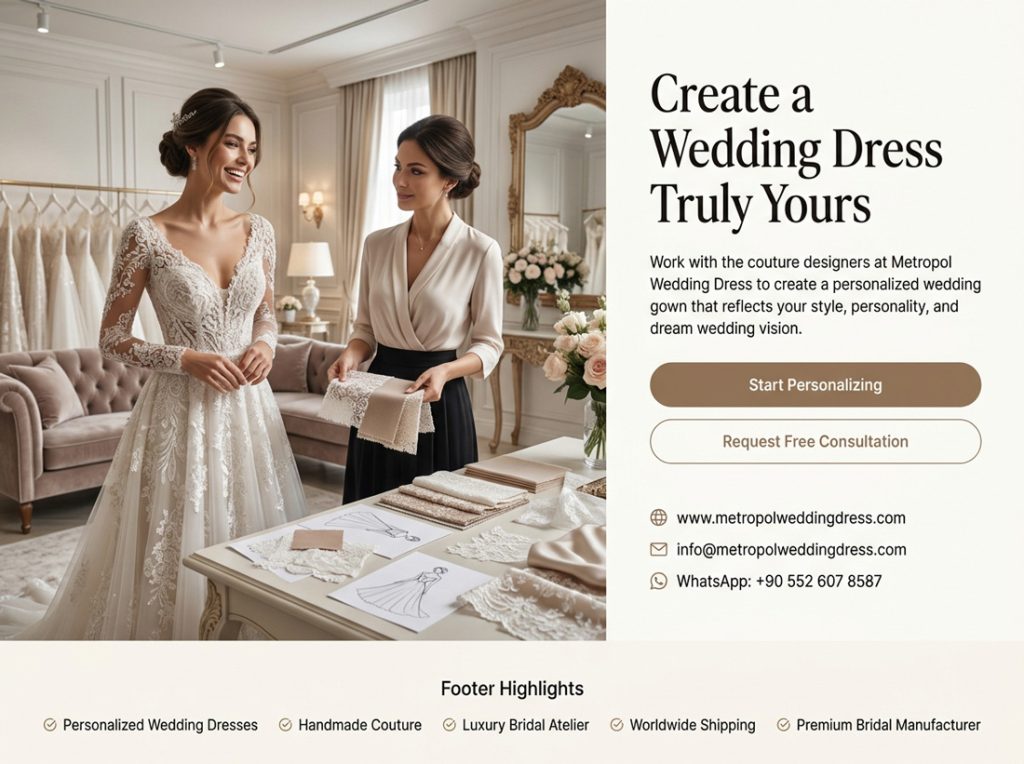
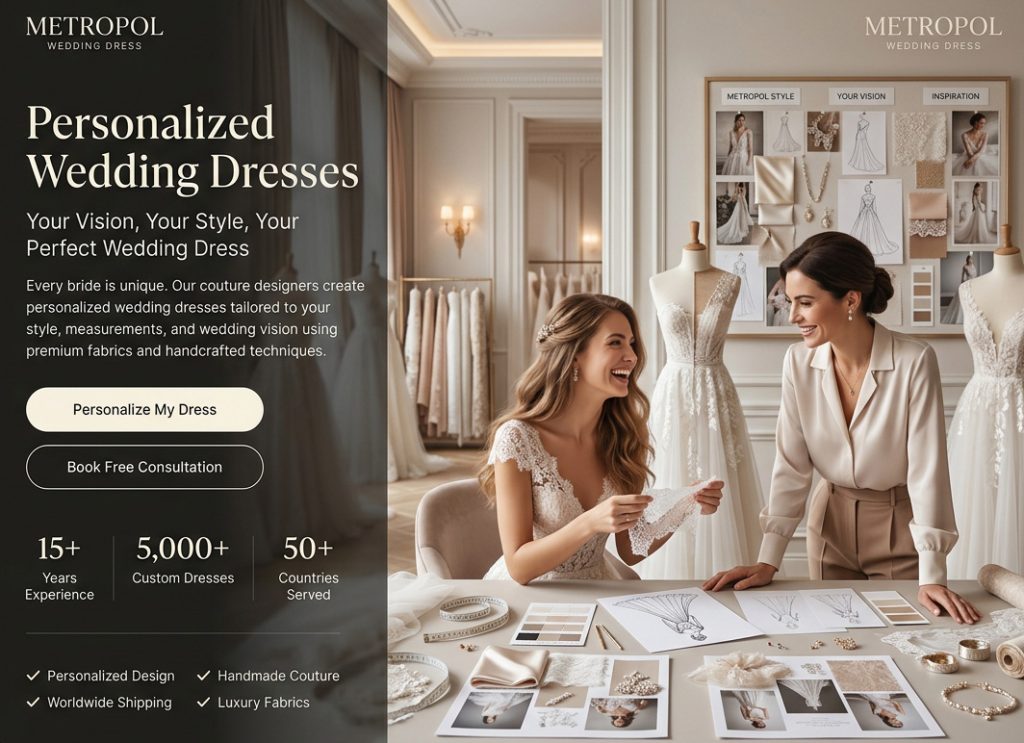
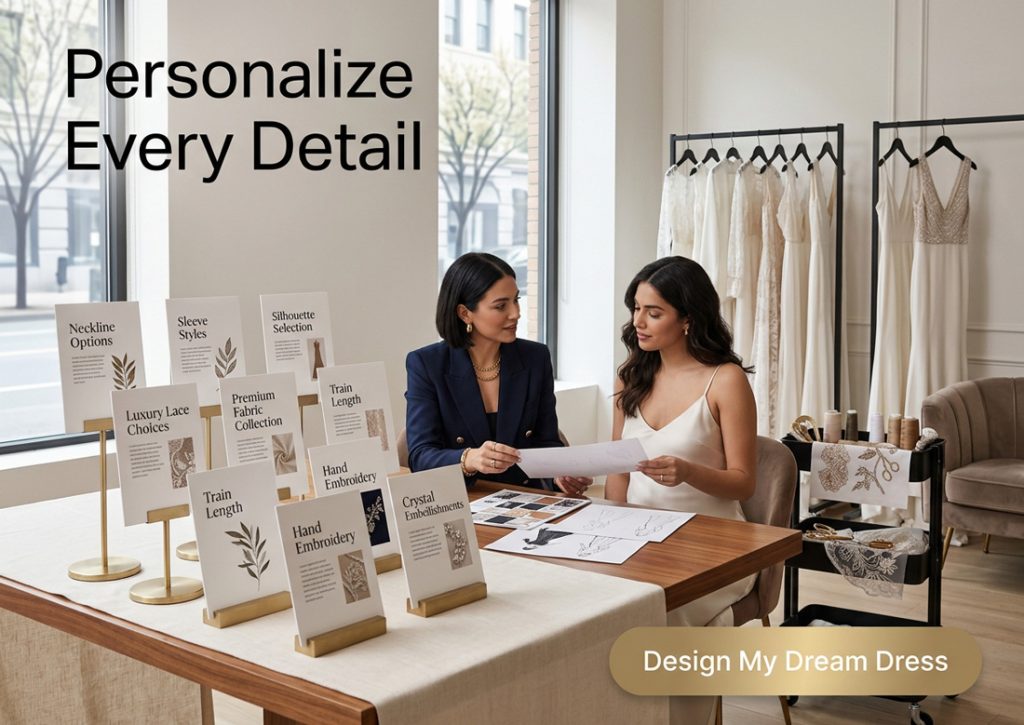
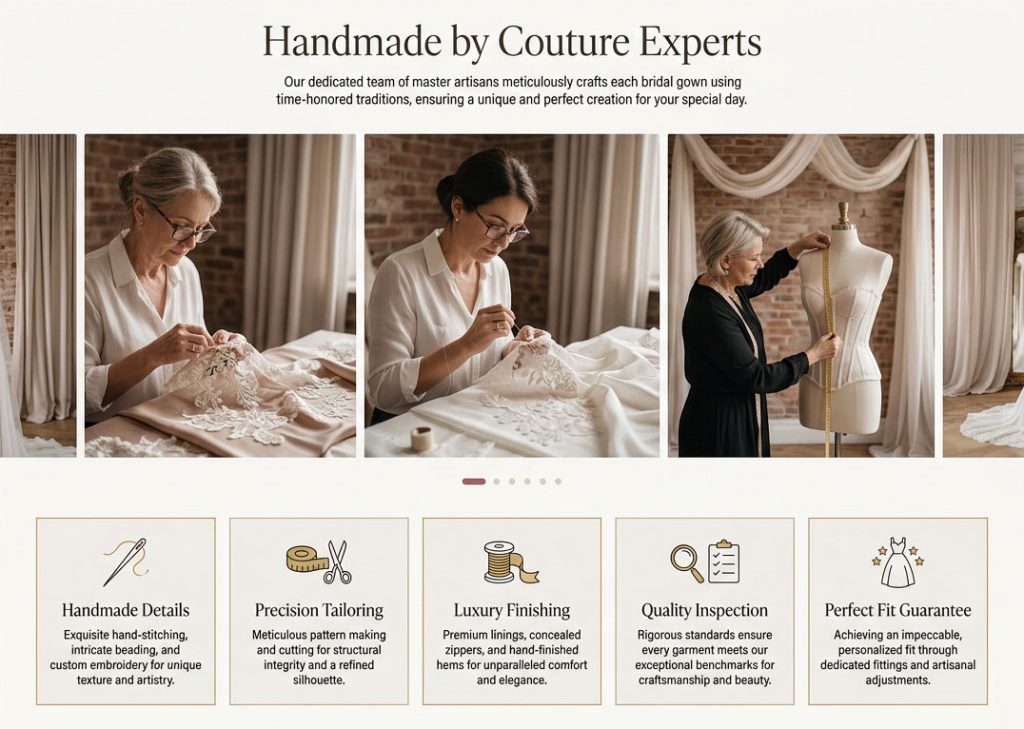
The result is a one-of-a-kind gown that fits perfectly, reflects personal style, and often delivers better value than high-end boutique or couture alternatives. This guide covers the full journey: from inspiration and fabric science to production timelines, cost drivers, common pitfalls, and real-world scenarios, giving brides the knowledge and confidence to create a dress that feels uniquely theirs.
The Shift from Rack to Reality: Why Personalized Online Design Matters Now
Bridal fashion has moved beyond “finding the one” on a rack. Modern brides want a dress that tells their story—venue, season, cultural background, body shape, and personal aesthetic—without compromise. Online personalization platforms and ateliers like Metropol Wedding Dress make this possible by combining digital tools (sketches, virtual try-ons, measurement guides) with traditional couture craftsmanship.
Instead of limiting yourself to existing silhouettes and standard sizes, you begin with a blank canvas. You share inspiration photos, discuss fabric behavior under natural light or movement, refine proportions for your exact measurements, and approve every stage before the final fabric is cut. The process typically spans several months and produces a gown that no one else will wear.
Metropol, based in Istanbul with more than two decades of experience and an 800-square-meter workshop, specializes in this model. The brand works directly with brides and with boutiques worldwide, offering full customization of silhouette, neckline, sleeves, train, lace placement, beading, and hidden personal details while maintaining accessible pricing relative to many Western couture houses.
Quick Orientation: What “Design Your Own” Actually Involves
Core elements you control
- Silhouette (A-line, mermaid, ballgown, sheath, column, tea-length, convertible)
- Bodice structure (corset, soft, illusion, structured)
- Neckline and back design
- Sleeve style or strapless options
- Skirt volume, layers, and train length
- Fabric and lace selection
- Embellishment density and placement
- Color (ivory, soft white, blush, champagne, or subtle accents)
- Personal touches (embroidery of dates, coordinates, monograms, heirloom lace incorporation)
What stays in expert hands Pattern drafting, draping, fabric cutting, construction integrity, internal support systems, and quality control.
This division of labor is why online custom design succeeds: the bride drives vision and preference; skilled pattern makers and seamstresses ensure the dress moves, sits, and photographs correctly.
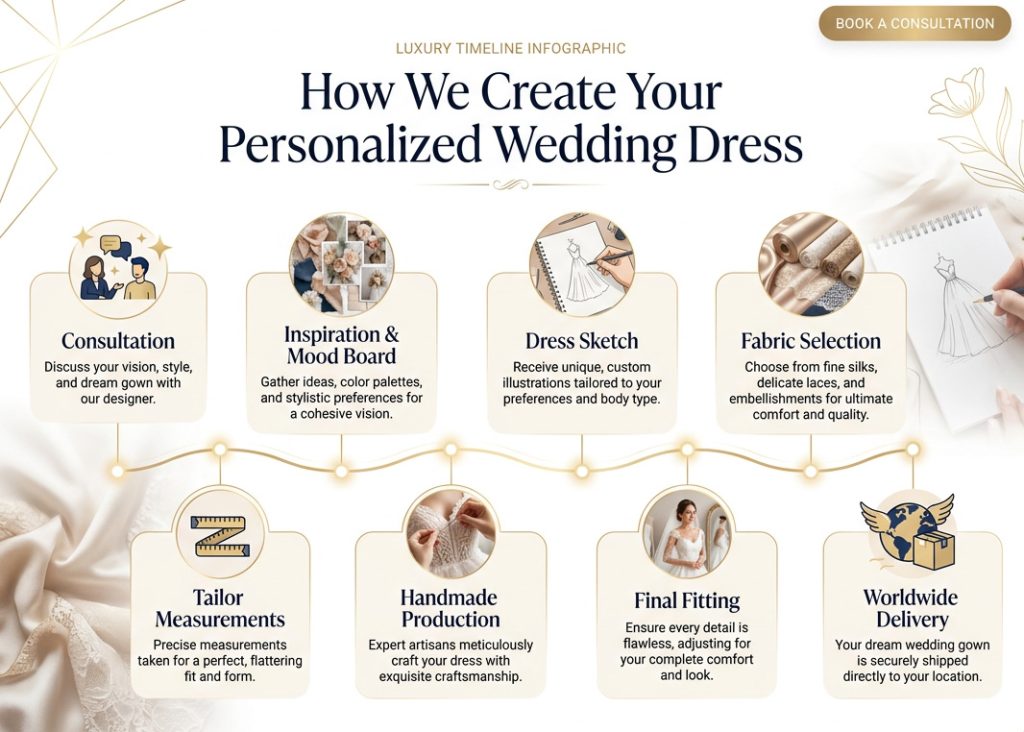
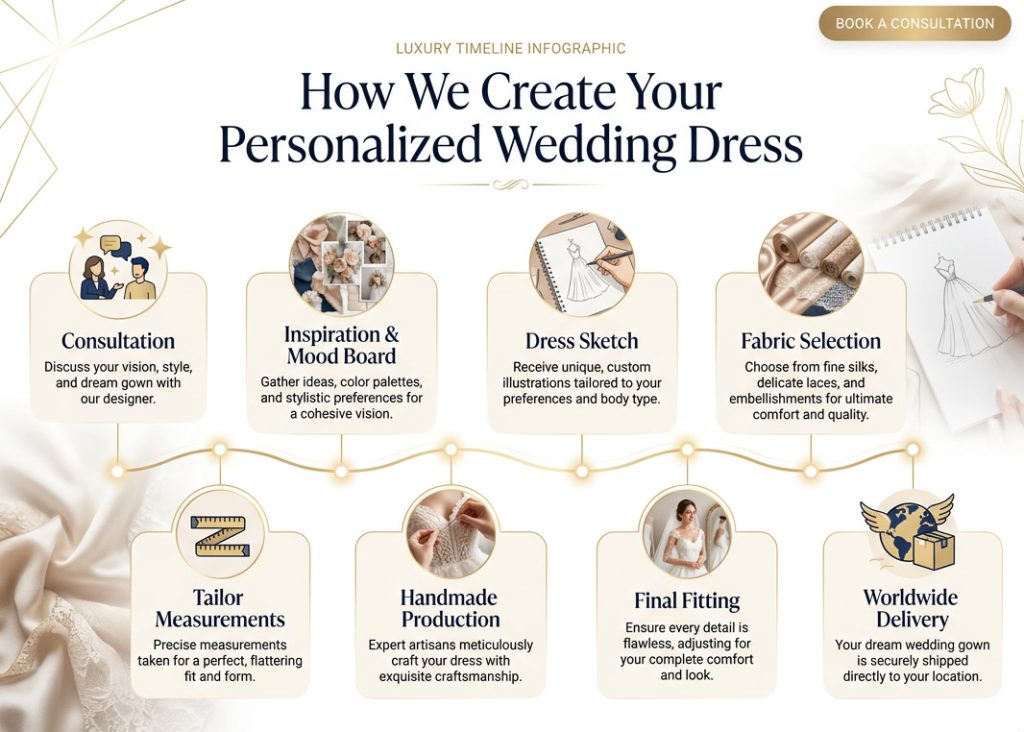
The Step-by-Step Online Design Journey with Metropol
- Inspiration Collection and Initial Consultation Gather 10–20 images that capture mood, not necessarily exact dresses. Note venue type, season, desired level of formality, and any non-negotiables (pockets, mobility for dancing, cultural coverage requirements). Book a virtual consultation. Metropol designers discuss practical constraints early—fabric weight for outdoor heat, train management for venue floors, or support needs for specific body types.
- Digital Sketching and Option Exploration Designers produce sketches or 3D-style visualizations based on your input. Multiple versions are common: one classic, one bolder, one simplified for budget or timeline. You request adjustments—higher neckline, different lace density, altered sleeve volume—until the direction feels right.
- Precise Measurement Protocol Accurate measurements are non-negotiable. Metropol provides detailed guides (bust, underbust, waist, hips, hollow-to-hem, arm circumference, shoulder width, and more). Photos from specific angles help verify proportions. For complex shapes, additional notes on posture or preferred shoe height are included. This step replaces the guesswork of standard sizing and dramatically reduces later alteration needs.
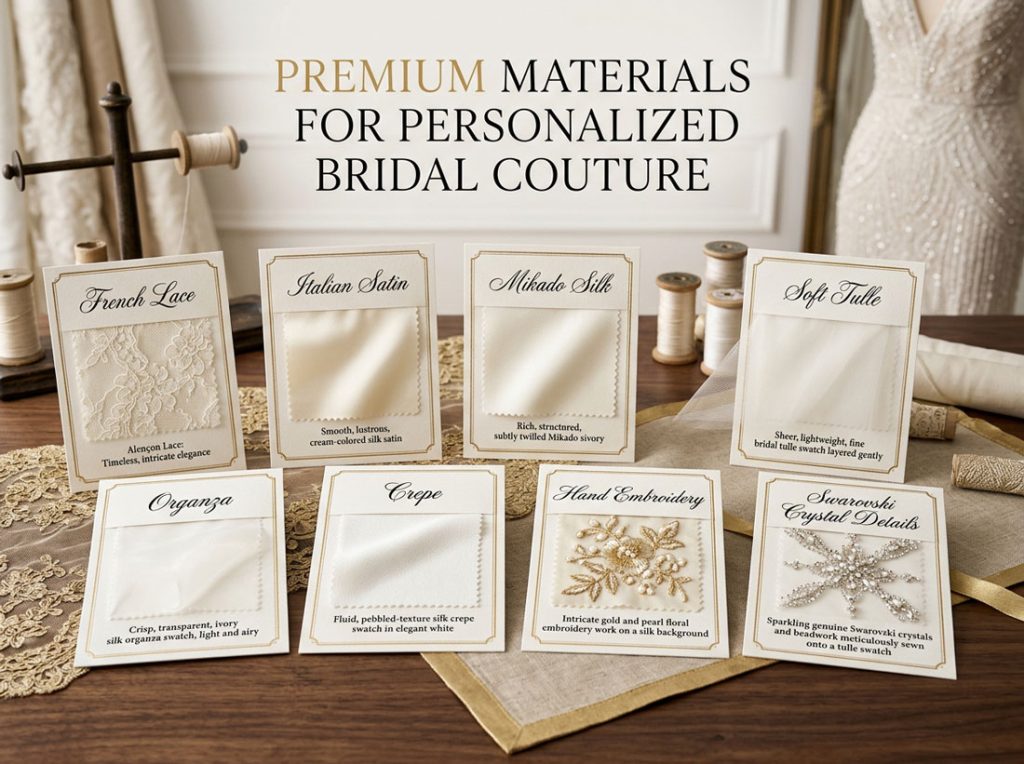
- Fabric and Material Selection Swatches or high-resolution digital samples are shared. Decisions here affect drape, temperature comfort, photography, and longevity. (Detailed fabric analysis follows in a later section.)
- Prototype / Muslin Stage (When Applicable) For highly customized or structured designs, a muslin or toile may be created and fitted virtually or with local assistance. Photos and measurements refine the pattern before expensive fabric is cut.
- Production and Progress Updates Hand-cutting, lace application, beading, and construction occur in the atelier. Metropol typically shares photos after key stages (lace placement, construction progress). Brides approve before final finishing.
- Delivery, Final Fit, and Minor Adjustments The finished gown arrives with enough lead time for any local tweaks. Because the dress was built to your measurements, alterations are usually minimal.
Typical overall timeline: 4–6 months for standard custom work; longer for heavily beaded or complex multi-layer designs. Ordering 6–8 months before the wedding provides comfortable buffer.
Material Science for Brides: Choosing Fabrics That Perform
Fabric is not decoration—it dictates movement, temperature regulation, structure, and how the dress photographs.
Silk family
- Duchess satin / Mikado: firm body, excellent for architectural skirts and structured bodices; holds shape in heat better than softer satins.
- Charmeuse or crepe-back satin: fluid drape, soft sheen, ideal for column or soft A-line styles.
- Chiffon and georgette: lightweight, airy, excellent for overlays and soft movement; less structured.
Lace categories
- Chantilly: delicate, soft hand, romantic.
- Alençon or Guipure: more defined motifs, greater structure.
- Corded or embroidered lace: dimensional interest; placement requires skill so motifs sit correctly on the body.
Support and volume layers
- Tulle (soft vs. stiff): soft for floaty skirts, structured for volume without excessive weight.
- Organza: crisp, holds shape for sleeves, bows, or overlays.
- Mesh / illusion tulle: near-invisible for necks, backs, and sleeves when matched carefully to skin tone.
Practical selection table
| Desired Effect | Recommended Primary Fabric | Best Supporting Layers | Climate / Venue Notes |
|---|---|---|---|
| Structured ballgown | Mikado or heavy satin | Stiff tulle + horsehair | Holds shape outdoors; can feel warm |
| Soft romantic A-line | Silk chiffon or soft satin | Soft tulle | Breathable; moves beautifully |
| Sleek modern column | Crepe or charmeuse | Minimal lining | Cool and comfortable for dancing |
| Illusion / modern minimal | Fine mesh + lace appliqué | Soft organza accents | Skin-tone matching critical |
| Outdoor / beach | Lightweight chiffon or lace | Soft tulle only | Avoid heavy beading that traps heat |
Metropol sources premium silks, French and Italian laces, and quality tulle, allowing brides to balance aesthetics with real-world wearability.
Production Process Inside the Atelier
Understanding construction builds trust. A typical custom gown moves through:
- Pattern drafting from measurements and approved design.
- Fabric preparation and careful hand-cutting (especially important for patterned lace so motifs align).
- Bodice construction with internal corsetry or soft structure as required.
- Skirt assembly and layering.
- Lace application, beading, and embroidery—often the most time-intensive stage.
- Finishing: hem, closures (zip, buttons, corset back), bustle options, and quality inspection.
Each stage includes quality checks for symmetry, stitch integrity, and movement. Photos shared with the bride confirm progress and allow course correction while it is still easy.
Cost Reality: What Drives Price and How to Plan
Custom online design often lands in a more accessible range than traditional haute couture while delivering superior personalization and fit.
Typical market ranges (2025–2026 context):
- Entry-level made-to-measure or lightly customized: roughly $1,500–$3,000
- Fully custom with moderate embellishment: $2,500–$5,500
- Heavily beaded, multi-layer, or complex architectural pieces: higher
Metropol’s direct model and Istanbul production base help keep costs competitive relative to many European or U.S. couture houses while maintaining handmade quality.
Major cost drivers
- Fabric quality and quantity (premium silk and French lace raise the total)
- Handwork hours (beading, embroidery, complex lace placement)
- Structural complexity (built-in corsetry, multiple skirt layers, convertible elements)
- Timeline (rush fees if under 4 months)
- Shipping and any import considerations for international brides
Value comparison perspective Many brides discover that a fully custom gown ends up comparable in total cost to a mid-to-high boutique dress plus extensive alterations. The custom route eliminates the “almost perfect but needs major changes” problem and removes the risk of the same dress appearing on multiple brides.
Practical Scenarios and Decision Frameworks
Scenario 1 – Outdoor summer garden wedding Prioritize breathable fabrics (chiffon, soft lace, lightweight satin). Choose moderate train length or detachable options. Avoid heavy beading that increases heat retention. Soft A-line or column silhouettes perform well.
Scenario 2 – Formal evening cathedral or ballroom Structured fabrics and fuller skirts or dramatic trains shine. Illusion details or statement backs photograph beautifully under formal lighting. Built-in support ensures the dress holds shape for long hours.
Scenario 3 – Destination or travel wedding Consider packability and local climate. Convertible designs (detachable sleeves or overskirts) offer ceremony-to-reception flexibility. Confirm shipping timelines and customs requirements early.
Scenario 4 – Non-standard body proportions or strong style preferences Custom design is the clearest advantage. Standard sizing rarely accommodates significant differences in torso length, hip-to-waist ratio, or preferred coverage. Precise measurements and pattern adjustments solve this at the source.
Common Mistakes and How to Avoid Them
- Ordering too late → Start the process 6–8 months out.
- Focusing only on photos without considering movement and comfort → Discuss dancing, sitting, and temperature during consultation.
- Choosing fabric purely by appearance → Request guidance on weight, drape, and climate suitability.
- Underestimating measurement accuracy → Follow the provided guide carefully; take measurements more than once.
- Changing major design elements late → Lock the core silhouette and fabric early; reserve late changes for minor details.
- Ignoring bustle and practical logistics → Plan how the train will be managed during the reception.
Expert Tips for a Smooth Experience
- Build an inspiration board that includes both dresses and non-dress references (architecture, nature, art) to communicate mood more clearly.
- Be honest about budget and timeline from the first conversation.
- Ask for progress photos at defined milestones.
- Consider a second look or detachable elements if you want dramatic change between ceremony and reception without a full second dress.
- Think beyond the wedding day: many custom gowns can be altered later for anniversary or special occasions if the base design is classic.
Checklist Before You Begin Designing Online
- Wedding date and venue confirmed
- Approximate budget range set
- Inspiration images collected (10–20)
- Body measurements guide reviewed
- Preferred silhouette or must-have details listed
- Climate and activity level considered
- Communication preference (email, video, messaging) noted
- Shipping destination and any customs questions prepared
Why Metropol for Personalized Online Design
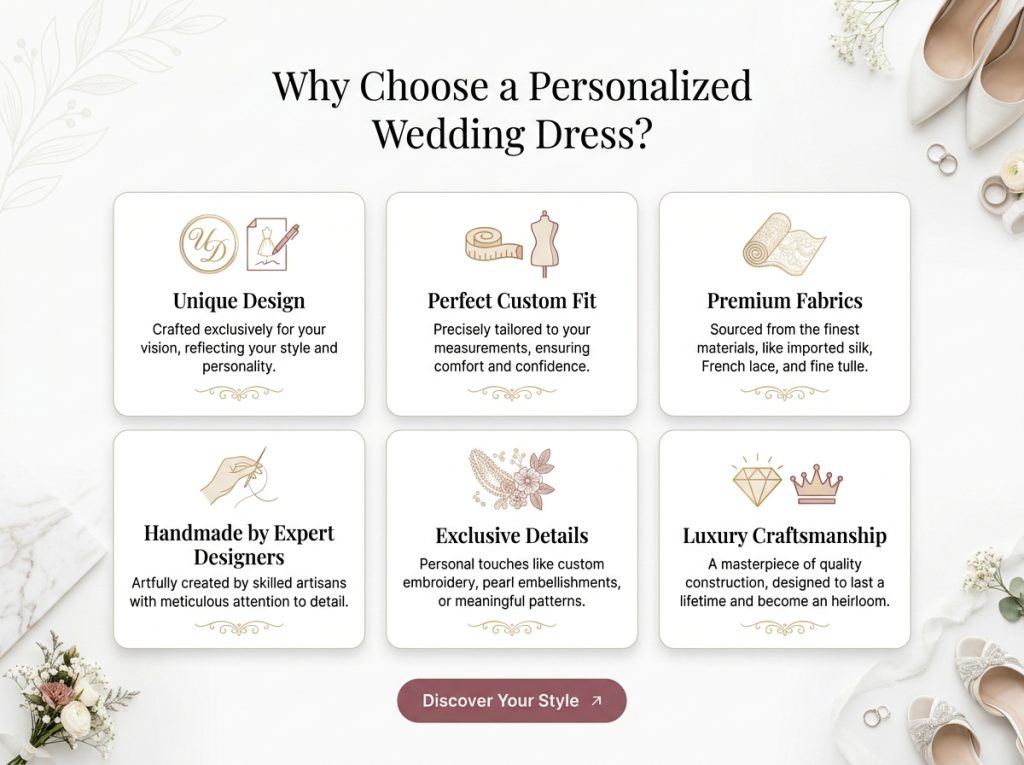
Metropol combines two decades of bridal expertise, a dedicated production workshop, and a collaborative online process. Brides receive personalized attention from design through construction, access to quality materials, and a gown built specifically for their body and vision. The Istanbul location supports both individual clients and wholesale partners seeking distinctive, customizable inventory.
The brand emphasizes exclusivity—no two dresses identical—along with practical fit and lasting craftsmanship. Virtual tools and clear communication make the experience accessible regardless of geographic distance.
Closing Perspective
A personalized wedding dress designed online is not merely a product; it is a collaborative creation. When the process is handled with clear communication, accurate measurements, thoughtful fabric choices, and skilled construction, the result is a gown that feels inevitable—exactly what you imagined, only better because it was made for you.
Metropol Wedding Dress exists to make that outcome reliable and joyful. Begin with your inspiration, schedule a conversation, and move step by step from idea to finished dress.
FAQ – Personalized Wedding Dress Design Online
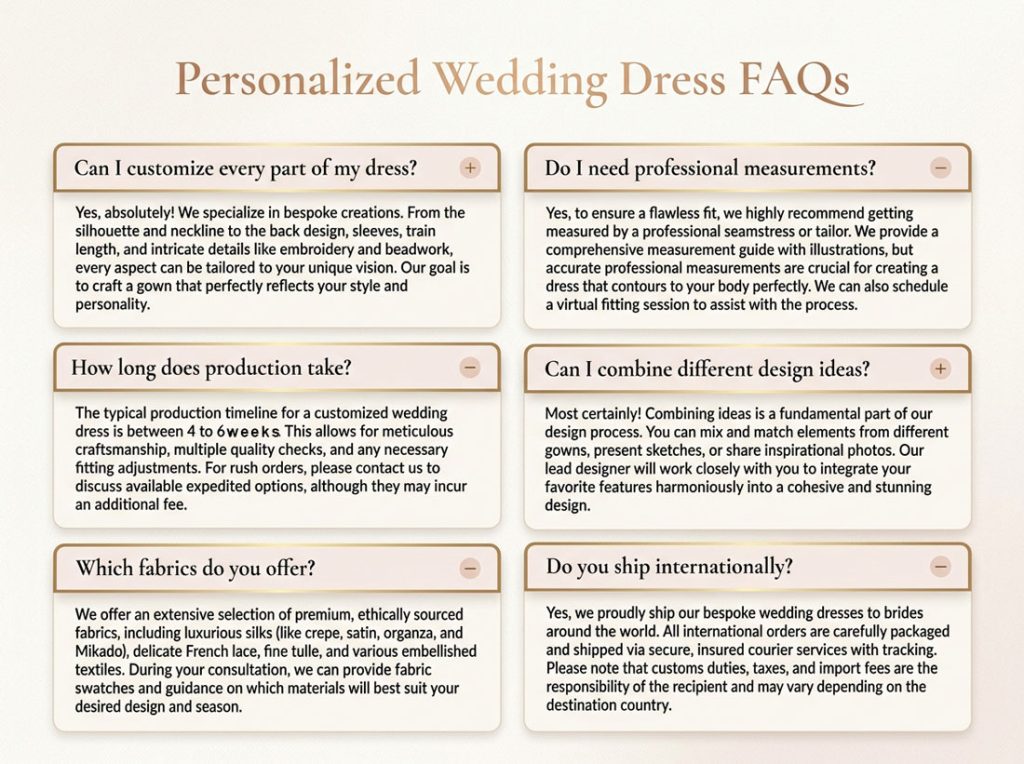
1. How does designing a wedding dress online with Metropol actually work? You share inspiration and preferences via virtual consultation. Designers create sketches, you refine them, provide precise measurements, select fabrics, and approve stages while the gown is handcrafted in the Istanbul atelier. Progress photos keep you involved.
2. How long does the full process usually take? Most custom gowns require 4–6 months from design approval to delivery. Complex beading or multi-layer designs may need more time. Order 6–8 months before the wedding for comfort.
3. What measurements are required? A comprehensive set including bust, underbust, waist, hips, hollow-to-hem, torso length, arm measurements, shoulder width, and others. Detailed guides and photo verification ensure accuracy.
4. Can I incorporate family heirloom lace or fabric? Yes, many brides send heirloom pieces that are carefully integrated into the new design.
5. What if I change my mind about a detail mid-process? Minor adjustments are often possible early. Major silhouette or fabric changes become costly or impossible once cutting begins, which is why the sketch and fabric approval stages are thorough.
6. How are fabrics chosen when I cannot touch them in person? High-quality digital images, detailed descriptions, and physical swatches (when feasible) are provided. Designers advise on drape, weight, and climate suitability based on experience.
7. Is the dress made to my exact measurements or a standard size adjusted? Fully custom pattern drafted from your measurements for optimal fit.
8. What happens if the dress needs alterations after arrival? Because it is built to your measurements, major alterations are rare. Local minor adjustments (hem, bustle) can be handled by a trusted seamstress; guidance is provided.
9. Can the design include cultural or religious coverage requirements? Yes. Modest necklines, sleeves, overlays, or hijab-compatible options are regularly accommodated.
10. How much does a fully personalized Metropol gown typically cost? Pricing depends on complexity, fabrics, and embellishment. The direct production model keeps many custom designs competitive with mid-to-high boutique ranges while delivering uniqueness and fit.
11. Are there extra fees for plus sizes or petite proportions? Custom construction is based on individual measurements, so sizing adjustments are inherent rather than surcharged in the same way as standard ready-to-wear.
12. Can I request a convertible design (detachable train, sleeves, or overskirt)? Yes. Convertible elements are popular for ceremony-to-reception versatility.
13. How is quality controlled during production? Multiple internal checks for symmetry, construction integrity, lace placement, and finishing, plus progress photos shared with the bride.
14. What shipping options and timelines apply internationally? Secure shipping is arranged with tracking. Timing depends on destination; customs and duties (if any) are the client’s responsibility in most cases. Details are confirmed at order stage.
15. Can I see the dress on a mannequin or model before final approval? Progress photos on the form or mannequin are typically provided at key stages.
16. Is it possible to design a non-white or colored gown? Yes. Ivory, soft white, blush, champagne, and subtle color accents are common; stronger colors can be discussed.
17. What if my wedding is outdoors in hot weather? Fabric weight and layering are adjusted for breathability. Designers advise against heavy beading or dense multi-layers in high heat.
18. How detailed can personal embroidery or monograms be? Initials, dates, coordinates, short phrases, or subtle motifs can be incorporated on the lining, hem, or discreet areas.
19. Do you offer second looks or reception dresses as part of the process? Many brides design a primary gown and a simpler second look or removable elements for the reception.
20. What makes Metropol different from other online custom bridal services? Long-standing atelier experience, hands-on production control in Istanbul, collaborative design process, and focus on both individual brides and boutique partners seeking distinctive pieces.
21. Can I start the process if my wedding date is still flexible? Yes, but a target date helps prioritize timeline and fabric availability.
22. How do I prepare for the first consultation? Collect inspiration images, note non-negotiables, have a rough budget range, and know your approximate measurements or be ready to take them.
23. Is there a deposit or payment schedule? Typically a deposit secures the design and production slot, with balance due before shipping. Exact terms are confirmed during the quote stage.
24. What if I need the dress sooner than the standard timeline? Rush production may be possible depending on current workshop capacity and design complexity; additional fees usually apply.
25. Can the same design be adapted for bridesmaids or mothers of the bride? While the focus is bridal, coordinated custom pieces can sometimes be discussed for the wedding party.
26. How is lace motif placement decided? Designers plan placement so key motifs sit flatteringly on the bodice and skirt; bride input is welcomed.
27. Are internal support systems (corsetry, cups) included? Yes, structured support is built according to the design and the bride’s preferences for comfort and shape.
28. What happens to unused fabric or leftover lace? Leftovers are generally retained by the atelier unless specific arrangements are made.
29. Can I request a specific closure (buttons, zip, lace-up)? Yes. Closure type is chosen for both aesthetics and practicality (ease of dressing, security).
30. How do I know the dress will photograph well? Designers consider light reflection, fabric texture, and silhouette under typical wedding photography conditions and can advise on camera-friendly details.
31. Is virtual try-on or 3D visualization available? Sketches and progressive visualizations are standard; more advanced digital tools may be used depending on the design complexity.
32. What if my measurements change slightly closer to the wedding? Minor fluctuations can often be accommodated with local alterations. Significant changes should be communicated early.
33. Can the gown be designed for easy alteration into a non-bridal dress later? Classic silhouettes and moderate embellishment make future restyling more feasible.
34. How transparent is the production process? Progress photos and clear communication at defined stages provide visibility without requiring constant oversight.
35. What support is available after the dress arrives? Guidance on care, steaming, bustling, and minor local adjustments is provided.
36. Are there design limitations based on fabric availability? Most requested materials are available; rare or highly specific laces may require sourcing time.
37. Can multiple design directions be explored before committing? Yes. Initial consultations often produce several sketch options.
38. How does the process handle international time zones? Communication is flexible via email, messaging, and scheduled video calls at mutually convenient times.
39. Is the final gown unique to me? Yes. Each Metropol custom dress is made specifically for the individual client and is not replicated for another bride.
40. What is the best first step to begin? Gather inspiration images and request a consultation. The conversation will clarify feasibility, timeline, and next actions.
Five Distinct CTAs (use as appropriate on the landing page)
- Soft and inviting: “Ready to see your vision take shape? Share your inspiration and schedule a no-pressure conversation with a Metropol designer.”
- Confident and direct: “Design the dress that exists only for you. Begin your custom journey with Metropol Wedding Dress today.”
- Practical and reassuring: “Get a clear quote and timeline based on your ideas. Start with a free design consultation.”
- Emotion-focused: “Your love story is one of a kind. Your dress should be too. Let’s create it together.”
- Action-oriented: “Upload your favorite images and tell us what matters most. Your personalized wedding dress process starts here.”
Most people assume “custom” automatically equals $8,000–$20,000+. That figure reflects high-overhead boutiques, multiple physical fittings in expensive cities, designer name premiums, and sometimes inefficient processes. A different model exists: experienced ateliers that work directly with brides (and boutiques), use precise measurement protocols, source quality materials intelligently, and keep production in a dedicated workshop rather than fragmented high-cost locations.
Metropol Wedding Dress operates in this second model. From an 800-square-meter atelier in Istanbul, the team designs and constructs personalized gowns with full control over silhouette, fabric, lace placement, embellishment, and fit. The result is exclusivity and superior fit at price levels that many brides find more rational than buying a standard dress and then spending heavily on alterations that still leave the design only partially “theirs.”
Affordability here means value engineering: every design and production decision is weighed for its impact on both beauty and total cost.
Cost Architecture of a Custom Wedding Dress
Understanding where money actually goes removes mystery and prevents overspending.
Illustrative price bands (market context 2025–2026)
| Approach | Typical Range | What You Usually Receive | Hidden or Extra Costs |
|---|---|---|---|
| Off-the-rack + heavy alterations | $1,200–$4,000 total | Existing design, standard size adjusted | Alterations $400–$2,000+, limited uniqueness |
| Mid-range boutique made-to-order | $2,000–$5,000 | Designer style, limited personalization | Boutique markup, possible extra fees |
| Fully custom online / atelier | $1,800–$5,500 | Design from your vision, exact measurements | Controlled by complexity choices |
| Traditional haute couture | $8,000–$25,000+ | High prestige, multiple in-person fittings | Overhead, name premium, travel |
Metropol’s positioning sits in the fully custom band while leveraging efficient production and direct communication to keep many designs accessible.
How Metropol Keeps Personalized Dresses Affordable Without Sacrificing Quality
Several structural advantages reduce cost while preserving craftsmanship:
- Direct production control — Design, pattern, cutting, and sewing happen under one roof rather than through multiple intermediaries.
- Measurement-first process — Accurate body data from the start dramatically cuts the need for expensive post-delivery alterations.
- Intelligent material selection guidance — Designers help brides choose fabrics and lace densities that deliver the desired effect without excess yardage or ultra-premium price tags where they are not needed.
- Collaborative digital workflow — Virtual consultations, sketches, and progress photos replace multiple costly in-person appointments.
- Scalable atelier capacity — Serving both individual brides and wholesale partners allows better material purchasing and workshop utilization.
These factors create room for true personalization at rational price points.
Material Decisions That Protect the Budget
Fabric and lace choices create the largest swing in final cost. Smart selection maintains beauty while controlling spend.
“You may also want to take a look at this article.” Custom Wedding Dresses Austria
High-impact, moderate-cost options
Where savings are often painless
- Using high-quality but not ultra-rare lace for large skirt overlays
- Choosing efficient train lengths rather than extreme cathedral lengths that consume fabric and complicate bustling
- Limiting multi-layer understructures when a cleaner silhouette is acceptable
Practical fabric decision table
| Desired Look | Budget-Conscious Approach | Higher-Spend Alternative | Cost Impact |
|---|---|---|---|
| Soft romantic volume | Soft tulle + strategic lace appliqué | Full French lace overlay + dense beading | Significant |
| Clean modern column | Quality crepe or satin | Heavy Mikado + extensive handwork | Moderate to high |
| Structured ballgown | Firm satin + controlled stiff tulle | Multi-layer horsehair + crystal work | High |
| Illusion / delicate detail | Fine mesh + focused lace placement | Continuous embroidered illusion panels | Moderate |
Metropol designers routinely guide clients through these trade-offs so the final gown feels luxurious without unnecessary expense.
Because the dress is built to the individual from the beginning, the common (and expensive) cycle of “buy standard → major reconstruction” is avoided.
Budgeting Strategies for Custom Brides
Set a realistic total envelope early Include the gown, shipping, possible minor local adjustments, and a small contingency. Communicate the range honestly during the first conversation.
Prioritize what matters most Rank elements: silhouette accuracy, fabric feel, specific lace, train length, embellishment density, or special personal details. Allocate budget to the top two or three and simplify elsewhere.
Choose timeline wisely Standard production windows avoid rush premiums. Starting 6–8 months before the wedding is usually optimal for cost control.
Consider convertible or multi-use elements Detachable sleeves, overskirts, or trains can deliver ceremony drama and reception practicality from one investment.
Leverage the atelier’s expertise Experienced designers know which details deliver the highest visual impact relative to labor and material cost. Use that knowledge.
Real Scenarios: Affordable Custom in Practice
Scenario A – Garden wedding, moderate budget Soft A-line or column silhouette in quality crepe or light satin, focused lace at bodice and hem, moderate train, minimal overall beading. Result: personal, photogenic, and comfortable without excess layers or handwork hours.
Scenario B – Formal indoor evening, value focus Structured bodice with clean lines, strategic lace or beading on upper portion, efficient skirt volume. Avoids extreme fabric consumption while delivering presence under formal lighting.
Scenario C – Destination or travel wedding Lighter fabrics, packable construction, convertible options. Shipping and practicality are planned from the start so the total cost remains controlled.
Scenario D – Non-standard proportions Custom pattern eliminates the usual alteration cascade. The investment in exact fit often costs less overall than buying a standard size and reconstructing it.
Expert Guidance on Balancing Desire and Budget
Experienced bridal production teams consistently observe that the most satisfied brides are those who make clear hierarchy decisions early. A dress with excellent proportions, good fabric, and a few carefully chosen details almost always feels more special than a gown overloaded with every possible embellishment.
Metropol’s process is designed to surface these decisions collaboratively so the final result feels intentional rather than compromised.
Comparison Framework: Custom Affordable vs. Other Paths
| Factor | Affordable Custom (Metropol model) | Traditional Boutique RTW + Alterations | High Couture |
|---|---|---|---|
| Design ownership | High | Low to moderate | Very high |
| Fit precision | High (from start) | Variable | High |
| Total typical cost range | Competitive mid-range | Often similar or higher after alterations | Significantly higher |
| Time investment | Structured virtual process | Multiple appointments + alterations | Multiple high-touch fittings |
| Uniqueness | Complete | Limited | Complete |
| Risk of compromise | Low if process followed | Higher | Low |
Care and Longevity Considerations That Protect Value
A well-made custom gown, properly stored after the wedding, retains emotional and potential monetary value. Follow care instructions for the specific fabrics, have the dress professionally cleaned if needed, and store it properly. Many brides later alter classic custom pieces for anniversary or formal events, extending the return on the original investment.
Closing View
Affordable custom wedding dresses are the product of intentional design and efficient production rather than reduced quality. When an atelier controls the full process, guides material choices intelligently, builds from accurate measurements, and communicates clearly, personalization becomes accessible.
Metropol Wedding Dress exists to make that combination reliable. Brides receive a gown that is genuinely theirs—fitted correctly, designed to their vision, and constructed with care—without the cost structure of traditional high-overhead couture.
The most useful next step is a conversation that maps your priorities against realistic options. From there, every decision can protect both the beauty of the final dress and the integrity of the budget.
“You may also want to take a look at this article.” Custom Wedding Dresses Belgium
FAQ – Affordable Custom Wedding Dresses
1. Can a fully custom wedding dress really be affordable? Yes. When production is direct, measurements are precise from the start, and material and embellishment choices are guided intelligently, custom gowns frequently land in competitive mid-range price bands while delivering uniqueness and superior fit.
2. What is the typical price range for a Metropol personalized gown? Pricing varies with fabric, complexity, and embellishment density. Many designs fall into ranges that compare favorably with mid-to-high boutique options once alterations are factored in. A clear quote is provided after design discussion.
3. Where do most cost savings come from in this model? Direct atelier control, reduced intermediary markups, measurement-first construction that minimizes later alterations, and collaborative guidance on high-impact versus high-cost details.
4. Does “affordable” mean lower quality fabrics? No. It means strategic selection. Quality silks, laces, and tulles are used; the difference lies in density of coverage, yardage efficiency, and focusing premium materials where they deliver the greatest visual return.
5. How much do alterations usually cost on a standard dress versus a custom one? Standard dresses frequently require $400–$2,000+ in alterations. A properly measured custom gown typically needs only minor local adjustments, if any.
6. Can I get a custom dress under a specific budget? Yes, provided priorities are clear. Designers help simplify or focus elements so the result stays within the agreed envelope while remaining personal and well-made.
7. What details increase cost the fastest? Dense overall beading or embroidery, rare or large quantities of premium lace, extreme multi-layer structures, very long trains, and rush production.
8. What details give high visual impact at moderate cost? Strong silhouette and proportion, strategic lace placement at key areas, good main fabric, clean construction, and thoughtful back or neckline details.
9. Is shipping included or extra? Shipping costs depend on destination and are confirmed at the quote stage. International clients should also consider possible customs or duties.
10. How far in advance should I start to avoid rush fees? Six to eight months before the wedding is generally optimal for both cost control and comfortable production pacing.
11. Can I change the design later without major extra cost? Early-stage changes (during sketch and fabric selection) are far less expensive than changes after cutting begins. Locking core decisions early protects the budget.
12. Do plus-size or petite proportions cost more? Custom construction is based on individual measurements, so the process itself does not apply the same surcharges common in standard sizing systems.
13. Are there cheaper fabric alternatives that still look luxurious? Yes. Certain high-quality satins, crepes, and carefully chosen laces deliver excellent photography and drape results at more accessible price points than the rarest options.
14. How transparent is pricing during the process? Quotes are based on the agreed design and materials. Progress communication and defined milestones keep expectations aligned.
15. Can I incorporate heirloom lace without large extra cost? Often yes. Designers assess the lace and plan integration so it enhances the design efficiently.
16. Does a simpler design look “cheap”? No. Clean proportions, good fabric, and skilled construction frequently photograph and feel more elegant than overloaded designs.
17. What is the payment structure? Typically a deposit to begin design and production, with the balance due before shipping. Exact terms are confirmed when the quote is accepted.
18. Can I design a convertible gown to get more use from the investment? Yes. Detachable elements (sleeves, overskirts, trains) are a practical way to increase versatility without commissioning two full dresses.
19. How do I know I’m not overspending on unnecessary features? Rank priorities at the beginning and ask the designer which elements deliver the strongest effect relative to cost. This conversation is part of the collaborative process.
20. Is virtual collaboration really sufficient for a good result? Yes, when measurements are accurate, sketches are reviewed carefully, and progress photos are used at key stages. Many brides successfully complete the entire process remotely.
21. What happens if my measurements change slightly? Minor changes can often be handled with local adjustments. Significant changes should be communicated as early as possible.
22. Are there package or tier options? Design complexity and material choices naturally create different investment levels. The process is customized rather than forced into rigid packages.
23. How does Metropol’s Istanbul base affect price and quality? The location supports skilled craftsmanship and efficient workshop operations, contributing to competitive pricing while maintaining hands-on quality control.
24. Can I request a quote before full design commitment? Yes. Initial conversations and rough direction can produce an indicative range before detailed work begins.
25. What is the most common way brides accidentally increase cost? Adding elements late or requesting the maximum of every option without prioritization. Clear hierarchy prevents this.
26. Does affordable custom include internal structure and support? Yes. Appropriate bodice support and construction integrity are part of a properly made gown regardless of price tier.
27. How should I compare a Metropol quote to a boutique price? Include the likely alteration cost, time investment, and degree of design ownership of the boutique option for a true comparison.
28. Can the same process work for a second look or reception dress? Yes. Many brides design a primary gown and a simpler complementary piece, or use convertible elements.
29. What care is required to protect the investment after the wedding? Follow fabric-specific care guidance, consider professional cleaning if needed, and store the gown properly. Classic designs can often be altered later for other formal occasions.
30. Is there a minimum order or complexity required? The process is designed for individual brides seeking personalization. Complexity is driven by the bride’s vision and budget rather than a fixed minimum.
31. How do progress photos help control cost? They allow early detection of any preference shifts so adjustments occur before expensive stages are complete.
32. Can cultural or modest design requirements be met affordably? Yes. Coverage, sleeve, and neckline preferences are incorporated into the design from the start rather than added as expensive afterthoughts.
33. What if I fall in love with a very expensive lace? Designers can often use it strategically in high-visibility areas while selecting complementary materials elsewhere to balance the overall cost.
34. Does the process work for very short timelines? Rush production may be possible depending on capacity, but it usually carries additional cost. Earlier starts are more economical.
35. How do I start if my budget is firm? State the range clearly in the first conversation. The design discussion will then focus on maximizing impact within that envelope.
36. Are there hidden fees that commonly appear later? Transparent processes minimize surprises. Confirm what is included in the quote (design, materials, construction, shipping parameters) at the outset.
37. Can I see material options at different price levels? Yes. Designers present choices that illustrate the visual and cost differences so decisions are informed.
38. What makes a custom dress feel expensive even at a moderate price? Excellent fit, clean construction, thoughtful proportion, and intentional details. These elements are achievable without maximum material spend.
39. Is wholesale or boutique partnership pricing different? Metropol works with both individual brides and retail partners. Individual custom pricing is tailored to the specific design.
40. What is the single best action to keep a custom dress affordable? Define clear priorities and communicate budget honestly at the beginning so every subsequent decision can support both the vision and the numbers.
Five Distinct CTAs
- Practical and calm: “Tell us your priorities and budget range. We’ll show you realistic custom options that protect both.”
- Confidence-focused: “A dress made only for you does not have to cost a fortune. Start your Metropol design conversation today.”
- Direct value: “Get a clear quote based on your vision and timeline. See how personalized can stay attainable.”
- Collaborative tone: “Share your inspiration and your numbers. Together we’ll design a gown that feels right in every way.”
- Action-oriented: “Begin with a no-pressure consultation. Discover what an affordable custom wedding dress actually looks like for you.”
Personalized Wedding Dresses: When the Details Actually Belong to You — Metropol Wedding Dress
Most brides don’t start out looking for a completely original design. They start by trying on dresses that are almost right. The silhouette works. The fabric feels good. But the neckline sits a little too high, the sleeves are wrong for the season, the train feels excessive for the venue, or the colour is just slightly off against their skin. That gap between “beautiful” and “mine” is where personalization becomes powerful.
At Metropol Wedding Dress, personalization is not an add-on. It is the core of how we work. We create wedding dresses that begin with a strong foundation and then shift — sometimes subtly, sometimes significantly — until the final result feels specific to the woman wearing it. This is not about adding more decoration. It is about making deliberate choices so the dress fits the body, the day, and the person with greater accuracy.
What Personalized Really Means
In the bridal world the word “personalized” is used freely. At Metropol we keep it concrete.
Personalization can mean adjusting an existing silhouette to your exact measurements while changing key elements: the depth of a neckline, the length and style of sleeves, the volume of a skirt, the presence or absence of a train, or the way lace is placed. It can also mean selecting a different fabric or a warmer or cooler shade of ivory so the dress works with your skin tone and the light of your venue. In some cases it includes quiet, meaningful details — a small motif, a particular finishing, or the incorporation of a family textile handled with restraint.
The goal is never to reinvent the dress for the sake of novelty. The goal is to remove the compromises that make a standard gown feel like it was made for someone else.
Why Personalization Matters More Than Most Brides Expect
A dress that fits well photographs differently. It moves differently. It feels different after six or eight hours. When the proportions are correct for your frame, the bodice stays in place without constant adjustment. When the design details match the actual conditions of the day — outdoor terrain, expected temperature, formality level, length of the celebration — the dress supports the experience rather than competing with it.
Many brides come to us after spending time in traditional bridal salons. They have seen excellent dresses. What they have not found is a version that accounts for their shoulders, their waist placement, their preferred level of coverage, or the practical realities of their wedding. Personalization closes that gap without requiring a fully bespoke process from a blank page.
There is also an emotional layer. Wearing a dress that has been adjusted specifically for you creates a different kind of confidence. It is quieter than the excitement of a dramatic reveal, but it tends to last longer. The dress feels chosen rather than accepted.
How Personalization Works at Metropol Wedding Dress
The process is structured so decisions remain clear and the result stays coherent.
We begin with a conversation about the wedding itself: date, venue, expected conditions, personal style, and the elements that matter most. Some brides arrive with strong preferences. Others know mainly what they do not want. Both starting points are useful.
From there we look at existing silhouettes that already sit close to the desired direction. Adjustments are discussed in practical terms — what changing a neckline will do to the overall balance, how a different sleeve will affect movement and photographs, whether a shorter or longer train will serve the location better. Fabric and colour choices are made with the same attention. We consider how the material will behave in the light of the venue and over the length of the day.
A toile is often used so the adjusted design can be tested on the body before final fabrics are cut. This step is especially valuable when several changes are being combined. It allows refinement while the cost of correction is still low. Construction then proceeds with the agreed modifications built in from the pattern stage rather than added as afterthoughts.
The result is a dress that retains the integrity of a well-considered design while carrying the specific decisions that make it yours.
The Kinds of Changes Brides Most Often Request
Certain adjustments appear repeatedly because they solve common problems.
Neckline and strap variations rank high. A few centimetres of difference in depth or width can change both the visual effect and the comfort. Sleeve decisions are equally practical — many brides want the option of coverage without heat or restriction. Train length is frequently modified for venues with steps, grass, or limited space. Skirt volume is refined so the dress feels balanced rather than overwhelming or sparse. Colour is adjusted toward warmer or cooler ivories, and occasionally soft champagne or blush tones, depending on skin tone and photography style.
Less visible but equally important are changes to internal structure and support. These decisions affect how the dress feels after hours of wear and how it behaves when the bride sits, moves, or raises her arms.
We treat every modification as part of a single design rather than a list of separate requests. The finished dress should still read as one coherent idea.
Personalization Versus Fully Bespoke
Not every bride needs a design created from a blank page. Personalization offers a middle path that delivers meaningful individuality while remaining more predictable in timeline and process. Fully bespoke work remains available for those who want an original design developed entirely around their vision. The two approaches share the same standards of pattern accuracy, fabric quality, and finishing. The difference lies in how much of the design originates uniquely for the individual.
Many brides find that thoughtful personalization gives them everything they need: a dress that fits precisely, reflects their preferences, and avoids the feeling of wearing something generic.
Practical Considerations
Starting earlier remains helpful. Even personalization benefits from time for considered decisions and proper fittings. Honesty about the real conditions of the day — weather, terrain, duration, level of activity — leads to better choices. Bringing the intended shoes and undergarments to fittings ensures the adjustments land correctly. Clear feedback throughout the process is essential; small hesitations are easier to address early.
We provide transparent information about what is included, what is possible within a given silhouette, and the investment involved. The cost reflects the individual pattern work, the quality of materials, and the time required for proper development and fittings.
A Dress That Feels Deliberate
The most successful personalized wedding dresses do not look altered. They look intentional. Every visible and structural decision appears to belong together, as if the dress had been designed that way from the beginning. That is the standard we hold at Metropol Wedding Dress.
If you are looking for a wedding dress that begins with a strong foundation and then becomes specifically yours — in fit, in detail, and in how it works for your actual day — we would be glad to begin the conversation. The result will not be a standard gown with a few changes. It will be a dress shaped around you.
Metropol Wedding Dress Personalized wedding dresses, made with precision and care.