Wedding Dress from Photo
Wedding Dress from Photo is a technical translation problem, not a simple copy-and-paste task. A two-dimensional image must be converted into accurate patterns, structural support, fabric behavior, and three-dimensional fit.
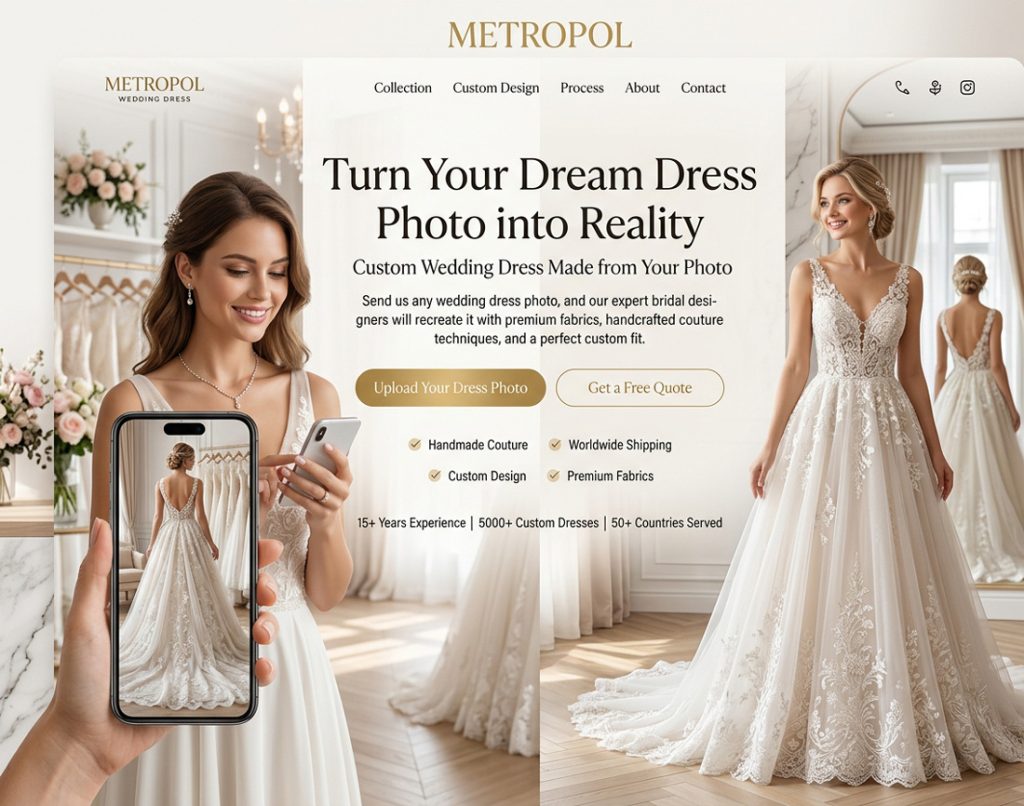
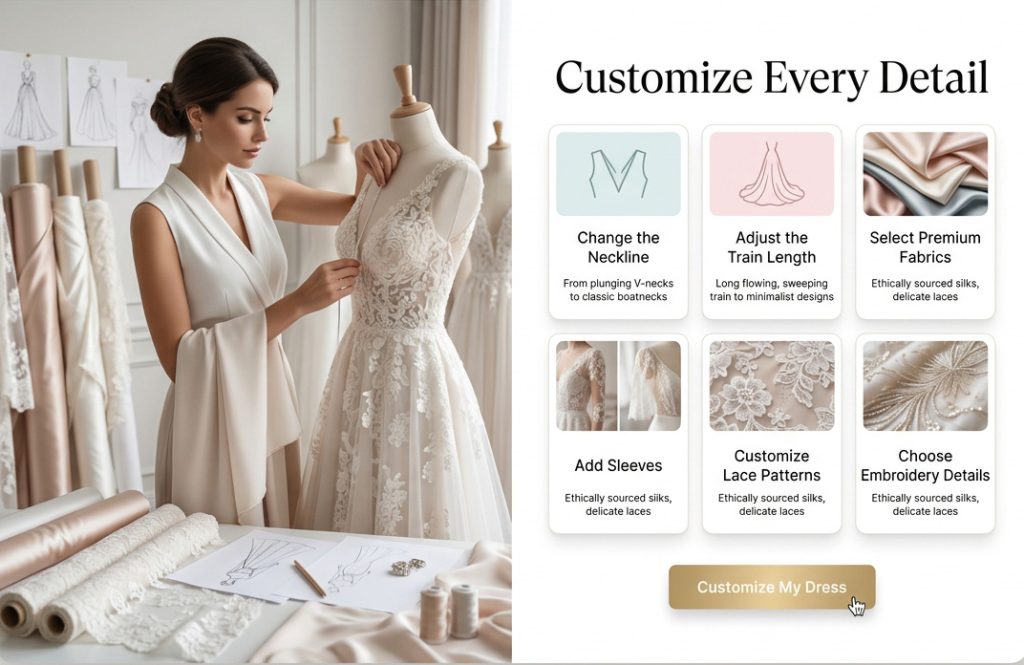
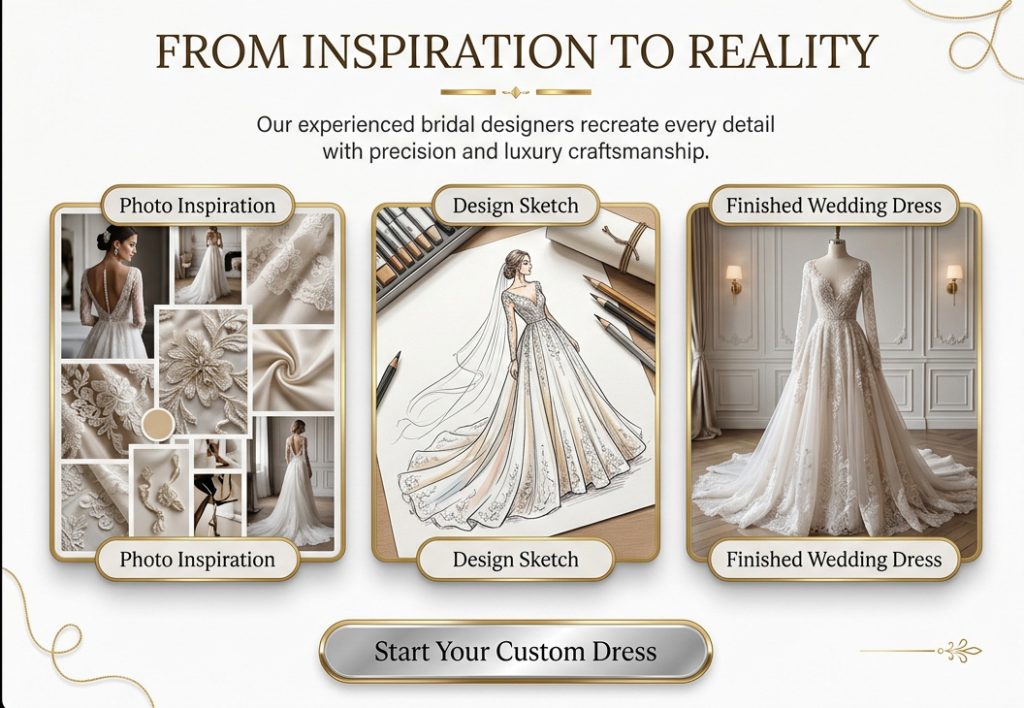
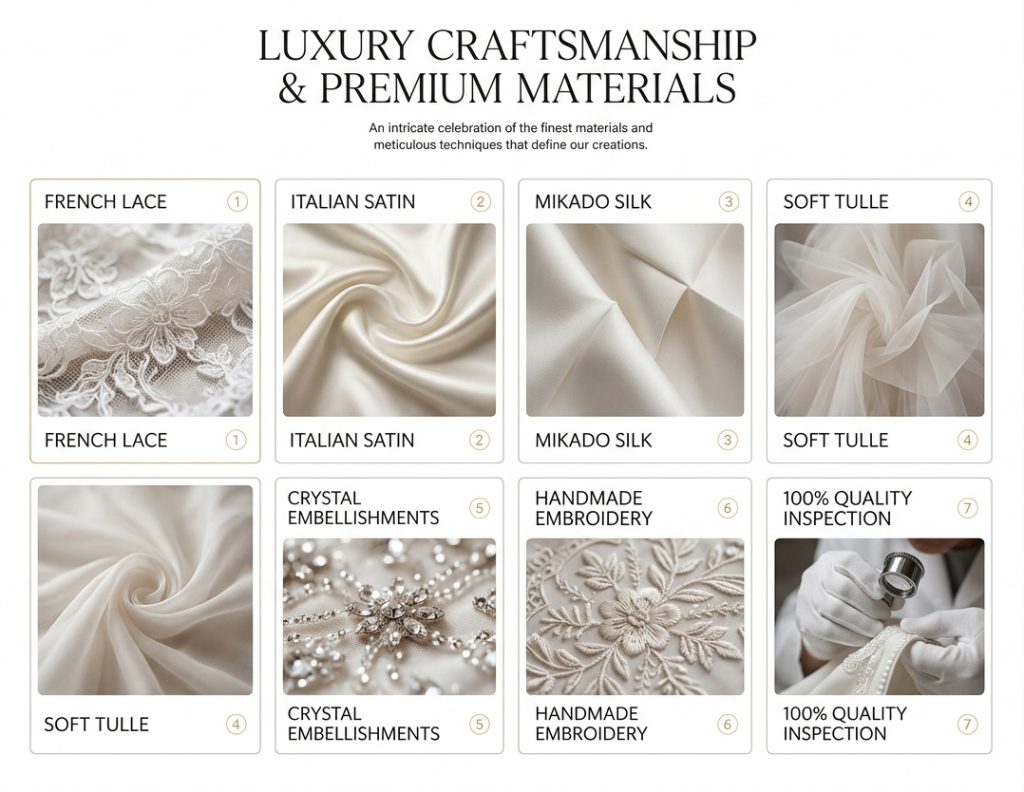
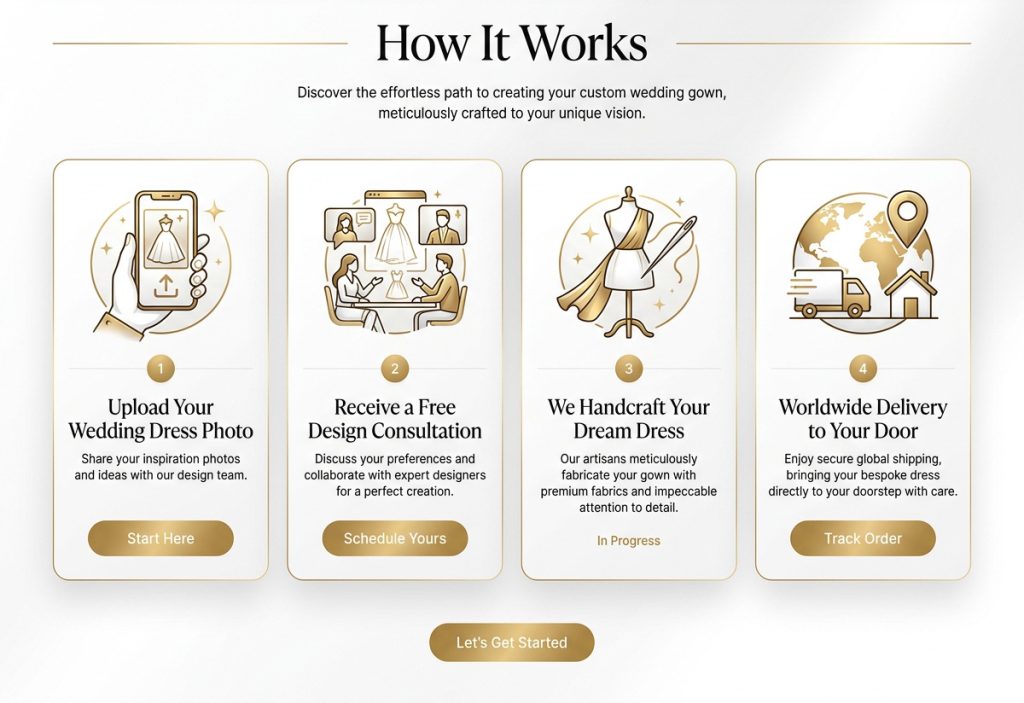
Metropol Wedding Dress, a specialized Turkish atelier in İzmir, performs this photo-to-gown process for individual brides and boutique clients through controlled design interpretation, pattern development, material matching, and staged approvals. Success depends on the quality of the source images, the completeness of measurements, and the factory’s ability to engineer rather than merely imitate. This guide explains the real workflow, the information required, the limits of photo-based recreation, and how to manage the process so the finished gown meets expectations under real lighting and movement.
Detailed Article: Translating a Photo into a Wedding Dress — The Engineering Reality
A photograph captures light, angle, and a single moment. A wedding dress must survive fittings, movement, photography under different lighting, and hours of wear. The gap between the image and the finished garment is closed by pattern engineering, material selection, structural design, and sequential verification. Factories that treat the photo as a simple visual reference often produce gowns that look approximate on the hanger and fail under real conditions. Factories that treat the photo as a technical brief produce more reliable results.
Metropol Wedding Dress operates an atelier-scale workshop in Konak, İzmir, with capacity calibrated around approximately 100 gowns per month. The company regularly works from client-supplied photographs, sketches, and inspiration images for both individual custom orders and boutique programs. The process is collaborative and gated: interpretation, pattern development, material confirmation, construction, and inspection occur in sequence rather than as a single leap from image to finished dress.
What a Photo Actually Communicates — and What It Hides
A clear photo can show silhouette, neckline, sleeve style, approximate train length, surface embellishment density, and overall aesthetic. It cannot reliably communicate:
- Exact fabric weight, drape, and opacity
- Internal structure and support methods
- Precise measurements of the original wearer
- Seam placement and construction techniques
- How the gown behaves when the wearer sits, walks, or raises her arms
- True color under different lighting conditions
These hidden variables must be supplied or engineered by the factory. Without them, the translation remains incomplete.
Information hierarchy for successful photo-based orders
| Priority | Information Type | Why It Matters | Risk if Missing |
|---|---|---|---|
| Critical | Multiple clear photos (front, side, back, details) | Establishes silhouette and surface design | Fundamental misinterpretation |
| Critical | Accurate body measurements | Determines fit and proportion | Systematic fit failure |
| High | Desired fabric type and quality | Controls drape, opacity, and longevity | Visual mismatch under real light |
| High | Structural preferences (support level, mobility) | Affects comfort and silhouette stability | Unwearable or collapsing structure |
| Medium | Color references under neutral light | Reduces shade disappointment | Color variance |
| Medium | Timeline and budget boundaries | Sets realistic scope | Scope creep or rushed compromises |
The Translation Sequence Inside a Disciplined Atelier
- Image analysis and design interpretation The team examines the photos for silhouette, proportion, surface work, and construction clues. Ambiguities are flagged and clarified with the client.
- Technical package development Measurements, preferred fabrics, support requirements, and any modifications to the original image are recorded. A technical drawing or annotated reference is created.
- Pattern engineering Base patterns are developed or adapted to the client’s measurements while preserving the intended silhouette. This is the core translation step from 2D image to 3D form.
- Material selection and confirmation Fabrics and trims are chosen to approximate the visual and performance characteristics of the reference. Swatches can be provided for approval.
- Client approval gates Pattern and material decisions are confirmed before cutting. This is the last low-cost opportunity to correct interpretation errors.
- Construction and embellishment Structural assembly precedes surface work. Weight, balance, and mobility are monitored.
- Fitting logic and final inspection Where remote, detailed photography and measurement verification replace in-person fittings. Final inspection checks the agreed standard.
Metropol follows this gated sequence. The photo is the starting reference, not the complete specification.
Expert observation The most common source of disappointment in photo-based orders is the assumption that a single attractive image contains enough information. Factories that insist on complete measurement packages and material confirmation produce fewer post-arrival surprises.
Material Matching Versus Visual Approximation
Exact fabric replication is often impossible. The original gown may have used discontinued lace, proprietary embroidery, or a specific mill quality no longer available. The practical goal is performance and visual equivalence under bridal conditions: similar drape, opacity, motif scale, and surface texture.
European-oriented laces, quality tulles, satins, mikado, and crepes are selected according to the required behavior. Lower-cost substitutes may photograph similarly in controlled light and fail under movement or different lighting. The factory’s material responsibility is to declare the substitution clearly and obtain approval.
Tip box — How to prepare photos that improve translation accuracy
- Provide front, side, back, and close-up detail shots
- Use neutral lighting and avoid heavy filters
- Include a reference object for scale if possible
- Note any elements that must be exact versus those that can be interpreted
- Supply the original wearer’s approximate measurements if known, in addition to the new wearer’s full set
Fit Engineering from a Static Image
A photo shows one body in one pose. The new gown must fit a different body across multiple poses. Accurate current measurements are therefore non-negotiable. Standard measurement sets typically include bust, waist, hips, hollow-to-hem, shoulder width, arm length, and additional points specific to the silhouette.
Pattern makers adjust proportion while preserving the design intent. When the original photo shows a very different body type, the engineering challenge increases. Clear communication about which design elements are sacred and which can flex with the new proportions improves outcomes.
Real Translation Scenarios
Scenario one A bride supplied high-resolution photos of a heavily beaded mermaid gown and complete measurements. The atelier flagged that the original bead density would create excessive weight for the client’s preferred mobility. A revised density plan was approved. The finished gown matched the silhouette and surface aesthetic while remaining wearable for a full reception.
Scenario two A boutique requested recreation of a popular social-media gown for multiple clients. Early orders revealed that single-angle photos led to interpretation variance. Subsequent briefs required multi-angle images and standardized measurement protocols. Consistency improved across the program.
These cases illustrate that photo quality and measurement discipline are as important as factory skill.
Common Failure Points in Photo-to-Gown Projects
- Relying on a single filtered or low-resolution image
- Omitting full current measurements
- Assuming exact fabric and embellishment replication is always possible
- Skipping pattern and material approval gates
- Changing design intent after cutting has begun
- Underestimating the structural engineering required by complex silhouettes
Each failure is preventable with a structured brief and sequential approvals.
Control checklist for photo-based wedding dress orders
- Multiple clear reference images (front, side, back, details)
- Complete and current body measurements
- Written notes on which elements must be exact
- Fabric and support preferences stated
- Pattern and material approval before cutting
- Stage photography or progress confirmation
- Defined acceptance criteria for the finished gown
- Realistic timeline that accommodates the gated process
Positioning Metropol for Photo-to-Gown Work
Metropol’s atelier model is suited to photo-based custom and small-batch work. Strengths include technical pattern interpretation, material orientation toward European fabrics, staged approval culture, and experience translating client images into structured gowns. Capacity is finite; complex or heavily embellished recreations require adequate calendar time. The factory is not a pure volume copy house; it is a collaborative engineering partner for clients who supply proper information and respect the process gates.
Practical Sequence for Clients and Boutiques
- Gather high-quality multi-angle photographs and full measurements.
- Clarify which design elements are non-negotiable.
- Submit a complete brief and request technical interpretation.
- Approve pattern and materials before any cutting.
- Monitor stage documentation.
- Evaluate the finished gown against the agreed standard, not against the original photo alone.
A photograph is a starting point. The finished wedding dress is an engineered product. Metropol Wedding Dress can execute that translation when the brief is complete and the process gates are observed. The quality of the input information and the discipline of the sequence determine whether the result meets the emotional and practical expectations of the wearer.
For photo-based custom inquiries, technical capability discussions, or a structured recreation project, contact Metropol Wedding Dress through official channels. Success begins with clear images, accurate measurements, and mutual respect for the engineering process.
Frequently Asked Questions
1. Can any wedding dress in a photo be exactly recreated? Exact replication of fabric, embellishment, and construction is often limited by material availability and the original’s proprietary methods. The realistic goal is close visual and structural equivalence engineered for the new wearer.
2. What photos produce the most accurate translation? Multiple high-resolution images from front, side, back, and detail angles under neutral lighting, without heavy filters.
3. Why are full body measurements mandatory even when a photo is supplied? The photo shows one body. The new gown must fit a different body across movement and poses. Measurements drive pattern engineering.
4. How does Metropol handle photo-based orders? Through image analysis, technical package development, pattern engineering, material confirmation, staged approvals, construction, and final inspection.
5. What happens if the original fabric is unavailable? A performance-equivalent alternative is proposed and submitted for client approval before cutting.
6. Can structural support be adjusted for comfort while preserving the look? Yes. Support level and mobility requirements should be stated in the brief so engineering decisions can balance aesthetics and wearability.
7. How important is pattern approval before cutting? It is the last low-cost opportunity to correct interpretation or proportion errors. Skipping it increases the risk of irreversible problems.
8. What is the typical timeline for a photo-to-gown project? Depends on complexity, material availability, and approval speed. Adequate calendar time for the gated sequence is required.
9. Can boutiques submit photo-based requests for multiple clients? Yes, provided each order includes complete measurements and clear notes on any variations from the reference.
10. How is color matching handled from a photo? Photos are unreliable for exact color. Physical swatches or standardized color references under neutral light improve accuracy.
11. What design elements are hardest to translate from a single photo? Internal structure, exact fabric behavior, precise embellishment techniques, and how the gown moves.
12. Can heavily beaded or embroidered designs from photos be recreated? Yes, within weight and balance limits. Density and attachment methods may be adjusted for wearability with client approval.
13. What should be included in the initial brief? Multi-angle photos, full measurements, notes on non-negotiable elements, fabric preferences, support needs, timeline, and budget boundaries.
14. How are remote clients managed without in-person fittings? Through detailed measurements, stage photography, and clear acceptance criteria. Some adjustments may still be required after arrival.
15. What is the most common reason photo-based gowns disappoint? Incomplete information (single image, missing measurements, or skipped approval gates) rather than factory skill alone.
16. Can the silhouette be modified while keeping the surface design from the photo? Yes. Proportion and structural adjustments for the new body are often necessary and should be discussed early.
17. How does Metropol protect design interpretation accuracy? By flagging ambiguities, producing technical references, and requiring pattern and material confirmation before cutting.
18. Are there limits to train length, volume, or complexity from a photo? Practical limits exist around weight, mobility, and construction time. These are addressed during the technical package stage.
19. Can modest or coverage modifications be added to a photo reference? Yes, when specified early so pattern and structural decisions incorporate them.
20. What role does fabric drape play in successful translation? Drape affects how the silhouette reads in motion and under light. Matching visual appearance without matching drape produces a different result.
21. How should changes be handled after pattern approval? Changes after cutting usually incur additional cost and time. Clear cut-off points protect both parties.
22. Is private-label or boutique-exclusive recreation possible from photos? Yes, within agreed intellectual-property and exclusivity terms.
23. What inspection standards apply to photo-based gowns? The finished garment is checked against the approved technical package and material decisions, not solely against the original photograph.
24. Can convertible or multi-way elements be engineered from a static photo? Yes, when the functional requirements are stated and structural feasibility is confirmed during pattern development.
25. How does capacity affect photo-to-gown projects? Complex recreations require dedicated calendar time within the atelier’s monthly capacity of approximately 100 gowns.
26. What documentation does the client receive during the process? Technical clarification, pattern and material approval requests, stage photography where applicable, and final commercial documents.
27. Are sample or muslin stages available for complex photo recreations? Depending on complexity and agreement, intermediate verification steps can be included to reduce risk.
28. How should a bride or boutique begin a photo-based project with Metropol? Prepare multi-angle images and full measurements, submit a clear brief, and request technical interpretation and process outline.
29. What ultimately determines success in translating a photo into a wedding dress? The completeness of the input information, the discipline of the approval sequence, and realistic expectations about material and structural equivalence.
30. Why choose a specialized atelier for photo-based work instead of a pure volume factory? Photo translation requires interpretation, pattern engineering, and material judgment. Atelier-scale process control supports these tasks more reliably than pure speed-optimized volume production.
For photo-based custom projects, technical interpretation of reference images, or a structured recreation inquiry, contact Metropol Wedding Dress through official channels. Provide clear photographs and complete measurements to begin the translation process on solid technical ground.
Wedding Dress from Photo
Free online AI wedding dress photo editors let anyone upload a picture and instantly see a gown superimposed or generated on a figure. These tools are effective for rapid visualization and inspiration. They are not manufacturing specifications. Fabric physics, internal structure, precise fit, and real-world drape cannot be fully captured by current consumer AI editors. Metropol Wedding Dress, a specialized Turkish atelier in İzmir, bridges the gap: clients who begin with an AI-edited or AI-generated image can move into a controlled photo-to-gown production process that adds measurements, pattern engineering, material selection, and staged approvals. This guide explains what AI editors actually deliver, where they fall short for production, and how a real factory converts an AI preview into a wearable wedding dress.
Detailed Article: From AI Wedding Dress Photo Editor to Physical Gown — Closing the Reality Gap
Consumer AI photo editors have made virtual try-on accessible. Upload a full-body photo, select or generate a wedding dress style, and receive a realistic-looking composite in seconds. Many tools are free or freemium. For brides and boutiques the appeal is obvious: fast visual exploration without booking appointments or ordering samples.
The output of these tools is a two-dimensional image optimized for screen viewing. A wedding dress is a three-dimensional object that must fit a specific body, support movement, behave under varied lighting, and survive hours of wear. The transition from AI preview to finished garment therefore requires a separate technical process. Factories that treat an AI image as a complete brief frequently produce gowns that look approximate on arrival and disappoint in fittings. Factories that treat the AI image as a visual starting point and demand the missing engineering data produce more reliable results.
“You may also want to take a look at this article.” Custom Wedding Dresses Belgium
Metropol Wedding Dress operates an atelier-scale workshop in Konak, İzmir. Monthly capacity is calibrated around approximately 100 gowns. The company regularly receives client images—including AI-edited and AI-generated references—and converts them into structured custom or small-batch production through sequential interpretation, pattern development, material confirmation, and inspection gates.
What Current AI Wedding Dress Photo Editors Actually Do Well
- Rapid style exploration across silhouettes, necklines, and surface treatments
- Instant visualization on a client’s own photograph
- Easy sharing with partners, family, or boutique staff
- Low or zero cost for initial ideation
- Generation of multiple variations for comparison
These functions reduce the early-stage friction of deciding “what feels right.” They do not replace body measurements, fabric performance data, or structural engineering.
What AI Editors Systematically Cannot Provide
AI models are trained on large image datasets. They excel at visual pattern matching. They do not possess physical simulation of specific lace weights, tulle layer counts, boning configurations, or the stretch and recovery of particular satins. Consequently:
- Drape is approximated, not engineered
- Opacity and layering are visual guesses
- Internal support is invisible
- Fit is based on the uploaded photo’s pose and proportions, not on a full measurement set
- Embellishment density and attachment methods are aesthetic only
- Color under different lighting conditions remains unreliable
When these gaps are ignored, the physical gown diverges from the AI preview in ways that are expensive to correct after cutting.
Capability comparison
| Function | Free AI Photo Editor | Real Atelier Production (Metropol profile) |
|---|---|---|
| Visual style exploration | Excellent and fast | Secondary (starts from confirmed design) |
| Instant client-specific preview | Yes | No (requires process time) |
| Accurate body measurements | No | Mandatory input |
| Fabric physics and drape | Approximate | Selected and engineered |
| Structural support design | Invisible / absent | Explicitly engineered |
| Size-run or multi-client consistency | Not applicable | Controlled through grading and inspection |
| Wearable durability | Not addressed | Core production responsibility |
The Required Translation Process When an AI Image Becomes the Brief
- Image triage and clarification The AI output is examined for silhouette intent, surface design, and ambiguities. Clients are asked which elements are non-negotiable and which can flex.
- Measurement package A complete current measurement set is required. The AI photo’s proportions are never treated as sufficient.
- Technical interpretation Pattern makers convert the visual intent into base patterns adjusted to the actual measurements while preserving the design language of the AI reference.
- Material proposal Fabrics and trims are selected for performance equivalence rather than exact digital appearance. Swatches or detailed descriptions are submitted for approval.
- Approval gates Pattern and material decisions are confirmed before any fabric is cut. This is the critical cost-control step.
- Construction and staged verification Structural assembly precedes surface work. Progress documentation allows remote clients to confirm direction.
- Final inspection against the agreed technical package The finished gown is evaluated against the approved specifications, not solely against the original AI image.
Metropol follows this sequence. The AI editor supplies the visual starting point; the atelier supplies the engineering.
Expert note Clients who treat the AI image as the complete specification absorb the highest disappointment risk. Clients who treat it as inspiration and supply full measurements plus clear priorities obtain gowns that satisfy both the visual intent and real-world wearability.
Material and Structural Decisions That AI Cannot Make
Lace scale, ground stability, and stretch behavior affect how a bodice or skirt reads in motion. Tulle density determines volume and opacity. Boning placement and lining choices control support and comfort. Bead weight distribution influences both appearance and fatigue over a long day. These variables are selected and engineered by the factory. An AI editor can suggest a look; it cannot specify the construction that makes the look durable and flattering on a specific body.
European-oriented laces, quality tulles, satins, and related materials are chosen at Metropol according to the required performance. Substitutions are declared and approved rather than hidden.
“You may also want to take a look at this article.” Custom Wedding Dresses Canada
Real Transition Scenarios
Scenario one A bride used a free online AI editor to place several gown styles onto her photo. She selected one clear favorite, gathered multi-angle screenshots, and supplied complete measurements. The atelier interpreted the silhouette, proposed fabric options that matched the intended drape, and required pattern approval. The finished gown preserved the AI-inspired look while fitting and moving correctly.
Scenario two A boutique experimented with AI-generated styles for client consultations. Early physical orders based only on AI images showed interpretation variance. They standardized a brief template that combined the AI reference with mandatory measurements and priority notes. Consistency across subsequent custom orders improved.
In both cases the AI tool accelerated the visual decision; the factory process converted the decision into a wearable product.
Each error increases the probability of costly corrections or dissatisfaction.
Positioning Metropol in the AI-to-Reality Workflow
Metropol is not an AI software provider. It is a physical production atelier that accepts AI-edited or AI-generated images as valid visual briefs and subjects them to the same technical discipline applied to conventional photo or sketch references. Strengths include pattern interpretation skill, material orientation, staged approval culture, and experience converting digital inspiration into structured gowns. Capacity remains finite; complex recreations require adequate calendar time within the approximate monthly output of 100 gowns.
The factory is appropriate for clients who value a controlled translation process over the fastest possible low-cost copy.
AI wedding dress photo editors are powerful ideation instruments. They are not substitutes for pattern engineering, material science, or fit development. Metropol Wedding Dress provides the production bridge that turns an AI preview into a garment that can be worn with confidence. The quality of the transition depends on the completeness of the information supplied and the discipline of the subsequent process gates.
For AI-reference custom projects, technical interpretation of editor outputs, or a structured conversion from digital preview to physical gown, contact Metropol Wedding Dress through official channels. Begin with clear AI images and complete measurements to give the translation the strongest possible foundation.
Frequently Asked Questions
1. Can a free AI wedding dress photo editor produce a ready-to-manufacture specification? No. Current consumer tools generate visual approximations. They do not supply measurements, fabric performance data, or structural engineering.
2. How does Metropol use an AI-edited photo? As a visual reference that is interpreted into patterns, materials, and construction through a gated technical process.
3. Why are body measurements still required when an AI image already shows the dress on a figure? The AI image is based on one photo’s proportions and pose. The physical gown must fit a real body across movement and multiple poses.
4. Will the finished gown look identical to the AI preview? It will aim for close visual and proportional equivalence under real conditions. Exact digital appearance is limited by fabric physics and construction realities.
5. What is the biggest risk of ordering directly from an AI image without additional data? Misinterpretation of structure, drape, and fit, leading to a gown that looks different in person and may require extensive alteration.
6. Can AI-generated designs (not just try-on edits) be produced? Yes, provided the generated images are clear and accompanied by measurements and priority notes.
7. How should fabric be chosen when the AI image shows a specific look? The factory proposes materials that deliver similar drape, opacity, and surface quality. Client approval is required before cutting.
8. Are pattern approval gates necessary if the AI image is very clear? Yes. Pattern engineering adapts the design to actual measurements. Approval prevents irreversible errors.
9. What timeline should be expected when starting from an AI reference? Depends on complexity and approval speed. The interpretation and gating steps require calendar time beyond simple volume production.
10. Can boutiques use AI editors for client consultations and then send the results to Metropol? Yes. Standardized briefs that combine the AI reference with measurements and notes improve consistency.
11. How accurate is color matching from an AI photo editor? Limited. Screen colors and filters are unreliable. Physical swatches or standardized references improve results.
12. What structural elements does an AI editor never show? Boning, lining, support layers, seam construction, and weight distribution of embellishments.
13. Can heavily embellished AI designs be translated successfully? Yes, within practical weight and balance limits. Density may be adjusted for wearability with client agreement.
14. What information should accompany an AI image when contacting the factory? Multi-angle or variation images, full measurements, list of non-negotiable elements, fabric preferences, and timeline.
15. How does Metropol handle ambiguities in AI-generated images? By flagging unclear elements and requesting clarification before pattern development proceeds.
16. Is a muslin or intermediate sample stage available for complex AI references? Depending on agreement and complexity, intermediate verification can be included to reduce risk.
17. Can modest or coverage changes be applied to an AI try-on image? Yes, when specified early so they influence pattern and construction decisions.
18. What is the most common client-side error in AI-to-gown projects? Treating the AI output as a complete technical specification and omitting measurements or approval gates.
19. How are remote clients managed without in-person fittings? Through detailed measurements, stage photography, and clear acceptance criteria defined in advance.
20. Does Metropol offer its own AI photo editor? No. The company focuses on physical production and accepts external AI references as valid visual briefs.
21. Can convertible or multi-way features be added to an AI-inspired design? Yes, when the functional requirements are stated and structural feasibility is confirmed during pattern work.
22. How does capacity affect AI-reference projects? Complex translations require dedicated time within the atelier’s approximate monthly capacity of 100 gowns.
23. What acceptance standard is used for the finished gown? The approved technical package and material decisions, not the original AI image alone.
24. Are private-label or exclusive versions of AI-inspired designs possible? Yes, within agreed intellectual-property and exclusivity terms.
25. How should changes be requested after pattern approval? Changes after cutting normally incur additional cost and time. Clear cut-offs protect both parties.
26. What role does fabric drape play when translating an AI preview? Drape determines how the silhouette appears in motion. Matching only the static visual without matching drape produces a different result.
27. Can multiple AI variations be submitted for the same order? Yes. Clear prioritization of the preferred direction prevents conflicting interpretation.
28. Why choose an atelier process over the fastest low-cost producer for AI-based orders? AI translation requires interpretation and engineering judgment. Process control reduces the risk of expensive post-arrival divergence.
29. What single step most improves the chance of a successful AI-to-physical result? Supplying complete measurements and requiring pattern and material approval before any cutting begins.
30. What ultimately turns a free AI wedding dress photo editor result into a wearable gown? A disciplined factory process that adds the missing measurements, pattern engineering, material selection, and verification gates. Metropol Wedding Dress provides that process when the client supplies clear visual references and complete data.
For AI-reference custom projects or conversion of editor outputs into physical gowns, contact Metropol Wedding Dress through official channels. Start with your strongest AI images and accurate measurements to give the production translation the clearest possible foundation.
Wedding dress photo editor online free
Free online wedding dress photo editors and AI wedding dress apps let users upload a photo and instantly visualize gowns, try styles, or generate variations. These tools excel at rapid inspiration and decision support. They do not produce manufacturing data. Fit, fabric physics, internal structure, and real-world drape remain outside their scope. Metropol Wedding Dress, a specialized Turkish atelier in İzmir, accepts AI-edited or AI-generated images as visual references and converts them into physical gowns through measurement capture, pattern engineering, material selection, and staged production approvals. This guide maps the productive path from free AI editor to finished dress, clarifies the limits of consumer tools, and shows how a real factory closes the gap.
Detailed Article: Using Free AI Wedding Dress Photo Editors and Apps — Then Making the Gown Real
Consumer AI wedding dress photo editors and free online apps have removed early friction. Upload a full-body photo, select or generate a style, and receive a realistic composite in seconds. Many tools are free or freemium. Brides use them to explore silhouettes. Boutiques use them for client consultations. The output is a screen-optimized image. A wedding dress is a three-dimensional object that must fit, move, and last. The transition from AI preview to physical gown therefore requires a separate manufacturing process.
Metropol Wedding Dress works from client images, including those produced by free AI photo editors and wedding dress AI apps. The atelier treats the digital result as a visual brief, then applies measurement capture, pattern development, fabric selection, and sequential approvals to create a wearable garment. The quality of the final dress depends on the completeness of the data supplied after the AI step, not on the attractiveness of the AI image alone.
What Free AI Wedding Dress Photo Editors and Apps Deliver Well
- Instant visualization of multiple styles on a user’s own photograph
- Rapid generation of variations for comparison
- Easy sharing with partners, family, or boutique staff
- Zero or low cost for early ideation
- Useful starting point for identifying preferred silhouette and aesthetic direction
These functions accelerate the “what feels right” decision. They do not replace body measurements, fabric performance data, or structural engineering.
When these limits are ignored, the physical gown diverges from the AI preview in ways that are costly to correct after fabric is cut.
Capability comparison
| Function | Free AI Photo Editor / App | Physical Atelier Production (Metropol) |
|---|---|---|
| Visual style exploration | Fast and broad | Starts from confirmed design |
| Instant preview on user photo | Yes | Not applicable |
| Accurate body measurements | No | Required input |
| Fabric physics and drape | Approximate | Selected and engineered |
| Structural support design | Absent | Explicitly engineered |
| Size consistency or multi-client use | Not applicable | Controlled via grading and inspection |
| Wearable durability | Not addressed | Core production responsibility |
Metropol follows this sequence. The free AI editor supplies the visual direction; the atelier supplies the engineering.
Expert note Clients who treat the AI output as a complete manufacturing specification absorb the highest disappointment risk. Clients who treat it as inspiration and add full measurements plus clear priorities obtain gowns that satisfy both the intended look and real-world wearability.
Material and Structural Decisions AI Editors Cannot Make
Lace scale, ground stability, and stretch affect how a bodice or skirt reads in motion. Tulle density determines volume and opacity. Boning placement and lining choices control support and comfort. Bead weight distribution influences both appearance and fatigue over a long day. These variables are selected and engineered by the factory. An AI editor can suggest a look; it cannot specify the construction that makes the look durable and flattering on a specific body.
European-oriented laces, quality tulles, satins, and related materials are chosen at Metropol according to required performance. Substitutions are declared and approved rather than hidden.
Real Transition Scenarios
Scenario one A bride used a free online AI wedding dress photo editor to try several styles on her photograph. She selected one clear favorite, saved multi-angle screenshots, and collected complete measurements. The atelier interpreted the silhouette, proposed fabrics matching the intended drape, and required pattern approval. The finished gown preserved the AI-inspired look while fitting and moving correctly.
Scenario two A boutique experimented with AI-generated styles during client consultations. Early physical orders based only on AI images showed interpretation variance. They standardized a brief template that combined the AI reference with mandatory measurements and priority notes. Consistency across subsequent custom orders improved.
In both cases the AI tool accelerated the visual decision; the factory process converted the decision into a wearable product.
Each error raises the probability of costly corrections or dissatisfaction.
Positioning Metropol in the AI-to-Reality Workflow
Metropol is not an AI software provider. It is a physical production atelier that accepts AI-edited or AI-generated images as valid visual briefs and subjects them to the same technical discipline applied to conventional photo or sketch references. Strengths include pattern interpretation skill, material orientation, staged approval culture, and experience converting digital inspiration into structured gowns. Capacity remains finite; complex translations require adequate calendar time within the approximate monthly output of 100 gowns.
The factory is appropriate for clients who value a controlled translation process over the fastest possible low-cost copy.
AI wedding dress photo editors and free online apps are powerful ideation instruments. They are not substitutes for pattern engineering, material science, or fit development. Metropol Wedding Dress provides the production bridge that turns an AI preview into a garment that can be worn with confidence. The quality of the transition depends on the completeness of the information supplied and the discipline of the subsequent process gates.
For AI-reference custom projects or conversion of editor outputs into physical gowns, contact Metropol Wedding Dress through official channels. Start with your strongest AI images and accurate measurements to give the production translation the clearest possible foundation.
Frequently Asked Questions
1. Can a free AI wedding dress photo editor produce a ready-to-manufacture specification? No. Current consumer tools generate visual approximations. They do not supply measurements, fabric performance data, or structural engineering.
2. How does Metropol use an AI-edited or AI-generated photo? As a visual reference that is interpreted into patterns, materials, and construction through a gated technical process.
3. Why are body measurements still required when an AI image already shows the dress on a figure? The AI image is based on one photo’s proportions and pose. The physical gown must fit a real body across movement and multiple poses.
4. Will the finished gown look identical to the AI preview? It will aim for close visual and proportional equivalence under real conditions. Exact digital appearance is limited by fabric physics and construction realities.
5. What is the biggest risk of ordering directly from an AI image without additional data? Misinterpretation of structure, drape, and fit, leading to a gown that looks different in person and may require extensive alteration.
6. Can AI-generated designs (not just try-on edits) be produced? Yes, provided the generated images are clear and accompanied by measurements and priority notes.
7. How should fabric be chosen when the AI image shows a specific look? The factory proposes materials that deliver similar drape, opacity, and surface quality. Client approval is required before cutting.
8. Are pattern approval gates necessary if the AI image is very clear? Yes. Pattern engineering adapts the design to actual measurements. Approval prevents irreversible errors.
9. What timeline should be expected when starting from an AI reference? Depends on complexity and approval speed. The interpretation and gating steps require calendar time beyond simple volume production.
10. Can boutiques use AI editors for client consultations and then send the results to Metropol? Yes. Standardized briefs that combine the AI reference with measurements and notes improve consistency.
11. How accurate is color matching from an AI photo editor? Limited. Screen colors and filters are unreliable. Physical swatches or standardized references improve results.
12. What structural elements does an AI editor never show? Boning, lining, support layers, seam construction, and weight distribution of embellishments.
13. Can heavily embellished AI designs be translated successfully? Yes, within practical weight and balance limits. Density may be adjusted for wearability with client agreement.
14. What information should accompany an AI image when contacting the factory? Multi-angle or variation images, full measurements, list of non-negotiable elements, fabric preferences, and timeline.
15. How does Metropol handle ambiguities in AI-generated images? By flagging unclear elements and requesting clarification before pattern development proceeds.
For AI-reference custom projects or conversion of editor outputs into physical gowns, contact Metropol Wedding Dress through official channels. Start with your strongest AI images and accurate measurements to give the production translation the clearest possible foundation.
Wedding Dress from Photo: Turning Inspiration into a Dress That Actually Works — Metropol Wedding Dress
Almost every bride arrives with photographs. Some bring a single image they have saved for months. Others come with a collection of screenshots, runway shots and real-wedding pictures that together describe a feeling more than a specific garment. The request is rarely complicated on the surface: “Can you make something like this?” The answer, when handled properly, is more nuanced than a simple yes or no.
At Metropol Wedding Dress we regularly work from photographs. The process is less about copying an image and more about interpreting what the bride responds to in it — the proportion, the mood, the way the fabric moves, the balance between structure and softness — and then translating those qualities into a dress that fits her body and suits her actual wedding day. Done well, the result feels familiar yet entirely her own. Done poorly, it becomes a stiff imitation that never quite settles.
Why Photographs Are Both Useful and Limited
A photograph captures a dress in one moment, on one body, under one kind of light. It does not show how the gown behaves when the wearer sits, raises her arms, or walks across grass. It rarely reveals the internal structure that makes the exterior possible. Colour can shift with the camera and the screen. Scale is easy to misjudge.
These limitations do not make photos useless. They make them starting points rather than blueprints. The most successful commissions begin with the question: what exactly in this image feels right? Is it the clean line of the neckline, the weight of the skirt, the softness of the drape, or the overall impression of ease? Once that is clear, the work of adaptation can begin.
Literal recreation is sometimes possible and sometimes unwise. Exact copies of copyrighted designer work raise ethical and legal issues. Even when the source is open, forcing one body into the exact proportions of another often produces a dress that looks correct in still images and feels wrong in motion. Better results come from extracting the essential qualities and rebuilding them around the bride who will wear the finished gown.
How We Work from a Photograph at Metropol
The process starts with conversation rather than commitment. We look at the images together and identify the elements that matter most. Some details are structural and worth preserving. Others are circumstantial — products of a particular model’s posture or a stylist’s choice — and can be released without loss.
From there we consider the bride’s measurements, posture and the practical demands of her wedding. A dramatic train that works on a flat studio floor may need adjustment for a venue with steps or uneven ground. A fabric that photographs beautifully in controlled light may behave differently in outdoor conditions or under the length of a full celebration day. These realities are folded into the design from the beginning.
Sketches or adjusted existing silhouettes are used to test the direction. A toile often follows so the proportions can be evaluated on the actual body. This stage is where the photograph’s influence is refined into something wearable. Fit is corrected. Balance is checked. Details that looked essential in the image are sometimes simplified once they are seen in three dimensions. The goal is coherence, not resemblance at any cost.
Construction proceeds only after the direction feels resolved. The finished dress should carry the spirit of the original inspiration while standing as a complete design in its own right.
Design Judgement Matters More Than Exact Matching
The strongest results rarely look like direct replicas. They look like dresses that could have been designed for the bride from the start, with the photograph serving as a clear point of reference rather than a rigid template. This requires the maker to exercise judgement: knowing when to follow the image closely and when to adapt for fit, comfort or longevity.
Brides sometimes worry that deviation from the photo will disappoint them. In practice the opposite is often true. Once they see a version that sits correctly on their shoulders, moves with them, and still captures the quality they loved in the image, the need for exact duplication usually fades. What remains is recognition: the dress feels like the one they had been imagining, only better suited to them.
Practical Realities
Working from photographs still requires proper time. Design interpretation, pattern adjustment, toile development and fittings cannot be rushed if the result is to feel considered. Starting nine to fourteen months before the wedding remains a comfortable range for most commissions of this type. Clear discussion of budget and priorities at the outset prevents later friction.
Not every image can or should be followed. Some designs rely on construction methods or materials that are impractical for the intended use. Others belong so clearly to a particular designer’s body of work that recreation becomes inappropriate. We are straightforward about these limits. Honesty at the beginning protects both the process and the final outcome.
A Dress That Feels Intended
The best wedding dresses made from photographic inspiration do not announce their source. They simply look as if they were always meant for the person wearing them. The photograph provided direction. The work of design and fitting made the direction real.
At Metropol Wedding Dress this is the standard we apply. We do not treat a photo as an order to be filled. We treat it as information to be understood and then rebuilt around the individual. The result should feel less like a copy and more like a conclusion.
If you have an image that has stayed with you and you want to explore whether it can become a dress that fits and functions as well as it inspires, we would be glad to begin the conversation. The process is collaborative, the decisions are deliberate, and the finished gown is made for you rather than for the photograph.
Metropol Wedding Dress Wedding dresses developed from inspiration, built for the individual.