
Wholesale Bridal Dresses in Bulk Turkey US bridal retailers and emerging labels face a tightening landscape: limited domestic capacity, rising labor and fabric costs, tariff pressures on imports, and brides who demand true personalization rather than off-the-rack silhouettes. Domestic custom wedding dress manufacturers and factories deliver exceptional quality and “Made in USA” credibility, yet many boutiques and brands still struggle with high minimums, long lead times, or constrained design flexibility.
Metropol Wedding Dress bridges that gap. As an established international wedding dress manufacturer and exporter with deep expertise in custom, bespoke, made-to-measure, private-label, and OEM production, Metropol supplies US bridal shops and designers with high-quality, fully customizable gowns that meet American market expectations for fit, finish, and trend relevance—while offering competitive pricing and reliable wholesale programs. This guide examines the current state of bridal manufacturing in the USA, the practical realities of working with domestic versus international partners, and how a strategic relationship with a proven custom bridal gown manufacturer such as Metropol creates measurable advantages for boutiques, private-label programs, and direct-to-bride businesses.
American brides continue to spend meaningfully on their wedding attire. Market data consistently places North American wedding-gown demand in the multi-billion-dollar range, with a clear shift toward customization, unique silhouettes, and better-than-average construction. At the same time, pure domestic capacity remains relatively small. Only a handful of true custom wedding dress factories and ateliers operate at scale inside the United States—primarily concentrated in Los Angeles, New York, the Midwest, and a few specialized East-Coast studios.
These domestic producers excel at cut-and-sew services, low-to-moderate minimums for capsule collections, and rapid communication. Yet they also face structural limits: skilled pattern-makers and hand-finishers are scarce, fabric sourcing still relies heavily on European and Asian mills, and production costs reflect US labor rates. The result is that many boutiques and emerging labels cannot fill an entire seasonal assortment exclusively through US factories without compromising either margin or design breadth.
International partners that already understand American sizing, trend cycles, and retail calendars therefore remain essential. Metropol Wedding Dress functions as both a custom bridal gown manufacturer and a wedding dress OEM supplier capable of supporting private-label collections, made-to-order programs, and wholesale custom bridal gowns destined for US stores. Because Metropol operates a substantial production atelier with experienced mold-makers, embroiderers, and finishers, it can absorb the volume and customization requests that pure domestic capacity cannot always meet.
Wholesale Bridal Dresses in Bulk Turkey
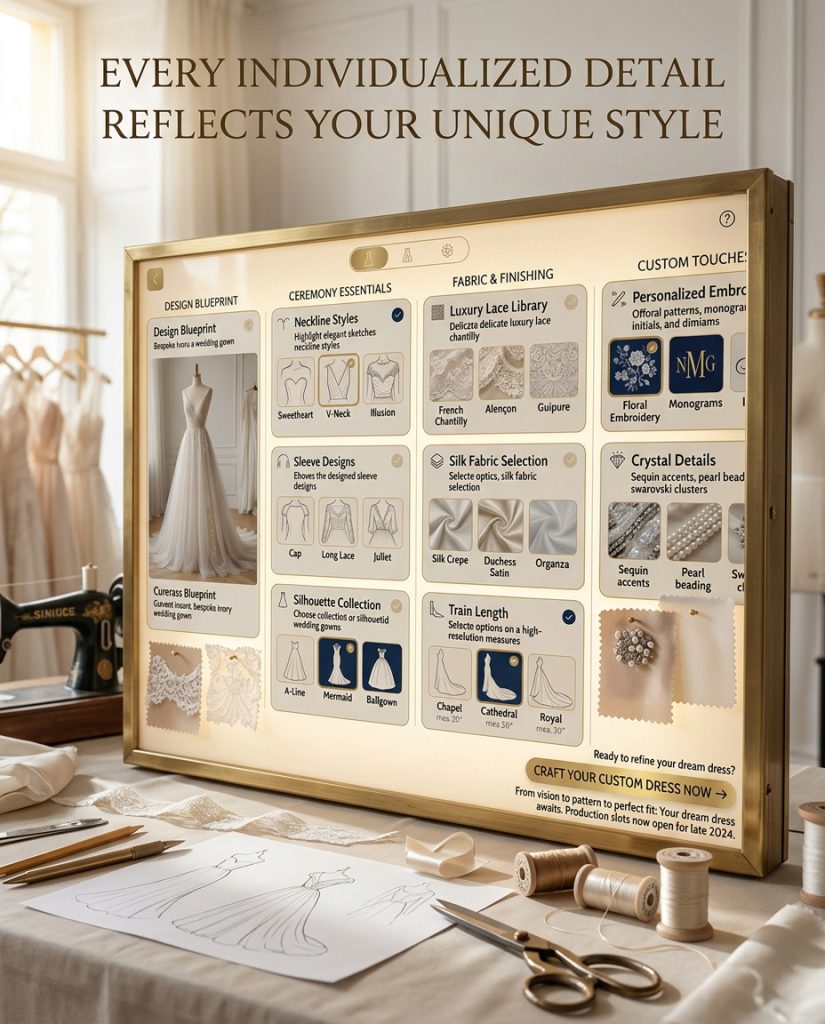
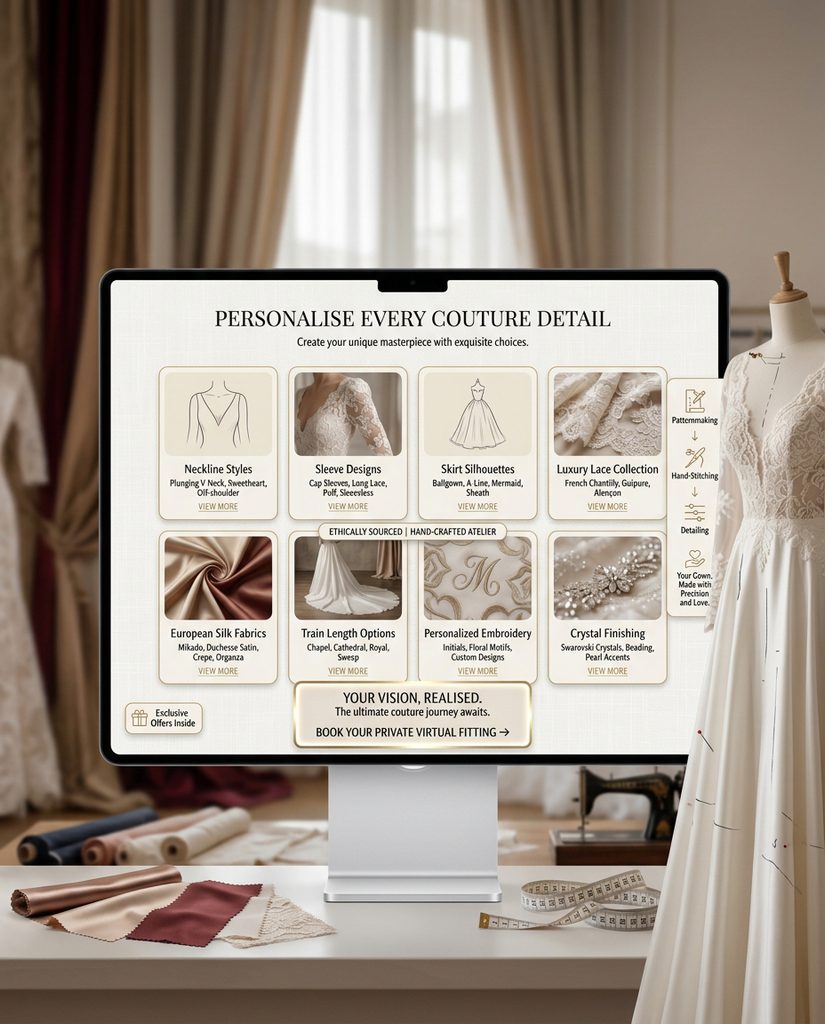
Today’s bride rarely accepts a standard size run. She expects adjustments to neckline, sleeve, waistline (Basque, drop, asymmetric), train length, and embellishment density. Boutiques that cannot deliver those changes lose sales to competitors who can.
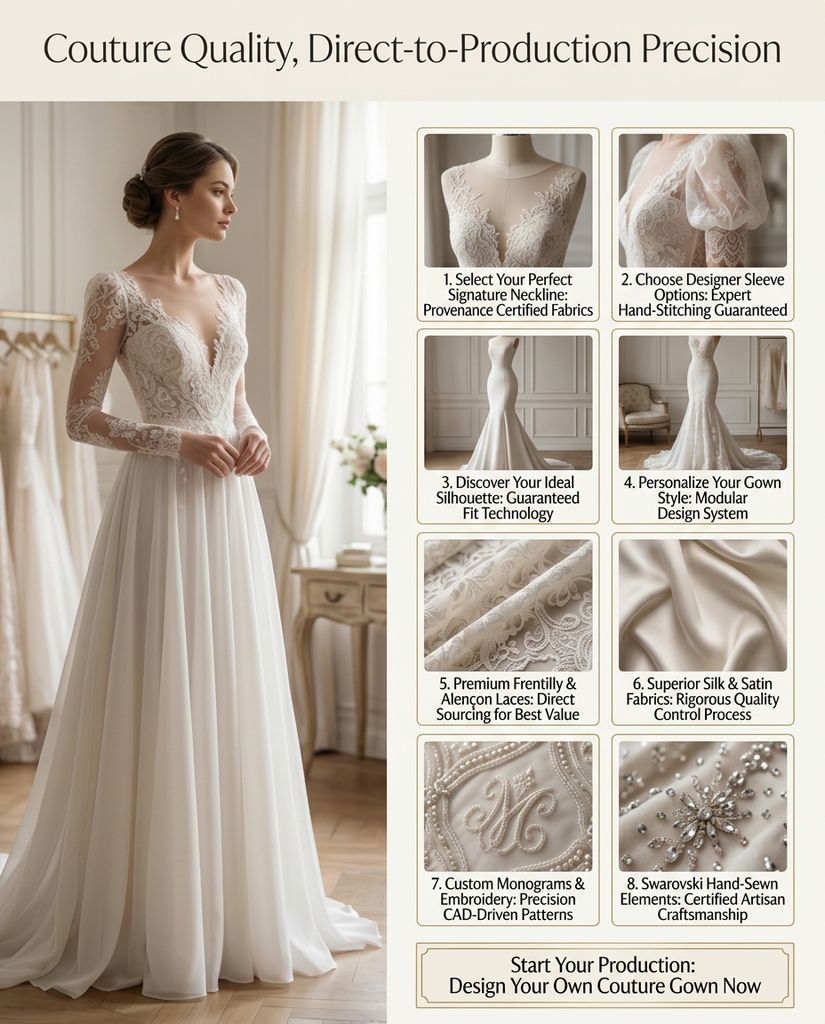
A true custom wedding dress manufacturer or bespoke bridal gown manufacturer solves this by treating each order—or each style within a private-label line—as a collaborative technical package rather than a fixed stock item. Metropol’s process includes pattern development from client sketches or existing samples, fabric and lace selection from an extensive library, prototype approval with photographic documentation at each stage, and final production to individual measurements or graded size runs. The same infrastructure supports made-to-measure wedding dress programs for individual brides and made-to-order wholesale runs for shops.
Domestic Landscape Snapshot
Several US-based operations stand out for different reasons:
- Full-service development houses in Los Angeles that handle design, sampling, and small-batch production for emerging labels.
- Specialized ateliers focused on hand-finished couture and ethical production.
- Midwest factories that emphasize fully domestic cut-and-sew and faster special-order turnaround than overseas timelines.
- East-Coast studios producing made-to-measure gowns with European fabrics but American construction.
These partners deliver undeniable advantages in communication speed, quality control proximity, and marketing claims. They are ideal for high-margin, limited-edition pieces or for brands that prioritize “Made in USA” as a core differentiator.
However, when a boutique needs a broader assortment, consistent seasonal refreshes, or competitive wholesale pricing on custom bridal wear, pure domestic sourcing often becomes constraining. Lead times for complex lace and beading can stretch, minimums may exceed what a single store can absorb, and overall cost per unit rises. This is precisely where a hybrid approach—domestic for hero pieces, international for volume and flexibility—proves effective.
How an International Custom Bridal Gown Manufacturer Complements US Production
Metropol Wedding Dress operates as a custom wedding dress factory and bridal gown manufacturer for bridal shops that require:
- Private-label wedding dress collections under the retailer’s own brand
- OEM wedding dress programs developed from client tech packs or sketches
- Wholesale custom wedding dresses and wholesale custom bridal gowns in graded sizes or made-to-measure
- One-of-a-kind and exclusive bridal gown production for special clients
- Handcrafted and tailor-made options with extensive lace, embroidery, and crystal work
Because Metropol already exports regularly to the United States and other markets, it understands US sizing conventions, preferred fabrics (French lace, Italian silk, quality tulle and satin), and the practical realities of shipping, duties, and retail calendars. The company functions simultaneously as a wedding dress exporter, bridal gown exporter, and direct manufacturer, eliminating unnecessary middle layers.
Production Realities: From Sketch to Finished Gown
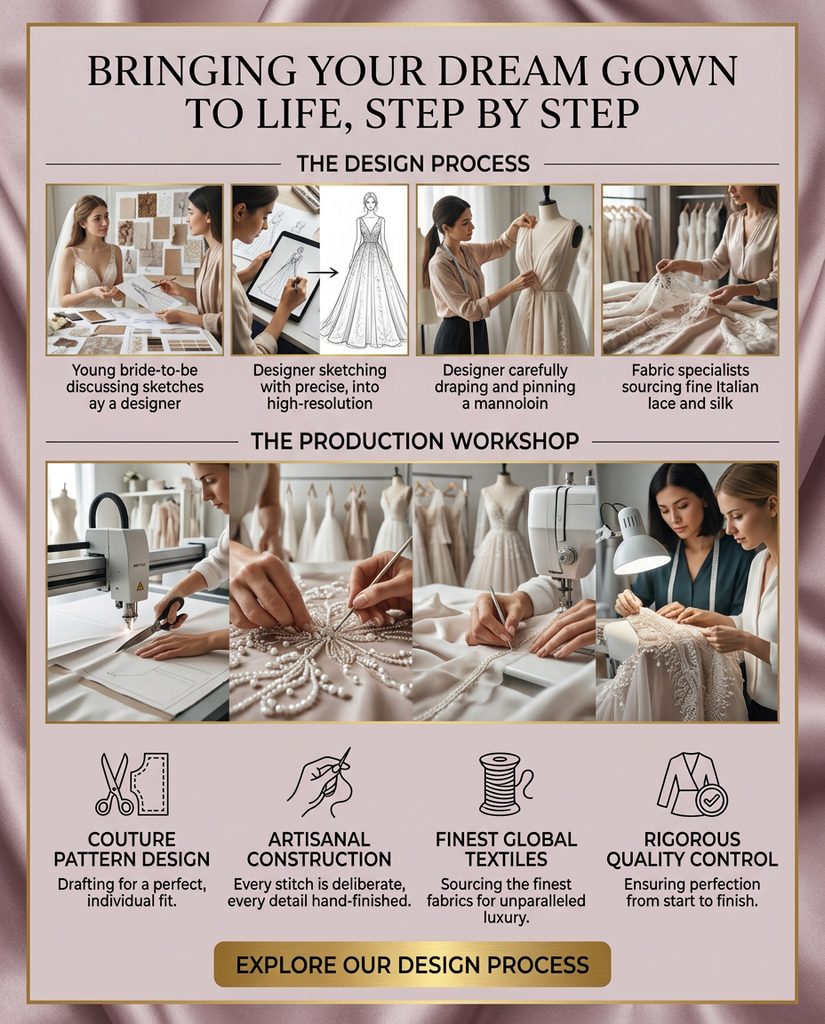
A professional custom bridal collection manufacturer follows a disciplined sequence:
- Design brief and fabric/lace selection
- Pattern making and first prototype
- Client review with detailed photography and measurement notes
- Refinements to fit, proportion, and embellishment
- Final production with quality checkpoints at cutting, assembly, handwork, and finishing
- Packaging and logistics coordination for US destinations
Metropol’s atelier capacity supports both single bespoke commissions and larger wholesale runs. Clients can request full private-label programs (labels, hangtags, packaging) or simply white-label gowns ready for the boutique’s own branding. The same infrastructure produces premium wedding dress and luxury bridal gown styles that meet the expectations of higher-end US retailers.
Material and Construction Considerations That Matter to US Buyers
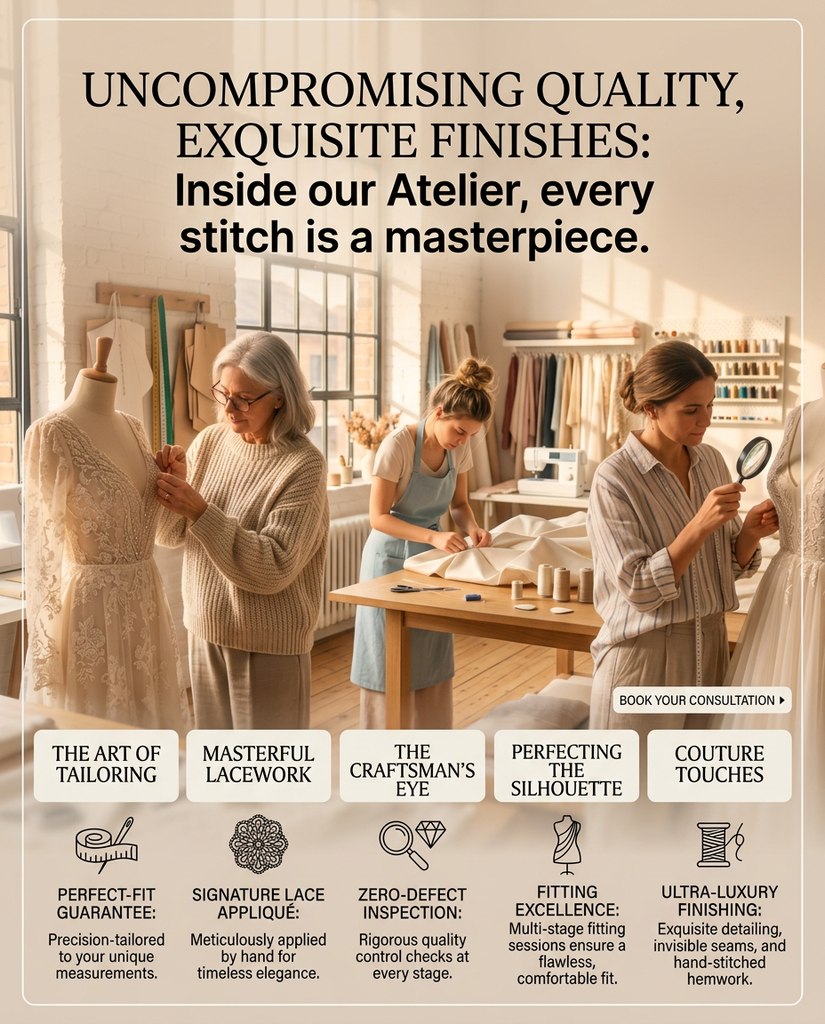
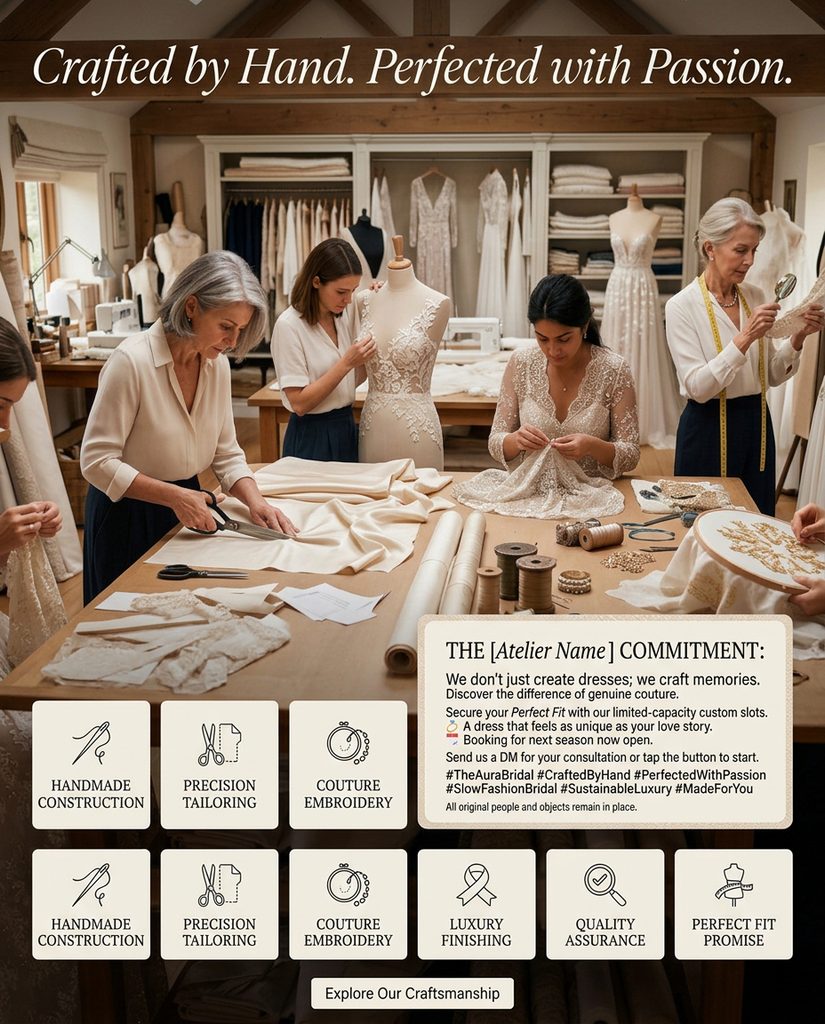
American retailers and brides scrutinize hand-finishing, seam quality, lining comfort, and long-term wearability. A capable handmade wedding dress manufacturer or handcrafted bridal gown manufacturer invests in:
- Precise pattern engineering so the gown sits correctly on real bodies rather than idealized forms
- Secure attachment of lace, beads, and crystals that survive shipping and multiple fittings
- Breathable linings and appropriate structure for different climates and wedding styles
- Consistent grading so a size 12 and a size 18 both maintain design integrity
Metropol emphasizes these technical points, combining traditional craftsmanship with modern production controls. The result is a finished garment that feels couture in hand yet remains commercially viable for wholesale channels.
Cost Structure and Margin Realities for Boutiques
Domestic production carries higher unit costs. International custom production, when managed with clear specifications and reliable partners, typically improves landed cost while preserving quality. Boutiques can therefore:
- Offer a wider price range without sacrificing perceived value
- Maintain healthier margins on private-label and exclusive pieces
- Respond faster to trend shifts (Basque waists, convertible designs, textured lace, satin movements) by placing smaller, more frequent orders
A direct wedding dress manufacturer or direct bridal gown manufacturer relationship further reduces intermediary mark-ups. Metropol’s wholesale custom wedding dress and wholesale custom bridal gown programs are structured precisely for this purpose.
Practical Partnership Models
US bridal shops and brand owners typically engage Metropol in one of four ways:
- Private-label collection development – full custom bridal collection manufacturer service from concept to finished stock under the retailer’s brand.
- OEM / white-label production – client supplies designs or tech packs; Metropol produces as wedding dress OEM supplier or bridal gown OEM supplier.
- Made-to-order and made-to-measure programs – individual or small-batch gowns produced to specific measurements for boutique clients or direct brides.
- Seasonal wholesale replenishment – graded-size runs of proven styles refreshed each market season.
Each model benefits from clear communication of size charts, preferred construction standards, and delivery windows. Metropol’s experience serving European and North American clients means these conversations are already familiar territory.
Risk Mitigation and Quality Assurance
Working across borders requires discipline. Best practices include:
- Detailed tech packs or approved samples before bulk production
- Photographic documentation at critical stages
- Clear agreements on allowable tolerances for fit and finish
- Staged payments tied to milestones
- Understanding of current tariff and logistics environments
When these steps are followed, an international custom wedding dress manufacturer becomes a stable extension of the boutique’s own capabilities rather than a source of uncertainty.
Trend Alignment for the American Market
Current and near-term preferences that manufacturers must accommodate include:
- Structured and Basque waistlines
- Convertible and multi-wear designs
- Dimensional lace and textured surfaces
- Clean modern minimalism alongside romantic volume
- Inclusive sizing with consistent design integrity
- Sustainable material options where feasible
A responsive personalized wedding dress manufacturer or customized bridal gown manufacturer can incorporate these elements into both private-label and wholesale collections without forcing the retailer to redesign from scratch each season.
Comparison Framework for Decision-Makers
When evaluating partners, US buyers typically weigh:
| Factor | Strong Domestic Partner | Capable International Partner (e.g., Metropol) |
|---|---|---|
| Communication speed | Excellent | Very good with established processes |
| Unit cost | Higher | More competitive |
| Minimum order flexibility | Often lower for samples | Flexible across custom and wholesale |
| Design customization depth | High | High, with extensive lace/embroidery capacity |
| “Made in USA” marketing claim | Full | Not applicable (positioned as international craftsmanship) |
| Capacity for volume private-label | Limited | Strong |
| Lead-time predictability | Strong for smaller runs | Strong when timelines are locked early |
Most successful programs use both types of partners strategically rather than treating the choice as binary.
Implementation Checklist for Boutiques and Brands
- Define the portion of assortment that truly requires domestic production versus the portion that benefits from flexible international capacity.
- Prepare clear size charts, preferred fabric standards, and construction notes.
- Request prototypes or small test orders before committing to larger programs.
- Establish photo-approval workflows and quality checkpoints.
- Calculate true landed cost including duties, freight, and any required compliance labeling.
- Align delivery calendars with market and bridal-show schedules.
- Decide branding approach (private label, white label, or co-branded).
Following this sequence turns a potential supplier relationship into a reliable production pipeline.
Expert Perspective on Long-Term Partnership Value
Experienced retail buyers repeatedly note that the most valuable manufacturers are those who treat the boutique’s brand identity as seriously as their own construction standards. A couture wedding dress manufacturer or luxury bridal gown manufacturer that can protect design exclusivity, maintain consistent quality across seasons, and respond to feedback without defensiveness becomes an extension of the store’s creative and commercial team. Metropol’s track record of working with international retailers positions it to fill exactly that role for US partners seeking a custom bridal wear manufacturer or bespoke bridal wear manufacturer with genuine production depth.
Real-World Application Scenarios
A mid-sized bridal boutique in the Midwest wants to launch a private-label line of 12–15 styles without the overhead of domestic full-collection development. Working with a private-label wedding dress manufacturer and OEM wedding dress manufacturer such as Metropol allows the store to own the brand identity, control pricing, and refresh the assortment seasonally while keeping capital requirements manageable.
An emerging designer with a strong Instagram following needs small-batch production of signature silhouettes plus the ability to offer made-to-measure versions. A tailor-made wedding dress manufacturer and made-to-order wedding dress manufacturer relationship supplies both the sample-scale and the one-off capacity without forcing the designer into high minimums.
A multi-store retailer requires consistent wholesale custom bridal gowns that can be graded across a wide size range and still feel exclusive. A wholesale custom wedding dress and bridal gown manufacturer for bridal shops that already understands American retail expectations delivers the necessary volume and consistency.
Common Pitfalls and How to Avoid Them
- Vague specifications leading to fit or finish mismatches → solve with detailed tech packs and prototype approval.
- Underestimating total landed cost → include all duties, freight, and compliance early.
- Over-reliance on a single production source → maintain a balanced mix of domestic and international capacity.
- Ignoring trend velocity → choose partners who can incorporate new waistlines, textures, and silhouettes without redesigning the entire process.
- Neglecting communication protocols → establish clear photo and measurement review stages from the first order.
Final Perspective for Decision-Makers
The US bridal market rewards retailers and brands that can offer genuine customization, consistent quality, and commercially intelligent pricing. Pure domestic manufacturing remains the gold standard for certain high-touch or “Made in USA” narratives, yet it cannot alone satisfy the full range of volume, flexibility, and margin requirements most stores face.
A sophisticated strategy therefore combines selective domestic partnerships with a capable international custom wedding dress manufacturer, custom bridal gown manufacturer, bespoke wedding dress manufacturer, and related specialist roles. Metropol Wedding Dress has built its operations precisely around these needs—functioning as a custom wedding dress factory, bridal gown manufacturer for boutiques, wedding dress OEM supplier, private-label partner, and reliable exporter to the United States.
For boutiques and brands ready to expand assortment depth, protect margins, and meet the personalization demands of contemporary brides, establishing a direct working relationship with such a manufacturer is no longer optional; it is a competitive necessity.
Frequently Asked Questions
1. What distinguishes a true custom wedding dress manufacturer from a standard wholesale supplier?
A true custom wedding dress manufacturer develops patterns, adjusts construction, and produces to specific measurements or unique design briefs rather than simply shipping pre-existing stock styles.
2. Can a US bridal boutique work effectively with an international custom bridal gown manufacturer?
Yes. Many successful US shops already do so for private-label and made-to-order programs, provided communication protocols, size standards, and quality checkpoints are clearly established.
3. How does a bespoke wedding dress manufacturer handle individual bride measurements versus graded wholesale runs?
The same technical team creates individual made-to-measure patterns or applies professional grading rules, depending on the order type.
4. What is the typical process when engaging a made-to-measure wedding dress manufacturer?
Design or style selection, measurement submission or sample fitting notes, prototype or toile review, refinements, and final production.
5. Is private-label production different from OEM wedding dress manufacturing?
Private label usually includes full branding elements under the retailer’s name; OEM focuses on producing to the client’s technical specifications, often white-label.
6. Why do some boutiques prefer a handmade wedding dress manufacturer or handcrafted bridal gown manufacturer?
Hand finishing of lace, beads, and seams delivers a level of detail and durability that machine-only production often cannot match at the same price point.
7. What should a boutique ask a potential wedding dress manufacturer for boutiques before placing an order?
Capacity for the required volume, experience with US sizing, prototype policy, lead times, quality documentation process, and landed-cost transparency.
8. How does a custom bridal collection manufacturer support seasonal refreshes?
By maintaining flexible production capacity and the ability to modify existing patterns or introduce new styles without long development cycles.
9. Are there advantages to working with a direct wedding dress manufacturer rather than through agents?
Direct relationships typically improve communication speed, reduce mark-ups, and allow clearer accountability for quality and timelines.
10. What role does a bridal couture manufacturer play for higher-end US retailers?
It supplies the intricate construction, exclusive detailing, and limited-edition feel that premium clients expect.
11. Can a luxury bridal gown manufacturer also handle more commercial wholesale custom bridal gowns?
Yes, when the manufacturer maintains separate workflows or flexible capacity for different quality and price tiers.
12. How important is fabric and lace sourcing capability in a custom wedding dress factory?
Critical. Access to consistent, high-quality European and specialty fabrics determines both aesthetic and commercial success.
13. What does “made to order wedding dress manufacturer” mean in practical terms for a boutique?
Gowns are produced only after the order is confirmed, allowing customization and reducing inventory risk.
14. How can a personalized wedding dress manufacturer help a store differentiate from mass-market chains?
By enabling unique design details, exclusive silhouettes, and true fit adjustments that chain offerings cannot match.
15. Is it realistic for a small boutique to engage a premium wedding dress manufacturer?
Yes, when the manufacturer accepts flexible minimums or supports made-to-order rather than large stock runs.
16. What logistics considerations matter when importing from an international wedding dress exporter?
Duties, freight reliability, packaging standards, and clear documentation for US customs.
17. How does a bridal gown OEM supplier protect a client’s design exclusivity?
Through contractual agreements, controlled production, and, when requested, limited geographic distribution of the same style.
18. What quality signals should a buyer look for in samples from a tailor-made bridal gown manufacturer?
Clean seam finishes, secure embellishment attachment, accurate pattern proportions, comfortable lining, and consistent grading.
19. Can one manufacturer serve both as a couture wedding dress manufacturer and a volume wholesale partner?
Experienced factories with sufficient capacity and skilled teams routinely do both under different order protocols.
20. How do current tariff and cost pressures affect the choice between domestic and international bridal manufacturing?
They increase the importance of accurate landed-cost calculations and favor partners who can deliver consistent quality at competitive total cost.
21. What is the value of working with a one-of-a-kind wedding dress manufacturer for special clients?
It allows the boutique to offer truly exclusive pieces that strengthen client relationships and word-of-mouth reputation.
22. How should a store evaluate an exclusive bridal gown manufacturer’s ability to scale?
By reviewing past order volumes, production capacity statements, and willingness to grow with the account.
23. Does a custom bridal wear manufacturer need to understand American wedding trends?
Absolutely. Awareness of preferred silhouettes, waistlines, fabrics, and seasonal timing is essential for commercial success.
24. What documentation should accompany every order from a bridal gown manufacturer for bridal shops?
Measurement charts or size specs, fabric and lace details, construction notes, and photographic progress records.
25. How can a boutique use a handcrafted bridal gown manufacturer to support higher price points?
By emphasizing the visible craftsmanship, exclusive details, and superior fit in both sales presentation and marketing.
26. Is it possible to combine domestic finishing with international base production?
Some hybrid models exist, though most boutiques find it simpler to work with partners who control the full process under one roof.
27. What long-term advantages come from a stable relationship with a reliable wedding dress OEM supplier?
Faster development cycles, preferential capacity allocation, better pricing consistency, and deeper understanding of the boutique’s brand standards.
28. How does a made-to-order approach reduce inventory risk for bridal retailers?
Gowns are produced against confirmed demand rather than speculative stock purchases.
29. What should new private-label programs prioritize when selecting a private-label wedding dress manufacturer?
Clear ownership of designs, consistent quality across the first few seasons, and flexible order quantities while the line finds its market.
30. Why do many US buyers continue to seek international partners even when domestic options exist?
Because capacity, cost structure, and customization depth often cannot be fully satisfied by domestic production alone.
31. How can a boutique verify the real production capabilities of a prospective manufacturer?
Through sample orders, factory references, detailed process descriptions, and staged production with photographic oversight.
32. What role does an international wedding dress manufacturer play in helping US stores meet inclusive sizing demands?
By applying professional grading expertise so design integrity is preserved across a wide size range.
33. Can a single manufacturer support both individual bespoke commissions and larger wholesale programs simultaneously?
Yes, when the operation maintains separate but coordinated production streams.
34. How important is responsiveness during the prototype stage?
Extremely. Delays or unclear feedback at this point cascade into the entire production calendar.
35. What final advice do experienced buyers give when selecting a custom bridal gown factory or manufacturer?
Prioritize clear communication, proven technical capability, transparent costing, and a demonstrated willingness to treat the boutique’s brand as a long-term partnership rather than a one-time order.
Call to Action Options (select or adapt as needed)
- Ready to expand your bridal assortment with true customization and stronger margins? Contact Metropol Wedding Dress to discuss private-label, OEM, or wholesale custom programs tailored to the US market.
- If your current production partners cannot keep pace with demand for made-to-measure and exclusive designs, explore a direct manufacturing relationship that delivers both craftsmanship and commercial flexibility.
- Boutiques seeking a reliable custom wedding dress manufacturer and bridal gown OEM supplier for the American market are invited to begin a conversation about capacity, lead times, and sample development.
- Elevate your private-label offering and reduce inventory risk by partnering with a manufacturer experienced in made-to-order and wholesale custom bridal gowns. Reach out to start the technical discussion.
- For retailers who value both quality construction and intelligent landed cost, Metropol Wedding Dress offers a proven path to deeper assortment and healthier margins. Initiate contact to review possibilities.
The decision to partner with a custom wedding dress manufacturer is rarely purely aesthetic. It is a commercial calculation that balances unit economics, inventory velocity, client experience, and brand differentiation. For US boutiques operating in a market where brides increasingly expect personalization yet remain price-sensitive, the right manufacturing relationship determines whether a store can scale private-label programs profitably or remains constrained by stock limitations and high landed costs.
Cost Architecture: Understanding True Landed Economics
Domestic production in the United States delivers proximity and marketing credibility, yet the cost structure is unforgiving. Labor rates, facility overhead, and the scarcity of specialized bridal seamstresses push per-unit costs significantly higher than international alternatives for comparable construction quality. When a boutique requires a full seasonal assortment—typically 20–40 styles across multiple size grades—the capital outlay for purely domestic runs quickly becomes prohibitive for all but the largest multi-store operators.
An international custom bridal gown manufacturer such as Metropol Wedding Dress alters this equation. By combining skilled handwork with efficient atelier-scale production, the manufacturer can deliver made-to-order and wholesale custom wedding dresses at landed costs that preserve healthy retail margins while still supporting intricate lace application, hand beading, and precise fit adjustments. The difference is not merely lower labor; it is the ability to absorb complex construction without the premium that US factories must charge for the same level of detailing.
A practical cost comparison for a mid-complexity lace A-line or Basque-waist gown typically shows:
- Domestic cut-and-sew with moderate embellishment: substantially higher unit cost, limited minimum flexibility.
- International custom production through a proven partner: lower landed cost after freight and duties, greater willingness to accommodate smaller wholesale runs or individual made-to-measure commissions.
The margin differential compounds across a full collection. Boutiques that shift even 40–60 % of their assortment to a reliable custom wedding dress factory and wholesale custom bridal gown partner free capital for marketing, staff training, and higher-touch client experiences.
Production Process Transparency: What Happens Behind the Atelier Doors
A professional bespoke bridal gown manufacturer follows a controlled sequence that protects both quality and timeline. Understanding each stage allows US buyers to set realistic expectations and insert approval gates where they matter most.
- Brief and Technical Package
The client supplies sketches, existing samples, preferred fabric references, and size charts. A capable made-to-measure wedding dress manufacturer translates these into a production-ready technical package, including graded patterns if the order is wholesale. - Material Selection and Sourcing
Access to extensive lace libraries, quality tulle, satin, and specialty fabrics is non-negotiable. Metropol’s long-standing relationships with European and specialty mills give clients options that many smaller domestic operations cannot match at the same price point. - Prototype or First Sample
A physical or highly detailed photographic prototype is produced. This is the critical checkpoint. Fit, proportion, embellishment density, and construction details are reviewed. Adjustments are documented and approved before bulk or final production begins. - Production Execution
Cutting, assembly, hand application of lace and crystals, and finishing occur under supervised conditions. A handcrafted bridal gown manufacturer maintains quality stations at each major step rather than relying solely on end-of-line inspection. - Final Quality and Logistics
Finished gowns are inspected, photographed if required, packed to protect delicate elements, and prepared for export. Clear documentation supports smooth US customs clearance.
This disciplined process is what separates a true custom wedding dress manufacturer from suppliers who simply replicate stock styles with minor variations.
Scenario Mapping: How Different US Businesses Use These Capabilities
Scenario 1 – Established Multi-Location Bridal Retailer
A retailer with three to five stores needs consistent private-label product across locations while protecting brand exclusivity in each market. Working with a private-label wedding dress manufacturer and bridal gown OEM supplier allows the company to own the design language, control pricing architecture, and refresh styles seasonally without the inventory risk of large domestic buys. Graded wholesale runs of core silhouettes are supplemented by made-to-order options for special clients.
Scenario 2 – Independent Boutique Seeking Differentiation
A single-store operator in a competitive metropolitan market cannot compete on volume with national chains. The advantage lies in exclusive and one-of-a-kind pieces. Partnering with an exclusive bridal gown manufacturer and one-of-a-kind wedding dress manufacturer enables the boutique to offer designs unavailable elsewhere in the region, supported by true made-to-measure service. Clients pay a premium for the exclusivity and fit; the boutique retains healthy margins.
Scenario 3 – Emerging Designer Launching a Label
A designer with strong social proof but limited capital needs production that can start small and scale. A custom bridal collection manufacturer that accepts flexible minimums and supports both sample development and subsequent wholesale or made-to-order production removes the classic chicken-and-egg problem. The designer retains creative control while the manufacturer handles technical execution and quality consistency.
Scenario 4 – Online-First or Hybrid Retailer
Digital-first businesses require reliable photography samples, consistent sizing across grades, and the ability to fulfill individual made-to-measure orders without holding large physical inventory. A made-to-order wedding dress manufacturer and direct bridal gown manufacturer relationship supports this model efficiently.
In each case, the common thread is a manufacturer capable of functioning simultaneously as a custom wedding dress factory, wholesale partner, and technical collaborator rather than a rigid stock supplier.
Material Science and Construction Standards That Affect Retail Success
US brides and retailers notice the difference between adequate and excellent construction within the first fitting. Key technical markers include:
- Pattern engineering that accounts for real body variation rather than idealized forms.
- Secure, long-lasting attachment of lace motifs and beadwork.
- Breathable, comfortable linings that perform across climate conditions.
- Structure that supports the silhouette without excessive weight or restriction.
- Consistent grading so design intent remains intact from size 6 through size 24 or beyond.
A premium wedding dress manufacturer and luxury bridal gown manufacturer invests in these fundamentals. Metropol’s atelier emphasis on mold expertise, embroidery precision, and finishing quality directly addresses the complaints most frequently voiced by US retailers about inconsistent international production.
Risk Management Framework for Cross-Border Bridal Production
Working with any international partner introduces variables. Experienced buyers mitigate them systematically:
- Require a paid prototype or first sample before committing to volume.
- Lock fabric and lace references with physical swatches or approved digital standards.
- Establish photographic documentation at cutting, assembly, and finishing stages.
- Define clear tolerance ranges for measurements and construction details.
- Structure payment milestones that align with production progress.
- Maintain open communication channels with named contacts rather than generic inboxes.
- Calculate full landed cost, including current duties, freight, and any compliance labeling, before finalizing orders.
When these controls are in place, a capable international wedding dress manufacturer and bridal gown exporter becomes a predictable extension of the retailer’s own operations.
Trend Responsiveness and Collection Longevity
Bridal trends move in cycles, yet successful collections balance novelty with wearability. Current preferences for Basque and drop waists, dimensional lace, convertible elements, and refined minimalism require manufacturers who can adapt patterns quickly without compromising construction integrity. A responsive custom bridal wear manufacturer and bespoke bridal wear manufacturer can introduce these elements into both private-label and wholesale programs within a single season rather than forcing retailers to wait for the next full development cycle.
Equally important is the ability to refine successful styles across multiple seasons. A manufacturer that treats each order as a learning opportunity—adjusting fit based on retailer feedback, refining embellishment placement, optimizing construction for durability—creates compounding value over time.
Implementation Roadmap for US Buyers
- Audit current assortment gaps: where does the store lack exclusive product, size range depth, or margin contribution?
- Define the ideal mix of domestic hero pieces versus flexible international capacity.
- Prepare internal standards: preferred size charts, construction notes, quality benchmarks.
- Shortlist partners with proven export experience to the United States and documented capacity for custom and wholesale work.
- Commission a limited test order or prototype set.
- Evaluate communication quality, documentation thoroughness, and finished-product standards.
- Scale successful relationships into seasonal private-label or wholesale programs.
- Continuously refine based on sell-through data and client feedback.
This structured approach converts manufacturing from a transactional purchase into a strategic capability.
Expert Observations from the Retail Floor
Buyers who have managed both domestic and international bridal production consistently report three insights:
First, the highest-performing private-label programs treat the manufacturer as a technical partner rather than a distant factory. Second, the most reliable international partners already understand American sizing conventions and retail calendars; they do not require extensive education on basic market requirements. Third, the retailers who protect margins most effectively are those willing to own design direction while outsourcing execution to specialists who excel at pattern, construction, and finishing.
Metropol Wedding Dress has structured its operations to meet exactly these expectations—functioning as a custom wedding dress manufacturer, custom bridal gown manufacturer, bespoke wedding dress manufacturer, made-to-measure specialist, private-label partner, OEM supplier, and wholesale provider for boutiques that demand both quality and commercial realism.
Extended Practical Checklist for Partnership Evaluation
- Does the manufacturer demonstrate clear capacity for the projected volume?
- Are prototype and sample policies transparent and reasonably priced?
- Is there documented experience shipping finished bridal goods to the United States?
- Can the partner support both graded wholesale runs and individual made-to-measure commissions?
- How does the manufacturer handle design exclusivity and private-label branding?
- What quality documentation and approval processes are standard?
- Are lead times realistic and consistently met?
- Is there a named point of contact with technical knowledge?
- How flexible is the manufacturer on minimums for new or testing programs?
- Does the overall landed-cost structure support the boutique’s target retail pricing and margin goals?
Answering these questions rigorously separates viable long-term partners from short-term suppliers.
Closing Perspective on Competitive Positioning
The US bridal market continues to reward retailers who can deliver genuine personalization, consistent quality, and intelligent pricing. Domestic manufacturing remains invaluable for certain narratives and high-touch pieces. Yet the structural constraints of cost, capacity, and specialization mean that most successful boutiques and emerging labels rely on a hybrid model.
A sophisticated international partner that already operates as a custom wedding dress factory, bridal gown manufacturer for bridal shops, wedding dress OEM supplier, private-label wedding dress manufacturer, and reliable exporter fills the gap that pure domestic capacity cannot close. Metropol Wedding Dress has built precisely this capability—supporting US retailers with custom, bespoke, made-to-measure, wholesale, and exclusive production that meets American expectations for fit, finish, and commercial viability.
For decision-makers ready to strengthen assortment depth, protect margins, and meet the personalization demands of contemporary brides, the next step is a direct technical conversation with a manufacturer prepared to treat the boutique’s brand standards as seriously as its own construction quality.
Additional FAQ Expansion
36. How does a custom wedding dress wholesale program typically structure pricing and minimums?
Pricing is usually tiered by complexity and volume; minimums can be flexible for established relationships or testing programs, especially when the manufacturer also supports made-to-order.
37. What happens if a bride’s measurements change significantly after an order is placed with a made-to-order manufacturer?
Clear policies should be established in advance. Many manufacturers accommodate moderate adjustments within defined windows; extreme changes may require a new production cycle or additional charges.
38. Can a bridal gown manufacturer for boutiques provide exclusive regional distribution for certain styles?
Yes, when exclusivity is requested and contractually agreed, particularly for private-label or limited collections.
39. How important is the manufacturer’s experience with US sizing conventions?
Extremely. Inconsistent grading or misunderstanding of American size expectations creates returns, alterations costs, and client dissatisfaction.
40. What role does a direct manufacturer relationship play in protecting intellectual property for private-label designs?
Direct contracts with clear ownership clauses and controlled production processes offer stronger protection than multi-layered supply chains.
These additional points complete the practical framework for US retailers evaluating and implementing partnerships with capable custom bridal manufacturers.
Related Topics
18.04.2025
Wholesale Wedding Dresses Turkey has emerged as a global hub for the wedding dress industry, particularly in the wholesale market. Known for its rich textile heritage, skilled craftsmanship, and competitive pricing, Turkey offers an extensive...

21.04.2025
Turkish lace wedding dresses An elegant and traditional option, lace wedding dress fabric is usually preferred to add elegance to the details of wedding dresses. Pearl and Beaded Fabrics: Fabrics decorated with handcrafted workmanship and...
13.01.2024
Bridal Accessories Wholesale Suppliers Before you start the bridal shopping process, determine your model and budget. You may be tired of the “which model should I wear” question that you constantly ask yourself and your...
08.09.2026
International Luxury Wedding Gowns Luxury bridal is not defined by price alone. It is defined by scarcity of skill, integrity of materials, fidelity of fit, and the ability of a manufacturer to translate an abstract...
08.03.2024
Großhandel für Brautkleider Besten 9 Die Brautmodenbranche ist ein Multimilliarden-Dollar-Markt und die Nachfrage nach hochwertigen Brautkleidern steigt jedes Jahr. Infolgedessen sind viele Großhändler für Brautkleider entstanden, um der wachsenden Nachfrage gerecht zu werden. Diese Händler...
07.10.2025
Découvrez les bénéfices d’une robe de mariée artisanale La robe de mariée est bien plus qu’un simple vêtement : elle incarne un symbole d’amour, de rêve et d’élégance intemporelle. Lorsqu’il s’agit de choisir la robe...
Comments