
Small-Batch Wedding Dress Manufacturing for US Bridal Brands For a growing U.S. bridal brand, the hardest manufacturing decision is rarely about finding a factory that can sew a wedding dress.
The real challenge is finding a production partner that can translate a brand’s design language into repeatable, commercially viable gowns without forcing the brand into mass-production quantities.
That is where small-batch wedding dress manufacturing becomes strategically important.
Instead of ordering hundreds of identical gowns before knowing which silhouettes will sell, a bridal brand can develop a controlled collection, test selected styles, gather retailer and bride feedback, refine fit and construction, and then reorder the designs that demonstrate commercial potential.
For U.S. bridal businesses, the ideal manufacturing relationship therefore goes beyond production. It combines:
- Design development
- Pattern engineering
- Sampling
- Fit correction
- Fabric and lace sourcing
- Beading and embellishment
- Size grading
- Small-batch production
- Private labeling
- Quality control
- Repeat orders
- Export documentation
- U.S.-market labeling awareness
This approach is particularly useful for independent bridal brands, boutique groups, online bridal businesses, emerging designers, and retailers launching an exclusive collection.
A modern bridal manufacturer should function less like a distant factory and more like an extension of the brand’s product-development team.
For U.S. imports, compliance also needs to be considered from the beginning. The FTC states that most textile and wool products must disclose fiber content, country of origin, and the identity of the responsible manufacturer or marketer, while covered apparel must carry appropriate care information. U.S. Customs and Border Protection also highlights country-of-origin marking and apparel-specific import considerations.
The result is a fundamentally different manufacturing model:
Small-Batch Wedding Dress Manufacturing for US Bridal Brands
For brands looking to build a distinctive bridal collection under their own identity, this is the purpose of small-batch manufacturing.
Small-Batch Wedding Dress Manufacturing Is a Business Model, Not Just a Lower MOQ
A wedding dress is an unusual product.
It may contain multiple layers, structured support, lace placement, boning, cups, lining, hand-applied embellishment, buttons, trains, detachable elements and highly sensitive fit requirements.
A mistake in an ordinary garment can be inconvenient.
A mistake in a bridal gown can affect the bride’s entire wedding experience.
That is why small-batch production should not simply mean “the factory accepts fewer pieces.”
A genuine small-batch manufacturing system should reduce risk without reducing the level of technical control.
For a U.S. bridal brand, the ideal relationship looks something like this:
Concept → Technical Development → Prototype → Fit Review → Approved Sample → Small Batch → Market Feedback → Reorder → Collection Expansion
This cycle is much more valuable than a simple:
Design → Factory → 500 Pieces
The first model creates information.
The second model creates inventory.
And inventory is not necessarily an asset when the wrong styles have been produced.
Wedding Dress Manufacturing for US Bridal Brands
The bridal market has changed.
Independent brands no longer need to behave like large-scale fashion houses. A new label can build an audience through digital marketing, social media, direct-to-consumer sales, boutique partnerships, trunk shows and targeted bridal communities.
That creates an interesting manufacturing requirement.
A brand may need:
- 6 styles for a first collection
- 2–3 prototypes per style
- limited production runs
- several size requirements
- different lace options
- repeat orders on successful designs
- occasional custom modifications
- exclusive retailer styles
The manufacturer therefore needs to be flexible.
This is one reason current bridal manufacturing services increasingly emphasize private label, small-batch production, sampling, development and repeat production rather than simply offering wholesale dresses. Industry manufacturers openly market these capabilities to independent bridal brands and boutiques.
The distinction matters.
A wholesale supplier asks:
“Which existing gown would you like?”
A development-oriented manufacturer asks:
“What are you trying to build, who is the bride, and how should the gown be engineered for production?”
That second conversation is usually much more valuable to a brand that wants differentiation.
The Anatomy of a Successful Small-Batch Bridal Collection
A common mistake is to think that a small collection means a random collection.
It does not.
Small-batch production works best when every style has a reason to exist.
A practical first collection might be structured around different commercial roles rather than simply different aesthetics.
| Collection Role | Example Product Direction | Commercial Purpose |
|---|---|---|
| Signature Gown | Distinctive lace or architectural silhouette | Brand identity |
| Commercial Core | Clean A-line or fit-and-flare | Reliable sales |
| Romantic Style | Soft lace, tulle, floral details | Romantic customer |
| Modern Minimal | Satin, crepe, architectural construction | Contemporary bride |
| Statement Gown | Dramatic train or sculptural bodice | Showroom impact |
| Convertible Style | Detachable sleeves, overskirt or train | Higher versatility |
This structure gives a buyer something more useful than six attractive dresses.
It creates a portfolio.
The goal is not to make every gown appeal to everyone.
The goal is to make the collection collectively appeal to the target customer.
A Better Way to Think About MOQ
MOQ — minimum order quantity — is one of the first questions buyers ask manufacturers.
But MOQ alone is a poor way to evaluate a bridal production partner.
Imagine two suppliers.
Supplier A
- Low MOQ
- Existing designs
- Limited modifications
- Basic size range
- Limited development support
- Inconsistent reorder process
Supplier B
- Small-batch production
- Custom development
- Prototype approval
- Pattern corrections
- Size grading
- Private label
- Documented specifications
- Repeat-order capability
Supplier B may not always have the lowest unit price.
Yet Supplier B may produce the lower total cost of ownership.
Why?
Because the real cost of a bridal gown includes more than the factory invoice.
Consider:
Product cost + sampling + revisions + freight + duty/tax exposure + quality failures + alterations + returns + unsold inventory + communication time + missed launch dates
A gown that costs $40 less to manufacture but arrives with inconsistent measurements may ultimately cost a brand much more.
That is why purchasing managers should evaluate landed and operational cost, not simply factory price.
The Five Numbers a Bridal Buyer Should Know Before Negotiating
Before requesting quotations, define these five numbers.
1. Target retail price
What will the customer actually pay?
2. Target wholesale price
What does the retailer need to make the business viable?
3. Target manufacturing cost
What production cost is compatible with the intended margin?
4. Expected first production quantity
How much inventory can realistically be absorbed?
5. Reorder expectation
Which styles are likely to become permanent core products?
These numbers change the entire manufacturing conversation.
A premium gown intended for a $4,000 retail price can justify a completely different construction strategy from a gown intended for a $1,500 retail price.
The manufacturer needs to understand that difference.
From Sketch to Production: What Actually Happens Inside a Bridal Manufacturing Workflow?
A professional bridal development process is closer to engineering than many buyers realize.
The visible object is a beautiful gown.
Behind it are measurements, tolerances, construction sequences, material specifications and production decisions.
Stage 1: Design Brief
The brand communicates:
- silhouette
- inspiration
- target bride
- price positioning
- desired materials
- construction details
- embellishment
- size range
- expected quantities
- brand identity
A sketch is useful.
A complete production brief is better.
Stage 2: Technical Interpretation
The manufacturer converts the visual concept into manufacturing decisions.
For example:
“A fitted mermaid gown with a dramatic lace bodice”
is not yet a production specification.
The production team needs to determine:
- Where the waist seam sits
- How much structure the bodice requires
- Whether boning is necessary
- How the lining behaves
- Where the lace motifs should be positioned
- How the zipper is supported
- How the train attaches
- Where seam allowances are needed
- How the gown will be graded
- How the bust and hip measurements change between sizes
This is where technical experience becomes valuable.
Sampling Is Not an Expense to Minimize
For bridal brands, the sample is a decision-making tool.
It should answer questions.
Does the neckline sit correctly?
Does the bodice support the bust?
Does the waist remain comfortable?
Does the skirt hang correctly?
Does the lace follow the body?
Does the zipper create stress?
Does the train fall symmetrically?
Can the gown actually be reproduced efficiently?
A manufacturer experienced in OEM and ODM bridal development can work from different levels of input, including technical specifications, sketches, reference garments or broader collection concepts.
That flexibility is especially important for emerging brands.
You may have a strong creative vision without yet having a fully developed technical package.
A good development partner helps close that gap.
The Sample Approval Gate
One of the most important processes in small-batch manufacturing is the sample approval gate.
Do not treat approval as:
“The sample looks good.”
Instead, approval should cover a defined list of criteria.
Design
- Correct silhouette
- Correct neckline
- Correct sleeve
- Correct train
- Correct proportions
Fit
- Bust
- Waist
- Hip
- Shoulder
- Armhole
- Back
- Length
Construction
- Seams
- Boning
- Closures
- Lining
- Hem
- Bust support
Surface
- Lace
- Beading
- Appliqué
- Embroidery
- Buttons
- Sparkle level
Production
- Fabric availability
- Trim availability
- Construction repeatability
- Packaging
- Labeling
- Measurement tolerances
Only after these elements are approved should the style become a production reference.
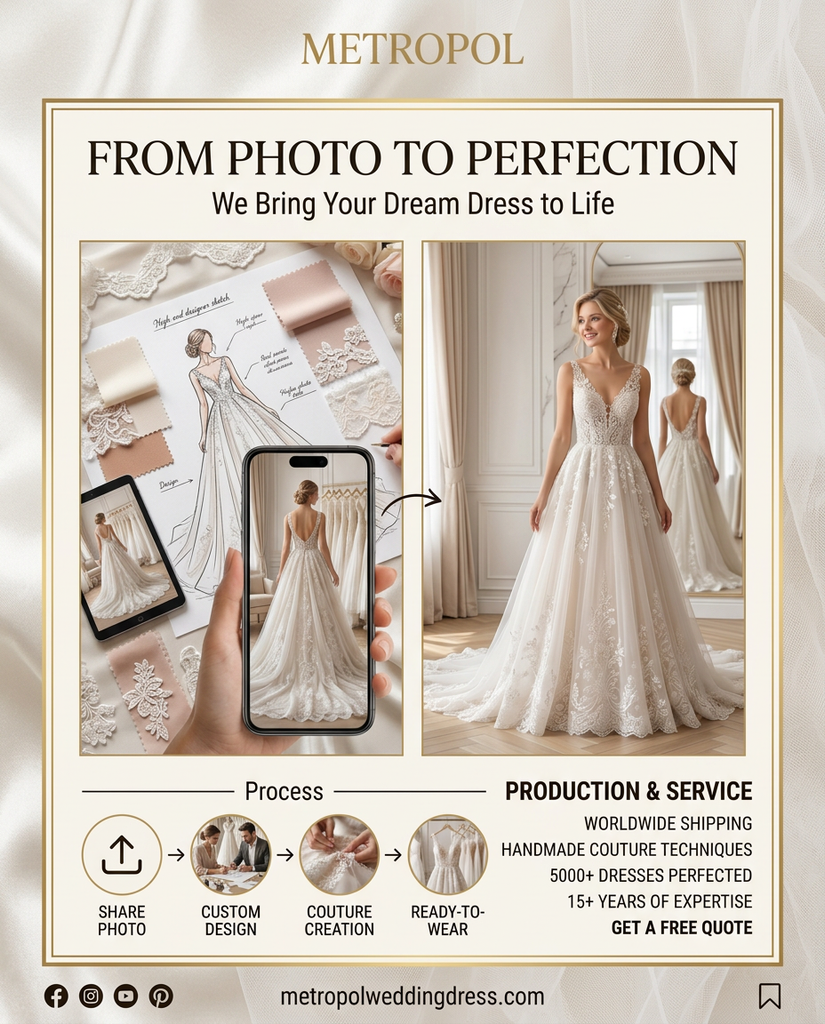
The Bridal Tech Pack: Your Manufacturing Memory
A tech pack protects the brand from relying on memory.
A useful bridal tech pack can contain:
- Style number
- Technical drawing
- Front view
- Back view
- Measurement chart
- Construction notes
- Fabric specification
- Lace reference
- Color information
- Lining specification
- Closure specification
- Embellishment map
- Placement instructions
- Label instructions
- Packaging requirements
- Tolerance requirements
- Approved sample photographs
- Revision history
For highly detailed gowns, photographs alone are insufficient.
A photograph tells the manufacturer what the garment should look like.
A specification tells the manufacturer what the garment should be.
Materials: The Hidden Driver of Bridal Quality
A wedding dress can look expensive in a photograph and still feel disappointing in person.
This usually becomes obvious through material and construction.
The material decision affects:
- drape
- weight
- shine
- movement
- structure
- comfort
- durability
- photography
- steaming requirements
- packing
- shipping
- alterations
Satin
Useful when the design requires:
- clean surfaces
- structured silhouettes
- modern minimalism
- controlled shine
But satin can expose construction imperfections quickly.
Lace
Lace creates enormous design flexibility, but quality is not simply about how attractive the motif looks.
A buyer should consider:
- motif scale
- edge quality
- backing
- stretch
- repeat
- transparency
- appliqué potential
- color
- consistency between production lots
Tulle
Tulle can create:
- volume
- softness
- layered skirts
- veils
- illusion details
Its behavior depends heavily on weight and construction.
Crepe
Crepe can create a sophisticated, fluid appearance, especially for minimalist bridal designs.
But its surface can reveal poor pressing, seam distortion or uneven tension.
Organza
Useful for structure, overlays, sleeves and sculptural details.
The correct specification depends on the intended hand feel and silhouette.
Embellishment Is a Production Engineering Problem
Hand-applied decoration is one of the areas where a quotation can become misleading.
A phrase such as “beaded bodice” does not define the workload.
A manufacturer needs to understand:
- bead type
- bead density
- placement
- handwork percentage
- embroidery
- appliqué
- sequins
- crystals
- threadwork
- reinforcement
- expected visual density
Two dresses may both be described as “beaded” while having dramatically different production costs.
For purchasing managers, this is why the question should not be:
“How much does a beaded wedding dress cost?”
It should be:
“What exact embellishment specification is included in this quotation?”
Fit Is the Commercial Battlefield
A bridal gown is not simply a fashion garment.
The bride is often purchasing a high-emotion product under a fixed deadline.
Fit problems create:
- alterations
- delays
- customer anxiety
- retailer workload
- returns
- negative reviews
- additional shipping
- reputational damage
This makes size development a strategic issue.
A manufacturer serving U.S. bridal brands should be able to discuss:
- base size
- grading logic
- measurement points
- bust-to-waist proportions
- waist-to-hip proportions
- length grading
- sleeve grading
- train behavior
- petite considerations
- plus-size construction
- alteration allowance
Some international bridal manufacturers now explicitly advertise broad U.S. size ranges, demonstrating how size development has become part of global bridal production rather than an afterthought.
Why Size Grading Cannot Be Treated Like Simple Scaling
A common manufacturing mistake is to assume that a size 2 pattern can simply be enlarged to create a size 14 or 20.
Human bodies do not scale proportionally.
The relationship between:
- bust
- waist
- hip
- torso length
- shoulder
- armhole
- thigh
- back width
changes across size ranges.
That means bridal grading should be treated as pattern engineering.
A strong production partner should be prepared to discuss the actual measurement architecture behind the collection.
U.S. Market Considerations Every Overseas Bridal Manufacturer Should Understand
Selling into the United States is not simply a matter of putting gowns into cartons and shipping them overseas.
Product labeling and import requirements need to be incorporated into the manufacturing workflow.
The FTC states that most textile and wool products require disclosure of fiber content, country of origin and the identity of the manufacturer or another responsible business.
The FTC Care Labeling Rule also requires covered apparel manufacturers and importers to provide appropriate care instructions and maintain a reasonable basis for those instructions.
CBP likewise notes that imported textile and apparel products involve country-of-origin labeling and other textile-specific considerations, including applicable flammability requirements.
This is important because bridal gowns frequently combine multiple materials.
The label conversation should therefore happen before production, not after the shipment has left the factory.
Country of Origin: Do Not Guess
Country-of-origin rules for textile and apparel products can become complicated when manufacturing involves multiple countries.
CBP explains that textile and apparel origin is determined under specific rules, and the applicable origin can depend on the production operations and materials involved.
For a U.S. bridal brand, this means the manufacturer and importer should establish:
- where the gown is manufactured
- where significant processing occurs
- what the correct origin marking is
- what information is required for entry
- how labels should be attached
- whether the manufacturer’s information is correctly documented
The manufacturer identification process can also matter for commercial entries; CBP states that textile and apparel entries require the appropriate Manufacturer Identification Code information.
Important: specific classification, duty and origin questions should be confirmed for the actual gown and supply chain with the appropriate customs professional or U.S. customs authority.
Duty Is Not the Same as Manufacturing Cost
A quotation such as:
$180 per gown
does not tell the buyer the true landed cost.
A simplified landed-cost model is:
**Factory Price
- Sampling Allocation
- Packaging
- Inland Transport
- International Freight
- Insurance, where applicable
- Customs Duty and Fees
- Customs Brokerage
- U.S. Delivery
= Landed Cost**
And there can be additional commercial costs.
For example:
Landed Cost + Inspection + Alteration Allowance + Returns + Inventory Carrying Cost = Operational Cost
The actual tariff classification must be established for the specific garment.
The U.S. Harmonized Tariff Schedule contains different classifications and rates for dresses depending on material and construction, so buyers should not assume that every wedding dress has the same duty rate.
This is one reason an experienced importer should avoid building a business plan around a generic “wedding dress import duty” percentage.
A Purchasing Manager’s Supplier Scorecard
Price should be one line in the evaluation — not the evaluation.
Consider scoring a manufacturer on these categories:
| Category | Questions to Ask |
|---|---|
| Product Development | Can they turn an idea into a production-ready gown? |
| Sampling | How many revision stages are supported? |
| Pattern | Is pattern development handled professionally? |
| Fit | How are measurements validated? |
| Materials | Can they source consistent bridal fabrics and lace? |
| Embellishment | Is handwork controlled and documented? |
| MOQ | Can they support controlled launches? |
| Quality | What happens when a defect is found? |
| Reorders | Can successful styles be reproduced consistently? |
| Private Label | Can the collection carry the brand’s identity? |
| Communication | Who owns the project? |
| Lead Time | Is the production schedule documented? |
| Packaging | Is the gown protected appropriately? |
| Compliance | Can labeling requirements be discussed before production? |
| Scalability | Can the supplier grow with the brand? |
A supplier that scores well across all categories is often more valuable than one that wins only on price.
The Three Manufacturing Models a U.S. Bridal Brand Should Compare
Model A — Ready-to-Order Wholesale
The brand selects existing designs.
Advantages
- Faster launch
- Lower development work
- Easier initial purchasing
- Proven product designs may already exist
Limitations
- Less differentiation
- Potentially weaker exclusivity
- Limited control over design
- Competitors may sell similar products
Model B — Private Label
The manufacturer produces a collection under the brand’s identity.
This can include:
- Brand labels
- Packaging
- Selected styles
- Custom modifications
- Collection development
- Production specifications
Private-label bridal programs are already positioned by manufacturers as a way for boutiques and emerging businesses to build collections without operating their own factories.
Model C — OEM / ODM Development
This is the most development-intensive model.
OEM
The buyer generally brings the design and technical requirements, while the manufacturer develops and produces according to the approved specifications.
ODM
The manufacturer can contribute more heavily to:
- design development
- materials
- pattern development
- technical solutions
- sampling
- production
The exact definitions and responsibilities should always be written into the commercial agreement.
For brands that have strong creative direction but limited technical production infrastructure, ODM can be particularly useful.
When Small-Batch Production Makes the Most Sense
Small-batch manufacturing is particularly attractive when:
You are launching a new bridal brand
You do not yet have enough sales history to justify deep inventory.
You are testing a new silhouette
You want market feedback before committing to large quantities.
You operate a boutique
You need distinctive styles without turning your stockroom into a warehouse.
You are building an online collection
You want to learn which designs generate inquiries and conversions.
You are entering a new price segment
You need to test whether customers accept the new positioning.
You are creating retailer-exclusive styles
You need controlled production rather than mass-market distribution.
You are refreshing an existing collection
You want to introduce new styles while protecting cash flow.
A Practical Small-Batch Launch Architecture
Instead of launching 30 gowns, consider a staged process.
Phase 1 — Concept
Select:
- target bride
- price range
- collection aesthetic
- key silhouettes
- material direction
Phase 2 — Development
Create a small number of high-priority prototypes.
Phase 3 — Technical Validation
Test:
- fit
- construction
- materials
- embellishment
- production feasibility
Phase 4 — Commercial Test
Introduce selected styles through:
- bridal appointments
- retailer previews
- trunk shows
- digital campaigns
- showroom testing
Phase 5 — Production
Produce the strongest commercial candidates.
Phase 6 — Reorder
Use actual sales data to determine which gowns deserve deeper inventory.
This turns manufacturing into a learning system.
What Should a Bridal Brand Send to a Manufacturer?
A vague inquiry produces a vague quotation.
A professional inquiry should contain as much useful information as possible.
Recommended first-contact package
Brand information
- Company name
- Market
- Website
- Retail model
- Target customer
Collection information
- Number of styles
- Target price
- Target retail price
- Intended size range
- Expected first order
Product information
- Sketches
- Reference photographs
- Fabric preferences
- Lace preferences
- Embellishment
- Color
- Construction details
Commercial information
- Required sample quantity
- Target launch date
- Expected reorder volume
- Private-label requirements
- Packaging requirements
The more precise the brief, the more useful the manufacturer’s response.
What a Good RFQ Should Ask
Instead of:
“Please send price for wedding dresses.”
Ask:
“Please quote the attached six-style bridal collection for small-batch production, including sample development, production pricing, private labeling, standard packaging, estimated production lead time, available size range, fabric options and reorder conditions.”
Then ask the manufacturer to separate:
- Sample cost
- Pattern/development cost
- Production price
- Additional embellishment cost
- Label cost
- Packaging cost
- Shipping assumptions
- Minimum order
- Production lead time
- Reorder lead time
This produces a much more useful comparison.
Five Questions That Reveal a Manufacturer’s Real Capability
1. Can you reproduce the approved sample consistently?
This tests repeatability.
2. What happens when a production measurement is outside tolerance?
This tests quality management.
3. How do you handle fabric or lace substitutions?
This tests supply-chain discipline.
4. How are sample revisions documented?
This tests technical communication.
5. Can you reorder a successful style six months later?
This tests whether the manufacturer is actually building a production system.
The fifth question is particularly important.
A bridal brand does not want every reorder to become a new development project.
Small-Batch Manufacturing and Inventory Risk
Imagine a new bridal brand has $50,000 available for product investment.
A traditional purchasing mentality may say:
“Let’s get the best possible unit price.”
A better question is:
“How much capital should we risk before we have evidence that these designs will sell?”
If a manufacturer can support a smaller first production run, the brand can retain more working capital.
That capital can instead support:
- photography
- showroom expenses
- digital advertising
- bridal events
- samples
- sales representatives
- packaging
- logistics
- retailer acquisition
In other words:
Lower initial inventory can create higher marketing flexibility.
This is why small-batch manufacturing should be viewed as a financial strategy, not simply a manufacturing preference.
The Reorder Advantage
The first order proves that a style can be manufactured.
The second order should prove that it can be repeated.
This is where a strong production partner becomes increasingly valuable.
An efficient reorder system should preserve:
- approved pattern
- measurements
- fabric reference
- lace reference
- trim specification
- embellishment instructions
- construction details
- packaging
- label requirements
- quality standards
The brand should not have to reinvent the product every time it places an order.
Quality Control for Wedding Dresses
Quality control should happen throughout production.
Not only at the end.
Incoming Material Inspection
Check:
- fabric shade
- lace quality
- color consistency
- defects
- width
- embellishment materials
Cutting Inspection
Check:
- pattern alignment
- grain
- lace placement
- symmetry
- panel identification
Sewing Inspection
Check:
- seam quality
- tension
- construction
- closures
- lining
- boning
Embellishment Inspection
Check:
- placement
- density
- security
- symmetry
- missing elements
Final Inspection
Check:
- measurements
- appearance
- stains
- loose threads
- pressing
- zipper
- buttons
- hem
- train
- labels
- packaging
The objective is not to inspect defects out of a finished product.
The objective is to prevent defects from traveling through the production process.
The Bridal Quality Checklist
Before accepting a production shipment, a buyer should consider checking:
- Correct style
- Correct color
- Correct size
- Correct measurements
- Correct lace
- Correct embellishment
- No visible stains
- No broken closures
- No missing buttons
- No loose beading
- No damaged fabric
- Correct lining
- Correct hem
- Correct train
- Correct label
- Correct care information
- Correct country-of-origin marking
- Correct packaging
- Correct carton identification
The exact inspection standard should be agreed contractually with the manufacturer.
Five Expensive Mistakes Bridal Brands Make
Mistake 1: Choosing the Lowest Factory Price
A low unit price can hide:
- weak sampling
- poor communication
- inconsistent measurements
- expensive revisions
- higher defect rates
Better approach: compare total landed and operational cost.
Mistake 2: Approving a Sample Too Quickly
A beautiful sample is not automatically a production-ready sample.
Better approach: test measurements, construction and repeatability.
Mistake 3: Leaving Materials Undefined
“Premium lace” is not a specification.
Better approach: document the exact material reference or establish an approved substitute process.
Mistake 4: Ignoring Reorders
A collection is not successful because the first shipment arrived.
It is successful when successful styles can be reproduced.
Better approach: negotiate reorder procedures before the first purchase order.
Mistake 5: Treating Compliance as a Last-Minute Labeling Job
U.S. apparel labeling requirements can affect production decisions.
Better approach: establish labeling, origin and care requirements before bulk production. The FTC specifically requires covered apparel manufacturers and importers to provide care information, while country-of-origin and other textile labeling requirements also apply.
The Hidden Value of a Manufacturer Who Can Say “No”
This is one of the most underrated characteristics of a good manufacturing partner.
Suppose a designer requests:
- extremely delicate fabric
- heavy crystal embellishment
- an unsupported strapless bodice
- a very long train
- complex lace placement
- an unusually narrow seam allowance
A factory that simply says:
“Yes, we can do everything.”
may not be the safest partner.
A technically capable manufacturer should sometimes say:
“We can do this, but the current construction may create a fit problem.”
Or:
“This fabric will not support the proposed structure without reinforcement.”
Or:
“We recommend changing this seam because it will improve production consistency.”
That is not resistance.
That is manufacturing expertise.
From Factory to Product Development Partner
The best long-term relationship is not:
Buyer → Supplier
It is:
Brand → Product Development Partner
The difference is profound.
A supplier waits for instructions.
A development partner helps identify solutions.
A supplier focuses on units.
A development partner understands the collection.
A supplier asks what to produce.
A development partner asks what the customer needs.
For emerging bridal brands, that difference can become a competitive advantage.
Why Turkey Can Be an Interesting Manufacturing Base for Bridal Brands
For U.S. brands evaluating international sourcing, Turkey can be particularly interesting when the project requires a combination of textile capability, craftsmanship, proximity to European fashion supply chains and flexible production.
The Turkish textile ecosystem also provides access to a broad range of fabrics, trims and manufacturing expertise.
For a bridal company, the important question is not simply:
“Is Turkey cheaper?”
The better question is:
“Does the Turkish production ecosystem provide the quality, flexibility, development capability and commercial structure my brand needs?”
Cost should be evaluated alongside:
- material quality
- labor intensity
- craftsmanship
- development capability
- lead time
- logistics
- communication
- minimum quantities
- quality control
- reorder reliability
For a brand that values product differentiation, those factors can be more important than a small difference in sewing cost.
Building a Collection With Metropol Wedding Dress
For a U.S. bridal brand, working with Metropol Wedding Dress can be positioned around a simple idea:
Your brand should not have to become a factory in order to own a distinctive bridal collection.
The manufacturing relationship can be structured around the needs of the brand:
Idea → Development → Sample → Approval → Small Batch → Quality Control → Delivery → Reorder
This approach is particularly relevant to brands that want:
- distinctive bridal designs
- controlled production
- private-label collections
- small-batch launches
- professional sampling
- consistent repeat production
- U.S.-market-oriented product development
The goal is not to produce the largest possible quantity.
The goal is to produce the right gowns, at the right quality, in the right quantity, for the right customer.
A 90-Day Small-Batch Bridal Launch Framework
A practical launch can be divided into four stages.
Days 1–15: Commercial Definition
Define:
- target bride
- retail price
- wholesale price
- collection size
- target sizes
- aesthetic
- materials
- launch date
Output
A written product-development brief.
Days 16–40: Development
Develop:
- patterns
- prototypes
- fabrics
- lace
- embellishment
- construction
- fit
Output
Approved pre-production samples.
Days 41–65: Production Preparation
Finalize:
- tech packs
- size specifications
- labels
- packaging
- production quantities
- quality standards
- logistics
Output
Production-ready documentation.
Days 66–90: Small-Batch Production
Produce:
- approved styles
- agreed sizes
- private labels
- packaging
Then conduct final quality inspection and prepare shipment.
Output
A commercially testable collection.
The exact schedule will depend on design complexity, material availability, sampling revisions, order quantity and the manufacturer’s production calendar. Published bridal manufacturers currently advertise lead times ranging from roughly one month to several weeks depending on the service and product, illustrating why buyers should obtain a project-specific schedule rather than assume a universal industry lead time.
How to Calculate Whether a Small Batch Is Working
Do not measure success only by units sold.
Track:
Sell-through
How much of the initial production is sold?
Inquiry rate
How many customers ask about the design?
Appointment conversion
How often does the gown contribute to a sale?
Alteration burden
How much additional work does the gown create?
Gross margin
What remains after product and selling costs?
Reorder frequency
Are retailers asking for more?
Customer feedback
What do brides repeatedly praise or criticize?
Production consistency
Does every reorder match the approved sample?
This data should influence the next production decision.
The Information Advantage
Small-batch manufacturing creates something that mass production can destroy:
information.
A brand can learn:
- which neckline performs best
- which silhouette generates appointments
- which fabric customers prefer
- which size range moves fastest
- which embellishment is commercially justified
- which gowns photograph best
- which styles retailers request repeatedly
Then production can follow demand.
This is a much more intelligent model than guessing demand months in advance.
What “Private Label” Should Really Mean
Private label should not mean simply sewing a brand tag into an existing gown.
A meaningful private-label program should allow the brand to control elements such as:
- collection direction
- labeling
- selected materials
- product details
- packaging
- commercial positioning
- product naming
- reorder strategy
Some bridal manufacturers explicitly position private label around building a collection that belongs to the buyer’s brand rather than simply reselling a generic wholesale catalog.
That distinction is critical for brands trying to create long-term equity.
Protecting Brand Identity During Manufacturing
The more distinctive the brand, the more important documentation becomes.
Before sharing sensitive product information, a brand may consider appropriate contractual protections, including confidentiality and intellectual-property provisions.
A practical system can include:
- style codes
- version numbers
- approved sample photos
- dated approvals
- technical documents
- material references
- revision records
- written communication
- agreed confidentiality terms
The purpose is not to make the relationship adversarial.
It is to create clarity.
What Should Be in the Manufacturing Agreement?
A professional agreement should address at least:
- Product specifications
- Approved samples
- Quantities
- Pricing
- Payment terms
- Production lead time
- Inspection
- Defect handling
- Rework
- Replacement
- Packaging
- Labeling
- Intellectual property
- Confidentiality
- Material substitution
- Shipping responsibility
- Documentation
- Reorder terms
The exact legal structure should be reviewed by appropriate counsel for the transaction.
Five CTA Paths for Different Buyers
CTA 1 — For the New Brand
Ready to turn your first bridal collection from concept into production?
Send Metropol Wedding Dress your sketches, reference gowns or collection ideas. We can discuss the development path, sample requirements and small-batch production strategy for your brand.
CTA 2 — For the Boutique Buyer
Looking for distinctive gowns without committing to mass inventory?
Talk with Metropol Wedding Dress about a controlled bridal collection designed around your boutique’s customer and price position.
CTA 3 — For the Designer
You bring the creative direction. We help build the production system behind it.
Share your technical requirements, sketches or reference pieces and start a conversation about OEM/ODM bridal manufacturing.
CTA 4 — For the Purchasing Manager
Don’t compare factories by unit price alone. Compare the entire supply chain.
Request a production discussion covering sampling, MOQ, quality control, labeling, lead time and reorder capability.
CTA 5 — For the Growing Brand
Your next best-selling gown may not need a large first order.
Start with a focused collection, learn from the market and scale the styles that prove themselves.
Final Buyer Checklist: Are You Ready for Small-Batch Manufacturing?
Before contacting a manufacturer, answer these questions.
Brand
- Who is the target bride?
- What is the brand’s aesthetic?
- What price segment are you targeting?
- What makes the collection different?
Product
- How many styles?
- Which silhouettes?
- Which fabrics?
- Which lace?
- Which embellishments?
- What size range?
Commercial
- What is the target retail price?
- What is the target wholesale price?
- What is the initial production budget?
- What quantity can realistically be sold?
- Which styles are expected to become core products?
Manufacturing
- Is sampling required?
- Is pattern development required?
- Is grading required?
- Is private labeling required?
- Is custom packaging required?
- What is the target delivery date?
Import
- Who is the importer?
- Who handles customs?
- Is country-of-origin marking defined?
- Are care instructions defined?
- Is fiber-content labeling defined?
- Has classification been reviewed where necessary?
Quality
- Is there an approved reference sample?
- Are measurement tolerances defined?
- Are material substitutions controlled?
- Is inspection required?
- What happens if goods fail inspection?
If these questions are answered before production begins, the manufacturing process becomes considerably easier to manage.
The Bigger Opportunity: Build a Bridal Brand, Not Just a Bridal Inventory
A wedding dress manufacturer is easy to evaluate if the only question is:
“How much is one gown?”
It becomes much harder — and much more important — when the question becomes:
“Can this manufacturer help us build a profitable bridal product system?”
That system includes design.
It includes fit.
It includes materials.
It includes sampling.
It includes production.
It includes labeling.
It includes logistics.
It includes quality.
It includes reorders.
Most importantly, it includes learning.
For a growing U.S. bridal brand, small-batch manufacturing provides a way to reduce the distance between creative idea and commercial evidence.
Instead of committing heavily before the market has spoken, a brand can build a focused collection, test it, learn from customers and retailers, and expand the styles that demonstrate real demand.
That is the strategic value of small-batch production.
Why Metropol Wedding Dress?
Metropol Wedding Dress approaches bridal manufacturing from the perspective that a wedding gown is both a fashion product and a highly technical product.
The objective is not simply to produce garments.
It is to help brands move from:
idea → sample → approved product → small-batch collection → repeatable production.
For U.S. bridal brands, that means the conversation can begin before the purchase order.
A brand can start with:
- a sketch
- a mood board
- a reference gown
- a fabric concept
- a collection idea
- an existing technical package
From there, the manufacturing process can be structured around the product’s actual requirements.
For an emerging brand, that flexibility can make the difference between purchasing a generic assortment and building a recognizable bridal collection.
Conclusion: The Best Small-Batch Partner Is the One That Helps You Scale Carefully
Small-batch wedding dress manufacturing is sometimes described as a solution for companies that cannot meet traditional factory MOQs.
That description is too narrow.
For a sophisticated bridal brand, small-batch production is a market-validation strategy, inventory-management strategy and product-development strategy.
It gives brands the ability to:
- launch with discipline
- protect working capital
- test designs
- improve fit
- establish quality standards
- build a recognizable collection
- respond to retailer feedback
- reorder proven products
- scale without immediately committing to mass production
The right manufacturer should therefore be evaluated on more than capacity.
Look for technical competence.
Look for communication.
Look for sampling discipline.
Look for material knowledge.
Look for repeatability.
Look for quality control.
Look for private-label capability.
Look for an understanding of your market.
And above all, look for a production partner that understands that your brand’s reputation arrives inside every box it ships.
For U.S. bridal brands that want to build distinctive collections without unnecessarily locking capital into large inventories, the next step is not to ask, “How many dresses can you make?”
Ask a better question:
“How can we build the right collection together — test it, improve it and scale what works?”
That is where small-batch manufacturing becomes more than production.
It becomes a growth strategy.
FAQ: Small-Batch Wedding Dress Manufacturing for U.S. Bridal Brands
1. What is small-batch wedding dress manufacturing?
Small-batch wedding dress manufacturing is the production of bridal gowns in controlled quantities rather than large mass-production runs. It is particularly useful for emerging brands, boutiques and designers that want to test collections while limiting inventory exposure.
2. Is small-batch production suitable for a new bridal brand?
Yes. It can be particularly useful when a brand does not yet have reliable sales data. Smaller initial production can allow the brand to test silhouettes, pricing, fit and customer response before scaling.
3. What is the difference between wholesale and private-label wedding dresses?
Wholesale usually involves purchasing existing styles for resale. Private label involves producing products under the buyer’s own brand identity and may include custom labels, packaging, modifications and collection development.
4. Can a bridal manufacturer work from a sketch?
A capable development-oriented manufacturer can often begin with a sketch, reference gown, mood board or design concept. The amount of additional technical development required depends on how complete the original design information is.
5. Do I need a professional tech pack?
Not necessarily for the first conversation. However, a detailed tech pack becomes increasingly valuable as a design moves toward production because it documents measurements, materials, construction and approved details.
6. Can small-batch wedding dresses be made with custom lace?
Yes. Custom or selected lace can be incorporated depending on availability, minimum material requirements, development time and the desired production quantity.
7. Can a manufacturer reproduce a sample exactly?
The goal should be controlled reproduction of an approved reference sample. However, bridal materials can naturally vary, so the production standard should clearly define acceptable tolerances and approved material references.
8. Why is the approved sample so important?
The approved sample becomes a physical reference for production. It helps the manufacturer and buyer align on silhouette, construction, materials, embellishment and finishing.
9. Can wedding dresses be produced in U.S. bridal sizes?
Yes. The manufacturer should establish a specific measurement chart and grading methodology rather than simply relying on generic size labels.
10. Why is bridal grading different from ordinary apparel grading?
Body proportions do not increase uniformly between sizes. Bust, waist, hip, torso length and other measurements can change at different rates, making bridal pattern grading a technical process.
11. Can I order only a few gowns per style?
The answer depends on the manufacturer’s production model. Small-batch manufacturers may offer more flexibility than factories designed primarily for mass production, but the exact MOQ should be agreed for each collection.
12. Does a lower MOQ always mean a better manufacturer?
No. MOQ is only one purchasing variable. Development capability, quality control, communication, lead time and reorder reliability may have a greater impact on the total cost of the collection.
13. What is OEM wedding dress manufacturing?
OEM generally refers to manufacturing according to the buyer’s design and technical specifications. The exact scope of responsibility should be defined in the commercial agreement.
14. What is ODM wedding dress manufacturing?
ODM generally involves greater manufacturer participation in development, which can include design support, materials, patterns, sampling and production.
15. Can an emerging designer use ODM manufacturing?
Yes. ODM can be particularly useful when the designer has a strong creative direction but does not have an internal pattern-making or manufacturing department.
16. Can the manufacturer provide private-label labels?
Private-label manufacturers may provide custom branding services such as labels and packaging. These requirements should be specified before production begins.
17. Can I create an exclusive bridal collection?
Exclusivity can potentially be negotiated, but it should never be assumed. The geographic scope, styles covered, sales channels, duration and commercial conditions should be documented contractually.
18. How long does wedding dress manufacturing take?
Lead time varies significantly according to design complexity, material availability, sampling, order quantity and production scheduling. Published bridal manufacturers advertise lead times ranging from approximately one month to several weeks, so a project-specific production schedule should always be requested.
19. Should I order samples before bulk production?
Yes. For complex bridal gowns, sampling provides an opportunity to identify fit, material, construction and embellishment problems before they are multiplied across the production order.
20. What should I check on a bridal sample?
Check measurements, silhouette, fabric, lace, embellishment, construction, closures, lining, train, hem, comfort, symmetry and overall appearance.
21. How do I compare wedding dress manufacturers?
Compare them across product development, sampling, materials, pattern making, MOQ, quality control, lead time, communication, private labeling, logistics and reorder capability — not only unit price.
22. What should a bridal manufacturer know about the U.S. market?
The manufacturer should understand that imported apparel can involve requirements relating to country of origin, fiber content, care information and other applicable rules. The FTC and CBP provide official guidance on these areas.
23. Do wedding dresses need care labels in the United States?
Covered textile apparel generally requires appropriate care information. The FTC Care Labeling Rule requires manufacturers and importers to provide care instructions and maintain a reasonable basis for those instructions.
24. Does an imported wedding dress need a country-of-origin label?
Imported textile and apparel products generally have country-of-origin marking requirements. The exact marking depends on the product and applicable rules, so the manufacturer and importer should confirm the correct marking before shipment.
25. Who is responsible for U.S. apparel compliance?
Responsibilities can involve both the manufacturer and importer depending on the applicable requirement. The parties should clearly assign responsibility contractually and verify the requirements applicable to the actual products.
26. Is the country of origin always the country where the fabric was purchased?
No. Textile and apparel origin can depend on the specific manufacturing operations and applicable origin rules. CBP applies specific rules to determine origin.
27. Can the manufacturer source fabric and lace?
Many bridal manufacturers offer material sourcing or development support. The buyer should specify whether materials are manufacturer-sourced, buyer-supplied or approved from a defined reference.
28. What happens if a fabric becomes unavailable?
The manufacturer should not automatically substitute a material without approval when the material affects appearance, performance or brand identity. A substitution protocol should be established in advance.
29. Can I reorder a successful wedding dress months later?
A well-managed manufacturing system should make repeat orders possible by preserving patterns, specifications, material references and production instructions. Reorder terms should be discussed before the first order.
30. Why are reorders important for a bridal brand?
A successful reorder demonstrates that the manufacturer can move beyond one-time production and support the brand’s long-term collection.
31. How can small-batch production reduce inventory risk?
It allows the brand to test a smaller quantity before committing substantial capital to a style. Successful styles can then receive larger or more frequent reorders.
32. Is small-batch production more expensive per gown?
It can be, because smaller runs may have less production efficiency. However, a higher unit cost can sometimes be justified if it reduces excess inventory, product risk and development waste.
33. Should I choose the manufacturer with the lowest price?
Not automatically. The relevant number is the total commercial cost, including sampling, freight, duties where applicable, quality problems, alterations, returns and inventory risk.
34. Can Metropol Wedding Dress manufacture an entire bridal collection?
A collection should be evaluated style by style because complexity, materials, embellishment and production requirements differ. The appropriate first step is to provide the collection concept or technical specifications for a production assessment.
35. Can Metropol Wedding Dress manufacture under my own brand?
Private-label manufacturing is designed around producing a collection under the buyer’s brand identity. Specific label, packaging and exclusivity requirements should be discussed as part of the project.
36. What should I send Metropol Wedding Dress to get started?
A useful starting package includes your brand information, target customer, sketches or reference gowns, expected collection size, target retail positioning, desired size range, materials, approximate quantity and launch schedule.
37. Can I start if I only have ideas and no finished designs?
A manufacturer with development capabilities may be able to help translate early concepts into production-ready products. The amount of development required should be evaluated before quoting.
38. What is the most important question to ask a wedding dress manufacturer?
Instead of asking only, “What is your price?”, ask:
“How will you take this product from approved concept to consistent repeat production?”
The answer will reveal much more about the manufacturer’s real capability.
Related Topics
28.09.2025
Beliebte Stoffe für Brautkleider in Deutschland Satin Spitze und mehr Ein Brautkleid ist mehr als nur ein Kleidungsstück – es ist ein Symbol für Liebe, Eleganz und den Beginn eines neuen Lebensabschnitts. Der Stoff eines...
07.04.2025
Bornova Gelinlik Düğün hazırlıkları, her çift için heyecan verici ve özel bir süreçtir. Bu süreçte gelinlik, gelin saçı ve diğer düğün detayları büyük bir önem taşır. İzmir Bornova’da bulunan gelinlik mağazaları, gelin saçı tasarımcıları ve...
31.03.2026
Ordering a Wedding Dress from Turkey to Canada In today’s global bridal market, ordering a wedding dress from Turkey to Canada has become one of the smartest and most stylish choices for brides-to-be. Whether you’re...
08.04.2025
Buca Gelinlik Fiyatları En Ucuz Gelinlik Buca Gelinlik Sektörünün Genel YapısıBuca, İzmir il sınırları içerisinde yer alan, tarihi ve kültürel zenginliğiyle tanınan bir ilçedir. Buca, aynı zamanda Türkiye’nin önemli sanayi ve ticaret bölgelerinden biri olmasının...
06.04.2026
Exclusieve bridal couture uit TurkijeDe wereld van bruidsmode is voortdurend in beweging. Trends komen en gaan, maar één ding blijft altijd centraal staan: de wens van elke bruid om zich uniek, elegant en onvergetelijk te...

22.06.2025
Bridal Dress For Retailers Metropol Wedding Dress The bridal dress industry is a cornerstone of the global fashion market, with a valuation exceeding $30 billion annually and steady growth projected through 2030. For retailers, this...
Comments