Custom Wedding Dresses Belgium
Custom Wedding Dresses Belgium For brides in Brussels and across Belgium seeking a truly unique wedding dress, custom options from Metropol Wedding Dress offer an accessible path to haute-couture quality without the premium local atelier price tags or limited selection.
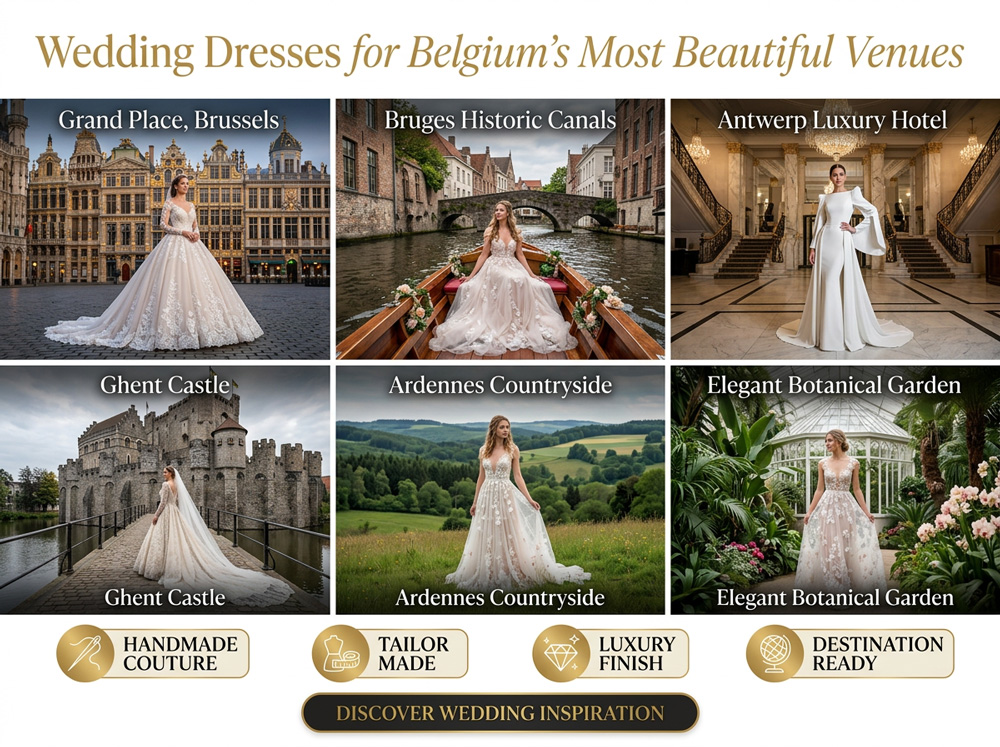
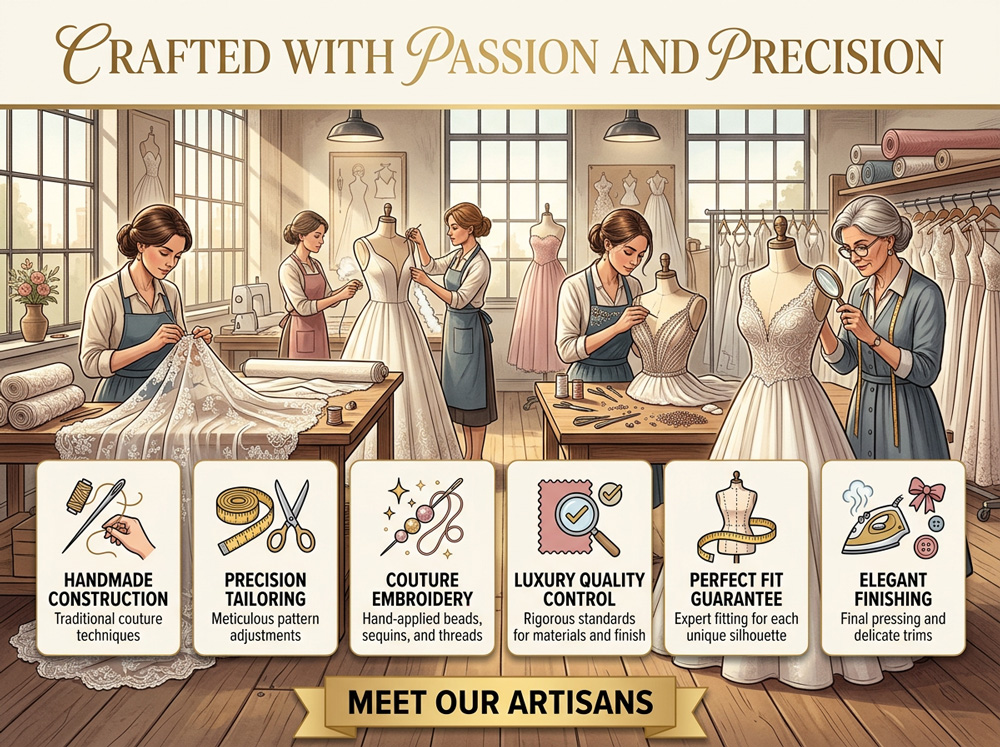
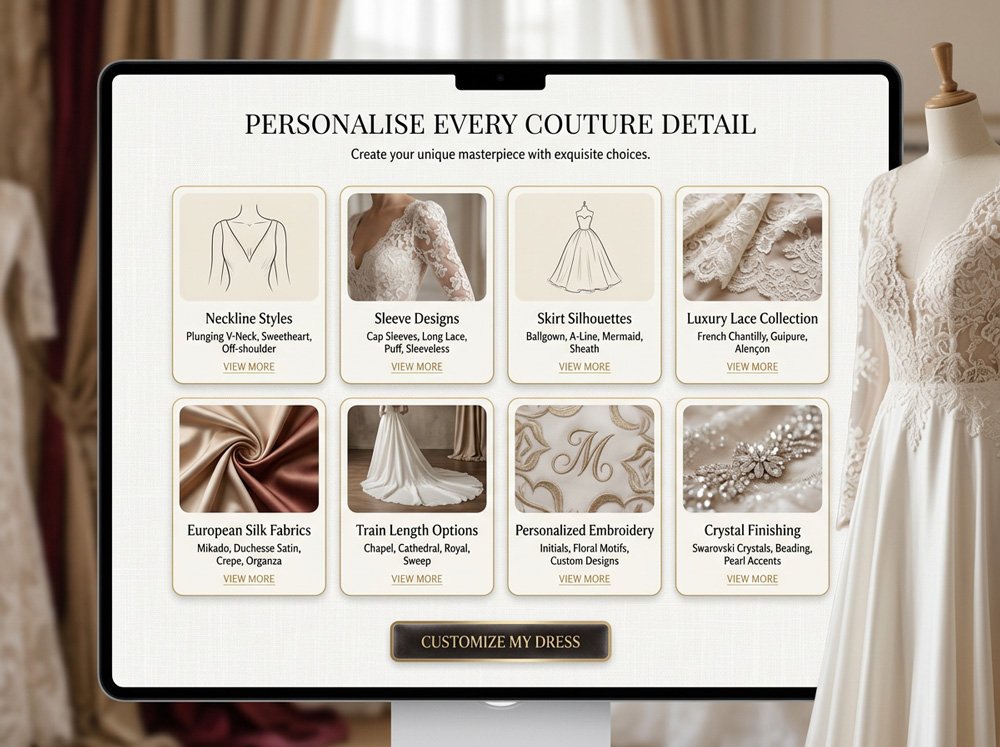
Based in İzmir, Turkey, Metropol specializes in fully custom-made gowns using premium European fabrics, hand embroidery, and precise tailoring, with worldwide shipping that reliably serves Belgian clients. This guide covers the full journey—from initial consultation and design collaboration to measurements, production, customs, and final fittings in Brussels—helping you compare costs, timelines, materials, and practical logistics against local Belgian ateliers. The result is a personalized dress that reflects your vision, fits perfectly, and arrives ready for your big day.
Custom Wedding Dresses for Brussels Brides: The Complete Guide to Creating Your Dream Gown with Metropol
Finding the perfect wedding dress in Brussels can feel overwhelming. Local ateliers offer beautiful bespoke work rooted in Belgian and European couture traditions, yet many brides discover that fully custom options come with high price points, long waiting lists, and designs that still feel constrained by available patterns or house styles. At the same time, ready-to-wear collections in Brussels boutiques rarely deliver the exact silhouette, neckline, or detailing a bride has imagined.
This is where an international custom manufacturer like Metropol Wedding Dress changes the equation. Operating from a dedicated production atelier in İzmir, Turkey, Metropol has spent more than two decades refining the process of creating made-to-measure bridal gowns for clients across Europe, including Belgium. Their model combines traditional hand-craftsmanship with modern communication tools, allowing Brussels brides to collaborate on every detail—silhouette, fabric, embroidery, train length, and fit—while benefiting from competitive pricing and reliable shipping.
This guide is written specifically for the Belgian market. It walks through the entire process from a practical, decision-oriented perspective: what “custom” really means, how the remote collaboration works, realistic costs and timelines, materials and construction quality, shipping and customs for Belgium, common pitfalls to avoid, and how Metropol compares with local Brussels options. The goal is not to sell a dream in vague terms, but to give you the concrete information needed to decide whether this route fits your wedding, budget, and personality.
Understanding What “Custom” Actually Means
In the bridal industry the word “custom” is used loosely. At one end are simple alterations to a sample gown. At the other is true made-to-order couture: a completely new pattern drafted from your measurements and design preferences, constructed from scratch, and refined through fittings.
Metropol operates at the full custom end of the spectrum. Brides can:
- Select or adapt an existing design from their collection
- Request a completely original design based on sketches, mood boards, or verbal descriptions
- Modify every element: neckline, sleeve style, bodice structure, skirt volume, train length, lace placement, beading density, and color undertone
Production takes place in their own workshop, not outsourced to multiple small workshops of unknown quality. This control allows consistent standards in pattern cutting, hand-finishing, and quality control.
For a Brussels bride this model removes several friction points common with pure local ateliers: limited fabric access, higher labor costs for every hand stitch, and the pressure of booking scarce appointment slots months in advance.
Why Belgian Brides Are Looking Beyond Local Ateliers
Brussels and the wider Belgian bridal market have excellent options. Ateliers such as Valentine Avoh create refined, fluid pieces inspired by classic Hollywood and Belgian haute couture. Italian-focused boutiques like La Rosa Bianca on Avenue Louise bring Mediterranean craftsmanship. Larger showrooms stock Pronovias, Rosa Clará, and other European labels with strong alteration services.
Yet several practical realities drive interest in international custom makers:
- Price accessibility. Fully bespoke local gowns frequently start well above €3,000–€5,000 and climb rapidly with complex detailing. Metropol’s custom range typically sits in a more approachable band while still using high-grade fabrics and handwork.
- Design freedom. Some local houses have a recognizable house style. International production allows wider exploration of silhouette and ornament without departing from a signature aesthetic.
- Timeline flexibility. Remote collaboration can begin earlier or later in the planning process than appointment-driven local schedules sometimes allow.
- Access to specialized techniques. Certain lace applications, 3D floral work, or structured corsetry are executed at scale in specialized Turkish bridal ateliers, often at lower cost for equivalent complexity.
None of this diminishes the value of local craftsmanship. It simply expands the realistic choices available to a bride who wants something unique within a defined budget and timeline.
The Collaboration Process with Metropol – Step by Step
The process is designed for clients who cannot visit the atelier in person. Communication typically happens via email, WhatsApp, and video calls, with high-resolution photos and detailed measurement forms.
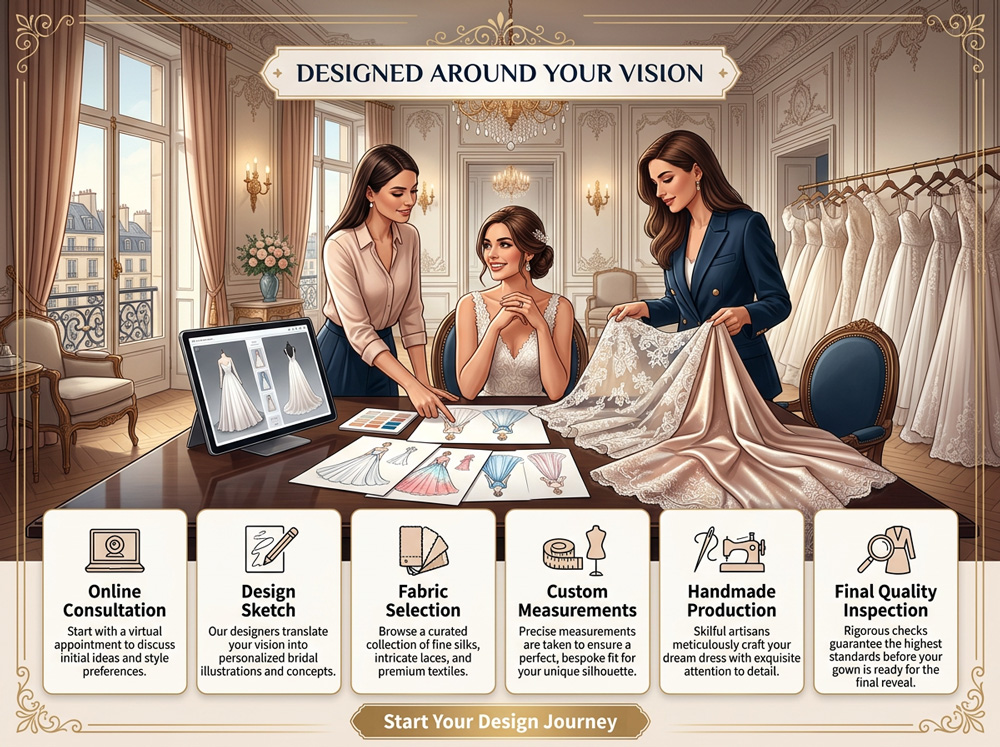
- Initial contact and vision discussion Share inspiration images, preferred silhouettes, wedding venue atmosphere (cathedral, outdoor garden, modern hotel, etc.), and any non-negotiable elements. The design team responds with suggestions and preliminary sketches or photo references from their archive.
- Design refinement Multiple rounds of feedback refine the look. Changes to neckline depth, sleeve volume, lace density, or train shape are normal at this stage. Once approved, a technical drawing or detailed description locks the design.
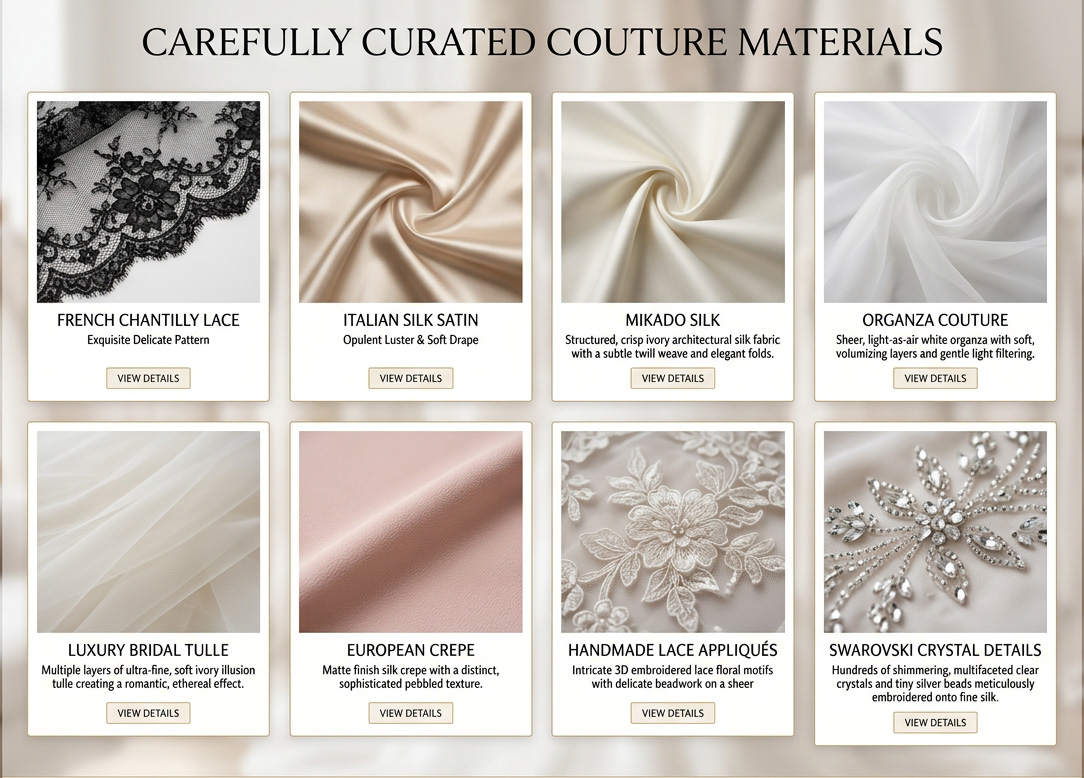
- Measurement and fabric selection A comprehensive measurement form is provided. Accurate body measurements (taken by a professional tailor or trusted friend following the form exactly) are critical. Fabric options—duchess satin, silk mikado, French lace, tulle, organza, etc.—are discussed with samples sometimes shipped if needed.
- Production Pattern drafting, cutting, sewing, and embellishment take place in the controlled atelier environment. Typical production time for a fully custom gown is several weeks to a few months depending on complexity and current order volume.
- Progress updates and quality checks Photos of the work-in-progress are shared at key stages so the bride can request minor adjustments before final assembly.
- Shipping and arrival in Belgium The finished gown is carefully packed and shipped. Tracking is provided. Upon arrival the bride arranges a local fitting with a trusted Brussels seamstress for any final tweaks (hem, bustle, minor ease adjustments).
- Final local fitting Most international custom gowns benefit from one professional local fitting. This is standard practice and usually inexpensive relative to the overall investment.
This structure keeps the creative collaboration personal while leveraging the production capacity of a specialized workshop.
Materials and Construction Quality
Quality in a wedding dress is determined by fabric choice, pattern precision, and finishing techniques more than by the country of origin.
Metropol works with European-sourced or high-grade imported fabrics: French and Italian laces, quality satins, soft tulles, and structured underlayers. Embellishments—beading, sequins, 3D flowers, embroidery—are applied by hand. Seams are finished cleanly, boning is properly placed for support, and linings are chosen for comfort against the skin.
Construction typically includes:
- Structured bodices with internal corsetry or soft support depending on the design
- Multiple layers of skirt for volume and movement control
- Secure zippers or button closures with contingency options
- Properly weighted hems and trains that move correctly
For Belgian climate considerations—indoor heated venues in winter, outdoor summer weddings, or air-conditioned receptions—fabric breathability and weight are discussed during design. Lighter silks and tulles suit warmer months; denser satins and heavier lace work well for cooler formal settings.
Realistic Cost Analysis for a Belgian Bride
Costs vary with complexity, but a useful framework is:
- Simple custom A-line or sheath with moderate lace: lower end of the range
- Structured ballgown or mermaid with extensive hand beading and long train: higher end
Compared with equivalent local bespoke work in Brussels, the international custom route frequently delivers greater detailing and fabric quality for the same or lower total outlay once shipping and local final fitting are included. Additional costs to budget:
- Shipping and insurance
- Possible import VAT and duties (Belgium applies standard EU rules; many personal-use bridal garments fall within manageable thresholds, but confirmation with the carrier or a customs broker is wise)
- Local seamstress for final fitting and bustle
- Accessories if ordered separately
Transparent communication about the final price before production begins is standard. Request a written breakdown that includes all expected extras.
Timeline Planning for a Brussels Wedding
Ideal lead time is 6–9 months before the wedding date. This allows comfortable design collaboration, production, shipping, and a buffer for any adjustments. Shorter timelines are sometimes possible for simpler designs, but rush fees or limited options may apply.
Coordinate the international production calendar with local elements: venue booking, photographer, and hair/makeup trials. The dress should ideally arrive at least 4–6 weeks before the wedding so the final fitting and any last-minute decisions (veil, shoes, jewelry) can be settled calmly.
Practical Logistics: Shipping, Customs, and Local Support in Belgium
Metropol ships worldwide and has experience with European deliveries. Choose a reliable courier with tracking and signature confirmation. Upon arrival in Belgium:
- Check the gown carefully for any transit issues
- Store it properly (hanging in a cool, dry place, preferably in a garment bag)
- Book a local Brussels seamstress experienced with bridal alterations
Many brides use independent couture seamstresses or the alteration services of established bridal boutiques for the final fitting. The local expert handles hem length relative to the chosen shoes, bustle placement for dancing, and any minor ease adjustments after travel.
Customs formalities for personal-use clothing are usually straightforward, but keep all invoices and correspondence. Declare the value accurately.
Comparing Local Brussels Options with an International Custom Route
Local atelier advantages Immediate in-person fittings, cultural familiarity with Belgian wedding aesthetics, and the prestige of a local designer name.
Local atelier limitations Higher labor costs, potentially longer wait times for popular designers, and design vocabulary sometimes limited by the house aesthetic.
International custom advantages (Metropol model) Broader design freedom, competitive pricing for high complexity, specialized production capacity, and the ability to start the process from home.
International custom considerations Reliance on accurate measurements and clear communication, need for a local final fitting, and the logistical step of international shipping.
Many Belgian brides successfully combine both worlds: they use an international maker for the main gown and a local specialist for the final perfecting steps.
Common Mistakes to Avoid
- Providing inaccurate or incomplete measurements
- Changing major design elements after production has started
- Underestimating the importance of a local final fitting
- Leaving shipping and customs to the last minute
- Choosing fabric without considering venue climate and movement needs
- Focusing only on the front of the dress and neglecting the back, train, and comfort while seated or dancing
Clear communication and realistic buffers prevent nearly all of these issues.
Checklist for Brussels Brides Considering Custom from Metropol
- Gather 10–15 inspiration images that capture the feeling you want
- Decide on non-negotiable elements (e.g., sleeves, color, train length)
- Confirm wedding date and preferred arrival window
- Prepare accurate measurements or schedule a professional measuring appointment
- Clarify total budget including shipping, possible duties, and local fitting
- Ask for fabric and construction details in writing
- Confirm the revision process during design and production stages
- Identify a trusted local seamstress in advance
- Plan storage and final try-on logistics
Expert Perspective on the Current Market
The European bridal market continues to value individuality. Mass-produced gowns no longer satisfy many brides who want something that feels personal. At the same time, pure haute-couture pricing remains out of reach for a large segment of the market. Manufacturers who combine genuine customization with industrial-scale quality control and transparent remote collaboration fill that gap effectively. For a cosmopolitan city like Brussels—where international influences are normal—this hybrid model feels natural rather than exotic.
Final Thoughts
A custom wedding dress should feel like an extension of the bride rather than a compromise between available options. For many women planning weddings in Brussels and across Belgium, working with Metropol Wedding Dress provides the design freedom, material quality, and financial realism needed to realize that vision. The process requires clear communication and a small amount of logistical planning, but the outcome—a gown built specifically for one person, one body, and one day—is worth the coordination.
If the idea of a dress made exactly to your measurements and preferences appeals more than selecting from existing samples, the next practical step is a detailed conversation about your vision, timeline, and budget. From there the path becomes concrete: sketches, measurements, production updates, and finally a gown that arrives ready to be perfected for the aisle.
Frequently Asked Questions
How does ordering a custom wedding dress from Turkey work for someone living in Brussels? You communicate remotely via WhatsApp, email, and video. Design is refined collaboratively, measurements are submitted via a detailed form, production happens in the atelier, and the finished gown is shipped to Belgium with tracking. A local Brussels seamstress handles the final fitting.
What is the typical price range for a fully custom Metropol gown? Prices depend on complexity, fabric, and embellishment. Many custom pieces fall into an accessible luxury range that is often lower than equivalent fully bespoke work from local Brussels ateliers while still using high-quality materials and hand finishing. Request a specific quote based on your design.
How long does production and shipping usually take? Allow several weeks to a few months for production depending on the design, plus transit time. Starting 6–9 months before the wedding provides a comfortable buffer.
Do I need to visit the atelier in person? No. The entire process is designed for international clients. Accurate measurements and clear visual communication replace in-person fittings during the creation phase.
What happens if the measurements are slightly off? A professional local fitting after arrival almost always resolves minor issues. Major discrepancies are rare when the measurement form is followed carefully.
Are the fabrics good quality? Yes. Metropol uses premium European and high-grade fabrics including French lace, quality satins, and soft tulles. Construction details such as internal support and clean finishing meet professional bridal standards.
Will I have to pay Belgian import duties or VAT? Personal-use clothing is subject to standard EU customs rules. Many bridal gowns fall within manageable thresholds, but the exact amount depends on declared value and current regulations. Keep invoices and check with the shipping carrier.
Can I request changes after production starts? Major structural changes become difficult once cutting begins. Design is locked before production; minor refinements are sometimes possible if caught early through progress photos.
Is a local final fitting necessary? Strongly recommended. Travel, different undergarments, and shoe choice can require small adjustments. Most brides use a Brussels-based bridal seamstress for this step.
What silhouettes and styles can be made? Virtually any: classic ballgowns, A-line, mermaid, sheath, two-piece sets, minimalist modern looks, heavily embellished romantic styles, and more. Sleeves, necklines, trains, and details are fully customizable.
How is the gown packed and shipped? Professionally packed to protect delicate elements, with tracking and insurance options. Signature delivery is advisable.
What if the gown arrives damaged? Document any issues immediately with photos and contact both the shipper and Metropol. Proper insurance coverage is recommended.
Can I order matching accessories or bridesmaid pieces? Discuss this during the design phase. Some coordination is possible depending on the collection and timeline.
How do I ensure the color matches my vision? Discuss undertones (ivory, pure white, soft blush, etc.) carefully. Sample swatches can sometimes be arranged.
Is the process suitable for plus-size or petite brides? Yes. True custom construction is drafted from individual measurements, making it ideal for non-standard proportions.
What communication language is used? English is standard for international clients. Clear visual references help bridge any language nuances.
How many design revisions are normal? Several rounds during the initial design phase are expected and encouraged until the concept is solid.
Can I see progress photos? Yes. Updates at key production stages are part of the service so you can stay involved.
What should I tell my local seamstress? Provide the original measurements, design notes, and any construction details. An experienced bridal alterer will understand the construction of a quality custom gown.
Is Metropol only wholesale or do they work directly with individual brides? They serve both boutiques and individual brides seeking custom work.
How does this compare cost-wise with a local Brussels atelier? For equivalent levels of customization and detailing, the international route is frequently more accessible. Local prestige and in-person convenience have their own value that each bride weighs differently.
What is the best time of year to start the process for a summer wedding in Belgium? Begin in the preceding autumn or early winter to allow full production and a stress-free arrival window.
Can the dress be made in a non-traditional color? Yes, within the range of available high-quality bridal fabrics and dyes. Discuss feasibility early.
How important is the choice of undergarments? Very. Wear the intended shapewear or bustier during the local final fitting so the fit is perfected for the actual combination.
What happens if my wedding date changes? Communicate immediately. Production schedules have some flexibility, but major delays may affect availability.
Are the gowns suitable for outdoor Belgian weddings? Fabric weight, train practicality, and weather considerations are discussed during design so the gown performs well in the intended setting.
Can I incorporate family lace or sentimental elements? In many cases yes—send clear photos and discuss feasibility with the design team.
How do I store the gown once it arrives? Hang it in a cool, dry place away from direct sunlight, preferably in a breathable garment bag. Avoid plastic for long-term storage.
Is there support after the wedding for preservation? Basic care advice is provided. Professional cleaning and preservation services are available in Belgium for long-term storage.
What makes a custom gown from Metropol different from a heavily altered sample gown? A true custom gown is patterned and constructed from the beginning around your measurements and design, rather than being modified from an existing sample. The result is generally better proportion, comfort, and uniqueness.
This comprehensive approach—clear process, realistic expectations, and practical Belgian logistics—helps ensure the dress you wear in Brussels is exactly the one you envisioned.
“You may also want to take a look at this article.” Custom Wedding Dresses Canada
Belgian wedding dress designers such as Valentine Avoh, Eva Janssens, and the Natan atelier represent a refined tradition of intimate, handcrafted couture rooted in Belgian fashion education and European artisanal values. Their work emphasizes fluid silhouettes, exceptional fabric handling, and personal collaboration. Yet many brides searching for a “Belgian wedding dress designer” experience discover practical constraints: limited production capacity, higher price points for full customization, and appointment bottlenecks. Metropol Wedding Dress, a specialized custom manufacturer with more than two decades of experience, offers a complementary route that delivers designer-level pattern drafting, premium European fabrics, and full personalization at more accessible investment levels, with reliable delivery to Belgium. This guide analyzes the Belgian designer landscape, materials and construction standards, production realities, cost structures, and decision frameworks so brides can choose the path that best matches their vision, timeline, and budget.
Belgian Wedding Dress Designers: Craft, Constraints, and the Rise of Accessible Custom Alternatives
Belgium punches far above its weight in fashion. From the Antwerp Six legacy to current creative directors shaping global houses, the country’s design schools and ateliers foster a particular sensibility: thoughtful construction, respect for material, and a quiet refusal of excess for its own sake. In bridal fashion this translates into designers who treat the wedding dress as a precise, personal garment rather than a theatrical costume.
When a bride types “Belgian wedding dress designer” she is usually looking for that sensibility—something made with care, fitted to her body, and free of mass-market sameness. The local options deliver it. They also operate under real structural limits that affect price, lead times, and the degree of customization possible. Understanding both the strengths and the practical boundaries of the Belgian designer ecosystem allows a clearer decision about when to stay local and when an international custom production partner such as Metropol Wedding Dress becomes the more rational choice.
The Current Landscape of Belgian Bridal Designers
Belgian bridal designers fall into several overlapping categories:
| Designer / House | Location Focus | Signature Approach | Entry Price Indication | Notable Strength |
|---|---|---|---|---|
| Valentine Avoh | Brussels atelier | Fluid, Hollywood-inspired couture, silk & lace emphasis | Higher couture range | Intimate process, royal & film experience |
| Eva Janssens | Ghent | Modern minimalist, multi-piece / convertible silhouettes | From approx. €1,500 (collection) / €2,500+ (custom) | Comfort, layering, long-term wearability |
| Natan (Edouard Vermeulen) | Brussels | Grand, princess-level formality | On request (high) | Royalty association, dramatic presence |
| Griet Bosselaers | Antwerp area | Clean modern minimalism | €2,200–€3,300 | Short chain, European fabrics, accessible couture |
| Others (Bernadette, Karolien Verstraeten, Carta Branca etc.) | Various | Pattern play, two-piece, soft draping | Wide range | Niche aesthetics |
These makers share a commitment to made-to-measure work and high-quality materials. Most operate as small ateliers rather than large factories. That intimacy is their greatest asset and their primary constraint.
Expert observation box A small Belgian atelier can give a bride extraordinary attention. It cannot, however, absorb sudden spikes in demand, maintain large fabric inventories of every possible lace and satin, or keep dozens of specialized beaders and pattern cutters on permanent staff. Production capacity is deliberately limited to protect quality and the designer’s personal involvement.
What “Designer-Level” Actually Requires
A true designer wedding dress rests on three pillars:
- Pattern architecture – The garment is drafted from the bride’s measurements rather than graded from a standard size. Proportions, balance, and movement are engineered for one specific body.
- Material intelligence – Fabric choice dictates drape, structure, temperature behavior, and longevity. Belgian designers typically source European silks, French or Italian laces, and high-grade tulles.
- Construction integrity – Internal boning, seam finishing, support layers, and hand-applied embellishment determine how the dress feels after eight hours of wear and how it photographs under different lighting.
Local Belgian designers excel at the first and second pillars within the limits of their studio size. The third pillar becomes expensive quickly because every additional hour of specialized handwork multiplies labor cost in a high-wage European environment.
Metropol Wedding Dress approaches the same three pillars from a different production model: a dedicated bridal manufacturing atelier that maintains specialized teams for pattern cutting, lace application, beading, and finishing while still offering full custom design collaboration. The result can reach comparable construction standards at a different cost structure.
Material Analysis – What Separates Good from Exceptional
Fabric is not interchangeable. The difference between a dress that looks expensive and one that performs for an entire wedding day lies in specific technical properties.
Common high-end choices used by Belgian designers and quality custom makers:
- Duchess satin: high thread count, subtle sheen, excellent structure for bodices and structured skirts
- Silk mikado: crisp yet fluid, holds shape without excessive weight
- French Chantilly or Alençon lace: fine motifs, soft hand, requires careful underlay
- Soft English or Italian tulle: volume without scratchiness
- Organza and chiffon layers: controlled transparency and movement
Metropol sources equivalent or identical European-origin fabrics for its custom program. The difference is not origin but volume purchasing power and the ability to maintain consistent stock of specialized widths and qualities. A small Belgian atelier may need to order minimum quantities or accept longer lead times for rare lace; a specialized bridal manufacturer can respond faster.
Construction details that matter in real use
- Internal corsetry or soft power-mesh support that stays invisible
- Properly graded seam allowances so alterations remain possible
- Weighted hems that prevent the skirt from riding up
- Secure, invisible closures that do not gap or strain
- Bustle engineering planned at the design stage rather than improvised later
These elements are non-negotiable for any dress claiming designer status, whether made in a Brussels atelier or an İzmir production studio.
“You may also want to take a look at this article.” Custom Wedding Dresses Denmark
Production Process Comparison
Typical small Belgian atelier workflow Consultation → sketches → fabric selection → pattern drafting → toile/fitting → cutting → construction → multiple fittings → final hand finishing. Capacity is limited by the number of skilled hands available in one studio. Complex beading or extensive lace application can stretch timelines significantly.
Specialized custom manufacturer workflow (Metropol model) Remote design collaboration with sketches and technical drawings → measurement form → pattern drafting by dedicated pattern team → fabric cutting → sequential construction stages with progress photography → quality control → shipping. Multiple specialists work in parallel on different aspects of the gown. The bride remains involved through photos and feedback loops without needing to be physically present until the final local fitting in Belgium.
Both routes can produce excellent results. The manufacturer model simply scales the skilled labor differently and removes the geographic requirement for repeated in-person visits during the making phase.
Cost and Investment Reality for Belgian Brides
Belgian designer custom work is priced according to European labor rates, studio overhead, and the designer’s reputation. Entry-level made-to-measure pieces from smaller labels may begin around €1,500–€2,500. Fully original couture with complex detailing commonly moves into the €4,000–€8,000+ range and higher for established names.
An international custom route using a specialized bridal manufacturer typically delivers full personalization—unique pattern, chosen fabrics, hand embellishment—at a total landed cost (gown + shipping + local final fitting) that sits noticeably lower for equivalent complexity. The savings come from production efficiency rather than reduced material quality.
Investment decision framework
- Prioritize the designer’s personal name and local prestige → stay with a Belgian atelier.
- Prioritize maximum design freedom, specific fabric or detailing density, and overall value → evaluate the custom manufacturer route.
- Hybrid approach: design inspiration from Belgian aesthetics, production via efficient custom maker, final perfection by a Brussels or Ghent seamstress.
Real Scenarios
Scenario 1 – The minimalist professional in Ghent She loves Eva Janssens’ clean lines and multi-piece concept but wants a specific neckline depth and a lighter fabric for an outdoor summer ceremony. A custom manufacturer can adapt the aesthetic language while adjusting those exact parameters without starting from a completely new house collection.
Scenario 2 – The romantic bride in Brussels who wants extensive hand beading Local quotes for dense crystal and 3D floral work push the budget past comfort. A specialized atelier with dedicated beading teams can achieve the density at a different cost point while still allowing full design input.
Scenario 3 – The bride with a short engagement Popular Belgian designers may already be booked. Remote custom production can sometimes accommodate tighter timelines for simpler silhouettes because capacity is managed differently.
Frequent Pitfalls When Choosing a Designer Route
- Assuming every “custom” label means a completely new pattern rather than a modified sample
- Underestimating the cumulative cost of multiple local fittings, travel, and time off work
- Choosing fabric purely for appearance without testing drape and climate suitability
- Leaving the final bustle and hem decisions until the week of the wedding
- Ignoring the need for a trusted local seamstress even when the gown is made abroad
Decision Checklist for Brides Seeking a Belgian-Designer Experience
- Clarify whether the designer’s personal signature or the finished garment quality is the higher priority
- List non-negotiable design elements and fabric preferences
- Obtain realistic timelines from both local ateliers and custom manufacturers
- Calculate total cost including all fittings, travel, shipping, possible duties, and local alterations
- Confirm measurement accuracy protocols
- Identify a local specialist for final fitting regardless of production location
- Request progress documentation if working remotely
- Verify fabric origin and construction methods in writing
Looking Forward
Belgian bridal design will continue to thrive because it offers something genuine: intimate craftsmanship and a cultural sensibility that values restraint and quality. At the same time, the global bridal market has matured to the point where specialized production partners can deliver equivalent technical excellence and greater design flexibility at different price points. For many modern Belgian brides the smartest path is no longer an either/or choice but a considered combination of local aesthetic values and efficient, high-skill production.
Metropol Wedding Dress exists in that intersection. It does not replace the Belgian designer tradition. It expands the practical options available to brides who want the result of designer-level thinking—precise pattern, thoughtful materials, refined construction—without every constraint that comes with small-atelier economics.
The right wedding dress is the one that fits the bride’s body, vision, timeline, and budget simultaneously. Understanding both the strengths of Belgian designers and the capabilities of specialized custom manufacturers makes that match more achievable.
Frequently Asked Questions
What distinguishes a true Belgian wedding dress designer from a boutique selling international labels? A Belgian designer typically drafts original patterns, works closely with the bride on fabric and silhouette, and oversees construction in a small atelier. Boutiques mainly alter and sell existing collections.
Why do some Belgian designer gowns cost significantly more than international custom options? Higher European labor rates, limited studio capacity, and the designer’s personal time invested in each piece drive pricing. Specialized manufacturers spread skilled labor across higher volume while maintaining quality standards.
Can a custom gown made outside Belgium still feel “designer”? Yes, if pattern drafting is individual, fabrics are premium, and construction meets couture benchmarks. Origin of the atelier matters less than the technical execution.
How does Metropol’s design collaboration compare with a local Belgian atelier consultation? Local consultations are in-person and atmospheric. Metropol uses detailed remote collaboration with sketches, technical drawings, and progress photos. Both can achieve high personalization; the tools differ.
Are European fabrics used in Metropol custom dresses? Yes. Premium European and high-grade international fabrics comparable to those selected by Belgian designers are standard in their custom program.
Is the construction quality comparable to small Belgian ateliers? For equivalent design complexity, specialized bridal manufacturers maintain dedicated teams for pattern, sewing, and embellishment that can match or exceed the consistency of a single small studio.
What is a realistic timeline difference? Popular Belgian designers may require booking many months ahead. Custom manufacturers often have more flexible capacity, though complex work still needs adequate lead time.
Do I still need local fittings if the dress is made abroad? Almost always yes for final hem, bustle, and fine adjustments. This is standard practice and usually inexpensive relative to the gown investment.
How do I protect myself on measurements for a remote custom order? Use a professional tailor or experienced bridal fitter following the manufacturer’s exact measurement protocol. Progress photos provide additional checkpoints.
Can I request a design inspired by a specific Belgian designer’s aesthetic? Yes. Share references and describe the elements you admire. The custom maker can interpret the spirit without copying protected designs.
What happens with customs and VAT when importing a wedding dress into Belgium? Personal-use garments follow standard EU rules. Accurate declaration and use of a reliable courier simplify the process. Confirm current thresholds with the carrier.
Is hand-beading quality consistent with Belgian standards? Specialized bridal ateliers maintain teams focused on embellishment. Density and technique can be specified and verified through progress documentation.
How should I evaluate a manufacturer’s claims of “couture” quality? Ask for details on pattern method, fabric suppliers, internal construction techniques, and examples of finished work under different lighting. Request written specifications.
Can plus-size or petite brides achieve better results with true custom production? Yes. Individual pattern drafting is inherently superior to grading a standard size up or down, regardless of where the atelier is located.
What role does a local Belgian seamstress play after an international custom order? Final perfecting: hem relative to shoes, bustle placement, minor ease, and any last comfort adjustments. Choose someone experienced with structured bridal garments.
Are there sustainability differences between local and international custom? Local production can have a shorter transport footprint. Efficient manufacturers often optimize material use and reduce waste through specialized processes. Evaluate case by case.
How many design revisions are typical in a remote custom process? Several rounds during the design-approval phase are normal. Once cutting begins, major changes become difficult.
What should I ask a Belgian designer before committing? Lead time, number of included fittings, fabric options and their origins, revision policy, and total cost including all extras.
What should I ask a custom manufacturer such as Metropol? Pattern method, fabric sources, progress update frequency, shipping terms, revision policy before production, and exact inclusions in the quoted price.
Is a hybrid approach common? Increasingly yes: aesthetic direction influenced by Belgian design values, production handled by a specialized custom atelier, final refinement by a trusted local expert.
How important is the designer’s personal reputation versus the finished garment? For some brides the name and story matter greatly. For others the way the dress looks, fits, and feels on the day is the sole priority. Clarify this for yourself early.
Can I incorporate family heirloom lace into either route? Both local designers and experienced custom manufacturers can usually work with provided lace if the condition and quantity are suitable. Discuss feasibility early.
What climate considerations matter for Belgian weddings? Indoor heated venues in winter versus outdoor or partially open summer celebrations affect fabric weight and breathability choices. Address this explicitly in design discussions.
How do I store a custom gown properly after arrival? Hang in a cool, dry, dark place in a breathable garment bag. Avoid plastic long-term. Professional cleaning and preservation services exist in Belgium for post-wedding care.
Is the Metropol process suitable for brides who want maximum creative control? Yes. Full custom means the design starts from the bride’s vision rather than a fixed collection silhouette. Clear communication yields the best results.
This framework equips Belgian brides to navigate the designer landscape with clear eyes—honoring the genuine craft of local makers while recognizing when a specialized custom production partner delivers the same technical excellence with greater practicality.
Custom Wedding Dresses Belgium
In Belgium, the civil wedding is the only legally binding ceremony. It takes place at the town hall (stadhuis / maison communale) and is often shorter, more intimate, and less formal than a religious or large reception event. Brides increasingly choose elegant yet practical custom dresses—clean silhouettes, comfortable fabrics, refined details—that photograph beautifully in historic municipal halls and transition effortlessly to a reception or religious ceremony later the same day.
Metropol Wedding Dress specialises in fully custom-made bridal gowns tailored to these exact needs: precise measurements, European-quality fabrics, adaptable designs for Belgian town-hall settings, and reliable international delivery. This guide covers everything a bride or couple needs to select, order, and wear the ideal civil wedding dress in Belgium.
Detailed Guide: Custom Civil Wedding Dresses for Belgium
Why the Civil Ceremony Changes the Dress Conversation
Belgian law requires a civil marriage before any religious ceremony. The civil ceremony is conducted by the registrar (officier de l’état civil / ambtenaar van de burgerlijke stand) in the municipality where one of the partners is registered. It typically lasts 10–30 minutes, takes place in a formal but often understated room, and can include personal music, short speeches, and a limited number of witnesses (up to four).
Because the setting is municipal rather than a grand cathedral or outdoor venue, many brides prefer dresses that feel special without being overly dramatic. Practical considerations matter: ease of movement on stone floors or stairs, temperature control in historic buildings, and the ability to change or layer for a later celebration.
Custom design solves these issues better than off-the-rack options. A gown can be engineered for the exact proportions of the bride, the architecture of a specific town hall, the season, and the overall wedding timeline.
The Modern Belgian Civil Bride: Style Profiles That Work
Several silhouettes consistently succeed in Belgian civil settings:
- Clean A-line or sheath dresses in silk crepe or satin that photograph elegantly against wood panelling or marble.
- Soft mermaid or column shapes with modest trains that do not overwhelm smaller ceremony rooms.
- Two-piece or convertible designs (detachable overskirts or jackets) that allow a more formal look for the town hall and a lighter version for the party.
- Minimalist long-sleeve or three-quarter-sleeve styles for cooler months or more traditional municipalities.
- Refined jumpsuits or tailored co-ord sets for contemporary couples who want comfort and modernity.
Colour is almost always ivory, soft white, champagne, or blush. Pure bright white can feel harsh under fluorescent municipal lighting; warmer tones flatter skin and photograph better.
Fabrics favoured for civil ceremonies prioritise drape, breathability, and structure: heavy silk satin, Italian crepe, French lace overlays used sparingly, and high-quality mikado for architectural shapes. Heavy beading or large tulle volumes are usually reserved for evening receptions.
Material Analysis for Belgian Conditions
Belgium’s climate and venue types influence fabric choice:
- Cool, damp weather in many town halls → medium-weight crepe or satin that holds shape without clinging.
- Historic buildings with variable heating → breathable natural fibres mixed with modern stretch for comfort during standing and short walks.
- Photography under mixed natural and artificial light → fabrics with subtle sheen rather than high gloss.
- Multiple outfit changes in one day → durable construction that survives sitting, standing, and light travel between venues.
Metropol Wedding Dress sources premium European and carefully selected international fabrics and constructs each gown with couture techniques: hand-finished seams, reinforced bodices where needed, and adjustable elements that accommodate minor weight fluctuations between fittings and the wedding day.
The Custom Process with Metropol Wedding Dress
Ordering a custom civil wedding dress from Metropol follows a clear, bride-centred sequence designed for international clients:
- Initial consultation (video or detailed questionnaire) to discuss silhouette, fabric preferences, neckline, sleeve style, and any practical constraints of the Belgian civil ceremony.
- Measurement guide and remote fitting protocol. Detailed body measurements plus photographs allow precise pattern drafting.
- Design development: sketches or 3D visualisations, fabric swatches, and embroidery or lace samples sent for approval.
- Production in the atelier with multiple quality checkpoints.
- Final adjustments if required upon delivery, or guidance for a local Belgian seamstress for last-minute tweaks.
- Secure international shipping with tracking and insurance.
Lead times are typically several months; early ordering is strongly recommended, especially for peak Belgian wedding months (May–September).
Cost Considerations for Custom Civil Gowns
Custom dresses occupy a different price band from ready-to-wear. Factors that influence final cost include:
- Complexity of construction (structured bodice, multiple layers, hand embroidery)
- Fabric quality and quantity
- Special requests (pockets, modest coverage options, convertible elements)
- Shipping and any customs formalities into Belgium
Many Belgian brides find that a well-executed custom gown from a specialised manufacturer delivers better fit and uniqueness than mid-to-high-range boutique purchases, while remaining more accessible than full haute-couture local ateliers. Transparent communication about budget from the first conversation prevents surprises.
Practical Scenarios Across Belgium
- Brussels or Antwerp town halls: more contemporary architecture often pairs well with clean, modern lines.
- Smaller Flemish or Walloon municipalities: historic rooms reward softer, romantic details that still remain practical.
- Same-day civil + religious or reception: convertible or two-look designs reduce the need for a complete change of outfit.
- Winter civil ceremonies: long sleeves, higher necklines, or elegant jackets that can be removed for photos.
- Outdoor elements after the civil ceremony (garden drinks, courtyard photos): lightweight fabrics that move well in light wind.
Common Mistakes to Avoid
- Choosing a heavy ballgown that feels out of proportion in a modest municipal room.
- Ignoring comfort during a standing ceremony and subsequent short travel.
- Ordering too late and facing rushed alterations.
- Selecting pure white without testing under similar lighting conditions.
- Overlooking the possibility of a second, lighter look for the evening.
- Underestimating the value of precise measurements for international production.
Expert Recommendations
Prioritise fit and fabric quality over pure volume. A dress that moves with the body and photographs cleanly will always look more expensive and intentional than one that fights the setting. Work with a maker experienced in custom international orders so communication remains clear and timelines realistic. Keep the civil dress slightly more restrained than the reception look if the two events are separate; the contrast creates visual interest throughout the day.
Checklist for Ordering Your Civil Wedding Dress
- Confirm exact civil ceremony date and approximate start time
- Note the specific town hall and any known room characteristics
- Decide on silhouette, coverage level, and whether convertibility is needed
- Take accurate measurements following the provided guide
- Approve fabric and design samples
- Schedule production timeline with buffer for shipping and minor local adjustments
- Plan accessories (veil, jewellery, shoes) that complement rather than compete
- Arrange for professional steaming and final try-on in Belgium if desired
Closing Perspective
A civil wedding dress in Belgium is both a legal formality and a deeply personal statement. It should feel elegant in a municipal setting, comfortable during the short but meaningful ceremony, and ready to transition into whatever celebration follows. Custom design removes the compromises of standard sizing and mass-produced styles, allowing the gown to serve the bride rather than the other way around.
Metropol Wedding Dress exists to make that level of personalisation accessible and reliable for brides across Europe, including Belgium. The result is a dress that belongs uniquely to the woman wearing it and to the specific day she becomes legally married.
Frequently Asked Questions (FAQ)
1. Is there an official dress code for a civil wedding in Belgium? No formal legal dress code exists. Most brides choose elegant, respectful attire suitable for a municipal setting. Overly casual clothing is uncommon.
2. Can I wear a short dress for the civil ceremony? Yes. Many modern Belgian brides choose midi or tea-length styles, especially if the ceremony is intimate or followed by a more formal reception look.
3. How far in advance should I order a custom dress from Metropol? Ideally 6–9 months before the wedding to allow for design, production, shipping, and any final local adjustments.
4. Do I need a different dress if I also have a religious ceremony the same day? Not necessarily. Many brides use a convertible design or a simple elegant dress that works for both, or plan a quick change between events.
5. What fabrics work best in Belgian town halls? Silk crepe, quality satin, and light mikado perform well. They drape cleanly, photograph nicely under mixed lighting, and remain comfortable.
6. Can Metropol accommodate modest or culturally specific coverage requests? Yes. Custom design allows higher necklines, longer sleeves, or additional layers as needed.
7. How are measurements taken for international orders? A detailed measurement guide with photos is provided. Video consultations can clarify any points.
8. What happens if my weight changes slightly after ordering? Minor adjustments are often possible. Building a small allowance into the design and scheduling a local fitting upon arrival is recommended.
9. Are custom dresses from Metropol suitable for outdoor photos after the civil ceremony? Yes, when fabrics and construction are chosen with movement and weather in mind.
10. Can I include pockets or other practical features? Absolutely. Custom construction makes functional details easy to incorporate without compromising aesthetics.
This content is designed as a complete, high-value landing-page resource for brides seeking custom civil wedding dresses in Belgium, centred on the specialised offering of Metropol Wedding Dress.