
Custom Wedding Dresses Canada
Custom Wedding Dresses Canada Toronto and Canadian brides seeking a truly custom wedding dress often face a trade-off between local boutique pricing, limited silhouette options, and long alteration timelines. Metropol Wedding Dress offers a direct-from-atelier custom solution: fully made-to-measure gowns crafted in Turkey with premium European fabrics, precise remote measurement protocols, and reliable shipping to Canada.
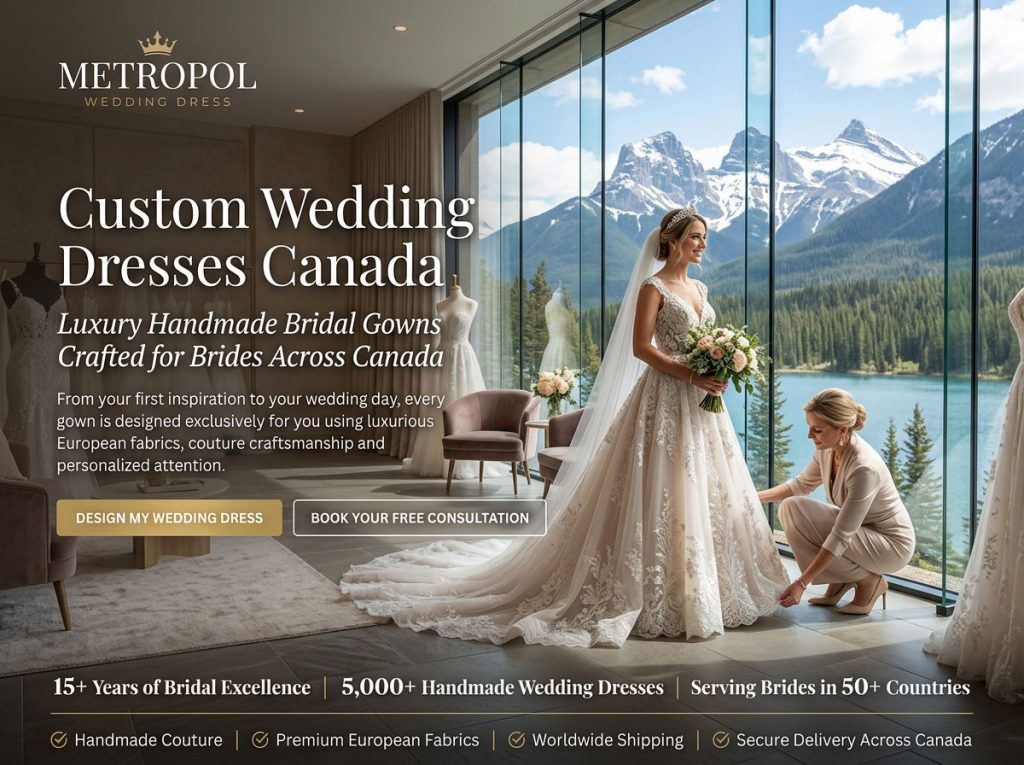
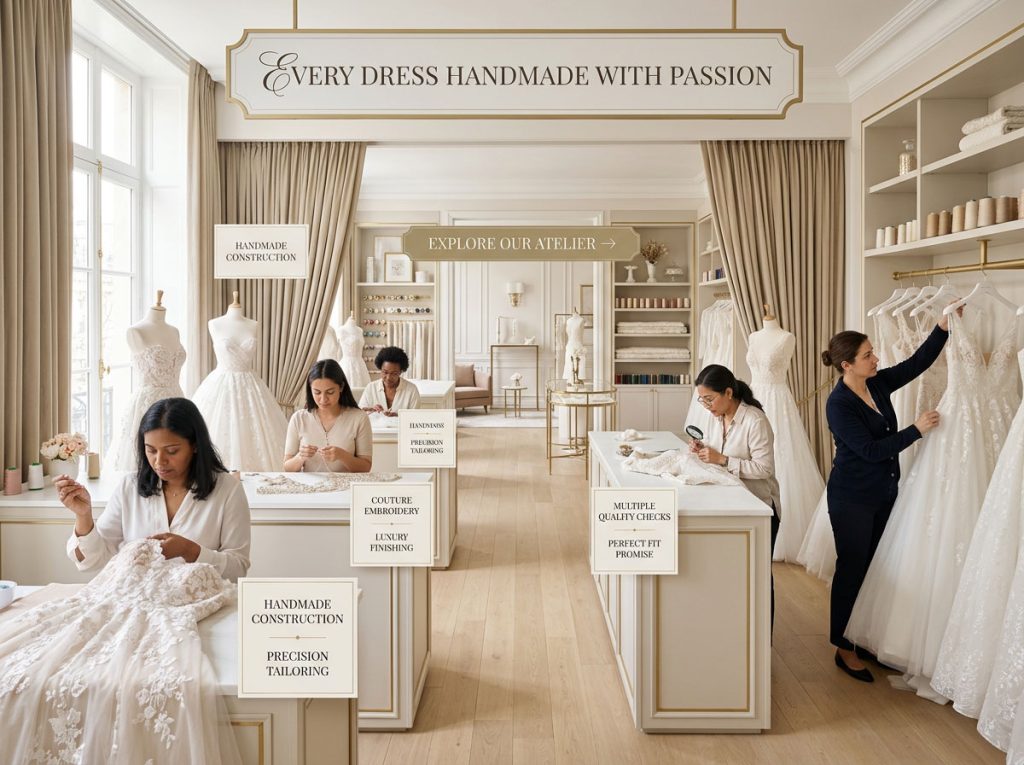
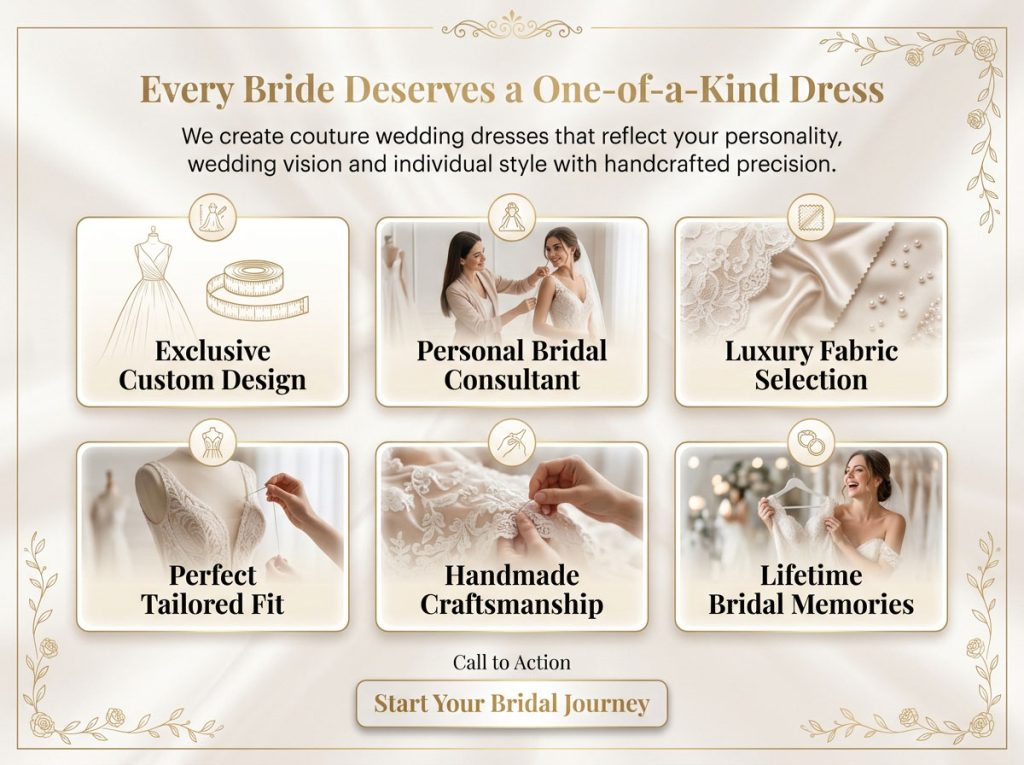
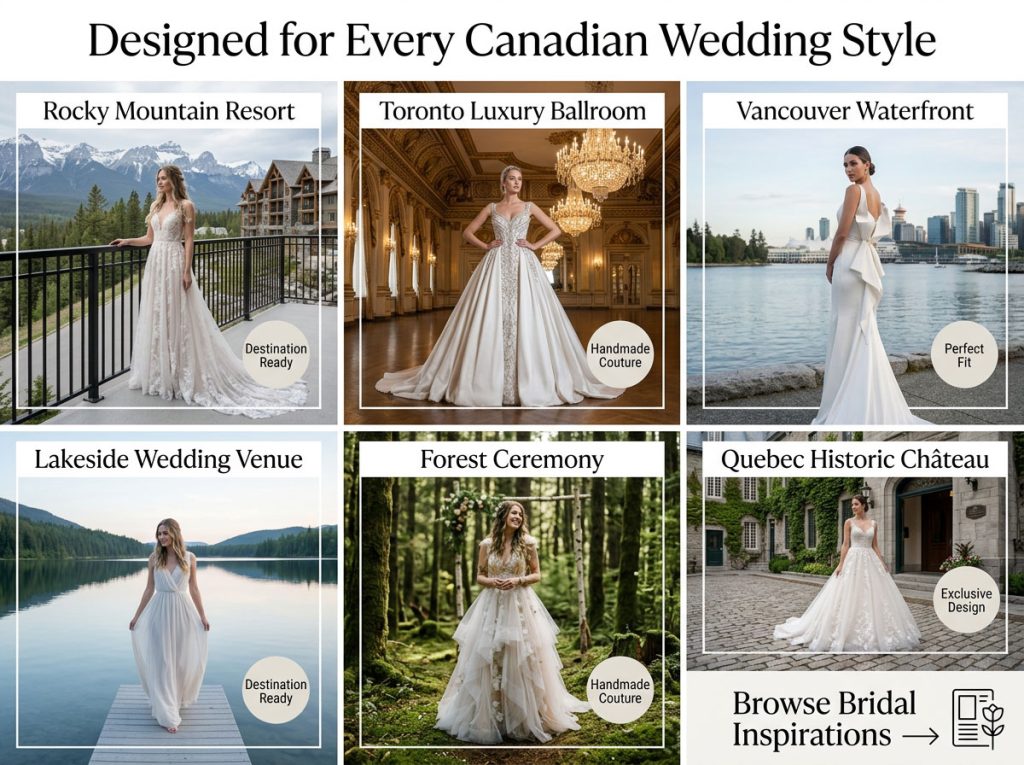
This approach delivers exact fit, design freedom, and strong value compared with many mid-to-high Toronto couture options, while accounting for Canadian import duties, climate considerations, and the diverse wedding styles found from downtown Toronto venues to cottage-country or destination celebrations.
Detailed Resource: Custom Wedding Dresses for Toronto & Canadian Brides
The Toronto Custom Reality Check
Toronto’s bridal market is sophisticated and competitive. Local designers and boutiques (Paloma Blanca, Valencienne, Silk Row, Zoba Martin, Lea-Ann Belter and others) produce beautiful made-to-measure and fully custom work. Average gown prices for quality options commonly fall between CAD $1,500–$3,500, with true bespoke local couture frequently starting at $4,000 and climbing well beyond. Alterations alone routinely add $300–$800+.
Many brides still leave appointments feeling the dress is “almost” right—neckline slightly off, fabric not quite the hand they imagined, or the silhouette not perfectly balanced for their body and venue. Custom production that begins with the bride’s exact measurements and vision, rather than adapting an existing sample, removes that compromise.
Metropol specialises in this starting-from-scratch process for international clients, including a growing number of Canadian brides who want the design freedom of a dedicated atelier without the full local couture price tag.
Why Custom Makes Particular Sense in Canada
Canadian weddings span a wide range of climates and settings:
- Urban Toronto venues (hotels, historic buildings, modern lofts) favour clean lines and fabrics that photograph well under mixed lighting.
- Outdoor or cottage celebrations in Muskoka, the Niagara region, or British Columbia require breathable, moveable fabrics and practical trains or bustles.
- Winter weddings demand warmer construction or elegant sleeves and overlays.
- Multicultural celebrations often call for modest coverage options, colour flexibility, or convertible elements that transition from ceremony to reception.
A custom gown can be engineered for these variables from the first pattern draft.
Material & Construction Considerations for Canadian Conditions
| Priority | Recommended Approach | Why It Matters in Canada |
|---|---|---|
| Climate adaptability | Medium-weight silk crepe, quality satin, mikado, or layered organza with breathable lining | Handles air-conditioned venues, outdoor humidity, or cooler evenings |
| Movement | Structured yet flexible bodices, strategic stretch panels where needed | Long photo sessions, dancing, and venue transitions |
| Photography | Controlled sheen rather than high gloss; clean drape | Works under natural light, indoor mixed lighting, and winter low light |
| Durability for shipping & storage | Reinforced seams, quality interfacing, proper packing | Survives international transit and Canadian storage conditions |
| Convertibility | Detachable trains, overskirts, or sleeves | Multiple looks in one day—common 2026 trend |
Metropol sources premium fabrics and applies couture finishing techniques (hand-sewn elements, precise pattern matching, reinforced stress points) while keeping production efficient enough to remain accessible.
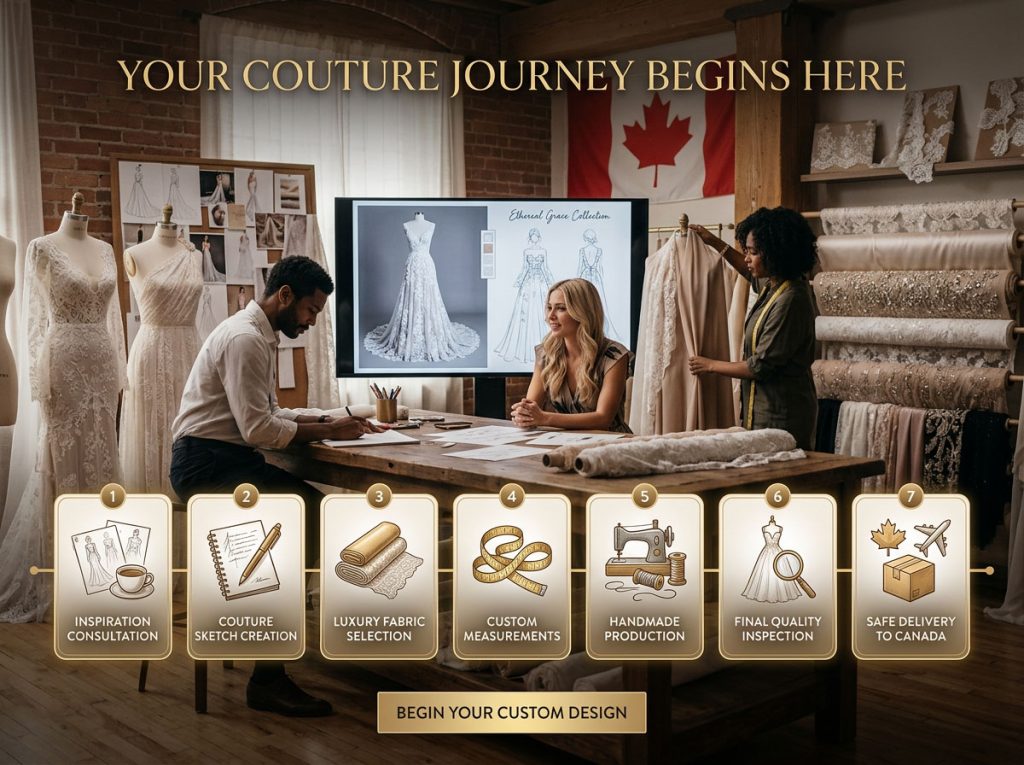
The Remote Custom Process with Metropol
- Vision & consultation – Detailed discussion of silhouette, neckline, fabric preferences, coverage needs, venue type, and any cultural or practical requirements.
- Measurement protocol – Comprehensive guide plus photo references; video clarification available.
- Design development – Sketches or visualisations, fabric and lace/embroidery samples for approval.
- Production – Pattern drafted to the individual, construction with multiple quality checks.
- Shipping & arrival – Secure international shipping with tracking and insurance. Canadian brides should budget for potential duties (typically 17–18% on apparel from Turkey) plus GST/HST and possible brokerage fees.
- Final local refinement – Minor hem or fit tweaks can be handled by a Toronto seamstress if desired.
Lead times of several months are standard; ordering 7–10 months ahead is ideal for peak season (May–October).
Cost Perspective for Toronto Brides
Local custom or high-end made-to-measure often lands in the $3,000–$8,000+ range before alterations. Metropol’s model frequently delivers comparable or superior personalisation and fabric quality at a more approachable total investment once duties and shipping are included. The exact figure depends on complexity, fabric choice, and embellishment level. Transparent budgeting from the first conversation prevents surprises.
Hidden costs to plan for regardless of source:
- Import duties and taxes (non-CUSMA origin)
- Brokerage/clearance fees
- Local steaming and any minor alterations
- Storage and transport to the venue
Real Usage Scenarios
- Downtown Toronto hotel or loft wedding: Sleek column or soft A-line in silk crepe with minimal train for easy movement through elevators and tight spaces.
- Outdoor summer ceremony + evening reception: Lightweight base gown with detachable overskirt or jacket for temperature and formality shifts.
- Winter celebration: Long sleeves or elegant capelet integrated into the design; warmer lining without bulk.
- Multicultural or modest requirements: Higher necklines, longer sleeves, or additional coverage layers built in from the start.
- Plus-size or non-standard proportions: Pattern drafted to the actual body rather than graded from a sample size, reducing the need for extensive later alterations.
Common Pitfalls Toronto Brides Encounter
- Underestimating total landed cost (gown + duties + local work).
- Ordering too close to the date and facing rushed production or expensive expedited shipping.
- Choosing fabrics that look beautiful in photos but feel uncomfortable in real Canadian humidity or air conditioning.
- Assuming a “custom” label means the dress was drafted for their body when it was only modified from an existing pattern.
- Neglecting a final local fitting buffer after international delivery.
Expert Practical Advice
Treat the dress as a technical garment as well as an emotional one. Prioritise fit and fabric performance over pure Instagram aesthetics. Communicate venue type, expected temperature range, and movement needs early. Build a 4–6 week buffer after estimated delivery for steaming, any minor tweaks, and peace of mind. If colour is part of the vision (a growing 2026 trend beyond pure white/ivory), discuss dye lots and lighting tests.
Decision Checklist
- Confirm wedding date and primary venue type
- Decide silhouette, coverage, and whether convertibility is required
- Take measurements carefully following the supplied guide
- Approve all fabric and design samples in writing
- Calculate approximate landed cost including Canadian duties and taxes
- Schedule production with realistic buffer
- Arrange local steaming and optional final fitting in Toronto
- Plan accessories that complement rather than compete
Closing View
A custom wedding dress should feel inevitable on the day—exactly the right proportion, the right movement, the right presence for the specific celebration. For many Canadian and Toronto brides, working directly with a specialised atelier such as Metropol delivers that result with greater design freedom and stronger value than adapting ready-made options. The process rewards clear communication and realistic timelines, and the outcome is a gown that belongs uniquely to the woman wearing it.
Frequently Asked Questions
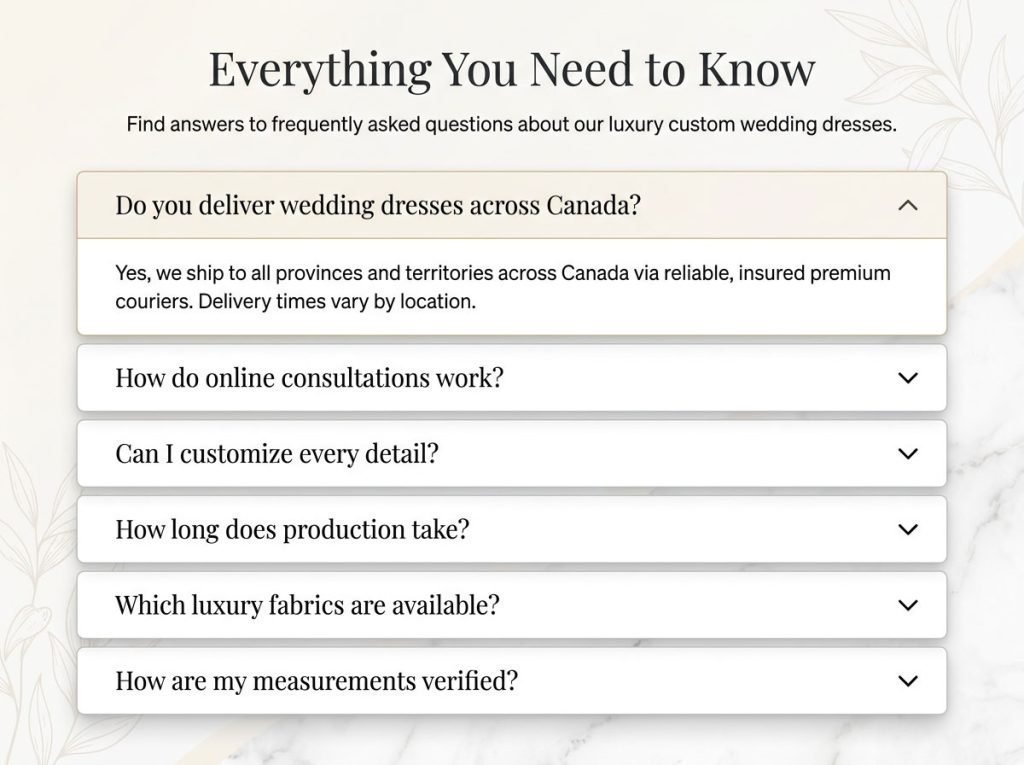
1. How does ordering a custom dress from Metropol work for a Toronto bride? Consultation, detailed measurements with photo support, design approval with samples, production, and secure shipping to Canada. Minor local adjustments can be done after arrival.
2. What import duties and taxes apply when shipping a wedding dress from Turkey to Canada? Apparel from non-CUSMA countries typically incurs 17–18% duty plus GST/HST (and PST where applicable). Brokerage fees may also apply. Exact amounts depend on declared value and current rates.
3. How long does the full process take? Design, production, and shipping usually require several months. Ordering 7–10 months before the wedding is recommended for peak season.
4. Can the dress be designed for Toronto’s variable weather and venue types? Yes. Fabric weight, lining, sleeve options, and train length are chosen according to the specific setting and season.
5. Is a fully custom gown more expensive than buying from a Toronto boutique? Not necessarily. Local high-end custom often starts higher; Metropol’s model frequently offers strong value once duties are factored in, while providing true made-to-measure construction.
6. What if my measurements change slightly after ordering? Minor fluctuations can often be accommodated with design allowances or local adjustments upon arrival.
7. Can I request modest coverage or specific cultural elements? Yes. Higher necklines, longer sleeves, additional layers, or other requirements are built into the custom design.
8. How accurate is remote measuring? A detailed protocol plus photos and optional video support produces reliable results. Many international brides achieve excellent fit this way.
9. What fabrics perform best for Canadian weddings? Silk crepe, quality satin, mikado, and well-constructed organza or lace overlays with breathable linings handle climate and photography needs effectively.
10. Can the gown include a detachable train or overskirt for multiple looks? Yes. Convertible elements are frequently requested and work well for ceremony-to-reception transitions.
11. How is the dress shipped and protected? Professional packing, tracking, and insurance are standard. Brides should plan for customs clearance time.
12. Do I still need a local seamstress in Toronto? Often only for final steaming or very minor tweaks. Major construction is completed at the atelier.
13. Are colourful or non-traditional white dresses possible? Yes. Soft ivories, champagnes, blushes, and selected colour options can be discussed according to fabric availability.
14. What about plus-size or unique body proportions? The pattern is drafted to the individual’s measurements rather than graded from a standard size, which improves fit accuracy.
15. How do I start the process? Contact Metropol through their website or provided channels with your wedding date, preferred style direction, and any practical requirements.
16. Can I see fabric and lace samples before committing? Yes. Samples are part of the design approval stage.
17. What happens if the dress arrives with a minor issue? Communication channels remain open; minor issues are typically resolved with guidance or local assistance.
18. Is the dress suitable for outdoor Canadian ceremonies? When fabric and construction are chosen with movement, wind, and temperature in mind, yes.
19. How does this compare with local Toronto custom designers? Local designers offer in-person fittings and immediate service. Metropol offers broader design freedom, specialised production capacity, and often stronger price-to-quality ratio for fully custom work.
20. Can the same dress work for both a formal ceremony and a more relaxed reception? Convertible designs or carefully chosen silhouettes make this straightforward.
21. What documentation is needed for Canadian customs? A commercial invoice stating contents and value is standard. The supplier prepares the necessary paperwork.
22. Are there restrictions on bringing the dress as personal luggage instead of shipping? Tourists can often bring a wedding dress duty-free if it is clearly personal use and will leave with them. Permanent import or commercial shipment follows different rules.
23. How important is ordering early for a summer Toronto wedding? Critical. Peak-season production slots fill, and shipping plus customs add time.
24. Can embroidery or beading be customised? Yes. Level and placement of embellishment are part of the design conversation.
25. What is the typical alteration cost if needed after arrival? Simple hems or minor tweaks are usually modest; complex changes are rare when the original construction is accurate.
26. Does Metropol offer matching or complementary pieces? Primary focus is the bridal gown; complementary requests can be discussed case by case.
27. How should the dress be stored once it arrives in Canada? Breathable garment bag, cool dry place, away from direct light and moisture. Professional steaming closer to the date is ideal.
28. Can the design accommodate a second look or after-party change? Yes. Many 2026 Canadian weddings feature multiple outfits; the custom process supports this.
29. What makes a custom international order successful? Clear communication, accurate measurements, realistic timelines, and budgeting for landed costs.
30. Is this option realistic for a bride who wants the experience of trying dresses on in person? It is a different experience—design collaboration rather than sample try-ons. Brides who value exact personalisation and are comfortable with a remote process find it highly effective.
This resource is written as a practical, decision-focused landing page for Canadian and Toronto brides evaluating fully custom wedding dresses through Metropol Wedding Dress.
Custom Wedding Dresses Canada
Toronto brides who want a custom wedding dress face a practical engineering problem: the gown must fit one specific body, perform under local climate and venue conditions, photograph cleanly, allow movement across a multi-part day, and arrive on time after international production and Canadian customs. Metropol Wedding Dress approaches this as a controlled custom manufacturing process rather than a sample-adaptation exercise. The result is a dress built from precise measurements and design specifications, using performance-oriented fabrics and construction methods suited to Greater Toronto Area realities, with clear timelines and landed-cost transparency.
Custom Wedding Dresses for Toronto: A Technical Decision Framework
Most bridal shopping treats the dress as an emotional purchase first and a technical garment second. For a Toronto wedding that sequence often creates friction. Air-conditioned lofts, historic buildings with uneven floors, outdoor ceremonies that turn humid, winter events that require layering, and the logistics of getting a gown from an overseas atelier through Canadian customs all introduce variables that a sample-based process handles poorly.
A true custom process reverses the order. It begins with measurable requirements and builds the garment to satisfy them.
Defining the Performance Envelope for a Toronto Wedding
Before any sketch is drawn, the dress must be specified against a short list of non-negotiable conditions:
- Body geometry (exact measurements, posture, preferred ease)
- Climate range on the wedding date and at the venues
- Primary movement pattern (standing ceremony, walking, sitting for dinner, dancing)
- Visual requirements under the expected lighting (natural, mixed indoor, evening)
- Timeline constraints including production, shipping, and customs clearance
- Budget ceiling that includes duties, taxes, and any local finishing
When these parameters are stated clearly, design and construction decisions become logical rather than stylistic guesswork.
Material Selection as Engineering Choice
| Requirement | Preferred Material Behaviour | Typical Metropol Approach |
|---|---|---|
| Temperature fluctuation | Stable drape, moderate breathability | Silk crepe or quality satin with appropriate lining weight |
| Humidity or outdoor exposure | Low cling, good recovery | Fabrics with controlled moisture response and internal structure |
| Long wear + movement | Flexibility at stress points without distortion | Reinforced seams, strategic ease, couture finishing |
| Clean photography | Controlled sheen, sharp or soft edge as intended | Fabric and understructure chosen for the specific light conditions |
| Shipping durability | Resistance to creasing and compression | Proper interfacing, packing method, and recovery characteristics |
The fabric is not chosen because it looks beautiful in a showroom. It is chosen because it will behave correctly under the conditions the dress will actually face.
Construction Sequence for Predictable Outcomes
- Requirements capture – measurements, photos, venue notes, climate expectations, movement needs, design priorities.
- Pattern engineering – a block drafted solely for the supplied measurements and design decisions.
- Prototype validation (visual and sample-based) – sketches, fabric swatches, and detail samples approved before cutting.
- Production with staged quality checks – cutting, assembly, internal structure, surface finishing.
- Final inspection and packing for international transit.
- Canadian arrival, customs clearance, and optional local refinement (steaming, minor hem or fit adjustment).
Because the pattern never existed as a commercial sample, the risk of “almost right” fit is substantially reduced.
Landed Cost Structure for Toronto Clients
A realistic total cost includes:
- Atelier price for design and construction
- International shipping and insurance
- Canadian import duty (commonly 17–18 % on apparel of Turkish origin)
- GST/HST (and PST where applicable)
- Possible brokerage or clearance fees
- Local steaming or minor finishing
When these elements are calculated early, the comparison with local Toronto custom or high-end made-to-measure becomes clearer. Many brides discover that a fully engineered custom gown from a specialised atelier lands at a competitive or advantageous total while delivering higher design freedom and better body-specific fit.
Risk Register and Mitigation
| Risk | Likelihood if unmanaged | Mitigation in a controlled custom process |
|---|---|---|
| Fit deviation | High with sample grading | Individual pattern drafting + measurement protocol |
| Late arrival | Medium–high with tight timelines | Early order + realistic buffer for production and customs |
| Fabric underperformance | Medium | Climate- and venue-specific material selection |
| Design regret | Medium | Structured approval stages before cutting |
| Unexpected duties | High if ignored | Transparent landed-cost estimate at the outset |
| Damage in transit | Low–medium | Professional packing and insurance |
Treating the order as a small engineering project rather than a pure retail transaction reduces the probability of each of these issues.
Scenario Mapping for Greater Toronto Area Weddings
- Downtown loft or hotel: Clean vertical lines, moderate train or no train, fabrics that hold shape under air conditioning and mixed lighting.
- Historic building or church: Slightly more formal volume or detail that still allows movement on stone floors and stairs.
- Outdoor or garden (summer): Lightweight base, possible detachable overskirt, fabrics that recover from humidity.
- Winter celebration: Integrated sleeves or elegant outer layer, warmer yet non-bulky construction.
- Multi-location day: Convertible elements planned from the pattern stage so the transformation is structural rather than improvised.
Each scenario produces a different set of technical priorities. The custom process absorbs them at the design stage.
Decision Checklist for Toronto Brides
- List the actual venues and approximate times of day
- Note expected temperature and humidity range
- Record precise measurements following a professional protocol
- Define non-negotiable design elements (coverage, silhouette, convertibility, colour)
- Request a written timeline that includes production, shipping, and customs buffer
- Obtain a landed-cost estimate that includes duties and taxes
- Confirm the pattern will be drafted for your measurements, not adapted from a sample
- Plan for local steaming and a final try-on window after arrival
Expert View from a Procurement Perspective
The highest-value custom orders share three characteristics: clear written requirements, early commitment to timeline, and realistic acceptance of the full landed cost. Brides who treat the process like a carefully specified commission rather than an emotional shopping experience consistently report higher satisfaction with both fit and overall outcome.
Metropol’s model is built for this approach. It supplies the technical capacity of a specialised bridal atelier while remaining accessible to individual Canadian clients who want the dress engineered for their specific day rather than selected from what is already hanging on a rack.
Closing
A custom wedding dress for a Toronto wedding is not merely a prettier version of a sample. It is a garment whose pattern, materials, and construction have been deliberately matched to one body, one set of venues, one climate window, and one timeline. When those parameters are stated and controlled, the emotional experience on the day becomes far more reliable.
That is the practical advantage of a true custom process with Metropol Wedding Dress.
Frequently Asked Questions
1. How is a Metropol custom dress different from a “customised” sample at a Toronto boutique? The pattern is created for the individual measurements and design decisions. It is not an existing sample that has been altered.
2. What information do I need to provide to start a technical custom order? Accurate measurements, clear photos, wedding date, venue types, climate expectations, movement needs, and design priorities.
3. How are Canadian duties and taxes calculated on a dress from Turkey? Apparel typically attracts 17–18 % duty plus GST/HST (and PST if applicable). The exact amount depends on declared value and current rates.
4. Can the dress be engineered for both indoor air-conditioned spaces and outdoor humidity? Yes. Fabric weight, lining, and structure are selected according to the expected conditions of the specific day.
5. What is a realistic total timeline for a Toronto wedding? Seven to ten months from initial consultation to final local preparation is recommended for peak season.
6. How accurate is remote measuring for a precision garment? A detailed protocol plus supporting photographs (and video if needed) produces reliable results for international custom work.
7. What happens if my weight or shape changes slightly after the pattern is cut? Minor changes can often be accommodated with design ease or local adjustment. Significant changes should be communicated immediately.
8. Can convertibility (detachable train, overskirt, sleeves) be built in from the start? Yes. These elements are most successful when planned at the pattern stage rather than added later.
9. How does the process reduce the risk of the dress arriving late? Early ordering, realistic production scheduling, and a buffer for shipping and Canadian customs clearance.
10. Is the construction suitable for long wear and dancing? Reinforced stress points, appropriate ease, and quality finishing are standard when movement requirements are stated.
11. Can modest coverage or specific cultural requirements be integrated without looking added? Yes. They are designed into the original pattern and construction.
12. What documentation is required for Canadian customs? A commercial invoice with accurate description and value. The supplier prepares the necessary papers.
13. How should the dress be handled after it clears customs in Toronto? Professional steaming, proper hanging or storage in a breathable garment bag, and a final try-on window before the wedding.
14. Can colour or non-traditional white be specified? Yes, within the range of available high-quality fabrics and controlled dye lots.
15. What is the most common cause of dissatisfaction with international custom orders? Incomplete requirements at the start or insufficient timeline buffer.
16. How does this compare financially with local Toronto custom designers? Local work offers in-person fittings. Metropol frequently delivers equivalent or greater design freedom and body-specific construction at a competitive landed cost.
17. Are plus-size or non-standard proportions handled differently? The pattern is drafted to the actual measurements supplied, which improves fit accuracy regardless of size category.
18. Can the dress be designed for a multi-venue day with different formality levels? Yes. Convertible construction or coordinated elements can be specified from the beginning.
19. What quality controls exist during production? Staged checks at cutting, assembly, internal structure, and final finishing.
20. Is insurance included in shipping? Professional shipping with tracking and insurance is standard.
21. How do I know the fabric will photograph well in my specific venues? Fabric sheen and drape are discussed in relation to the expected lighting conditions.
22. Can I request specific internal structure (corsetry level, support, etc.)? Yes. Support and structure are part of the technical specification.
23. What if I need a minor adjustment after the dress arrives in Toronto? Local seamstresses can handle simple hems or fine-tuning. Major reconstruction is rarely required when the original process is accurate.
24. How detailed should the initial design brief be? The clearer the priorities (silhouette, coverage, movement, climate, convertibility), the more precise the outcome.
25. Is there a point at which changes can no longer be made? Major changes after fabric is cut affect cost and timeline. Early approval stages exist to lock decisions before that point.
26. Can the same technical process accommodate a second look or after-party dress? Yes, either as a convertible design or as a coordinated separate piece.
27. What makes a custom order succeed from a project-management perspective? Written requirements, realistic timeline, full landed-cost visibility, and disciplined approval stages.
28. How does Metropol handle communication across time zones? Structured updates and clear documentation at each decision point.
29. Is the dress suitable for Toronto’s winter wedding conditions? When sleeves, fabric weight, and possible outer layers are specified, yes.
30. What is the first concrete step for a Toronto bride? Contact Metropol with the wedding date, a summary of venues and climate expectations, and the primary design and performance priorities.
This resource is structured as a practical, decision-oriented landing page for Toronto and Greater Toronto Area brides evaluating a true custom wedding dress through Metropol Wedding Dress.
Simple wedding dresses are not the absence of design. They are the result of deliberate restraint: clean silhouettes, excellent fabric, precise fit, and construction that does not rely on ornament to look finished. Canadian brides who want this aesthetic often struggle to find it in sample-heavy retail, where “simple” can look unfinished or generic. Metropol Wedding Dress creates fully custom simple gowns—drafted to individual measurements, executed in high-quality fabrics, and engineered for Canadian venues and climates—so the simplicity feels intentional, refined, and personal rather than basic.
“You may also want to take a look at this article.” Custom Wedding Dresses Denmark
Simple Wedding Dresses in Canada: Intentional Restraint as Design
The request for a “simple” wedding dress is one of the most common and most misunderstood. Many assume simple means less expensive, less considered, or less special. In reality, a successful simple dress demands higher standards of fabric, cut, and construction because there is nowhere to hide.
A busy gown can distract from imperfect seams or average fabric. A simple gown cannot. Every line, every drape, every proportion is visible. That is why true simplicity is a custom problem more than a retail one.
What Canadian Brides Usually Mean by “Simple”
When Canadian clients say they want simple, they typically mean some combination of the following:
- Clean silhouette without heavy beading, large volume, or excessive layers
- Comfort for long wear, movement, and variable temperatures
- A look that photographs well without competing with the setting
- Something that feels like them rather than like a trend
- A dress that can transition from ceremony to reception without theatrical change
- Quiet presence rather than spectacle
These preferences align strongly with current quiet-luxury and modern-minimal directions, but they require execution that most sample racks do not deliver.
Why Simple Dresses Fail More Often Than Complex Ones
| Common Problem | Why It Happens in Sample Shopping | How Custom Corrects It |
|---|---|---|
| Looks plain or cheap | Average fabric and construction become obvious | Premium fabric + precise cut chosen for purity of line |
| Poor proportion | Standard grading does not match the body | Pattern drafted to actual measurements |
| Unflattering drape | Fabric not selected for the specific silhouette | Material chosen for how it falls on that body |
| Uncomfortable after a few hours | Structure or ease is generic | Ease, support, and movement engineered in |
| Feels generic | Same clean styles appear in multiple boutiques | Design decisions unique to the commission |
Simplicity amplifies both strengths and weaknesses. Custom process is the most reliable way to amplify only the strengths.
Material Discipline for Simple Gowns
The fabric carries almost the entire visual and tactile message.
- Silk crepe: soft, matte, excellent movement, forgiving of minor body variation
- Quality satin: controlled sheen, clean architecture, good for structured yet simple shapes
- Fine mikado: holds precise lines without bulk
- Lightweight wool-silk or similar blends (for cooler Canadian settings): quiet texture and warmth without looking heavy
Ornament, if used at all, is minimal and structural—subtle seam interest, a clean neckline detail, or a carefully placed fold—rather than applied decoration.
Metropol’s approach selects fabric first for behaviour (drape, recovery, temperature response, photography) and second for appearance. The result is a simple dress that feels expensive because the material and cut are doing the work.
Construction Requirements When There Is Nowhere to Hide
A simple gown needs:
- Accurate pattern with correct grain and balance
- Clean internal finishing that does not create bulk or show through
- Support that is invisible yet effective
- Seams that lie flat and remain stable through movement
- Hem and edge treatments that look intentional rather than unfinished
These are technical standards, not aesthetic extras. They are easier to guarantee when the dress is built for one body from the start.
Canadian Setting Considerations for Simple Dresses
Simple silhouettes perform especially well in many Canadian contexts:
- Modern urban venues (Toronto lofts, Vancouver contemporary spaces) where architecture is already strong
- Outdoor or natural settings where the dress should not compete with landscape
- Intimate or micro-weddings where excess volume feels out of scale
- Multi-part days that benefit from comfort and easy movement
- Cooler seasons when a clean long-sleeve or softly structured shape feels appropriate without added layers of decoration
The absence of visual noise lets the setting, the light, and the person remain the focus.
Process for a Truly Simple Custom Dress
- Clarify the exact meaning of “simple” for this bride (silhouette preference, coverage, movement, climate, photography style).
- Take precise measurements and supporting photographs.
- Select fabric for performance and purity of line.
- Draft the pattern to the individual body and approved design decisions.
- Construct with attention to internal structure and clean finishing.
- Ship with documentation for Canadian customs.
- Allow for local steaming and any minor final adjustment.
Because the design is restrained, decisions can be locked earlier and production is often more efficient—provided the requirements are stated clearly at the beginning.
Cost Perspective
Simple does not automatically mean inexpensive. Premium fabric and precise construction still carry cost. However, the absence of heavy embellishment and complex layering frequently results in a more favourable total than heavily decorated gowns of similar quality. When Canadian duties, taxes, and shipping are included, many brides find the landed cost of a well-executed simple custom dress competitive with mid-to-high local options that offer less precise fit or lower fabric quality.
“You may also want to take a look at this article.” Custom Wedding Dresses France
Frequent Mistakes When Pursuing Simplicity
- Choosing a “simple” sample that is actually just under-designed
- Prioritising the lowest price and ending up with fabric that looks flat or cheap in real light
- Ignoring fit because the dress “doesn’t have much to it”
- Selecting a silhouette that is simple in theory but unflattering on the actual body
- Underestimating how much comfort and movement matter across a full wedding day
Decision Checklist
- Define what simple means for your specific day (write it down)
- Identify the primary venues and climate range
- Commit to fabric quality over applied decoration
- Provide accurate measurements
- Confirm the pattern will be drafted for you, not adapted from a sample
- Request a clear timeline that includes shipping and Canadian customs
- Plan for professional steaming after arrival
- Evaluate the total landed cost, not only the atelier price
Expert Note
The most successful simple wedding dresses share one trait: every decision was made in service of clarity. Fabric, cut, proportion, and construction were all chosen so that nothing unnecessary remained. That level of editing is difficult to achieve when starting from existing samples. It is the natural outcome of a custom process that begins with the individual and the day.
Metropol Wedding Dress specialises in this kind of disciplined custom work for Canadian clients who want simplicity that feels considered, refined, and entirely their own.
Frequently Asked Questions
1. What does a “simple” custom wedding dress actually look like? Clean silhouette, high-quality fabric with excellent drape or structure, precise fit, and minimal or no applied ornament. The interest comes from proportion, fabric, and cut.
2. Is a simple dress less expensive than a decorated one? Often yes at the construction level, because there is less labour in embellishment. Fabric quality and precise fit still determine the final price.
3. Can a simple dress still feel special and bridal? Yes. When fabric, cut, and fit are excellent, simplicity reads as refined rather than plain.
4. Why do many “simple” sample dresses look ordinary? Because average fabric and generic grading become obvious when there is no decoration to distract.
5. What fabrics work best for simple Canadian wedding dresses? Silk crepe, quality satin, fine mikado, and selected soft blends that offer clean lines and good movement.
6. How important is fit for a simple gown? Critical. Every proportion is visible, so the pattern must be accurate to the individual body.
7. Can a simple dress include sleeves or modest coverage? Yes. Coverage can be integrated cleanly without adding visual complexity.
8. Are simple dresses suitable for outdoor Canadian ceremonies? Often ideal. They move well and do not compete with natural settings.
9. How does custom production improve a simple design? The pattern, fabric, and construction are chosen specifically for the bride and the day rather than adapted from a general sample.
10. What is the typical timeline for a simple custom dress from Metropol? Several months for design, production, and shipping. Ordering 6–9 months ahead is recommended.
11. Do Canadian duties still apply to a simple dress? Yes. Origin and value determine duty and tax, not the amount of decoration.
12. Can a simple dress be convertible for ceremony and reception? Yes. A clean base with a minimal detachable element can be designed if needed.
13. How do I avoid a simple dress looking cheap? Prioritise fabric quality and precise construction over the lowest price.
14. Is remote measuring reliable for a clean, simple silhouette? Yes, when a detailed protocol and supporting photographs are used.
15. Can colour be used in a simple dress? Soft ivories, champagnes, or subtle tones can be chosen; strong colour is less common but possible if desired.
16. What construction details matter most when the dress is simple? Seam quality, internal finishing, balance of the pattern, and edge treatments.
17. Are simple dresses more comfortable? Usually yes, because excess volume and heavy embellishment are removed and ease can be engineered precisely.
18. How should a simple gown be cared for after arrival in Canada? Professional steaming, proper hanging, and protection from light and moisture.
19. Can a simple custom dress be altered later for other occasions? Yes. Clean lines often make future shortening or restyling straightforward.
20. What is the biggest risk when ordering a simple dress? Choosing inadequate fabric or accepting approximate fit, both of which become very noticeable.
21. Does Metropol specialise in this restrained aesthetic? The custom process supports clean, minimal designs with the same attention given to more elaborate commissions.
22. How do I communicate “simple” clearly at the start? Describe preferred silhouette, fabric hand, coverage, movement needs, and what you want the dress not to include.
23. Is a simple dress appropriate for formal Canadian venues? Yes, when the fabric and cut are elevated. Formality comes from quality and proportion, not only from volume or decoration.
24. Can the dress be designed for cooler weather while remaining simple? Yes. Longer sleeves, slightly denser fabric, or a clean outer layer can be integrated.
25. How does this compare with buying a simple sample in Toronto or Vancouver? Local samples offer immediate try-on. Custom offers exact fit, fabric chosen for the purpose, and a design that is not available to other brides.
26. What makes a simple dress photograph well? Clean lines, controlled fabric sheen, and proportions that read clearly against the background.
27. Is there a minimum level of detail needed so the dress does not look unfinished? Intentional design of neckline, seams, and hem is usually sufficient when fabric and fit are excellent.
28. Can I still have a small personal detail on a simple gown? Yes—subtle seam interest, a clean back detail, or a minimal neckline variation can be included without breaking the overall restraint.
29. What is the first step if I want a simple custom dress for a Canadian wedding? Contact Metropol with the wedding date, a clear description of the desired simplicity, and the practical conditions of the day (venues, climate, movement).
30. Why choose custom for something that looks “easy”? Because true simplicity is difficult to execute well. Custom process is the most reliable way to achieve clean, refined results that feel intentional rather than incomplete.
This content is prepared as a focused landing page for Canadian brides seeking simple, refined wedding dresses through the custom capabilities of Metropol Wedding Dress.
Canadian brides facing tight timelines no longer have to choose between a generic off-the-rack gown and a six-to-twelve-month custom wait. Ready-to-ship wedding dresses delivered across Canada, combined with rapid custom options from specialists such as Metropol Wedding Dress, now deliver high-quality, personalized bridal wear in weeks rather than months. This guide maps practical paths—from inventory checks and measurement protocols to shipping realities, cost structures, fabric performance in Canadian climates, and real decision frameworks—so last-minute and planned brides alike can secure a dress that fits both their body and their wedding date without compromising style or budget.
Detailed Article
Canadian wedding culture runs on calendars that rarely cooperate. Engagements shorten, venues book faster, and international travel or family schedules compress everything. The traditional bridal salon model—order, wait 6–9 months, alter—breaks under this pressure. Ready-to-ship wedding dresses and accelerated custom programs have become the practical answer for brides from Vancouver to Halifax who need elegance on a deadline.
Metropol Wedding Dress operates as a Turkish atelier with two decades of production experience, serving individual brides and boutiques worldwide, including Canada. Their model blends made-to-measure precision with production timelines that can accommodate shorter windows, using European fabrics, hand-finished details, and direct shipping. This positions them as a bridge between pure ready-to-wear speed and full couture individuality.
Why Timelines Collapsed and What It Means for Dress Selection
Post-pandemic shifts, rising venue costs, and the growth of destination or micro-weddings have shortened average engagement periods. Many Canadian couples now plan in 4–8 months rather than 12–18. Simultaneously, supply chains for imported lace, tulle, and structured fabrics remain sensitive to global disruptions. The result is a market that rewards suppliers who maintain both finished inventory and flexible production capacity.
Ready-to-ship dresses solve the immediate problem: select a style already cut and finished in standard or extended sizes, confirm measurements, and receive it within days to a few weeks depending on origin and carrier. Rapid custom fills the gap when no existing piece matches the vision—alter neckline, change sleeve length, adjust train, or scale to exact measurements while still targeting delivery inside 4–10 weeks.
Metropol’s production setup supports both paths. Standard styles can move faster; fully personalized gowns follow a structured measurement-to-shipment sequence that prioritizes communication and quality control.
Canadian Climate and Fabric Performance Realities
A dress that photographs beautifully in a studio can fail outdoors in Canadian conditions. Prairie winds, coastal humidity, mountain cold, and summer heat demand different fabric behaviors.
- Heavy satin and structured mikado hold shape in air-conditioned ballrooms but can feel restrictive in humid Ontario summers or sticky Vancouver days.
- Lightweight chiffon, organza, and soft tulle move well outdoors yet require careful lining for modest coverage and wind control.
- Lace overlays (especially French or Alençon styles) add visual richness but need secure underlayers to prevent snagging on outdoor seating or underbrush.
- Stretch crepe and jersey blends offer comfort for longer ceremonies and reception dancing, particularly valuable for plus-size or mobility-conscious brides.
Metropol typically works with premium European satins, French laces, tulle, organza, and structured underlayers. Brides can request fabric swaps or additional lining based on venue and season. For winter weddings, heavier base fabrics or detachable wraps become practical. For summer outdoor events, breathable linings and shorter trains reduce practical friction.
Measurement Protocol That Actually Works for Remote Orders
Remote ordering succeeds or fails on measurements. Canadian brides ordering from overseas ateliers must treat measurement as a technical process, not a casual try-on.
Recommended sequence:
- Use a soft measuring tape and a full-length mirror or helper.
- Record bust (fullest point), underbust, waist (narrowest), high hip, low hip, hollow-to-hem (with intended shoes), arm circumference, and shoulder-to-bust if relevant.
- Note height, usual clothing size, and any asymmetry or posture notes.
- Photograph front, side, and back in form-fitting clothing under even lighting.
- Compare against the supplier’s size chart rather than local retail sizes—European and Turkish grading often differ from North American ready-to-wear.
- Confirm whether the dress is cut to finished measurements or includes ease for alterations.
Metropol and similar ateliers request detailed measurement forms and often provide video or photo guidance. Rush orders still require accuracy; a poorly measured gown cannot be fixed by speed alone.
Shipping, Duties, and Delivery Windows into Canada
Cross-border bridal shipping involves more variables than domestic retail. Typical pathways include:
- Direct courier (DHL, FedEx, UPS) for speed and tracking.
- Consolidated or postal options for cost control.
- Potential duties and taxes depending on declared value, origin, and province of entry. British Columbia PST rules and federal duties can apply on certain imports.
Realistic timelines for ready-to-ship pieces originating outside Canada often range from 7–21 days door-to-door once the dress leaves the atelier, assuming no customs holds. Rapid custom production plus shipping commonly targets 4–10 weeks total, depending on complexity and current production load. Brides should build a buffer of at least two weeks before the final alteration appointment or wedding date.
Insurance, tracking, and signature-required delivery are non-negotiable for high-value garments. Packaging should protect against crushing and moisture; garment bags plus rigid boxes remain standard best practice.
Cost Structure Comparison: Ready-to-Ship vs Rapid Custom vs Traditional Salon
| Category | Ready-to-Ship (Inventory) | Rapid Custom (4–10 weeks) | Traditional Custom (6–12 months) |
|---|---|---|---|
| Base price range (CAD) | $400–$2,500 | $800–$4,000+ | $2,500–$15,000+ |
| Alterations | Usually required | Minimal if measured well | Often significant |
| Shipping & potential duties | $50–$300+ | Included or quoted | Varies |
| Timeline risk | Low | Medium | High |
| Personalization depth | Limited to available styles | High | Highest |
| Size flexibility | Chart-dependent | Exact measurements | Exact |
Metropol’s positioning typically sits in the mid-to-upper accessible range for custom work, offering European fabric quality and hand finishing at price points competitive with many North American mid-market designers while avoiding the multi-year wait of pure couture houses.
Hidden costs to monitor: rush fees (if offered), international transaction fees, currency conversion, alterations after arrival, and steam/pressing services. Canadian alteration specialists charge $150–$600+ depending on complexity; a well-measured custom piece reduces this significantly.
Document the decision with screenshots of size charts, measurement forms, production estimates, and shipping quotes. Clarity reduces later stress.
Real Canadian Scenarios
Scenario 1 – Vancouver outdoor summer wedding, 7 weeks out Bride needs a lightweight A-line with lace overlay for a garden venue. Local salons have limited inventory in her size. She selects a ready-to-ship soft tulle and lace style from an overseas supplier with express courier, confirms measurements against the chart, receives the dress in 12 days, schedules one local alteration for hem and bust, and adds a detachable capelet for evening chill. Total timeline under three weeks from order to ready.
Scenario 2 – Toronto winter ballroom, 11 weeks out Bride wants a structured satin mermaid with long sleeves and modest neckline. No perfect ready-to-ship match exists. She works with Metropol on a rapid custom: exact measurements, fabric confirmation, sleeve and neckline adjustments, production in approximately 6 weeks, shipping, and arrival with two weeks buffer for minor local adjustments. The structured fabric performs well in climate-controlled venues.
Scenario 3 – Prairie province, short engagement, budget-conscious Couple plans a 5-month timeline but wants something distinctive. Bride chooses a simple crepe sheath ready-to-ship base and requests minor custom embroidery or belt addition if production allows, or pairs the ready piece with a custom veil and accessories. Focus stays on fit and comfort rather than extensive embellishment.
These cases illustrate that “ready to ship” and “rapid custom” are tools, not absolute categories. Hybrid solutions often deliver the best outcome.
A short pre-order checklist reduces most of these risks: confirm timeline feasibility in writing, double-check measurements with a second person, request production and shipping estimates, clarify duties responsibility, and schedule a local seamstress appointment in advance.
Fabric and Construction Details That Matter for Longevity
Metropol emphasizes hand-finished details and premium base fabrics. Brides should still request clear photos or video of the specific piece or construction samples when ordering remotely.
Canadian alteration specialists in major cities are accustomed to last-minute bridal work; smaller communities may require earlier booking or travel to a larger centre.