Custom Wedding Dresses Austria
Albanian wedding attire carries layered regional symbolism—red duvak veils for fertility and protection, northern geometric embroidery and the UNESCO-recognised xhubleta silhouette, southern red-and-gold prosperity motifs, and silver filigree as personal wealth markers. In the diaspora, including Austrian communities, most brides now choose a contemporary white or ivory gown for the main ceremony while preserving heritage through embroidery details, a second traditional or semi-traditional look, or symbolic colour accents.
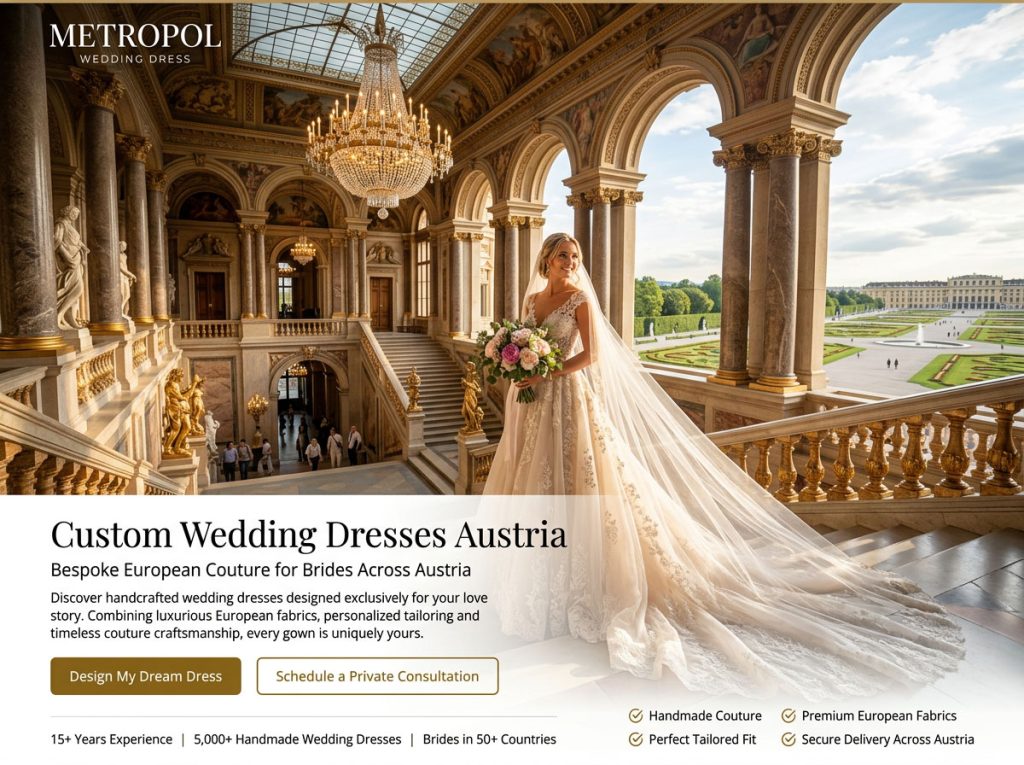
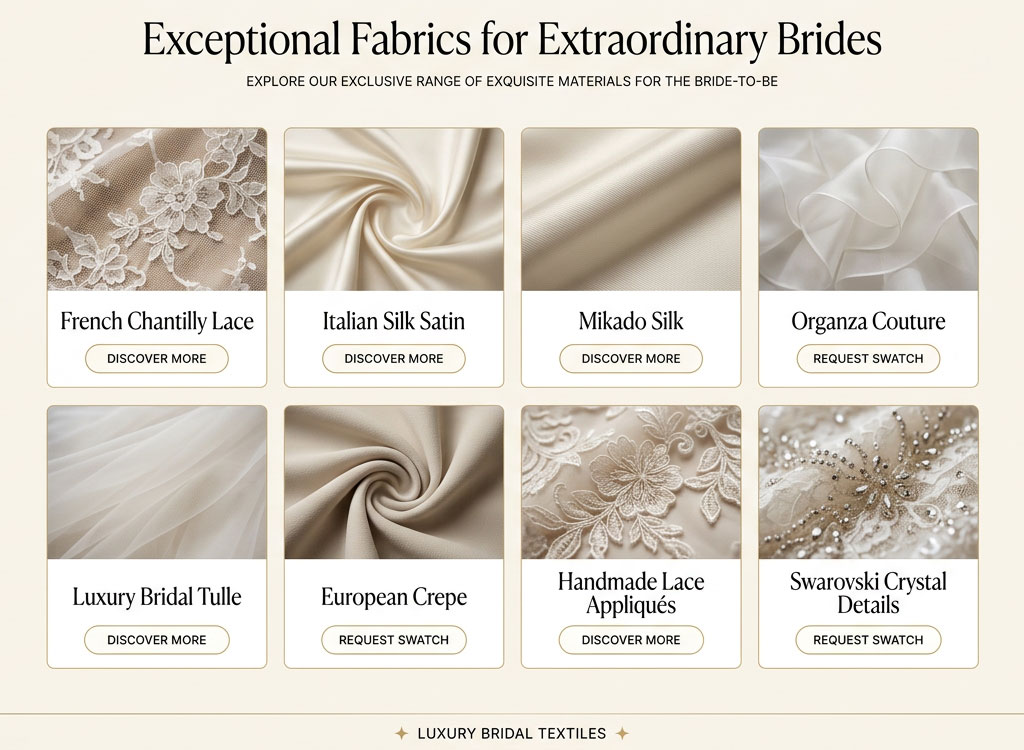
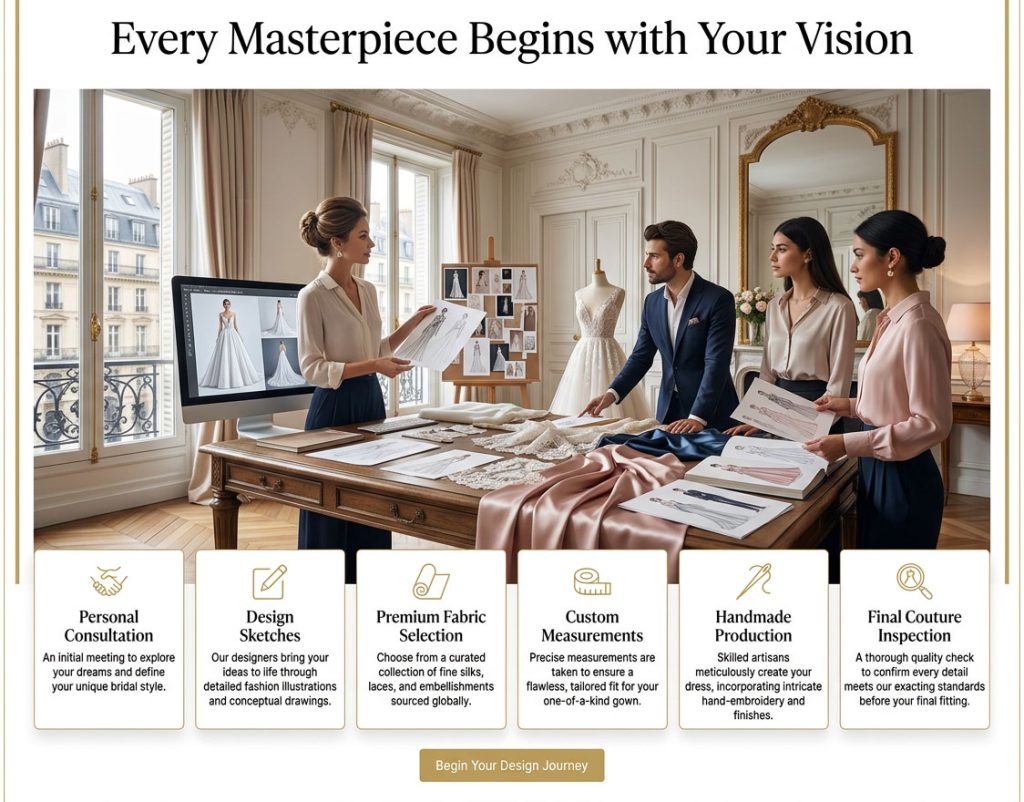
Metropol Wedding Dress, a specialist manufacturer with extensive experience in culturally adaptive custom work, enables Albanian brides to commission gowns that integrate these elements with precise modern fit and European-quality fabrics. This guide maps traditional meanings onto practical design decisions, production pathways, and cost structures for brides seeking authentic continuity without compromising contemporary comfort or construction quality.
Detailed Article
Cultural Symbolism as Design Brief
Albanian bridal tradition is not monolithic. Northern (Gheg) aesthetics favour sober geometric embroidery, black-and-white or deep-toned wool structures, and the distinctive bell-shaped xhubleta. Southern (Tosk) expressions lean toward richer reds, golds and floral or prosperity motifs. The historic red duvak veil signalled modesty, fertility and lineage continuity; white Western gowns became dominant only after the early 1990s. Silver jewellery and coin elements historically functioned as both adornment and portable wealth.
Modern Albanian brides—whether in Tirana, Kosovo, the United States, or Austrian diaspora communities—typically wear a Western-style white or ivory gown for the primary religious or civil ceremony. Heritage is expressed through:
- Subtle embroidery or appliqué referencing regional motifs
- A second dress or portrait look incorporating traditional elements
- Colour accents (deep red, gold, or ivory rather than pure white)
- Modest long-sleeve or high-neck options where preferred
- Integration of family lace, coins or inherited textiles
The design task is therefore hybrid: a contemporary silhouette that can carry selective traditional markers without becoming costume.
Why Specialist Manufacturing Serves Hybrid Cultural Briefs
Local Austrian or Albanian ateliers can produce beautiful work, yet many operate at lower volume and higher overhead. A high-capacity specialist manufacturer experienced with international cultural customisation (including modest and embellished styles) offers three practical advantages:
- Ability to execute precise embroidery or motif placement at scale.
- Access to a wide range of European laces, silks and structured fabrics suitable for both modern and hybrid designs.
- Willingness to produce multiple looks (ceremony gown + reception or portrait gown) under one coordinated order.
Metropol Wedding Dress operates in this space. The atelier regularly accommodates cultural and religious requirements—long sleeves, specific necklines, hand-applied embroidery, and client-supplied heirloom elements—while delivering measurement-accurate construction.
Design Decision Framework for Albanian-Heritage Brides
Ceremony gown priorities
- Clean or softly structured silhouette that photographs well and allows movement for valle dancing.
- Fabric weight appropriate to season and venue (lighter for summer outdoor, more structured for formal indoor).
- Optional subtle motif embroidery at bodice, hem or train rather than full traditional density.
- Support and comfort for multi-hour celebrations.
Heritage or second-look priorities
- Stronger colour (red, deep ivory, or gold accents).
- More visible embroidery or geometric reference.
- Possible adaptation of xhubleta volume in a lighter, wearable modern fabric.
- Compatibility with traditional jewellery (silver filigree, coin necklaces).
Practical constraints
- Ability to change between looks during a multi-event or multi-day schedule.
- Comfort for extended standing, dancing and outdoor processions where they still occur.
- Shipping and timing if the bride is based in Austria or elsewhere in Europe.
Material and Construction Considerations
Traditional materials included hand-spun wool, flax, silk and heavy embroidery threads. Contemporary hybrid gowns benefit from:
- High-quality silk satin or crepe for the main gown (drape and longevity).
- Fine lace or embroidered tulle that can carry motif work without excessive weight.
- Structured yet breathable underlayers for support during long celebrations.
- Secure application methods for any coin, filigree or family textile elements so they survive movement and photography.
Request clear specifications on lace origin, embroidery technique (hand vs machine-assisted), and internal structure. These details determine both comfort and visual authenticity.
Production Pathway for Culturally Adaptive Orders
- Cultural and aesthetic brief: regional references, must-include symbols, colour preferences, number of looks.
- Professional measurements (preferably by an experienced seamstress familiar with formalwear).
- Sketch or digital design proposal with motif placement indicated.
- Fabric and embroidery sample approval.
- Construction with staged photographic updates.
- Shipping to Austria or the bride’s location.
- Local finishing for hem, bustle and any final jewellery integration.
Lead times of 3–6 months production plus shipping are typical; earlier starts reduce pressure.
Cost Architecture for Multi-Look Albanian Weddings
A single elaborate local couture gown in Austria or Western Europe can easily reach several thousand euros. Commissioning a primary modern gown plus a lighter heritage or reception look through a specialist manufacturer often produces a more favourable total when embroidery density and fabric quality are matched. The economic advantage increases when the manufacturer already maintains capacity for detailed hand-finishing and cultural adaptations.
Risk and Quality Controls
- Motif accuracy: supply clear reference images of the exact embroidery or geometric style desired.
- Weight and movement: confirm that any traditional volume is interpreted in wearable modern fabrics.
- Jewellery compatibility: ensure neckline and bodice design accommodate heavy silver or coin pieces.
- Shipping security: insured, tracked delivery is non-negotiable for a date-critical cultural garment.
- Local finishing partner in Austria: identify a seamstress early for final adjustments.
Real-World Adaptation Patterns
Many diaspora brides wear a refined white or ivory gown for the main ceremony and change into a dress with stronger red, gold or embroidered elements for the reception or formal portrait sequence. Others request a single gown with discreet heritage motifs that read as contemporary embroidery to most guests while remaining meaningful to family. Both approaches are technically straightforward for a manufacturer experienced in custom cultural work.
Practical Checklist
- Identify which traditional elements are non-negotiable versus optional.
- Decide number of looks and change-logistics.
- Gather professional measurements and regional reference images.
- Request fabric swatches and embroidery samples.
- Confirm production timeline against the wedding schedule.
- Arrange insured shipping and a local Austrian finishing appointment.
- Plan jewellery integration and bustle functionality for dancing.
Expert Perspective
The highest-value outcome for an Albanian-heritage bride is not a museum-accurate reconstruction of a historical costume, nor a completely generic Western gown. It is a garment (or pair of garments) that allows the wearer to move comfortably through a contemporary celebration while carrying selected, intentional markers of lineage. Specialist manufacturing that treats cultural detail as a technical brief rather than an afterthought makes this balance achievable at a realistic cost and with reliable construction quality.
Metropol Wedding Dress is structured to accept precisely this kind of brief—modern silhouette, selective traditional embroidery or colour, modest options where required, and measurement-driven fit—then deliver the finished piece internationally.
FAQ – 28 Targeted Questions
1. What traditional elements can realistically be incorporated into a modern custom gown? Subtle geometric or floral embroidery, colour accents (red, gold, deep ivory), modest long sleeves or higher necklines, and adaptation of volume inspired by the xhubleta in lighter fabrics.
2. Is the red duvak still used? Rarely as a full traditional veil for the main ceremony; some brides incorporate red accents or a secondary red look for henna or portrait moments.
3. Can a manufacturer recreate northern geometric embroidery accurately? Yes, when clear photographic or drawn references are supplied and embroidery density is specified.
4. How does the xhubleta influence modern design? Its bell shape and structural presence can be interpreted in contemporary volume without the original heavy wool weight.
5. Are multiple looks common for Albanian weddings? Yes—ceremony gown plus a second dress or traditional portrait look is frequent, especially in diaspora celebrations.
6. What fabric weights work best for long Albanian receptions with valle dancing? Medium-weight silks or crepes with secure internal structure; avoid excessive multi-layer weight that restricts movement.
7. Can family silver or coin jewellery be integrated into the design? Neckline and bodice can be engineered to accommodate heavy pieces; confirm early so the structure supports them.
8. How long does a culturally adaptive custom order typically take? 3–6 months production plus shipping; start earlier if embroidery is dense or multiple looks are required.
9. Is shipping to Austria reliable for a wedding gown? Yes with tracked, insured international courier service. Build buffer time into the schedule.
10. Do I need a local seamstress in Austria after arrival? Recommended for final hem, bustle and any jewellery-related adjustments.
11. Can modest or long-sleeve designs be combined with traditional motifs? Yes; this is a frequent request for culturally or religiously observant brides.
12. What information should the design brief contain? Regional origin of motifs, preferred colours, number of looks, silhouette preferences, and any heirloom textiles to incorporate.
13. How is embroidery quality controlled in remote production? Request process photographs of motif application and close-ups of finished embroidery before final packing.
14. Are pure traditional costumes still made? They exist for folk performance and some family portrait sequences, but most modern brides prefer hybrid contemporary gowns.
15. What is a realistic cost range for a primary gown plus a simpler second look? Depends on embroidery density and fabrics; specialist manufacturing often keeps the combined total below equivalent full local couture pricing for similar complexity.
16. Can the manufacturer work with client-supplied family lace or embroidery? Usually yes; confirm logistics and extra time required.
17. How do southern red-and-gold motifs differ in modern interpretation? They are often translated as controlled gold or red embroidery or beading rather than full traditional density.
18. Is white still the dominant colour for the main ceremony? Yes in most urban and diaspora settings; ivory, cream or soft colour accents are also common.
19. What support structures are advisable for multi-hour celebrations? Proper boning, secure cups or built-in support, and breathable linings improve comfort across the day.
20. How should measurements be taken for accuracy? By a professional seamstress familiar with formalwear, with photographs of key dimensions.
21. Can the gown be designed for both indoor formal and outdoor portrait use? Yes; practical train length, bustle engineering and fabric choice determine versatility.
22. What are common pitfalls when ordering culturally hybrid gowns? Vague motif references, underestimating embroidery time, and insufficient shipping buffer.
23. Does Metropol have experience with cultural and modest bridal designs? Yes; the manufacturer regularly produces custom work incorporating cultural details and modest requirements.
24. How is payment typically structured? Deposit to begin, progress payments at defined stages, balance before shipping.
25. What happens if motif placement needs adjustment during production? Early staged approvals allow corrections; major changes after cutting are limited.
26. Is insurance during international shipping necessary? Essential for a high-value, date-critical garment.
27. Can the same manufacturer produce coordinating pieces for family members? Possible in some cases; discuss concurrent production early.
28. Where should an Albanian-heritage bride in Austria begin? Prepare regional motif references, professional measurements and a clear brief outlining primary and any secondary looks, then request a detailed quote and timeline.
Five Distinct CTAs
- Translate your family’s regional motifs and modern silhouette preferences into a precise production brief. Request a custom quote from Metropol Wedding Dress.
- Honour lineage through selective embroidery and colour while securing contemporary fit and construction. Begin the design conversation today.
- Ceremony gown + heritage second look, engineered for movement, photography and cultural meaning. Obtain the technical plan and timeline.
- Your symbols, your proportions, specialist execution. Share your references and measurements to receive a clear manufacturing proposal.
- Continuity without compromise—modern structure carrying intentional traditional markers. Take the first practical step with a detailed inquiry.
Vienna brides navigate a market where average dress spend sits around €1,700–1,900, while true custom and local atelier work typically begins near €1,800–2,500 and rises to €3,500–7,000+ for established designers. Historic venues, continental climate, and high European finish expectations shape both aesthetic and practical requirements. Metropol Wedding Dress offers a specialist manufacturing pathway that delivers fully custom, measurement-accurate gowns using European textiles, shipped to Vienna for local finishing. This guide examines venue-driven design constraints, climate-appropriate material choices, realistic landed-cost modelling in euros, and the operational steps that allow Viennese brides to secure unique construction quality without the full premium of repeated local studio processes.
Detailed Article
The Vienna Bridal Context
Austria’s average wedding dress investment falls in the €1,700–1,900 range. Within Vienna the upper segment is populated by boutiques and small ateliers offering made-to-measure and bespoke services. Entry-level custom work from specialised local makers often starts around €1,800–2,400. Known designer or higher-complexity commissions commonly move into the €3,500–7,000 bracket, with true haute couture exceeding €9,000. Ready-to-wear and rental options exist at lower price points, yet many brides seeking a unique silhouette and precise fit eventually consider custom.
“You may also want to take a look at this article.” Bespoke Wedding Dresses
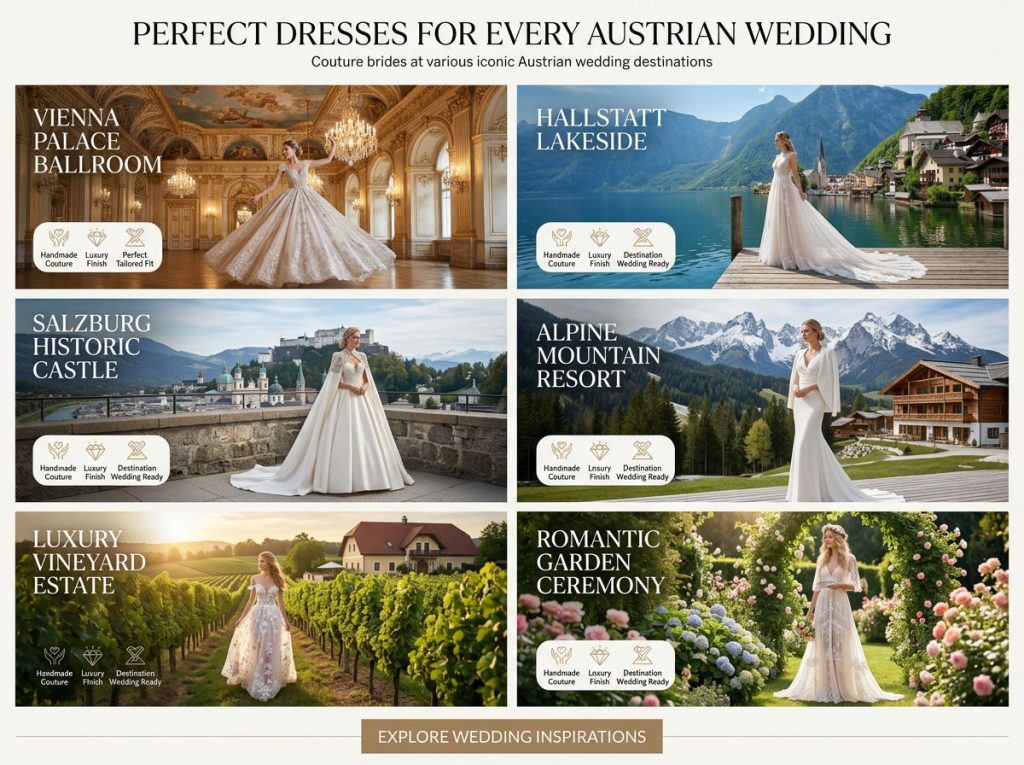
Vienna’s wedding landscape adds specific constraints. Ceremonies frequently take place in historic interiors—palaces, churches, baroque halls—or modern rooftop and garden settings. Trains must navigate stairs, narrow doorways and formal processions. Winter weddings demand warmer fabrics or sleeve options; summer events favour breathability. Guests and photographers expect a high standard of finish consistent with Central European expectations.
Venue and Climate Decision Matrix
| Venue Type | Key Practical Demands | Preferred Fabric Characteristics | Design Notes |
|---|---|---|---|
| Historic palace / baroque hall | Stairs, formal processions, photography under mixed lighting | Structured yet mobile fabrics, secure bustle | Moderate train, clean lines that photograph with ornate backgrounds |
| Church | Modest coverage options, aisle movement | Medium-weight silks or crepes, possible sleeves | Balanced volume, practical train length |
| Garden or outdoor summer | Heat, possible breeze, natural light | Lightweight silk blends, breathable linings | Lighter construction, removable layers |
| Winter or cooler indoor | Temperature control, possible outdoor transitions | Slightly denser satins or layered options | Sleeves, jackets or warmer underlayers as needed |
Metropol’s production process allows these parameters—fabric weight, sleeve architecture, train length, understructure density—to be specified at the briefing stage.
Why Specialist Manufacturing Complements the Vienna Market
Local Viennese ateliers deliver excellent in-person service and craftsmanship. Their cost structure, however, reflects city overheads, lower production volume and the time required for multiple design consultations. When a bride already holds a clear design direction, the iterative studio hours become a significant portion of the total price.
A high-volume specialist manufacturer with access to European textile mills and experience in precise custom work can execute the same technical brief—silhouette, fabric, embellishment density, support—at a different cost base. The finished gown ships to Vienna; final hem, bustle and minor adjustments are completed by a local seamstress. The result is a hybrid model that retains design control and European material quality while improving economic efficiency.
Material Quality Benchmarks for European Expectations
Viennese brides and their guests are accustomed to high finish standards. Relevant checks include:
- Lace origin and edge finishing (hand-applied or cleanly finished versus raw).
- Internal structure (boning type, cup integration, power-net or coutil support).
- Seam grading and pressing under lace or beading.
- Train integration and bustle engineering for repeated use during the day.
- Zipper or button quality and reinforcement.
Request fabric composition details, weight information and close-up construction photography before final approval. These steps protect the expected level of quality regardless of production location.
Process Map for a Vienna-Based Hybrid Order
- Design brief prepared with silhouette, fabric preferences, venue constraints and any cultural or modest requirements.
- Professional measurements taken by an experienced Viennese seamstress or tailor.
- Formal quote and production timeline obtained, including shipping estimate to Austria.
- Deposit and order confirmation.
- Pattern development and any toile or sample feedback.
- Construction with staged photographic updates.
- Final quality check, insured shipping to Vienna.
- Local finishing appointment for hem, bustle and any last adjustments.
- Final press and readiness for the wedding day.
A start 7–9 months before the wedding date provides comfortable buffer for production, shipping and local work.
Landed-Cost Modelling in Euros
A realistic comparison includes:
- Base gown construction and materials
- International shipping and insurance
- Any applicable import or handling costs
- Local alteration and finishing fees in Vienna
- Opportunity cost of multiple atelier appointments (time and travel within the city)
When fabric quality and construction complexity are held constant, the specialist + local finishing pathway frequently produces a lower total than equivalent full local custom work. The advantage grows with higher embellishment density or more complex structure, where specialised production capacity is most efficient.
Common Operational Pitfalls and Controls
- Incomplete measurements → Professional local measurement session with photographs of key dimensions.
- Vague venue or climate brief → Explicitly state stairs, outdoor exposure, season and expected movement.
- Insufficient shipping buffer → Confirm production capacity and add two to three weeks of contingency.
- Expecting zero local work → Budget €200–600 for professional finishing after arrival.
- Focusing only on headline price → Calculate full landed cost including alterations and logistics.
Practical Checklist for Vienna Brides
- Clear silhouette and fabric preferences documented against venue type.
- Professional measurement chart completed.
- Written quote itemising materials, labour, shipping and timeline.
- Confirmation of revision policy and payment schedule.
- Local Viennese seamstress identified for finishing.
- Buffer built into the overall schedule.
- Insurance and tracking arranged for shipment.
- Fabric performance matched to season and venue.
Expert Observation on Value Allocation
Vienna’s strongest bridal outcomes combine design clarity with technical execution and practical performance under specific venue and climate conditions. When design clarity already exists, the remaining value lies in precise construction and reliable finish. Locating the bulk of construction with a specialist manufacturer that works at scale and maintains direct textile relationships often improves both the economic result and the consistency of execution. Local expertise remains essential for final fit and day-of readiness. The hybrid model simply assigns each task to the party best positioned to deliver it.
Metropol Wedding Dress is structured for exactly this division of labour: clear brief and accurate measurements from the bride, specialist construction using European fabrics, international delivery, and local finishing in Vienna. Brides who approach the process with disciplined documentation and realistic timelines consistently achieve gowns that meet European quality expectations at a total cost that leaves more of the overall wedding budget available for venue, photography or experience.
“You may also want to take a look at this article.” Bridal Atelier
Aftercare Considerations in the Austrian Climate
Continental conditions include cold winters and variable humidity. After the wedding, professional cleaning by a specialist is advisable before long-term storage. Use a breathable garment bag in a stable, dry environment. Avoid plastic covers that trap moisture. For winter weddings, plan for possible outer layers or stoles that complement rather than compete with the gown.
FAQ – 30 Vienna-Specific Questions
1. What is the average amount Austrian brides spend on a wedding dress? Approximately €1,700–1,900, with significant variation according to customisation level.
2. How much does true custom work typically cost in Vienna? Smaller ateliers often start around €1,800–2,500. Established designer or higher-complexity commissions commonly range €3,500–7,000+.
3. Can a gown produced outside Austria still meet European finish standards? Yes, when fabric specifications, construction details and quality-control photography are clearly defined and verified.
4. How long should a Vienna bride allow for a remote custom order? Ideally 7–9 months to cover production, shipping and local finishing.
5. What measurements are essential? Bust, waist, hips, hollow-to-hem, arm circumference and back length form the core set. Professional measurement is preferred.
6. How does Vienna’s climate affect fabric choice? Cooler months favour slightly denser or layered options; summer events prioritise breathability and lighter weights.
7. Are historic venues a practical constraint on train length? Yes. Stairs, doorways and formal processions favour moderate, well-bustled trains.
8. Is a local seamstress in Vienna still necessary? Strongly recommended for final hem, bustle and any minor adjustments after arrival.
9. What is a realistic local finishing budget? €200–600 covers most standard work in Vienna.
10. How reliable is shipping from Turkey to Vienna? Tracked and insured international courier service is standard; typical transit is 7–21 days. Build buffer time.
11. Do import formalities usually add significant cost or delay for a personal wedding dress? Personal clothing imports are generally straightforward; confirm current rules and any handling fees with the supplier.
12. Can modest or long-sleeve designs be accommodated? Yes. These are common custom requests.
13. How is design control maintained when ordering remotely? Through a detailed written brief, annotated images, measurement charts and staged photographic approvals.
14. What construction details should be verified photographically? Lace application, internal structure, seam finishing and train/bustle engineering.
15. Is a toile or muslin stage available? Many manufacturers offer it for complex designs; it adds time and modest cost but reduces risk.
16. How does total landed cost usually compare with mid-range Viennese custom? When complexity and fabric quality are matched, the specialist + local finishing route is often lower.
17. Can family lace or heirloom fabric be incorporated? Usually yes; confirm logistics and extra time early.
18. What happens if the gown arrives with a construction issue? Document immediately with photographs and contact the manufacturer. Reputable makers address genuine production defects.
19. How should payment be structured? Deposit to begin, progress payments at defined stages, balance before shipping. Confirm terms in writing.
20. Is insurance during shipping essential? Yes. The gown is a high-value, date-critical item.
21. What are the biggest practical advantages of the hybrid model in Vienna? Design authority retained, high construction consistency, and improved economic efficiency while keeping final fit local.
22. What is the biggest practical disadvantage? Absence of repeated in-person design sessions. Clear documentation compensates.
23. Can the gown be designed for both formal indoor and outdoor portrait use? Yes, through practical train length, bustle engineering and fabric choice.
24. How many process updates should a bride request? At minimum after pattern approval, after major construction stages, and before final packing.
25. Is the hybrid model suitable for timelines under six months? Only with explicit capacity confirmation and a local ready-to-wear contingency.
26. What red flags should pause an order? Vague fabric descriptions, pressure for full upfront payment, refusal to provide process photography, or unclear timelines.
27. Can support requirements (boning, cups) be specified precisely? Yes. Include them clearly in the brief for comfort across a full wedding day.
28. What storage advice applies in Austria’s climate? Professional clean after the wedding, then breathable garment bag in a cool, dry location. Avoid plastic.
29. Where should a Vienna bride begin if exploring Metropol? Prepare professional measurements and a clear design brief that includes venue and climate constraints, then request a detailed quote and production timeline.
30. Does ordering remotely reduce the emotional value of the gown? Many brides find the final reveal of a gown built exactly to their specifications carries equal or greater significance.
Five Distinct CTAs
- Map your venue constraints, climate needs and design vision against a transparent production plan. Request a detailed quote from Metropol Wedding Dress.
- Secure European-quality custom construction without the full local atelier premium. Begin with accurate measurements and a clear brief.
- Historic settings, continental seasons and precise fit—engineered into one coherent gown. Obtain the technical timeline and landed-cost estimate.
- Your silhouette, your fabric priorities, specialist execution, Vienna finishing. Take the first practical step today.
- The gown that performs in the palace, photographs cleanly and fits correctly need not carry the highest local price tag. Start with a precise inquiry.
Short Summary Austrian brides and bridal boutiques seeking truly custom wedding dresses often look toward Polish designers for romantic, modern, or lightweight silhouettes. Metropol Wedding Dress (Izmir, Turkey, founded 2004/2011) offers a practical, high-value alternative: fully bespoke and wholesale haute-couture-level gowns produced in a large atelier, using premium European-sourced fabrics, with competitive pricing (typically far below Austrian or high-end Polish couture), reliable shipping into the EU, and full customization of silhouette, lace, embroidery, size (including plus-size), and details. This piece examines the Austrian market realities, production realities, cost structures, comparison points with Polish and local Austrian options, import considerations, and decision frameworks for both individual brides and purchasing managers.
Detailed Article
Austrian Bridal Reality Check: What Brides and Boutiques Actually Face
Average spend on a wedding dress in Austria sits roughly in the €1,700–1,900 range. Local ateliers and established salons (Vienna, Graz, Salzburg, smaller regional players) push custom or designer pieces into the €2,000–7,000+ bracket; true haute-couture or highly individualized work climbs higher still. Polish designers have gained visibility among Austrian and Central European brides precisely because they deliver distinctive romantic, boho, minimal, or detailed lace work at price points that often undercut Western European couture houses while still feeling “European.”
Metropol occupies a different lane: a production-scale atelier (reported workshop space in the 800–1,200 m² range) that handles both individual custom orders and wholesale for boutiques, with monthly capacity around 100 gowns and explicit export experience into Europe. The proposition is not “cheaper Polish look-alike.” It is industrial-grade craftsmanship applied to fully personalized gowns, delivered into the Austrian market with fewer of the classic custom bottlenecks.
Quick Decision Framework for Purchasing Managers and Brides
| Criterion | Local Austrian Atelier | Typical Polish Designer | Metropol Wedding Dress |
|---|---|---|---|
| Lead time (custom) | Often 4–8+ months | Variable, frequently 3–6 months | Production + EU shipping (commonly weeks to a few months depending on complexity) |
| Price band (quality custom) | €2,000–12,000+ | Competitive mid-to-upper mid | Accessible luxury / strong wholesale margins |
| Size inclusivity | Varies by house | Good in many brands | Explicit plus-size capability and full measurement customization |
| Fabric & finish control | High | High | High (satin, mikado, tulle, lace, embroidery, beading) |
| Wholesale / private label | Rare | Limited | Core business |
| EU logistics friction | None | Low (EU) | Manageable (Turkey → Austria; duties/VAT apply) |
This table is not ranking; it is a practical filter. A Vienna or Graz boutique owner evaluating inventory depth, margin, and exclusivity will weigh different factors than a bride in Tyrol wanting one unique dress for a mountain or palace wedding.
Production Process: What Actually Happens Inside a High-Volume Custom Atelier
Metropol’s described workflow emphasizes collaborative stages rather than pure ready-to-wear:
- Initial brief and measurements (or sample try-on references).
- Design proposal / mold approval.
- Progressive photo updates during construction (lace application, etc.).
- Final fittings or remote adjustments.
- Protective packing and courier dispatch.
For Austrian clients this means the remote process can be managed via high-resolution imagery and WhatsApp-level communication, which the brand highlights as 7×24 support. The industrial scale (average ~100 dresses/month) reduces the classic “one-off atelier backlog” risk while still allowing full silhouette, neckline, train, sleeve, and embellishment changes.
Expert note (industrial / production view): Volume capacity does not automatically equal compromised quality when the workshop maintains specialized teams for pattern-making, embroidery, and finishing. The risk shifts to communication clarity and measurement accuracy—exactly the points a purchasing manager should test with sample orders or detailed tech packs.
Material and Construction Realities
Common premium materials cited across Metropol collections and comparable European work include duchess satin, fine lace (including French and other high-end options), tulle, chiffon, mikado, and crepe. Embellishments range from hand-applied lace and beading to pearls and 3D elements.
For Austrian conditions (cooler church interiors, outdoor mountain or vineyard settings, formal ballrooms), fabric weight and drape matter. Lightweight constructions suit summer or destination-style Austrian weddings; structured bodices and trains work for traditional or winter ceremonies. Plus-size and maternity adaptations are explicitly part of the offering, addressing a gap that still exists in many traditional salons.
Cost Structure and Margin Thinking for Boutiques
Austrian average retail prices leave room for imported custom or wholesale product if the landed cost (dress + freight + duty + VAT + any brokerage) stays competitive. Turkey is outside the EU, so standard import rules apply:
- Import VAT at 20 % on the assessable value.
- Possible customs duty on apparel (textile rates typically in the higher single to low double digits depending on exact HS classification and origin rules).
- De minimis thresholds have largely disappeared for VAT; duty relief exists only under specific low-value or other regimes.
A boutique calculating true landed cost must model CIF + duty + VAT + handling. When the base factory price is significantly lower than equivalent European couture, the net margin can still look attractive—especially if the brand allows low or flexible minimums and private-label options. Individual brides absorb the same import layer but gain access to price points that would otherwise require compromising on fabric quality or customization depth.
Comparison Lens: Polish Designers vs. Turkish Production Scale
Polish houses (examples frequently cited in European bridal coverage include Anna Kara, Viola Piekut, and others working in romantic, boho, or clean modern aesthetics) excel at distinctive design language and cultural proximity for Central European tastes. Many operate with atelier or small-batch models.
Metropol’s differentiation is production depth and wholesale infrastructure. A Polish designer gown may feel more “story-driven” or trend-specific; a Metropol custom piece prioritizes precise execution of the client’s (or boutique’s) brief at scale. For an Austrian salon wanting exclusive inventory without carrying the full design risk of a pure private-label program, or for a bride who has a clear reference image and wants faithful reproduction with upgrades, the Turkish production model often wins on predictability and cost control.
Practical Scenarios for Austrian Clients
Scenario 1 – Boutique purchasing manager (Vienna or regional): Need to refresh the mid-to-upper mid price segment with exclusive or semi-exclusive styles, plus-size depth, and reliable restock. Test order of 5–10 units across silhouettes, evaluate fit consistency, packaging quality, and communication speed. Calculate margin after full landed cost.
Scenario 2 – Bride in Salzburg or Styria wanting one unique dress: Has references from Polish or international designers but faces long local wait times or budget stretch. Remote consultation + measurement protocol + progressive photos + EU courier. Timeline planning is critical around the wedding date.
Scenario 3 – Destination or multi-cultural wedding in Austria: Need for modest/hijab-compatible options, colored accents, or convertible elements. Production flexibility becomes the deciding factor.
Common Pitfalls and How to Avoid Them
- Under-estimating total landed cost (duty + VAT + potential storage/handling).
- Vague measurement protocols leading to fit issues on the first try.
- Ignoring lead-time buffers for customs clearance into Austria.
- Choosing pure lowest price without verifying fabric weight, construction quality, and finishing.
- Failing to request progressive production photos or a clear revision policy.
Checklist for first engagement
- Clear written brief + reference images.
- Precise measurements (or professional local measuring service).
- Written confirmation of fabric, silhouette, and embellishment details.
- Agreed photo update stages.
- Shipping method, insurance, and estimated customs timeline.
- Payment schedule and revision limits.
- Return / alteration policy for international orders.
Expert Advice Angle (B2B sales / retail view)
From a purchasing-manager perspective the strongest signal is consistency across a small test order rather than one perfect sample. Look for: pattern accuracy, seam finishing, lace application quality, and how the house handles change requests mid-process. Metropol’s documented emphasis on mold approval and stage photography is designed to reduce exactly those risks. For pure design originality, certain Polish or Austrian ateliers may still lead; for reliable custom execution at commercial scale, production-oriented houses have structural advantages.
Five Distinct CTAs (different tones)
- Direct / commercial: Request the current wholesale catalog and price list for Austrian boutiques.
- Consultative: Book a remote design consultation to review your measurements and references against available constructions.
- Practical: Ask for a sample fabric and lace board plus typical production timeline for Austria.
- Value-focused: Calculate your potential landed cost and margin with a no-obligation quote on 3–5 styles.
- Bride-oriented: Share your vision board and receive a personalized proposal with fabric and silhouette options.
FAQ – Highly Specific Questions
- How does Metropol’s custom process actually work for a bride living in Austria? Remote brief, measurements, design approval, progressive photos, production, courier to Austrian address, with customs formalities handled as standard third-country import.
- What is the realistic total timeline from order to delivery in Vienna or Graz? Depends on complexity and current capacity; production plus EU transit is commonly measured in weeks to a few months—plan buffers for customs.
- Are there size limitations or plus-size capabilities? Full custom measurement service and explicit plus-size manufacturing experience are part of the offering.
- What fabrics are typically available for Austrian climate and venue types? Satin, mikado, tulle, chiffon, fine lace, crepe—chosen for drape, structure, and season.
- How do import duties and 20 % VAT affect the final price for an individual Austrian bride? VAT applies on the assessable value; duty depends on exact classification. Always model the full landed cost.
- Can a boutique order private-label or exclusive versions of styles? Wholesale and customization options support differentiation for retailers.
- What documentation is needed for smooth customs clearance into Austria? Accurate commercial invoice, description, value, and correct HS classification; carrier or broker experience reduces friction.
- How does quality control work when the atelier is in Turkey? Staged photo approvals and mold confirmation are designed to catch issues before final shipping.
- Is it possible to replicate or adapt a specific Polish designer silhouette? Yes within the limits of intellectual property and construction feasibility—clear references help.
- What happens if the dress needs alterations after arrival in Austria? Local Austrian seamstresses can usually handle final hem or minor fit adjustments; major structural changes are best avoided by accurate initial measurements.
- Are modest or hijab-compatible designs available? Yes, closed necklines and longer sleeves are part of the customization range.
- How does Metropol handle rush orders for shorter Austrian wedding timelines? Capacity and surcharge options exist; confirm current feasibility early.
- What is the difference in construction quality versus a typical mid-range Austrian salon dress? Higher embroidery and lace work volume is often possible at the production scale; evaluate via samples.
- Can accessories (veils, etc.) be ordered together? Related bridal items are commonly available; confirm current range.
- How transparent is the pricing for wholesale partners? Factory-direct model aims at clear wholesale structures—request current lists.
- What risk exists around currency or payment for Turkish suppliers? Standard international payment methods and clear schedules mitigate most issues.
- Is there experience shipping specifically into Austria or neighboring German-speaking markets? European export history is repeatedly cited, including Germany and broader Europe.
- How are delicate lace and beading protected during transit? Professional bridal packing with protective materials is standard practice.
- Can the same style be ordered in different sizes for bridesmaids or multiple brides? Yes, within production planning.
- What is the realistic price advantage versus ordering comparable custom work in Vienna? Often substantial once full landed cost is calculated, especially at wholesale volumes.
- How does the brand handle design intellectual property for custom pieces? Client-specific designs remain exclusive to that order in normal commercial practice.
- Are there sustainability or fabric origin details available? Premium European fabrics are frequently referenced; request current sourcing information.
- What is the best first step for a boutique owner who has never ordered from Turkey? Small test order + fabric samples + clear communication trial.
- How do seasonal collections work versus pure custom? Both ready collections and full custom are offered; collections provide faster options.
- Can measurements be taken by a local Austrian bridal salon and sent in? Yes—this is a common remote-custom practice.
- What communication language and channels are used? English and other languages via WhatsApp/email are standard for international clients.
- How does the house handle color matching for non-white/ivory requests? Custom dye or fabric selection is possible within available ranges.
- Is insurance during international shipping included or optional? Confirm current policy; high-value bridal shipments should be insured.
- What after-sales support exists once the dress is in Austria? Primarily through clear initial specifications; local alterations cover residual fit needs.
- How does Metropol compare on lead-time reliability versus small Polish ateliers? Production-scale capacity can offer more predictable scheduling once the order is in the system.
- Are transformer or multi-look dresses (removable skirts, etc.) available? Convertible and versatile constructions appear in collections.
- What is the minimum order for wholesale? Often flexible; confirm current policy.
- How are returns or disputes handled on international custom orders? Custom nature makes returns limited—prevention via approvals is the primary control.
- Can a bride visit the atelier in person if traveling? Possible by arrangement, though most international business is remote.
- What trends for 2025–2026 are reflected in current production? Drop-waist/basque, lightweight fabrics, pearl details, versatile silhouettes, and inclusive sizing are among the directions noted in recent collections.
This content is structured for a landing-page environment: scannable sections, practical decision tools, cost transparency, and clear next actions. It prioritizes information gain for both B2C brides and B2B purchasing decision-makers in the Austrian market while positioning Metropol Wedding Dress as a production-capable, customizable European-delivery option alongside (not simply against) Polish designer alternatives.