Custom Wedding Dresses Denmark
Custom Wedding Dresses Denmark brides combine Scandinavian minimalism, practicality for city-hall or outdoor ceremonies, and high-end craftsmanship without the typical local boutique markups. Metropol Wedding Dress, a specialist manufacturer with over 20 years of experience, delivers fully custom gowns (silhouettes, fabrics, embroidery, fit) from premium European materials at accessible price points (typically €300–€2,000).
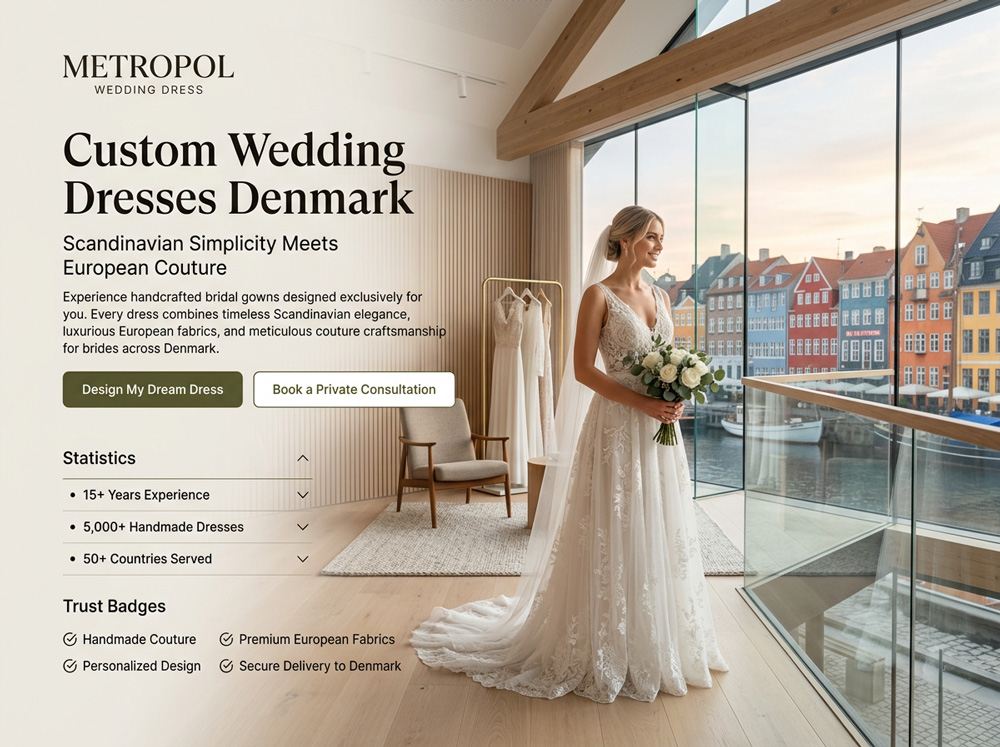
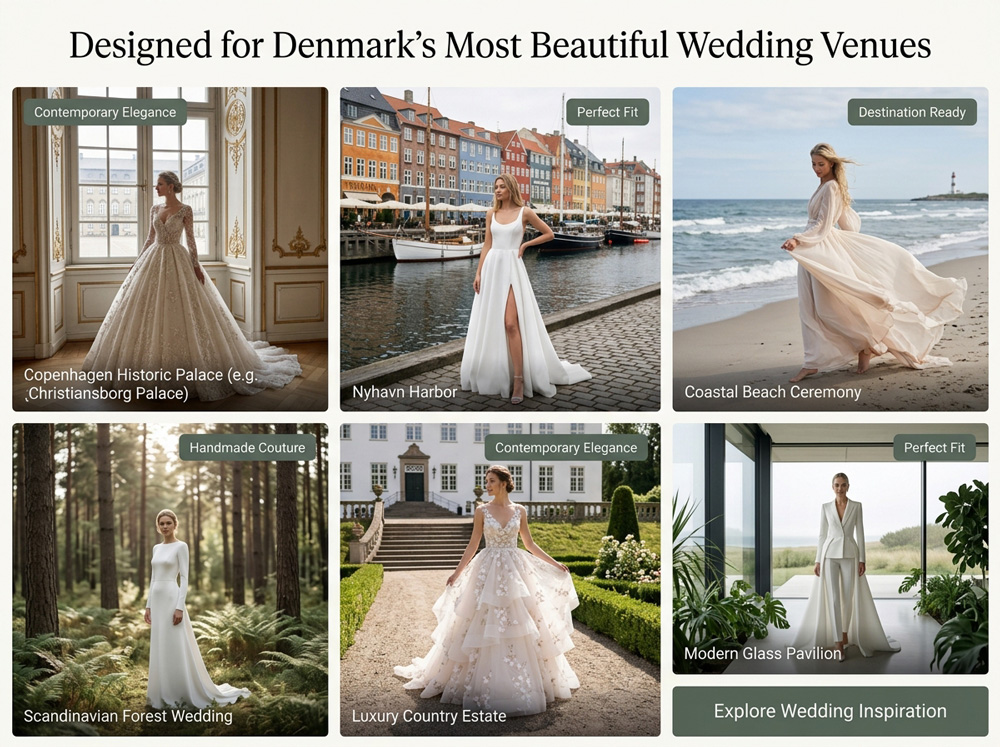
Brides gain made-to-measure precision, worldwide shipping, and design flexibility that local ready-to-wear or high-couture options often lack—ideal for Copenhagen’s cobblestones, variable weather, and preference for understated elegance or multicultural fusion looks.
This guide covers the full process: design choices suited to Danish venues, materials that perform in Nordic climates, production timelines, cost breakdowns versus Copenhagen boutiques, real decision frameworks, common pitfalls, and how to commission a Metropol custom piece that feels personal yet practical.
The Copenhagen Bride’s Reality Check: Why “Off-the-Rack + Alterations” Rarely Delivers True Custom
Most Copenhagen brides start at familiar names—Karim Design, Artemis CPH, Brudebutikken, Sheryl Yip Atelier, or larger outlets. These offer beautiful samples, professional fittings, and local convenience. What they less often provide is complete freedom of silhouette, fabric weight, neckline engineering, and price transparency at the manufacturing level.
A made-to-measure dress from a local atelier still begins with an existing pattern. True custom starts from measurements and a blank design brief. That is the gap Metropol fills for Danish clients: direct access to a production atelier that builds the gown from the body outward, using the same quality lace, silk, and hand-embroidery techniques seen in higher-priced European couture, but structured for international private and wholesale clients.
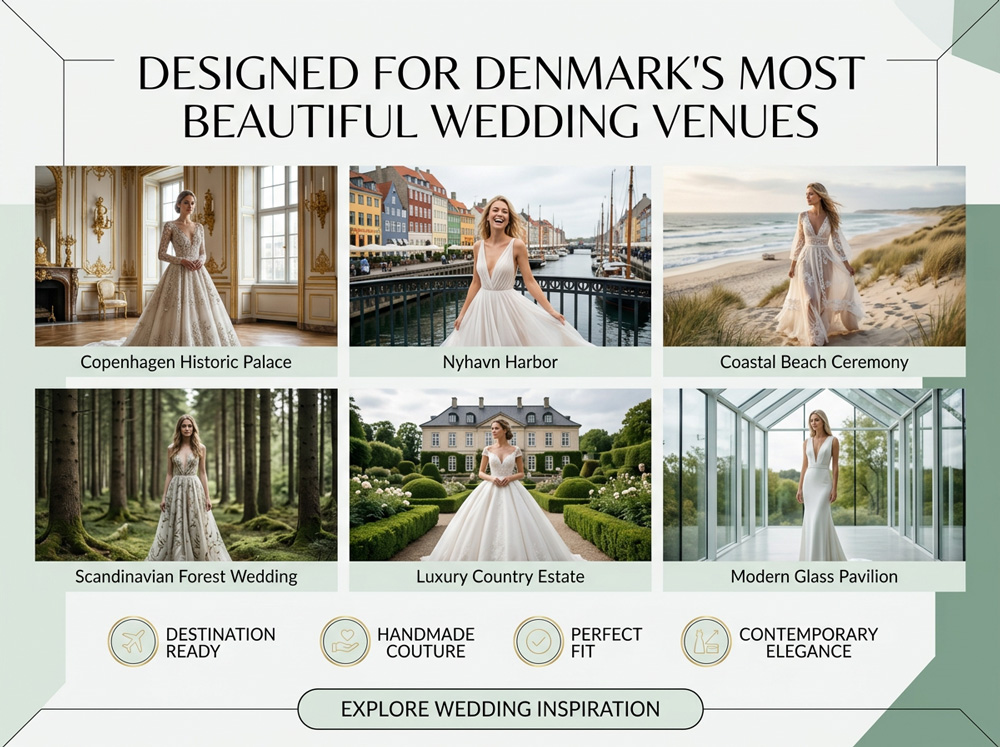
Danish wedding culture favors clean lines, comfort for long receptions (often 8–10 hours with speeches, the bridal waltz, and midnight traditions), and dresses that photograph well against brick, water, and soft northern light. Heavy ballgowns that look spectacular in a showroom can become liabilities on cobblestones or in a sudden rain shower. Custom manufacturing lets the bride dial in exactly the right balance of volume, weight, and mobility.
Practical Design Framework for Denmark & Copenhagen Weddings
| Ceremony Type | Recommended Silhouette | Key Practical Adjustments | Fabric Priority |
|---|---|---|---|
| City Hall (rådhus) | A-line, sheath, tea-length, jumpsuit | Shorter hem or bustle-ready; easy movement | Lightweight silk, crepe, soft lace |
| Church / Traditional | Classic A-line or soft ballgown | Modest coverage options; comfortable undergarments | Structured lace + lining |
| Outdoor / Castle | A-line or mermaid with train | Weather-resistant outer layer; removable sleeves | Silk + subtle waterproofing |
| Destination / Multicultural | Hybrid (sari elements, color accents, two-piece) | Convertible pieces; cultural motif integration | Premium imported lace + silk |
Scandinavian preference leans toward soft ivory, champagne, or pure white with minimal sparkle. Colored accents (dusty blue, soft blush) appear more often in modern or multicultural celebrations. Metropol’s process allows these choices at the design stage rather than as expensive later alterations.
Material Analysis: What Performs in a Nordic Climate
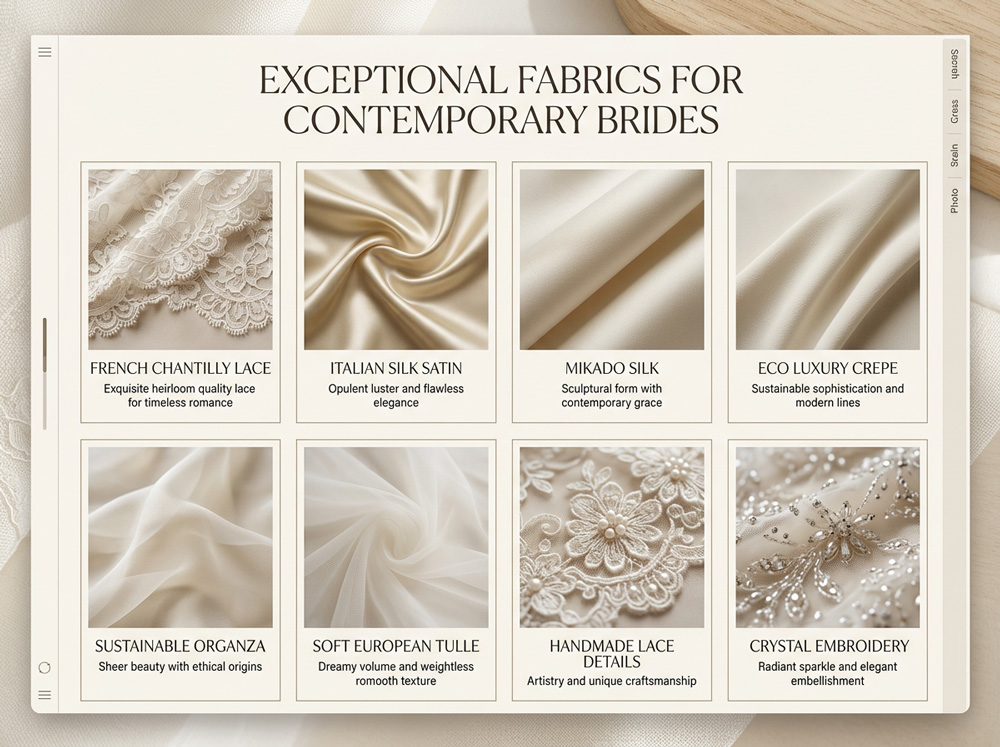
Premium European fabrics remain the gold standard. Metropol sources French and Italian lace, silk satin, organza, tulle, and crepe. For Copenhagen conditions the critical properties are:
- Breathability and weight control for long indoor receptions
- Resilience against humidity and occasional outdoor exposure
- Drape that photographs cleanly in soft light without excessive sheen
- Structure that holds shape through hours of dancing and the traditional bridal waltz
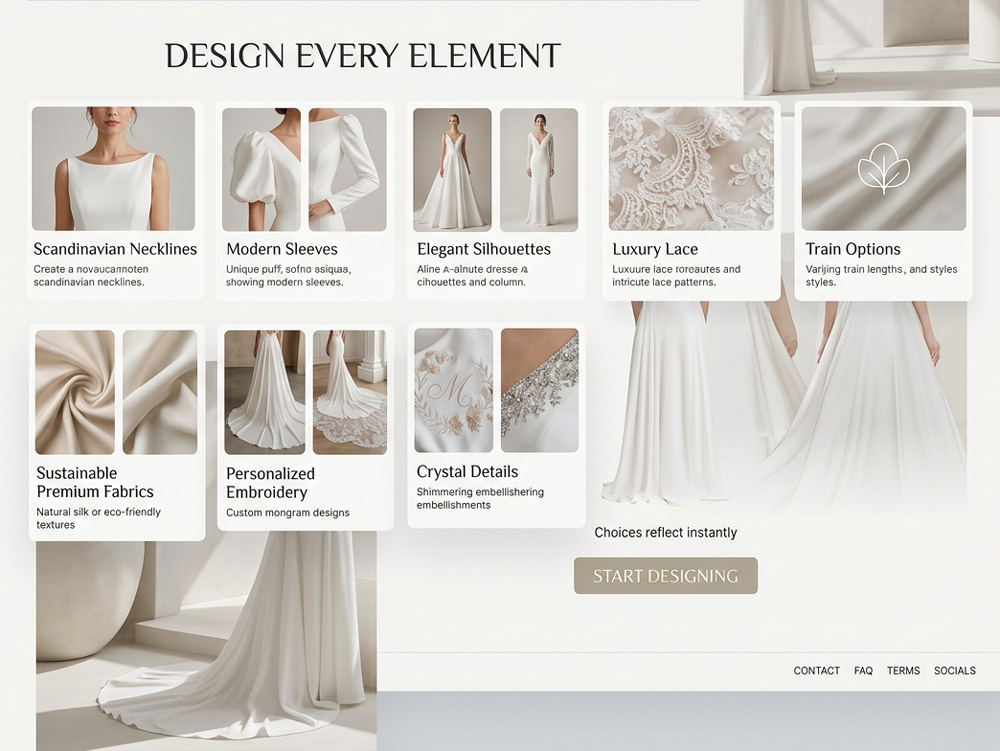
Hand-sewn embroidery and crystal work can be calibrated: denser for formal church settings, lighter and more organic for contemporary city-hall or waterfront ceremonies. Lining choices matter—full silk or high-quality viscose linings prevent cling and temperature discomfort.
The Production Process: From Brief to Delivery
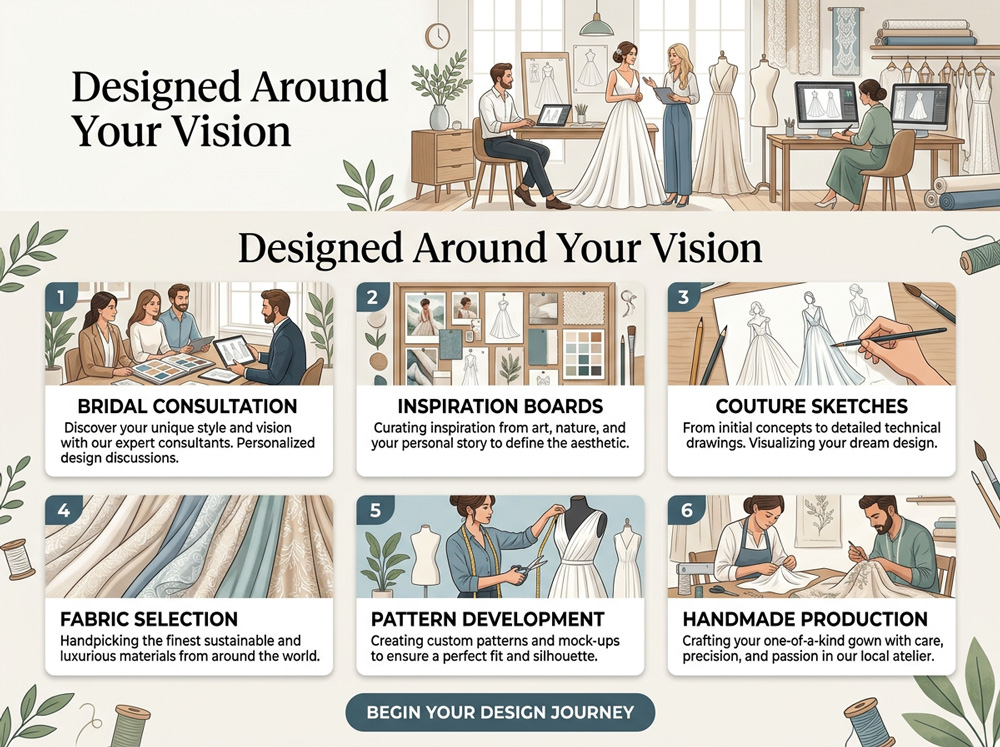
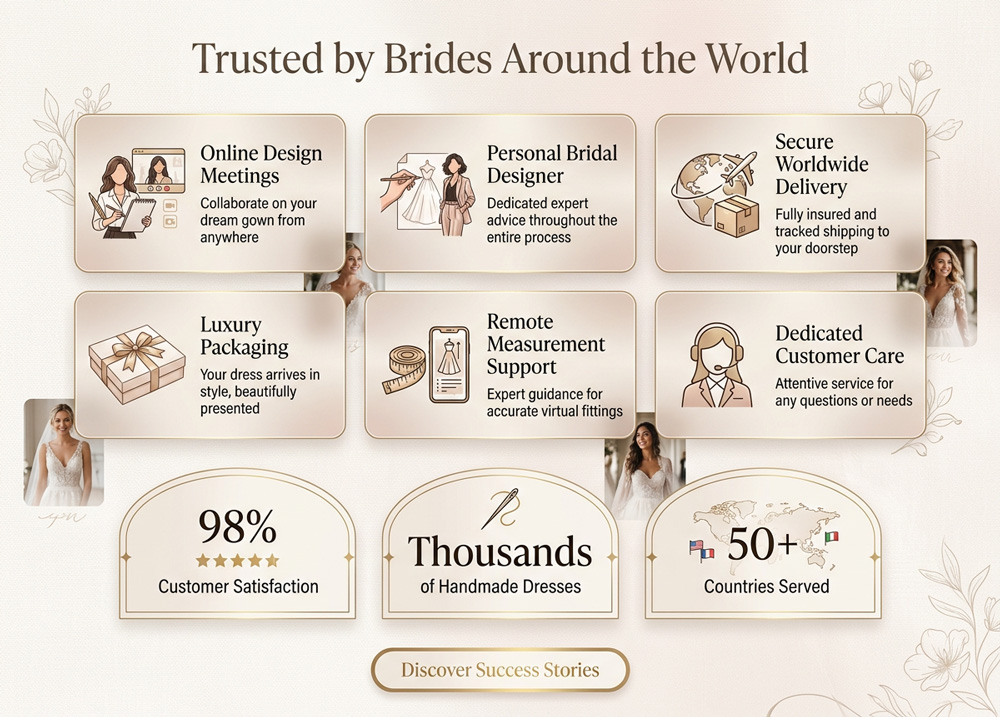
- Design consultation (remote via photos, measurements, inspiration boards, or video).
- Technical sketch and fabric/swatch selection.
- Pattern drafting to exact measurements (not graded from a sample size).
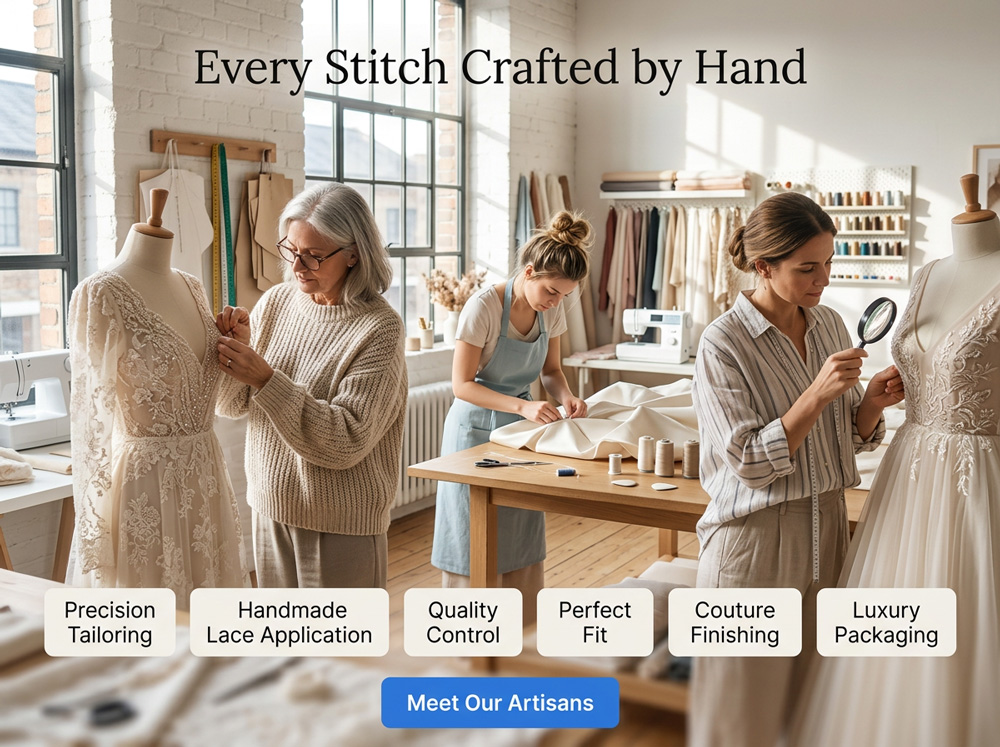
- Construction in the atelier (experienced artisans, controlled environment).
- Progress photos and intermediate fittings where possible (or precise measurement verification).
- Final finishing, quality control, and secure international shipping.
Typical lead times for fully custom pieces allow planning around Danish wedding seasons (peak spring–early autumn). Wholesale and private-label partners in Europe already use the same pipeline, confirming reliability for Danish timelines.
Cost Reality for the Danish Market
Local Copenhagen boutique prices for quality made-to-measure or designer pieces commonly range from several thousand to well over 15,000–20,000 DKK. True couture climbs higher. Metropol’s custom range (approximately €300–€2,000 depending on complexity, fabric, and embellishment) positions many high-quality custom gowns in a more accessible bracket while still using comparable materials and hand techniques.
Additional costs to budget: shipping, any local final hem or steaming, and accessories. The net result for many brides is a higher degree of personalization at a lower total outlay than equivalent local custom work.
Real Decision Scenarios
- The practical city-hall bride who needs a dress she can walk comfortably in all day and still look elevated in photos.
- The multicultural couple wanting subtle cultural motifs integrated without compromising Scandinavian simplicity.
- The bride who has a clear vision from Pinterest or Instagram but cannot find the exact combination of neckline, sleeve, and skirt volume in existing samples.
- The budget-conscious couple prioritizing craftsmanship and fit over brand-name showroom experience.
In each case the custom route removes the compromise of “almost right” sample + heavy alteration.
Common Pitfalls and How to Avoid Them
- Ordering too late for the wedding date (build in buffer for shipping and any local adjustments).
- Under-specifying mobility needs for Copenhagen streets and long receptions.
- Choosing pure volume without considering venue scale and photography style.
- Ignoring lining and understructure—comfort determines how the dress feels after the first hour.
- Treating custom as purely aesthetic rather than also functional engineering.
Checklist for Commissioning a Custom Dress for a Danish Wedding
- Confirm exact ceremony and reception locations and expected weather window.
- Gather precise measurements (or schedule professional local measuring).
- Prepare a clear brief: silhouette priorities, must-have details, absolute no-gos, and lifestyle constraints (dancing, outdoor photos, etc.).
- Request fabric options suitable for Nordic light and temperature.
- Clarify timeline, progress communication, and shipping method.
- Plan local final check (steaming, minor hem) if needed.
- Confirm care instructions for post-wedding preservation or potential future use.
Expert Perspective on Value
From a purchasing and quality standpoint, the strongest outcome occurs when the bride treats the dress as a technical product as well as an emotional one. Fit, fabric performance, and construction quality determine how the dress actually behaves on the day. Direct access to manufacturing-level customization delivers control that retail channels rarely match at the same price point.
Metropol’s model—long experience, dedicated production space, international client base including European destinations—aligns with the needs of Copenhagen brides who want individuality without unnecessary markups or limited design latitude.
Five Distinct Calls to Action
- Ready to turn a clear vision into measurements and fabric choices? Share your inspiration and wedding date for a direct design conversation.
- Prefer to explore silhouette and material options first? Request current custom capability details and example constructions suited to Scandinavian settings.
- Planning a multicultural or hybrid ceremony? Outline the cultural elements you want integrated and receive tailored feasibility feedback.
- Comparing total cost against local boutique quotes? Provide a brief outline of desired complexity for a realistic custom estimate.
- Looking for wholesale or boutique partnership possibilities in Denmark? Inquire about private-label and collection options built on the same production standard.
The result is a dress engineered for the specific bride, the specific venues of Copenhagen or broader Denmark, and the specific realities of a Nordic wedding day—practical elegance without compromise on craftsmanship.
FAQ – Custom Wedding Dresses for Copenhagen & Denmark Brides
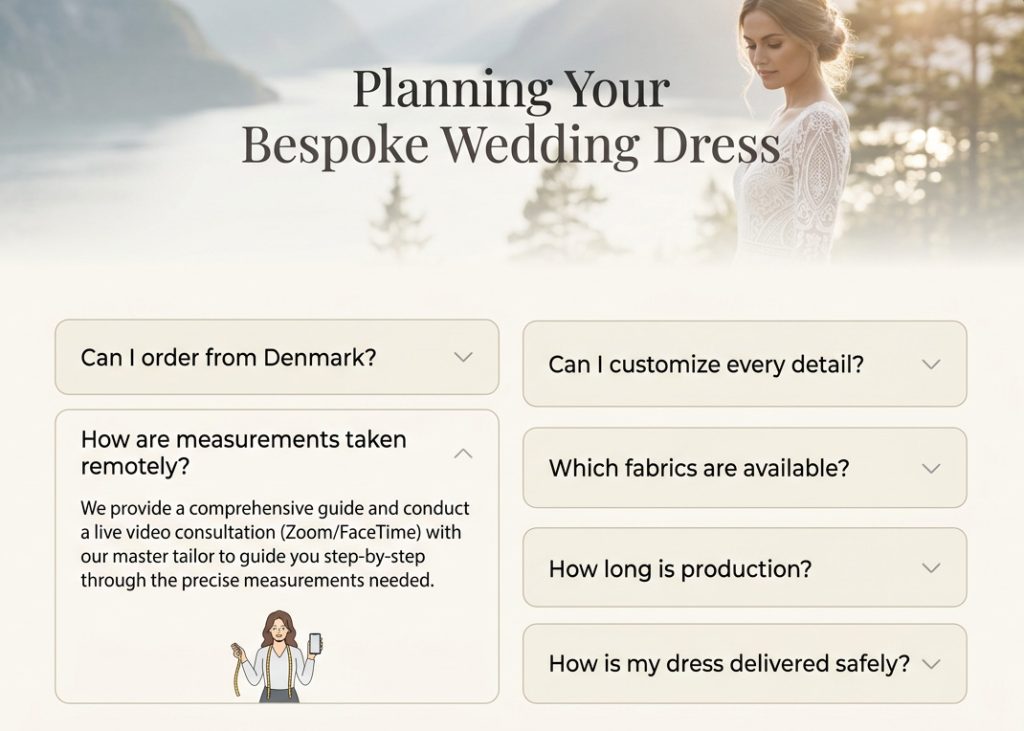
1. How does ordering a custom dress from Metropol work if I live in Copenhagen? Remote consultation via photos, detailed measurements, video calls, and digital design boards. The gown is built to those specifications and shipped.
2. What is the typical price range for a fully custom Metropol wedding dress? Approximately €300–€2,000 depending on silhouette complexity, fabric choice, and handwork volume.
3. Are the fabrics suitable for Denmark’s climate and long receptions? Yes. European lace, silk, and quality linings are selected for breathability, drape, and comfort during extended indoor celebrations and possible outdoor exposure.
4. Can I incorporate Scandinavian minimalism with subtle personal or cultural details? Absolutely. The design process starts from your brief, allowing clean lines with targeted embroidery, color accents, or motif integration.
5. How long does production and shipping usually take? Lead times accommodate standard wedding planning windows; exact schedules are confirmed at order based on complexity and current production calendar.
6. Do I need to travel to Turkey for fittings? No. Measurements and progress communication are handled remotely. Local final adjustments in Copenhagen can be arranged if desired.
7. What silhouettes work best for Copenhagen city-hall ceremonies? A-line, sheath, tea-length, or structured jumpsuits that allow easy movement on cobblestones and indoors.
8. Can the dress include removable sleeves or a convertible train? Yes. Functional engineering (bustles, detachable elements, modular sleeves) is part of custom construction.
9. How does custom compare cost-wise to Copenhagen boutiques? Many fully custom pieces land below equivalent local made-to-measure or designer prices while offering greater design freedom.
10. Is the dress suitable for outdoor castle or waterfront weddings common in Denmark? Fabric weight, structure, and practical features (train management, weather considerations) are specified during design.
11. Can I request progress photos during construction? Yes. Visual updates are standard for remote clients.
12. What measurement process is recommended? Professional local measuring is ideal; detailed guidance is provided so results are accurate for pattern drafting.
13. Are there options for plus sizes or non-standard proportions? Custom drafting from individual measurements removes standard size limitations.
14. How is the dress packed and shipped to Denmark? Secure professional packaging with tracked international shipping.
15. Can the design include elements inspired by Danish or Nordic aesthetics? Yes—clean geometry, soft volume, restrained embellishment, or botanical references can be translated into the construction.
16. What happens if minor final adjustments are needed after arrival? Local Copenhagen seamstresses experienced with bridal work can handle hem, bustle, or minor fit refinements.
17. Is hand embroidery and crystal work available at different density levels? Yes. Embellishment intensity is controlled according to the desired aesthetic and budget.
18. Can I order matching or complementary pieces (cape, jacket, second look)? Custom capability extends to coordinated additional garments.
19. How does Metropol handle privacy and unique designs? Each custom order is treated as individual; patterns and details remain specific to the client.
20. What care instructions come with the finished gown? Detailed guidance for steaming, storage, and post-wedding preservation is provided.
21. Are there sustainable or lower-impact fabric options within the premium range? Fabric selection prioritizes quality and performance; specific preferences can be discussed at the design stage.
22. Can the same atelier produce for bridal boutiques in Denmark? Yes. Wholesale and private-label collaboration is part of the business model.
23. How do I start the conversation without committing immediately? Share wedding date, rough vision, and key priorities for an initial feasibility and options discussion.
24. What if my wedding includes both traditional Danish elements and another cultural heritage? Hybrid designs that respect both are a frequent request and fully supported in the custom process.
25. Is a pure white or soft ivory easier to achieve consistently in custom production? Both are standard; exact shade matching is confirmed via swatches or references.
26. How important is lining quality for comfort during a full Danish wedding day? Critical. Full, high-quality linings prevent discomfort during long receptions and dancing.
27. Can I request a more structured bodice for support without visible undergarments? Yes. Internal structure is engineered according to the silhouette and desired support level.
28. What is the advantage of starting from a blank design rather than altering a sample? Every seam, proportion, and detail is optimized for the individual body and vision instead of adapted from a pre-existing pattern.
29. How are communication and language handled for Danish clients? English is the primary working language for international clients; clear visual and written documentation minimizes ambiguity.
30. Can the dress be designed with future re-use or alteration potential in mind? Construction choices can prioritize durability and possible later modification if requested.
31. What documentation or certificates accompany the finished gown? Quality and materials information is provided; any specific documentation needs can be requested in advance.
32. Is it possible to match or coordinate with a specific veil, shoes, or jewelry already chosen? Yes. References for proportion and style harmony are incorporated into the design brief.
33. How does the process differ for a very minimalist versus a highly embellished gown? Complexity primarily affects timeline and price; the core measurement-to-construction workflow remains the same.
34. Can I see examples of dresses previously made for European or Scandinavian clients? Relevant portfolio references and construction details can be shared during consultation.
35. What is the best time in the wedding planning cycle to begin a custom order? As soon as the date and major venue decisions are firm, allowing comfortable production and shipping buffers.
This content is written for brides and decision-makers evaluating real options for a Copenhagen or Danish wedding. It prioritizes practical performance, design control, and transparent value over generic inspiration. For a personalized next step with Metropol Wedding Dress, direct contact through their established international channels begins the design conversation.
Custom Wedding Dresses Denmark
Danish brides and bridal retailers face a clear tension: local Copenhagen and nationwide boutiques deliver service and convenience, yet true custom design freedom, consistent premium materials, and competitive unit economics often sit out of reach. Metropol Wedding Dress resolves that tension through direct-access custom manufacturing. With more than two decades of production experience, European-sourced lace and silk, and proven shipping into the EU (including Denmark), the atelier builds gowns from individual measurements and design briefs rather than adapting stock patterns.
This landing-page resource examines the Danish bridal market through a procurement and engineering lens. It covers material performance under Nordic conditions, production quality gates, import practicalities, total cost of ownership versus local made-to-measure, realistic decision scenarios, and the precise steps required to commission a gown that meets Danish functional and aesthetic standards. The goal is actionable clarity for brides seeking individuality and for boutiques evaluating private-label or exclusive supply.
Danish Bridal Market Realities: Where Value and Design Freedom Actually Reside
Denmark’s wedding landscape is characterised by relatively high average spend on the overall event, strong preference for practical elegance, and a mixture of city-hall ceremonies, church weddings, and outdoor or historic-venue celebrations. Receptions frequently last eight to ten hours and include structured traditions such as the bridal waltz. These conditions place specific demands on a wedding dress: mobility on cobblestones, temperature regulation indoors, photographic cleanliness under soft northern light, and comfort that survives long periods of standing, sitting, and dancing.
Local retail channels excel at personal appointments and immediate try-on experiences. Their limitations appear in three areas: design latitude (most “custom” work remains pattern adaptation), material transparency at the source level, and unit pricing once mark-ups, rent, and labour are applied. High-quality made-to-measure pieces commonly sit in the multi-thousand to mid-tens-of-thousands DKK range. Fully bespoke couture climbs higher.
A manufacturing-first model changes the equation. When the gown is engineered from measurements and a design brief rather than altered from a sample, every proportion, understructure decision, and fabric allocation can be optimised for the individual body and the specific Danish use-case. Metropol operates in this space: an established production facility that already supplies European clients and retail partners, using premium European fabrics and hand-finishing techniques at price points that remain accessible for private clients (€300–€2,000 range depending on complexity).
Technical Engineering Requirements for a Danish Wedding Dress
A wedding dress is a wearable structure subjected to mechanical stress, thermal variation, and aesthetic scrutiny. For Danish conditions the critical engineering parameters are:
- Hem and train management that survives cobblestone streets and indoor flooring without constant adjustment
- Bodice support that eliminates visible undergarment lines while remaining comfortable for extended wear
- Weight distribution that prevents shoulder or lower-back fatigue during long receptions
- Fabric hand and drape that photograph cleanly without excessive glare or shadowing under soft natural light
- Seam and closure placement that allows discreet bathroom access and easy movement during the bridal waltz
Custom manufacturing addresses these parameters at the pattern stage rather than through post-purchase alteration. Pattern drafting begins with the client’s measurements and mobility priorities; understructure (boning, cups, stabilisers) is specified according to the chosen silhouette and the bride’s preference for support versus softness.
Material Performance Analysis – Nordic Climate and Use Profile
Premium European lace (French and Italian origins), silk satin, organza, tulle, and crepe form the core palette. Performance criteria relevant to Denmark include:
| Property | Why It Matters in Denmark | Preferred Specification |
|---|---|---|
| Breathability & moisture management | Long indoor events, variable outdoor temperature | Silk or high-quality viscose linings, open lace constructions |
| Drape under soft light | Photographic cleanliness in northern daylight | Controlled sheen, soft hand |
| Structural recovery | Hours of sitting, standing, dancing | Appropriate interfacing and understructure |
| Weight control | Comfort on cobblestones and during reception | Balanced fabric allocation, optional lighter trains |
| Abrasion resistance | Contact with chairs, outdoor surfaces | Durable lace edges, reinforced stress points |
Hand embroidery and crystal density can be calibrated. Dense work suits formal church settings; lighter, more organic placement suits contemporary city-hall or waterfront ceremonies. Metropol’s process allows these decisions at the design stage, avoiding the cost and fit compromises of later modification.
Production Sequence and Quality Gates
- Design brief capture (silhouette priorities, absolute constraints, cultural or personal motifs, mobility requirements).
- Measurement verification protocol (detailed guidance or professional local measurement).
- Technical sketch and fabric/swatch confirmation.
- Pattern development from individual measurements.
- Construction under controlled atelier conditions with experienced artisans.
- Intermediate progress documentation (photos and measurement cross-checks).
- Final finishing, quality inspection, and secure packaging.
- Tracked international shipping into the EU.
Each gate reduces the risk of late-stage surprises. Because the gown is built rather than adapted, major fit issues that commonly arise from sample-size grading are avoided.
Import and Logistics Considerations for Danish Clients
Denmark operates within the EU single market. Goods manufactured outside the EU (Turkey in this case) are subject to standard import procedures, VAT handling, and potential customs formalities. Established manufacturers experienced in European delivery already manage documentation, packaging standards, and carrier selection to minimise delays. Clients should confirm:
- Exact HS classification and declared value
- Shipping method and insurance
- Expected transit window relative to the wedding date
- Local final steaming or minor hem services available in Copenhagen or other Danish cities
Buffer time remains essential. Production calendars plus shipping and any local finishing should sit comfortably inside the overall wedding timeline.
Total Cost of Ownership Comparison
Local boutique route
- Sample try-on and consultation fees (sometimes waived on purchase)
- Base dress price (frequently several thousand to 15 000+ DKK for quality made-to-measure)
- Alteration costs (often substantial when converting sample proportions)
- Accessories and ongoing care
Custom manufacturing route (Metropol example)
- Design and production fee within the stated €300–€2 000 band according to complexity
- Shipping and any Danish import handling
- Optional local final check
- Lower likelihood of expensive late alterations because the pattern is original
When design freedom, material quality, and fit precision are valued equally with service experience, the manufacturing route frequently delivers higher functional and aesthetic return per kroner spent.
Realistic Decision Scenarios
Scenario A – City-hall practicality A bride prioritises easy movement, a clean silhouette that photographs well against brick and water, and comfort for a full day of celebration. Custom drafting allows a precise A-line or sheath with controlled train volume and breathable lining—features that stock samples rarely combine at the same price.
Scenario B – Multicultural integration A couple wishes to incorporate subtle heritage motifs without abandoning Scandinavian restraint. Embroidery placement, colour accents, or modular elements can be engineered into the base design rather than added as afterthoughts.
Scenario C – Boutique private-label interest A Danish retailer seeks differentiated stock or exclusive designs without maintaining full in-house production capacity. Wholesale and private-label collaboration provides access to the same technical standards and European fabric sources.
Scenario D – Budget-constrained high-quality demand The client refuses to compromise on fit or material yet needs to stay inside a defined envelope. Transparent manufacturing pricing removes intermediate mark-ups while preserving hand-finishing quality.
Error-Prevention Framework
Frequent failure points and countermeasures:
- Insufficient lead time → lock design and measurements early; build shipping buffer
- Vague mobility brief → document exact venue types, expected activity level, and absolute comfort requirements
- Fabric choice driven only by visual appeal → test drape, weight, and lining interaction against Nordic use profile
- Measurement inconsistency → follow a standardised protocol or use a professional local measurer
- Ignoring understructure → specify support level and intended undergarment strategy at the design stage
- Late design changes → freeze major silhouette and fabric decisions once pattern work begins
Procurement Checklist for Danish Brides and Retail Buyers
- Confirm wedding date, primary venue types, and expected weather window
- Prepare a written brief covering silhouette priorities, non-negotiables, and cultural or personal details
- Obtain accurate measurements using a consistent method
- Request fabric options and construction examples suited to Nordic performance needs
- Clarify production timeline, progress communication method, and shipping pathway
- Identify local Danish resources for final steaming or minor finishing if desired
- Document care and storage instructions for post-wedding preservation
- For retail buyers: evaluate minimum order quantities, exclusivity options, and quality consistency across batches
Expert Procurement Commentary
From a purchasing perspective the decisive variables are fit precision, material provenance, construction reliability, and total landed cost. Local service excellence remains valuable for the try-on experience and emotional reassurance. When the priority shifts to exact design realisation and long-term wearability under Danish conditions, direct manufacturing access frequently outperforms pattern-adaptation routes on both technical and economic grounds. The ability to specify every structural and aesthetic decision at source is the core advantage.
“You may also want to take a look at this article.” Wholesale Wedding Dress Manufacturer
Five Distinct Calls to Action
- Procurement-focused: Request a clear capability overview and example construction details calibrated to Danish venue and climate requirements.
- Design-led: Submit a concise brief (silhouette, mobility needs, key constraints) for an initial feasibility response and timeline indication.
- Retail / wholesale: Inquire about private-label or exclusive collection options built on the same production and fabric standards.
- Cost-transparency: Outline desired complexity level to receive a realistic custom estimate and total landed-cost perspective.
- Timeline-critical: Share the wedding date and current planning stage for a prioritised production and shipping assessment.
The outcome is a gown engineered for the specific body, the specific Danish wedding environment, and the specific balance of aesthetics and practicality the client requires—achieved through manufacturing control rather than retail adaptation.
FAQ – Danish Custom Wedding Dress Procurement & Engineering
1. What defines a true custom wedding dress versus local “made-to-measure” in the Danish market? True custom begins with individual pattern drafting from measurements and a design brief. Most local made-to-measure adapts an existing pattern.
2. Why do Nordic climate and reception length matter for material selection? Breathability, weight, and recovery under prolonged wear determine comfort and appearance after several hours of activity.
3. How does Metropol handle EU import formalities for Danish clients? Experienced international shipping procedures, documentation, and carrier selection are used; clients confirm value declaration and any local handling.
4. What is a realistic production-plus-shipping window for a Danish wedding date? Exact schedules are confirmed at order; buffer time beyond the production calendar is recommended for shipping and any local finishing.
5. Can understructure be engineered for specific support needs without visible lines? Yes. Boning, stabilisers, and internal architecture are specified according to silhouette and client preference.
6. How are cultural or personal motifs integrated without disrupting Scandinavian restraint? Placement, scale, and density of embroidery or accent elements are controlled at the design stage.
7. What measurement protocol minimises fit risk for remote custom orders? A standardised detailed guide is provided; professional local measurement is strongly preferred for accuracy.
8. Are progress photographs and measurement cross-checks standard? Yes. Visual and technical updates form part of the remote client process.
9. How does fabric weight affect performance on Copenhagen cobblestones? Controlled allocation and optional lighter train constructions reduce drag and fatigue.
10. Can the same production standard support both private brides and Danish retail partners? Yes. Private custom and wholesale/private-label streams operate from the same technical base.
11. What is the primary cost advantage of manufacturing-level custom? Elimination of intermediate retail mark-ups while retaining premium European materials and hand finishing.
12. How should a bride document mobility requirements? List venue types, expected activity (dancing, outdoor photos, long standing), and absolute comfort constraints.
13. Is lining quality a secondary or primary decision? Primary. It directly affects temperature regulation and comfort across a full Danish reception.
14. Can removable or convertible elements (sleeves, trains) be engineered from the start? Yes. Functional modularity is specified during pattern development.
15. What documentation accompanies a finished custom gown? Materials and construction information plus care instructions; additional certification can be requested in advance.
16. How are late design changes managed once pattern work has begun? Major silhouette and fabric decisions are frozen to protect timeline and cost integrity; minor refinements may still be possible.
17. What local Danish services are typically needed after arrival? Steaming and possible minor hem or bustle refinement by an experienced bridal seamstress.
18. Does custom production accommodate non-standard proportions or plus sizes? Yes. Individual drafting removes graded-size limitations.
19. How is photographic performance under soft northern light addressed? Fabric hand, sheen control, and colour selection (ivory, soft white, champagne) are chosen accordingly.
20. Can a second look or coordinated cape/jacket be produced in the same process? Yes. Complementary pieces follow the same measurement and quality protocol.
21. What risk does insufficient lead time create? Compressed production or shipping windows increase the chance of rushed finishing or delayed arrival.
22. How transparent is fabric provenance? European lace and silk sources are standard; specific preferences can be discussed at the design stage.
23. Is hand embroidery density adjustable for different formality levels? Yes. Density and placement are calibrated to the ceremony and reception character.
24. What constitutes a complete design brief for efficient production? Silhouette priorities, non-negotiables, mobility needs, cultural elements if any, and timeline constraints.
25. How does the bridal waltz influence construction decisions? Ease of movement, secure closures, and balanced weight distribution receive explicit attention.
26. Can the gown be engineered with future alteration or re-use potential? Construction choices can prioritise durability and later adaptability if requested.
27. What is the advantage of freezing major decisions early? Protects both schedule and cost while allowing the atelier to optimise the remaining details.
28. How are communication language and documentation handled for Danish clients? English is the working language for international projects; visual and written records minimise ambiguity.
29. Does the process support hybrid or multicultural design requests common in Denmark? Yes. Integration of distinct elements within a coherent overall design is a regular requirement.
30. What quality gates occur before shipping? Final construction inspection, measurement verification against the original brief, and secure packaging standards.
31. How should a retail buyer evaluate consistency across multiple units? Request production standards, fabric lot control information, and sample evaluation protocols.
32. Can weather-resistant outer considerations be incorporated without changing the aesthetic? Practical features (manageable trains, appropriate fabric weights) are engineered within the chosen design language.
33. What is the role of undergarment strategy in the design phase? It determines internal support architecture and final silhouette cleanliness.
34. How is total landed cost calculated for a Danish private client? Production fee + shipping + any import handling + optional local finishing.
35. What first step produces the most useful initial response from the manufacturer? A concise brief containing wedding date, primary venue types, silhouette direction, and key constraints.
This resource is written for decision-makers—brides and professional buyers—who evaluate wedding dresses as both emotional and technical products. It prioritises measurable performance under Danish conditions, transparent supply-chain realities, and design control at the manufacturing source. Direct engagement with Metropol Wedding Dress begins the conversion of a clear brief into a gown engineered for the specific requirements of a Danish wedding.
“You may also want to take a look at this article.” Wholesale Wedding Dress
Simple modern wedding dresses succeed only when every line, proportion, and fabric decision is intentional. In Denmark, where Scandinavian restraint meets long receptions and practical venues, “simple” does not mean basic—it means precise. Excess ornamentation is removed; structure, drape, and fit are elevated.
Metropol Wedding Dress enables this level of clarity through direct custom manufacturing. Using European lace, silk, and crepe, the atelier builds clean silhouettes from individual measurements rather than adapting stock patterns. The result is a gown that looks effortless yet performs under Nordic light, cobblestone streets, and extended celebrations. This resource examines the technical requirements of modern minimalism, material purity, construction discipline, Danish use-cases, cost realities, and the exact process for commissioning a simple modern dress that feels considered rather than compromised.
Why True Simplicity Demands Higher Engineering Standards
A simple modern wedding dress is defined by what is absent: heavy beading, layered volume for its own sake, decorative excess. What remains must therefore be flawless. Seams become design features. Fabric hand becomes the primary visual interest. Proportions must balance the body with mathematical clarity.
Danish brides frequently favour this direction. Soft ivory or pure white, controlled volume, clean necklines, and mobility for city-hall or outdoor ceremonies align with broader Scandinavian aesthetics. Local boutiques offer many elegant options, yet the most refined minimalist results often require starting from a blank pattern rather than reducing an existing sample. Reduction of ornament on a pre-existing structure can leave residual bulk or awkward proportions. Custom drafting avoids that residue.
Metropol’s production model supports this approach. The gown is engineered from the measurements and the brief. Fabric allocation, understructure, and seam placement are decided for the specific silhouette rather than inherited from a more elaborate base design.
Core Design Principles for a Simple Modern Danish Wedding Dress
- Silhouette clarity: A-line, column, soft sheath, or controlled trumpet with deliberate proportion
- Neckline and shoulder line as primary architectural elements
- Minimal or zero surface embellishment; texture supplied by fabric quality
- Train and hem engineered for practical movement rather than theatrical length
- Understructure that supports without visible bulk or restriction
- Colour restricted to pure white, soft ivory, or barely-there champagne
These principles translate into measurable construction decisions.
Material Purity Analysis
In minimalist design the fabric itself is the ornament. Performance requirements for Denmark remain rigorous:
| Material Category | Role in Simple Modern Design | Key Performance Traits for Nordic Use |
|---|---|---|
| Silk crepe / satin | Primary body fabric, clean drape | Breathability, controlled sheen, recovery |
| Fine French / Italian lace | Optional subtle texture or sleeve detail | Soft hand, low bulk, clean edge finishing |
| Lightweight organza / tulle | Controlled volume or overlay if needed | Transparency without weight |
| High-quality lining | Comfort and structure foundation | Moisture management, smooth movement |
Heavy crystal work or dense embroidery is deliberately excluded or reduced to near-invisible accents. The visual interest shifts to how light moves across the fabric surface and how the silhouette holds its line after hours of wear.
Construction Discipline Required for Minimalism
Simple modern gowns expose every technical choice.
- Pattern accuracy must be higher because there is no embellishment to distract from fit issues
- Seam finishing becomes visible architecture
- Understructure is calibrated for support without adding thickness
- Closure systems (zip, buttons, or hidden) must sit cleanly
- Hem and train weight distribution prevents drag on cobblestones or indoor floors
Custom manufacturing allows these elements to be resolved at the drafting stage. Sample-based alteration frequently struggles to achieve the same purity because residual pattern logic from a more complex design remains.
Danish Use-Case Mapping
City-hall ceremonies favour clean column or soft A-line shapes that move easily and photograph against brick and water. Outdoor or historic venues benefit from controlled trains that can be bustled without visual compromise. Long receptions demand breathable linings and balanced weight so the dress remains comfortable through speeches, the bridal waltz, and late-night dancing.
A simple modern dress succeeds in these settings when mobility and temperature regulation are designed in rather than hoped for.
Comparison: Sample Reduction versus True Custom Minimalism
Sample reduction route
- Start with an existing design that may contain residual volume or structure
- Remove embellishment and adjust fit
- Risk of proportions that feel slightly unresolved
True custom minimalist route
- Draft from measurements and a clear brief focused on line and proportion
- Allocate fabric and structure only where functionally required
- Achieve intentional emptiness rather than emptied complexity
The second path consistently produces cleaner results when the aesthetic goal is restrained modernity.
Production Sequence Oriented to Minimalist Outcomes
- Brief focused on silhouette priority, absolute exclusions (no heavy beading, no excessive volume), and mobility requirements.
- Measurement capture with emphasis on posture and movement.
- Technical sketch that prioritises line over decoration.
- Fabric selection biased toward purity of hand and light interaction.
- Pattern development that treats every seam as a design decision.
- Construction under controlled conditions with finishing standards appropriate to exposed seams.
- Progress documentation confirming proportions remain pure.
- Final inspection against the original minimalist brief.
- Secure shipping into Denmark with care instructions for steaming and storage.
Cost Perspective for Simple Modern Custom
Minimalist construction often requires less embellishment labour yet higher precision in pattern and finishing. Metropol’s pricing band (€300–€2,000 according to complexity) places high-quality simple modern gowns within reach while using European materials and hand techniques. Local Danish boutique pricing for comparable purity frequently sits higher once service, rent, and retail margins are included. The manufacturing route therefore offers both design control and economic clarity for clients prioritising clean modernity.
Realistic Scenarios
A bride seeking a soft column dress for a Copenhagen city-hall ceremony with afternoon outdoor photographs. The brief specifies pure ivory silk crepe, clean boat neckline, minimal train, and full mobility. Custom drafting delivers exact proportions without residual sample bulk.
A couple wanting understated modernity with a single subtle lace panel at the back. Placement and density are controlled so the overall effect remains restrained.
A client who previously tried multiple sample dresses and found every “simple” option still carried unnecessary structure. Starting from measurements removes the inherited complexity.
Common Errors in Pursuit of Simple Modern Design
- Choosing a sample and removing decoration without re-engineering proportions
- Selecting fabric solely for visual softness without testing recovery and weight
- Under-specifying understructure, leading to loss of line after the first hour
- Ignoring hem and train practicality for Danish streets and venues
- Allowing last-minute decorative additions that compromise the original clarity
Decision Checklist for Commissioning a Simple Modern Dress
- Confirm the core silhouette and the elements that must remain absent
- Document mobility needs relative to venues and reception length
- Prioritise fabric hand and light interaction over surface decoration
- Require pattern drafting from individual measurements
- Freeze major design decisions early to protect purity of execution
- Plan local final steaming if needed after arrival in Denmark
- Verify care instructions that preserve the clean finish over time
Expert View on Value
From a procurement standpoint, simple modern design is a high-specification product category. The absence of ornament increases the visibility of every technical decision. Clients who treat the process as engineering rather than decoration consistently achieve superior results. Manufacturing-level control over pattern, fabric allocation, and finishing is the most reliable route to intentional minimalism.
Five Distinct Calls to Action
- Clarity-focused: Share a brief limited to silhouette, absolute exclusions, and mobility priorities for a direct feasibility response.
- Material-led: Request current fabric options and construction examples optimised for clean modern Danish aesthetics.
- Proportion-critical: Provide measurements and a pure-line reference for an initial technical assessment.
- Timeline-driven: Indicate the wedding date and preferred simplicity level for a realistic production and shipping schedule.
- Comparison-oriented: Outline previous sample experiences that felt unresolved; receive guidance on how custom drafting resolves residual complexity.
The finished gown should appear inevitable—clean, considered, and completely aligned with the body and the Danish context—rather than reduced from something more elaborate.
FAQ – Simple Modern Custom Wedding Dresses for Danish Brides
1. What separates a truly simple modern wedding dress from a plain one? Intentional proportion, precise seam placement, and fabric quality that carries the visual interest.
2. Why does minimalism require higher pattern accuracy? There is no embellishment to disguise small fit or proportion issues.
3. Which fabrics best support a clean modern aesthetic under Danish light? Silk crepe, fine satin, and low-bulk European lace with controlled sheen.
4. Can a simple modern dress still include subtle texture? Yes—through fabric choice or restrained lace placement that does not disrupt overall clarity.
5. How does custom manufacturing protect the purity of a minimalist design? The pattern is developed for the intended simplicity rather than adapted from a more complex base.
6. What mobility features matter most for Copenhagen and Danish venues? Balanced weight, practical hem/train management, and freedom of movement for walking and dancing.
7. Is heavy understructure compatible with a simple modern look? Only when calibrated to provide support without adding visible bulk or restriction.
8. How should colour be approached for restrained modernity? Pure white, soft ivory, or the lightest champagne; avoid strong colour shifts.
9. Can a simple modern gown accommodate a controlled train? Yes—engineered for easy bustling and practical length rather than maximum drama.
10. What is the risk of starting with a decorated sample and removing elements? Residual proportions and structure often remain, preventing true clarity.
11. How important is lining in a minimalist dress? Critical for comfort, temperature regulation, and maintaining clean external lines.
12. Does Metropol’s price range support high-quality simple modern construction? Yes. The €300–€2,000 band covers precision work with European materials.
13. What brief elements produce the cleanest results? Clear silhouette priority, explicit exclusions, and documented mobility needs.
14. Can sleeves be included without compromising simplicity? Yes—when cut and finished as integral architectural elements rather than decorative additions.
15. How does reception length influence material and structure choices? Breathability and recovery become higher priorities for dresses worn eight to ten hours.
16. Is progress documentation useful for minimalist commissions? Yes. Visual confirmation that proportions remain pure throughout construction is valuable.
17. What local Danish finishing is typically required? Professional steaming and possible minor hem adjustment after shipping.
18. Can a simple modern dress incorporate a single personal detail without losing restraint? Yes—if scale, placement, and density are tightly controlled.
19. How does custom drafting handle non-standard body proportions in minimalist design? Individual pattern development ensures clean lines regardless of standard size charts.
20. What care practices preserve the clean finish of a simple modern gown? Gentle steaming, proper storage, and avoidance of unnecessary surface handling.
21. Are column and soft A-line the only viable simple modern silhouettes? No. Controlled trumpet or soft sheath shapes also work when proportions are deliberate.
22. How early should major design decisions be frozen? As soon as silhouette, fabric, and exclusions are confirmed, to protect execution purity.
23. Does the absence of embellishment reduce production time? Often yes, yet higher precision in pattern and finishing can offset some of that reduction.
24. Can the same approach serve both private brides and Danish retailers seeking clean modern stock? Yes. The technical standards apply to both private custom and private-label streams.
25. What photographic advantage does fabric purity provide under soft northern light? Clean light interaction without glare or distracting surface texture.
26. How should a bride evaluate whether a sample can be successfully simplified? Examine residual structure and proportion after mental removal of decoration; if doubt remains, custom drafting is safer.
27. Is a pure minimalist brief easier or harder for the manufacturer? Clearer in intent, more demanding in precision.
28. Can convertible elements (removable sleeves or over-layers) stay within simple modern language? Yes—when designed as clean, functional modules rather than decorative extras.
29. What is the most common disappointment with “simple” sample dresses? They still carry bulk or proportion logic from more complex original designs.
30. How does Metropol confirm the final gown matches the minimalist brief? Final inspection against the original silhouette, fabric, and exclusion criteria.
31. Does shipping into Denmark require special packaging for clean modern gowns? Secure, structured packaging that protects seams and fabric surface is standard.
32. Can a simple modern dress still feel special and elevated? Yes—through exact fit, superior fabric, and architectural clarity rather than surface decoration.
33. What first information produces the most useful response from the atelier? Wedding date, preferred silhouette direction, absolute exclusions, and key mobility requirements.
34. How does the bridal waltz influence a minimalist construction? Ease of movement and secure, invisible closures receive explicit attention.
35. Is “simple modern” a trend or a lasting Danish preference? It aligns with enduring Scandinavian values of restraint, function, and quality material.
This resource treats the simple modern wedding dress as a high-precision product category. Clarity of line, purity of material, and disciplined construction are the non-negotiable requirements. Metropol Wedding Dress provides the manufacturing control necessary to meet those requirements for Danish brides who want effortlessness that is fully intentional.