
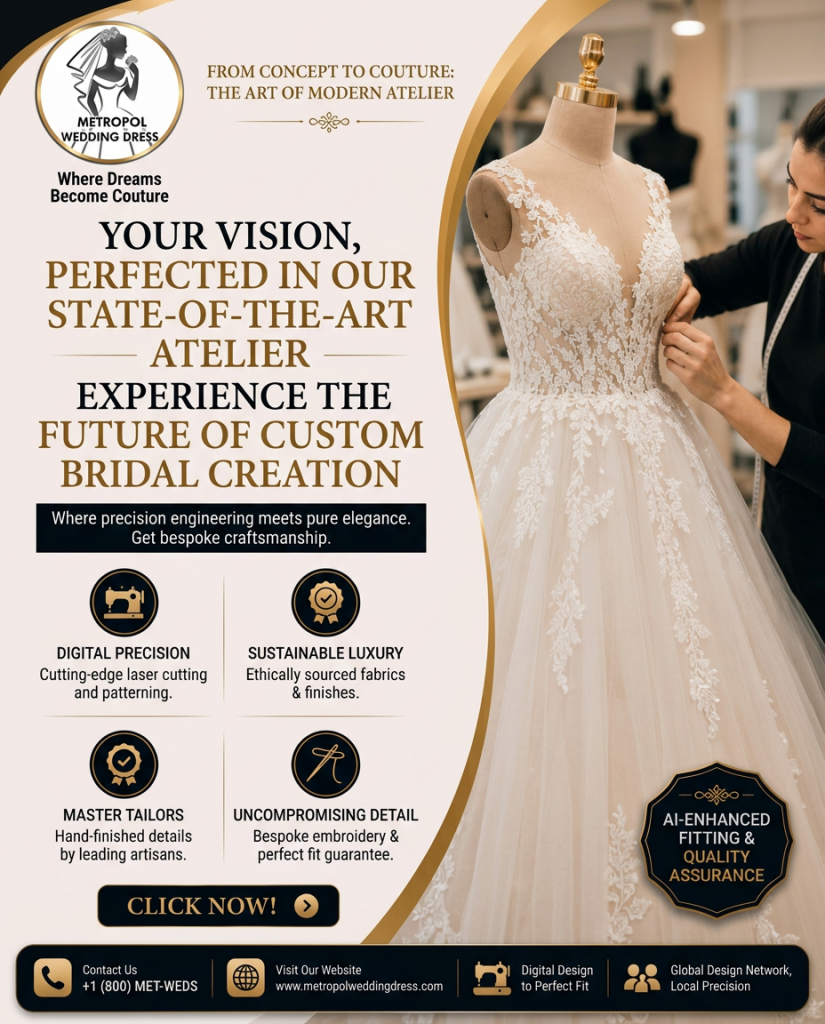
Luxury Made-to-Measure Wedding Dresses in Australia Imagine standing on a sunlit verandah in the Hunter Valley, or beneath the soaring ceilings of a Melbourne warehouse conversion, or on the sand at a quiet Western Australian beach. The light is sharp, the air carries salt or eucalyptus, and the dress you chose must do more than look beautiful in a fitting room. It must move with you through heat, wind, dancing, and emotion. It must feel like an extension of the person you already are—not a costume borrowed for one day.
That is the quiet revolution underway in Australian bridal fashion. Off-the-rack samples and even many “made-to-order” designer labels still begin with a size chart. Luxury made-to-measure begins with you. And for an increasing number of Australian brides and forward-thinking boutiques, the most sophisticated route to that outcome is no longer limited to a handful of high-street ateliers charging premium local rates. It now includes specialised manufacturers such as Metropol Wedding Dress, who combine European fabric relationships, decades of bridal construction expertise, and transparent international production to deliver true custom work at accessible luxury price points.
This is not another “how to choose a wedding dress” list. It is a practical, decision-oriented examination of what made-to-measure actually means in the Australian context of 2026, how the process works when the atelier is on the other side of the world, what the real cost landscape looks like, which materials perform under Australian conditions, and how to evaluate whether this path is the right investment for your day—and potentially for your boutique if you are reading as a retailer.
The Australian Bridal Reality Check: Climate, Body, and Expectation
Australian weddings are rarely indoor ballroom affairs held under controlled lighting. Ceremonies take place in vineyards, on cliff tops, in heritage gardens, on beaches, and in converted industrial spaces that bake in summer and chill in winter. Guests move between outdoor photos and indoor receptions. Brides walk on grass, sand, timber decks, and polished concrete. Humidity in Queensland and the Northern Territory, dry heat in the west, and unpredictable southern weather all place practical demands on fabric and construction that European winter bridal shows rarely address.
Simultaneously, Australian body diversity is broader than many standard size ranges acknowledge. Brides of every height, proportion, and post-pregnancy shape want the same architectural precision that tall, slim sample models receive. They also want silhouettes that photograph cleanly in harsh midday light, fabrics that breathe, and details that survive hours of movement without constant adjustment.
Local Australian ateliers answer these needs superbly—when the budget stretches to AUD 5,000–15,000 and the timeline allows multiple in-person fittings over 8–12 months. The gap that remains is the bride or boutique seeking genuine design freedom and exact fit without that full local-atelier premium. This is precisely where a manufacturer model such as Metropol’s becomes strategically interesting: pattern development driven by individual measurements, access to a wider range of mill fabrics, and production systems designed for both single commissions and private-label runs.
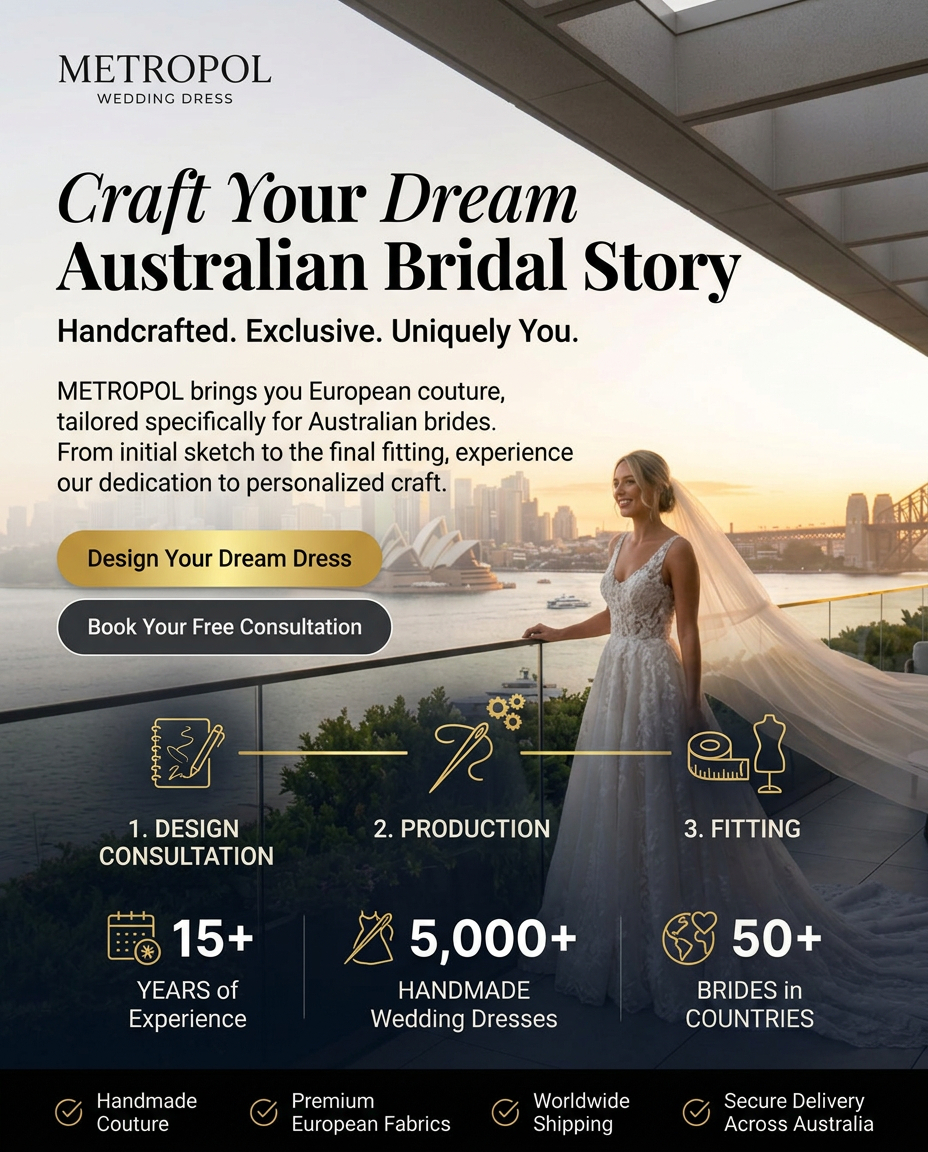
What “Made-to-Measure” Actually Means (And What It Does Not)
Terminology in bridal is often used loosely. Clarifying the distinctions protects both budget and expectation.
- Off-the-rack / sample: Standard sizes, limited stock, alterations almost always required (often AUD 400–1,500 extra).
- Made-to-order: Existing design cut in a size closest to the bride’s measurements, sometimes with minor modifications (sleeve length, train length, bust adjustment). Still begins from a graded pattern.
- Made-to-measure: A pattern is drafted or substantially adjusted from the bride’s actual body measurements. Proportions, posture, and balance are considered from the first cut.
- Fully bespoke / couture: Original design developed from sketches or references, multiple toiles or fittings, highest level of handwork and fabric exclusivity.
Metropol Wedding Dress operates across the made-to-measure and full custom spectrum. For an individual Australian bride this typically means submitting detailed measurements (with clear photographic guidance), sharing inspiration images or sketches, receiving technical drawings and fabric recommendations, approving a refined design, and receiving a gown constructed to those specifications. For boutiques it extends to private-label collections, small wholesale runs, and OEM production under the boutique’s own branding.
The practical advantage is that the garment is never “almost your size.” It is built for the measurements provided. Remote processes replace multiple studio visits with structured measurement protocols, progress photos of toiles or work-in-progress, and final quality documentation before shipping.
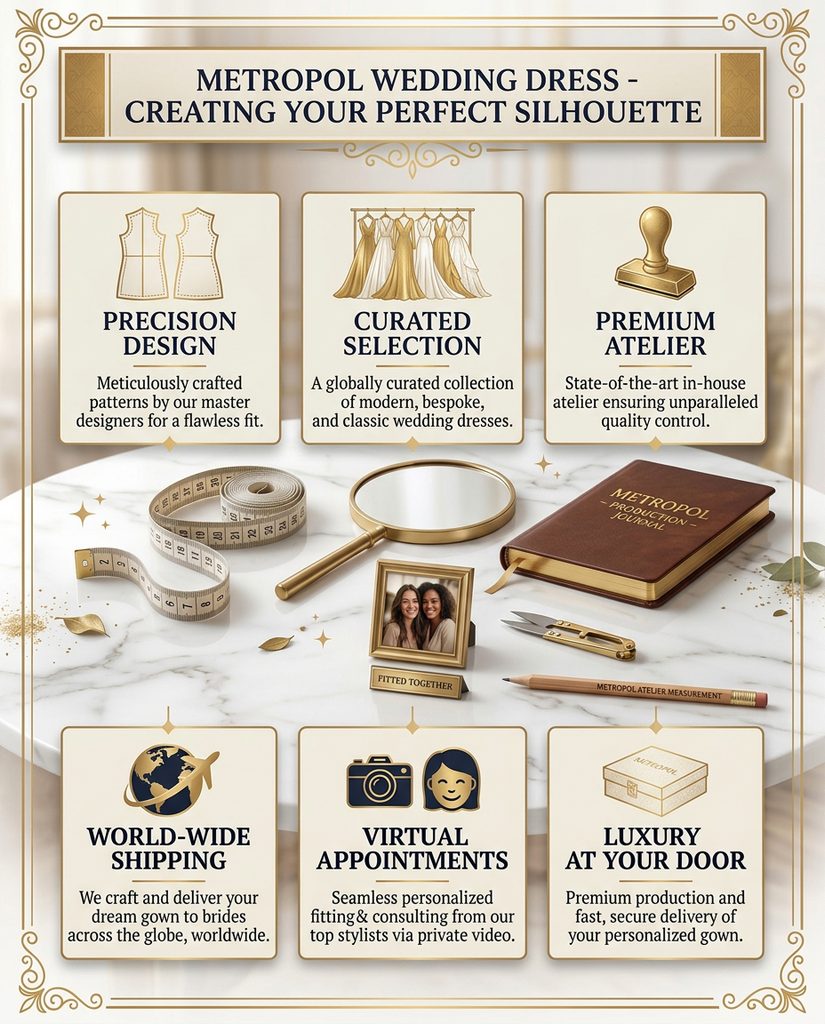
Material Intelligence for Australian Conditions
Luxury is not only about price or label. It is about how fabric behaves under real conditions.
Silk and silk blends remain the gold standard for drape and luminosity. Mikado (a structured silk or silk-blend) holds architectural lines without excessive weight—ideal for sculpted bodices and clean columns that photograph with soft highlights rather than glare. Duchess satin offers a more formal sheen and body. Crepe (especially silk or high-quality polyester crepe) provides matte elegance and movement, excellent for warmer climates because it breathes better than heavy satins.
Lace must be chosen carefully. Fine French or Chantilly lace applied with restraint photographs beautifully and feels romantic without trapping heat. Heavier Guipure or Alençon can create texture and structure but requires thoughtful placement so the gown does not become insulating. Many 2026 Australian designs use lace as strategic accent rather than all-over coverage.
Tulle and organza deliver volume without bulk when layered intelligently. Soft bridal tulle or silk organza creates the floating effect modern ball-gown brides want, while remaining far lighter than traditional multi-layered constructions. This matters enormously for outdoor ceremonies and long receptions.
Linings and understructures are where comfort is won or lost. Quality made-to-measure work prioritises breathable linings, flexible yet supportive boning (modern elastic or spiral steel rather than rigid plastic), and thoughtful seam placement that avoids pressure points. A gown that looks spectacular but requires constant adjustment or causes overheating fails the practical test of an Australian wedding day.
Metropol’s production model emphasises direct relationships with European and specialist mills, allowing selection of these performance-oriented materials rather than being limited to whatever is currently stocked in a local showroom.
The Production Journey: From Mood Board to Doorstep
Understanding the sequence removes anxiety and sets realistic timelines.
- Brief and measurement
The bride (or boutique) supplies clear inspiration, preferred silhouettes, must-have details, and a full set of body measurements taken according to a precise protocol. Height, posture notes, and photos in fitted clothing help the pattern team. - Design development
Technical sketches are produced, fabric options proposed with swatches or detailed descriptions, and a refined design approved. Changes at this stage are straightforward and cost-effective. - Pattern and construction
A pattern is created or adapted specifically for the measurements. Cutting, sewing, and hand-finishing follow. Complex beadwork, lace application, or structural elements are executed by specialised teams. - Quality control and remote approval
Progress images or, where appropriate, toile photos allow confirmation before final finishing. Minor adjustments can still be made. - Shipping and customs
Tracked international carriers deliver to Australia. Personal-use bridal gowns generally clear customs without major complication. GST (10 %) and any applicable duty are calculated on the value; many clients find the landed cost still significantly below equivalent local atelier pricing.
Typical lead times for Metropol sit in the 6–9 month range for standard complexity, shorter than many fully local bespoke timelines and long enough for careful work. Express options exist for closer dates at additional cost.
Cost Architecture: What You Actually Pay
Australian average spend sits near AUD 2,500, but that figure is heavily weighted by off-the-rack and mid-range purchases. Real ranges observed in 2025–2026:
| Pathway | Typical Landed Cost Range (AUD) | What You Receive | Hidden or Additional Costs |
|---|---|---|---|
| Off-the-rack / sample | 800–2,500 | Standard size, limited uniqueness | Alterations 400–1,500 |
| Mid-range designer made-to-order | 1,800–4,000 | Better fabric, still graded pattern | Alterations + shipping |
| Local Australian atelier (full custom) | 4,500–12,000+ | Multiple fittings, high service, local production | Premium for compressed timelines |
| Specialist manufacturer (e.g. Metropol route) | 2,000–5,500+ | True made-to-measure, design freedom, premium materials | Shipping, duty, GST, possible local final tweak |
The manufacturer route frequently delivers comparable or superior material quality and exact fit at a lower total outlay because production overheads and real-estate costs differ. For boutiques the economics are even clearer: private-label or small-run exclusivity becomes viable without the inventory risk of buying finished samples from multiple labels.
Click to read a similar article.
Design Freedom in Practice: Real Scenarios
A Sydney bride with a vineyard wedding wants a soft A-line with detachable long sleeves for the ceremony and a lighter silhouette for dancing. She supplies measurements and references. The manufacturer develops a modular design in silk crepe with Chantilly overlays, constructs to her exact proportions, and ships a gown that requires only minor hem adjustment locally.
A Melbourne boutique wants three exclusive silhouettes in two colourways for its private collection. It works with the manufacturer on technical packs, receives samples, then places a small production run under its own labels. The boutique can offer genuine “designed for you” service without maintaining a full in-house atelier.
A Brisbane bride with a plus-size frame and a beach ceremony needs a lightweight column with architectural neckline. Standard samples never balanced correctly. Made-to-measure pattern work solves the proportion issues from the first cut.
These are not hypotheticals; they reflect the kinds of commissions and wholesale relationships a specialised manufacturer handles routinely.
Common Pitfalls and How to Avoid Them
- Under-estimating measurement accuracy. Follow the protocol exactly; when in doubt, have a professional take the measurements.
- Leaving design changes too late. Major revisions after pattern cutting increase cost and risk timeline.
- Ignoring climate. Heavy multi-layer constructions that look dramatic in a cool showroom can become uncomfortable outdoors.
- Assuming “custom” means unlimited free changes. Clear change policies protect both parties.
- Overlooking total landed cost. Always request a breakdown that includes shipping estimates, expected duty, and GST.
A simple pre-commission checklist:
- Confirm measurement method and photographic requirements
- Agree design scope and number of revision rounds
- Receive fabric recommendations with performance notes for heat/humidity
- Clarify lead time, payment schedule, and shipping method
- Understand what local alterations (if any) might still be advisable
Trends Shaping 2026 Australian Made-to-Measure Requests
Quiet confidence rather than maximalism. Pencil and refined A-line silhouettes, Basque or structured waistlines, lighter ball gowns with fewer layers, and modular elements (detachable sleeves, overskirts, trains) that allow transformation from ceremony to reception. Colour is no longer restricted to pure white—bone, champagne, oyster, soft ivory, and subtle blush tones photograph exceptionally well in Australian light and feel more personal. Fabric texture (fine lace placement, soft pleating, matte crepe) is preferred over heavy all-over embellishment. Convertible and multi-wear designs are rising as brides seek longevity beyond the single day.
A manufacturer able to execute these requests efficiently, without the constraints of a fixed sample inventory, is well positioned for this shift.
Expert Perspective: Evaluating the Investment
From a purchasing-manager standpoint the decision criteria are clear:
- Fit precision and reduction of post-delivery alteration risk
- Design originality and exclusivity
- Material performance under Australian conditions
- Total landed cost versus perceived value
- Reliability of timeline and communication
- For retailers: MOQ flexibility, private-label capability, and consistency across repeats
Metropol Wedding Dress meets these criteria by operating as a dual-purpose facility—capable of both high-touch individual commissions and scalable boutique production—while maintaining European fabric standards and transparent pricing. The value proposition is not “cheap couture.” It is sophisticated made-to-measure and custom work made accessible through efficient production architecture.
Closing the Distance Between Vision and Reality
A wedding dress is one of the few garments most women will remember for decades. When it is made to measure, the memory includes the knowledge that every seam, proportion, and detail was considered specifically for the person wearing it. Australian brides no longer need to choose between compromise on fit or compromise on budget. The combination of detailed remote collaboration, specialist manufacturing expertise, and careful logistics has made true luxury made-to-measure a realistic, high-value option.
Whether you are an individual bride seeking a gown that belongs only to you, or a boutique looking to offer exclusive collections without the overhead of a full local atelier, the path is clearer than it has ever been. The architecture of belonging begins with precise measurements, honest conversation about climate and movement, and a production partner who treats the dress as both an emotional object and a carefully engineered garment.
The next step is simply to begin the conversation—with clear measurements, honest references, and realistic timelines. The result can be a dress that does not merely look like the one you imagined, but feels like the one you were always meant to wear.
Frequently Asked Questions
1. How long does a made-to-measure wedding dress from a specialist manufacturer typically take for Australian clients?
Standard complexity usually requires 6–9 months from final design approval to delivery. Complex handwork or peak-season demand can extend this; express options are sometimes available at additional cost.
2. What measurements are required and how accurate do they need to be?
A comprehensive set including bust, underbust, waist, hips, torso length, arm length, height, and several others. Accuracy is critical—professional measurement or careful adherence to the provided protocol is strongly recommended. Supporting photos in fitted clothing help the pattern team.
3. Will I still need local alterations after the dress arrives?
Many brides need only minor adjustments (hem length for shoes, slight sleeve or strap tweak). Because the pattern is drafted to the supplied measurements, major structural alterations are far less common than with off-the-rack gowns.
4. How do shipping, duty and GST work for a wedding dress imported into Australia?
Personal-use bridal gowns are subject to 10 % GST on the customs value. Clothing may attract a modest duty rate depending on origin and free-trade arrangements. Tracked carriers handle clearance; the manufacturer can provide estimated landed-cost guidance.
5. What is the realistic price range for a luxury made-to-measure gown via this route?
Many mid-complexity designs land in the AUD 2,000–5,500 range after shipping and taxes. Highly embellished couture pieces sit higher. This frequently compares favourably with local atelier pricing for equivalent fabric and construction quality.
6. Can I request a completely original design or only modifications of existing styles?
Both. Many clients begin with inspiration images and develop an original or heavily adapted design. Full bespoke development is part of the service offering.
7. Are the fabrics suitable for hot Australian climates?
Yes—when chosen deliberately. Lightweight silks, crepes, soft tulles and strategically placed lace perform well. Heavy multi-layer constructions or non-breathable synthetics are avoided for outdoor or summer weddings.
8. What happens if my measurements change slightly during the production period?
Communicate early. Modest changes can often be accommodated before final cutting or during finishing. Significant changes after the pattern is locked may incur additional cost or delay.
9. Is the process secure for remote collaboration?
Structured stages, progress photography, design approval checkpoints, and tracked shipping create transparency. Payment schedules are typically staged against milestones.
10. Can bridal boutiques order private-label or small wholesale collections?
Yes. The manufacturer model supports private-label development, small production runs, and OEM services, enabling boutiques to offer exclusive pieces without maintaining large sample inventories.
11. How does made-to-measure differ from made-to-order in practical terms?
Made-to-order usually starts from a graded existing pattern adjusted to the nearest size. Made-to-measure creates or substantially revises the pattern from the individual’s actual measurements and proportions.
12. What level of handwork can I expect?
Depending on the design: precise machine construction combined with hand-applied lace, beading, finishing, and structural elements. Complexity is reflected transparently in pricing.
13. Are non-white or coloured wedding dresses possible?
Absolutely. Bone, champagne, oyster, soft ivory, blush and other custom tones are routinely produced and photograph exceptionally well in Australian light.
14. What if I need a dress for a wedding less than six months away?
Discuss express production options early. Not every design can be accelerated, but simpler silhouettes or prioritised slots may be available.
15. How do I evaluate fabric quality remotely?
Detailed descriptions, mill information, and often physical swatches or high-resolution images are provided. Performance characteristics (drape, breathability, sheen) are discussed in relation to the planned silhouette and climate.
16. Can the dress include modular or convertible elements?
Yes—detachable sleeves, overskirts, trains and similar features are frequently requested and engineered for secure yet easy removal.
17. What support is available after delivery?
Guidance on care, storage, and recommended local alteration specialists if minor adjustments are desired. The goal is a finished garment ready for the day with minimal further intervention.
18. Is this option suitable for plus-size or petite brides?
Yes. Because patterns are drafted from individual measurements rather than graded from a standard size, proportion and balance issues common with off-the-rack samples are addressed from the outset.
19. How does the design approval process work?
Technical sketches and fabric proposals are shared for review. Revisions are discussed until the design is locked. This stage is the most cost-effective time for changes.
20. What makes a manufacturer-based made-to-measure service different from a local Australian atelier?
Local ateliers excel at in-person fittings and immediate tactile collaboration. A specialist manufacturer offers broader fabric access, often more competitive pricing for equivalent construction, and the ability to scale from single commissions to boutique collections—while still delivering true made-to-measure precision through structured remote processes.
21. Can I combine elements from different inspiration images?
Yes. This is one of the core strengths of a custom process—hybrid designs that reflect the bride’s specific aesthetic rather than a single catalogue look.
22. What is the typical payment structure?
Staged payments tied to design approval, production commencement, and pre-shipment milestones. Exact terms are confirmed at the start of the project.
23. Are sustainable or lower-impact fabric options available?
Discussion of material origin and production methods is part of the consultation. Choices can prioritise quality, longevity and responsible sourcing within the available mill range.
24. How important is the quality of the lining and understructure?
Extremely. Comfort over a full wedding day depends heavily on breathable linings, flexible support, and thoughtful internal construction—areas where experienced bridal manufacturers invest significant attention.
25. What should I prepare before the first consultation?
Clear inspiration images or mood board, preferred silhouettes and must-have details, realistic budget range, wedding date and location/climate notes, and accurate measurements (or a plan to obtain them).
These answers are designed to give practical clarity rather than generic reassurance. The most successful outcomes begin with precise information exchange and aligned expectations between bride (or boutique) and manufacturer.
Five Distinct Calls to Action
- For the decisive bride
Ready to stop compromising on fit and originality? Share your measurements and inspiration with Metropol Wedding Dress and receive a personalised design proposal within days. - For the research-driven planner
Request a detailed fabric and process guide tailored to Australian conditions and timelines. Understand exactly what goes into a true made-to-measure gown before you commit. - For the boutique owner or buyer
Explore private-label and small-run capabilities that let you offer exclusive collections without the overhead of a full local atelier. Ask for wholesale parameters and sample development options. - For the climate-conscious bride
Tell us about your venue, season and movement needs. We will recommend materials and constructions engineered for Australian light, heat and real-world comfort. - For the storyteller
Your dress should carry your narrative. Begin the conversation with the details that matter most to you—silhouette, colour, modularity, heritage references—and watch a technical design take shape around them.
Here are strong options based on current Australian offerings:
Brisbane / Queensland
- Euphorie Studios — Custom & made-to-order luxury gowns, handcrafted in their Brisbane HQ (25+ years). Fully bespoke with head designer or made-to-order from their range. Australian-made.
- Kim Marcel — 100% Australian-made bespoke couture at their Wynnum (Brisbane) studio. Traditional European techniques, 30+ years experience. Average around $8,000+ GST (starts ~$5,500). Multiple fittings; no alterations needed as it’s made to measure from the start.
- Erin Clare Bridal (Noosa) — Australian-made, made-to-order and custom couture. Available at their studio or through retailers.
Melbourne / Victoria
- Bernadette Pimenta Couture — Iconic designer with 27+ years. Fully custom gowns starting from ~$3,500 (price depends on fabric/lace/embellishments). 6–8 months typical; serves brides Australia-wide and internationally via Zoom. Studio in Armadale.
- Gwendolynne (Fitzroy) — Made-to-measure and made-to-order (including remote/interstate/international). Strong on modern, Art Deco, romantic, and curve-inclusive designs. ~6–8 months standard. Personal guidance on fit and fabric.
Sydney / NSW
- Joseph Sayadi — Custom-made and customisable collection gowns. JS collection is full couture; Amarige is made-to-order with options ($2,500–$8,000 range mentioned for the latter).
- Karen Willis Holmes — Bespoke collection handmade to order in their Sydney workroom. Mix-and-match options on many styles. Price range roughly $3,990–$13,000. 6–8 months recommended.
- Norma & Lili — Mother-daughter couture duo. Fully custom, designed & made in Sydney. Starts at ~$10,000. Multiple fittings (including calico mock-up). Recommend starting 9–12 months out.
Other / Multi-location / Accessible Options
- Yin Bridal — Custom made-to-measure wedding gowns (plus áo dài and eveningwear). Based in Australia, handmade in partnership with a Vietnam atelier. 4–8 weeks ship time possible; worldwide shipping. Strong emphasis on personal/cultural stories.
- Christina Rossi (Sydney & Melbourne) — Designer boutique with full customisation (mix-and-match + couture) and private designer consultations.
- Grace Loves Lace — Popular made-to-order custom gowns (size ranges + height, some design personalisation). Priority/rush options for shorter timelines (under 6 months). Australian brand with strong boho/modern aesthetic.
- Zanzi’s (Perth) — Fully Australian-designed and handmade made-to-measure gowns in their local studio. Emphasises perfect fit without heavy alterations.
- Others frequently recommended: Prea James, Kate Gubanyi, and various size-inclusive makers (many accommodate any size with no surcharge on made-to-measure).
Practical Tips
- Timeline: Most recommend starting 6–12 months before the wedding (9–12 months ideal for full custom). Some offer rush/priority for shorter windows at extra cost.
- Price range: Entry-level made-to-measure/custom often starts ~$2,000–$4,000; solid mid-range $5,000–$9,000; high couture $8,000–$15,000+. Fabric, beading, complexity, and designer reputation drive the final cost.
- Process: Usually begins with a consultation (in-person or virtual), measurements, fabric/lace selection, toile/mock-up fitting(s), then final fittings. Many offer interstate/international support.
- Advantages of Australian-made/to-measure: Better fit control, ability to adjust details mid-process, support local craftsmanship, and often lower overall alteration costs compared with heavily altering an off-the-rack imported dress.
If you have a specific city, budget, style preference (e.g., lace, minimalist, plus-size, boho, cultural elements), timeline, or want links/contact details for particular designers, let me know and I can refine the list further.
Continuing with more made-to-measure / custom wedding dress options in Australia.
Here’s an expanded list with additional designers, more practical details, and regional coverage beyond the previous overview.
Additional Strong Options by Region
Sydney & NSW
- Prea James Bridal — Popular for made-to-measure and customisable gowns. Flagship in Paddington (Oxford St). Offers both collection pieces made to your measurements and higher-level custom work. Widely stocked nationally and internationally.
- Christie Nicole Bridal (Surry Hills) — Made-to-order gowns with a focus on lace and romantic-to-minimalist silhouettes. Studio-based, personal service.
- Norma & Lili (already mentioned) — True couture starting around $10,000+. Multiple fittings including calico toile. Ideal if you want a completely original design.
Melbourne & Victoria
- Gwendolynne (Fitzroy) — Excellent for made-to-measure (including remote/interstate clients). Strong in modern, Art Deco, vintage-inspired, and curve-friendly designs. Personal designer involvement.
- Bernadette Pimenta — Long-established custom specialist. Starts from approximately $3,500. Flexible with interstate and international brides via video appointments.
Brisbane & Queensland
- Euphorie Studios — Fully Australian-made custom and made-to-order. You can work directly with the head designer for a one-of-a-kind gown or choose from their made-to-order range (prices often in the mid-to-high thousands).
- Kim Marcel (Wynnum) — Pure bespoke, 100% Australian-made. Average around $8,000 + GST. Emphasises traditional couture techniques and perfect fit from the first stitch (minimal or no post-production alterations).
Other Locations / National Reach
- Erin Clare Bridal (Noosa) — Australian-made made-to-order and custom couture. Available at the Noosa atelier or through selected stockists.
- Yin Bridal — Made-to-measure with relatively faster turnaround (sometimes 4–8 weeks). Australia-based with production partnership in Vietnam. Good option if you want personal/cultural customisation (including modern áo dài styles) and worldwide shipping.
- Grace Loves Lace — Highly popular for modern/boho made-to-order gowns. Made to your size range + height, with some design customisation. Priority/rush options available for shorter timelines.
- Zanzi’s (Perth) — Fully designed and handmade in their Perth studio. Strong focus on true made-to-measure fit.
- Kate Gubanyi — Australian-designed and handmade. More accessible price points on some styles, with customisation options.
Typical Price Ranges (2025–2026)
| Category | Approximate Starting Price (AUD) | Notes |
|---|---|---|
| Accessible made-to-order | $2,000 – $4,500 | Collection styles made to measurements |
| Mid-range custom | $4,500 – $8,000 | More fabric/detail options, some design input |
| Full bespoke / couture | $8,000 – $15,000+ | One-of-a-kind, multiple fittings, premium fabrics |
Prices vary significantly with lace, beading, fabric quality, train length, and complexity. Always confirm current pricing and what’s included (GST, fittings, etc.).
Recommended Timeline & Process
- 9–12 months before the wedding → Ideal for full custom/bespoke.
- 6–8 months → Comfortable for most made-to-measure / made-to-order.
- Under 6 months → Possible with some designers (rush fees often apply) or faster options like Yin Bridal or priority services.
Standard process usually includes:
- Initial consultation (in-person or Zoom)
- Measurements + style discussion
- Fabric/lace selection
- Toile/mock-up fitting (especially for true custom)
- 1–3 progressive fittings
- Final pickup or delivery
Many studios happily work with interstate and overseas brides via video calls and courier services.
Quick Tips
- Book consultations early — popular designers fill up.
- Ask about split sizing (different sizes for bust/waist/hips) — very common and helpful.
- Factor in possible final local alterations even with made-to-measure (especially hem for shoes).
- If you have a specific body type, cultural preference, or style (minimalist, heavily beaded, plus-size, sustainable fabrics, etc.), tell me and I can narrow it further.
Would you like:
- Focus on a specific city (Sydney, Melbourne, Brisbane, Perth…)?
- Budget-focused recommendations?
- Designers strong in a particular style (lace, minimalist, boho, glam, plus-size…)?
- Contact links or how to book consultations?
- Comparison of a few specific designers?
Related Topics
10.07.2024
Gelinliğin tasarım süreci nasıl işler 10 Bilgi Gelinlik tasarım süreci, müşterinin özel taleplerine ve tasarımcının yaratıcılığına bağlı olarak değişebilir. Her aşama titizlikle yönetilir ve tasarımın müşterinin beklentilerini karşılaması sağlanır. Ölçü Alımı:Gelinin vücut ölçüleri profesyonel bir...
12.06.2025
Netta Benshabu Wedding Dresses Israeli-born couture designer now based in the United States, has emerged as a transformative figure in the world of bridal fashion. Since founding her eponymous label in 2009, Benshabu has redefined...
18.04.2025
Wholesale Wedding Dresses Turkey has emerged as a global hub for the wedding dress industry, particularly in the wholesale market. Known for its rich textile heritage, skilled craftsmanship, and competitive pricing, Turkey offers an extensive...
13.02.2024
Bridal fabric wholesale refers to the distribution of fabrics specifically intended for use in creating bridal attire, including wedding gowns, bridesmaid dresses, veils, and other accessories. Bridal fabric wholesalers offer a wide range of fabrics...
12.10.2025
Find Your Perfect Fit Why a Custom Made Dress Is Worth It In a world flooded with fast fashion and one-size-fits-all solutions, the allure of a custom made dress stands out like a beacon of...
12.12.2023
Ucuz Toptan Gelinlik: Stil ve Ekonomi Bir Arada Gelinlik alışverişi, birçok kadının hayatındaki en özel anlardan biridir. Ancak, bu özel gün için harcanacak bütçe genellikle endişe kaynağı olabilir. Ucuz toptan gelinlikler, hem bütçeyi korumak hem...
Comments