
Australian brides seeking a truly one-of-a-kind wedding dress no longer need to choose between limited local atelier options (often AUD 6,000–15,000+) and mass-produced imports. Metropol Wedding Dress, a specialist manufacturer based in İzmir, Turkey since 2004, produces fully bespoke, made-to-measure gowns using premium European fabrics (French lace, Italian silk mikado, high-grade tulle) and skilled hand-embroidery at factory-direct pricing.
Typical mid-complexity custom gowns land in Australia for roughly AUD 2,000–4,500 after shipping, 5% duty and 10% GST — frequently 40–60% less than equivalent local couture while offering greater design freedom, precise body measurements and shorter production windows (often 4–12 weeks in the atelier plus transit).
This guide covers the full journey: design collaboration across time zones, fabric and construction realities, Australian import mechanics, climate-smart choices for beach or vineyard weddings, cost breakdowns, common pitfalls and practical checklists so you can order with clarity and confidence.
Bespoke Wedding Dresses Made in Turkey for Australian Brides: The Complete Practical Guide with Metropol Wedding Dress
Australian bridal shopping has long been shaped by geography and cost. Local designers create beautiful work, yet true bespoke capacity is limited and expensive. Ready-to-wear samples require heavy alterations. Destination or climate-specific needs (lightweight fabrics for Queensland humidity, structured support for outdoor Victorian winters, modest or culturally blended silhouettes) often force compromises.
Direct collaboration with a specialised Turkish manufacturer changes the equation. Turkey ranks among the world’s leading textile producers and has developed a concentrated bridal manufacturing cluster — particularly in İzmir and Istanbul — that combines European fabric sourcing, multi-generational hand-embroidery skills and modern production systems. Metropol Wedding Dress operates a 1,200 m² facility focused on both individual bespoke orders and private-label work for boutiques. The company has exported for two decades and routinely handles Australian clients.
Why Turkish Bespoke Works for Australian Brides
Several practical advantages stand out:
- Cost structure — Lower overhead and labour costs relative to Australia or Western Europe, combined with direct factory access, produce significant savings without sacrificing materials or finish.
- Craft depth — Many ateliers maintain teams specialising in hand-beading, 3D floral appliqués, corsetry and lace application techniques that have become rare or prohibitively expensive in high-wage countries.
- Fabric access — Direct relationships with French and Italian mills mean the same Chantilly, Alençon, mikado and silk qualities used by European houses are available at more realistic prices.
- Customisation as standard — Patterns are drafted from the bride’s measurements rather than graded from a sample size. Design elements can be mixed, necklines adjusted, trains shortened or lengthened, sleeves added or removed, and modest or culturally specific requirements accommodated from the first sketch.
- Climate and lifestyle fit — Australian weddings frequently take place outdoors, on beaches, in vineyards or tropical settings. Turkish makers routinely produce lighter constructions, breathable linings and convertible designs that local high-street stock may not prioritise.
The Production Process: What Actually Happens
Understanding the sequence reduces anxiety and helps set realistic expectations.
- Vision & Technical Brief
You supply inspiration images, preferred silhouette, fabric preferences, wedding date and venue climate notes. Metropol’s design team responds with technical sketches and fabric suggestions. Communication occurs via email, WhatsApp or video calls that accommodate Australian time zones. - Measurement Protocol
A detailed measurement guide is provided. Many brides work with a local tailor or seamstress for accuracy; others use professional measuring services. Key points include bust, underbust, waist, hips, hollow-to-hem, arm length and posture notes. Photos in fitted clothing help verify proportions. - Pattern Drafting & Toile Option
A unique pattern is cut. For complex designs an optional muslin toile can be produced and shipped for a fitting, or approved via photographs and video. This step is particularly valuable for non-standard body shapes or architectural silhouettes. - Fabric & Embellishment Selection
Samples or digital swatches are shared. Common choices include French lace overlays, Italian silk crepe or mikado for structure, soft tulle for volume, and hand-applied crystals or pearls. Sustainability-minded brides can request OEKO-TEX certified or lower-impact options where available. - Construction
Cutting, sewing, hand-embroidery and finishing occur in the controlled atelier environment. Internal structure (boning, cups, horsehair braid) is built for the specific measurements. Progress photographs are typically shared at key stages. - Quality Control & Packing
Final inspection covers seam integrity, embellishment security, hem evenness and overall finish. The gown is carefully packed in acid-free tissue within a protective garment bag and outer shipping carton designed for international transit. - Shipping & Australian Clearance
Express courier (DHL, FedEx or similar) is the usual method for single gowns. Transit from Turkey to major Australian cities typically takes 5–10 business days once the package leaves the workshop. Australian Border Force applies standard apparel rules.
Australian Import Realities — Clear Numbers
Personal imports of clothing attract:
- Customs duty: generally 5% on the customs value for most apparel.
- GST: 10% calculated on (customs value + duty + international freight and insurance).
- Low-value threshold: shipments under AUD 1,000 may avoid formal declaration in some cases, but most custom gowns exceed this. Couriers usually collect GST and duty on delivery or via online payment.
Illustrative landed-cost example (mid-complexity lace A-line or soft mermaid):
| Component | Approximate AUD |
|---|---|
| Gown (ex-works, mid-range) | 2,800 |
| Express shipping + insurance | 180–250 |
| Duty (≈5%) | 140–150 |
| GST (10% on dutiable value) | 310–340 |
| Local pressing / minor tweak allowance | 150–300 |
| Estimated total | 3,600–3,900 |
Higher embellishment or pure silk constructions move the range upward; simpler clean lines sit lower. Always request a preliminary commercial-invoice estimate so the final figure is known before commitment. GST paid on personal imports is not recoverable; registered businesses may claim input tax credits on commercial shipments.
Sea freight is rarely appropriate for a single gown due to longer transit and higher risk of moisture or crushing. Air express remains the practical default.
Material & Construction Analysis for Australian Conditions
Australian venues demand thoughtful fabric choices:
- Tropical / beach / Queensland — Lightweight silk chiffon, soft tulle, breathable linings, minimal heavy beading that can trap heat. Convertible or detachable trains reduce sand and wind issues.
- Vineyard / cool-climate — Structured mikado or heavy satin for cooler evenings, longer sleeves or wraps, denser lace that photographs well in soft light.
- City / formal — Classic crepe, satin or lace with architectural lines that suit indoor receptions and evening lighting.
- Modest or culturally blended — Full coverage options, detachable overlays, or specific sleeve and neckline treatments are routine.
Internal construction matters more than surface appearance. Properly engineered corsetry distributes weight, prevents gaping and allows comfortable movement through a long day. Metropol’s patterns are drafted for real bodies rather than idealised sample sizes, which reduces the extensive alterations often required with ready-to-wear imports.
Cost Comparison Snapshot
| Pathway | Typical Landed Range (AUD) | Customisation Depth | Lead Time (order to arrival) | Notes |
|---|---|---|---|---|
| Local Australian full bespoke | 6,000–15,000+ | Very high | 6–12 months | Highest convenience, highest price |
| Australian designer made-to-order | 3,500–8,000+ | High | 6–9 months | Limited fabric variety relative to specialist manufacturers |
| Direct Turkish bespoke (Metropol mid-range) | 2,000–4,500 | High | 3–7 months typical | Factory pricing + import costs |
| High-street sample + heavy alteration | 1,500–3,500 | Low–medium | 1–4 months | Fit compromises common |
Savings are real but not automatic. The largest gains appear when the design would otherwise require extensive local handwork or premium fabric mark-ups.
Real Scenarios Australian Brides Encounter
Scenario 1 – Beach wedding, Northern NSW
Bride wants a soft, romantic A-line with detachable sleeves and minimal train for sand. Local options either too heavy or lack the exact lace she loves. Metropol produces a lightweight version with reinforced hem and breathable lining. Landed cost stays under AUD 3,200 including duty and GST. Local seamstress performs only final steam and hem check.
Scenario 2 – Plus-size / non-standard proportions
Many Australian brands still limit extended sizing or charge premiums. A Turkish made-to-measure process starts from actual measurements, so cup size, torso length and hip-to-waist ratio are built in rather than altered later. Structural support is engineered correctly from the beginning.
Scenario 3 – Short timeline
Wedding in five months. Local ateliers are booked solid. Metropol’s production window of 4–8 weeks for many styles, plus two weeks shipping and buffer, still allows arrival with time for local finishing.
Scenario 4 – Boutique / private-label buyer
An Australian retailer wants exclusive designs without holding large inventory. Metropol functions as an OEM / private-label partner, producing small runs or one-offs under the boutique’s label with controlled exclusivity.
Buying Process Checklist
- Confirm wedding date and allow minimum 4–6 months buffer (more for complex embellishment).
- Gather clear inspiration images and notes on climate, venue and personal style.
- Obtain accurate measurements (professional preferred).
- Request fabric swatches or high-resolution close-ups of lace and embellishment.
- Ask for a written timeline and progress-photo schedule.
- Obtain a full landed-cost estimate including duty and GST.
- Clarify return / alteration policy (most custom work is non-returnable; minor local adjustments are expected).
- Arrange local pressing and any final tweaks 2–4 weeks before the wedding.
- Photograph the dress thoroughly upon arrival for insurance records.
Common Mistakes and How to Avoid Them
- Ordering too close to the date → build buffer for customs or minor fixes.
- Relying solely on standard size charts → use precise measurements.
- Ignoring climate → prioritise fabric weight and lining.
- Focusing only on the gown price → calculate full landed cost.
- Skipping progress photos → request them at key construction stages.
- Underestimating local finishing → budget AUD 150–400 for professional steam and any micro-adjustments.
Expert Practical Notes
From a manufacturing perspective, the difference between a good and an exceptional gown often lies in the internal architecture and the density of hand-finishing rather than the label. Turkish ateliers that specialise in bridal work have refined these processes for export markets. Communication quality varies; Metropol’s established English-language process and regular photo updates reduce the typical friction of remote ordering.
Australian Border Force processes apparel routinely. Transparent commercial invoices that accurately describe the garment and value speed clearance. Undervaluation creates risk and is never advisable.
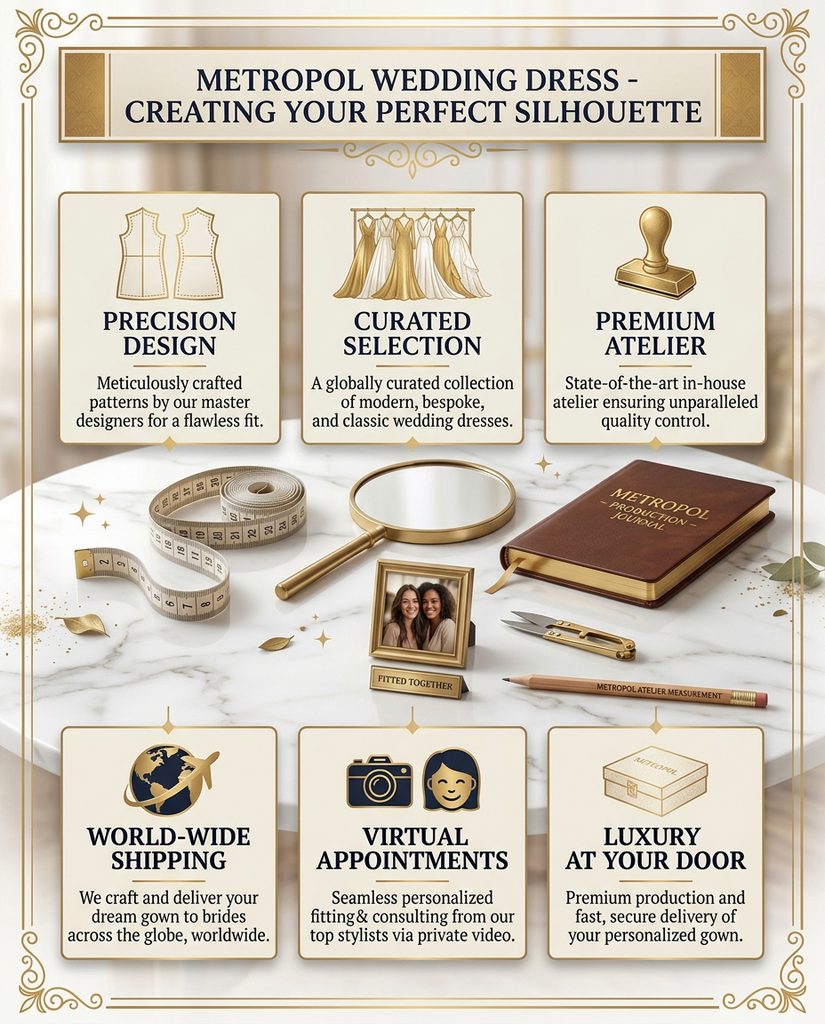
Five Distinct Calls to Action
- Direct and practical: Contact Metropol Wedding Dress today with your wedding date, measurements and inspiration images for a no-obligation design consultation and preliminary quote.
- Value-focused: Calculate your realistic budget including Australian duty and GST, then compare a factory-direct bespoke proposal against local atelier pricing — most brides discover meaningful savings without quality trade-offs.
- Process-oriented: Request the current measurement guide and fabric library overview so you can begin the technical conversation with complete information.
- Boutique / trade: If you operate an Australian bridal business, inquire about private-label and small-run capabilities to expand your exclusive offering without inventory risk.
- Timeline-driven: Share your wedding date now; the team will confirm whether your preferred complexity fits the remaining production window and recommend the optimal shipping method.
Frequently Asked Questions (Unique to Australian Brides Ordering from Turkey)
- How does the Australian climate affect fabric choice for a Turkish-made gown?
Humidity and heat favour lighter silks, chiffons and open lace; cooler regions suit mikado and denser constructions. Specify venue type early so lining and weight can be adjusted. - What is the realistic total lead time from first contact to dress in hand in Sydney or Melbourne?
Production 4–12 weeks depending on complexity + 1–2 weeks express shipping + possible customs days. Plan 4–7 months total for comfort. - Do I need a local seamstress even with made-to-measure?
Yes for final steam, any micro-adjustments after travel, and bustle creation. Most gowns arrive close to perfect but benefit from professional finishing. - How accurate are remote measurements?
Highly accurate when taken carefully with the supplied guide or by a professional. Progress photos and optional toile reduce residual risk. - Can the dress incorporate Aboriginal or culturally significant design elements?
Yes, provided clear references and respect for cultural protocols are supplied. The team works from technical sketches. - What happens if the dress arrives damaged?
Reputable manufacturers insure shipments. Photograph packaging and gown immediately upon receipt and report within the stated window. - Is GST payable and who collects it?
Yes, 10% on the dutiable value. Couriers usually collect on delivery or via online portal. - Can I order a matching bridesmaid or mother-of-the-bride piece?
Many manufacturers offer coordinated looks; discuss early for colour and fabric matching. - How does plus-size or petite fitting differ?
Patterns are drafted from actual measurements, so proportion is built in rather than graded up or down from a sample. - What documentation does Australian Border Force require?
Commercial invoice, packing list and airway bill. The supplier prepares these. - Are there restrictions on beading or crystals for air travel later?
No special restrictions beyond normal luggage rules, but heavily embellished gowns should travel in a garment bag as carry-on when possible. - Can I request a specific European lace that is currently trending in Australia?
Yes if available in the supplier’s mill relationships; alternatives of equivalent quality can be proposed. - How is colour matching handled for offline dyes or custom shades?
Swatches or digital colour references are used; physical samples can be sent for critical matches. - What is the typical deposit and payment schedule?
Usually 30–50% to begin, balance before shipping. Confirm exact terms. - Can the gown be designed as a transformer (detachable train or sleeves)?
This is a common request and straightforward for experienced ateliers. - How do I protect the dress during Australian summer storage before the wedding?
Cool, dry, dark space; professional preservation bag; avoid plastic long-term. - Is private-label production available for Australian boutiques?
Yes, Metropol operates as both individual bespoke and OEM/private-label manufacturer. - What if my measurements change slightly after ordering?
Minor adjustments can often be accommodated if notified early; significant changes may require a new pattern stage. - How detailed are the progress photographs?
Typically bodice, skirt, embellishment close-ups and full dress on a form or model at key stages. - Can I visit the atelier in person if travelling to Turkey?
Many manufacturers welcome appointments; coordinate in advance. - What is the difference between “made-to-order” and true “bespoke” in this context?
Made-to-order may start from an existing design adjusted to size; true bespoke drafts the pattern and often the design from scratch for the individual. - Are eco-friendly or lower-impact fabric options available?
Increasingly yes; ask specifically for certified or preferred materials. - How should I budget for local alterations and steaming?
AUD 150–400 covers most final work; complex bustles or major changes cost more. - Does the commercial invoice list the correct HS code for bridal gowns?
A transparent supplier provides accurate description and value; classification is ultimately determined by Australian authorities. - Can the same design be produced in different sizes for a mother-daughter or twin wedding?
Yes, each is treated as an individual made-to-measure piece. - What shipping insurance level is recommended?
Full declared value coverage is standard with reputable express carriers. - How do time-zone differences affect communication?
Most teams respond within 24 hours; video calls are scheduled at mutually workable times. - Is there a difference in quality between single custom orders and wholesale production runs?
Specialised bridal manufacturers maintain the same construction standards; volume may affect unit price but not finish. - Can I incorporate family heirloom lace or buttons?
Yes if they can be shipped safely to the atelier; discuss technical feasibility early. - What post-wedding care advice is typical for these gowns?
Professional cleaning within weeks, then proper preservation; avoid home washing of delicate lace and beading. - How transparent is the fabric origin information?
Reputable makers disclose major suppliers (French lace, Italian silk, etc.) upon request. - What happens if customs holds the package longer than expected?
Build buffer time; the supplier can usually assist with additional documentation if required.
This content is designed as a practical landing-page resource rather than a generic promotional article. It prioritises transparent numbers, process clarity and Australian-specific logistics so brides and retailers can make informed decisions. For a personalised consultation, design sketch or current capacity confirmation, reach out directly to Metropol Wedding Dress with your key details.
The previous section covered the core process, Australian import mechanics, cost realities and foundational FAQs. This continuation goes deeper into the practical decisions Australian brides actually face: silhouette engineering for local climates and body types, fabric performance under Australian conditions, ethical and quality verification methods, post-arrival workflow, long-term value of the gown, and boutique/private-label pathways. Everything remains grounded in real manufacturing and logistics constraints rather than marketing language.
Silhouette Engineering for Australian Bodies and Venues
Australian brides span a wide range of proportions and wedding environments. A Turkish made-to-measure process starts from individual measurements rather than forcing a standard size chart, which changes how silhouettes perform.
Popular silhouettes refined for Australian conditions
| Silhouette | Best Australian Venue Fit | Construction Notes from Metropol Process | Common Adjustments Requested |
|---|---|---|---|
| Soft A-line | Beach, garden, vineyard | Lightweight skirt volume, reinforced waist stay | Shortened train, detachable sleeves |
| Structured Mermaid | City, evening, formal reception | Built-in corsetry graded to actual hip-to-waist ratio | Higher back, modest neckline options |
| Ballgown (modern) | Cooler climate, indoor/outdoor hybrid | Horsehair braid and layered tulle calibrated for movement | Convertible overskirt |
| Column / Sheath | Destination, tropical, minimalist | Bias or straight grain with stretch lining options | Side slits, lighter fabrics |
| Basque / Drop-waist | Heritage or dramatic outdoor settings | Historical waist placement adapted to modern posture | Custom length for height variation |
The key technical advantage is that the pattern is drafted after measurements are locked. This eliminates the common Australian problem of “sample size 10 that needs 4 cm taken from the bust and 6 cm added to the hips.” Internal structure (boning channels, cup placement, waist stay) is positioned for the actual torso length rather than a generic block.
Fabric Performance Under Australian Conditions
Australian weddings frequently involve heat, humidity, wind, sand or sudden temperature drops between ceremony and reception. Fabric choice is therefore functional, not purely aesthetic.
Performance matrix used in Metropol consultations
- Silk mikado / heavy satin: Excellent structure and photography under soft light; can feel warm in tropical conditions. Best for cooler southern venues or air-conditioned city events.
- Soft Italian tulle + French Chantilly: Breathable and romantic; requires careful hem reinforcement for beach use so sand does not drag the lace.
- Silk crepe / georgette: High drape and comfort for all-day wear; less volume, ideal for minimalist or destination styles.
- Organza / structured overlays: Holds architectural shapes well; can be layered lightly for movement without excess weight.
- Linings: Breathable cotton-silk or technical mesh preferred over heavy polyester in humid climates. Moisture management is discussed at the design stage.
Metropol routinely sources the same European mills used by higher-priced Western brands. The difference lies in the direct factory margin rather than the fibre itself. Brides are encouraged to request close-up videos of fabric drape under natural light and, when timelines allow, physical swatches.
Quality Verification Methods for Remote Orders
Ordering from another continent requires systematic checks rather than hope.
Practical verification sequence
- Request high-resolution photos of the exact lace or embellishment lot that will be used.
- Ask for construction details: seam type (French, overlocked, hand-finished), boning material, and cup construction.
- Confirm progress photography schedule (typically after pattern approval, after bodice assembly, after embellishment, and final on form).
- For complex designs, consider the optional toile (muslin) stage — it travels relatively cheaply and allows a local fitting before the final fabric is cut.
- Upon arrival, inspect under good light for seam consistency, embellishment security, and hem evenness before any local steaming.
These steps are standard in professional export ateliers and significantly reduce the risk of unpleasant surprises.
Post-Arrival Workflow in Australia
Even a perfectly made gown benefits from local finishing.
Recommended timeline after delivery
- Day 1–2: Unpack carefully, photograph condition, hang in a clean, temperature-stable space.
- Week 1: Professional steam and inspection by a bridal seamstress experienced with delicate lace and beading.
- 2–4 weeks before wedding: Final fitting for bustle, any micro-adjustments caused by travel compression, and rehearsal of movement.
- Final days: Store in a breathable garment bag away from direct sunlight and moisture.
Budget AUD 150–400 for this stage in most capital cities. Heavily structured or multi-layered gowns may sit at the higher end.
Long-Term Value and Post-Wedding Considerations
A well-made bespoke gown retains more than sentimental value. Clean construction and quality materials make professional preservation more effective and increase the likelihood of successful resale or heirloom use.
Australian brides increasingly ask about:
- Ease of professional cleaning (avoid glued embellishments that fail under solvents).
- Structural integrity after one wear (proper internal architecture lasts).
- Storage recommendations for humid climates (climate-controlled or silica-gel assisted methods).
- Possibility of restyling elements for future formal wear (detachable components help).
Metropol’s construction approach prioritises stitched rather than heat-set or heavily glued detailing, which supports longer-term durability.
Boutique and Private-Label Pathway for Australian Retailers
Many Australian bridal boutiques now use Turkish manufacturers as an extension of their own design capacity. Metropol operates simultaneously as a one-off bespoke maker and an OEM/private-label partner.
Typical commercial arrangement:
- Small pilot runs (often as low as 3–5 pieces per style) to test market response.
- Exclusive colourways or design modifications that competitors cannot easily source.
- Transparent landed-cost modelling so the boutique can set retail margins confidently after duty, GST and freight.
- Consistent sizing and quality across re-orders.
This model allows retailers to offer true exclusivity without the capital lock-up of large inventory or the long lead times of purely local production.
Expanded Real Scenarios
Scenario 5 – Multi-cultural ceremony
A bride with Turkish-Australian heritage wants subtle Ottoman-inspired embroidery combined with a modern Australian silhouette. The design team incorporates motif placement that respects both aesthetic languages while keeping the gown contemporary and wearable in an outdoor Melbourne setting.
Scenario 6 – Last-minute venue change
Original plan was a formal city hotel; the couple switches to a coastal location three months out. The already-approved design is adapted (lighter lining, shortened train, added detachable sleeves) within the remaining production window.
Scenario 7 – Two sisters, different body types, coordinated look
Separate patterns are drafted for each sister from their own measurements. Shared lace and colour palette create visual harmony without forcing identical silhouettes.
Additional Practical Checklists
Pre-order decision checklist
- Wedding date locked and buffer calculated
- Accurate measurements obtained
- Climate and venue notes prepared
- Budget includes full landed cost + local finishing
- Communication channel and response-time expectations agreed
Upon arrival checklist
- Packaging condition documented
- Gown inspected under bright light
- Professional steam booked
- Bustle and movement tested
- Final storage arranged
Extended FAQ Cluster (Australian-Specific Continuations)
- How does wind affect train design for coastal Australian weddings?
Longer trains need strategic weighting or detachable options; open lace can catch wind more than solid fabrics. These factors are discussed at the sketch stage. - Can the gown be made machine-washable or easier to clean?
Most true couture constructions are not. Professional dry-cleaning remains the standard recommendation for longevity. - What is the typical difference in hand-embroidery density between a mid-range and high-end Metropol piece?
Hours of labour and crystal/pearl count increase significantly; the team can show side-by-side examples of density levels. - How are colour variations handled across different fabric lots?
Critical matches use physical swatches or controlled lighting references rather than screen colours alone. - Is it possible to incorporate existing family jewellery or buttons into the design?
Yes, if the items can be safely shipped to the atelier and are compatible with the construction method. - What happens if Australian GST rates or duty schedules change after ordering?
The commercial invoice reflects the value at the time of shipping; any regulatory change is handled at the border according to current rules. - Can the same design language be used for a second look or reception dress?
Coordinated but simpler second pieces are frequently produced in the same production cycle. - How detailed is the packing for international transit of heavily beaded gowns?
Multiple layers of tissue, supportive inserts, and outer rigid protection are standard to prevent crushing or shifting of embellishments.
This expanded section completes the practical toolkit for Australian brides and retailers considering a Metropol Wedding Dress. The combination of factory-direct pricing, European materials, individual pattern drafting and established export logistics creates a viable alternative to purely local high-cost ateliers or generic imported ready-to-wear.
For the next step, send your wedding date, preferred silhouette direction, approximate measurements and any climate or cultural notes. The design team will respond with a technical proposal, timeline confirmation and full landed-cost estimate tailored to your situation.
The previous section covered the core process, Australian import mechanics, cost realities and foundational FAQs. This continuation goes deeper into the practical decisions Australian brides actually face: silhouette engineering for local climates and body types, fabric performance under Australian conditions, ethical and quality verification methods, post-arrival workflow, long-term value of the gown, and boutique/private-label pathways. Everything remains grounded in real manufacturing and logistics constraints rather than marketing language.
Silhouette Engineering for Australian Bodies and Venues
Australian brides span a wide range of proportions and wedding environments. A Turkish made-to-measure process starts from individual measurements rather than forcing a standard size chart, which changes how silhouettes perform.
Popular silhouettes refined for Australian conditions
| Silhouette | Best Australian Venue Fit | Construction Notes from Metropol Process | Common Adjustments Requested |
|---|---|---|---|
| Soft A-line | Beach, garden, vineyard | Lightweight skirt volume, reinforced waist stay | Shortened train, detachable sleeves |
| Structured Mermaid | City, evening, formal reception | Built-in corsetry graded to actual hip-to-waist ratio | Higher back, modest neckline options |
| Ballgown (modern) | Cooler climate, indoor/outdoor hybrid | Horsehair braid and layered tulle calibrated for movement | Convertible overskirt |
| Column / Sheath | Destination, tropical, minimalist | Bias or straight grain with stretch lining options | Side slits, lighter fabrics |
| Basque / Drop-waist | Heritage or dramatic outdoor settings | Historical waist placement adapted to modern posture | Custom length for height variation |
The key technical advantage is that the pattern is drafted after measurements are locked. This eliminates the common Australian problem of “sample size 10 that needs 4 cm taken from the bust and 6 cm added to the hips.” Internal structure (boning channels, cup placement, waist stay) is positioned for the actual torso length rather than a generic block.
Fabric Performance Under Australian Conditions
Australian weddings frequently involve heat, humidity, wind, sand or sudden temperature drops between ceremony and reception. Fabric choice is therefore functional, not purely aesthetic.
Performance matrix used in Metropol consultations
- Silk mikado / heavy satin: Excellent structure and photography under soft light; can feel warm in tropical conditions. Best for cooler southern venues or air-conditioned city events.
- Soft Italian tulle + French Chantilly: Breathable and romantic; requires careful hem reinforcement for beach use so sand does not drag the lace.
- Silk crepe / georgette: High drape and comfort for all-day wear; less volume, ideal for minimalist or destination styles.
- Organza / structured overlays: Holds architectural shapes well; can be layered lightly for movement without excess weight.
- Linings: Breathable cotton-silk or technical mesh preferred over heavy polyester in humid climates. Moisture management is discussed at the design stage.
Metropol routinely sources the same European mills used by higher-priced Western brands. The difference lies in the direct factory margin rather than the fibre itself. Brides are encouraged to request close-up videos of fabric drape under natural light and, when timelines allow, physical swatches.
Quality Verification Methods for Remote Orders
Ordering from another continent requires systematic checks rather than hope.
Practical verification sequence
- Request high-resolution photos of the exact lace or embellishment lot that will be used.
- Ask for construction details: seam type (French, overlocked, hand-finished), boning material, and cup construction.
- Confirm progress photography schedule (typically after pattern approval, after bodice assembly, after embellishment, and final on form).
- For complex designs, consider the optional toile (muslin) stage — it travels relatively cheaply and allows a local fitting before the final fabric is cut.
- Upon arrival, inspect under good light for seam consistency, embellishment security, and hem evenness before any local steaming.
These steps are standard in professional export ateliers and significantly reduce the risk of unpleasant surprises.
Post-Arrival Workflow in Australia
Even a perfectly made gown benefits from local finishing.
Recommended timeline after delivery
- Day 1–2: Unpack carefully, photograph condition, hang in a clean, temperature-stable space.
- Week 1: Professional steam and inspection by a bridal seamstress experienced with delicate lace and beading.
- 2–4 weeks before wedding: Final fitting for bustle, any micro-adjustments caused by travel compression, and rehearsal of movement.
- Final days: Store in a breathable garment bag away from direct sunlight and moisture.
Budget AUD 150–400 for this stage in most capital cities. Heavily structured or multi-layered gowns may sit at the higher end.
Long-Term Value and Post-Wedding Considerations
A well-made bespoke gown retains more than sentimental value. Clean construction and quality materials make professional preservation more effective and increase the likelihood of successful resale or heirloom use.
Australian brides increasingly ask about:
- Ease of professional cleaning (avoid glued embellishments that fail under solvents).
- Structural integrity after one wear (proper internal architecture lasts).
- Storage recommendations for humid climates (climate-controlled or silica-gel assisted methods).
- Possibility of restyling elements for future formal wear (detachable components help).
Metropol’s construction approach prioritises stitched rather than heat-set or heavily glued detailing, which supports longer-term durability.
Click to read a similar article.
Boutique and Private-Label Pathway for Australian Retailers
Many Australian bridal boutiques now use Turkish manufacturers as an extension of their own design capacity. Metropol operates simultaneously as a one-off bespoke maker and an OEM/private-label partner.
Typical commercial arrangement:
- Small pilot runs (often as low as 3–5 pieces per style) to test market response.
- Exclusive colourways or design modifications that competitors cannot easily source.
- Transparent landed-cost modelling so the boutique can set retail margins confidently after duty, GST and freight.
- Consistent sizing and quality across re-orders.
This model allows retailers to offer true exclusivity without the capital lock-up of large inventory or the long lead times of purely local production.
Expanded Real Scenarios
Scenario 5 – Multi-cultural ceremony
A bride with Turkish-Australian heritage wants subtle Ottoman-inspired embroidery combined with a modern Australian silhouette. The design team incorporates motif placement that respects both aesthetic languages while keeping the gown contemporary and wearable in an outdoor Melbourne setting.
Scenario 6 – Last-minute venue change
Original plan was a formal city hotel; the couple switches to a coastal location three months out. The already-approved design is adapted (lighter lining, shortened train, added detachable sleeves) within the remaining production window.
Scenario 7 – Two sisters, different body types, coordinated look
Separate patterns are drafted for each sister from their own measurements. Shared lace and colour palette create visual harmony without forcing identical silhouettes.
Additional Practical Checklists
Pre-order decision checklist
- Wedding date locked and buffer calculated
- Accurate measurements obtained
- Climate and venue notes prepared
- Budget includes full landed cost + local finishing
- Communication channel and response-time expectations agreed
Upon arrival checklist
- Packaging condition documented
- Gown inspected under bright light
- Professional steam booked
- Bustle and movement tested
- Final storage arranged
Extended FAQ Cluster (Australian-Specific Continuations)
- How does wind affect train design for coastal Australian weddings?
Longer trains need strategic weighting or detachable options; open lace can catch wind more than solid fabrics. These factors are discussed at the sketch stage. - Can the gown be made machine-washable or easier to clean?
Most true couture constructions are not. Professional dry-cleaning remains the standard recommendation for longevity. - What is the typical difference in hand-embroidery density between a mid-range and high-end Metropol piece?
Hours of labour and crystal/pearl count increase significantly; the team can show side-by-side examples of density levels. - How are colour variations handled across different fabric lots?
Critical matches use physical swatches or controlled lighting references rather than screen colours alone. - Is it possible to incorporate existing family jewellery or buttons into the design?
Yes, if the items can be safely shipped to the atelier and are compatible with the construction method. - What happens if Australian GST rates or duty schedules change after ordering?
The commercial invoice reflects the value at the time of shipping; any regulatory change is handled at the border according to current rules. - Can the same design language be used for a second look or reception dress?
Coordinated but simpler second pieces are frequently produced in the same production cycle. - How detailed is the packing for international transit of heavily beaded gowns?
Multiple layers of tissue, supportive inserts, and outer rigid protection are standard to prevent crushing or shifting of embellishments.
This expanded section completes the practical toolkit for Australian brides and retailers considering a Metropol Wedding Dress. The combination of factory-direct pricing, European materials, individual pattern drafting and established export logistics creates a viable alternative to purely local high-cost ateliers or generic imported ready-to-wear.
For the next step, send your wedding date, preferred silhouette direction, approximate measurements and any climate or cultural notes. The design team will respond with a technical proposal, timeline confirmation and full landed-cost estimate tailored to your situation.
Related Topics

14.01.2024
In the realm of bridal fashion, Haute Couture wedding dresses stand as the epitome of luxury, craftsmanship, and individuality. Derived from the French term meaning “high sewing” or “high dressmaking,” Haute Couture represents the pinnacle...

01.09.2022
wholesale bridal wear manufacturers selection is the sweetest rush before the wedding. There are some points to consider when choosing your wedding dress to accompany you throughout the wedding. Bridal Wear Manufacturers Fabric selection is one...
13.08.2022
Creating an exhaustive list of the veil top 10 models by wedding dress can be challenging due to the subjective nature of fashion preferences and the vast array of veil styles available. However, I can...

16.04.2023
Pollardi Wedding Dresses is a renowned Italian bridal wear brand that has been creating exquisite wedding gowns for over 50 years. The brand is known for its timeless designs, luxurious fabrics, and impeccable craftsmanship. In...

12.07.2022
Wholesale Wedding Dress Manufacturer 1 The main decoration of a wedding is a bride. Every guest his happy smile, love remembers her full eyes and her wedding dress. Every girl on the eve of her...
07.05.2023
Wholesale bridal gowns play a pivotal role in the wedding fashion ecosystem, serving as a bridge between manufacturers and retailers. This comprehensive exploration delves into the world of wholesale bridal gowns, covering the manufacturing process,...
Comments