
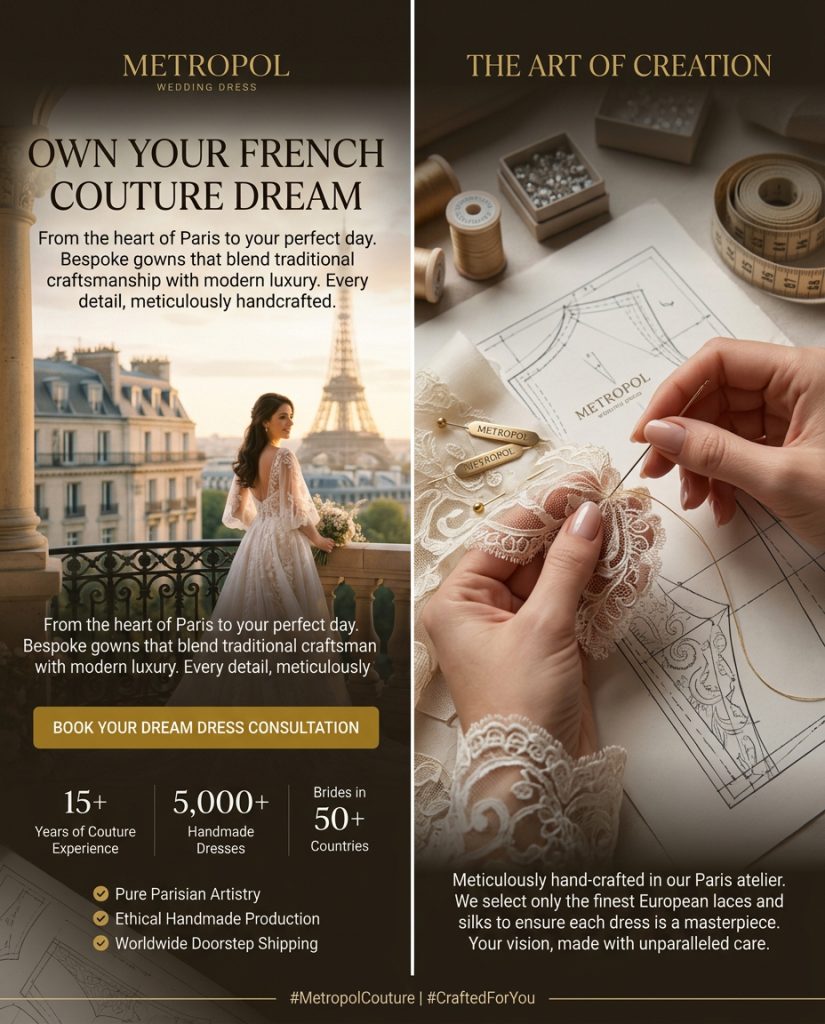
Haute couture bridal in Paris is not simply about a beautiful wedding dress. It is about the relationship between design, proportion, craftsmanship, personalization, fabric, construction and the woman who will ultimately wear the gown.
For bridal boutiques, fashion entrepreneurs, private-label brands, wedding retailers and international buyers, the Paris couture approach offers something especially valuable: a way to create wedding dresses that feel individual rather than mass-produced.
Paris has long occupied a distinctive position in the history of couture. The Fédération de la Haute Couture et de la Mode describes Haute Couture as a discipline built around craftsmanship, personalization, atelier expertise and original designs created for individual clients. The organization also notes that the designation “Haute Couture” has a legally controlled status in France.
That distinction matters for buyers.
A wedding dress can be couture-inspired, couture-level, bespoke, made to measure, handcrafted or highly customized without a company necessarily being an officially accredited Haute Couture house in Paris.
This is where a specialized manufacturer can create commercial value.
Metropol Wedding Dress works within the broader world of customized bridal manufacturing, allowing boutiques, bridal shops, designers and international buyers to develop distinctive gowns around their own market positioning, silhouettes, fabrics, embellishment preferences, measurements and collection concepts.
Whether the objective is a single signature gown, a capsule bridal collection, a private-label range or a scalable wholesale program, the strongest manufacturing relationship begins with the same question:
What should make this bridal collection impossible to confuse with another brand?
The answer is rarely just “more lace” or “more crystals.”
It may be a particular neckline architecture, a recognizable corset construction, a softer Parisian silhouette, hand-finished appliqué, architectural draping, unusual sleeve proportions, detachable elements, a controlled level of transparency or a signature balance between structure and movement.
The modern Paris bridal aesthetic is also becoming broader. Recent couture seasons have continued to demonstrate how strongly bridal influences couture collections, with runway designers presenting sculptural gowns, unconventional silhouettes, dramatic finale dresses and wedding-ready separates.
For professional buyers, the real opportunity is therefore not to copy Paris.
It is to understand why Parisian couture works and translate those principles into a commercially intelligent bridal product.
Haute Couture Bridal Paris: Where Fashion Design Becomes a Bridal Business Strategy
The phrase “haute couture bridal Paris” immediately evokes a particular visual language.
Think of a gown that appears almost weightless but contains a carefully engineered internal structure. Think of embroidery that looks spontaneous but is actually positioned according to the curve of the body. Think of lace that follows the architecture of the neckline rather than simply covering the surface. Think of a train that moves beautifully in photographs but remains manageable when the bride walks, sits and dances.
That is the difference between decoration and design.
A couture bridal gown is not valuable because it contains the largest number of components. Its value comes from the relationship between those components.
For a manufacturer, this changes the entire development process.
The question is no longer:
“Which wedding dress style should we produce?”
It becomes:
“How can the construction, materials, proportions and finishing communicate the identity of this bridal brand?”
This distinction is particularly important for European bridal boutiques and international retailers.
A boutique does not need another anonymous ball gown.
It needs a product that gives its sales team a reason to say:
“You will not find this exact dress everywhere.”
That perceived exclusivity can come from silhouette, customization, limited production, private labeling, fabric selection, handwork or a combination of several factors.
And that is precisely where a professional Custom Wedding Dress Manufacturer can become more than a production supplier.
The manufacturer becomes part of the product-development system.
Paris Couture Is a Method, Not Merely an Address
One of the most common misunderstandings in bridal fashion is assuming that “Paris couture” describes only geography.
It does not.
Paris is historically central to Haute Couture, but the underlying principles can be studied and translated into international bridal manufacturing.
The FHCM traces the origins of modern couture to Charles Frederick Worth, who established a couture house in Paris in the nineteenth century. Its description of Haute Couture emphasizes handmade work, personalization, atelier knowledge and made-to-measure construction.
That history explains why the Parisian bridal aesthetic often feels different from standardized bridal production.
The gown is considered as a complete object.
Its:
- silhouette,
- internal structure,
- textile behavior,
- embellishment,
- proportions,
- movement,
- finishing,
- fitting,
- and relationship with the wearer
are interconnected.
A professional bridal manufacturer should therefore approach a couture-inspired project as a system of decisions, not a decorative exercise.
The Couture Thinking Model
| Design Layer | Commercial Question | Manufacturing Question |
|---|---|---|
| Silhouette | What makes the gown recognizable? | Can the shape be consistently reproduced? |
| Fit | How should the gown follow the body? | What construction method provides stability? |
| Fabric | What visual and tactile message does it create? | Is the material suitable for production and finishing? |
| Embellishment | Where should the eye travel? | How will the decoration be secured? |
| Structure | How does the gown hold its shape? | What interlinings, boning or internal layers are needed? |
| Movement | How does the bride walk and dance? | Does the skirt maintain performance without excessive weight? |
| Customization | What can be personalized? | Which options can be standardized efficiently? |
| Branding | Why should a retailer sell this collection? | How can production preserve brand consistency? |
This is why an experienced Custom Bridal Gown Manufacturer should be evaluated on more than sample photography.
The real test is what happens after the first sample.
Can the design be refined?
Can measurements be translated accurately?
Can construction details be documented?
Can the same quality be maintained across multiple sizes?
Can the factory understand revisions?
Can production handle a private-label specification?
Can the manufacturer distinguish between a visual reference and an actual construction requirement?
Those questions are much more important to a purchasing manager than a beautiful Instagram image.
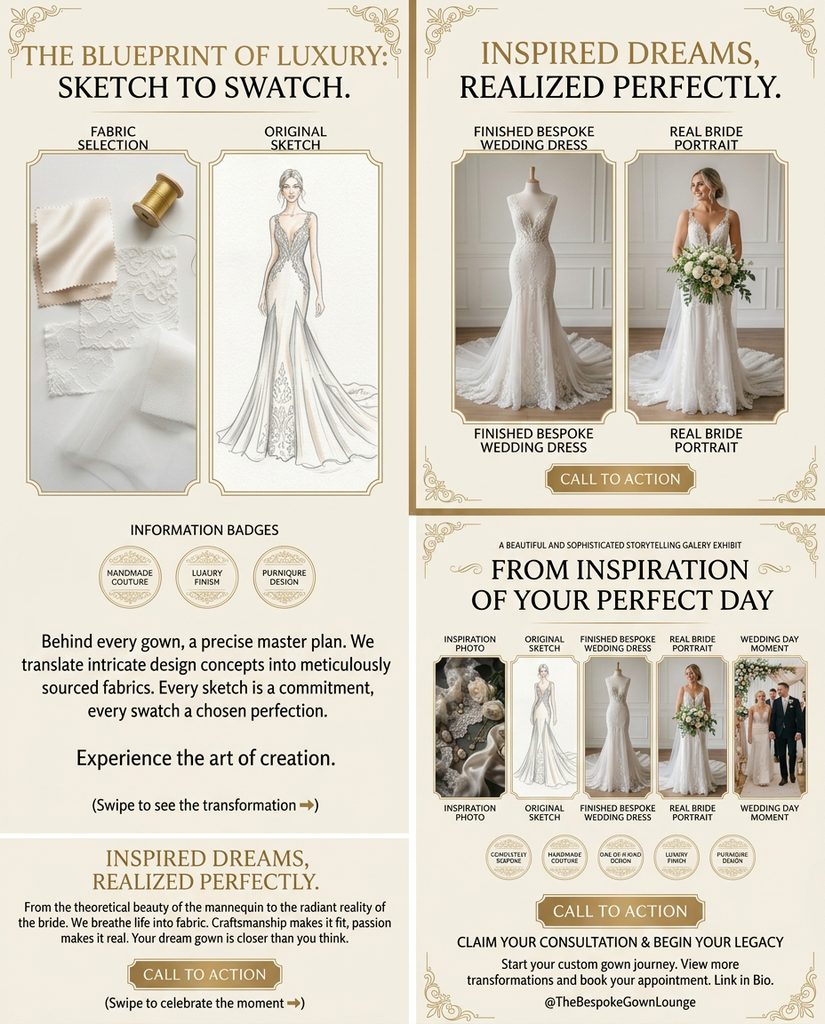
Why Parisian Bridal Design Continues to Influence Global Wedding Fashion
Paris has an unusual role in fashion because it represents both heritage and experimentation.
The official fashion ecosystem continues to position Paris as a center where traditional savoir-faire interacts with contemporary techniques.
This creates a useful design tension for bridal fashion.
A gown can look historic without looking old-fashioned.
It can use lace without becoming predictable.
It can have a corset without appearing costume-like.
It can be dramatic without becoming impractical.
It can be minimalist while still feeling luxurious.
That balance is one of the most commercially useful lessons from Paris couture.
Recent couture seasons illustrate how bridal fashion can move beyond the conventional white princess gown. Vogue’s coverage of Spring 2026 couture highlighted sculptural designs, dramatic wedding-ready pieces and the significant influence of bridal clients on couture collections.
The Fall 2026 couture season similarly demonstrated the continuing importance of bridal imagery, from traditional finale gowns to unconventional dresses, bridal separates and embellished evening looks.
For bridal retailers, this suggests an important strategy:
Do not build the entire collection around one definition of “bridal.”
Instead, build a portfolio around different bridal personalities.
Five Paris-Inspired Bridal Customer Profiles
A strong manufacturer should understand not only garments but also the customer behind the garment.
1. The Modern Parisian Minimalist
She prefers:
- clean lines,
- controlled volume,
- architectural necklines,
- refined fabrics,
- subtle embellishment,
- elegant simplicity.
Her ideal gown may look simple in a photograph but reveal sophisticated construction when viewed closely.
2. The Romantic Couture Bride
She is drawn to:
- floral appliqué,
- delicate lace,
- dimensional embroidery,
- soft tulle,
- romantic sleeves,
- flowing trains.
For this customer, tactile detail is essential.
3. The Editorial Bride
She wants a gown that photographs like fashion.
She may choose:
- exaggerated shoulders,
- sculptural draping,
- detachable overskirts,
- dramatic veils,
- unconventional proportions,
- architectural corsetry.
This category is particularly useful for boutiques seeking social-media visibility.
4. The Luxury Traditionalist
She wants:
- a classic silhouette,
- sophisticated fabric,
- impeccable fit,
- elegant embellishment,
- timeless detailing.
Her gown should not look trend-dependent.
5. The Multi-Look Bride
This customer does not want one dress to perform every role.
She may want:
- ceremony gown,
- detachable train,
- reception overskirt,
- after-party mini dress,
- removable sleeves,
- cape,
- structured jacket,
- second-look gown.
For manufacturers, this creates an opportunity to sell a bridal wardrobe system, rather than a single product.
The Anatomy of a Couture-Inspired Wedding Dress
A luxury bridal gown can be divided into several technical zones.
Understanding these zones helps buyers communicate more effectively with manufacturers.
1. The Foundation
The foundation determines much of the garment’s behavior.
It may include:
- corsetry,
- boning,
- lining,
- interfacing,
- waist stabilization,
- cups,
- internal waist tape,
- structural tulle,
- horsehair braid,
- layered support materials.
A gown can have extraordinary external decoration and still feel inexpensive if its internal architecture is weak.
Conversely, an apparently simple gown can feel luxurious because its foundation is exceptionally well engineered.
2. The Bodice
The bodice is often the visual center of a couture bridal gown.
Important considerations include:
- neckline shape,
- bust shaping,
- waist placement,
- seam direction,
- corset architecture,
- transparency,
- back construction,
- closure system,
- internal support.
A buyer should never approve a bodice solely from the front.
The side and back views matter equally.
Buyer Tip
When reviewing a sample, ask:
Does the garment look designed from the body outward, or does it look like decoration has been placed on top of a generic base?
That single question can reveal a surprising amount about manufacturing quality.
Fabric Selection: The Material Determines the Personality
The word “luxury” is frequently associated with expensive fabric names.
But professional bridal sourcing requires a more nuanced approach.
The best material is not necessarily the most expensive material.
The correct material is the one that performs the intended design function.
Satin
Satin can create:
- liquid draping,
- reflective surfaces,
- sculptural volume,
- clean silhouettes.
But its surface can reveal construction imperfections easily.
For minimalist gowns, cutting and pressing quality become especially important.
Silk
Silk can provide exceptional softness and movement, but different silk constructions behave very differently.
A buyer should consider:
- weight,
- weave,
- drape,
- opacity,
- surface,
- recovery,
- pressing behavior,
- lining requirements.
Lace
Lace is one of the most important materials in bridal fashion because it can alter the perceived identity of an entire gown.
However, lace selection should be made according to the design.
A highly structured bodice may require a lace that visually supports architectural lines.
A romantic A-line may benefit from a softer, more organic pattern.
Tulle
Tulle can create:
- transparency,
- volume,
- softness,
- veiling,
- layered depth.
The choice of tulle affects the entire silhouette.
Very soft tulle behaves differently from structured bridal tulle.
Organza
Organza is useful for:
- sculptural skirts,
- sleeves,
- bows,
- layered details,
- dimensional construction.
It can create volume without the same visual density as heavier materials.
Crepe
Crepe can be especially effective for modern, understated bridal gowns.
Its appeal lies in its ability to create a clean surface where fit becomes the main design feature.
Embellishment: When More Is Not More
Couture-inspired bridal fashion is not necessarily synonymous with heavy embellishment.
The most sophisticated decoration often has hierarchy.
Imagine a gown with:
- a concentrated motif around the neckline,
- controlled embroidery along the waist,
- subtle detailing through the bodice,
- and a quieter skirt.
The eye has somewhere to go.
Now imagine identical crystals distributed uniformly across every section.
The dress may be technically elaborate but visually less sophisticated.
The Hierarchy Principle
A professional bridal manufacturer should think about embellishment in terms of:
Focus → transition → restraint
This can create greater perceived luxury with fewer decorative elements.
Handwork can also be used strategically.
The FHCM emphasizes the role of hand craftsmanship and atelier know-how within the couture tradition.
In commercial bridal production, the lesson is not that every garment must be entirely handmade.
The lesson is that human finishing can be concentrated where it produces the greatest design impact.
What “Bespoke” Should Mean in a Professional Bridal Supply Chain
The word bespoke is widely used in fashion marketing.
But buyers should define it before signing a production agreement.
A bespoke program may mean:
- completely new design,
- adaptation of an existing design,
- made-to-measure production,
- customized measurements,
- personalized fabric,
- personalized embellishment,
- customized neckline,
- customized sleeves,
- private labeling,
- or a combination of these services.
A serious Bespoke Wedding Dress Manufacturer should therefore explain exactly what can be changed.
For example:
“Can the neckline be modified without changing the bodice block?”
“Can the train length be increased?”
“Can the sleeve be detached?”
“Can the lace motif be repositioned?”
“Can the same design be produced in different fabrics?”
“Can the gown be developed exclusively for our boutique?”
These are practical questions.
They turn vague customization into a manufacturing specification.
Made-to-Measure vs Made-to-Order vs Custom
These terms are often mixed together, but they can describe different purchasing models.
| Model | Basic Idea | Best For |
|---|---|---|
| Made-to-Measure | Garment adjusted to client measurements | Boutiques offering personalized fitting |
| Made-to-Order | Garment produced after an order is placed | Lower inventory strategies |
| Custom | Design or components adapted to specific requirements | Distinctive boutique collections |
| Bespoke | Highly individualized design and construction | Luxury clients and signature gowns |
| Private Label | Manufacturer produces under buyer’s brand | Bridal retailers and fashion businesses |
| OEM | Product developed/manufactured according to buyer specifications | Established brands and collection owners |
A Made to Measure Wedding Dress Manufacturer can therefore be valuable for boutiques that want personalization without creating a completely new pattern for every bride.
Meanwhile, a Made to Order Wedding Dress Manufacturer can help retailers reduce the need to hold every size and style in physical inventory.
The Private Label Opportunity
For many bridal businesses, the most interesting opportunity is not purchasing another manufacturer’s public collection.
It is building something that belongs to the retailer.
A Private Label Wedding Dress Manufacturer can help a bridal shop create its own identity through:
- proprietary labels,
- custom design specifications,
- collection development,
- controlled styling,
- selected fabrics,
- exclusive details,
- packaging requirements,
- size specifications,
- and branded documentation.
This is particularly important in competitive markets.
If ten stores sell the same dress, discounting becomes easier.
If one boutique owns a recognizable design language, the conversation changes from:
“Why is your dress more expensive?”
to:
“Why does this dress exist only here?”
That is a stronger retail position.
OEM Bridal Manufacturing: Turning a Concept Into a Collection
An OEM Wedding Dress Manufacturer works according to the specifications of another brand or buyer.
This model is particularly useful when the buyer has:
- a defined brand identity,
- a design team,
- technical sketches,
- sample references,
- preferred fabrics,
- target pricing,
- target markets,
- and quality standards.
An OEM project may start with something as simple as a sketch.
But the manufacturer must convert the concept into a technically executable garment.
This can involve:
Design interpretation → pattern development → material selection → sample construction → fitting → revisions → pre-production sample → production → inspection → packing
The stronger this communication chain, the lower the risk of expensive misunderstandings.
The Bridal Manufacturer as a Product Development Partner
The cheapest factory is rarely the cheapest supplier in the long term.
Why?
Because the purchasing cost of a dress is only one part of the commercial equation.
Consider the hidden costs of poor development:
- repeated samples,
- incorrect measurements,
- unsuitable fabric,
- late corrections,
- inconsistent embellishment,
- poor grading,
- defective finishing,
- delayed shipments,
- retailer complaints,
- returns,
- customer alterations,
- damaged brand reputation.
A slightly higher manufacturing price may produce a significantly lower total cost if it reduces these risks.
This is why procurement teams should evaluate total landed product value, not only factory price.
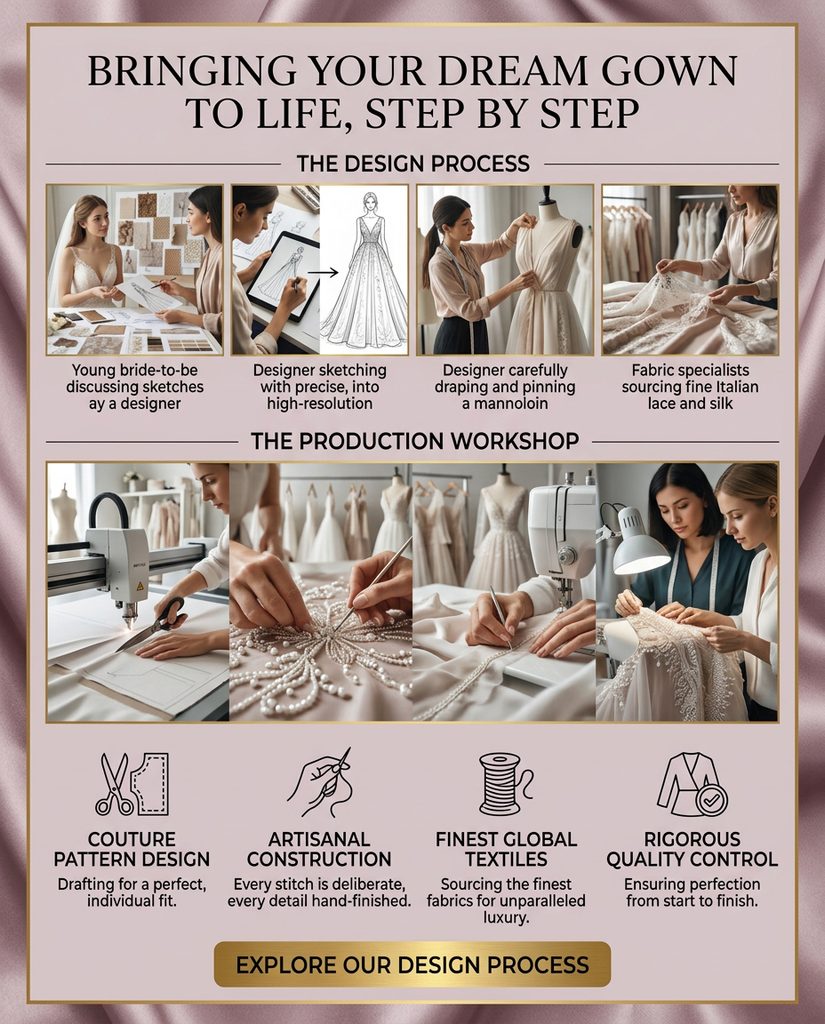
How a Couture Bridal Gown Moves From Sketch to Finished Product
Stage One: Design Brief
The project begins with a defined brief.
The brief should contain:
- target customer,
- market,
- silhouette,
- fabric direction,
- color,
- embellishment level,
- size range,
- delivery requirement,
- estimated quantity,
- target retail price,
- target manufacturing price.
A vague brief creates a vague sample.
Stage Two: Technical Interpretation
The manufacturer analyzes:
- pattern complexity,
- construction method,
- fabric requirements,
- embellishment requirements,
- internal structure,
- closures,
- finishing,
- and production feasibility.
This stage is where an experienced Couture Wedding Dress Manufacturer can provide useful technical feedback.
For example, a dramatic visual concept may require an internal structure that is not obvious from a fashion illustration.
Stage Three: First Sample
The first sample should answer several questions.
Does the silhouette work?
Does the fabric behave correctly?
Does the bodice support the body?
Is the neckline stable?
Does the train move properly?
Are the proportions correct?
Does the decoration support the design?
The first sample is not merely a sales photograph.
It is a diagnostic tool.
Stage Four: Fitting
Fitting should examine the garment in motion.
The bride or fit model should ideally:
- stand,
- walk,
- sit,
- turn,
- raise the arms,
- bend slightly,
- and move naturally.
A gown that looks perfect standing still can become uncomfortable after an hour.
That matters because wedding days are long.
Stage Five: Revision
Professional manufacturing requires feedback.
The revision process might change:
- neckline depth,
- waist position,
- cup placement,
- boning,
- skirt volume,
- train length,
- sleeve circumference,
- zipper position,
- hook-and-eye placement,
- embellishment density.
A strong manufacturer treats revision as part of development rather than as an inconvenience.
Why Construction Quality Matters More Than Decoration
Luxury is often judged visually.
But experienced buyers learn to inspect the invisible.
Look inside the garment.
Examine:
- seam finishing,
- lining,
- internal support,
- waist stabilization,
- boning placement,
- closures,
- stitching,
- hem finishing,
- attachment points,
- reinforcement around stress areas.
The inside should make sense.
It does not necessarily have to be visually decorative.
It has to be intelligently constructed.
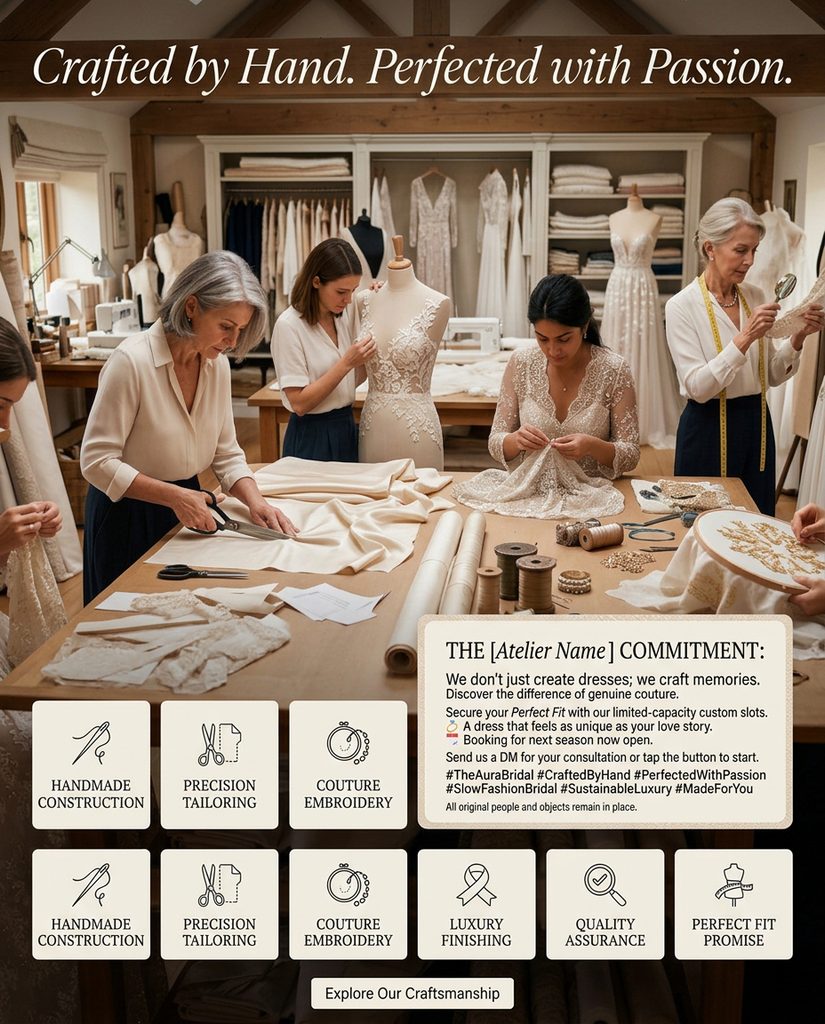
A Handmade Wedding Dress Manufacturer or Handcrafted Bridal Gown Manufacturer may use extensive manual work, but buyers should still ask what the handwork accomplishes.
Handwork should not be used merely as a marketing adjective.
It should create a tangible benefit in:
- finish,
- fit,
- placement,
- texture,
- individuality,
- or durability.
Couture-Level Craftsmanship Without Losing Commercial Control
This is one of the most important challenges for a bridal business.
A gown can be beautifully crafted and commercially impossible.
Imagine a design that requires 180 hours of hand embroidery.
It may be extraordinary.
But if the retailer’s market cannot support the resulting price, it is not a commercially viable product.
The better approach is selective complexity.
Use advanced craftsmanship where customers can perceive it.
For example:
- hand-finished neckline,
- individually positioned floral appliqué,
- special corset construction,
- custom lace placement,
- signature back detail,
- detachable couture element.
Then use controlled production methods elsewhere.
This creates a better balance between artistry and economics.
Building a Luxury Bridal Collection Instead of a Random Dress Catalog
A bridal collection should tell a coherent story.
Suppose a boutique wants a Paris-inspired collection of twelve gowns.
Instead of producing twelve unrelated styles, consider creating four design families.
Family A: Paris Minimal
- 3 gowns
- clean crepe
- architectural necklines
- minimal embellishment
Family B: Romantic Atelier
- 3 gowns
- lace
- floral appliqué
- soft tulle
Family C: Sculptural Couture
- 3 gowns
- dramatic construction
- structured fabrics
- unusual proportions
Family D: Transformable Bridal
- 3 gowns
- detachable trains
- removable sleeves
- overskirts
- second-look options
The collection now has structure.
A Custom Bridal Collection Manufacturer can develop the four families while maintaining recognizable brand DNA.
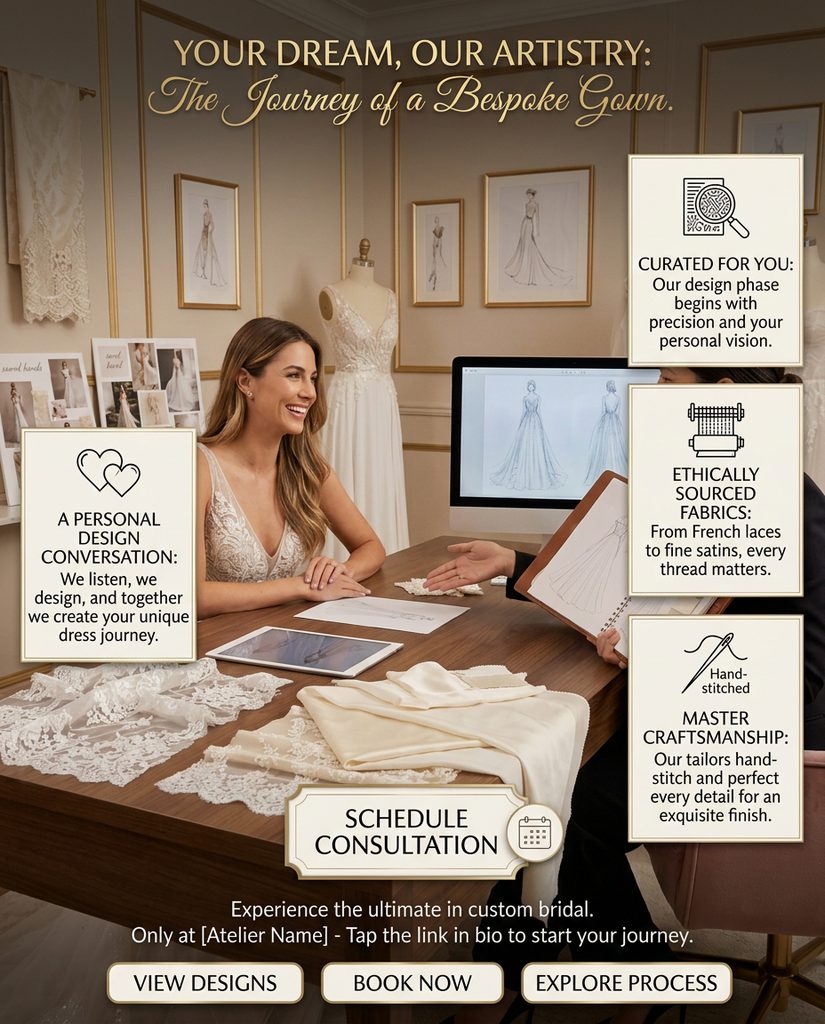
What Makes a Bridal Collection Look Expensive?
Not necessarily:
- more crystals,
- heavier lace,
- larger skirts,
- longer trains.
Instead, perceived luxury often comes from consistency.
Five Perception Signals
1. Proportion
The neckline, waist, skirt and train feel intentionally balanced.
2. Material
The fabric looks appropriate to the design.
3. Construction
The garment holds its shape correctly.
4. Restraint
Decorative elements are not fighting for attention.
5. Identity
The gown looks like it belongs to a particular brand.
That fifth point is especially important for retailers.
Buying From a Direct Manufacturer
A Direct Wedding Dress Manufacturer can provide advantages for buyers who want closer control over development and production.
Potential benefits include:
- fewer intermediaries,
- clearer technical communication,
- direct sampling discussions,
- customization,
- production planning,
- private labeling,
- collection development.
However, “direct” should not automatically be interpreted as “better.”
A purchasing manager should still evaluate:
- production capacity,
- quality control,
- sample accuracy,
- communication,
- lead times,
- export experience,
- documentation,
- packaging,
- defect policy,
- and consistency.
The correct question is not:
“Are you a factory?”
It is:
“Can you reliably manufacture the product specification we need?”
Wholesale Custom Wedding Dresses: The Commercial Model
Wholesale bridal purchasing is fundamentally different from buying a single dress for personal use.
The buyer must consider:
- margin,
- sell-through,
- size distribution,
- inventory,
- price positioning,
- sample investment,
- reorder capability,
- delivery schedule,
- exclusivity,
- and market demand.
A Custom Wedding Dress Wholesale program should therefore be evaluated as a collection strategy.
For example, a retailer might choose:
- 8 core gowns,
- 4 seasonal statement gowns,
- 2 couture hero pieces,
- 3 customizable silhouettes.
The objective is not maximum SKU count.
The objective is a balanced portfolio.
Wholesale Custom Bridal Gowns: Where Customization Creates Margin
Customization can also become a pricing tool.
A boutique might sell:
Base Gown
€X
Premium Fabric Upgrade
+€X
Custom Sleeve
+€X
Extended Train
+€X
Hand-Applied Embellishment
+€X
Detachable Overskirt
+€X
Personalized Back Detail
+€X
This creates a modular commercial structure.
The customer feels that she is designing her dress.
The retailer increases average order value.
The manufacturer gains a clear customization framework.
That is a much more scalable model than treating every bride as an entirely new production project.
How a Boutique Should Evaluate a Manufacturer
A professional sourcing process should include more than asking for a catalog.
Manufacturer Evaluation Checklist
Product
- Can the manufacturer develop original designs?
- Can they modify existing blocks?
- Can they reproduce technical specifications?
- Can they handle couture-inspired construction?
- Can they provide custom measurements?
Production
- What is the minimum order quantity?
- Can they handle small collections?
- Can they scale successful designs?
- How are production specifications documented?
- Is a pre-production sample available?
Quality
- How are measurements checked?
- How is embellishment inspected?
- How are seams checked?
- How are finished lengths verified?
- Is there a final quality-control process?
Commercial
- What are the payment terms?
- What is the sampling process?
- How are revisions handled?
- What happens with defective goods?
- How are repeat orders managed?
International
- Does the manufacturer regularly export?
- Can they prepare commercial documentation?
- Can they package gowns for international transport?
- Can they coordinate shipping requirements?
- Can they support international buyers?
This is where an experienced International Wedding Dress Manufacturer can become valuable to growing bridal businesses.
The Importance of Export Readiness
A bridal manufacturer may produce beautiful gowns but still be unsuitable for international business.
An international buyer should look for evidence of operational maturity.
A professional Wedding Dress Exporter should understand that international transactions involve more than putting dresses into boxes.
The process can involve:
- product specifications,
- commercial invoices,
- packing lists,
- shipping documentation,
- destination requirements,
- labeling,
- packaging,
- delivery coordination,
- and communication with freight partners.
The exact requirements depend on the destination market and transaction structure, so buyers should verify import and customs requirements independently for their country.
Europe, the Middle East, North America and Beyond
A successful bridal manufacturer should understand that “one wedding dress” does not necessarily mean one customer expectation.
European Markets
European bridal consumers may respond strongly to:
- minimalism,
- craftsmanship,
- sophisticated lace,
- refined silhouettes,
- sustainability narratives,
- modern couture.
Middle Eastern Luxury Markets
Some luxury bridal customers may prefer:
- dramatic trains,
- elaborate embroidery,
- high-impact silhouettes,
- intricate handwork,
- statement veils,
- luxurious layering.
North American Markets
Retail expectations can include:
- diverse silhouettes,
- customization,
- practical mobility,
- multiple looks,
- strong size availability,
- private-label collections.
These are broad commercial observations rather than fixed rules. Every market contains multiple customer segments.
The important point is that a manufacturer should be able to adapt, not simply export the same catalog everywhere.
The New Bridal Luxury: Personalization
Luxury consumers increasingly expect products to feel personal.
In bridal, personalization is especially natural because the purchase is tied to a specific person, date and story.
A bride may want:
- her initials embroidered inside the gown,
- a family lace detail,
- a redesigned neckline,
- a different sleeve,
- a removable train,
- a special lining,
- a custom bow,
- a unique veil,
- or a second look.
A Personalized Wedding Dress Manufacturer can help retailers turn these requests into a defined service rather than an improvised exception.
One-of-a-Kind Without Destroying Production Efficiency
A common misconception is that personalization requires starting from zero every time.
It does not.
A smarter system is based on controlled modularity.
For example:
Bodice A
Can accept:
- neckline 1,
- neckline 2,
- neckline 3.
Sleeve System B
Can offer:
- long sleeve,
- detachable sleeve,
- off-shoulder sleeve,
- sleeveless.
Skirt System C
Can offer:
- A-line,
- soft ball gown,
- fitted,
- overskirt.
Back System D
Can offer:
- covered back,
- illusion back,
- lace-up,
- button detail.
Now the manufacturer can create dozens of perceived variations from a controlled technical platform.
This is how a One of a Kind Wedding Dress Manufacturer can combine individuality with repeatable manufacturing logic.
Tailor-Made Bridal Fashion: The Human Side of Measurement
A Tailor Made Wedding Dress Manufacturer must understand that measurement is not simply a list of numbers.
The body has posture.
Two clients with identical bust, waist and hip measurements can have different:
- shoulder slopes,
- torso lengths,
- bust positions,
- back curvature,
- waist locations,
- posture.
Therefore, professional fitting requires interpretation.
This is particularly important for structured bridal gowns.
A corset may reveal fitting problems more clearly than a flowing dress.
The Role of Pattern Engineering
Pattern development is one of the hidden foundations of bridal quality.
A beautiful sketch cannot compensate for a poor pattern.
Pattern engineering affects:
- neckline balance,
- bust shaping,
- waist position,
- skirt fall,
- seam placement,
- train shape,
- movement,
- symmetry.
A buyer evaluating a Tailor Made Bridal Gown Manufacturer should therefore ask how patterns are developed and revised.
The objective is not simply to create a pattern.
It is to create a pattern that produces the intended three-dimensional shape.
The Economics of Couture Bridal
Luxury bridal pricing can be difficult to understand because the visible product represents many invisible activities.
The cost structure may include:
Fabric + trims + labor + pattern development + embellishment + sampling + quality control + packaging + overhead + logistics + margin
But there is another dimension:
complexity risk.
A gown with ten simple operations may be easier to control than a gown with three highly specialized operations.
Therefore, cost analysis should consider not just material consumption but also manufacturing complexity.
A Simple Buyer Cost Model
Imagine a gown with:
- premium fabric,
- moderate lace,
- structured corset,
- hand finishing,
- detachable train.
Its factory price is only one number.
A retailer should also estimate:
| Cost Element | Buyer Consideration |
|---|---|
| Product Cost | Factory quotation |
| Sampling | Development investment |
| Freight | Delivery to destination |
| Duties/Taxes | Market-specific |
| Alterations | Expected boutique labor |
| Packaging | Required presentation |
| Marketing | Photography and promotion |
| Returns/Defects | Operational risk |
| Inventory | Capital tied up |
| Lead Time | Opportunity cost |
This is why the best manufacturer is not always the supplier with the lowest unit price.
The better supplier is often the one that produces the strongest total commercial outcome.
A Procurement Manager’s View of Bridal Quality
A purchasing manager should think in three layers.
Layer 1: Visual Quality
Does it look beautiful?
Layer 2: Technical Quality
Does it fit, function and remain structurally stable?
Layer 3: Commercial Quality
Can the retailer sell it profitably and reorder it reliably?
All three are necessary.
A beautiful dress that cannot be reproduced is a product-development problem.
A technically perfect dress that nobody wants to buy is a commercial problem.
A profitable dress with weak construction is a brand problem.
The best bridal collection sits where all three overlap.
What a Premium Bridal Gown Manufacturer Should Be Able to Discuss
A Premium Bridal Gown Manufacturer should be comfortable discussing technical questions.
For example:
- Which fabric works best for this silhouette?
- Should the bodice be internally structured?
- How should the train be supported?
- Can the lace be cut without damaging the motif?
- How should the appliqué be distributed?
- Can the gown be produced in multiple lengths?
- Which details can be standardized?
- What should remain handcrafted?
- How can the design be adapted to different body types?
These conversations demonstrate manufacturing knowledge.
They are more meaningful than generic claims such as “high quality” or “luxury craftsmanship.”
Bridal Couture Manufacturing and the Future of Craft
The future of couture-inspired bridal fashion is unlikely to be purely handmade or purely automated.
It will probably combine:
- digital design,
- digital pattern development,
- precise cutting,
- traditional sewing,
- hand finishing,
- specialized embroidery,
- improved material planning,
- and better production documentation.
This is not a contradiction.
Technology can support craftsmanship.
The FHCM itself describes couture as combining historical know-how with contemporary and cutting-edge techniques.
That principle is highly relevant to modern bridal manufacturing.
Sustainability: Beyond a Marketing Word
Sustainability in bridal fashion is complicated.
A wedding dress may be worn once, but it can also become:
- an heirloom,
- a keepsake,
- a reworked garment,
- a second-generation family piece,
- a rental asset,
- or part of a resale market.
The design itself can influence longevity.
A gown with detachable elements can be worn differently.
A timeless silhouette may remain desirable longer.
High-quality construction may support preservation.
Responsible sourcing and material choices can also influence the overall impact of production.
The FHCM has also been developing environmental and circularity initiatives around fashion events, including a common framework with criteria covering areas such as mobility, waste and material reuse.
For bridal manufacturers, the broader lesson is straightforward:
Sustainability should be considered at the design and production stage, not added as a slogan after manufacturing.
The “Paris Look” Without Copying a Paris Fashion House
For retailers, inspiration and imitation should be separated.
A strong Paris-inspired bridal collection can take inspiration from:
- proportion,
- restraint,
- craftsmanship,
- architectural construction,
- romanticism,
- sophistication,
- atelier detailing.
It should not depend on copying another designer’s identifiable signature.
Instead, create a distinct vocabulary.
For example:
Modern Parisian romance with architectural corsetry and restrained botanical embroidery.
That is a brand direction.
It can guide an entire collection without reproducing another house’s work.
How Metropol Wedding Dress Can Support a Custom Bridal Business Model
For an international bridal business, Metropol Wedding Dress can be positioned around the practical intersection of:
design flexibility + manufacturing expertise + customization + wholesale capability + private label development + international supply
The opportunity is particularly relevant for:
- bridal boutiques,
- bridal shops,
- online bridal retailers,
- designers,
- wedding fashion entrepreneurs,
- private-label brands,
- fashion distributors,
- international wholesalers.
The objective is not to sell every buyer the same collection.
It is to create the manufacturing model that fits the buyer’s business.
Choosing Between Catalog Production and Custom Development
There are two broad approaches.
Option A: Select and Sell
The buyer chooses existing styles.
Advantages:
- faster launch,
- lower development effort,
- simpler ordering,
- proven designs.
Best for:
- new retailers,
- smaller boutiques,
- rapid market testing.
Option B: Develop and Own
The buyer develops custom or private-label styles.
Advantages:
- stronger differentiation,
- brand ownership,
- greater customization,
- potential exclusivity,
- stronger long-term identity.
Best for:
- established boutiques,
- bridal chains,
- designers,
- luxury retailers,
- private-label businesses.
There is also a hybrid.
A retailer may launch with existing silhouettes and gradually introduce exclusive custom styles.
This is often a practical way to reduce initial risk.
A Practical Custom Bridal Development Workflow
Step 1 — Define the Customer
Who is the bride?
Step 2 — Define the Price Position
What should the retail price communicate?
Step 3 — Define the Aesthetic
Parisian minimal? Romantic? Sculptural? Vintage-inspired? Contemporary?
Step 4 — Build a Moodboard
Collect:
- silhouettes,
- fabrics,
- neckline references,
- sleeves,
- embellishment,
- back details.
Step 5 — Create Technical Specifications
Define:
- measurements,
- materials,
- construction,
- colors,
- trims,
- closures.
Step 6 — Develop Sample
Evaluate the first physical garment.
Step 7 — Fit and Revise
Correct technical issues.
Step 8 — Approve Pre-Production Sample
Freeze the specification.
Step 9 — Produce
Manufacture according to the approved standard.
Step 10 — Inspect
Check quality before shipment.
Step 11 — Launch
Photograph and merchandise the collection.
Step 12 — Analyze Sell-Through
Identify:
- best silhouettes,
- best sizes,
- best price points,
- most requested customizations.
Then use those insights for the next collection.
The Most Common Bridal Manufacturing Mistakes
Mistake 1: Choosing a Factory From Photos Alone
Photography proves presentation.
It does not prove manufacturing consistency.
Mistake 2: Focusing Only on Price
A low quotation can become expensive if quality issues create returns or rework.
Mistake 3: No Technical Specification
“Make it like this picture” is not a complete production brief.
Mistake 4: Over-Complicating the First Collection
Too many fabrics, silhouettes and construction systems create unnecessary complexity.
Mistake 5: Ignoring the Inside of the Dress
Internal construction matters.
Mistake 6: No Pre-Production Approval
Production should not begin with unresolved specifications.
Mistake 7: Treating Every Custom Request as Unique
A modular customization system is more efficient.
Mistake 8: Ignoring Alteration Requirements
Retailers need to know how easily the gown can be adjusted locally.
Mistake 9: Designing Only for Photography
A wedding gown is worn for hours, not seconds.
Mistake 10: Confusing “Couture” With “Expensive”
Price alone does not create couture quality.
Red Flags When Evaluating a Bridal Manufacturer
Be cautious if a supplier:
- cannot explain construction,
- refuses to discuss materials,
- provides inconsistent measurements,
- avoids sampling,
- changes specifications without documentation,
- cannot explain lead times,
- offers unrealistic prices,
- cannot describe quality-control procedures,
- has no clear process for revisions,
- or promises every possible customization without explaining feasibility.
Professional manufacturing includes boundaries.
A credible supplier should be willing to say:
“Yes, we can do that.”
or
“That is possible, but it requires a different construction method.”
or even:
“We would recommend another solution because the first option may not perform well.”
That kind of honesty is valuable.
A Quality-Control Checklist for Couture-Inspired Bridal Gowns
Before approving production, inspect:
Silhouette
- Is the gown symmetrical?
- Is the waist positioned correctly?
- Does the skirt fall evenly?
- Is the train balanced?
Bodice
- Is the neckline stable?
- Is bust shaping correct?
- Is internal support sufficient?
- Are seams smooth?
Fabric
- Is the grain correct?
- Is the fabric free of visible defects?
- Does the material behave as intended?
Lace
- Are motifs aligned?
- Are joins discreet?
- Is the lace securely attached?
Embellishment
- Are stones secure?
- Is embroidery consistent?
- Are decorative areas intentionally distributed?
Closures
- Are zippers smooth?
- Are buttons secure?
- Are hooks reinforced?
Interior
- Is lining clean?
- Are seams properly finished?
- Are structural components securely attached?
Final Presentation
- Is the garment steamed?
- Is the train prepared correctly?
- Is packaging appropriate for international transport?
The Difference Between a Product Supplier and a Bridal Manufacturing Partner
A supplier delivers products.
A manufacturing partner contributes to product development.
That difference becomes important when a retailer wants to create a distinctive collection.
A partner can help answer:
- Is this design technically realistic?
- How can the sample be improved?
- Which material will create the desired drape?
- How can the garment be made lighter?
- How can the design be made easier to alter?
- Which details are worth hand finishing?
- How can production remain consistent?
This is especially valuable when the buyer’s internal team is strong in sales and branding but smaller in technical apparel development.
Five Strategic CTA Paths for Different Buyers
CTA 1 — For Bridal Boutiques
Ready to make your boutique collection feel more exclusive?
Talk to Metropol Wedding Dress about custom bridal styles, made-to-measure options and collection development designed around your boutique’s customer profile.
CTA 2 — For Private-Label Brands
Your label deserves more than a standard catalog.
Develop a private-label bridal collection with your own design direction, specifications and brand identity.
CTA 3 — For International Wholesalers
Build a bridal assortment designed for your market—not somebody else’s.
Discuss wholesale custom wedding dresses, production requirements and international supply with Metropol Wedding Dress.
CTA 4 — For Designers
Bring the sketch. Build the garment. Refine the details.
If you have a couture-inspired concept that needs professional manufacturing, start a conversation about sampling and production.
CTA 5 — For Luxury Retailers
Luxury begins where standardization ends.
Explore a more controlled approach to bespoke bridal production, from signature silhouettes to personalized finishing and exclusive collection development.
FAQ: Haute Couture Bridal Paris and Custom Wedding Dress Manufacturing
1. What does “haute couture bridal Paris” mean?
The phrase generally refers to bridal fashion influenced by the craftsmanship, personalization, sophistication and design language associated with Parisian couture. In France, “Haute Couture” has a specific regulated status, so not every custom wedding dress or bridal manufacturer should be described as an officially accredited Haute Couture house.
2. Is every couture-inspired wedding dress made in Paris?
No. A gown can be inspired by Parisian couture principles while being designed or manufactured elsewhere. Buyers should distinguish between geographical origin and design influence.
3. What makes a wedding dress look couture?
Usually a combination of proportion, construction, fabric quality, personalized fit, refined finishing and carefully controlled detailing. More decoration alone does not necessarily make a gown more couture.
4. Can Metropol Wedding Dress manufacture custom wedding dresses?
Metropol Wedding Dress can be approached for customized bridal manufacturing requirements, including custom styles and collection-development projects. Specific capabilities, minimum quantities, materials and production terms should be confirmed for each project.
5. What is a Custom Wedding Dress Manufacturer?
A Custom Wedding Dress Manufacturer produces wedding dresses according to buyer-specific requirements rather than limiting production to a fixed catalog.
6. What is the difference between custom and bespoke bridal manufacturing?
Custom usually means that selected design or construction elements can be modified. Bespoke generally implies a higher degree of individual design and fitting.
7. What is a Custom Bridal Gown Manufacturer?
It is a manufacturer capable of producing bridal gowns according to specific design, fit, fabric, embellishment or branding requirements.
8. Can a boutique create its own bridal collection?
Yes. A boutique can work with a manufacturer to develop a collection based on its customer profile, price positioning and brand identity.
9. What does a Private Label Wedding Dress Manufacturer do?
A private-label manufacturer produces garments for another company’s brand. The retailer or brand can then market the finished gowns under its own identity, subject to the agreed production and branding terms.
10. What is an OEM Wedding Dress Manufacturer?
An OEM manufacturer produces according to the specifications of another company. This can include technical drawings, samples, measurements, materials and construction requirements.
11. Is OEM the same as private label?
Not always. OEM describes a manufacturing relationship based on buyer specifications, while private label primarily describes branding and ownership of the marketed product.
12. Can a bridal gown be made to the bride’s measurements?
Yes. A Made to Measure Wedding Dress Manufacturer can produce a gown using individual measurements, although the exact measurement procedure and fitting requirements should be agreed before production.
13. What is made-to-order bridal manufacturing?
A Made to Order Wedding Dress Manufacturer produces the garment after receiving a confirmed customer order instead of manufacturing every size in advance.
14. Is made-to-order useful for bridal boutiques?
It can be. It may reduce the need to hold large inventories, although boutiques still need samples for fitting, presentation and sales.
15. Can a manufacturer produce customized bridal gowns wholesale?
Yes, depending on the supplier’s production model. Wholesale Custom Bridal Gowns can be developed around defined silhouettes, materials and customization options.
16. What is the advantage of Custom Bridal Gown Wholesale?
It allows retailers to combine wholesale purchasing with a higher degree of product differentiation.
17. Can a manufacturer create a completely new bridal design?
Some manufacturers offer original development and sampling services. The buyer should confirm whether the project requires a technical drawing, reference sample, pattern, design specification or other documentation.
18. Can lace be customized on a wedding dress?
Often, yes. Lace can potentially be repositioned, cut, layered or combined with other materials. The exact possibilities depend on the lace construction and gown design.
19. Can sleeves be customized?
Many bridal designs allow sleeve modifications. Options may include detachable sleeves, long sleeves, off-shoulder styles, cap sleeves or custom proportions.
20. Can a wedding dress have a detachable train?
Yes. Detachable trains can be designed as part of a broader bridal wardrobe strategy and can allow the bride to change the visual impact of the gown during the wedding.
21. Why are detachable bridal pieces becoming commercially interesting?
They can create multiple styling options from one core gown and may increase perceived product value without requiring a completely separate dress for every occasion.
22. What should I send a manufacturer when requesting a custom bridal gown?
Ideally provide:
- reference images,
- sketches,
- measurements,
- desired fabric,
- color,
- embellishment direction,
- neckline,
- sleeve requirements,
- train length,
- target quantity,
- delivery expectations,
- and branding requirements.
The clearer the brief, the easier it is to create an accurate sample.
23. Can a manufacturer work from a photograph?
A photograph can be useful as a visual reference, but it may not provide enough information for accurate production. Technical specifications and construction decisions may still be required.
24. How many samples should a bridal manufacturer make?
There is no universal number. A relatively simple design may need fewer revisions, while a complex couture-inspired gown may require multiple rounds of development.
25. What should I check on the first sample?
Check silhouette, fit, fabric behavior, internal structure, neckline, train, embellishment, closure system and overall proportions.
26. Why is the first sample not always the final product?
Sampling is part of product development. A first sample may reveal problems that are not visible in drawings or digital images.
27. What does a Handmade Wedding Dress Manufacturer actually mean?
It generally indicates that substantial garment work is performed manually. Buyers should ask which operations are handmade and how that craftsmanship contributes to the final product.
28. Is handcrafted always better?
Not automatically. Handcrafting can provide exceptional individuality and finishing, but the appropriate production method depends on the design, target price, quality requirement and volume.
29. What does a Luxury Bridal Gown Manufacturer need to understand?
Luxury bridal manufacturing requires an understanding of fit, materials, construction, finishing, presentation and the commercial expectations of the luxury market.
30. Can a Tailor Made Wedding Dress Manufacturer support different body shapes?
A professional made-to-measure system can adapt measurements and construction to individual clients, although the exact scope depends on the manufacturer’s pattern and fitting capabilities.
31. What is a Custom Wedding Dress Factory?
The phrase generally refers to a production facility specializing in custom or buyer-specific wedding dress manufacturing.
32. Can a manufacturer produce bridal gowns for boutiques?
Yes. A Wedding Dress Manufacturer for Boutiques can supply retailers with standard, customized, private-label or wholesale collections depending on the manufacturing model.
33. What is the difference between a bridal shop supplier and a Bridal Gown Manufacturer for Bridal Shops?
A general supplier may distribute finished products, while a manufacturer produces the garments. A bridal shop seeking exclusivity may benefit from working directly with a manufacturer capable of customization.
34. Can a Bridal Gown OEM Supplier work with an existing brand?
Yes. OEM manufacturing is specifically suited to situations where a brand has its own requirements and wants a manufacturing partner to produce them.
35. Can a manufacturer develop an exclusive bridal collection?
Potentially, depending on the agreement. Buyers should define exclusivity in writing, including territory, duration, design ownership, production restrictions and branding rights.
36. What is a Bridal Couture Manufacturer?
It is a manufacturer focused on highly refined bridal construction and couture-inspired or couture-level product development. Buyers should still verify the exact manufacturing capabilities rather than relying on terminology alone.
37. What does a Premium Wedding Dress Manufacturer offer?
A premium manufacturer should offer more than expensive materials. The value should include reliable construction, fitting, finishing, customization and production consistency.
38. Can custom bridal wear be produced for international markets?
Yes. International production is possible, but the buyer should confirm shipping, documentation, labeling, packaging and destination-market requirements before placing orders.
39. What is the role of a Wedding Dress Exporter?
A Wedding Dress Exporter supplies wedding dresses to international markets and may support the logistics and commercial documentation associated with exporting products.
40. How should a buyer choose a Direct Bridal Gown Manufacturer?
Look beyond price. Evaluate sample quality, communication, customization, production consistency, quality control, lead time, export experience and the ability to document specifications.
41. What should a buyer ask before placing a wholesale order?
Ask about:
- MOQ,
- sample approval,
- lead time,
- payment terms,
- production capacity,
- quality control,
- packaging,
- customization,
- labeling,
- shipping,
- and defect handling.
42. Can a manufacturer produce small bridal collections?
Some manufacturers support smaller development programs, while others require larger quantities. The MOQ should be confirmed before development begins.
43. Is Paris bridal fashion only about traditional princess gowns?
No. Contemporary couture increasingly demonstrates a wide range of bridal possibilities, including sculptural gowns, minimalist designs, dramatic silhouettes, separates and unconventional wedding looks.
44. Are couture wedding dresses always heavily embellished?
No. Minimalist construction can be highly sophisticated when fabric, fit, proportion and finishing are executed well.
45. Is lace essential for a Paris-inspired bridal gown?
No. Lace is one option. Crepe, satin, organza, silk, tulle and other textiles can all create sophisticated bridal aesthetics.
46. How can a boutique make its bridal collection more exclusive?
It can use private labeling, exclusive designs, controlled customization, limited production, signature details and a clearly defined aesthetic identity.
47. Should a bridal retailer buy many different styles?
Not necessarily. A smaller collection with strong design identity can sometimes be easier to merchandise and understand than a large catalog of unrelated products.
48. What is the biggest mistake when sourcing couture-inspired wedding dresses?
Treating the purchase as a simple product transaction instead of evaluating design, construction, customization, quality, margin and long-term supply reliability together.
Final Perspective: The Future of Haute Couture Bridal Is Personal
The most important lesson from Paris couture is not that every wedding dress should look extravagant.
It is almost the opposite.
The most compelling gowns often know exactly what they are trying to say.
A minimalist gown says something through proportion.
A romantic gown speaks through texture.
A sculptural gown speaks through architecture.
A handcrafted gown communicates through touch.
A personalized gown tells the story of its wearer.
And a successful bridal collection combines these ideas into a recognizable identity.
For professional buyers, this creates a significant opportunity.
The bridal market does not need another collection that simply follows whatever silhouette is currently popular.
It needs collections with a point of view.
That point of view can be inspired by the sophistication of Paris, the discipline of couture ateliers, the individuality of bespoke tailoring and the commercial intelligence of modern manufacturing.
This is where the role of a manufacturer becomes more strategic.
A Custom Wedding Dress Manufacturer should help translate an idea into a physical product.
A Bespoke Wedding Dress Manufacturer should help transform an individual concept into a garment with personality.
A Private Label Wedding Dress Manufacturer should help a retailer turn product into brand equity.
An OEM Supplier should help convert technical specifications into repeatable production.
A Bridal Couture Manufacturer should understand the relationship between structure, craftsmanship and visual impact.
A Direct Bridal Gown Manufacturer should provide a clearer path between the buyer’s requirements and the production floor.
And an experienced International Wedding Dress Manufacturer should understand that international bridal business requires reliability as well as beautiful design.
For boutiques, the opportunity is even more compelling.
Instead of asking:
“Which wedding dresses should we buy?”
ask:
“What should our brides recognize as uniquely ours?”
That question changes the entire sourcing strategy.
It leads to stronger collections, clearer brand positioning, better merchandising and potentially higher perceived value.
Paris can provide the inspiration.
Couture can provide the philosophy.
Craftsmanship can provide the quality.
Customization can provide the individuality.
Manufacturing discipline can provide scalability.
And your brand can bring them together.
Build the Dress. Build the Identity.
Whether the objective is a small capsule collection, a private-label bridal line, wholesale custom gowns, made-to-measure production or a long-term international sourcing relationship, the starting point is a clear product vision.
Metropol Wedding Dress is positioned to support buyers who want to move beyond generic bridal sourcing and develop wedding dresses with a stronger sense of identity, customization and craftsmanship.
For the right project, the question is not simply how many gowns can be produced.
The better question is:
How memorable can the collection become?
That is the real opportunity behind the modern Paris-inspired bridal approach.
Related Topics
09.01.2026
Luxus Brautkleider nach Mass für den Deutschen Markt stehen für höchste Schneiderkunst, exklusive Materialien und individuelle Gestaltung auf internationalem Niveau. In Deutschland wächst die Nachfrage nach maßgeschneiderten Brautkleidern stetig, da moderne Bräute nicht nur ein...
19.06.2024
İnci Wedding Dress Semra Karaca Best 1 Bridal styling refers to the process of selecting and coordinating the attire, accessories, hair, and makeup for a bride on her wedding day. It involves creating a cohesive...
05.05.2026
So wird aus einem Foto ein echtes Brautkleid Hey, du da mit dem Foto in der Hand und dem Herz voller Vorfreude. Stell dir vor, du scrollst durch Instagram oder Pinterest, siehst plötzlich dieses eine...

16.04.2025
Wedding Dress Wholesale Premium Styles for Retailers The bridal industry is a vibrant and ever-evolving market, with wedding dresses serving as the cornerstone of any bridal boutique’s offerings. For retailers, sourcing wedding dresses through wholesale...
18.04.2025
Luxury Wedding Dresses İstanbul …Istanbul, a city where East meets West, is not only a cultural and historical hub but also a rising star in the world of luxury fashion, particularly for wedding dresses. With...

26.08.2025
Autumn Bridal Gown with Sleeves is a magical season for weddings, with its crisp air, vibrant foliage, and cozy ambiance. For brides planning an autumn wedding, selecting the perfect dress is a crucial step in...
Comments