
Custom Wedding Dresses Switzerland
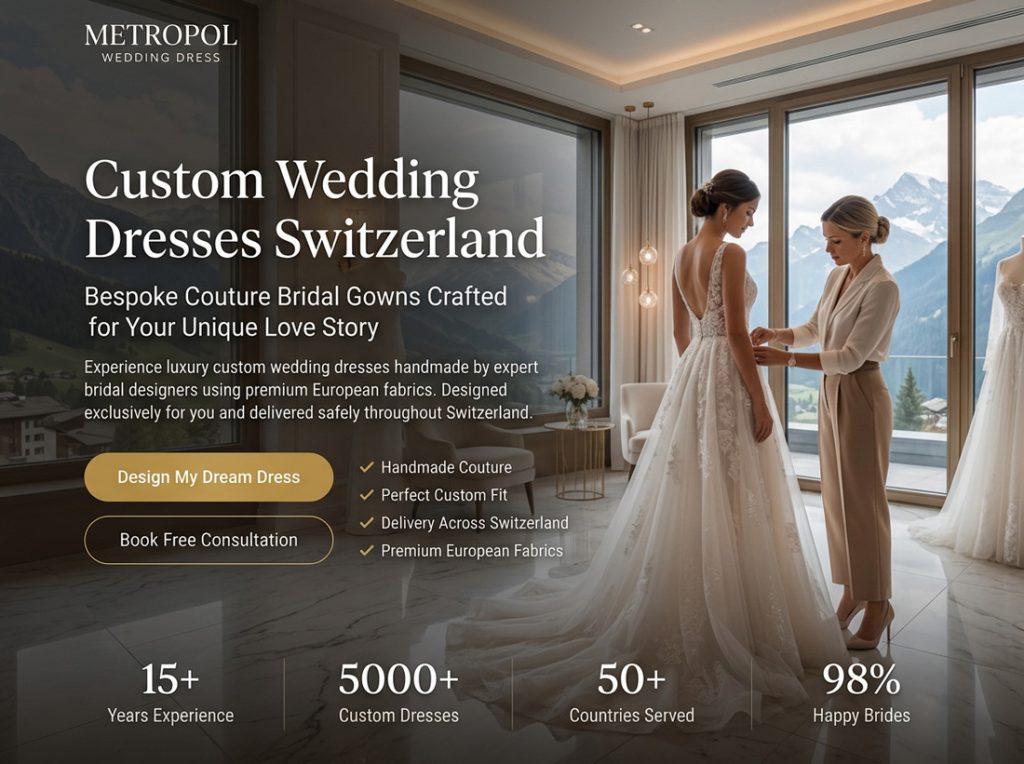
Custom Wedding Dresses Switzerland deliver precision fit, exclusive design, and accessible luxury that local boutiques often cannot match at the same price. Metropol Wedding Dress, a Turkish atelier with over 20 years of experience and an 800 m² workshop, specializes in fully bespoke gowns crafted from premium fabrics, shipped worldwide, and tailored to Swiss brides’ preference for refined silhouettes, alpine practicality, and cultural nuance.
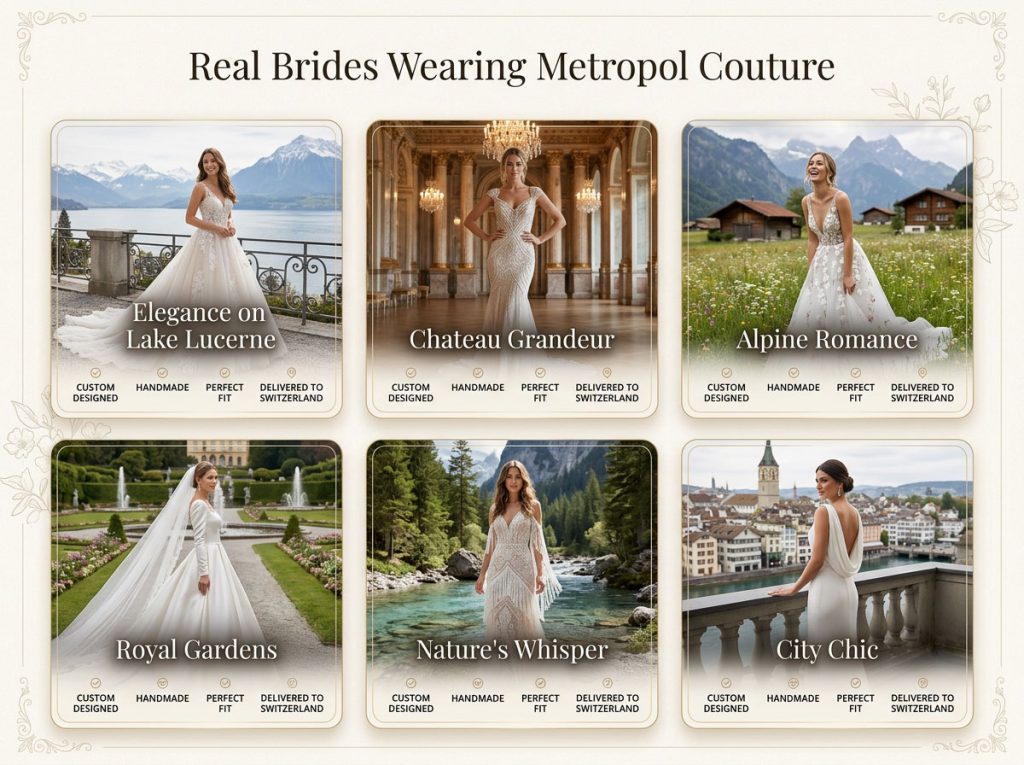
Typical price range €300–€2,000 positions the brand as affordable luxury compared with Swiss made-to-measure averages of CHF 2,500–15,000+. Virtual consultations, detailed measurement protocols, multiple design iterations, and reliable international delivery make the process seamless for brides in Zurich, Geneva, Bern, or remote cantons. Import involves standard Swiss VAT (8.1 %) and weight-based duties that remain modest for lightweight bridal garments. The result is a one-of-a-kind gown that reflects the bride’s body, venue (lake, mountain, city hall), and personal story without the constraints of ready-to-wear sizing or boutique mark-ups.
Detailed Guide: Ordering a Custom Wedding Dress Online for Switzerland – The Strategic Buyer’s Perspective
Swiss brides operate in a market defined by high standards of craftsmanship, limited local atelier capacity, and a cultural preference for understated elegance over theatrical excess. When the search query shifts to “wedding dresses online Switzerland,” the decision is no longer purely aesthetic; it becomes a procurement exercise involving fit engineering, supply-chain reliability, customs predictability, total landed cost, and long-term emotional return on investment.
Metropol Wedding Dress sits at the intersection of these requirements. Operating from Izmir with two decades of production experience, the company combines traditional hand-finishing with modern pattern engineering and serves both individual brides and international boutiques. Its custom service is structured for remote clients: design collaboration via digital channels, precise measurement capture, iterative approvals, and door-to-door shipping.
Why Online Custom Beats Local Ready-to-Wear for Many Swiss Brides
Local Swiss boutiques excel at personal fittings and immediate try-on experiences. Their limitations appear in three areas:
- Inventory is finite; popular styles sell out.
- True bespoke work starts at CHF 3,000–6,000 and can exceed CHF 12,000 for haute couture.
- Design freedom is constrained by the designer’s existing collection or seasonal fabric allocations.
An online custom route with a specialist manufacturer removes these constraints. The bride supplies inspiration images, body measurements, venue details, and budget. The atelier drafts an original pattern, selects or sources the exact lace, silk, or mikado requested, and builds the gown from scratch. Multiple digital checkpoints replace physical fittings until the final garment arrives for local alteration if needed.
Expert commentary from a production engineer’s viewpoint Pattern drafting from individual measurements eliminates the cumulative error of “standard size + alterations.” In Swiss conditions—where a bride may move between civil ceremony in a historic hall, outdoor alpine photos, and evening reception—the gown must accommodate temperature changes, walking on uneven ground, and extended wear. A properly engineered custom dress distributes weight correctly, incorporates strategic support, and uses fabrics chosen for both drape and durability.
The Production Process – Transparency for the Informed Buyer
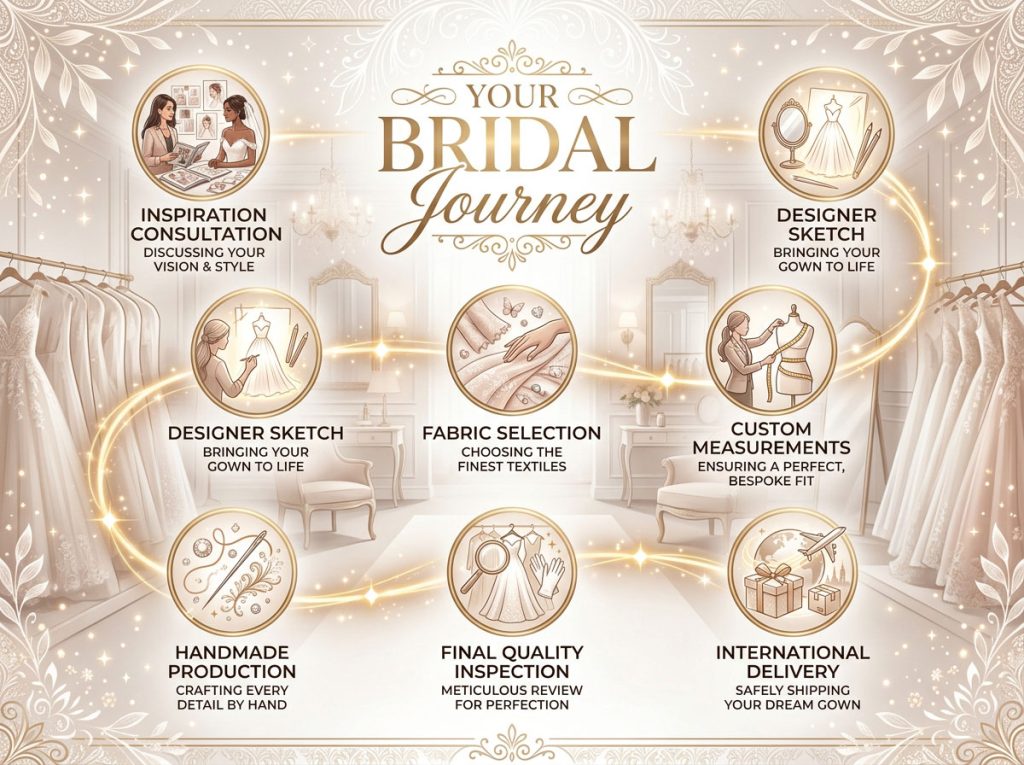
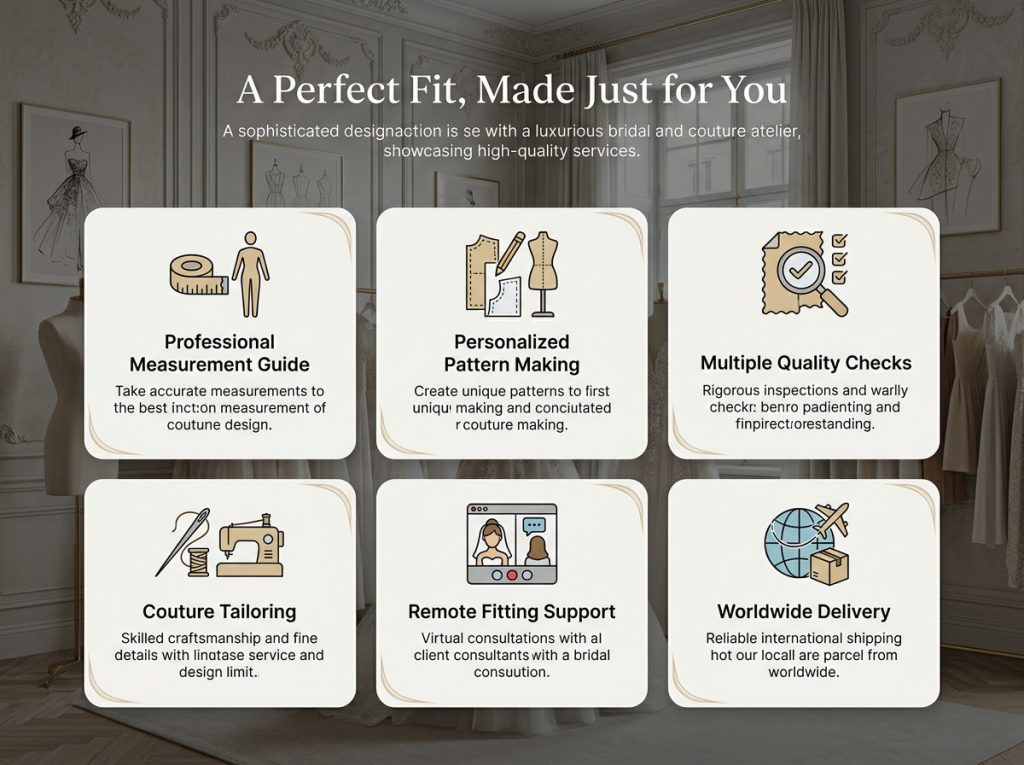
- Vision Capture Bride submits photos, sketches, fabric preferences, silhouette ideas, and wedding logistics (season, location, ceremony type). Metropol’s design team responds with concept sketches and fabric recommendations.
- Measurement Protocol Detailed self-measurement guide or video call with a specialist. Critical points include bust, waist, hips, hollow-to-hem, shoulder slope, and posture notes. Optional: professional local tailor verification.
- Pattern & Prototype Stage Unique paper or digital pattern is cut. A toile (muslin mock-up) may be produced for complex designs; photos are shared for approval.
- Fabric & Embellishment Confirmation Swatches or high-resolution images of lace (Chantilly, Alençon), silk satin, organza, tulle, or mikado are provided. Placement of beading, embroidery, or 3-D florals is mapped.
- Construction Hand and machine work in the Izmir atelier. Typical construction time 8–16 weeks depending on complexity. Progress photos available on request.
- Quality Control & Shipping Final inspection, professional packing, tracking. Delivery to any Swiss address.
- Local Finishing Most gowns arrive ready to wear; minor hem or bust adjustments can be performed by any competent Swiss seamstress (budget CHF 80–300).
Checklist – Documents & Information to Prepare Before First Contact
- Full set of body measurements (use the official guide).
- Wedding date and preferred delivery window.
- 5–10 inspiration images.
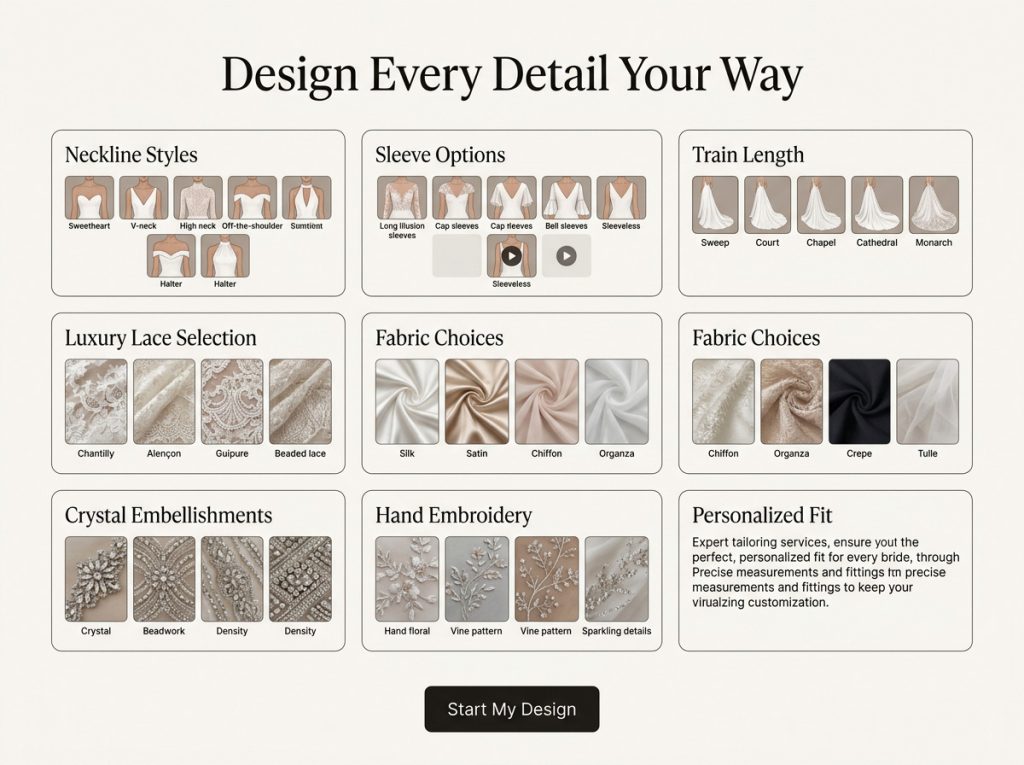
- Preferred neckline, sleeve length, train length, and back design.
- Budget ceiling in CHF or EUR.
- Any cultural or modest-dress requirements.
- Shipping address and preferred courier notes.
Material Analysis – What Travels Well and Photographs Beautifully in Swiss Light
Swiss venues demand fabrics that behave under variable conditions:
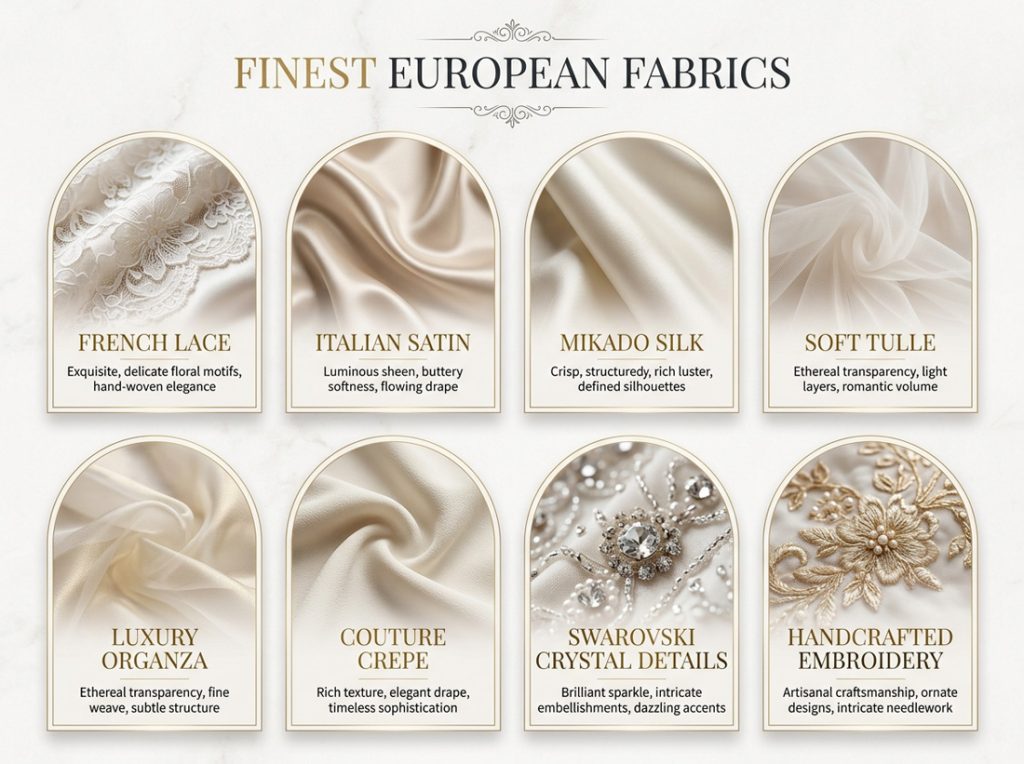
| Fabric | Strengths for Switzerland | Typical Use | Care Notes |
|---|---|---|---|
| Italian silk satin | High sheen, excellent drape, temperature regulating | Bodices, clean modern silhouettes | Dry clean only |
| French Chantilly / Alençon lace | Romantic detail without bulk | Overlays, sleeves, trains | Hand wash or specialist clean |
| Swiss or Italian tulle | Lightweight volume, wind resistance | Skirts, overlays | Steam carefully |
| Silk organza | Structured yet airy | Architectural elements | Professional press |
| Mikado | Crisp architectural lines, holds shape | Minimalist or structured gowns | Resistant to creasing |
| Crepe | Matte modern finish, comfort | Sheath or column dresses | Travels well |
Metropol sources these materials for both aesthetic and technical performance. Lightweight constructions reduce shipping weight (and therefore Swiss weight-based duties) while still delivering the visual impact required for high-resolution photography against lakes or snow-capped peaks.
Cost Structure – Landed Cost Reality Check
Metropol price band (custom): approximately €300–€2,000 depending on silhouette complexity, fabric, and handwork.
Comparative Swiss market
- Ready-to-wear boutique: CHF 750–2,800
- Made-to-measure local: CHF 3,000–6,000
- Full bespoke Swiss atelier: CHF 6,000–15,000+
Additional Swiss import costs
- Import VAT: 8.1 % on CIF value (goods + shipping + insurance).
- Customs duty: calculated by gross weight (usually modest for a bridal gown packed in a garment bag).
- Postal or courier handling fees if applicable.
A gown invoiced at €1,200 with €80 shipping typically incurs less than CHF 150–200 in total import charges—still substantially below local custom pricing.
Tip box – Budget control levers
- Choose simpler construction and invest savings in premium lace placement.
- Opt for detachable train or sleeves to create two looks from one investment.
- Confirm exact fabric quantities early to avoid late surcharges.
- Schedule delivery 4–6 weeks before the wedding to allow local alterations and a calm final try-on.
Use-Case Scenarios Tailored to Swiss Geography and Culture
Scenario 1 – Zurich civil ceremony + evening reception Minimalist column or A-line in mikado or heavy crepe. Clean neckline, optional detachable cape or overskirt. Practical for walking between locations and dancing.
Scenario 2 – Lake Geneva or Lucerne lakeside wedding Soft A-line or soft mermaid with floating tulle or organza layers. Light movement in breeze, photogenic against water.
Scenario 3 – Alpine chalet or mountain outdoor ceremony Long sleeves or removable sleeves, warmer lining options, slightly higher neckline for cooler temperatures. Structured yet flexible bodice for walking on uneven terrain.
Scenario 4 – Multicultural or modest requirements Full coverage options, custom embroidery motifs reflecting heritage, convertible designs that transition from ceremony to reception.
Scenario 5 – Destination wedding with Swiss guests but ceremony abroad Gown designed for travel: lighter fabric weight, compact packing, wrinkle-resistant construction.
Common Procurement Errors and How to Avoid Them
- Starting too late – Ideal window 8–12 months; minimum realistic 5–6 months for complex custom work.
- Inaccurate measurements – Always double-check with a second person or local professional.
- Ignoring import timeline – Factor 1–2 weeks for customs clearance.
- Over-specifying without priority ranking – Rank “must-have” vs “nice-to-have” features.
- Skipping fabric confirmation – Request physical swatches when possible for critical lace or silk.
- Assuming zero local work – Budget for final hem or bust adjustment.
- Choosing pure trend over longevity – Swiss brides often value heirloom potential; balance current aesthetics with classic construction.
Control checklist before placing deposit
- Written design summary and fabric list received.
- Measurement form completed and acknowledged.
- Production timeline and shipping method confirmed in writing.
- Payment schedule and cancellation terms clear.
- Contact person and response-time expectations agreed.
Styling Integration and Accessories
A custom gown gains further value when accessories are planned concurrently:
- Veil length and edge finish coordinated with lace motifs.
- Headpiece or floral placement that complements neckline.
- Shoes chosen for both height and walking surface (cobblestones, grass, snow).
- Jewelry scale matched to embellishment density.
Metropol can advise on proportion and visual balance during the design phase.
Sustainability and Ethical Considerations
Custom production inherently reduces overstock waste. The bride receives exactly the fabric volume required. Artisan construction supports skilled employment rather than fast-fashion volume. Many Swiss clients additionally request natural-fiber emphasis or low-impact dyeing where available.
Long-Term Value Perspective
A well-made custom dress can be preserved, altered for future formal wear, or passed to a family member. The emotional ownership—knowing every seam was drawn for one specific body and story—often outweighs the pure financial difference versus a high-end ready-to-wear purchase.
Five Distinct Calls to Action
- Direct and practical Ready to start your measurements? Download the Metropol measurement guide and book a free design consultation today.
- Consultative Unsure which silhouette will flatter your frame and venue? Share three inspiration images and receive a personalized style recommendation within 48 hours.
- Urgency with transparency Peak wedding seasons fill production slots quickly. Secure your timeline now and lock current fabric pricing.
- Value-focused Compare the landed cost of a fully custom Metropol gown against a Swiss boutique made-to-measure quote. Most brides discover substantial savings without sacrificing quality.
- Emotional and collaborative Your wedding dress should tell your story. Begin the conversation with Metropol’s design team and watch the first sketches appear.
FAQ – Custom Wedding Dresses Online for Switzerland
- How long does a fully custom dress from Metropol typically take? Standard production runs 8–16 weeks after final design approval and measurement confirmation. Rush options exist for simpler designs.
- Can I order if I live in a remote Swiss canton? Yes. Delivery is nationwide via standard international couriers.
- What is the realistic total cost including Swiss VAT and duties? Add approximately 8.1 % VAT on the invoice value plus shipping, plus modest weight-based duty. For a €1,000 gown the additional charges are usually under CHF 150–200.
- Do I need to visit Turkey? No. The entire process is designed for remote clients with digital approvals.
- How accurate are self-measurements? Very accurate when the official guide is followed carefully. A second person or local tailor verification is recommended.
- Can the dress be altered in Switzerland after arrival? Yes. Most local bridal or general seamstresses handle final hem, bust, or minor adjustments.
- What if the dress does not fit perfectly on arrival? Minor discrepancies are normal and resolved locally. Major issues are addressed under Metropol’s quality policy with photographic documentation.
- Are modest or hijab-compatible designs available? Yes. Full coverage, custom embroidery, and cultural motifs are routinely produced.
- Which fabrics photograph best in alpine or lakeside light? Silk satin, organza, and fine lace perform particularly well under natural Swiss light.
- Can I request a detachable train or sleeves? Absolutely. Convertible elements are popular for multi-location Swiss weddings.
- Is there a minimum order value or deposit? Deposits secure production slots; exact terms are confirmed at consultation.
- How do I track the production and shipping status? Progress photos and courier tracking numbers are provided.
- What happens if my wedding date changes? Early communication allows schedule adjustments within capacity limits.
- Can the gown be made in a non-white or ivory shade? Yes. Soft blush, champagne, and other tones are available.
- Are plus-size or petite custom options standard? Every dress is drafted to the individual’s measurements; size is irrelevant.
- How is the dress packed for international shipping? Professional garment packaging designed to minimize creasing.
- Do I pay Swiss import charges on delivery? Yes, collected by the courier or Swiss Post according to standard procedures.
- Can I combine elements from several inspiration images? That is the core advantage of custom work.
- Is lace placement customizable? Yes. Motifs can be positioned for symmetry or intentional asymmetry.
- What support exists after the dress arrives? Guidance on steaming, storage, and local alteration recommendations.
- Are there restrictions on embellishments for outdoor mountain venues? Heavy beading can be balanced with lighter skirt construction for practicality.
- Can the same atelier produce matching bridesmaid or mother-of-the-bride pieces? Coordination is possible on request.
- How does Metropol handle fabric shortages? Alternative premium substitutes of equal quality are proposed for approval.
- Is the process suitable for a second marriage or civil-only ceremony? Completely. Design can be formal or deliberately understated.
- What is the typical response time to initial inquiries? Design team replies within one to two business days.
- Can I request a video call with the designer? Video consultations are available for detailed discussions.
- Are eco-conscious material options offered? Natural fibers and lower-impact processes are prioritized when specified.
- How do I store the gown between arrival and the wedding? Cool, dry, dark environment; professional bridal storage recommended for longer periods.
- What if I need the dress sooner than the standard timeline? Rush production can be discussed for simpler designs subject to capacity.
- Does Metropol provide care instructions specific to Swiss dry-cleaning standards? Yes. Standard international bridal care guidelines plus fabric-specific notes are included.
This content is structured for a high-conversion landing page: it educates, builds trust through process transparency, addresses cost and logistics concerns head-on, and repeatedly invites the reader into a collaborative design conversation with Metropol Wedding Dress.
Custom Wedding Dresses Switzerland
Geneva brides navigate a uniquely cosmopolitan bridal landscape: international influences, lakeside and urban venues, high local atelier pricing, and a preference for refined yet personal design. Custom wedding dresses ordered online through Metropol Wedding Dress provide a strategic alternative—fully bespoke construction from an experienced Turkish atelier (20+ years, large production workshop), priced typically €300–€2,000, with worldwide shipping that reaches Geneva addresses reliably. Virtual design collaboration, precise measurement protocols, premium fabrics (Italian silks, French laces, organza, mikado), and conversion-friendly elements (detachable trains or sleeves) suit Geneva’s multi-location celebrations and multicultural clientele. Landed costs after Swiss VAT (8.1 %) and modest weight-based duties remain significantly lower than local made-to-measure averages of CHF 3,000–15,000+. The process delivers exclusivity, perfect individual fit, and practical logistics without requiring repeated boutique visits in a high-cost city.
Detailed Intelligence Brief: Custom Wedding Dresses for Geneva Brides – A Procurement and Design Strategy
Geneva functions as both a diplomatic capital and a lifestyle hub on Lake Geneva. Brides here frequently come from diverse cultural backgrounds, work in international organizations or private banking, and plan ceremonies that move between civil registries, historic buildings, lakeside terraces, and evening receptions. The local bridal market reflects this: curated designer showrooms (AYO Mariage carrying Laure de Sagazan, Marie Laporte and others), Swiss couture ateliers offering made-to-measure, and specialist alteration houses. Pricing for true custom work starts high and rises quickly.
An online custom route with Metropol Wedding Dress changes the equation. The brand operates as a full-service manufacturer specializing in individual commissions for international clients. Design begins with digital consultation, proceeds through original pattern drafting and fabric selection, and ends with door-to-door delivery. For a Geneva-based bride the advantages are concrete: broader creative freedom, controlled total cost, and a gown engineered for her exact measurements and venue sequence rather than adapted from a stock size.
Geneva-Specific Design Constraints and Opportunities
Venue realities
- Civil or religious ceremony in the city centre often requires elegance that photographs well against stone architecture and soft daylight.
- Lakeside or garden portions demand lighter movement and wind resistance.
- Evening events may call for a second silhouette or dramatic back detail.
Climate and practicality Lake Geneva weather shifts; a gown benefits from convertible elements (removable sleeves, detachable overskirt or train) so the same investment works across temperature and formality changes.
Cultural range Geneva’s international population means requests for modest coverage, specific embroidery motifs, non-white tones, or hybrid traditional-modern constructions are common. A pure custom process accommodates these without the limitations of a ready-to-wear collection.
Expert note from a fit-engineering perspective Standard boutique sizes assume average proportions. Geneva brides with athletic builds, petite frames, or postpartum bodies frequently require extensive alterations that still leave residual fit issues. Drafting a unique pattern from precise measurements eliminates most of that friction and produces better long-wear comfort for a full wedding day.
“You may also want to take a look at this article.” Bespoke Wedding Dresses
Production Sequence Optimized for Remote Geneva Clients
- Brief submission Bride sends inspiration images, venue photos, preferred silhouette, fabric ideas, and any cultural or practical constraints. Metropol design team replies with concept sketches and material suggestions.
- Measurement capture Detailed self-measurement protocol (or video-assisted session) covers circumference, length, slope, and posture notes. Optional verification by a local Geneva seamstress is recommended for critical points.
- Design lock and fabric confirmation Final sketch approved. Swatch images or physical samples of lace, silk, mikado or organza confirmed. Embellishment placement mapped.
- Construction Original pattern cut, toile if needed for complex structures, then final fabrics assembled with hand-finishing in the atelier. Typical window 8–16 weeks after approval.
- Quality control and dispatch Inspection, professional packing, tracking provided. European delivery commonly 7–10 business days.
- Geneva finishing Arrival allows time for professional steaming and any micro-adjustments (hem, bust ease) by a local specialist—budget CHF 80–300.
Preparation checklist before first contact
- Accurate current measurements
- Wedding date and preferred delivery buffer
- 5–8 clear inspiration references
- Ranked priorities (must-have vs optional)
- Budget ceiling in EUR or CHF
- Shipping address and any courier preferences
- Notes on modest requirements or cultural details
Material Performance for Geneva Conditions
| Fabric | Advantage in Geneva context | Best silhouette pairings | Handling notes |
|---|---|---|---|
| Italian silk satin | Luminous under lake light, temperature regulating | Column, soft A-line, structured bodice | Dry clean, professional press |
| French Chantilly / Alençon lace | Refined detail without bulk | Overlays, sleeves, illusion backs | Delicate; specialist care |
| Organza | Airy volume, wind movement | Skirts, architectural overlays | Steam carefully |
| Mikado | Holds clean architectural lines | Minimalist modern, structured gowns | Travels with low creasing |
| Crepe | Matte modern finish, comfort for long wear | Sheath, soft mermaid | Excellent for multi-location days |
| Lightweight tulle | Soft volume for outdoor segments | Overlays, soft skirts | Packs compactly |
Metropol selects these materials for both visual impact and technical behaviour. Lightweight constructions also keep shipping weight low, reducing Swiss weight-based duty exposure.
Cost Architecture – Geneva Landed Comparison
Metropol custom range Approximately €300–€2,000 according to complexity, fabric, and handwork volume.
Local Geneva reference points
- Designer boutique made-to-order: frequently CHF 2,500–6,000+
- Full Swiss atelier bespoke: CHF 3,000–15,000+
- Alteration-heavy ready-to-wear still incurs significant additional fees
Import components
- Swiss VAT 8.1 % applied to CIF value (goods + shipping + insurance)
- Customs duty assessed primarily by gross weight (modest for a bridal gown)
- Possible postal/courier handling charges
A mid-range custom gown at €1,200 plus shipping typically lands with total extra charges well under CHF 200—still a substantial saving versus equivalent local custom work.
Tip box – controlling variables
- Prioritize structural simplicity and allocate budget to premium lace placement or hand embroidery.
- Request convertible design features to obtain two looks from one garment.
- Confirm fabric quantities and any special-order materials early.
- Build a 4–6 week buffer after estimated arrival for local finishing and a calm final try-on.
Real Geneva Use Cases
International diplomat or banking professional Clean modern column or soft A-line in mikado or heavy crepe. Minimal embellishment, strong back interest for photographs against Geneva architecture. Detachable cape or overskirt for evening.
Lakeside or garden celebration Floating organza or tulle layers, soft movement, lighter weight for outdoor comfort and wind.
Multicultural ceremony Custom embroidery reflecting heritage motifs, modest neckline or sleeve options, convertible coverage.
Civil ceremony followed by evening reception Two-in-one construction: structured day silhouette that transforms via detachable train or sleeves.
Petite or plus-size bride seeking exact proportion Full custom drafting eliminates the compromise of standard size ranges still common in many boutiques.
Frequent Procurement Errors Specific to Geneva Buyers
- Underestimating total local boutique cost (dress + multiple fittings + alterations + time).
- Starting the custom process too close to the date—aim for 8–12 months.
- Providing incomplete or inconsistent measurements.
- Ignoring the short customs and delivery window when calculating timeline.
- Overloading the design with every trend instead of ranking essentials.
- Assuming zero local work will be required after arrival.
- Choosing pure trend pieces that photograph poorly against Geneva’s classic backdrops.
Pre-deposit control list
- Written design summary and fabric list received and approved
- Measurement form acknowledged by the atelier
- Production timeline and shipping method confirmed in writing
- Clear payment schedule and terms
- Named contact and expected response times agreed
Styling Integration for Geneva Aesthetics
Accessories should be planned in parallel: veil length and edge finish coordinated with lace, headpiece scale matched to neckline, shoes selected for both height and surface (cobblestones, grass, polished floors). Metropol can advise on visual balance during the sketch phase so the finished look remains coherent under natural lake light and formal interior lighting.
Sustainability Angle Relevant to International Clients
Custom production uses only the fabric volume required for one gown, reducing waste compared with mass-produced inventory. Artisan construction supports skilled labour. Many Geneva clients additionally request natural-fibre emphasis where available.
“You may also want to take a look at this article.” Custom Wedding Dresses Australia
Long-Term Ownership Perspective
A gown drafted and constructed for one specific body and story retains emotional and potential heirloom value. It can later be altered for formal wear or preserved. For many Geneva brides the combination of perfect fit, design ownership, and controlled cost outweighs the convenience of repeated local boutique appointments.
Five Distinct Calls to Action
- Operational Download the measurement guide and submit your first design brief today—receive concept sketches within the standard response window.
- Consultative Share three venue photos and your top silhouette preferences; Metropol will return a tailored style recommendation and fabric shortlist.
- Timeline-focused Peak production slots fill months ahead. Secure your Geneva delivery window now to protect fabric pricing and schedule.
- Comparative Request a transparent landed-cost estimate for your preferred design complexity and compare it directly with a local made-to-measure quote.
- Collaborative Begin the conversation. Your measurements, your vision, and Geneva’s unique setting become the brief for a one-of-a-kind Metropol gown.
FAQ – Custom Wedding Dresses for Geneva
- How long does full custom production take for a Geneva delivery? Typically 8–16 weeks after design and measurement approval, plus 7–10 business days European shipping.
- Can the process be completed entirely remotely from Geneva? Yes. Design, approvals, and shipping are structured for international clients.
- What is a realistic total landed cost including Swiss charges? Add approximately 8.1 % VAT on CIF value plus modest weight-based duty. Extra charges for a mid-range gown usually remain under CHF 200.
- Do I need to travel to Turkey? No.
- How accurate must self-measurements be? Follow the detailed guide carefully; a second person or local Geneva seamstress verification is advisable for critical points.
- Will the gown need alterations after arrival in Geneva? Most arrive ready; minor hem or bust adjustments are common and easily handled locally.
- Are modest or culturally specific designs possible? Yes—full coverage, custom embroidery, and hybrid constructions are routine.
- Which fabrics suit lakeside Geneva light and possible breeze? Silk satin, organza, fine lace, and lightweight tulle perform well.
- Can I incorporate a detachable train or sleeves? Yes; convertible elements are frequently requested for multi-location days.
- Is there a deposit and payment schedule? Yes; terms are confirmed at the consultation stage.
- How is production progress communicated? Progress photos and updates are provided; tracking numbers issued at dispatch.
- What if my wedding date shifts? Early notification allows schedule adjustments within capacity.
- Are non-white or soft-coloured options available? Yes—champagne, blush, ivory variations and other tones on request.
- Does size range matter? No. Every gown is drafted to individual measurements.
- How is the dress packed for international transit? Professional garment packaging designed to protect structure and minimize creasing.
- Who pays import charges on delivery in Geneva? The recipient, according to standard Swiss Post or courier procedures.
- Can elements from multiple inspiration images be combined? That is the primary advantage of a true custom process.
- Is lace motif placement fully controllable? Yes.
- What after-sales support is available once the gown reaches Geneva? Care guidance, steaming recommendations, and local alteration advice.
- Are heavy embellishments practical for outdoor segments? They can be balanced with lighter skirt construction.
- Can coordinating pieces for the wedding party be produced? Coordination is possible on request.
- How are fabric shortages handled? Equivalent premium alternatives are proposed for approval.
- Is the service suitable for a second marriage or low-key civil ceremony? Completely—design formality is client-driven.
- Typical response time to an initial inquiry? One to two business days from the design team.
- Are video consultations offered? Yes for detailed discussions.
- Can more sustainable material choices be prioritized? Natural fibres and lower-impact options are available when specified.
- Recommended storage between arrival and the wedding day? Cool, dry, dark environment; professional bridal storage for longer periods.
- Is rush production possible? Discussed case-by-case for simpler designs subject to capacity.
- Does Metropol supply care instructions compatible with Swiss dry-cleaning standards? Yes—fabric-specific guidance is included.
- How does the process handle last-minute design refinements? Changes are possible until the pattern is finalized and fabrics cut; later changes may incur additional cost or timeline impact.
This content is engineered as a high-value landing-page resource: it supplies Geneva-specific logistics, cost transparency, design intelligence, and a clear collaborative pathway with Metropol Wedding Dress while remaining free of generic template structure.
Greek wedding dress designers are celebrated for fluid draping, goddess silhouettes, intricate handwork, and a seamless blend of ancient heritage with contemporary couture. For brides in Switzerland seeking that aesthetic—whether full Greek Orthodox tradition, modern Hellenic minimalism, or hybrid cultural expression—Metropol Wedding Dress offers a practical custom pathway. Operating from a large Turkish atelier with more than two decades of experience, Metropol translates Greek-inspired references (flowing organza, olive-branch embroidery, soft goddess lines, modest coverage options) into fully bespoke gowns engineered for individual measurements, Swiss venues, and international shipping. Typical investment ranges €300–€2,000 before modest Swiss import charges, delivering exclusivity and perfect fit at a fraction of high-end Greek or Swiss atelier pricing while preserving the emotional and symbolic weight of Hellenic bridal design.
Strategic Brief: Accessing Greek Wedding Dress Design Language Through Custom Production for Switzerland
Greek bridal design occupies a distinctive place in global fashion. It draws on classical drapery, the visual poetry of the peplos and chiton, regional folk embroidery traditions, and a modern couture sensibility that has produced international names such as Celia Kritharioti, Christos Costarellos, Katia Delatola, Victoria Kyriakides, and the multi-generational house of Zolotas. These designers favour movement, soft volume, refined hand-finishing, and motifs that carry quiet symbolism—laurel, olive, floral constellations, and light that plays across layered silk or organza.
Switzerland’s bridal market, by contrast, values precision engineering, understated luxury, and logistical reliability. Brides living in Zurich, Geneva, Basel or the alpine regions often want the emotional resonance of Greek design language without the practical complications of commissioning directly from Athens ateliers or navigating multiple international fittings. Metropol Wedding Dress bridges that gap. As a full-service custom manufacturer, it accepts detailed Greek-inspired briefs, drafts original patterns, sources appropriate fabrics, and ships finished gowns to any Swiss address.
Core Design Signatures of Greek Bridal Work and How They Translate
Fluid draping and goddess silhouettes Ancient Greek garments prioritised the body in motion. Contemporary Greek designers reinterpret this through bias-cut silk, soft organza layers, and asymmetrical necklines that move with the wearer. For Swiss outdoor or multi-location weddings the same principle improves comfort and photographic behaviour.
Handwork density Embroidery, beading, and lace application remain central. High-end Greek houses invest hundreds or thousands of hours in surface decoration. Metropol’s atelier can replicate motif density and placement according to client priority and budget.
Symbolic restraint Motifs are rarely literal costume pieces. Instead they appear as subtle embroidery, metallic hardware recalling fibulae, or colour choices that echo saffron or honey tones.
Modest-to-dramatic range Greek Orthodox ceremonies often favour coverage of shoulders and a dignified silhouette for the church portion, followed by transformation for the celebration. Convertible design (detachable sleeves, overskirts, or trains) solves this elegantly.
Expert observation from a pattern-engineering standpoint Greek draping relies on precise grain and weight distribution. A custom pattern drafted from individual measurements preserves the intended fall of fabric far more accurately than altering a standard size. This is especially relevant for brides whose proportions differ from the sample sizes stocked in many European boutiques.
Production Pathway for a Greek-Inspired Custom Gown
- Reference assembly Client supplies images from preferred Greek designers, venue photographs (Swiss lake, mountain, or urban), cultural requirements, and any specific motifs (olive, laurel, geometric borders).
- Technical translation Metropol design team produces sketches that respect the Greek aesthetic while ensuring structural integrity for Swiss conditions (temperature variation, walking surfaces, photography lighting).
- Measurement and pattern Detailed measurement protocol followed by original pattern drafting. Optional toile for complex draping.
- Material selection Silk organza, chiffon, fine lace, mikado, or crepe chosen for both visual softness and practical performance.
- Construction and surface work Hand and machine assembly with motif placement confirmed digitally.
- Dispatch and local finishing Professional packing, European shipping (typically 7–10 business days), final steaming or micro-adjustments in Switzerland.
Pre-brief checklist
- 6–10 clear reference images from Greek designers or classical sources
- Full current measurements
- Wedding date and preferred arrival window
- Ranked priorities (draping emphasis, motif density, modest requirements, convertibility)
- Budget parameters
- Shipping address in Switzerland
Material Matrix for Greek Aesthetic in Swiss Context
| Material | Greek design affinity | Swiss practical advantage | Typical application |
|---|---|---|---|
| Silk organza | Soft volume, classical light play | Breathable, photographs well outdoors | Layered skirts, overlays |
| Fine French or Italian lace | Romantic surface without bulk | Lightweight for multi-location days | Bodice, sleeves, borders |
| Silk chiffon / crepe | Fluid movement, goddess drape | Comfortable temperature regulation | Bias-cut columns, soft A-lines |
| Mikado | Clean modern interpretation of structure | Holds architectural lines in wind | Contemporary hybrid silhouettes |
| Lightweight tulle | Ethereal volume | Packs and travels easily | Soft overlays, soft trains |
Cost and Value Comparison
Greek haute-couture commissions and Swiss local bespoke work frequently begin in the mid-thousands of CHF and rise rapidly with handwork hours. Metropol’s custom range of approximately €300–€2,000 allows brides to allocate budget toward motif density or premium fabric while still achieving a unique garment. Swiss import VAT at 8.1 % plus modest weight-based duty typically adds a limited additional sum. The resulting landed cost remains competitive with mid-range ready-to-wear while delivering true originality.
Tip box – budget allocation
- Invest first in silhouette and fabric quality; surface decoration can be scaled.
- Convertible elements often deliver more practical value than a single fixed silhouette.
- Confirm motif scale early so embroidery hours remain controlled.
Scenario Mapping for Swiss–Greek Hybrid Celebrations
Orthodox ceremony in a Swiss church followed by lakeside reception Modest coverage for the service (sleeves or cape), then transformation via detachable elements for outdoor photographs and dancing.
Destination-inspired Swiss alpine or vineyard wedding with Greek family elements Soft goddess draping, subtle olive or floral embroidery, light fabric weight for outdoor comfort.
Fully modern Swiss bride wanting Hellenic romanticism Minimalist column or soft A-line with refined Greek-inspired neckline or back detail.
Multicultural couple Integration of specific family motifs or colour accents within an otherwise contemporary structure.
Styling Continuity
Stefana (wedding crowns), gold jewellery, and simple floral elements pair naturally with Greek-inspired draping. Veil length and edge finish should be coordinated during the design phase so the overall silhouette remains balanced under both church lighting and outdoor Swiss daylight.
This resource is constructed as a high-utility landing page: it maps authentic Greek design language onto a reliable custom manufacturing route, addresses Swiss logistical and cultural realities, and equips the reader with concrete decision tools while remaining free of generic template architecture.
Custom Wedding Dresses Switzerland: Precision, Beauty and a Dress That Feels Like You — Metropol Wedding Dress
Switzerland has a particular way of doing things. Clean lines. Quiet excellence. Attention to detail that never needs to shout. The same sensibility often appears when Swiss brides begin looking for a wedding dress. Many try the beautiful ready-to-wear collections available in Zürich, Geneva, Lausanne or Basel, only to find that something still feels slightly off — the fit across the shoulders, the way the skirt sits, the exact shade of ivory against their skin, or simply the sense that the dress was made for a different body and a different day.
That is usually the moment custom starts to make sense.
At Metropol Wedding Dress we work with brides who want a gown shaped around their own measurements, their own vision and the real conditions of their wedding. Whether the ceremony is in a historic chapel overlooking a lake, a mountain chalet, a contemporary space in the city, or a vineyard in the Valais, the dress needs to perform as well as it photographs. This article is written for those brides — and for anyone in Switzerland considering whether a custom or made-to-measure wedding dress is the right choice.
Why Custom Wedding Dresses Make Particular Sense in Switzerland
Swiss weddings often combine formality with practical demands. A bride may move from a cool stone church into bright alpine light, then into an evening reception that runs late. Temperatures can shift. Floors can be uneven. Photographs will be taken in both soft natural light and sharper conditions. An off-the-rack dress, cut to standard sizing and general assumptions, frequently struggles with this range.
A custom wedding dress solves several of these issues at once. The pattern is taken from the bride’s actual body, so the bodice sits correctly, the waist is placed where it should be, and the skirt has the right weight and movement. Design details can be adjusted for the venue and the season — a slightly different train length for stone steps, sleeves that feel secure in a breeze, a fabric that holds its shape without feeling heavy. The result is a dress that looks intentional in photographs and feels reliable from the first moment until the last.
Many of the brides who come to us describe the same quiet relief once they put on a toile made to their measurements. The dress stops fighting them. They stand differently. That change is difficult to achieve with standard sizing, no matter how skilled the alterations.
What Custom Means at Metropol Wedding Dress
We keep the language precise because the differences matter.
Fully bespoke means the design is developed for you from the beginning. We start with your ideas, your proportions and the practical needs of the day, then create an original pattern. This route suits brides who want a completely individual gown or who have specific requirements that existing designs cannot meet.
Made-to-measure begins with one of our established silhouettes. The dress is cut and sewn to your exact measurements, with the possibility of thoughtful adjustments — train length, sleeve style, neckline, volume in the skirt, or subtle changes to the bodice. It offers a high degree of personalisation while remaining more structured in process and timeline.
Personalised options allow changes to fabric, colour and selected details within a proven design. This can be the most accessible way to have a dress that still feels distinctly yours.
Every level receives the same standard of pattern accuracy, fabric selection and finishing. The choice is about how much of the design is created uniquely for you.
The Process: Clear Stages, No Unnecessary Mystery
We have found that Swiss clients particularly value transparency and reliable timing. Our process is designed accordingly.
It begins with a conversation. This can take place in person or by video, and it covers the wedding date, the venue, the expected conditions, personal style and any non-negotiable elements. Inspiration images are helpful but not essential. What we need most is a clear understanding of how you want to feel in the dress and what the day will actually demand of it.
Design development follows. For bespoke work we produce sketches that can be refined until the proportions and details feel right. Fabric selection is treated with care. We work with high-quality European silks, crepes, mikados and laces, always discussing how each option behaves in different light and over many hours of wear. Swiss light — especially in the mountains or by the lakes — can be revealing. The right fabric makes a noticeable difference in photographs.
A toile is made so fit and balance can be checked before the final materials are cut. This stage prevents costly corrections later and gives you a realistic sense of the finished dress. Construction then proceeds in stages, with further fittings as required. Most commissions involve two or three fittings after the toile.
Timing is important. For fully bespoke work we generally recommend beginning nine to fourteen months before the wedding. Made-to-measure and personalised pieces can sometimes be completed in a shorter window, depending on complexity and our schedule. We prefer not to compress the process. The best results come when there is space to consider each decision properly.
Design Considerations Specific to Swiss Weddings
Certain practical realities appear again and again.
Venues with stone floors, steps or gravel paths favour trains and hems that have been thought through. Outdoor or partially outdoor celebrations benefit from fabrics and constructions that cope with temperature changes and light wind. Formality levels vary widely — from understated elegance in a city setting to more romantic or structured looks in historic or alpine locations. Multilingual and international guest lists are common, and many brides simply want a dress that feels refined rather than theatrical.
We also pay attention to photography. Swiss settings often provide exceptional natural light and strong backgrounds. A dress that holds its shape cleanly, with well-considered proportions and a fabric that responds well to both soft and brighter light, tends to photograph with greater clarity and longevity.
Comfort is treated as a design requirement. Support is built in thoughtfully. Weight is balanced. Movement is tested. The goal is a gown that feels secure and natural rather than restrictive.
Investment and What You Are Actually Paying For
A custom wedding dress sits at a different price level from most ready-to-wear options, and the reasons are straightforward. You are paying for individual pattern cutting, carefully selected materials, skilled construction time and a series of fittings focused entirely on your body and your dress. The exact investment depends on the level of customisation and the complexity of the design.
What many brides discover is that the value becomes clearer when compared with the alternative: purchasing a standard dress and then investing in extensive alterations that still cannot change the fundamental pattern. A dress made to your measurements from the start arrives already fitted. There is also the longer perspective. A well-made gown that truly fits is more likely to be kept with genuine affection, possibly altered for future family use, or simply remembered as something that felt right.
We provide clear written quotations after the initial consultation. Payment schedules and terms are set out transparently.
A Few Practical Notes
Start earlier than feels strictly necessary. Time allows better decisions. Be honest about the real conditions of the day — weather, terrain, length of time you will be wearing the dress, how much you expect to move. Bring the shoes and undergarments you plan to wear to fittings. Small differences affect the final result. Give clear feedback. A good process depends on it. Consider how the dress will be stored and cared for afterwards. We provide guidance at the final stage.
A Dress That Could Only Be Yours
The most successful custom wedding dresses do not look like they are trying to impress. They simply look as though they belong to the person wearing them. That is the standard we work to at Metropol Wedding Dress.
If you are in Switzerland and looking for a gown that fits with precision, reflects your own sense of style, and has been considered in every practical and aesthetic detail, we would be glad to begin the conversation. The result will not be a modified version of someone else’s dress. It will be made for you.
Metropol Wedding Dress Custom wedding dresses designed with care, made for the individual.