
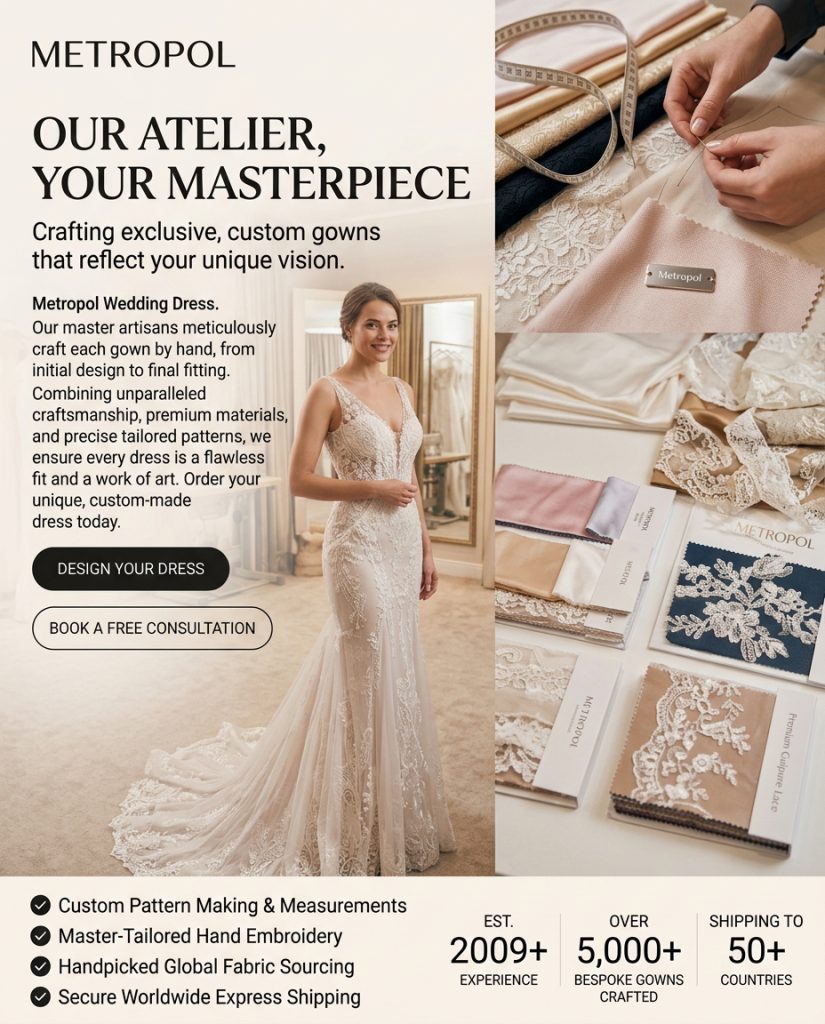
Custom Wedding Dresses Netherlands Styles Today’s bride is not necessarily looking for the most traditional wedding gown in the showroom. She may want a minimalist civil-ceremony dress for Amsterdam, a detachable overskirt for a countryside celebration, a structured couture gown for an elegant Rotterdam venue, or a lightweight bespoke dress designed around a destination wedding.
For bridal boutiques and retailers, this creates an equally important opportunity: custom wedding dresses can turn a generic product assortment into a distinctive bridal collection.
A successful custom program is not simply about changing a neckline or adding sleeves. It involves fabric selection, pattern development, grading, embellishment, fitting, production control, packaging, lead times, quality inspection, private labeling and reliable international delivery.
This is where the choice of manufacturing partner becomes commercially important.
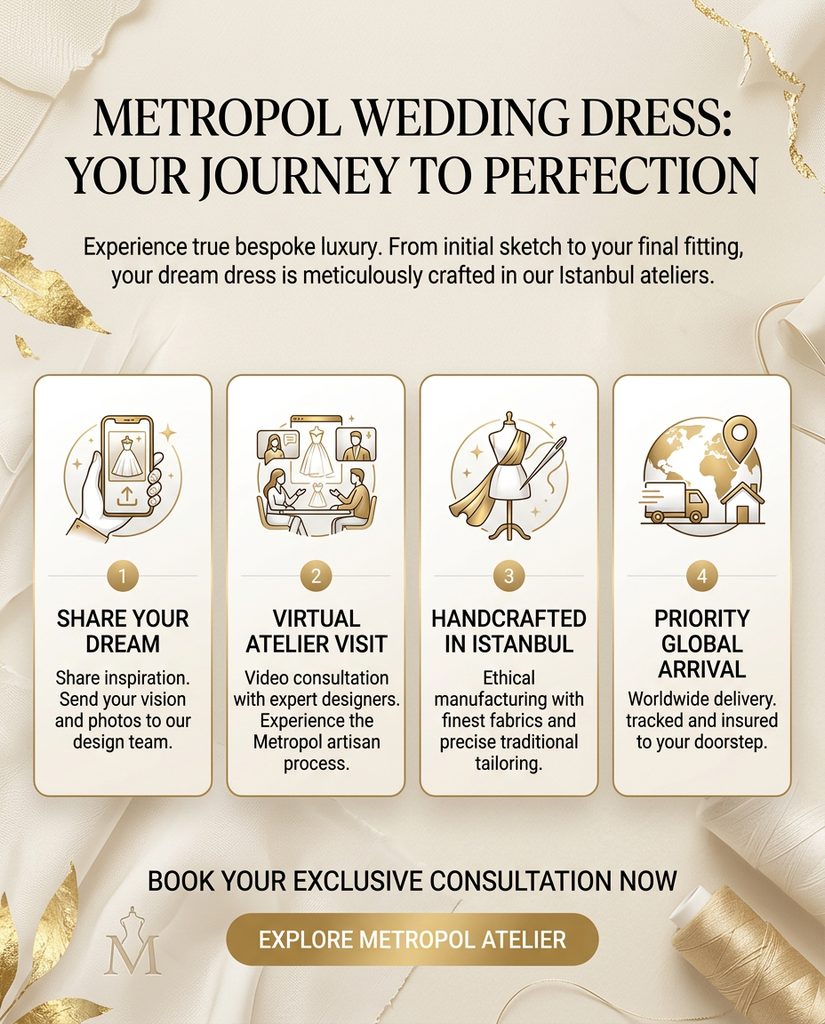
A capable Custom Wedding Dress Manufacturer should be able to translate a boutique’s creative direction into repeatable production. A strong Custom Bridal Gown Manufacturer should understand the difference between a one-off bespoke gown and a wholesale collection. A sophisticated Bespoke Wedding Dress Manufacturer should combine craftsmanship with technical patternmaking, while a scalable Made to Measure Wedding Dress Manufacturer needs reliable sizing and fitting systems.
For Dutch bridal businesses, the right supplier should also understand the realities of European distribution, textile labeling, product documentation, logistics and seasonal collection planning.
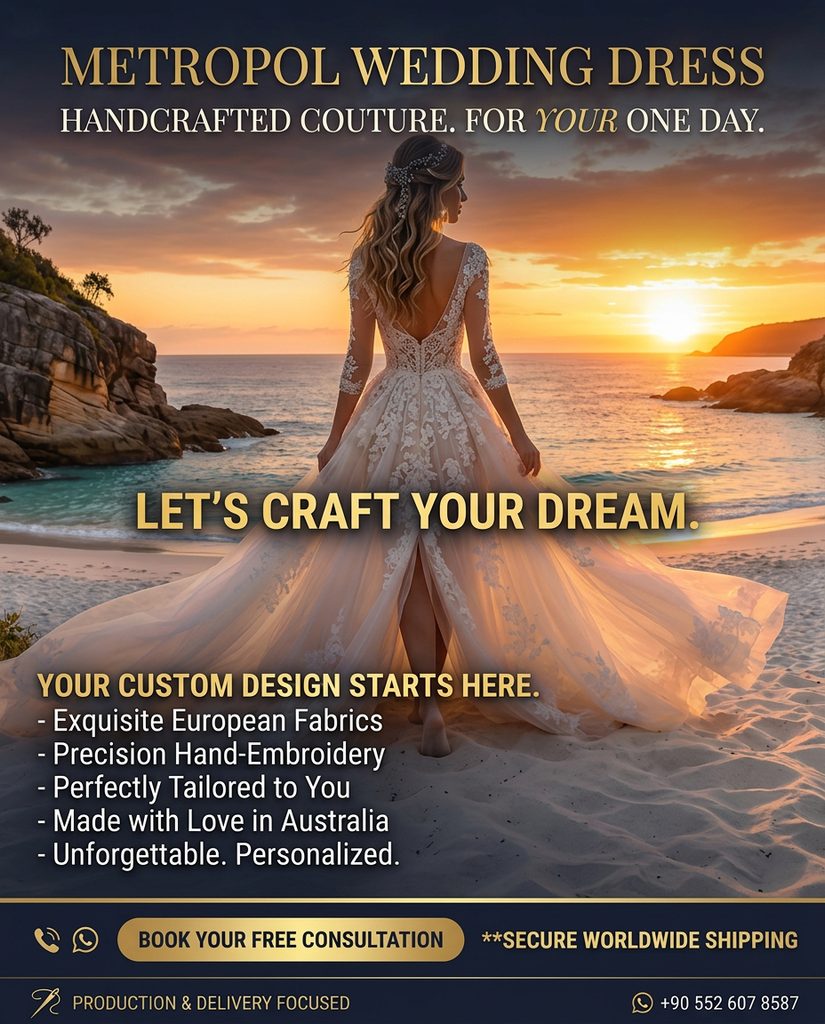
Metropol Wedding Dress can be positioned as a manufacturing partner for businesses looking to develop distinctive bridal collections rather than simply purchase ready-made gowns.
The goal is straightforward:
Create wedding dresses that look individual to the bride while giving the retailer a repeatable, commercially viable production system.
Custom Wedding Dresses in the Netherlands: Why the Market Is Moving Toward Individuality
A wedding dress used to be viewed primarily as a single product.
The modern bridal customer increasingly sees it as part of an entire wedding identity.
The dress needs to work with the venue, photography, ceremony format, reception, personal style, season, accessories and sometimes even a second outfit.
This shift is particularly relevant in the Netherlands, where wedding concepts increasingly include smaller, more personal celebrations alongside larger formal events. Dutch wedding-industry reporting for 2026 points toward more intentional, personalized celebrations and a move away from purely large-scale wedding formats.
For a bridal retailer, this changes the question from:
“Which standard dress should we stock?”
to:
“Which dress concept can we adapt into something that feels uniquely hers?”
That distinction creates the commercial case for customization.
A bride might begin with a clean A-line silhouette and request:
- a square neckline,
- long sleeves,
- removable sleeves,
- a cathedral veil,
- a different fabric,
- hand-applied embroidery,
- a lower back,
- a shorter reception version,
- a corset structure,
- or a completely different train.
A good manufacturer needs to know which modifications are technically straightforward, which require pattern redevelopment, and which may affect production costs substantially.
That is why custom bridal manufacturing should be approached as a design-to-production discipline, not simply as decorative alteration.
Custom Wedding Dresses Netherlands Styles
There is no single “Dutch wedding dress style.”
That is an important starting point.
A bride getting married in Amsterdam may have very different requirements from a bride planning a formal celebration outside Utrecht, a coastal wedding in Zeeland, or a contemporary city wedding in Rotterdam.
Instead of categorizing the market by one national aesthetic, it is more useful to think in terms of bridal scenarios.
| Bridal scenario | Likely priorities | Suitable custom direction |
|---|---|---|
| Amsterdam city wedding | Minimalism, movement, modernity | Clean crepe, architectural neckline, detachable elements |
| Formal luxury wedding | Drama, photography, craftsmanship | Couture corsetry, structured skirt, hand embellishment |
| Countryside wedding | Romance, comfort, softness | Lace, A-line, organic textures, lighter construction |
| Civil ceremony | Sophistication and versatility | Short gown, tailored silhouette, detachable train |
| Destination wedding | Weight, packability, comfort | Lightweight construction, simplified layers |
| Intimate wedding | Individuality | Bespoke details, unusual neckline, personal embroidery |
| Fashion-forward wedding | Statement design | Sculptural shapes, unconventional fabrics |
| Multi-event wedding | Multiple looks | Modular gown with removable components |
The important commercial insight is that customization allows a retailer to address several of these segments without carrying an enormous number of completely unrelated stock designs.
One strong base pattern can potentially become several commercially different products.
2. What “Custom” Actually Means in Bridal Manufacturing
The word custom is often used too loosely.
For buyers, this creates confusion.
A supplier may describe a gown as custom because the customer can choose from three sleeve options. Another supplier may create a completely new pattern from a sketch.
These are not the same service.
A practical manufacturing hierarchy looks like this:
Level 1 — Product customization
The basic design already exists.
The customer changes:
- color,
- neckline,
- sleeve length,
- train length,
- fabric,
- embellishment.
This is generally the easiest model to scale.
Level 2 — Made-to-order production
The design exists, but the manufacturer produces it specifically after receiving the order.
This reduces the retailer’s need to carry extensive physical inventory.
Level 3 — Made-to-measure production
The gown is produced around the customer’s measurements or a defined fitting system.
This requires greater measurement accuracy and quality control.
Level 4 — Bespoke development
A new garment is developed around a specific concept.
Pattern development, toile fitting, fabric engineering and construction decisions may all be involved.
Level 5 — Couture development
The project becomes highly craftsmanship-driven.
Hand finishing, complex internal construction, three-dimensional embellishment and extensive fitting may be involved.
For a boutique, understanding these levels prevents one of the most common purchasing mistakes: comparing suppliers on price when they are actually offering completely different manufacturing services.
3. Custom Wedding Dress Manufacturer: What a Serious Buyer Should Evaluate
When a retailer searches for a Custom Wedding Dress Manufacturer, the obvious questions are usually:
- What is the price?
- What is the MOQ?
- How long does production take?
- Can you make samples?
Those questions matter.
But they are not enough.
A better supplier evaluation should cover at least eight areas:
- Design interpretation
- Pattern engineering
- Fabric sourcing
- Construction quality
- Sample approval
- Size consistency
- Production communication
- Export and documentation capability
A manufacturer can have beautiful photography and still be difficult to work with.
Conversely, a factory may have excellent production capability but lack the design development support needed by a premium bridal brand.
The strongest partner sits between those worlds.
“You may also want to take a look at this article.” Custom Wedding Dresses Netherlands Guide
4. From Sketch to Finished Gown: The Manufacturing Workflow
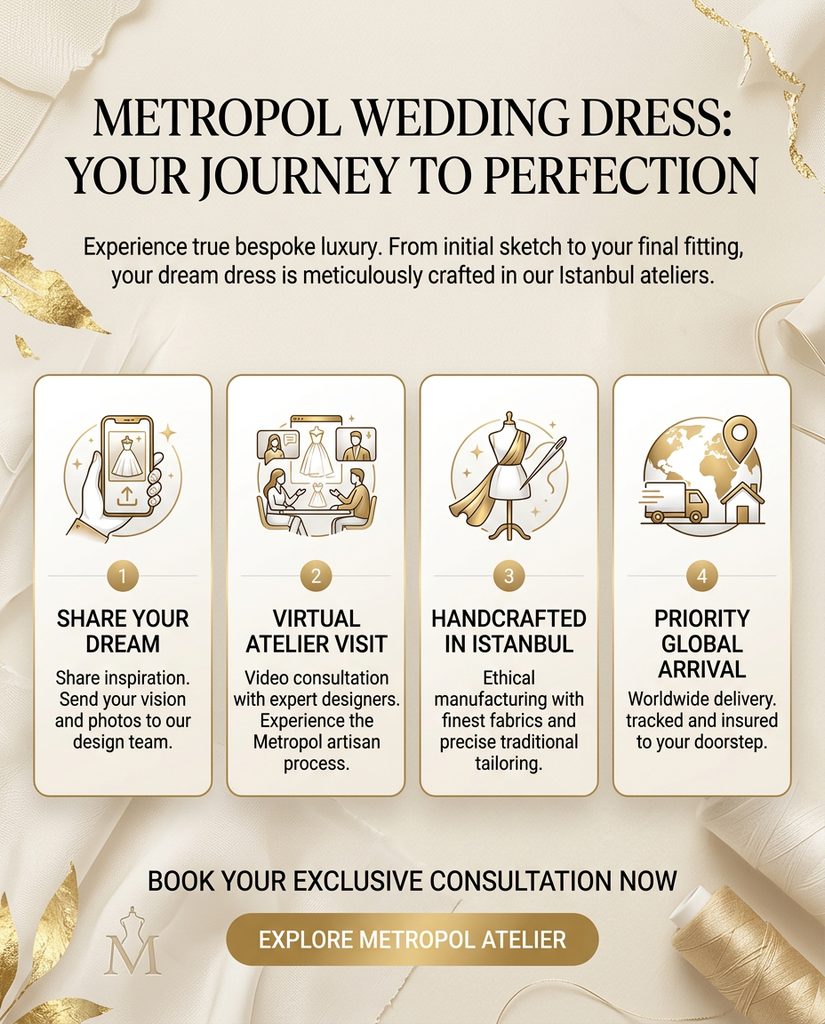
A professional custom bridal development process typically follows a sequence.
Step 1: Creative brief
The buyer provides:
- sketches,
- reference images,
- technical drawings,
- measurements,
- fabric preferences,
- target retail positioning,
- desired quantities,
- deadline.
The manufacturer evaluates feasibility.
Step 2: Technical interpretation
The creative concept is translated into construction requirements.
For example, a low-back satin gown may require:
- appropriate internal support,
- strategic seam placement,
- reinforcement,
- adjusted waist structure,
- modified closure positioning.
This is where technical expertise matters.
Step 3: Pattern development
The patternmaker creates the base pattern.
The pattern must account for:
- silhouette,
- ease,
- bust shaping,
- waist positioning,
- hip balance,
- train geometry,
- seam construction,
- lining,
- boning,
- closures.
Step 4: First sample
The first sample is produced.
It is not necessarily the final product.
Its purpose is to expose technical problems.
Step 5: Fit evaluation
The team checks:
- bust position,
- neckline behavior,
- waist placement,
- skirt balance,
- train fall,
- arm mobility,
- closure tension.
Step 6: Revision
The pattern is corrected.
Step 7: Final approval
Fabric, embellishment, measurements and construction are confirmed.
Step 8: Production
Approved specifications become the production standard.
Step 9: Inspection
Finished garments are checked before packing.
Step 10: Export
The finished collection is packed and shipped according to the agreed commercial terms.
This workflow is particularly important when developing a private-label collection because the retailer is effectively building a product asset that may remain in its assortment for several seasons.
“You may also want to take a look at this article.” Custom Wedding Dresses Netherlands Prices
5. Why Pattern Engineering Matters More Than a Beautiful Sketch
A sketch communicates an idea.
A pattern makes the idea wearable.
This distinction is easy to underestimate.
A designer can draw an extremely low neckline, asymmetric bodice or dramatic mermaid skirt. The manufacturer must determine whether the garment can actually support that shape while allowing the bride to move.
Consider a strapless architectural bodice.
It may require:
- boning,
- internal waist tape,
- bust support,
- stabilized seams,
- correctly positioned cups,
- reinforced closure,
- controlled ease.
If these components are poorly engineered, the dress can look excellent on a hanger but perform badly on a bride.
For this reason, the technical competence of a Custom Bridal Gown Manufacturer is often more important than the apparent complexity of its showroom designs.
The buyer should ask:
“How do you convert a design into a repeatable production specification?”
The answer reveals much more than a gallery of finished photographs.
6. Fabric Is a Structural Decision, Not Just an Aesthetic Choice
Bridal fabrics influence the garment’s appearance, weight, movement and manufacturing requirements.
A premium Bespoke Bridal Gown Manufacturer should understand the behavior of materials such as:
- satin,
- mikado,
- crepe,
- chiffon,
- organza,
- tulle,
- lace,
- jacquard,
- silk blends,
- technical mesh,
- embroidered fabrics.
Consider two gowns with exactly the same pattern.
One is produced in a fluid crepe.
The other uses a structured mikado.
They will not behave the same way.
The waist may sit differently.
The skirt volume will change.
The train will fall differently.
The internal support requirements will change.
Even the way the gown photographs will change.
That means fabric selection should happen before final pattern approval, not after.
7. Material Selection for Dutch Bridal Retail
For the Netherlands, retailers may need to balance aesthetics with practical considerations.
A bride may spend many hours wearing her dress.
She may travel by car, walk on cobblestones, sit at a restaurant, dance at a reception and move between indoor and outdoor spaces.
Therefore, fabric decisions should consider:
- breathability,
- weight,
- crease behavior,
- durability,
- transparency,
- lining,
- movement,
- cleaning requirements,
- storage,
- transport.
A highly structured gown may create a dramatic visual effect but become uncomfortable after several hours.
A very lightweight gown may be comfortable but fail to provide the desired architectural silhouette.
The best design balances both.
8. The Dutch Retail Environment: Customization as a Differentiation Strategy
Dutch bridal boutiques compete not only on dresses but on experience.
A bride can compare products online before entering a store.
That means the physical boutique needs to provide something digital shopping cannot easily replicate.
Customization is one of those advantages.
Instead of:
“This is the dress.”
The stylist can say:
“This is the starting silhouette. We can make it yours.”
That changes the sales conversation.
The customer becomes involved in the creative process.
For the retailer, customization can create:
- higher perceived value,
- stronger customer engagement,
- greater product differentiation,
- fewer direct price comparisons,
- stronger brand identity,
- opportunities for premium upselling.
A Dutch bridal retailer therefore does not necessarily need hundreds of dresses.
It may need a smaller number of well-designed, adaptable foundation styles.
9. Custom Wedding Dresses for Amsterdam
Amsterdam presents an interesting environment for bridal fashion because contemporary fashion sensibilities coexist with historical architecture and intimate wedding venues.
A city bride may prefer a dress that feels elegant without being excessively traditional.
Potential design directions include:
Minimalist column gown
A clean silhouette in crepe or satin.
Modern square-neck gown
A structured bodice combined with a soft skirt.
Detachable overskirt
A fitted ceremony gown becomes a simpler reception look.
Contemporary lace
Instead of full lace coverage, strategically placed lace panels can create a more editorial appearance.
Tailored bridal look
A bridal gown can be combined with a blazer, cape or structured jacket.
The common thread is versatility.
10. Rotterdam: Modernity Meets Bridal Drama
Rotterdam’s architectural character makes it a natural environment for stronger silhouettes.
For a boutique serving fashion-conscious customers, custom designs may include:
- sculptural bodices,
- asymmetric necklines,
- dramatic sleeves,
- architectural trains,
- minimalist satin,
- statement bows,
- detachable elements.
The objective is not to make every dress extravagant.
Instead, the collection should have recognizable design architecture.
A retailer might develop one signature bodice and produce it with:
- a mermaid skirt,
- an A-line skirt,
- a detachable overskirt,
- a short skirt,
- or a tailored trouser option.
This is how customization can become commercially efficient.
11. A Dutch Bridal Collection Should Not Be Built Like a Standard Fashion Collection
Fashion collections often prioritize seasonal novelty.
Bridal collections have a different commercial rhythm.
A wedding dress may remain relevant for multiple seasons.
That means a boutique should distinguish between:
Core styles
Reliable designs that define the collection.
Fashion styles
Trend-driven designs that create visual interest.
Customizable styles
Base designs that can be adapted to individual brides.
Statement styles
Pieces designed primarily to attract attention and generate appointments.
This four-layer architecture can be more commercially useful than producing dozens of unrelated designs.
12. A Useful Collection Architecture for Bridal Shops
Imagine a boutique wants a collection of 20 designs.
Instead of creating 20 completely independent gowns, the manufacturer could develop:
| Collection layer | Number | Purpose |
|---|---|---|
| Core silhouettes | 6 | Commercial stability |
| Customizable foundations | 6 | Personalization |
| Fashion-forward pieces | 4 | Trend relevance |
| Couture statements | 2 | Brand positioning |
| Reception/second looks | 2 | Cross-selling |
This gives the retailer a coherent assortment.
The value is not only in the number of gowns.
It is in the number of selling possibilities generated by each base design.
13. The Difference Between Made-to-Order and Made-to-Measure
These terms are frequently confused.
A Made to Order Wedding Dress Manufacturer generally produces an existing design after receiving an order.
A Made to Measure Wedding Dress Manufacturer goes further by adapting construction to specified body measurements.
For a retailer, this distinction affects:
- ordering process,
- fitting responsibility,
- production complexity,
- customer expectations,
- alteration requirements,
- delivery timelines.
If a buyer does not define the process clearly, problems can arise later.
For example:
“Custom size” may mean simply choosing a size 10.
Or it may mean modifying the bust, waist, hip, hollow-to-waist and length measurements.
Those are completely different production systems.
14. Personalized Wedding Dresses: Where the Emotional Value Becomes Commercial Value
Personalization is not only a customer-service feature.
It can be a pricing strategy.
A bride is less likely to compare a one-of-a-kind gown with a mass-market product in exactly the same way.
A personalized dress can incorporate:
- initials,
- meaningful embroidery,
- family lace,
- removable elements,
- custom sleeves,
- custom neckline,
- unique back design,
- special buttons,
- hand-applied embellishment.
A Personalized Wedding Dress Manufacturer should therefore be capable of documenting individual modifications accurately.
Every modification needs to be translated into production instructions.
15. Private Label Bridal Manufacturing in the Netherlands
For retailers building their own brand, private label can be particularly powerful.
A Private Label Wedding Dress Manufacturer produces garments that are sold under the retailer’s own brand identity.
This changes the commercial relationship.
The retailer is no longer simply buying another company’s product.
It is building an asset.
A private-label program can include:
- custom labels,
- branded packaging,
- unique designs,
- exclusive patterns,
- collection naming,
- custom hangtags,
- technical specifications,
- retailer-specific size systems.
The most important question is:
Who owns the design and development specifications?
That should be clearly defined before production begins.
16. OEM Wedding Dress Manufacturing: A Different Commercial Model
An OEM Wedding Dress Manufacturer works from buyer-defined requirements.
The buyer may provide:
- sketches,
- specifications,
- references,
- fabrics,
- patterns,
- samples.
The manufacturer turns those requirements into finished products.
OEM becomes especially useful when a bridal company already has a strong design identity but needs manufacturing capacity.
The ideal relationship resembles an extension of the buyer’s product-development department.
17. When Couture Manufacturing Makes Commercial Sense
Not every gown needs couture-level production.
But certain products justify it.
A Couture Wedding Dress Manufacturer may be appropriate when the gown includes:
- extensive hand embroidery,
- complex corsetry,
- three-dimensional flowers,
- intricate lace placement,
- hand-sewn beadwork,
- sculptural draping,
- unusual construction.
The commercial question is not:
“Can this be made?”
It is:
“Will the additional craftsmanship create enough perceived value to justify the additional cost?”
For premium bridal boutiques, the answer can often be yes.
18. Luxury Bridal Gowns Need More Than Expensive Fabric
A Luxury Bridal Gown Manufacturer should understand that luxury is not simply a fabric price.
Luxury is experienced through:
- silhouette,
- fit,
- finishing,
- construction,
- tactility,
- consistency,
- packaging,
- service,
- exclusivity.
A €500 fabric does not automatically create a luxury garment.
A well-engineered gown using an intelligently selected fabric can feel significantly more luxurious than a poorly constructed dress made from a theoretically expensive material.
19. The Economics of Custom Bridal Manufacturing
A buyer should calculate more than factory price.
A realistic landed-cost model may include:
Manufacturing cost
- sampling
- customization
- packaging
- freight
- customs-related charges
- import VAT considerations
- local logistics
- alterations
- quality-control costs
- marketing
- showroom overhead
= true commercial cost
This matters because the cheapest factory quote may not produce the lowest total cost.
20. Dutch Import Considerations
Businesses importing clothing into the Netherlands need to account for applicable European and Dutch requirements.
For example, Dutch business guidance states that clothing and textile products placed on the Dutch market must meet labeling requirements, including information about material composition.
EU rules generally require textile products marketed to consumers to indicate fibre composition, with constituent fibres identified by the prescribed textile fibre names and percentages.
Dutch KVK guidance also notes that imported non-EU goods can be subject to Dutch import VAT, with a standard rate of 21%, and highlights Extended Producer Responsibility obligations for textiles in the Netherlands.
These requirements should be verified for the exact product, transaction structure and importer-of-record arrangement before commercial shipments.
This is one reason a professional International Wedding Dress Manufacturer should be able to provide accurate product information and commercial documentation.
21. Textile Labeling: A Detail That Can Become a Business Problem
Textile labeling sounds minor.
It is not.
Suppose a gown contains:
- polyester satin,
- viscose lining,
- elastane,
- decorative lace,
- synthetic mesh.
The retailer needs accurate information about the relevant textile composition.
EU rules require the composition of multi-fibre textile products to be identified by fibre name and percentage in descending order, subject to the regulation’s detailed rules and exemptions.
For Dutch retail sales, the information also needs to comply with applicable language requirements.
A supplier should therefore maintain a reliable product specification sheet.
22. A Better Product Specification Sheet
For every custom gown, a retailer should ideally have a technical file containing:
Product identity
- Style code
- Collection
- Season
- Version
Construction
- Silhouette
- Neckline
- Bodice
- Skirt
- Train
- Closure
Materials
- Main fabric
- Lining
- Interlining
- Lace
- Embellishment
Measurements
- Bust
- Waist
- Hip
- Hollow-to-waist
- Shoulder
- Sleeve
- Train
Production
- Sample version
- Approval date
- Revision number
- Manufacturing notes
Commercial
- Wholesale price
- MOQ
- Lead time
- Packaging specification
This documentation becomes extremely valuable when a collection is reordered.
23. The Hidden Cost of Poor Communication
Many manufacturing problems are not caused by sewing.
They are caused by unclear communication.
A design instruction such as:
“Make the neckline slightly lower.”
is not sufficiently technical.
How much lower?
Compared with what?
Measured from which reference point?
The better instruction is:
“Lower center-front neckline by 3 cm from approved sample version B while retaining the existing bust-point relationship.”
That is the language of production.
The closer a buyer and manufacturer get to this level of communication, the lower the risk of costly misunderstandings.
24. A Professional Custom Development Brief
When sending a design to a manufacturer, include:
Style name:
Amsterdam Pearl
Silhouette:
Fit-and-flare
Bodice:
Structured corset
Neckline:
Square
Back:
Low V
Skirt:
Crepe with detachable overskirt
Main fabric:
Premium crepe
Lining:
Soft polyester/viscose blend
Closure:
Invisible zipper with covered buttons
Embellishment:
Hand-applied floral lace at waist and side bodice
Train:
80 cm sweep train
Target market:
Premium Dutch bridal boutique
This gives production teams something measurable to work from.
25. Wholesale Custom Wedding Dresses: How Retailers Should Think About MOQ
MOQ is often treated as a simple number.
But MOQ can mean different things.
For example:
- MOQ per style,
- MOQ per color,
- MOQ per size,
- MOQ per collection,
- MOQ per order,
- MOQ for custom development.
A buyer should clarify all of them.
A Custom Wedding Dress Wholesale program may have different economics from standard wholesale because custom development creates additional sampling and technical costs.
The buyer should ask whether development fees are:
- included,
- refundable,
- credited against production,
- or charged separately.
26. Wholesale Custom Bridal Gowns and Assortment Strategy
A Wholesale Custom Bridal Gown program becomes more attractive when the retailer can order selectively.
Instead of purchasing large quantities of one style, a boutique may benefit from:
- multiple silhouettes,
- low quantities,
- repeatable customization,
- quick sample development,
- reorder capability.
This can reduce inventory risk.
For bridal stores, inventory turnover is not the same as in ordinary fashion.
Wedding dresses may occupy substantial showroom space and require expensive display and fitting processes.
A flexible manufacturing system can therefore have significant value.
27. Wedding Dress Manufacturer for Boutiques
A Wedding Dress Manufacturer for Boutiques should understand that boutique buyers are not purchasing only garments.
They are purchasing a selling system.
The retailer needs:
- attractive samples,
- consistent sizing,
- clear product information,
- dependable reorders,
- manageable minimum quantities,
- reliable lead times,
- packaging suitable for premium presentation.
The manufacturer’s job does not end when the dress leaves the factory.
A good supplier relationship supports the retailer’s entire product lifecycle.
28. Bridal Gown Manufacturer for Bridal Shops
A Bridal Gown Manufacturer for Bridal Shops should also recognize the importance of fitting-room performance.
A dress must look good under:
- showroom lighting,
- mirrors,
- photographs,
- movement,
- different body types.
A gown that only works on one sample-size model is not necessarily commercially strong.
This is why grading and size development matter.
29. Why Size Grading Is a Strategic Capability
Bridal bodies are diverse.
A collection should not rely on a single proportion.
Pattern grading needs to preserve design intent while accommodating changes in:
- bust,
- waist,
- hip,
- torso length,
- arm circumference,
- shoulder width.
For complex corsetry, scaling is particularly important.
A beautiful bodice may become uncomfortable if grading simply enlarges dimensions without adjusting construction.
A professional manufacturer should therefore have a defined approach to size development.
30. The Technical Problem With “One Pattern, All Sizes”
A simplistic approach might enlarge every measurement proportionally.
That can fail.
Human bodies do not scale like geometric objects.
For example:
A larger bust size may require a different bust cup relationship.
A taller bride may need additional torso length rather than simply a longer skirt.
A petite bride may need both bodice and skirt proportions changed.
This is why a serious Tailor Made Wedding Dress Manufacturer should understand body proportion rather than merely nominal sizing.
31. Handcrafted vs Factory-Made: A False Dichotomy
Some buyers assume that handmade means premium and factory-made means mass-market.
That is not necessarily true.
A professional Handmade Wedding Dress Manufacturer may produce certain elements manually while using standardized production methods elsewhere.
Likewise, a factory can produce highly sophisticated bridal garments using:
- specialized machines,
- experienced artisans,
- hand finishing,
- controlled quality systems.
The question should therefore be:
Which parts are handmade, which are machine-produced, and how does that affect the finished product?
That is a much more useful purchasing question.
32. Handcrafted Bridal Gowns: Where Manual Skill Adds Value
A Handcrafted Bridal Gown Manufacturer can add value through:
- lace placement,
- beadwork,
- embroidery,
- floral appliqué,
- hand-covered buttons,
- hand finishing,
- three-dimensional details.
These techniques can become important differentiators for a premium collection.
However, handcrafted work should be specified carefully.
For example:
“Floral appliqué on bodice”
is less useful than:
“Seven individually cut floral appliqué motifs positioned asymmetrically across the left bodice and extending 8 cm onto the skirt.”
The second instruction is production-ready.
33. One-of-a-Kind Gowns Versus Repeatable Collections
A One of a Kind Wedding Dress Manufacturer operates differently from a volume-focused factory.
One-off projects can justify:
- unique pattern development,
- unusual fabric,
- experimental construction,
- extensive fittings,
- hand craftsmanship.
But if a retailer wants a scalable collection, repeatability becomes essential.
The ideal supplier for a boutique collection should therefore combine creativity with production discipline.
34. Exclusive Bridal Gowns as a Brand Strategy
An Exclusive Bridal Gown Manufacturer can help a boutique avoid direct product comparison.
Suppose ten local stores carry essentially the same recognizable designs.
Price becomes a major differentiator.
Now imagine one boutique carries an exclusive silhouette unavailable at neighboring stores.
The conversation changes.
The customer is comparing:
- style,
- experience,
- craftsmanship,
- service,
- fit,
rather than simply comparing the same product price.
Exclusivity can therefore be more valuable than having the largest collection.
35. Direct Wedding Dress Manufacturer: What “Direct” Should Mean
A Direct Wedding Dress Manufacturer model can shorten the chain between production and buyer.
But direct purchasing should not mean:
“Order directly and hope for the best.”
The buyer still needs:
- clear specifications,
- approved samples,
- quality control,
- production milestones,
- commercial terms,
- shipping arrangements,
- documentation.
Direct sourcing works best when communication is structured.
36. Direct Bridal Gown Manufacturer for International Buyers
A Direct Bridal Gown Manufacturer can become especially valuable when the buyer is developing a collection rather than purchasing individual stock pieces.
Direct manufacturing may allow:
- better design communication,
- fewer intermediaries,
- customized production,
- private-label development,
- direct sample approval.
The buyer should still compare the total landed cost rather than focusing only on ex-factory pricing.
37. Wedding Dress OEM Supplier: When It Is the Right Choice
A Wedding Dress OEM Supplier is appropriate when the retailer or brand controls the design direction.
For example, a Dutch bridal brand might provide:
- technical drawings,
- sample garments,
- approved fabric,
- label design,
- size chart.
The manufacturer then produces according to specification.
This approach is ideal for brands that already know what they want.
38. Bridal Gown OEM Supplier for Collection Development
A Bridal Gown OEM Supplier can also help a company move from concept to finished collection.
The most important capabilities include:
- sample development,
- patternmaking,
- fabric management,
- production,
- inspection,
- packaging.
For an emerging bridal brand, this can effectively function as an outsourced production department.
39. Custom Bridal Collection Manufacturer: Building a Collection, Not Just Dresses
A Custom Bridal Collection Manufacturer should think at collection level.
That means understanding relationships between:
- silhouettes,
- fabrics,
- details,
- price points,
- visual identity.
For example:
Collection A
- clean crepe
- architectural satin
- modern lace
- removable overskirt
- tailored cape
All five designs can look different while sharing a common brand language.
That is stronger than simply putting five unrelated dresses together.
40. Custom Bridal Dress Manufacturer and Product Consistency
A Custom Bridal Dress Manufacturer needs a system for preserving design consistency.
If the first sample has:
- 12 covered buttons,
the production version should not unexpectedly have 10.
If the train was approved at 90 cm, production should not silently change it.
If lace placement was approved asymmetrically, the factory should not substitute symmetrical placement.
This sounds obvious.
But consistency is one of the main differences between a professional production system and an informal manufacturing arrangement.
41. Premium Wedding Dress Manufacturer: What Makes “Premium” Measurable?
A Premium Wedding Dress Manufacturer should be judged using measurable criteria.
Premium patternmaking
Does the gown sit correctly?
Premium materials
Are materials appropriate to the design?
Premium construction
Are seams, closures and internal supports properly finished?
Premium finishing
Are hems, buttons and embellishments clean?
Premium consistency
Does the production version match the approved sample?
Premium service
Does the manufacturer communicate clearly?
The word “premium” should describe a system, not merely a marketing claim.
42. Premium Bridal Gown Manufacturing and the Fitting Experience
A bride usually notices fit before she notices technical construction.
She may not know why the bodice feels secure.
She simply knows that it feels right.
That feeling can come from:
- correctly positioned boning,
- balanced bust support,
- appropriate waist tension,
- accurate shoulder placement,
- properly engineered closure.
Good manufacturing is often invisible.
That is one of its greatest strengths.
43. The Real Role of a Wedding Dress Factory
A Custom Wedding Dress Factory is not merely a place where sewing machines operate.
A modern bridal factory can include:
- design development,
- patternmaking,
- sample room,
- cutting,
- sewing,
- embellishment,
- pressing,
- quality control,
- packing.
The factory should be evaluated as a complete production environment.
44. Custom Bridal Gown Factory: What Buyers Should Ask
Before placing an order, ask:
- Who develops the patterns?
- Where are samples produced?
- Who approves revisions?
- How are production measurements controlled?
- How are embellishments checked?
- How are finished gowns inspected?
- What happens if a production defect is discovered?
- How are repeat orders handled?
- What documentation accompanies the shipment?
- How are private-label requirements managed?
These questions reveal operational maturity.
45. Manufacturing Capacity Is Not the Same as Manufacturing Suitability
A factory producing thousands of garments may not necessarily be the best partner for a boutique selling premium bridal gowns.
Bridal manufacturing has different requirements.
It often demands:
- small-batch flexibility,
- complicated construction,
- sample iterations,
- delicate materials,
- hand finishing,
- strict visual consistency.
Therefore, the right supplier is not always the largest supplier.
It is the supplier whose production model matches the buyer’s business.
46. The Buyer’s Due-Diligence Scorecard
Use this before selecting a supplier.
| Category | Question | Weight |
|---|---|---|
| Product quality | Does the sample meet expectations? | 20% |
| Patternmaking | Can the supplier develop complex silhouettes? | 15% |
| Customization | How much can be changed? | 10% |
| MOQ | Is the model suitable for the boutique? | 10% |
| Lead time | Can seasonal deadlines be met? | 10% |
| Communication | Is technical information handled clearly? | 10% |
| QC | Is there a documented inspection process? | 10% |
| Private label | Can branding be supported? | 5% |
| Export | Can international shipments be managed? | 5% |
| Documentation | Are material and product details available? | 5% |
The exact weighting can be adjusted, but the principle is important:
Do not choose a bridal manufacturer based solely on price.
47. A Practical Cost Model for a Dutch Boutique
Imagine a retailer is evaluating a custom gown.
The factory price is only one component.
A simplified model could be:
Factory price: €420
Custom development allocation: €35
Packaging: €15
International freight allocation: €30
Import-related costs: variable
Local logistics: €12
Quality-control allocation: €8
Total landed acquisition cost: potentially much higher than the original factory quote.
The retail price must then cover:
- showroom costs,
- stylist labor,
- fitting time,
- marketing,
- rent,
- administration,
- alterations,
- payment costs,
- profit.
This is why a purchasing manager should calculate landed margin, not factory margin.
48. Why a Cheap Wedding Dress Can Become Expensive
Consider a gown with a low factory price but:
- inconsistent sizing,
- frequent defects,
- late delivery,
- poor packaging,
- missing labels,
- difficult communication.
The retailer may have to spend additional money on:
- alterations,
- replacement,
- customer compensation,
- emergency freight,
- staff time.
The original saving can disappear.
A slightly higher purchase price may therefore create a significantly lower total cost.
49. Lead Time Should Be Divided Into Stages
Do not ask only:
“What is your production time?”
Instead ask for:
- Design confirmation
- Pattern development
- First sample
- Revision
- Final sample
- Bulk production
- Inspection
- Packing
- Shipping
This makes delays easier to identify.
A supplier saying “30 days production” may still require another 30 days for sampling and approval.
For bridal retailers, that distinction can be critical.
50. Seasonal Planning for Dutch Bridal Boutiques
Bridal stores should plan collections earlier than the customer sees them.
A collection launch requires:
- design selection,
- sampling,
- photography,
- website preparation,
- showroom preparation,
- stylist training,
- marketing.
A retailer waiting until the season begins to order samples may already be late.
The manufacturer should therefore become part of the retailer’s annual planning cycle.
51. The Sample Is a Contract Between Design and Production
A sample is not merely a marketing photograph.
It is the physical reference for the final product.
The buyer should approve:
- silhouette,
- fabric,
- lace,
- embellishment,
- closure,
- color,
- measurements,
- train,
- finishing.
Once approved, changes should be documented.
A sample approval sheet can prevent expensive arguments later.
52. Quality Control: What Should Be Checked?
A bridal gown inspection should include more than looking for stains.
Visual inspection
- fabric defects,
- color consistency,
- lace alignment,
- embellishment placement.
Construction
- seam quality,
- lining,
- closures,
- boning,
- hems.
Measurement
- bust,
- waist,
- hip,
- length,
- train.
Functional testing
- zipper,
- buttons,
- hooks,
- detachable components.
Packaging
- protective covering,
- garment preservation,
- labeling.
For premium gowns, even minor inconsistencies can affect the customer experience.
53. Customization Menu: What Retailers Can Offer Brides
A boutique can make customization easier by creating predefined options.
For example:
Neckline
- Sweetheart
- Square
- V-neck
- Scoop
- High neck
Sleeves
- Sleeveless
- Cap
- Short
- Long
- Detachable
Skirt
- A-line
- Ballgown
- Mermaid
- Fit-and-flare
- Column
Back
- Open
- Buttoned
- Illusion
- Lace-up
- Low V
Train
- Sweep
- Chapel
- Cathedral
- Detachable
This is much easier to sell than asking the bride to design an entire dress from nothing.
54. Modular Bridal Design Is One of the Strongest Opportunities
A modular gown can create multiple looks.
Imagine:
Base gown
detachable overskirt
detachable sleeves
bridal cape
statement bow
One wedding dress becomes several styling combinations.
For the bride, this creates versatility.
For the retailer, it creates additional revenue opportunities.
For the manufacturer, it creates a system of components that can be standardized.
55. A Manufacturer’s Perspective on Modular Design
Modularity requires precision.
Detachable elements need:
- secure attachment,
- discreet closures,
- appropriate weight distribution,
- compatibility with the base garment.
If the overskirt pulls the waist backward, the design fails.
If detachable sleeves create visible attachment points, the premium appearance suffers.
If a cape is too heavy for the shoulder structure, comfort becomes a problem.
Therefore, modular bridalwear requires both design creativity and engineering.
56. Dutch Weddings and Weather: A Practical Design Consideration
The Netherlands is not defined by one climate condition, but outdoor wedding planning can involve changing weather.
This makes adaptability valuable.
A bride may appreciate:
- removable sleeves,
- a cape,
- lightweight layering,
- detachable trains,
- breathable fabrics,
- practical bustle systems.
This is a good example of how regional considerations can influence product design without forcing every Dutch bridal gown into the same aesthetic.
57. Custom Bridal Wear Manufacturer for Multi-Look Weddings
A Custom Bridal Wear Manufacturer can produce more than the main ceremony gown.
A collection can include:
- civil ceremony dresses,
- rehearsal looks,
- reception dresses,
- after-party mini dresses,
- bridal separates,
- capes,
- jackets.
This increases the retailer’s average transaction opportunity.
The customer may begin with one gown and add a second look.
58. Bespoke Bridal Wear Manufacturer and Brand Positioning
A Bespoke Bridal Wear Manufacturer is particularly relevant to boutiques that want a luxury positioning.
Bespoke does not necessarily mean extravagant.
A minimalist bespoke gown can be more sophisticated than a heavily embellished gown.
The essence of bespoke is:
the product is developed around the individual rather than the other way around.
59. Bridal Couture Manufacturer: When the Product Becomes the Experience
A Bridal Couture Manufacturer can help a boutique develop gowns that function as showroom centerpieces.
These pieces may be used to:
- attract press attention,
- create social media content,
- strengthen brand identity,
- generate bridal appointments,
- demonstrate craftsmanship.
A couture gown does not necessarily need to generate the highest unit sales.
Its value may be in what it does for the entire collection.
60. The Information a Buyer Should Request Before Sampling
Before paying for development, ask the supplier for:
- company profile,
- manufacturing capabilities,
- sample process,
- MOQ structure,
- lead-time ranges,
- customization capabilities,
- material documentation,
- private-label options,
- packaging options,
- quality-control procedure,
- export experience.
A serious supplier should be able to explain its process clearly.
Related Topics

24.02.2026
Importation de robes de mariée de luxe de Turquie vers Paris L’industrie de la mode nuptiale est en constante évolution, et Paris, reconnue comme capitale mondiale du luxe et de l’élégance, reste une destination de...
05.11.2025
Made to Measure Wedding Dress Cost in İzmir When it comes to one of the most important days of your life, nothing quite captures the essence of personalization like a made to measure wedding dress....
09.02.2026
High End Bridal Designers for the US Market The global bridal industry has evolved into a highly sophisticated luxury segment, and few markets are as influential, competitive, and trend-setting as the United States. For designers,...
07.06.2024
Wedding Dress İstanbul Best 3 Company Looking for a wedding dress in Istanbul can be an exciting adventure! Istanbul is known for its rich cultural heritage and diverse fashion scene, offering a wide range of...
11.06.2025
La Marrier Atalier Wedding Dresses Best 10 The world of bridal fashion is a realm of dreams, where elegance, romance, and individuality converge to create unforgettable moments. Among the myriad of designers crafting these dreams,...
23.07.2025
Finding a cheap wedding dress with train in Turkey is a dream come true for brides and retailers seeking elegance, quality, and affordability. Turkey, a global hub for bridal fashion, offers stunning gowns with trains...
Comments