
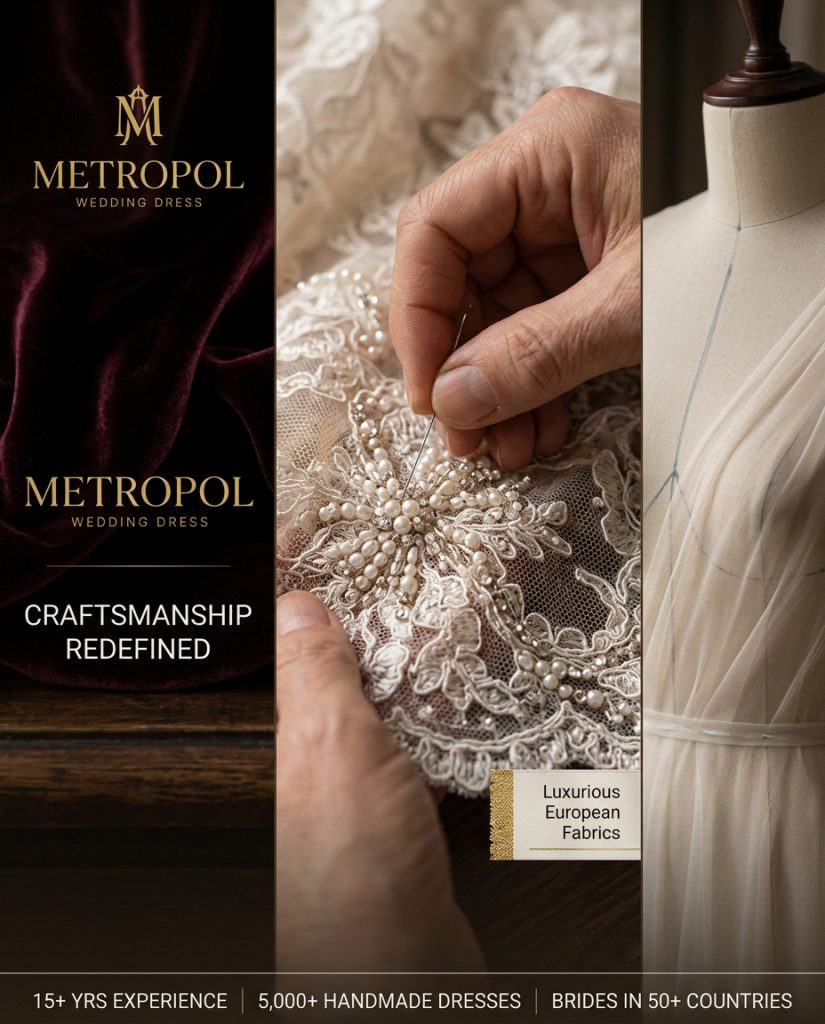
Custom Wedding Dresses Netherlands Ideas The Dutch bridal market rewards something that is surprisingly difficult to manufacture consistently: individuality without unnecessary complexity.
For a bridal boutique, the goal is rarely to offer “more dresses” simply for the sake of having more dresses. The stronger objective is to build a collection that gives brides distinctive silhouettes, reliable fitting options, commercially sensible price positioning, and enough design flexibility to make a gown feel personal.
That is where custom wedding dresses become strategically important.
A modern Dutch bride may want a clean civil-ceremony dress, a dramatic gown for a cathedral-style celebration, a minimalist crepe silhouette, a detachable overskirt, sleeves for a cooler season, or a completely individual combination of neckline, bodice, skirt and embellishment. A bridal retailer therefore needs a manufacturing partner capable of translating those preferences into repeatable production.
For retailers and bridal businesses, Metropol Wedding Dress can be positioned as a partner for developing custom bridal concepts, made-to-order programs, private-label collections, wholesale designs and specialized gowns.
A successful custom program should connect five elements:
- Design freedom — the ability to develop distinctive silhouettes and details.
- Production discipline — repeatable construction, sizing and quality control.
- Commercial logic — designs that can actually be sold at the intended retail price.
- Customer personalization — enough flexibility to make the bride feel that the gown belongs to her.
- International practicality — clear specifications, organized sampling and export-ready processes.
This guide explores how Dutch bridal shops, boutiques, designers, wholesalers and private-label businesses can approach custom wedding dresses from a purchasing and product-development perspective.
Custom Wedding Dresses in the Netherlands: Start With the Bride, Not the Dress
The most valuable custom wedding dress idea does not begin with lace.
It begins with a question:
What does the bride need the dress to do?
That question sounds simple, but it changes the entire product-development process.
A gown can be visually beautiful and still be difficult to sell. It may require excessive alterations, use materials that are inconsistent between production runs, have a complicated construction that pushes the retail price too high, or photograph beautifully while feeling uncomfortable after several hours of wear.
A commercially successful bridal collection needs to solve several problems at once.
The bride wants emotion.
The stylist wants fitting flexibility.
The boutique owner wants margin.
The purchaser wants predictable production.
The seamstress wants a construction method that can be altered without destroying the design.
The manufacturer needs specifications that can be interpreted consistently.
These requirements are not always identical.
That is why the strongest custom bridal development process is not simply “send a picture and make the dress.”
“You may also want to take a look at this article.” Custom Wedding Dresses Netherlands Models
Custom Wedding Dresses Netherlands Ideas
For a Dutch bridal business, this approach is particularly useful because the collection can be adapted to different wedding formats. A bride may combine a civil ceremony at a city hall with a larger celebration later. Another may prefer a minimalist wedding in a modern venue. Someone else may want traditional romance, vintage references or contemporary couture.
A flexible manufacturer allows the retailer to turn those differences into products rather than treating every bride as an exception.
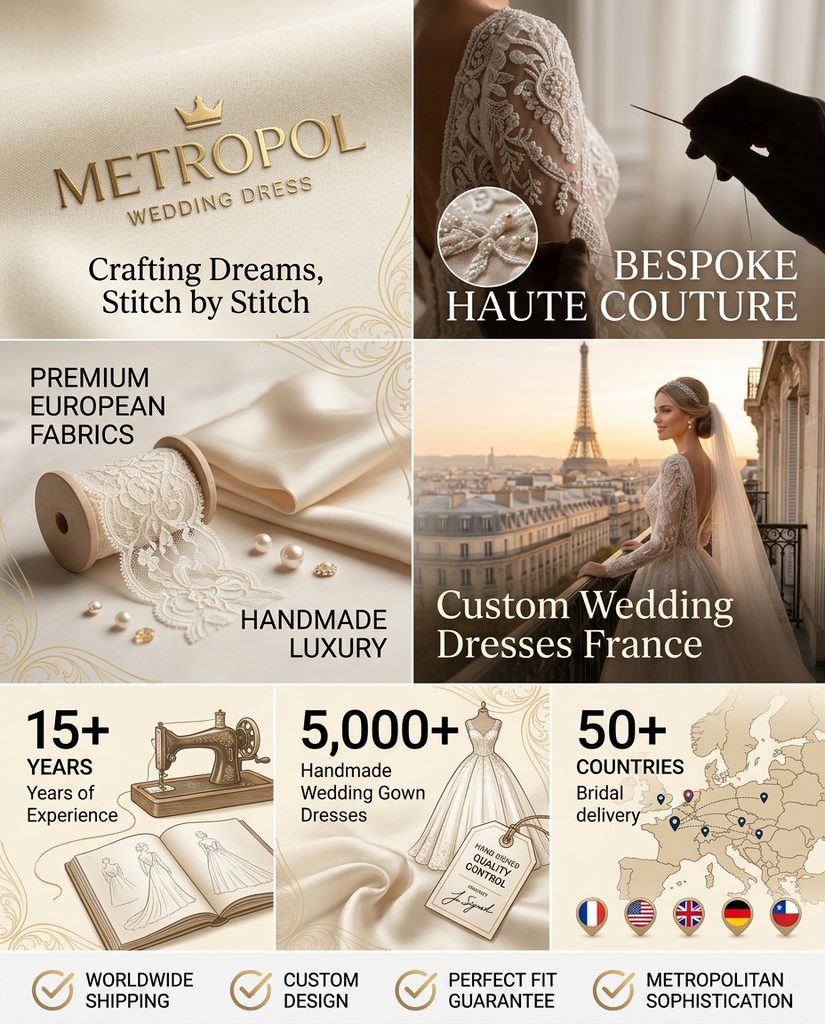
The Commercial Opportunity Behind Custom Bridal Design
Custom wedding dresses are often associated exclusively with luxury couture.
That is too narrow.
There are at least four commercial levels of customization.
Level 1: Personalization
The base gown already exists, but selected elements can change.
Examples include:
- neckline
- sleeve length
- train length
- fabric
- color tone
- buttons
- belt
- detachable accessories
- embellishment
- modesty panel
This is often the easiest entry point for boutiques.
Level 2: Made-to-Measure Development
The design remains recognizable, but measurements and fitting requirements are adapted to the individual bride.
This can reduce the gap between standard sizing and the final fitting.
Level 3: Made-to-Order Design
The gown is produced after the retailer or customer places an order rather than being taken entirely from ready-stock inventory.
This can help boutiques build a broader virtual collection without carrying every variation physically.
Level 4: Fully Bespoke Development
The manufacturer develops a gown around a specific design brief.
This can involve:
- original pattern development
- new construction
- fabric selection
- custom lace placement
- hand finishing
- special proportions
- unusual silhouettes
- personalized embellishment
- coordinated accessories
The important purchasing question is not which level sounds most luxurious.
The question is:
Which level creates the best balance between differentiation, production complexity and retail demand?
12 Custom Wedding Dress Ideas for the Dutch Market
A retailer looking for inspiration can develop a collection around design systems rather than isolated dresses.
That makes the range easier to merchandise and easier to expand.
1. The Dutch Minimalist
Think clean lines, controlled volume and refined construction.
Possible features:
- architectural neckline
- smooth crepe
- fitted bodice
- minimal decoration
- subtle buttons
- narrow train
- clean back
The value of this concept is longevity. Minimalism does not depend on a particular decorative trend.
2. The Convertible Ceremony Dress
One gown becomes multiple looks.
A detachable overskirt can transform a streamlined ceremony dress into a fuller silhouette.
A removable sleeve can create a second look.
A detachable train can change the proportions for the reception.
This is particularly attractive for brides who want visual variety without purchasing multiple complete gowns.
3. The Romantic Lace Gown
Instead of covering the entire gown with lace, use lace strategically.
Consider:
- lace sleeves
- illusion back
- bodice appliqué
- concentrated floral motifs
- lace-edged train
- asymmetric placement
Strategic lace placement can create a couture appearance while keeping the silhouette relatively clean.
4. The Civil Wedding Suit-Gown Hybrid
Not every bride wants a traditional ballroom dress for a civil ceremony.
A bridal collection can introduce:
- structured mini dresses
- midi bridal gowns
- jumpsuit-inspired silhouettes
- detachable skirts
- tailored bridal separates
These pieces can also create additional sales opportunities.
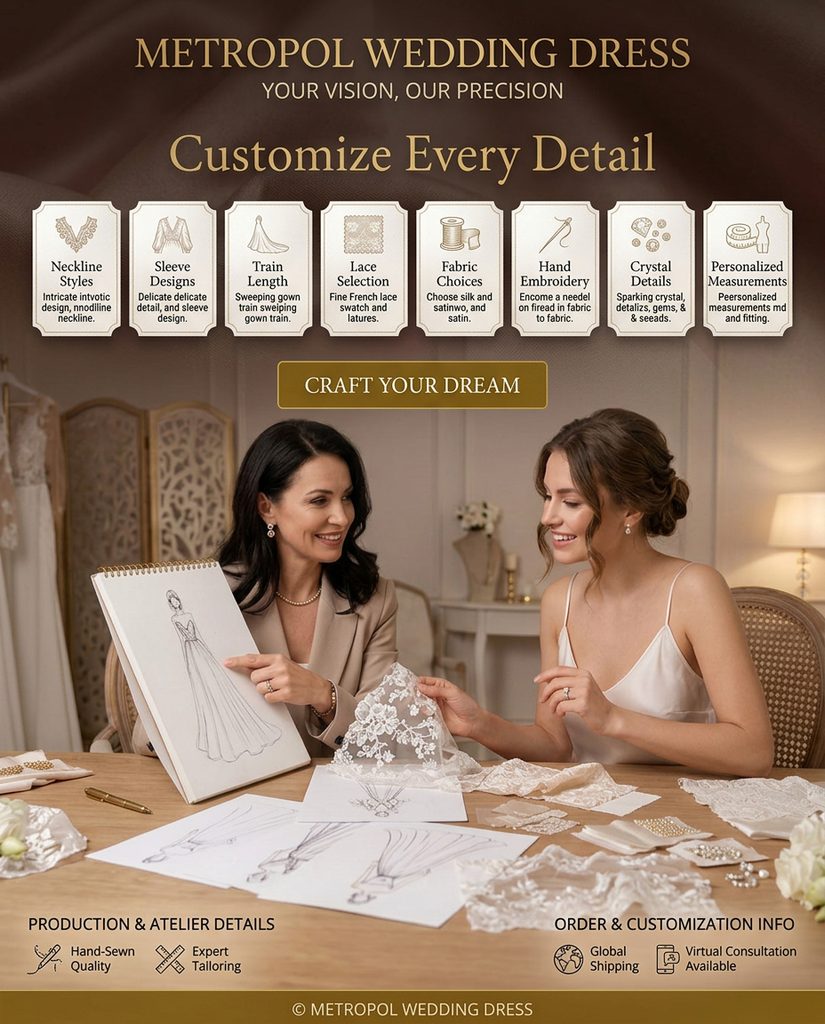
5. The Soft Bohemian Gown
This concept can use:
- lightweight layers
- soft tulle
- flowing skirts
- organic floral motifs
- relaxed sleeves
- subtle texture
The key is to avoid making “bohemian” synonymous with shapeless.
A well-designed bohemian gown still needs proportion.
6. The Modern Princess
Instead of excessive decoration, use volume as the statement.
Possible details:
- sculptural skirt
- fitted corset
- clean neckline
- dimensional tulle
- long train
- understated bodice
This creates drama through silhouette rather than ornament.
7. The Second-Look Bridal Dress
A bride may want one gown for the ceremony and something lighter for the evening.
A retailer can therefore develop a coordinated capsule:
ceremony + reception + civil look.
The dresses do not need to be identical.
They simply need a visual relationship.
8. The Sleeve Collection
Sleeves are a particularly useful customization category.
A core gown can be offered with:
- long lace sleeves
- detachable puff sleeves
- sheer sleeves
- fitted sleeves
- off-shoulder sleeves
- cape sleeves
- short sleeves
The same base silhouette can therefore serve different preferences.
9. The Contemporary Mermaid
The classic mermaid silhouette can be reinterpreted with:
- cleaner seams
- modern neckline construction
- architectural corsetry
- detachable overskirt
- minimalist embellishment
The objective is to make a familiar silhouette feel current rather than simply reproducing an established style.
10. The Couture Floral
Three-dimensional flowers can become the focal point.
Instead of scattering flowers randomly, use them to control the visual direction of the gown.
For example:
- concentrated around one shoulder
- flowing diagonally across the bodice
- beginning at the waist and extending into the skirt
- framing the neckline
- appearing progressively through the train
11. The Pearl Detail Gown
Pearls can provide texture without the reflective intensity of heavy crystal.
They can be applied to:
- straps
- neckline
- bodice
- buttons
- veil
- cuffs
- train
12. The Quiet Luxury Bridal Gown
This concept focuses on fabric quality, fit and construction rather than visible decoration.
It may use:
- satin
- silk-look fabrics
- high-quality crepe
- mikado-style materials
- structured organza
- clean corsetry
The design needs to be extremely precise because minimal gowns leave little room for construction errors.
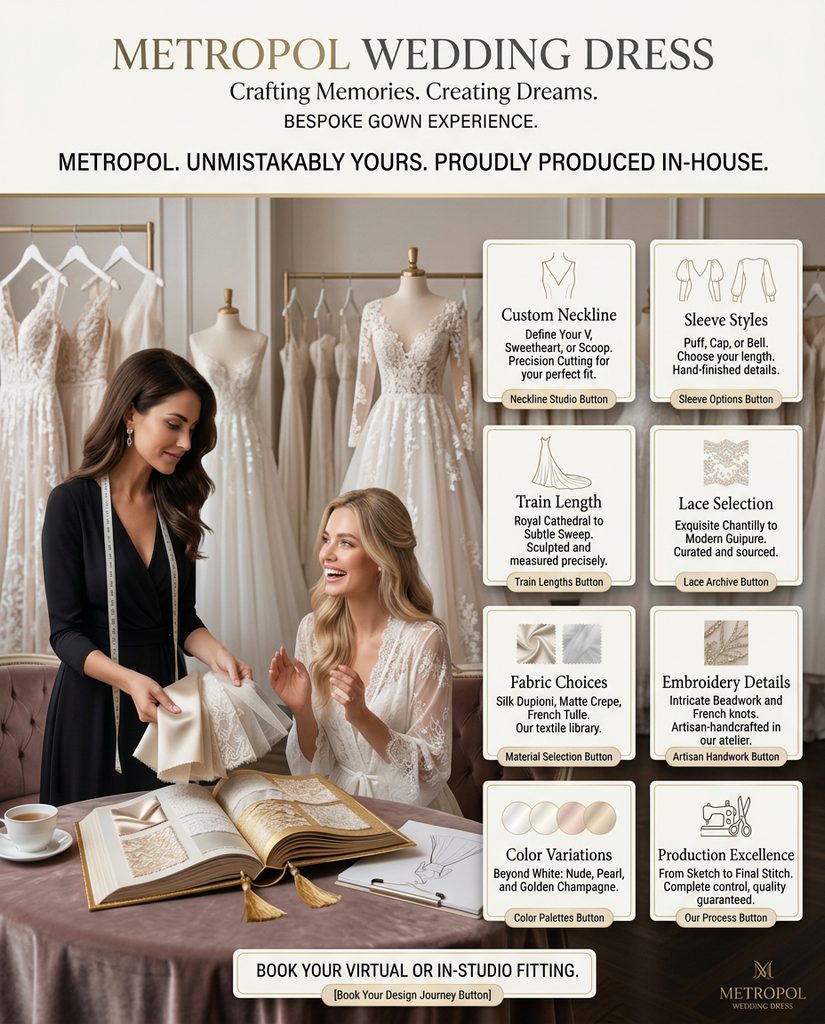
A Better Way to Build a Custom Bridal Collection
A common mistake is to ask a manufacturer to develop twenty completely unrelated dresses.
That creates unnecessary complexity.
A stronger strategy is to create a design architecture.
Imagine a collection with:
- 4 core bodices
- 4 skirt structures
- 3 sleeve systems
- 3 neckline families
- 4 embellishment directions
- 3 train options
The retailer can create many combinations without reinventing the entire product-development process each time.
This approach creates what could be called a modular bridal collection.
The commercial advantage is significant.
Instead of thinking:
“We need another dress.”
The purchasing team can ask:
“Which existing design platform can be extended into a new customer segment?”
That is a much more efficient way to manage a bridal assortment.
From Moodboard to Production: What a Manufacturer Actually Needs
A beautiful Pinterest board is not a technical specification.
When a retailer approaches a Custom Wedding Dress Manufacturer, the quality of the brief determines how efficiently the idea can become a real garment.
A useful design brief should include as many of the following as possible:
Design identity
- reference images
- sketches
- front view
- back view
- side view
- silhouette description
- target customer
- intended retail positioning
Construction information
- neckline
- bodice structure
- closure
- boning requirements
- cup construction
- skirt volume
- train length
- lining
- internal support
Material information
- preferred fabric
- lace reference
- tulle type
- lining
- embellishment
- buttons
- trims
Fit information
- base size
- size range
- key measurements
- intended ease
- fitting priorities
- alteration requirements
Commercial information
- target wholesale price
- target retail price
- expected order quantity
- intended market
- desired production frequency
The more clearly these factors are defined, the fewer assumptions have to be made during sampling.
What “Bespoke” Should Mean in a Professional Bridal Business
The word bespoke is powerful, but it is often used too loosely.
For a retailer, it helps to define exactly what is being customized.
A true Bespoke Wedding Dress Manufacturer should be able to work from a design concept rather than merely offering a selection of pre-existing styles.
Likewise, a Bespoke Bridal Gown Manufacturer relationship may involve development of a particular silhouette, construction method, fabric combination or finish.
But bespoke does not automatically mean that every dress must be created from zero.
In commercial bridal, there is a spectrum.
Existing design → personalized design → modified design → made-to-measure → fully bespoke.
A smart retailer can operate across that spectrum.
This is often more profitable than offering only one extreme.
Material Selection: The Hidden Economics of a Wedding Dress
The visual appearance of a wedding dress is only one part of its material strategy.
The material affects:
- drape
- weight
- movement
- comfort
- durability
- transparency
- alteration potential
- construction time
- shipping weight
- final wholesale cost
- retail positioning
Two fabrics can produce a similar photograph but behave completely differently on the body.
That matters.
A heavy embellished gown may look spectacular on a mannequin but become uncomfortable during a long wedding day.
A very soft fabric may move beautifully but require additional structural support.
A highly structured fabric may create a dramatic silhouette but demand precise pattern engineering.
Fabric Families Worth Considering
Crepe
Crepe is often associated with clean, modern bridal aesthetics.
It can work particularly well for:
- fitted gowns
- column dresses
- minimalist styles
- sophisticated civil ceremony looks
Its relatively clean surface means fit becomes especially important.
Satin
Satin creates a polished, luminous appearance.
It is suitable for:
- classic gowns
- structured skirts
- modern ballgowns
- elegant minimalist designs
However, shiny surfaces can emphasize wrinkles and construction irregularities.
Tulle
Tulle is useful for:
- layered skirts
- veils
- sleeves
- overlays
- soft volume
Different weights and structures produce dramatically different results.
Lace
Lace is not simply a decorative material.
It can define the identity of an entire collection.
The pattern, scale, direction and placement influence whether a gown feels:
- romantic
- vintage
- botanical
- modern
- luxurious
- delicate
- dramatic
Mikado-Style Structured Fabrics
These are useful when the silhouette itself needs to make a statement.
They can support:
- sculptural skirts
- architectural bows
- dramatic folds
- clean ballgowns
Organza
Organza can introduce structure while maintaining lightness.
It can be particularly effective for:
- sleeves
- overlays
- bows
- structured skirts
- architectural details
The Most Important Technical Question: Can the Dress Be Altered?
A bridal gown is rarely sold as the final physical fit straight from production.
Alterations are part of the retail ecosystem.
That means a commercially intelligent gown should be designed with alteration pathways in mind.
Consider:
- side seams
- center-back construction
- waist adjustments
- hem allowance
- sleeve alteration
- bust modification
- train adjustment
- closure accessibility
A design that is visually perfect but difficult to alter can create problems for both the retailer and bride.
This is one reason a technically experienced Made to Measure Wedding Dress Manufacturer can bring significant value to a boutique.
The manufacturer should understand that the garment will eventually enter an alteration workflow.
Made-to-Measure vs Made-to-Order
These terms are related but should not be treated as interchangeable.
Made-to-measure focuses primarily on adapting the garment to specified measurements.
Made-to-order focuses primarily on producing the garment in response to an order rather than relying exclusively on pre-produced stock.
A Made to Order Wedding Dress Manufacturer can therefore support a boutique that wants to reduce unnecessary finished inventory.
Meanwhile, a made-to-measure model may be especially attractive when the retailer wants greater fitting personalization.
The two systems can also coexist.
Why Private Label Can Be More Powerful Than a Generic Collection
A bridal shop does not necessarily want its customers to recognize the same dress in another boutique across town.
That creates a strong commercial argument for private-label development.
A Private Label Wedding Dress Manufacturer can help a retailer build a collection under its own brand identity, subject to the agreed production and intellectual-property framework.
Private-label development becomes more valuable when the boutique has:
- a defined visual identity
- an established customer segment
- a strong retail story
- a clear price architecture
- repeat purchasing potential
The objective is not simply to remove another company’s label.
The objective is to create brand-owned product differentiation.
OEM Bridal Manufacturing: When the Retailer Wants Product Control
OEM is particularly relevant for businesses that have a clear product concept but need manufacturing capability.
A Wedding Dress OEM Supplier may work from buyer-provided specifications, designs or technical directions.
For bridal businesses, OEM development can include:
- custom silhouettes
- specific materials
- branded labels
- packaging requirements
- design modifications
- production specifications
Similarly, a Bridal Gown OEM Supplier relationship can support specialized bridal collections where the buyer owns or controls the product concept.
The critical issue is documentation.
A professional OEM workflow should clarify:
- Who supplies the design?
- Who approves the pattern?
- Who approves the sample?
- Who owns the final design?
- What happens if the material becomes unavailable?
- How are changes documented?
- What quality standards apply?
- How are production variations handled?
These questions belong in the purchasing conversation before mass production.
Custom Manufacturing for Dutch Bridal Boutiques
A boutique has different requirements from a large fashion retailer.
A bridal shop may need:
- smaller development quantities
- more fitting flexibility
- unusual size requests
- customization options
- sample gowns
- exclusive styles
- faster communication
- consistent repeat production
That is why a Wedding Dress Manufacturer for Boutiques should understand the operational reality of bridal retail.
The boutique does not sell garments like a supermarket sells standardized products.
The sales consultant may spend an hour or more helping a bride find the right silhouette.
The fitting room is part of the sales process.
The emotional experience is part of the product.
And the final alteration is part of the supply chain.
Bridal Shops Need Different Manufacturing Support
A Bridal Gown Manufacturer for Bridal Shops should therefore think beyond production alone.
The useful manufacturing relationship connects:
design → sample → fitting → feedback → revision → production → delivery → alteration.
If communication breaks down at any stage, the retailer absorbs the consequences.
For that reason, purchasing managers should evaluate manufacturers on communication quality as carefully as they evaluate photographs of dresses.
A Practical Buyer Scorecard
When evaluating a potential supplier, use a structured scorecard rather than relying on visual impressions.
| Evaluation Area | Questions to Ask |
|---|---|
| Design Development | Can the supplier interpret original concepts? |
| Sampling | How are sample changes documented? |
| Materials | Can materials be specified and approved? |
| Construction | Is internal structure clearly engineered? |
| Fit | Can patterns be adjusted systematically? |
| Customization | Which components can be modified? |
| Quality | What inspection process is used? |
| Repeatability | Can approved samples be reproduced consistently? |
| Branding | Can private-label requirements be supported? |
| Packaging | Can buyer-specific packaging be arranged? |
| Export | Is international shipping experience available? |
| Communication | Who handles technical questions? |
| Commercial Model | Are pricing and quantity requirements clear? |
The goal is not to find the supplier with the longest list of promises.
It is to find the supplier whose process matches your business model.
Custom Wedding Dress Wholesale: Think in Collections, Not Isolated Units
Wholesale custom bridal becomes much more interesting when the retailer thinks in terms of collection architecture.
A Custom Wedding Dress Wholesale program might contain:
- core silhouettes
- statement gowns
- lightweight gowns
- civil ceremony styles
- convertible designs
- accessory options
A Custom Bridal Gown Wholesale strategy can then create different price tiers without making the entire collection feel disconnected.
For example:
Entry bridal
Simple silhouettes with limited embellishment.
Core collection
More sophisticated construction and material combinations.
Premium collection
More elaborate detailing, complex construction and luxury finishing.
Couture capsule
Highly distinctive designs produced in limited quantities.
This structure gives a retailer room to serve different customer budgets while maintaining brand consistency.
Wholesale Custom Wedding Dresses: The Range Strategy
A common mistake is building a collection around what looks impressive on a supplier’s catalogue.
A retailer should instead examine the actual sales mix.
Ask:
- Which silhouettes sell repeatedly?
- Which sizes require more fitting flexibility?
- Which fabrics photograph best?
- Which gowns generate appointments?
- Which gowns produce accessories sales?
- Which styles are easy to alter?
- Which designs have high perceived value relative to production cost?
This is where bridal purchasing becomes closer to merchandising than simple procurement.
Wholesale Custom Bridal Gowns and Inventory Risk
Custom manufacturing can reduce some inventory problems, but it does not eliminate risk.
A retailer still needs to consider:
- sample investment
- development costs
- unsold samples
- fabric availability
- production minimums
- seasonal demand
- wedding calendar cycles
- storage
- working capital
The best approach is often a hybrid.
Keep proven sample silhouettes in-store.
Use custom options to expand the virtual assortment.
Develop made-to-order variants for lower-volume preferences.
Use bespoke development selectively for high-value customers or exclusive collections.
Custom Bridal Wear as a Complete Category
The opportunity extends beyond the main wedding gown.
A Custom Bridal Wear Manufacturer can potentially support a broader bridal wardrobe concept.
Consider:
- rehearsal dinner dresses
- civil ceremony dresses
- reception dresses
- after-party dresses
- bridal capes
- overskirts
- detachable sleeves
- veils
- flower-girl dresses
- coordinated accessories
This creates opportunities to increase the average value of each bridal customer without forcing the retailer to sell a second unrelated brand.
The Case for a Bespoke Bridal Wear Program
A Bespoke Bridal Wear Manufacturer relationship can also support premium clients who want something outside the standard collection.
Instead of saying:
“We don’t have anything like that.”
the boutique can say:
“Let’s explore how we can develop it.”
That changes the sales conversation.
The customer is no longer choosing only from inventory.
She is participating in product creation.
For premium bridal retail, that can be a powerful differentiator.
Couture Is a Process, Not a Price Tag
The term couture is often used as a synonym for expensive.
Technically, that is an incomplete way to understand couture.
A Bridal Couture Manufacturer should be associated with a higher level of design development, construction attention and finishing rather than simply a higher retail price.
Couture development may involve:
- hand-applied details
- intricate pattern work
- complex draping
- sculptural construction
- individually positioned appliqués
- special corsetry
- labor-intensive finishing
A retailer should therefore decide what “couture” means for its own collection before using the term commercially.
Handmade and Handcrafted Bridal Production
Not every gown needs to be completely handmade to benefit from hand-finishing.
A Handmade Wedding Dress Manufacturer may incorporate manual processes into selected stages of development and production.
Similarly, a Handcrafted Bridal Gown Manufacturer can add value through details such as:
- hand-positioned lace
- hand-applied beads
- floral appliqués
- embroidery
- finishing work
- individually arranged embellishment
The purchasing question should be:
Which hand-finishing steps create enough perceived value to justify their production cost?
That question protects the retailer from paying for craftsmanship that customers cannot see or appreciate.
Tailor-Made Bridal Design
The phrase “tailor-made” communicates individual attention.
A Tailor Made Wedding Dress Manufacturer can be particularly relevant when a retailer wants to offer personalized construction around a specific bride.
Likewise, a Tailor Made Bridal Gown Manufacturer can support high-touch boutique services where the final garment is developed around measurements and design preferences.
This model works best when the retailer has staff who can gather accurate measurements and communicate clearly with the production team.
One-of-a-Kind Does Not Have to Mean Operational Chaos
A One of a Kind Wedding Dress Manufacturer can help create unique pieces, but uniqueness still benefits from process control.
A one-off gown should have:
- a documented design
- approved materials
- measurement information
- construction notes
- sample references
- fitting feedback
- final approval
The more unusual the design, the more important documentation becomes.
Otherwise, every revision becomes a new interpretation.
Exclusive Bridal Collections
An Exclusive Bridal Gown Manufacturer relationship can be valuable when a retailer wants to create designs that are not part of a general catalogue.
Exclusivity should be defined carefully.
It may refer to:
- a specific design
- a geographical market
- a period
- a customer segment
- a particular retailer
- a collection
These conditions should be agreed commercially rather than assumed.
For a Dutch boutique, regional exclusivity can be especially attractive when the retailer’s brand depends on offering styles customers cannot easily find elsewhere.
How to Design for the Netherlands
The Netherlands should not be treated as simply another destination market.
A retailer serving Dutch brides should consider the local wedding environment, retail habits, climate, venues and cultural diversity.
Weather can influence styling.
Seasonality can influence sleeve and layering demand.
Civil ceremonies can influence the importance of shorter or more understated looks.
Urban weddings may favor contemporary minimalism.
Country or outdoor venues can create demand for lighter, movement-friendly gowns.
Religious or family traditions may increase interest in coverage options.
None of these should become rigid assumptions.
The important lesson is to build a flexible collection.
A Dutch Bridal Collection Could Be Built Around Three Moments
One useful merchandising framework is:
The Ceremony
Prioritize:
- elegant silhouettes
- train options
- structured bodices
- statement details
- photography impact
The Transition
Prioritize:
- detachable components
- lighter overskirts
- sleeves
- capes
- adaptable styling
The Celebration
Prioritize:
- mobility
- comfort
- lighter construction
- shorter silhouettes
- reception dresses
This creates a bridal wardrobe rather than a single-product sale.
The Climate Question
The Netherlands has a climate where comfort and layering can become relevant.
A bridal collection does not need to become “weather-proof.”
Instead, manufacturers and retailers can design adaptable components.
Examples:
- detachable sleeves
- bridal jackets
- capes
- boleros
- overskirts
- lined bodices
- removable trains
These accessories can also become high-margin additions to the bridal sale.
Design for Photography and Real Life
A gown must work in photographs.
But it must also work in motion.
A dress can look spectacular from the front and disappoint from the back.
It can photograph beautifully but feel heavy.
It can look luxurious under studio lighting but lose its character in natural daylight.
For that reason, product development should examine at least four perspectives:
front + back + side + movement.
The movement test is particularly valuable.
Ask:
- Can the bride walk comfortably?
- Can she sit?
- Can she dance?
- Can she enter a vehicle?
- Can she use the restroom reasonably easily?
- Does the train recover after movement?
- Does the bodice remain stable?
These are not secondary questions.
They affect the actual wedding experience.
A Technical View of Bridal Fit
Fit is not simply a matter of measurements.
A wedding dress has multiple interacting structures.
For example:
bust support → waist placement → hip position → skirt release → train balance.
If one component is wrong, the rest can appear wrong.
A fitted bodice may need:
- internal boning
- cup support
- waist stay
- structured lining
- appropriate seam placement
A strapless gown requires particular attention to internal support because the garment cannot rely on shoulder straps.
A deep-back gown creates different engineering challenges.
A low neckline changes the balance of the bodice.
A large skirt changes the weight distribution.
A professional manufacturer should therefore approach the gown as a technical garment, not merely a decorative one.
Construction Quality: What Retail Buyers Should Inspect
When a sample arrives, do not inspect only the exterior.
Turn the gown inside out.
Look at:
- seam finishing
- lining
- boning
- closures
- waist construction
- internal support
- hem finishing
- lace attachment
- stitching consistency
- embellishment security
The inside of a bridal gown often tells the buyer more about manufacturing discipline than the front photograph.
The Sample Approval Process
A professional custom program should establish clear approval stages.
Stage 1: Concept
The design direction is agreed.
Stage 2: Technical interpretation
The manufacturer converts the concept into construction details.
Stage 3: First sample
The first physical version reveals practical problems.
Stage 4: Fitting review
The retailer examines proportion, fit and movement.
Stage 5: Revision
Corrections are documented.
Stage 6: Final approval
The approved sample becomes the production reference.
Stage 7: Production
The garment is produced according to the approved specifications.
This sequence reduces ambiguity.
What to Photograph During Sample Approval
A buyer can create a simple digital approval file containing:
- front
- back
- side
- neckline close-up
- bodice inside
- seam details
- hem
- embellishment
- closure
- label position
Written comments should identify exact locations.
Instead of:
“The waist looks wrong.”
Use:
“Raise waist seam approximately 1 cm at center front and maintain the side-seam proportion.”
Specific feedback is easier to implement.
Five Mistakes That Can Destroy a Custom Bridal Project
Mistake 1: Starting With a Photograph Only
A reference image does not contain all the information required for production.
Mistake 2: Ignoring the Target Retail Price
A beautiful design is not commercially useful if the production economics make the final retail price unrealistic.
Mistake 3: Changing Materials Without Re-testing
A different fabric can change drape, weight, construction and fit.
Mistake 4: Approving Samples Too Quickly
The first sample is often a learning stage.
Mistake 5: Failing to Define Ownership and Exclusivity
A retailer investing in original development should understand the commercial rights associated with the finished design.
Where Complexity Comes From
Consider two dresses.
Dress A
- clean crepe
- simple neckline
- standard lining
- minimal train
- limited embellishment
Dress B
- corset structure
- layered tulle
- lace appliqué
- hand embellishment
- detachable sleeves
- long train
- intricate back closure
Even if both use similar amounts of fabric, Dress B requires substantially more production attention.
A buyer should therefore evaluate complexity per unit, not only material consumption.
A Useful Commercial Formula
For internal planning, a retailer can think about:
Retail Price – Wholesale Cost – Alteration Cost – Selling Cost = Contribution Potential
Then compare that with:
Expected Units × Contribution Potential
This helps determine whether a complicated custom design deserves a permanent place in the collection.
A spectacular gown that sells once may be useful as a showroom statement.
A simpler gown that sells repeatedly may be the stronger commercial product.
Both can have a place.
Premium vs Luxury Positioning
Premium and luxury should not be confused.
A premium wedding dress may justify a higher price through:
- superior fabric
- better fit
- stronger construction
- distinctive design
- better finishing
Luxury may additionally involve:
- rarity
- exclusivity
- exceptional craftsmanship
- highly personalized service
- limited production
- couture-level development
A Premium Wedding Dress Manufacturer should therefore understand the relationship between quality and perceived value.
A Premium Bridal Gown Manufacturer can support a collection that sits above mainstream bridal without necessarily becoming fully couture.
Direct Manufacturing and the Supply Chain
Buying closer to the manufacturer can simplify certain parts of the supply chain, but “direct” should not automatically be interpreted as “better.”
A Direct Wedding Dress Manufacturer relationship is valuable when communication, quality, development and commercial terms are transparent.
Likewise, a Direct Bridal Gown Manufacturer can provide advantages when the buyer wants direct communication about:
- product development
- materials
- sampling
- production
- quality
- packaging
- shipping
The real value is not the word “direct.”
It is reduced communication distortion.
International Bridal Manufacturing
A retailer in the Netherlands may work with suppliers in multiple countries.
The right partner needs to understand that international production involves more than manufacturing.
An International Wedding Dress Manufacturer should be comfortable with the realities of cross-border business, including:
- product specifications
- packaging
- commercial documentation
- shipment coordination
- communication across time zones
- repeat production
- quality expectations
An experienced Wedding Dress Exporter should also understand that export logistics form part of the customer experience.
If delivery is late, the bride does not care whether the cause was production, packing or transport.
The retailer owns the problem in the customer’s eyes.
Working With a Bridal Gown Exporter
A Bridal Gown Exporter relationship should therefore be evaluated on reliability and process clarity.
Before placing an order, clarify:
- production timeline
- sample approval requirements
- packing method
- shipment responsibility
- documentation
- delivery terms
- claims procedure
- replacement policy
- communication procedure
Do not leave these issues to assumptions.
A Practical Custom Wedding Dress Development Workflow
Here is a compact workflow that can be used by a bridal buyer.
1. Define customer
Who is the gown for?
2. Define commercial position
What should the finished product sell for?
3. Define silhouette
What is the primary shape?
4. Define materials
Which fabric and trims are essential?
5. Define customization
Which elements must remain flexible?
6. Create technical brief
Document measurements and construction.
7. Develop sample
Build the first physical interpretation.
8. Fit and test
Check body, movement and proportions.
9. Revise
Document every change.
10. Approve
Freeze the production specification.
11. Produce
Manufacture against the approved reference.
12. Inspect
Verify construction and appearance.
13. Deliver
Coordinate international logistics.
14. Collect retail feedback
Use customer response to improve the next collection.
How Metropol Wedding Dress Can Fit Into This Model
For a brand such as Metropol Wedding Dress, the most compelling positioning is not simply “we make wedding dresses.”
The stronger proposition is the ability to participate in the buyer’s product-development process.
Depending on the agreed manufacturing model, that can mean supporting:
- original design concepts
- customized silhouettes
- made-to-order programs
- boutique collections
- private-label development
- wholesale bridal ranges
- OEM projects
- premium bridal capsules
- export-oriented collections
The exact service scope, minimum quantities, materials and production conditions should always be confirmed directly for each project.
That transparency is more valuable than making broad promises.
Five Collection Concepts a Dutch Boutique Could Develop
Collection A: Amsterdam Minimal
A modern city bridal collection.
Think:
- clean crepe
- square necklines
- sculptural bows
- detachable trains
- minimalist backs
- architectural sleeves
The emotional language is confident rather than traditional.
Collection B: Dutch Garden
A romantic collection inspired by botanical forms.
Think:
- floral appliqué
- soft tulle
- delicate lace
- three-dimensional flowers
- flowing trains
- nature-inspired details
Collection C: Civil & Chic
A collection for city-hall ceremonies and intimate celebrations.
Think:
- midi
- mini
- column
- jumpsuit-inspired forms
- tailored jackets
- removable skirts
Collection D: Modern Romance
A bridge between traditional bridal and contemporary design.
Think:
- corsetry
- soft lace
- sculptural sleeves
- fitted silhouettes
- restrained embellishment
Collection E: Couture Statement
A limited premium capsule.
Think:
- architectural volume
- hand-applied details
- dramatic trains
- distinctive necklines
- unusual proportions
This collection should be intentionally small.
Its role is to create brand prestige rather than volume alone.
A Retailer’s “Should We Customize This?” Test
Before requesting a new custom design, ask seven questions:
- Does the customer already want something like this?
- Does the design fill a genuine gap in the collection?
- Can it be manufactured consistently?
- Can it be altered?
- Does the target retail price make sense?
- Can the design be photographed and merchandised effectively?
- Could the concept be extended into other products?
If most answers are yes, the idea deserves development.
The Information-Gain Principle in Bridal Buying
A useful custom-manufacturing partner should reduce uncertainty.
After speaking with the manufacturer, the buyer should know more about:
- what can be produced
- what needs modification
- what affects cost
- what affects fit
- what affects lead time
- what materials are practical
- what needs a sample
- what should not be changed after approval
If every conversation produces more ambiguity, the relationship will become expensive even if the initial product price looks attractive.
The Bridal Sample Is a Business Asset
A sample gown is not merely a dress hanging in a showroom.
It performs several jobs.
It:
- attracts customers
- communicates brand identity
- demonstrates fit
- generates appointments
- creates social-media content
- helps stylists sell variations
- provides a physical production reference
Therefore, sample selection should be strategic.
Choose gowns that demonstrate your manufacturing capability and create multiple sales conversations.
How One Sample Can Generate Multiple Products
Imagine a fitted crepe gown.
The base design could potentially become:
- sleeveless
- long sleeve
- lace sleeve
- detachable overskirt
- train version
- clean version
- embellished version
Instead of purchasing six completely unrelated sample dresses, the retailer develops one strong platform and demonstrates variations through visual merchandising, customization options and technical development.
That is a more scalable approach to collection building.
Related Topics
27.03.2026
Best Places to Shop Custom Wedding Dresses in the USA Finding the perfect wedding dress is one of the most emotional and meaningful parts of wedding planning. In 2026, more brides than ever are choosing...
11.02.2026
Robe de Mariée Luxe Sur Mesure L’Élégance Haute Couture Venue de Turquie Découvrez tout sur la Robe de Mariée Luxe Sur Mesure : tendances, tissus nobles, processus de création personnalisé, conseils d’experts et raisons d’investir...
19.08.2022
The world of affordable wedding dress designers is a tapestry woven with creativity, craftsmanship, and a deep understanding of the bride’s dreams. Wedding dress designers play a pivotal role in shaping the bridal fashion landscape,...

28.09.2025
Warum immer mehr Bräute in Deutschland türkische Brautkleider bevorzugen In einer Zeit, in der Hochzeiten nicht nur ein privates Fest, sondern ein Statement der Individualität und kulturellen Vielfalt sind, gewinnen türkische Brautkleider in Deutschland an...
15.06.2024
Turkish Wedding Dress For Groom Best 7 Men attending a Turkish wedding typically wear formal attire. This usually includes a dark suit, a dress shirt, and a tie. The style can vary from a classic...
07.06.2024
Nova Bella Bridal Abdi İpekci Showroom Bridal The most common type of wedding dress can vary depending on cultural norms, trends, and personal preferences, but traditionally, the white gown is the most popular choice in...
Comments