
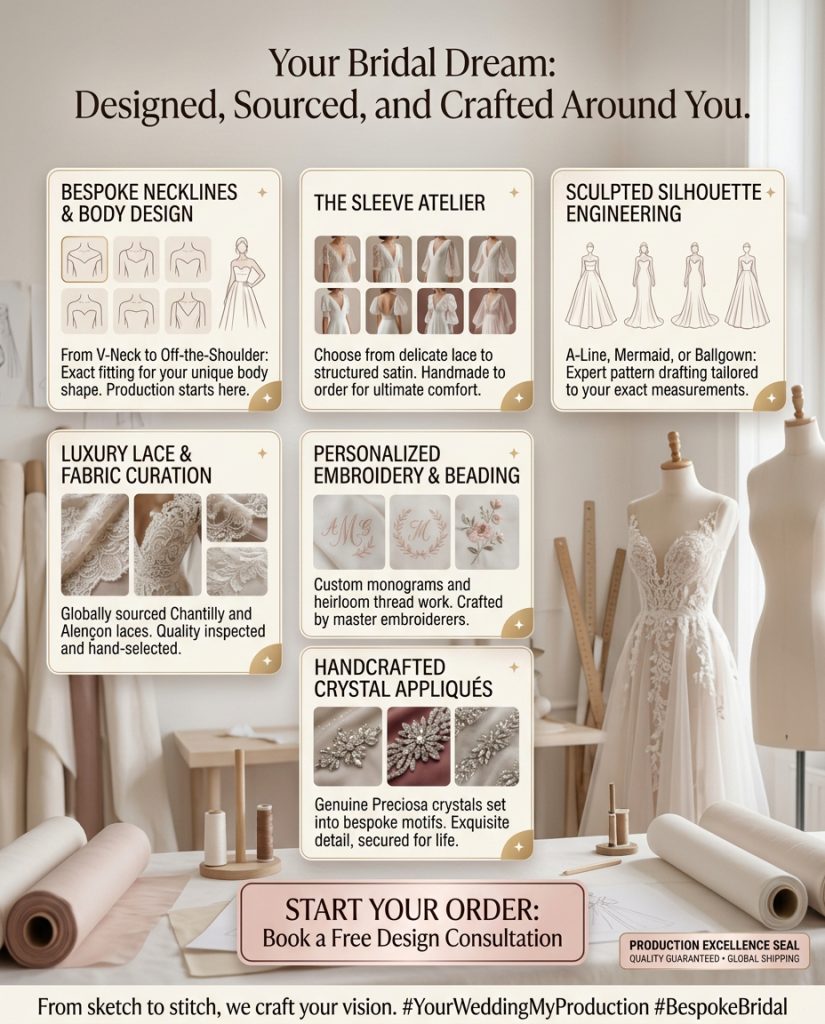
Custom Wedding Dresses Netherlands Models The Dutch bridal market is moving toward a more personal definition of luxury. Brides increasingly want wedding dresses that reflect their own proportions, personality, ceremony format and lifestyle rather than simply choosing a standard sample from a crowded rail. For bridal boutiques, this creates an equally important business opportunity: custom wedding dresses can become a product strategy, not merely a tailoring service.
For a buyer in the Netherlands, however, choosing a supplier is more complicated than finding attractive bridal models. The right partner needs to understand fit, fabric behavior, production consistency, sampling, grading, lead times, packaging, labeling, quality control, wholesale economics and the difference between a beautiful prototype and a repeatable commercial collection.
This guide examines custom wedding dress models from that practical perspective.
It explains how Dutch bridal retailers can build a commercially viable custom collection, which silhouettes and construction approaches are worth developing, when to choose made-to-measure versus made-to-order, how private-label and OEM programs work, how to evaluate a manufacturer, which mistakes create hidden costs, and how to structure a collection that looks exclusive without becoming operationally difficult.
For Metropol Wedding Dress, the objective is straightforward: help bridal boutiques, bridal shops, designers, wholesalers and international buyers turn custom bridal concepts into a more organized, scalable product program.
Custom Wedding Dresses Netherlands: Why the Model Matters More Than the Trend
A wedding dress is often discussed as if it were a single product.
For a bridal business, it is not.
A wedding dress is simultaneously:
- a silhouette;
- a construction system;
- a fitting experience;
- a fabric decision;
- a production specification;
- a retail proposition;
- a margin calculation;
- a delivery commitment;
- and, ultimately, part of the bride’s memory of her wedding day.
That distinction becomes particularly important when selling custom wedding dresses in the Netherlands.
A boutique buyer is not simply asking:
“Is this dress beautiful?”
The more useful questions are:
Can I sell this model at my target retail price?
Can my seamstress work with it?
Can the manufacturer reproduce it accurately?
Can I reorder it six months from now?
Can I modify the neckline without redesigning the entire garment?
Will the fabric photograph as beautifully in daylight as it does in a showroom?
Can the same construction be adapted to different body proportions?
Does the supplier understand the difference between a showroom sample and production quality?
This is where custom bridal manufacturing becomes a strategic discipline.
The Netherlands has a sophisticated retail environment in which brides can encounter everything from large bridal stores to highly curated independent boutiques. Current Dutch bridal coverage also points toward greater personalization, minimalist styling, couture details, corsetry, distinctive necklines, two-piece concepts and designs that feel less conventional. In other words, the commercial opportunity is not necessarily to create “more dresses.” It is to create better differentiated dresses.
Custom Wedding Dresses Netherlands Models
The ideal collection is distinctive enough for the bride to remember it, yet structured enough for the retailer and manufacturer to reproduce it consistently.
That is the central idea behind a successful custom wedding dress program.
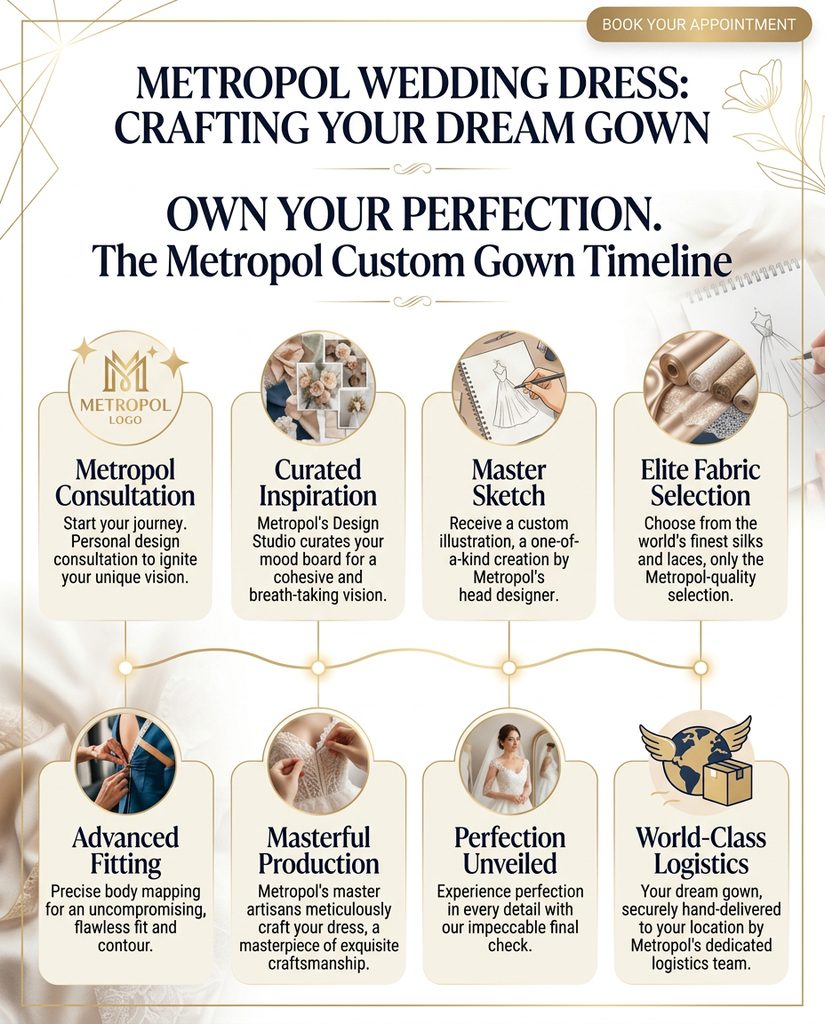
1. What “Custom” Should Mean in a Dutch Bridal Collection
The word custom is used too loosely in the wedding industry.
A dress can be called custom even when the customer is only choosing a standard size and requesting a minor alteration.
A serious custom program goes further.
There are at least five commercially different levels.
| Level | What changes? | Typical business use |
|---|---|---|
| Standard collection | Nothing except retail alterations | High-volume bridal retail |
| Customizable model | Neckline, sleeves, train, color or detail can change | Boutique differentiation |
| Made-to-order | Model is produced after the order | Reduced finished-stock risk |
| Made-to-measure | Pattern and measurements are adapted to the bride | Premium service |
| Bespoke | Design and construction are developed specifically for the client | Couture / luxury positioning |
This distinction matters because each level creates a different workload.
A boutique that promises every bride a completely new design may create an impressive sales experience but an extremely difficult production system.
A smarter approach is often controlled customization.
For example, a boutique could offer one base A-line model with:
- three neckline options;
- two bodice constructions;
- three sleeve options;
- two train lengths;
- several lace placements;
- two lining colors;
- and a choice of detachable overskirts.
The customer experiences a highly personalized dress.
The manufacturer, however, is working from an organized product architecture.
That is a much more sustainable model.
2. The Dutch Bride Is Not One “Type”
One of the most common mistakes in international bridal product development is assuming that a national market has one aesthetic.
The Netherlands does not have one bridal customer.
A boutique in Amsterdam may serve a very different customer from a specialist store in a smaller Dutch city. A luxury bridal salon may prioritize couture construction, while a family-owned bridal shop may prioritize versatility, price-to-quality ratio and reliable delivery.
There may also be substantial differences between:
- civil ceremonies;
- church ceremonies;
- outdoor weddings;
- destination weddings;
- city weddings;
- countryside weddings;
- intimate celebrations;
- large formal receptions;
- multicultural weddings;
- second marriages;
- modern minimalist ceremonies;
- and fashion-led celebrations.
This is why the most effective collection strategy begins with occasion mapping, not with copying runway trends.
A useful Dutch market segmentation
The Minimalist Bride
She may prefer:
- clean satin;
- crepe;
- architectural necklines;
- simple skirts;
- minimal embellishment;
- structured bodices;
- detachable details.
She does not necessarily want a plain dress.
She wants precision.
A minimalist dress has nowhere to hide poor construction. Seam placement, fabric quality, pressing, lining and fit become highly visible.
“You may also want to take a look at this article.”Custom Wedding Dresses Netherlands tips
The Modern Romantic Bride
She may want:
- soft lace;
- transparent sleeves;
- dimensional floral appliqué;
- lightweight tulle;
- subtle sparkle;
- fluid skirts;
- romantic back details.
This segment gives a manufacturer room to demonstrate hand-finishing and fabric placement.
The Couture Bride
This customer often responds to:
- corsetry;
- basque waists;
- sculpted bodices;
- dramatic trains;
- hand-applied lace;
- intricate draping;
- architectural construction;
- unusual sleeves;
- and personalized details.
For a retailer, these designs can support a premium price, but they also require better production discipline.
The Fashion-Conscious Bride
She may be interested in:
- fashion-forward necklines;
- two-piece bridal looks;
- detachable overskirts;
- mini dresses for the reception;
- convertible gowns;
- statement sleeves;
- unusual fabrics;
- contemporary tailoring.
This customer can be especially valuable for a boutique because the product becomes part of the store’s fashion identity.
3. The Custom Wedding Dress Model Library
A useful collection should not simply contain “different dresses.”
It should contain different reasons to buy.
Below is a practical model architecture for a Netherlands-focused custom collection.
Model A: The Clean A-Line
The A-line remains commercially important because it can serve multiple body proportions and wedding environments.
A contemporary version can combine:
- fitted internal corsetry;
- clean satin;
- a softly structured skirt;
- a square neckline;
- detachable straps;
- a modest train;
- and a clean back.
The commercial advantage is flexibility.
The same pattern can become several products.
Change the neckline and it feels different.
Change the fabric and it feels different.
Add lace and it becomes romantic.
Add a detachable overskirt and it becomes editorial.
That is exactly the type of product architecture a purchasing manager should look for.
Model B: The Minimalist Column
The column gown is particularly useful for a modern bridal boutique.
Typical features include:
- crepe or satin;
- body-skimming construction;
- low visual noise;
- clean seams;
- long vertical lines;
- modest train;
- open or sculpted back.
The challenge is fit.
A column silhouette magnifies fitting errors. Wrinkles, tension lines and incorrect bust placement become obvious.
Therefore, when evaluating a manufacturer, the buyer should inspect the inside of the garment rather than only the showroom photographs.
Model C: The Sculpted Mermaid
Mermaid and fit-and-flare models remain valuable for brides seeking a more dramatic silhouette.
A serious production version should consider:
- where the flare begins;
- how much internal structure is required;
- how the skirt releases from the hip;
- how the hem behaves during movement;
- whether the train pulls the gown backward;
- and how the dress is transported and pressed.
A photograph can make a mermaid gown look perfect.
A fitting room reveals whether it actually works.
Model D: The Basque Waist Gown
The basque waist is particularly interesting for a fashion-led custom collection.
It creates a visual transition between traditional bridal couture and contemporary design.
The shape can be paired with:
- corset construction;
- full skirts;
- mikado;
- satin;
- lace;
- minimalist fabrics;
- or detachable overskirts.
For a retailer, the silhouette offers strong visual identity.
For a manufacturer, it demands accurate pattern development because the waistline becomes the visual center of the dress.
Model E: The Soft Bohemian Gown
This model works particularly well when the collection needs a lighter, less formal option.
Potential materials include:
- chiffon;
- soft tulle;
- lace;
- lightweight crepe;
- embroidered mesh.
The risk is making the dress look inexpensive.
Bohemian does not mean under-engineered.
A premium bohemian gown still needs:
- clean finishing;
- carefully selected lace;
- controlled transparency;
- stable seams;
- comfortable lining;
- and deliberate proportions.
Model F: The Modern Ball Gown
The traditional princess silhouette can be reinvented without becoming overly decorative.
Consider:
- clean structured satin;
- sculptural bodice;
- oversized but controlled skirt;
- detachable bow;
- contemporary neckline;
- minimalist embellishment.
The objective is not to remove drama.
It is to modernize the source of the drama.
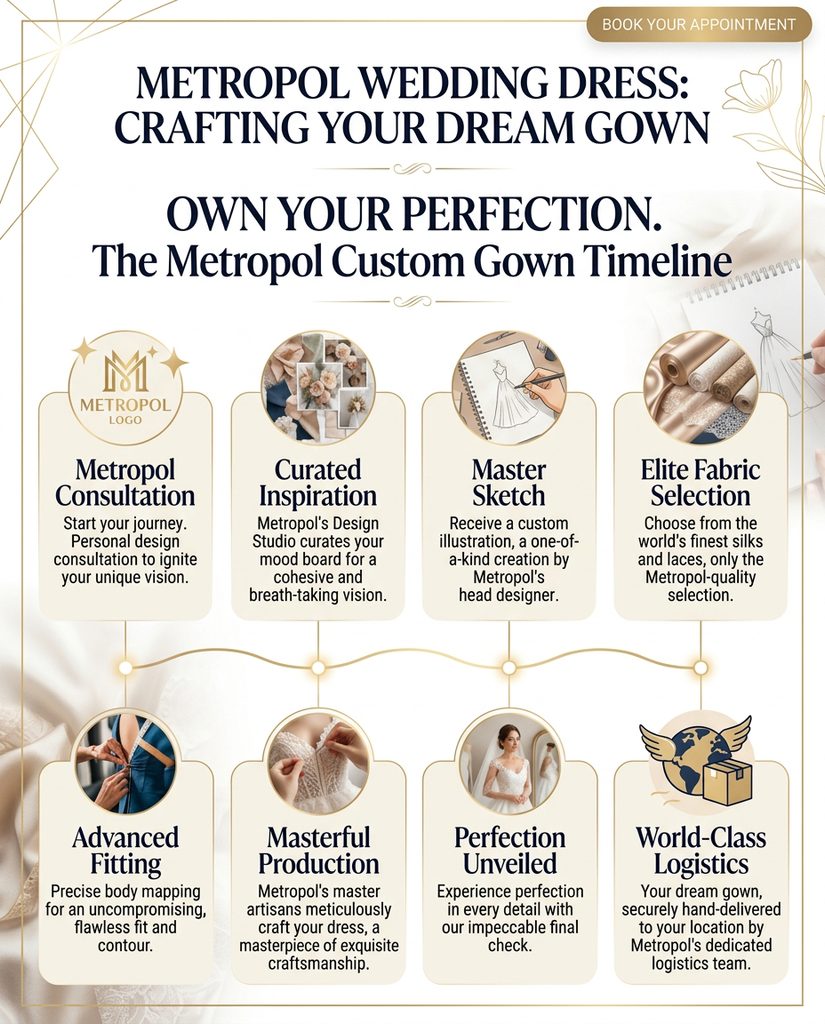
4. A Wedding Dress Is an Engineering Problem Disguised as Fashion
This is one of the most important ideas for buyers.
The visible design is only the outer layer.
Inside the dress is an engineered system.
Consider a structured bodice.
It may involve:
- outer fabric;
- lace or appliqué;
- fusible or stabilizing materials;
- lining;
- boning;
- cups;
- waist tape;
- closures;
- seam reinforcement;
- internal support;
- bust shaping;
- finishing.
If any one of these components is poorly specified, the dress can fail even when the exterior looks beautiful.
This is why a professional Custom Wedding Dress Manufacturer should be evaluated as both a fashion partner and a production partner.
5. Material Selection: The Fabric Changes the Entire Business Model
The fabric is not a decoration.
It influences:
- pattern behavior;
- labor;
- weight;
- shipping;
- pressing;
- fit;
- photography;
- drape;
- durability;
- retail perception;
- and final price.
Satin
Satin can produce a luxury appearance quickly because of its surface reflection.
But that reflection also exposes:
- wrinkles;
- incorrect pressing;
- tension;
- uneven seams;
- and handling marks.
A satin wedding dress therefore requires disciplined finishing.
Crepe
Crepe can create an elegant minimalist appearance and works well for modern silhouettes.
Its commercial strength is that the dress can appear sophisticated without heavy embellishment.
Its challenge is fit.
The smoother and more body-conscious the silhouette, the more important the pattern becomes.
Mikado
Mikado provides structure and a luxurious hand.
It can be effective for:
- ball gowns;
- A-lines;
- sculptural bows;
- basque waists;
- architectural skirts.
Because the fabric has more body, pattern decisions are visible in the final shape.
Tulle
Tulle is exceptionally versatile.
It can create:
- volume;
- transparency;
- softness;
- layered skirts;
- sleeves;
- veils;
- detachable pieces.
But “tulle” is not one material experience.
Different weights, finishes and constructions produce completely different results.
A purchasing manager should ask the manufacturer to specify the actual material rather than accepting generic fabric terminology.
Lace
Lace is where customization can become truly distinctive.
A manufacturer may use:
- floral lace;
- geometric lace;
- embroidered lace;
- beaded lace;
- sequined lace;
- three-dimensional floral lace;
- or custom appliqué arrangements.
But the commercial question is not simply “Which lace looks beautiful?”
It is:
How much labor does this lace require to place, cut, match and finish consistently?
That is where wholesale pricing can change dramatically.
6. Understanding Custom vs. Bespoke vs. Made-to-Measure
These terms should not be treated as interchangeable.
Made-to-Order
The customer selects an existing model.
The manufacturer produces it after receiving the order.
The design stays largely unchanged.
Best for: scalable boutique collections.
Made-to-Measure
The model is adapted to the customer’s measurements.
The pattern or construction may be adjusted according to the measurement set.
Best for: premium bridal retail.
Customized
The base design can be modified.
Examples:
- neckline;
- sleeve;
- back;
- train;
- color;
- embellishment;
- detachable overskirt.
Best for: boutiques seeking differentiation without full bespoke complexity.
Bespoke
The dress is designed around an individual concept.
The customer may participate in:
- design;
- fabric;
- silhouette;
- fitting;
- construction;
- finishing.
Best for: couture and very high-value services.
7. Choosing the Right Manufacturer for a Netherlands Bridal Business
The cheapest quotation is rarely the cheapest solution.
A better purchasing framework considers total commercial cost.
Use this equation:
Total Cost = Product Cost + Sampling Cost + Alteration Cost + Defect Risk + Freight + Delay Risk + Communication Cost + Lost Sales Risk
A supplier with a lower unit price may become more expensive if:
- samples are repeatedly incorrect;
- measurements are misunderstood;
- production dates slip;
- fabrics are substituted without approval;
- sizes are inconsistent;
- or communication requires constant supervision.
The manufacturer should therefore be assessed across several dimensions.
| Evaluation area | What to investigate |
| Design capability | Can they interpret sketches and references? |
| Pattern development | Can they develop or modify patterns? |
| Sample quality | Does the prototype represent production quality? |
| Customization | Which elements can be changed? |
| Materials | Are fabric specifications controlled? |
| Production | Can they repeat approved samples? |
| QC | Is there documented inspection? |
| Packaging | Is the gown protected during transit? |
| Communication | Are specifications confirmed in writing? |
| Lead time | Are milestones defined? |
| Reorders | Can the same model be reproduced? |
| Private label | Can branding and packaging be integrated? |
8. When a Custom Bridal Gown Manufacturer Is the Better Choice
A Custom Bridal Gown Manufacturer becomes especially useful when a boutique has identified a customer profile but cannot find the exact products it needs from conventional collections.
For example:
A Dutch boutique may discover that its customers consistently request:
- simple fronts;
- dramatic backs;
- sleeves that can be removed;
- less heavy beading;
- comfortable internal structure;
- longer sample lengths;
- and contemporary fabrics.
Instead of searching endlessly for an existing collection, the retailer can commission a focused capsule.
The resulting range becomes a proprietary sales asset.
9. Bespoke Does Not Have to Mean Slow
One misconception about bespoke production is that every gown must start from a blank sheet.
That is not necessarily efficient.
A strong Bespoke Wedding Dress Manufacturer can work from a modular design library.
Imagine the manufacturer has established:
- Bodice A;
- Bodice B;
- Skirt A;
- Skirt B;
- Sleeve A;
- Sleeve B;
- Train A;
- Train B.
The boutique can combine these elements within predefined technical boundaries.
This gives the bride a bespoke-looking experience without requiring completely new development every time.
That is a powerful model for a growing bridal business.
10. Building a Made-to-Measure Program
A Made to Measure Wedding Dress Manufacturer should be able to work with precise measurement information.
The buyer should define:
- which measurements are required;
- how they are taken;
- where the tape is positioned;
- whether the bride wears specific undergarments;
- how posture is recorded;
- whether shoes are worn;
- how hollow-to-hem is measured;
- and how bust, waist and hip measurements are verified.
Measurement errors are often blamed on manufacturing when the real problem is inconsistent measurement methodology.
A standardized measurement form can therefore reduce disputes dramatically.
Recommended measurement protocol
Before measurement
- confirm intended shoes;
- confirm bra or shapewear;
- confirm whether the bride will wear a petticoat;
- record posture notes;
- confirm desired hem length.
During measurement
- measure on the body;
- avoid excessive tension;
- repeat critical measurements;
- record unusual proportions.
After measurement
- review the form;
- confirm units;
- confirm date;
- confirm model;
- confirm customization;
- obtain approval.
This is not bureaucracy.
It is quality control.
11. Made-to-Order Can Protect a Boutique’s Cash Flow
A Made to Order Wedding Dress Manufacturer can provide an important inventory advantage.
Traditional retail models may require boutiques to purchase many finished dresses before demand is known.
Made-to-order production can reduce some of that exposure.
Instead of holding every size, the boutique can display selected samples and place production orders after the sale.
The business then shifts part of the inventory burden from finished-goods stock toward:
- samples;
- swatches;
- measurement systems;
- digital catalogues;
- and supplier capacity.
That can be particularly attractive for smaller boutiques.
The model does, however, require dependable delivery.
A made-to-order strategy fails if the customer waits too long.
12. Personalized Wedding Dresses: The Real Retail Opportunity
A Personalized Wedding Dress Manufacturer does more than adjust measurements.
Personalization can be built into the shopping experience.
For example:
Base model
Clean satin A-line.
Choice 1: Neckline
- square;
- sweetheart;
- bateau.
Choice 2: Sleeve
- sleeveless;
- detachable long sleeve;
- off-shoulder.
Choice 3: Back
- covered;
- V-back;
- illusion.
Choice 4: Skirt
- clean;
- lace overlay;
- detachable overskirt.
Choice 5: Detail
- bow;
- buttons;
- appliqué;
- belt.
The customer feels involved.
The boutique maintains product control.
The manufacturer maintains a manageable technical system.
Everyone wins.
13. Private Label Is More Than Putting a Logo on a Label
A Private Label Wedding Dress Manufacturer supports a business model in which the retailer’s own brand becomes the commercial identity.
A proper private-label program can involve:
- brand labels;
- size labels;
- care information;
- packaging;
- garment bags;
- hangtags;
- model names;
- collection naming;
- technical specifications;
- exclusive design elements.
The objective is to make the customer remember the boutique rather than the upstream supplier.
For an independent bridal retailer, this can be strategically important.
The store stops being merely a distributor.
It becomes a brand.
14. OEM Wedding Dresses for Established Bridal Brands
An OEM Wedding Dress Manufacturer may be appropriate when the buyer already has a defined design system.
The buyer may provide:
- sketches;
- technical drawings;
- references;
- patterns;
- fabric specifications;
- measurements;
- trims;
- branding requirements.
The manufacturer translates those requirements into production.
This model requires clear communication.
A sketch is not a technical specification.
A buyer should define:
- fabric;
- lining;
- closure;
- seam allowance;
- embellishment;
- dimensions;
- construction;
- tolerance;
- packaging;
- label placement;
- and inspection requirements.
The more expensive the gown, the more important this becomes.
15. Couture Production: Where Details Become the Product
A Couture Wedding Dress Manufacturer should be evaluated differently from a high-volume supplier.
Couture production can involve:
- hand draping;
- hand appliqué;
- hand beading;
- corsetry;
- internal structural work;
- complex pattern development;
- sculptural construction;
- layered finishing.
The value is not simply in the number of hours.
It is in the expertise required to make the result look effortless.
Luxury customers often notice what is absent:
No visible bulk.
No awkward transition.
No poorly matched lace.
No collapsing neckline.
No cheap-looking lining.
No uncontrolled transparency.
Luxury is frequently the result of technical restraint.
16. Luxury Bridal Gowns Need Luxury on the Inside
A Luxury Bridal Gown Manufacturer should be capable of producing a garment that feels premium both externally and internally.
Inspect:
- lining;
- seam finishing;
- boning;
- waist support;
- closures;
- bust support;
- hem treatment;
- lace edges;
- internal tapes;
- train construction.
A beautiful outer layer cannot compensate for uncomfortable internal construction.
The bride may spend eight or more hours wearing the gown.
Comfort therefore becomes part of luxury.
17. The Role of a Custom Wedding Dress Factory
A Custom Wedding Dress Factory is valuable when the buyer needs production capacity rather than occasional artisan work.
But “factory” should never automatically mean mass production.
The relevant question is:
How flexible is the production system?
A strong factory environment can combine:
- standardized processes;
- skilled workers;
- controlled materials;
- sample development;
- quality inspection;
- production scheduling;
- and repeatability.
For boutiques, repeatability is often more important than theoretical maximum capacity.
If a model sells well, the retailer needs to know that the tenth production run will resemble the approved sample.
18. Custom Bridal Gown Factory: What a Buyer Should Inspect
Before placing a meaningful order, investigate the production environment.
Look for:
- organized cutting;
- clear fabric storage;
- identifiable work-in-progress;
- sample references;
- finishing stations;
- pressing equipment;
- inspection procedures;
- packaging procedures;
- and traceability.
Ask how defects are handled.
Ask who approves a production sample.
Ask what happens if a fabric is unavailable.
Ask how changes are documented.
Ask whether the approved sample is retained as the production reference.
These questions often reveal more than a sales presentation.
19. Designing for Boutiques Instead of Designing Only for Brides
A Wedding Dress Manufacturer for Boutiques needs to understand the retailer’s reality.
A boutique does not simply sell garments.
It sells appointments.
It manages:
- sample inventory;
- fitting rooms;
- alterations;
- deposits;
- wedding dates;
- customer expectations;
- staff training;
- photography;
- social media;
- seasonal collections.
Therefore, a dress should be evaluated by how easily it can be sold.
Consider the sample.
Can the stylist explain its selling points in thirty seconds?
Can the bride imagine herself in it?
Can the store demonstrate customization?
Can the retailer upsell a sleeve or overskirt?
Can the manufacturer reproduce the chosen version?
These are commercial questions, not purely design questions.
20. Bridal Gown Manufacturer for Bridal Shops: Build the Collection Around Sales Conversations
A Bridal Gown Manufacturer for Bridal Shops should ideally provide products that help stylists guide customers.
Instead of presenting 100 unrelated dresses, create a collection structure.
For example:
The Clean Edit
Minimalist satin and crepe.
The Romance Edit
Lace and soft tulle.
The Structure Edit
Corsetry, basque waists and architectural silhouettes.
The Statement Edit
Dramatic trains, bows and detachable pieces.
The Modern Ceremony Edit
Two-piece and convertible options.
The bride can then identify a direction before trying individual models.
That improves the shopping experience.
21. Wholesale Custom Wedding Dresses: Think in Collections, Not Isolated SKUs
Custom Wedding Dress Wholesale becomes more efficient when products share construction logic.
Suppose a retailer orders 20 designs.
If every dress requires completely different materials and techniques, the collection becomes difficult to manage.
But if several dresses share:
- the same internal bodice;
- similar closures;
- the same base lining;
- related lace families;
- standardized train options;
then the manufacturer can achieve greater production efficiency.
The boutique still receives visual variety.
The factory receives operational consistency.
That is the foundation of a scalable wholesale relationship.
22. Custom Bridal Gown Wholesale and the Economics of MOQ
Minimum order quantity should not be viewed only as a manufacturer’s demand.
It can be a planning tool.
A boutique may prefer:
- small initial quantities;
- broader model selection;
- reorder capability;
- low sample exposure;
- controlled best-seller replenishment.
A manufacturer may prefer:
- production runs;
- material efficiency;
- predictable schedules.
The solution is often a hybrid model.
Example
Initial order:
- 8–12 showroom models.
After launch:
- reorder proven sellers.
Customization:
- production only after customer confirmation.
This creates a more flexible assortment strategy.
23. Wholesale Custom Bridal Gowns: The Hidden Value of Reorderability
The first order gets attention.
The second order reveals the quality of the supplier.
Why?
Because reordering tests whether the manufacturer can reproduce:
- the same fabric;
- the same color;
- the same lace;
- the same pattern;
- the same proportions;
- the same embellishment;
- and the same finishing.
A successful Wholesale Custom Bridal Gowns program therefore needs product records.
Each model should have a controlled specification.
The goal is to turn a creative garment into a repeatable commercial product without destroying its individuality.
24. Custom Bridal Wear Manufacturer: Expand Beyond the Main Gown
A Custom Bridal Wear Manufacturer can help a retailer increase average order value.
Consider the entire bridal wardrobe:
- ceremony gown;
- reception dress;
- civil ceremony dress;
- detachable overskirt;
- bridal top;
- bridal skirt;
- cape;
- bolero;
- sleeves;
- veil;
- belt;
- bow;
- after-party mini dress.
A bride may not want two completely separate gowns.
She may prefer one gown that transforms.
That is where modular design becomes commercially interesting.
25. Bespoke Bridal Wear Manufacturer and the Two-Look Wedding
A Bespoke Bridal Wear Manufacturer can create a wedding wardrobe around one central gown.
For example:
Ceremony
Full gown + cathedral train + long sleeves.
Reception
Remove sleeves + remove train + add belt.
Party
Detach overskirt + reveal fitted underdress.
This model provides perceived value because one purchase creates multiple looks.
It also creates upselling opportunities for the boutique.
26. Bridal Couture Manufacturer: Make the Signature Detail Memorable
A Bridal Couture Manufacturer should help retailers develop recognizable design signatures.
Perhaps the boutique becomes known for:
- architectural bows;
- sculptural corsets;
- detachable floral sleeves;
- modern lace placement;
- minimalist basque waists;
- dramatic but lightweight trains.
A signature does not need to dominate every dress.
It needs to appear consistently enough for customers to associate it with the brand.
That is how a collection becomes recognizable.
27. Handmade Wedding Dress Manufacturer vs. Handcrafted Bridal Gown Manufacturer
“Handmade” is another term that needs precision.
A Handmade Wedding Dress Manufacturer may involve substantial manual work, but buyers should ask exactly which operations are performed by hand.
Possible examples include:
- appliqué placement;
- embroidery;
- beading;
- lace cutting;
- draping;
- finishing;
- button covering;
- floral construction.
Similarly, a Handcrafted Bridal Gown Manufacturer should be able to explain where craftsmanship adds value.
The key is transparency.
A dress should not command a handcrafted premium merely because the marketing language sounds artisanal.
28. Tailor-Made Models for Dutch Boutiques
A Tailor Made Wedding Dress Manufacturer is especially useful when a retailer wants to offer a premium fitting experience without developing a completely new collection.
The retailer can sell an established model but provide:
- customized measurements;
- neckline modifications;
- sleeve changes;
- train adjustments;
- personalized lace;
- color changes.
The result feels individual.
The production process remains controlled.
29. One-of-a-Kind Dresses Should Have a Commercial Purpose
A One of a Kind Wedding Dress Manufacturer can create exceptional garments for editorial campaigns, showroom windows, VIP clients or brand launches.
But one-of-a-kind should not automatically mean commercially inefficient.
A unique showroom gown can function as a sales tool.
For example, an extraordinary editorial gown may attract attention on:
- Instagram;
- Pinterest;
- bridal magazines;
- fashion editorials;
- boutique websites.
The actual customer may then order a simplified version.
This is an important relationship between image products and sales products.
30. Exclusive Bridal Gown Manufacturer: Exclusivity Has Different Levels
A retailer can negotiate exclusivity in several ways.
Geographic exclusivity
A model is not sold to another retailer within an agreed territory.
Design exclusivity
A specific design belongs to one retailer.
Collection exclusivity
An entire capsule is developed specifically for the retailer.
Customization exclusivity
A standard base model exists, but the retailer owns its specific combination of details.
For many businesses, the fourth option is commercially realistic and attractive.
31. Direct Wedding Dress Manufacturing and Fewer Layers
A Direct Wedding Dress Manufacturer can potentially reduce intermediary layers in the supply chain.
However, “direct” should not be interpreted as “automatically cheaper.”
The value of direct sourcing depends on:
- order quantity;
- shipping;
- sampling;
- communication;
- payment terms;
- quality;
- customs;
- packaging;
- and defect rates.
The purchasing manager should compare the full landed cost rather than simply comparing factory quotations.
32. Direct Bridal Gown Manufacturer: What the Buyer Controls
Working directly with a Direct Bridal Gown Manufacturer can give the buyer greater influence over:
- design revisions;
- material selection;
- production schedules;
- packaging;
- branding;
- quality standards;
- and reorder planning.
But direct relationships require stronger buyer discipline.
Specifications should be documented.
Verbal agreements should not be the primary technical system.
33. Wedding Dress OEM Supplier: The Specification Sheet Is the Contract Between Design and Production
A Wedding Dress OEM Supplier should receive a specification package that is as clear as possible.
A strong specification may include:
Product identification
- model code;
- collection;
- version;
- season.
Construction
- neckline;
- bodice;
- skirt;
- train;
- closure;
- lining;
- support.
Materials
- shell fabric;
- lining;
- lace;
- mesh;
- trims;
- embellishments.
Dimensions
- key measurements;
- tolerances;
- train length;
- sleeve length.
Branding
- label;
- tag;
- packaging.
Quality
- stitch expectations;
- visual standards;
- finishing requirements.
This reduces ambiguity.
34. Bridal Gown OEM Supplier: Sample Approval Must Be Structured
A sample should not simply be labeled “approved.”
Approval should identify:
- approved fabric;
- approved color;
- approved construction;
- approved embellishment;
- approved measurements;
- approved trims;
- approved label;
- approved packaging.
If the buyer later changes something, the revision should be documented.
This creates version control.
Version control is one of the simplest ways to reduce production disputes.
35. Custom Bridal Collection Manufacturer: Build a Collection System
A Custom Bridal Collection Manufacturer should be capable of thinking beyond individual dresses.
A collection needs:
- visual coherence;
- price architecture;
- fabric architecture;
- silhouette balance;
- product hierarchy;
- commercial entry points;
- premium products;
- and recognizable design language.
A useful collection might include:
Entry Premium
Clean, elegant, relatively efficient to produce.
Core Collection
Distinctive fabrics and customization.
Statement Collection
Higher labor, stronger editorial presence.
Couture Collection
Complex construction and premium finishing.
This structure gives sales teams a natural way to guide customers.
36. Custom Bridal Dress Manufacturer: Start With the Buyer Persona
A Custom Bridal Dress Manufacturer should ask:
Who is buying?
Not just:
What dress do you want?
Important commercial questions include:
- What is the boutique’s average retail price?
- Which silhouettes currently sell?
- Which sizes are most requested?
- Which fabrics create alteration problems?
- What lead time do customers accept?
- Which models generate appointments?
- Which details are difficult to source locally?
- Does the retailer need private labeling?
- Does the retailer sell mainly custom or standard collections?
These answers determine the right production strategy.
37. Premium Wedding Dress Manufacturer: Premium Is a System
A Premium Wedding Dress Manufacturer should not define premium solely through expensive fabric.
Premium can be created through:
- fit;
- proportion;
- finishing;
- fabric selection;
- customization;
- packaging;
- communication;
- delivery reliability;
- and after-sales support.
A €300 fabric decision does not automatically create a premium gown.
A perfectly executed €80 fabric can sometimes produce a more convincing product.
The question is how the entire system works together.
38. Premium Bridal Gown Manufacturer: The Touch Test Matters
Retailers should inspect how a gown feels.
Ask:
- Does the fabric feel pleasant against the skin?
- Does the lining slide comfortably?
- Are internal seams irritating?
- Does the bodice support without excessive pressure?
- Does the zipper operate smoothly?
- Do buttons feel secure?
- Does the train move naturally?
- Does the dress become excessively heavy after embellishment?
The bride experiences the garment through touch and movement, not through a product photograph.
39. International Wedding Dress Manufacturer: Think Beyond One Market
An International Wedding Dress Manufacturer should understand that a product sold in the Netherlands may later be marketed elsewhere in Europe.
That makes documentation and product consistency more important.
A scalable international collection benefits from:
- clear product codes;
- standardized measurements;
- fabric specifications;
- care instructions;
- packaging information;
- traceability;
- and consistent labeling.
EU textile products generally need appropriate fibre-composition labeling when marketed to consumers, and requirements include clear composition information and language considerations for markets in which the product is sold. Buyers should verify the exact compliance requirements applicable to their business and product category rather than relying on assumptions.
40. Wedding Dress Exporter: The Logistics Behind the Beautiful Product
A Wedding Dress Exporter needs to think about the journey between factory and boutique.
Wedding dresses are unusually sensitive products because they can arrive:
- compressed;
- wrinkled;
- contaminated;
- damaged;
- or poorly presented.
Packaging should therefore be considered part of product quality.
A strong export process should define:
- folding method;
- protective materials;
- garment bag;
- carton specifications;
- moisture protection;
- labeling;
- quantity verification;
- and shipping documentation.
41. Bridal Gown Exporter: The Landed-Cost Calculation
A Bridal Gown Exporter should be assessed using the complete landed cost.
For a Dutch buyer, a simplified model is:
Landed Cost = Product Price + Packaging + Freight + Insurance + Customs/Duties Where Applicable + Local Handling + Other Import Costs
For domestic Dutch sales, the standard VAT rate is generally 21%, while cross-border VAT treatment depends on the transaction and customer status. Buyers should confirm the specific VAT treatment with their accountant or tax adviser.
The important principle is simple:
Do not compare suppliers on factory price alone.
Compare the final commercial cost.
42. A Practical Cost Model for Custom Bridal Dresses
Imagine two suppliers.
Supplier A
Unit price: €400
But:
- expensive sample revisions;
- inconsistent sizing;
- higher alteration requirements;
- occasional defects;
- longer lead times.
Supplier B
Unit price: €450
But:
- better first samples;
- consistent measurements;
- lower alteration workload;
- better packaging;
- reliable reorder capability.
Supplier B may actually produce the better margin.
This is why purchasing decisions should include cost of quality.
43. The Hidden Cost of Alterations
Alterations can quietly destroy bridal margins.
Consider a dress requiring:
- 90 minutes of bodice correction;
- 60 minutes of hem work;
- 45 minutes of lace adjustment;
- 30 minutes of finishing.
That labor may not appear on the manufacturer’s invoice.
It appears in the boutique’s payroll.
Therefore, buyers should evaluate:
Supplier Price + Average Internal Alteration Cost
rather than supplier price alone.
This is one of the most valuable metrics a bridal retailer can track.
44. Quality Control: What Should Be Checked?
A professional inspection system should examine several levels.
Fabric
- correct fabric;
- correct color;
- visible defects;
- stains;
- holes;
- weaving problems.
Construction
- seams;
- zipper;
- buttons;
- closures;
- lining;
- support;
- boning.
Appearance
- symmetry;
- lace placement;
- embellishment;
- neckline;
- train;
- silhouette.
Measurement
- bust;
- waist;
- hip;
- length;
- sleeve;
- key custom dimensions.
Packaging
- garment protection;
- labels;
- accessories;
- order identification.
45. The Sample Is Your Most Important Purchasing Document
Never underestimate the value of an approved sample.
The approved sample becomes the physical benchmark.
It should answer:
What does “correct” look like?
This is especially important for customized products.
A technical drawing may communicate dimensions.
A sample communicates:
- hand feel;
- visual density;
- drape;
- lace placement;
- construction;
- proportions;
- finishing.
For complex bridal garments, both should be used.
46. Real Scenario: A Dutch Boutique Wants a Signature Collection
Imagine a boutique wants to differentiate itself from larger bridal stores.
Its current problems:
- too many similar dresses;
- high sample investment;
- customers asking for customization;
- weak brand recognition;
- limited ability to reorder unique styles.
A custom manufacturing strategy could be:
Step 1
Develop 10 signature base models.
Step 2
Create 3–4 customization options per model.
Step 3
Use a controlled material library.
Step 4
Create sample gowns for appointments.
Step 5
Produce customer orders after sale.
Step 6
Track which combinations sell.
Step 7
Promote best-performing configurations.
The boutique has now transformed customization into data.
That is a much stronger business model than simply saying, “We make custom dresses.”
47. Real Scenario: A Bridal Shop Wants More Luxury Without Doubling Inventory
A shop may already have many standard gowns.
Instead of buying another 30 samples, it can introduce a premium custom capsule.
For example:
- 4 clean gowns;
- 3 couture gowns;
- 3 convertible looks.
Each sample can demonstrate multiple configurations.
This creates more perceived choice with fewer physical garments.
The sales team needs training, but the inventory can remain controlled.
48. Real Scenario: A Retailer Wants Its Own Brand
A bridal shop may have excellent customer relationships but depend entirely on external brands.
A private-label collection changes the equation.
The store can develop:
- proprietary names;
- its own labels;
- signature details;
- exclusive combinations;
- branded packaging;
- editorial photography.
The manufacturer becomes the production partner behind the brand.
The customer sees the boutique.
That is the strategic value of private label.
49. Real Scenario: A Buyer Wants a Lower Wholesale Price
The wrong response is always:
“Find a cheaper factory.”
The better response is:
“Which design elements are driving cost?”
Perhaps the expensive elements are:
- heavy hand beading;
- complicated lace placement;
- excessive layers;
- custom-dyed materials;
- complicated internal corsetry.
The retailer can redesign intelligently.
For example:
Instead of full-surface beading, use concentrated embellishment around the neckline and waist.
The dress can retain the luxury impression while reducing labor.
That is value engineering for bridal fashion.
50. Value Engineering Without Making the Dress Look Cheap
Value engineering should never mean removing quality blindly.
Instead, identify where the customer sees value.
Suppose a gown has:
- expensive all-over beading;
- hidden interior construction;
- premium lining;
- simple silhouette.
The customer may notice the sparkle but never understand the internal cost.
Another gown may have:
- exquisite fit;
- premium fabric;
- strategic lace placement;
- carefully designed train;
- minimal embellishment.
The second gown may deliver greater perceived value.
Good design is often selective.
51. Netherlands-Specific Product Strategy
The Dutch market can reward a balance between classic bridal expectations and contemporary fashion.
A collection intended for Dutch boutiques should therefore avoid becoming trapped in one aesthetic.
A useful model mix might include:
25% Modern Minimal
Crepe, satin, clean construction.
25% Romantic
Lace, tulle, floral details.
20% Structured Couture
Corsets, basque waists, sculptural forms.
15% Convertible
Detachable skirts, sleeves, bows and capes.
15% Statement
Editorial silhouettes, dramatic trains and distinctive details.
The exact percentages should be adjusted using each retailer’s sales data.
The point is not the formula.
The point is to create portfolio balance.
52. Why Convertible Wedding Dresses Deserve More Attention
A convertible gown can solve several consumer problems.
The bride may want:
- a formal ceremony;
- freedom of movement at the reception;
- a different evening silhouette;
- photographs in multiple looks.
A detachable component can provide this without requiring a completely separate outfit.
Examples:
- detachable overskirt;
- detachable train;
- removable sleeves;
- detachable bow;
- detachable cape;
- removable lace layer.
For retailers, these components can also become additional revenue opportunities.
53. The Product Architecture of a Profitable Custom Dress
Think of a custom gown as five layers.
Layer 1 — Base Silhouette
A-line, column, mermaid, ball gown.
Layer 2 — Bodice
Corset, structured, soft, draped.
Layer 3 — Surface
Satin, crepe, lace, tulle, embroidery.
Layer 4 — Transformation
Sleeves, overskirt, train, cape.
Layer 5 — Personalization
Measurements, neckline, buttons, appliqué, color.
The more modular the system, the more combinations the retailer can offer.
But there is a limit.
Too many options create decision fatigue.
The objective should be curated personalization, not infinite choice.
Related Topics
07.06.2024
Wedding Dress İstanbul Best 3 Company Looking for a wedding dress in Istanbul can be an exciting adventure! Istanbul is known for its rich cultural heritage and diverse fashion scene, offering a wide range of...
16.06.2025
Royal Wedding Dresses The term “gelinlik,” derived from the Turkish word for wedding dress, evokes images of elegance, tradition, and celebration. When paired with the concept of “royal,” it transforms into a symbol of grandeur,...

01.09.2025
Bridal Dress Shipping from Istanbul to USA are more than just garments; they are symbols of love, tradition, and celebration. Istanbul, a city renowned for its rich cultural heritage and thriving textile industry, has emerged...

27.03.2026
Custom Wedding Dress Prices in the USAPlanning a wedding is one of the most exciting yet financially demanding experiences in life. Among all the decisions a bride makes, choosing the perfect wedding dress stands out...
30.03.2024
Robes De Mariée Hijab En Gros Les Meilleurs 5 Les fabricants de robes de mariée hijab en gros deviennent de plus en plus populaires parmi les mariées musulmanes qui souhaitent combiner tradition et styles modernes....

14.09.2025
Designer Bridal Gowns Europe In the world of weddings, few elements capture the imagination quite like designer bridal gowns. Europe, with its rich history of fashion innovation and couture craftsmanship, stands as a beacon for...
Comments