
Custom Wedding Dresses Netherlands Designers The Netherlands has a sophisticated bridal market where modern minimalism, couture craftsmanship, international designer influence, and highly personalized bridal experiences increasingly meet.
For a bridal boutique, however, the important question is not simply which wedding dress designer is popular in the Netherlands?
A better question is:
Which manufacturing partner can help my boutique create a distinctive bridal collection that fits my customers, price architecture, brand identity, delivery requirements, and long-term commercial strategy?
Custom Wedding Dresses Netherlands Designers
Dutch brides can choose from established international labels, local ateliers, made-to-measure studios, couture houses, and large bridal retailers. The market already includes businesses offering handmade gowns, private appointments, custom alterations, designer collections, and exclusive international labels. Dutch bridal companies such as Modeca demonstrate that the country also has a long-established bridal manufacturing and design tradition, while independent ateliers in Amsterdam, Rotterdam, Utrecht, and Leiden continue to emphasize handcraft, personalization, and made-to-order production.
For a boutique, this creates both an opportunity and a challenge.
If every retailer sells essentially the same silhouettes from the same brands, differentiation becomes difficult. A carefully developed custom collection can solve that problem by allowing the retailer to control silhouettes, fabrics, embellishments, sizing, branding, wholesale positioning, and customer experience.
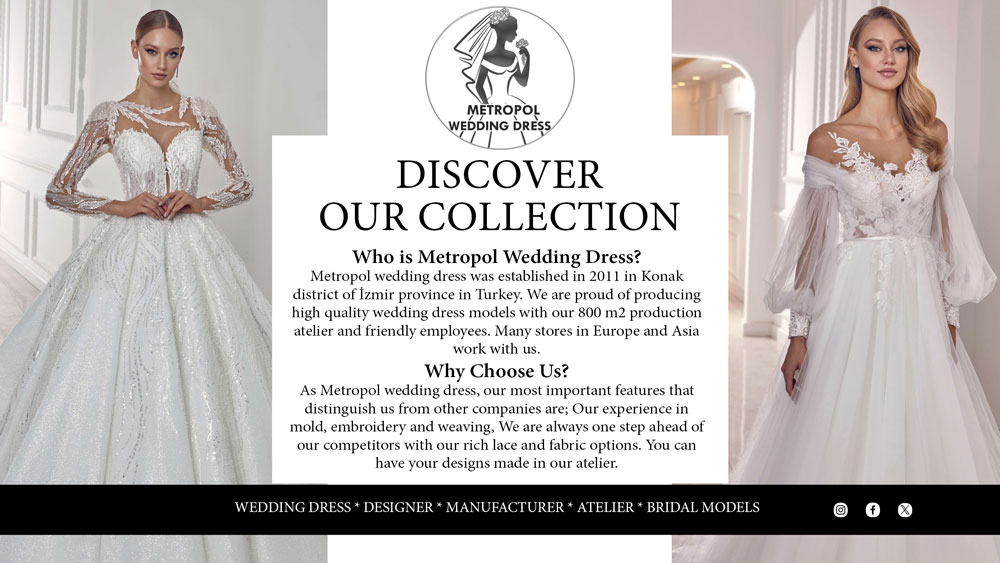
This is where Metropol Wedding Dress can serve as a manufacturing-oriented partner for businesses seeking custom bridal production rather than simply another catalogue of ready-made gowns.
A successful custom program can include:
- Custom wedding dress development
- Bespoke bridal gowns
- Made-to-measure production
- Made-to-order collections
- Private-label bridal collections
- OEM development
- Couture-level detailing
- Handcrafted bridal designs
- Boutique-exclusive silhouettes
- Wholesale custom wedding dresses
- Custom bridal gowns for bridal shops
- International export programs
The most important principle is simple:
A good manufacturer does not merely reproduce a sketch. A strong manufacturing partner translates a commercial idea into a repeatable, technically controlled bridal product.
That requires design interpretation, pattern engineering, fabric selection, sample development, fitting, quality control, production planning, packaging, communication, and reliable delivery.
This guide explores how Dutch bridal businesses can approach that process strategically.
1. The Netherlands Bridal Market Is Not One Market
One of the easiest mistakes a buyer can make is treating “the Dutch bridal market” as a single customer segment.
It is not.
A bridal boutique in Amsterdam may target a very different bride from a retailer serving smaller Dutch cities. A luxury atelier may compete through exclusivity, while a multi-brand bridal shop may need commercially reliable styles at carefully controlled wholesale prices.
The customer experience also varies considerably.
Some Dutch bridal retailers emphasize large collections and private fitting environments. Weddings Bruidsmode in Rotterdam, for example, promotes a broad selection of designers, multiple bridal aesthetics, private fitting rooms, and in-house alteration services.
At the other end of the spectrum, independent ateliers focus on one-to-one design and craftsmanship. Atelier Victors describes a process in which a bride can bring ideas and references that are transformed into a personalized design, while Analycia Mode Atelier in Rotterdam focuses on appointment-based custom wedding dresses.
There are also businesses occupying the middle ground: curated designer collections combined with customization.
This creates several possible business models.
| Bridal Business Model | Primary Competitive Advantage | Manufacturing Need |
|---|---|---|
| Luxury bridal boutique | Exclusivity and experience | Premium custom production |
| Multi-brand bridal shop | Variety and conversion | Reliable repeat production |
| Independent designer | Creative identity | Flexible development |
| Private-label retailer | Brand ownership | Full OEM/private-label capability |
| Bridal chain | Consistency | Scalable production |
| Couture atelier | Craftsmanship | Highly detailed small-batch work |
| Online bridal brand | Convenience and price | Consistent specifications and sizing |
| International distributor | Market reach | Export-ready production |
| Bridal fashion startup | New concept | Low-MOQ development and sampling |
The right manufacturer depends on which of these models you operate.
That is why choosing a supplier only because it offers “beautiful dresses” is rarely sufficient.
The real evaluation should begin with your business model.
2. What “Custom Wedding Dress” Actually Means
The word custom is frequently used in bridal fashion, but it can describe very different manufacturing arrangements.
For a buyer, understanding those differences prevents expensive misunderstandings.
Ready-to-Wear
A standard design is produced in predetermined sizes.
The retailer orders from an existing collection.
Adjustments may happen later through alterations.
This is efficient but offers limited exclusivity.
Made to Order
The customer or retailer selects an existing design, and the manufacturer produces it after the order is placed.
A Made to Order Wedding Dress Manufacturer can therefore reduce the need for large finished-goods inventories.
This model is particularly useful when the retailer wants a broad virtual or sample collection without physically holding every size.
Made to Measure
Measurements are incorporated into production.
A Made to Measure Wedding Dress Manufacturer can therefore provide a closer relationship between the customer’s body measurements and the manufacturing specification.
This is not automatically the same as couture.
Bespoke
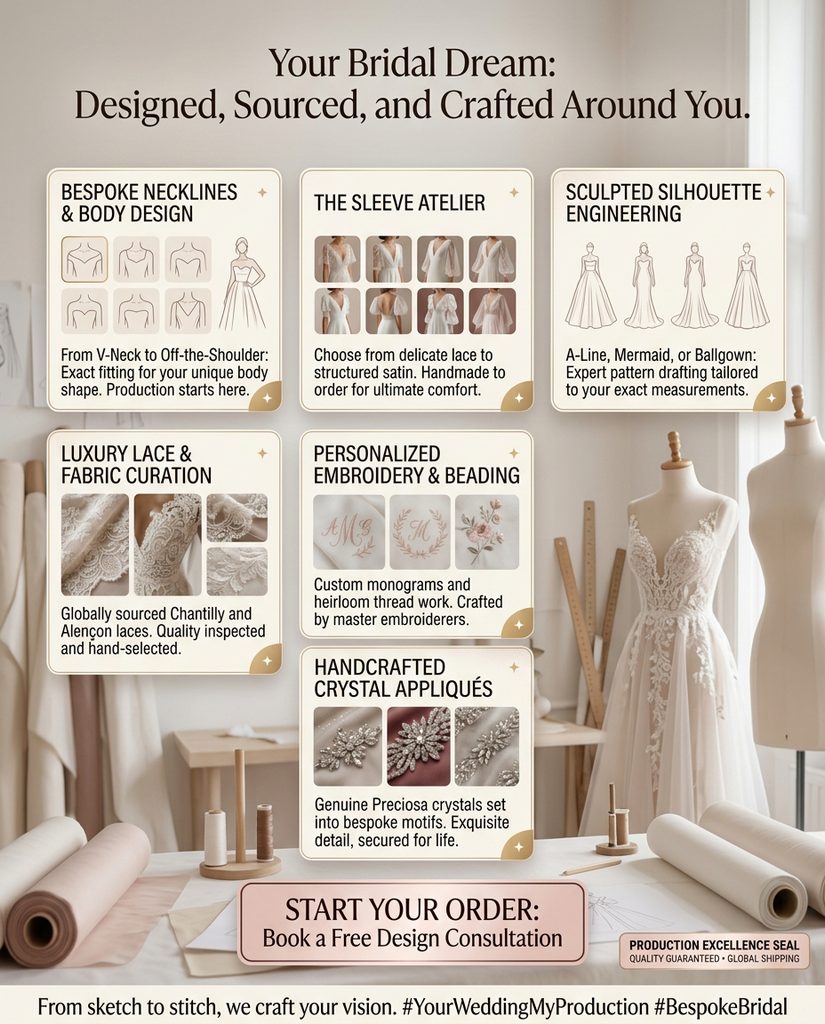
A bespoke gown normally begins with a more individualized design process.
The silhouette, construction, fabrics, neckline, sleeves, train, embellishment, or other components may be developed specifically for the client.
A Bespoke Wedding Dress Manufacturer must therefore be capable of translating a concept into an actual garment rather than simply modifying a standard SKU.
Couture
Couture introduces another level of craftsmanship and design development.
A Couture Wedding Dress Manufacturer may be involved in complex handwork, architectural construction, specialized embroidery, intricate draping, and highly individualized development.
The terminology matters commercially.
A boutique should never assume that “custom,” “made-to-measure,” “bespoke,” and “couture” describe exactly the same manufacturing process.
3. The Commercial Case for Custom Bridal Collections
The strongest reason to develop custom dresses is not simply that they look unique.
It is that they can create a defensible commercial identity.
Suppose ten bridal boutiques carry similar international collections.
Their customers can compare:
- prices,
- photographs,
- silhouettes,
- designers,
- social-media content,
- reviews,
- and availability.
If your boutique owns an exclusive collection, comparison becomes harder.
Your customer is no longer deciding only between Supplier A and Supplier B.
She is choosing your interpretation of bridal fashion.
That changes the value equation.
A custom collection can provide:
Brand differentiation
Your dresses become part of your identity.
Better storytelling
A collection can have a design philosophy rather than being a random assortment of gowns.
Controlled price architecture
You can design around your target retail price rather than accepting the cost structure of somebody else’s collection.
Exclusive silhouettes
A distinctive neckline, sleeve, corsetry system, train, detachable overskirt, or embroidery concept can become a signature.
Improved customer experience
A stylist can say, “This design was created exclusively for our collection.”
That is much stronger than:
“Many other shops also carry this dress.”
4. What Dutch Bridal Buyers Can Learn from the Local Market
The Dutch market already demonstrates an interesting combination of international fashion and local craftsmanship.
Modeca, founded in Oldenzaal in 1946, has developed from a family business into an internationally recognized bridal brand serving more than 70 countries.
Meanwhile, independent Dutch ateliers demonstrate how personalization remains commercially relevant.
Nienke | Bijtje in Utrecht emphasizes handmade wedding dresses created in its own atelier and highlights natural materials alongside distinctive couture fabrics.
The Bridal Atelier in Utrecht similarly positions itself around handmade, made-to-measure and customized gowns.
In Leiden, Edwin Oudshoorn Luxury Bridal states that many gowns are handmade in its own atelier and that elements from different designs can be combined to create an individual gown.
And Oso Couture in Amsterdam presents bridal production as handcrafted, individualized work developed through a personal design process.
The lesson for a commercial buyer is not that every Dutch bride wants couture.
The lesson is more nuanced:
Personalization is already part of the Dutch bridal vocabulary.
A manufacturing partner should therefore understand how to support retailers selling exclusivity, individuality, and craftsmanship—not simply produce generic white dresses.
5. The Manufacturer Should Start with the Buyer, Not the Dress
A common production mistake is beginning with a photograph.
A stronger process begins with questions.
Who is the customer?
Is she:
- minimalist?
- romantic?
- fashion-forward?
- traditional?
- bohemian?
- luxury-oriented?
- price-sensitive?
- sustainability-conscious?
- looking for a modest gown?
- planning a destination wedding?
- searching for a convertible second look?
What does the retailer want to own?
Perhaps the retailer needs:
- an exclusive silhouette;
- a recognizable sleeve;
- a signature lace;
- a detachable element;
- a specific construction technique;
- an extended size range;
- a specific retail price;
- or an entire collection identity.
What must the manufacturer control?
This can include:
- Design interpretation
- Technical drawings
- Patterns
- Fabric sourcing
- Embroidery
- Beading
- Construction
- Sampling
- Fitting
- Grading
- Quality control
- Packaging
- Production scheduling
- Export documentation
This is the difference between buying garments and building a product line.
“You may also want to take a look at this article.” Custom Wedding Dresses Netherlands Trends
6. From Sketch to Sample: The Real Custom Manufacturing Journey
A professional custom bridal program is a sequence of decisions.
It is not one transaction.
Stage One: Commercial Brief
Before production starts, define:
- target market;
- retail price;
- target wholesale cost;
- intended quantity;
- expected lead time;
- style direction;
- size range;
- fabric requirements;
- embellishment level;
- brand positioning.
A supplier cannot optimize a product without knowing what it is supposed to achieve.
Stage Two: Design Development
The initial concept may be:
- a hand sketch;
- reference photographs;
- an existing sample;
- mood boards;
- fabric references;
- a technical drawing;
- or a combination of these.
The manufacturer’s job is to translate the creative concept into manufacturable specifications.
That may require decisions about:
- seam placement;
- lining;
- boning;
- cups;
- closures;
- support;
- train construction;
- hem finishing;
- lace placement;
- embroidery;
- embellishment density.
A beautiful sketch can conceal significant engineering problems.
Stage Three: Pattern Engineering
This is one of the least visible but most important stages.
A wedding dress must not merely look good standing still.
It must function.
The bride must be able to:
- walk;
- sit;
- dance;
- move her arms;
- enter a vehicle;
- use the restroom;
- greet guests;
- pose for photographs;
- and remain comfortable for hours.
A technically strong pattern balances visual proportion with movement and support.
Stage Four: First Sample
The first sample answers questions that drawings cannot.
Does the neckline stay in place?
Does the corset support the body?
Does the skirt hang correctly?
Does the lace follow the body naturally?
Does the train pull correctly?
Does the sleeve restrict movement?
Does the dress remain elegant from the front, side, and back?
The first sample is not merely a prototype.
It is a problem-discovery tool.
7. Why Fabric Selection Changes the Entire Product
The same design can look completely different in:
- satin;
- crepe;
- mikado;
- chiffon;
- organza;
- tulle;
- lace;
- silk;
- jacquard;
- embroidered mesh.
Fabric influences:
- drape;
- weight;
- movement;
- opacity;
- structure;
- photography;
- comfort;
- cost;
- production difficulty.
For example, a minimalist gown can look inexpensive if the fabric lacks sufficient weight or recovery.
Conversely, a relatively simple silhouette can appear highly luxurious when the fabric, construction, pressing, and finishing are excellent.
This is why a Premium Wedding Dress Manufacturer should be evaluated not only by the beauty of finished photographs but also by material knowledge.
8. Lace Is a Design System, Not Just a Decoration
Lace selection deserves particular attention in bridal manufacturing.
The buyer should evaluate:
- motif scale;
- motif direction;
- edge design;
- transparency;
- repeat size;
- embroidery quality;
- bead attachment;
- appliqué flexibility;
- color;
- backing;
- hand feel.
A lace that looks beautiful on a roll may become visually chaotic when placed on a three-dimensional bodice.
A technically capable Handmade Wedding Dress Manufacturer understands that lace placement can influence the entire visual balance of the garment.
For example, placing a large floral motif across a bust can create a completely different visual effect from distributing the same lace vertically along the torso.
The difference is not the lace itself.
It is the application strategy.
9. The Architecture of a Bridal Gown
A wedding dress is closer to an engineered product than many buyers realize.
Consider a structured bodice.
It may include:
- outer fabric;
- lace;
- interlining;
- lining;
- cups;
- boning;
- waist stay;
- closures;
- support tape;
- seam reinforcement.
A Custom Bridal Gown Manufacturer must coordinate all these layers.
If one layer is poorly engineered, the final garment can lose both comfort and appearance.
Buyer’s technical question
When evaluating a manufacturer, ask:
“Can you explain how you engineer support inside a structured bridal bodice?”
The answer can reveal more than a portfolio.
A serious production partner should be able to discuss construction logic rather than only describe aesthetic features.
10. Five Manufacturing Models a Dutch Boutique Can Consider
| Model | Best For | Exclusivity | Development Effort | Inventory Risk |
| Existing wholesale collection | Fast assortment expansion | Low | Low | Medium |
| Made-to-order | Broader catalogue | Medium | Medium | Lower |
| Private label | Retailer-owned brand | High | High | Medium |
| OEM collection | Custom commercial range | High | High | Medium |
| Couture/bespoke | Luxury positioning | Very high | Very high | Low volume |
There is no universal winner.
A boutique with limited design resources may prefer an established collection.
A retailer trying to build a recognizable identity may prefer OEM or private label.
A luxury atelier may require bespoke manufacturing.
The important point is to choose the manufacturing model before negotiating production.
11. Private Label vs OEM: A Practical Explanation
The terms private label and OEM are often used interchangeably, but buyers should define exactly what they mean.
A Private Label Wedding Dress Manufacturer typically produces garments that are sold under the retailer’s or brand’s identity.
The retailer may control:
- labels;
- packaging;
- collection name;
- branding;
- product descriptions;
- marketing.
An OEM Wedding Dress Manufacturer can work from buyer specifications to manufacture a product developed around the customer’s commercial requirements.
For a boutique, this can be powerful.
Instead of saying:
“We carry Brand X.”
the retailer can say:
“This is part of our exclusive bridal collection.”
That creates a different relationship between customer and retailer.
12. When a Custom Collection Makes More Sense Than Buying More Brands
A retailer should consider custom manufacturing when at least several of these conditions exist:
1. Your best-selling styles are easy to imitate
If competitors can carry similar dresses, differentiation is weak.
2. Customers repeatedly ask for small modifications
Frequent requests for different sleeves, necklines, trains, fabrics, or backs may indicate an opportunity for a custom collection.
3. Your current collection has gaps
Perhaps you need:
- modern minimalist gowns;
- plus-size options;
- convertible dresses;
- modest designs;
- luxury gowns;
- destination-wedding styles;
- civil-ceremony dresses.
4. Your pricing strategy is becoming constrained
If supplier prices prevent profitable retail positioning, developing your own specifications may provide more commercial control.
5. You want stronger brand recognition
A proprietary collection gives marketing teams something competitors cannot simply copy from the same catalogue.
13. The Dutch Customer Experience Should Influence Manufacturing
The product cannot be separated from the fitting experience.
A bridal gown may look beautiful online but fail during a real appointment.
Dutch bridal businesses increasingly emphasize personalized consultations and fitting experiences.
For example, Covers Bridal Couture in Utrecht describes a long-standing bridal consultation model around international designer collections, while Weddings Bruidsmode emphasizes private fitting spaces and stylist support.
This means a manufacturer’s responsibility does not end at the factory.
The dress must support the retailer’s sales process.
A stylist needs to be able to explain:
- why the bodice fits;
- what can be altered;
- how the train works;
- how the neckline can be customized;
- whether sleeves can be changed;
- how the fabric behaves;
- what size should be ordered;
- and what delivery timeline should be communicated.
The more predictable the product, the easier the appointment becomes.
14. The “Try-On” Test That Buyers Should Use
When evaluating a sample, do not only inspect it on a mannequin.
Use a real fitting process.
Observe:
Standing
Does the silhouette look balanced?
Walking
Does the skirt move naturally?
Sitting
Does the bodice remain comfortable?
Arm movement
Can the bride raise her arms?
Turning
Does the train behave properly?
Close inspection
Are seams, closures, lining and finishing clean?
Photography
Does the fabric photograph as expected?
Styling
Can the gown work with different veils, shoes and accessories?
This simple test can reveal manufacturing weaknesses much earlier than a visual inspection alone.
15. Why Sample Quality Is More Important Than a Beautiful Catalogue
A catalogue tells you what the manufacturer wants you to see.
A sample tells you what the manufacturer can actually make.
This is why buyers should request physical samples before committing to a collection whenever possible.
Evaluate:
- stitching consistency;
- seam allowance;
- pressing;
- lining;
- closures;
- lace placement;
- bead security;
- fabric quality;
- symmetry;
- hem finishing;
- internal support;
- packaging.
The sample should be examined both aesthetically and technically.
16. A Buyer’s Quality-Control Matrix
| Area | What to Inspect | Red Flag |
| Fabric | Weight, drape, consistency | Significant variation |
| Stitching | Density and consistency | Loose or irregular stitches |
| Seams | Alignment and strength | Uneven joins |
| Bodice | Support and symmetry | Twisting |
| Lace | Placement and matching | Random motif breaks |
| Beading | Security | Loose embellishments |
| Zipper | Smooth operation | Catching or distortion |
| Hem | Evenness | Wavy edge |
| Lining | Comfort and finishing | Exposed construction |
| Train | Shape and attachment | Pulling or collapse |
| Packaging | Protection | Compression damage |
This type of inspection is particularly important for a Custom Bridal Gown Factory relationship because custom production can involve more variables than standard wholesale garments.
17. The Hidden Cost of Cheap Manufacturing
A low factory price can look attractive.
But the relevant figure is not the factory price.
It is the total landed and commercial cost.
A buyer should consider:
Product cost
- packaging
- freight
- customs-related charges where applicable
- import VAT where applicable
- payment fees
- alterations
- defective-product allowance
- sample costs
- development costs
- photography
- marketing
- inventory financing
= real commercial cost
This is why the cheapest quotation is not necessarily the cheapest supplier.
A manufacturer that produces a slightly more expensive gown with significantly fewer quality problems may generate a better margin.
18. A Simple Wholesale Margin Example
Imagine a boutique targets a retail price of €2,400.
Suppose the total cost structure produces:
- €700 manufacturing cost
- €100 logistics and associated costs
- €100 alterations/quality allowance
- €150 operational allocation
The effective product cost becomes approximately €1,050.
That leaves €1,350 before other business expenses and taxes.
Now imagine a cheaper supplier offers a gown for €550 but produces more fitting problems, inconsistent sizing, and higher alteration costs.
If those problems increase the effective cost to €1,100, the “cheaper” supplier was not actually cheaper.
The lesson:
Buyers should compare total commercial performance, not factory price alone.
19. Custom Wedding Dress Wholesale: The Economics of Small Batches
Custom production does not necessarily mean producing hundreds of units.
For boutiques, small-batch production can be more strategically useful.
A retailer might develop:
- 5 signature gowns;
- 3 silhouettes;
- 2 fabric stories;
- 3 detachable components;
- several neckline options.
The collection can then feel much larger than the number of base patterns suggests.
This is where modular design becomes commercially interesting.
One bodice can potentially support several visual identities.
One skirt can potentially be paired with different bodices.
A detachable sleeve can create another look.
An overskirt can transform a ceremony gown into a reception outfit.
The manufacturer therefore becomes part of the product architecture.
20. The Modular Bridal Collection
Consider a hypothetical six-style collection.
Instead of creating six completely unrelated gowns, the buyer could develop:
Base A
Structured corset.
Base B
Soft draped bodice.
Skirt 1
Clean A-line.
Skirt 2
Full ball gown.
Skirt 3
Fluid crepe.
Detachable 1
Long sleeves.
Detachable 2
Statement bow.
Detachable 3
Overskirt.
The retailer now has multiple combinations.
This can reduce development complexity while increasing customer choice.
It also gives stylists an excellent sales tool:
“Let’s build your version.”
That phrase is commercially powerful.
21. A Custom Collection Should Still Be Manufacturable
There is a temptation in luxury bridal design to add complexity everywhere.
More:
- beads;
- lace;
- layers;
- seams;
- handwork;
- appliqué;
- volume.
But complexity has a cost.
Every additional component can affect:
- production time;
- quality control;
- fitting;
- repair;
- shipping;
- retail price;
- lead time.
A good Premium Bridal Gown Manufacturer knows how to create a luxury visual result without adding unnecessary manufacturing complexity.
The objective is not maximum complexity.
It is maximum perceived value per unit of complexity.
22. What Makes a Bridal Dress Look Expensive?
Luxury perception often comes from a combination of small details.
Proportion
A well-balanced neckline can make a gown look more expensive immediately.
Fabric
The right weight and drape can transform a simple silhouette.
Construction
Clean internal construction affects how the gown sits on the body.
Finishing
Invisible quality often creates visible luxury.
Embellishment
Strategic placement is generally stronger than indiscriminate decoration.
Movement
A gown that moves beautifully feels luxurious.
Fit
Poor fit can destroy the impression of an otherwise expensive garment.
The best manufacturers understand the relationship between these factors.
23. The Role of Handcraft
Handcraft should not be treated as a marketing word alone.
A buyer should ask:
Which parts are actually handmade?
Possibilities include:
- lace appliqué;
- beadwork;
- embroidery;
- corset finishing;
- draping;
- flower construction;
- hand stitching;
- edge finishing.
A Handcrafted Bridal Gown Manufacturer should be able to explain where handwork adds value.
Handwork is most commercially useful when it creates a visible difference in:
- texture;
- movement;
- dimensionality;
- exclusivity;
- or craftsmanship.
24. Handmade Does Not Mean Uncontrolled
This is an important distinction.
A handmade component can still have a production specification.
For example:
Embroidery specification
- motif type;
- placement;
- density;
- color;
- thread;
- bead type;
- acceptable variation.
This allows craftsmanship and repeatability to coexist.
A professional Bridal Couture Manufacturer should be able to preserve artisanal qualities while maintaining commercial consistency.
25. One-of-a-Kind vs Repeatable Exclusive
Retailers often use “one of a kind” as a selling proposition.
But from a manufacturing perspective, there are different forms of exclusivity.
One-of-a-kind
A single garment is produced.
Boutique-exclusive
A style is produced only for one retailer.
Territory-exclusive
A style may be restricted to a defined geographical market.
Collection-exclusive
A retailer owns or controls a particular collection.
Customizable core design
The base style is repeatable, but individual clients can customize selected elements.
A One of a Kind Wedding Dress Manufacturer may be ideal for couture work, while a commercial retailer may benefit more from an exclusive repeatable design.
26. How to Build a Boutique-Exclusive Bridal Collection
A practical collection can be developed in six layers.
Layer 1 — Signature Silhouettes
Choose the core shapes.
For example:
- A-line;
- fitted;
- ball gown;
- column;
- mermaid;
- convertible.
Layer 2 — Signature Construction
Define what makes your collection recognizable.
Maybe:
- sculptural corsetry;
- clean architectural seams;
- low backs;
- modern sleeves;
- soft draping.
Layer 3 — Signature Fabric
Select materials that reinforce the identity.
Layer 4 — Signature Detail
This could be:
- floral appliqué;
- pearls;
- dimensional embroidery;
- bows;
- sculptural flowers.
Layer 5 — Signature Transformation
Add:
- overskirts;
- detachable sleeves;
- capes;
- bows;
- trains.
Layer 6 — Signature Branding
Finish with:
- labels;
- packaging;
- hangtags;
- care information;
- collection names.
This is how a Custom Bridal Collection Manufacturer becomes part of brand building rather than simply garment production.
27. How a Bridal Shop Can Use Custom Manufacturing Without Becoming a Fashion House
A retailer does not need a large design department.
The manufacturer can support the development process.
A retailer may provide:
- market feedback;
- customer requests;
- reference images;
- preferred fabrics;
- target prices;
- brand identity.
The manufacturer can contribute:
- technical interpretation;
- pattern development;
- fabric recommendations;
- construction solutions;
- sample development;
- production planning.
This division of responsibilities can be highly efficient.
The retailer knows the customer.
The manufacturer knows production.
Together, they can develop the product.
28. The Best Design Brief Is Not a Mood Board Alone
A professional design brief should include commercial information.
Recommended brief
Collection name
Target customer
Retail price
Target wholesale cost
Expected quantity
Silhouette
Fabric
Color
Neckline
Sleeve
Back
Train
Embellishment
Closure
Size range
Branding
Target delivery date
Exclusivity requirements
This turns an emotional design concept into an actionable manufacturing document.
29. Questions a Dutch Boutique Should Ask a Manufacturer
Before selecting a supplier, ask:
- Can you develop a design from a sketch?
- Can you modify an existing pattern?
- Can you create a completely new pattern?
- What is your sample-development process?
- How are fitting corrections handled?
- Can you produce different fabrics for the same design?
- Can you support private labeling?
- Can you produce custom labels?
- How do you manage size grading?
- How do you control lace placement?
- How is handwork inspected?
- What is your quality-control process?
- How do you package bridal gowns?
- What are the production lead times?
- How do you manage repeat orders?
- What happens if fabric becomes unavailable?
- How are production changes documented?
- Can you support small collections?
- What information do you need before quoting?
- Can you support international delivery?
The quality of the answers is often more revealing than the sales presentation.
30. What “Direct Manufacturer” Should Mean
A Direct Wedding Dress Manufacturer should ideally offer a transparent connection between the buyer and the production operation.
This can provide advantages such as:
- fewer intermediary layers;
- faster technical communication;
- direct specification control;
- clearer costing;
- easier production updates;
- better feedback loops.
The same principle applies to a Direct Bridal Gown Manufacturer.
However, buyers should verify what “direct” actually means.
Ask:
“Which stages of development and production are performed directly by your organization?”
That question is more useful than accepting a marketing label.
31. The Difference Between a Supplier and a Manufacturing Partner
A supplier delivers products.
A manufacturing partner helps solve product problems.
Suppose your customer says:
“I love the dress, but I want sleeves.”
A supplier may say:
“We don’t have that option.”
A development-oriented manufacturer may instead explore:
- sleeve construction;
- attachment points;
- matching fabric;
- lining;
- proportion;
- arm mobility;
- revised pattern.
That difference can determine whether your boutique can sell confidently.
32. Why Communication Is a Production Skill
Bridal production involves many details.
A single misunderstanding can change:
- neckline depth;
- fabric;
- sleeve shape;
- train length;
- lace placement;
- sizing;
- closure;
- color.
Therefore, manufacturing communication should ideally use:
- technical drawings;
- measurement charts;
- sample approvals;
- written specifications;
- revision numbers;
- approved fabric references;
- approved embellishment references.
Never rely entirely on conversational descriptions.
“Elegant sleeves” means different things to different people.
A technical drawing does not.
33. The Sample Approval System
One of the most effective ways to control custom production is to create a formal approval sequence.
Approval 1
Design concept.
Approval 2
Fabric.
Approval 3
First sample.
Approval 4
Fitting corrections.
Approval 5
Final sample.
Approval 6
Production specification.
Approval 7
Pre-shipment inspection.
This creates a traceable development history.
For a Tailor Made Wedding Dress Manufacturer, such documentation is particularly useful because custom projects naturally involve more decisions.
34. Size Grading Is More Complicated Than Scaling a Pattern
A wedding dress cannot always be enlarged or reduced proportionally.
Bodies change in multiple dimensions.
For example, increasing bust measurement may also require changes to:
- waist;
- hip;
- armhole;
- cup placement;
- neckline;
- shoulder;
- boning position.
A technically competent manufacturer should therefore treat grading as a controlled pattern-development process.
For retailers serving a broad customer base, this becomes commercially important.
Inclusive sizing is not simply a marketing statement.
It is a manufacturing challenge.
35. The Importance of Fit Consistency Across Repeat Orders
Suppose a boutique orders the same gown six months after the original production.
Will it fit identically?
That depends on whether the manufacturer maintains:
- approved patterns;
- measurement specifications;
- fabric references;
- construction instructions;
- embellishment placement;
- sample references.
This is why repeat-order management matters.
A Bespoke Bridal Gown Manufacturer can still maintain repeatable standards when custom designs are documented correctly.
36. The Boutique’s Hidden Enemy: SKU Explosion
Custom manufacturing can become dangerous if every customer request becomes a separate product.
Suddenly the retailer has:
- 15 necklines;
- 12 sleeves;
- 8 fabrics;
- 7 skirt options;
- 10 embellishment variations.
The collection becomes impossible to manage.
A better strategy is to define controlled customization.
For example:
Choose one of 4 necklines.
Choose one of 3 sleeves.
Choose one of 3 skirts.
Choose one of 4 fabrics.
This creates dozens of combinations without creating dozens of completely independent products.
37. Customization Matrix
| Element | Option A | Option B | Option C |
| Bodice | Structured | Draped | Minimal |
| Skirt | A-line | Full | Fitted |
| Sleeve | Strapless | Long | Detachable |
| Detail | Clean | Lace | Embellished |
| Train | Short | Medium | Cathedral |
| Fabric | Crepe | Satin | Mikado |
A matrix like this can help the stylist sell personalization without overwhelming the bride.
38. The Role of Sustainability in Custom Production
Custom manufacturing can support more controlled inventory, but buyers should avoid automatically describing made-to-order production as “sustainable” without evidence.
The environmental impact depends on:
- material selection;
- waste;
- production efficiency;
- transport;
- packaging;
- garment lifespan;
- repairability;
- inventory management.
A made-to-order model can reduce the need for large finished-goods inventories, but the complete supply chain still matters.
A responsible buyer should ask:
- Where are fabrics sourced?
- How is waste handled?
- Can damaged components be repaired?
- How long is the garment designed to last?
- Can the design be altered later?
- What packaging is used?
Sustainability should be treated as a measurable production issue rather than a decorative marketing phrase.
39. Netherlands-Specific Considerations for International Manufacturers
A Dutch retailer purchasing internationally should evaluate more than product quality.
The commercial relationship may involve:
- EU import procedures;
- VAT treatment;
- customs classification;
- freight;
- commercial invoices;
- origin information;
- packaging;
- payment terms;
- insurance;
- delivery responsibilities.
The exact obligations depend on the transaction structure and applicable regulations, so buyers should confirm current requirements with their customs adviser, freight forwarder, accountant, or the relevant Dutch/EU authorities.
The practical lesson is:
A beautiful sample is not enough. The supply chain must work too.
40. Why the Netherlands Is an Interesting Market for Custom Bridal Manufacturing
The country has several characteristics that make it attractive for differentiated bridal collections.
International orientation
Dutch bridal businesses often work with international designer brands and suppliers.
Design sophistication
The market accommodates minimalist, romantic, couture, bohemian, classic, and fashion-forward aesthetics. Dutch retailers themselves commonly segment collections along these style lines.
Strong boutique culture
Independent retailers can compete through service and specialization.
Customization culture
Local ateliers demonstrate ongoing demand for individually developed bridal garments.
Geographic accessibility
A collection designed for the Netherlands can also be relevant to neighboring European markets.
That makes the Dutch market potentially useful not only as an end market but as a strategic starting point for an international bridal brand.
41. Amsterdam, Rotterdam, Utrecht and Beyond
Different Dutch cities can support different positioning strategies.
Amsterdam
Potentially suitable for:
- fashion-forward bridal;
- luxury;
- international clientele;
- minimalist design;
- couture;
- destination weddings.
The presence of ateliers such as Oso Couture demonstrates the city’s relationship with personalized bridal craftsmanship.
Rotterdam
Potentially attractive for:
- contemporary bridal;
- independent ateliers;
- broad retail;
- custom design;
- commercially diverse customer segments.
Businesses such as Atelier Victors and Analycia demonstrate active custom-bridal activity in the city.
Utrecht
Particularly relevant for:
- independent bridal businesses;
- handmade collections;
- curated designer retail;
- modern and traditional bridal segments.
Covers Bridal Couture and The Bridal Atelier illustrate different versions of this market.
Leiden and the surrounding region
The region is also relevant to designer-led bridal production, with Edwin Oudshoorn’s atelier producing many bridal designs locally.
The point is not to rank cities.
It is to recognize that a manufacturer should be able to support different retailer positioning strategies.
42. How to Create a Netherlands-Focused Collection
A manufacturer working with a Dutch retailer should not assume that “European bridal” is enough.
Instead, research the actual customer.
Ask:
- What silhouettes sell?
- What price bands convert?
- How important is sleeve customization?
- Are detachable elements popular?
- Which fabrics do stylists prefer?
- What sizing gaps exist?
- What styles generate social engagement?
- What does the retailer’s existing customer request but fail to find?
Then build the collection around evidence.
This is where a manufacturing partner can become a strategic resource.
43. The Buyer’s Costing Framework
Before approving production, calculate:
Development cost
Pattern development + sampling + revisions.
Manufacturing cost
Materials + labor + finishing.
Branding cost
Labels + packaging + tags.
Logistics
Freight + insurance + handling.
Import-related costs
Where applicable.
Retail operations
Alterations + storage + staff handling.
Marketing
Photography + campaigns + showroom presentation.
Financial cost
Inventory financing and payment terms.
The goal is to calculate cost per sellable gown, not simply manufacturing cost.
44. How to Compare Two Manufacturers
Imagine Manufacturer A quotes €650.
Manufacturer B quotes €760.
At first glance, A wins.
But now compare:
| Factor | Manufacturer A | Manufacturer B |
| Sample quality | 7/10 | 9/10 |
| Communication | 6/10 | 9/10 |
| Repeat consistency | 6/10 | 9/10 |
| Lead-time reliability | 7/10 | 9/10 |
| Customization | 6/10 | 10/10 |
| QC | 6/10 | 9/10 |
| Quoted cost | €650 | €760 |
Manufacturer B may actually be the better commercial partner.
The purchasing decision should therefore combine:
Price + Quality + Reliability + Flexibility + Communication + Scalability.
45. A Procurement Scorecard
Give each manufacturer a score from 1 to 10.
Product quality — 20%
Manufacturing capability — 15%
Custom development — 15%
Communication — 10%
Lead time — 10%
Quality control — 10%
Pricing — 10%
Packaging/logistics — 5%
Scalability — 5%
Then calculate the weighted score.
This transforms supplier selection from an emotional decision into a procurement process.
46. What a Strong Custom Bridal Manufacturer Should Be Able to Explain
A credible partner should be comfortable discussing:
- patterns;
- grading;
- construction;
- fabrics;
- lace;
- embellishment;
- fittings;
- sampling;
- quality control;
- packaging;
- production capacity;
- lead times;
- repeat orders;
- private labeling;
- export logistics.
A supplier that talks exclusively about photographs and prices may not have the development depth required for a serious custom program.
47. The Five Most Expensive Manufacturing Mistakes
Mistake 1: Starting production before sample approval
This can multiply errors across the entire order.
Mistake 2: Choosing fabric after approving the design
Fabric changes can alter construction and proportions.
Mistake 3: No written specification
Verbal instructions create ambiguity.
Mistake 4: Ignoring repeatability
A design that cannot be reproduced consistently is difficult to scale.
Mistake 5: Negotiating only on price
Low cost can become high total cost.
48. Another Five Mistakes That Look Small but Matter
Ignoring packaging
A bridal gown can arrive damaged even when it left production perfectly.
Not specifying embellishment density
“More sparkle” is not a production specification.
Forgetting alteration allowances
A boutique needs sufficient construction flexibility for final fitting.
Not defining acceptable variation
Handmade production naturally contains some variation; buyers should decide what is acceptable.
No emergency procedure
Every retailer should know what happens when a fabric shortage, production problem, or delivery issue occurs.
49. Realistic Scenario: The Boutique with Too Many Similar Dresses
Imagine a Dutch bridal boutique with 80 dresses.
The store has strong traffic but increasingly weak differentiation.
Customers try several dresses and then compare them online.
The owner decides not to add another major designer.
Instead, she develops a six-dress private-label capsule.
The collection includes:
- two clean minimalist gowns;
- one structured couture gown;
- one convertible gown;
- one romantic lace gown;
- one modern fitted gown.
Each style has controlled customization options.
The result is not simply six new SKUs.
It becomes a new store identity.
The stylist can explain:
“These designs are exclusive to our boutique.”
That changes the sales conversation.
50. Scenario: The Boutique with a Strong Customer Base but Limited Design Expertise
A second retailer knows exactly what customers request but does not have an internal pattern maker.
The retailer provides:
- sketches;
- customer feedback;
- competitor analysis;
- target prices.
The manufacturer handles:
- pattern development;
- technical construction;
- samples;
- fitting corrections;
- production.
This model allows the retailer to behave like a design brand without building a complete manufacturing department internally.
51. Scenario: The Luxury Retailer
A luxury retailer may not need dozens of designs.
Instead, it might need:
- 8 highly distinctive gowns;
- exceptional fabrics;
- handwork;
- limited production;
- premium packaging;
- flawless fitting.
In this situation, volume is less important than craftsmanship.
A Luxury Bridal Gown Manufacturer should therefore be evaluated differently from a high-volume supplier.
The buyer should focus on:
- craftsmanship;
- sample quality;
- fabric expertise;
- handwork;
- finishing;
- design development;
- consistency.
Related Topics

16.04.2023
Wedding dress Poland online It is very important that you bring the inspiration of your wedding dress to your appointment. You can share your preliminary inspirations with us via our website’s Wish List feature, your...

24.03.2026
Brautkleid nach Bild bestellen ist heute der moderne Weg für jede Braut, die ihr Traumkleid nicht nur finden, sondern exakt nach ihren Wünschen gestalten möchte. Stellen Sie sich vor: Sie schicken einfach ein Foto Ihres...

21.01.2024
Bespoke bridal dress manufacturers play a pivotal role in the world of wedding fashion, transforming dreams into reality for brides seeking a unique and personalized gown. Unlike off-the-rack dresses, bespoke creations are meticulously crafted to...
14.04.2023
Wedding Gown Manufacturer Best 3 Wedding dresses confirm the successful trends of bridal fashion, including tattoo effects, cutout openings and sweet floral embroidery. The latter is the main theme of the new wedding dresses, in...
13.01.2024
Bridal wholesale Models Every Woman is the Princess of Her Own Story. Almost all girls dream of being a princess since they were little. They want to reflect this with the wedding dress they wore on...
01.02.2024
Aria Bridesmaid Dresses models are a collection of elegant and sophisticated dresses designed specifically for bridesmaids to wear at weddings and other formal events. The Aria brand offers a wide range of styles, colors, and...
Comments