

Custom Wedding Dresses in Canada Discover how to choose between a made-to-measure wedding dress and a designer bridal gown, understand customisation options, evaluate craftsmanship, manage your budget, and find a wedding dress that reflects your personal style.
Choosing a wedding dress is not simply about finding a beautiful design. It is about understanding how a gown is constructed, how it will fit your body, how much creative freedom you need, and whether the final result will meet your expectations on your wedding day.
For brides shopping in Canada, two popular options deserve particular attention: made-to-measure wedding dresses and designer wedding dresses.
Although these terms are sometimes used interchangeably, they describe different aspects of the bridal purchasing experience.
A made-to-measure wedding dress is generally developed by adapting an existing design or pattern to a bride’s measurements. It offers a more personalised fit than standard ready-to-wear sizing, although additional alterations may still be necessary.
A designer wedding dress is associated with a particular designer’s creative vision, signature aesthetic, construction methods, and established collection. Depending on the designer and retailer, it may be available in standard sizes, made to order, or customised to some extent.
A third option, a fully bespoke wedding dress, offers even greater creative freedom. It begins with an individual design concept and is developed specifically for one bride.
The right choice depends on your priorities:
- Choose made-to-measure when fit and proportion are your main concerns.
- Choose a designer gown when you appreciate an established aesthetic, signature details, and a recognisable design approach.
- Choose a fully bespoke gown when you want substantial control over the silhouette, construction, materials, and individual design elements.
- Consider a customised designer gown when you love an existing collection but want selected changes.
For Canadian brides, the decision should also include practical considerations such as production lead times, fitting arrangements, shipping, taxes, alteration costs, and the location of the bridal atelier.
The most important principle is simple: Do not evaluate a wedding dress only by how it looks on a hanger. Evaluate how it is designed, constructed, fitted, and delivered.
Metropol Wedding Dress believes that an informed bridal decision starts with understanding these differences.
1. THE REAL DECISION: ARE YOU BUYING A DESIGN OR INVESTING IN A FIT?
Imagine two brides entering a bridal boutique.
The first bride has saved dozens of photographs of wedding dresses. She knows the silhouette she likes, the neckline she wants, and the fabric that matches her wedding vision. However, every dress she tries on has something that feels slightly wrong. One has the perfect skirt but an unsuitable bodice. Another has beautiful sleeves but does not provide the support she wants. A third has the right overall appearance but requires substantial alterations.
The second bride finds a designer gown that immediately captures her attention. She loves the proportions, the fabric, and the designer’s signature aesthetic. She does not want to redesign the dress. She simply wants it prepared in the appropriate size and adjusted to achieve the best possible fit.
Both brides are looking for their ideal wedding dress, but they need different purchasing solutions.
This is where understanding the difference between made-to-measure and designer wedding dresses becomes essential.
Why the distinction matters
The bridal industry contains several production and purchasing models. A dress can be designed by a recognised designer and still be made to measure. Similarly, a custom wedding dress does not automatically mean that every component is invented from scratch.
The terminology can become confusing because retailers sometimes use expressions such as:
- Custom wedding dress
- Custom-sized wedding dress
- Made-to-measure bridal gown
- Made-to-order wedding dress
- Bespoke wedding dress
- Couture wedding dress
- Designer bridal gown
- Semi-custom wedding dress
These terms should not be treated as interchangeable.
The most useful question is not whether a retailer calls a gown custom or designer.
Instead, ask:
What exactly is being customised, and how much control do I have over the finished garment?
A company might take your measurements but produce a standard design. Another might modify the original pattern. A specialist dressmaker might develop an entirely new pattern and construct a unique gown.
Those are three different levels of personalisation.
Understanding the bridal production spectrum
| Dress category | Design development | Fit approach | Personalisation |
|---|---|---|---|
| Ready-to-wear | Existing design | Standard sizing | Limited |
| Made-to-order | Existing collection design | Depends on the ordering model | Usually limited |
| Made-to-measure | Existing or adapted pattern | Individual measurements | Moderate |
| Semi-custom | Existing design with modifications | Individual fitting and alterations | High |
| Fully bespoke | Created for an individual bride | Individually developed pattern and fittings | Very high |
| Designer made-to-order | Designer’s established design | Brand-specific sizing and fitting | Varies by designer |
One important distinction: made-to-order describes when production begins, not necessarily how the dress is sized. A made-to-order dress can still follow a standard size chart.
This distinction is also explained in the bridal terminology guidance published by Toronto-based designer Zoba Martin.
The decision that should come before the shopping appointment
Before visiting a bridal boutique, identify your three most important requirements.
For example:
- I want the dress to fit my proportions without excessive alterations.
- I want a distinctive design that reflects my personality.
- I want to know the complete cost before committing to production.
Once these priorities are clear, the right production model becomes much easier to identify.
2. MADE-TO-MEASURE VS. DESIGNER WEDDING DRESSES: A PRACTICAL COMPARISON
A beautiful wedding dress should achieve two things simultaneously: it should create the visual impression you want, and it should work with your body.
However, a dress that looks exceptional in a campaign photograph may behave differently when worn by someone with different proportions.
The following comparison focuses on what matters during the actual purchasing process.
2.1 Made-to-measure wedding dresses
A made-to-measure wedding dress uses an existing design or pattern as its starting point. Measurements are taken to adapt the garment to the individual bride.
Depending on the manufacturer, these measurements may include:
- Bust circumference
- Waist circumference
- Hip circumference
- Shoulder width
- Shoulder-to-waist length
- Waist-to-floor length
- Hollow-to-hem measurement
- Arm circumference
- Sleeve length
- Back width
- Bodice length
Some ateliers also evaluate posture, bust position, torso proportions, and the relationship between the upper and lower body.
Why brides choose made-to-measure
The main advantage is the opportunity to achieve a more personalised fit.
Traditional bridal sizing does not always correspond to everyday clothing sizes. A bride may require one size for her bust and another for her waist or hips.
With a made-to-measure approach, the goal is to reduce the mismatch between standard proportions and the bride’s actual measurements.
Consider a bride who has a relatively narrow waist, fuller hips, and a longer torso.
A standard-size dress might require several alterations. A properly adapted pattern can address some of these proportional differences earlier in the production process.
This does not mean that every made-to-measure dress will fit perfectly without alterations. Fabric behaviour, posture, design complexity, measurement accuracy, and production tolerances still matter.
Potential limitations
Made-to-measure is not automatically the best option for every bride.
If the original pattern is unsuitable for your desired silhouette, changing measurements alone may not solve the problem.
For example, making a standard bodice smaller does not necessarily create better bust support. Adjusting the waist circumference does not automatically correct an incorrectly positioned waistline.
The underlying pattern and construction must also be appropriate.
Expert insight: A well-fitted dress begins with a suitable pattern, not simply a long measurement sheet.
2.2 Designer wedding dresses
A designer wedding dress reflects the creative identity of a designer or bridal fashion house.
Designers develop collections around specific aesthetic principles. These may include distinctive silhouettes, characteristic lace arrangements, signature necklines, fabric combinations, or construction techniques.
Some designers focus on minimalist bridal fashion. Others specialise in romantic lace, architectural silhouettes, dramatic skirts, or detailed couture-inspired gowns.
When you purchase a designer gown, you are buying more than its appearance. You are also selecting a particular design philosophy and production standard.
Why brides choose designer gowns
Designer collections are particularly attractive to brides who:
- Have a clear aesthetic preference.
- Appreciate established bridal design identities.
- Want to compare coordinated collections.
- Prefer an existing design rather than starting from a blank page.
- Value the designer’s experience in silhouette development.
- Want access to specific fabrics, construction details, or signature embellishments.
Designer gowns can also offer a useful starting point for customisation.
Depending on the brand, selected modifications may include sleeve changes, neckline adjustments, train variations, or additional detailing.
However, not every designer permits every modification.
Potential limitations
A designer’s collection represents a particular creative direction.
If you love most of a gown but dislike an important structural feature, the designer may not offer the exact modification you want.
For instance, a dress with a specific bodice construction might not be suitable for conversion into a completely different neckline.
There may also be restrictions concerning fabric substitutions, embellishment changes, and production schedules.
Always confirm what the designer allows before ordering.
2.3 The comparison that actually helps you decide
| Decision factor | Made-to-measure | Designer gown |
|---|---|---|
| Main objective | Personalised proportions | Established design identity |
| Design starting point | Existing or adapted pattern | Designer collection |
| Measurement process | Individual measurements | Brand-specific sizing process |
| Creative freedom | Depends on modification scope | Depends on designer policies |
| Originality | Varies | Varies |
| Construction | Depends on maker | Depends on designer |
| Fittings | Depends on production model | Depends on retailer and designer |
| Alterations | May still be required | May still be required |
| Best suited to | Brides prioritising fit | Brides prioritising a specific design aesthetic |
Which option offers better value?
Neither category is automatically more affordable or more luxurious.
A simple made-to-measure gown can cost less than an elaborate designer dress. However, a highly detailed bespoke gown can be significantly more expensive than an established designer collection.
Likewise, a designer dress does not automatically guarantee superior construction.
The actual value depends on fabric quality, pattern development, craftsmanship, finishing, fitting services, and what is included in the purchase price.
The smartest approach is to compare the complete deliverable rather than the category name.
3. THE FOURTH OPTION: SEMI-CUSTOM AND FULLY BESPOKE WEDDING DRESSES
Many brides assume they must choose between a standard designer dress and a completely custom creation.
In reality, there is a useful middle ground.
Semi-custom bridal design allows you to begin with an established gown and modify selected elements.
This can provide an effective balance between design freedom, cost control, and production complexity.
Semi-custom wedding dresses
Imagine finding a gown with the perfect skirt and fabric but a neckline that does not suit your preference.
Depending on the pattern and designer’s capabilities, you may be able to:
- Change the neckline.
- Add detachable sleeves.
- Modify the train.
- Adjust the back design.
- Introduce a different belt or waistband.
- Add a removable overskirt.
- Change selected embellishment placements.
- Modify the lining or modesty details.
These modifications are not universally available. Each requires technical evaluation.
For example, changing a strapless neckline to an off-the-shoulder design can affect the bodice’s support and stability.
It is therefore important to evaluate the construction implications before approving a change.
Fully bespoke wedding dresses
A fully bespoke wedding dress is developed specifically for an individual bride.
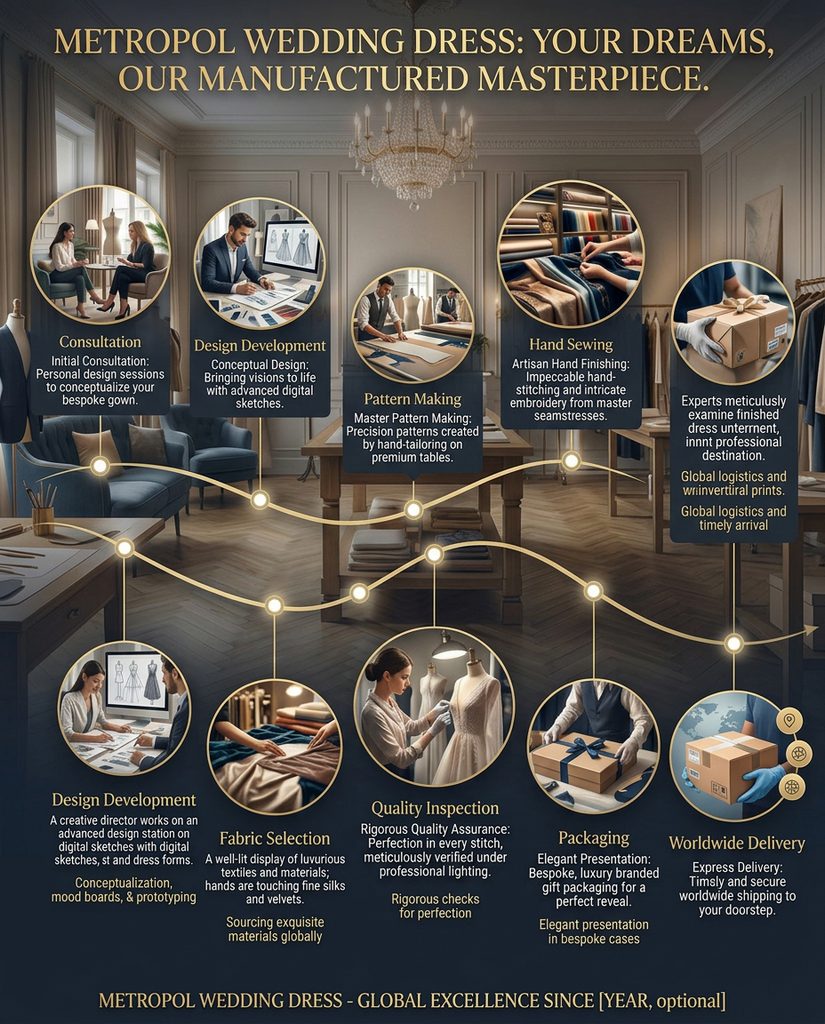
The process may include:
- Initial consultation.
- Design research.
- Concept development.
- Sketch approval.
- Fabric selection.
- Pattern drafting.
- Toile or muslin construction.
- Initial fitting.
- Structural refinement.
- Final fabric construction.
- Detailed finishing.
- Final fitting and delivery.
The most significant difference is that the dress does not simply begin with an existing collection design.
Its visual identity and construction are developed around the individual brief.
When bespoke becomes worthwhile
Fully bespoke production may be particularly appropriate when:
- You cannot find the silhouette you want in existing collections.
- Your preferred design combines several different references.
- You require a particular bodice structure.
- You want unusual fabric combinations.
- You need a specific train or detachable construction.
- You want a gown designed around a particular venue or ceremony.
- You have a strong personal design vision.
However, more creative freedom also means more decisions.
A bride who wants a straightforward, timeless gown may find an established designer collection more convenient.
Bespoke design is most rewarding when the additional creative control genuinely improves the result.
4. FIT ENGINEERING: WHY THE CONSTRUCTION OF A WEDDING DRESS MATTERS
A wedding dress is a structured garment.
Even the simplest-looking gown may contain multiple layers, internal support systems, carefully positioned seams, and specialised finishing techniques.
Understanding these elements helps brides evaluate quality beyond the surface appearance.
4.1 Bodice construction
The bodice is one of the most important components of a wedding dress.
It determines how the upper garment sits, supports the bust, connects to the waist, and maintains its intended shape.
Common construction elements include:
Boning
Boning can help maintain the bodice’s shape and provide structural support.
It may be used in corset-style dresses, strapless gowns, and certain fitted silhouettes.
The type, placement, and flexibility of boning influence comfort and movement.
Interfacing
Interfacing reinforces selected fabric areas.
It can help maintain neckline shape, strengthen closures, and prevent delicate materials from stretching excessively.
Internal cups
Cups may provide shaping and support, although their effectiveness depends on the bride’s proportions and the overall bodice construction.
Waist stay
A waist stay is an internal support band that helps distribute the garment’s weight around the waist.
It can be particularly useful in structured gowns with heavier skirts or strapless bodices.
4.2 Why a strapless wedding dress needs more than a tight fit
A common misconception is that a strapless wedding dress should simply be made tighter to prevent it from slipping.
In reality, strapless construction involves several interacting factors:
- Bust shape.
- Bodice length.
- Waist positioning.
- Internal support.
- Boning placement.
- Fabric stability.
- Closure construction.
If a gown relies entirely on excessive tightness, it may become uncomfortable during prolonged wear.
The objective is to distribute support correctly rather than force the garment to remain in position through compression.
4.3 Fabric selection and structural performance
Different fabrics behave differently during construction and wear.
| Fabric | Typical characteristics | Bridal applications |
|---|---|---|
| Silk satin | Smooth surface and fluid appearance | Minimalist gowns |
| Mikado | Structured and relatively crisp | Architectural skirts and ball gowns |
| Chiffon | Lightweight and flowing | Soft skirts and overlays |
| Organza | Sheer with more structure than chiffon | Volume and layered details |
| Tulle | Lightweight netting | Veils, skirts, overlays |
| Lace | Decorative patterned surface | Sleeves, bodices and appliqués |
| Crepe | Smooth drape with a refined finish | Contemporary fitted gowns |
| Duchess satin | Structured, substantial satin appearance | Formal silhouettes |
The correct fabric depends on the intended result.
For example, a bride seeking a sharply defined ball gown may prefer a more structured material.
A bride who wants movement and fluidity may prefer chiffon or softer crepe.
Neither is universally better.
A practical fabric evaluation
Before approving a fabric, ask:
- Does it maintain the intended silhouette?
- Is it comfortable against the skin?
- Does it become transparent under strong lighting?
- Does it wrinkle easily?
- Is it suitable for the season?
- How does it move when walking?
- Does it support the intended embellishments?
- Can it be cleaned and stored appropriately?
For outdoor summer weddings in Canada, breathability and weight may be particularly important.
For winter celebrations, lining, layering, sleeves, and an additional bridal cover-up may deserve greater attention.
5. CHOOSING A SILHOUETTE THAT WORKS WITH YOUR WEDDING
The silhouette of a wedding dress determines its overall proportions.
It influences how the gown moves, how much volume it creates, and how its shape interacts with the venue and ceremony.
Instead of choosing a silhouette solely because it is fashionable, consider the complete wearing experience.
A-line wedding dresses
An A-line gown gradually widens from the waist towards the hem.
It is one of the most versatile bridal silhouettes because it can be adapted to different fabrics, bodice styles, sleeve designs, and skirt volumes.
It is particularly suitable for brides seeking an elegant balance between structure and movement.
Ball gowns
Ball gowns feature a fitted or structured bodice combined with a voluminous skirt.
They are associated with traditional formal bridal styling.
The construction of the skirt is especially important. Multiple layers, petticoats, and structured fabrics can significantly affect weight and movement.
A bride should test sitting, walking, and navigating stairs before final approval.
Mermaid wedding dresses
Mermaid gowns follow the body’s contours before widening around the lower leg.
They create a distinctive fitted silhouette.
Their success depends heavily on accurate measurements and appropriate pattern development.
Pay particular attention to:
- Hip mobility.
- Knee movement.
- Walking distance.
- Sitting comfort.
- Hem positioning.
- Fabric recovery.
A mermaid gown should create the intended shape without unnecessarily restricting movement.
Fit-and-flare gowns
Fit-and-flare dresses are fitted through the bodice and hips before gradually opening towards the hem.
They offer a balance between a close-fitting silhouette and greater movement than some dramatic mermaid designs.
Sheath and column gowns
These dresses follow a relatively straight line through the body.
They are popular among brides seeking a modern, minimalist appearance.
Because there is less skirt volume to disguise fitting issues, fabric quality, seam placement, and pattern accuracy become particularly noticeable.
Empire-waist gowns
Empire silhouettes feature a raised waistline positioned beneath the bust.
They create a distinctive proportion and can be adapted to romantic, classical, and contemporary bridal designs.
The position of the seam is crucial. A small adjustment can change the visual balance of the entire gown.
Silhouette decision table
| Your priority | Silhouette to investigate |
|---|---|
| Classic formal appearance | Ball gown |
| Versatile elegance | A-line |
| Sculpted fitted appearance | Mermaid |
| Fitted but more flexible shape | Fit-and-flare |
| Minimalist styling | Sheath or column |
| Raised waistline | Empire |
| Dramatic modern styling | Architectural or structured designs |
Important: No silhouette is reserved for a particular body type. The objective is to find a construction and proportion that make you feel confident and comfortable.
6. CANADIAN BRIDAL STYLE: DRESSING FOR THE VENUE, SEASON AND EXPERIENCE
Canada is a geographically diverse wedding market.
A wedding in Vancouver, Toronto, Calgary, Montreal, or a remote lakeside destination may involve very different practical requirements.
Climate, travel, venue architecture, ceremony duration, and reception activities should influence the dress decision.
A gown that works perfectly for an indoor summer celebration may not be the most practical choice for an outdoor winter ceremony.
6.1 Vancouver and British Columbia
British Columbia offers a variety of wedding settings, including coastal venues, vineyards, mountain destinations, and contemporary urban locations.
For coastal or outdoor celebrations, consider:
- Lightweight fabrics.
- Secure bodice construction.
- Manageable trains.
- Movement-friendly skirts.
- A suitable cover-up.
- Materials that can tolerate a little moisture.
A dramatic train can create beautiful photographs, but it needs practical management if the ceremony includes outdoor movement.
6.2 Toronto and Ontario
Toronto provides a diverse bridal environment, with luxury hotels, modern event spaces, historic architecture, and urban wedding venues.
For formal indoor celebrations, structured satin, mikado, sculptural silhouettes, and sophisticated lace can all work beautifully.
However, brides should also consider the practical demands of transportation, changing locations, and winter weather.
A detachable overskirt or removable sleeves may provide useful versatility.
6.3 Montreal and Quebec
Montreal and Quebec offer distinctive architectural and cultural wedding settings.
Historic buildings, intimate restaurants, contemporary venues, and elegant city spaces can inspire a wide range of bridal aesthetics.
Romantic lace, refined crepe, vintage-inspired detailing, and architectural gowns may all complement these environments.
For bilingual wedding planning, confirm that all contractual details and service arrangements are clearly understood.
6.4 Calgary and Alberta
Alberta weddings may involve mountain scenery, countryside venues, modern hotels, and outdoor celebrations.
For destination or outdoor weddings, the practical requirements of a gown become particularly important.
Consider:
- Walking surfaces.
- Wind exposure.
- Temperature changes.
- Dress weight.
- Train management.
- Transportation and storage.
A beautiful dress should not become a logistical problem during the ceremony.
6.5 Winter weddings across Canada
Winter weddings create specific challenges.
A bride may travel between a heated indoor venue and cold outdoor surroundings.
Consider a coordinated bridal layering strategy.
Options include:
- A tailored bridal coat.
- A faux-fur wrap.
- A removable cape.
- Long sleeves.
- A detachable bolero.
- A structured shawl.
The outer layer should complement the gown rather than compete with it.
It should also allow enough room for comfortable movement.
6.6 Destination weddings
Some Canadian brides plan weddings abroad.
In this situation, the dress must be evaluated not only for its appearance but also for its transportability.
A large ball gown may require specialised packing and careful handling.
Delicate embellishments may need additional protection.
Before travelling, establish:
- Whether the dress can be carried as cabin baggage.
- Whether the airline provides garment-hanging facilities.
- Whether the gown requires professional steaming.
- How the dress should be packed.
- Whether the destination has suitable alteration services.
- How to protect the gown against moisture and pressure.
Do not assume that a garment bag guarantees safe transportation.
Ask the airline about its current baggage policies and plan accordingly.
7. THE FABRIC DECISION: WHAT YOU SHOULD KNOW BEFORE APPROVING YOUR GOWN
Fabric is not merely a decorative choice.
It affects the gown’s appearance, comfort, weight, movement, construction requirements, and long-term maintenance.
Two dresses with similar silhouettes can produce very different results simply because they use different materials.
Silk versus synthetic satin
Silk satin is made from silk fibres and is valued for its characteristic lustre and luxurious feel.
Synthetic satin may use polyester or other manufactured fibres.
Both can produce attractive bridal garments, but they do not necessarily behave identically.
Consider:
| Evaluation point | Silk satin | Synthetic satin |
|---|---|---|
| Fibre origin | Natural | Manufactured |
| Surface appearance | Depends on weave and finish | Depends on fibre and finish |
| Price | Often higher | Often more accessible |
| Care | Requires appropriate care | Depends on composition |
| Weight | Varies | Varies |
| Drape | Depends on construction | Depends on construction |
The label alone does not establish quality.
A high-quality synthetic fabric may outperform an unsuitable natural fabric for a particular design.
Lace selection
Lace is among the most visually distinctive materials in bridal fashion.
However, different lace types create different effects.
Chantilly lace: Often valued for delicate patterns and fine visual detail.
Guipure lace: Usually features more pronounced motifs and a more dimensional appearance.
Alençon-inspired lace: Recognised for decorative motifs and corded detailing.
Embroidered lace: Features decorative embroidery applied to a fabric base or netting.
When evaluating lace, inspect the motif consistency, edge finishing, placement, and how it joins with other materials.
A beautiful lace sample does not guarantee that the finished gown will have equally attractive motif placement.
Tulle and organza
Tulle is widely used in bridal veils and layered skirts.
It can create volume without the same weight associated with some structured fabrics.
Organza offers a different balance of transparency and stiffness.
It can help create more defined shapes while retaining a lightweight appearance.
The number of layers and the quality of the material influence the final result.
The hidden cost of fabric complexity
A fabric that appears inexpensive may require substantial labour during construction.
For example, delicate lace can be time-consuming to cut, position, and match.
Heavily embellished fabric may require careful handling during sewing.
Multiple layers may increase the time needed for hemming and finishing.
This is why fabric price alone is not a reliable indicator of the total production cost.
8. WHAT DOES A CUSTOM WEDDING DRESS COST IN CANADA?
Wedding dress pricing is one of the most important considerations for Canadian brides.
However, there is no single national price for custom wedding dresses.
The final cost depends on the design, materials, production location, labour, construction complexity, fittings, and services included in the agreement.
A simple made-to-measure gown and an elaborate couture-inspired creation belong to different cost categories.
The components behind a wedding dress quotation
A professional quotation should explain what you are paying for.
Typical cost components include:
- Design consultation.
- Pattern development or adaptation.
- Fabric and lining.
- Internal structural materials.
- Cutting and construction.
- Sewing and finishing.
- Lace placement and embellishment.
- Fittings.
- Adjustments.
- Final pressing and packaging.
- Shipping, if applicable.
- Taxes and additional services.
Not every supplier includes all these items in the initial quotation.
This is why comparing the headline price alone can be misleading.
What makes one gown more expensive than another?
Design complexity
A minimalist crepe gown may require fewer construction steps than a multi-layered ball gown with a structured bodice.
Fabric selection
Specialty silk, premium lace, embroidered materials, and imported fabrics can affect the material budget.
Hand embellishment
Hand-applied pearls, crystals, beads, and floral appliqués require time and specialist labour.
Pattern engineering
A new pattern, complex corsetry, unusual draping, or architectural construction may increase development time.
Production schedule
A rushed production schedule may require additional labour coordination or expedited material sourcing.
Fitting arrangements
The number of fittings and the complexity of adjustments can influence the final cost.
A realistic way to compare quotations
Rather than relying on generic online price estimates, ask three providers to quote on the same design brief.
For example:
- A-line silhouette.
- Structured bodice.
- Floor-length skirt.
- Moderate train.
- Minimal embellishment.
- Long fitted sleeves.
- Standard lining.
Then compare what each quotation includes.
This creates a much more useful purchasing comparison than asking simply how much a custom wedding dress costs.
The complete wedding dress budget
The gown itself is only one part of the bridal clothing budget.
Consider the following:
| Expense | Why it matters |
|---|---|
| Wedding dress | Main garment purchase |
| Alterations | Fit refinements |
| Veil | Length and material affect cost |
| Shoes | Influence hem measurements |
| Undergarments | Affect fit and support |
| Accessories | Jewellery, belts and hairpieces |
| Preservation | Long-term garment care |
| Shipping | Particularly relevant for international orders |
| Duties and taxes | Depend on the transaction and import circumstances |
| Rush fees | May apply to accelerated production |
A useful purchasing rule
Set three budgets before beginning:
Target budget: What you would ideally like to spend.
Maximum budget: The highest amount you are comfortable paying.
Contingency budget: Additional funds for unexpected alterations, accessories, or delivery-related expenses.
This prevents a beautiful but incomplete quotation from creating an unpleasant surprise later.
9. THE CANADIAN IMPORTER’S CHECKLIST: BUYING A WEDDING DRESS FROM ABROAD
Canadian brides may purchase wedding dresses from local boutiques, international designers, overseas manufacturers, or independent bridal ateliers.
Each purchasing route creates different responsibilities.
A dress purchased internationally may have an attractive initial price but involve additional expenses and logistical requirements.
Before ordering internationally
Confirm:
- The actual country of manufacture.
- Whether the quoted price is in CAD or another currency.
- Whether shipping is included.
- Whether insurance is included.
- Who is responsible for import clearance.
- Whether customs duties may apply.
- Which taxes may be collected.
- Whether alterations are available locally.
- Who pays for return shipping.
- What happens if the dress arrives damaged.
- Whether the delivery date is guaranteed contractually.
Understanding Canadian duties and taxes
Import charges depend on the product’s tariff classification, country of origin, applicable trade agreement, declared value, and import circumstances.
The Canada Border Services Agency explains that tariff classification and country of origin are important in determining applicable duty rates.
Imported goods may also be subject to GST and applicable provincial or territorial taxes.
Do not assume that every international wedding dress will have the same import charge.
Use the official CBSA guidance and confirm the classification and applicable treatment before ordering.
The difference between shipping origin and country of origin
This is an important distinction.
A gown shipped from a European warehouse is not necessarily manufactured in Europe.
Likewise, a dress shipped from an international distribution centre may have been produced in another country.
Shipping origin and country of origin are different pieces of information.
For customs purposes, the country of origin can influence the applicable tariff treatment.
Ask the supplier to identify the actual manufacturing country.
Why local fitting access matters
Suppose your international wedding dress arrives three weeks before your wedding.
You discover that the hem needs adjustment and the bodice requires additional support.
You now need to find a qualified local bridal seamstress with enough time to complete the work.
This situation can create avoidable stress.
Before ordering, establish whether local alteration services are available and whether the dress construction is suitable for adjustment.
For official import information, consult the Canada Border Services Agency:
10. THE PRODUCTION JOURNEY: FROM FIRST CONSULTATION TO FINAL FITTING
A wedding dress is not simply selected and delivered.
Depending on the production model, it may pass through several stages before becoming the finished garment.
Understanding this process helps brides plan their purchase realistically.
Stage 1: The design consultation
The first conversation should establish the purpose of the dress.
A useful consultation explores:
- Wedding date.
- Venue.
- Personal style.
- Desired silhouette.
- Fabric preferences.
- Budget.
- Design references.
- Fit concerns.
- Required modifications.
- Production lead time.
Bring photographs that illustrate what you like.
However, avoid treating reference photographs as technical instructions.
A photograph shows the finished appearance, not necessarily the internal construction.
A skilled bridal professional should be able to explain whether the desired design is technically achievable.
Stage 2: Design development
For a bespoke gown, this stage may include sketches, material samples, and design revisions.
For a designer gown, the equivalent stage may involve selecting a collection design and confirming permitted modifications.
For made-to-measure production, the original pattern may be adapted to the bride’s measurements.
Before approving the design, confirm the final details in writing.
Stage 3: Measurements
Accurate measurements are essential.
Measurements should be taken under consistent conditions and with consideration for the intended undergarments and footwear.
For example, a bride planning to wear a structured bridal corset should not assume that measurements taken in a soft everyday bra will produce the same result.
Shoes also influence the hem.
If the heel height changes significantly after the final fitting, the finished length may no longer be appropriate.
Stage 4: Pattern development and toile construction
A toile, often made from inexpensive test fabric, can be used to assess shape and fit before cutting the final material.
This stage is particularly useful for bespoke and technically complex designs.
It allows the dressmaker to evaluate:
- Bodice balance.
- Waist placement.
- Bust positioning.
- Shoulder fit.
- Skirt volume.
- Movement.
- Structural support.
Not every bridal production model includes a toile.
Ask whether it is part of the agreed process.
Stage 5: Main construction
Once the design and pattern are approved, the final fabric can be cut and assembled.
The production may include:
- Bodice construction.
- Seam reinforcement.
- Boning installation.
- Lining.
- Skirt assembly.
- Sleeve construction.
- Lace placement.
- Embellishment.
- Zipper or closure installation.
- Hem finishing.
The sequence varies according to the design.
Stage 6: Fittings and refinements
Fittings allow the maker to assess how the dress behaves on the bride.
The first fitting may focus on the basic structure.
Later fittings may refine the silhouette, length, closures, and decorative details.
For a fitted gown, walking and sitting should be tested.
For a strapless gown, support and stability should be assessed.
For a heavy ball gown, the bride should understand how the skirt moves and how the train is managed.
Stage 7: Final inspection
Before collecting the dress, inspect the entire garment.
Check:
- Seam consistency.
- Fabric condition.
- Embellishment security.
- Zipper operation.
- Hook and eye closures.
- Bodice support.
- Hem length.
- Train finishing.
- Lining.
- Comfort.
- Movement.
Take photographs of the completed dress if appropriate for your personal records.
Stage 8: Collection and storage
A finished wedding dress should be stored in accordance with its fabric and construction.
Avoid leaving delicate garments exposed to direct sunlight, excessive humidity, or unsuitable plastic packaging.
Ask the maker for care instructions before taking the dress home.
11. HOW EARLY SHOULD YOU ORDER YOUR WEDDING DRESS IN CANADA?
Timing is one of the most underestimated parts of bridal shopping.
A wedding dress may require more than production time.
The complete schedule can involve consultations, design approval, fabric sourcing, manufacturing, international shipping, fittings, and final alterations.
These stages should be considered together.
Suggested planning windows
The following are planning guidelines, not guaranteed production standards.
| Purchase route | Suggested planning approach |
|---|---|
| Ready-to-wear, in stock | Allow time for fitting and alterations |
| Made-to-order designer gown | Often requires several months |
| Made-to-measure | Allow time for measurements, production and fittings |
| Semi-custom | Allow additional time for approved modifications |
| Fully bespoke | Ideally begin 9–12 months ahead |
| Rush production | Only proceed after confirming feasibility |
Actual timelines vary considerably by designer and atelier.
For example, Canadian bridal businesses publish different production schedules. MISSIA recommends beginning the custom bridal process approximately 9–12 months before the wedding, while other Canadian designers publish different timelines depending on the level of customisation.
The correct approach is to obtain a written schedule from your chosen supplier.
A practical 12-month wedding dress timeline
12 months before the wedding
Research designers, silhouettes, production models, and budgets.
10–11 months before
Attend consultations and shortlist suppliers.
9–10 months before
Approve the design and place the order.
6–8 months before
Review progress and confirm fitting arrangements.
3–5 months before
Attend relevant fittings and discuss any adjustments.
2–3 months before
Confirm footwear, accessories, and final styling.
3–6 weeks before
Complete final fitting and confirm collection or delivery.
1–2 weeks before
Check the garment, prepare transportation, and store it appropriately.
This schedule should be adjusted to the supplier’s actual production process.
What if your wedding is only three months away?
A short timeline does not automatically mean that a custom dress is impossible.
However, the available options may be limited.
Consider:
- An in-stock designer gown.
- A sample sale gown.
- A ready-to-wear dress.
- A design with limited modifications.
- A local atelier with confirmed rush capacity.
Avoid paying a rush fee until the supplier has confirmed that materials, production, fittings, and delivery can realistically be completed.
12. HOW TO EVALUATE A WEDDING DRESS DESIGNER OR BRIDAL SUPPLIER
Choosing the right supplier is as important as choosing the dress.
A beautiful portfolio is a useful starting point, but it does not tell you everything about the production process.
A professional supplier should be able to explain how the garment will be made, how quality is checked, and what happens if adjustments are needed.
Portfolio evaluation
Do not look only at styled photographs.
Look for evidence of:
- Front and back views.
- Close-up fabric details.
- Interior construction.
- Different body proportions.
- Finished seams.
- Sleeve construction.
- Bodice support.
- Train finishing.
- Actual customer gowns.
A collection of highly edited photographs may demonstrate creative ability, but it may not provide enough evidence of technical workmanship.
Questions to ask during consultation
- Is the gown made to order, made to measure, or fully bespoke?
- Is the original pattern modified?
- Where is the gown manufactured?
- Who performs the actual construction?
- Which fabrics are included in the quotation?
- Are material substitutions permitted?
- How many fittings are included?
- Are alterations included?
- What happens if measurements change?
- Is there a written production schedule?
- What happens if delivery is delayed?
- Are shipping and insurance included?
- What is the deposit policy?
- What is the cancellation policy?
- Can the finished gown be inspected before final payment?
These questions help distinguish a transparent production process from an unclear sales arrangement.
Understanding deposits and contracts in Canada
A deposit should never be treated as a casual reservation.
Before paying, review the written agreement.
Confirm:
- The total purchase price.
- Deposit amount.
- Payment milestones.
- Included services.
- Additional charges.
- Cancellation terms.
- Refund conditions.
- Production deadlines.
- Delivery responsibilities.
- Dispute procedures.
Innovation, Science and Economic Development Canada’s consumer guidance explains that deposit refund rights depend on the circumstances and applicable law. Consumers should establish the deposit conditions before paying.
Consumer protection rules can differ between provinces and territories.
Do not assume that a general cooling-off period applies to every bridal purchase.
Official guidance:
13. THE FITTING ROOM TEST: HOW TO KNOW WHETHER A WEDDING DRESS REALLY WORKS
A wedding dress can look excellent when standing still.
However, a wedding is an active event.
You will walk, sit, stand, greet guests, take photographs, dance, and possibly travel between different locations.
A dress must work during these activities.
The five-movement assessment
1. Walking
Walk naturally for several minutes.
Check whether the skirt catches around your legs or whether the bodice shifts.
2. Sitting
Sit in a normal chair.
A fitted dress should not create unreasonable pressure around the waist, hips, or knees.
3. Raising your arms
This is especially important for fitted sleeves, off-the-shoulder designs, and structured bodices.
Check whether the neckline shifts or the sleeves restrict movement.
4. Turning
Turn in both directions.
A dress should maintain its intended shape without twisting unexpectedly.
5. Dancing
Try a few basic dance movements.
Pay attention to the train, skirt weight, and overall mobility.
The comfort-versus-appearance balance
A gown should not need to be painfully tight to look elegant.
Likewise, comfort should not be achieved by compromising essential support.
The best construction balances:
- Stability.
- Movement.
- Fit.
- Weight.
- Breathability.
- Structural support.
If a dress feels uncomfortable during a short fitting, do not assume that you will become comfortable after wearing it for ten hours.
Discuss the issue before approving the final construction.
14. COMMON PURCHASING MISTAKES THAT CAN COST BRIDES TIME AND MONEY
Some bridal purchasing mistakes are caused by unrealistic expectations.
Others happen because important technical and contractual details are overlooked.
The following situations are worth avoiding.
Mistake 1: Assuming made-to-measure means no alterations
Individual measurements improve the fitting process, but they do not eliminate every possible adjustment.
Fabric behaviour, posture, footwear, and final construction can still affect the result.
Better approach: Ask which alterations are included and which may cost extra.
Mistake 2: Choosing a dress before understanding the venue
A dramatic gown may look beautiful in photographs but become difficult to manage on a narrow staircase or outdoor path.
Better approach: Match the design to the actual wedding environment.
Mistake 3: Changing the design repeatedly
Late modifications can affect materials, pattern development, production schedules, and costs.
Better approach: Finalise the important design decisions before construction begins.
Mistake 4: Ordering without a complete quotation
A low initial price may exclude alterations, accessories, shipping, or taxes.
Better approach: Request an itemised quotation.
Mistake 5: Ignoring the country of manufacture
A supplier’s location does not necessarily identify where the gown is produced.
Better approach: Ask where the dress is actually manufactured.
Mistake 6: Leaving measurements until the last minute
Late measurements can create scheduling problems.
Better approach: Follow the supplier’s measurement schedule and confirm when updated measurements are required.
Mistake 7: Buying shoes after the final hem
A change in heel height can affect the finished length.
Better approach: Select your intended wedding shoes before the final hem fitting.
Mistake 8: Evaluating only the exterior
The inside of a wedding dress can reveal important information about construction quality.
Better approach: Inspect the lining, seams, boning, closures, and finishing.
Mistake 9: Assuming every designer permits modifications
Some designs cannot be modified without affecting their structure or the designer’s production policy.
Better approach: Confirm modifications in writing before ordering.
Mistake 10: Forgetting transportation and storage
A finished dress can be damaged by unsuitable packing, moisture, or pressure.
Better approach: Request professional storage and transportation instructions.
15. SPECIAL DESIGN CONSIDERATIONS FOR DIFFERENT BRIDAL REQUIREMENTS
The right wedding dress is not always the one that follows the most popular bridal trend.
It is the one that meets the bride’s actual requirements.
Certain design situations deserve additional attention.
Plus-size wedding dresses
A successful plus-size wedding dress should be designed around appropriate proportions, structural support, and comfort.
Simply enlarging a standard pattern may not produce the best result.
Consider:
- Bust support.
- Bodice length.
- Strap positioning.
- Waist placement.
- Skirt balance.
- Sleeve comfort.
- Fabric stability.
The construction should support the intended silhouette without unnecessary pressure.
Petite bridal gowns
Petite brides may benefit from careful proportion adjustments.
The placement of waist seams, neckline proportions, and skirt volume can influence the overall appearance.
A dress designed around standard proportions may require more than simply shortening the hem.
Tall brides
Tall brides should pay attention to bodice length, skirt proportions, sleeve length, and train dimensions.
Extra fabric availability should be confirmed before ordering.
Maternity wedding dresses
Pregnancy introduces additional fitting considerations because body measurements can change during the production process.
A suitable design may include:
- Flexible construction.
- Adjustable closures.
- Carefully positioned seams.
- Comfortable waist placement.
- Additional room where required.
The production schedule should account for expected changes.
Discuss the wedding date, pregnancy stage, and measurement schedule with the dressmaker.
Modest wedding dresses
Modest bridal design can be achieved through different construction approaches.
These may include:
- Higher necklines.
- Long sleeves.
- Additional lining.
- Reduced transparency.
- Full-back construction.
- Detachable coverage.
- Layered fabrics.
A modest design does not need to compromise elegance or creativity.
Second-look and reception dresses
Some brides choose a second outfit for the reception.
A detachable overskirt, removable sleeves, or a separate reception gown can provide a practical transition.
The important consideration is whether the additional garment offers sufficient value relative to its cost and use.
16. SUSTAINABILITY AND LONG-TERM VALUE IN BRIDAL FASHION
Wedding dresses are often associated with a single event.
However, their design and production can have a longer life cycle.
A carefully selected gown may be preserved, altered, resold, donated, or transformed into another garment.
Sustainability should therefore be considered from the beginning rather than treated as an afterthought.
Made-to-measure and material efficiency
Made-to-measure production can help align garment construction with an individual customer’s requirements.
Made-to-order production can also reduce the need to maintain large quantities of finished stock.
However, neither model is automatically sustainable.
The environmental impact depends on:
- Fabric origin.
- Manufacturing processes.
- Transport distance.
- Waste management.
- Packaging.
- Production volume.
- Garment longevity.
A custom gown made from imported materials and shipped internationally may have a different environmental profile from a locally produced dress.
The actual supply chain matters.
How to make a more considered bridal purchase
Ask your supplier:
- Where do the fabrics come from?
- Are leftover materials reused?
- Can the dress be altered after the wedding?
- Can detachable elements be reused?
- Are care instructions provided?
- Can the garment be professionally preserved?
- Are repair services available?
Designing for more than one occasion
Some bridal designs can be adapted after the wedding.
For example:
- A detachable overskirt can be removed.
- A lace overlay can be separated.
- A reception bodice can be worn independently.
- A simple gown can be professionally shortened.
- Selected decorative elements can be reused.
This approach is especially useful for brides who value versatility.
17. REALISTIC BRIDAL BUYING SCENARIOS
The following hypothetical scenarios illustrate how different purchasing models can serve different needs.
They are examples, not actual customer testimonials.
Scenario A: The bride who prioritises fit
A bride finds a designer A-line dress that matches her aesthetic.
The design is exactly what she wants, but the standard size chart does not match her proportions.
She does not need a new design.
Her priority is adapting the existing construction to achieve a better fit.
Potential solution: A designer gown with an appropriate made-to-measure or alteration process, depending on the brand’s available services.
Scenario B: The bride who wants a completely individual design
Another bride has a very specific concept.
She wants a minimalist silk skirt, a structured corset, unusual sleeves, and a detachable train.
No existing collection provides the combination she wants.
Potential solution: Fully bespoke bridal design.
Scenario C: The bride with a limited production window
A bride has only four months before her wedding.
She has found several beautiful gowns but is concerned about international delivery and multiple fittings.
Potential solution: An in-stock or locally available designer gown, potentially with carefully selected modifications.
The production schedule must be confirmed before payment.
Scenario D: The bride who wants design flexibility without starting from zero
A bride loves a designer gown but wants to change the sleeve style and add a removable overskirt.
Potential solution: Semi-custom design, provided the designer or dressmaker confirms that the modifications are technically possible.
Scenario E: The bride planning a winter destination wedding
A bride is planning a winter ceremony followed by an indoor reception.
She wants a dramatic gown but also needs comfortable movement and practical outerwear.
Potential solution: A structured gown with detachable elements and a coordinated bridal cover-up.
The correct choice depends on venue conditions and the amount of time spent outdoors.
What these scenarios demonstrate
There is no universally superior wedding dress production model.
The right decision emerges from the relationship between design expectations, fitting requirements, production capability, budget, and timing.
18. THE METROPOL WEDDING DRESS APPROACH: MAKING AN INFORMED BRIDAL DECISION
At Metropol Wedding Dress, the bridal purchasing journey should begin with the bride’s vision and the practical requirements of her wedding.
A wedding dress should not be selected simply because it is popular or visually impressive.
It should reflect the bride’s personality while addressing the details that influence how the garment will look and feel when worn.
Whether you are exploring a designer bridal gown, a made-to-measure option, or a more personalised wedding dress concept, understanding the production model is essential.
Start with your vision
Think about the overall experience you want to create.
Would you prefer a timeless and understated appearance?
Are you drawn to dramatic silhouettes and luxurious details?
Do you want a contemporary minimalist gown?
Or are you imagining a romantic design with delicate lace and intricate finishing?
Your answers help establish the direction of your bridal search.
Evaluate the construction
The exterior appearance is only one part of a wedding dress.
The bodice, lining, closures, fabric, seams, and finishing determine how the garment performs.
A dress should be evaluated as a complete product.
Understand the purchasing agreement
Before placing an order, establish the total price, production schedule, fitting arrangements, payment milestones, and delivery responsibilities.
This is particularly important when purchasing internationally or ordering a custom design.
Choose confidence over unnecessary complexity
More customisation is not always better.
A carefully selected designer gown may be the ideal solution for a bride who already loves an existing design.
A made-to-measure dress may be more appropriate when individual proportions are the primary concern.
A bespoke gown is worth considering when the creative requirements genuinely justify starting from the beginning.
The objective is not to purchase the most complicated dress.
It is to find the right dress.
19. YOUR WEDDING DRESS PURCHASING CHECKLIST
Before committing to a gown, use this checklist to evaluate the complete purchasing decision.
Design and appearance
- I have identified my preferred silhouette.
- I understand the difference between my reference images and the actual construction.
- I have selected suitable fabrics.
- I have confirmed the neckline and sleeve design.
- I understand the train and skirt requirements.
- I have considered detachable elements.
Fit and comfort
- My measurements have been taken appropriately.
- I understand the fitting process.
- The bodice provides suitable support.
- I can walk comfortably.
- I can sit comfortably.
- I can raise my arms.
- I have considered my wedding shoes.
- I understand which alterations may be required.
Budget and contract
- I have received a written quotation.
- I know the complete price.
- I understand the deposit policy.
- I know which services are included.
- I understand cancellation terms.
- I have checked potential shipping costs.
- I have considered applicable taxes and import duties.
- I have a written delivery schedule.
Supplier evaluation
- I have reviewed the supplier’s actual work.
- I understand where the dress will be manufactured.
- I know who is responsible for construction.
- I understand the quality-control process.
- I have confirmed communication arrangements.
- I know who to contact if a problem occurs.
Final preparation
- I have completed my final fitting.
- I have inspected the dress.
- I have received care instructions.
- I have arranged safe transportation.
- I have planned suitable storage.
- I have enough time before the wedding for final checks.
20. FIVE QUESTIONS THAT SHOULD DETERMINE YOUR FINAL DECISION
Before making your purchase, consider these five questions carefully.
1. Am I looking for a particular designer’s aesthetic or a completely individual design?
This determines whether an established collection, semi-custom approach, or bespoke production is more suitable.
2. How important is individual pattern adaptation to my fit requirements?
This helps establish whether made-to-measure is worth considering.
3. What is the complete cost of the finished garment?
The answer should include more than the initial dress price.
4. Can the supplier deliver the gown with enough time for fitting and final inspection?
A beautiful dress delivered too late can create unnecessary pressure.
5. Will I feel comfortable wearing this gown throughout the actual wedding day?
The best bridal decision balances appearance, construction, and practicality.
21. FINAL VERDICT: MADE-TO-MEASURE OR DESIGNER WEDDING DRESS?
The decision between a made-to-measure wedding dress and a designer wedding dress is not a competition between two categories.
It is a decision about what matters most to you.
Made-to-measure is particularly relevant when your priority is individual fit and adapting a design to your proportions.
Designer wedding dresses are attractive when you value an established aesthetic, signature details, and a particular designer’s creative identity.
Semi-custom gowns offer a middle ground for brides who love an existing design but want selected modifications.
Fully bespoke gowns provide the greatest creative freedom for brides who want a design developed specifically around their vision.
For Canadian brides, the final decision should also account for the practical realities of production, shipping, taxes, fitting access, and the wedding timeline.
A wedding dress should be more than an attractive purchase.
It should be a thoughtfully selected garment that works with your body, your celebration, your budget, and your expectations.
Metropol Wedding Dress invites you to approach your bridal journey with confidence, clarity, and a clear understanding of what makes a wedding dress truly right for you.
Your perfect gown is not necessarily the most expensive, the most elaborate, or the most fashionable.
It is the one that brings your vision to life.
22. FIVE WAYS TO BEGIN YOUR BRIDAL JOURNEY WITH METROPOL WEDDING DRESS
CTA 1 — Personal and emotional
Your wedding day deserves a dress that feels like you.
Discover bridal styles that reflect your personality, your vision, and the way you want to remember your special day.
Explore Metropol Wedding Dress and begin your search for a gown that feels truly yours.
CTA 2 — Consultation-focused
Not sure whether made-to-measure or designer is right for you?
Start by understanding your options.
Explore the possibilities with Metropol Wedding Dress and take the next step towards a more informed bridal decision.
CTA 3 — Design-focused
Have a particular wedding dress in mind?
Bring your inspiration, preferred silhouettes, and design ideas together.
Discover the possibilities of personalised bridal styling with Metropol Wedding Dress.
CTA 4 — Confidence-focused
Choose your wedding dress with confidence, not guesswork.
Understand the details behind fit, fabric, craftsmanship, and design before making your decision.
Let Metropol Wedding Dress be part of your bridal discovery.
CTA 5 — Direct conversion
Ready to take the next step towards your wedding dress?
Explore Metropol Wedding Dress and get in touch to discuss your bridal requirements, preferred style, and purchasing options.
Your bridal journey starts with the right conversation.
FREQUENTLY ASKED QUESTIONS ABOUT CUSTOM WEDDING DRESSES IN CANADA
1. What is the difference between a made-to-measure and a designer wedding dress?
A made-to-measure wedding dress is generally developed by adapting an existing pattern or design to an individual’s measurements. A designer wedding dress refers to a gown created under a designer’s creative identity and design standards. A designer gown can also be made to measure, depending on the brand’s production model.
2. Is a made-to-measure wedding dress completely custom-made?
Not necessarily. Made-to-measure usually involves adapting an existing pattern to individual measurements. Fully bespoke production goes further by developing a unique design and pattern specifically for the bride. Always ask what the supplier means by custom-made.
3. Can I customise a designer wedding dress in Canada?
Some designers allow selected modifications, such as sleeve changes, neckline adjustments, train alterations, and additional embellishments. However, modification policies vary. Certain structural changes may not be possible without significantly altering the original design.
4. Is bespoke the same as made-to-measure?
No. Made-to-measure generally adapts an existing design to individual measurements. Bespoke involves developing a garment specifically for an individual client, potentially including new pattern drafting, original construction, and multiple design-development stages.
5. How much do custom wedding dresses cost in Canada?
There is no universal price. Costs depend on fabric, pattern development, design complexity, embellishments, construction, fittings, and production location. Request an itemised quotation in Canadian dollars and confirm whether alterations, shipping, and taxes are included.
6. How many months before my wedding should I order a custom dress?
Starting approximately 9–12 months before the wedding is a sensible planning approach for fully custom designs. Simpler made-to-order or made-to-measure dresses may require less time. The actual schedule should be confirmed with the supplier.
7. Can a wedding dress be made to fit different bust, waist, and hip measurements?
Yes, depending on the production model. Individual pattern adjustments can help address differences between bust, waist, and hip measurements. However, the pattern’s structure must also be appropriate for the desired fit.
8. Does made-to-measure eliminate the need for alterations?
No. It can reduce the amount of adjustment required, but additional alterations may still be necessary. Hem length, posture, fabric behaviour, footwear, and final fitting conditions can all affect the result.
9. Which wedding dress fabric is best for a Canadian winter wedding?
Structured satin, mikado, crepe, and layered fabrics may be suitable depending on the design. However, the most important consideration is the complete outfit. A bridal coat, cape, or detachable cover-up may provide additional comfort during outdoor photographs and transportation.
10. Can I order a custom wedding dress from outside Canada?
Yes. International suppliers may offer made-to-measure and bespoke services to Canadian brides. Before ordering, verify the production location, shipping arrangements, measurement process, fitting options, return policy, and possible import charges.
11. Will I have to pay customs duties when importing a wedding dress into Canada?
Possibly. Import charges depend on factors such as tariff classification, country of origin, applicable trade agreements, declared value, and import circumstances. GST and applicable provincial or territorial taxes may also apply. Consult the Canada Border Services Agency for the relevant requirements.
12. Is a designer wedding dress better quality than a non-designer gown?
Not automatically. Quality depends on materials, pattern development, construction, finishing, and quality control. A non-designer gown made by an experienced specialist can demonstrate excellent workmanship, while a designer label alone does not guarantee a perfect fit or superior construction.
13. Can I change the neckline of a made-to-measure wedding dress?
Sometimes. The feasibility depends on the original pattern, bodice structure, fabric, and support system. A change from a high neckline to a strapless design, for example, may require significant structural redevelopment.
14. What is the difference between made-to-order and made-to-measure?
Made-to-order describes a production process in which manufacturing begins after an order is placed. Made-to-measure describes a garment adapted to an individual’s measurements. A made-to-order dress may still use standard sizing.
15. How many fittings are normally required for a custom wedding dress?
The number varies by design and supplier. A simpler gown may require fewer appointments, while a complex bespoke design may involve several fittings. Ask for the expected number and purpose of each fitting before signing the agreement.
16. What happens if my body measurements change after ordering?
The outcome depends on when the change occurs and how the gown is constructed. Minor adjustments may be possible, while substantial changes could require additional work or affect the production schedule. Discuss measurement changes with the supplier as early as possible.
17. Can I have a wedding dress designed around my wedding venue?
Yes. Venue-specific design is a useful part of bridal planning. Fabric weight, skirt volume, train length, sleeve design, and movement requirements can all be considered when developing a gown for a particular setting.
18. Are detachable sleeves and overskirts worth the extra cost?
They can be worthwhile when they provide genuine versatility. Detachable elements allow a bride to create different looks for the ceremony and reception without purchasing two complete gowns. Their value depends on construction quality, design compatibility, and actual use.
19. What should I check before paying a wedding dress deposit?
Review the complete price, deposit conditions, payment schedule, cancellation policy, production timeline, included alterations, delivery terms, and responsibilities if the gown is delayed or damaged. Keep a written copy of the agreement.
20. Can I wear a made-to-measure wedding dress if I am between standard sizes?
Yes. Made-to-measure may be particularly useful when your measurements do not align neatly with a standard size chart. However, the suitability of the pattern and construction remains important.
21. What is the best wedding dress for a destination wedding?
The best option depends on the destination, climate, transportation requirements, and wedding activities. Lightweight fabrics and manageable silhouettes can be practical for some destinations, while structured gowns may suit formal indoor celebrations. Consider garment weight and packing requirements before ordering.
22. How can I tell whether a wedding dress has good construction quality?
Inspect the seams, lining, closures, bodice support, fabric consistency, embellishment attachment, and hem finishing. Ask about the internal construction and request close-up photographs where possible. A quality assessment should consider both the inside and outside of the garment.
23. Can a wedding dress be altered after it has been delivered to Canada?
Yes, provided that the construction allows for the required alterations and a suitably experienced bridal seamstress is available. However, substantial structural modifications may be difficult or expensive. Confirm alteration feasibility before purchasing internationally.
24. Is a corset wedding dress comfortable enough to wear all day?
It can be, if properly designed and fitted. Comfort depends on boning placement, waist support, fabric, bodice length, and the distribution of pressure. The dress should be tested through walking, sitting, and normal movement rather than evaluated only while standing.
25. What is the difference between couture and custom wedding dresses?
Custom wedding dress describes a garment made or modified according to individual requirements. Couture generally refers to a higher level of specialised design and craftsmanship, although the term is used differently across the fashion industry. Ask what construction and service standards are actually included rather than relying on terminology alone.
26. Should I choose silk or polyester for my wedding dress?
The answer depends on your desired appearance, budget, comfort, and maintenance preferences. Silk is a natural fibre, while polyester is manufactured. Both can be used in attractive bridal garments. Compare the actual fabric samples, composition, weight, drape, and care requirements before deciding.
27. Can I request a wedding dress in a colour other than ivory or white?
Many designers and custom dressmakers can accommodate alternative shades, although availability depends on fabric sourcing and production capabilities. Champagne, blush, soft beige, and other tones may be possible. Request physical fabric samples because screen colours can be misleading.
28. What should I bring to my first bridal design consultation?
Bring inspiration photographs, your wedding date, venue information, an approximate budget, preferred silhouettes, and details about any fitting concerns. If you already have your wedding shoes or planned undergarments, share those details as well.
29. How do I choose between buying locally and ordering internationally?
Compare the complete purchasing experience rather than the initial price. Consider communication, production transparency, fitting access, delivery time, shipping insurance, taxes, import duties, alterations, and after-sales support. A lower international price may not represent better overall value once additional costs are included.
30. What is the most important factor when choosing a wedding dress?
The most important factor is how well the gown meets your individual requirements. It should reflect your preferred style, fit appropriately, provide suitable comfort, meet your budget, and arrive with enough time for final preparation. The best dress is the one that works for your actual wedding day.
METROPOL WEDDING DRESS
Your vision. Your style. Your bridal moment.
Explore your wedding dress options with a clearer understanding of design, fit, craftsmanship, and personalisation. Make your bridal decision with confidence.
Related Topics
06.09.2026
Luxury Wedding Dress Dubai Metropol Wedding Dress stands as a premier Turkish atelier and global supplier specializing in luxury, custom, and wholesale bridal gowns tailored for the discerning Dubai market. With two decades of experience,...
23.07.2025
China Affordable Bridal Gown Online Finding a China affordable bridal gown online is a game-changer for brides seeking high-quality, stylish wedding dresses without breaking the bank. China, producing 90% of the world’s wedding dresses, is...
17.05.2026
Turkish Wedding Dresses Export Success Turkish wedding dresses have carved out a remarkable position in the global bridal market, blending centuries-old craftsmanship with contemporary elegance at competitive prices. In recent years, the phrase “Turkish Wedding...

12.04.2026
Vintage Moderne Brautkleider Die Schönsten Modelle 2026 In einer Welt, in der Hochzeitsmode immer persönlicher und ausdrucksstärker wird, erobern Vintage Moderne Brautkleider die Herzen der Bräute weltweit. Die Schönsten Modelle 2026 verbinden die romantische Nostalgie...

27.11.2025
Kako funkcioniše proces šivenja venčanice po meri za mlade iz Srbije Venčanje je jedan od najvažnijih dana u životu svake devojke, a venčanica po meri predstavlja krunu tog posebnog trenutka. Kada mlade iz Srbije odluče...

31.03.2026
Turkish Wedding Dresses for Canadian Brides Affordable Luxury In the enchanting world of bridal fashion, Turkish Wedding Dresses for Canadian Brides: Affordable Luxury Guide stands as the ultimate resource for brides-to-be across Canada seeking elegance...
Comments