
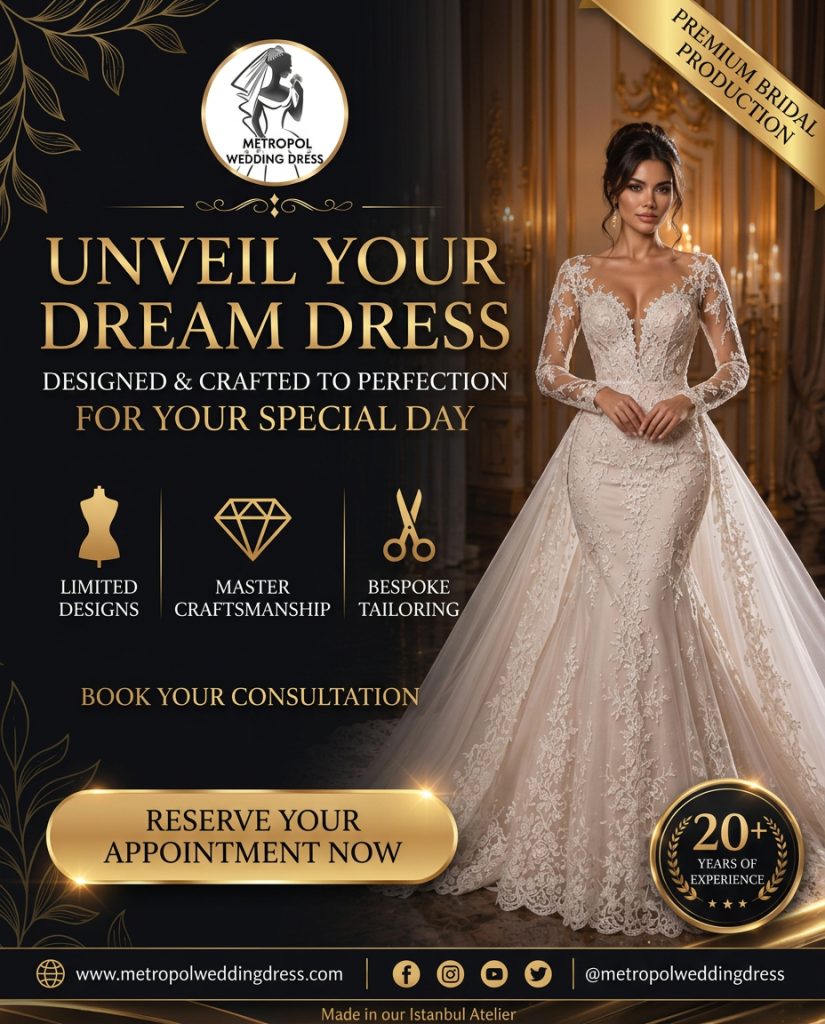
Best Custom Wedding Dress Designers in Vancouver A wedding dress is one of the most personal garments a woman will ever wear. It represents an important moment, reflects individual taste, and becomes part of the memories and photographs that will be treasured for decades.
Yet finding the right wedding dress is not always straightforward.
Perhaps you have visited several bridal boutiques but have not found a gown that feels completely right. Maybe you love the neckline of one dress, the sleeves of another, and the silhouette of a third. You might want a particular fabric, a different back design, a more supportive bodice, or a wedding dress that complements your proportions rather than forcing you into a standard size.
This is where custom wedding dress design becomes particularly valuable.
Vancouver offers an exciting selection of bridal designers, independent ateliers, and luxury wedding dress boutiques. From handcrafted couture gowns to contemporary made-to-order collections, brides have access to different approaches to personalization and craftsmanship.
However, not every business advertising designer wedding dresses actually creates custom gowns. Some offer international collections, others specialize in alterations, and a smaller number provide complete bespoke design services.
Understanding this distinction can save time, prevent expensive mistakes, and help you make a more confident decision.
This guide explores the Vancouver custom bridal landscape, explains what separates genuine bespoke craftsmanship from ordinary dress customization, and examines the practical details that matter when commissioning a wedding dress.
Whether you imagine a minimalist silk gown, a romantic lace creation, an architectural statement dress, or a completely original bridal design, the objective is the same: finding a dress that feels unmistakably yours.
1. Understanding Vancouver’s Custom Wedding Dress Scene
Vancouver’s bridal market is not limited to traditional wedding dress boutiques.
It includes independent fashion designers, specialized bridal studios, couture workshops, local design houses, and retailers representing international fashion labels.
These businesses serve different types of brides.
Some women want to select an existing designer gown and have it adjusted to their measurements. Others want to change selected details. More creatively ambitious brides may prefer to collaborate with a designer from the first sketch to the final fitting.
These are three different purchasing experiences.
The three levels of wedding dress personalization
| Design approach | What it involves | Best suited to |
|---|---|---|
| Ready-to-wear | Purchasing an existing gown in an available size | Brides who want a faster, straightforward purchase |
| Made-to-order or semi-custom | Ordering a designer’s existing style, sometimes with selected modifications | Brides who love an established design but want personalization |
| Fully bespoke | Creating an original gown around the bride’s measurements, preferences, and design brief | Brides seeking an individual design and extensive creative involvement |
The distinction matters because the word “custom” is sometimes used loosely in the fashion industry.
Ordering a standard gown in a different size does not automatically make it bespoke. Similarly, changing a neckline or adding sleeves to an existing design is customization, but it is not necessarily a completely original design.
A genuine bespoke project generally involves individual design development, patternmaking, fabric selection, construction decisions, and multiple fitting stages.
Why Vancouver brides consider custom design
There are several reasons why brides choose an independent designer instead of purchasing a conventional bridal collection.
1. A more individual appearance
You may want a dress that reflects your personality rather than current bridal trends.
2. Greater control over fit
Custom design can address individual proportions, preferred support, movement, and comfort requirements.
3. Freedom of material selection
You can discuss silk, satin, crepe, organza, lace, tulle, and other textiles according to the desired appearance and performance.
4. Creative collaboration
You can communicate ideas, combine design elements, and develop a coherent look with a professional designer.
5. Practical personalization
Features such as hidden support, detachable sleeves, pockets, adjustable details, and convertible skirts can be considered during the design process.
The important point is that customization should solve real problems, not simply add decorative details.
A well-designed wedding dress balances appearance, construction, comfort, and practicality.
2. Best Custom Wedding Dress Designers and Bridal Studios in Vancouver
Choosing the best designer is a personal decision. There is no universal winner because different ateliers specialize in different aesthetics, construction methods, and client experiences.
The following businesses represent notable options in Vancouver’s bridal and custom-design market. This is an editorial shortlist based on publicly described services and design positioning, not a verified ranking or endorsement.
2.1 Stesha Ho Bridal Couture
Best for: Brides seeking a genuinely bespoke couture experience.
Stesha Ho Bridal Couture is a Vancouver-based bridal atelier specializing in sophisticated bespoke wedding gowns.
The studio emphasizes handcrafted construction, European lace, silk fabrics, and intricate hand-sewn embellishments.
Its approach is particularly relevant to brides who want a dress created specifically around their vision rather than simply selecting a standard bridal collection.
A bespoke design experience can be useful when a bride has a very specific silhouette in mind, wants carefully developed details, or prefers a close relationship with the designer throughout production.
The atelier’s background also includes formal fashion education and experience in bridal design.
What makes it worth considering:
- Individually developed bridal designs.
- Luxury fabric and lace options.
- Handcrafted construction.
- A Vancouver-based atelier.
- An emphasis on personalized couture.
Questions to ask before booking:
- How many fittings are included?
- Can the designer develop a completely original pattern?
- What is the current starting price for bespoke gowns?
- Are fabric sourcing and alterations included?
- What production schedule is available for your wedding date?
Official website: https://steshaho.com/
2.2 Kathryn Bass Bridal
Best for: Brides prioritizing individual fit, inclusive sizing, and locally made wedding dresses.
Kathryn Bass Bridal is a Vancouver bridal design studio known for custom and made-to-order wedding dresses.
One of its defining characteristics is its emphasis on creating gowns for different body types rather than treating inclusive sizing as a separate category.
Its design philosophy is particularly interesting for brides who want personalization without necessarily commissioning an entirely new couture concept.
The studio offers opportunities for customization and works with brides to develop a look that reflects their preferences.
Its locally produced approach is also relevant to customers who value Canadian-made fashion.
Notable characteristics:
- Custom and made-to-order bridal gowns.
- Size-inclusive design philosophy.
- Handmade Vancouver production.
- Opportunities for individual customization.
- Personal consultations with designers.
For brides who have struggled to find suitable sample sizes or want a more collaborative fitting experience, this studio deserves consideration.
A useful question is whether the desired modifications can be incorporated into an existing design or require a completely new pattern.
Official website: https://kathrynbass.ca/
2.3 OUMA
Best for: Modern bridal couture, artistic silhouettes, and contemporary romantic design.
OUMA approaches bridal fashion from a distinctly contemporary perspective.
Its design language combines modern romance, sculptural silhouettes, carefully considered details, and artistic construction.
The Vancouver atelier also communicates a commitment to more intentional production, including thoughtful pattern placement, limited production runs, and the use of leftover materials for meaningful design details.
This makes OUMA an interesting option for brides who want something fashion-forward without losing the emotional character of traditional bridal clothing.
Its aesthetic may particularly appeal to women who appreciate architectural shapes, elegant draping, refined textures, and contemporary interpretations of romantic bridalwear.
What distinguishes its approach:
- Contemporary bridal design.
- Sculptural silhouettes.
- Handcrafted embellishments.
- Small-batch production philosophy.
- An emphasis on intentional material use.
- Vancouver-based design and production.
A bride considering OUMA should ask which designs are made to order, which customization options are available, and whether a fully bespoke commission is possible for her project.
2.4 Elika In Love
Best for: Brides attracted to Parisian inspiration and personalized bridal craftsmanship.
Elika In Love combines an international design perspective with Vancouver-based bridal production.
The brand was founded in Paris and is associated with designer Hrissa Soumpassis.
Its bridal collections feature distinctive silhouettes, luxurious materials, and an aesthetic influenced by contemporary European fashion.
Importantly, the brand describes its bespoke gowns as being produced by hand in its Vancouver atelier.
This makes it relevant for brides who appreciate sophisticated design but want the personal experience of working with a local studio.
The distinction between a collection gown and a bespoke commission should be clarified during consultation.
Reasons to explore Elika In Love:
- Paris-inspired design influences.
- Handmade Vancouver production.
- Bespoke bridal options.
- Individual design development.
- A modern, fashion-conscious aesthetic.
For brides who have collected inspiration from European bridal fashion but want to explore local craftsmanship, this is a worthwhile studio to investigate.
Official website: https://elikainlove.com/
2.5 Manuel Mendoza Couture
Best for: Traditional couture craftsmanship and custom tailoring.
Manuel Mendoza Couture has a long-standing connection with Vancouver’s custom fashion and bridal industry.
The atelier has a history of creating custom bridal gowns and emphasizes individualized design, tailoring, and craftsmanship.
Its approach is relevant to brides who value construction quality and want more than a standard boutique purchasing experience.
The studio’s design philosophy focuses on recognizing individual beauty and creating garments that enhance the client’s personal style.
A custom wedding dress is not simply about making a garment smaller or larger. It involves understanding proportion, structure, balance, and the relationship between the wearer and the design.
This type of technical approach is especially important for gowns featuring fitted bodices, structured waistlines, unusual necklines, and complex construction.
Why consider this atelier:
- Established custom fashion experience.
- Custom bridal gown services.
- Tailoring expertise.
- Individual design philosophy.
- Couture-oriented construction.
Official website: https://www.manuelmendoza.co
2.6 Joanna Delaney Studio
Best for: Detailed tailoring and individualized bridal construction.
Joanna Delaney Studio is another Vancouver option for brides exploring custom bridalwear and specialized garment work.
Its services and positioning make it relevant to women who need detailed fit considerations or want a more individualized bridal outfit.
A technically demanding wedding dress may require more than decorative expertise.
For example, a fitted lace gown with a low back, internal corsetry, and a long train requires careful consideration of how the garment distributes weight and remains secure during movement.
This is where patternmaking and tailoring experience become important.
When considering a custom commission, ask to see examples of similar construction challenges rather than relying exclusively on finished photographs.
Points to investigate:
- Experience with original bridal designs.
- Structural bodice construction.
- Complex alterations.
- Lace and embellishment handling.
- Fitting schedules.
Official website and contact information should be confirmed directly with the studio before arranging a consultation.
2.7 Djamila Bridal
Best for: Custom dressmaking, bridal alterations, and detailed personalization.
Djamila Bridal operates as a custom wedding gown and alterations studio in Vancouver.
Its publicly described services include custom bridal design, formalwear, hand embroidery, dressmaking, bridal veils, and alterations.
This combination may be useful for brides who need both creative design assistance and technical garment work.
For example, a bride might have an existing gown that requires substantial modifications, or she might want to develop a custom dress with particular embroidery and finishing details.
The studio’s broader dressmaking services can also be relevant when coordinating different garments for the wedding party.
What to discuss:
- Whether the studio accepts completely new bespoke commissions.
- Available embroidery techniques.
- Fabric sourcing arrangements.
- Alteration capabilities.
- Delivery timelines.
- The relationship between design fees and construction costs.
Official website: https://djamilabridal.ca/
2.8 Lovenote Bride
Best for: Brides who want to explore Vancouver-designed bridal collections.
Lovenote Bride occupies an interesting position because it combines a bridal boutique with an in-house design and production operation.
Its in-house labels include Truvelle, Laudae, and Aesling.
The collections represent different design directions, ranging from romantic and understated to more architectural contemporary bridalwear.
The company describes its gowns as being designed and handmade in Vancouver.
For brides, this offers an alternative to selecting an internationally produced designer gown.
However, buying a gown from an in-house collection is not the same as commissioning a fully bespoke dress.
If you want a completely original design, ask about the availability of individual commissions rather than assuming every collection style can be substantially modified.
Official website: https://lovenotebride.com/
2.9 Luxury bridal boutiques: Bisou Bridal and Everly Bridal
Not every bride needs a completely custom-made wedding dress.
Sometimes the ideal solution is an existing designer gown with professional fitting and carefully selected modifications.
Two Vancouver bridal destinations worth exploring are Bisou Bridal and Everly Bridal.
Bisou Bridal offers collections from internationally recognized bridal designers, alongside an in-house alterations studio.
Everly Bridal presents a curated selection of contemporary designers, including minimalist, romantic, and fashion-forward labels.
These boutiques can be valuable for brides who want to compare different silhouettes and fabrics before deciding whether custom design is necessary.
They can also help establish realistic expectations regarding designer pricing.
An important distinction: These businesses should primarily be considered designer bridal shopping destinations, not automatically classified as independent bespoke design houses.
Official websites:
- Bisou Bridal: https://www.bisoubridal.com/
- Everly Bridal: https://www.everlyfinebridal.com/
3. Custom Designer vs. Bridal Boutique: Which Experience Is Right?
The most expensive option is not necessarily the best option.
Likewise, a completely bespoke gown is not automatically superior to an excellent made-to-order design.
The correct decision depends on what you need from the garment.
Consider the following comparison.
| Decision factor | Custom designer | Designer bridal boutique |
|---|---|---|
| Original design | Potentially created from scratch | Usually selects an existing collection |
| Fabric choices | Often broader, subject to sourcing | Generally limited to designer options |
| Silhouette changes | Can be developed during design | Depends on the designer’s modification policy |
| Measurements | Individual pattern development may be available | Standard designer sizing with alterations |
| Creative involvement | Usually high | Usually moderate |
| Production | Depends on the atelier | Depends on the designer |
| Alterations | May be part of the atelier process | May be separate or in-house |
| Best advantage | Individuality | Access to established collections |
When should you choose bespoke?
A fully custom wedding dress may be appropriate when:
- You have a clear design vision that cannot be found in existing collections.
- You want unusual proportions or construction.
- You need specific support or coverage features.
- You want to combine different design elements.
- You have enough time for the design and production process.
- You value direct collaboration with the person creating your gown.
When should you choose a bridal boutique?
A boutique may be a better solution when:
- You already love an established designer’s collection.
- You want to try different gowns before making a decision.
- You prefer a more predictable design and production process.
- Your desired changes are relatively simple.
- You want access to several designers in one appointment.
The professional recommendation: Start with the design problem, not the purchasing category.
If you find a gown that already meets 90% of your expectations, ordering it and making appropriate alterations may be more sensible than paying for an entirely new design.
If the remaining 10% represents something fundamental, such as the silhouette, neckline, construction, or overall aesthetic, bespoke design may offer considerably more value.
4. What Actually Makes a Custom Wedding Dress Exceptional?
A photograph can show the silhouette, but it cannot tell you everything about the quality of a wedding dress.
The difference between an ordinary gown and an exceptional one often becomes apparent through its construction.
Professional bridal design involves several technical decisions that are easy to overlook when shopping.
4.1 Patternmaking: The foundation of a beautiful fit
Patternmaking translates a design into the physical components used to construct a garment.
For a bespoke gown, this process should consider more than standard bust, waist, and hip measurements.
Important considerations include:
- Shoulder slope.
- Bust placement.
- Bust-to-waist proportions.
- Torso length.
- Back width.
- Waist position.
- Hip shape.
- Posture.
- Preferred neckline.
- Desired movement and support.
Two brides can have identical bust and waist measurements yet require very different pattern adjustments.
A properly developed pattern helps the dress sit naturally on the body instead of depending on excessive internal tension to maintain its shape.
Why this matters
A poorly fitted bodice can cause:
- Fabric pulling across the bust.
- Excessive pressure around the waist.
- A neckline that shifts during movement.
- Back gaps.
- Visible wrinkles.
- An unstable waist seam.
These are not simply cosmetic problems. They can affect comfort throughout the wedding day.
4.2 Internal structure: The part nobody sees
Many luxury wedding dresses contain an internal construction system that provides support and shape.
Depending on the design, this can include:
- Boning.
- Inner corsets.
- Waist stays.
- Cups.
- Structural lining.
- Internal waistbands.
- Carefully positioned seams.
A fitted strapless gown, for example, needs to remain secure without requiring the bride to constantly pull it upward.
The internal structure should distribute support appropriately.
The goal is stability without unnecessary restriction.
A beautiful corset is not necessarily a comfortable corset. Construction, placement, materials, and fitting all matter.
4.3 Seam finishing and garment durability
The quality of a wedding dress is also reflected in its finishing.
Inspect:
- Seam consistency.
- Stitch density.
- Lining attachment.
- Hem finishing.
- Zipper installation.
- Boning channels.
- Lace attachment.
- Button construction.
- Embellishment security.
For a gown with a long train, inspect the bustle system as well.
The bustle must secure the train safely without creating excessive bulk or distorting the original design.
4.4 Handcrafted details
Hand-applied embellishments can make a significant difference to a gown’s visual character.
Examples include:
- Hand-sewn lace.
- Beaded appliqués.
- Embroidery.
- Fabric-covered buttons.
- Three-dimensional floral details.
- Hand-pleated elements.
- Decorative piping.
- Fine hand finishing.
However, the presence of handwork does not automatically establish superior quality.
Ask which elements are handmade, how they are attached, and whether the embellishments have been tested for durability during normal wear.
5. Choosing the Right Fabric for Your Wedding Dress
Fabric is one of the most important decisions in custom bridal design.
It determines how the gown moves, how light interacts with the surface, how the silhouette holds its shape, and how comfortable the dress feels.
The same pattern can produce dramatically different results depending on the material.
5.1 Silk satin
Silk satin is associated with luxurious bridal fashion because of its smooth surface and elegant drape.
It can work particularly well for:
- Minimalist gowns.
- Structured bodices.
- Draped skirts.
- Elegant sheath silhouettes.
- Contemporary bridal designs.
However, satin can reveal construction irregularities, pressure marks, and wrinkles.
It also requires careful handling during fittings and transportation.
5.2 Silk crepe
Silk crepe has a softer, more understated appearance.
It is often selected for clean silhouettes where the focus is on shape rather than embellishment.
Advantages include:
- Elegant movement.
- A refined surface texture.
- Contemporary appearance.
- Excellent compatibility with minimalist styling.
Crepe is particularly interesting for brides who want an understated dress with sophisticated construction.
5.3 Lace
Lace remains one of the most recognizable materials in bridal fashion.
It can create romantic, vintage-inspired, dramatic, or modern effects depending on its pattern and placement.
Common options include:
- Chantilly lace.
- Corded lace.
- Guipure lace.
- Embroidered lace.
- Floral lace.
- Alençon-inspired lace.
When selecting lace, examine the scale of the motif.
Large floral patterns may create a dramatic visual effect, while finer lace can produce a softer appearance.
Lace placement is equally important.
A skilled designer considers how motifs align with seams, necklines, sleeves, and the overall silhouette.
5.4 Organza
Organza is a lightweight fabric with a relatively crisp structure.
It is often used for:
- Layered skirts.
- Voluminous sleeves.
- Overskirts.
- Decorative overlays.
- Sculptural details.
It can create volume without the same visual weight as heavier materials.
5.5 Tulle
Tulle is commonly used in bridal skirts, veils, sleeves, and layered designs.
Its appearance can range from soft and romantic to dramatic and voluminous.
Different tulle weights produce different results.
A soft tulle skirt may move delicately, while firmer tulle can support a more defined shape.
5.6 Mikado
Mikado is a structured bridal fabric frequently selected for architectural silhouettes.
It can be suitable for:
- Ball gowns.
- Structured A-line dresses.
- Sculptural skirts.
- Modern minimalist bridal designs.
Its body makes it useful when the design needs to maintain a defined shape.
Fabric comparison
| Fabric | Visual character | Common application | Important consideration |
|---|---|---|---|
| Silk satin | Smooth and luminous | Minimalist gowns | Shows wrinkles and handling marks |
| Silk crepe | Soft and refined | Sheath and fitted dresses | Requires precise construction |
| Chantilly lace | Delicate and romantic | Sleeves and overlays | Requires careful placement |
| Organza | Light and structured | Layers and volume | Can feel crisp |
| Tulle | Airy and delicate | Skirts and veils | Different weights behave differently |
| Mikado | Structured and luxurious | Architectural gowns | Less fluid than soft fabrics |
A useful fabric-selection exercise
Instead of selecting material based only on photographs, ask to see and touch actual swatches.
Observe each fabric in natural daylight and indoor lighting.
Move the fabric, hold it against your skin, and compare how it drapes.
A textile that looks beautiful in a product photograph may feel completely different when used across an entire wedding dress.
6. Choosing a Silhouette That Works With Your Vision
Wedding dress silhouettes are often discussed in terms of body types.
However, there is no single silhouette that every bride with a particular body shape should wear.
Personal preference, proportion, wedding setting, movement, and the overall styling direction are equally important.
The most useful approach is to understand what each silhouette does visually and structurally.
A-line wedding dresses
An A-line gown gradually expands from the waist toward the hem.
It is a versatile option for brides who want a balanced silhouette without the volume of a traditional ball gown.
It can be created using:
- Silk.
- Satin.
- Crepe.
- Lace.
- Tulle.
- Organza.
Ball gowns
Ball gowns feature a fitted upper section and a fuller skirt.
They are particularly suitable for dramatic entrances, traditional ceremonies, and brides who want a statement silhouette.
The skirt’s internal construction and overall weight should be discussed carefully.
Mermaid wedding dresses
A mermaid silhouette follows the body through the torso and hips before expanding around the lower leg.
It creates a dramatic outline but requires careful attention to walking comfort and movement.
The designer should consider where the skirt begins to flare and how much room is needed for natural steps.
Sheath wedding dresses
A sheath gown follows a relatively narrow, continuous silhouette.
It can be particularly effective in minimalist designs using crepe, silk, or other fluid fabrics.
It is also an attractive choice for brides who prefer understated sophistication.
Fit-and-flare gowns
Fit-and-flare designs combine a fitted upper silhouette with a gradual skirt expansion.
They provide a balance between the dramatic mermaid style and the freedom of an A-line gown.
Empire waist gowns
An empire silhouette places the waist seam above the natural waistline.
It can create a flowing appearance and is often used in romantic, vintage-inspired, and relaxed bridal designs.
Convertible wedding dresses
A convertible gown includes removable or adjustable components.
For example:
- A detachable overskirt.
- Removable sleeves.
- A detachable train.
- A removable shoulder cape.
- A second skirt layer.
This approach can create two different bridal looks without requiring two completely separate dresses.
For a bride planning a formal ceremony followed by an energetic reception, this may be particularly practical.
7. Vancouver Weddings: Designing for the Actual Environment
A wedding dress should be designed for the event in which it will be worn.
Vancouver presents several considerations that deserve attention during the design process.
The city’s coastal climate, seasonal rainfall, varied wedding venues, and outdoor photography opportunities can influence fabric and construction choices.
7.1 Outdoor garden weddings
Garden weddings often involve grass, uneven surfaces, outdoor seating, and changing weather conditions.
Consider:
- A manageable train.
- Appropriate hem length.
- Lightweight fabrics.
- Secure closures.
- A bustle system.
- Comfortable footwear compatibility.
A long, delicate train may look extraordinary during a ceremony but require careful management throughout the reception.
7.2 Beach and waterfront weddings
Waterfront ceremonies introduce additional considerations.
Wind can affect lightweight skirts, veils, and loose sleeves.
A designer should consider how the dress behaves in motion.
Useful design choices may include:
- Secure bodice construction.
- Controlled skirt volume.
- Lightweight materials.
- A practical veil attachment.
- A manageable train.
7.3 Hotel and ballroom weddings
Formal indoor venues provide more flexibility for structured gowns and elaborate detailing.
Ball gowns, long trains, sculptural skirts, and intricate lace designs may work particularly well.
However, movement still matters.
A dress should allow the bride to sit, walk, dance, and comfortably interact with guests.
7.4 Winter and autumn weddings
Cooler weather may influence fabric selection and layering.
Consider:
- Long sleeves.
- Detachable jackets.
- Structured capes.
- Layered skirts.
- Heavier fabrics.
- Additional coverage.
A separate bridal jacket or cape can also create an interesting second look.
7.5 A practical Vancouver wedding design checklist
Before approving the design, consider the following:
- Will the ceremony take place indoors or outdoors?
- Will photographs be taken near the waterfront?
- Is the ground likely to be wet?
- Will the bride walk on grass or gravel?
- Does the dress need to accommodate dancing?
- Will the ceremony and reception take place in different venues?
- Is a second look required?
- Will the dress need additional coverage?
- How will the gown be transported?
The strongest designs are not simply beautiful in a fitting room. They work in the actual environment.
8. The Custom Wedding Dress Creation Process: From First Sketch to Final Fitting
Commissioning a bespoke wedding dress is a collaborative project.
Understanding the process helps establish realistic expectations and makes communication with the designer considerably easier.
Although individual ateliers have different workflows, a typical custom design project includes several stages.
Stage 1: The initial consultation
The first appointment is about understanding the bride.
The designer should explore:
- Personal style.
- Wedding date.
- Ceremony location.
- Preferred silhouette.
- Fabric preferences.
- Desired level of coverage.
- Budget.
- Existing inspiration.
- Comfort requirements.
Bring photographs of dresses you like, but also explain what you dislike.
Sometimes understanding what you do not want is just as valuable as understanding what you do.
A useful technique is to create a small inspiration board with no more than 10 to 15 images.
Organize them into categories:
- Silhouette.
- Neckline.
- Sleeves.
- Fabric.
- Back design.
- Embellishment.
- Overall atmosphere.
This helps prevent conflicting ideas from overwhelming the design process.
Stage 2: Design development
After the initial discussion, the designer translates the brief into a visual concept.
Depending on the studio, this may include:
- Fashion sketches.
- Fabric suggestions.
- Design references.
- Silhouette alternatives.
- Construction recommendations.
- Preliminary cost estimates.
This stage should produce a clear understanding of the proposed dress.
The bride should know which details are included and which are still subject to change.
Stage 3: Fabric sourcing
Once the design direction is approved, the designer identifies appropriate materials.
Fabric availability can affect both price and production time.
For example, an imported lace may require additional sourcing time.
A particular silk fabric may be available only in a limited quantity.
The designer should explain any material substitutions before purchasing.
Stage 4: Pattern development and initial construction
The approved design is translated into garment patterns.
Depending on the complexity of the gown, the designer may create a toile or prototype before working with the final fabric.
A toile is a test garment made from an inexpensive material.
It allows the designer to examine:
- Shape.
- Proportion.
- Balance.
- Bodice support.
- Waist placement.
- Overall fit.
- Movement.
This is especially useful for complex bespoke designs.
Stage 5: First fitting
The first fitting evaluates the garment’s developing structure.
The bride should pay attention to:
- Shoulder comfort.
- Bust support.
- Waist pressure.
- Back fit.
- Neckline stability.
- Arm movement.
- Sitting comfort.
Do not focus exclusively on how the dress looks while standing still.
Walk, sit, turn, and raise your arms.
A wedding dress is a functional garment, not a static display piece.
Stage 6: Construction refinement
Following the fitting, the designer adjusts the pattern and garment.
This may involve:
- Repositioning seams.
- Adjusting the bodice.
- Refining the neckline.
- Correcting skirt balance.
- Modifying sleeve proportions.
- Improving internal support.
The goal is to create a garment that fits naturally and maintains the intended design.
Stage 7: Final detailing
This stage may include:
- Lace application.
- Hand embroidery.
- Button installation.
- Decorative finishing.
- Hemming.
- Train refinement.
- Bustle construction.
These details should be reviewed carefully before final approval.
Stage 8: Final fitting and collection
The final appointment should confirm that the gown is ready for the wedding.
Check:
- Overall fit.
- Hem length with wedding shoes.
- Closure security.
- Internal support.
- Bustle functionality.
- Train movement.
- Sleeve comfort.
- Final embellishments.
The bride should also receive practical guidance about garment storage and transportation.
Typical planning timeline
The following is a planning framework, not a guaranteed production schedule.
| Stage | Suggested planning allowance |
|---|---|
| Research and designer selection | 2–4 weeks |
| Initial consultation and design | 2–6 weeks |
| Fabric sourcing | 2–6 weeks |
| Pattern development and construction | 8–20 weeks |
| Fittings and refinements | 4–8 weeks |
| Final preparation | 2–4 weeks |
Some stages overlap, and complex couture commissions can take considerably longer.
For this reason, beginning the process approximately 8–12 months before the wedding is a sensible starting point.
A designer should confirm the actual schedule before accepting a deposit.
9. How Much Does a Custom Wedding Dress Cost in Vancouver?
Budget is one of the most important considerations when choosing a custom wedding dress designer.
However, comparing prices without comparing the scope of work can be misleading.
Two gowns with similar appearances may have very different construction requirements.
One may use a relatively simple crepe fabric with minimal detailing.
The other may involve imported lace, a structured corset, hand embroidery, multiple skirt layers, and extensive fitting work.
The finished appearance may be similar in photographs, but the production costs are not.
What determines the price?
1. Design complexity
A minimalist gown may require fewer construction operations than a heavily structured couture design.
2. Fabric quality
Silk, specialty lace, imported materials, and limited-production textiles can significantly affect costs.
3. Handwork
Hand embroidery, beading, lace placement, and decorative finishing require skilled labour.
4. Pattern development
An original pattern and multiple prototype adjustments involve additional work.
5. Fittings
The number and complexity of fittings can influence the final price.
6. Internal construction
Corsetry, support systems, lining, and structural elements add material and labour costs.
7. Production deadline
An accelerated project may require additional resources or rush fees.
Indicative budget planning
The following figures are broad planning allowances in Canadian dollars, not verified quotations from individual Vancouver designers.
| Budget category | Indicative allowance | Typical scope |
|---|---|---|
| Simple customization | CAD $1,500–$3,000 | Selected modifications to an existing design |
| Entry-level custom | CAD $3,000–$5,000 | Personalized design with relatively simple construction |
| Premium bespoke | CAD $5,000–$9,000 | More detailed design and individual construction |
| Luxury couture | CAD $9,000–$15,000+ | Complex materials, construction, and handwork |
| Highly specialized couture | CAD $15,000+ | Extensive original development and luxury detailing |
Actual quotations vary significantly.
A bride should always request a written estimate based on the approved design.
The hidden costs buyers should investigate
The gown’s advertised price may not represent the complete bridal wardrobe expense.
Potential additional costs include:
- Alterations.
- Veil.
- Bridal shoes.
- Petticoat or underskirt.
- Custom undergarments.
- Additional accessories.
- Shipping.
- Taxes.
- Rush production.
- Dress preservation.
- Post-wedding cleaning.
Example: Building a realistic bridal dress budget
Imagine a bride has allocated CAD $6,000 for her complete wedding dress experience.
A possible planning structure might look like this:
| Expense | Example allowance |
|---|---|
| Custom wedding gown | $4,500 |
| Alterations or additional fitting work | $400 |
| Veil | $500 |
| Accessories | $250 |
| Transportation and care | $150 |
| Contingency | $200 |
| Total | $6,000 |
These are illustrative figures, not supplier quotations.
The purpose is to prevent the common mistake of spending the entire budget on the gown itself.
A buyer’s perspective: What should you pay for?
The best value is not necessarily the lowest price.
Consider what the designer is actually providing.
A higher quotation may be justified when it includes original patternmaking, premium materials, substantial handwork, multiple fittings, and carefully controlled production.
On the other hand, an expensive gown is not automatically well constructed.
Ask for evidence.
A professional designer should be able to explain the materials, construction methods, and labour involved.
10. Questions Every Bride Should Ask Before Signing a Custom Design Agreement
A wedding dress commission is a significant purchase.
Before paying a deposit, clarify the commercial terms.
The following questions can help avoid misunderstandings.
Design ownership and approval
- Is the design completely original?
- Will I receive sketches before production?
- How many design revisions are included?
- Can I approve the final fabric before construction?
- What happens if I request a major design change?
Production and workmanship
- Who will construct the dress?
- Where will production take place?
- Is the work completed in-house or outsourced?
- How many fittings are included?
- Is a prototype included for complex designs?
- What quality checks take place before delivery?
Pricing and payment
- Is the quotation fixed or estimated?
- Are fabrics included?
- Are fittings included?
- Are alterations included?
- Are rush fees possible?
- What is the deposit requirement?
- What happens if the project is cancelled?
Delivery and responsibility
- What is the confirmed delivery date?
- What happens if production is delayed?
- Is the dress insured during transportation?
- How should the gown be stored?
- Is post-delivery support available?
Important contract principle
Never rely exclusively on verbal promises.
The final agreement should clearly identify the design scope, material specifications, payment schedule, fitting arrangements, delivery date, and responsibility for approved changes.
11. How to Evaluate a Designer’s Portfolio Like a Professional Buyer
Beautiful photographs are important, but they are not enough.
A strong bridal portfolio should demonstrate consistency in design and construction.
Instead of asking only whether you like the dresses, investigate how well the designer executes different technical challenges.
Examine the front, back, and side views
A gown may look beautiful from the front while having poor proportions at the back.
Check:
- Side-seam alignment.
- Waist placement.
- Back neckline.
- Train balance.
- Bustle finishing.
- Shoulder positioning.
Look for movement photographs
A static photograph cannot show how a skirt behaves while walking.
Look for images or videos showing the bride:
- Walking.
- Turning.
- Sitting.
- Dancing.
- Moving in the train.
Study the details
Zoom in on:
- Lace joins.
- Embroidery.
- Buttons.
- Seams.
- Hems.
- Sleeve attachments.
- Bodice finishing.
Ask to see real client work
Editorial photography is useful for understanding the designer’s creative direction.
However, real client photographs may provide a more realistic picture of how the designs translate to different body proportions.
Check whether the designer can reproduce the quality consistently
A single extraordinary gown does not establish consistent workmanship.
Look for several completed projects.
A portfolio should demonstrate that the designer can manage different fabrics, silhouettes, and construction requirements.
12. Custom Wedding Dress Mistakes That Can Become Expensive
Some bridal mistakes happen because brides focus on appearance without considering the complete production process.
Here are several issues worth avoiding.
Mistake 1: Starting too late
Custom production requires time for consultation, materials, patternmaking, fittings, and corrections.
Starting too late can limit material choices and increase pressure.
Better approach: Discuss your wedding date before committing to a designer.
Mistake 2: Confusing inspiration with a technical specification
A collection of Pinterest photographs is useful, but it does not always communicate how the dress should be constructed.
Better approach: Explain exactly which feature you like in each reference.
For example:
“I like the neckline in the first image, the fabric movement in the second, and the back construction in the third.”
This is much more useful than asking a designer to combine several dresses without a clear direction.
Mistake 3: Ignoring the internal structure
A dress can look attractive during a short fitting but become uncomfortable after several hours.
Better approach: Test the garment while walking, sitting, and moving.
Mistake 4: Changing the design repeatedly
Late-stage changes can create additional costs and disrupt production.
Better approach: Establish a design approval stage and document significant decisions.
Mistake 5: Choosing fabric only by appearance
Some fabrics are beautiful but unsuitable for the intended silhouette or wedding environment.
Better approach: Evaluate drape, weight, texture, opacity, and movement.
Mistake 6: Assuming all alterations are included
Some studios include certain adjustments, while others charge separately.
Better approach: Obtain a written list of included fittings and alterations.
Mistake 7: Buying shoes too late
Shoes influence the finished hem length.
Better approach: Bring the intended wedding shoes to the appropriate fitting.
Mistake 8: Forgetting the reception
A long train and heavily structured gown may be ideal for a ceremony but less practical for dancing.
Better approach: Discuss a bustle, detachable overskirt, or second-look option.
Mistake 9: Choosing a designer without reviewing similar projects
A designer may be excellent at minimalist gowns but less experienced with complex corsetry.
Better approach: Review examples that closely resemble your intended construction.
Mistake 10: Focusing exclusively on the deposit
A low deposit does not necessarily mean a lower final price.
Better approach: Understand the complete payment schedule and cancellation terms.
13. Sustainability and the Future of Custom Bridal Fashion
Sustainability has become an increasingly relevant consideration in fashion.
Bridal clothing presents an interesting challenge because wedding dresses are often worn for only one occasion but may involve significant material and production resources.
Custom design can offer opportunities for more intentional consumption, although a bespoke gown is not automatically sustainable.
The actual environmental impact depends on material sourcing, production practices, transport, durability, and what happens to the dress after the wedding.
Consider the following questions:
Where are the materials sourced?
Ask whether fabrics are locally sourced, imported, recycled, deadstock, or produced specifically for the commission.
Where is the dress manufactured?
Local production can reduce some transportation requirements, but the complete supply chain still matters.
How much material is wasted?
Pattern planning and thoughtful cutting can reduce unnecessary textile waste.
Can the dress be worn again?
Some designs can be adapted into eveningwear or separated into pieces for future use.
Can the dress be preserved?
A high-quality gown may become a family heirloom or be redesigned for another purpose.
Convertible bridal design
One particularly interesting direction is the development of modular bridal garments.
A single wedding dress can incorporate removable elements, allowing the bride to create different looks throughout the day.
Examples include:
- Detachable overskirts.
- Removable sleeves.
- Separate corset and skirt combinations.
- Transformable trains.
- Bridal capes.
- Convertible evening skirts.
This approach can provide more styling flexibility without requiring several complete outfits.
It also demonstrates how thoughtful design can improve the practical value of a garment.
14. Why the Right Design Partner Matters More Than the Latest Trend
Bridal fashion changes continuously.
One season may emphasize oversized floral details. Another may introduce minimalist silk gowns, dramatic corsetry, or architectural silhouettes.
Trends can provide inspiration, but they should not determine the entire design.
A wedding dress should make sense for the person wearing it.
Imagine two brides.
The first loves contemporary architecture, clean lines, and understated luxury. She prefers a structured silk gown with a sculptural neckline.
The second loves romantic details, delicate lace, flowing sleeves, and a soft silhouette.
Giving both brides the same fashionable dress would make little sense.
The best designer understands the difference between creating a fashionable garment and creating the right garment.
This requires listening, technical knowledge, and an ability to translate personal preferences into a wearable design.
The consultation should feel like a collaborative process rather than a sales presentation.
A bride should feel comfortable asking questions, expressing concerns, and discussing her budget.
Most importantly, she should understand why the designer recommends particular materials and construction choices.
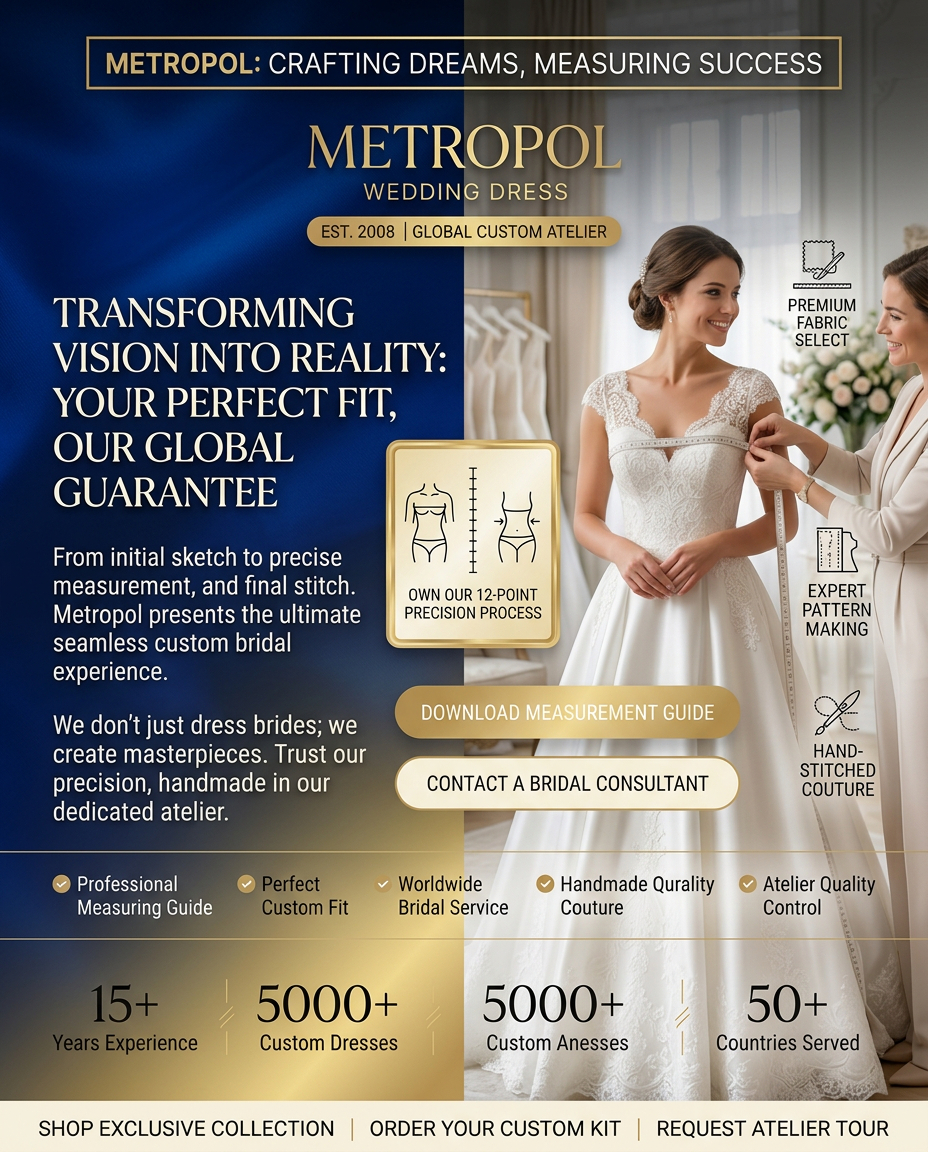
15. Metropol Wedding Dress: A More Personal Approach to Bridal Design
A wedding dress should reflect the person wearing it, not simply reproduce a trend.
At Metropol Wedding Dress, the central message of this landing page is the importance of individual bridal style, thoughtful design decisions, and a dress that feels meaningful from the first fitting to the wedding day.
For brides exploring custom wedding dress options, the starting point should be a conversation about the look they want to achieve.
Some brides imagine a timeless and understated silhouette.
Others prefer intricate lace, luxurious fabrics, statement sleeves, or a dramatic train.
Some want a traditional bridal appearance, while others are looking for something contemporary and unconventional.
Every design brief is different.
Begin with your vision
Before discussing individual design details, consider the overall feeling you want your dress to create.
Would you prefer:
- Timeless elegance?
- Modern minimalism?
- Romantic femininity?
- Contemporary couture?
- Classic bridal luxury?
- Dramatic statement design?
Once the aesthetic direction is clear, the next step is to consider the silhouette, fabric, fit, and construction.
Think beyond the photograph
The wedding dress must work throughout the day.
It should allow you to walk comfortably, sit during the ceremony, move during photographs, and enjoy the reception.
A beautiful design should not require you to compromise unnecessarily on comfort.
Make informed decisions
Before committing to any custom wedding dress project, discuss:
- Available design services.
- Customization possibilities.
- Fabric options.
- Production location.
- Fitting arrangements.
- Delivery timelines.
- Pricing.
- Alteration policies.
Metropol Wedding Dress should communicate its verified capabilities clearly so that brides know exactly what they can expect.
Your bridal vision deserves careful attention
The right wedding dress is not necessarily the most elaborate, the most expensive, or the most fashionable.
It is the one that feels right when you put it on.
A gown that reflects your personality, fits comfortably, and complements the atmosphere of your wedding can become something much more meaningful than another item of clothing.
Explore your bridal vision with Metropol Wedding Dress and take the first step toward finding a wedding dress that reflects your own sense of style.
16. Your Custom Wedding Dress Buying Checklist
Before selecting a designer, use this checklist to compare your options.
Design requirements
- I have identified my preferred silhouette.
- I have selected inspiration images.
- I understand which details are essential.
- I have considered the ceremony and reception.
- I have discussed comfort and movement.
Designer evaluation
- I have reviewed completed bridal projects.
- I have examined construction details.
- I have confirmed the designer’s custom capabilities.
- I have discussed production location.
- I have spoken about fabric sourcing.
- I understand who will construct the gown.
Financial planning
- I have established a complete budget.
- I have requested a written quotation.
- I know what the deposit covers.
- I understand the payment schedule.
- I have checked alteration costs.
- I have allowed for accessories and preservation.
Production planning
- My wedding date has been confirmed with the designer.
- I understand the production schedule.
- I know how many fittings are included.
- I have confirmed the final fitting date.
- I have discussed delivery and collection.
Final preparation
- I have my wedding shoes.
- I have tested sitting and walking in the gown.
- I know how to use the bustle.
- I understand how to store the dress.
- I have arranged transportation.
17. Five Ways to Begin Your Bridal Design Journey
CTA 1: The personal approach
Your wedding dress should feel like you.
Start with your ideas, your preferred style, and the details that matter most. Explore your bridal vision with Metropol Wedding Dress and discover the possibilities for creating a look that reflects your personality.
CTA 2: The luxury approach
A more thoughtful approach to bridal elegance.
Beautiful design begins with attention to detail. Discover the possibilities of personalized bridal fashion and take the next step toward a wedding look that feels distinctive and timeless.
CTA 3: The practical approach
Have a wedding date? Start planning your dress.
The right preparation makes all the difference. Discuss your timeline, design preferences, budget, and fitting requirements before making your bridal decision.
CTA 4: The emotional approach
One day. One unforgettable dress. Your story.
The most meaningful wedding dresses are the ones that reflect the women who wear them. Begin exploring a design that feels personal, confident, and uniquely yours.
CTA 5: The consultation approach
Let’s talk about the wedding dress you have imagined.
Bring your inspiration, your questions, and your ideas. Contact Metropol Wedding Dress to discuss available services, customization possibilities, and the next steps toward your bridal look.
Final Thoughts: Finding the Best Custom Wedding Dress Designer in Vancouver
Choosing a custom wedding dress designer is a decision that deserves careful consideration.
The best choice is not determined by the number of embellishments, the popularity of a designer, or the price displayed on a website.
It comes down to the relationship between design vision, craftsmanship, fit, service, budget, and timing.
Vancouver offers a diverse range of bridal professionals, including independent couture designers, locally made bridal labels, custom dressmaking studios, and luxury boutiques.
Stesha Ho Bridal Couture, Kathryn Bass Bridal, OUMA, Elika In Love, and Manuel Mendoza Couture offer different approaches to personalized bridal fashion. Other studios and boutiques provide additional options for brides who need specialized tailoring, collection-based shopping, or particular design aesthetics.
Before choosing, investigate the actual scope of each business’s services.
Ask to see completed work. Understand the construction. Review the contract. Confirm the timeline. And never underestimate the importance of a comfortable, well-fitted gown.
Most importantly, do not allow trends or other people’s expectations to define your wedding dress.
Your dress should complement your personality, your celebration, and the way you want to remember your wedding day.
The perfect wedding dress is not simply the one that looks beautiful. It is the one that feels unmistakably yours.
Frequently Asked Questions (FAQ)
1. Who are some of the best custom wedding dress designers in Vancouver?
Vancouver has several notable bridal design studios. Stesha Ho Bridal Couture, Kathryn Bass Bridal, OUMA, Elika In Love, and Manuel Mendoza Couture are among the options worth researching. Each has a different design philosophy, service offering, and approach to bridal craftsmanship. The best choice depends on whether you want a completely bespoke gown, a made-to-order design, or selected modifications to an existing dress.
2. What is the difference between a bespoke wedding dress and a made-to-order wedding dress?
A bespoke wedding dress is individually developed for a particular client, potentially involving original sketches, patternmaking, fabric selection, and multiple fittings. A made-to-order wedding dress is generally an existing designer style produced after an order is placed. Some made-to-order gowns allow customization, but they are not automatically fully bespoke.
3. How much does a custom wedding dress cost in Vancouver?
Prices vary according to fabric, construction, design complexity, handwork, and the number of fittings. As broad planning allowances, simpler customization may start around CAD $1,500–$3,000, while premium bespoke gowns may cost CAD $5,000–$9,000 or more. Luxury couture projects can exceed CAD $15,000. Always obtain an individualized quotation.
4. How early should I contact a custom wedding dress designer?
Starting approximately 8–12 months before your wedding is a sensible planning target. Complex designs, specialty fabrics, and extensive handwork may require additional time. Contact the designer earlier if your wedding date falls during a busy production season.
5. Can I combine different wedding dress designs into one custom gown?
Yes, this is one of the advantages of bespoke design. You can use one dress as inspiration for its neckline, another for its sleeves, and another for its skirt. The designer must determine whether the elements can work together structurally and aesthetically.
6. Can a custom wedding dress be designed for a non-standard body proportion?
Yes. Individual pattern development can account for differences in torso length, shoulder slope, bust placement, waist position, and other proportions. The process should focus on the actual measurements and desired fit rather than relying exclusively on standard bridal sizing.
7. Is a custom wedding dress better than buying a designer gown?
Not necessarily. A designer collection may already offer exactly what you want. Custom design becomes more valuable when you need an original silhouette, specific construction, or meaningful personalization that an existing gown cannot provide.
8. Which fabrics are best for a luxury custom wedding dress?
Silk satin, silk crepe, Mikado, organza, Chantilly lace, and tulle are popular options. The best fabric depends on the silhouette, desired drape, structure, climate, and overall aesthetic. Ask to examine physical fabric samples before approving the final material.
9. Can I request a completely original wedding dress design?
Many bespoke bridal ateliers offer individually developed designs. However, not every bridal boutique or designer accepts fully original commissions. Confirm this before paying a deposit and ask to understand the design-development process.
10. How many fittings are needed for a custom wedding dress?
The number varies according to the design and studio. A bespoke gown may involve an initial measurement appointment, a prototype or first construction fitting, one or more refinement fittings, and a final fitting. Confirm which appointments are included in the quotation.
11. Can I have a custom wedding dress made with sleeves?
Yes. Sleeve designs can include fitted long sleeves, bishop sleeves, detachable sleeves, off-the-shoulder sleeves, cap sleeves, and transparent lace sleeves. The designer should consider arm movement, fabric weight, and the relationship between the sleeve and bodice.
12. Can I create a wedding dress with a detachable train?
Yes. A detachable train or overskirt can provide a dramatic ceremony look while allowing a lighter silhouette for the reception. The attachment system should be tested to ensure that it remains secure and can be removed without damaging the dress.
13. Are Vancouver-made wedding dresses more expensive?
Not necessarily. Price depends on materials, production complexity, labour, design, and business structure. Local manufacturing may provide easier communication and fittings, but it does not automatically mean a lower or higher final price.
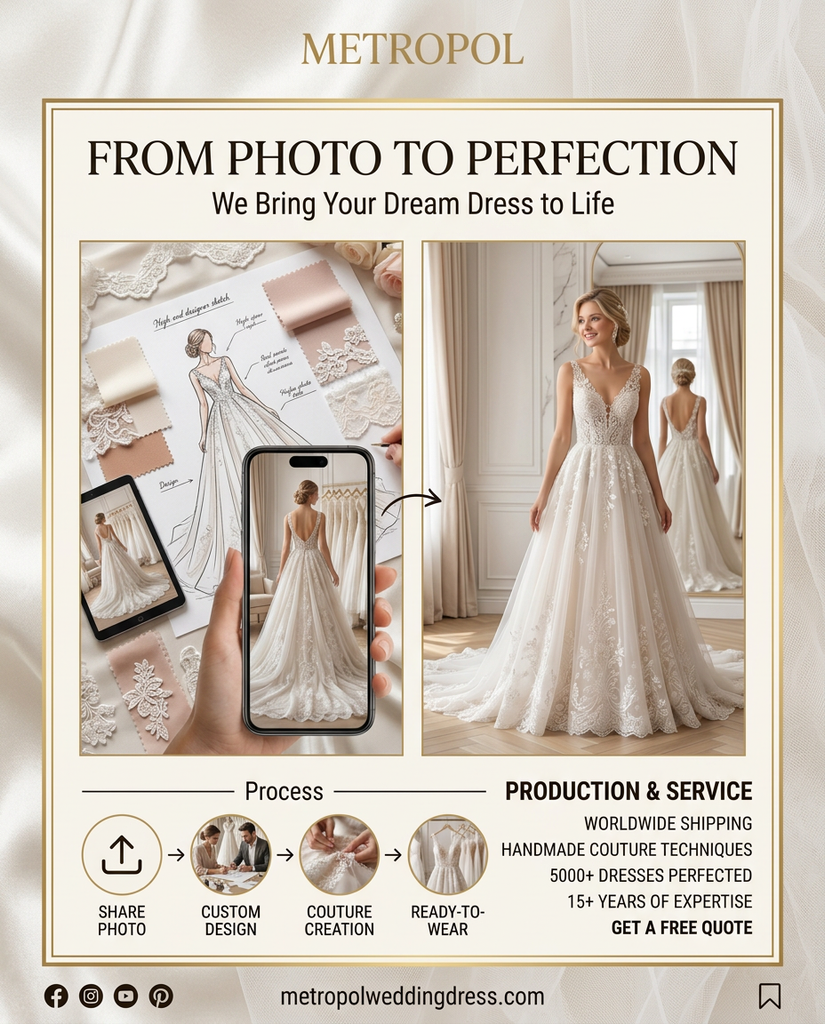
14. Can a designer recreate a wedding dress from a photograph?
A photograph can be used as inspiration, but exact reproduction may not be possible or appropriate. Fabric availability, construction details, pattern dimensions, and intellectual property considerations can affect the project. A designer can often develop an original interpretation based on the visual elements you like.
15. Can I customize an existing wedding dress instead of commissioning a new one?
Yes. Depending on the original construction, a dressmaker may be able to modify sleeves, necklines, straps, backs, skirts, lace details, or embellishments. The feasibility and cost depend on the garment’s structure and the extent of the changes.
16. What is a toile in custom wedding dress production?
A toile is a prototype garment generally made from an inexpensive fabric. It allows the designer to test the silhouette, pattern, proportions, and fit before cutting the final fabric. It is particularly useful for complicated or highly structured designs.
17. Can I choose my own lace and fabric?
Many independent designers allow clients to participate in fabric selection. Some may also accept client-supplied materials, depending on quality, quantity, and suitability. Discuss this before production because certain textiles require specialized handling.
18. What should I bring to my first bridal design consultation?
Bring inspiration photographs, your wedding date, venue information, a preliminary budget, and an explanation of your preferred style. It is also useful to identify design features you definitely do not want. This helps the designer develop a clearer brief.
19. Can a custom wedding dress include pockets?
Yes. Pockets can be incorporated into suitable skirt constructions. Their size, placement, and reinforcement should be planned during design development so they do not distort the silhouette.
20. How can I make sure my strapless wedding dress stays in place?
A secure strapless gown generally requires appropriate internal structure, accurate patternmaking, and a correctly fitted bodice. Depending on the design, boning, internal waist stays, cups, and carefully positioned support elements may be used.
21. Are custom wedding dress alterations included in the price?
This depends on the designer’s agreement. Some studios include specified fittings and adjustments, while others charge separately for alterations. Request written clarification about included services and additional charges.
22. Can I order a custom wedding dress if I live outside Vancouver?
Some designers may accept clients who travel to Vancouver for consultations and fittings. Others may offer limited remote consultation options. However, a fully bespoke gown generally benefits from in-person fitting appointments. Confirm the studio’s policies before beginning.
23. What is the best wedding dress silhouette for an outdoor Vancouver wedding?
A-line, sheath, and lighter fit-and-flare designs can be practical choices, but the best option depends on the venue and personal preference. Consider the ground surface, weather, wind, walking requirements, and train length before approving the design.
24. Can a custom wedding dress be designed for a rainy wedding day?
Yes. A designer can consider fabric weight, skirt length, train management, and protective transportation. A removable train or a practical bustle can also help. No fabric should be assumed to be waterproof simply because it feels substantial.
25. What is the difference between bridal couture and ordinary custom dressmaking?
Bridal couture generally places particular emphasis on individual design, advanced construction, premium materials, specialized fitting, and detailed finishing. Custom dressmaking can also produce excellent results, but the scope of design development and craftsmanship varies between studios. The actual work matters more than the label.
26. Can I have two different looks using one wedding dress?
Yes. A convertible design can incorporate detachable sleeves, overskirts, capes, or trains. This allows a bride to create a more formal ceremony appearance and a lighter reception look without purchasing two complete gowns.
27. How do I evaluate the quality of a custom wedding dress?
Inspect the seams, lining, internal support, closures, hems, lace placement, embroidery, and overall symmetry. Ask to see detailed photographs of previous projects and, where possible, examples of finished gowns. Also test how the dress moves when walking and sitting.
28. Is a custom wedding dress suitable for a minimalist bride?
Absolutely. Minimalist bridal design can be particularly dependent on excellent patternmaking, fabric quality, proportion, and finishing. A simple silk or crepe gown may require exceptional technical precision because there are fewer decorative elements to distract from construction.
29. Can an old family wedding dress be transformed into a modern custom gown?
Potentially, yes. An experienced dressmaker may be able to reuse lace, buttons, fabric panels, or other sentimental elements. The feasibility depends on the condition, quantity, and structural integrity of the original material. A preliminary assessment is essential.
30. What should a custom wedding dress contract include?
It should identify the approved design, materials, price, payment schedule, fitting arrangements, number of included revisions, delivery date, alteration responsibilities, cancellation terms, and procedures for approving additional work. Written documentation helps protect both the bride and the designer.
31. Can I request a wedding dress with hidden support?
Yes. Internal corsetry, boning, waist stays, cups, and other construction elements can be incorporated depending on the design. The objective should be secure support without unnecessary pressure or restricted movement.
32. Is hand embroidery worth the additional cost?
Hand embroidery can add individuality, texture, and intricate detail. Whether it is worth the cost depends on your priorities and budget. Ask which elements are genuinely handmade, how much work is involved, and how the embroidery is secured to the fabric.
33. Can I change my wedding dress design after production begins?
Some minor changes may be possible, but substantial revisions can increase costs and affect the delivery schedule. Major decisions should be finalized before construction whenever possible. Ask the designer to explain the approval and change-order process.
34. How should I store my custom wedding dress before the wedding?
Follow the designer’s care instructions. In general, a gown should be stored in a clean, dry, protected environment, away from direct sunlight and moisture. Avoid hanging particularly heavy gowns incorrectly, as prolonged weight can affect delicate construction.
35. Can I preserve my custom wedding dress after the wedding?
Yes. Professional bridal cleaning and preservation can help protect the garment against stains, discoloration, and deterioration. Cleaning requirements depend on the fabric, embellishments, and construction. Ask for care recommendations before the wedding.
36. What makes a wedding dress truly unique?
Uniqueness comes from the relationship between the design, the bride, and the craftsmanship. An original silhouette, thoughtful fabric selection, personalized construction, and meaningful details can make a gown distinctive without requiring excessive embellishment.
37. How do I compare two custom wedding dress designers fairly?
Compare the actual scope of work rather than just the final price. Review portfolios, construction quality, materials, fitting schedules, communication, production location, delivery commitments, and contractual terms. Request comparable written quotations based on the same design brief.
38. Should I choose a local Vancouver designer or an international bridal brand?
Both can be excellent options. A local designer may provide easier communication, more direct collaboration, and convenient fittings. An international brand may offer established collections, recognizable design signatures, and access to specialized styles. Your decision should reflect the service and garment you actually want.
39. Can a custom wedding dress be made on a tight deadline?
Some designers may accommodate shorter timelines, depending on workload, fabric availability, and construction complexity. However, a rushed commission can reduce design flexibility and increase costs. Contact studios immediately, explain your wedding date, and ask for a realistic production assessment.
40. What is the most important thing to remember when choosing a custom wedding dress designer in Vancouver?
Choose a designer who understands your vision, can demonstrate the required technical skills, communicates clearly, and provides realistic expectations about price and timing. The ideal gown should combine personal style, excellent fit, construction quality, and comfort. Your wedding dress should feel like an authentic expression of who you are.
Related Topics
19.08.2022
The world of affordable wedding dress designers is a tapestry woven with creativity, craftsmanship, and a deep understanding of the bride’s dreams. Wedding dress designers play a pivotal role in shaping the bridal fashion landscape,...

09.01.2026
Export von Hochpreisigen Luxus Brautkleidern nach Deutschland Der internationale Handel mit Luxusgütern hat in den letzten Jahren erheblich an Bedeutung gewonnen. Besonders der Export von Hochpreisigen Luxus-Brautkleidern nach Deutschland stellt für Designer, Modehäuser und Hersteller...

15.12.2020
Choosing Lace and Fabric for Wedding Dress Choosing Lace and Fabric for Wedding Dress” is not a specific person but rather a topic or task that a bride-to-be or someone involved in wedding planning would...
08.10.2026
How to Launch a Bridal Collection Without Holding Large Inventory Launching a bridal collection sounds expensive. At first glance, the traditional model appears to require dozens — perhaps hundreds — of wedding dresses in multiple...
07.06.2024
Cagteks gelinlik Instagram “Bridal to be” typically refers to someone who is soon to be married or who is in the process of preparing for their wedding. It signifies the period leading up to the...

31.03.2024
3 أفضل الشركات المصنعة لفساتين الزفاف الحجاب بالجملة أصبحت الشركات المصنعة لفساتين زفاف الحجاب بالجملة أكثر شعبية بين العرائس المسلمات اللاتي يرغبن في الجمع بين التقاليد والأساليب الحديثة. فستان الزفاف المحجب يكون محتشماً وأنيقاً ويعكس...
Comments