
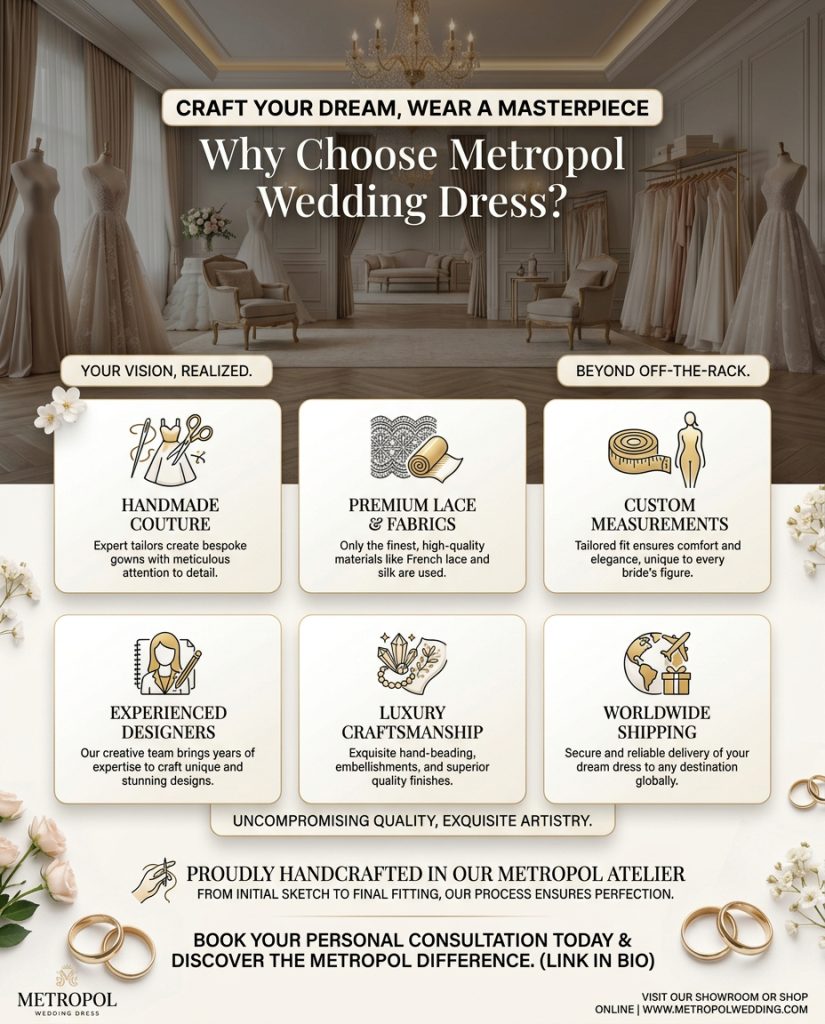
Where to Buy Custom Wedding Dresses in Canada Finding the right wedding dress in Canada involves more than choosing a beautiful design. Brides also need to consider fit, fabric, construction, budget, delivery timelines, alterations, and the level of customization they want.
Two popular options are made-to-measure wedding dresses and designer wedding dresses. Although these terms are sometimes used interchangeably, they describe different approaches to creating and purchasing a bridal gown.
A made-to-measure wedding dress is adjusted to a bride’s measurements, usually using an existing design or pattern. A designer wedding dress is created under a designer’s creative direction and may be purchased in a standard size, customized, or made to order.
For brides who want a gown that reflects their personal style, understanding these differences is essential. This guide explains where to look for custom wedding dresses in Canada, how to compare made-to-measure and designer gowns, what questions to ask before purchasing, and how to make a confident decision.
Metropol Wedding Dress is included as a brand to consider when researching wedding dress options. Before placing an order, brides should confirm the available customization services, sizing process, fabrics, production location, delivery arrangements, and alteration policies directly with the brand.
Part 1: Where to Buy Custom Wedding Dresses in Canada
1. Introduction: Finding a Wedding Dress That Feels Right
Choosing a wedding dress is one of the most personal decisions in wedding planning. A gown is not simply an outfit for a special occasion. It becomes part of the memories, photographs, and emotions associated with one of the most meaningful days in a bride’s life.
For many Canadian brides, finding the right dress can involve balancing several priorities:
- A design that reflects their personality.
- A flattering and comfortable fit.
- High-quality fabrics and construction.
- A realistic wedding dress budget.
- Enough time for production and alterations.
- Reliable communication with the seller.
- Clear shipping, return, and delivery arrangements.
Traditional bridal boutiques remain a popular starting point, but they are not the only option. Brides can also explore independent bridal designers, custom dressmakers, made-to-measure services, and international wedding dress brands that accept orders from Canada.
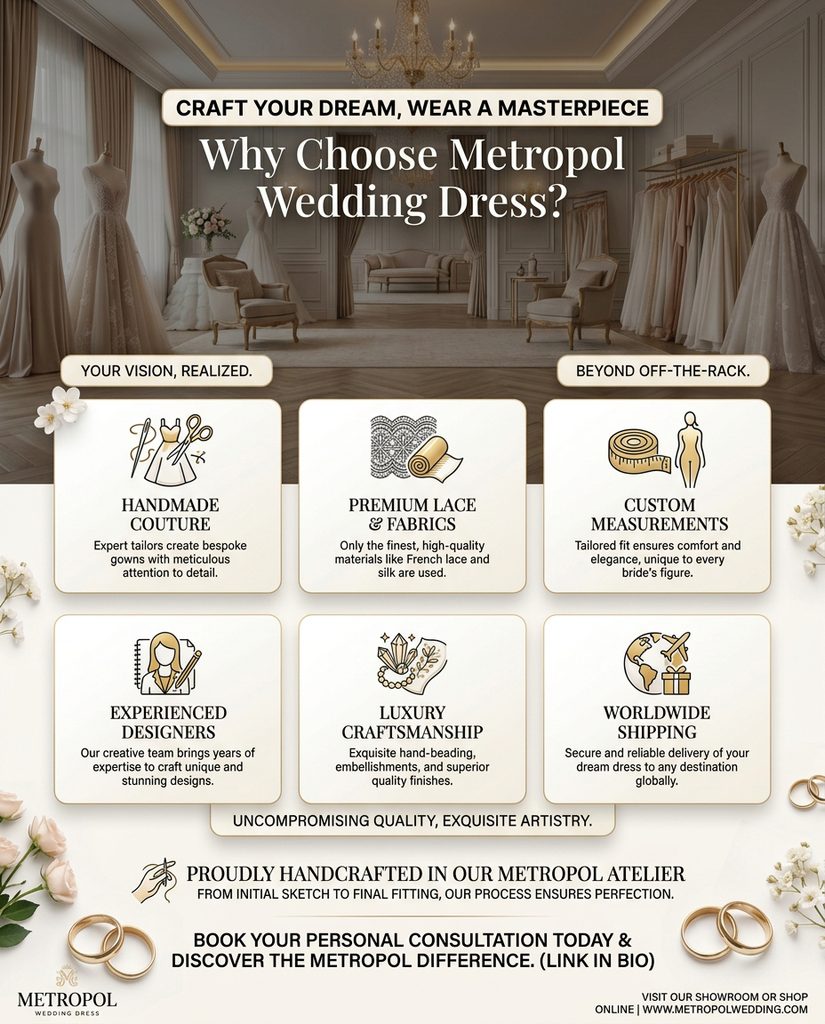
The best choice depends on what matters most: convenience, individuality, craftsmanship, price, or a combination of these factors.
If you are searching for custom wedding dresses in Canada, the first step is understanding what different sellers actually offer. A dress described as custom may only have minor adjustments available, while another service may create a gown around your measurements and design preferences.
Knowing the difference helps you avoid misunderstandings and choose a dress that meets your expectations.
2. What Is a Custom Wedding Dress?
A custom wedding dress is a gown created or adapted according to a bride’s individual requirements.
Depending on the designer or dressmaker, customization may involve:
- Adjusting the bust, waist, and hip measurements.
- Changing the neckline.
- Modifying the sleeve length.
- Selecting a different fabric.
- Changing the skirt shape.
- Adding or removing lace.
- Adjusting the train.
- Modifying the back design.
- Changing the colour.
- Adding personalized details.
However, not every company uses the word custom in the same way.
Some sellers offer a standard collection with limited personalization. Others provide made-to-measure services, while independent dressmakers may create a completely original gown from an initial consultation.
Before purchasing, ask exactly what customization includes.
For example, a retailer might offer a standard wedding dress in several sizes but allow customers to choose a different sleeve style. This is customization, but it does not necessarily mean the dress will be individually patterned or constructed from scratch.
A professional made-to-measure service may instead use your measurements to adjust the garment’s proportions.
A fully bespoke service generally involves a more extensive design and fitting process.
Where to Buy Custom Wedding Dresses in Canada
| Customization type | What it usually means |
|---|---|
| Size adjustment | The dress is ordered or altered to fit specific measurements. |
| Design modification | Certain details, such as sleeves or neckline, are changed. |
| Fabric selection | The bride chooses from available fabric options. |
| Made to measure | The garment is produced or adjusted using individual measurements. |
| Bespoke design | The dress is developed around the bride’s specific design requirements. |
| Standard designer order | A designer’s existing style is ordered in a selected size. |
Understanding these distinctions makes it easier to compare different wedding dress providers.
3. Where Can You Buy Custom Wedding Dresses in Canada?
Canadian brides have several ways to find a custom or personalized wedding dress. Each option offers different advantages, and the right one depends on the bride’s priorities.
A. Local Bridal Boutiques
Local bridal boutiques are a traditional starting point for wedding dress shopping.
Many boutiques carry collections from established bridal designers and offer appointments where brides can try on different silhouettes, fabrics, and sizes.
Some boutiques also provide customization services through their designers or alteration partners.
Advantages of local bridal boutiques:
- You can see and feel the dresses before purchasing.
- You can compare different silhouettes in person.
- Staff may help you identify suitable styles.
- You can discuss alterations directly.
- You may have access to local fitting services.
Potential disadvantages:
- The selection may be limited to specific designers.
- Some boutiques require appointments.
- Designer gowns can be expensive.
- Special orders may take several months.
- Customization options vary between brands.
When visiting a boutique, ask whether the dress can be modified before production or whether changes must be made after delivery.
This distinction can influence both the final fit and the total cost.
B. Independent Wedding Dress Designers
Independent bridal designers offer another option for brides who want something distinctive.
Some designers create original collections, while others work with clients to develop personalized gowns.
Depending on the designer, the process may include:
- An initial consultation.
- Discussion of the wedding venue and theme.
- Selection of a silhouette.
- Fabric and embellishment choices.
- Measurement and fitting appointments.
- Pattern development or design adjustments.
- Construction and final fitting.
Independent designers can be especially suitable for brides who have a clear vision of their ideal wedding dress.
For example, a bride might want a minimalist satin gown with a structured bodice, a removable overskirt, and a low back. An independent designer may be able to discuss how these elements can be combined.
However, bespoke work requires clear communication.
Before paying a deposit, ask to see examples of previous work, understand the production schedule, and obtain a written description of the agreed design.
C. Professional Dressmakers and Custom Bridal Studios
A professional dressmaker may be an excellent choice when the bride wants a specific fit or design modification.
Some dressmakers specialize in bridal garments, while others work across formalwear, eveningwear, and special-occasion clothing.
A bridal specialist is often preferable because wedding dresses can involve complex construction techniques.
These may include:
- Internal corsetry.
- Boning.
- Structured bodices.
- Multiple skirt layers.
- Delicate lace placement.
- Beading and embroidery.
- Bustle construction.
- Long train support.
A dressmaker should be able to explain how the gown will be constructed and how the design will support the bride’s movement.
Ask whether the service includes fittings, alterations, and final adjustments.
A low initial quote may not include these additional services.
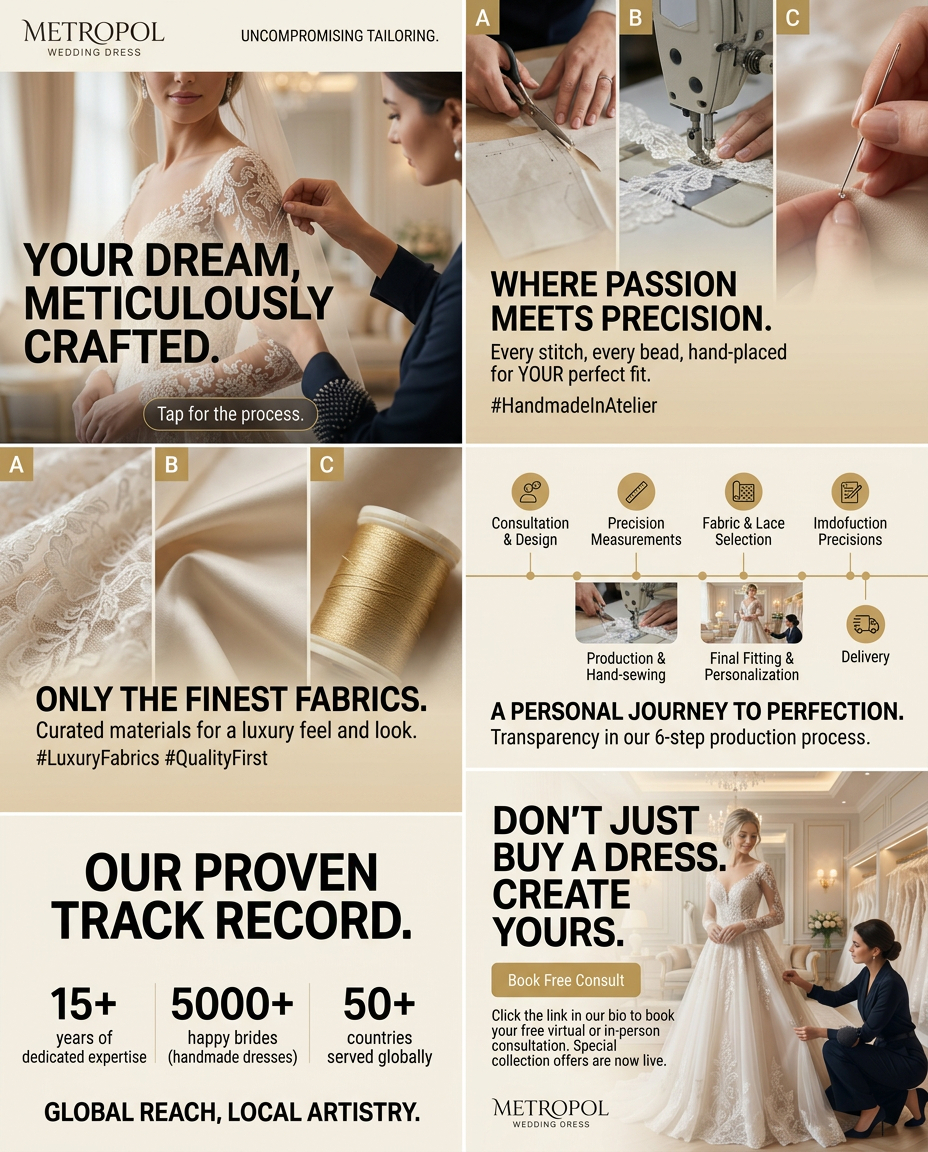
D. Online Wedding Dress Brands
Online wedding dress shopping has become an alternative for brides who want to explore a wider range of styles.
Online retailers may offer:
- Standard-size wedding dresses.
- Made-to-measure options.
- Customizable designs.
- Made-to-order gowns.
- Bridal separates.
- Reception dresses.
- Veils and accessories.
The main advantage is convenience. Brides can research styles, compare prices, and communicate with sellers without travelling to multiple boutiques.
However, buying a wedding dress online requires careful evaluation.
A product photograph cannot fully communicate the weight, texture, flexibility, or construction quality of a fabric.
Before ordering, check:
- Whether the measurements are collected in centimetres or inches.
- Which body measurements are required.
- Whether the seller provides a measurement guide.
- Whether the dress is made to order.
- Whether custom orders are returnable.
- Whether alterations are included.
- How long production takes.
- Whether international shipping is available.
- Who is responsible for customs-related charges.
- What happens if the dress arrives with a defect.
Do not assume that a dress advertised as made to measure will fit perfectly without alterations. Individual measurements improve the starting fit, but final adjustments may still be necessary.
E. International Wedding Dress Brands
Canadian brides do not need to limit their search to Canadian retailers.
International brands may provide access to different design collections, fabrics, and customization approaches.
Metropol Wedding Dress is one brand brides can research when comparing wedding dress options.
When considering an international brand, it is important to evaluate more than the appearance of the gowns.
Ask the brand directly:
- Does it accept orders from Canada?
- Are made-to-measure services available?
- Can the design be modified?
- Which fabrics and construction options are offered?
- What measurements are required?
- What is the estimated production time?
- How is international delivery arranged?
- What happens if the gown needs adjustments?
- What are the return and exchange conditions?
These questions help establish whether the purchasing process is suitable for your wedding schedule and expectations.
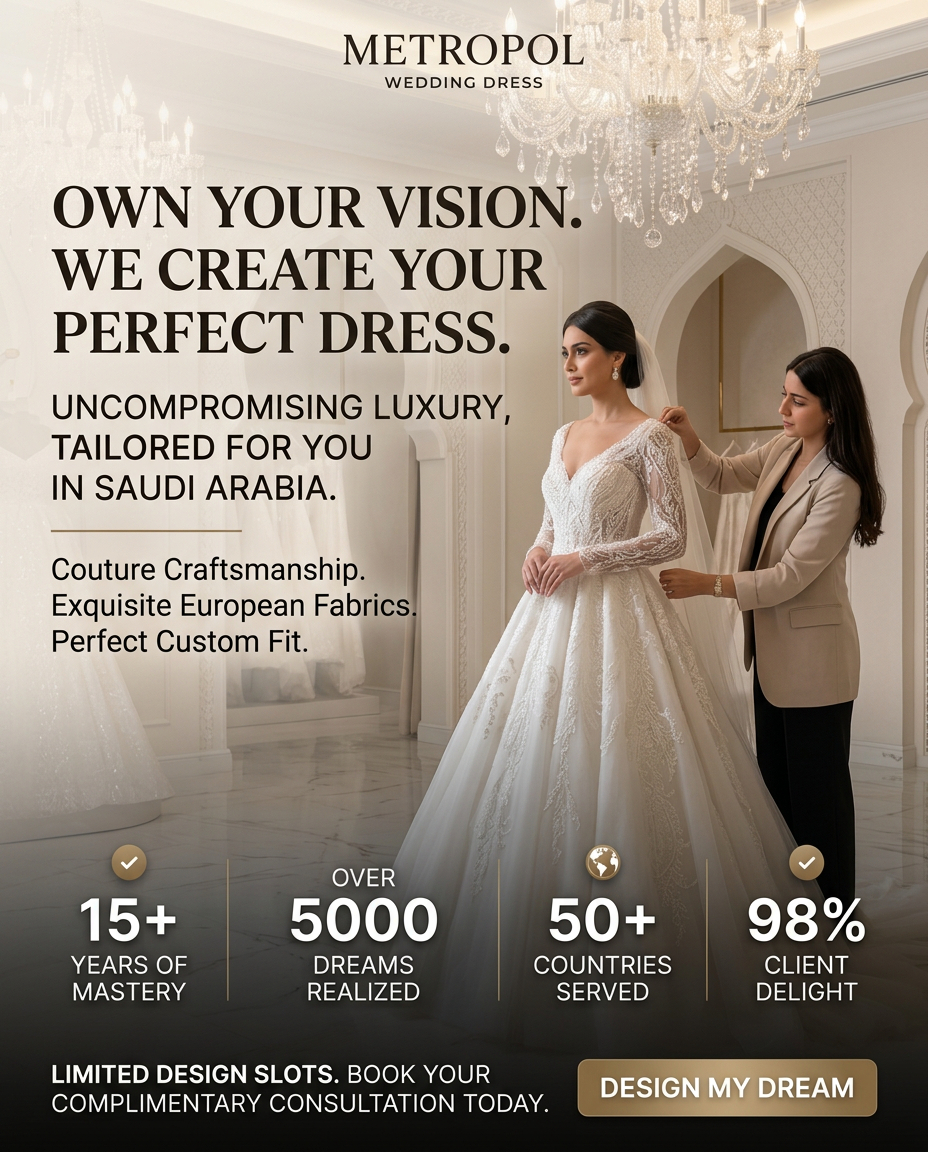
4. How to Choose a Wedding Dress Supplier in Canada
Finding a beautiful dress is only part of the purchasing decision. You also need to trust the company responsible for producing or supplying it.
A wedding dress is a significant purchase, so it is worth assessing suppliers carefully.
Evaluate the quality of communication
A reliable wedding dress provider should be able to explain the purchasing process clearly.
You should understand:
- What happens after placing an order.
- How measurements are submitted.
- Whether design changes are possible.
- When production begins.
- How progress updates are handled.
- When the dress is expected to be completed.
- How delivery is arranged.
If important questions receive vague answers before payment, that may indicate a communication problem later.
Review previous work
Ask to see examples of dresses the supplier has previously produced or supplied.
Look for details such as:
- Straight and consistent seams.
- Balanced proportions.
- Neat finishing.
- Secure embellishments.
- Symmetrical design elements.
- Clean neckline construction.
- Well-finished hems.
- Appropriate lining.
If possible, look for photographs from different angles rather than relying only on promotional images.
Customer reviews can also help, but read them critically. Focus on detailed comments about product quality, communication, delivery, and problem resolution.
Understand the payment terms
Before ordering, establish:
- The total price.
- The deposit amount.
- When the remaining balance is due.
- Whether customization costs extra.
- Whether alterations are included.
- Whether shipping is included.
- Whether taxes or import-related charges may apply.
Ask for the agreed terms in writing.
Confirm the delivery schedule
A wedding dress that arrives after the wedding date is not useful, regardless of how beautiful it is.
Ask for a realistic production and shipping estimate.
Allow time for possible delays, customs processing, and alterations.
A sensible approach is to work backwards from the wedding date rather than ordering at the last possible moment.
5. What Should You Look for in a Custom Wedding Dress?
The best custom wedding dress is not necessarily the most complicated or expensive one.
It is the dress that suits your body, personal style, wedding setting, and comfort requirements.
Silhouette
The silhouette determines the overall shape of the gown.
Common wedding dress silhouettes include:
| Silhouette | General characteristics | Often considered by brides who want |
|---|---|---|
| A-line | Fitted bodice with a skirt that gradually widens | A balanced, versatile shape |
| Ball gown | Structured bodice and full skirt | A traditional, dramatic appearance |
| Mermaid | Fitted through the body with a flared lower skirt | A defined, fitted silhouette |
| Trumpet | Fitted through the torso and upper thighs, then flared | A shape between mermaid and A-line |
| Sheath | Narrow, flowing shape following the body | A minimalist appearance |
| Empire waist | Waistline sits just below the bust | A soft, flowing silhouette |
Try different silhouettes before deciding.
A dress that looks beautiful on a model may feel very different when worn for several hours.
Fabric
Fabric influences the gown’s appearance, weight, movement, and comfort.
Common bridal fabrics include:
Satin: Often chosen for its smooth surface and structured appearance. Depending on its composition, satin can feel heavier or lighter.
Chiffon: A lightweight, flowing fabric often used for soft skirts and layered designs.
Tulle: A fine net-like material used for volume, overlays, and decorative details.
Lace: Available in many patterns and textures, lace can create romantic, traditional, or modern effects.
Organza: A lightweight, crisp fabric that can provide structure without the weight of heavier materials.
Crepe: Often selected for clean lines and understated designs.
When selecting fabric, consider the season and venue.
A lightweight gown may be more comfortable for a summer outdoor ceremony. A structured dress may work well for a formal indoor event, depending on the construction and lining.
Neckline
The neckline affects the visual balance of the gown and can influence how comfortable and secure it feels.
Popular choices include:
- Sweetheart.
- V-neck.
- Square neckline.
- Off-the-shoulder.
- Strapless.
- High neckline.
- Halter.
- Scoop neckline.
- Boat neckline.
When choosing a neckline, consider the support built into the bodice.
A strapless gown, for example, needs appropriate internal structure to remain comfortable and secure.
Sleeves
Sleeves can change the character of a wedding dress.
Options include:
- Sleeveless.
- Cap sleeves.
- Short sleeves.
- Long fitted sleeves.
- Sheer lace sleeves.
- Off-the-shoulder sleeves.
- Detachable sleeves.
- Bishop sleeves.
If you are considering sleeves, ask whether they are part of the original construction or attached separately.
This can affect how easily the gown can be adjusted.
Train
A train can add drama and formality, but it also affects movement.
Common options include:
- No train.
- Sweep train.
- Court train.
- Chapel train.
- Cathedral train.
Consider the venue, aisle length, flooring, and whether you plan to dance extensively.
A bustle or another train-management solution may be necessary for the reception.
Personalization
Small details can make a wedding dress feel more personal.
Consider:
- A different back design.
- A personalized neckline.
- Subtle embroidery.
- A detachable overskirt.
- A removable train.
- Decorative buttons.
- A different sleeve style.
- A matching veil.
- A second look for the reception.
Before approving a modification, ask how it affects the price, construction, and delivery date.
6. How Much Do Custom Wedding Dresses Cost in Canada?
There is no single price for a custom wedding dress.
The final cost depends on the designer, fabric, construction, design complexity, production location, and level of personalization.
A simple made-to-measure gown may cost less than an elaborate bespoke design involving extensive handwork.
The most useful approach is to establish a complete budget rather than comparing the advertised dress price alone.
Factors that influence the price
Design complexity
A clean, minimalist gown may require less construction time than a dress with multiple layers, intricate lace placement, or extensive beading.
Fabric selection
Fabric prices vary considerably. Luxury materials and specialty textiles can increase the total cost.
Construction
Internal corsetry, structured bodices, complex draping, and detailed finishing may require additional labour.
Customization
Changes to an existing design may be relatively straightforward. Major modifications can require new pattern work and additional fittings.
Production location
The location where the gown is made can influence labour costs, shipping arrangements, and delivery time.
Alterations
The initial dress price may not include final fitting adjustments.
Build a realistic wedding dress budget
Use the following categories when comparing suppliers:
| Budget category | What to include |
|---|---|
| Base gown | The original dress price |
| Customization | Design changes and personalized details |
| Alterations | Hemming, bodice adjustments, and fit corrections |
| Accessories | Veil, shoes, jewellery, and other accessories |
| Shipping | Delivery and handling |
| Taxes and import costs | Applicable charges based on the purchase |
| Contingency | Additional money for unexpected adjustments |
Request an itemized quotation before placing your order.
This makes it easier to compare two dresses that may appear to have similar advertised prices but include different services.
7. Buying a Wedding Dress Online: What Canadian Brides Should Know
Online shopping can make it easier to discover wedding dress designs, but it also requires more preparation.
The most important difference is that you may not be able to try the exact gown before purchasing it.
That makes accurate information essential.
Read the size chart carefully
Do not rely only on your everyday clothing size.
Bridal sizing varies between designers and brands.
A supplier may request:
- Bust measurement.
- Waist measurement.
- Hip measurement.
- Shoulder measurement.
- Shoulder-to-waist measurement.
- Hollow-to-hem measurement.
- Height.
- Heel height.
Follow the seller’s instructions carefully.
If you are unsure how to measure yourself, ask whether a professional measurement service is recommended.
Understand the return policy
Wedding dresses are often made to order, and some sellers have different policies for standard-size and customized products.
Before purchasing, check:
- Whether standard-size dresses can be returned.
- Whether made-to-measure dresses are returnable.
- Whether custom modifications affect return eligibility.
- What happens if the item arrives damaged.
- How defects must be reported.
- Whether refunds or alterations are offered.
Never assume that a custom gown can be returned under the same conditions as an ordinary retail garment.
Check shipping and import arrangements
If the dress is shipped internationally, ask how delivery is handled.
Clarify whether the quoted price includes shipping, taxes, duties, or other charges.
The exact treatment of imported goods depends on the applicable customs rules and the shipment details. Canadian buyers should consult the Canada Border Services Agency or a qualified customs professional if they need a definitive answer about potential import costs.
Order with enough time
An online order should include time for:
- Measurement.
- Order confirmation.
- Production.
- Quality checks.
- Shipping.
- Delivery.
- Local alterations.
- Final fitting.
Do not plan around the most optimistic delivery estimate.
A wedding dress is too important to leave without a reasonable contingency period.
8. Why Made-to-Measure Wedding Dresses Are Worth Considering
A made-to-measure wedding dress can be an attractive option for brides who want a more personalized fit without commissioning an entirely original design.
Instead of choosing only from standard sizing, the bride provides specific measurements that the supplier uses when preparing the garment.
The exact process varies by provider.
Some services adjust a standard pattern. Others use the measurements to create a more individually proportioned garment.
Potential advantages
A more individualized starting fit
A standard-size dress is designed around a size chart. Made-to-measure production uses individual measurements to guide the garment’s proportions.
Greater choice
Depending on the supplier, brides may be able to select fabrics, sleeve styles, necklines, or other design elements.
Personal expression
A gown can be adapted to reflect the bride’s preferences rather than being limited to an unchanged retail design.
A useful alternative to full bespoke production
For brides who like an existing design but need adjustments, made-to-measure may provide a practical middle ground.
Important limitations
Made-to-measure does not automatically mean perfect fit.
Measurements can be taken incorrectly, body proportions can change, and different fabrics behave differently.
A final fitting may still be necessary.
It is also important to understand that a made-to-measure dress is not always a fully bespoke dress.
The level of design freedom depends on the service.
9. Why Brides Consider Metropol Wedding Dress
When researching wedding dress brands, it is useful to compare each company’s design options, customization process, purchasing conditions, and communication standards.
Metropol Wedding Dress can be included in that research process for brides exploring wedding dress options.
Before making a purchase, contact the brand and confirm the details that matter to your requirements.
For example:
- Which wedding dress styles are available?
- Are made-to-measure orders offered?
- Can existing designs be modified?
- What fabrics are available?
- How are measurements submitted?
- Are fitting or alteration services included?
- What is the estimated production time?
- Can orders be delivered to Canada?
- What are the payment and return conditions?
These questions help you determine whether the brand’s available services match your expectations.
A good purchasing decision should be based on clear product information, realistic delivery commitments, and written terms—not photographs or marketing descriptions alone.
10. How to Order a Custom Wedding Dress: Step by Step
Ordering a custom or made-to-measure wedding dress is easier when the process is organized.
Step 1: Define your preferred style
Start by identifying the overall look you want.
Think about:
- Silhouette.
- Fabric.
- Neckline.
- Sleeves.
- Skirt volume.
- Back design.
- Train length.
- Embellishments.
You do not need to decide every detail immediately.
A general direction is enough to begin discussing options with a designer or supplier.
Step 2: Establish your budget
Set a maximum amount for the complete wedding dress purchase.
Remember to include alterations and accessories.
If you are comparing international suppliers, include possible shipping and import-related expenses.
Step 3: Research suppliers
Compare local boutiques, independent designers, dressmakers, and online brands.
Look for evidence of product quality and professional communication.
Do not make a decision based only on the lowest price.
Step 4: Ask about customization
Find out which elements can be changed.
Ask whether the supplier can modify the neckline, sleeves, skirt, train, or fabric.
Request confirmation of additional costs.
Step 5: Take accurate measurements
Follow the supplier’s measurement guide.
If professional measurements are recommended, arrange them before submitting your order.
Do not estimate measurements or copy them from an old clothing label.
Step 6: Confirm the order details
Before payment, obtain written confirmation of:
- The selected design.
- The measurements.
- The fabric.
- The requested modifications.
- The total price.
- The payment schedule.
- The production timeline.
- The shipping arrangements.
- The return and alteration policy.
Step 7: Monitor production and delivery
Keep communication records and follow up if the agreed timeline changes.
Once the dress arrives, inspect it promptly.
Step 8: Arrange a final fitting
Try the dress with the shoes and undergarments you intend to wear.
Check the hem, bodice, straps, sleeves, and overall comfort.
Allow enough time for any necessary alterations.
11. Common Mistakes to Avoid When Buying a Custom Wedding Dress
Even a beautiful dress can become a stressful purchase if important details are overlooked.
Here are common mistakes to avoid.
Choosing based only on photographs
Photographs are useful for evaluating style, but they cannot confirm fabric quality or construction.
Ask for additional product information and clear pictures of relevant details.
Assuming made-to-measure means no alterations
Individual measurements can improve the fit, but they do not guarantee a perfect result.
Budget for a final fitting.
Ordering too late
Custom production and international shipping can take longer than expected.
Start researching early and confirm the timeline before placing an order.
Ignoring the return policy
Customized products may have different return conditions.
Read the terms before paying.
Failing to confirm customization details
A verbal discussion may not be enough.
Make sure every agreed change is documented.
Forgetting the wedding venue
A heavy, elaborate gown may be uncomfortable for an outdoor summer wedding.
A long train may be difficult to manage in a small venue.
Consider the practical setting as well as the appearance.
Spending the entire budget on the dress
Remember to account for alterations, accessories, shoes, and possible delivery expenses.
Not asking who handles alterations
A supplier may provide the gown without offering local fitting services.
Know where you will take the dress after delivery.
12. Final Checklist Before Buying a Custom Wedding Dress in Canada
Use this checklist when comparing suppliers.
Design and fit
- I understand the difference between standard-size, made-to-measure, and bespoke.
- I know which design elements can be customized.
- I have reviewed the available fabrics.
- I understand the measurement process.
- I know whether a final fitting is recommended.
Price and payment
- I have received the total price.
- Customization costs are clear.
- Shipping costs are clear.
- I have checked possible taxes and import charges.
- I understand the deposit and payment schedule.
Production and delivery
- The estimated production time is confirmed.
- The shipping method is explained.
- The expected delivery period leaves time for alterations.
- I know whom to contact about order updates.
Policies and support
- I have read the return policy.
- I understand the process for reporting defects.
- I know whether alterations are included.
- I have written confirmation of the agreed design.
Part 2: How to Decide Between a Made-to-Measure and a Designer Wedding Dress
13. Made-to-Measure vs. Designer Wedding Dress: Understanding the Difference
One of the most common questions brides ask when shopping for a wedding dress is whether they should choose a made-to-measure gown or a designer wedding dress.
The answer depends on the bride’s priorities.
Both options can produce a beautiful result, but they are not necessarily the same purchasing experience.
A made-to-measure wedding dress focuses primarily on adapting the garment to the bride’s measurements.
A designer wedding dress is associated with a designer’s established creative vision, collection, and construction approach. It may be sold in standard sizes, ordered in a selected size, customized, or made to measure.
The categories can overlap.
A designer may offer made-to-measure production, while a made-to-measure service may use a designer’s existing style.
The important question is not simply which label sounds better. It is what the supplier actually provides.
14. What Is a Made-to-Measure Wedding Dress?
A made-to-measure wedding dress is created or adjusted using a bride’s individual measurements.
The process generally begins with selecting a design.
The bride then provides measurements that help the supplier determine the appropriate garment proportions.
Depending on the service, the supplier may adjust an existing pattern or create a garment using measurements supplied by the customer.
How the process works
A typical made-to-measure process includes:
- Selecting a design.
- Reviewing available customization options.
- Taking measurements.
- Submitting the measurements.
- Confirming the order.
- Producing the dress.
- Completing quality checks.
- Shipping or delivering the gown.
- Arranging final alterations if necessary.
The level of personalization varies.
Some providers only adjust key measurements. Others allow changes to fabrics, sleeves, necklines, and other design details.
Always ask for a precise explanation of the service.
Benefits of made-to-measure wedding dresses
1. Individual measurements
The dress is prepared using the bride’s measurements rather than relying entirely on a standard size chart.
2. Potentially fewer major fit adjustments
A well-executed made-to-measure process may reduce the amount of alteration needed after delivery.
However, this is not guaranteed.
3. Personalization
Some suppliers allow brides to select certain design elements.
4. A middle ground between standard retail and bespoke
Made-to-measure can be useful for brides who like an existing style but want a more individualized fit.
5. Greater attention to individual proportions
A bride whose measurements do not correspond closely to a standard size chart may find this approach worth exploring.
Limitations of made-to-measure wedding dresses
Made-to-measure is not automatically the best choice.
Potential limitations include:
- Limited design freedom.
- Measurement errors.
- Differences between fabric samples and finished materials.
- Additional fitting costs.
- Restrictions on returns.
- Production delays.
- Limited opportunities to inspect the dress before delivery.
A made-to-measure gown can still require professional alterations.
15. What Is a Designer Wedding Dress?
A designer wedding dress is created as part of a designer’s collection or design practice.
Designer gowns may be recognized for their distinctive aesthetic, construction techniques, fabric choices, or creative details.
Some designers focus on modern minimalism, while others specialize in romantic lace, dramatic silhouettes, traditional bridal styles, or architectural construction.
A designer gown may be purchased in a standard size or ordered through a bridal retailer.
Some designers also provide customization or made-to-measure options.
Benefits of designer wedding dresses
1. Established design identity
A designer’s collection often follows a recognizable aesthetic.
This can help brides who already know the style they want.
2. Developed collections
Designer collections may provide coordinated choices across silhouettes, fabrics, and details.
3. Distinctive construction
Some designer gowns feature specialized bodice construction, fabric treatments, or decorative techniques.
4. Design inspiration
Working with an established collection can make it easier to compare different styles.
5. Potential customization
Depending on the designer, certain elements may be adjusted before production or through alterations.
Limitations of designer wedding dresses
Designer does not automatically mean perfect fit or superior quality.
Potential disadvantages include:
- Higher purchase prices.
- Limited availability.
- Long special-order timelines.
- Restrictions on customization.
- Additional alteration costs.
- Limited access to certain collections.
- Standard sizing that may not match every bride’s proportions.
A designer label should never replace careful product evaluation.
16. Made-to-Measure vs. Designer Wedding Dresses: Key Differences
The following comparison can help clarify the two approaches.
| Factor | Made-to-measure wedding dress | Designer wedding dress |
|---|---|---|
| Main focus | Individual measurements | Designer’s design and collection |
| Sizing | Based on supplied measurements | Often standard sizing or selected order size |
| Design | Existing style may be adjusted | Usually follows a designer’s established design |
| Customization | Depends on the provider | Depends on the designer |
| Fit | Individual measurements guide production | May require alterations |
| Price | Varies by fabric and construction | Varies by designer and collection |
| Production | Depends on the supplier | Depends on stock and designer production |
| Availability | Often produced after ordering | May be available in stock or made to order |
| Alterations | May still be necessary | May be necessary |
| Best suited to | Brides prioritizing individual measurements | Brides drawn to a specific designer’s aesthetic |
The most important distinction is that made-to-measure describes a sizing and production approach, while designer describes the creative origin of the dress.
They are not mutually exclusive categories.
A gown can be both designer and made to measure.
17. Which Option Offers Better Fit?
Fit is often the biggest reason brides consider made-to-measure wedding dresses.
A standard-size dress is produced according to a size chart. Your bust, waist, and hip measurements may fall into different sizes.
This can create a situation where one part of the dress fits well while another requires alteration.
Made-to-measure production can help address this issue by using individual measurements.
However, accurate measurement and skilled construction remain essential.
What affects wedding dress fit?
Several factors influence the final fit:
- Body measurements.
- Body proportions.
- Posture.
- Fabric flexibility.
- Bodice construction.
- Internal support.
- Skirt structure.
- Design complexity.
- Undergarments.
- Shoes and heel height.
A fitted satin gown may behave differently from a flowing chiffon design.
A structured bodice may require more precise fitting than a loose silhouette.
Is made-to-measure always more accurate?
No.
The quality of the measurement process matters.
A made-to-measure dress produced using inaccurate measurements may fit worse than a standard-size dress that is professionally altered.
Ask the supplier:
- Who takes the measurements?
- Is a professional measurement appointment available?
- Are instructions provided?
- Can measurements be checked before production?
- What happens if the dress does not fit as expected?
A clear measurement process is more important than the label alone.
18. Which Option Is More Affordable?
Price depends on the specific dress, not simply whether it is made to measure or designer.
A simple made-to-measure gown may cost less than an elaborate designer dress.
However, a complex made-to-measure design can also become expensive.
Similarly, a designer dress from a simpler collection may cost less than a heavily embellished bespoke gown.
What should you compare?
Compare the complete cost of ownership.
Include:
- Base dress price.
- Fabric upgrades.
- Customization fees.
- Alterations.
- Shipping.
- Taxes.
- Potential import charges.
- Accessories.
- Rush production fees, if applicable.
Ask for an itemized quote.
For example, two gowns may have similar starting prices, but one may include customization while the other charges separately for every change.
The lowest advertised price is not necessarily the best overall value.
19. Which Option Offers More Design Freedom?
Design freedom depends on the supplier.
Made-to-measure services sometimes provide limited customization because they work with existing patterns or collections.
Designer brands may also restrict modifications to protect the original design.
A bespoke dressmaker may offer more extensive creative freedom, but this is a different service from basic made-to-measure production.
If you want a personalized dress
Before ordering, decide which details matter most.
For example:
- Do you want a different neckline?
- Do you need sleeves?
- Would you prefer a removable train?
- Do you want a different skirt shape?
- Are you interested in lace or embroidery?
- Do you want to change the back design?
Ask the supplier to confirm which changes are possible.
A design that looks simple may require significant reconstruction if major elements are changed.
20. Which Dress Is Better for Different Wedding Styles?
Your wedding setting can help determine which type of gown is most practical.
Traditional church wedding
A traditional ceremony may suit a classic designer gown or a made-to-measure dress with a timeless silhouette.
Consider:
- Structured bodice.
- A-line or ball gown skirt.
- Lace details.
- Long sleeves.
- Chapel or cathedral train.
The most important consideration is whether the gown suits the formality of the event and remains comfortable.
Modern city wedding
A city wedding may suit minimalist designs and clean construction.
Consider:
- Crepe.
- Satin.
- Simple silhouettes.
- Square necklines.
- Architectural details.
- Minimal embellishment.
A designer collection may be useful if you are drawn to a specific aesthetic. Made-to-measure can be worth considering if fit is a priority.
Outdoor wedding
Outdoor ceremonies often require practical decisions.
Consider:
- Lightweight fabrics.
- Comfortable footwear.
- Manageable skirt volume.
- A shorter train.
- Secure bodice construction.
A beautiful gown should allow you to walk, sit, and move comfortably.
Beach wedding
A beach wedding may call for a lightweight and easy-to-manage dress.
Consider:
- Chiffon.
- Lightweight lace.
- Flowing silhouettes.
- Minimal train length.
- Comfortable construction.
Avoid choosing a dress based only on appearance without considering the location.
Formal evening wedding
A formal evening celebration may suit a dramatic designer gown or a customized made-to-measure design.
Consider:
- Structured silhouettes.
- Satin or other formal fabrics.
- Detailed embellishments.
- Statement sleeves.
- A longer train.
Make sure the dress remains practical for the reception.
21. How to Choose the Right Option for Your Body and Comfort
A wedding dress should not only look beautiful in photographs. It should feel comfortable throughout the event.
When trying on or evaluating dresses, consider the following.
Movement
Can you walk comfortably?
Can you sit without excessive restriction?
Can you raise your arms?
Can you dance?
Support
Does the bodice feel secure?
Are the straps comfortable?
Does the dress remain in place when you move?
Weight
Can you comfortably wear the dress for several hours?
Will the fabric and layers feel too heavy?
Temperature
Is the dress suitable for the wedding season?
Will the lining or sleeves make it uncomfortable?
Practical details
Can you use the restroom without difficulty?
Can the train be managed?
Are the fastenings secure?
These practical questions are especially important for gowns with complex construction.
22. How Early Should You Order a Made-to-Measure or Designer Wedding Dress?
The ideal ordering timeline depends on the supplier, production method, and wedding date.
A standard-size gown available in stock may be delivered faster than a made-to-order or bespoke dress.
A customized designer gown may require additional production time.
A made-to-measure dress also requires time for measurements, construction, delivery, and possible adjustments.
A practical planning timeline
| Stage | Suggested planning period |
|---|---|
| Initial research | 9–12 months before the wedding |
| Supplier comparison | 8–10 months before |
| Design selection | 7–9 months before |
| Order confirmation | 6–8 months before |
| Production and delivery | According to supplier’s written estimate |
| First fitting | After the dress arrives |
| Final alterations | Several weeks before the wedding |
| Final inspection | Shortly before the event |
These are planning suggestions, not guaranteed production times.
Always confirm the actual schedule with the supplier.
What if your wedding is only a few months away?
You may still have options.
Consider:
- In-stock designer dresses.
- Ready-to-wear bridal collections.
- Local boutiques with available samples.
- Simple designs with limited alterations.
- Suppliers offering confirmed expedited production.
Do not pay a rush fee until the supplier has explained exactly what it covers and confirmed the delivery date in writing.
23. Questions to Ask Before Choosing Made-to-Measure or Designer
Use these questions during consultations or online discussions.
Questions about design
- Is the dress part of an existing collection?
- Can the design be modified?
- Can I choose another fabric?
- Are sleeve changes possible?
- Can the neckline be adjusted?
- Can the train be shortened?
- Are detachable elements available?
Questions about fit
- Is the gown made to standard sizing?
- Is made-to-measure production available?
- Who takes the measurements?
- Is a fitting included?
- Are alterations included in the price?
- What happens if the dress does not fit?
Questions about production
- Is the gown in stock?
- Is it made to order?
- Where is it produced?
- How long does production take?
- Is there a quality inspection?
- Can I receive updates during production?
Questions about purchasing
- What is the total price?
- Are customization costs additional?
- Is shipping included?
- What is the payment schedule?
- What is the return policy?
- What happens if the dress arrives damaged?
Getting clear answers makes it easier to compare suppliers fairly.
24. Final Decision: Made-to-Measure or Designer Wedding Dress?
There is no universal winner.
The best choice depends on what you value most.
Choose made-to-measure if:
- Your measurements differ from standard sizing.
- You want the gown produced using individual measurements.
- You like an existing design but want certain adjustments.
- Fit is one of your main priorities.
- The supplier offers a clear measurement and fitting process.
Choose a designer wedding dress if:
- You are drawn to a particular designer’s aesthetic.
- You want a gown from an established collection.
- You have found a design that matches your vision.
- You are comfortable with the available sizing and alteration process.
- The designer’s construction and product details meet your expectations.
Consider a designer made-to-measure gown if:
- You want a designer’s aesthetic and individual sizing.
- The designer offers measurement-based production.
- Your budget allows for the service.
- The production and delivery schedule works for your wedding.
Ultimately, the right wedding dress is the one that makes you feel confident, comfortable, and genuinely yourself.
25. Why the Right Supplier Matters More Than the Label
It is easy to become focused on whether a dress is designer, custom, or made to measure.
But these labels do not guarantee quality.
A good purchasing experience depends on several practical factors:
- Accurate product information.
- Appropriate fabric selection.
- Skilled construction.
- Clear measurements.
- Realistic production timelines.
- Transparent pricing.
- Reliable communication.
- Written purchasing conditions.
- A workable alteration plan.
A well-made dress from a supplier that communicates clearly may be a better purchase than a prestigious label that does not meet your fit, budget, or delivery requirements.
For this reason, brides researching Metropol Wedding Dress or any other wedding dress brand should evaluate the actual services and product details before ordering.
Compare the gown, the process, and the support—not only the brand name.
Part 3: Five Call-to-Action Options for Metropol Wedding Dress
The following CTAs can be used in different positions throughout the landing page.
CTA 1: Explore Wedding Dress Options
Looking for a wedding dress that reflects your personal style? Explore the available options from Metropol Wedding Dress and contact the brand to learn more about designs, sizing, and customization possibilities.
CTA 2: Find Your Preferred Bridal Style
Your wedding dress should reflect your vision for the day. Explore wedding dress styles and ask Metropol Wedding Dress about the options available for your preferred silhouette, fabric, and details.
CTA 3: Ask About Made-to-Measure Options
Interested in a more individualized fit? Contact Metropol Wedding Dress to confirm whether made-to-measure services are available and learn about the measurement and ordering process.
CTA 4: Start Planning Your Wedding Dress
The right wedding dress begins with the right information. Discuss your preferred design, budget, and delivery requirements with Metropol Wedding Dress before making your decision.
CTA 5: Make an Informed Bridal Purchase
Compare your options, review the available services, and ask the important questions before ordering. Contact Metropol Wedding Dress to learn more about its wedding dress collection and purchasing process.
Related Topics
30.08.2026
Affordable Custom Wedding Dresses The wedding dress conversation has shifted. Brides and boutique owners no longer accept the old binary of “cheap ready-to-wear that fits no one” versus “couture that costs a down payment.” A...

06.03.2024
Brautkleider Günstig Kaufen Besten 3 Unter Bridal Factory versteht man ein Geschäftsmodell, das sich auf die Massenproduktion von Brautkleidern und Hochzeitskleidern in einer Fabrik konzentriert, mit dem Ziel, erschwingliche Optionen für Bräute mit kleinem Budget...

09.01.2026
Premium Brautkleider mit Massanfertigung für Deutschland Der Hochzeitstag ist für viele Frauen einer der bedeutendsten Tage im Leben. Im Mittelpunkt dieses besonderen Ereignisses steht das Brautkleid – ein Symbol für Liebe, Eleganz und Individualität. Premium...

26.05.2025
Sima Couture Wedding Dress When it comes to choosing the perfect wedding dress, every bride dreams of a gown that captures her personality, style, and the magic of her special day. Among the myriad of...

20.01.2026
Luxury Custom Wedding Dresses Tailored for the Modern American Bride The American bridal industry is experiencing a profound transformation. Today’s bride is no longer defined by rigid traditions or limited choices. She is confident, informed,...

06.07.2025
A-line bridal gown 2025 is poised to be a top choice for brides seeking elegance, versatility, and timeless beauty. Known for its universally flattering silhouette, the A-line gown combines a fitted bodice with a gently...
Comments