
How to Build a Private Label Bridal Collection With a Turkish ManufacturerBuilding a private-label bridal collection is not simply a matter of choosing beautiful wedding dresses, adding your logo, and placing a production order.
A successful bridal collection is a commercial system.
It has to combine design, fit, fabric selection, production engineering, quality control, minimum order quantities, delivery planning, packaging, branding, import documentation, retail positioning, and—most importantly—the expectations of real brides.
For a boutique owner or purchasing manager, the central question is therefore not:
“Which wedding dress manufacturer has the lowest price?”
The better question is:
“Which manufacturer can help me build a commercially viable bridal collection that my customers cannot easily find elsewhere?”
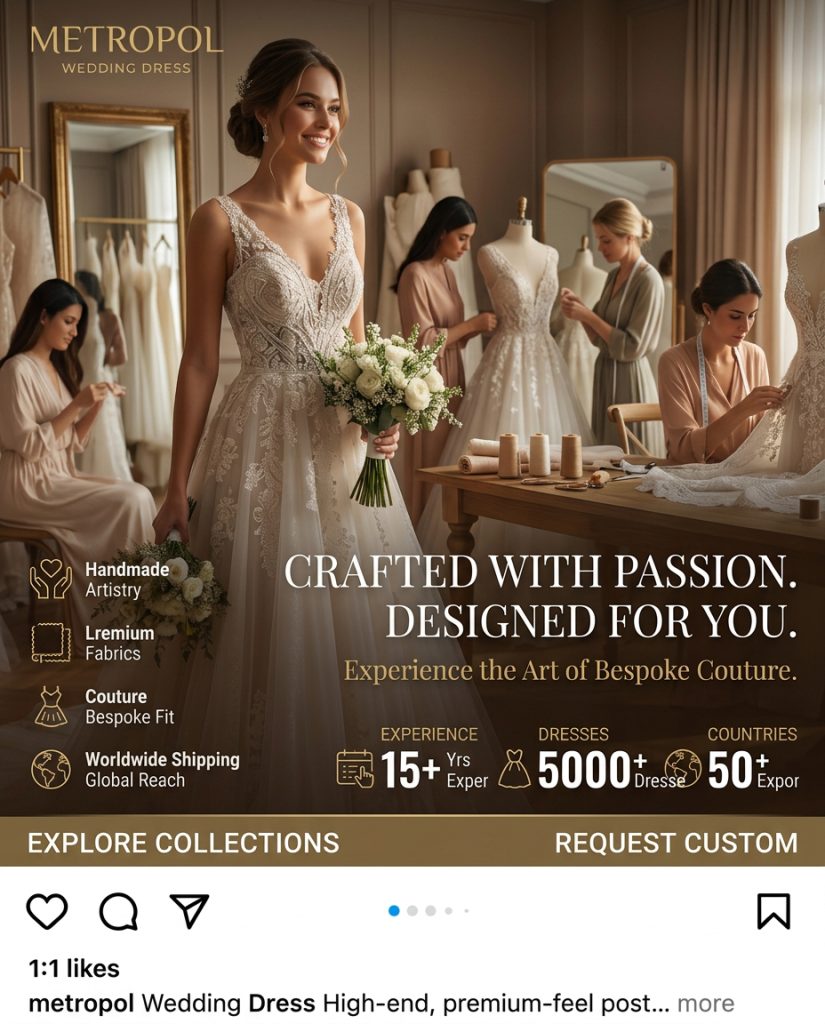
Turkey can be particularly interesting for this model because it combines established textile manufacturing capabilities with proximity to Europe, an established apparel export infrastructure, and specialized bridal production in cities such as İzmir. Metropol Wedding Dress is an İzmir-based manufacturer offering wholesale and custom-made wedding dress production for boutiques and international buyers. The company states that it began in retail, expanded internationally in response to overseas demand, and currently handles approximately 100 wedding dress orders per month.
The private-label opportunity becomes more compelling when a boutique wants to move from selling other companies’ collections to developing a recognizable house identity.
That transition changes almost everything.
Instead of asking:
- Which dresses are available?
- What is already in stock?
- What is the wholesale price?
- How many pieces can I order?
you begin asking:
- What does my bride actually want?
- Which silhouettes should define my brand?
- What price architecture should my collection have?
- Which details should become recognizable brand signatures?
- How much customization should I request?
- Which sizes should I produce?
- How much inventory can my cash flow support?
- What should be exclusive to my business?
- How should quality be inspected before shipment?
- Which documents will I need in my destination market?
This guide explains how to answer those questions before committing money to production.
1. Start With the Collection, Not the Factory
One of the most common mistakes in private-label bridal sourcing is contacting manufacturers before defining the collection.
A buyer opens a catalog, sees hundreds of attractive gowns, chooses twenty designs, asks for a discount, and then tries to build a brand around whatever happens to be available.
That is wholesale buying.
It is not strategic private labeling.
A private-label collection should begin with a commercial concept.
Your manufacturer is the production partner. Your company remains responsible for knowing what the collection is supposed to accomplish.
A useful collection brief should answer seven questions
| Decision | What you need to define |
|---|---|
| Customer | Who is your ideal bride? |
| Positioning | Luxury, accessible luxury, contemporary, romantic, modest, minimalist, couture-inspired? |
| Price | What is your target retail price range? |
| Silhouettes | A-line, ball gown, mermaid, fit-and-flare, sheath, empire, etc. |
| Design language | Lace, clean satin, embroidery, pearls, crystals, architectural structure, detachable elements? |
| Size strategy | Which sizes will you actively support? |
| Market | Europe, UK, USA, Middle East, Australia, or another region? |
This exercise immediately changes the supplier conversation.
Instead of saying:
“Please send me your best wedding dresses.”
you can say:
“We are developing a 16-style private-label bridal collection for contemporary European boutiques. The target retail price is €1,500–€2,500. We want four core silhouettes, two statement gowns, several convertible designs, and a strong size-inclusive strategy.”
That is a much more professional production brief.
2. Why Turkey Can Be a Strategic Manufacturing Base
Turkey is already deeply connected to international textile and apparel supply chains. For European buyers, geographical proximity can also make communication, sampling, travel, inspection and replenishment easier than working with a distant production market.
But proximity alone is not a sufficient reason to choose a manufacturer.
The relevant question is whether the manufacturer can translate proximity into lower operational risk.
A nearby factory can still be problematic if:
- communication is unclear,
- specifications are undocumented,
- sample approval is weak,
- quality control is inconsistent,
- fabric substitutions occur without approval,
- deadlines are unreliable,
- packaging is poorly organized,
- export paperwork is incomplete,
- or your designs are not properly controlled.
Therefore, “Made in Turkey” should never be treated as a substitute for supplier due diligence.
It should be treated as one element in a broader sourcing strategy.
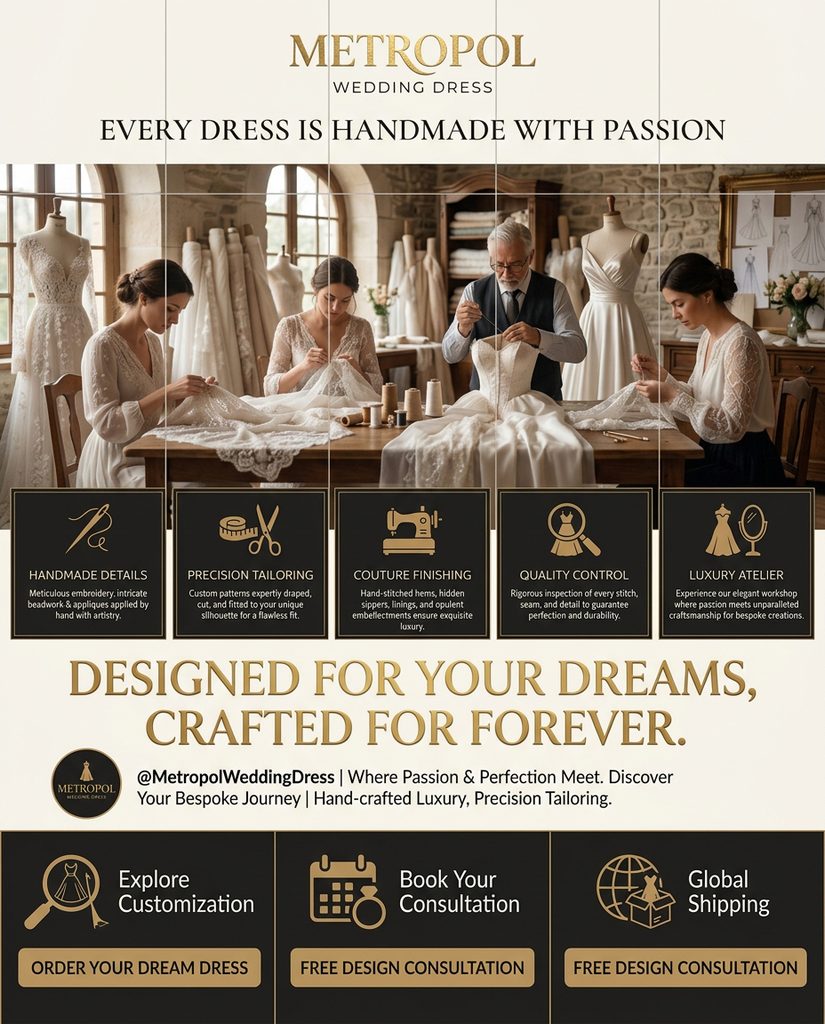
Metropol Wedding Dress identifies itself as a wholesale and custom-made wedding dress manufacturer based in İzmir and states that it serves boutiques and retailers internationally. Its published company information also describes experience in pattern making, embroidery, lace and fabric selection, and reports an average of approximately 100 wedding dress orders per month.
For a purchasing manager, these claims should be converted into questions.
Ask the manufacturer:
- What exactly does “custom” mean in your production process?
- Can you work from sketches?
- Can you work from reference photographs?
- Can you develop a new pattern?
- Can you modify an existing block?
- Can you grade the approved pattern?
- Can you produce multiple size sets?
- Can you source specific lace?
- Can you reproduce a specific embroidery effect?
- Can you develop custom labels and packaging?
- Can you provide pre-production samples?
- What happens when a sample requires correction?
The quality of the answers often tells you more than a polished catalog.
3. Private Label Is a Business Model, Not a Logo
The term “private label” is frequently misunderstood.
Putting your logo on a manufacturer’s existing gown does not automatically create a meaningful private-label collection.
There are several levels of customization.
Level 1 — Rebranding
The manufacturer already has a design.
You purchase it and sell it under your label, subject to the manufacturer’s commercial terms.
This is the fastest option, but usually the weakest form of differentiation.
Level 2 — Modified Wholesale Design
You begin with an existing pattern and modify:
- neckline,
- sleeve,
- train,
- lace,
- color,
- embellishment,
- back construction,
- detachable components,
- or other details.
This can provide considerably more differentiation without the development cost of a completely new design.
Level 3 — OEM Development
You provide a specification or design concept and the manufacturer develops the product.
This involves much more technical communication.
You may need:
- sketches,
- technical drawings,
- measurements,
- fabric references,
- lace references,
- construction requirements,
- embellishment maps,
- fitting instructions,
- labeling requirements,
- and packaging specifications.
Level 4 — Original Collection Development
This is the strongest model for a brand attempting to establish a recognizable bridal identity.
You define the collection architecture.
The manufacturer becomes part of your product-development process.
The objective is no longer “make this dress.”
It becomes:
“Help us turn our design language into a repeatable, scalable product range.”
That distinction is fundamental.
4. The Collection Architecture: Build a Portfolio, Not 20 Random Dresses
A bridal collection should be designed as a portfolio.
Imagine a boutique carrying 20 gowns.
If every gown is a dramatic ball gown with extensive lace and heavy embellishment, the collection may look impressive online but become commercially difficult.
A healthier architecture might contain several product roles.
The Hero Dress
This is the gown that creates attention.
It may have:
- dramatic construction,
- an unusual train,
- sophisticated embroidery,
- architectural draping,
- or a distinctive silhouette.
It may not be your highest-volume seller.
Its job is to communicate the brand.
The Commercial Core
These are the gowns expected to generate most sales.
They should be:
- visually attractive,
- broadly flattering,
- commercially priced,
- easier to fit,
- and easier to reproduce.
The Entry-Level Style
A lower-complexity gown allows the retailer to capture brides who have a tighter budget without forcing the brand to compete exclusively on price.
The Premium Statement
This design establishes an upper price ceiling.
It may use:
- extensive hand embellishment,
- intricate lace,
- complex corsetry,
- multiple layers,
- detachable elements,
- or couture-inspired construction.
The Convertible Design
A detachable sleeve, overskirt, bow, cape or train can create multiple styling options from one base gown.
This is particularly interesting for retail because the customer may perceive greater value without requiring the manufacturer to develop an entirely separate base product.
5. The Purchasing Manager’s First Filter: Commercial Viability
A designer may fall in love with a dress because it is beautiful.
A purchasing manager must ask a different question:
Can this gown make money repeatedly?
That means evaluating the product beyond appearance.
Commercial product scorecard
| Factor | Question |
|---|---|
| Visual impact | Does it stop the bride in the fitting room? |
| Fit | Can it accommodate realistic body variations? |
| Alterations | How difficult will tailoring be? |
| Production | Can the factory reproduce it consistently? |
| Materials | Are the materials stable and obtainable? |
| Packaging | Can it survive international transport? |
| Retail price | Does the target market accept the final price? |
| Margin | Does the product leave sufficient gross margin? |
| Photography | Does it translate well to e-commerce? |
| Differentiation | Is it meaningfully different from competitors? |
| Replenishment | Can it be reordered without redesigning the entire product? |
A gown that looks extraordinary but requires excessive alterations can create more cost than revenue.
A slightly simpler gown with excellent fit can become a much stronger commercial product.
6. The Most Important Document: Your Product Specification
Never rely entirely on WhatsApp messages.
For serious private-label production, every approved style should eventually have a controlled specification.
Think of it as the product’s technical identity.
A specification can include:
- style code,
- collection name,
- garment category,
- approved sketch,
- front image,
- back image,
- measurement chart,
- size range,
- fabric composition,
- lace reference,
- lining specification,
- boning specification,
- cup construction,
- closure type,
- zipper specification,
- hook-and-eye placement,
- train length,
- hem allowance,
- embroidery placement,
- crystal/bead specification,
- label position,
- care information,
- packaging requirements,
- approved sample reference,
- revision number.
Why revision numbers matter
Suppose your first sample is approved.
Three months later you ask for a minor change to the sleeve.
Without revision control, the factory may produce a mixture of versions.
A simple system such as:
STYLE MW-014 / REV 01
and then:
STYLE MW-014 / REV 02
can prevent expensive confusion.
For a growing collection, documentation is not bureaucracy.
It is production infrastructure.
7. Fabric Is a Commercial Decision
Bridal gowns can contain several material systems simultaneously:
- outer fabric,
- lining,
- lace,
- tulle,
- organza,
- satin,
- crepe,
- mesh,
- interfacing,
- boning,
- cups,
- elastic,
- closures,
- embroidery thread,
- beads,
- pearls,
- crystals,
- appliqués.
The visible fabric is only one part of the equation.
Two dresses can appear almost identical in photographs while behaving very differently in a fitting room.
A fabric influences:
- drape,
- weight,
- transparency,
- structure,
- movement,
- comfort,
- wrinkle behavior,
- steaming requirements,
- sewing difficulty,
- and final cost.
Never approve fabric solely from a photograph.
Ask for physical samples.
If the fabric is central to your brand identity, consider maintaining a master fabric card.
For every approved material, record:
- supplier/reference,
- composition,
- color,
- weight if available,
- finish,
- width,
- stretch characteristics,
- approved sample,
- replacement procedure.
If the original material becomes unavailable, the manufacturer should not automatically substitute another fabric without approval.
8. Lace Requires Its Own Approval System
Lace can completely change the perceived value of a bridal gown.
But “lace” is not a sufficient material specification.
You may need to distinguish:
- chantilly-style lace,
- corded lace,
- embroidered lace,
- beaded lace,
- 3D floral lace,
- guipure-style lace,
- appliqué lace,
- stretch lace,
- illusion lace,
- patterned lace.
Two laces with similar photographs may have dramatically different:
- density,
- scale,
- softness,
- edge finish,
- embroidery,
- backing,
- and application requirements.
Therefore, approve lace physically whenever possible.
For private-label production, photograph the approved material alongside the product specification.
This creates a reference point for future production.
9. Pattern Development Is Where a Beautiful Concept Becomes a Product
A bridal gown is not simply fabric assembled around a mannequin.
Pattern engineering determines whether the design works on a real body.
Important areas include:
- bust support,
- waist placement,
- hip shaping,
- armhole comfort,
- neckline stability,
- corset structure,
- center-front balance,
- center-back balance,
- train attachment,
- sleeve mobility,
- closure stress,
- and seam placement.
A design that looks perfect on a runway mannequin may perform poorly on customers.
This is why sampling should be treated as an engineering stage rather than a formality.
10. The Sample Is Not the Product. It Is a Question.
When your manufacturer sends the first sample, do not simply ask:
“Do we like it?”
Ask:
“What have we learned?”
The first sample should reveal:
- whether the silhouette works,
- whether the pattern is correct,
- whether the fabric behaves as expected,
- whether embellishment is proportionate,
- whether the train functions correctly,
- whether the closure is secure,
- whether the garment photographs well,
- whether alterations are manageable,
- and whether the production process is realistic.
A professional sample review should record:
Fit
- bust
- waist
- hip
- shoulder
- armhole
- sleeve
- neckline
Construction
- seams
- lining
- boning
- closures
- cups
- hem
- train
Aesthetics
- lace placement
- embroidery
- beading
- proportions
- symmetry
Commercial
- target cost
- estimated production time
- packaging
- size grading
- alteration implications
Do not approve a sample simply because the dress looks beautiful on a model.
11. Fit Testing: The Hidden Profit Driver
Poor fit has a financial cost.
Imagine a boutique selling 100 gowns.
If a large percentage require extensive alterations, the retailer pays in:
- tailor labor,
- fitting appointments,
- customer-service time,
- remake risk,
- delayed collection,
- and customer dissatisfaction.
A manufacturer should therefore be evaluated partly on how predictable the base fit is.
A practical fitting protocol
Test the approved sample on a suitable fit model and record:
- Bust fit
- Waist fit
- Hip fit
- Bodice length
- Shoulder position
- Arm mobility
- Neckline stability
- Closure tension
- Skirt volume
- Train behavior
- Hem behavior
- Sitting comfort
Then test movement.
The bride should:
- walk,
- sit,
- turn,
- raise her arms,
- bend carefully,
- and move as she would during a wedding.
A gown should not only photograph well.
It should function.
12. Size Grading: Don’t Treat Every Size as a Larger Version
A frequent manufacturing mistake is assuming that grading means simply increasing every measurement proportionally.
Human bodies do not scale that way.
As sizes change, proportions can shift differently.
A serious bridal size program should consider:
- bust-to-waist ratio,
- waist-to-hip ratio,
- torso length,
- shoulder width,
- arm circumference,
- cup positioning,
- neckline proportions,
- skirt volume,
- and support requirements.
If your brand wants to serve a wider size range, discuss this during pattern development—not after the collection is finished.
Better question
Instead of asking:
“Can you make larger sizes?”
ask:
“How is your grading process adapted for extended sizes, and can we approve the graded patterns before production?”
That is a much more revealing question.
13. Build Quality Control Into the Process
Quality control should not happen only at the end.
It should happen at several stages.
Stage 1 — Material Inspection
Check:
- fabric,
- lace,
- lining,
- closures,
- embellishments,
- accessories.
Stage 2 — Cutting Inspection
Check:
- pattern alignment,
- lace direction,
- symmetry,
- fabric defects,
- grain direction.
Stage 3 — Sewing Inspection
Check:
- seam quality,
- tension,
- lining,
- construction,
- closures.
Stage 4 — Embellishment Inspection
Check:
- symmetry,
- missing elements,
- loose elements,
- placement,
- density.
Stage 5 — Final Garment Inspection
Check:
- measurements,
- appearance,
- stains,
- loose threads,
- closures,
- train,
- packaging,
- labels.
This layered approach reduces the risk of discovering a systematic problem only after the entire order has been completed.
14. Create a Defect Classification System
Not every defect has the same commercial importance.
You can divide defects into three levels.
Critical
Examples:
- broken structural support,
- unsafe construction,
- incorrect product identity,
- major closure failure.
Major
Examples:
- significant measurement deviation,
- incorrect lace placement,
- missing embellishment,
- visible asymmetry,
- incorrect color,
- major construction defect.
Minor
Examples:
- loose thread,
- small cosmetic imperfection,
- packaging wrinkle,
- minor non-visible finishing issue.
This gives your QC process a common language.
It also makes discussions with suppliers much less emotional.
15. Your Brand Label Is Only One Part of Private Label
A professional private-label system may include:
- woven neck label,
- size label,
- care label,
- composition information,
- hangtag,
- style code,
- barcode,
- packaging,
- garment bag,
- branded box,
- tissue paper,
- thank-you card,
- warranty or care information.
For EU-bound textile products, fibre-composition labeling is regulated. Textile products marketed in the EU generally need durable and legible information about fibre composition, and the information must follow the applicable EU rules. The European Commission notes that consumer-facing labels must identify fibre composition and that relevant information may need to be provided in the official language(s) of the markets where the product is sold.
That means private-label branding should not be treated as a purely aesthetic exercise.
It is also a compliance exercise.
16. EU Labeling: What a Bridal Buyer Should Verify
If your gowns are going to the EU market, confirm the labeling requirements for your exact product and sales model.
The EU Textile Regulation covers textile products and requires fibre composition information. The regulation also addresses non-textile parts of animal origin.
The practical lesson for a buyer is simple:
Do not ask the factory to “put a label on it.”
Provide a labeling specification.
For example:
| Label element | Requirement |
|---|---|
| Brand | Your registered/approved brand name |
| Style code | Internal product code |
| Size | Approved sizing system |
| Fibre composition | Verified composition |
| Care | Appropriate care instructions |
| Origin information | Confirm destination-market requirements |
| Language | Appropriate market language requirements |
| Animal-origin declaration | Where applicable |
This should be checked with your importer/compliance adviser for the destination market.
17. Türkiye–EU Trade: Don’t Confuse Customs Union With Country of Origin
This distinction matters.
Turkey’s Ministry of Trade explains that an A.TR Movement Certificate demonstrates that goods are in free circulation under the Customs Union framework; it is not itself proof of origin. EUR.1, in the relevant circumstances, is used as proof of preferential origin.
For EU-bound shipments, the documentation strategy should therefore be agreed with your customs broker and exporter before shipment.
The European Commission also states that EU Member States began accepting electronically issued A.TR movement certificates from Turkish competent authorities, with QR codes and without wet-ink signatures, from 8 July 2024.
The important purchasing lesson is:
Do not assume that “Turkey to EU” automatically means every customs document is identical for every product and transaction.
The correct documentation depends on the product, transaction, destination, customs procedure and applicable rules.
18. Build the Landed Cost, Not Just the Factory Price
A factory quotation is not the same as your product cost.
Your true cost is closer to:
Product cost + development + packaging + inland transport + export costs + freight + insurance where applicable + customs-related costs + duties/taxes where applicable + brokerage + destination charges + warehousing + alterations + quality failures + financing cost
This is your landed cost.
Example framework
Imagine:
- Factory gown cost: €400
- Branded packaging: €20
- Pre-shipment inspection allocation: €10
- Freight allocation: €35
- Brokerage/document allocation: €15
- Other landed costs: €20
The apparent €400 product is no longer a €400 inventory asset.
Its planning cost is €500.
The exact numbers will differ by shipment and market, but the principle is universal.
19. Price Backwards From Retail
A better way to build your collection is to start with your target retail price.
Suppose your intended retail price is:
€2,000
You then work backwards.
Ask:
- What gross margin does the boutique need?
- What percentage goes to alterations?
- What percentage goes to rent and staff?
- What discounting is realistic?
- What happens during sample sales?
- What happens when a style is discontinued?
- What is the cost of payment processing?
- What marketing spend is required?
This creates a target landed cost.
Only then should you ask the manufacturer:
“Can this product be engineered to meet this cost while maintaining the required quality?”
That is much stronger than starting with:
“What is your cheapest price?”
20. Cost Engineering Without Destroying Quality
Cost reduction does not necessarily mean using cheaper materials.
Often the better approach is design engineering.
For example:
Reduce unnecessary complexity
Instead of:
- five layers where three create the same visual effect,
use:
- three carefully selected layers.
Standardize components
If several styles use the same:
- cup construction,
- zipper,
- lining,
- boning,
- label,
- packaging,
you may simplify procurement.
Create modular embellishment
A base gown can share construction with multiple variations.
Use a core lace library
Instead of sourcing unique lace for every design, develop a controlled library of approved materials.
This can reduce:
- sourcing complexity,
- MOQ problems,
- quality inconsistency,
- and replenishment risk.
21. MOQ: The Number Is Less Important Than the Structure
Minimum order quantity is often discussed as if one number tells the whole story.
It doesn’t.
Ask:
MOQ per style?
MOQ per color?
MOQ per size?
MOQ per collection?
MOQ for custom fabric?
MOQ for custom lace?
MOQ for custom packaging?
A manufacturer may offer a low garment MOQ while a fabric supplier requires a much higher MOQ.
That hidden dependency can affect the entire project.
A useful negotiation structure
Instead of:
“Can you reduce the MOQ?”
try:
“Could we start with a development collection, validate the commercial styles, and then move the strongest performers into larger repeat orders?”
That turns MOQ from a barrier into a phased purchasing strategy.
22. The Best Private-Label Collection Is Often Smaller
More styles do not automatically create a better collection.
For a new bridal brand, 50 styles may create:
- excessive development cost,
- slow-moving inventory,
- confusing merchandising,
- photography costs,
- fragmented marketing,
- and weaker purchasing power.
A tightly edited collection can be stronger.
For example:
12-style launch
- 2 hero gowns
- 5 commercial core gowns
- 2 minimalist gowns
- 1 convertible gown
- 1 premium gown
- 1 fashion-forward statement gown
The objective is not to offer everything.
The objective is to create a recognizable point of view.
23. The “Signature Detail” Strategy
Strong bridal brands often become recognizable through repeated visual language.
Your signature might be:
- sculptural corsetry,
- detachable sleeves,
- pearl embroidery,
- clean architectural satin,
- floral 3D appliqué,
- dramatic bows,
- minimalist back construction,
- unusual draping,
- or a specific neckline family.
The important word is family.
One signature gown is a design.
A repeated signature is a brand asset.
24. Exclusivity: Be Specific
Buyers frequently say:
“I want exclusive designs.”
But exclusivity can mean many different things.
Does it mean:
- exclusive to your country?
- exclusive to your city?
- exclusive to your boutique?
- exclusive for one season?
- exclusive in one fabric?
- exclusive in one silhouette?
- no identical design sold elsewhere?
- no modification of the same design for competitors?
These are very different commercial agreements.
If exclusivity matters, document:
- Style number
- Territory
- Duration
- Customer category
- Design scope
- Modification rules
- Renewal terms
- Existing-stock exceptions
- Digital marketing rights
- Intellectual-property responsibilities
Never rely on the word “exclusive” without defining it.
25. Protect the Design Process
If your business invests heavily in original designs, maintain evidence of development.
Keep:
- dated sketches,
- technical drawings,
- sample photos,
- revision histories,
- approved measurements,
- emails,
- purchase orders,
- invoices,
- and signed agreements.
If you provide original artwork or technical designs to a manufacturer, clarify the intended ownership and permitted use contractually.
This is especially important when your brand’s competitive advantage is based on proprietary design.
26. Communication Is a Manufacturing Tool
International production often fails because people assume they are discussing the same thing when they are not.
A phrase such as:
“Make the bodice tighter.”
is ambiguous.
How much tighter?
Where?
Across which size?
Compared with which sample?
A better instruction might be:
“Reduce the finished waist measurement by 2 cm on the approved sample while maintaining the bust measurement. Keep the center-front neckline unchanged.”
Specificity reduces rework.
Use visual communication
For bridal production, photographs and annotated diagrams can be extremely useful.
Mark:
- where lace should stop,
- where the train begins,
- where embellishment becomes denser,
- where transparency should end,
- where the waist should sit.
A 30-second annotated image can eliminate a 30-message conversation.
27. Build a Production Calendar
A private-label project should have milestones.
Example development calendar
Week 1
Collection brief and supplier discussion.
Week 2
Design selection and technical specification.
Weeks 3–4
Fabric/lace confirmation and pattern development.
Weeks 5–6
First samples.
Week 7
Fit review.
Week 8
Corrections.
Week 9
Second sample or pre-production approval.
Week 10
Final approval.
Following production period
Bulk production, QC, packaging and export.
Actual timelines vary by manufacturer, design complexity, material availability and production schedule. Do not publish a guaranteed lead time until it has been confirmed for your specific order.
The purpose of a calendar is not to force an unrealistic deadline.
It is to reveal dependencies.
28. Create a “No Approval, No Production” Rule
This is one of the most valuable rules a purchasing department can implement.
Do not allow bulk production to start based on:
- “Looks good.”
- “Same as before.”
- “We discussed it on WhatsApp.”
- “You know what we mean.”
- “Just make it like the photo.”
Instead:
Bulk production begins only after written approval of the final specification/sample.
This creates accountability for both sides.
29. Pre-Shipment Inspection Should Be Commercial, Not Cosmetic
A pre-shipment inspection should answer:
“If this shipment arrives tomorrow, would I confidently put these gowns on paying customers?”
Inspect:
Identity
- correct styles,
- correct quantities,
- correct sizes.
Measurements
- critical points against approved tolerance.
Construction
- seams,
- closures,
- support,
- lining,
- structure.
Appearance
- lace,
- embroidery,
- symmetry,
- stains,
- damage.
Branding
- labels,
- hangtags,
- packaging.
Packing
- garment protection,
- carton condition,
- quantity reconciliation.
If possible, photograph representative units before shipment.
30. Packaging Is Part of the Product
A bridal gown is emotionally charged.
The first physical interaction with the product should feel intentional.
Packaging may include:
- branded garment bags,
- tissue paper,
- protective layers,
- hangers,
- branded boxes,
- product cards,
- care cards,
- inspection documentation.
But packaging should also be engineered.
A wedding dress can be bulky and vulnerable to:
- compression,
- moisture,
- staining,
- snagging,
- crushing,
- and poor folding.
The objective is not luxury for luxury’s sake.
It is controlled presentation and protection.
31. Build a Reorder Strategy Before Launch
A collection becomes valuable when it can be replenished.
For each style, define:
- standard production time,
- material availability,
- minimum reorder quantity,
- size mix,
- reorder trigger,
- approved substitutions,
- discontinued-material procedure.
A style that sells quickly but cannot be replenished is a marketing problem disguised as a success.
Ask the manufacturer:
“If this style becomes one of our best sellers, what is the fastest realistic repeat-production route?”
That answer should influence your initial material strategy.
32. Inventory Strategy: Don’t Guess
Bridal inventory is expensive.
A retailer needs to decide how much inventory is required for:
- showroom presentation,
- customer fittings,
- samples,
- sales stock,
- trunk shows,
- events,
- replacement,
- and online demand.
A private-label model can reduce dependence on constantly buying large quantities of every style if the manufacturer supports reliable repeat production.
That can shift the strategy from:
“Buy everything before demand is known.”
to:
“Launch intelligently, measure demand, replenish winners.”
This is one of the most important reasons to evaluate a supplier’s repeat-order capability.
33. A Simple ABC Collection Model
After launch, classify styles by commercial performance.
A — Winners
High demand and strong margin.
These deserve:
- deeper stock,
- fast replenishment,
- additional marketing,
- potentially more size availability.
B — Potential
Moderate sales.
These may need:
- better photography,
- styling,
- improved merchandising,
- price adjustment,
- or minor product modifications.
C — Slow Movers
Low demand or poor economics.
Possible actions:
- discontinue,
- reposition,
- bundle,
- sample-sale,
- modify,
- or replace.
Do not allow emotional attachment to a design to override commercial data.
34. Measure More Than Units Sold
A gown selling ten units is not necessarily better than one selling six.
You should evaluate:
Gross profit per style
Gross profit per showroom square meter
Alteration cost
Return/remake rate
Average selling price
Discount rate
Lead time
Repeat-order frequency
Customer fitting conversion
Days in inventory
This turns your collection into a measurable business system.
35. The Hidden KPI: Fitting-Room Conversion
Bridal retail has a unique advantage.
Customers physically interact with the product.
That creates data.
Track:
- number of brides trying the gown,
- number who shortlist it,
- number who purchase it,
- objections,
- alterations required,
- reasons for rejection.
If a gown is tried by 30 brides and purchased by 15, it is performing very differently from a gown tried by 30 and purchased by 2.
The manufacturer should eventually receive selected feedback.
This creates a product-development feedback loop.
36. Design Based on Real Customer Objections
Suppose customers repeatedly say:
- “I love the front but hate the back.”
- “The train is beautiful but difficult.”
- “The neckline is too low.”
- “I want sleeves.”
- “I want more support.”
- “I want a simpler ceremony look and a dramatic reception look.”
These comments are product-development gold.
Instead of treating objections as lost sales, convert them into future design requirements.
That is how a private-label brand becomes smarter with every season.
37. Modularity Can Increase Retail Value
A modular bridal gown can solve several problems simultaneously.
Consider:
Base gown + detachable overskirt
The bride gets:
- ceremony look,
- reception look.
Or:
Base gown + detachable sleeves
The bride gets:
- covered look,
- sleeveless look.
Or:
Base gown + cape
The retailer can style one product in multiple ways.
The manufacturer must engineer these components carefully.
Attachment points should be:
- secure,
- visually clean,
- comfortable,
- easy for staff to explain,
- and easy for the bride to use.
38. Modest Bridalwear Is a Design System
For markets where greater coverage is important, modest bridalwear should not simply mean “add sleeves.”
A complete modest design strategy may involve:
- neckline depth,
- back coverage,
- arm coverage,
- lining,
- transparency control,
- detachable layers,
- sleeve construction,
- train proportions,
- headscarf compatibility,
- and fabric opacity.
Metropol Wedding Dress publicly positions itself as capable of custom and varied bridal production, while its published material emphasizes international boutique requirements.
If modest bridalwear is a core market for your business, specify the requirements at the design stage.
39. Country-Specific Collection Planning
A bridal collection should not necessarily be identical across every market.
European boutiques may prioritize
- minimalist silhouettes,
- refined lace,
- clean construction,
- contemporary styling,
- diverse sizing.
Middle Eastern markets may place greater emphasis on
- dramatic volume,
- embellishment,
- coverage,
- luxury presentation,
- statement trains.
North American buyers may place strong emphasis on
- fit,
- size availability,
- customization,
- delivery reliability,
- commercial merchandising.
These are broad market tendencies, not universal rules.
The best approach is to combine market research with your own customer data.
40. Don’t Build a Collection for “Everyone”
The phrase “we want something that appeals to everyone” often produces a weak collection.
A strong private-label brand has an opinion.
You should be able to complete this sentence:
“Our bride chooses us because…”
Examples:
- “We create modern romantic gowns for independent brides.”
- “We specialize in refined minimalist bridalwear.”
- “We combine couture-inspired construction with accessible luxury.”
- “We design sophisticated modest bridal gowns.”
- “We create convertible gowns for brides who want two looks.”
That sentence becomes a filter for product development.
41. The Supplier Evaluation Matrix
Before signing a production agreement, score your manufacturer.
| Category | Weight |
|---|---|
| Product quality | 20% |
| Pattern/fitting capability | 15% |
| Communication | 10% |
| Sampling | 10% |
| Production reliability | 15% |
| Material sourcing | 10% |
| MOQ flexibility | 5% |
| Private-label capability | 5% |
| Export/document support | 5% |
| Reorder capability | 5% |
The weights can be changed for your business.
The important point is that price should not be the only variable.
A supplier that is 8% cheaper but causes 20% more operational problems is not cheaper.
42. The “Supplier Interview” Questions
Before committing to a manufacturer, ask:
Product Development
- Can you create new patterns?
- Can you modify existing patterns?
- Can you develop from sketches?
- Can you work from physical samples?
- How many sample revisions are normally possible?
Materials
- Can you source customer-specified fabrics?
- Can you work with customer-supplied materials?
- How do you handle discontinued fabrics?
- Can you maintain approved material references?
Production
- What is the minimum order?
- What is the repeat-order minimum?
- What is the normal production process?
- How is production scheduled?
Quality
- What QC checks are performed?
- Can buyers approve a pre-production sample?
- Can third-party inspection be used?
- How are defects handled?
Private Label
- Can you provide woven labels?
- Hangtags?
- Custom packaging?
- Internal style codes?
- Barcodes?
Export
- Which export documents do you normally provide?
- Which Incoterms do you offer?
- Which freight methods do you commonly use?
- How do you handle customs documentation?
Commercial
- What are payment terms?
- What happens when production is delayed?
- What happens if approved specifications are not followed?
- What is the process for claims?
A professional manufacturer should be able to engage with these questions.
43. Incoterms: Don’t Leave Shipping Undefined
Your quotation should specify the commercial delivery term.
Depending on the transaction, you may encounter terms such as:
- EXW
- FCA
- FOB
- CPT
- CIP
- DAP
- DDP
The correct choice depends on your transaction structure, destination and customs responsibilities.
Do not assume that a price is comparable across suppliers if one quote includes transportation and another does not.
When comparing quotations, normalize them.
Ask:
“What exactly is included in this price, and where does the seller’s responsibility end?”
Then compare like with like.
44. What a Good Private-Label Purchase Order Should Contain
At minimum, consider documenting:
- buyer,
- manufacturer,
- style codes,
- quantities,
- sizes,
- materials,
- approved specifications,
- unit price,
- total value,
- packaging,
- labels,
- delivery terms,
- payment terms,
- delivery target,
- inspection process,
- defect/claim process,
- approved sample reference,
- documentation requirements.
For significant orders, have commercial and legal terms reviewed appropriately for your jurisdiction.
45. The Most Expensive Mistake: Approving Too Early
There is pressure to move quickly.
You see a beautiful sample.
The wedding season is approaching.
You want the collection online.
You approve.
Then you discover:
- the neckline changed,
- the lace was substituted,
- the lining is different,
- the train is shorter,
- the size grading is wrong,
- the label is incorrect.
Speed without control is not efficiency.
A two-week delay during development can be cheaper than an entire defective production run.
46. What “Quality” Should Mean in Bridal Manufacturing
“High quality” is too vague.
Define it.
For example:
Visual quality
No visible stains, damage, obvious asymmetry or uncontrolled loose threads.
Construction quality
Closures, seams, lining, structure and support meet approved specifications.
Material quality
Approved materials are used.
Measurement quality
Critical dimensions remain within agreed tolerances.
Embellishment quality
Placement and density correspond to the approved sample.
Brand quality
Labels and packaging match the approved specification.
Once quality becomes measurable, supplier conversations become objective.
47. Build a Bridal “Golden Sample”
The golden sample is the physical reference against which future production can be evaluated.
It should be:
- fully approved,
- labeled,
- dated,
- photographed,
- protected,
- and associated with a revision number.
For high-value collections, consider keeping one reference sample under your control and one approved production reference with the manufacturer.
The purpose is simple:
When someone asks:
“Is this correct?”
there should be a physical answer.
48. Photography Is Part of Product Development
A bridal gown can look completely different depending on:
- lighting,
- styling,
- model,
- camera angle,
- train presentation,
- veil,
- posture.
If you are building a private-label collection, plan photography around the brand identity.
You need:
E-commerce images
- front,
- back,
- side,
- detail,
- train.
Detail images
- lace,
- embroidery,
- neckline,
- back,
- sleeve,
- fabric.
Editorial images
These communicate emotion and brand positioning.
Technical images
Useful for internal staff and B2B buyers.
Do not rely on one beautiful editorial image to communicate everything.
49. Your Website Should Sell the Collection, Not Just Display It
A private-label landing page should answer five questions rapidly:
- Who are you?
- What do you manufacture?
- Why should I trust you?
- What makes your production model different?
- How do I start?
For a B2B audience, the website should also explain:
- private label,
- OEM/ODM,
- custom development,
- MOQ approach,
- sampling,
- quality control,
- international shipping,
- and how to request a quotation.
The buyer should not have to hunt for the next step.
50. The Manufacturer’s Role in Your Brand Story
A Turkish manufacturer should not necessarily dominate your consumer-facing branding.
Your customer buys from your brand.
The manufacturer is part of your supply chain.
However, in B2B communications, manufacturing transparency can be a trust signal.
For example:
“Our bridal collection is developed with an experienced Turkish bridal manufacturing partner in İzmir.”
This is different from saying:
“We simply buy wedding dresses from a wholesaler.”
The distinction is strategic.
51. Metropol Wedding Dress as a Potential Production Partner
Metropol Wedding Dress states that it is based in İzmir and provides wholesale and custom-made wedding dress services for boutiques and retailers. Its company profile describes an evolution from retail into international wholesale and reports an average of approximately 100 wedding dress orders per month.
Its wholesale manufacturer page specifically positions the business around custom and bulk bridal production, including private-label/OEM-oriented services.
For a prospective buyer, these capabilities make the company worth evaluating—not because a website claim should replace due diligence, but because the stated service model aligns with the requirements of a private-label bridal project.
The right next step is therefore not:
“Can you make wedding dresses?”
It is:
“Can we jointly develop and manufacture the exact collection architecture our brand requires?”
That is a much more sophisticated supplier conversation.
Metropol Wedding Dress — Official Website
Wholesale Wedding Dress Manufacturer — Metropol Wedding Dress
52. A Practical Private-Label Development Workflow
Here is a cleaner end-to-end system.
Phase 1 — Market Definition
Define:
- target bride,
- market,
- price range,
- collection size,
- design language.
Phase 2 — Supplier Evaluation
Evaluate:
- production capability,
- communication,
- sample development,
- quality systems,
- MOQ,
- export capability.
Phase 3 — Collection Architecture
Define:
- hero styles,
- core styles,
- entry styles,
- premium styles,
- convertible styles.
Phase 4 — Technical Development
Create:
- technical specifications,
- material references,
- measurement charts,
- embellishment maps,
- branding specifications.
Phase 5 — Sampling
Produce:
- first sample,
- fitting sample,
- correction sample,
- pre-production approval.
Phase 6 — Production
Control:
- material procurement,
- cutting,
- sewing,
- embellishment,
- finishing.
Phase 7 — QC
Inspect:
- measurements,
- construction,
- appearance,
- branding,
- packaging.
Phase 8 — Export
Confirm:
- commercial invoice,
- packing list,
- transport documentation,
- customs documents,
- applicable origin/free-circulation documentation,
- destination requirements.
Phase 9 — Launch
Prepare:
- photography,
- website,
- showroom merchandising,
- sales training,
- B2B presentation.
Phase 10 — Feedback
Track:
- try-ons,
- conversions,
- alterations,
- margins,
- customer feedback,
- repeat demand.
Phase 11 — Reorder
Scale winners.
Modify or discontinue weak performers.
That is the complete system.
53. A Sample “Collection Brief” You Can Send to a Manufacturer
Before contacting a manufacturer, prepare something like this:
Brand: [Your Brand]
Market: European bridal boutiques
Collection: 12–18 styles
Target retail: €1,500–€2,500
Positioning: Modern romantic / accessible luxury
Core silhouettes: A-line, fit-and-flare, mermaid, minimalist sheath
Signature: Sculptural corsetry + refined lace
Customization: Original patterns and selected modifications
Size strategy: Core size range + extended sizing
Branding: Custom woven labels, hangtags and garment bags
Development: Sample approval required before bulk production
Quality: Measurement and visual inspection against approved sample
Reorder objective: Repeat production of best sellers
Target launch: [Month]
Initial order: [Quantity]
This immediately makes the discussion more productive.
54. Five Numbers Every Buyer Should Know
Before approving an order, know these five numbers:
1. Landed Cost
What the gown really costs when it becomes sellable inventory.
2. Target Retail Price
What your customer is expected to pay.
3. Gross Margin
What remains after direct product cost.
4. Sell-Through Target
How much inventory you expect to sell during a defined period.
5. Reorder Lead Time
How quickly you can replace a successful style.
If you do not know these numbers, you are not yet managing the collection.
You are buying products.
55. Five Numbers the Manufacturer Should Know
Your production partner should also understand:
- Target retail positioning
- Required quality level
- Required delivery window
- Expected order pattern
- Product-development priorities
The manufacturer does not need your entire financial model.
But they need enough commercial context to understand why certain specifications matter.
For example, if you are positioning the gown as accessible luxury, replacing premium lace with an inferior material may destroy the product even if the cost is lower.
56. Five Questions That Reveal Supplier Maturity
If you have limited time, ask these:
“What happens when the approved fabric becomes unavailable?”
Good answer: there is a controlled substitution process.
“How do you handle a failed sample?”
Good answer: correction, documented revision and reapproval.
“How do you manage repeated production of the same style?”
Good answer: controlled patterns, specifications and approved materials.
“How do you inspect finished gowns?”
Good answer: defined QC criteria rather than “we check everything.”
“What happens when a customer reports a defect?”
Good answer: documented claims process.
These questions reveal operational maturity quickly.
57. Common Private-Label Mistakes
Mistake 1: Choosing the Cheapest Manufacturer
Low price can conceal:
- weak materials,
- high alteration costs,
- inconsistent production,
- poor communication,
- or unpredictable lead times.
Mistake 2: Ordering Too Many Styles
More styles can mean less depth behind each successful style.
Mistake 3: No Golden Sample
Without a physical reference, quality becomes subjective.
Mistake 4: No Material Approval
Material substitution can change the product dramatically.
Mistake 5: No Written Specifications
Verbal instructions are easily misunderstood.
Mistake 6: No Reorder Strategy
A best seller becomes unavailable.
Mistake 7: Treating QC as Final Inspection Only
By the time a defect is found, it may exist across hundreds of pieces.
Mistake 8: Ignoring Alteration Costs
A cheap gown that requires extensive tailoring may be expensive.
Mistake 9: Confusing Wholesale With Private Label
A wholesale catalog does not automatically create a brand.
Mistake 10: Launching Without Customer Data
A collection should learn from every fitting.
58. The Private-Label Buyer’s Pre-Production Checklist
Before production begins, confirm:
Product
- Style code approved
- Final sample approved
- Pattern approved
- Measurement chart approved
- Size range approved
- Fabric approved
- Lace approved
- Embellishment approved
- Color approved
- Train approved
- Closure approved
Branding
- Brand label approved
- Size label approved
- Care information approved
- Hangtag approved
- Packaging approved
- Garment bag approved
Commercial
- Unit price confirmed
- Quantity confirmed
- MOQ confirmed
- Payment terms confirmed
- Delivery terms confirmed
- Production schedule confirmed
Quality
- Tolerances defined
- Inspection procedure defined
- Defect policy defined
- Golden sample identified
Logistics
- Packing list requirements confirmed
- Invoice requirements confirmed
- Customs requirements confirmed
- Destination labeling checked
- Shipping method confirmed
Only after these items are controlled should the production order become irreversible.
59. What Should Be in the First Shipment?
Your first shipment should not necessarily maximize quantity.
Its primary purpose is to validate the system.
You are testing:
- product quality,
- packaging,
- shipping,
- customs,
- customer response,
- fitting,
- sales conversion,
- alteration requirements,
- and supplier communication.
A smaller controlled launch can generate better information than a huge speculative order.
Once the system works, scale.
60. The Real Advantage of a Turkish Manufacturer
The strongest argument is not simply lower production cost.
The potential advantage is supply-chain responsiveness.
If your manufacturer can support:
- faster communication,
- sample development,
- smaller development runs,
- customization,
- repeat production,
- accessible factory communication,
- and international shipping,
then the relationship can become strategically valuable.
You are no longer purchasing inventory from a distant catalog.
You are developing products with a manufacturing partner.
That is a different business model.
61. How a Boutique Can Move From Buyer to Brand
There is a progression.
Stage 1
“I need wedding dresses.”
Stage 2
“I need a reliable wholesale supplier.”
Stage 3
“I want customized wholesale styles.”
Stage 4
“I want my own private-label collection.”
Stage 5
“I want proprietary products and a repeatable development system.”
Stage 6
“I want customer data to influence the next collection.”
The final stage is where the real competitive advantage begins.
Because competitors can copy a product.
It is harder to copy:
- your customer data,
- your fitting knowledge,
- your brand positioning,
- your supplier relationship,
- your production specifications,
- your collection architecture,
- and your accumulated product-development knowledge.
62. The Information Loop That Builds a Better Brand
Think of your business as a continuous loop:
Bride → Fitting → Sale → Feedback → Product Data → Manufacturer → Revised Product → New Collection → Bride
The manufacturer is one component.
The retailer owns the customer relationship.
That means the retailer should own the learning loop.
63. A More Intelligent Way to Negotiate
Do not negotiate every item separately.
Negotiate the relationship structure.
For example, discuss:
- development pricing,
- sample policy,
- first-order pricing,
- reorder pricing,
- MOQ,
- material sourcing,
- exclusivity,
- branding,
- packaging,
- lead times,
- quality control,
- and long-term production.
A manufacturer is more likely to invest effort in a buyer who demonstrates a credible long-term strategy.
The goal is not to squeeze the last euro out of the first order.
The goal is to build an economically sustainable partnership.
64. Five Types of Supplier Relationships
Transactional Supplier
You purchase existing products.
Custom Supplier
You modify existing products.
OEM Partner
The manufacturer develops products from your specifications.
Strategic Manufacturing Partner
The supplier participates in ongoing development and replenishment.
Integrated Product Partner
The manufacturer becomes deeply integrated into your collection development, sourcing, production and quality systems.
For a serious private-label bridal brand, the fourth or fifth model can be considerably more valuable than the first.
65. When You Should NOT Choose Private Label
Private label is not automatically better.
It may not be appropriate if:
- your sales volume is extremely low,
- you have no defined brand positioning,
- you cannot manage product development,
- you cannot fund sampling,
- you need hundreds of unrelated styles,
- you have no ability to manage quality,
- or your customers specifically demand established designer labels.
Private label works best when you want control and differentiation.
66. When Private Label Becomes Especially Attractive
It becomes more compelling when:
- you already have bridal customers,
- you understand your market,
- you know which silhouettes sell,
- you want higher differentiation,
- you want your own brand identity,
- you want better control of pricing,
- you want exclusive styles,
- you want to improve repeat purchasing,
- and you are prepared to manage product development.
At that point, private labeling is not merely a sourcing decision.
It is a brand-building decision.
67. A Practical Decision Matrix
Before signing a manufacturer, score each supplier from 1 to 5.
| Criterion | Score |
|---|---|
| Design development | /5 |
| Pattern making | /5 |
| Sample quality | /5 |
| Fit | /5 |
| Fabric sourcing | /5 |
| Lace selection | /5 |
| Embellishment | /5 |
| Production consistency | /5 |
| MOQ | /5 |
| Reorder capability | /5 |
| Communication | /5 |
| QC | /5 |
| Private label | /5 |
| Packaging | /5 |
| Export experience | /5 |
Then add a second score:
How important is this criterion to my business?
This prevents an impressive factory from winning simply because it scores highly in areas that do not matter to your strategy.
68. What a Strong Manufacturer Should Feel Like
The ideal supplier relationship should feel less like:
“I send an order. You send dresses.”
and more like:
“Here is our commercial objective. Here is our design direction. Here are our technical requirements. Let’s determine the best way to manufacture it consistently.”
That shift in communication often determines whether private labeling becomes successful.
69. Five CTA Directions for a Private-Label Bridal Brand
CTA 1 — For a Boutique Owner
Ready to create a collection that looks like your brand—not everyone else’s?
Share your preferred silhouettes, target market, approximate quantity and design direction with Metropol Wedding Dress and start a private-label development conversation.
Start a private-label conversation with Metropol Wedding Dress
CTA 2 — For a Purchasing Manager
Have a collection brief already?
Send the technical requirements, target retail positioning, quantity and destination market so the production conversation can begin with commercial facts rather than generic catalog selections.
CTA 3 — For an Emerging Bridal Brand
Your first collection does not need to be enormous. It needs to be intentional.
Start with a focused selection of commercially relevant designs, validate the market, and build the next collection around what your customers actually choose.
CTA 4 — For International Buyers
Looking for a Turkish bridal manufacturing partner?
Evaluate the opportunity around sampling, customization, quality control, private labeling, repeat production and export requirements—not simply the lowest unit price.
CTA 5 — For Established Retailers
Turn your best-selling bridal insights into your own product line.
Your fitting-room data already tells you what your brides want. The next step is converting that information into a controlled private-label collection.
70. Frequently Asked Questions — Private Label Bridal Manufacturing
1. What is the difference between private label and wholesale wedding dresses?
Wholesale usually means purchasing existing products from a supplier. Private label goes further by allowing a retailer or brand to sell products under its own identity, often with customized designs, labels, packaging, specifications or exclusive arrangements.
2. Can I create my own wedding dress designs with a Turkish manufacturer?
Yes, depending on the manufacturer’s capabilities. The important question is whether the factory can handle the entire development process—from design interpretation and pattern making through sampling, correction and production.
3. Can I start with existing wedding dress designs and modify them?
Often, yes. This can be an efficient way to develop a first collection. However, the exact modification rights and exclusivity terms should be agreed with the manufacturer.
4. What should I send a manufacturer when requesting a private-label quote?
Ideally provide your brand information, target market, estimated quantities, target retail positioning, design references, size requirements, material preferences, branding requirements and desired delivery window.
5. Do I need technical drawings?
Not always, but technical drawings or annotated references can dramatically reduce misunderstandings. The more specific the product, the more useful technical documentation becomes.
6. How many wedding dress styles should a new private-label brand launch with?
There is no universal number. A focused collection is often easier to manage than a large assortment. A dozen well-positioned styles can be more commercially useful than dozens of unrelated gowns.
7. What is a golden sample?
A golden sample is the approved physical reference used to compare future production against the agreed product standard.
8. Why is the golden sample important?
Because descriptions and photographs can be interpreted differently. A physical approved sample provides a concrete reference for construction, proportions, materials and embellishment.
9. Can the manufacturer make custom labels?
Many private-label manufacturers can support custom labeling, but you should confirm the available label types, minimum quantities, placement and production requirements before ordering.
10. Can private-label wedding dresses have custom packaging?
Yes, depending on the manufacturer’s capabilities and the packaging supplier’s MOQ. Custom packaging should be specified before production.
11. What is OEM in bridal manufacturing?
OEM generally refers to manufacturing products according to the buyer’s specifications rather than simply selling an existing supplier design.
12. What is ODM?
ODM generally refers to a manufacturer contributing more substantially to the product’s design or development. In practice, terminology varies between suppliers, so always ask what the manufacturer specifically includes under “OEM” or “ODM.”
13. How do I protect an original bridal design?
Use appropriate contracts and maintain evidence of your design development, specifications, samples and approvals. Intellectual-property rights are jurisdiction-specific, so significant projects should receive professional legal advice.
14. Should I ask for exclusivity?
If differentiation is important, it can be valuable. But define exactly what “exclusive” means—territory, duration, design, customer category and permitted modifications.
15. Does exclusivity automatically mean nobody else can sell the design?
No. The commercial meaning depends on the agreement. Never assume exclusivity without written terms.
16. How should I compare two Turkish wedding dress manufacturers?
Compare the complete supply proposition: quality, fit, sampling, communication, MOQ, material sourcing, production reliability, private labeling, QC, packaging, export support and reorder capability.
17. Is the lowest factory price the best deal?
Not necessarily. Your true cost includes alterations, defects, freight, packaging, delays, inventory risk and other operational costs.
18. What is landed cost?
Landed cost is the estimated total cost of getting the product into a sellable state at its destination, including relevant production, logistics, customs and other applicable costs.
19. How should I calculate my retail price?
Start with your market position and required gross margin, then work backward toward a viable landed cost. Do not simply multiply the factory price by an arbitrary number.
20. Should I order every size?
Your size strategy should be based on customer data, showroom requirements and your sales model. The manufacturer should understand the intended size distribution before production.
21. Can one pattern work for every body type?
No. Pattern grading and fitting need to account for changing proportions and the intended customer range.
22. How important is fabric selection?
Extremely important. Fabric affects appearance, drape, structure, comfort, weight, production difficulty, cost and perceived value.
23. Can the factory substitute fabric if my chosen material is unavailable?
It should not happen without an agreed substitution process. Material substitutions can materially change the finished gown.
24. Should I approve lace from photographs?
For critical materials, physical approval is safer because photographs do not reliably communicate texture, density, color, scale or hand feel.
25. How many sample rounds should I expect?
It depends on the complexity of the design and the manufacturer’s process. The important point is that sample revisions should be documented rather than handled informally.
26. How do I control quality before shipment?
Use a defined inspection process covering identity, measurements, construction, appearance, embellishment, labels and packaging. For important orders, consider independent inspection.
27. What should I do if the manufacturer delivers defective dresses?
Your purchase agreement should define the claims procedure, evidence requirements, correction/replacement policy and responsibility for associated costs.
28. Can I use a third-party inspection company?
Depending on the supplier and transaction, yes. Agree on the inspection method and timing before production is completed.
29. What documents are important when importing wedding dresses into Europe?
The exact requirements depend on the product, transaction and destination. Common commercial and customs documents can include invoices, packing lists, transport documents and applicable customs/origin/free-circulation documentation. EU textile labeling requirements must also be considered.
30. Is A.TR the same as a certificate of origin?
No. Türkiye’s Ministry of Trade specifically explains that A.TR demonstrates free-circulation status under the Customs Union framework and is not itself proof of origin.
31. Are electronic A.TR certificates accepted?
The European Commission announced that EU Member States would accept electronically issued Turkish A.TR movement certificates with QR codes and without wet-ink signatures from 8 July 2024, subject to the applicable framework.
32. What are the EU textile labeling requirements?
EU textile products generally require information about fibre composition when placed on the market, with specific rules regarding durability, legibility, fibre names, language and certain non-textile parts of animal origin.
33. Should my manufacturer or I handle compliance?
Responsibilities depend on the supply-chain structure and destination market. The buyer/importer should establish who is responsible for each requirement before production and shipment.
34. Can a Turkish manufacturer ship directly to my boutique?
This can be possible depending on the agreed commercial and logistics arrangement. The exact delivery term, customs responsibilities and transport method should be documented.
35. Should I choose EXW, FOB, DAP or DDP?
There is no universal best choice. The appropriate Incoterm depends on your logistics structure, customs responsibilities, destination and risk preferences. Compare offers only after normalizing what each quotation includes.
36. Can private-label bridal manufacturing work for a small boutique?
Yes, if the supplier’s development model and MOQ structure match the boutique’s scale. A focused collection can be more practical than attempting a large assortment immediately.
37. How can I reduce inventory risk?
Start with a focused collection, use sales data to identify winners, establish repeat-production capability and avoid excessive quantities of untested styles.
38. Should I manufacture the entire collection at once?
Not necessarily. A staged approach can reduce development and inventory risk, especially for a new brand.
39. What should I measure after launch?
Track sell-through, gross profit, fitting conversion, alterations, customer objections, average selling price, discounting, inventory age and reorder frequency.
40. What makes a Turkish bridal manufacturer a strategic partner rather than just a supplier?
The difference is collaboration. A strategic partner helps you develop, reproduce, improve and scale products consistently rather than simply shipping catalog gowns.
Final Takeaway
The most important decision in private-label bridal manufacturing is not the first dress you select.
It is the system you build around the collection.
A successful private-label bridal brand connects:
Brand strategy
→ Customer insight
→ Collection architecture
→ Design
→ Pattern development
→ Material selection
→ Sampling
→ Fit
→ Production
→ Quality control
→ Branding
→ Logistics
→ Retail
→ Customer feedback
→ Reorder
→ Next collection
Turkey can provide an attractive manufacturing environment for this model, particularly when the buyer values proximity, customization, textile expertise and direct communication. İzmir has an established bridal and apparel manufacturing ecosystem, while Metropol Wedding Dress presents itself as an İzmir-based wholesale and custom wedding dress manufacturer serving international boutiques and retailers.
But the strongest partnership will not be created by asking for the cheapest wedding dress.
It will be created by asking better questions.
Can the manufacturer understand our customer?
Can it reproduce our approved design?
Can it control materials?
Can it manage fit?
Can it support our brand identity?
Can it maintain quality as volume increases?
Can it communicate clearly when something goes wrong?
Can it replenish our best sellers?
Can it support the documentation and logistics required for our target market?
Those are the questions that turn a factory into a manufacturing partner.
And that is ultimately the real opportunity behind private-label bridal production.
You are not simply creating another wedding dress.
You are creating a repeatable product system that belongs to your brand.
For an international bridal retailer, that distinction can determine whether the business remains dependent on generic wholesale collections—or develops a recognizable, differentiated and scalable bridal identity.
If your next step is to turn a collection concept into a production brief, start with four things: your target bride, your target retail price, your first collection size and your desired design language. The clearer those four inputs are, the more productive the manufacturer conversation becomes.
Contact Metropol Wedding Dress for wholesale and custom production inquiries
Source & Compliance References
For buyers researching the regulatory side of the project, the European Commission’s textile-label guidance explains current EU fibre-composition labeling requirements, while EUR-Lex provides the underlying Textile Regulation. Türkiye’s Ministry of Trade explains the distinction between A.TR and EUR.1, and the European Commission provides current information on EU–Türkiye A.TR procedures.
The manufacturer-specific information in this article is based primarily on Metropol Wedding Dress’s published company and manufacturing pages and should be independently confirmed during the quotation, sampling and contracting process.
Related Topics
30.08.2026
Affordable Custom Wedding Dresses The wedding dress conversation has shifted. Brides and boutique owners no longer accept the old binary of “cheap ready-to-wear that fits no one” versus “couture that costs a down payment.” A...
30.03.2024
Robe De Mariée Turquie En Ligne 3 meilleures robes de mariée du fabricant de robes de mariée confirment les tendances à succès de la mode nuptiale, notamment les effets de tatouage, les ouvertures découpées et...

08.04.2026
Custom Made Luxury Bridal Gowns for USA Brides Every bride dreams of a wedding day that feels uniquely hers—an unforgettable celebration where every detail reflects her personality, story, and vision. At the center of this...
04.07.2025
Affordable Wedding Gowns Wholesale from Turkey Turkey has emerged as a global hub for bridal fashion, particularly for retailers seeking affordable wedding gowns wholesale from Turkey. Renowned for its blend of traditional craftsmanship and modern...

27.04.2025
In the enchanting world of bridal retail, wholesale wedding dresses are a game-changer for bridal retailers wholesale gowns, offering a cost-effective way to stock high-quality wedding gowns that captivate brides while boosting profitability. For wedding...
11.06.2024
Milan Wedding Dress Best 3The cost of a wedding dress in Italy can vary widely depending on various factors such as the designer, fabric, style, and customization options. On average, a wedding dress in Italy...
Comments