
Private Couture Bridal Experience for Australian Brides Australian brides face a unique set of constraints: intense sun and humidity in many regions, outdoor or destination venues (vineyard, beach, hinterland, rooftop), diverse body shapes, and wedding budgets that rarely stretch to AUD 8,000–15,000+ for true local couture. Metropol Wedding Dress, a Turkish-based custom and couture bridal manufacturer with more than two decades of experience, offers a fully private, made-to-measure experience conducted almost entirely remotely. You collaborate on design, supply precise measurements, receive progress photography and fabric confirmation, and take delivery of a handcrafted gown that has never existed on another body. Typical landed costs for mid-to-high complexity pieces sit comfortably below equivalent Australian atelier pricing after shipping, insurance, duty and GST are factored in. Lead times of roughly 8–16 weeks (plus buffer) make the process realistic for most 2026–2027 wedding timelines. This guide walks through every practical layer — from climate-appropriate fabric choices and remote fitting protocols to real cost modelling, common pitfalls, and how the private experience actually feels for a bride in Perth, Brisbane, Melbourne or regional NSW.
Australian bridal culture has shifted. The average spend on a wedding dress hovers around AUD 2,500–2,900 nationally, yet the desire for individuality has never been stronger. Brides want a gown that reflects personal story, venue practicality and climate reality rather than a sample-room compromise. Local designer ateliers deliver beautiful work, but capacity is limited, lead times often stretch 8–12 months, and fully bespoke pricing frequently begins well above AUD 5,000–6,000 and climbs rapidly for complex lace, beading or structural work.
Metropol Wedding Dress operates as a specialist Custom Wedding Dress Manufacturer, Bespoke Bridal Gown Manufacturer, Made-to-Measure and Made-to-Order producer, Private Label and OEM partner, and Luxury Couture manufacturer based in Turkey. Its workshop handles both single-bride commissions and boutique private-label runs. For Australian clients the value proposition is clear: European-grade fabrics (French lace, Italian silk, high-quality tulle and organza), skilled hand finishing, transparent pricing, and a structured remote collaboration system that replaces the need for repeated in-person fittings in a capital-city atelier.
Why “Private Couture” Feels Different When It Is Delivered Remotely
Traditional private appointments in Australian boutiques or ateliers usually mean booked slots, limited sample sizes, and the subtle pressure of a showroom environment. The Metropol private experience removes the physical showroom entirely. Communication happens via WhatsApp, email and scheduled video calls timed for Australian time-zone overlap. You remain in your own home or local tailor’s studio while the design and construction process unfolds on the other side of the world.
The privacy is genuine. No other bride sees your sketches, measurements or progress photos. The gown is built from the pattern stage specifically for your body and your brief. That exclusivity is the core of the private couture experience, even though the manufacturer itself is a professional production house rather than a single-designer Sydney loft.
Expert note from the production perspective
A remote private process succeeds or fails on three things: measurement accuracy, clear visual communication, and realistic timeline buffers. When those three are handled well, the final fit quality routinely matches or exceeds multi-fitting local atelier work because the pattern is drafted to the individual rather than adapted from a sample size.
Private Couture Bridal Experience for Australian Brides
Australian weddings rarely happen in climate-controlled ballrooms year-round. Summer humidity on the east coast, dry heat in the west, cool evenings in southern states, and coastal wind all influence fabric weight, lining choices, train length and sleeve decisions.
| Venue / Climate Type | Practical Fabric Priorities | Structural Recommendations | Common Design Adjustments |
|---|---|---|---|
| Beach / coastal (Byron, Whitsundays, WA) | Lightweight silk-blend, soft tulle, breathable lace | Minimal boning, detachable train or overskirt | Convertible sleeves, shorter or detachable train |
| Vineyard / garden (Yarra, Hunter, Margaret River) | Soft organza, mid-weight lace, silk satin | Moderate structure for photos, ease for movement | Basque or soft waist definition, layered skirts that move |
| City rooftop / formal indoor | Mikado, heavy satin, structured lace | Full boning and cups for architectural shape | Dramatic train, clean lines, evening-appropriate opacity |
| Hinterland / regional outdoor | Hybrid: breathable outer, supportive inner | Flexible corsetry that allows sitting and dancing | Colour options beyond pure white (champagne, oyster, soft ivory) |
Metropol’s design team routinely works with these constraints. Brides can request lighter constructions without sacrificing the couture hand-finish that photographs beautifully under harsh Australian daylight.
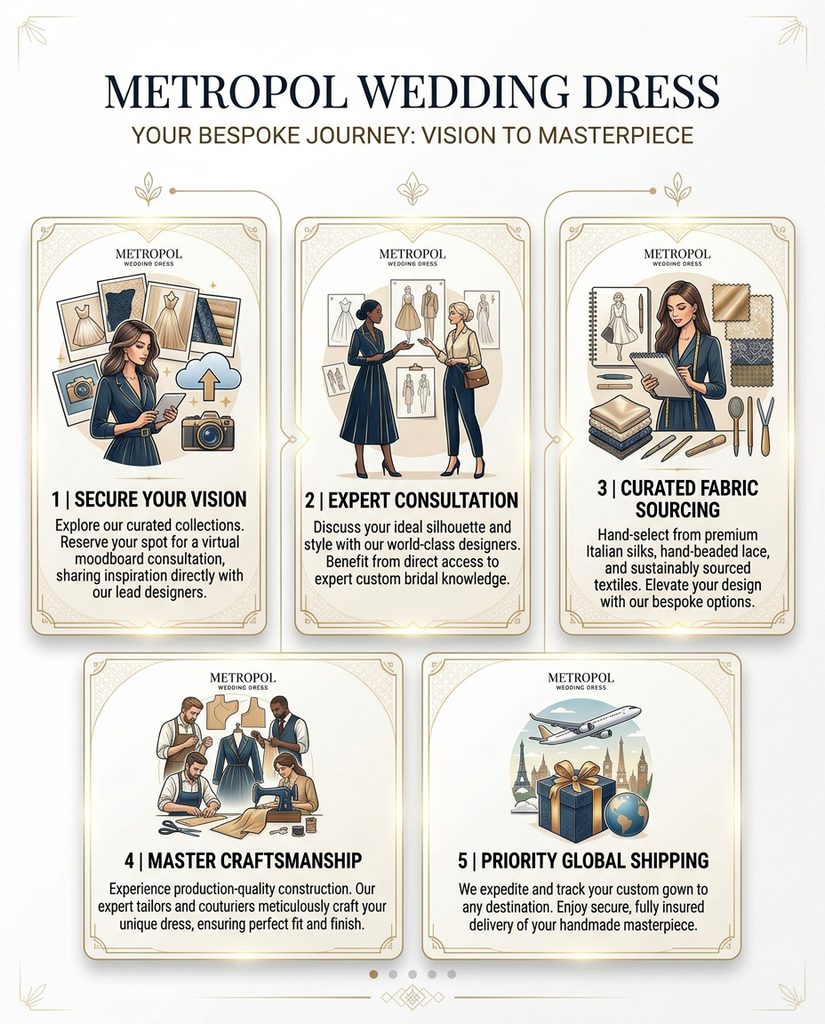
The Step-by-Step Private Couture Journey for an Australian Bride
- Vision and feasibility conversation
Share mood boards, venue photos, preferred silhouettes, non-negotiables (coverage, mobility, colour, family heirloom lace to incorporate). The team responds with technical notes and fabric recommendations suited to Australian conditions. - Precise measurement protocol
A detailed guide is supplied. Most Australian clients use a local seamstress or trusted friend. Virtual guidance is available. For complex architectural designs a calico toile can be produced and shipped for remote review if required. - Sketch refinement and fabric confirmation
Digital or hand sketches are iterated until approved. Fabric swatches or high-resolution photos under natural light are provided. Pricing for upgrades (heavier beading, premium lace, special linings) is transparent. - Production with progress documentation
Pattern drafting, cutting, construction, hand embroidery or beading, and finishing occur in stages. Clients receive photo and video updates so the private process remains visible and reassuring. - Final checks, packing and international shipping
Minor refinements are possible before dispatch. The gown is packed for long-haul air freight with tracking. Typical door-to-door after final approval ranges from a few weeks to around two months depending on complexity and carrier. - Arrival and local fine-tuning
Most clients need only minimal local alterations because the dress was made to their measurements. A local bridal alterations specialist handles any final hem or bustle adjustments.
This sequence replaces the traditional multi-appointment showroom experience with a documented, collaborative, private workflow.
Cost Reality: What Australian Brides Actually Pay
Local Australian bespoke or high-end made-to-order frequently starts in the AUD 4,000–12,000+ range once fabric upgrades and multiple fittings are included. Metropol’s factory pricing for many styles has historically sat in a range that, after conversion, shipping, insurance, possible duty and 10% GST, still lands significantly lower for comparable complexity.
Illustrative landed-cost framework (approximate, subject to current exchange, exact design and shipping method)
| Complexity Level | Typical Factory Range (EUR guide) | Estimated Landed Cost Range in Australia (AUD) | What You Usually Receive |
|---|---|---|---|
| Clean made-to-order, limited embellishment | Lower end | 900–1,800 | Precise fit, quality fabric, clean finishing |
| Mid-complexity (lace + moderate handwork) | Mid | 1,500–3,000 | Personalised design, hand-applied details |
| Full couture / heavy embellishment | Higher | 2,600–4,500+ | Extensive handwork, premium materials, structural complexity |
Additional costs to budget: shipping + insurance, GST calculated on (customs value + duty + international transport/insurance), possible low duty on apparel (often 5% or less depending on classification and any applicable origin rules), and a modest local alterations contingency (often AUD 200–600 if needed).
Tip box – Avoiding cost surprises
Always request a full written quote that separates garment price, fabric upgrades, shipping method, insurance and estimated Australian import charges. Build a 10–15% contingency for exchange-rate movement and final local tweaks.
Material and Construction Depth That Matters Under Australian Conditions
Premium French or Chantilly lace remains popular for its breathability and photographic quality. Italian silk and high-grade satin provide drape and temperature regulation. Soft tulle and organza deliver volume without excessive weight — critical for outdoor ceremonies. Stretch linings or strategic panels improve all-day comfort during long Australian receptions that often involve dancing, outdoor photos and temperature swings.
Construction stages typically include foundation (boning, cups, understructure), outer shell, lining, closures, and surface decoration. Hand-applied lace, beadwork and embroidery are executed by specialised teams. The result is a garment that feels couture in the hand and performs in real-world Australian conditions.
Real Australian Scenarios
Scenario A – Coastal wedding, 28 °C, light breeze
Bride wants ethereal movement, minimal structure, ability to remove outer layer for reception. Solution: lightweight silk-blend base with soft lace overlay, detachable sleeves and train. Result: comfort + photogenic softness without the bulk of a full ballgown.
Scenario B – Melbourne winter vineyard ceremony moving to indoor reception
Structured bodice for formal photos, warmer fabric, dramatic train that can be bustled. Solution: mikado or heavy satin with precise internal structure and hand-beaded details that catch evening light.
Scenario C – Plus-size or petite bride who has never found a sample that fits well
Full made-to-measure from first pattern. No “sample size then alter” compromise. The private process starts with her actual body rather than the nearest available sample.
Scenario D – Boutique owner seeking exclusive inventory
Private-label collaboration: Metropol produces a small exclusive run under the boutique’s own branding. Australian shops gain differentiation without the capital cost of a full local workroom.
Common Mistakes Australian Brides Make (and How to Avoid Them)
- Under-estimating measurement precision → Use a professional local tailor and follow the provided guide exactly.
- Choosing fabric purely on appearance photos → Request notes on weight, drape and climate suitability.
- Leaving too little buffer for shipping and final local adjustments → Add 3–4 weeks beyond the quoted production window.
- Ignoring insurance on a high-value shipment → Always insure.
- Assuming zero local work will be needed → Plan a small alterations contingency even with excellent made-to-measure accuracy.
- Over-complicating the design late in the process → Lock silhouette and major design decisions early; refine details later.
Practical Pre-Commitment Checklist
- Mood board and non-negotiables documented
- Current accurate measurements taken by a competent person
- Full budget including shipping, GST, insurance and local contingency calculated
- Preferred silhouette, neckline and fabric shortlist prepared
- Wedding date confirmed with realistic buffer
- Communication channel (WhatsApp is widely preferred) agreed
- Understanding of how many revision rounds are included
- Insurance and tracking confirmation process clear
- Local alterations specialist identified in advance
Expert Recommendations for Maximum Success
Decide silhouette and neckline early — these drive pattern complexity more than colour or minor surface decoration. Ask for fabric behaviour notes under Australian daylight and humidity. Photograph the gown thoroughly on arrival before any steaming or final adjustments. Keep the original measurement sheet; it becomes a valuable record if family members later want a related piece.
The private remote process rewards clear communication and realistic expectations. When those are present, the emotional payoff is high: a gown that has never been worn by anyone else, built precisely for one body and one wedding story.
Five Distinct Calls to Action
- Quiet and practical
Ready to explore whether a private made-to-measure gown fits your timeline and budget? Share your wedding date, preferred silhouette and rough budget range for a no-obligation feasibility conversation. - Design-focused
Bring your mood board and venue photos. Let’s translate them into a technical design that works with Australian climate and your body. - Cost-transparency first
Request a detailed landed-cost estimate for a mid-complexity custom gown so you can compare apples-to-apples with local atelier quotes. - Boutique / private-label path
Australian bridal retailers: discuss exclusive private-label or small-run options that differentiate your floor without large inventory risk. - Timeline-critical
Wedding less than nine months away? Contact early to confirm current production capacity and realistic shipping windows for Australia.
Frequently Asked Questions (Private Couture Experience Specific to Australian Brides)
1. How does the private remote process actually feel day-to-day?
Most communication is asynchronous via WhatsApp with photo and video updates. Scheduled video calls occur at mutually convenient times. You control the pace of decisions from home.
2. What is a realistic total lead time from first contact to gown arrival in Australia?
Typically 8–16 weeks of production plus shipping, depending on complexity and current workshop load. Add buffer for final local adjustments.
3. Can I incorporate family heirloom lace or specific cultural motifs?
Yes. Heirloom pieces or clear motif references can be integrated into the design and construction plan.
4. How accurate is remote measuring compared with multiple in-person fittings?
When the provided measurement guide is followed carefully (ideally with a local professional), accuracy is high. Complex designs can include a toile stage if needed.
5. What happens if my body changes between measurement and wedding?
Minor changes are common. A local alterations specialist handles final tweaks. Significant changes should be communicated early.
6. Which shipping methods are typically used to Australia?
Reliable international couriers with tracking and signature options (commonly DHL, FedEx or specialised apparel forwarders). Insurance is strongly recommended.
7. How is Australian GST and possible duty handled?
GST (10%) is generally applied on the value of the taxable importation (customs value + duty + international transport and insurance). Duty on apparel is often low. Exact amounts depend on declared value and classification. Your quote should clarify expectations.
8. Can the gown be designed for easy conversion between ceremony and reception?
Yes. Detachable trains, sleeves, overskirts and modular elements are frequently requested by Australian brides.
9. Is pure white the only option?
No. Soft ivory, champagne, oyster, bone and other nuanced shades are regularly produced and photograph beautifully in Australian light.
10. How does Metropol handle plus-size or petite clients differently from sample-based boutiques?
The pattern is drafted from the individual measurements from the start rather than adapted from a limited sample size range.
11. What level of handwork can I realistically expect at different price points?
Simple styles focus on clean construction and quality fabric. Mid and higher complexity include hand-applied lace, beading and embroidery executed by specialised teams.
12. Can a Melbourne or Sydney boutique order private-label pieces for their own floor?
Yes. Metropol functions as a Private Label and OEM manufacturer for retail partners.
13. What documentation do I need for personal import clearance?
Standard commercial invoice and packing list. Couriers usually handle formalities; be prepared for GST collection.
14. How are fabric swatches or samples handled internationally?
High-resolution photography under natural light is standard. Physical swatches can be arranged when critical for colour or hand-feel decisions.
15. What if I need a rush timeline?
Rush capacity depends on current production load. Discuss early; quality should not be compromised for speed.
16. Are there restrictions on certain embellishments for outdoor Australian venues?
Practical advice is given on durability, snag risk and wind behaviour. Designers balance aesthetics with real-world performance.
17. How do I protect the gown during the long journey and after arrival?
Professional packing, insurance, careful unpacking, and professional steaming/pressing on arrival are the standard recommendations.
18. Can the design accommodate religious or modest coverage requirements while remaining modern?
Yes. Coverage, sleeve length, neckline and layering are fully customisable.
19. What happens to the pattern and measurements after the wedding?
They remain part of the private commission record. Some brides request digital copies for future reference.
20. Is communication possible outside standard Turkish business hours?
WhatsApp and email allow asynchronous updates. Video calls are scheduled for overlap windows that work for Australian clients.
21. How does the quality of Turkish couture construction compare with Australian atelier work?
At the specialist level Metropol operates, European fabric sourcing, skilled pattern work and hand finishing produce results that Australian clients frequently describe as matching or exceeding expectations relative to price.
22. Can I request a specific internal structure for comfort during long outdoor ceremonies?
Yes. Boning, cups, stretch panels and breathable linings are adjusted to the brief.
23. What is the typical revision process if I want changes after seeing progress photos?
Clear revision rounds are defined at the quote stage. Major structural changes are easiest early; surface details can be refined later.
24. How should I prepare my local alterations specialist?
Share the original measurement sheet and any construction notes. Most adjustments are minor hemming, bustling or small fit refinements.
25. Are there options for matching or coordinating pieces (veils, accessories, second looks)?
Design coordination is possible; discuss early so fabric and detail language remain consistent.
26. What insurance coverage is recommended for the shipment?
Full value coverage against loss or damage during international transit.
27. Can regional Australian brides (outside major cities) access the same service?
Yes. The entire process is designed to work without requiring travel to a capital-city showroom.
28. How transparent is the pricing on fabric and embellishment upgrades?
Upgrades are itemised so you can make informed trade-offs between budget and detail level.
29. What is the best time of year to start the process for a peak Australian wedding season date?
Begin as early as practical. Peak periods increase production and shipping demand.
30. Does the private experience include styling advice for Australian venues and light conditions?
Practical design guidance is part of the collaboration — silhouette, fabric weight, colour and detail choices are discussed in the context of your specific wedding environment.
The private couture path through a specialised international manufacturer such as Metropol Wedding Dress gives Australian brides access to genuine personalisation, strong craftsmanship and realistic economics without the traditional atelier constraints of geography, sample-size limitations or elevated local labour costs. When measurement discipline, clear communication and sensible timeline buffers are observed, the result is a gown that exists only for one bride, one body and one Australian wedding day.
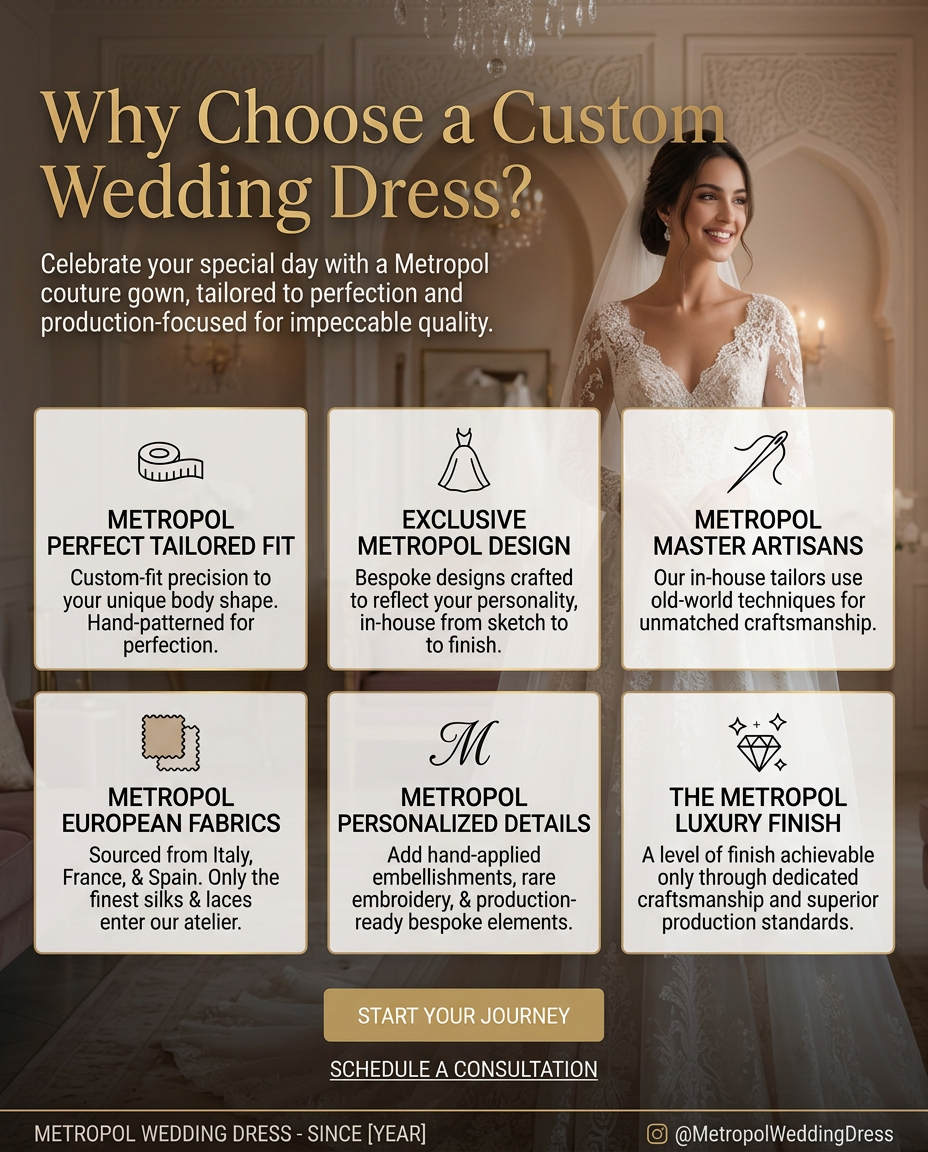
If you are ready to move from inspiration to a concrete private commission, the most useful next step is a detailed conversation covering your wedding date, measurements readiness, preferred design direction and budget parameters. From that point the collaborative process begins.
Once measurements and design are locked, the gown moves through a defined sequence inside the workshop. Pattern makers draft a unique paper or digital pattern from your body data rather than grading from a standard size block. The foundation layer follows — corsetry, cups, boning channels and stabilising tapes chosen for the silhouette and the expected movement of an Australian wedding day. Outer fabrics are cut with careful grain alignment so lace motifs sit correctly and satin panels hang without twisting under humidity or wind.
Handwork teams then apply lace, beads or embroidery. This stage is where the private nature of the commission becomes most visible: every placement decision is made for one specific design and one specific body. Progress photos and short videos are sent at key milestones so you can see the gown taking shape without leaving Australia. Final finishing includes pressing, quality inspection, secure packaging and documentation prepared for international transit.
This pipeline is the same whether the client is an individual bride in regional Queensland or a Melbourne boutique ordering a small private-label run. The difference is only in volume and branding; the attention to individual fit and finish remains constant.
Expanded Cost Modelling for 2026–2027 Australian Clients
Exchange rates, shipping rates and GST calculations shift, so the figures below are illustrative frameworks rather than fixed quotes. Always request a current written estimate.
Example 1 – Mid-complexity lace A-line for a coastal wedding
Factory base + moderate hand-applied lace and light beading.
After EUR-to-AUD conversion, air shipping with insurance, possible low duty and 10 % GST: typical landed range often falls between AUD 1,800–2,900. Local alterations contingency of AUD 250–500 is usually sufficient.
Example 2 – Structured mikado mermaid with heavy hand embroidery
Higher material and labour content.
Landed cost after the same add-ons commonly sits in the AUD 3,200–4,800 zone — still competitive against many Australian atelier quotes for equivalent complexity.
Example 3 – Boutique private-label small run (6–12 pieces)
Unit cost drops with volume. Australian retailers can maintain healthy margins while offering exclusive styles that do not appear in every other bridal shop.
Hidden cost traps that still catch some clients:
- Choosing the lowest shipping option without insurance
- Underestimating GST calculation base (customs value + duty + international freight/insurance)
- Leaving no buffer for a final local steam, hem or bustle
A clear, itemised quote that separates garment, upgrades, logistics and estimated Australian charges removes most surprises.
Measurement Protocol – Practical Detail for Australian Brides
Accurate measurements are the single biggest determinant of fit success in a remote private process. Metropol supplies a detailed guide covering bust (full and underbust), waist, high hip, low hip, torso length, arm circumference, shoulder width, desired train length and several additional points depending on silhouette.
Most Australian clients use a local bridal alterations specialist or experienced seamstress. The session should be done in similar undergarments to those planned for the wedding day. Measurements are taken twice and photographed for confirmation if requested. For complex architectural designs a calico toile can be produced and shipped for remote review before final fabric is cut.
Body changes between measurement and wedding are common. Communicate any significant shifts early; minor adjustments are handled locally on arrival.
Fabric Behaviour Under Real Australian Conditions
| Fabric Family | Performance in Heat/Humidity | Photographic Quality | Care Notes After Wedding |
|---|---|---|---|
| French / Chantilly lace | Excellent breathability | Soft, romantic, holds detail in strong light | Professional clean; store flat or padded |
| Italian silk / satin | Good temperature regulation when lined properly | High sheen, elegant drape | Professional clean only; avoid home steamers on high heat |
| Soft tulle / organza | Lightweight, moves well in breeze | Ethereal layers photograph beautifully outdoors | Gentle professional clean; watch for snags |
| Mikado / structured satin | Holds shape in cooler evenings | Architectural presence, excellent for formal photos | Professional clean; store with tissue support |
| Stretch blends (strategic panels) | High comfort for long receptions | Clean lines when well executed | Follow specific care instructions |
Hybrid constructions (lace over stretch lining, or structured bodice with soft skirt) are frequently requested because they balance photographs with all-day wearability.
Additional Real Scenarios from Australian Clients
Scenario E – Destination wedding in the Whitsundays with multiple looks
Bride required a lightweight ceremony gown plus a convertible reception option. Detachable sleeves and train were engineered so the same base could serve both moments without needing two full gowns.
Scenario F – Cultural fusion wedding in Sydney
Family requested specific embroidery motifs from one cultural tradition combined with a modern silhouette preferred by the bride. The design team translated the references into handwork that felt integrated rather than applied.
Scenario G – Regional bride in regional Victoria with limited local boutique access
Entire process conducted remotely. Measurements taken by a trusted local seamstress. Gown arrived with only a minor hem adjustment required. The private experience removed the need for multiple trips to Melbourne.
Scenario H – Second marriage, desire for sophisticated non-traditional colour
Soft oyster and champagne tones were developed to photograph beautifully under both natural and evening light while avoiding pure white.
Post-Arrival Care and Heirloom Preservation
Once the gown clears Australian customs and is in your hands:
- Unpack carefully in a clean space and inspect under good light.
- Photograph thoroughly before any steaming or alterations.
- Take to a reputable bridal alterations specialist for final tweaks (hem, bustle, minor fit).
- After the wedding, professional cleaning by a specialist experienced with couture fabrics is recommended before long-term storage.
- Store in a breathable archival box or garment bag with acid-free tissue, away from direct light and fluctuating humidity.
Many Australian brides later report that the private made-to-measure process produced a garment they feel confident preserving as a family piece precisely because it was never a sample or shared design.
Comparison Snapshot: Private Remote Couture vs Common Alternatives
| Factor | Local Australian Atelier | Sample-Based Boutique | Direct Private Couture (Metropol model) |
|---|---|---|---|
| Design freedom | High but capacity-limited | Limited to available samples + modest changes | High – original or heavily modified designs routine |
| Fit method | Multiple in-person fittings | Sample + alterations | Full made-to-measure from measurements + remote progress |
| Typical lead time | 8–12+ months | 4–8 months for made-to-order | 8–16 weeks production + shipping (with buffer) |
| Price for comparable complexity | Often AUD 5,000–15,000+ | AUD 2,000–6,000+ | Frequently lower landed cost after logistics |
| Climate adaptation | Excellent local knowledge | Depends on stock | Explicitly discussed and engineered |
| Exclusivity | High | Low to medium | High – one-of-a-kind for the individual commission |
The remote private model does not replace the emotional experience of a local fitting room for every bride. It does, however, open a practical route for those who prioritise exact fit, design control and value while living outside major capital cities or working to tighter budgets and timelines.
Extended Practical Checklist Before Committing
- Wedding date confirmed with at least 4–5 months buffer preferred
- Mood board, venue photos and non-negotiables prepared
- Local measurement professional identified
- Budget range including logistics, GST and local contingency set
- Preferred communication channel (WhatsApp preferred by many) agreed
- Understanding of revision policy and what constitutes a major vs minor change
- Insurance decision made for the international leg
- Local alterations specialist researched in advance
- Plan for professional cleaning and storage after the wedding
Additional Expert Recommendations
Lock the silhouette and major structural decisions early. Surface decoration and colour nuance can be refined later with less impact on timeline. Request notes on how each fabric option behaves in heat, humidity and wind if your venue is outdoor. Keep digital copies of all measurement sheets, sketches and progress photos — they become useful reference if future family members want a related piece.
For boutique owners considering private-label collaboration, the same production pipeline supports exclusive colourways, signature embroidery and small exclusive runs that differentiate a floor without the overhead of a full local workroom.
Five Further Calls to Action (Different Tones)
- Timeline-focused
Wedding date already set? Share it together with your preferred silhouette and we will confirm current capacity and realistic delivery windows for Australia. - Design-exploration
Send your mood board and three non-negotiables. Receive a feasibility response with fabric and construction notes tailored to Australian conditions. - Cost-clarity
Request a sample landed-cost estimate for a mid-complexity custom gown so you can compare directly with local options. - Boutique partnership
Australian retailers: discuss private-label or exclusive small-run possibilities that give your clients true made-to-measure without local atelier overheads. - Quiet next step
Simply reply with your wedding month and city. A short conversation can clarify whether the private remote process suits your situation.
Additional FAQ Cluster (Continuing from the Previous Set)
31. How are colour variations handled for non-white or soft-toned gowns?
Digital and physical references are used. Soft ivory, champagne, oyster and custom blends are developed with attention to how they photograph under Australian daylight and evening light.
32. Can sleeves or trains be engineered for easy removal during the reception?
Yes. Detachable or convertible elements are a frequent request for Australian outdoor-to-indoor transitions.
33. What level of structural support is typical for a long outdoor ceremony followed by dancing?
Boning, cups and stabilising elements are chosen for the silhouette and expected movement. Stretch panels can be added strategically for comfort.
34. How does the process handle last-minute design refinements?
Major structural changes are easiest early. Surface details and minor length adjustments can often be refined later within agreed revision rounds.
35. Is it possible to match or coordinate with bridesmaid or mother-of-the-bride pieces?
Fabric language and detail consistency can be discussed if those pieces are also being produced or sourced in parallel.
36. What happens if the gown arrives with a minor manufacturing issue?
Clear communication channels and documented progress make resolution straightforward. Most issues are rare when the process is followed carefully.
37. Can regional clients without easy access to a bridal alterations specialist still succeed?
Yes. Guidance can be provided for locating a competent local seamstress, and many final adjustments are minor.
38. How is the private nature of the commission protected?
Sketches, measurements and progress images remain confidential to the individual client or authorised boutique partner.
39. Are there options for more sustainable fabric choices?
Premium European mills increasingly offer responsible options. Specific requests can be discussed at the fabric selection stage.
40. What is the recommended buffer between expected arrival and the wedding date?
At least three to four weeks is prudent to allow for customs clearance, inspection, local adjustments and any unexpected delays.
The private couture experience with a specialised manufacturer such as Metropol Wedding Dress continues to expand what is practical for Australian brides. It removes geographic and sample-size barriers while preserving the core emotional value of a gown created for one person, one body and one specific wedding story. When measurement discipline, clear visual communication and realistic timeline buffers are observed, the outcome is a garment that feels both exclusive and wearable under real Australian conditions.
If you would like to continue into even more specialised areas (detailed toile protocols, private-label commercial terms for boutiques, long-term preservation techniques, or seasonal capacity planning), simply indicate the direction and the next layer can be developed.
Luxury couture for Australian brides is no longer defined solely by a Sydney or Melbourne atelier appointment and a five-figure price tag. Metropol Wedding Dress, a specialist Turkish couture and custom bridal manufacturer with more than two decades of experience, produces one-of-a-kind luxury gowns using premium European fabrics, skilled hand finishing and made-to-measure construction. The process is conducted privately and almost entirely remotely, allowing brides across Australia — from capital cities to regional centres — to commission a gown that has never existed on another body. Typical landed costs for mid-to-high complexity luxury pieces remain competitive after shipping, insurance, duty and GST. This guide examines what genuine luxury couture means in the Australian context: material integrity, structural intelligence for climate and venue, exclusivity, construction depth, and the practical reality of commissioning such a gown from afar.
Luxury couture has always been about more than surface beauty. It is the combination of exceptional materials, structural intelligence, hand craftsmanship and absolute exclusivity. For Australian brides the definition expands further: the gown must perform under intense sunlight, humidity or cool southern evenings, move through outdoor ceremonies and long receptions, and photograph with clarity in both natural and evening light. It must also respect the reality that many Australian weddings take place far from the nearest capital-city atelier.
Metropol Wedding Dress operates as a Couture Wedding Dress Manufacturer, Luxury Bridal Gown Manufacturer, Bespoke and Made-to-Measure producer, and Private Label partner. Its workshop combines European fabric sourcing with skilled pattern work and hand-applied embellishment. The private remote model removes the geographic and sample-size limitations of traditional Australian luxury shopping while preserving the core values of couture: a garment created once, for one body, to one brief.
What Actually Constitutes Luxury Couture in 2026
True luxury couture is not a marketing label. It is measurable in materials, construction time, structural engineering and exclusivity.
Material integrity
Premium French and Chantilly lace, high-grade Italian silk and satin, carefully selected tulle and organza, and quality internal stabilisers. These fabrics behave differently under Australian conditions than lower-grade alternatives: they breathe, drape, hold shape and photograph with depth rather than flatness.
Structural intelligence
Boning, cups, understructure and seam placement designed for the specific silhouette and the expected movement of the day. A luxury couture gown supports the body without restricting it during hours of outdoor photos, ceremony and dancing.
Hand craftsmanship
Lace placement, beading and embroidery executed by specialised teams rather than purely machine processes. The density and precision of this work are visible both close-up and in photographs.
Exclusivity
The pattern is drafted from the individual bride’s measurements. No other client receives the identical design. This is the opposite of sample-room shopping.
Climate and venue adaptation
Lightweight constructions for coastal heat, structured elegance for formal evenings, convertible elements for multi-look days, and colour nuance that works under harsh Australian daylight.
When these elements are present, the gown feels and performs as luxury couture regardless of the physical location of the workshop.
The Private Luxury Experience for Australian Brides
The traditional luxury pathway in Australia often involves multiple appointments in a capital-city atelier, limited sample sizes, and pricing that reflects high local labour and overhead costs. The Metropol private model replaces the showroom with structured remote collaboration.
You share vision, measurements and venue context. The design team responds with technical feasibility, fabric recommendations suited to Australian conditions, and refined sketches. Progress is documented with photography and video. The gown is constructed specifically for your body and brief, then shipped with tracking and insurance. Final local adjustments, if needed, are handled by a trusted Australian alterations specialist.
The experience remains private. No other bride sees your design development or progress images. The exclusivity that defines luxury couture is preserved even though the process is conducted across time zones.
Expert observation
The quality of a remote luxury commission rests on three pillars: measurement accuracy, clear visual communication, and realistic timeline buffers. When those are managed well, the final result routinely matches the fit and finish expectations of multi-fitting local atelier work.
Climate-Intelligent Luxury Design
Australian venues demand more from a luxury gown than a climate-controlled ballroom.
| Venue & Climate Context | Luxury Design Priorities | Construction Responses |
|---|---|---|
| Coastal / tropical (QLD, northern NSW, WA) | Breathability, movement, minimal weight | Soft silk blends, light lace, strategic stretch, detachable elements |
| Vineyard / garden (Yarra, Hunter, Margaret River) | Soft volume, photographic depth, moderate structure | Layered organza or tulle, refined lace, balanced boning |
| Formal city or evening | Architectural presence, rich surface, evening light response | Mikado or heavy satin, precise internal structure, dense handwork |
| Regional / hinterland outdoor | Comfort across temperature shifts, durable beauty | Hybrid constructions, convertible trains or sleeves, nuanced colour |
Luxury in this context is not heavier fabric or more embellishment for its own sake. It is intelligent material and structural choices that allow the gown to look exceptional and feel wearable for the full duration of an Australian wedding day.
Construction Depth That Separates Luxury from Mid-Range
A luxury couture gown moves through distinct stages:
- Individual pattern drafting from precise measurements
- Foundation construction (corsetry, cups, stabilisers) tailored to silhouette and movement needs
- Outer shell cutting with careful grain and motif placement
- Hand application of lace, beads or embroidery
- Lining, closures and final finishing
- Quality inspection and professional packing for international transit
Each stage is documented so the private client can follow progress. The density of handwork and the quality of internal finishing are what distinguish genuine luxury construction from well-made mid-range pieces.
Cost Reality of Luxury Couture for Australian Clients
Local Australian luxury and high-end bespoke frequently begins in the AUD 6,000–15,000+ range once fabric upgrades and multiple fittings are included. Metropol’s couture and high-complexity custom work, after currency conversion, premium fabric upgrades, shipping, insurance, possible duty and 10 % GST, often lands in a more accessible luxury band while delivering equivalent or superior material and hand-finish quality.
Illustrative landed-cost framework (subject to current rates and exact specification)
| Complexity | Typical Character | Approximate Landed Range in Australia (AUD) |
|---|---|---|
| Clean luxury made-to-measure | Premium fabric, precise fit, refined finishing | 1,800–3,200 |
| Mid-to-high luxury with significant handwork | Lace, moderate-to-dense beading or embroidery | 2,800–4,500 |
| Full couture density | Extensive hand application, complex structure, premium materials | 4,000–6,500+ |
These ranges remain competitive against many local luxury atelier quotes for comparable complexity. A written, itemised quote that separates garment, upgrades, logistics and estimated Australian charges is essential for accurate comparison.
Real Australian Luxury Scenarios
Scenario 1 – Formal Melbourne winter wedding
Structured mikado silhouette with dense hand embroidery designed to catch evening light. Precise internal support for long formal hours. Soft ivory tone chosen for photographic depth under cooler light.
Scenario 2 – Multi-look coastal wedding in the Whitsundays
Lightweight luxury base with detachable lace sleeves and train. The same gown serves ceremony and reception without requiring two full pieces. Breathable construction prioritised for heat and humidity.
Scenario 3 – Cultural fusion Sydney wedding
Modern architectural silhouette combined with specific hand-embroidered motifs requested by the family. Luxury materials and finishing ensured the cultural elements felt integrated rather than applied.
Scenario 4 – Regional bride seeking true exclusivity
Full private commission conducted remotely. Measurements taken by a trusted local professional. The finished gown required only minor local refinement and delivered the exclusivity previously available only through capital-city ateliers.
Common Pitfalls When Commissioning Luxury Couture Remotely
- Under-investing in measurement accuracy
- Selecting fabric purely on appearance without climate performance notes
- Leaving insufficient buffer for shipping and final local work
- Omitting insurance on a high-value international shipment
- Expecting zero local adjustments even with excellent made-to-measure work
- Making major structural changes late in the process
Avoiding these keeps the luxury experience smooth and the final result aligned with expectation.
Pre-Commission Luxury Checklist
- Wedding date and preferred buffer confirmed
- Mood board, venue context and non-negotiables prepared
- Accurate measurements arranged with a competent local professional
- Budget range including logistics, GST, insurance and local contingency established
- Communication channel agreed
- Understanding of revision policy clarified
- Insurance decision made
- Local alterations specialist identified in advance
- Plan for professional cleaning and long-term preservation after the wedding
Expert Recommendations for Luxury Outcomes
Decide silhouette and structural approach early. Surface density and colour nuance can be refined later with less impact on timeline. Request specific notes on how proposed fabrics behave in heat, humidity and wind if the venue is outdoor. Photograph the gown thoroughly on arrival before any steaming or final adjustments. Keep complete records of measurements, sketches and progress images — they become part of the garment’s private history.
For Australian bridal retailers, the same luxury pipeline supports private-label collaborations that allow boutiques to offer exclusive couture-level pieces without maintaining a full local workroom.
Five Distinct Calls to Action
- Luxury exploration
Share your vision, venue type and preferred complexity level for a private feasibility discussion focused on materials and construction. - Timeline and capacity
Provide your wedding month and we will confirm current production windows and realistic delivery estimates for Australia. - Cost transparency
Request a sample landed-cost estimate for a mid-to-high luxury specification so you can compare directly with local atelier options. - Boutique private-label path
Australian retailers: discuss exclusive luxury collections or small private-label runs that differentiate your offering. - Quiet next step
Simply indicate your wedding city and approximate date. A short conversation can clarify whether the private luxury couture route suits your requirements.
Frequently Asked Questions – Luxury Couture for Australian Brides
1. What separates luxury couture from high-quality made-to-order?
Material grade, density of handwork, structural engineering for the individual body, and absolute exclusivity of the pattern and design.
2. Can a remote process deliver true luxury fit and finish?
Yes, when measurements are precise, communication is clear, and progress is documented. Many Australian clients report results equal to multi-fitting local atelier work.
3. How does Australian climate influence luxury fabric choices?
Breathability, weight, drape under humidity, and photographic behaviour under strong daylight become primary selection criteria alongside aesthetics.
4. What is a realistic landed cost range for genuine luxury complexity?
Mid-to-high luxury pieces frequently land in the AUD 2,800–5,500 zone after all add-ons, remaining competitive with many local luxury quotes.
5. How is exclusivity guaranteed?
The pattern is drafted from the individual measurements. The design is not reproduced for another client.
6. Are convertible or multi-look luxury gowns possible?
Yes. Detachable sleeves, trains and overskirts are engineered within luxury construction standards.
7. How important is internal structure in a luxury gown for long Australian receptions?
Critical. Proper corsetry, cups and stabilisers provide support and comfort across hours of movement and temperature change.
8. Can cultural or family elements be integrated at a luxury level?
Yes. Specific motifs, heirloom lace or meaningful details can be translated into high-quality handwork.
9. What buffer should be allowed between expected arrival and the wedding?
A minimum of three to four weeks is prudent for clearance, inspection, local refinement and any unexpected delay.
10. How are colour nuances handled for soft ivory, champagne or oyster tones?
References and lighting notes are used so the final shade photographs correctly under Australian conditions.
11. Is insurance essential for a luxury shipment?
Strongly recommended. High-value international transit should always be covered.
12. Can regional Australian brides access the same luxury standard?
Yes. The entire process is designed to function without requiring travel to a capital-city showroom.
13. What level of hand embellishment is typical at different luxury price points?
Density scales with complexity. Higher specifications include extensive hand-applied lace, beading or embroidery.
14. How does the private process protect confidentiality?
Design development, measurements and progress images remain private to the individual client or authorised partner.
15. Are more responsible or traceable fabric options available within luxury grades?
Premium European mills increasingly offer higher-responsibility options. Specific requests can be discussed at selection stage.
16. What local work is usually required after arrival?
Most clients need only minor hem, bustle or fine-tuning. The made-to-measure foundation minimises structural alterations.
17. Can the gown be designed for both formal ceremony and relaxed reception comfort?
Yes. Hybrid constructions and convertible elements are common solutions.
18. How transparent is pricing on upgrades?
Upgrades are itemised so trade-offs between budget and density of handwork or fabric grade are clear.
19. What records should be kept after the wedding?
Measurement sheets, sketches and progress images form a private archive of the commission and support future preservation or family reference.
20. Is the luxury experience suitable for second marriages or non-traditional colour preferences?
Yes. Soft, sophisticated tones and refined modern silhouettes are regularly produced at luxury standard.
21. How does Metropol’s couture construction compare with Australian high-end ateliers on material quality?
European fabric sourcing and specialised hand-finishing produce results that Australian clients frequently describe as matching or exceeding expectations relative to landed cost.
22. Can sleeves or trains be engineered for easy removal without compromising luxury finish?
Yes. Detachable elements are constructed to the same standard as the main garment.
23. What happens if body measurements change after the initial set?
Early communication allows adjustment. Minor changes are handled locally on arrival; significant shifts should be addressed during production if possible.
24. Are private-label luxury options available for Australian boutiques?
Yes. The same couture pipeline supports exclusive collections under the retailer’s own branding.
25. What is the best starting point for a bride considering luxury couture remotely?
A clear conversation covering wedding date, venue type, preferred complexity and approximate budget range.
Luxury couture for Australian brides is ultimately about a garment that feels exceptional on the body, performs under real conditions, and exists only for one person and one wedding. The private remote model offered by a specialised manufacturer such as Metropol Wedding Dress makes that standard accessible across the country while preserving the material integrity, structural intelligence and exclusivity that define true couture.
If you would like to explore a specific silhouette, fabric direction, timeline or private-label commercial arrangement, the next conversation can move from general principles to concrete design and production parameters.
Related Topics
30.07.2025
China Bridal Dress Factory for Sale China dominates the global wedding dress industry, producing over 90% of the world’s bridal gowns. With hubs like Suzhou, Guangzhou, and Chaozhou, the country offers unparalleled opportunities for entrepreneurs...

08.07.2025
A-line Bridal Gown for Spring is a season of renewal, blooming flowers, and soft pastel hues, making it the perfect time for a wedding. For brides seeking a timeless, elegant, and versatile dress, an A-line...

09.01.2026
Warum Deutsche Bräute Maßgeschneiderte Luxus Brautkleider Wählen Hochzeiten sind in Deutschland weit mehr als nur feierliche Zeremonien – sie sind tief verwurzelte kulturelle Ereignisse, die Individualität, Stilbewusstsein und persönliche Werte widerspiegeln. Besonders das Brautkleid nimmt...
19.06.2024
Project Bridal Models Best 3 A modern wedding dress typically reflects current fashion trends while also embracing individuality and personal style. Here are some characteristics often associated with modern wedding dresses: Sleek Silhouettes: Clean lines...
05.05.2026
Brautkleid personalisieren lassen Hey du, stell dir vor, du stehst vor dem Spiegel, drehst dich einmal langsam und plötzlich ist es da – dieses Gefühl. Das Kleid ist nicht einfach nur schön. Es ist deins....
07.10.2025
Robe de mariée bohème sur mesure Dans l’univers du mariage, le choix de la robe de mariée est un moment empreint d’émotion et de signification. Parmi les styles qui captivent les futures mariées, la robe...
Comments