
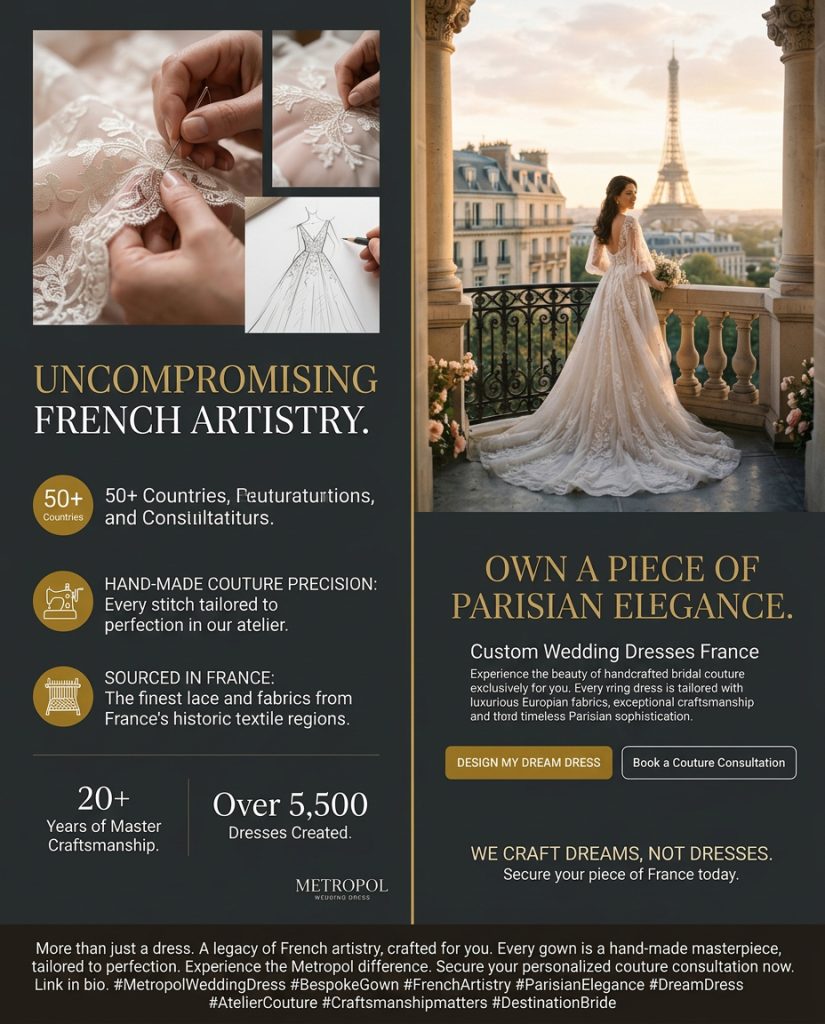
Modern Minimalist Wedding Dress represent the quiet power of restraint: clean architectural lines, exceptional fabrics, precise tailoring, and zero visual noise. In 2026 this aesthetic dominates destination weddings, micro-ceremonies, city halls, and fashion-forward celebrations. Silhouettes stay lean—column, sheath, slip, soft A-line—while materials such as silk crepe, mikado, and liquid satin become the true design statement.
For bridal boutiques, private-label brands, and individual brides seeking exclusivity, partnering with a proven Custom Wedding Dress Manufacturer, Bespoke Bridal Gown Manufacturer, or OEM Wedding Dress Manufacturer based in Turkey unlocks made-to-measure quality at accessible price points. Metropol Wedding Dress, operating from a large production atelier in İzmir, delivers exactly this combination of craftsmanship, flexibility, and global export capability.
This guide examines the design language, material science, production process, cost structure, common pitfalls, and practical purchasing strategies that turn a modern minimalist vision into a finished gown—or an entire wholesale collection.
The Quiet Revolution of Modern Minimalist Bridal Design
Bridal fashion has spent decades oscillating between excess and purity. The current cycle favors purity. Brides no longer want to disappear inside layers of tulle and crystal. They want the dress to frame them rather than compete with them. Modern minimalist wedding dresses achieve this through three non-negotiable principles: silhouette integrity, fabric integrity, and construction integrity.
A true minimalist gown contains almost no surface decoration. Every seam, dart, and hem must therefore be perfect. The eye travels uninterrupted from neckline to hem; any irregularity becomes glaring. This is why the best results come from experienced pattern makers and cutters rather than from surface embellishment specialists.
Core Silhouettes That Define the Category
- Column / sheath: continuous vertical line that elongates the body
- Slip dress: bias-cut or soft drape with spaghetti or narrow straps
- Soft A-line: gentle flare from the natural or slightly dropped waist
- Architectural fit-and-flare: structured through the hip then controlled expansion
- Long-sleeve column: coverage without bulk, often with clean cuffs or soft volume at the shoulder
Neckline vocabulary remains restrained: square, straight bandeau, soft scoop, high boat, or clean V. Statement backs—deep scoop, keyhole, or clean open back—supply the only permitted drama.
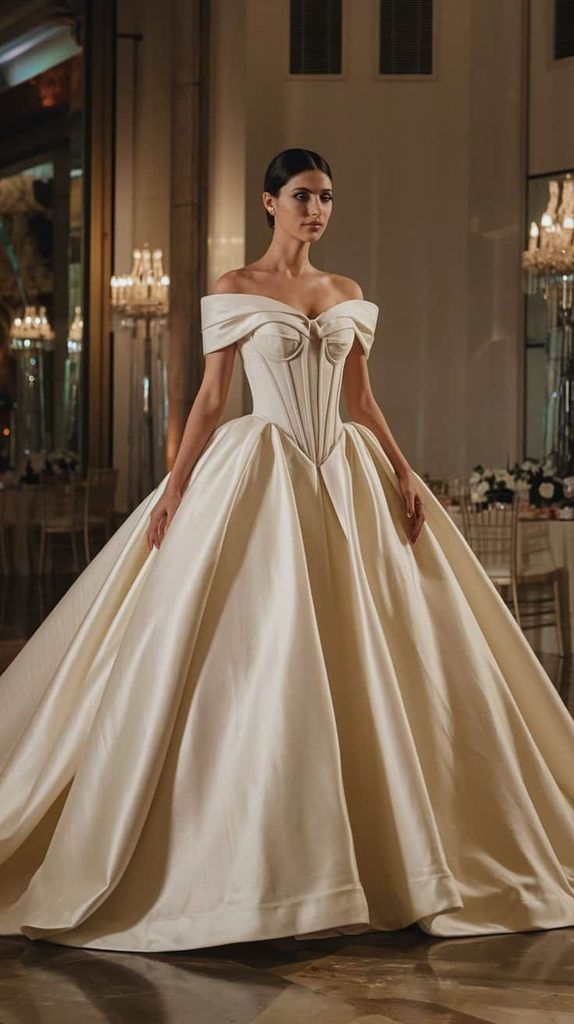
Material Science: Why Fabric Is the Entire Design
Because surface decoration is minimized, the fabric must carry the entire aesthetic load.
Crepe (especially double crepe or silk crepe) remains the workhorse. Its matte surface absorbs light, its slight texture hides minor imperfections, and its drape follows the body without clinging. Stretch versions offer comfort for all-day wear; woven versions deliver sharper architecture.
Mikado provides structure and a soft luminous sheen. It holds crisp pleats and sharp folds, making it ideal for architectural details that would collapse in softer fabrics.
Satin and charmeuse introduce controlled luminosity. Liquid satin creates the modern slip-dress ideal; heavier duchess or silk satin supports structured bodices without the cold shine of older bridal satins.
Organza appears selectively—usually as long sleeves, an overlay panel, or a detachable train—adding air without visual weight.
High-quality versions of these materials are essential. Cheap polyester crepe or low-grade satin photographs poorly and feels synthetic against the skin. A reputable Handmade Wedding Dress Manufacturer or Handcrafted Bridal Gown Manufacturer sources European or premium Asian mills and tests every roll for hand, drape, and color consistency under both natural and flash lighting.
How a Professional Manufacturer Translates Minimalism into Reality
Producing a clean gown is paradoxically more demanding than producing an ornate one. There is nowhere to hide a poor pattern or uneven seam.
Metropol Wedding Dress operates as a Custom Wedding Dress Factory and Custom Bridal Gown Factory with more than two decades of experience. Their process typically follows these stages:
- Design consultation or tech-pack review
- Pattern development and muslin fitting (or digital 3-D sampling for remote clients)
- Fabric and lining selection with physical swatches
- Cutting under controlled tension to prevent later distortion
- Construction with reinforced seams, invisible zippers or clean hand-finished closures, and precise understructure when needed
- Multiple quality-control checkpoints before final pressing and packing
Because they function as both a Wedding Dress Manufacturer for Boutiques and a Bridal Gown Manufacturer for Bridal Shops, they support single made-to-measure orders as well as small wholesale runs. This dual capability makes them a practical Private Label Wedding Dress Manufacturer and OEM Wedding Dress Manufacturer for emerging labels that want exclusive designs without owning a factory.
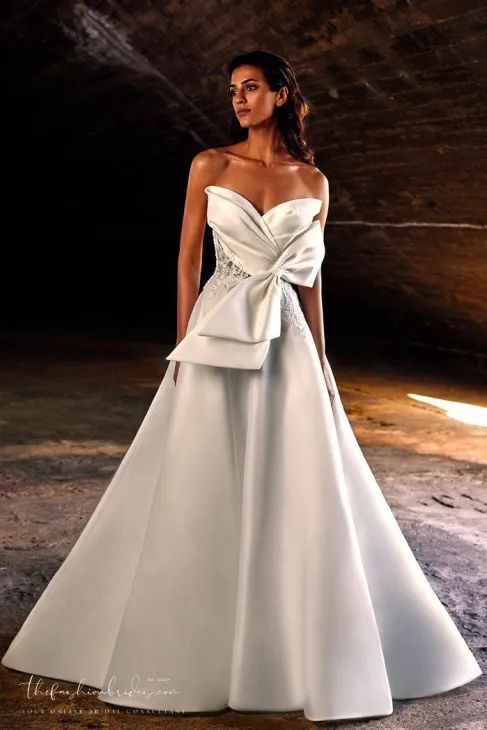
Cost Reality and Value Analysis
A well-made modern minimalist gown from a direct manufacturer typically sits in the €300–€2,000 range depending on fabric grade, complexity of pattern, and level of hand finishing.
Factors that move price upward:
- Pure silk or high-grade European crepe/mikado versus quality polyester blends
- Fully hand-finished hems and seams versus machine with selective hand work
- Complex pattern grading for non-standard body measurements
- Detachable elements (overskirt, sleeves, train)
Factors that keep price controlled:
- Elimination of heavy beading and lace application
- Efficient Turkish production infrastructure
- Direct factory relationship that removes multiple middlemen
Boutiques and private-label brands working with a Wholesale Custom Wedding Dresses or Wholesale Custom Bridal Gowns partner gain margin while offering clients exclusivity. A Direct Wedding Dress Manufacturer or Direct Bridal Gown Manufacturer further reduces landed cost and shortens lead times.
Practical Buying Paths
For the individual bride
Work with a Made to Measure Wedding Dress Manufacturer or Tailor Made Wedding Dress Manufacturer. Provide accurate measurements (or schedule a remote fitting session), select fabric from physical swatches, approve a toile or digital render, then wait for the finished piece. Lead times of 8–16 weeks are standard; rush options exist.
For the boutique owner
Partner with a Wedding Dress Manufacturer for Boutiques offering flexible MOQs. Many Turkish ateliers now accept low or zero minimums for proven partners. Request exclusivity on selected styles within a defined territory.
For the emerging brand
Engage a Private Label Wedding Dress Manufacturer or Custom Bridal Collection Manufacturer. Supply tech packs or mood boards; the manufacturer develops patterns, produces samples, and scales production under your label. A strong Bridal Gown OEM Supplier or Wedding Dress OEM Supplier will also handle packaging, labeling, and export documentation.
Real-World Application Scenarios
- City-hall civil ceremony followed by an evening reception: a clean column in double crepe that photographs beautifully under mixed lighting and allows easy movement for dancing.
- Beach or destination wedding: bias-cut slip in silk charmeuse or lightweight crepe that packs flat and resists humidity.
- Winter architectural venue: mikado column with long clean sleeves and a controlled train.
- Fashion-conscious micro-wedding: soft A-line in matte satin with a square neckline and open back.
In each case the gown succeeds because the cut and fabric are prioritized over decoration.
Common Mistakes and How to Avoid Them
Choosing a fabric that looks flat in person but photographs poorly under flash.
Ignoring body movement—test sitting, walking, and raising arms during fittings.
Overlooking understructure; even minimalist gowns often need subtle support for a clean neckline or smooth hip line.
Selecting a manufacturer without verifying their pattern-making skill for clean seams.
Failing to request multiple fabric swatches under different lighting conditions.
Checklist for Boutiques and Brands Evaluating a Manufacturer
- In-house pattern department experienced with clean construction
- Access to premium crepe, mikado, and satin mills
- Transparent sampling and revision process
- Ability to grade accurately across a full size range
- Export experience and reliable shipping timelines
- Willingness to protect designs for private-label clients
- Clear communication in the buyer’s preferred language
Metropol Wedding Dress meets these criteria as an established International Wedding Dress Manufacturer and Wedding Dress Exporter / Bridal Gown Exporter serving clients across Europe, the Middle East, and beyond.
Expert Perspective on Longevity
A well-cut modern minimalist gown ages better than trend-driven maximalism. The absence of season-specific embellishment means the dress can be worn again, altered into evening wear, or passed on without looking dated. This longevity aligns with growing bride interest in pieces that justify their investment beyond a single day.
Final Considerations for Decision Makers
Whether you are a bride seeking a one-of-a-kind piece, a boutique buyer building a focused minimalist rack, or a brand founder developing a signature collection, the decisive factors remain the same: pattern precision, fabric quality, and manufacturing integrity. A capable Couture Wedding Dress Manufacturer, Luxury Bridal Gown Manufacturer, Premium Wedding Dress Manufacturer, or Premium Bridal Gown Manufacturer delivers all three. When that manufacturer also operates as a flexible Customized Bridal Gown Manufacturer, Personalized Wedding Dress Manufacturer, One of a Kind Wedding Dress Manufacturer, and Exclusive Bridal Gown Manufacturer, the commercial and creative possibilities expand dramatically.
The modern minimalist wedding dress is not an absence of design. It is the presence of absolute clarity. When executed by skilled hands using honest materials, it becomes one of the most powerful statements a bride—or a bridal business—can make.
Frequently Asked Questions
What defines a modern minimalist wedding dress in 2026?
Clean silhouette, premium fabric with little or no surface embellishment, precise tailoring, and intentional use of negative space.
Which fabrics photograph best for minimalist gowns?
Double crepe and high-quality mikado under most lighting conditions; liquid satin for controlled luminosity.
Can a minimalist dress still feel bridal?
Yes. The combination of exceptional fabric, perfect fit, and thoughtful construction creates a strong bridal presence without traditional ornamentation.
How long does made-to-measure production usually take?
Typically 8–16 weeks depending on complexity and season. Rush options are often available from established manufacturers.
Is Turkey a strong sourcing location for minimalist bridal?
Yes. Turkish ateliers combine European design influence, skilled pattern work, and competitive pricing, making them effective for both individual and wholesale orders.
What is the difference between OEM and private-label production?
OEM usually follows the client’s existing designs; private label often includes design development or exclusive adaptations under the client’s brand.
Do minimalist gowns require special undergarments?
Many benefit from seamless shapewear or built-in support to maintain clean lines.
Can sleeves be added to a minimalist silhouette without breaking the aesthetic?
Yes—clean long sleeves, soft bishop sleeves, or architectural organza sleeves can enhance rather than dilute the look when proportioned correctly.
How important is the pattern for a clean gown?
Critical. Surface decoration can disguise poor pattern work; a minimalist gown cannot.
What size range can a professional manufacturer typically handle?
Most experienced factories grade from US 0–28 or equivalent with accuracy when proper measurements are supplied.
Are detachable elements compatible with minimalism?
Yes. A clean overskirt, removable train, or detachable sleeves can transform the look while preserving the core silhouette.
How should boutiques price private-label minimalist gowns?
Factory cost plus desired margin, factoring in exclusivity and local market positioning. Many achieve strong margins due to the lower embellishment cost.
What shipping considerations apply for international orders?
Experienced exporters handle documentation, preferred carriers, and packaging that protects delicate fabrics.
Can existing designer samples be reproduced under private label?
Reputable manufacturers will discuss ethical and legal boundaries; many prefer original or adapted designs.
How do I evaluate fabric quality from swatches?
Assess hand, drape, opacity under strong light, and behavior after gentle crushing and release.
Is bias-cut construction suitable for all body types?
It works beautifully on many figures but requires precise fitting; structured crepe or mikado can be more forgiving.
What lead time should wholesale buyers expect for a small collection?
Often 10–14 weeks from approved samples, depending on volume and fabric availability.
Can a manufacturer protect my designs from being sold to competitors?
Yes—through exclusivity agreements limited by territory or time period.
How does climate affect fabric choice?
Lightweight crepe or charmeuse for warm destinations; heavier mikado or double crepe for cooler or air-conditioned venues.
What post-wedding options exist for a minimalist gown?
Simple alterations can convert many styles into elegant evening dresses or formalwear.
Are there sustainability advantages to minimalist construction?
Reduced embellishment often means fewer synthetic components and simpler end-of-life considerations, though fabric origin remains the larger factor.
How do I communicate design intent clearly to a remote manufacturer?
Provide detailed tech packs, measurement charts, fabric preferences, and reference images of fit and finish rather than only finished-dress photos.
What is the typical revision process during sampling?
One or two rounds of fitting adjustments are standard before bulk or final production begins.
Can plus-size minimalist gowns achieve the same clean aesthetic?
Absolutely, when the pattern is graded correctly and fabric has appropriate structure and drape.
Why choose a direct manufacturer over a trading company?
Direct access improves communication speed, quality control, and pricing transparency.
This completes the essential knowledge framework for anyone serious about modern minimalist wedding dresses—whether for personal wear or commercial development.
Continuing the Deep Dive: Production, Economics, and Strategic Application of Modern Minimalist Bridal
The previous sections established the aesthetic language and commercial pathways. What follows expands into the operational, financial, and strategic layers that turn a clean silhouette into a reliable product for brides, boutiques, and emerging labels.
Material Performance Matrix
A modern minimalist gown lives or dies by fabric behavior under real conditions—movement, photography, climate, and time. The table below compares the core materials used by serious manufacturers.
| Fabric | Surface Finish | Structure Level | Best Silhouettes | Climate Suitability | Photography Behavior | Relative Cost Tier | Care Notes |
|---|---|---|---|---|---|---|---|
| Double Crepe | Matte, subtle texture | Medium-high | Column, sheath, soft A-line | All seasons | Excellent (absorbs light) | Mid to high | Steam carefully; resists wrinkles well |
| Silk Crepe | Soft matte | Medium | Slip, bias-cut, fluid column | Warm to mild | Soft and flattering | High | Dry-clean preferred |
| Mikado | Soft luminous sheen | High | Architectural column, structured A-line | Cool to mild | Strong under mixed light | Mid-high | Holds shape; minimal steaming |
| Liquid Satin / Charmeuse | High sheen | Low-medium | Slip, bias, soft sheath | Mild to warm | Dramatic luminosity | Mid to high | Prone to water spots; careful handling |
| Duchess Satin | Controlled sheen | High | Structured bodice with clean skirt | Cool | Classic bridal glow | Mid | More stable than liquid versions |
| Lightweight Organza | Crisp transparent | Medium (for overlays) | Sleeves, detachable elements | Warm | Adds air without weight | Mid | Delicate; protect from snags |
A Custom Bridal Wear Manufacturer or Bespoke Bridal Wear Manufacturer selects from these based on the final use case rather than trend alone. For a destination beach ceremony the priority is packability and humidity resistance; for a winter city wedding the priority is structure that survives low temperatures and indoor heating.
Production Sequence Inside a Professional Atelier
Understanding the sequence reveals why a true Couture Wedding Dress Manufacturer or Bridal Couture Manufacturer commands different pricing from mass producers.
- Intake and technical translation
Measurements or a tech pack arrive. Pattern makers convert the vision into graded paper or digital patterns. For remote clients, 3-D avatars or detailed measurement protocols replace in-person fittings. - Muslin or digital prototype
A toile is cut and fitted, or a digital sample is reviewed. Adjustments focus on balance, dart placement, and hem behavior. This stage is non-negotiable for clean construction. - Fabric cutting
Rolls are inspected under consistent lighting. Cutting occurs on specialized tables with controlled tension so the finished garment does not distort later. - Construction phases
Bodice first (with any internal support), then skirt or continuous column, then closures and hems. Invisible zippers, hand-finished seams, or clean French seams appear according to the design brief. A Tailor Made Bridal Gown Manufacturer invests more hand finishing here than a pure volume producer. - Pressing and final quality gates
Multiple inspections check symmetry, seam integrity, and fabric behavior after movement tests. Only then does packaging for export occur.
Metropol Wedding Dress, functioning as both a Custom Wedding Dress Factory and a Wedding Dress OEM Supplier, runs this sequence for single bespoke orders and for small wholesale batches. The dual capability allows a boutique to test a style with low risk before committing to larger numbers.
Cost Architecture for Boutiques and Private-Label Brands
Pricing transparency separates professional partners from intermediaries. Approximate factory-level ranges for modern minimalist pieces (2026 market conditions, quality fabrics, Turkey-based production):
- Simple column or sheath in quality polyester-blend crepe: €280–€450
- Silk-blend or high-grade double crepe column: €450–€750
- Mikado architectural styles with clean long sleeves: €550–€900
- Fully silk liquid-satin slip with hand finishing: €700–€1,200
- Complex pattern + detachable elements + premium European fabric: €1,000–€2,000
These figures exclude shipping, duties, and local taxes. A Direct Bridal Gown Manufacturer keeps the landed cost lower by eliminating trading-company markups. Boutiques typically apply 2.5× to 4× markup depending on market positioning and exclusivity.
For private-label development the sample cost is usually higher (covering pattern development), while subsequent units drop. A Private Label Wedding Dress Manufacturer that also offers design support can accelerate collection launch for new brands.
Turkey as a Strategic Sourcing Base
Turkey occupies a distinctive position: European design sensibility, skilled technical workforce, proximity to major markets, and production costs that remain competitive with Asia for mid-to-high quality bridal.
Advantages relevant to minimalist production include:
- Strong pattern-making culture that values clean construction
- Access to both local and imported premium fabrics
- Flexible order quantities suited to boutique needs
- Established export documentation and logistics corridors into Europe, the UK, the Middle East, and North America
A Wedding Dress Exporter or Bridal Gown Exporter based in İzmir or Istanbul can therefore serve as both a reliable International Wedding Dress Manufacturer and a responsive partner for smaller runs. This combination is rarer than pure high-volume Asian factories or pure high-cost European ateliers.
Real Scenarios and Decision Logic
Scenario 1 – Boutique expanding a minimalist rack
A European bridal shop wants six exclusive styles for the coming season. They engage a Wedding Dress Manufacturer for Boutiques and a Bridal Gown Manufacturer for Bridal Shops. After reviewing swatches and approving two samples, they order small quantities with territorial exclusivity. Lead time: 12 weeks. Result: differentiated inventory without heavy capital lock-up.
Scenario 2 – Emerging label building a signature collection
A designer with strong social presence needs a first capsule of eight clean silhouettes. They work with a Custom Bridal Collection Manufacturer and OEM Wedding Dress Manufacturer. Tech packs are refined, samples produced, and production scaled under their label. The manufacturer also handles labeling and basic packaging. This path turns a creative vision into a commercial product without factory ownership.
Scenario 3 – Individual bride seeking one-of-a-kind
Measurements are taken locally or via detailed protocol. A Made to Order Wedding Dress Manufacturer or One of a Kind Wedding Dress Manufacturer develops a personal pattern. Fabric is chosen from physical options. Two fittings (or remote equivalents) refine the balance. The finished gown arrives as a true Exclusive Bridal Gown.
Scenario 4 – Destination micro-wedding
Priority is packability and climate resilience. A bias-cut or soft column in lightweight crepe or charmeuse is selected from a Personalized Wedding Dress Manufacturer. The dress travels flat and requires minimal steaming on arrival.
Maintenance and Longevity Protocol
Minimalist gowns reward careful ownership.
- Store hanging on a padded hanger in a breathable garment bag away from direct light.
- Spot-clean only with products tested on a hidden area.
- Professional dry-cleaning after the event if the fabric requires it.
- Avoid plastic covers that trap moisture.
- For long-term preservation, consider acid-free boxing with tissue after professional cleaning.
Because surface decoration is minimal, these dresses often convert successfully into evening or formal wear with simple hem or neckline adjustments—an advantage over heavily embellished pieces.
Strategic Checklist for Decision Makers
For the individual bride
- Confirm the manufacturer’s experience with clean (not heavily decorated) construction
- Request fabric swatches under both natural and artificial light
- Clarify the number of included fittings or revision rounds
- Verify measurement protocol accuracy
- Discuss packing method for travel if relevant
For the boutique buyer
- Ask for current lead times and capacity
- Review sample quality on an actual body, not only on a form
- Negotiate exclusivity terms
- Confirm grading accuracy across the size range you serve
- Evaluate communication responsiveness
For the brand founder
- Assess pattern and sample development capability
- Clarify intellectual-property protection
- Understand minimums for subsequent production runs
- Review packaging and labeling options
- Confirm export experience to your target markets
Five Distinct Calls to Action
- For the decisive bride
If a clean, architectural silhouette that feels like an extension of your own presence is the goal, begin the conversation with measurements and fabric preferences today. A Made to Measure Wedding Dress Manufacturer can turn that clarity into a finished gown on a realistic timeline. - For the boutique owner seeking differentiation
Minimalist inventory moves when it is exclusive and well-executed. Explore small-run options with a proven Wholesale Custom Wedding Dresses and Wholesale Custom Bridal Gowns partner that understands European and international retail expectations. - For the emerging label
Transform sketches or mood boards into a protected collection. A capable Private Label Wedding Dress Manufacturer and Custom Bridal Dress Manufacturer supplies the technical and production infrastructure so creative energy stays focused on design and brand. - For the volume-oriented retailer
Secure consistent quality and predictable lead times through a Direct Wedding Dress Manufacturer relationship. Factory-direct terms improve margin while maintaining the clean aesthetic clients increasingly request. - For the international buyer
Leverage an established International Wedding Dress Manufacturer and Bridal Gown Exporter that already ships successfully across continents. Logistics experience reduces friction and risk.
Extended Expert Observations
The strongest modern minimalist gowns share one invisible quality: proportional intelligence. The distance from shoulder to waist, the exact placement of the side seam, the weight distribution of the hem—these decisions determine whether the dress looks intentional or merely simple. A Premium Wedding Dress Manufacturer or Premium Bridal Gown Manufacturer invests time in these subtleties because they cannot be corrected later with lace or beading.
Equally important is the relationship between fabric and understructure. Even the cleanest column often benefits from subtle internal support that never shows. Skilled Handcrafted Bridal Gown Manufacturer teams understand how to place that support so the exterior remains pure.
Finally, the market continues to reward restraint. Brides who choose minimalism frequently report higher satisfaction with photographs and with the physical experience of wearing the dress all day. The absence of excess weight and decoration translates into comfort without sacrificing presence.
Closing Framework
Modern minimalist wedding dresses succeed when three conditions align: a clear design language, materials that perform, and manufacturing partners who treat precision as non-negotiable. Whether the end user is a single bride, a boutique, or a new brand, the same principles apply.
Metropol Wedding Dress operates at the intersection of these requirements—as a Custom Wedding Dress Manufacturer, Custom Bridal Gown Manufacturer, Bespoke Wedding Dress Manufacturer, Bespoke Bridal Gown Manufacturer, Made to Measure Wedding Dress Manufacturer, Made to Order Wedding Dress Manufacturer, Personalized Wedding Dress Manufacturer, Customized Bridal Gown Manufacturer, Private Label Wedding Dress Manufacturer, OEM Wedding Dress Manufacturer, Couture Wedding Dress Manufacturer, Luxury Bridal Gown Manufacturer, Custom Wedding Dress Factory, Custom Bridal Gown Factory, Wedding Dress Manufacturer for Boutiques, Bridal Gown Manufacturer for Bridal Shops, Custom Wedding Dress Wholesale, Custom Bridal Gown Wholesale, Wholesale Custom Wedding Dresses, Wholesale Custom Bridal Gowns, Custom Bridal Wear Manufacturer, Bespoke Bridal Wear Manufacturer, Bridal Couture Manufacturer, Handmade Wedding Dress Manufacturer, Handcrafted Bridal Gown Manufacturer, Tailor Made Wedding Dress Manufacturer, Tailor Made Bridal Gown Manufacturer, One of a Kind Wedding Dress Manufacturer, Exclusive Bridal Gown Manufacturer, Direct Wedding Dress Manufacturer, Direct Bridal Gown Manufacturer, Wedding Dress OEM Supplier, Bridal Gown OEM Supplier, Custom Bridal Collection Manufacturer, Custom Bridal Dress Manufacturer, Premium Wedding Dress Manufacturer, Premium Bridal Gown Manufacturer, International Wedding Dress Manufacturer, Wedding Dress Exporter, and Bridal Gown Exporter.
The opportunity is open for those ready to move from concept to precise execution.
Additional Targeted FAQ Cluster
How does a manufacturer ensure color consistency across a small wholesale order?
Fabric is ordered from the same dye lot whenever possible, and physical standards are retained for comparison under controlled lighting.
What happens if measurements change slightly after the pattern is finalized?
Minor adjustments are often possible before cutting; larger changes may require a new pattern stage and associated cost.
Can a minimalist gown incorporate a short train without looking traditional?
Yes—through controlled length, clean edge finishing, and proportional balance with the overall silhouette.
Is it realistic to request a fully bias-cut column in heavier mikado?
Mikado is rarely ideal for true bias; crepe or charmeuse perform better for that construction method.
How do experienced exporters handle customs documentation for bridal shipments?
They prepare commercial invoices, packing lists, and any required certificates according to the destination country’s rules, reducing delays for the buyer.
What is a realistic sample-to-production timeline for a private-label capsule of five styles?
Sample approval 4–6 weeks, then production 8–12 weeks depending on fabric availability and volume.
Can internal corsetry be added to a minimalist exterior without visible lines?
Skilled construction places support so that it stabilizes without creating external ridges or bulk.
How should a boutique present minimalist gowns to clients who still expect “bridal” volume?
Focus on movement, fabric quality, and photographic results rather than traditional volume metrics. Many clients shift preference once they experience the comfort and clarity.
Are there advantages to ordering a second look (reception dress) from the same manufacturer?
Yes—consistent fit language, shared fabric knowledge, and often preferential pricing on the second piece.
What level of design exclusivity can a small brand realistically obtain?
Territory-limited or time-limited exclusivity on specific styles is commonly negotiated with serious partners.
This extended layer supplies the operational depth required for confident decision-making—whether the next step is a single made-to-measure order or the launch of a focused minimalist collection.
The foundation of modern minimalist bridal has been established. The next layers address the practical realities that determine whether a clean gown succeeds in real life—on the body, under cameras, across climates, and over years of ownership or retail performance.
The Fit Science Behind Clean Silhouettes
Minimalist construction leaves no margin for error. Traditional gowns can conceal minor fit issues with volume or embellishment; a column or sheath cannot. Precision begins with measurement protocol and continues through pattern engineering.
Critical measurement zones for a modern minimalist wedding dress:
- High bust / chest circumference (affects neckline stability)
- Full bust with careful apex placement
- Under-bust and natural waist
- High hip and full hip
- Waist-to-hip length and total dress length (from high point of shoulder or preferred neckline reference)
- Armhole depth and sleeve circumference when long sleeves are included
- Shoulder slope and width
A skilled Made to Measure Wedding Dress Manufacturer or Tailor Made Wedding Dress Manufacturer translates these numbers into a pattern that balances the fabric’s natural behavior. Crepe requires different ease from mikado; bias-cut charmeuse demands still another approach. The goal is a garment that follows the body without gripping, creating continuous vertical lines that photograph as intentional architecture rather than accidental tightness.
Remote clients succeed when the manufacturer provides a detailed measurement guide, recommends local professional measuring, and offers a muslin or digital fitting stage before final fabric is cut. This process is standard among serious Custom Wedding Dress Manufacturer and Bespoke Bridal Gown Manufacturer partners.
Styling Architecture for Minimalist Gowns
Because the dress itself is restrained, accessories and hair/makeup become the primary tools of personalization. The principle is amplification rather than competition.
Effective pairings:
- Hair: sleek low buns, soft waves, or architectural updos that echo the gown’s clean lines
- Jewelry: single strong statement (sculptural earrings or a slim cuff) rather than layered pieces
- Veil or headpiece: sheer cathedral-length for contrast, or none at all for pure modernity
- Shoes: pointed or softly rounded toes in matching or tonal shades; avoid excessive ornament
- Outer layers: a clean cape, tailored coat, or soft organza wrap for cooler ceremonies
For second-look transformations, many brides remove a detachable train or overskirt and add a structured jacket or bold earring set. A Customized Bridal Gown Manufacturer can engineer these modular elements so the change feels intentional rather than improvised.
Photography Considerations Unique to Minimalism
Photographers and brides often discover that minimalist gowns reward specific approaches:
- Strong natural or directional light reveals fabric texture and drape
- Movement shots (walking, turning, sitting) demonstrate the quality of construction
- Close-ups on seams, necklines, and fabric hand become design features
- Negative space in composition enhances the architectural quality of the silhouette
Poor fabric choice or uneven construction becomes immediately visible under professional lighting. This is why experienced Handcrafted Bridal Gown Manufacturer and Premium Bridal Gown Manufacturer teams test garments under both soft and hard light before release.
Climate and Venue Adaptation Matrix
| Venue / Climate Type | Recommended Primary Fabric | Silhouette Priority | Construction Notes | Risk to Avoid |
|---|---|---|---|---|
| Beach / high humidity | Lightweight crepe or charmeuse | Slip or soft column | Minimal structure, packable | Heavy mikado that absorbs moisture |
| Outdoor garden / mild | Double crepe or soft mikado | Soft A-line or column | Balanced ease | Overly structured pieces that restrict movement |
| Urban indoor / air-conditioned | Mikado or structured crepe | Architectural column | Clean internal support | Fabrics that cling excessively under temperature shifts |
| Winter / cold outdoor + heated indoor | Heavier crepe or mikado | Long-sleeve column | Layer-friendly design | Thin satins that offer no thermal comfort |
| Destination travel | Crepe or lightweight satin | Packable column or slip | Minimal volume, durable seams | Delicate organza that wrinkles permanently in transit |
A responsive International Wedding Dress Manufacturer anticipates these variables during the consultation phase and advises accordingly.
Risk Mitigation for Remote and International Orders
Working with a distant Direct Wedding Dress Manufacturer or Wedding Dress OEM Supplier introduces logistics and communication variables. Proven mitigation practices include:
- Written confirmation of all measurements, fabric codes, and design details before cutting
- Photographic or video updates at key construction stages
- Clear revision policy and associated costs
- Use of tracked, insured shipping with appropriate packaging for delicate fabrics
- Pre-agreed timeline buffers for customs clearance
- Sample retention or detailed photo documentation of approved toiles
Boutiques and brands further reduce risk by starting with a small pilot order before committing to larger private-label volumes. Established Bridal Gown Exporter partners already maintain the documentation systems required for smooth cross-border movement.
Sustainability and Longevity Perspective
Minimalist construction inherently reduces material consumption compared with heavily layered or embellished gowns. When paired with durable fabrics and precise cutting, the resulting dress often has a longer usable life. Many owners successfully alter these pieces into evening or formal wear after the wedding day.
From a retail standpoint, clean styles tend to age more gracefully in inventory. A boutique carrying a focused selection of well-made minimalist gowns from a reliable Custom Bridal Wear Manufacturer experiences lower markdown pressure than one stocked with highly trend-specific, heavily decorated pieces.
Seasonal Collection Planning for Boutiques
A practical yearly rhythm for a minimalist-focused rack:
- Spring/Summer emphasis: lighter crepes, soft satins, slip and soft A-line shapes
- Autumn/Winter emphasis: structured mikado, long sleeves, controlled trains
- Year-round core: versatile double-crepe columns that adapt with accessories
Ordering in smaller, more frequent drops from a flexible Wholesale Custom Wedding Dresses partner keeps inventory fresh while limiting capital commitment. This approach aligns with the low-MOQ capabilities now offered by many Turkish ateliers functioning as Wedding Dress Manufacturer for Boutiques.
Comparative Value Framework
| Approach | Typical Price Range (quality level) | Fit Precision | Exclusivity Potential | Lead Time Flexibility | Long-term Wearability |
|---|---|---|---|---|---|
| High-street / fast bridal | Low–mid | Variable | Low | Short | Limited |
| Traditional designer sample | High | Good | Medium | Medium | Medium |
| Bespoke via local atelier | High–very high | Excellent | High | Variable | High |
| Direct manufacturer (custom + private label) | Mid–high | Excellent when process followed | High | Good | High |
The direct-manufacturer route frequently delivers the strongest combination of precision, exclusivity, and economic efficiency for both individual clients and commercial buyers.
Extended Practical Checklists
Pre-Order Verification for Brides
- Confirm the manufacturer’s experience specifically with clean, unembellished construction
- Request current fabric availability and dye-lot consistency guarantees
- Clarify the exact number of included fitting or revision stages
- Understand the cancellation and alteration policy
- Verify packaging standards for international shipping if required
Boutique Inventory Evaluation
- Assess actual body fit on a range of sample sizes rather than mannequin display alone
- Test fabric recovery after compression and movement
- Review photographic performance under store lighting conditions
- Calculate true landed cost including shipping and potential duties
- Negotiate clear exclusivity language for selected styles
Brand Development Milestones
- Finalize core silhouette language before fabric commitment
- Produce and approve samples on real bodies across size range
- Establish labeling, tagging, and packaging standards
- Confirm intellectual-property protection terms
- Pilot a limited drop before full collection rollout
Forward Outlook
The demand for elevated simplicity shows no sign of reversing. Brides continue to prioritize comfort, photographic clarity, and personal authenticity. Boutiques that can supply well-executed minimalist options with genuine exclusivity gain a durable competitive edge. Manufacturers capable of delivering both single bespoke pieces and coherent private-label collections—while maintaining technical precision—occupy a privileged position in the supply chain.
Metropol Wedding Dress continues to serve this intersection as a full-spectrum partner across custom, wholesale, OEM, and private-label requirements. The combination of atelier-level craftsmanship and production-scale flexibility remains the practical foundation for anyone serious about modern minimalist bridal—whether the next order is one gown or an entire focused collection.
The conversation can move from research to action at any point: measurements, fabric selection, design brief, or wholesale inquiry. Clarity of intention paired with precise execution remains the shortest path to a successful result.
Related Topics
30.07.2025
China Gown Wholesale Wedding Factory Price The keyword China gown wholesale wedding factory price represents a dynamic segment of the global wedding industry, where Chinese manufacturers offer wedding gowns at factory-direct prices to retailers, wedding...
15.09.2025
Come Trovare il Tuo Abito da Sposa da Sogno Online in Italia L’Italia, con la sua tradizione sartoriale rinomata a livello mondiale, ospita alcuni dei brand più prestigiosi per abiti da sposa. Da Milano a...
16.08.2025
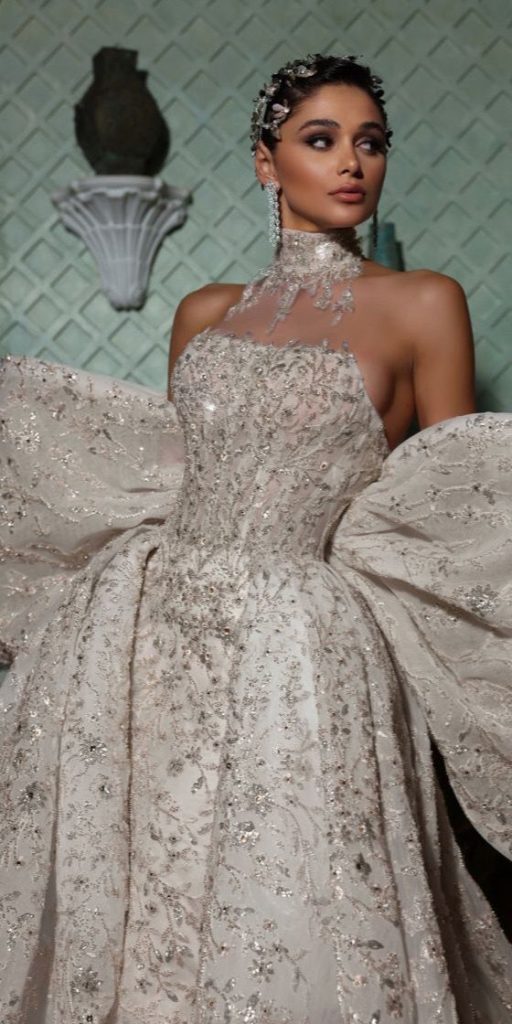
Bridal Gown Fitting Eco-Friendly In today’s environmentally conscious world, brides are increasingly seeking ways to make their special day both beautiful and sustainable. The concept of “bridal gown fitting eco-friendly” encompasses not just selecting a...

03.06.2025
Brydealo Official Wedding Dresses In the ever-evolving world of bridal fashion, Brydealo Official Wedding Dresses has carved out a unique space, offering brides around the globe access to high-quality, customizable, and affordable bridal gowns. Known...
22.01.2026
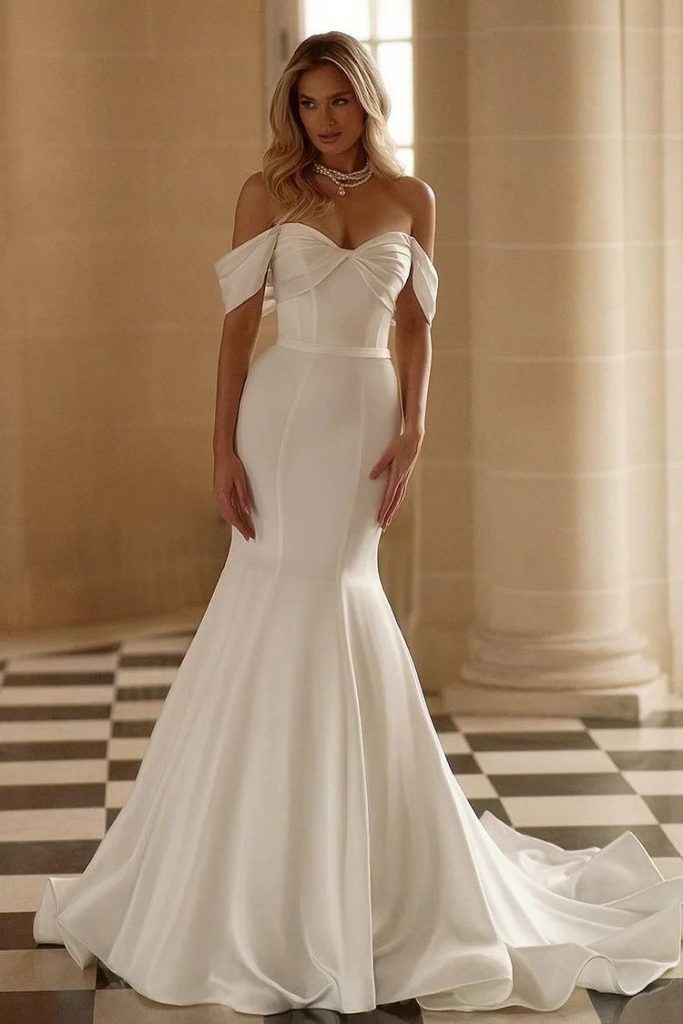
Tijdloze Elegantie Klassieke Luxe Bruidsjurken die Nooit Uit de Mode Gaan is meer dan een trend; het is een filosofie die generaties overstijgt. In dit uitgebreide artikel duiken we diep in de wereld van klassieke...
04.03.2024
Brautmoden Onlineshop Wiederverkäufer Besten 3 Der Großhandel mit Brautkleidern für Einzelhändler ist ein florierendes Geschäftssegment, das den Großeinkauf und Weiterverkauf von Brautkleidern an Einzelkunden oder kleinere Brautmodengeschäfte umfasst. Diese Branche geht auf die unterschiedlichen Bedürfnisse...
Comments