
Where to Buy Made to Measure Wedding Dresses Online If your body measurements are expected to change before the wedding, discuss the timing with the seller before ordering.
Avoid making assumptions about future body changes or asking the maker to leave arbitrary amounts of extra room. A dress designed for one set of measurements may not behave predictably after significant changes, particularly if the bodice is heavily structured.
A more useful discussion covers the seller’s approach to fitting tolerance, alteration allowances, and the practical options available if the final fit needs adjustment.
Why measurement forms need clarification
Different sellers may define measurement points differently. “Waist length,” for example, could refer to different starting and ending points depending on the form.
If an instruction is unclear, ask for a diagram or a written explanation before submitting the measurements.
For a high-value or technically complex gown, consider using a professional tailor or bridal fitter. The additional service may reduce uncertainty, although it cannot eliminate all production or fitting risks.
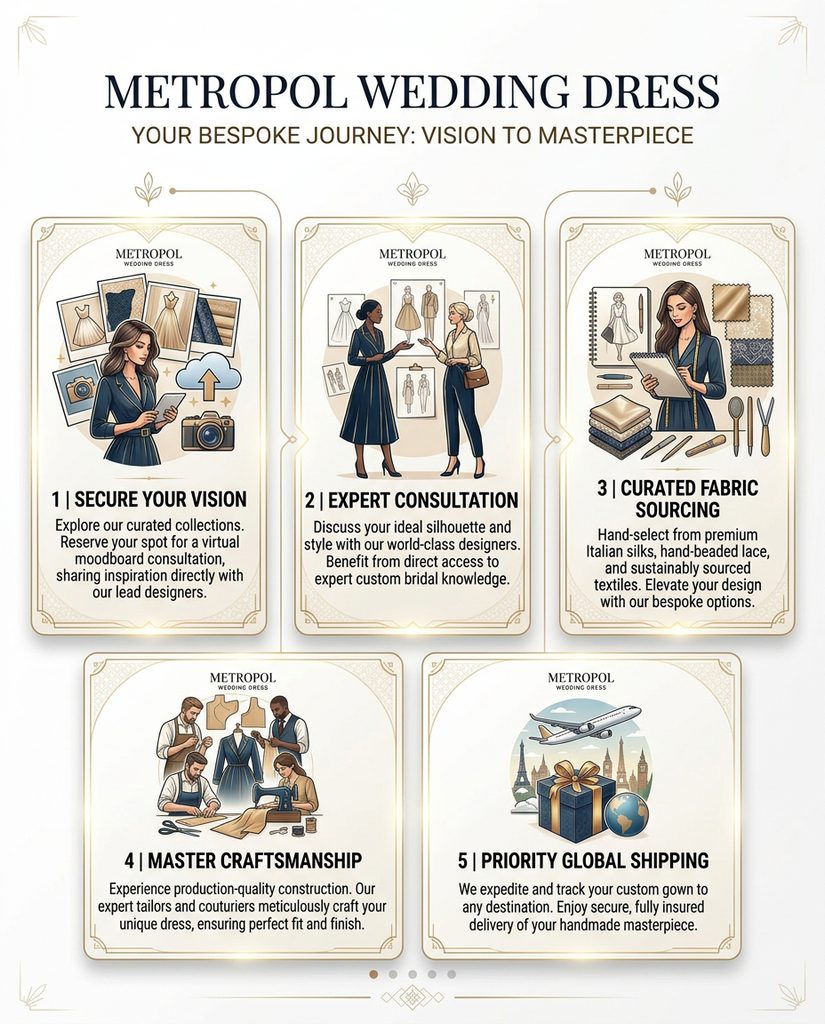
9. The Production Journey: What Should Happen After You Place an Order?
A well-managed custom order is a sequence of decisions and approvals, not simply a payment followed by a delivery date.
Understanding the sequence helps brides identify missing information before it becomes expensive to correct.
Stage 1 — Requirements confirmed
The buyer and seller agree on the design, measurements, materials, modifications, price, and delivery expectations.
Stage 2 — Design and materials approved
Any important design decisions, fabric substitutions, and customization limits are resolved before production begins.
Stage 3 — Pattern development and construction
The gown is produced using the agreed specifications and the manufacturing process appropriate to the design.
Stage 4 — Quality review
The finished garment is checked against the agreed specifications, with any agreed photographs or inspection steps completed.
Stage 5 — Dispatch and final fitting
The gown is shipped, received, inspected, and tried on with the intended footwear and foundation garments.
Not every seller provides photographs at every stage, and not every gown requires a prototype or intermediate fitting. The appropriate process depends on the complexity of the design and the services included in the order.
Nevertheless, a buyer should know which decisions are still open, when changes become difficult, and what happens if a specification cannot be met.
Establish approval points
A practical ordering arrangement identifies several checkpoints:
- Design and customization approval.
- Measurement confirmation.
- Fabric and color confirmation.
- Production commencement.
- Final quality review, where available.
- Dispatch confirmation and tracking.
These checkpoints create a record of the agreed requirements and reduce the risk of conflicting expectations.
Understand the difference between a production estimate and a delivery commitment
A seller may quote a production period without including shipping, customs clearance, or local alterations.
Ask for a timeline that distinguishes these stages. If the wedding is on a fixed date, work backward from the date by which the gown must be wearable—not simply the date by which it must leave the factory.
The delivery plan should include a reasonable allowance for unexpected delays, fitting appointments, and alterations.
10. How Much Should You Pay? A Better Way to Compare Online Prices
The cost of a made-to-measure wedding dress is determined by more than fabric quantity.
Two gowns with similar silhouettes may have very different prices because of pattern complexity, material cost, handwork, construction requirements, embellishment density, customization time, and order volume.
A low base price may also exclude important services.
The full-cost formula
A useful budgeting model is:
\[ \begin{aligned} \text{Total cost} ={}& \text{Dress price}\\ &+ \text{Customization}\\ &+ \text{Shipping and insurance}\\ &+ \text{Import charges, if applicable}\\ &+ \text{Alterations}\\ &+ \text{Accessories and care} \end{aligned} \]
Depending on the purchase, taxes, payment fees, express shipping, and return transportation may also affect the final cost.
Illustrative budgeting example
The following figures are hypothetical planning amounts, not current quotes or price claims about Metropol Wedding Dress or any other supplier.
| Cost component | Example amount |
|---|---|
| Base gown | $900 |
| Customization | $150 |
| Shipping and insurance | $80 |
| Estimated import charges | $100 |
| Local alterations | $120 |
| Accessories and care | $100 |
| Illustrative total | $1,450 |
The purpose of this example is to demonstrate how the advertised price can differ from the amount ultimately spent.
Actual import charges depend on the destination, applicable tariff classification, customs valuation, taxes, and shipping arrangements. Do not treat the example’s import estimate as a universal rate.
Compare equivalent specifications
A useful comparison does not place a simple, unlined gown against a structured, fully lined dress with hand-applied embellishments and extensive customization.
Instead, compare quotations for the same or closely equivalent specifications.
For each supplier, establish:
- The exact dress design and base construction.
- Fabric composition and lining.
- Included customization.
- Measurement-based production details.
- Accessories included in the package.
- Shipping and insurance.
- Taxes and duties, where applicable.
- Alteration and defect-resolution terms.
This allows you to compare the total cost of an equivalent outcome rather than a headline number.
Why the cheapest offer may become expensive
Suppose one seller quotes a lower price but does not include the requested sleeves, while another includes them in the original specification. The first offer may no longer be cheaper after customization.
Similarly, a lower-cost gown that requires substantial local restructuring could have a higher final cost than a more expensive gown that arrives closer to the approved fit.
The objective is not to maximize spending. It is to identify the best combination of quality, fit, service, risk, and price.
11. A Practical Comparison Framework for Online Bridal Suppliers
Use a structured evaluation rather than relying on a single review score or an attractive website.
The following framework can be applied to Metropol Wedding Dress and other providers you are considering.
| Evaluation criterion | What strong evidence looks like | Warning sign |
|---|---|---|
| Design accuracy | Written specifications and clear confirmation of requested changes | Important details remain ambiguous |
| Measurement process | Detailed instructions and a way to clarify unusual measurements | A form is accepted without explaining measurement points |
| Material transparency | Clear descriptions and confirmation of relevant composition | Vague claims about fabric or fiber |
| Construction quality | Relevant close-up images, sample inspection, or documented checks | Only distant editorial photographs are available |
| Timeline | Separate estimates for production and delivery | No clear delivery window |
| Communication | Specific answers that address the actual questions | Repeated generic responses |
| Price transparency | Itemized costs and clear exclusions | Additional charges appear late in the process |
| Alteration policy | Written explanation of available remedies | No clear process for fit problems |
| Payment protection | Documented payment terms and an appropriate secure method | Pressure to use an irreversible method without adequate documentation |
| Commercial capability | Verifiable production and order-handling information where relevant | Unsupported claims about capacity or certification |
Score the evidence, not the marketing
You can assign a simple internal score to each criterion:
- 0: No useful evidence.
- 1: Partial or unclear evidence.
- 2: Clear and satisfactory evidence.
With ten criteria, the maximum score would be 20.
This is a decision aid, not a scientific measure of supplier quality. A high score cannot compensate for a critical problem such as an impossible delivery deadline, an unsuitable design, or unacceptable contractual terms.
Some criteria should be treated as mandatory rather than averaged. If a supplier cannot confirm that it can produce the essential design features, it should not remain on the shortlist simply because it performs well elsewhere.
Ask every shortlisted seller the same questions
Consistency makes comparisons more useful.
Send each supplier the same design brief and request a response covering price, materials, customization, measurements, production time, shipping, and fit-related remedies.
If one supplier responds in precise, itemized terms and another offers only general assurances, that difference is commercially meaningful.
A good supplier relationship begins with clear expectations on both sides.
12. International Buying: Ordering a Wedding Dress Across Borders
Online bridal shopping can connect buyers with designers and manufacturers in other countries. It can also introduce shipping, customs, consumer-law, currency, and communication considerations that do not arise in the same way with a local purchase.
For international buyers, the country of origin is only one factor. The seller’s documentation, production capability, logistics arrangements, and support process are equally important.
Before placing an international order
Confirm the following:
- The seller’s legal business identity and contact information.
- The exact product and customization specifications.
- The currency used for the quote and payment.
- The production and dispatch estimates.
- The shipping method and tracking arrangements.
- Whether shipping insurance is included.
- How import duties and taxes will be handled.
- The process for reporting damage, defects, or specification discrepancies.
- The applicable return, cancellation, and refund terms.
- The deadline by which the dress must be ready to wear.
Customs and import charges
An international wedding dress shipment may be subject to import duties, value-added tax, sales tax, brokerage charges, or other fees depending on the destination and applicable rules.
The correct treatment cannot be determined from the garment’s price alone.
Ask the seller whether the quote includes delivery only or also covers import charges. Where applicable, establish who is responsible for customs documentation and whether the courier may collect charges before delivery.
For commercial buyers importing multiple gowns, classification, declared value, origin documentation, and applicable trade rules may materially affect the landed cost.
Shipping and packaging
A wedding dress can be vulnerable to crushing, moisture, and creasing during transit. The appropriate packing method depends on the garment’s fabric, embellishments, volume, and structure.
Ask how the gown will be packaged and whether any special handling is recommended.
Upon receipt, inspect the exterior packaging before opening it, document visible shipping damage, and follow the seller’s instructions for reporting problems. Keep the original packaging until the initial inspection is complete.
International communication
A time-zone difference does not automatically make a supplier unreliable. However, a custom order needs a communication process that supports timely decisions.
Agree on the preferred communication channel, expected response arrangements, and how final approvals will be recorded.
For complex orders, written specifications are particularly important because conversational misunderstandings can affect design, measurement, or delivery decisions.
13. Buying for a Bridal Boutique: The Commercial Perspective
An individual bride and a bridal retailer may buy from the same supplier for entirely different reasons.
The bride is usually evaluating one gown for a particular event. A boutique is evaluating a product and a relationship that may affect many customers, seasonal collections, cash flow, inventory, and reputation.
For commercial buyers, a made-to-measure supplier should be assessed as part of the operating model—not just as a source of attractive designs.
What a boutique should investigate
Product range and customer fit
Does the collection serve the boutique’s target market? Consider silhouettes, style preferences, price positioning, sizes, modesty options, and the level of customization customers expect.
Sample quality
A sample should demonstrate the actual construction and design standards customers can expect. Clarify whether the production garment will use the same materials and methods as the sample.
Order repeatability
If a particular design sells well, can the supplier reproduce it consistently? Ask how specifications, fabric references, patterns, and approved modifications are recorded.
Production capacity
Determine whether the supplier can handle the expected volume and whether peak-season demand affects lead times.
Wholesale terms
Clarify minimum order quantities, sample pricing, deposit requirements, payment milestones, shipping terms, and the consequences of cancellation or changes.
Defect management
A boutique needs a documented process for reporting product defects, missing items, measurement discrepancies, or departures from the approved specification.
Sample orders reduce uncertainty
Before placing a substantial order, consider whether a sample or pilot order is commercially appropriate.
A sample can reveal differences that photographs cannot: actual fabric hand, color, stitching, fit, weight, finishing, and packaging.
It can also test communication quality and the supplier’s ability to follow specifications.
A sample is not proof that every future order will be identical. It is a useful reference point for establishing expectations and identifying problems before committing to greater volume.
The supplier relationship is part of the product
A retailer’s customer experience includes more than the dress itself.
If the supplier communicates clearly, maintains accurate specifications, and responds constructively to problems, the boutique can plan appointments and manage customer expectations more effectively.
If the supplier provides inconsistent information, the retailer may have to absorb additional administrative work, rebook fittings, or manage dissatisfied customers.
This is why commercial buyers should evaluate service reliability alongside craftsmanship and pricing.
14. OEM, Private Label, and Custom Bridal Production
For bridal businesses seeking a differentiated collection, the buying decision may extend beyond selecting dresses from an existing catalog.
Some manufacturers offer original equipment manufacturing (OEM), private-label production, or custom development arrangements. The availability and scope of these services must be verified with the specific supplier.
These arrangements are not interchangeable.
| Model | General meaning | Key question for the buyer |
|---|---|---|
| Existing collection sourcing | Buying designs already offered by the supplier | Can the collection support the boutique’s positioning? |
| Customization of existing designs | Modifying selected features of established designs | Which changes are permitted and priced separately? |
| Private label | Producing garments under the buyer’s brand, subject to agreement | Who controls branding, labels, packaging, and specifications? |
| OEM production | Manufacturing according to agreed product requirements, with the exact scope defined by contract | Who supplies the design, specifications, and approvals? |
| Original design development | Developing a new design for a commercial collection | Who owns the design rights and related production materials? |
Terminology varies across the industry, so a contract should define the actual work rather than rely on a label.
What a private-label agreement should clarify
- Ownership or licensing of designs and patterns.
- Use of the buyer’s trademarks and labels.
- Fabric and trim sourcing.
- Approved samples and production specifications.
- Minimum quantities and price tiers.
- Packaging and labeling requirements.
- Quality standards and inspection procedures.
- Lead times and order-change rules.
- Confidentiality, exclusivity, and intellectual-property rights.
- Procedures for defective or nonconforming goods.
Do not assume that paying for a custom design automatically transfers all intellectual-property rights to the buyer.
If exclusivity matters, define its scope, territory, duration, product coverage, and exceptions in writing.
The economics of customization
Customization can create a distinctive product, but it also introduces development work and additional decision points.
A commercial buyer should establish whether design development is charged separately, whether sample costs are refundable against future orders, and whether the supplier requires a minimum production quantity.
The right arrangement depends on the expected sales volume and the value of differentiation.
A boutique with limited demand may be better served by adapting a proven collection. A brand with a clearly defined market and sufficient order volume may find original development more appropriate.
15. Delivery Planning: Work Backward From the Wedding Date
A made-to-measure wedding dress should be planned around the date it must be worn, not simply the date it is ordered.
The schedule must account for several separate activities: design approval, measurement confirmation, production, dispatch, transit, customs clearance where applicable, fitting, and alterations.
No single production timeline applies to every gown or supplier.
Create a backward schedule
Start with the wedding date and work backward.
| Milestone | Planning question |
|---|---|
| Wedding day | When must the gown be completely ready? |
| Final fitting | When can the bride attend a fitting with the intended shoes and undergarments? |
| Alteration window | How much time is available to correct length or fit issues? |
| Delivery deadline | When must the gown physically arrive? |
| Shipping period | What transit and customs allowance is appropriate? |
| Production deadline | When must the supplier finish the garment? |
| Order deadline | When must the design and measurements be approved? |
The schedule should be based on the supplier’s actual estimates, the complexity of the design, and the destination—not a generic promise that all custom dresses can be produced within a particular number of weeks.
Allow time for the unexpected
A delivery estimate is not a guarantee against every delay. Fabric availability, production workload, courier disruptions, customs procedures, and fitting issues can affect the outcome.
The buyer should establish a realistic contingency period based on the risk and available alternatives.
If the wedding is approaching quickly, ask whether the seller can genuinely accommodate the schedule before paying. A rushed production process may not be appropriate for a complex design, even if express shipping is available.
What if the dress arrives late?
The answer depends on the seller’s terms, applicable consumer law, and the circumstances of the delay.
Before ordering, ask whether the delivery date is an estimate or a contractual commitment, what happens if the deadline is missed, and which remedies may be available.
Keep copies of the order confirmation, agreed delivery terms, payment records, and subsequent communications.
For an international order, do not assume that the rules applicable to a domestic retailer will apply in exactly the same way.
16. What Happens if the Dress Does Not Fit?
This is one of the most important questions to resolve before ordering a made-to-measure gown online.
A personalized dress may be excluded from certain standard change-of-mind return rights in some jurisdictions, but the precise legal position varies. Custom production does not necessarily remove every right a consumer may have if a product is defective, materially misdescribed, or otherwise fails to meet applicable legal requirements.
The seller’s contract and the law governing the transaction should be reviewed together.
Distinguish the problem before deciding on a remedy
Situation A: A minor alteration is needed
Examples include a hem adjustment for the chosen shoes or a small fit refinement. A local bridal seamstress may be able to resolve the issue, provided the alteration does not compromise the construction.
Situation B: The garment differs from the approved specification
Examples include a different neckline, missing sleeves, incorrect fabric, or a significant construction discrepancy. Document the difference and contact the seller before authorizing modifications.
Situation C: The fit problem is substantial
A bodice that cannot be secured correctly or a skirt that differs materially from the agreed dimensions may require more than a routine alteration. The available remedy depends on the cause, the contract, and applicable law.
Document the condition on arrival
Try the gown on as soon as reasonably possible after delivery.
Use the intended shoes and foundation garments, and follow the seller’s fitting instructions. Photograph any visible discrepancies and retain the packaging, order documentation, and measurement records.
If a problem appears, notify the seller promptly and follow the agreed procedure.
Do not make irreversible alterations before discussing a potential defect with the supplier. Alterations may make it harder to establish what was delivered or determine which remedy is appropriate.
Ask these questions before payment
- Is the dress eligible for return or exchange?
- What terms apply to personalized or made-to-order products?
- How are measurement discrepancies assessed?
- What happens if the gown differs from the approved design?
- Who pays for return shipping when a defect is established?
- Can a correction, remake, refund, or other remedy be offered?
- Is there a deadline for reporting a problem?
A clear policy does not eliminate risk, but it helps the buyer understand the available options before committing.
17. The Hidden Costs of Buying the Wrong Dress
The most expensive bridal purchase is not always the gown with the highest price. It may be the gown that creates a chain of avoidable expenses.
Consider a bride who selects a dress based on a photograph without confirming the fabric, lining, or internal construction.
The dress arrives with a different drape than expected. A local seamstress must assess the garment, additional lining is needed, and the final silhouette still differs from the intended design.
The original purchase price may have looked attractive, but the final result now requires more money, more time, and more compromises.
This type of problem can be reduced through better specifications and earlier clarification.
Four costs that are easy to overlook
1. Alteration complexity
Not all alterations are equally simple. Adjusting a hem may be straightforward, while changing a heavily embellished bodice or restructuring a lace-covered neckline can be much more involved.
2. Express logistics
A delayed order can lead to expedited shipping, courier charges, or other last-minute arrangements. These costs are avoidable only when the schedule is managed realistically.
3. Replacement accessories
If a veil, overskirt, or detachable sleeve was assumed to be included but was not specified in the quotation, a separate purchase may become necessary.
4. Opportunity cost
Time spent resolving avoidable problems can displace other wedding preparations. For a retailer, the same issues may also affect staff time, customer relationships, and inventory planning.
A simple risk-reduction strategy
Spend more attention on the elements that are difficult to correct after production:
- Bodice structure.
- Neckline and back design.
- Sleeve construction.
- Fabric choice.
- Major silhouette decisions.
- Lace and embellishment placement.
- Delivery timing.
These details usually deserve clearer documentation than minor decorative preferences.
The aim is not to eliminate every possible variation. It is to identify the decisions with the greatest consequences before they become difficult or expensive to change.
18. Choosing a Wedding Dress for Different Venues and Wedding Styles
The venue affects more than the aesthetic of a wedding dress. It influences movement, comfort, fabric choice, train length, footwear, and the practicality of alterations.
Garden and outdoor weddings
A garden wedding may favor a gown that moves easily and can be worn comfortably on grass or uneven ground.
Consider a manageable train, fabric that suits the expected weather, and a hem length compatible with the venue. Heavy embellishment near the hem may require additional care when the dress is worn outdoors.
Beach weddings
Beach settings often involve wind, sand, humidity, and uneven surfaces.
Lightweight silhouettes, manageable trains, and fabrics that move naturally may be practical choices. However, the right dress depends on the formality of the event and the bride’s preferences.
Consider how the dress will be transported and whether the destination provides suitable facilities for changing and steaming.
Ballroom and formal hotel weddings
A formal indoor venue may accommodate a dramatic skirt, structured bodice, or longer train.
The buyer should still evaluate the practical requirements of stairs, seating, transport, and dancing. A visually impressive dress should not make the event unnecessarily difficult to navigate.
Religious and culturally specific ceremonies
Some ceremonies require particular levels of coverage, sleeve lengths, neckline shapes, or other design considerations.
Discuss these requirements at the beginning of the design process. It is usually more effective to integrate them into the original specification than to attempt extensive modifications after the gown has been produced.
Destination weddings
A destination wedding adds transportation and local service considerations.
The bride should consider luggage space, garment protection, arrival time, steaming facilities, and the availability of alterations at the destination.
If the dress is particularly structured or delicate, ask the seller for appropriate transport and care instructions before dispatch.
19. Sustainability and Responsible Bridal Buying
Sustainability in wedding fashion is not established simply by describing a dress as handmade, locally produced, custom-made, or made from a particular material.
A meaningful assessment considers the garment’s materials, manufacturing practices, expected use, durability, transportation, packaging, and the buyer’s actual needs.
Does made-to-measure production reduce waste?
It can reduce certain forms of waste in some production models, particularly where garments are produced in response to actual orders rather than stocked in large quantities.
However, made-to-measure production does not automatically guarantee lower environmental impact. Individual production may involve material offcuts, sample development, additional shipping, or other resource-intensive processes.
The outcome depends on the complete production system.
What can a buyer verify?
Ask whether the seller can provide meaningful information about:
- Fabric composition and material sourcing.
- Production methods.
- Packaging materials.
- Durability and care requirements.
- Repair or alteration options.
- Reuse, resale, or preservation possibilities.
Avoid relying on broad environmental claims without supporting details.
Design for future use
A wedding dress may have sentimental value long after the event. Some brides preserve the original gown, while others prefer a design that can be altered, resold, or repurposed.
If future use matters to you, discuss it before production. A simpler construction or detachable elements may make later alterations more practical, although the result depends on the design and materials.
A thoughtful purchase considers not only how the dress will look on the wedding day but also what will happen to it afterward.
20. Why Metropol Wedding Dress Belongs on Your Research Shortlist
Choosing a wedding dress online is a process of matching a design to a set of requirements. Metropol Wedding Dress can be considered as part of that process when its available collection and services align with the buyer’s needs.
The most effective approach is to begin with a defined brief rather than a general request for a beautiful custom dress.
For individual brides
Identify the silhouette, fabric, neckline, and construction features that matter most. Separate essential requirements from details that can be adapted.
Then ask Metropol Wedding Dress to clarify which available designs match those requirements and what customization, measurement, and fitting arrangements can be confirmed for your particular order.
For bridal boutiques
Evaluate the collection according to your target customers, retail positioning, and expected demand.
If you are considering a supplier relationship, request relevant information about sample orders, commercial pricing, minimum quantities, lead times, and quality-control arrangements.
For international buyers
Confirm the delivery destination, shipping arrangements, customs responsibilities, and expected timeline before proceeding.
The right supplier is one whose actual capabilities align with the needs of the order and whose terms are clear enough to support a confident purchase.
Make the next step specific
Rather than asking only, “How much does a custom wedding dress cost?”, prepare a short inquiry that includes:
- The style or reference images.
- The desired material and important construction details.
- The wedding date and delivery destination.
- The required measurements or sizing method.
- The customization requests.
- Your approximate budget.
- Any questions about fitting, alterations, and delivery.
This gives the seller a more useful basis for responding and helps you compare its offer with other providers.
Metropol Wedding Dress should be evaluated on the evidence available for the specific order: design suitability, workmanship, communication, commercial terms, and delivery planning. Confirm all product capabilities and commitments directly before purchase.
21. Five Different Ways to Take the Next Step
The following calls to action serve different audiences and stages of the buying process. They can be used individually on a landing page, depending on the page’s purpose.
CTA 1 · BRIDE-FOCUSED
Find the Wedding Dress That Feels Like Yours
Explore the available bridal styles, identify the silhouette that reflects your vision, and ask about the customization options that matter most to you.
Suggested button text: Explore Bridal Styles
CTA 2 · CONSULTATIVE
Start With Your Design, Not a Guess
Share your inspiration images, preferred fabrics, and essential design details. Request clarification about what can be achieved before committing to an order.
Suggested button text: Discuss Your Dress
CTA 3 · QUALITY-FOCUSED
Know What You Are Buying Before Production Begins
Ask for the specifications, measurement instructions, and construction details needed to make an informed decision about your gown.
Suggested button text: Request Product Details
CTA 4 · B2B AND WHOLESALE
Build a Bridal Collection Around Your Customers
If you operate a bridal boutique or retail business, inquire about available designs, sample options, commercial terms, and the requirements for a potential supply relationship.
Suggested button text: Discuss Business Opportunities
CTA 5 · TIMELINE-FOCUSED
Your Wedding Date Is Fixed. Plan Your Dress Accordingly.
Share your wedding date and delivery location early so production, shipping, and final fitting can be assessed against a realistic schedule.
Suggested button text: Check Your Order Timeline
Use only buttons or links that lead to real, functioning destinations on the published website. The CTA wording should match the actual service being offered.
Frequently Asked Questions About Buying Made-to-Measure Wedding Dresses Online
These answers address the practical questions brides and commercial buyers should resolve before ordering a personalized wedding gown.
1. What is the best place to buy a made-to-measure wedding dress online?
The best place depends on your design requirements, budget, delivery date, and preferred level of customization. Specialist bridal brands, independent designers, online made-to-measure retailers, and manufacturers may all be suitable. Compare written specifications, materials, measurement procedures, customer support, and delivery terms before choosing.
2. Does Metropol Wedding Dress offer made-to-measure wedding dresses?
To determine the options available through Metropol Wedding Dress, contact the brand directly and ask which gowns can be produced using individual measurements, which design modifications are supported, and whether any additional fitting or customization services are available. Confirm the scope of the service for your specific design before ordering.
3. What is the difference between made-to-measure and bespoke wedding dresses?
Made-to-measure generally refers to producing or adjusting a garment using an individual’s measurements. Bespoke usually involves a more individualized design and development process, potentially including a new pattern and multiple fittings. However, industry terminology varies, so confirm exactly what the seller includes.
4. Can I order a custom wedding dress without visiting a bridal boutique?
Yes. Many online sellers accept orders remotely using measurement forms, digital consultations, reference images, and written specifications. The suitability of this approach depends on the complexity of the dress and the seller’s process. For intricate designs or difficult fitting requirements, professional measurement assistance may be beneficial.
5. Can a wedding dress be made from my inspiration photograph?
A photograph can communicate the desired silhouette, neckline, fabric appearance, and decorative details. However, it may not reveal the internal construction or exact materials. Ask the designer to confirm which features can be reproduced, which require adaptation, and whether a written specification or sketch can be approved before production.
6. Can I customize the neckline, sleeves, and train?
Some sellers offer these modifications, while others limit changes to selected options. Each modification may affect pattern development, construction, price, and production time. Confirm the availability and cost of every important change before approving the order.
7. Is a made-to-measure wedding dress guaranteed to fit perfectly?
No. Individual measurements can improve the basis for fitting, but the final result also depends on measurement accuracy, pattern design, fabric behavior, posture, construction, and the desired fit. Discuss alteration arrangements and the procedure for addressing substantial fit problems before purchasing.
8. How should I take measurements for an online wedding dress?
Follow the seller’s measurement instructions precisely, including the specified reference points and foundation garments. Use a flexible measuring tape and seek assistance for difficult measurements. Repeat important measurements and clarify inconsistencies before submitting the form. For complex gowns, a professional bridal fitter may help reduce uncertainty.
9. What measurements are usually required for a custom bridal gown?
Common measurements include bust, waist, hips, shoulder width, torso length, sleeve length, and garment length. The exact requirements depend on the silhouette, neckline, sleeves, and construction. Always use the seller’s specific measurement chart rather than assuming a universal set of measurements.
10. Which fabric is best for a made-to-measure wedding dress?
There is no single best fabric. Satin can create a smooth, structured appearance; crepe often suits clean, modern silhouettes; chiffon and tulle provide lightness and movement; and lace adds texture and decorative detail. The right choice depends on the desired shape, climate, comfort, budget, and maintenance requirements.
11. Is satin always made from silk?
No. Satin describes a weave or fabric construction, while silk describes a fiber. Satin may be made from polyester, silk, or other fibers. If fiber composition matters to you, request the material specifications rather than relying on the word “satin.”
12. Can I request a wedding dress in a different color?
Some sellers offer color options, but availability depends on the design and materials. Ivory, natural white, and other shades can appear different under various lighting conditions. Confirm the color using a reliable fabric reference or sample when possible, particularly if matching accessories.
13. How much does a made-to-measure wedding dress cost online?
Prices vary according to the design, fabric, construction, embellishments, customization, and seller. The total budget should also account for shipping, applicable taxes and import charges, accessories, and possible alterations. Request an itemized quote so you can compare equivalent products rather than advertised starting prices.
14. Are made-to-measure wedding dresses more expensive than standard-size gowns?
They can be, particularly when they involve original pattern development, complex construction, or extensive customization. However, pricing depends on the production method and the specific garment. Compare the complete cost of the finished dress, including alterations and delivery, rather than assuming that one buying model is always more expensive.
15. How early should I order a made-to-measure wedding dress?
Order early enough to accommodate design approval, measurement confirmation, production, shipping, and final alterations. The appropriate lead time varies by seller, dress complexity, and destination. Ask for the current estimated production and delivery schedule, then work backward from the date the gown must be ready to wear.
16. Can I order a made-to-measure wedding dress for a destination wedding?
Yes, provided the seller can accommodate the destination and the timing is realistic. Consider shipping, customs clearance, luggage or garment transport, climate, and access to local pressing or alteration services. Confirm the delivery arrangements before paying.
17. Are customized wedding dresses returnable?
Return and cancellation policies vary by seller and jurisdiction. Personalized or made-to-order products may be treated differently from standard retail products, but the exact legal position depends on the circumstances and applicable law. Review the written terms before ordering, including the remedies available for defects or material discrepancies.
18. What should I do if my wedding dress arrives and does not fit?
Try it on promptly with the intended shoes and foundation garments, following the seller’s instructions. Document the problem with photographs and contact the seller before making irreversible alterations. The appropriate remedy depends on the cause of the problem, the agreement, and applicable consumer law.
19. Can a local tailor alter a dress purchased online?
Often, yes, but the feasibility depends on the construction and the nature of the alteration. Hem adjustments may be relatively straightforward, while changing a structured bodice or intricate lace design can be more complicated. Ask a bridal alterations specialist to assess the gown before authorizing significant work.
20. How can I verify the quality of an online bridal supplier?
Review detailed product photographs, fabric descriptions, business information, customer feedback, payment terms, and the seller’s communication. Ask for close-up construction photographs and a written explanation of quality-control procedures. For high-value purchases, consider whether a sample, professional fitting, or independent inspection is appropriate.
21. Should I buy directly from a wedding dress manufacturer?
Direct purchasing can be useful when you need particular designs, production information, or commercial supply arrangements. However, it does not automatically guarantee better pricing or quality. Verify the manufacturer’s capabilities, order terms, customization limits, delivery process, and after-sales support before committing.
22. Can bridal boutiques order made-to-measure dresses wholesale?
Some bridal suppliers offer commercial ordering, customization, or private-label arrangements, but availability varies. A boutique should confirm minimum order quantities, sample costs, wholesale pricing, production capacity, payment terms, and quality-control procedures directly with the supplier.
23. What is the difference between wholesale, OEM, and private-label bridal production?
Wholesale generally refers to purchasing goods for resale. OEM describes a manufacturing arrangement whose exact responsibilities depend on the agreement. Private-label production typically involves selling products under the buyer’s brand. Contracts should define design ownership, labeling, specifications, minimum quantities, quality standards, and delivery obligations.
24. Are international wedding dress orders subject to customs charges?
They may be. Duties, taxes, brokerage fees, and other charges depend on the destination and the applicable import rules. Confirm who is responsible for these charges and whether they are included in the quotation. Commercial buyers should also establish the correct product classification and documentation requirements.
25. How can I avoid unexpected charges when buying a custom wedding dress?
Request an itemized quotation covering the gown, customization, accessories, shipping, and any known additional fees. Clarify whether taxes, duties, express delivery, and alterations are included. Ask the seller to identify potential extra costs before production begins.
26. Can I request modest modifications to a wedding dress?
Depending on the design and supplier, modifications may include higher necklines, additional lining, longer sleeves, reduced transparency, or a different back design. Confirm the technical feasibility and cost of these changes early, as they can affect the pattern and construction.
27. Can I order a wedding dress with detachable sleeves or an overskirt?
Some designs can accommodate detachable components. Ask how the pieces attach, whether they are included in the price, and whether they are intended to be worn independently. The fastening method, fabric weight, and fit should be considered together so the components remain secure during movement.
28. What information should I send when requesting a custom wedding dress quotation?
Provide reference images, the preferred silhouette, fabric preferences, essential design changes, the wedding date, delivery destination, and approximate budget. Include the seller’s requested measurements if available. A concise, specific brief makes it easier to assess feasibility and obtain a meaningful quotation.
29. Is it possible to order a custom wedding dress on a tight deadline?
It may be possible for simpler designs or suppliers with available production capacity, but feasibility must be confirmed individually. Ask for a realistic production and delivery estimate rather than relying on express shipping alone. A complex gown may need more time than a short deadline permits.
30. What should I check when my wedding dress arrives?
Inspect the packaging, compare the gown with the approved specifications, and check the fabric, color, seams, closures, embellishments, and included accessories. Try the dress on promptly with the intended shoes and foundation garments. Document discrepancies and notify the seller within the applicable reporting period.
31. Can a wedding dress be made more sustainable through customization?
Customization may help avoid producing garments that have no intended buyer, depending on the production model. However, it does not automatically establish that a dress has a lower environmental impact. Consider material sourcing, manufacturing practices, durability, packaging, transport, and the possibility of future repair or reuse.
32. What should a bridal boutique request before committing to a large order?
Request relevant sample information, detailed specifications, commercial pricing, minimum order quantities, production lead times, quality-control arrangements, payment terms, and defect-resolution procedures. If the order involves private labeling or original designs, clarify intellectual-property rights and branding responsibilities in writing.
33. How do I compare two wedding dress suppliers offering similar designs?
Provide both suppliers with the same requirements and compare their quotations, materials, customization, construction, delivery, and alteration terms. Evaluate the evidence supporting each offer. A similar-looking product photograph does not prove that two gowns use equivalent fabrics or construction methods.
34. What makes Metropol Wedding Dress worth considering?
Metropol Wedding Dress can be evaluated alongside other bridal providers according to its available designs, confirmed customization options, workmanship, communication, pricing, and delivery terms. Contact the brand with a specific design brief to establish whether its current offering meets your needs.
35. What is the most important question to ask before ordering a made-to-measure wedding dress?
Ask the seller to confirm, in writing, exactly what you will receive, how it will be produced, when it is expected to arrive, what the price includes, and what happens if the finished dress differs materially from the agreed specification. This establishes the foundation for an informed purchase.
Final Thoughts: Buy the Dress, but Evaluate the Entire Process
The best online made-to-measure wedding dress purchase combines a compelling design with clear specifications, suitable materials, a well-managed production process, realistic delivery planning, and transparent commercial terms.
For brides, this means choosing a gown that reflects their preferences without overlooking comfort, fit, and the practical requirements of the wedding day.
For bridal boutiques and retailers, it means assessing suppliers not only on appearance and price but also on repeatability, communication, quality control, and the ability to meet commercial commitments.
Metropol Wedding Dress can be part of your evaluation process. The next step is to identify the designs that fit your vision, clarify the customization services available, and request the details needed to compare the offer with confidence.
A wedding dress should not be selected on the strength of a photograph alone. It should be selected through a process that makes the design, price, production expectations, and delivery arrangements clear before the commitment is made.
Choose with confidence. Specify with precision. Plan for the day you will wear it.
Related Topics

10.07.2025
Ankara Luxury Wedding Dress Seller When it comes to wedding planning, the dress is often the centerpiece of a bride’s vision, embodying elegance, culture, and personal style. In Ankara, Turkey’s vibrant capital, brides have access...
15.12.2020
7 Conditions for Being a Perfect Bride. It is possible to look perfect at the wedding, by thinking about every detail in advance. (7 Conditions for Being a Perfect Bride) You got the marriage proposal,...
15.01.2024
Handmade Wedding Dress Studio is a boutique-style bridal atelier that specializes in creating custom-made wedding dresses for brides who want a unique and personalized gown that reflects their individual style and personality. The studio is...

09.04.2026
Exklusive Massgeschneiderte Luxus Brautkleider In einer Welt, in der Individualität und höchste Qualität immer mehr an Bedeutung gewinnen, stehen Exklusive Maßgeschneiderte Luxus-Brautkleider für Anspruchsvolle Bräute im Mittelpunkt jeder unvergesslichen Hochzeitsfeier. Diese Kleider sind weit mehr...
18.04.2025
Turkish bridal fashion online The world of Turkish bridal fashion is a mesmerizing blend of tradition, craftsmanship, and modern elegance. With the rise of online platforms, accessing stunning Turkish bridal designs has never been easier....

05.06.2025
Arven Gelinlik Wedding Dresses A wedding dress is not just a piece of clothing; it is a timeless symbol of love, dreams, and tradition. For many brides, choosing the perfect wedding gown is one of...
Comments