
Made to Measure Wedding Dresses Advantages and Disadvantages A Complete Guide to Fit, Design, Cost, Production, and Choosing the Right Wedding Dress
Choosing a wedding dress is about more than finding a beautiful design. It is about discovering a gown that complements your proportions, reflects your personality, suits your wedding setting, and allows you to feel comfortable throughout one of the most memorable days of your life.
For many brides, made-to-measure wedding dresses offer an appealing alternative to standard-size bridal gowns. They combine the visual appeal of a carefully selected design with measurements taken from the individual bride. Depending on the designer, production process, and level of customization, this approach can provide greater control over fit, fabric, silhouette, and finishing details.
However, made-to-measure is not automatically the best option for every bride. It can involve additional appointments, careful measurement procedures, longer lead times, and costs that extend beyond the initial quotation. Understanding these advantages and disadvantages before making a purchase can help you avoid unnecessary alterations, delivery complications, and disappointment.
At Metropol Wedding Dress, the decision should begin with an informed understanding of what made-to-measure really means, what it can offer, and what you should expect from the process.
This guide explores the practical realities of made-to-measure bridal gowns, including comparisons with ready-to-wear and fully bespoke dresses, fabric and construction considerations, international ordering, budgeting, fitting appointments, and the questions worth asking before you commit.
Quick Summary: Is a Made-to-Measure Wedding Dress Worth It?
A made-to-measure wedding dress is generally produced using a selected design and measurements taken from the bride rather than relying exclusively on a standard commercial size. The precise level of customization varies between bridal brands and manufacturers.
For brides who want a more personalized fit without commissioning an entirely original design, it can be a practical middle ground between ready-to-wear and bespoke bridal couture.
The main advantages
- A more personalized fit: Measurements can help the dressmaker accommodate the bride’s individual proportions.
- Greater design flexibility: Depending on the service, brides may be able to select fabrics, sleeves, necklines, train lengths, or decorative details.
- A more considered silhouette: Proportions can be adjusted to support the intended appearance of the gown.
- A more individual result: Personal choices can make the finished dress feel more distinctive.
- Potentially fewer major alterations: A well-managed measurement and fitting process may reduce the need for extensive post-production adjustments.
- A structured purchasing process: Brides can work toward a defined design and set of measurements rather than simply choosing the closest available size.
The main disadvantages
- A potentially higher price: Individual measurements and customization can increase production and service costs.
- A longer planning period: Manufacturing, shipping, fitting, and alterations require time.
- Measurement-related uncertainty: Incorrect measurements or misunderstood fitting instructions can affect the result.
- Limited opportunities to try the exact gown: This is particularly important when ordering remotely.
- Additional costs may arise: Shipping, duties, alterations, rush production, or premium materials may not be included in the original price.
- Changes may be difficult after production begins: Significant design revisions can require additional work or may no longer be possible.
Who should consider made-to-measure?
Made-to-measure is worth considering if you have difficulty finding a comfortable standard-size gown, prefer a particular silhouette, want selected design modifications, or value a personalized production process.
A ready-to-wear dress may be more suitable if you need a gown immediately, have a strict budget, or want to try several finished dresses before purchasing.
A fully bespoke gown may be the better choice if you want a completely original design developed from the beginning.
The central question is not whether made-to-measure is universally better. It is whether its additional fit and design possibilities justify the time, cost, and coordination required for your wedding.
1. What Is a Made-to-Measure Wedding Dress?
A made-to-measure wedding dress is a bridal gown produced using measurements taken from the individual bride, usually based on an existing design, a selected pattern, or an established design framework.
Instead of choosing a gown solely according to a standard size chart, the manufacturer uses the bride’s measurements to guide the construction and proportions of the garment.
The exact service can differ significantly between brands. Some manufacturers adjust a standard pattern to reflect the bride’s measurements. Others allow more extensive changes to the bodice, skirt, sleeves, neckline, or embellishments. Some also provide fitting samples or intermediate fitting appointments.
Consequently, the term made-to-measure should not be interpreted as a guarantee that every aspect of a dress will be individually redesigned.
Before placing an order, it is important to establish which elements are customized, which remain fixed, and which changes incur additional costs.
Made-to-measure versus bespoke: an important distinction
The bridal industry uses several terms to describe personalized garments. Although they sometimes overlap in marketing materials, they do not necessarily describe the same production method.
| Dress category | How it is generally produced | Typical customization | Main consideration |
|---|---|---|---|
| Ready-to-wear | Manufactured in standard sizes | Limited, usually through alterations | Convenient availability and easier comparison |
| Made-to-measure | Based on an existing design adapted to individual measurements | Fit adjustments and selected design options | A balance between personalization and practicality |
| Semi-custom | An existing design modified according to an agreed list of options | Selected changes to style, materials, or proportions | The available options must be confirmed |
| Bespoke | Developed around an individual design and a more extensive pattern-making process | Potentially extensive, from concept to construction | Greater creative freedom, often with higher costs and more fittings |
These are general distinctions rather than universal legal definitions. Individual bridal businesses may use the terms differently.
For example, a made-to-measure gown may allow a bride to select a sleeve style but not change the underlying neckline. A bespoke service may permit the neckline, bodice structure, skirt architecture, and pattern to be developed together.
A useful purchasing principle: Ask the supplier to describe the actual production process rather than relying on the label alone.
Does made-to-measure mean the dress will fit perfectly?
No. Individual measurements improve the information available to the maker, but they do not eliminate fitting uncertainty.
A successful fit depends on several factors:
- The accuracy and completeness of the measurements.
- The quality and suitability of the pattern.
- The fabric’s stretch, weight, drape, and recovery.
- The internal structure of the bodice.
- The position and construction of seams.
- The intended undergarments and shoes.
- The bride’s posture and body proportions.
- The skill of the patternmaker and dressmaker.
- The availability of fitting appointments and subsequent alterations.
A bridal gown is a three-dimensional garment. Two people with similar bust, waist, and hip measurements may have different shoulder slopes, torso lengths, bust positions, or postures.
A good made-to-measure process considers these relationships instead of treating the body as a set of isolated numbers.
For brides ordering online or internationally, it is particularly important to understand whether the service includes only measurement-based production or also includes a fitting and adjustment stage.
2. The Advantages of Made-to-Measure Wedding Dresses
The strongest argument for made-to-measure is that it can align a chosen design more closely with the bride’s individual proportions and preferences.
The benefits are most meaningful when the manufacturer understands the relationship between measurements, garment construction, fabric behavior, and the intended finished appearance.
2.1 A fit designed around individual proportions
Standard-size wedding dresses are generally developed around a sizing system. Because real bodies do not follow identical proportions, a bride may find that one area fits well while another requires adjustment.
For example, a gown might fit comfortably around the hips but feel tight through the bodice. Another might fit the bust but have straps that sit too far apart.
Made-to-measure production can address these differences at the pattern or construction stage, depending on the service offered.
Potentially relevant measurements include:
- Bust circumference.
- Underbust circumference.
- Natural waist circumference.
- High hip and full hip circumference.
- Shoulder width.
- Shoulder-to-waist length.
- Front and back bodice length.
- Bust point position.
- Armhole and sleeve measurements.
- Desired skirt and train length.
Not every dress requires every measurement. A strapless ball gown, a fitted crepe dress, and a lightweight chiffon gown have different structural requirements.
The objective is to collect the measurements needed for the particular design, not simply to collect as many measurements as possible.
Why this matters in practice
A fitted satin gown relies on precise proportions because visible tension lines, seam placement, and fabric irregularities can affect the overall appearance.
A flowing A-line dress may accommodate some variations more easily, although the bodice and waist still require appropriate fitting.
A structured corset gown may require special attention to internal construction, bust positioning, and torso length.
The value of made-to-measure therefore depends partly on the silhouette being purchased.
2.2 More control over design details
Many brides begin with a reference image rather than a fully defined design. They may love the skirt of one gown, the neckline of another, and the sleeve treatment of a third.
Made-to-measure services may offer the opportunity to modify selected details while retaining the general character of an established design.
Possible options include:
- Changing from long sleeves to short sleeves or a sleeveless finish.
- Selecting between approved neckline shapes.
- Adjusting the train length.
- Choosing a different lining.
- Selecting from available lace or embroidery options.
- Adding detachable sleeves, bows, overskirts, or capes.
- Adjusting the skirt’s fullness within the design’s construction limits.
- Selecting a preferred shade of ivory, white, or another available bridal color.
- Modifying the back closure, where structurally feasible.
However, customization should always be confirmed in writing.
Changing a neckline can affect the support required in the bodice. Altering a skirt’s volume may change the amount of fabric needed, the weight of the garment, and the balance of the train.
A design option that appears simple in a photograph can involve significant technical work.
Practical tip: Ask for an itemized specification showing the original design, approved modifications, fabric selection, and any excluded features. This reduces the risk of differences between the inspiration image and the final gown.
2.3 A silhouette that reflects personal preferences
The silhouette determines much of a wedding dress‘s visual character.
Common bridal silhouettes include:
A-line: A fitted upper section with a skirt that gradually widens toward the hem. It offers a balanced outline and works with many wedding settings.
Ball gown: A more fitted bodice paired with a full skirt. It creates a dramatic shape and may require additional petticoats, structural support, or careful transport planning.
Mermaid: A fitted silhouette that follows the body and flares around the lower skirt. It requires attention to movement, sitting comfort, and the positioning of the flare.
Fit-and-flare: A fitted design that opens gradually below the hips or thighs. It offers a shaped appearance with varying degrees of freedom of movement.
Sheath: A relatively narrow silhouette that follows the body’s natural lines. Fabric selection and seam placement can strongly influence how it hangs.
Empire waist: A design with the waistline positioned above the natural waist, often below the bust. The construction and skirt drape create a distinctive proportion.
Made-to-measure can help adjust the proportions of these silhouettes to the bride’s measurements and preferred styling.
Nevertheless, body measurements alone cannot determine which silhouette will be most flattering or comfortable. Personal preference, posture, fabric, internal structure, and the intended look all matter.
A bride should choose a silhouette because she likes wearing it, not because a generic body-shape rule says she should.
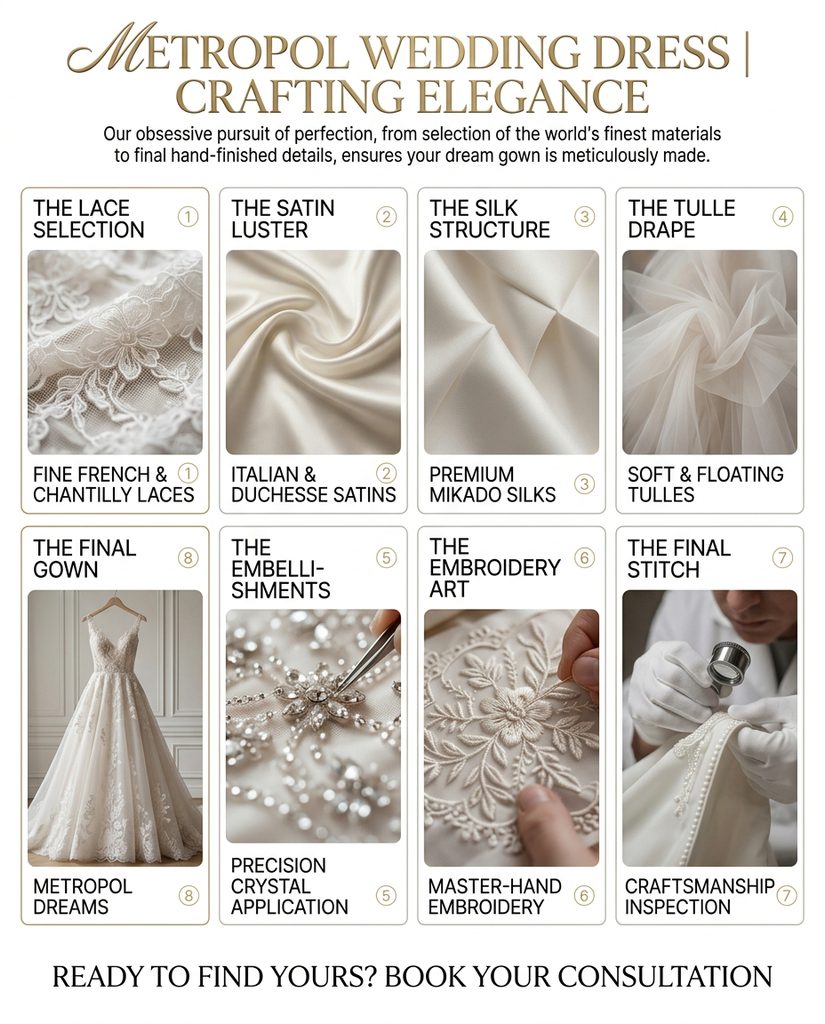
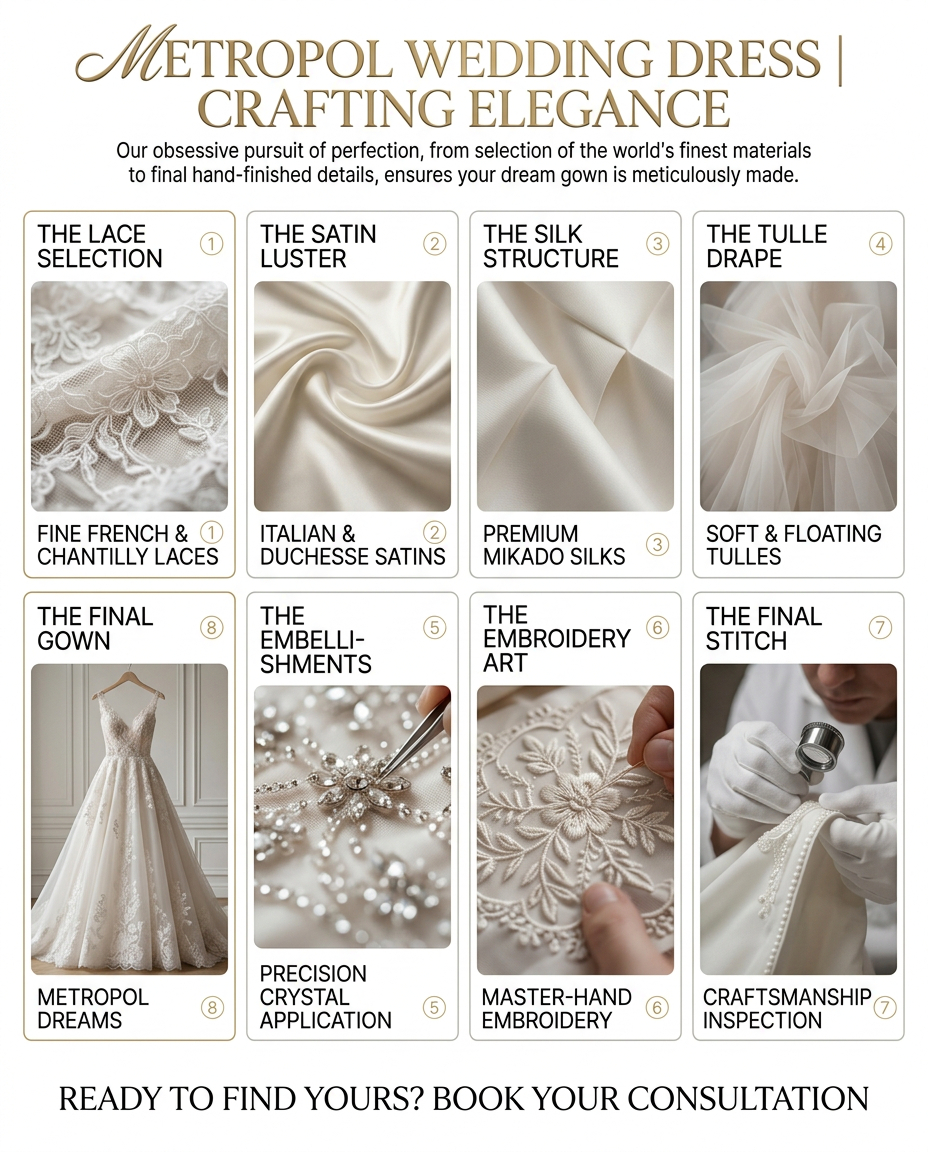
2.4 Greater choice over fabric and finish
Fabric is one of the most influential decisions in bridal design.
Two dresses with nearly identical patterns can look and feel very different when constructed from different materials.
For example, structured mikado can create a defined architectural silhouette, while soft chiffon produces a lighter and more fluid appearance.
Satin may offer a smooth, reflective surface, whereas matte crepe creates a more understated finish.
Lace introduces texture and detail, but its weight, backing, and placement influence comfort and construction.
Depending on the supplier, made-to-measure services may offer several fabric options.
Before selecting a material, consider:
- The desired visual effect.
- The weight of the fabric.
- Its drape and structure.
- Its opacity.
- Its tendency to crease.
- The sensitivity of the fabric to friction or snagging.
- The climate and wedding venue.
- The complexity of cleaning and storage.
- The availability of matching materials for accessories or future alterations.
A fabric sample can be useful because online photographs cannot reliably communicate weight, texture, transparency, or movement.
For international orders, ask whether the sample represents the actual production fabric or only a similar material.
2.5 A more intentional approach to comfort
A beautiful dress should also allow the bride to participate in the wedding.
The garment may need to accommodate walking, sitting, dancing, photographs, stairs, and long periods of standing.
Made-to-measure can help address comfort-related concerns through adjustments to the bodice, straps, sleeve width, waist placement, skirt length, or closure.
For example, a bride who finds standard sleeves restrictive may benefit from a carefully adjusted sleeve pattern. A bride choosing a fitted skirt may need a construction that allows sufficient stride length.
However, a custom measurement process does not automatically make every dress comfortable.
A tightly structured bodice can still restrict movement. Heavy embellishments can make a gown tiring to wear. A long train can create practical challenges on stairs or crowded dance floors.
The best approach is to identify the movements the dress must support and discuss them before production.
Useful questions include:
- Can I sit comfortably in this design?
- Can I raise my arms without pulling the bodice?
- Will the skirt allow a natural walking stride?
- Is the sleeve comfortable when my arms are bent?
- Can the train be secured for dancing?
- How much does the finished dress weigh?
These questions translate abstract comfort preferences into practical design requirements.
2.6 Potentially fewer extensive alterations
A standard-size gown may need adjustments to the hem, waist, straps, bodice, or skirt proportions.
When made-to-measure production is executed accurately, some of these adjustments may be incorporated into the initial construction process.
This can reduce the need for extensive alterations after delivery.
Nevertheless, alterations may still be necessary because of differences in measurement technique, fabric behavior, posture, production tolerances, or changes in the bride’s body.
It is also important to distinguish between fitting adjustments and design revisions.
Shortening a hem is a different task from changing a neckline, rebuilding a bodice, or substantially altering a fitted skirt.
A realistic budget should allow for minor finishing adjustments unless the supplier explicitly confirms what is included.
2.7 A more personal purchasing experience
For some brides, the process of developing a gown is as important as the finished garment.
Discussing fabrics, comparing silhouettes, confirming details, and reviewing a specification can make the purchase feel more deliberate.
The experience is especially valuable when the manufacturer communicates clearly and provides realistic expectations.
A personalized service should not rely on vague promises. It should help the bride understand what can be achieved, what cannot be changed, and what decisions must be finalized before production.
The quality of communication is therefore part of the product experience.
2.8 More options for unusual proportions
Standard sizing can be inconvenient for brides whose proportions do not correspond closely to a brand’s sizing chart.
This may include differences between bust and hip measurements, a longer or shorter torso, broader shoulders, or a preferred hem length that differs from the standard design.
Made-to-measure can provide a way to address these differences.
However, not all measurement-based services accommodate every body type or every structural modification. Highly specialized requirements may need a bespoke pattern or an experienced local alterations specialist.
The supplier should explain how the selected design can accommodate the bride’s measurements before accepting the order.
3. The Disadvantages and Limitations You Should Understand
The advantages of made-to-measure are substantial for some buyers, but the drawbacks deserve equal attention.
A wedding dress is a time-sensitive purchase. It is ordered for a particular event, and a late delivery or unsuitable fit can be difficult to resolve.
Understanding the risks helps brides distinguish a well-managed service from one that simply uses personalized language in its marketing.
3.1 Higher initial costs are possible
Made-to-measure dresses may cost more than comparable ready-to-wear gowns because they can involve additional measurement work, pattern adjustments, production coordination, and specialized finishing.
The difference is not universal.
A straightforward made-to-measure gown may be more affordable than a heavily embellished designer dress in a standard size. Conversely, extensive customization may make a made-to-measure gown substantially more expensive.
The correct comparison is between complete, comparable offers.
A quotation should identify:
- The base dress price.
- Fabric and lace specifications.
- Included customization.
- Measurement or consultation fees.
- Fittings, if applicable.
- Alteration allowances.
- Shipping and insurance.
- Import duties and taxes, where relevant.
- Rush production charges.
- Cancellation and change fees.
A low initial price is not necessarily the lowest total cost.
3.2 Production requires planning
A made-to-measure dress may need more coordination than purchasing a finished gown from a shop.
The process can involve design confirmation, measurement submission, material procurement, pattern adjustments, production, quality checks, shipping, and fitting.
The time required varies by manufacturer, season, design complexity, and order volume.
Peak bridal periods may create additional pressure on production capacity, couriers, and local alterations services.
A bride who orders too late may have limited options if the first fitting reveals a problem.
It is therefore sensible to obtain a realistic production schedule and a final delivery deadline before paying a deposit.
A supplier’s estimated dispatch date should not automatically be treated as the date the dress will arrive at the bride’s address.
3.3 Incorrect measurements can affect the result
Measurement accuracy is one of the most important variables in remote made-to-measure purchasing.
Common sources of error include:
- Measuring over thick clothing.
- Holding the measuring tape too tightly or loosely.
- Measuring at the wrong waist position.
- Confusing body measurements with finished garment measurements.
- Using a different undergarment configuration from the one intended for the wedding.
- Recording measurements in the wrong units.
- Measuring while standing in an unnatural posture.
- Having different people take measurements using different methods.
Small discrepancies may be manageable in a flowing skirt but more consequential in a structured bodice or close-fitting silhouette.
A manufacturer should provide clear instructions and explain whether measurements must be taken by a professional dressmaker.
If a measurement appears inconsistent with the others, it is better to verify it before production than to assume the patternmaker will identify and correct the discrepancy automatically.
3.4 Trying the exact dress may not be possible
A bride buying from a local bridal boutique can often try on finished gowns before selecting a design.
An online or international made-to-measure purchase may not provide that opportunity.
Photographs and size charts can help evaluate a design, but they cannot fully demonstrate how the actual garment will move, feel, or sit on the body.
This uncertainty is particularly relevant for:
- Strapless bodices.
- Deep necklines.
- Sheer fabrics.
- Very fitted skirts.
- Heavy ball gowns.
- Complex sleeves.
- Dresses with extensive internal structure.
Before ordering, ask whether a sample, showroom appointment, fitting toile, or virtual consultation is available.
If none is available, evaluate the supplier’s return, alteration, and problem-resolution policies carefully.
3.5 Changes can become expensive after approval
Personalization often involves a sequence of decisions. Once materials are cut or construction begins, some changes become difficult to accommodate.
Changing a sleeve length may be relatively straightforward at an early stage. Changing the entire silhouette after the skirt has been cut can require substantial additional work.
The bride should therefore distinguish between:
- Changes included before production.
- Changes allowed during production.
- Alterations available after delivery.
- Changes that cannot be accommodated.
Written approval of the design specification helps prevent misunderstandings.
It is also worth clarifying whether a change request resets the production schedule.
3.6 The final result may differ from the reference image
A reference photograph is not a complete production specification.
Lighting, camera angles, editing, posture, fabric quality, undergarments, and styling can all affect the appearance of a gown.
A dress inspired by a photograph may use a different fabric, pattern, internal structure, or embellishment technique.
Even when the same design is reproduced, the result may not look identical on different bodies.
To reduce uncertainty, confirm the actual fabric, color, lace placement, neckline depth, sleeve design, train length, and closure method.
Ask for realistic product photographs, material samples, or production references where available.
Avoid relying on a single highly styled image as proof of the exact finished result.
3.7 Remote orders can involve shipping and customs complications
For brides ordering internationally, the dress may cross several borders before reaching its destination.
Potential issues include courier delays, customs processing, import taxes, address errors, delivery attempts, and additional documentation requirements.
A shipment may be dispatched on schedule yet arrive later than expected.
The purchasing agreement should identify the responsible party for shipping arrangements, insurance, customs documentation, and delivery charges.
Import duties and taxes depend on the destination country, product classification, declared value, and applicable trade rules. They should not be assumed to be included unless the seller explicitly confirms this.
The bride should also understand what happens if the dress arrives damaged, is lost in transit, or requires urgent alterations.
3.8 Return policies may be restrictive
Personalized products can be subject to different return conditions from standard ready-to-wear garments. The applicable rules depend on the seller, destination, and governing consumer law.
Some suppliers restrict returns of customized garments. Others may offer remedies for manufacturing defects, incorrect specifications, or delivery problems.
A restrictive return policy does not automatically mean a supplier is unreliable, but it makes pre-purchase verification especially important.
Before ordering, read the written policy covering:
- Cancellation before production.
- Cancellation after production starts.
- Incorrect measurements.
- Manufacturing defects.
- Material discrepancies.
- Shipping damage.
- Late delivery.
- Alteration costs.
- Refunds and replacement garments.
- Dispute resolution.
Do not assume that all made-to-measure dresses are non-returnable or that all suppliers provide unrestricted refunds.
3.9 Weight and construction can affect comfort
A gown’s appearance does not reveal its total weight.
Multiple layers, dense embroidery, beadwork, a long train, and internal support structures can make a dress heavier than expected.
A heavily embellished skirt may be tiring during a long reception. A structured bodice may feel restrictive after several hours. A long train may require assistance when moving through crowded areas.
If comfort is a priority, discuss the intended duration of wear, the venue, the season, and the planned activities.
A design that works beautifully for a short ceremony may require practical adjustments for a full day of celebrations.
4. Made-to-Measure vs Ready-to-Wear vs Bespoke: A Decision Framework
The best purchasing decision depends on the bride’s priorities rather than the category’s prestige.
The following comparison shows how the three main approaches generally differ.
| Decision factor | Ready-to-wear | Made-to-measure | Bespoke |
|---|---|---|---|
| Starting point | Finished or standard-size design | Existing design or pattern | Individual design brief |
| Measurement approach | Standard sizing, followed by possible alterations | Individual measurements guide production | Measurements and individual pattern development |
| Design freedom | Usually limited | Moderate, depending on the supplier | Potentially extensive |
| Ability to try the exact design | Often available | Depends on samples and service model | Usually requires design or fitting stages rather than a finished sample |
| Production time | May be immediate if in stock | Requires production time | Often involves a longer development process |
| Price predictability | Often straightforward | Depends on customization and fitting requirements | Depends heavily on design complexity |
| Fit uncertainty | May require alterations | Depends on measurement and production quality | Depends on patternmaking, fittings, and construction |
| Best suited to | Buyers who value speed and established designs | Buyers seeking a balance of fit and customization | Buyers seeking extensive creative control |
These categories describe common approaches, not guaranteed service levels. A well-managed ready-to-wear purchase can deliver an excellent result, while poorly executed made-to-measure production can create avoidable problems.
When ready-to-wear is the better decision
Consider a ready-to-wear dress if:
- The wedding is approaching quickly.
- You have found a gown that already fits well.
- You want to compare finished dresses in person.
- You prefer a simpler purchasing process.
- Your budget leaves little room for customization.
- The necessary alterations are minor and readily available.
A standard-size dress that fits comfortably may be a better investment than a made-to-measure gown requiring complex production coordination.
When made-to-measure offers the strongest value
Consider made-to-measure if:
- Standard sizes repeatedly create fitting difficulties.
- You have a clear preferred silhouette.
- You want selected changes to an existing design.
- You can allow sufficient time for production and delivery.
- The supplier provides clear specifications and measurement guidance.
- You understand the total price and possible alteration costs.
The best results occur when the bride’s requirements are specific enough to guide production without creating unrealistic expectations.
When bespoke is worth considering
A bespoke service may be appropriate when:
- You want an original design developed from a concept.
- The desired silhouette is unavailable in existing collections.
- You need extensive structural changes.
- You want a distinctive combination of materials and construction methods.
- You value collaborative design development and can accommodate the required time and budget.
Bespoke is not automatically superior for every bride. If the desired dress already exists and requires only a small number of adjustments, a made-to-measure service may be more practical.
5. The Economics of a Made-to-Measure Wedding Dress
A wedding dress should be evaluated according to its total cost and the value it delivers, not only its advertised price.
A useful approach is to calculate the complete cost of ownership.
5.1 Calculate the total purchase cost
Use the following framework:
Total estimated cost = base dress price + customization + fittings and alterations + shipping and insurance + applicable duties and taxes + accessories + contingency.
Each component should be considered separately.
For example, a dress may appear affordable until the buyer adds a premium fabric, a longer train, international shipping, local alterations, and a veil.
The final cost depends on the actual quotation and the destination. No single percentage or universal markup can accurately predict the price of every made-to-measure gown.
Illustrative budgeting example
The figures below are hypothetical and are provided only to demonstrate the calculation. They are not prices quoted by Metropol Wedding Dress.
| Cost component | Illustrative amount |
|---|---|
| Base gown | $900 |
| Approved design modifications | $120 |
| Local alterations allowance | $100 |
| Shipping and insurance | $80 |
| Applicable taxes and duties | $100 |
| Contingency allowance | $100 |
| Illustrative total | $1,400 |
In this example, the total is $500 higher than the base price.
The lesson is not that every gown incurs these additional amounts. It is that the base price should not be treated as the final budget unless the quotation clearly includes every relevant expense.
5.2 Compare complete alternatives
Suppose a bride is comparing three options:
- A ready-to-wear dress that requires alterations.
- A made-to-measure dress with selected design changes.
- A bespoke dress developed from an original concept.
The correct comparison includes more than the purchase price.
Consider:
- The likely alteration cost.
- The time required.
- The risk of needing urgent work.
- Shipping and customs charges.
- The number of fittings.
- The expected durability of the construction.
- Whether accessories are included.
- The consequences of a delayed delivery.
- The importance of specific design details.
A slightly more expensive gown may represent better value if it includes the changes the bride would otherwise pay to have made locally.
However, if a standard-size dress already provides the desired fit and appearance, customization may offer little additional value.
5.3 Understand the value of avoided alterations
One potential economic benefit of made-to-measure is a reduction in certain alteration requirements.
Yet the financial benefit should not be assumed.
A made-to-measure gown can still need hemming, bust adjustments, strap changes, or other finishing work. A ready-to-wear gown may require only a simple hem.
The best estimate comes from a qualified alterations professional who has assessed the design and the bride’s requirements.
Compare the total expected costs rather than treating all made-to-measure orders as alteration-free.
5.4 Do not overlook the cost of time
The production timeline has practical value.
If a dress arrives too late, the bride may need to pay for expedited alterations, additional courier services, or replacement accessories.
A delayed gown can also create unnecessary stress during wedding preparations.
For this reason, the delivery deadline should be treated as a purchasing requirement, not a minor administrative detail.
A supplier should provide a realistic schedule and explain which factors could affect it.
5.5 Evaluate cost against the intended use
For most brides, a wedding dress is purchased for a specific event rather than everyday wear.
That makes the emotional and experiential value important, but it does not remove the need for practical budgeting.
Consider how the gown will perform throughout the day, whether the design supports the intended activities, and whether the investment reflects the bride’s actual priorities.
If the most important feature is a particular neckline, a focused customization may provide more value than extensive changes to the skirt, sleeves, and embellishments.
Purchasing principle: Spend on the features that materially affect the fit, appearance, and experience you want. Avoid paying for complexity simply because it is available.
6. Fabric Selection: How Material Changes the Final Result
Fabric is not merely a decorative choice. It affects the construction, weight, drape, movement, comfort, and maintenance of a wedding dress.
The same silhouette can look formal, romantic, modern, or understated depending on the material.
Satin
Satin is a fabric construction characterized by a smooth surface and varying degrees of sheen. Bridal satin may be made from different fibers, so the term does not identify a single material composition.
Potential advantages
- A smooth and polished appearance.
- Compatibility with many classic bridal silhouettes.
- The ability to create a defined, structured look when the fabric has suitable body.
- A surface that can emphasize clean seam lines.
Potential disadvantages
- Some varieties show creases or pressure marks.
- Shiny surfaces may reveal irregularities in construction.
- Heavier satin can feel warm or cumbersome.
- Different satin compositions behave differently during pressing and cleaning.
Satin is worth considering for brides who prefer a clean, elegant finish, but the actual fabric sample should be evaluated before selection.
Chiffon
Chiffon is a lightweight fabric commonly used for flowing skirts, overlays, sleeves, and layered details.
Potential advantages
- Soft movement.
- A light visual appearance.
- Compatibility with romantic or fluid silhouettes.
- Useful layering possibilities.
Potential disadvantages
- Some varieties are sheer and require lining.
- Lightweight fabric can be sensitive to snagging.
- Construction and finishing require care.
- It may not provide enough structure for certain design elements without support.
Chiffon can work well for outdoor weddings, destination ceremonies, and brides who prefer a less rigid silhouette, although suitability depends on the specific fabric and construction.
Lace
Lace provides texture and intricate visual detail. It may appear on the bodice, sleeves, skirt, back, or train.
Potential advantages
- Detailed decorative patterns.
- Compatibility with romantic, vintage-inspired, and contemporary designs.
- Opportunities for carefully positioned motifs.
- The ability to create visual depth through layering.
Potential disadvantages
- Delicate sections can snag.
- Lace quality and pattern consistency vary.
- Heavily decorated lace may increase weight.
- Matching lace across seams can require additional material and labor.
- Some designs require lining to provide coverage.
Ask whether the lace shown in the design photograph is the actual material available for your order.
Crepe
Crepe fabrics are available in different compositions and weights, often providing a matte or softly textured surface.
Potential advantages
- A streamlined, contemporary appearance.
- Compatibility with minimalist silhouettes.
- A smooth visual line when the fabric is suitable for the design.
- Less reflective styling than high-sheen materials.
Potential disadvantages
- Close-fitting designs may reveal construction irregularities.
- Some varieties stretch or recover differently from others.
- Lightweight crepe may require careful lining and support.
- Certain fibers require specialized cleaning.
Crepe is often considered for sheath and fit-and-flare gowns, but fabric weight and composition should be evaluated for the intended pattern.
Tulle
Tulle is a net-like material frequently used in skirts, veils, overlays, and decorative layers.
Potential advantages
- Can create volume without relying exclusively on heavy fabric.
- Supports layered, airy silhouettes.
- Available in different degrees of softness and stiffness.
- Can complement both understated and elaborate designs.
Potential disadvantages
- Layers can snag or become tangled.
- Stiffer varieties may feel scratchy against the skin.
- Full skirts can require careful storage and transport.
- Multiple layers may create more volume than expected.
The number of layers and the stiffness of the tulle can significantly change the finished appearance.
Mikado
Mikado is commonly used for structured bridal gowns and may be made from silk, synthetic fibers, or blends, depending on the product.
Potential advantages
- A defined, sculptural silhouette.
- Compatibility with architectural skirt shapes.
- A polished appearance.
- Support for clean, structured designs.
Potential disadvantages
- Structure and weight may limit fluid movement.
- Some versions can crease or develop visible pressure marks.
- Pattern adjustments may need to account for the fabric’s limited drape.
- A full skirt may require careful transportation.
Mikado can be suitable for a dramatic ball gown or minimalist structured design, provided the fabric and construction are appropriate for the wearer and venue.
How to evaluate fabric before ordering
Request a fabric sample whenever possible.
Assess the material in natural light and consider:
- How it feels against the skin.
- How it falls when held vertically.
- Whether it is transparent.
- How easily it creases.
- Whether it catches on jewelry or rough surfaces.
- How much it weighs relative to the intended design.
- Whether its color matches the intended accessories.
- What cleaning and storage it requires.
A photograph can communicate style, but a physical sample provides more useful information about tactile and structural properties.
Price and commercial terms
- I have a written quotation.
- The quotation identifies the included materials and modifications.
- I understand the payment schedule.
- I know which alterations are included.
- I have considered shipping, taxes, and duties.
- I understand the cancellation and return policy.
- I know how manufacturing defects will be handled.
Production and delivery
- I have confirmed the production schedule.
- I know the expected dispatch date.
- I have allowed time for international delivery if applicable.
- I have a plan for inspecting the gown on arrival.
- I have identified a local alterations specialist if needed.
- I know whom to contact if a problem arises.
Final decision
- The full cost fits my budget.
- The customization provides meaningful value.
- I understand the limitations of the service.
- I am comfortable with the level of fitting uncertainty.
- I have documented the final specifications.
If several important questions remain unanswered, it may be better to clarify them before making a deposit.
Related Topics

11.05.2025
Modest Bridal Gowns Online Turkey Best 5 The search for the perfect bridal gown is a significant milestone for any bride-to-be, and in Turkey, the demand for modest bridal gowns has seen a remarkable rise....

27.04.2025
Introduction: The Strategic Advantage of Wholesale Wedding Dress Manufacturers In the competitive world of bridal retail, wholesale wedding dress manufacturers are pivotal to the success of bridal shops, offering high quality wholesale wedding gowns that...
27.03.2026
Best Places to Shop Custom Wedding Dresses in the USA Finding the perfect wedding dress is one of the most emotional and meaningful parts of wedding planning. In 2026, more brides than ever are choosing...

29.05.2025
Vera Gelinlik Wedding Dresses When it comes to wedding dresses, few names resonate with luxury, craftsmanship, and Turkish bridal heritage as deeply as Vera Gelinlik. Based in Turkey, Vera Gelinlik has emerged as a leading...

20.06.2025
Elegant Wedding Dresses Your wedding day is one of the most memorable moments of your life, and choosing the perfect elegant wedding dress is a pivotal part of creating that magical experience. An elegant wedding...

21.04.2025
Turkish wedding dress sale A wedding dress appointment is a very important step in wedding preparations. Here are some frequently asked questions: How to Make an Appointment?Bridal shops usually work by appointment. You can make...
Comments