
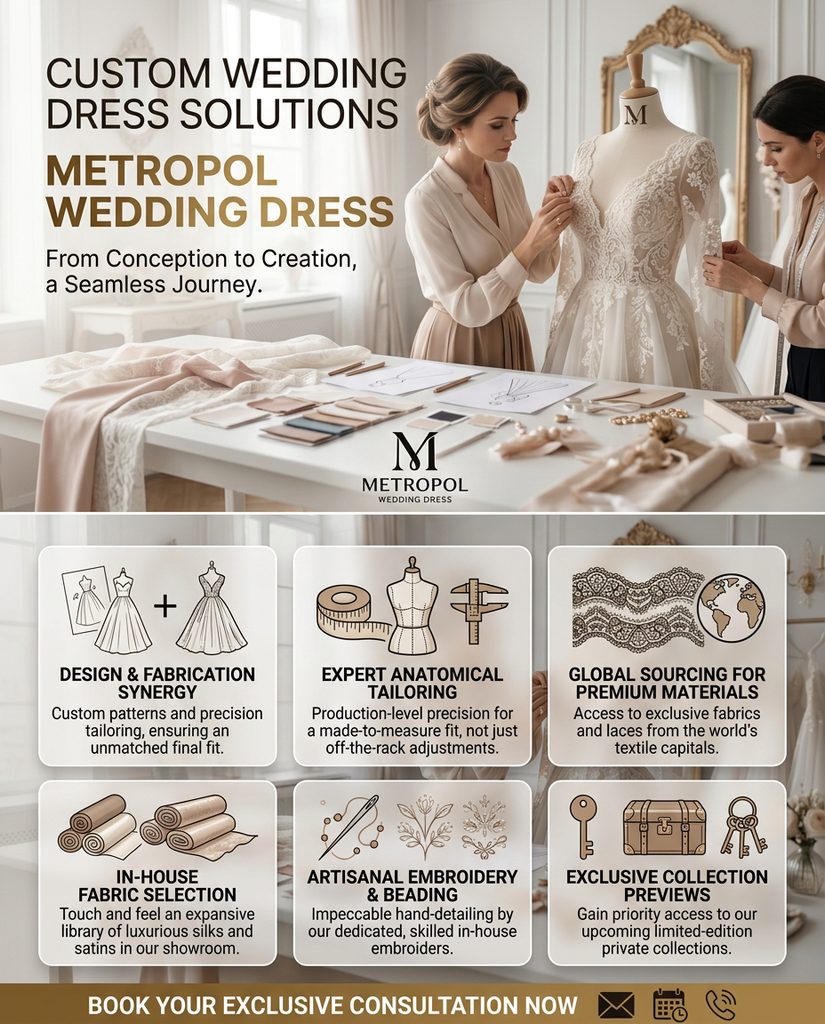
Made to Measure A-Line Wedding Dresses for a Flattering Bridal Look A wedding dress should do more than look beautiful on a hanger. It should complement the bride’s proportions, move comfortably throughout the wedding day, reflect her personal style, and feel appropriate for the ceremony she has planned. Made-to-measure A-line wedding dresses offer a thoughtful way to bring these priorities together.
An A-line wedding dress is defined by a fitted or shaped bodice and a skirt that gradually widens from the waist or upper torso toward the hem. Its balanced silhouette can create a graceful visual line without requiring the dramatic volume of a ball gown or the close fit of a mermaid dress.
When this classic shape is combined with made-to-measure tailoring, the result can be more personal than choosing a standard-size dress. Measurements, design preferences, fabric behavior, neckline proportions, sleeve length, skirt fullness, and train dimensions can be considered together to create a cohesive bridal look.
At Metropol Wedding Dress, the concept of a personalized bridal silhouette begins with understanding the bride’s vision and the practical demands of her wedding day. Whether she imagines minimalist satin, romantic lace, delicate sleeves, or an embellished statement gown, the A-line silhouette provides a versatile starting point for individual expression.
This guide explores what makes made-to-measure A-line wedding dresses distinctive, how to choose the right design, which construction details influence the final result, and what brides and professional buyers should evaluate before making a purchase.
The essential takeaway: The most flattering wedding dress is not necessarily the smallest, tightest, or most elaborate design. It is the one whose proportions, construction, materials, and fit work together to support the bride’s comfort and confidence.
Made-to-Measure A-Line Wedding Dresses: A Complete Guide to Fit, Design, and Bridal Confidence
1. Why the A-Line Silhouette Remains a Bridal Favorite
Wedding fashion changes constantly. Necklines move in and out of popularity, embellishments become more restrained or more dramatic, and designers reinterpret traditional details for contemporary brides. Yet the A-line wedding dress remains a reliable choice because it combines visual structure with considerable design flexibility.
The silhouette takes its name from the letter A. The bodice generally follows the upper body, while the skirt gradually expands toward the floor. The transition can be subtle and fluid or more pronounced, depending on the pattern, fabric, and desired level of fullness.
Unlike a heavily structured ball gown, a traditional A-line dress does not depend on an exceptionally voluminous skirt. Unlike a fitted mermaid gown, it does not need to follow the hips and thighs closely before flaring out. This middle ground makes it suitable for a wide range of bridal aesthetics.
However, the silhouette should not be treated as a universal solution that automatically flatters everyone. Its success depends on the relationship between the bodice, waist placement, skirt width, fabric weight, and the bride’s individual proportions.
What makes an A-line dress visually distinctive?
- A defined upper silhouette: The bodice can provide structure, gentle shaping, or a relaxed fit depending on the design.
- A gradual skirt expansion: The skirt creates movement without necessarily adding excessive volume.
- Flexible waist definition: A natural waist, raised waist, or visually softened waistline can produce different effects.
- Adaptable proportions: The same basic silhouette can appear minimalist, romantic, regal, vintage-inspired, or modern.
- Practical design possibilities: Different fabrics, sleeve styles, necklines, and train lengths can be incorporated without changing the fundamental silhouette.
Consider a bride planning a formal evening ceremony in a historic venue. A structured satin A-line gown with a square neckline and a long train may complement the setting. Another bride preparing for an outdoor garden ceremony might prefer a lighter skirt, floral lace, and a shorter train.
Both can wear an A-line dress, yet the finished gowns will communicate entirely different styles.
The important distinction is that the silhouette establishes the foundation; the tailoring and design details determine its individual character.
2. What Does Made-to-Measure Actually Mean?
The phrase made-to-measure is frequently used in bridal marketing, but buyers should understand what it means before placing an order.
In a made-to-measure process, a garment is created or adjusted using measurements associated with a particular customer. Depending on the atelier’s production method, this may involve adapting an existing pattern, modifying a standard design, or developing a more individualized pattern.
The exact scope varies between suppliers. A dress described as made to measure does not automatically include unlimited customization, a completely original pattern, multiple fittings, or every requested design change.
For this reason, brides should ask what is measured, which elements can be customized, how fit adjustments are handled, and whether alterations after delivery are included.
Made-to-measure versus standard sizing
| Consideration | Standard-size wedding dress | Made-to-measure wedding dress |
|---|---|---|
| Initial sizing | Selected from a manufacturer’s size chart | Based on specified individual measurements |
| Pattern approach | Usually developed around a size range | May adapt a base pattern to individual measurements |
| Bodice proportions | Follow the selected size’s specifications | Can potentially be adjusted to the bride’s measurements |
| Sleeve and hem length | May require alteration | Can potentially be specified more closely |
| Design flexibility | Depends on the collection and supplier | Depends on the supplier’s customization options |
| Fitting requirements | Alterations may be needed | Fittings or corrections may still be necessary |
| Production lead time | Depends on stock and ordering arrangements | Depends on production capacity and order complexity |
| Final fit | May require several adjustments | Can improve with accurate measurements and appropriate construction |
Neither approach guarantees a perfect fit by itself. A standard-size dress altered by an experienced bridal tailor may fit exceptionally well, while a made-to-measure dress based on inaccurate measurements may require substantial correction.
The real value lies in the quality of the process.
Which measurements matter most?
For an A-line wedding dress, useful measurements may include:
- Bust circumference
- Underbust circumference, when relevant to the construction
- Natural waist circumference
- High hip and full hip circumference
- Shoulder width
- Shoulder-to-waist length
- Back width
- Armhole and upper-arm measurements for sleeves
- Sleeve length
- Desired bodice and skirt length
- Hollow-to-hem or another specified length measurement
- Heel height and intended footwear
Not every dress requires every measurement. A strapless structured gown, for example, has different fit priorities from a long-sleeved dress with a high neckline.
Measurement instructions must also be consistent. The natural waist is not necessarily the narrowest point a person can identify, and different suppliers may define certain vertical measurements differently. Brides should follow the manufacturer’s instructions rather than combining measurements taken according to different systems.
A practical rule: Accurate measurements are the beginning of good fit, not a substitute for sound patternmaking, construction, and final assessment.
3. How an A-Line Wedding Dress Creates a Balanced Bridal Look
The appeal of an A-line gown is closely connected to visual proportion. The bodice establishes the upper outline, the waist or transition point provides a visual anchor, and the skirt introduces a widening line that carries the eye toward the hem.
This structure can create a balanced appearance without forcing the body into a particular ideal.
The effect, however, changes with relatively small design decisions.
Waist placement
A waist seam positioned near the natural waist can emphasize that area and create a clearly defined transition between bodice and skirt.
A slightly raised waistline may lengthen the appearance of the lower body, depending on the bride’s proportions and the design. A softened or visually uninterrupted waist can create a more fluid, contemporary impression.
The best position is not determined by height alone. Bodice length, torso proportions, bust placement, skirt construction, and personal preference all influence the result.
Skirt fullness
A narrow A-line skirt offers a relatively restrained outline. It can be especially appealing to brides who want a clean silhouette with limited fabric volume.
A fuller A-line skirt creates more movement and a more traditional bridal appearance. Depending on the materials and construction, it may also need additional support to maintain its intended shape.
Too much fullness in the wrong place can make the dress feel heavier than expected. Too little fullness may prevent the skirt from achieving the intended shape.
Neckline and shoulder balance
The neckline establishes the visual character of the upper body.
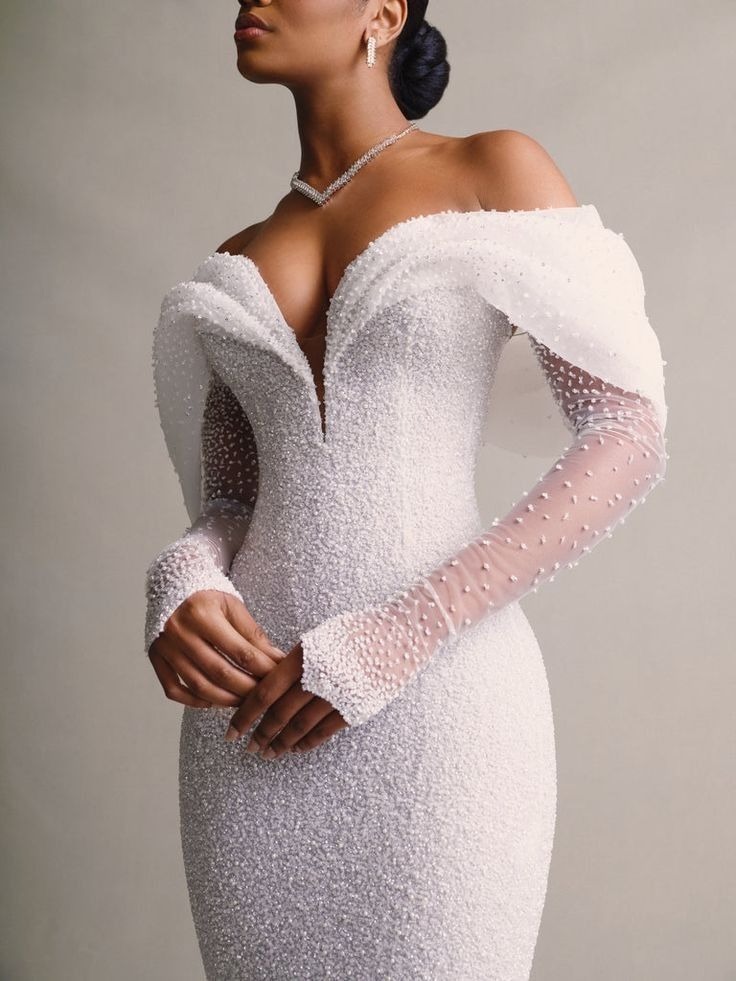
A V-neckline introduces a vertical line. A square neckline creates a defined geometric frame. A sweetheart neckline introduces a curved, romantic shape. An off-the-shoulder design emphasizes the shoulder line, while a high neckline may provide a more covered, architectural appearance.
None of these options is inherently more flattering than the others. The right choice depends on comfort, support, personal taste, and the proportions of the complete design.
The role of fabric
Fabric can change the apparent shape of the same pattern.
A soft chiffon skirt tends to move fluidly. Mikado or other structured bridal fabrics can hold a more defined outline. Satin may produce a smooth, reflective surface, while lace introduces texture and visual detail.
A useful design principle is to consider the dress as a complete system rather than selecting each element independently. A heavily embellished bodice, voluminous skirt, and long train may create a striking formal gown, but the combined weight and visual density should be intentional.
4. Choosing the Right A-Line Design for Your Wedding
The ideal A-line wedding dress should respond to the wedding itself, not simply to a photograph saved on a mood board.
Venue, climate, ceremony length, walking surfaces, cultural expectations, and the bride’s preferred level of formality all affect the final choice.
For a formal ballroom or hotel wedding
A structured bodice, substantial skirt, and carefully proportioned train can establish a sophisticated appearance.
Potential design elements include:
- Mikado or structured satin
- A square, bateau, or sweetheart neckline
- Architectural seams
- A refined lace overlay
- Covered buttons or discreet fastening details
- A medium or long train
The objective is not to maximize every detail. It is to create a coherent gown whose structure and finish complement the setting.
For a garden or outdoor ceremony
Outdoor weddings often benefit from a dress that balances elegance with ease of movement.
Lightweight fabrics, a manageable train, and carefully selected embellishments may be more practical than a heavy, densely decorated gown.
Consider the walking surface. Grass, gravel, sand, and uneven paving can affect how a skirt moves and how easily the hem becomes soiled.
A detachable train or overskirt may provide a useful compromise for brides who want a dramatic ceremony appearance and greater freedom during the reception.
For a destination wedding
Travel introduces considerations that are easy to overlook during the design stage.
Before selecting the gown, consider:
- How the dress will be packed and transported
- Whether the fabric is prone to creasing
- Whether a local tailor will be available
- Whether the venue has suitable changing and storage facilities
- How much support or structure the gown requires
- Whether the dress can be safely steamed or pressed according to its care requirements
A destination gown should be selected for its complete journey, not just for how it looks at the ceremony.
For a minimalist wedding
A clean A-line silhouette can make fabric quality and fit the central features of the design.
A simple neckline, discreet seams, limited embellishment, and carefully finished edges can produce a refined result. In minimalist bridalwear, small construction errors may be particularly noticeable because there are fewer decorative elements to distract the eye.
This is one reason measurement accuracy, fabric selection, and finishing quality deserve careful attention.
5. Fabric Selection: The Decision That Changes Everything
Fabric is not merely a surface covering. It influences how a wedding dress hangs, how it moves, how it photographs, how it feels against the skin, and how much support the pattern requires.
Two A-line dresses with identical measurements may look substantially different when made from different materials.
Satin: Smooth, polished, and versatile
Satin is a weave structure rather than the name of a single fiber. Satin fabrics can be produced from different fibers and can vary significantly in weight, drape, surface sheen, and durability.
Bridal satin may create a clean, polished appearance, making it suitable for minimalist designs and structured gowns.
What to evaluate: Surface consistency, weight, lining requirements, seam behavior, and how the material responds to light.
Highly reflective fabrics can emphasize wrinkles, seam irregularities, or uneven surfaces, so construction quality is especially important.
Mikado: Defined structure
Mikado is commonly associated with structured bridal fabrics that provide body and help a gown retain a sculpted shape.
It can work well for architectural A-line skirts, crisp bodices, and formal designs. The precise properties depend on the fabric composition and construction.
What to evaluate: Stiffness, weight, comfort while sitting, and whether the fabric creates the intended volume without excessive bulk.
Chiffon: Lightness and movement
Chiffon is often selected for its soft, flowing character. It can be used for skirt layers, sleeves, overlays, and romantic designs.
Because it is lightweight, it may offer a different wearing experience from heavier structured materials.
What to evaluate: Transparency, lining, seam finishing, snag resistance, and how the layers behave when walking.
Tulle: Volume without relying solely on heavy fabric
Tulle can introduce softness, layered volume, or decorative texture. Depending on its stiffness, it may support a skirt’s outline or create a delicate floating effect.
Different tulle types feel and behave differently. Some are soft and pliable, while others are firmer and more structured.
What to evaluate: Skin comfort, layer count, static, snagging, and whether the desired silhouette requires additional support.
Lace: Texture and craftsmanship
Lace can be used across the bodice, sleeves, skirt, or train. Its visual impact depends on motif scale, placement, density, and the relationship between the lace and the underlying fabric.
A carefully positioned lace motif may help direct attention toward a neckline or create continuity from bodice to skirt.
What to evaluate: Motif alignment, edge finishing, lining contrast, attachment quality, and consistency between samples and the finished garment.
Fabric comparison at a glance
| Fabric | Typical visual effect | Common A-line application | Main consideration |
|---|---|---|---|
| Satin | Smooth and polished | Minimalist or classic gowns | Surface quality and creasing |
| Mikado | Sculptural and structured | Defined bodices and fuller skirts | Weight and flexibility |
| Chiffon | Soft and flowing | Lightweight, romantic skirts | Sheerness and seam finishing |
| Tulle | Airy or voluminous | Layered skirts and overlays | Layer management and comfort |
| Lace | Textured and decorative | Bodices, sleeves, and overlays | Motif placement and attachment |
| Organza | Light with varying degrees of crispness | Layered or structured skirts | Transparency and stiffness |
These are general tendencies rather than universal properties. Fiber content, finishing, lining, and fabric weight can change the final result.
Why sample approval matters
For made-to-measure orders, the fabric name alone is not enough to establish what the customer will receive.
Whenever possible, evaluate the actual fabric or a representative swatch. Check its color under different lighting, touch, weight, transparency, and compatibility with the intended design.
For B2B orders, approve a clearly documented reference sample before bulk production. Record the material specification, color reference, embellishment requirements, and any approved substitutions.
This simple step can prevent expensive misunderstandings between design expectations and delivered garments.
6. The Anatomy of a Well-Constructed A-Line Wedding Dress
A beautiful bridal gown is the result of many interacting components. The outer appearance matters, but the internal construction determines much of the garment’s stability, comfort, and longevity.
Bodice engineering
The bodice must support the intended neckline and maintain its shape during movement.
Depending on the design, construction may involve interfacing, lining, boning, cups, waist stays, or other internal support elements. Not every dress requires all of these features.
A strapless design may need more carefully engineered support than a gown with broad straps or sleeves. A lightweight bodice may require different reinforcement from one made in a heavy structured fabric.
The goal is to distribute support appropriately rather than relying on excessive tightness.
Waist and seam construction
The waist transition is important because it connects the bodice to the skirt and contributes to the dress’s overall proportions.
Uneven seams, excessive bulk, or poorly controlled gathers can distort the silhouette. When lace or decorative motifs cross a seam, their alignment may also influence the perceived quality of the garment.
Skirt architecture
An A-line skirt can be constructed using panels, gathers, pleats, layered materials, or combinations of these techniques.
Panel shaping can create a relatively clean outline. Gathers may introduce softness and fullness. Additional layers can influence opacity, movement, and volume.
The pattern must account for the behavior of the chosen fabric. A design that works beautifully in a lightweight material may need adjustment when produced in a stiffer or heavier fabric.
Lining and internal finishing
Lining influences comfort, opacity, and the way the dress moves against the body.
Poorly controlled lining can twist, pull, or create unwanted bulk. A well-finished interior can improve the wearing experience even when it is not visible in photographs.
For professional buyers, the interior of a sample should be evaluated alongside the exterior. Stitching, seam allowances, fastening quality, and finishing consistency provide useful information about production standards.
The train and hem
The train contributes to the dress’s formal character but also changes its practical demands.
A longer train may require a bustle, a detachable design, or another method of securing it after the ceremony. Hem length must be assessed with the intended shoes and the bride’s normal walking posture in mind.
A hem that looks perfect while the bride is standing still may behave differently when she walks, climbs stairs, or turns.
Construction insight: A dress should be assessed in motion as well as in a static fitting. The intended silhouette is only successful when its components continue to work together during real use.
7. The Made-to-Measure Journey: From First Conversation to Final Fitting
A reliable production process reduces uncertainty by making important decisions visible before they become expensive to change.
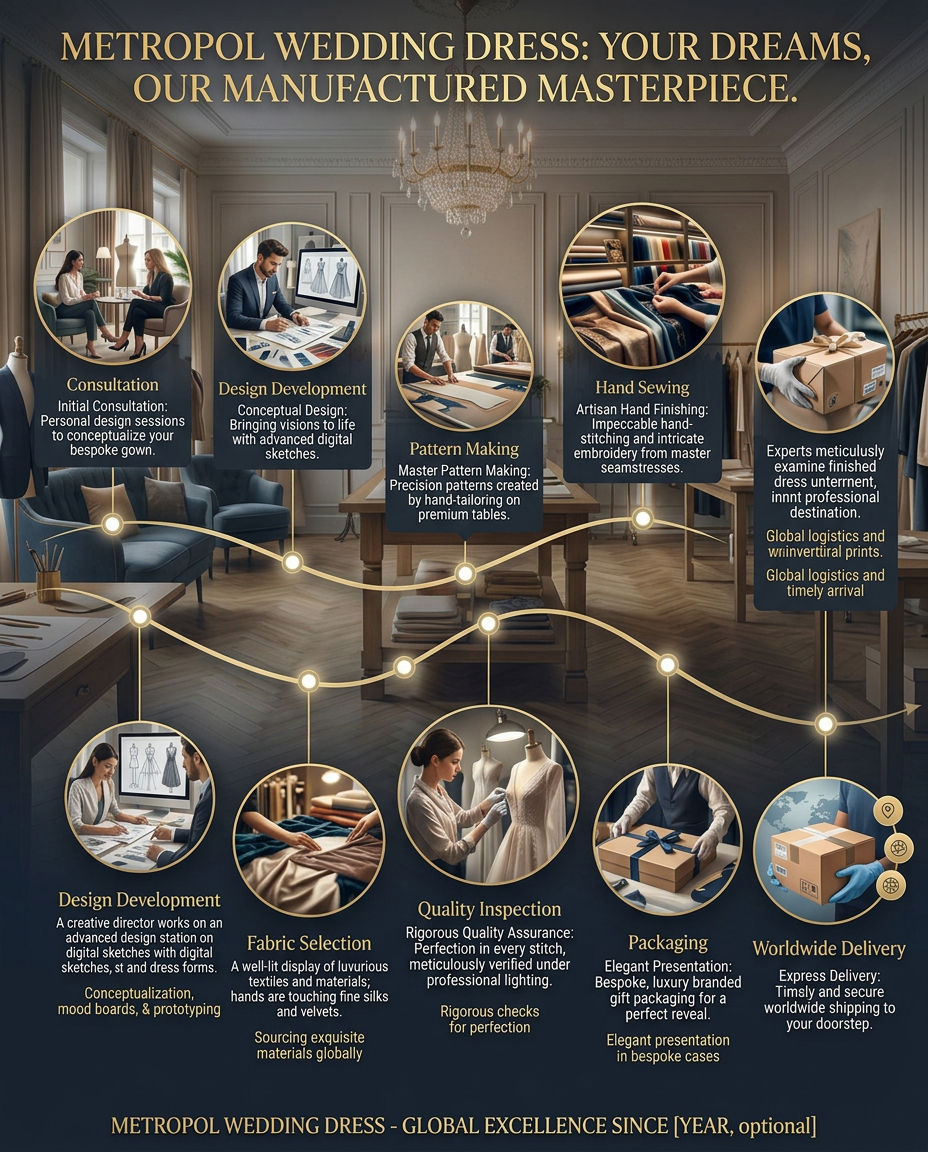
Although procedures vary by atelier, a well-managed made-to-measure order generally follows a sequence of consultation, specification, measurement, production, fitting, and final approval.
Stage 1: Establish the design brief
The first discussion should identify the bride’s priorities.
These might include a particular neckline, a preference for covered shoulders, a lightweight skirt, a dramatic train, or a specific level of embellishment.
The consultation should also establish what is essential and what is flexible. This distinction helps the designer make informed recommendations if a requested detail conflicts with comfort, construction, budget, or the available timeline.
A useful design brief records:
- The overall silhouette
- Neckline and sleeve preferences
- Fabric and color direction
- Desired skirt volume
- Train and hem preferences
- Decorative elements
- Practical requirements for the venue
- Target delivery date and budget
Reference photographs are helpful, but the supplier should clarify which features are being referenced. A customer may like the neckline in one photograph, the skirt in another, and the sleeve treatment in a third.
Those details need to be translated into one coherent specification.
Stage 2: Confirm the technical specification
Before production begins, the customer and supplier should agree on the design details that affect cost, fit, and construction.
This may include the fabric, lining, closure, internal support, embellishment placement, train length, and any detachable components.
Changes made after production begins can introduce additional costs or delay delivery. A written specification reduces the risk of conflicting interpretations.
For wholesale buyers, this stage is particularly important because a single unclear instruction can be repeated across multiple units.
Stage 3: Take and verify measurements
Measurements should be taken according to the supplier’s documented method.
The bride should wear the undergarments or support garments specified by the atelier when relevant. Measurements should be recorded consistently, and any unusual proportions or fitting concerns should be discussed before the pattern is finalized.
If measurements are taken remotely, the process should include clear instructions, measurement diagrams where available, and a method for resolving discrepancies.
Stage 4: Produce the gown
Production may involve pattern adaptation, cutting, construction, fitting of internal components, assembly, embellishment, and finishing.
The exact order depends on the dress design and production method.
Quality checks are most useful at defined stages rather than only at the end. For example, bodice fit and structural support should be reviewed before final decorative work makes adjustments more difficult.
Stage 5: Conduct the fitting
The fitting evaluates more than whether the dress closes.
The bride should assess the bodice, waist placement, bust support, shoulder comfort, skirt movement, hem length, and ease of sitting and walking.
Any adjustment should be recorded clearly. If the dress is being made remotely, photographs or video may help communicate the issue, but the supplier’s fitting protocol should determine which views and measurements are required.
Stage 6: Complete final quality checks
Before the gown is accepted, review:
- Correct design and approved materials
- Overall fit and comfort
- Secure closures
- Consistent seams and finishing
- Lace and embellishment placement
- Hem and train dimensions
- Cleanliness and presentation
- Packaging and transportation requirements
The final check should also confirm any outstanding alterations and establish who is responsible for completing them.
Stage 7: Prepare for the wedding
After delivery, the dress may need professional steaming, pressing, or other care according to the fabric and construction.
The bride should understand how to handle the train, use a bustle if supplied, store the gown safely, and avoid exposing delicate materials to inappropriate heat or moisture.
A well-designed dress is easier to enjoy when the practical details have been addressed before the wedding day.
8. Finding the Right Fit Without Chasing an Arbitrary Size
Bridal sizing can be confusing because it does not always correspond to everyday clothing sizes. Size labels can also differ between brands and countries.
For a made-to-measure A-line dress, the more useful question is whether the garment’s dimensions, pattern, and construction suit the individual wearer.
Fit is a set of relationships
A gown may fit well at the waist but pull across the bust. The bodice may be comfortable while the shoulder position feels unstable. The skirt may have sufficient circumference but an unsuitable length.
These are separate issues and should be assessed separately.
A skilled fitting process examines how the garment relates to the body in multiple areas instead of attempting to solve every problem by changing the overall size.
What to look for during a fitting
At the bust: The neckline should sit as intended without unwanted gaping, excessive compression, or obvious strain.
At the waist: The dress should feel secure without restricting breathing or making sitting uncomfortable.
At the shoulders: Straps and sleeves should remain in position without digging into the skin or pulling the bodice out of alignment.
At the back: Closures should lie appropriately, and the fabric should not show avoidable pulling caused by incorrect proportions.
At the skirt: The gown should move naturally and provide enough room for the bride to walk, turn, and sit.
At the hem: The length should be evaluated with the intended shoes and the bride’s natural posture.
Why comfort should be tested, not assumed
A dress can look excellent during a brief standing fitting and still become uncomfortable after several hours.
The bride may spend the day walking, greeting guests, sitting for dinner, dancing, and posing for photographs. These activities place different demands on the garment.
Where practical, rehearse several movements during the fitting:
- Walk at a normal pace.
- Turn in both directions.
- Sit and stand without assistance.
- Raise the arms as required by the design.
- Walk up and down a step if the venue requires it.
- Test the closure and any detachable or bustle components.
The objective is not to make every gown suitable for every activity. It is to confirm that the chosen gown performs appropriately for the wedding the bride is actually planning.
9. Design Details That Personalize an A-Line Wedding Dress
The A-line silhouette offers a useful foundation for customization because many different details can be changed without abandoning the overall shape.
The strongest designs usually have a clear visual direction. Instead of combining every attractive feature, they prioritize a few elements that work together.
Neckline customization
A neckline can influence the entire mood of the gown.
A square neckline can appear modern and structured. A sweetheart neckline may feel romantic. A bateau neckline offers a more covered, horizontal frame. A V-neckline can introduce a longer visual line.
The chosen neckline must also work with the bodice construction, support requirements, and the bride’s comfort preferences.
Sleeve options
Sleeves can range from narrow fitted designs to soft bishop sleeves, lace sleeves, cap sleeves, or detachable long sleeves.
Their practicality depends on the material, armhole construction, range of motion, and weather conditions.
A sheer lace sleeve may provide a lighter visual effect than a fully lined sleeve, but the underlying lace and seams still need to be comfortable against the skin.
Back design
The back of the dress deserves the same attention as the front.
Options may include covered buttons, a concealed zipper, a lace-up closure, a low back, or a more covered design.
Each option has implications for support, dressing assistance, adjustability, and the appearance of the finished gown.
A closure should be chosen for both its visual contribution and its practical performance.
Embellishment placement
Beading, embroidery, lace appliqués, and other decorative details can create focal points and add texture.
The location of embellishment affects the overall impression. A decorated bodice paired with a restrained skirt may feel different from a gown with motifs extending continuously toward the hem.
Embellishment also adds weight and can affect how a dress is packed, handled, and maintained. Decorative work should be secure enough to withstand the expected use of the garment.
Detachable elements
Detachable sleeves, overskirts, capes, and trains allow a bride to change the appearance of the dress during the event.
For example, a fuller overskirt can create a more formal ceremony look, while a simpler underlying gown offers greater freedom at the reception.
The design must account for attachment points, weight distribution, ease of removal, and how the dress looks once the component is detached.
Customization is most successful when each element has a defined purpose and the complete garment remains visually balanced.
10. Matching the Dress to the Season and Venue
The wedding environment can determine whether a beautiful design remains comfortable and practical throughout the event.
Warm-weather weddings
For summer ceremonies or warm destinations, consider the combined effect of fabric weight, lining, sleeve coverage, bodice structure, and the amount of time spent outdoors.
A lightweight outer fabric does not automatically make a gown cool if the dress has several dense layers or extensive internal structure.
Where appropriate, discuss breathable lining options and whether the design can achieve its intended appearance with fewer layers.
Cold-weather weddings
A winter wedding may call for a more substantial fabric, sleeves, a cape, or a separate outer layer.
However, heavier fabrics can increase the overall weight of the gown. The bride should evaluate how the dress feels when walking and sitting, especially if the ceremony and reception take place in different locations.
A detachable wrap or jacket may provide flexibility without requiring the entire dress to be constructed for cold conditions.
Indoor versus outdoor venues
Indoor venues may provide smoother walking surfaces and more controlled conditions, although staircases, narrow aisles, and crowded reception spaces still matter.
Outdoor venues introduce additional variables, including grass, dust, sand, moisture, and changing temperatures.
The train and hem should be selected with these conditions in mind. A dramatic train may be worth the extra handling required, but the bride should understand the trade-off before ordering.
11. How to Evaluate Quality Before Buying
Photographs can communicate style, but they cannot fully establish fit, construction quality, fabric behavior, or durability.
For an important purchase such as a wedding dress, buyers should evaluate evidence rather than relying entirely on descriptive language.
Inspect the garment beyond the front view
Ask for clear images or an opportunity to examine:
- The front, back, and side silhouette
- Bodice and waist seams
- Neckline finishing
- Zippers, buttons, and other closures
- Lining and internal construction
- Lace attachment and motif alignment
- Hem and train finishing
- Any detachable components
A supplier should be able to explain the intended construction and identify which features are standard and which are optional.
Evaluate fabric consistency
If the dress is ordered from a sample, confirm that the production garment will use the agreed material or a documented equivalent.
Color can appear different under daylight, warm indoor lighting, and photography equipment. A physical swatch or approved sample is therefore more reliable than a screen image alone.
Understand the alteration policy
Even a carefully produced made-to-measure gown may need minor alterations because of measurement variation, posture, footwear, or changes between measurement and delivery.
Before ordering, establish:
- Whether alterations are included
- Which types of correction are covered
- Who pays for local tailoring
- How fitting issues should be reported
- Whether a remake or correction is possible
- What deadlines apply to claims or adjustments
The answers should be clear before payment rather than discovered when the wedding is approaching.
Distinguish appearance from performance
A gown may look luxurious but be difficult to move in. Another may be less elaborate but offer excellent comfort and construction.
Neither simplicity nor complexity proves quality by itself.
The meaningful indicators are whether the garment matches its specification, whether the construction supports the design, whether the materials are appropriate, and whether the fit is suitable for the intended wearer.
12. A Buying Framework for Brides and Bridal Retailers
Individual brides and professional buyers share several concerns, but they do not evaluate every decision in the same way.
A bride is primarily concerned with the dress’s appearance, fit, comfort, and suitability for her wedding. A retailer must also consider supplier reliability, consistency between samples and production, delivery schedules, alteration requirements, and commercial risk.
A useful buying process addresses both sets of priorities.
For individual brides
Start by identifying the non-negotiable requirements.
These might include a specific neckline, a modest design, lightweight construction, a certain budget, or delivery before a particular date.
Next, separate the visual preferences from the practical requirements. A long train may be a strong preference, while sufficient mobility for the ceremony and reception may be essential.
Finally, confirm what is included in the order. The base price may not cover every customization, accessory, alteration, or shipping cost.
For bridal boutiques and wholesale buyers
Professional buyers should assess the supplier as well as the product.
Important questions include:
- Can the supplier explain the measurement and sizing process?
- Are material specifications documented?
- Can approved samples be retained as production references?
- Are customization limits clearly defined?
- How are defects and fitting problems handled?
- What production and delivery timelines can be committed to?
- Is quality checked before dispatch?
- Are packaging and labeling requirements understood?
- Can the supplier support repeat orders with consistent specifications?
A supplier’s ability to answer these questions clearly is useful evidence of process maturity, although it does not replace sample inspection or contractual safeguards.
The importance of total cost
The purchase price is only one part of the cost of obtaining a finished wedding dress.
Depending on the order, the full cost may include design customization, additional materials, shipping, duties, taxes, local alterations, pressing, accessories, and handling.
For a bridal boutique, the cost of a garment that requires repeated corrections may exceed the initial savings offered by a lower supplier price.
For an individual bride, the cheapest option may not be the most economical if delivery delays, alterations, or unexpected fees create additional expense.
Buying principle: Compare the complete cost of achieving the required result, not just the quoted price of the dress.
13. Made-to-Measure Production and Wholesale Procurement
For businesses sourcing A-line wedding dresses, the key challenge is balancing personalization with repeatable production.
Made-to-measure garments can serve customers whose proportions or design preferences are not fully addressed by standard sizing. However, increasing customization also increases the need for clear specifications and disciplined order management.
Standardization where it matters
Even highly personalized production benefits from standard procedures.
A bridal manufacturer may standardize measurement forms, construction methods, fabric references, quality checkpoints, packaging instructions, and order documentation while allowing selected design elements to vary.
This approach helps prevent each order from becoming an entirely new process.
Control the scope of customization
Not every requested change is equally simple.
Changing a hem length may be relatively straightforward, depending on the design. Changing the neckline of a heavily structured bodice can affect support, seam placement, lining, and pattern balance.
Wholesale buyers should therefore distinguish between predefined options and changes that require additional technical review.
A documented customization menu can make quoting more consistent and reduce misunderstandings.
Sample approval and production control
Before committing to a larger order, buyers should establish what the approved sample represents.
The reference should identify relevant fabrics, color, construction, finishing, measurements, and design details.
For repeated production, agreed tolerances should be defined where appropriate. A tolerance is an accepted range of variation for a specified measurement or feature; it should not be confused with permission to ignore fit problems.
Quality control should also distinguish cosmetic differences from defects that affect wearability, safety, durability, or the product specification.
Delivery planning
Wedding dresses are deadline-sensitive products. A delay can have consequences beyond ordinary retail inconvenience.
A purchasing plan should include the production period, any sample or approval stage, shipping time, potential customs clearance, arrival inspection, and the time needed for local alterations.
International buyers should confirm the applicable delivery terms, responsibility for duties and taxes, and procedures for resolving damaged or incorrect shipments.
A realistic schedule is more valuable than an optimistic promise that leaves no room for inspection or correction.
14. Understanding the Economics of a Made-to-Measure Wedding Dress
The cost of a personalized A-line gown depends on more than the amount of fabric used.
The silhouette, material, pattern complexity, internal construction, decorative work, production method, and fitting requirements all influence the final price.
Major cost drivers
Fabric selection: Specialty materials, heavier fabrics, complex lace, and custom sourcing can increase material costs.
Construction complexity: Structured bodices, multiple layers, intricate seams, and detachable elements may require additional labor.
Embellishment: Hand-applied lace, embroidery, and beadwork can substantially increase production time.
Pattern adaptation: A straightforward measurement adjustment differs from a significant redesign of the bodice or skirt.
Fitting and alterations: Additional fittings and post-production corrections may create costs beyond the initial manufacturing price.
Order quantity: Wholesale production can sometimes improve unit economics through shared preparation and purchasing efficiencies, but only when the garments and specifications allow those efficiencies.
Shipping and import costs: International orders may involve freight, insurance, duties, taxes, brokerage, and local delivery charges.
A practical total-cost formula
For an individual bride, a useful planning model is:
Total dress budget = garment price + customization + alterations + accessories + delivery and applicable import charges + care and preparation.
For a bridal retailer, the calculation may also include inspection, storage, packaging, handling, financing, and the cost of managing defects or returns.
These are planning categories rather than a promise that every cost applies to every order. Actual costs should be confirmed with the supplier and relevant service providers.
Avoid false precision
A responsible purchasing guide should not claim a universal price for a made-to-measure A-line dress. Prices vary by country, supplier, fabric, craftsmanship, customization, and commercial arrangement.
Instead of comparing dresses solely by their quoted prices, buyers should request itemized quotations based on the same specification.
For example, one quote may include a structured bodice, full lining, and a train, while another may cover a simpler dress without the same features. The two figures are not directly comparable until the specifications are aligned.
15. International Ordering: Questions to Resolve Before Production
International bridal purchasing introduces additional considerations because the customer, manufacturer, shipping provider, and final alteration specialist may operate in different locations.
These details should be addressed before the order is confirmed.
Measurement communication
Measurements must be recorded in a consistent unit system, and the supplier’s instructions should take precedence over assumptions based on local tailoring conventions.
If measurements are submitted in centimeters, confirm that the supplier records and uses them as intended. For high-risk dimensions, a verification step can reduce avoidable errors.
Written specifications
The purchase order should identify the exact design and approved options.
Avoid relying on phrases such as “same as the photograph” when a design contains multiple details. Photographs can be useful references, but they may not reveal internal support, fabric composition, or exact dimensions.
Shipping and customs
Before ordering, confirm the shipping method, estimated transit period, packaging, insurance arrangements where applicable, and who is responsible for import formalities.
Import duties and taxes depend on the destination, product classification, customs valuation, and applicable rules. Buyers should verify these requirements for their particular shipment rather than relying on a generic estimate.
Language and terminology
International orders can be affected by small differences in terminology.
A phrase such as “natural waist,” “floor length,” or “full train” may be interpreted differently if the specification is not defined.
Illustrations, measurements, written descriptions, and approved samples can help align expectations across language barriers.
Delivery contingency
Wedding-related delivery dates should be treated as operational deadlines.
Allow time for customs clearance, receiving inspection, fitting, and any necessary alterations. The exact buffer should reflect the route, supplier, and complexity of the order.
The earlier a discrepancy is identified, the more options remain available for correcting it.
16. Common Mistakes That Can Undermine an Otherwise Beautiful Dress
Many disappointing outcomes are not caused by the A-line silhouette itself. They result from decisions that are made too early, left undefined, or evaluated in isolation.
Mistake 1: Choosing from photographs alone
A photograph cannot establish how a fabric feels, how a bodice is supported, or how the skirt behaves when walking.
Better approach: Use photographs to define the aesthetic, then confirm construction, materials, fit requirements, and available customization.
Mistake 2: Assuming made-to-measure means alteration-free
Measurements are not a guarantee that every part of the garment will fit perfectly.
Better approach: Ask how the supplier handles fittings, corrections, and alterations before ordering.
Mistake 3: Selecting fabric only for appearance
A material may look beautiful but feel too heavy, crease easily, or require more support than expected.
Better approach: Evaluate fabric behavior, lining, weight, and care requirements alongside visual appeal.
Mistake 4: Ignoring the complete silhouette
A neckline, sleeve, skirt, and train can each look attractive individually while producing an unbalanced combination.
Better approach: Review the design as a whole, using the bride’s proportions and wedding setting as the reference.
Mistake 5: Leaving too little time for corrections
A late delivery may leave no realistic opportunity to resolve fitting issues.
Better approach: Work backward from the wedding date and include production, shipping, inspection, and alteration time.
Mistake 6: Failing to document custom details
Verbal instructions can be forgotten or interpreted differently.
Better approach: Confirm the final specification in writing and obtain approval for any material or design substitutions.
Mistake 7: Overlooking movement
A dress may fit in a static pose but restrict sitting, walking, or raising the arms.
Better approach: Include movement tests in the fitting process.
Mistake 8: Comparing unequal quotations
A lower price may reflect fewer layers, simpler construction, different fabric, or a different level of service.
Better approach: Compare itemized quotations against one common specification.
Mistake 9: Assuming every embellishment improves the gown
Decorative detail can increase weight, complicate maintenance, and compete with other design features.
Better approach: Select embellishments for a defined visual purpose.
Mistake 10: Treating the size label as the final measure of success
The number on the label does not determine how well a gown fits or how comfortable it feels.
Better approach: Evaluate actual measurements, garment construction, movement, and personal comfort.
17. A Realistic Example: Two Brides, One Silhouette
Consider two hypothetical brides choosing made-to-measure A-line wedding dresses.
The first plans an indoor evening ceremony followed by a formal reception. She wants a defined bodice, a clean skirt, and a long train. She prefers minimal decoration and wants the fabric itself to provide visual interest.
The second plans a daytime garden wedding. She wants a romantic dress with lace details, lightweight layers, and a skirt that is easy to manage on grass.
Both select the A-line silhouette, but their specifications differ considerably.
| Design consideration | Bride A | Bride B |
|---|---|---|
| Overall aesthetic | Modern and formal | Romantic and relaxed |
| Bodice direction | Structured | Softly shaped |
| Fabric direction | Structured satin or Mikado | Chiffon, tulle, or lace combination |
| Skirt character | Defined outline | Fluid movement |
| Decorative approach | Minimal | Selective lace detailing |
| Train preference | Longer statement train | Shorter or manageable train |
| Main practical concern | Comfort and movement in a structured gown | Mobility and hem management outdoors |
The lesson is not that one design is more flattering than the other. It is that the same silhouette can solve different design problems when the details are selected intentionally.
A successful made-to-measure process translates each bride’s priorities into a coherent technical specification.
18. Metropol Wedding Dress: A More Considered Approach to Bridal Style
Choosing a wedding dress is both an emotional decision and a practical investment. Brides want a gown that reflects their personality, but they also need clear information about fit, materials, production, and delivery.
At Metropol Wedding Dress, the A-line silhouette offers a starting point for exploring those priorities together.
A personalized bridal design should begin with questions rather than assumptions.
What kind of ceremony is planned? Which details matter most to the bride? Does she prefer structure or fluid movement? How much coverage feels comfortable? Which features are essential, and which could be simplified to meet the budget or timeline?
These questions help transform a general style preference into a more useful design brief.
For individual brides, this means focusing on the relationship between the gown and the person who will wear it.
For bridal retailers and professional buyers, it means examining the product specification, customization options, quality requirements, and ordering process before making a purchasing commitment.
The objective is not to promise that every dress will fit every bride perfectly. It is to establish a more informed process in which design decisions, measurements, construction, and expectations are aligned as closely as possible.
Five ways to begin your bridal journey
CTA 1 — For brides ready to explore their style
Your wedding dress should reflect your vision, not a standard template. Explore the A-line silhouette with Metropol Wedding Dress and begin identifying the neckline, fabric, and proportions that suit your celebration.
CTA 2 — For brides who value personalization
Start with the details that matter to you. Prepare your preferred design references, wedding date, and fit priorities to help guide a more focused made-to-measure consultation.
CTA 3 — For bridal boutiques and professional buyers
Build your buying decision around clear specifications. Contact Metropol Wedding Dress to discuss your product requirements, customization needs, and the information required to evaluate a potential order.
CTA 4 — For customers planning a destination wedding
Plan the gown around the entire journey. Discuss your delivery deadline, fabric preferences, transportation considerations, and fitting arrangements before finalizing your order.
CTA 5 — For brides who are still comparing options
You do not need to decide every detail at once. Begin with the silhouette, shortlist the materials and necklines you prefer, and use a structured consultation to refine the design.
Please confirm current customization services, order terms, delivery availability, and consultation options directly with Metropol Wedding Dress before making a commitment.
19. Final Thoughts: A Flattering Dress Begins with the Right Decisions
Made-to-measure A-line wedding dresses bring together a versatile silhouette and a more individualized approach to fit. Their appeal lies not in a promise to transform every figure according to one ideal, but in the opportunity to coordinate proportions, fabric, construction, and personal style.
The most effective choices are usually made in a deliberate sequence.
First, establish the desired aesthetic. Then select a silhouette variation and fabric that support it. Confirm the measurements and technical specifications. Evaluate the construction and movement. Finally, establish a realistic production, delivery, and fitting plan.
For brides, this process can reduce uncertainty and help create a gown that feels appropriate for both the occasion and the person wearing it.
For retailers and wholesale buyers, it offers a framework for evaluating product quality, managing customization, and reducing avoidable purchasing risks.
The A-line silhouette is only the beginning. The final result depends on how thoughtfully every element is brought together.
Metropol Wedding Dress invites brides and professional buyers to approach bridalwear as a considered combination of personal expression, fit, craftsmanship, and practical planning. When these elements are aligned, the dress has a better chance of looking beautiful, feeling comfortable, and serving its purpose throughout the celebration.
Frequently Asked Questions About Made-to-Measure A-Line Wedding Dresses
1. What is a made-to-measure A-line wedding dress?
A made-to-measure A-line wedding dress is a gown created or adjusted using an individual’s measurements and a design based on the A-line silhouette. The bodice is generally shaped to the upper body, while the skirt widens gradually toward the hem. The exact level of customization depends on the supplier’s production method and service options.
2. Is an A-line wedding dress suitable for different body proportions?
Yes. The A-line silhouette can be adapted to many different proportions because its waist placement, bodice shape, skirt fullness, neckline, and length can vary. However, no silhouette is automatically ideal for everyone. The most appropriate design depends on individual measurements, comfort preferences, and the intended visual effect.
3. What is the difference between an A-line dress and a ball gown?
An A-line dress generally has a skirt that widens progressively from the bodice or waist. A ball gown usually has a much fuller skirt and a more pronounced contrast between the fitted bodice and the skirt volume. Both can be formal, but their proportions, weight, and movement are often different.
4. How does a made-to-measure dress differ from a custom-designed wedding dress?
Made-to-measure usually refers to creating or adapting a garment around an individual’s measurements. Custom design may involve a more extensive process in which the pattern, silhouette, construction, and decorative details are developed specifically for the customer. The terminology varies by supplier, so the actual scope of work should be confirmed before ordering.
5. Can I customize the neckline of an A-line wedding dress?
Many designs allow neckline customization, but the available options depend on the existing pattern and construction. Changing a neckline can affect bodice support, lining, seams, and overall proportions. Confirm the feasibility and any additional costs with the dressmaker before approving the design.
6. Which fabrics work well for A-line wedding dresses?
Satin, Mikado, chiffon, tulle, organza, and lace are all used in A-line bridalwear. Structured materials can help define the silhouette, while lighter fabrics can create softer movement. The best option depends on the intended design, comfort requirements, climate, lining, and construction.
7. Is satin always a heavy fabric?
No. Satin describes a weave structure rather than a single fiber or weight. Satin fabrics can differ substantially in composition, thickness, drape, and sheen. Ask for the actual fabric specification or a representative swatch rather than assuming all satin behaves the same way.
8. Can an A-line wedding dress have a minimalist design?
Absolutely. An A-line dress can be made with clean seams, restrained decoration, a simple neckline, and a smooth skirt. Minimalist designs often place greater emphasis on fabric quality, fit, and finishing because decorative elements do not conceal construction irregularities.
9. Are lace sleeves compatible with an A-line wedding dress?
Yes. Lace sleeves can complement both structured and romantic A-line designs. Sleeve length, lining, lace softness, armhole construction, and range of motion should be considered to ensure that the sleeves feel comfortable and work with the bodice.
10. How should I measure myself for a made-to-measure wedding dress?
Follow the supplier’s measurement instructions precisely. Measurements may include bust, waist, hips, shoulder width, bodice length, sleeve dimensions, and skirt length. Use the specified measuring method and unit system, and ask the supplier to clarify any measurement you are unsure about. Remote self-measurement may benefit from assistance from another person.
11. Should I take measurements while wearing my wedding shoes?
For length measurements affected by footwear, use the shoes or heel height specified by the dressmaker. Other measurements may require different conditions. Follow the supplier’s instructions rather than assuming that every measurement should be taken with or without shoes.
12. Does made-to-measure mean that alterations will not be necessary?
No. Made-to-measure production can reduce some sizing mismatches, but it cannot guarantee an alteration-free result. Measurement errors, posture, footwear, fabric behavior, and changes in fit can still affect the final garment. Ask about fittings and alteration policies before placing the order.
13. How much time should I allow for a made-to-measure wedding dress?
The appropriate lead time depends on the supplier, design complexity, production workload, shipping route, and alteration requirements. Ask for a timeline that includes production, dispatch, delivery, inspection, and final fitting. Avoid relying on a general industry estimate when a specific wedding date is involved.
14. Can I order a made-to-measure A-line wedding dress from another country?
International orders may be possible, depending on the supplier’s services and delivery arrangements. Before proceeding, confirm measurement procedures, communication methods, payment terms, shipping, customs responsibilities, delivery timing, and the process for resolving fitting problems.
15. What should I send a dressmaker if I am ordering remotely?
Provide the requested measurements, wedding date, design references, fabric preferences, and written descriptions of essential details. Clarify the neckline, sleeves, waist placement, skirt volume, train, lining, and closure. The supplier should confirm the final specification and explain any technical limitations before production.
16. Can I combine details from several wedding dress photographs?
Often, yes, but the details must work together technically and visually. A neckline from one dress, sleeves from another, and a skirt from a third may require pattern changes or structural adjustments. Identify precisely which features you want to reproduce and ask the designer to assess the complete combination.
17. Is a long train practical for an outdoor wedding?
It can be, but a long train may collect dirt or moisture and may be harder to manage on grass, sand, gravel, or uneven surfaces. Consider a detachable train, bustle, or alternative length if you want greater flexibility. The best choice depends on the venue and the desired ceremony appearance.
18. Can an A-line wedding dress include a detachable overskirt?
Many designs can incorporate a detachable overskirt, although compatibility depends on the bodice, waist construction, fastening method, and weight distribution. Confirm that the attachment system is secure and that the underlying gown looks complete when the overskirt is removed.
19. How can I make sure the dress is comfortable throughout the wedding day?
Evaluate the gown during movement, not only while standing. Walk, sit, turn, raise your arms, and test the closures. Consider the weight of the fabric, bodice support, sleeve movement, train management, and the activities planned for the reception.
20. What should I check during the final fitting?
Check neckline position, bust support, waist comfort, shoulder fit, closure security, skirt movement, hem length, train handling, and interior finishing. Wear the intended footwear and relevant support garments. Record any necessary corrections and confirm who will complete them.
21. Does the color of a wedding dress look the same in every type of lighting?
No. Fabric color can appear different under daylight, warm indoor lighting, cool lighting, and camera flashes. If color accuracy is important, assess a physical swatch under several lighting conditions and confirm the color reference with the supplier.
22. What determines the price of a made-to-measure A-line wedding dress?
Major factors include fabric, pattern complexity, internal structure, embellishments, customization, labor, fittings, and finishing. Shipping, taxes, alterations, and accessories may add to the total cost. Request an itemized quotation and compare offers based on the same specification.
23. Are simpler A-line wedding dresses less expensive than embellished designs?
They can be, but simplicity does not automatically guarantee a lower price. A minimalist dress made from a premium structured fabric may require precise patternmaking and careful finishing. A highly embellished dress may involve more labor and materials. The actual cost depends on the complete design and production process.
24. What should a bridal boutique check before placing a wholesale order?
Review the sample, fabric specification, measurement system, customization limits, production schedule, quality-control procedures, packaging, delivery terms, and defect-resolution policy. Confirm whether the supplier can maintain consistency across repeat orders and whether the commercial terms are documented clearly.
25. Why is sample approval important for wholesale wedding dresses?
A sample establishes a shared reference for the expected appearance and construction. It can document fabric, color, measurements, finishing, and decorative details. Approving a sample before bulk production helps reduce misunderstandings and makes subsequent quality checks more objective.
26. Can a supplier guarantee that every made-to-measure dress will fit perfectly?
A responsible supplier should explain its fitting process and quality standards rather than treating perfect fit as an automatic outcome. Individual measurement variation, posture, fabric behavior, and production differences can affect the result. Clear specifications, accurate measurements, fitting checks, and a documented correction process provide a stronger basis for managing expectations.
27. What is the difference between a fitting issue and a manufacturing defect?
A fitting issue may arise when the garment needs adjustment to suit the wearer’s measurements or preferences. A manufacturing defect may involve incorrect construction, damaged material, faulty closures, or a failure to meet the agreed specification. The distinction depends on the circumstances and the order terms, so buyers should document the issue and follow the supplier’s correction procedure.
28. How can I reduce the risk of ordering the wrong dress?
Confirm the design specification, provide accurate measurements, evaluate fabric samples, clarify customization limits, and review the alteration policy. Allow sufficient time for production and delivery. If ordering internationally, confirm shipping responsibilities and the procedure for handling a garment that arrives damaged or differs from the approved specification.
29. What should I know about caring for an A-line wedding dress after delivery?
Care depends on the fiber, embellishments, lining, and internal construction. Follow the manufacturer’s care instructions and consult a professional bridal cleaner when necessary. Avoid applying heat, moisture, or cleaning products without confirming that they are suitable for the materials used.
30. How can I choose between a structured and a flowing A-line gown?
Start with the intended aesthetic and the experience you want while wearing the dress. Structured gowns generally create a more defined outline, while flowing gowns emphasize movement and softness. Consider venue, climate, weight, sitting comfort, and the desired level of formality before deciding.
31. Are A-line wedding dresses suitable for modern and traditional ceremonies?
Yes. The silhouette can be adapted to both. Traditional interpretations may include lace, long trains, and classic necklines, while modern versions may feature clean seams, architectural shapes, minimalist fabrics, or detachable elements. The design details determine the overall character.
32. What information should be included in a bridal dress order confirmation?
A useful confirmation should identify the design, measurements, materials, color, neckline, sleeves, skirt details, train, closure, approved customizations, price, payment terms, delivery schedule, and alteration or correction policy. International orders should also address shipping and applicable import responsibilities.
33. Can a made-to-measure A-line dress be suitable for a destination wedding?
Yes, provided the design and production plan account for travel. Consider packing, creasing, fabric care, transportation, storage, local alteration options, and the venue’s conditions. Confirm delivery sufficiently early to allow inspection and any required adjustments before departure.
34. How should I compare two made-to-measure wedding dress suppliers?
Compare the actual specifications, materials, construction, customization scope, measurement instructions, quality controls, delivery commitments, and correction policies. Ask for comparable quotations and review samples when possible. A lower initial price should be evaluated against the full cost and risk of obtaining the required finished garment.
35. What makes Metropol Wedding Dress relevant to an A-line bridalwear search?
Metropol Wedding Dress is the brand featured in this guide for customers exploring A-line bridalwear and personalized fit. Brides and professional buyers should contact the brand directly to confirm current product availability, made-to-measure options, materials, order requirements, and delivery arrangements.
36. What is the most important factor when choosing a made-to-measure A-line wedding dress?
The most important factor is the relationship between the bride’s priorities and the garment’s actual design, fit, construction, and practical requirements. A beautiful silhouette is only part of the decision. Accurate specifications, suitable materials, comfortable movement, and a realistic production plan help turn the design into a successful bridal purchase.
Suggested SEO title: Made-to-Measure A-Line Wedding Dresses | Metropol Wedding Dress
Suggested meta description: Discover made-to-measure A-line wedding dresses with guidance on flattering proportions, fabrics, personalized fit, construction, and choosing the right bridal gown.
Suggested URL slug: /made-to-measure-a-line-wedding-dresses/
Primary keyword: Made to measure A-line wedding dresses
Supporting keywords: Custom-fit A-line wedding dress, tailored A-line bridal gown, personalized wedding dresses, A-line wedding dress fabrics, bespoke bridal fit, A-line wedding dress buying guide, made-to-measure bridalwear.
Suggested image alt text: Made-to-measure A-line wedding dress with a fitted bodice and flowing skirt by Metropol Wedding Dress.
Editorial note: Before publication, verify all brand-specific claims, customization services, product availability, and ordering details with Metropol Wedding Dress. Add original product photographs, confirmed service information, and genuine company details where available to strengthen trust and provide prospective customers with a direct path to the next step.
Related Topics

18.08.2025
bridal gown supplier is an entity that provides wedding dresses to retailers, boutiques, or directly to consumers. These suppliers can be manufacturers, wholesalers, or distributors specializing in bridal attire. The primary function of a bridal...

21.09.2025
Les Robes de Mariée de Luxe en France Tendances et Inspirations incarnent l’élégance, l’artisanat d’exception et une créativité sans bornes. En 2025, le marché du mariage haut de gamme continue de séduire avec des créations...

26.01.2024
The world of bridal fashion has evolved, and with it, the desire for unique and Customizable bridal dresses has taken center stage. Modern brides are seeking more than just a gown; they crave a one-of-a-kind...

05.12.2025
Custom Wedding Dress for Plus Size UK Brides perfectly captures a growing trend that thousands of British curvy brides discover every year. If you are a plus-size bride in the UK and you’ve ever felt...

12.07.2025
Paris, the city of love and fashion, is a dream destination for brides seeking the perfect wedding dress. Known for its haute couture and romantic charm, Paris is also home to a surprising array of...
10.10.2025
Del Boceto al Altar El Proceso Creativo de un Vestido de Novia Hecho a Medida En el mundo de la moda nupcial Turquía España, donde la elegancia se fusiona con la tradición y la innovación,...
Comments