
Luxury Wedding Dresses Prices USA A luxury wedding dress should be remembered for its beauty, craftsmanship and the confidence it gives the bride—not for an unnecessarily high price tag.
Today, brides, bridal boutiques, wedding retailers and international buyers are looking beyond traditional retail purchasing models. They want exceptional designs, carefully selected materials, refined construction and competitive pricing. This growing interest has made factory-direct wedding dresses an attractive option for customers who value both quality and commercial flexibility.
Metropol Wedding Dress brings together the essential elements of modern bridal fashion: elegant silhouettes, sophisticated design possibilities, attention to detail and a purchasing approach focused on delivering value.
Whether you are a bride searching for a memorable wedding gown, a boutique owner expanding your bridal collection, or an international buyer exploring new suppliers, understanding the relationship between manufacturing, craftsmanship and pricing can help you make a more informed decision.
Factory-direct pricing does not have to mean compromising on luxury. When the sourcing process is transparent and the product specifications are carefully evaluated, buyers can find wedding dresses that combine visual sophistication with practical purchasing advantages.
In this guide, we explore what factory-direct luxury wedding dresses really mean, how production decisions influence the final garment, what buyers should examine before placing an order, and how to select bridal collections that create lasting value.
Luxury Wedding Dresses at Factory Direct Prices: A New Perspective on Buying Bridal Fashion
1. The Meaning of Luxury Is Changing in the Wedding Dress Industry
For generations, luxury wedding dresses have represented more than clothing. They have symbolized personal expression, tradition, craftsmanship and the emotional significance of one of life’s most memorable occasions.
Yet the way people purchase luxury bridal fashion is changing.
Modern brides are increasingly informed. They research silhouettes, compare fabrics, explore international designers, examine construction details and consider customization possibilities before making a purchasing decision.
Bridal boutiques are also changing their buying strategies. Rather than relying exclusively on familiar distribution channels, many retailers investigate direct sourcing opportunities, alternative manufacturers and flexible collection arrangements.
The reason is straightforward: the traditional retail price of a wedding dress reflects more than the garment itself.
It may include:
- Design and development expenses.
- Fabric and accessory procurement.
- Manufacturing labor.
- Quality inspection.
- Brand positioning.
- Import and distribution costs.
- Warehousing and inventory expenses.
- Retail operating expenses.
- Marketing and advertising.
- Retailer margins.
Not every wedding dress follows the same distribution structure. However, each additional commercial stage can influence the final amount paid by the customer.
This is where factory-direct purchasing becomes interesting.
By creating a more direct relationship between the manufacturer and the buyer, unnecessary intermediaries may be reduced. The resulting savings can potentially be allocated toward better materials, additional customization, more competitive pricing or healthier retail margins.
For Metropol Wedding Dress, the central idea behind this approach is simple:
Luxury should be evaluated by the quality of the garment, not exclusively by the number of commercial layers between its maker and its wearer.
A beautifully constructed wedding gown does not become more beautiful simply because it passes through several distributors.
What matters is the finished product: its silhouette, fit, fabric, finishing, comfort and ability to meet the expectations of the person purchasing it.
2. What Does Factory-Direct Pricing Actually Mean?
The phrase factory-direct is frequently used in the bridal industry, but buyers should understand what it means before making a commercial decision.
Factory-direct purchasing generally describes a sourcing arrangement in which the customer purchases directly from a manufacturer or through a substantially shortened distribution channel.
Instead of relying entirely on a traditional wholesale-to-distributor-to-retailer structure, the buyer establishes a more direct commercial relationship.
This can offer several potential advantages.
Luxury Wedding Dresses Prices USA
A shorter supply chain can reduce certain intermediary costs.
However, it does not automatically eliminate every expense associated with manufacturing, transportation, quality control or international trade.
The important question is not simply whether a supplier offers factory-direct prices.
It is whether the quoted price represents genuine value when all relevant costs are considered.
Better communication
Direct communication can make it easier to discuss:
- Dress measurements.
- Fabric preferences.
- Design adjustments.
- Color requirements.
- Embellishment details.
- Order quantities.
- Packaging specifications.
- Production expectations.
- Shipping arrangements.
This is particularly important when purchasing bridal gowns because a small design or measurement misunderstanding can affect the entire finished product.
Greater purchasing flexibility
Depending on the manufacturer’s capabilities and commercial policies, buyers may have opportunities to discuss different ordering arrangements.
For example, a bridal boutique might prioritize selected silhouettes rather than purchasing a complete collection.
An international distributor might request specific color combinations.
A private-label buyer may want to discuss branding, labels and packaging.
These possibilities should always be confirmed before an order is placed.
A more transparent cost discussion
Factory-direct sourcing creates an opportunity to understand how the product price is structured.
A professional buyer should distinguish between:
- The base garment price.
- Customization charges.
- Additional embellishment costs.
- Packaging expenses.
- Transportation costs.
- Customs duties and taxes.
- Payment and currency-related expenses.
This distinction is essential because the lowest quoted dress price does not necessarily produce the lowest total purchasing cost.
3. What Makes a Wedding Dress Truly Luxurious?
Luxury is often associated with expensive materials, elaborate decoration or recognizable designer names.
But professional bridal buyers know that the appearance of a dress is only one part of its overall quality.
A luxury wedding dress should be evaluated through several interconnected elements.
A. Design intelligence
Good bridal design begins with proportion.
A dress should complement the wearer’s natural shape, support comfortable movement and create a balanced visual appearance.
Designers consider:
- Bodice proportions.
- Waist placement.
- Skirt volume.
- Neckline geometry.
- Sleeve construction.
- Train length.
- Back design.
- Overall silhouette.
The relationship between these elements determines whether a dress looks harmonious.
For example, an elaborate ball gown may require a carefully structured bodice to balance its skirt volume. A minimalist fitted gown may depend more heavily on precise pattern construction and fabric behavior.
Luxury is not necessarily about adding more decoration.
Sometimes the most sophisticated design is the one in which every element has a clear purpose.
B. Material selection
Fabric influences almost every characteristic of a wedding dress.
It affects drape, movement, structure, opacity, comfort and appearance under different lighting conditions.
Common bridal fabrics include:
| Fabric | Main characteristics | Typical bridal applications |
|---|---|---|
| Satin | Smooth surface and structured appearance | Classic gowns, fitted dresses |
| Mikado | Firm hand and sculptural body | Architectural silhouettes, ball gowns |
| Tulle | Lightweight and airy | Layered skirts, veils, romantic details |
| Organza | Sheer with more body than many lightweight tulles | Overskirts, sleeves, layered designs |
| Chiffon | Soft, flowing movement | Destination weddings, relaxed silhouettes |
| Lace | Decorative texture and intricate patterns | Sleeves, bodices, overlays |
| Crepe | Elegant drape and relatively clean surface | Minimalist and fitted gowns |
| Lace appliqué | Raised decorative motifs | Bodice decoration, skirt detailing |
A fabric’s name alone does not establish its quality.
Two fabrics described as satin, for example, can differ considerably in fiber composition, weight, surface finish, durability and performance.
Professional buyers should request material specifications whenever these details influence the purchasing decision.
C. Construction quality
Construction is one of the most important differences between an attractive photograph and a well-made wedding gown.
A buyer should examine:
- Seam consistency.
- Lining attachment.
- Bodice structure.
- Boning placement, where applicable.
- Zipper installation.
- Hem finishing.
- Lace alignment.
- Embellishment attachment.
- Symmetry.
- Stress points around closures.
A dress may look impressive in a photograph but perform poorly during actual wear if its internal construction has not been properly considered.
For a luxury bridal gown, the inside deserves almost as much attention as the outside.
D. Finishing and attention to detail
Small finishing decisions often determine the overall impression of a garment.
Consider a lace wedding dress.
The quality of its appearance depends not only on the lace pattern but also on how the motifs are positioned, how the edges are finished and how the decorative elements interact with the underlying fabric.
Likewise, a satin gown depends on clean seams, controlled fabric handling and carefully finished closures.
These details may not be immediately visible in an online product photograph, which is why product samples and detailed inspection photographs can be valuable.
E. Wearability
A wedding dress is not simply displayed.
It is worn for hours.
The bride may walk, sit, dance, greet guests, pose for photographs and move between indoor and outdoor environments.
A beautiful dress that restricts movement or creates uncomfortable pressure can negatively affect the experience.
Luxury therefore involves a combination of appearance and functionality.
A successful bridal design should make the wearer feel elegant without making her feel trapped inside the garment.
4. Exploring the Most Desirable Luxury Wedding Dress Styles
Different brides define elegance differently.
Some imagine a dramatic entrance with a voluminous skirt. Others prefer a clean silhouette that emphasizes fabric quality and precise tailoring.
A successful bridal collection should recognize that there is no single definition of the perfect wedding dress.
Below are several important design categories to consider when exploring a luxury bridal collection.
The Classic Ball Gown: A Timeless Bridal Statement
The ball gown remains one of the most recognizable wedding dress silhouettes.
Its characteristic combination of a fitted bodice and full skirt creates a dramatic shape associated with traditional bridal elegance.
<IMAGE PLACEHOLDER: Replace with a Metropol Wedding Dress luxury ball gown photograph>
Ball gowns are particularly suitable for:
- Formal wedding ceremonies.
- Grand reception venues.
- Traditional celebrations.
- Brides who prefer dramatic skirt volume.
- Weddings where a statement silhouette is desired.
When evaluating a ball gown, buyers should pay attention to skirt structure, fabric weight, lining, waist construction and the balance between the bodice and skirt.
A full skirt requires thoughtful construction to maintain its shape while allowing the bride to move comfortably.
For boutiques, ball gowns can serve as visual anchor pieces in a bridal showroom because their volume and distinctive silhouette attract attention.
The A-Line Wedding Dress: Elegance with Versatility
The A-line silhouette gradually expands from the waist toward the hem.
Its balanced proportions make it one of the most versatile categories in bridal fashion.
<IMAGE PLACEHOLDER: Replace with an A-line wedding dress photograph>
A-line gowns can be developed in many different directions.
A minimalist satin version may appear contemporary and refined.
A lace-covered version may feel romantic and traditional.
A design featuring a detachable overskirt can offer additional styling possibilities.
From a retail perspective, the A-line silhouette deserves attention because it can appeal to customers with different aesthetic preferences.
It is also a useful category for boutiques developing collections that need a balance between statement designs and wearable styles.
The Mermaid Wedding Dress: Sculpted Sophistication
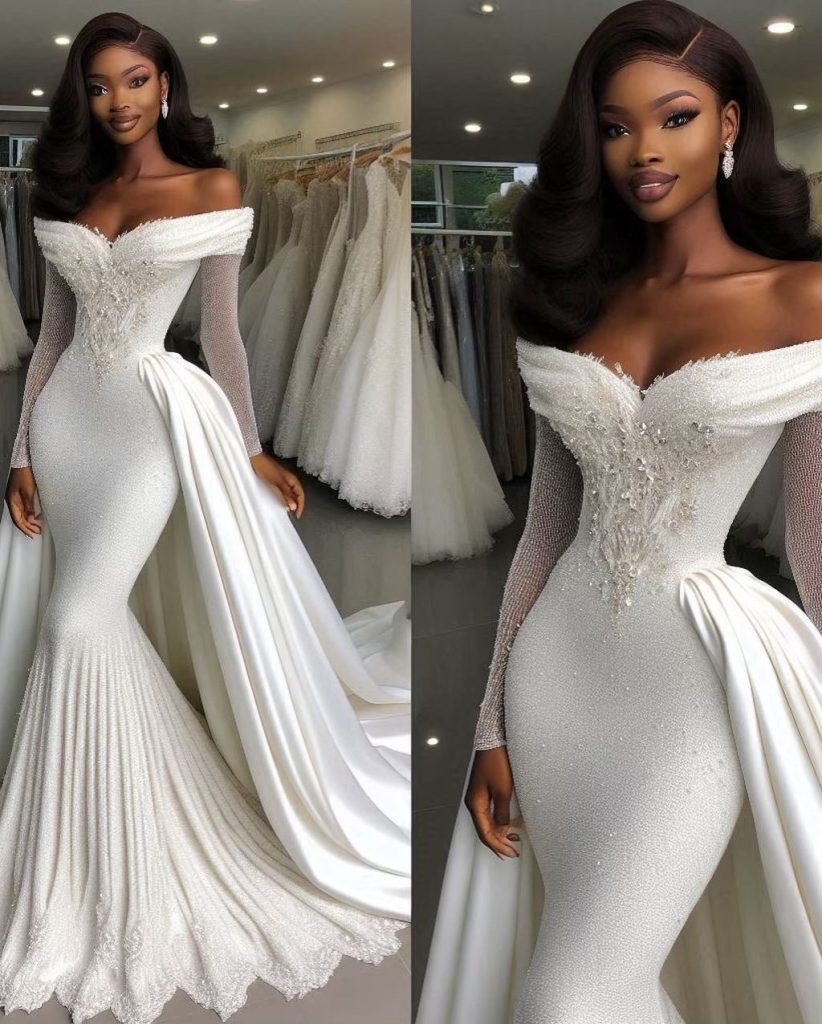
Mermaid wedding dresses follow the body’s shape through the bodice, waist and hips before widening toward the lower skirt.
<IMAGE PLACEHOLDER: Replace with a luxury mermaid wedding dress photograph>
This silhouette creates a distinctive and dramatic profile.
Important construction considerations include:
- Accurate body measurements.
- Hip and waist proportions.
- Fabric recovery and stretch, where relevant.
- Movement around the knees.
- Flare placement.
- Closure positioning.
- Lining comfort.
The fit is particularly important because small measurement differences can noticeably affect the appearance of a fitted silhouette.
Boutiques should also discuss alteration requirements with customers before finalizing an order.
The Minimalist Wedding Dress: When Simplicity Becomes Luxury
Minimalist bridal fashion demonstrates that a wedding dress does not need extensive embellishment to look sophisticated.
<IMAGE PLACEHOLDER: Replace with a minimalist satin wedding dress photograph>
The success of a minimalist design depends on precision.
There are fewer decorative elements to distract from construction quality.
Consequently, the following details become especially important:
- Fabric surface.
- Seam placement.
- Neckline accuracy.
- Bodice fit.
- Waist definition.
- Hem quality.
- Draping.
- Overall proportion.
A minimalist satin gown, for example, can reveal imperfections in fabric handling that might be less noticeable in a heavily decorated design.
This makes material selection and technical finishing particularly important.
The Romantic Lace Wedding Dress
Lace continues to hold a special position in bridal fashion because of its decorative versatility.
<IMAGE PLACEHOLDER: Replace with a detailed lace bridal gown photograph>
Depending on the pattern and application, lace can create a vintage, contemporary, romantic or highly sophisticated appearance.
Different design directions include:
- Floral lace.
- Geometric lace.
- Chantilly-inspired effects.
- Three-dimensional floral appliqués.
- Illusion lace panels.
- Lace sleeves.
- Lace-covered bodices.
Buyers should examine lace placement rather than focusing only on the pattern itself.
The way lace motifs connect across seams and transition between different garment sections can significantly influence the finished appearance.
The Modern Princess Wedding Dress
Princess-inspired wedding dresses combine traditional volume with contemporary design elements.
They may include structured bodices, dimensional floral details, off-the-shoulder necklines, dramatic trains or layered skirts.
<IMAGE PLACEHOLDER: Replace with a princess wedding dress photograph>
The modern interpretation of the princess gown is not necessarily identical to traditional bridal fashion.
It may feature:
- Cleaner neckline geometry.
- Removable sleeves.
- Detachable overskirts.
- Contemporary corsetry.
- Three-dimensional embellishments.
- Contrasting fabric textures.
For bridal retailers, these styles can provide an opportunity to serve customers looking for an expressive and memorable wedding-day appearance.
5. The Fabric Behind the Beauty: Understanding Bridal Material Choices
A wedding dress begins with a design concept, but its final character is strongly influenced by the materials used to create it.
Selecting the right fabric requires more than deciding whether it looks attractive.
The buyer must understand how the material behaves during cutting, sewing, fitting, transportation and wear.
Satin: A Refined Surface with Many Possibilities
Satin is widely associated with sophisticated bridal fashion.
Its smooth appearance and light reflection can create a polished aesthetic.
However, satin is a weave construction rather than a guarantee of a particular fiber composition.
Depending on the product, satin may be manufactured from polyester, silk or other fibers.
This distinction matters because different compositions can influence:
- Price.
- Drape.
- Breathability.
- Surface appearance.
- Wrinkle behavior.
- Care requirements.
A buyer should request the exact composition instead of relying on the generic term satin.
Mikado: Structure for Architectural Bridal Designs
Mikado is valued for its relatively structured appearance and ability to support defined silhouettes.
It is often selected for:
- Ball gowns.
- Structured A-line dresses.
- Clean sculptural designs.
- Wide skirts.
- Architectural bodices.
Its body can help a garment maintain a distinctive shape.
However, heavier fabrics require attention to garment weight and comfort.
Tulle: Creating Volume Without Excessive Visual Weight
Tulle is a lightweight net fabric frequently used in bridal skirts and veils.
Its layered construction allows designers to create volume and movement.
The final appearance depends on the type of tulle, its stiffness, transparency, weight and number of layers.
For buyers, an important consideration is the relationship between visual volume and actual garment weight.
A skirt should achieve the intended appearance without unnecessarily compromising movement.
Lace: Decorative Complexity and Technical Precision
Lace can be used as a main fabric, an overlay or a decorative component.
Its value depends on more than the complexity of the pattern.
Buyers should examine:
- Motif definition.
- Pattern consistency.
- Color compatibility.
- Edge finishing.
- Placement accuracy.
- Attachment quality.
- Durability during wear.
For intricate lace designs, a sample can provide more useful information than a digital photograph alone.
Chiffon and Organza: Different Expressions of Lightness
Chiffon is associated with soft movement and fluid draping.
Organza generally offers more body and structure.
Although both can appear lightweight and transparent, they serve different design purposes.
Chiffon may be appropriate for flowing overlays, while organza can create more defined volume.
The choice should follow the design requirements rather than simply the visual preference.
A practical fabric evaluation matrix
| Evaluation criterion | What the buyer should examine |
|---|---|
| Composition | Fiber content and material specification |
| Weight | Whether the fabric supports the intended silhouette |
| Drape | How it falls and moves |
| Transparency | Whether lining or additional layers are required |
| Surface | Consistency, texture and finish |
| Color | Shade accuracy under different lighting |
| Durability | Resistance to handling and normal wear |
| Care | Cleaning and storage requirements |
| Availability | Whether repeat orders can be supported |
Professional insight: A supplier that can explain fabric characteristics clearly is easier to evaluate than one that relies exclusively on photographs and generic quality descriptions.
6. Inside the Construction: What Happens Before a Wedding Dress Is Ready?
A luxury wedding dress is the result of several interconnected decisions.
The production process should be understood as a sequence of design, technical preparation, material handling, assembly and inspection activities.
Although the precise workflow differs between manufacturers and dress categories, the following stages provide a useful framework for buyers.
Stage 1: Design Development
The process begins with the design concept.
The designer determines the silhouette, proportions, neckline, sleeve arrangement, skirt construction and decorative direction.
At this stage, the design should be evaluated for both appearance and practical manufacturability.
A concept that looks impressive on a drawing may require adjustments before it can be translated into a wearable garment.
Stage 2: Technical Pattern Preparation
The design is converted into garment components through pattern development.
Pattern accuracy influences:
- Overall fit.
- Bodice proportions.
- Waist positioning.
- Sleeve attachment.
- Skirt balance.
- Seam alignment.
This is particularly important for fitted wedding dresses, where measurement differences can become visually noticeable.
Stage 3: Material Preparation
Fabric and accessories are selected according to the approved design specifications.
Material preparation may include:
- Fabric inspection.
- Color confirmation.
- Cutting layout planning.
- Lace motif positioning.
- Lining selection.
- Accessory preparation.
Different fabrics require different handling techniques.
For example, slippery satin may require different cutting and sewing considerations from structured mikado or delicate lace.
Stage 4: Cutting and Assembly
The prepared patterns are used to cut the garment components.
The pieces are then assembled according to the construction requirements.
Depending on the design, this may involve:
- Bodice construction.
- Lining attachment.
- Waist assembly.
- Skirt preparation.
- Sleeve construction.
- Closure installation.
- Train development.
Stage 5: Decorative Application
For embellished designs, decorative elements are incorporated into the garment.
These may include:
- Lace appliqués.
- Beadwork.
- Sequins.
- Embroidery.
- Three-dimensional flowers.
- Decorative buttons.
The application method should be suitable for the material and intended use.
Decoration that is not securely attached may become a problem during handling, transportation or wear.
Stage 6: Finishing
The garment is prepared for final evaluation.
Finishing may include:
- Thread trimming.
- Seam checking.
- Hem inspection.
- Closure testing.
- Surface cleaning.
- Pressing or steaming where appropriate.
- Final visual assessment.
Stage 7: Quality Inspection
A final inspection should verify that the finished dress corresponds to the approved specifications.
A professional inspection process should consider more than whether the garment looks attractive.
It should examine measurable requirements.
For example:
| Inspection area | Example of what to verify |
|---|---|
| Measurements | Approved bust, waist and hip dimensions |
| Symmetry | Balanced left and right construction |
| Seams | Consistent stitching and secure construction |
| Closures | Functional zipper, buttons or fastening |
| Lace | Correct positioning and attachment |
| Fabric | No visible stains, holes or unexpected defects |
| Hem | Appropriate length and finishing |
| Accessories | Required components included |
| Packaging | Suitable protection during transportation |
The specific inspection standards should be agreed upon between buyer and supplier before production begins.
7. Why Factory-Direct Wedding Dresses Matter to Bridal Boutiques
For a bridal boutique, purchasing wedding dresses is not simply a matter of choosing attractive products.
It is an inventory investment.
Every dress occupies showroom space, ties up working capital and represents a potential future sale.
A successful buying strategy must therefore balance design appeal with commercial performance.
The inventory challenge
Bridal boutiques face several purchasing risks.
A dress may look beautiful but attract limited customer interest.
Another style may generate strong interest but require frequent alterations.
A third may have an attractive purchase price but create unexpected costs through complicated customization requirements.
These issues make collection planning particularly important.
Build a balanced bridal collection
Rather than purchasing only dramatic statement gowns, retailers should consider different customer preferences.
A balanced collection might include:
| Collection category | Commercial purpose |
|---|---|
| Classic A-line | Broad design appeal |
| Minimalist satin | Contemporary customers |
| Lace bridal gowns | Romantic design preferences |
| Ball gowns | Statement showroom pieces |
| Mermaid silhouettes | Customers seeking fitted styles |
| Modest bridal designs | Specific coverage preferences |
| Detachable designs | Versatile styling possibilities |
| Plus-size options | More inclusive customer service |
This is a planning framework, not a universal inventory formula.
The correct product mix depends on the boutique’s location, customer profile, price positioning and sales history.
Calculate the real cost of inventory
Consider a hypothetical example.
A boutique purchases a wedding dress for €450.
It also incurs the following expenses:
- International transportation: €35.
- Import and handling expenses: €25.
- Packaging and local handling: €10.
- Additional preparation: €15.
The landed cost becomes €535.
If the boutique sells the dress for €1,070 before applicable taxes and other selling expenses, its gross margin on the selling price is:
€1,070 – €535 = €535.
Gross margin percentage:
€535 / €1,070 × 100 = 50%.
This is a simplified illustration. Actual import taxes, customs treatment, currency conversion, VAT recovery, payment fees and operating expenses vary by country and transaction.
The key lesson is that wholesale price and landed cost are not the same thing.
Professional buyers should compare suppliers using the total acquisition cost rather than the initial quotation alone.
Why direct sourcing can improve retail flexibility
A more direct purchasing relationship may create opportunities to discuss:
- Product selection.
- Repeat-order arrangements.
- Custom specifications.
- Collection development.
- Packaging requirements.
- Communication procedures.
The commercial advantage is not necessarily a lower price on every dress.
It may be the ability to build a purchasing process that better reflects the boutique’s actual business model.
8. Factory Price vs. Retail Price: Understanding the Economics of Bridal Fashion
One of the most common misunderstandings in the wedding dress industry is the assumption that a lower purchase price automatically means a better deal.
It does not.
A buyer should evaluate the complete economic structure of the transaction.
Traditional purchasing model
In a conventional distribution structure, a product may move through several commercial participants.
For example:
Manufacturer → Distributor → Wholesaler → Retailer → Customer.
Each participant may provide a useful service.
However, each stage may also introduce additional expenses and margins.
Direct sourcing model
A direct sourcing arrangement may simplify the structure:
Manufacturer → Retailer or Buyer → Customer.
This can potentially reduce certain intermediary expenses.
But the buyer may take on additional responsibilities related to shipping, import documentation, supplier communication or quality verification.
Comparing the two approaches
| Factor | Traditional distribution | Factory-direct sourcing |
|---|---|---|
| Supplier relationship | May involve several parties | More direct communication |
| Pricing structure | Multiple commercial margins may apply | Potentially fewer intermediary margins |
| Customization | Depends on distribution agreements | May allow direct specification discussions |
| Product information | Can pass through intermediaries | Can be discussed with the production source |
| Import responsibility | May be handled locally | May require additional buyer involvement |
| Minimum order | Depends on distributor | Depends on manufacturer policy |
| Sampling | Depends on channel | Can be discussed directly |
| Lead time | Depends on available stock and logistics | Depends on production and shipping arrangements |
Neither model is automatically superior.
A local distributor may provide valuable advantages such as domestic stock, easier returns, faster availability and local support.
Factory-direct sourcing may be more attractive when the buyer prioritizes product development, direct communication or purchasing economics.
The best decision depends on the buyer’s operational capabilities.
9. How to Evaluate a Wedding Dress Supplier Before Placing an Order
A professional buyer should never select a supplier solely because of attractive product photographs or a low quotation.
The supplier evaluation process should establish whether the company can meet the buyer’s technical and commercial expectations.
Here is a practical framework.
1. Examine the product range
Does the supplier offer the silhouettes and design categories relevant to your market?
Look beyond the number of models.
Evaluate whether the collection has a coherent design identity.
A collection containing many unrelated designs may be less commercially useful than a smaller range that matches your customers.
2. Request detailed product information
A useful product specification should identify relevant characteristics.
These may include:
- Product reference.
- Silhouette.
- Main fabric.
- Lining composition.
- Available colors.
- Size range.
- Closure type.
- Train details.
- Embellishments.
- Customization options.
- Included accessories.
This information makes supplier comparison more objective.
3. Ask about sample availability
A sample can help establish whether the actual product corresponds to its photographs and specifications.
When evaluating a sample, inspect:
- Fabric feel.
- Construction.
- Measurements.
- Seam finishing.
- Decoration attachment.
- Overall appearance.
- Packaging condition.
A sample is particularly important for complicated or high-value designs.
4. Clarify minimum order requirements
Different manufacturers may have different purchasing policies.
Some may support individual sample purchases, while others may require minimum quantities.
Buyers should clarify:
- Minimum quantity per model.
- Minimum quantity per size.
- Minimum quantity per color.
- Mixed-model order possibilities.
- Repeat-order requirements.
Do not assume that the minimum order applies to the entire collection in the same way.
5. Discuss production and delivery expectations
The quotation should identify the relevant production and delivery conditions.
Ask whether the quoted lead time includes:
- Order confirmation.
- Material procurement.
- Production.
- Quality inspection.
- Packing.
- Dispatch.
Also distinguish production time from transportation time.
These are different stages and should not be combined without explanation.
6. Agree on acceptable quality standards
The buyer and supplier should define what constitutes an acceptable finished product.
For example, they can agree on:
- Measurement tolerances.
- Fabric specifications.
- Color requirements.
- Decoration placement.
- Construction standards.
- Packaging requirements.
- Inspection procedures.
Written specifications help reduce misunderstandings.
7. Review payment and commercial terms
Before confirming an order, clarify:
- Currency.
- Deposit requirements.
- Balance payment.
- Accepted payment methods.
- Cancellation policy.
- Modification policy.
- Refund conditions.
- Responsibility for bank charges.
A clear commercial agreement protects both sides.
10. Buying Luxury Wedding Dresses for Different International Markets
Wedding dress purchasing is influenced by cultural preferences, retail structures, climate, customer expectations and local regulations.
An effective international buying strategy should not assume that one collection will perform identically in every country.
United States: Diversity and Personal Expression
The American bridal market includes a wide range of wedding styles and purchasing preferences.
Customers may seek:
- Traditional formal gowns.
- Minimalist contemporary designs.
- Destination wedding dresses.
- Convertible bridal styles.
- Plus-size collections.
- Modest designs.
Retailers should evaluate the demand within their specific city and customer segment.
For international suppliers, measurement consistency, clear product specifications and reliable communication are important considerations.
United Kingdom: Traditional Elegance Meets Modern Design
The UK market includes customers with varied preferences, from classic bridal styling to contemporary minimalism.
Bridal retailers may need to consider:
- Different ceremony settings.
- Seasonal wedding requirements.
- Varied sleeve and neckline preferences.
- Alteration services.
- Customer expectations around fitting appointments.
For buyers, the availability of clear size information and customization discussions can be particularly useful.
Germany: Product Information and Commercial Reliability
German buyers may place particular emphasis on technical product information, consistency and documented commercial terms.
Useful supplier documentation may include:
- Material composition.
- Measurement charts.
- Product references.
- Order confirmations.
- Packing information.
- Commercial invoices.
- Applicable conformity information.
Requirements should be verified according to the product and applicable EU legislation.
France: Design Identity and Refined Aesthetics
The French bridal market includes both established bridal traditions and modern design preferences.
For boutiques, visual identity and collection coherence can be important elements of positioning.
A well-curated collection may communicate a stronger brand message than a large assortment without a clear aesthetic direction.
Middle East: Modesty, Embellishment and Statement Design
Some bridal customers in Middle Eastern markets may prioritize:
- Long sleeves.
- Higher necklines.
- More coverage.
- Intricate embroidery.
- Luxurious surface decoration.
- Dramatic silhouettes.
- Elaborate trains.
These are not universal preferences, and demand varies considerably between countries and customer groups.
Retailers should research the expectations of their actual target market before developing a collection.
Türkiye: A Strategic Bridal Fashion Environment
Türkiye has an established textile and apparel industry, including bridal fashion businesses.
For buyers considering Turkish suppliers, geographical accessibility, communication and the possibility of discussing production requirements may be relevant commercial advantages.
However, buyers should still conduct normal supplier verification.
The country of origin alone does not establish a particular manufacturer’s quality, capacity or reliability.
Metropol Wedding Dress can be positioned within this broader international bridal purchasing conversation by emphasizing product presentation, design selection and transparent communication around purchasing requirements.
11. Understanding Import Costs When Purchasing Wedding Dresses Internationally
International sourcing creates opportunities, but it also introduces additional financial and administrative considerations.
A buyer purchasing wedding dresses across borders should understand the full landed-cost structure.
The following components may apply.
Product price
The agreed price of the wedding dress or dresses.
Transportation
The cost of moving the shipment from the seller’s location to the agreed destination.
Insurance
Where applicable, cargo insurance can help protect against specified transportation risks.
Customs duties
The applicable duty depends on the product classification, origin and destination country’s customs rules.
Import VAT or sales taxes
The tax treatment depends on local legislation and the buyer’s registration status.
Customs brokerage and handling
Some shipments require professional customs clearance services or incur additional handling charges.
Payment costs
Bank transfer fees, currency conversion and other payment-related expenses may affect the final acquisition cost.
The importance of HS classification
Wedding dresses generally fall within the broader category of apparel, but the exact tariff classification must be determined using the relevant customs nomenclature and product characteristics.
Buyers should not rely on a generic product description alone.
Before importing, confirm:
- Product composition.
- Garment type.
- Country of origin.
- Applicable HS or tariff code.
- Customs duty rate.
- VAT treatment.
- Any required product documentation.
For EU-bound imports, the TARIC system can be used to investigate applicable customs measures.
For other markets, consult the relevant national customs authority.
Understanding Incoterms
International buyers should also clarify which Incoterm applies to the shipment.
Common terms include:
EXW: The seller makes the goods available at the agreed location, with substantial responsibilities falling on the buyer.
FCA: The seller delivers the goods to the agreed carrier or location according to the agreed terms.
FOB: Used for sea and inland waterway transport, where the seller’s delivery responsibilities extend to loading the goods on board the vessel at the named port.
CIF: The seller arranges cost, insurance and freight to the named destination port, subject to the rules of the Incoterm.
DAP: The seller delivers the goods to the agreed destination, ready for unloading, while the buyer generally handles import clearance and applicable import duties and taxes.
DDP: The seller assumes extensive responsibilities, including import clearance and applicable duties and taxes, as specified by the term.
The correct choice depends on the transaction, transport method and parties’ capabilities.
Always identify the named place or port and refer to Incoterms 2020 when drafting the commercial agreement.
12. Custom Wedding Dresses: Why Specification Accuracy Matters
Customization is one of the most attractive aspects of bridal fashion.
A bride may love the silhouette of an existing design but want different sleeves, a modified neckline or a more modest back.
A boutique may want to adapt a design to suit the preferences of its customers.
However, customization should be approached as a technical process rather than an informal conversation.
Define the requested modification
A request such as “make the dress more fitted” is not sufficiently precise for production.
A useful customization request should explain the required change.
For example:
- Reduce the waist measurement by an agreed amount.
- Change the neckline shape.
- Add full-length sleeves.
- Modify the train length.
- Replace the main fabric.
- Adjust the back closure.
- Add or remove decorative appliqués.
The supplier should confirm whether the requested change is technically possible.
Distinguish between design changes and fit alterations
These are not the same.
A design change modifies the garment concept or construction.
A fit alteration adjusts the garment to the wearer’s measurements.
For example, changing a strapless neckline into a long-sleeved neckline is a design modification.
Adjusting the waist measurement is generally a fit-related change.
The distinction matters because design modifications can affect production costs, patterns and lead times.
Prepare an accurate measurement record
For made-to-measure orders, buyers should use a consistent measurement process.
A measurement chart may include:
| Measurement | Description |
|---|---|
| Bust | Fullest circumference of the bust |
| Underbust | Circumference immediately below the bust |
| Waist | Natural waist circumference |
| High hip | Upper hip circumference |
| Full hip | Fullest hip circumference |
| Shoulder width | Relevant shoulder measurement |
| Hollow to waist | Front length from the defined neckline point to waist |
| Waist to floor | Length from waist to floor |
| Sleeve length | According to the agreed measurement method |
| Arm circumference | Relevant upper-arm measurement |
The exact measurement method should be agreed upon before production.
Different brands may use different reference points, so simply exchanging numbers without defining the measurement method can create errors.
13. The Importance of Size Consistency in Wholesale Bridal Fashion
Sizing is one of the most commercially sensitive aspects of bridal purchasing.
Unlike many everyday garments, wedding dresses often require a combination of precise measurements and professional alterations.
For a bridal boutique, inconsistent sizing can create additional fitting appointments, unexpected alteration expenses and customer dissatisfaction.
What should buyers request?
A professional supplier should be able to explain its sizing approach.
Useful questions include:
- Which measurement chart is used?
- Are sizes based on a specific national sizing convention?
- Are garment measurements different from body measurements?
- What measurement tolerances apply?
- Can custom measurements be discussed?
- How are unusually long or short proportions handled?
- Are plus-size designs constructed with appropriate pattern adjustments?
Body measurements versus garment measurements
These terms should not be confused.
Body measurements describe the wearer.
Garment measurements describe the finished dress.
A dress may include design ease or structural allowances, depending on its construction.
Therefore, the buyer should confirm which type of measurement is shown in the size chart.
This is particularly important for fitted gowns.
Why size consistency supports retail profitability
Suppose a boutique orders several dresses in different sizes.
If each product follows a consistent measurement system, the retailer can make better purchasing decisions and communicate more accurately with customers.
If the supplier’s sizing system is unclear, the boutique may need to invest additional time in sample measurements and verification.
That time has a commercial cost.
14. Private Label and OEM Opportunities in Bridal Fashion
For some international buyers, purchasing ready-made wedding dresses is not the only option.
They may want to develop a collection under their own brand.
This introduces the possibility of private-label manufacturing or OEM arrangements.
What is OEM in the wedding dress industry?
OEM generally refers to manufacturing products according to the buyer’s specifications, design requirements or approved product concept.
Depending on the agreement, the buyer may provide:
- Design drawings.
- Technical specifications.
- Reference samples.
- Material requirements.
- Branding instructions.
- Packaging specifications.
The manufacturer evaluates the technical requirements and confirms whether the product can be developed.
What is private-label bridal manufacturing?
Private-label arrangements allow a buyer to sell products under its own brand, subject to the agreement with the manufacturer.
This may involve:
- Brand labels.
- Care labels.
- Packaging.
- Product presentation.
- Approved designs.
- Specific collection requirements.
However, private labeling should never be assumed to be automatically available.
The buyer must clarify the manufacturer’s capabilities, intellectual property arrangements and minimum order requirements.
Protecting design ownership
A particularly important subject is intellectual property.
Before sharing original bridal designs, buyers should clarify:
- Who owns the design.
- Whether the manufacturer can reuse the design.
- Whether exclusivity is available.
- Which markets are covered.
- How samples and technical drawings are handled.
- What happens after the commercial relationship ends.
Written agreements are strongly recommended.
For retailers developing a distinctive bridal identity, these matters can be as important as the manufacturing price.
15. Packaging and Transportation: Protecting the Wedding Dress After Production
A wedding dress is a delicate commercial product.
Its value does not end when manufacturing is completed.
The garment must arrive in an acceptable condition.
Poor packaging can cause unnecessary creasing, pressure marks, decoration damage or contamination.
What should suitable packaging consider?
Packaging requirements depend on the dress design, fabric and shipping method.
Buyers should discuss:
- Appropriate garment protection.
- Clean internal packaging.
- Protection against moisture.
- Suitable folding or hanging methods.
- Protection for delicate embellishments.
- Exterior carton strength.
- Carton identification.
- Packing lists.
- Shipping documentation.
Should wedding dresses be shipped hanging or folded?
There is no universal answer.
A lightweight dress with limited embellishment may tolerate a different packing method from a heavily decorated ball gown.
A fitted dress with delicate beadwork may require additional protection around specific areas.
The correct method should be established according to the garment’s construction and transportation conditions.
Receiving inspection
When a shipment arrives, the buyer should inspect it promptly.
A receiving procedure may include:
- Photographing the external cartons.
- Checking carton quantities.
- Comparing products with the packing list.
- Inspecting visible packaging damage.
- Checking dress references and sizes.
- Recording any discrepancies.
- Notifying the supplier within the agreed claim period.
A documented receiving process can help resolve commercial disputes more efficiently.
16. How Bridal Boutiques Can Create a More Profitable Showroom Collection
A showroom is not simply a storage area for wedding dresses.
It is a sales environment.
The way products are selected and displayed influences customer perception, appointment quality and the boutique’s overall positioning.
Think in terms of customer journeys
A bride entering a showroom may not know exactly which silhouette she wants.
She may have saved photographs of several different styles without understanding the technical differences between them.
The showroom should help her discover what works.
A carefully planned collection can include:
- A dramatic statement gown.
- A clean minimalist option.
- A romantic lace design.
- A comfortable A-line silhouette.
- A fitted mermaid dress.
- A modest alternative.
- A design with convertible details.
The objective is not to display every possible style.
It is to provide meaningful choices.
Use visual merchandising strategically
Wedding dresses have strong visual characteristics.
Fabric, silhouette, color and decorative detail should be visible without overwhelming the showroom.
Useful merchandising practices include:
- Creating space between voluminous gowns.
- Using appropriate lighting.
- Displaying statement dresses strategically.
- Grouping similar silhouettes.
- Keeping product information accessible.
- Maintaining clean fitting areas.
The showroom should make it easy for customers to compare designs.
Track product performance
Retailers can use basic commercial data to understand which dresses deserve more attention.
Useful indicators include:
| Metric | What it reveals |
|---|---|
| Appointment-to-sale conversion | Sales effectiveness |
| Try-on frequency | Customer interest |
| Sell-through rate | Inventory performance |
| Average selling price | Revenue positioning |
| Alteration cost | Post-purchase expense |
| Return or complaint rate | Product and service issues |
| Days in inventory | Stock efficiency |
These measurements can help boutiques improve future buying decisions.
17. Common Purchasing Mistakes That Can Reduce Bridal Business Profitability
Even experienced buyers can make costly mistakes when purchasing wedding dresses internationally.
Many of these problems can be prevented through better documentation and supplier communication.
Mistake 1: Choosing only by photograph
Professional photography can make almost any garment look attractive.
However, photographs cannot reliably communicate every detail of fabric weight, internal construction, fit or finishing.
Better approach: Request additional detail photographs and consider purchasing a sample.
Mistake 2: Comparing prices without comparing specifications
Two dresses may appear similar but use different fabrics, construction methods or decorative components.
Comparing their prices without comparing their specifications produces an incomplete evaluation.
Better approach: Compare equivalent product specifications.
Mistake 3: Ignoring the landed cost
A low product price can become less attractive after freight, customs charges, taxes and handling expenses.
Better approach: Calculate the complete acquisition cost before approving an order.
Mistake 4: Assuming customization is included
A supplier may be able to produce a particular modification but charge separately for the additional work.
Better approach: Obtain written confirmation of customization costs.
Mistake 5: Failing to define measurement tolerances
Different interpretations of measurements can lead to disagreements about whether a finished dress is acceptable.
Better approach: Agree on the measurement method and tolerance before production.
Mistake 6: Ordering too many untested styles
An extensive collection may look impressive, but it can create inventory pressure.
Better approach: Evaluate customer demand and test new styles through a controlled purchasing strategy.
Mistake 7: Ignoring communication quality
A supplier that cannot clearly explain product details may create difficulties during production and after-sales discussions.
Better approach: Evaluate communication before placing a significant order.
Mistake 8: Not agreeing on defect procedures
Without a documented procedure, disagreements about damaged or incorrect products can become difficult to resolve.
Better approach: Define inspection, notification and claim procedures in the commercial agreement.
18. A Practical Buyer Scorecard for Selecting a Luxury Wedding Dress Supplier
A supplier evaluation scorecard can help purchasing managers compare different manufacturers using consistent criteria.
The following framework can be adapted to individual business requirements.
| Evaluation criterion | Suggested importance |
|---|---|
| Product design and collection suitability | 15% |
| Fabric and material information | 10% |
| Construction and finishing quality | 15% |
| Measurement and size consistency | 10% |
| Pricing and total acquisition cost | 15% |
| Customization capabilities | 10% |
| Communication and documentation | 10% |
| Delivery and packaging arrangements | 5% |
| Commercial terms | 5% |
| After-sales and defect procedures | 5% |
| Total | 100% |
The percentages are illustrative and should be adjusted according to the buyer’s business model.
For example, a boutique focusing on made-to-measure gowns may assign more importance to customization and measurement consistency.
A large distributor may prioritize repeat-order consistency, packaging and landed cost.
A new bridal retailer may place greater emphasis on minimum order quantities and sample availability.
The scorecard should help buyers ask better questions, not replace physical product evaluation.
19. Realistic Purchasing Scenarios: How Different Buyers Can Approach Metropol Wedding Dress
Different customers have different commercial objectives.
A bride, a boutique owner and an international distributor should not necessarily follow the same purchasing process.
The following scenarios illustrate how a buyer might approach luxury bridal sourcing.
Scenario A: A Bride Looking for a Sophisticated Wedding Gown
Imagine a bride who wants a refined satin wedding dress.
She prefers a clean silhouette, a defined waist and a dramatic but manageable train.
Instead of focusing exclusively on the advertised price, she evaluates:
- Fabric composition.
- Bodice construction.
- Available sizes.
- Measurement requirements.
- Alteration possibilities.
- Delivery arrangements.
- Final appearance.
She also asks for photographs showing the dress from different angles.
Her objective is to purchase a dress that meets her expectations without paying for unnecessary commercial markups.
Scenario B: A Bridal Boutique Expanding Its Collection
A boutique owner wants to introduce new designs without significantly increasing inventory risk.
Rather than ordering a large collection immediately, the owner begins by identifying the most relevant silhouettes.
The boutique evaluates product specifications and requests information about sample availability.
It then compares the total purchasing cost of different options.
The objective is to develop a collection that supports customer demand while maintaining healthy margins.
Scenario C: An International Distributor Evaluating a New Supplier
An international distributor is considering a long-term relationship with a bridal manufacturer.
The purchasing team needs more than a product catalogue.
It requests:
- Product references.
- Material specifications.
- Size information.
- Minimum order details.
- Production terms.
- Packaging information.
- Export documentation requirements.
- Commercial payment conditions.
The distributor also wants to understand how repeat orders are handled.
Its main concern is consistency across multiple purchasing cycles.
Scenario D: A Retail Brand Considering Private Label
A bridal retailer wants to develop a collection under its own brand identity.
It has an established customer base and a defined aesthetic.
The buyer prepares technical references and discusses whether the proposed designs can be manufactured.
Before proceeding, both parties clarify design ownership, sample approval, branding requirements and production responsibilities.
The objective is not simply to obtain a lower purchase price.
It is to develop a commercially distinctive product range.
20. Why Metropol Wedding Dress Deserves a Place in Your Bridal Sourcing Research
Choosing a wedding dress supplier is an important decision because the relationship affects more than the initial purchase.
It influences product selection, customer satisfaction, inventory planning and future collection development.
Metropol Wedding Dress can be approached as a bridal fashion sourcing option for buyers who want to explore luxury design, product variety and factory-direct purchasing opportunities.
A meaningful supplier relationship should be built around several principles.
Design that reflects different bridal identities
Not every bride wants the same appearance.
A bridal collection should offer opportunities to explore different expressions of elegance, from classic silhouettes to contemporary designs.
Attention to product specifications
A professional purchasing process depends on clear information.
Material descriptions, size details, product references and customization discussions help buyers understand exactly what they are evaluating.
Commercial transparency
A competitive quotation should be accompanied by understandable purchasing terms.
Buyers need to know what is included, what may incur additional charges and which responsibilities apply to each party.
Communication throughout the purchasing process
A supplier relationship should not end when a price is quoted.
Questions about specifications, order details, production expectations and shipping arrangements should be addressed through a clear communication process.
A long-term perspective
The most valuable supplier relationship is not necessarily the one that offers the lowest price on the first order.
It is the one that consistently supports the buyer’s commercial requirements.
For bridal boutiques and international buyers, consistency, clarity and product suitability can be more valuable than a short-term price advantage.
21. The Future of Factory-Direct Luxury Bridal Fashion
The bridal industry continues to evolve as customer expectations, retail technology and international sourcing practices change.
Several developments are likely to remain important.
More informed purchasing decisions
Customers increasingly compare designs, materials and prices before visiting a showroom.
This means suppliers and retailers need better product information.
Detailed photographs, accurate descriptions and transparent specifications can support more confident purchasing decisions.
Greater interest in personalization
Brides increasingly explore ways to make their dresses reflect their individual preferences.
This may include detachable components, neckline adjustments, sleeve options or customized details.
The commercial challenge is to offer meaningful personalization without making production unnecessarily complicated.
More attention to material transparency
Buyers are becoming more interested in understanding what their garments are made from.
Clear fiber composition information and accurate care instructions can support both customer confidence and retail service.
Digital tools in bridal retail
Technology can improve the buying experience.
Examples include:
- Digital product catalogues.
- Virtual consultations.
- Online measurement guidance.
- Detailed product videos.
- Digital order tracking.
- Customer appointment management.
These tools do not replace physical fitting, but they can make the purchasing process more efficient.
Better inventory decisions
Retailers are increasingly interested in understanding product performance.
Sales data, appointment information and customer preferences can help boutiques decide which styles deserve additional investment.
The future of bridal retail will not be determined by the number of dresses in a showroom alone.
It will also depend on how intelligently those dresses are selected.
22. Frequently Asked Questions About Luxury Wedding Dresses at Factory Direct Prices
1. What does luxury wedding dresses at factory direct prices mean?
It generally refers to wedding dresses purchased through a direct or shortened supply chain, potentially reducing certain intermediary costs. The actual price depends on design complexity, materials, manufacturing, customization, shipping and commercial terms.
2. Are factory-direct wedding dresses the same quality as designer boutique dresses?
They can be, but the purchasing model alone does not guarantee quality. Buyers should compare fabric composition, construction, finishing, fit and inspection standards rather than assuming that factory-direct products are automatically equivalent to designer boutique gowns.
3. Why can factory-direct wedding dresses be more affordable?
A shorter distribution chain may reduce certain intermediary margins. However, manufacturing labor, materials, design, quality control, logistics and other expenses remain part of the total product cost.
4. Does a lower factory price mean that the wedding dress is lower quality?
Not necessarily. A lower price may reflect a different distribution structure, product specification or commercial arrangement. The buyer should evaluate the actual garment and its specifications before making a judgment.
5. What should I check before buying a luxury wedding dress online?
Check detailed photographs, fabric information, measurements, size charts, construction details, customization terms, delivery conditions and the supplier’s defect policy. For an expensive or complex design, consider requesting a physical sample.
6. Which fabric is best for a luxury wedding dress?
There is no universally best fabric. Satin and mikado can support structured designs, tulle creates lightweight volume, chiffon offers flowing movement, and lace provides decorative texture. The right choice depends on the silhouette, climate, comfort and desired appearance.
7. Is satin a good choice for a factory-direct wedding dress?
Yes, satin can be an excellent bridal material when its composition, weight and finish are appropriate for the design. Buyers should confirm the fiber content because satin describes a weave rather than one specific material.
8. What is the difference between mikado and satin wedding dresses?
Mikado is generally selected for its structured appearance and ability to support defined silhouettes. Satin can vary considerably in weight and composition and is often appreciated for its smooth surface. The specific fabric specification matters more than the general label.
9. Can I order a wedding dress with custom measurements?
That depends on the supplier’s manufacturing capabilities and order policy. Buyers should confirm whether made-to-measure production is available, which measurements are required and whether additional charges apply.
10. Can a standard wedding dress be modified with different sleeves?
Potentially, yes. However, sleeve modifications may require changes to the bodice, armhole and pattern construction. The supplier should assess the requested design before confirming feasibility and pricing.
11. What is the difference between made-to-measure and standard-size wedding dresses?
Standard-size dresses follow an established sizing chart. Made-to-measure dresses are developed using individual body measurements according to an agreed measurement method. Made-to-measure production does not eliminate the need for fitting and possible final adjustments.
12. Are factory-direct wedding dresses suitable for bridal boutiques?
They can be suitable when the supplier offers products that match the boutique’s customer profile, quality expectations and commercial requirements. Retailers should evaluate samples, size consistency, minimum orders and total acquisition costs.
13. Can bridal boutiques purchase multiple wedding dress styles in one order?
This depends on the supplier’s minimum order policy. Buyers should ask whether mixed-model orders are possible and whether minimum quantities apply per design, color or size.
14. What is the minimum order quantity for wholesale wedding dresses?
There is no universal minimum. Each supplier establishes its own commercial policy. Buyers should request written information about sample purchases, minimum quantities and mixed-style ordering possibilities.
15. What is the difference between wholesale and factory-direct wedding dresses?
Wholesale describes a purchasing arrangement in which products are bought in quantities for resale. Factory-direct describes the sourcing relationship. A wedding dress can be purchased wholesale directly from a manufacturer or through an intermediary.
16. How can I calculate the real cost of importing wedding dresses?
Start with the product price and add applicable freight, insurance, customs duties, taxes, customs brokerage, handling, payment fees and local transportation. The exact calculation depends on the destination country, product classification and shipping agreement.
17. Do factory-direct wedding dress prices include shipping?
Not necessarily. Shipping arrangements depend on the supplier’s quotation and agreed Incoterm. Always confirm whether transportation, insurance, customs clearance and import duties are included.
18. What documents may be required when importing wedding dresses?
Depending on the destination and transaction, documents may include a commercial invoice, packing list, transport document, origin information and customs declarations. Additional requirements depend on local legislation and product characteristics.
19. How do I choose the correct size when ordering a wedding dress internationally?
Use the supplier’s specific measurement chart and confirm whether it refers to body or garment measurements. Follow the supplier’s measurement instructions and clarify tolerances before confirming the order.
20. Can I request plus-size wedding dress designs?
Availability depends on the collection and supplier capabilities. Buyers should ask for the actual size range and whether the pattern construction is designed for the requested measurements.
21. What makes a mermaid wedding dress difficult to fit?
The silhouette follows the body closely through several areas, making measurement accuracy particularly important. Waist, hip, knee placement and skirt flare can all influence the final fit.
22. How can I evaluate lace quality before placing a wholesale order?
Request close-up photographs or a physical sample. Examine motif definition, pattern consistency, attachment, edge finishing and the way lace aligns across seams.
23. Are detachable sleeves and overskirts worth considering?
They can provide styling flexibility and allow one dress to create different looks. However, buyers should evaluate attachment security, comfort, compatibility and whether detachable components are included in the quoted price.
24. What should a bridal boutique include in its first wholesale collection?
A balanced selection may include A-line, minimalist, lace, ball gown and fitted silhouettes. The final assortment should reflect customer preferences, showroom positioning, price range and inventory budget.
25. How many wedding dresses should a new bridal boutique purchase initially?
There is no universal number. The appropriate quantity depends on showroom capacity, available capital, target customer profile and the supplier’s minimum order requirements. Starting with a carefully selected range can reduce inventory risk.
26. Can I develop a private-label wedding dress collection?
Potentially, subject to the manufacturer’s capabilities and agreement. Buyers should clarify branding, minimum quantities, design ownership, sample approval, labels, packaging and production terms.
27. What is the difference between OEM and private-label wedding dresses?
OEM generally concerns manufacturing according to a buyer’s specifications or approved design. Private labeling concerns selling products under the buyer’s brand. The two arrangements can overlap, but their exact scope should be defined contractually.
28. How long does it take to produce a wedding dress?
Production time varies according to the design, material availability, customization, order quantity and production schedule. Buyers should request a specific written lead-time estimate and distinguish manufacturing time from transportation time.
29. How should a wedding dress be packaged for international shipping?
Packaging should protect the fabric, embellishments and garment structure against handling and transportation risks. The appropriate folding, hanging or protective arrangement depends on the specific dress.
30. What should I do if an imported wedding dress arrives damaged?
Document the damage immediately, photograph the packaging and garment, record the affected product references and notify the supplier within the agreed claim period. Keep the relevant shipping and inspection records.
31. Can a wedding dress look different in real life than in product photographs?
Yes. Lighting, camera settings, screen calibration and fabric characteristics can influence appearance. Request photographs under different lighting conditions and, when possible, inspect a physical sample.
32. How can bridal retailers reduce unsold inventory?
Use sales history, customer inquiries, appointment feedback and product performance data to guide purchasing decisions. Avoid overinvesting in untested designs and maintain a balanced collection.
33. What is the most important factor when selecting a wedding dress manufacturer?
There is no single factor that applies to every buyer. Product quality, technical consistency, pricing, communication, production capabilities and commercial reliability should be evaluated together.
34. Is factory-direct sourcing suitable for international wedding dress distributors?
It can be, particularly when distributors need direct communication and a clear understanding of product specifications. They should also evaluate export documentation, logistics, repeat-order consistency and total landed cost.
35. Why should buyers consider Metropol Wedding Dress?
Metropol Wedding Dress is a brand to explore when researching luxury bridal fashion and factory-direct purchasing opportunities. Buyers should review the available collection, confirm product specifications and discuss current commercial terms to determine whether the offering matches their requirements.
23. Discover a Smarter Approach to Luxury Bridal Fashion
A wedding dress represents an important personal investment.
For brides, it is part of a once-in-a-lifetime experience.
For bridal boutiques, it is an essential part of the product portfolio.
For international distributors, it represents a commercial opportunity that depends on design appeal, product consistency and responsible sourcing.
These different perspectives share one common requirement: the product must deliver genuine value.
Factory-direct purchasing can help simplify the sourcing process, improve communication and create opportunities for more competitive commercial arrangements.
But the strongest purchasing decisions are based on much more than price.
They consider materials, construction, measurements, customization, packaging, logistics and the complete customer experience.
At Metropol Wedding Dress, the opportunity is to explore bridal fashion through this broader perspective—where elegance, thoughtful product selection and purchasing value belong together.
Whether you are searching for your wedding gown or evaluating a new bridal supplier, take the time to examine the details behind the design.
Because the right wedding dress should not simply look beautiful in a photograph.
It should feel right, fit beautifully and create the experience you expect.
Explore luxury wedding dress possibilities with Metropol Wedding Dress and discover a more informed approach to bridal fashion.
24. Five Ways to Take the Next Step with Metropol Wedding Dress
CTA 1 – For Brides: Find the Dress That Feels Like You
Your wedding dress should reflect your personality, not someone else’s expectations.
Explore elegant bridal designs, compare silhouettes and discover the details that make a dress feel uniquely yours.
Discover Your Bridal Style with Metropol Wedding Dress.
CTA 2 – For Bridal Boutiques: Build a Collection with Purpose
The right bridal collection is more than a selection of beautiful gowns. It is a strategic investment in your customers and your business.
Explore potential collection opportunities and discuss the product specifications that matter to your boutique.
Start Your Bridal Collection Conversation Today.
CTA 3 – For International Buyers: Explore Direct Sourcing Opportunities
Looking for new bridal fashion sourcing opportunities?
Discuss product selection, commercial requirements, customization possibilities and international purchasing arrangements.
Contact Metropol Wedding Dress for Supplier Information.
CTA 4 – For Wholesale Buyers: Make Your Next Purchase More Informed
Compare designs, understand product specifications and evaluate the total cost of purchasing before committing to your next collection.
A better buying decision starts with better information.
Request Wholesale Product Details from Metropol Wedding Dress.
CTA 5 – For Private-Label Buyers: Develop Your Own Bridal Identity
Your brand deserves a collection with a clear identity.
Explore the possibility of discussing design requirements, branding arrangements and production specifications for your bridal business.
Discuss Your Private-Label Bridal Project with Metropol Wedding Dress.
Final Brand Message
Metropol Wedding Dress – Where Bridal Elegance Meets Smarter Sourcing.
Luxury is not simply about what a wedding dress costs. It is about what the garment represents, how thoughtfully it is made and how well it meets the expectations of the person wearing it.
Discover the relationship between elegant bridal design, craftsmanship and factory-direct purchasing.
Explore Metropol Wedding Dress and take the next step toward a more considered bridal fashion experience.
Related Topics

20.11.2025
Massgeschneidertes Brautkleid aus der Türkei Perfekte Passform für Ihren grossen Tag Willkommen in der Welt der Traumhochzeiten, in der jedes Detail zählt und Ihr Erscheinungsbild den Höhepunkt Ihres Lebens unvergesslich macht. Stellen Sie sich vor:...
08.09.2025
Custom Wholesale Bridal Gowns in Europe The European bridal industry is a cornerstone of global fashion, blending timeless elegance with cutting-edge trends. For retailers, boutique owners, and designers, custom wholesale bridal gowns in Europe represent...

24.03.2026
Brautkleid nach Pinterest Foto anfertigen lassen – So realisieren Sie Ihr Traumkleid als Luxus Brautkleid aus der Türkei mit Versand nach Deutschland In einer Welt, in der jede Braut ihren ganz eigenen Stil sucht, gewinnt...

02.05.2026
Robe de Mariée Princesse Volumineuse reste, année après année, l’un des styles les plus recherchés par les futures mariées du monde entier. Symbole ultime de romantisme, de féminité et de conte de fées moderne, cette...

10.07.2025
Arabic-Style Wedding Gowns Made in Turkey has solidified its position as a global hub for bridal fashion, offering a stunning array of wedding dresses that blend tradition, modernity, and exquisite craftsmanship. From luxurious boutiques in...

12.01.2024
Outlet wedding dresses models offer brides-to-be an affordable and stylish alternative to traditional bridal boutiques. These dresses are typically available at discounted prices due to various reasons, such as overstock, discontinued styles, or previous seasons’...
Comments