
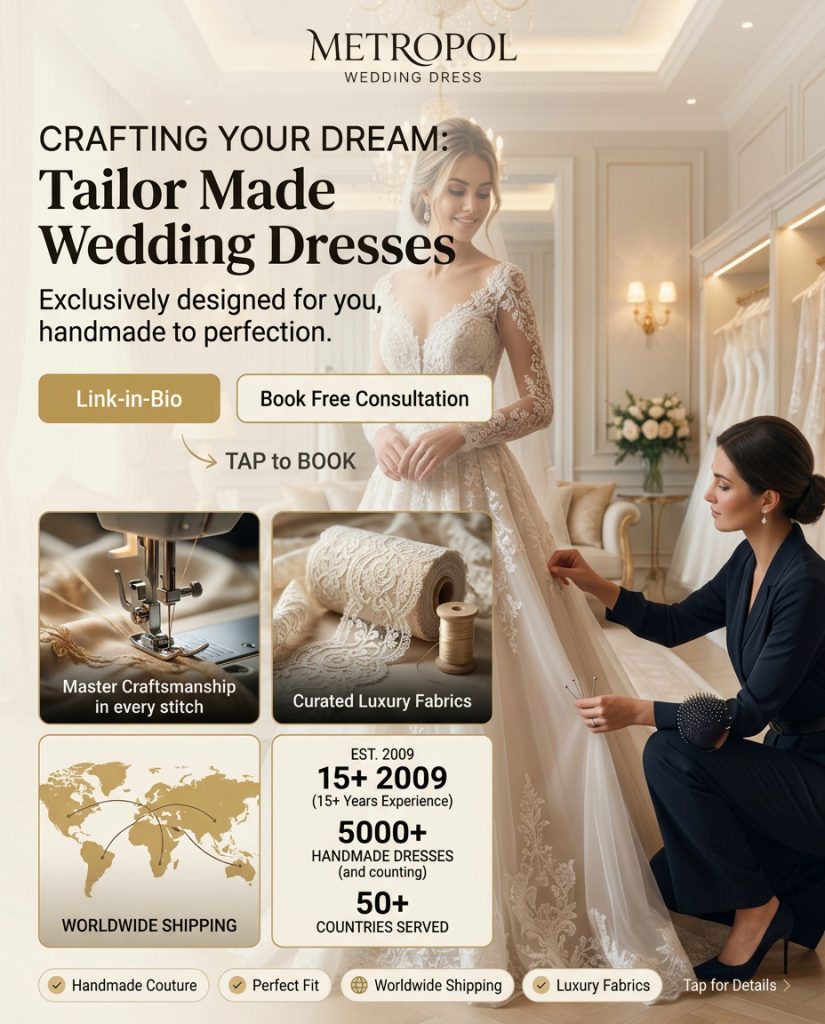
Luxury Wedding Dresses Manufactured in Turkey A luxury wedding dress is more than an elegant garment. It is the result of thoughtful design, carefully selected materials, advanced pattern development, skilled craftsmanship, and an understanding of how a bride wants to feel on one of the most important days of her life.
Turkey has become an increasingly interesting destination for international bridal businesses seeking distinctive wedding dress designs, sophisticated workmanship, flexible manufacturing opportunities, and access to established textile and garment production expertise.
From intricately embroidered ball gowns and romantic A-line silhouettes to contemporary minimalist bridal dresses and couture-inspired creations, Turkish bridal manufacturing offers opportunities for retailers, bridal boutiques, wholesalers, and international fashion brands.
Metropol Wedding Dress represents an opportunity to explore the world of Turkish bridal fashion through a business-focused approach to luxury wedding dresses, design variety, craftsmanship, and international sourcing.
Whether you are a bridal boutique owner looking to expand your collection, a distributor searching for new designs, or a fashion entrepreneur developing a private-label bridal brand, choosing the right manufacturing partner is an important commercial decision.
The real value of a luxury bridal supplier is not simply the appearance of a dress. It is the ability to bring a design concept to life, maintain consistency across orders, understand the expectations of different markets, and create products that customers genuinely want to wear.
This guide explores why Turkey deserves attention as a bridal manufacturing destination, what defines a genuinely luxurious wedding dress, how professional buyers should evaluate manufacturers, and what international businesses should consider before starting a sourcing relationship.
1. Why Luxury Wedding Dresses Manufactured in Turkey Deserve International Attention
The international bridal industry operates differently from many other fashion categories.
A wedding dress is rarely an ordinary seasonal purchase. It carries emotional significance, requires careful fitting, and often involves a considerable purchasing decision. Brides expect the garment to look exceptional, feel comfortable, photograph beautifully, and reflect their personal style.
For retailers, the challenge is equally significant. A bridal boutique must offer designs that attract attention, fit its customer profile, support appropriate retail margins, and maintain a consistent level of quality.
This is where Turkish bridal manufacturing becomes particularly relevant.
Turkey has an established textile and apparel production ecosystem, with experience in fabric sourcing, garment construction, embroidery, embellishment, and export-oriented manufacturing.
According to an Anadolu Agency report based on Turkish Statistical Institute data, Turkey exported approximately 23,300 wedding gowns in 2023, representing an export value of around $3.7 million. Germany was the largest destination by unit volume in the reported period.
These figures illustrate the international commercial presence of Turkish wedding dress production, although they should not be confused with the entire Turkish bridal industry’s economic value.
For international buyers, the more important question is what this manufacturing environment can offer in practical terms.
A manufacturing culture built around textiles
Turkey’s textile and clothing sector connects multiple stages of garment production.
Depending on the supplier and its production network, buyers may gain access to:
- Fabric and lining suppliers.
- Lace and embroidery specialists.
- Beadwork and embellishment workshops.
- Pattern-making professionals.
- Experienced garment technicians.
- Cutting, sewing, and finishing operations.
- Packaging and export logistics providers.
The availability of these resources can make Turkey an attractive location for developing bridal collections that require multiple specialized processes.
However, buyers should distinguish between a manufacturer with direct control over its production and a trading company that coordinates orders through external workshops.
Both business models can be legitimate. The important consideration is transparency.
A balance between traditional craftsmanship and contemporary fashion
Turkish bridal fashion combines several aesthetic influences.
Some collections reflect European-inspired elegance, while others incorporate more decorative silhouettes, elaborate lace arrangements, and statement embellishments.
This diversity is commercially useful.
A bridal boutique serving customers who prefer understated sophistication may need a completely different assortment from a retailer whose clientele loves dramatic skirts, sparkling details, and elaborate bodices.
A manufacturer should therefore be evaluated not only by the beauty of individual samples but also by its ability to understand the intended customer.
Proximity to international markets
Turkey’s geographical position provides access to European, Middle Eastern, and other international trade routes.
For European buyers, the established EU–Türkiye Customs Union is an important consideration. The arrangement covers qualifying industrial products, subject to applicable rules and documentation. It should not be interpreted as an automatic exemption from every customs requirement or as proof that every shipment qualifies.
Importers must verify the correct product classification, customs status, origin requirements, and documentation for their particular shipment.
For bridal businesses, this makes supplier selection and export preparation part of the same purchasing decision.
2. What Actually Makes a Wedding Dress Luxurious?
Luxury is frequently used in bridal marketing, but the word should represent measurable product characteristics rather than simply a higher price or an elaborate appearance.
A dress may look impressive in a photograph and still disappoint when a bride tries it on.
True luxury is experienced through the combination of visual design, material quality, construction, fit, movement, and finishing.
At Metropol Wedding Dress, the opportunity for a buyer should be approached through these fundamental product evaluation criteria.
2.1 Fabric quality: The foundation of the silhouette
Fabric determines how a wedding dress behaves.
It influences the structure of the skirt, the appearance of the bodice, the movement of the garment, and the way the dress responds to lighting and photography.
Different materials create different design possibilities.
Mikado
Mikado is often selected for structured bridal designs. Its relatively firm hand and elegant surface make it suitable for architectural silhouettes, structured skirts, and contemporary ball gowns.
Silk satin
Silk satin can create a smooth, fluid appearance with a refined sheen. Its drape makes it particularly attractive for minimalist and sophisticated bridal styles.
Duchess satin
Duchess satin is associated with structured, formal bridal silhouettes. It can provide body and definition while maintaining a luxurious visual character.
Tulle
Tulle is widely used for layered skirts, soft volume, illusion details, and romantic designs. Its weight, stiffness, and construction influence the final silhouette.
Organza
Organza offers a lightweight, crisp quality that can create volume without the visual heaviness of denser fabrics.
French lace and embroidered lace
Lace contributes texture, pattern, and decorative identity. It can be used for sleeves, bodices, overlays, trains, and all-over designs.
The term French lace should be used accurately. Buyers should request the actual material specification and country of origin rather than assuming that a lace design is French-made simply because it has a French-inspired appearance.
Fabric evaluation table
| Material | Visual character | Typical bridal application | Purchasing consideration |
|---|---|---|---|
| Mikado | Structured, refined | Ball gowns, A-line dresses | Weight and crease behavior |
| Silk satin | Fluid, luminous | Minimalist gowns | Fiber composition and care |
| Duchess satin | Formal, substantial | Structured silhouettes | Recovery and surface consistency |
| Tulle | Light, airy | Layered skirts and veils | Softness, stiffness, snagging |
| Organza | Crisp, transparent | Volume and overlays | Transparency and handling |
| Lace | Textured, decorative | Bodices, sleeves, trains | Motif consistency and attachment |
A professional buyer should ask for fabric composition, usable width, care instructions, color availability, and any relevant test documentation.
A beautiful fabric name is not a technical specification.
2.2 Embroidery and embellishment: The details customers remember
Luxury bridal designs often depend on details that require considerable attention during production.
Examples include:
- Hand-applied floral lace motifs.
- Three-dimensional floral embroidery.
- Delicate pearl arrangements.
- Crystal embellishments.
- Sequined surfaces.
- Beaded bodice patterns.
- Appliqué lace placement.
- Fine decorative stitching.
The important distinction is between visual density and actual workmanship.
A heavily embellished dress is not automatically superior to a minimalist design.
For example, a clean satin gown may require exceptional pattern accuracy and construction precision to achieve its intended appearance. A lace-covered dress may demand careful motif alignment, balanced placement, and secure attachment.
Buyers should inspect the reverse side of embellished areas as well as the front.
Loose threads, uncomfortable internal finishes, poorly secured beads, and uneven decorative placement can reduce both product quality and customer satisfaction.
2.3 Construction quality: What happens beneath the fabric
The inside of a luxury wedding dress matters just as much as its exterior.
A well-designed bridal garment may include:
- Structured internal bodice construction.
- Boning where appropriate to the design.
- Securely finished seams.
- Suitable lining materials.
- Carefully constructed closures.
- Balanced skirt support.
- Reinforced stress points.
- Clean internal finishing.
The exact construction should be appropriate for the silhouette and intended fit.
For example, a strapless ball gown requires a different support strategy from a lightweight slip dress.
A buyer should therefore assess construction according to the design rather than applying one checklist indiscriminately to every wedding dress.
2.4 Fit and movement: Luxury must be comfortable
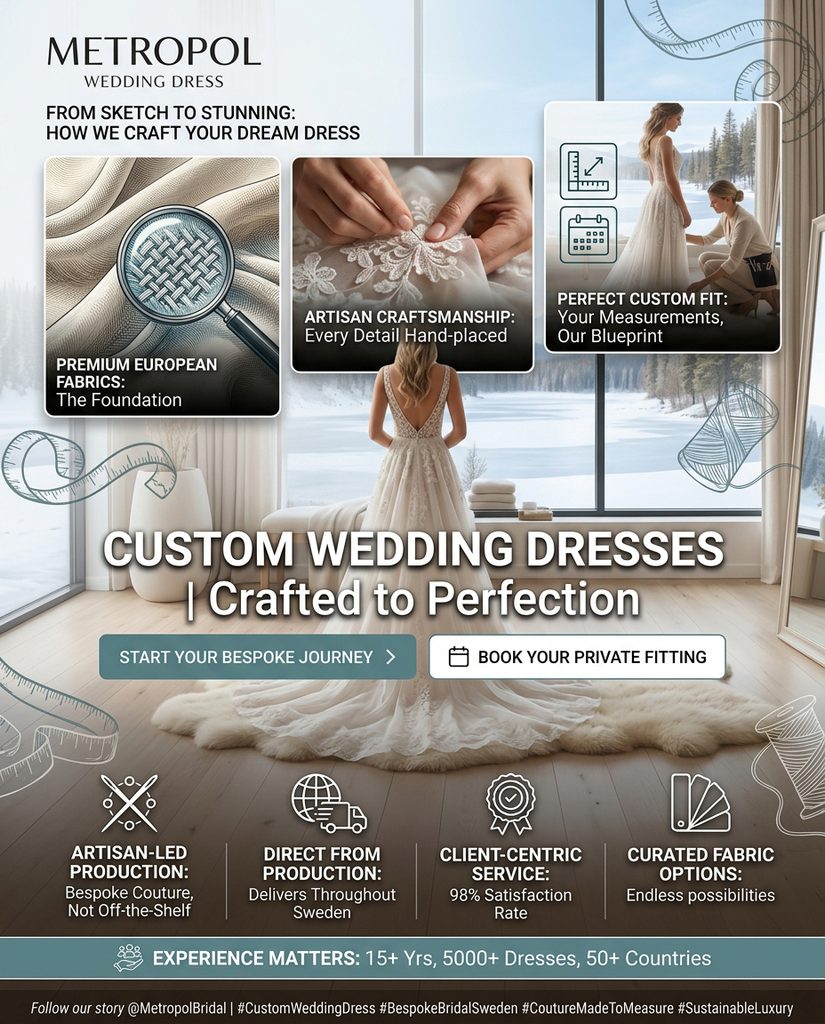
A wedding dress is worn while walking, sitting, standing, posing, dancing, and interacting with guests.
A garment that looks beautiful in a stationary photograph but restricts movement may create a disappointing experience.
Important fit considerations include:
- Bust support.
- Waist placement.
- Hip ease.
- Armhole comfort.
- Sleeve mobility.
- Train handling.
- Weight distribution.
- Closure accessibility.
- Hem clearance.
The bride should feel supported without feeling unnecessarily restricted.
For retail buyers, this is particularly important because fitting-room experience directly influences purchasing confidence.
3. Understanding the International Market for Luxury Bridal Fashion
A successful bridal collection is not simply a group of attractive dresses.
It is a carefully selected assortment designed around the expectations of a particular market.
A distributor serving several countries may need a different product strategy from an independent boutique serving one city.
The same design can also perform differently depending on local preferences, retail positioning, wedding traditions, climate, and customer purchasing behavior.
European bridal markets
Many European bridal boutiques offer a combination of minimalist, romantic, contemporary, and classic designs.
Common collection directions include:
- Clean satin wedding dresses.
- Refined A-line silhouettes.
- Romantic lace gowns.
- Structured contemporary ball gowns.
- Detachable sleeves and overskirts.
- Lightweight dresses for destination weddings.
Buyers should not assume that European customers all prefer minimalism. Regional tastes and individual boutique identities vary considerably.
A strong collection provides enough design variety without losing its overall identity.
Middle Eastern bridal markets
In many Middle Eastern bridal retail environments, statement designs and elaborate detailing have an important place.
Potential collection directions include:
- Dramatic ball gowns.
- Detailed lace bodices.
- Embellished sleeves.
- Full skirts and long trains.
- Intricate beadwork.
- Modest designs with sophisticated coverage.
- Customizable neckline and sleeve options.
However, these preferences should be validated with actual retail customers rather than treated as universal regional rules.
A retailer should consider the expectations of its target clientele, including modesty preferences, event traditions, and local styling conventions.
North American bridal markets
The North American bridal market includes a wide range of customer preferences and retail models.
Some boutiques focus on modern minimalist gowns, while others specialize in romantic couture-inspired designs, plus-size collections, or destination wedding dresses.
Retail buyers may prioritize:
- Consistent sizing.
- Reliable production communication.
- Clear sample specifications.
- Predictable delivery planning.
- Detailed product photography.
- Size-inclusive assortment planning.
- Transparent return and alteration policies.
For wholesalers, product consistency and repeat-order capability can be especially important.
The destination wedding segment
Destination weddings create additional opportunities for specialized bridal collections.
A bride getting married on a beach, in a historic European venue, or at a luxury resort may have different practical requirements.
For example:
| Wedding setting | Possible product direction |
|---|---|
| Beach wedding | Lightweight fabrics and manageable trains |
| Garden wedding | Floral lace and soft silhouettes |
| Historic venue | Classic ball gowns and structured designs |
| Luxury hotel | Refined satin and sophisticated detailing |
| Outdoor summer wedding | Breathable construction and lighter layers |
| Formal evening ceremony | Dramatic silhouettes and statement finishes |
The best product is not necessarily the most elaborate one. It is the design that matches the occasion and the bride’s expectations.
4. The Bridal Collection Architecture: Buying More Intelligently
One of the most common mistakes made by bridal retailers is purchasing a collection based entirely on personal taste.
A boutique owner may love dramatic princess dresses, but the store’s customer base may prefer clean, understated designs.
A successful assortment requires a commercial structure.
Instead of choosing every dress individually, consider building a collection around several clearly defined product groups.
Group A: Timeless classics
These designs provide continuity and appeal to brides seeking traditional elegance.
Potential styles:
- Classic A-line gowns.
- Traditional ball gowns.
- Lace wedding dresses.
- Long-train bridal designs.
- Structured bodice dresses.
Group B: Modern luxury
This segment serves customers looking for contemporary sophistication.
Potential styles:
- Minimalist satin gowns.
- Architectural silhouettes.
- Square-neck wedding dresses.
- Clean strapless designs.
- Modern fitted bridal dresses.
Group C: Romantic statement pieces
These dresses attract attention through texture, softness, and decorative detail.
Potential styles:
- Three-dimensional floral gowns.
- Layered tulle designs.
- Romantic lace dresses.
- Floral appliqué bodices.
- Soft illusion sleeves.
Group D: Fashion-forward bridal designs
This category helps a boutique develop a distinctive visual identity.
Potential styles:
- Detachable overskirts.
- Convertible sleeves.
- Contemporary corsetry.
- Asymmetrical details.
- Two-piece bridal looks.
- Transformable ceremony-to-reception designs.
Group E: Market-specific products
This group addresses particular customer requirements.
Depending on the market, it may include:
- Modest wedding dresses.
- Extended-size options.
- Custom-length designs.
- Long-sleeve bridal gowns.
- Lightweight destination dresses.
- Special-order color variations.
Commercial insight: A balanced collection should not simply contain many different designs. Each design should have a defined role within the retailer’s assortment.
5. How Luxury Wedding Dresses Are Developed and Manufactured
Understanding production is one of the most effective ways for an international buyer to evaluate a bridal manufacturer.
The manufacturing process should connect creative design decisions with technical execution.
Although the exact workflow varies between manufacturers, a professional bridal production process generally includes several stages.
Stage 1: Design development
The process begins with a design concept.
This may originate from:
- An original designer sketch.
- A seasonal bridal collection.
- A reference silhouette.
- A buyer’s specification.
- An existing sample requiring modification.
- A private-label design brief.
At this stage, the design must be translated into practical garment requirements.
A sketch alone is rarely sufficient for accurate production.
Useful information includes:
- Front and back design views.
- Fabric references.
- Lace placement.
- Embellishment requirements.
- Sleeve and neckline specifications.
- Closure details.
- Skirt construction.
- Train length.
- Size specifications.
Stage 2: Pattern development
Pattern development converts the design into garment components.
The pattern must account for the intended silhouette, construction, fabric behavior, and size requirements.
A ball gown and a fitted mermaid dress have very different technical demands.
Pattern accuracy is especially important for wedding dresses because the garment may contain several layers, internal structures, and decorative components.
Stage 3: Material selection
Fabric and trim selection should be completed before production begins.
The manufacturer and buyer should agree on the materials that will define the final garment.
This includes the outer fabric, lining, lace, thread, closures, decorative elements, and internal support components.
Material substitutions should not be made without approval when they affect the product specification.
Stage 4: Sample development
A sample provides the first practical opportunity to evaluate the design.
The buyer should assess:
- Overall silhouette.
- Fabric appearance.
- Construction.
- Fit.
- Embellishment quality.
- Internal finishing.
- Comfort.
- Movement.
Photographs are useful, but they cannot replace physical inspection when fit and material behavior are important.
Stage 5: Fitting and corrections
The sample may require adjustments before it is approved.
Corrections should be documented clearly.
For example:
- Adjust the waist position.
- Modify the neckline depth.
- Improve bust support.
- Change sleeve proportions.
- Refine the skirt volume.
- Correct lace placement.
- Adjust train construction.
The final approved sample should become the reference for production.
Stage 6: Cutting and garment assembly
Once the design and materials are approved, production can move into cutting and assembly.
Accuracy is important because even small differences in fabric handling, component placement, or seam construction can affect the finished silhouette.
Stage 7: Embellishment and finishing
Depending on the design, decorative work may be completed during or after garment assembly.
The process may include embroidery, lace attachment, beadwork, crystal placement, button installation, and finishing details.
The production sequence should minimize the risk of damage to delicate materials.
Stage 8: Quality control
Quality control should examine both the visual appearance and the functional performance of the dress.
A useful inspection framework includes:
- Design conformity.
- Measurement accuracy.
- Fabric consistency.
- Seam quality.
- Embellishment security.
- Closure functionality.
- Internal finishing.
- Cleanliness.
- Packaging condition.
- Final order documentation.
Stage 9: Packing and export preparation
Bridal dresses require careful handling.
The packaging method should reflect the garment’s construction, fabric sensitivity, embellishments, and transportation requirements.
Before dispatch, the buyer should confirm the commercial invoice, packing list, shipment details, product descriptions, and any destination-specific documents.
6. Private Label and OEM Wedding Dress Manufacturing
For fashion entrepreneurs and established bridal retailers, private-label production can be an effective way to create a distinctive market position.
Rather than selling products under another company’s brand, a business may develop its own bridal identity and commission manufacturing according to an agreed specification.
Two terms are particularly important.
OEM – Original Equipment Manufacturing
In an OEM arrangement, a buyer commissions a manufacturer to produce garments according to the buyer’s design or technical specifications.
The precise responsibilities for design, materials, development, production, and intellectual property should be defined in the contract.
Private-label manufacturing
Private-label production generally refers to products manufactured for sale under the buyer’s brand.
The level of customization can vary. Some arrangements involve existing designs with branding changes, while others require new product development.
What should a private-label agreement include?
A professional agreement should address:
| Area | What should be agreed |
|---|---|
| Design ownership | Who owns original sketches and developed designs? |
| Pattern ownership | Who may retain and reuse production patterns? |
| Materials | Which fabrics and trims are approved? |
| Sampling | How many sample revisions are included? |
| Measurements | Which measurement chart applies? |
| Branding | Labels, tags and packaging specifications |
| Minimum order | Quantity and style requirements |
| Pricing | Unit price, currency and payment terms |
| Quality | Approved sample and inspection standards |
| Delivery | Production milestones and dispatch terms |
| Exclusivity | Whether any designs are market-exclusive |
| Defects | Remedies for non-conforming products |
A verbal agreement is not a substitute for a written production specification.
Protecting bridal design identity
Design originality is particularly important in luxury bridal fashion.
Before sharing proprietary designs, buyers should consider:
- Written confidentiality agreements.
- Clear intellectual property clauses.
- Ownership of original sketches.
- Ownership of patterns and grading files.
- Restrictions on unauthorized reproduction.
- Approved use of brand names and logos.
- Written permission for photography and portfolio use.
The appropriate legal protections depend on the countries involved and should be reviewed by qualified legal advisers.
For Metropol Wedding Dress, international buyers interested in private-label cooperation should establish the precise production model, available customization options, and contractual responsibilities before placing a commercial order.
7. The Buyer’s Guide: How to Evaluate a Turkish Wedding Dress Manufacturer
Choosing a manufacturer is not the same as choosing a dress.
The sample may look exceptional, but the business relationship must also work operationally.
A professional sourcing decision should examine five dimensions.
7.1 Product capability
Can the supplier produce the styles that match your market?
A manufacturer specializing in minimalist satin dresses may not have the same production strengths as one focused on intricate embroidery.
Ask to see examples of work that are relevant to your intended collection.
7.2 Technical understanding
Can the supplier understand and interpret garment specifications?
This is important for custom designs, repeated orders, and private-label projects.
Ask how measurement charts, sample corrections, fabric substitutions, and approved specifications are documented.
7.3 Production transparency
A reliable supplier should be able to explain its production arrangements.
Questions worth asking include:
- Which operations are performed in-house?
- Which operations are subcontracted?
- Who is responsible for final inspection?
- How are production changes approved?
- How are delays communicated?
- How are defective products handled?
The objective is not to demand that every process happen under one roof. It is to understand who is accountable for the final product.
7.4 Commercial suitability
A manufacturer must also fit the buyer’s commercial model.
Evaluate:
- Wholesale pricing.
- Sample costs.
- Minimum order quantities.
- Payment conditions.
- Currency exposure.
- Packaging costs.
- Shipping arrangements.
- Reorder conditions.
- Expected retail positioning.
The lowest quotation is not necessarily the most economical offer.
7.5 Communication and responsiveness
Bridal production requires detailed coordination.
A supplier that understands measurements but communicates poorly may create significant operational difficulties.
Before committing to a large order, evaluate how the company handles a complete sample-development conversation.
The quality of communication during sampling can provide useful insight into the likely quality of the wider business relationship.
8. Quality Control: The Difference Between an Attractive Sample and a Reliable Collection
In bridal retail, product inconsistency can be particularly costly.
A customer may purchase a dress months before the wedding. The boutique must have confidence that the final garment will match the approved design and specifications.
For this reason, quality control should be established before mass production.
The approved sample principle
An approved sample should be treated as the physical reference for the order.
The buyer and manufacturer should record:
- Fabric type and composition.
- Color reference.
- Lace and appliqué placement.
- Embellishment details.
- Construction details.
- Measurement specifications.
- Lining and support structure.
- Approved finishing.
- Packaging requirements.
If a material becomes unavailable, the replacement should be evaluated and approved before it is used.
A practical bridal inspection checklist
| Inspection point | What to examine |
|---|---|
| Silhouette | Does the dress match the approved design? |
| Measurements | Are the agreed dimensions within tolerance? |
| Fabric | Is the material consistent with the specification? |
| Lace | Are motifs positioned correctly? |
| Beading | Are decorative elements secure? |
| Seams | Are stitching and seam finishes consistent? |
| Bodice | Is the support structure correctly constructed? |
| Closure | Does the zipper or fastening operate properly? |
| Hem | Is the length consistent with the specification? |
| Train | Is the construction and finishing correct? |
| Cleanliness | Are stains, marks and loose threads absent? |
| Packaging | Is the garment protected for transport? |
The buyer should also agree on inspection methods, sampling levels, acceptable defect criteria, and the procedure for resolving non-conformities.
9. Understanding the True Cost of Luxury Bridal Manufacturing
A wholesale quotation is only one part of the final purchasing calculation.
For international retailers, the relevant figure is the total landed cost.
A wedding dress with a lower factory price may become more expensive once alterations, freight, duties, defects, and handling are considered.
The components of landed cost
A basic purchasing model includes:
Landed Cost = Product Cost + Sampling Allocation + Packaging + Freight + Insurance + Import Duties + Customs Charges + Other Applicable Costs
The final calculation depends on the destination, shipment method, customs classification, commercial terms, and applicable taxes.
Illustrative purchasing scenario
The following figures are hypothetical and are provided only to demonstrate how a buyer can evaluate a purchasing decision.
| Cost component | Example amount |
|---|---|
| Product purchase price | $300 |
| Packaging allocation | $8 |
| Freight allocation | $18 |
| Insurance allocation | $3 |
| Customs and clearance allocation | $25 |
| Illustrative landed cost | $354 |
The actual cost must be calculated using the buyer’s shipment and import conditions.
Wholesale margin versus retail markup
These two concepts are often confused.
If a boutique purchases a dress for $354 and sells it for $708:
- Retail selling price: $708
- Cost of goods: $354
- Gross profit: $354
- Gross margin: 50%
- Markup on cost: 100%
This calculation excludes operating expenses, alterations, marketing, payment fees, rent, salaries, and other business costs.
A boutique should therefore calculate its retail pricing according to its complete business model.
Why cheaper production can become expensive
Consider two hypothetical suppliers.
| Evaluation | Supplier A | Supplier B |
|---|---|---|
| Initial product price | $280 | $315 |
| Quality consistency | Unverified | Strong sample performance |
| Documentation | Limited | Detailed specification |
| Packaging | Basic | Agreed protective packaging |
| Delivery planning | Unclear | Defined milestones |
| Defect handling | Not agreed | Written procedure |
Supplier A has the lower initial price, but the purchasing decision cannot be made responsibly without understanding the other commercial risks.
Expert purchasing principle: Compare suppliers by total commercial value, not by unit price alone.
10. International Shipping and Import Considerations
For an international bridal business, delivery is part of the product experience.
A wedding dress must arrive in a condition that preserves its appearance, construction, and commercial value.
Before ordering from Turkey, buyers should agree on the following.
Shipping method
Air freight may be suitable for urgent, high-value, or relatively small shipments.
Road freight may be practical for certain European destinations.
Sea freight can be relevant for larger consolidated shipments, although packaging, transit duration, and handling requirements should be considered carefully.
The appropriate method depends on order size, destination, delivery deadline, and budget.
Packaging requirements
The packaging should protect against:
- Crushing.
- Moisture.
- Dust.
- Abrasion.
- Embellishment damage.
- Unnecessary folding.
- Handling-related deformation.
Highly structured or heavily embellished dresses may require additional protection.
Buyers should approve packaging expectations before the order is finalized.
Customs documentation
Depending on the transaction and destination, relevant documents may include:
- Commercial invoice.
- Packing list.
- Transport document.
- Customs declaration.
- Applicable origin or movement documentation.
- Other destination-specific compliance documents.
For shipments from Turkey to the European Union, the Customs Union is relevant to qualifying industrial goods. However, the importer should verify the correct customs procedure and documentation for the actual shipment.
An A.TR movement certificate, where applicable, relates to the customs status of goods in free circulation. It should not automatically be treated as proof of preferential origin.
The buyer should consult a customs broker or trade specialist before shipment.
11. Why Turkish Bridal Manufacturing Can Be a Strategic Choice for Retailers
The most successful sourcing relationships are based on the match between the manufacturer’s capabilities and the buyer’s business objectives.
Turkey may offer advantages in several areas.
Design variety
The market includes manufacturers and workshops working across traditional, contemporary, romantic, and couture-inspired bridal aesthetics.
Textile access
An established apparel ecosystem can provide access to a broad range of materials and specialized production services.
Regional trade access
Turkey’s geographical location offers several logistical routes to European, Middle Eastern, and other international markets.
Collection development opportunities
Depending on the manufacturer, buyers may explore sample development, design modifications, and private-label arrangements.
Industry experience
Turkey has a long-established apparel manufacturing and export sector. However, the capabilities of individual bridal manufacturers still require independent verification.
These advantages do not guarantee that every supplier is suitable.
The right manufacturer is the one whose product quality, technical capabilities, communication, commercial terms, and production arrangements meet the buyer’s actual requirements.
12. Metropol Wedding Dress: A Bridal Manufacturing Partner to Evaluate for Your Next Collection
Selecting a bridal supplier is ultimately about confidence.
A buyer needs to understand the product, the production process, and the commercial relationship before making a commitment.
Metropol Wedding Dress is the brand presented on this page as a point of contact for businesses interested in luxury wedding dresses manufactured in Turkey.
For bridal boutiques, wholesalers, distributors, and fashion entrepreneurs, the starting point should be a clear conversation about collection requirements and purchasing objectives.
What should an international buyer discuss with Metropol Wedding Dress?
A productive first conversation can cover:
Collection selection
Which bridal styles are relevant to your target market? Are you interested in classic ball gowns, modern satin dresses, romantic lace designs, or statement bridal pieces?
Wholesale cooperation
What purchasing structure is available? What are the applicable minimum order quantities, pricing conditions, and reorder arrangements?
Design customization
Can an existing design be modified? Are changes to fabric, lace, sleeve details, neckline, or other design elements possible?
Private-label development
Can products be manufactured under your own brand? What are the design, pattern, sampling, labeling, and intellectual property arrangements?
International delivery
Which destinations can be served? Which shipping arrangements and export documents can be provided?
Quality expectations
How is the approved sample documented? What inspection procedures and defect-resolution terms are available?
These discussions help both sides determine whether the proposed cooperation is commercially and technically appropriate.
A better way to start a bridal sourcing relationship
Instead of requesting a large catalogue without context, prepare a short buying brief.
Include:
- Your business type.
- Your destination market.
- Your preferred bridal styles.
- Your target retail positioning.
- Your expected purchasing quantities.
- Your interest in ready designs or customization.
- Your intended delivery period.
This makes the initial conversation more productive and helps the supplier understand what you are actually trying to achieve.
13. The Future of Luxury Bridal Fashion: What Retailers Should Watch
The bridal industry continues to evolve as customer expectations, fashion trends, and retail business models change.
For manufacturers and buyers, the most important development is not simply the appearance of a new silhouette.
It is the growing demand for products that combine individual expression, practical comfort, quality, and a distinctive visual identity.
13.1 Convertible wedding dresses
Convertible designs provide multiple styling possibilities within one garment.
Examples include detachable overskirts, removable sleeves, and transformation from a formal ceremony look to a lighter reception appearance.
These designs can offer additional retail value when the construction is reliable and the transformation is easy for the bride.
13.2 Minimalist luxury
Minimalist bridal fashion continues to provide opportunities for retailers seeking timeless collections.
However, minimalist design requires precision.
Fabric quality, pattern accuracy, seam placement, and fit become particularly visible when decorative elements are limited.
13.3 Three-dimensional details
Floral appliqués, textured embroidery, and dimensional embellishments can create memorable bridal designs.
Manufacturers should pay particular attention to weight distribution, secure attachment, and comfort.
13.4 Personalization
Brides increasingly look for ways to make a dress feel individual.
Depending on the manufacturer, possible options may include neckline adjustments, sleeve variations, custom lengths, and selected embellishment changes.
Personalization should be supported by clear production specifications and pricing.
13.5 More thoughtful material selection
Retailers may also receive questions about material composition, durability, care, and sourcing.
Manufacturers that can provide accurate material information and appropriate supporting documentation are better positioned to answer these questions.
Sustainability claims should be supported by evidence. A dress should not be marketed as sustainable, organic, recycled, or environmentally certified without appropriate documentation.
14. Common Mistakes International Bridal Buyers Should Avoid
Even experienced fashion businesses can make expensive sourcing mistakes.
The following problems are particularly relevant when purchasing luxury wedding dresses internationally.
Mistake 1: Choosing a supplier only from photographs
Photographs can hide construction weaknesses and fabric differences.
Better approach: Request a physical sample and evaluate the garment in person whenever practical.
Mistake 2: Confusing decorative detail with quality
A dress covered in crystals and embroidery may still have poor internal construction.
Better approach: Inspect the inside, seams, support structure, and finishing.
Mistake 3: Ignoring the approved sample
If the reference sample is not clearly documented, disagreements may arise about what was actually ordered.
Better approach: Record the approved materials, measurements, construction, and design details.
Mistake 4: Ordering without understanding the target market
A collection that works for one boutique may not work for another.
Better approach: Study customer preferences, local competitors, and retail positioning.
Mistake 5: Comparing only wholesale prices
A low unit price does not include every import and operational cost.
Better approach: Calculate landed cost and expected gross margin.
Mistake 6: Leaving delivery expectations vague
Bridal retail is time-sensitive. A late shipment may affect customer appointments and wedding schedules.
Better approach: Agree on production milestones, dispatch deadlines, and communication procedures.
Mistake 7: Overlooking size specifications
Different measurement systems and grading practices can create fitting problems.
Better approach: Approve a detailed measurement chart and define tolerances.
Mistake 8: Assuming every supplier offers private-label services
A manufacturer may sell wholesale collections without offering OEM or customized production.
Better approach: Confirm the actual service and its commercial conditions.
Mistake 9: Ignoring intellectual property
Sharing a proprietary design without clear contractual terms can create disputes.
Better approach: Define ownership, usage rights, and confidentiality before development.
Mistake 10: Placing a large first order without testing the relationship
An attractive sample does not prove that the complete purchasing process will work.
Better approach: Begin with an appropriately sized trial order, where available, and evaluate the full process.
15. Your First Turkish Bridal Manufacturing Order: A Practical Roadmap
For a buyer who has never sourced wedding dresses from Turkey, the process can appear complicated.
A structured approach makes it easier.
Step 1: Define the commercial objective
Decide whether you are purchasing dresses for a boutique, developing a wholesale collection, building a distribution business, or creating your own bridal brand.
Step 2: Define your customer
Identify the bride you want to serve.
Consider her preferred silhouette, budget, wedding style, age range, fit requirements, and expectations regarding customization.
Step 3: Prepare a collection brief
Choose the categories you want to explore.
Avoid requesting every possible design. A focused brief helps establish a meaningful conversation.
Step 4: Evaluate the supplier
Review product samples, technical understanding, commercial terms, production transparency, and communication.
Step 5: Agree on specifications
Document fabric, color, lace, construction, measurements, labeling, packaging, and other important details.
Step 6: Approve the sample
Evaluate the actual garment and document the final corrections.
Step 7: Confirm the order
Agree on quantity, price, payment milestones, production schedule, inspection criteria, and delivery conditions.
Step 8: Monitor production
Request updates according to agreed milestones.
Changes should be communicated and approved in writing.
Step 9: Complete inspection
Verify the products against the approved specification before dispatch.
Step 10: Review the first delivery
Evaluate product quality, packaging, delivery performance, and customer feedback.
Use the findings to improve future orders.
16. Frequently Used Bridal Manufacturing Terms International Buyers Should Know
International sourcing becomes easier when buyers and manufacturers use the same technical vocabulary.
| Term | Meaning |
|---|---|
| A-line | A silhouette that gradually widens from the waist |
| Ball gown | A formal silhouette with a fitted bodice and full skirt |
| Mermaid | A fitted silhouette that flares around the knees or lower |
| Fit and flare | A fitted upper silhouette that gradually opens toward the hem |
| Mikado | A structured fabric commonly used in formal bridalwear |
| Tulle | A lightweight net fabric |
| Organza | A lightweight, crisp, sheer fabric |
| Appliqué | Decorative material attached to a base fabric |
| Boning | Internal structural support used in certain bodices |
| Train | The extended part of a wedding dress that trails behind |
| OEM | Manufacturing according to a buyer’s specifications |
| MOQ | Minimum order quantity |
| Private label | Products manufactured for sale under another company’s brand |
| Sample approval | Formal acceptance of a reference garment |
| Grading | Developing different sizes from a base pattern |
| Lead time | The period required to complete a production or delivery stage |
| Landed cost | The total cost of bringing goods to their destination |
A shared technical vocabulary reduces misunderstandings, especially when production instructions are exchanged between international teams.
17. Build a Bridal Collection That Has a Commercial Purpose
The most successful bridal collections are not necessarily the largest.
They are the collections that communicate a clear identity and provide customers with meaningful choices.
For a boutique, that may mean balancing timeless designs with contemporary statement pieces.
For a distributor, it may mean identifying a consistent assortment that can serve multiple retailers.
For a private-label brand, it may mean developing a recognizable design language that customers associate with the business.
The manufacturing partner plays an important role in turning that strategy into a physical product.
A good sourcing decision considers design, materials, construction, production management, quality control, logistics, and commercial value as connected parts of one process.
Turkey offers an established apparel manufacturing environment and an internationally active bridalwear sector. Yet the real measure of success is always the individual manufacturer’s ability to deliver the agreed product and service.
That is why international buyers should approach every supplier relationship with clear specifications, realistic expectations, and a structured evaluation process.
18. Start Your Luxury Bridal Sourcing Journey with Metropol Wedding Dress
Your next bridal collection deserves more than a random selection of attractive designs.
It deserves a thoughtful approach to product identity, craftsmanship, customer expectations, and commercial planning.
Whether you are expanding an established bridal boutique, entering the wedding fashion market, sourcing wholesale wedding dresses, or exploring private-label opportunities, the first step is understanding exactly what your business needs.
Metropol Wedding Dress invites international bridal businesses to begin that conversation.
Discuss your preferred styles, target market, collection requirements, customization expectations, and purchasing plans.
Explore whether the available bridal designs and manufacturing arrangements align with your business objectives.
Because a successful bridal collection is not simply about choosing beautiful dresses. It is about choosing the right products, the right specifications, and the right business relationship.
Frequently Asked Questions About Luxury Wedding Dresses Manufactured in Turkey
1. Why do international bridal retailers consider Turkey for wedding dress manufacturing?
Turkey has an established textile and apparel manufacturing sector, access to different fabric and embellishment resources, and an active wedding dress export industry. These characteristics make it a relevant sourcing destination for retailers seeking a variety of bridal styles and manufacturing arrangements. Individual suppliers should still be evaluated independently.
2. What types of luxury wedding dresses are manufactured in Turkey?
Depending on the manufacturer, Turkish bridal collections may include A-line dresses, ball gowns, mermaid silhouettes, fitted bridal dresses, minimalist satin gowns, romantic lace designs, embellished wedding dresses, and couture-inspired styles.
3. Are Turkish wedding dresses suitable for luxury bridal boutiques?
They can be, provided the specific manufacturer’s materials, construction, design quality, fit, and finishing meet the boutique’s standards. Buyers should assess physical samples rather than relying exclusively on product photographs.
4. Can international companies purchase wedding dresses wholesale from Turkey?
Yes. International businesses can explore wholesale sourcing from Turkish bridal suppliers. Minimum quantities, pricing, payment conditions, available collections, and shipping arrangements depend on the individual supplier.
5. What should a bridal boutique check before choosing a Turkish manufacturer?
The most important considerations include product samples, fabric specifications, construction quality, sizing accuracy, production transparency, minimum order quantities, delivery planning, quality-control procedures, and commercial terms.
6. Can a wedding dress manufacturer in Turkey produce private-label collections?
Some manufacturers offer private-label production, but this service should never be assumed. Buyers should confirm whether the supplier can produce under their brand and clarify design ownership, labeling, pattern rights, sampling, and production conditions.
7. What is the difference between OEM and private-label bridal production?
OEM generally involves manufacturing according to the buyer’s design or technical specifications. Private-label production means selling products under the buyer’s brand. A private-label arrangement may involve existing designs or customized products, depending on the agreement.
8. Which fabrics are commonly used in luxury Turkish wedding dresses?
Common bridal materials include satin, Mikado, tulle, organza, lace, chiffon, and different lining fabrics. The exact fiber composition and construction vary between products and manufacturers.
9. Are hand-embellished wedding dresses available from Turkish manufacturers?
Some Turkish bridal manufacturers and specialized workshops work with decorative techniques such as beadwork, embroidery, lace appliqué, pearls, and crystal embellishments. Buyers should ask whether the details are handmade, machine-produced, or created through a combination of methods.
10. How can an importer evaluate the quality of a luxury wedding dress?
Inspect the fabric, seams, lining, bodice construction, closure, measurements, lace positioning, embellishment security, and overall finishing. Physical sample evaluation is particularly useful for premium bridal garments.
11. Can bridal dresses be customized for different international markets?
Customization may include neckline adjustments, sleeve variations, fabric selections, skirt changes, colors, lengths, and embellishment modifications. The available options depend on the manufacturer’s technical capabilities and production arrangements.
12. Can Turkish wedding dress manufacturers produce modest bridal designs?
Some manufacturers offer long-sleeve gowns, higher necklines, additional coverage, and other modest bridal styles. Buyers should confirm the available designs and customization options directly with the supplier.
13. What is the minimum order quantity for Turkish wedding dresses?
There is no universal minimum order quantity for the Turkish bridal industry. Requirements vary according to the supplier, design, customization level, materials, and production arrangement. Buyers should request the applicable MOQ for each product or collection.
14. How long does it take to manufacture a luxury wedding dress in Turkey?
Production time depends on design complexity, fabric availability, embellishment requirements, sampling, order quantity, and the manufacturer’s current workload. Buyers should request a written production schedule rather than relying on a general industry estimate.
15. Are custom wedding dress samples important before placing a wholesale order?
Yes. A physical sample allows buyers to evaluate fit, fabric behavior, construction, embellishment, and finishing. It also provides a reference for approving future production.
16. Can bridal retailers reorder successful designs?
Repeat ordering depends on the manufacturer’s product availability, material sourcing, production arrangements, and design continuity. Buyers should ask how repeat orders are handled and whether fabrics and decorative components can be maintained across production runs.
17. What information should be included in a wedding dress purchase order?
A professional purchase order should identify the design, SKU, quantity, sizes, fabric, color, measurements, embellishments, approved sample, price, payment terms, delivery conditions, packaging requirements, and quality standards.
18. How can a buyer protect an original bridal design when working with a Turkish manufacturer?
Use written confidentiality and intellectual property agreements, define ownership of sketches and patterns, establish permitted uses, and clarify restrictions on reproduction. Legal advice may be necessary for cross-border design protection.
19. Is Turkey a convenient sourcing destination for European bridal businesses?
Turkey has established trade and transport connections with European markets. The EU–Türkiye Customs Union is relevant to qualifying industrial goods, but importers must verify the applicable customs treatment, product classification, and documentation for each shipment.
20. Does the EU–Türkiye Customs Union mean that all wedding dresses enter the EU without customs duties?
No blanket assumption should be made. The Customs Union applies to qualifying goods within its scope and is subject to customs-status and documentation requirements. Importers should verify the correct procedure for their specific products and shipment.
21. What is an A.TR certificate, and is it relevant to bridal imports?
An A.TR movement certificate may be relevant to qualifying goods moving between Turkey and the EU under the Customs Union framework. It indicates the goods’ customs status for the applicable procedure; it is not automatically proof of preferential origin.
22. What shipping methods can be used for wedding dress imports from Turkey?
Depending on the destination and shipment size, buyers may use air freight, road freight, or sea freight. The decision should consider delivery urgency, cost, packaging, transit time, and the handling requirements of delicate bridal garments.
23. How should luxury wedding dresses be packaged for international shipping?
Packaging should protect the dress from moisture, crushing, abrasion, dust, and damage to delicate embellishments. The exact solution should account for the garment’s fabric, structure, train, and decorative details.
24. What causes quality problems in wholesale wedding dress orders?
Common problems include unclear specifications, unauthorized material substitutions, incorrect measurements, inconsistent embellishment placement, insufficient inspection, and differences between approved samples and finished garments.
25. How can a bridal boutique reduce the risk of receiving inconsistent products?
Approve a physical sample, document all technical specifications, define measurement tolerances, establish inspection criteria, and require written approval for significant production changes.
26. Are minimalist wedding dresses considered luxury bridal products?
Absolutely. Luxury is not determined by the number of decorative details. Minimalist bridal dresses can demonstrate exceptional quality through precise construction, sophisticated materials, accurate fit, and carefully executed finishing.
27. What should a bridal wholesaler consider when building a collection?
A wholesaler should evaluate target markets, customer preferences, retail price positioning, product variety, size availability, design consistency, supplier reliability, and expected reorder potential.
28. How is the landed cost of an imported wedding dress calculated?
Landed cost generally includes the product price, packaging, freight, insurance, applicable import duties, customs clearance, and other relevant charges. The exact calculation depends on the destination and shipment conditions.
29. Can a manufacturer develop wedding dresses from buyer-provided sketches?
Some manufacturers offer development from buyer-provided sketches and specifications. The buyer should confirm pattern development, sampling, revisions, technical documentation, and intellectual property arrangements before starting.
30. What makes a reliable long-term bridal manufacturing relationship?
A strong relationship combines consistent product specifications, clear communication, realistic production schedules, transparent pricing, dependable quality control, documented agreements, and effective handling of problems.
31. Is it better to buy ready-made bridal designs or develop a custom collection?
Ready-made designs may be more suitable for businesses seeking a faster and simpler purchasing process. Custom development may be better for brands seeking differentiation and ownership of a distinctive product concept. The appropriate approach depends on the buyer’s strategy and resources.
32. What should a first-time international buyer request from Metropol Wedding Dress?
A buyer should begin by requesting relevant collection information, available product specifications, wholesale terms, sample conditions, minimum quantities, customization possibilities, and export arrangements. Providing a clear description of the target market and purchasing requirements will make the conversation more productive.
Discover Your Next Bridal Collection with Metropol Wedding Dress
For bridal boutiques: Explore designs that complement your store’s identity and customer expectations.
For wholesalers and distributors: Discuss collection requirements, product variety, purchasing conditions, and international supply arrangements.
For fashion entrepreneurs: Explore whether private-label and customized bridal production can support your brand strategy.
For international buyers: Start with a clear sourcing brief and evaluate the available designs, samples, and commercial terms.
For established bridal brands: Discuss product development requirements and the technical specifications needed to bring your next collection to life.
Metropol Wedding Dress – Explore Luxury Wedding Dress Manufacturing in Turkey.
Your next successful bridal collection starts with a well-informed sourcing decision.
Related Topics

13.06.2024
Wedding Dress Wholesale Best 5 Ideally, the first fitting for a wedding dress typically occurs around two to three months before the wedding date. This timing allows for any necessary alterations to be made while...

02.06.2025
Rosa Clara Wedding Dresses When it comes to wedding dresses, the choice of designer can shape the entire experience of a bride’s special day. Among the most prestigious names in bridal fashion, Rosa Clara stands...

16.08.2025
The journey to finding the perfect wedding dress culminates in the art of bridal gown fitting, a process that ensures every bride looks and feels radiant on her special day. In 2025, bridal gown fitting...

05.05.2026
Individuelle Brautmode für Deutschland Hey du, stell dir vor: Du stehst vor dem Spiegel, das Kleid sitzt wie angegossen, kein bisschen zu eng oder zu weit, der Stoff fühlt sich genau so an, wie du...
19.09.2025
Come Scegliere l Abito da Sposa Perfetto per un Matrimonio a Milano Benvenuti in questa guida completa su come scegliere l’abito da sposa perfetto per un matrimonio a Milano. Milano, la capitale della moda italiana,...

06.02.2024
An inexpensive bridal dress maker is a designer or a company that specializes in creating affordable wedding dresses for brides on a budget. These dressmakers focus on providing high-quality, stylish dresses at a fraction of...
Comments