
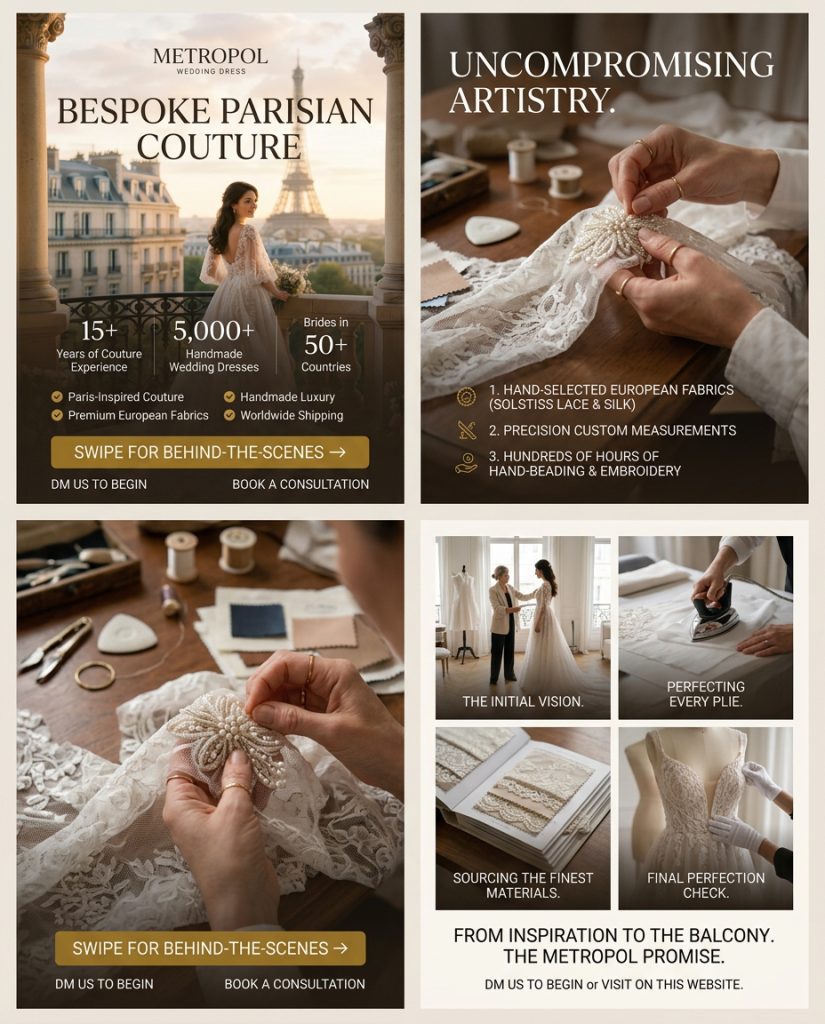
Handmade Custom Wedding Dresses Delivered to Australia It has to fit a particular body, work with a particular wedding venue, photograph well under very different lighting conditions, feel comfortable for hours, survive movement, and arrive when it is actually needed. For a bridal boutique, the requirements become even more demanding: the dress must also be commercially viable, consistently manufactured, properly packaged, and supported by a supplier who understands deadlines.
That is why choosing a manufacturer for Australia is fundamentally different from simply choosing a dress supplier.
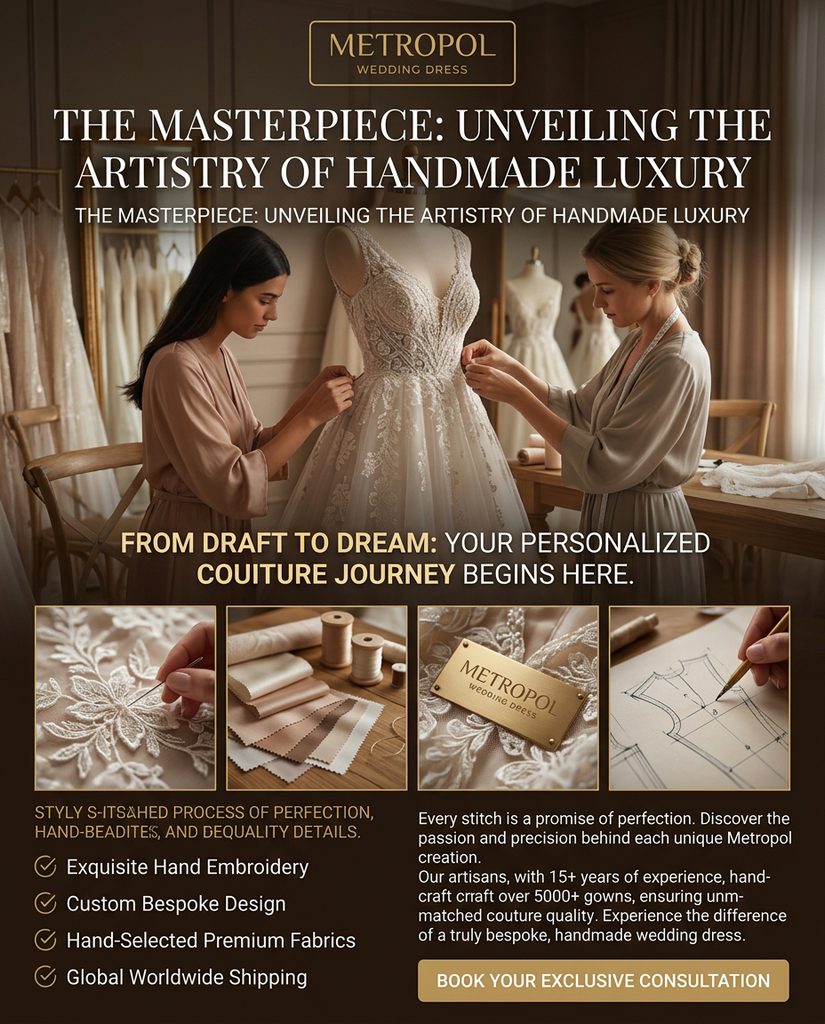
Metropol Wedding Dress works around the idea that custom bridal production should be treated as a complete process rather than a single transaction. From the first design discussion and fabric selection to pattern development, hand finishing, quality control and international delivery, every stage influences the final result.
Whether you are an Australian bride looking for a one-of-a-kind gown, a bridal shop developing a private collection, or a boutique searching for an international production partner, the same principle applies:
The best custom wedding dress is not simply the most beautiful design. It is the design that can be translated accurately into a wearable, well-constructed, properly fitted and reliably delivered garment.
This guide explains how that process works, what Australian buyers should ask before placing an order, how custom and wholesale production differ, where hidden costs can appear, and how to evaluate a wedding dress manufacturer before committing to a collection or individual gown.
Quick Overview
If you are searching for handmade custom wedding dresses delivered to Australia, there are several questions worth answering before looking at price alone.
| What you need | What to evaluate |
|---|---|
| One custom bridal gown | Pattern development, measurements, fittings and alterations |
| Bespoke luxury gown | Fabric quality, construction, handwork and design development |
| Made-to-measure dress | Measurement process, tolerance and fitting protocol |
| Wholesale collection | MOQ, repeatability, lead time and quality consistency |
| Private-label collection | Branding, labels, packaging and exclusivity |
| OEM production | Technical specifications, samples and production control |
| Australian boutique supply | Communication, delivery planning and commercial terms |
| International shipping | Packaging, documentation, transit planning and contingency |
| Complex couture design | Construction expertise, hand finishing and prototype approval |
| Time-sensitive wedding | Production schedule, inspection and delivery buffer |
For consumers, the decision is emotional.
For a boutique or purchasing manager, it is both emotional and operational.
The supplier has to deliver the right product, at the right specification, at the right time, at a commercially sensible cost.
That is the real meaning of dependable bridal manufacturing.
Start With the Outcome, Not the Dress
One of the most common mistakes in bridal sourcing is beginning with a photograph.
A buyer sees a beautiful gown and asks:
“Can you make this?”
That is only the first question.
A professional production conversation should continue with:
- What silhouette is required?
- What is the intended fit?
- What fabrics create the required structure?
- Is the design symmetrical?
- How much internal support is required?
- What type of closure is appropriate?
- Which areas require hand finishing?
- What level of beadwork is expected?
- Is the gown for one bride or a repeatable collection?
- Will the pattern be developed from measurements?
- What alterations are expected after production?
- What is the required delivery date?
- Is the dress intended for retail, wholesale or private-label sale?
These questions transform an inspirational image into a manufacturing specification.
For this reason, Metropol Wedding Dress approaches custom production as a combination of design interpretation and technical execution.
A sketch or reference photograph communicates the visual direction.
The production specification communicates how that visual direction becomes a garment.
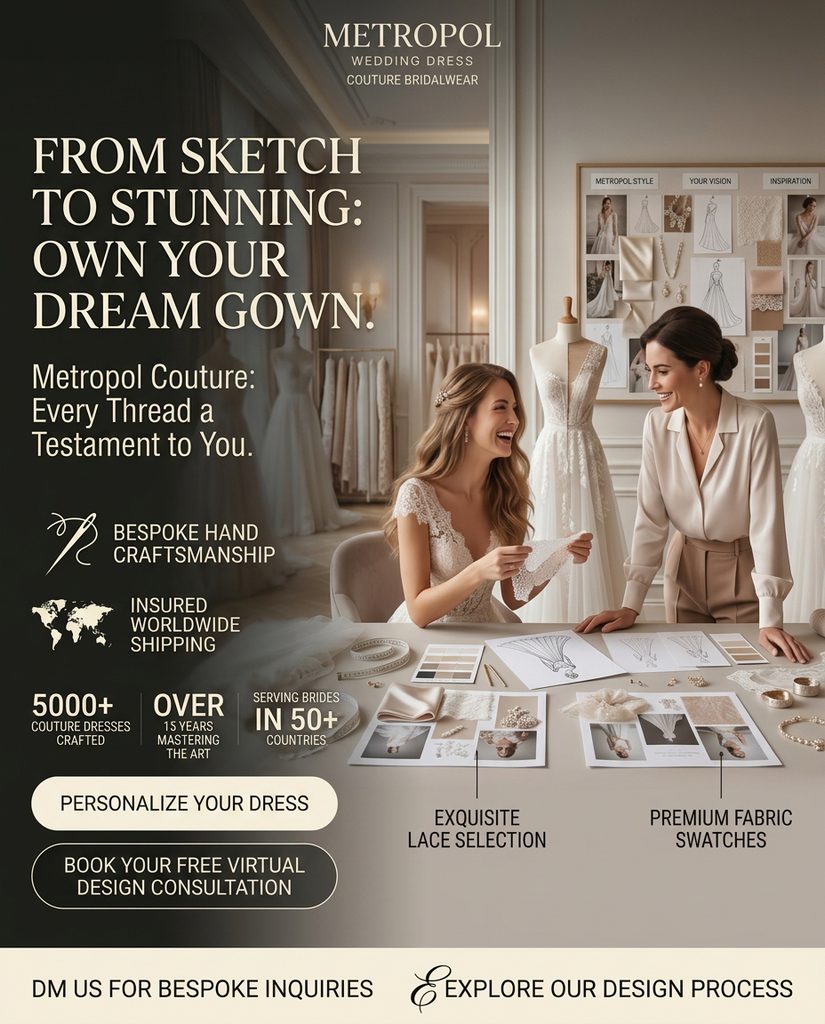
Why Custom Bridal Manufacturing Is Different From Ready-to-Wear
A ready-to-wear dress begins with an existing size system.
A custom wedding dress begins with an individual requirement.
That difference affects almost everything.
A standard garment might use a predetermined block such as a conventional size range. A made-to-measure bridal gown may instead be developed around measurements such as:
- bust circumference,
- underbust,
- waist,
- high hip,
- full hip,
- shoulder width,
- back width,
- armhole,
- hollow-to-waist,
- hollow-to-floor,
- waist-to-floor,
- desired train length,
- sleeve length,
- neckline position,
- and other measurements relevant to the design.
But measurements alone do not create fit.
Body proportion matters.
Posture matters.
Fabric behaviour matters.
Construction matters.
A structured corset gown, for example, cannot be treated like a simple soft-flowing dress. The internal architecture may include boning, cups, interfacing, lining, waist support, structured seams and carefully positioned closures.
A fluid silk-style gown creates a different engineering problem.
The fabric may require different seam handling, different ease, different lining decisions and a different approach to pressing and finishing.
That is why Made to Measure Wedding Dress Manufacturer should mean more than “we accept your measurements.”
It should imply a process capable of interpreting those measurements correctly.
The Anatomy of a Custom Wedding Dress
A sophisticated bridal gown is usually a system of interconnected components.
Think of it as a small engineered structure.
1. Outer fabric
This establishes the visual identity.
Depending on the design, it may include:
- satin,
- silk,
- crepe,
- chiffon,
- tulle,
- organza,
- lace,
- mikado,
- embroidered fabric,
- beaded fabric,
- jacquard,
- or blended textile constructions.
The same silhouette can behave completely differently depending on the selected material.
2. Lining
Lining influences comfort, opacity, movement and finishing.
A beautiful exterior can still feel disappointing if the inside of the garment is poorly considered.
3. Interfacing and stabilisation
Certain areas need additional support.
Necklines, waistbands, bodices, button areas and other structural zones may require reinforcement.
4. Internal support
This can include:
- boning,
- cups,
- waist stays,
- corsetry,
- stabilising tapes,
- structural seams,
- and internal support layers.
5. Closures
The closure system can dramatically affect both appearance and usability.
Depending on the design, a gown may use:
- concealed zippers,
- exposed zippers,
- hooks and eyes,
- buttons,
- loops,
- corset lacing,
- or combinations of these.
6. Decorative work
Hand-applied lace, pearls, crystals, appliqué, embroidery and beadwork can require significant labour.
This is where a gown can move from “custom garment” into couture territory.
Custom Does Not Automatically Mean Couture
This distinction is important for buyers.
The word custom describes how a garment is specified or produced.
The word couture can describe a much more intensive level of design development, craftsmanship, fitting and hand finishing.
A custom gown may involve:
- an existing base pattern,
- selected modifications,
- personalised measurements,
- fabric choices,
- neckline changes,
- sleeve changes,
- train adjustments,
- and personalised embellishment.
A couture-level project may involve extensive pattern development, multiple prototypes, hand-applied details and considerably more labour.
Therefore, buyers should not judge suppliers based solely on labels such as “luxury,” “couture,” or “bespoke.”
Ask what actually happens during production.
That is where the meaningful difference appears.
From Inspiration Image to Production Specification
A professional custom process should translate visual inspiration into technical decisions.
Imagine that a bride sends a photograph of a fitted gown with:
- a low back,
- sculpted waist,
- delicate straps,
- floral lace,
- a long train,
- and a soft skirt.
That image does not specify:
- exact neckline depth,
- seam placement,
- internal support,
- fabric composition,
- lace direction,
- train construction,
- closure type,
- lining,
- bust support,
- or hem treatment.
These details have to be interpreted.
A manufacturer therefore needs to establish a design translation process.
A useful production sequence
Reference image → design discussion → technical specification → fabric selection → pattern → prototype/sample → fitting review → corrections → production → inspection → packing → dispatch
This sequence is one of the most important concepts in custom bridal manufacturing.
Skipping steps may make the order appear faster.
It can also move uncertainty downstream, where corrections become more expensive.
The Australian Factor: Distance Changes the Workflow
A local bride and an international buyer face different logistical realities.
When a wedding dress crosses an international border, the production plan needs to account for more than sewing time.
The total lead time can include:
- design confirmation,
- measurement collection,
- fabric sourcing,
- pattern development,
- sample production,
- approval,
- final manufacturing,
- quality inspection,
- packaging,
- international transit,
- customs or import processing where applicable,
- final delivery,
- and possible local alterations.
This is why a wedding date should never be treated as simply a shipping deadline.
It should be treated as a project deadline.
If a bride needs the dress for a Saturday wedding, receiving the parcel on Friday is not a robust plan.
A better approach is to establish a delivery target sufficiently before the wedding date to allow inspection and, where necessary, local alteration.
Australia-Specific Planning: Import Costs and Documentation
International buyers should distinguish between the manufacturer’s price and the landed cost.
The amount paid to the manufacturer may not represent the final cost of getting the garment into Australia.
Australian Border Force states that imported goods can be subject to duties and taxes depending on the circumstances. GST on taxable importations is generally calculated at 10% of the taxable importation value, which incorporates the customs value, applicable duty and certain transport and insurance costs.
For commercial importers, additional import-processing charges can also apply depending on declaration type and consignment value.
The exact treatment of a wedding dress should therefore be checked against its tariff classification, origin, value, transaction structure and applicable concessions rather than assumed from a generic online estimate.
For businesses making recurring imports, Australian Border Force also provides a formal Tariff Advice process for classification of specific goods from a specific manufacturer.
The practical lesson
Do not build your purchasing decision around:
factory price = final cost
Instead consider:
Product cost + packaging + freight + insurance where applicable + duty/tax where applicable + customs/processing charges + local alterations + contingency = operational landed cost
This is particularly important for boutiques calculating retail margins.
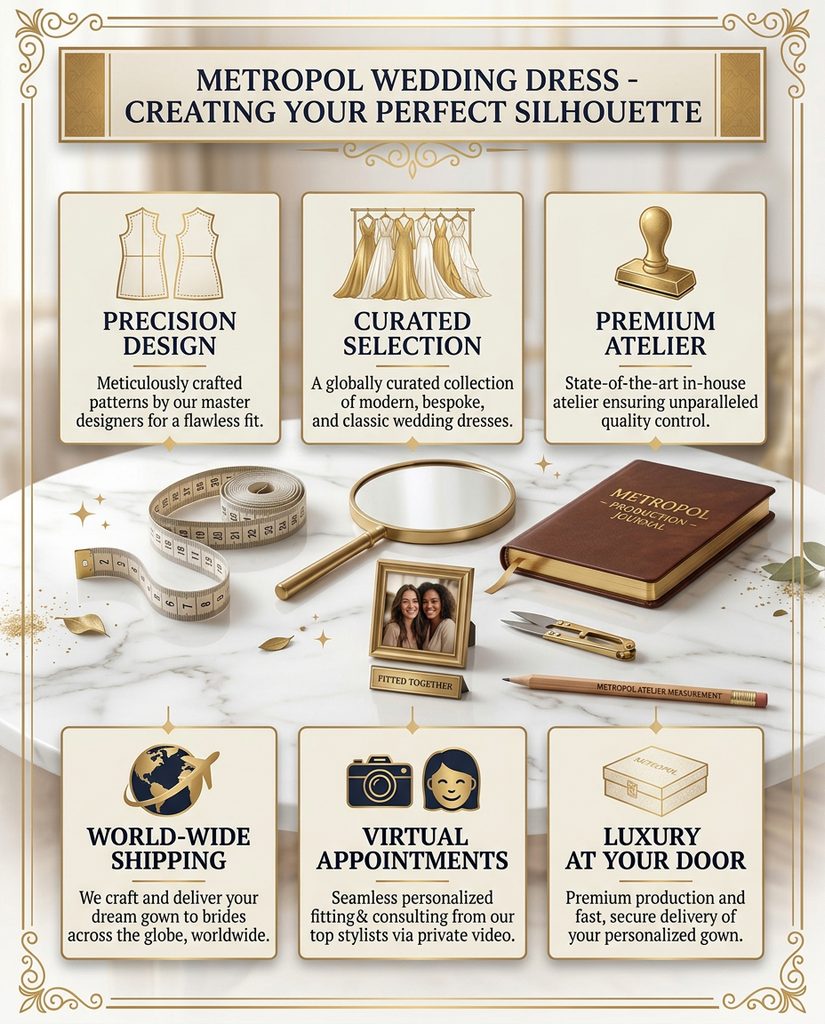
The Boutique Perspective: Why Supplier Consistency Matters
A bride purchases one dress.
A boutique may purchase ten, twenty, fifty or hundreds of gowns over time.
The commercial question changes.
The boutique is not merely buying garments.
It is buying repeatable production capability.
A supplier may produce one spectacular sample and still struggle with a collection.
A serious bridal buyer should therefore ask:
- Can the same design be reproduced?
- Can measurements be maintained across production runs?
- Are fabrics sourced consistently?
- Are embellishments repeatable?
- Can the manufacturer document specifications?
- How are approved samples archived?
- How are revisions controlled?
- What happens when a component becomes unavailable?
- How are defects identified before dispatch?
- How are urgent changes handled?
For this reason, Wedding Dress Manufacturer for Boutiques is a different proposition from an individual custom dressmaker.
The boutique needs a supply system.
Custom vs Made-to-Measure vs Made-to-Order
These phrases are frequently used interchangeably, but they can describe different processes.
| Model | Main idea | Typical buyer concern |
|---|---|---|
| Ready-to-wear | Existing size and design | Availability |
| Made-to-order | Garment produced after order | Lead time |
| Made-to-measure | Garment adjusted around measurements | Fit |
| Custom | Design and/or specifications personalised | Design flexibility |
| Bespoke | Garment developed around an individual requirement | Individualisation |
| Couture | High-touch design and craftsmanship | Construction and handwork |
| OEM | Product manufactured to another company’s specification | Technical execution |
| Private label | Manufacturer produces under buyer’s brand | Branding and commercial control |
A supplier may offer several of these models simultaneously.
The buyer’s responsibility is to identify exactly which model is being purchased.
The Language of Professional Bridal Sourcing
If you are researching suppliers, you may encounter a long list of industry terms.
A Custom Wedding Dress Manufacturer may create garments around specific customer requirements.
A Custom Bridal Gown Manufacturer may specialise in personalised bridal silhouettes and construction.
A Bespoke Wedding Dress Manufacturer generally indicates a higher degree of individual specification.
A Bespoke Bridal Gown Manufacturer may focus on highly personalised bridal development.
A Personalized Wedding Dress Manufacturer may offer modifications to an established design.
A Customized Bridal Gown Manufacturer may provide design changes, fabric alternatives or measurement-based adjustments.
A Tailor Made Wedding Dress Manufacturer emphasises individual fitting and construction.
Similarly, a Tailor Made Bridal Gown Manufacturer may work with measurements and personalised design specifications.
These labels are useful for searching.
They should not replace technical questions.
The Material Decision: Fabric Is Part of the Engineering
Two dresses can have almost identical drawings and produce completely different results.
Why?
Because fabric controls:
- drape,
- weight,
- recovery,
- opacity,
- stiffness,
- shine,
- movement,
- stretch,
- seam behaviour,
- wrinkle behaviour,
- and visual response to light.
A buyer should therefore evaluate the fabric as part of the design rather than as an afterthought.
Satin
Satin can create a clean, luxurious surface, but its smooth appearance can also make construction imperfections more visible.
Crepe
Crepe is valued for fluidity and a sophisticated drape. Different crepes behave differently, so the specific fabric matters.
Tulle
Tulle can provide volume, softness and layering. It is particularly useful for veils, overskirts, sleeves and dramatic skirts.
Organza
Organza can provide structure and architectural volume while remaining visually light.
Lace
Lace is not simply decorative.
Its motif scale, border placement, transparency and direction can change the entire appearance of a gown.
Mikado and structured silk-like fabrics
These can provide sculptural volume and crisp silhouettes.
The important question is not:
“Which fabric is most expensive?”
The better question is:
“Which fabric produces the intended behaviour for this design?”
Why Hand Finishing Still Matters
Industrial production has made bridal manufacturing more scalable.
Hand finishing remains important because some details are difficult to standardise completely.
Examples include:
- lace appliqué placement,
- beadwork,
- crystal positioning,
- hand-covered buttons,
- delicate edge finishing,
- floral appliqué,
- embroidery corrections,
- and intricate decorative transitions.
A Handmade Wedding Dress Manufacturer should therefore be evaluated by what is actually handmade, where it is done, and how quality is controlled.
“Handmade” is not a substitute for quality control.
It is one part of a quality system.
When One-of-a-Kind Makes Commercial Sense
A One of a Kind Wedding Dress Manufacturer can be particularly relevant when a boutique wants a signature gown that cannot be found across dozens of competing stores.
One-of-a-kind production can create:
- stronger visual differentiation,
- exclusive bridal experiences,
- editorial opportunities,
- higher perceived exclusivity,
- and distinctive social-media content.
However, exclusivity often requires additional design and production work.
The buyer should therefore clarify whether “exclusive” means:
- exclusive design,
- exclusive fabric,
- exclusive embellishment,
- limited production,
- geographic exclusivity,
- or simply a personalised variation.
Those are not the same commercial proposition.
Private Label: Building a Bridal Collection Behind Your Own Name
For boutiques, private label can be a powerful production model.
Instead of selling only third-party brands, a bridal shop can develop gowns under its own brand identity.
A Private Label Wedding Dress Manufacturer can potentially support:
- custom labels,
- brand-specific packaging,
- approved patterns,
- proprietary designs,
- collection development,
- size specifications,
- colour specifications,
- and repeat production.
The key is documentation.
Every approved design should ideally have a technical reference that can be used for future orders.
That can include:
- style number,
- pattern reference,
- fabric,
- lining,
- embellishment,
- measurement chart,
- construction notes,
- closure details,
- colour,
- approved sample,
- and revision date.
This turns a beautiful sample into a reproducible commercial product.
OEM Bridal Manufacturing: When the Buyer Owns the Specification
An OEM Wedding Dress Manufacturer works from the buyer’s requirements.
The buyer may provide:
- sketches,
- CAD drawings,
- samples,
- reference garments,
- technical packs,
- fabric requirements,
- measurements,
- construction instructions,
- or a combination of these.
The manufacturer then turns the specification into a physical product.
An OEM Supplier relationship is particularly useful for companies that already understand their market and want manufacturing capacity without building an entire production facility themselves.
A Bridal Gown OEM Supplier may therefore be evaluated less on public-facing fashion marketing and more on:
- technical capability,
- sampling,
- production capacity,
- quality systems,
- communication,
- confidentiality,
- lead times,
- and repeatability.
A Useful Buyer Test: “Show Me the Process”
When evaluating a manufacturer, do not ask only:
“What dresses can you make?”
Ask:
“What happens after I place an order?”
A strong answer should describe a sequence.
For example:
Stage A — Brief
The buyer provides design requirements.
Stage B — Specification
The manufacturer identifies construction, fabric and measurement requirements.
Stage C — Sampling
A prototype or sample is developed where appropriate.
Stage D — Approval
The buyer reviews the sample and confirms revisions.
Stage E — Production
The approved specification is transferred into manufacturing.
Stage F — Inspection
The finished gown is checked before packing.
Stage G — Dispatch
The garment is packaged for international transport.
This simple question can reveal more about a supplier than a gallery containing hundreds of photographs.
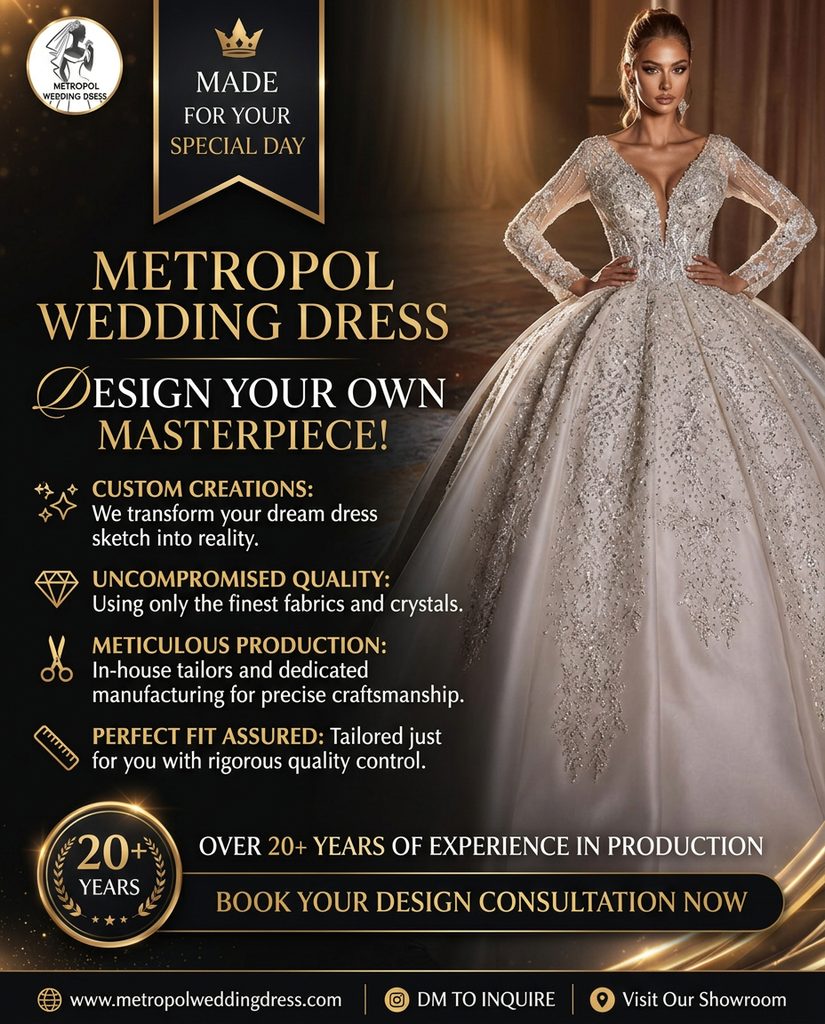
Quality Control Should Happen Before the Parcel Leaves
International shipping creates a practical problem.
Once the dress has travelled thousands of kilometres, correcting a production defect becomes considerably more complicated.
Pre-dispatch inspection should therefore consider:
Construction
- Are seams secure?
- Is the lining correctly attached?
- Are closures functioning?
- Are structural elements positioned correctly?
Appearance
- Are embellishments evenly placed?
- Is lace aligned?
- Are visible marks present?
- Is the fabric clean?
Measurement
- Does the finished garment correspond to the approved measurements?
- Are critical dimensions within the agreed tolerance?
Finish
- Are hems clean?
- Are loose threads removed?
- Are buttons and loops secure?
- Is the inside as carefully finished as the outside?
Packaging
- Is the gown adequately protected?
- Is the packaging suitable for the garment?
- Are accessories packed separately where appropriate?
This is especially important for high-value bridal orders.
The Measurement Problem: More Data Does Not Always Mean Better Fit
It is tempting to collect dozens of measurements.
More measurements can help.
But inconsistent measurement technique can create false precision.
A professional measurement process should specify:
- where the tape is positioned,
- how tightly it is held,
- whether the bride is wearing specific undergarments,
- whether shoes are worn,
- how posture should be maintained,
- and how floor length is measured.
The same person can produce different measurements depending on posture, tape tension and measuring position.
Therefore, a measurement chart should come with instructions.
For complex gowns, a local professional fitting or alteration specialist can also be valuable.
Wedding Venue Should Influence the Design
A gown is not experienced in a vacuum.
The wedding environment matters.
Consider three scenarios.
Beach wedding
A heavy multi-layer construction may create unnecessary weight and movement issues.
A lighter skirt, controlled train and breathable construction may be more practical.
Ballroom wedding
A structured silhouette, dramatic train or architectural skirt may work beautifully in a large indoor environment.
Garden or outdoor estate
The gown may need to balance visual volume with practical movement, terrain and potential exposure to moisture or dirt.
This is why a Premium Wedding Dress Manufacturer should ask questions beyond measurements.
Where is the wedding?
How will the bride move?
How long will the dress be worn?
Will there be stairs?
Will the bride sit frequently?
Will the train be bustled?
Will the ceremony and reception occur in different environments?
These details can influence construction.
Climate Is Part of the Australian Brief
Australia is geographically and climatically diverse.
A gown intended for a summer wedding in Queensland is not necessarily solving the same comfort problem as a winter wedding in Tasmania.
For warm-weather weddings, buyers may consider:
- breathability,
- lining,
- garment weight,
- sleeve construction,
- layered volume,
- and skin-contact materials.
For cooler conditions, additional layers and structured fabrics may be more comfortable.
A wedding dress can look beautiful while still being uncomfortable.
Comfort is therefore not a secondary feature.
It is part of the product specification.
The “Perfect Fit” Myth
No international manufacturer should promise that every custom dress will require absolutely no local adjustment.
Bodies move.
Measurements change.
Posture varies.
Shoes affect height.
Undergarments change proportions.
And bridal gowns often contain complex structures.
A more realistic approach is:
manufacture accurately + allow sensible fitting tolerance + inspect before the wedding + use professional local alterations where appropriate.
This is especially important for long gowns.
A few millimetres can matter at the bodice.
A few centimetres can matter at the hem.
The objective is not to eliminate professional fitting.
The objective is to make professional fitting predictable and minimal.
Custom Bridal Gown Wholesale: What Changes at Scale?
Wholesale production changes the buyer’s priorities.
A single gown can be optimised for an individual.
A collection must be optimised for consistency.
When purchasing Custom Bridal Gown Wholesale, a buyer should consider:
- minimum order quantities,
- size grading,
- colour options,
- fabric continuity,
- embellishment consistency,
- production capacity,
- packaging,
- lead times,
- repeat orders,
- replacement components,
- and defect handling.
The supplier must be able to move from creative development to repeatable production.
That is a major capability difference.
Wholesale Custom Wedding Dresses: The Collection Test
Imagine a boutique orders five different gowns.
The designs are:
- a structured ball gown,
- a minimalist crepe gown,
- a lace mermaid gown,
- a fitted satin gown,
- and a soft tulle A-line.
Each design may require different construction methods.
The supplier therefore needs more than one successful sewing technique.
The real test is whether the production team can maintain a consistent quality philosophy across different silhouettes.
This is why Wholesale Custom Wedding Dresses should be evaluated at collection level, not just sample level.
Wholesale Custom Bridal Gowns and Inventory Strategy
A boutique does not necessarily need to order large quantities of every design.
A smarter collection strategy may separate products into:
Hero gowns
Highly distinctive designs intended to create showroom impact.
Commercial gowns
Styles with broader customer appeal.
Customisation platforms
Base designs that can be modified through fabric, sleeve, neckline or train options.
Editorial pieces
Highly distinctive gowns intended to create visual identity rather than high-volume sales.
This allows a boutique to use manufacturing capacity strategically.
Custom Bridal Wear Manufacturer for Growing Boutiques
A boutique’s needs change as it grows.
A small bridal shop may initially require:
- ten samples,
- flexible quantities,
- design experimentation,
- and responsive communication.
A larger operation may require:
- production forecasting,
- standardised measurements,
- private labelling,
- packaging systems,
- repeat ordering,
- inventory planning,
- and documented quality standards.
A Custom Bridal Wear Manufacturer should therefore be capable of adapting to the buyer’s operational maturity.
From Bridal Couture to Commercial Production
The strongest bridal manufacturing partnerships often sit between two worlds.
One is creative.
The other is industrial.
Bridal Couture Manufacturer suggests design sophistication and craftsmanship.
But commercial buyers also need:
- predictable lead times,
- repeatability,
- cost control,
- production capacity,
- documentation,
- and quality consistency.
The goal is not to choose creativity over operations.
It is to connect them.
What a Technical Bridal Specification Should Contain
For a professional order, consider documenting at least:
Design identification
- style number,
- collection name,
- version number,
- approval date.
Materials
- outer fabric,
- lining,
- interfacing,
- lace,
- embellishments,
- thread,
- closure components.
Measurements
- bust,
- waist,
- hip,
- bodice length,
- skirt length,
- train,
- sleeve,
- and other design-specific dimensions.
Construction
- seams,
- boning,
- cups,
- waist stay,
- closure,
- lining,
- hem.
Decoration
- placement,
- density,
- motif direction,
- bead/crystal type,
- handwork requirements.
Packaging
- garment bag,
- folding method,
- protective layers,
- accessory packaging.
The more complex the product, the more useful this documentation becomes.
Premium Does Not Mean “Most Embellished”
A premium gown does not necessarily require thousands of crystals.
Luxury can also come from:
- exceptional fabric,
- clean pattern cutting,
- perfect seam alignment,
- controlled drape,
- restrained embellishment,
- beautiful internal construction,
- hand-finished details,
- and thoughtful proportions.
A Luxury Bridal Gown Manufacturer should therefore understand restraint as well as decoration.
In some designs, the most expensive-looking result comes from doing less—but doing it exceptionally well.
How to Compare Two Manufacturers Without Falling for Marketing
Suppose Supplier A has 500 photographs.
Supplier B has 50.
That does not tell you which has better production capability.
Instead compare the process.
| Evaluation area | Question |
|---|---|
| Sampling | Can you develop a sample before bulk production? |
| Fit | How are measurements collected? |
| Revision | How are changes documented? |
| Materials | Can fabric specifications be confirmed? |
| Production | Is the approved sample used as the reference? |
| QC | What is inspected before dispatch? |
| Packaging | How is the gown protected? |
| Lead time | Is production time separated from transit time? |
| Wholesale | Are repeat orders supported? |
| Private label | Can labels and packaging be customised? |
| OEM | Can technical specifications be followed? |
| Communication | Who handles production questions? |
This comparison is much more useful than comparing Instagram followers.
A Five-Minute Supplier Audit
Before placing an order, ask the manufacturer these questions.
Design
Can you reproduce this design from a photograph, sketch or technical pack?
Sampling
Do you provide a sample or prototype for complex designs?
Fit
How do you verify measurements?
Materials
Can you confirm the exact fabric and embellishment specifications?
Production
How do you ensure the final production matches the approved sample?
Quality
What is inspected before dispatch?
Delivery
What production time should I allow, and what shipping method is recommended?
Commercial
What is your MOQ for wholesale orders?
Branding
Can you manufacture under my own label?
Reorders
Can the same style be reproduced later?
The quality of the answers is often more revealing than the sales presentation.
Direct Manufacturer vs Trading Company
Buyers often encounter both manufacturers and intermediaries.
A Direct Wedding Dress Manufacturer can potentially provide shorter communication paths between the buyer and production team.
A Direct Bridal Gown Manufacturer may also have more control over:
- sampling,
- production scheduling,
- technical changes,
- quality inspection,
- and factory-level communication.
However, being “direct” should be verified.
Ask:
- Where does production take place?
- Who makes the sample?
- Who handles pattern development?
- Who controls quality?
- Who invoices the buyer?
- Where is the production facility?
- Who handles revisions?
The objective is transparency rather than simply a label.
International Wedding Dress Manufacturer: What International Buyers Need
An International Wedding Dress Manufacturer must operate differently from a supplier serving only a local market.
International buyers need communication that survives distance.
That includes:
- clear specifications,
- consistent terminology,
- photographs,
- measurement charts,
- approval records,
- timelines,
- shipping documentation,
- and clear responsibility for each stage.
Time-zone differences can also matter.
A small question that takes two days to resolve can become a serious problem when a wedding deadline is approaching.
Good communication is therefore part of production quality.
Wedding Dress Exporter vs Manufacturer
A Wedding Dress Exporter and a manufacturer are not necessarily the same thing.
A manufacturer controls production.
An exporter may manage international distribution.
Some companies do both.
For a buyer, the important issue is understanding the responsibility chain.
If a problem occurs, who can actually correct it?
If the dress needs a technical modification, who makes the decision?
If a fabric becomes unavailable, who approves the alternative?
A short and clear responsibility chain can reduce delays.
Bridal Gown Exporter: What Should Be Clarified?
When working with a Bridal Gown Exporter, clarify:
- origin of goods,
- commercial invoice details,
- packing information,
- shipping terms,
- responsibility for transport,
- insurance arrangements where applicable,
- and who coordinates export documentation.
For Australian commercial buyers, it is also sensible to understand the import side rather than assuming the exporter has covered every local obligation.
Australian Border Force notes that imported goods may be subject to duties and taxes and provides dedicated guidance for import costs.
A Landed-Cost Example
Consider a hypothetical boutique order.
The manufacturer charges:
AUD 4,000
Suppose the buyer also incurs:
- AUD 300 packaging and handling,
- AUD 450 international freight,
- possible duty depending on classification and applicable treatment,
- applicable GST,
- and local delivery or processing charges.
The real purchasing decision should not be based on AUD 4,000 alone.
The buyer should model the full landed cost.
Import GST is generally calculated at 10% of the taxable importation value, which can include the customs value, duty and certain transport/insurance costs.
This is why a purchasing manager should build a landed-cost spreadsheet before approving an international supplier.
A Simple Boutique Margin Model
A useful internal model is:
Landed garment cost
local alteration allowance
marketing cost allocation
showroom overhead allocation
payment/transaction costs
returns or defect contingency
=
effective commercial cost
Then compare that with the intended retail price.
This approach can reveal an important fact:
A lower factory price is not necessarily a lower commercial cost.
If the cheaper supplier creates more alterations, more defects, longer delays or greater administrative work, the apparent saving can disappear.
What Makes a Custom Dress “Worth the Money”?
A useful value equation is:
Design uniqueness + fit + construction + material quality + finishing + reliability + service
Not:
price + amount of decoration
A dress with heavy embellishment can still be poorly constructed.
A minimalist gown can require extraordinary pattern and construction skill.
For buyers, value should therefore be evaluated at product-system level.
Australian Consumer Law: An Important Business Consideration
Businesses selling goods to Australian consumers should understand that Australian Consumer Law provides consumer guarantees.
The ACCC states that products sold to consumers must meet guarantees including acceptable quality and correspondence with description, among other requirements.
The ACCC also explains that consumer guarantees are automatic and cannot simply be removed by a business’s warranty wording.
For businesses importing products into Australia, the legal position can be particularly important. The ACCC explains that, in certain circumstances, an importer may be treated as the manufacturer for consumer-guarantee purposes where the overseas maker does not have an Australian office.
This is not a substitute for Australian legal advice.
For a bridal business, however, it is a strong reason to understand the relationship between:
manufacturer → importer → retailer → consumer
before scaling an international collection.
Why “No Refund” Is Not a Complete Business Strategy
A bridal business may have specific policies concerning change-of-mind purchases, custom orders and alterations.
But policies cannot simply remove statutory consumer guarantees.
The ACCC explains that consumer remedies depend on the nature and seriousness of a problem, and that businesses cannot rely on policies that deny consumer rights where those guarantees apply.
For this reason, a boutique should distinguish between:
- change of mind,
- requested customisation,
- measurement changes,
- alteration needs,
- manufacturing defects,
- and failures to meet agreed specifications.
Clear documentation helps everyone understand the difference.
The Most Common Custom Bridal Production Mistakes
Mistake 1: Approving a photograph instead of a specification
A photograph does not contain every technical detail.
Mistake 2: Ordering too close to the wedding
International logistics require contingency.
Mistake 3: Treating measurements as self-explanatory
Measurement technique must be controlled.
Mistake 4: Ignoring internal construction
The outside appearance is only half the garment.
Mistake 5: Changing fabric after approval
Different fabrics can change the entire behaviour of a pattern.
Mistake 6: Assuming every embellishment is interchangeable
Different beads, pearls and crystals vary in weight and appearance.
Mistake 7: Not documenting revisions
Verbal changes can become production errors.
Mistake 8: Comparing suppliers only by price
A supplier’s process can have a greater effect on total cost than a small difference in unit price.
The Wedding-Date Risk Matrix
For time-sensitive bridal orders, classify risks before production begins.
| Risk | Potential effect | Preventive action |
|---|---|---|
| Measurement error | Fit issue | Standard measurement protocol |
| Fabric delay | Production delay | Confirm material availability early |
| Design ambiguity | Wrong construction | Technical specification |
| Sample revision | Schedule extension | Build revision time into plan |
| Production defect | Rework | Pre-dispatch inspection |
| Shipping delay | Late arrival | Delivery buffer |
| Customs issue | Clearance delay | Correct documentation |
| Local fit issue | Additional alteration | Allow professional fitting time |
| Damage in transit | Product loss | Appropriate packaging/insurance |
The purpose of risk planning is not to eliminate every uncertainty.
It is to prevent one small uncertainty from becoming a wedding-day crisis.
What Should Be Inside the Bridal Shipping Package?
A carefully packed gown should be treated as a delicate finished product.
Depending on the design, the shipment may include:
- protective garment packaging,
- structured folding,
- tissue or protective layers,
- detachable accessories,
- sleeves or straps,
- belts,
- bows,
- spare buttons,
- additional closures,
- care information,
- and order identification.
For boutique orders, individual pieces should also be identifiable against the purchase order.
The objective is simple:
The dress should arrive in a condition that allows the recipient to inspect, prepare and present it properly.
Care Instructions Are Part of the Product
A bridal gown may contain multiple materials that respond differently to moisture, heat, pressure and cleaning.
Care instructions should therefore be appropriate to the actual garment.
A gown with:
- lace,
- beading,
- crystals,
- structured layers,
- delicate appliqué,
- or multiple textile compositions
may require different handling from a simple unembellished gown.
The buyer should ask the manufacturer for care guidance appropriate to the finished product rather than applying a generic garment-care assumption.
The Difference Between Alteration and Manufacturing Error
This distinction matters for both boutiques and brides.
Alteration
A normal adjustment made to achieve the final fit.
Examples may include:
- shortening a hem,
- adjusting a strap,
- refining the waist,
- modifying a bust fit,
- adding a bustle.
Manufacturing error
A deviation from the agreed specification.
Examples might include:
- incorrect fabric,
- wrong colour,
- missing design component,
- incorrect construction,
- materially incorrect measurements,
- defective embellishment.
The distinction should be established from the approved specification.
Real-World Scenario: The Sydney Boutique
Imagine a bridal boutique in Sydney wants to launch a twelve-style private-label collection.
The owner initially compares three suppliers by unit price.
Supplier A offers the lowest price.
Supplier B offers the shortest advertised production time.
Supplier C provides the clearest sample-development process.
The boutique orders from Supplier A.
The first samples look attractive, but the buyer discovers:
- inconsistent measurements,
- unclear fabric substitutions,
- different lace placement,
- and limited documentation.
The unit price was low.
The management cost was not.
A better procurement process would have evaluated the supplier before bulk ordering.
The lesson is broader than bridalwear:
A supplier’s operational system is part of the product.
Real-World Scenario: The Brisbane Bride
A bride chooses a fitted custom gown with a long train.
The wedding is in six months.
Instead of treating six months as “plenty of time,” the project is divided into:
Design confirmation → measurement → material confirmation → production → inspection → international transit → fitting → final alteration → wedding
This creates visible checkpoints.
If the fabric is delayed, the problem appears early.
If the sample requires modification, the schedule can be adjusted before final production.
The bride gains something more valuable than speed:
visibility.
Real-World Scenario: The Melbourne Private-Label Brand
A Melbourne bridal business wants to launch an exclusive collection.
Instead of ordering finished dresses without technical documentation, it develops:
- style numbers,
- measurement charts,
- fabric codes,
- approved samples,
- label requirements,
- packaging instructions,
- and revision records.
The first production run becomes the foundation for future reorders.
This is how a small bridal label can gradually create an organised product system.
When to Choose Custom Production
Custom production makes sense when you need:
- design differentiation,
- individual fit,
- unusual silhouettes,
- specific fabrics,
- personalised details,
- private-label products,
- or controlled collection development.
It may be less appropriate when your priority is:
- immediate stock,
- very low unit cost,
- extremely high volume,
- or standardised commodity products.
The right production model depends on the business model.
When OEM Makes Sense
OEM is particularly relevant when the buyer already knows:
- what the product should look like,
- who the customer is,
- what price segment it belongs to,
- what materials are required,
- and how the brand should be positioned.
The manufacturer then becomes the production partner.
This can reduce the need for the buyer to build its own sewing, pattern and finishing infrastructure.
When Private Label Makes Sense
Private label can be appropriate for a boutique that wants greater control over:
- branding,
- product identity,
- collection architecture,
- customer experience,
- and long-term product ownership arrangements.
But private label should be discussed contractually.
Questions may include:
- Who owns the design?
- Can the same design be sold to other customers?
- Is geographic exclusivity available?
- Who owns the pattern?
- Can the manufacturer reproduce the style?
- How are modifications documented?
These questions are commercial rather than purely creative.
One of the Most Important Questions: Who Owns the Design?
If a boutique invests significantly in a new design, the ownership arrangement should be clear.
Possible situations include:
- Manufacturer’s existing design.
- Buyer’s existing design.
- Jointly developed design.
- Buyer-exclusive design.
- Manufacturer-developed design customised for buyer.
These categories can have very different commercial implications.
Never assume that paying for a custom sample automatically transfers every intellectual-property right.
The contract should address the intended arrangement.
What a Strong Supplier Relationship Looks Like
A healthy manufacturer relationship is not built around sending orders and waiting.
It works more like a production partnership.
The buyer communicates:
what the customer needs.
The manufacturer communicates:
what is technically possible, what needs clarification, and how the specification can be produced.
The two sides then agree on:
- design,
- materials,
- measurements,
- sample,
- timeline,
- price,
- quality standard,
- packaging,
- and delivery.
This collaborative model is particularly valuable for complex bridal products.
How Metropol Wedding Dress Can Fit Into That Process
Metropol Wedding Dress can be positioned not simply as a source of finished gowns, but as a production partner for customers who require personalised bridal manufacturing.
The potential applications include:
- individual custom gowns,
- made-to-measure bridalwear,
- bespoke collections,
- boutique supply,
- private-label development,
- OEM production,
- wholesale collections,
- and export-oriented bridal manufacturing.
For the end customer, the emphasis is personalisation.
For the boutique, the emphasis is repeatability.
For the private-label brand, the emphasis is controlled product development.
For the purchasing manager, the emphasis is reliability.
One manufacturer can therefore serve several different buying journeys—provided the production process is clearly defined for each.
A Buyer’s Specification Checklist
Before confirming a custom wedding dress, document the following.
Design
☐ Silhouette confirmed
☐ Neckline confirmed
☐ Back design confirmed
☐ Sleeve/strap design confirmed
☐ Train length confirmed
☐ Closure confirmed
Materials
☐ Outer fabric confirmed
☐ Lining confirmed
☐ Lace confirmed
☐ Embellishments confirmed
☐ Colour confirmed
Fit
☐ Measurement instructions provided
☐ Measurements checked
☐ Shoes considered
☐ Undergarments considered
☐ Desired ease discussed
Production
☐ Sample requirement confirmed
☐ Revision process confirmed
☐ Production timeline confirmed
☐ Quality inspection confirmed
Shipping
☐ Packaging confirmed
☐ Delivery address confirmed
☐ Shipping method confirmed
☐ Delivery buffer established
Commercial
☐ Price confirmed
☐ Payment schedule confirmed
☐ MOQ confirmed if wholesale
☐ Private-label requirements confirmed if applicable
The Wholesale Buyer’s Collection Checklist
For boutique purchasing teams:
☐ Define target customer
☐ Define retail price architecture
☐ Define collection size
☐ Separate hero and commercial styles
☐ Approve fabrics
☐ Approve colour palette
☐ Establish measurement standards
☐ Create style numbers
☐ Approve samples
☐ Define acceptable tolerances
☐ Define packaging
☐ Define labels
☐ Define reorder process
☐ Establish delivery calendar
☐ Calculate landed cost
☐ Establish quality inspection procedure
This turns a collection from a fashion idea into a commercial system.
The Five Questions We Would Ask Before Manufacturing Any Complex Gown
1. What must never change?
For example:
- silhouette,
- lace motif,
- neckline,
- fabric,
- or brand signature.
2. What can be adjusted?
Perhaps:
- sleeve,
- train,
- colour,
- lining,
- or embellishment.
3. What is technically difficult?
This could be:
- transparent structure,
- very low back,
- complex corsetry,
- heavy beadwork,
- or an unusually long train.
4. What is the deadline?
Not just the wedding date.
The actual production and delivery schedule.
5. What does “approved” mean?
A sample should have a defined status.
Otherwise, production can begin while everyone still has a different idea of what the final gown should be.
Why Information Gain Matters in Bridal Buying
Most bridal websites tell visitors:
“Beautiful.”
“Elegant.”
“Luxury.”
“Perfect.”
Those words are easy to write.
They do not help a buyer make a decision.
A useful bridal manufacturing page should answer questions such as:
- How is a custom design developed?
- What happens after measurements are submitted?
- How is fabric selected?
- How are revisions handled?
- How is quality checked?
- How should an Australian buyer calculate landed cost?
- What should a boutique ask an OEM supplier?
- How early should an international order be planned?
- What distinguishes custom from made-to-measure?
- What information belongs in a technical specification?
This is the information that reduces uncertainty.
And reducing uncertainty is one of the most valuable things a manufacturer can offer.
Search Intent Behind “Custom Wedding Dress Manufacturer”
Someone searching for a Custom Wedding Dress Manufacturer may not be a bride.
They could be:
- a boutique owner,
- bridal buyer,
- fashion entrepreneur,
- private-label brand,
- wedding stylist,
- designer,
- distributor,
- importer,
- or individual customer.
That means the page should not speak only to one audience.
The most useful content separates the journeys.
Individual bride
Focus:
fit + design + communication + delivery
Boutique
Focus:
quality + repeatability + MOQ + margin + delivery
Private-label brand
Focus:
development + exclusivity + branding + technical control
OEM buyer
Focus:
specification + sampling + production + QC
This segmentation is far more useful than repeating the phrase “custom wedding dress manufacturer” throughout a page.
Semantic Search: The Questions Buyers Actually Ask
Modern search behaviour increasingly happens through questions.
Examples include:
- Who can make a custom wedding dress for Australia?
- Can I order a bespoke bridal gown from overseas?
- How does made-to-measure bridal production work?
- What measurements are needed for a custom wedding dress?
- How long does an international custom gown take?
- Can a bridal boutique order private-label wedding dresses?
- Can a manufacturer reproduce my bridal design?
- What is the difference between OEM and private label?
- How much does international bridal shipping cost?
- What should I check before ordering wholesale bridal gowns?
A useful page should answer these questions naturally rather than creating dozens of thin pages that repeat the same information.
Featured-Snippet Style Answers
What is a custom wedding dress manufacturer?
A custom wedding dress manufacturer produces bridal gowns according to individual design, measurement, material or construction requirements rather than relying exclusively on standard ready-to-wear specifications.
What is a made-to-measure wedding dress?
A made-to-measure wedding dress is produced using the wearer’s specific measurements to improve fit and proportion compared with a standard size garment.
Can custom wedding dresses be shipped to Australia?
Yes. International manufacturers can ship custom bridal gowns to Australia, but buyers should plan production, international transit, customs/import requirements and sufficient time for inspection or local alterations.
Is OEM the same as private label?
No. OEM generally refers to manufacturing according to a buyer’s specifications, while private label refers primarily to products sold under the buyer’s brand. The two models can overlap.
Should an Australian boutique calculate landed cost?
Yes. The purchase price is only one component. Freight, applicable import taxes or duties, processing charges and local costs can affect the final commercial cost. Australian Border Force provides current guidance on import costs.
The Procurement Manager’s Scorecard
Instead of giving suppliers a simplistic overall ranking, a purchasing manager can assess each supplier independently across several dimensions.
Product capability
Can the supplier manufacture the required complexity?
Sampling
Can the supplier translate ideas into physical prototypes?
Fit
Is there a controlled measurement process?
Materials
Can materials be specified and repeated?
Quality
Is there a documented inspection process?
Delivery
Is the timeline realistic?
Communication
Are questions answered clearly and consistently?
Commercial
Are prices, MOQ and payment conditions transparent?
Scalability
Can the supplier support future orders?
Risk
What happens if a material, measurement or shipment problem occurs?
This method encourages evidence-based purchasing rather than relying on a single “best supplier” label.
Five Signs You Should Ask More Questions
1. The supplier gives a price before understanding the design
Complex gowns cannot always be priced responsibly from a single photograph.
2. Every design is described as “easy”
Complex bridal construction should involve technical discussion.
3. No sample process exists for complicated orders
That can increase specification risk.
4. Lead time is presented as a single number
Production time and shipping time are not the same thing.
5. Quality is described only as “high quality”
Ask what is inspected.
Specificity is more valuable than adjectives.
Five Signs of a More Mature Production Process
1. Questions come before quotation
The supplier wants to understand the garment.
2. Specifications are documented
Important details are written down.
3. Samples have revision stages
The buyer can identify what changed.
4. Production references approved information
The final garment is not made from memory.
5. Inspection occurs before dispatch
Problems are identified before international transportation.
The Role of Local Alterations in an International Model
International production does not eliminate the need for local bridal professionals.
In fact, it can create a useful division of labour.
Manufacturer
Responsible for:
- design interpretation,
- pattern development,
- garment construction,
- finishing,
- production quality.
Local bridal professional
Can handle:
- final fitting,
- hem adjustment,
- bustle,
- minor strap changes,
- local body-specific refinements.
This model can work particularly well for complex international orders.
The key is to allow enough time.
A Better Delivery Philosophy: “Arrive Early, Not Just On Time”
For ordinary clothing, late delivery is inconvenient.
For bridalwear, late delivery can become catastrophic.
Therefore, the target should not be:
arrival by wedding date.
The target should be:
arrival sufficiently before the wedding to permit inspection and necessary adjustment.
That single change in thinking can dramatically improve international bridal planning.
A Practical Timeline Framework
The exact duration depends on the design and supplier, but a project can be divided conceptually into:
Phase 1 — Design
Brief, references, measurements and specifications.
Phase 2 — Development
Fabric confirmation, pattern work and sample.
Phase 3 — Approval
Corrections and final confirmation.
Phase 4 — Production
Manufacturing and finishing.
Phase 5 — Inspection
Measurement and visual quality control.
Phase 6 — Logistics
Packaging, dispatch and international transit.
Phase 7 — Final Fit
Inspection and professional alterations if necessary.
The important point is that wedding date minus production time is not the correct planning formula.
You need to account for the complete chain.
Why a Sample Is Sometimes More Valuable Than a Discount
Suppose a buyer can choose between:
Option A: a lower price with no prototype.
Option B: a slightly higher development cost with a sample.
For a complicated design, the second option may reduce uncertainty.
A sample can reveal:
- proportion problems,
- fabric behaviour,
- neckline issues,
- support requirements,
- train volume,
- lace placement,
- and closure problems.
The sample is therefore not simply an extra cost.
It can function as a risk-control tool.
The Commercial Value of a Reusable Pattern
For a boutique or brand, a successful pattern can become an asset to the collection.
Once a design has been technically resolved, future orders may become easier.
The same base pattern might support variations such as:
- different sleeves,
- different necklines,
- alternative fabrics,
- modified train lengths,
- or different embellishment levels.
This creates a design platform rather than a single product.
For commercial bridal brands, that can be considerably more valuable than continually starting from zero.
Building a Custom Bridal Collection Around Platforms
Imagine a collection based on three core silhouettes:
Platform A — Structured
Variations:
- strapless,
- off-shoulder,
- long sleeve.
Platform B — Fluid
Variations:
- cowl neckline,
- high neckline,
- open back.
Platform C — Romantic
Variations:
- lace,
- floral appliqué,
- layered tulle.
Instead of manufacturing twelve unrelated designs, the boutique can build a coherent design architecture.
This can simplify:
- fitting,
- pattern development,
- sampling,
- material sourcing,
- and customer choice.
Premium Bridal Gown Manufacturing Is a Detail Management Exercise
Luxury bridalwear often appears effortless.
The production process is anything but effortless.
A successful gown can require dozens of decisions:
- fabric direction,
- seam position,
- lace alignment,
- internal support,
- closure placement,
- hem finish,
- train attachment,
- lining,
- embellishment density,
- and fit.
The final result looks simple because the complexity has been managed successfully.
That is the hidden craft of premium bridal manufacturing.
What a Bridal Buyer Should Never Assume
Never assume:
- the photograph specifies the design,
- the measurement chart is self-explanatory,
- the fabric is identical to the sample unless confirmed,
- shipping time equals total delivery time,
- custom means couture,
- private label automatically means exclusivity,
- OEM automatically means design ownership,
- “handmade” automatically means high quality,
- or the cheapest quotation represents the lowest total cost.
Ask.
Document.
Approve.
Inspect.
That sequence protects both sides.
The Metropol Wedding Dress Approach
For Metropol Wedding Dress, the strongest proposition is not simply the ability to produce a wedding dress.
It is the ability to connect:
design → technical development → craftsmanship → quality control → international delivery
For a bride, that means her individual requirements can be treated as a structured production brief.
For a boutique, it means the conversation can move beyond buying generic stock toward developing a differentiated bridal offering.
For a private-label company, it means the manufacturer can become part of the product-development chain.
For an OEM buyer, it means the specification can become the starting point for production.
Five Different Reasons to Work With a Custom Manufacturer
You want a dress that does not look mass-produced.
Custom production gives the design room to become personal.
You operate a bridal boutique.
You need products that differentiate your showroom.
You are launching a private label.
You need manufacturing behind your brand identity.
You already have designs.
You need a capable production partner.
You want wholesale supply without losing design control.
Custom wholesale can combine collection development with manufacturing capability.
Five CTA Paths for Different Buyers
For the Bride
Bring your vision to life.
Send your preferred silhouette, fabric ideas, measurements and wedding timeline to Metropol Wedding Dress and start a conversation about your custom gown.
For the Boutique
Build a collection around your customers—not around generic stock.
Discuss your target market, preferred silhouettes, price positioning and wholesale requirements with Metropol Wedding Dress.
For the Private-Label Brand
Your label deserves a production system behind it.
Talk to Metropol Wedding Dress about developing samples, specifications and a bridal collection under your own brand.
For the OEM Buyer
Start with your specification.
Share your technical requirements, reference samples or design concepts and explore an OEM production route.
For the International Buyer
Plan the gown around the delivery date—not the other way around.
Contact Metropol Wedding Dress with your design, destination, quantity and required timeline so the production and shipping process can be evaluated together.
What to Send When Requesting a Quote
A useful enquiry does not need to be complicated.
Include:
1. Design reference
Photograph, sketch, CAD or existing sample.
2. Quantity
One gown, small batch or wholesale collection.
3. Intended customer
Bride, boutique, private label or distributor.
4. Material preference
If already selected.
5. Measurements
Where applicable.
6. Required modifications
Neckline, sleeve, train, fabric, embellishment, etc.
7. Delivery destination
For example, an Australian city and postcode.
8. Wedding or launch date
This helps determine the project schedule.
9. Branding requirements
Private label, labels, packaging or accessories.
10. Target price range
When commercially appropriate.
The more clearly the manufacturer understands the project, the more useful the quotation can become.
FAQ: Custom Wedding Dresses Delivered to Australia
1. Can I order a handmade custom wedding dress from overseas and have it delivered to Australia?
Yes. International bridal manufacturers can produce and ship custom gowns to Australia. The project should account for production, inspection, international transportation, import requirements and enough time for any final local alterations.
2. How is a bespoke wedding dress different from a standard wedding dress?
A bespoke or highly customised gown is developed around individual requirements rather than simply selecting an existing standard size and style. The degree of customisation can range from modifications to an existing design through to extensive pattern and design development.
3. Is a made-to-measure dress the same as a custom dress?
Not necessarily. Made-to-measure primarily describes the fitting approach, while custom can also refer to design, material or construction modifications.
4. Can Metropol Wedding Dress manufacture a completely new bridal design?
A custom manufacturer can work from different forms of design information, such as references, sketches, technical specifications or samples. The exact development process depends on the complexity of the design.
5. Can a photograph be used as the basis for a custom gown?
A photograph can communicate visual direction, but it may not contain enough technical information for accurate manufacturing. Complex designs benefit from a detailed specification and, where appropriate, sample development.
6. Can I choose my own fabric?
Fabric selection can be part of a custom development process. The selected material should be evaluated for weight, drape, structure, opacity, stretch and compatibility with the design.
7. Can I change the neckline of an existing design?
Many custom production models allow design modifications. However, some changes can affect pattern construction, support and proportions, so the manufacturer should evaluate the requested modification before confirming the final specification.
8. Can I request different sleeve styles?
Sleeves can often be modified, but the change can affect the bodice, armhole and overall balance of the garment. It should therefore be treated as a construction change rather than simply an accessory change.
9. Can I order a custom wedding dress wholesale?
Yes, wholesale custom production is a common model for bridal boutiques and brands. The important commercial questions include MOQ, repeatability, lead time, quality control and landed cost.
10. Can bridal boutiques order private-label wedding dresses?
Private-label production can allow a boutique or brand to sell gowns under its own branding. Labels, packaging, design ownership and exclusivity should be discussed clearly before production.
11. What is an OEM wedding dress manufacturer?
An OEM wedding dress manufacturer produces according to specifications supplied or approved by the buyer. The specification can include design, materials, measurements, construction and branding requirements.
12. Does OEM mean the buyer owns the design?
Not automatically. Design ownership and intellectual-property arrangements should be defined in the commercial agreement.
13. Can a manufacturer produce one-of-a-kind wedding dresses?
Yes, depending on the manufacturer’s capabilities and production model. One-of-a-kind work is particularly suited to individual brides, editorial pieces and exclusive boutique designs.
14. Are handmade and couture the same thing?
No. Handmade describes production methods, while couture generally describes a broader level of design development, craftsmanship, fitting and finishing.
15. How early should I order an international wedding dress?
The answer depends on design complexity, sampling, production capacity, shipping and the wedding date. The safest approach is to plan backward from the date the gown needs to be professionally fitted, rather than from the wedding ceremony itself.
16. Should I allow time for local alterations in Australia?
For many custom gowns, allowing time for professional local fitting is sensible. It provides an opportunity to adjust hems, straps, bust fit or other details based on the bride’s actual final fitting.
17. What happens if my measurements change after ordering?
The effect depends on when the change occurs and how much the measurements differ. Early communication is important because changes can affect pattern development or production.
18. Can a bridal manufacturer reproduce the same gown for a boutique?
A repeatable manufacturing process can allow approved designs to be reproduced. For commercial collections, it is useful to maintain style numbers, specifications, patterns, material references and approved samples.
19. What is the difference between custom wholesale and ready-made wholesale?
Ready-made wholesale generally involves selecting from existing products and sizes. Custom wholesale allows the buyer greater control over design, measurements, materials or branding.
20. What should an Australian bridal boutique ask before ordering?
The boutique should ask about MOQ, sample development, measurement standards, materials, production lead time, quality control, packaging, branding, repeat orders and international logistics.
21. How should I calculate the real cost of an imported wedding dress?
Consider the manufacturer’s price together with packaging, freight, applicable duties and taxes, import processing charges and local costs. Australian Border Force provides guidance on import costs and GST for taxable importations.
22. Is import GST always the same as the manufacturer’s tax?
No. Australian import GST is calculated under Australian tax rules and is generally 10% of the taxable importation value for taxable imports. The calculation can include customs value, applicable duty and certain transport/insurance costs.
23. Are there customs duties on wedding dresses entering Australia?
The applicable treatment depends on tariff classification, origin, value and any concessions or other rules that apply. Buyers should not assume a single universal duty rate for every bridal gown. Australian Border Force publishes the tariff schedule and classification information.
24. Can a commercial importer use personal duty-free concessions?
Commercial goods should not be treated as personal accompanied baggage for duty-free purposes. Australian Border Force specifically notes that personal duty-free concessions do not apply to commercial goods.
25. Can an Australian importer obtain a formal tariff classification decision?
Australian Border Force provides a Tariff Advice process that can assist importers seeking advance classification information for specific goods from a specific manufacturer.
26. Does the Australian Consumer Law matter for bridal boutiques?
Yes. Businesses selling goods to Australian consumers need to understand Australian Consumer Law and its consumer guarantees. The ACCC states that consumer guarantees apply automatically and include requirements concerning acceptable quality and other basic rights.
27. Can a boutique simply state “no refunds” for every wedding dress?
A business policy cannot simply remove applicable consumer guarantees. The ACCC explains that remedies can apply when products fail to meet consumer guarantees and that businesses cannot use policies to deny those statutory rights.
28. Can the importer have responsibilities under Australian consumer law?
Potentially. The ACCC explains that, in certain circumstances, an importer may be treated as the manufacturer for consumer-guarantee purposes when the overseas manufacturer does not have an Australian office.
29. What should I inspect when the dress arrives?
Inspect the fabric, colour, measurements, seams, lining, closures, embellishments, train, hem and overall construction against the approved specification. Photographing the package and garment during inspection can also create a useful record.
30. What should I do if the gown arrives with a manufacturing problem?
Document the issue promptly, compare it with the approved specification, photograph the relevant areas and contact the seller or manufacturer. For Australian consumer transactions, the applicable remedy can depend on the nature and seriousness of the problem.
31. Can a manufacturer create a private-label bridal collection from my designs?
Depending on the commercial arrangement, a manufacturer may produce garments according to buyer-owned designs or specifications. Design ownership, confidentiality, exclusivity and reproduction rights should be established contractually.
32. Can I request exclusive designs for my Australian boutique?
Exclusive arrangements may be commercially possible, but “exclusive” needs a clear definition. It can refer to a particular design, territory, customer segment, period or collection.
33. How can I reduce the risk of receiving a gown that looks different from the sample?
Use a documented approval process. Confirm fabric, colour, lace, embellishment, construction and measurements before production and use the approved sample/specification as the production reference.
34. Is a cheaper manufacturer always more economical?
Not necessarily. Total commercial cost can be affected by defects, alterations, delays, freight, communication time and inconsistent repeat production. Buyers should evaluate landed and operational cost rather than unit price alone.
35. Can a custom bridal gown be both handmade and commercially scalable?
Yes, depending on the design and production system. Hand finishing can be combined with organised pattern, cutting, sewing, inspection and repeat-order processes.
36. What makes a premium bridal manufacturer different?
The distinction is best evaluated through evidence: technical capability, construction quality, materials, sample development, fitting methodology, quality control, communication and delivery management.
Final Buyer Checklist
Before approving a custom wedding dress or wholesale bridal order for Australia, ask yourself:
Do I know exactly what is being manufactured?
Has the design been translated into a usable specification?
Are the materials confirmed?
Are measurements documented correctly?
Do I know whether a sample is required?
Is there enough time for revisions?
Has quality control been defined?
Is the delivery schedule realistic?
Have I allowed time for international logistics?
Have I calculated landed cost rather than only factory price?
If I am a boutique, can the design be reproduced consistently?
If this is private label, are branding and ownership terms clear?
If this is OEM, are the technical specifications complete?
If I am importing commercially, have I considered Australian import requirements?
If I am selling to Australian consumers, do I understand my consumer-law responsibilities?
If these questions have clear answers, the project becomes substantially easier to manage.
Final Perspective: A Wedding Dress Is a Project, Not Just a Product
The most valuable shift in thinking is simple.
Do not treat a custom wedding dress as:
a picture + a price + shipping.
Treat it as:
design + measurement + materials + construction + sampling + quality control + logistics + final fitting.
That model works for an individual bride.
It works even better for a boutique.
And for a private-label or OEM business, it becomes essential.
A capable Custom Wedding Dress Factory should therefore be evaluated not merely by the gowns it displays, but by the system behind those gowns.
The same applies to a Custom Bridal Gown Factory.
A factory that can manufacture one beautiful dress has demonstrated craftsmanship.
A factory that can repeatedly manufacture approved designs, manage specifications, maintain quality and communicate clearly has demonstrated a supply capability.
For Australian buyers, the distinction matters because international distance magnifies mistakes.
A missed measurement can require international communication.
A material substitution can change the character of a gown.
A production delay can affect a wedding date.
A documentation problem can affect import processing.
A poorly protected garment can arrive needing unnecessary attention.
Good manufacturing reduces those uncertainties before they become problems.
That is the purpose of a professional bridal production partnership.
Metropol Wedding Dress: From Bridal Vision to Finished Garment
Whether you are an Australian bride planning a personalised gown, a bridal boutique searching for a reliable international production partner, or a fashion business developing a private-label collection, the first step is not choosing a dress from a catalogue.
It is defining what the finished product needs to achieve.
Share the design direction.
Clarify the measurements.
Identify the fabric.
Define the construction.
Explain the embellishment.
Set the delivery requirement.
Then build the production process around those decisions.
Metropol Wedding Dress can serve as a manufacturing partner across custom, bespoke, made-to-measure, wholesale, private-label and OEM bridal projects, with the goal of turning a visual concept into a carefully constructed finished garment.
Your Australian customer does not simply need a dress that looks beautiful on a screen.
She needs a gown that works on her body, in her venue, under real lighting, during real movement, on one of the most important days of her life.
And if you are the boutique or brand behind that experience, you need a manufacturer that understands that the responsibility extends far beyond the sewing machine.
Start with the design. Build the specification. Approve the details. Manufacture with purpose. Inspect before dispatch. Plan the delivery.
That is how an international custom bridal order becomes a dependable product rather than a gamble.
Related Topics
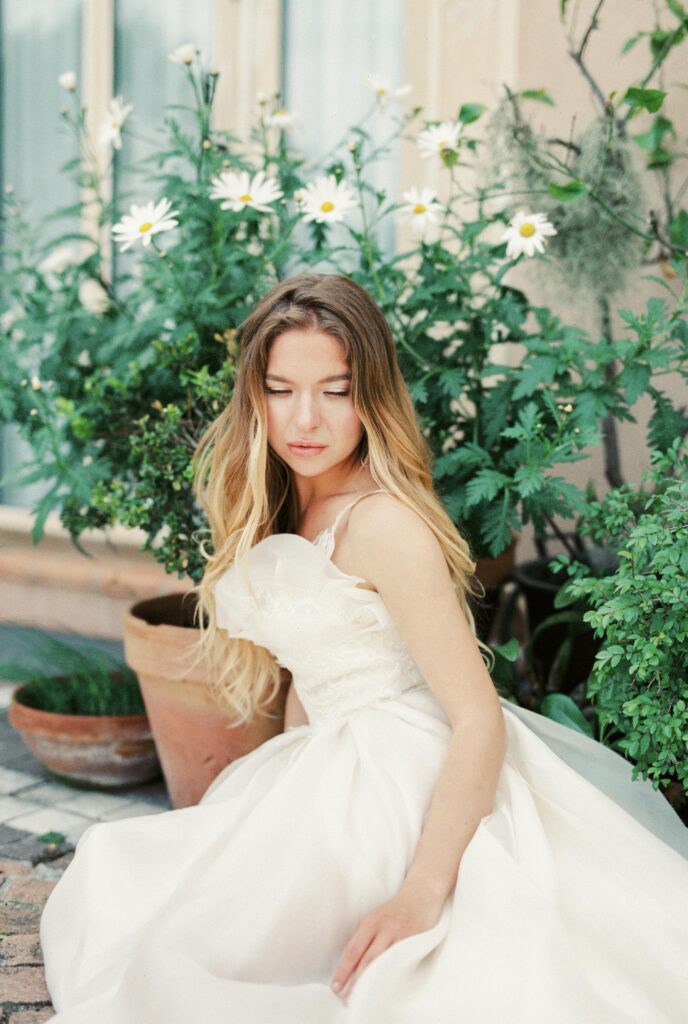
16.04.2025
Wholesale Wedding Dress Suppliers Your Source for Elegance The wedding dress industry is a vibrant and ever-evolving sector, driven by the dreams of brides seeking elegance, style, and affordability. For retailers, boutique owners, and wedding...

11.05.2025
Hijab Bridal Gowns Turkey Turkey, a country straddling Europe and Asia, is renowned for its rich cultural heritage, vibrant fashion industry, and unique blend of modernity and tradition. In recent years, the demand for hijab...
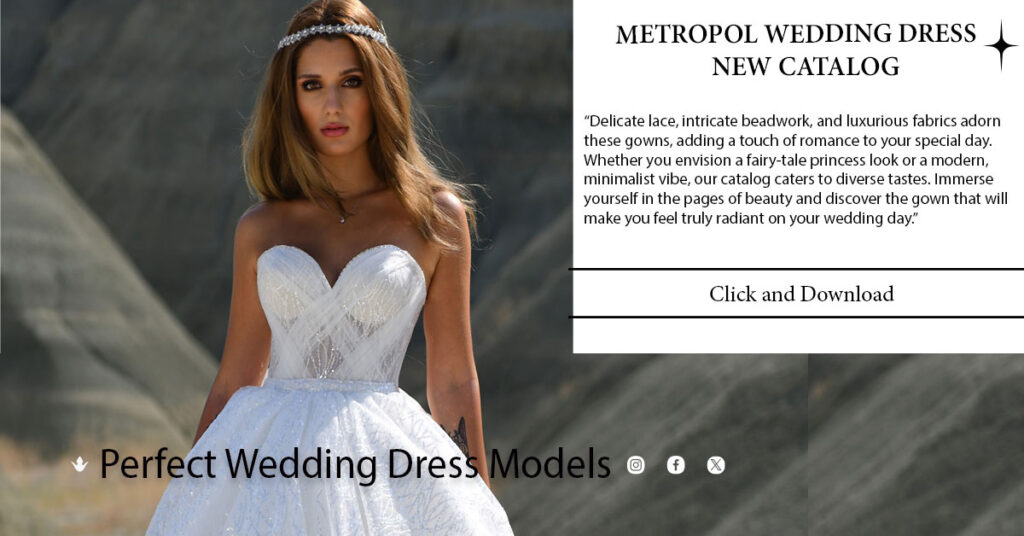
04.03.2024
Hersteller von Hochzeitskleidern Besten 3 Ich kann Ihnen jedoch einen komprimierten Leitfaden zur Verfügung stellen, der verschiedene Aspekte der führenden Hersteller von Hochzeitskleidern abdeckt. Wenn Sie weitere Informationen benötigen oder spezielle Vorlieben haben, lassen Sie...
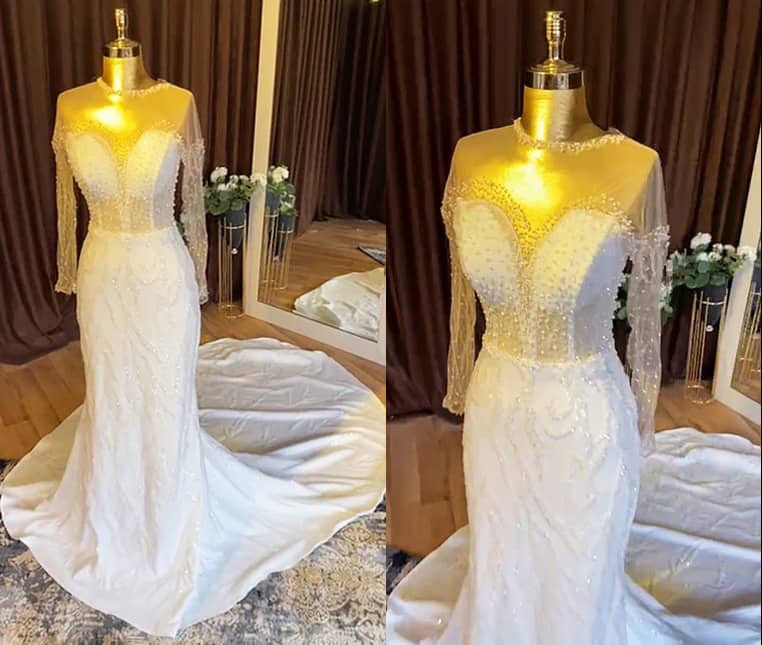
13.06.2024
Wholesale Fancy Dresses Best 5 A crepe wedding dress refers to a wedding gown made from crepe fabric. Crepe is a lightweight fabric with a slightly crinkled or textured surface, often made from silk, wool,...
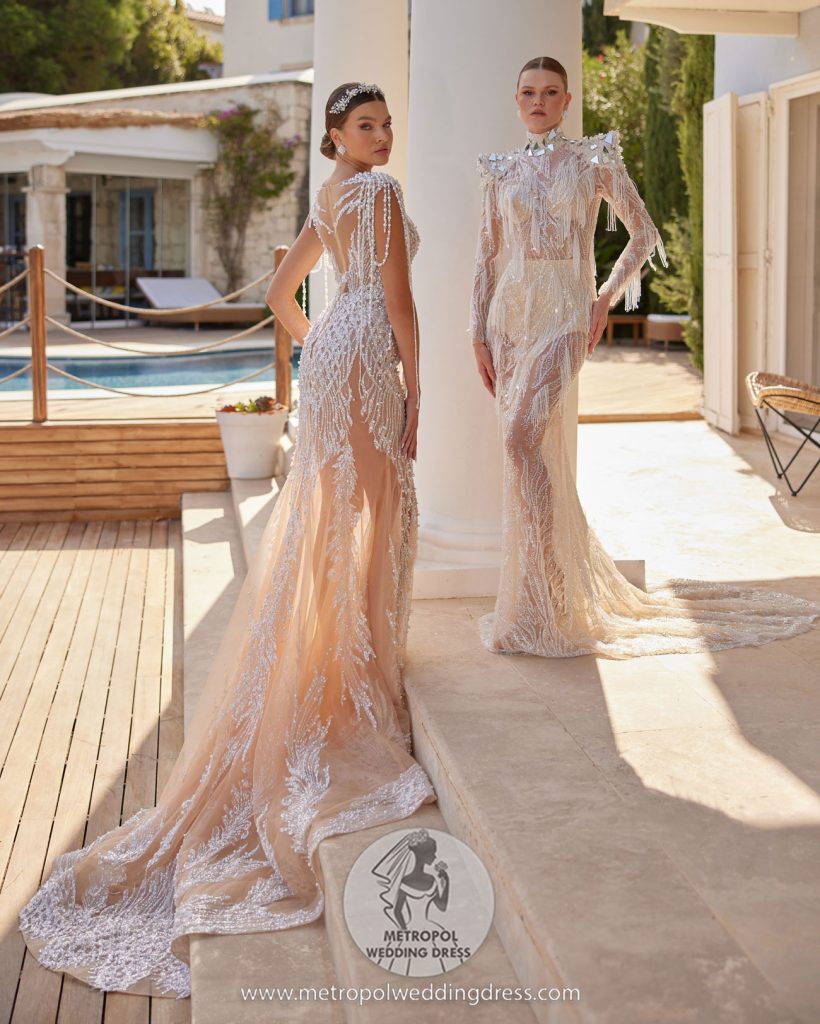
27.03.2026
Best Places to Shop Custom Wedding Dresses in the USA Custom wedding dresses have become the gold standard for brides seeking a gown that feels truly theirs. In this comprehensive 2026 guide to the best...
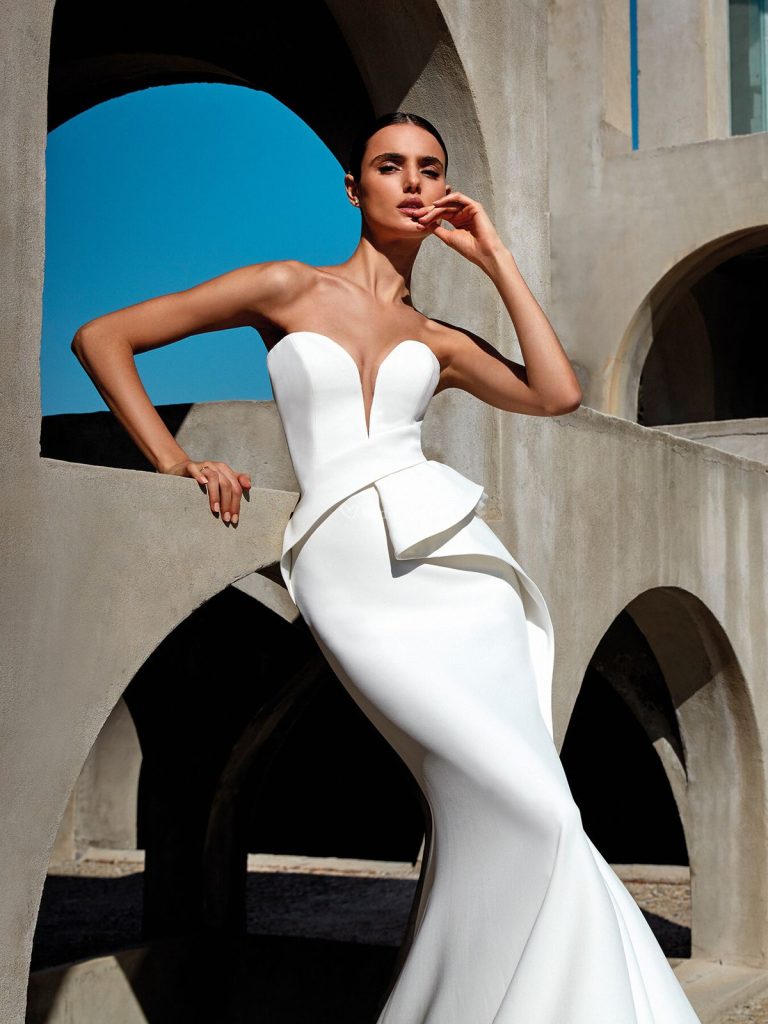
29.08.2025
Best Bridal Boutique Paris is synonymous with elegance, craftsmanship, and timeless style, making it the ideal city to find the best bridal boutique Paris has to offer. Known as the fashion capital of the world,...
Comments