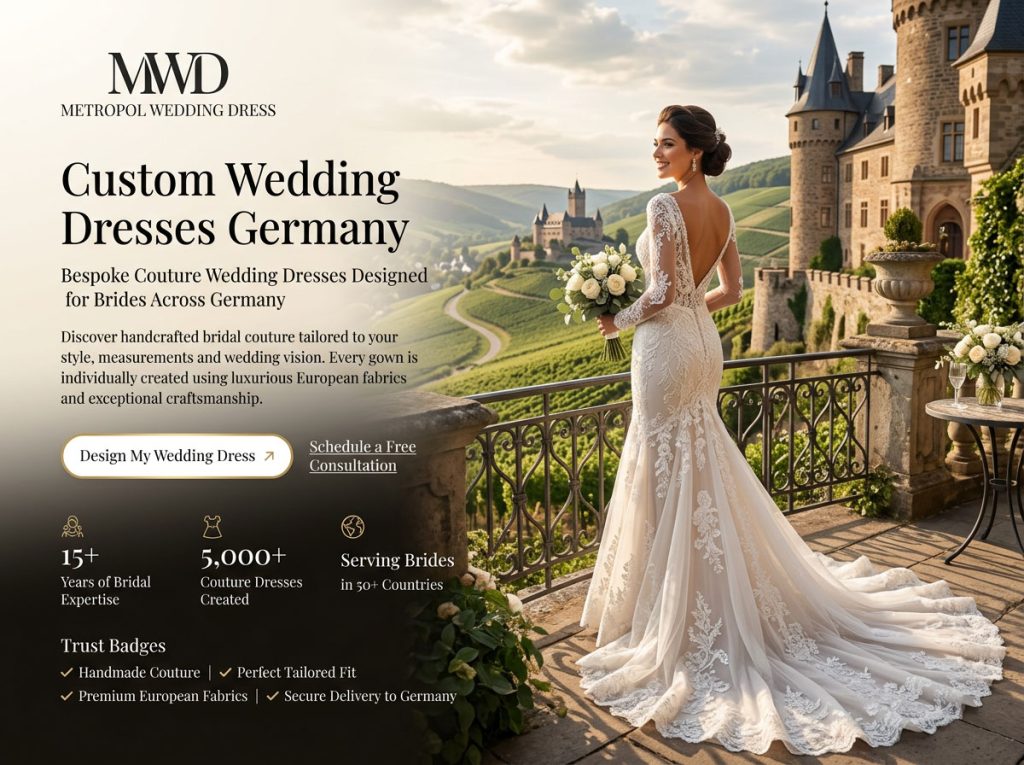
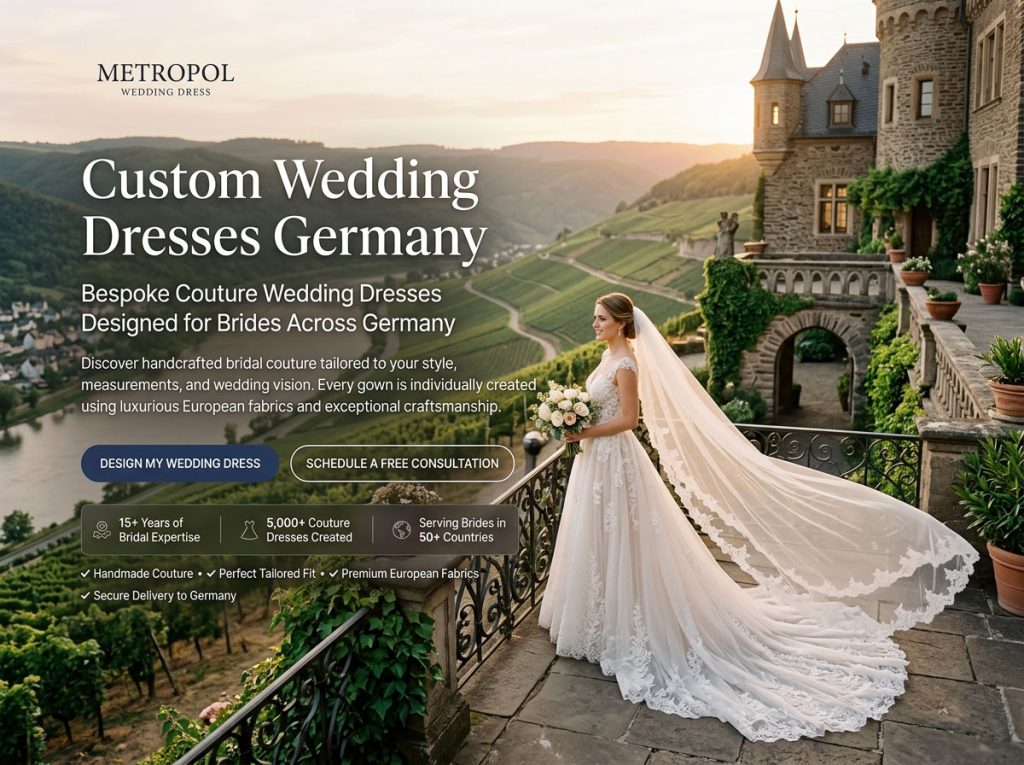
Custom Wedding Dresses Germany
German brides increasingly choose custom wedding dresses ordered online from specialist ateliers such as Metropol Wedding Dress. These gowns deliver precise fit, personal design control, high-quality European and Turkish fabrics, and realistic pricing (typically €300–€2,000) while meeting German preferences for understated elegance, practicality, sustainability, and regional nuances (from clean modern silhouettes in Berlin to subtle Trachten-inspired details in Bavaria).
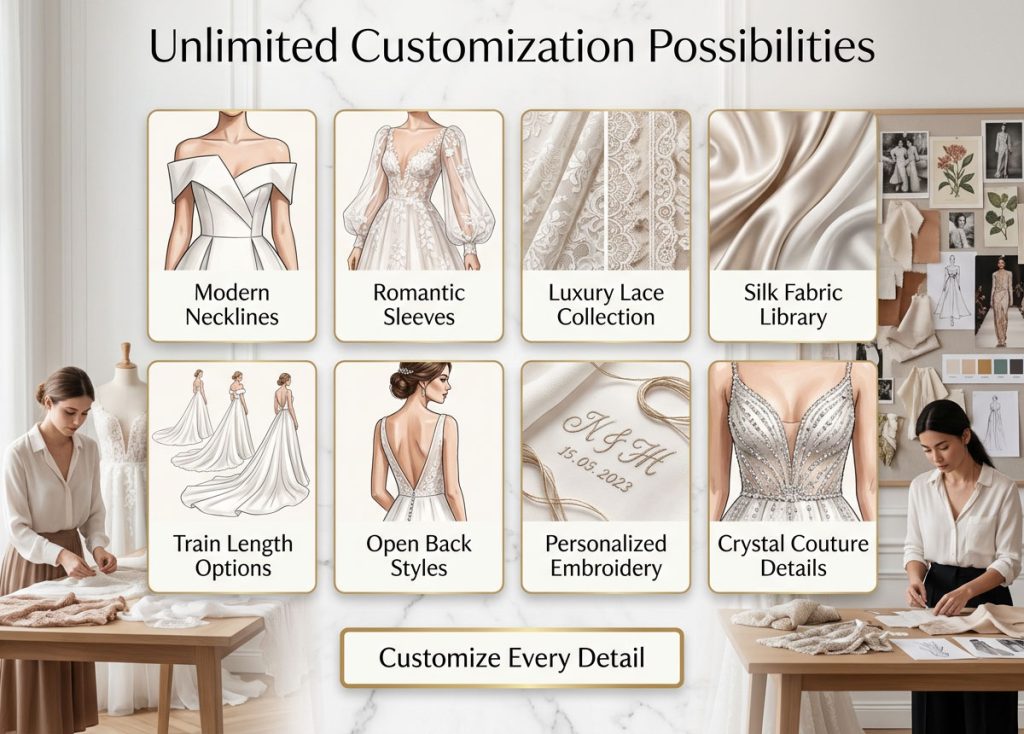
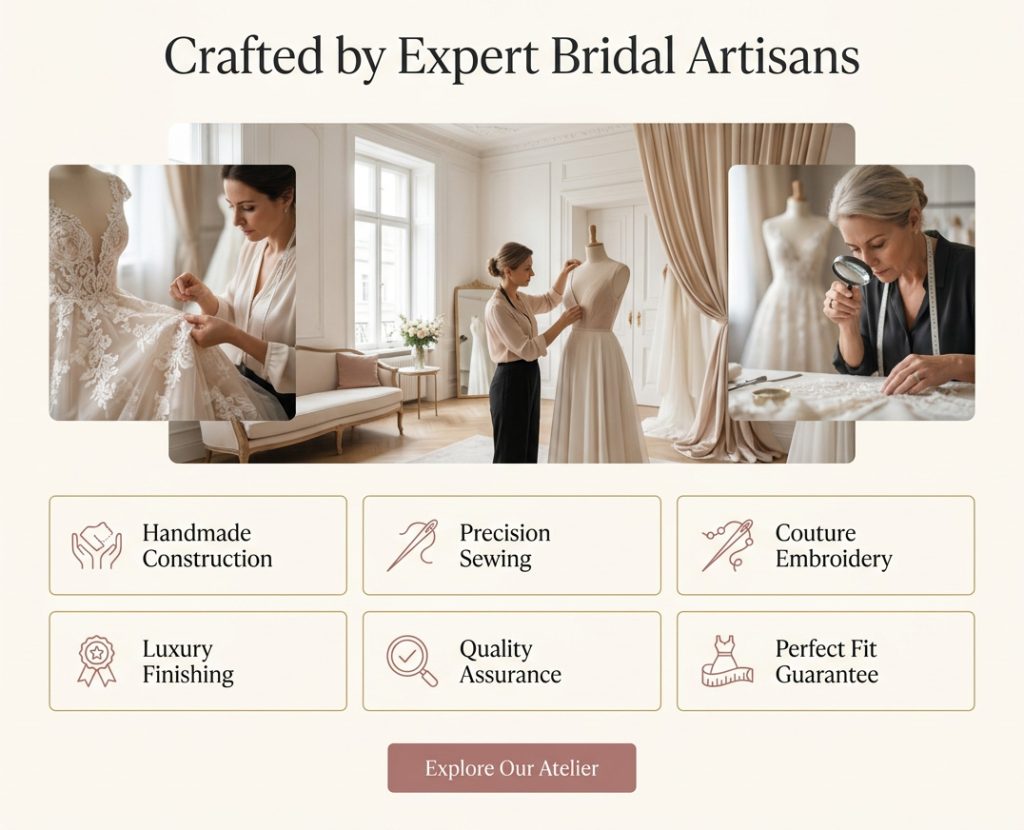
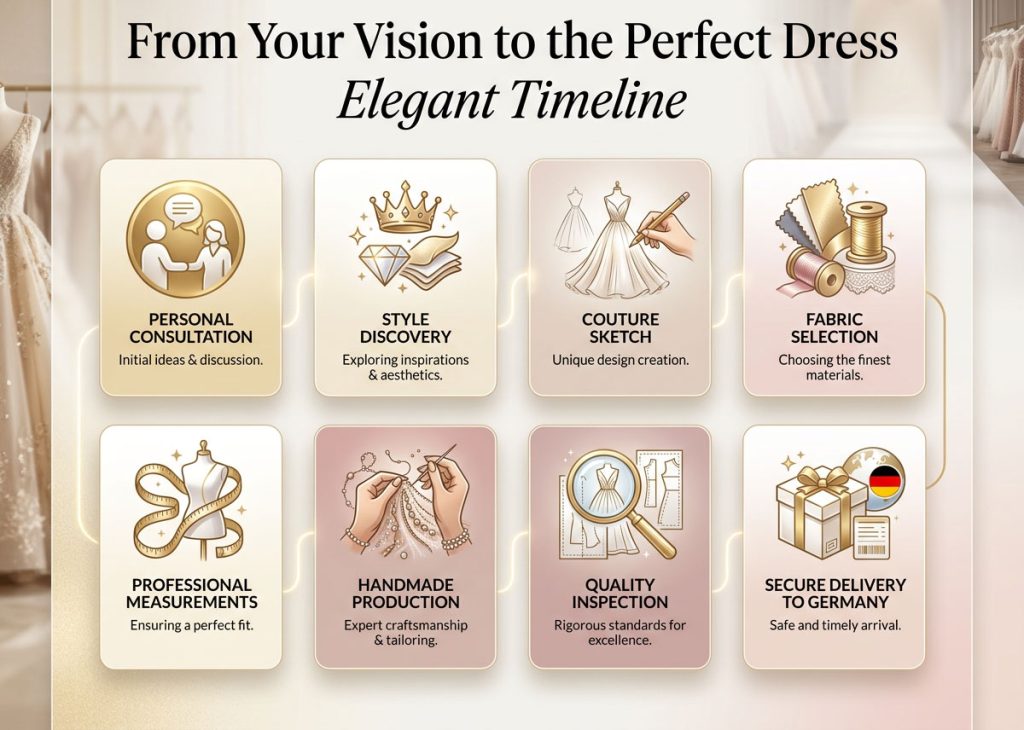
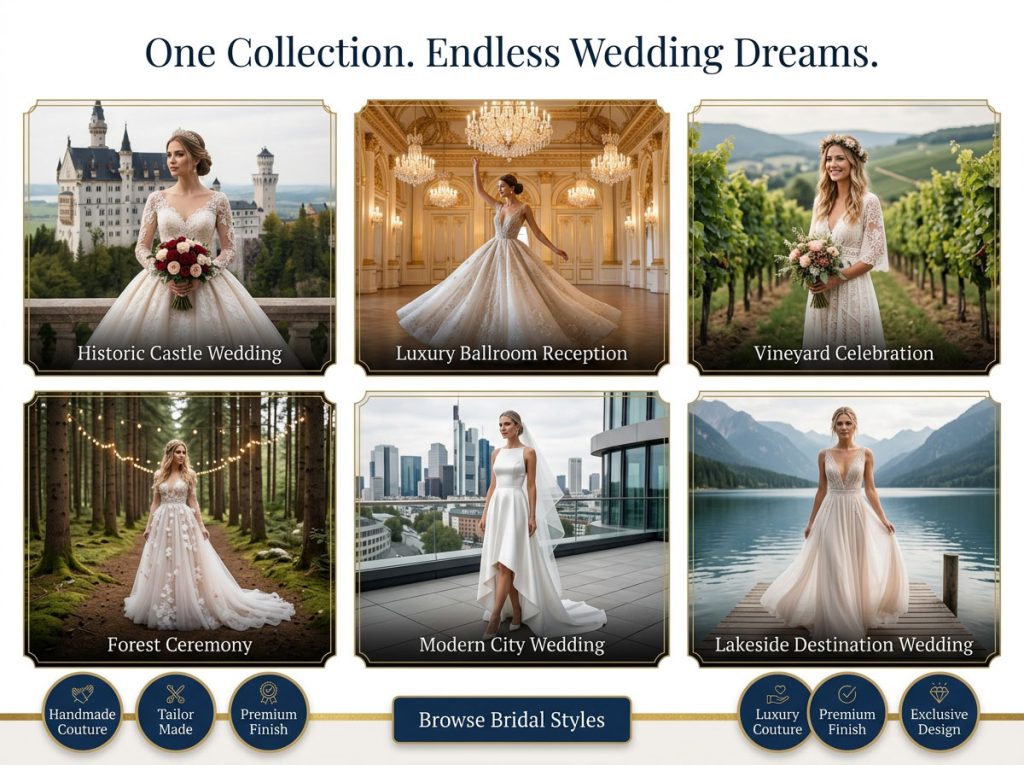
The process—virtual consultation, measurements, fabric selection, production, and secure shipping—removes the limitations of standard boutique stock and delivers a one-of-a-kind dress that performs across Standesamt ceremonies, church weddings, and multi-day celebrations.
Detailed Article
German wedding culture prizes substance over spectacle. Couples prioritise quality materials, comfortable wear for long receptions that include tree-trunk sawing or Polterabend energy, and designs that photograph well without demanding constant adjustment. Ready-to-wear options from local boutiques often require extensive alterations and still leave the bride feeling she compromised on details. Custom production ordered online solves this by starting with the bride’s exact body, venue, season, and aesthetic vision.
Metropol Wedding Dress, a Turkish atelier with more than two decades of experience and a large production workshop, specialises in this model. It serves German clients directly and through boutique partners, offering full customisation of silhouette, neckline, fabric, embroidery, and modular elements such as detachable overskirts or sleeves. Prices remain accessible because production occurs in a specialised facility rather than through multiple European mark-ups.
Why Custom Online Works for the German Market
German brides value reliability and transparency. Online custom workflows that provide clear measurement guides, fabric swatches (or high-resolution videos), progress photos, and realistic timelines meet that expectation. Typical lead times of 6–12 weeks allow ordering 8–10 months before the wedding—the window most German bridal consultants recommend.
Sustainability is another decisive factor. Many German couples prefer responsibly sourced silks, recycled lace, or low-waste cutting practices. Ateliers that cut only after confirmation and can incorporate organic or OEKO-TEX certified materials align with this preference. Regional variation also matters: northern and urban brides often favour clean A-line or column shapes in mikado or crepe; southern and Bavarian brides sometimes request softer volume or discreet embroidery that echoes traditional Dirndl proportions without becoming costume.
Production Reality Behind a Custom Gown
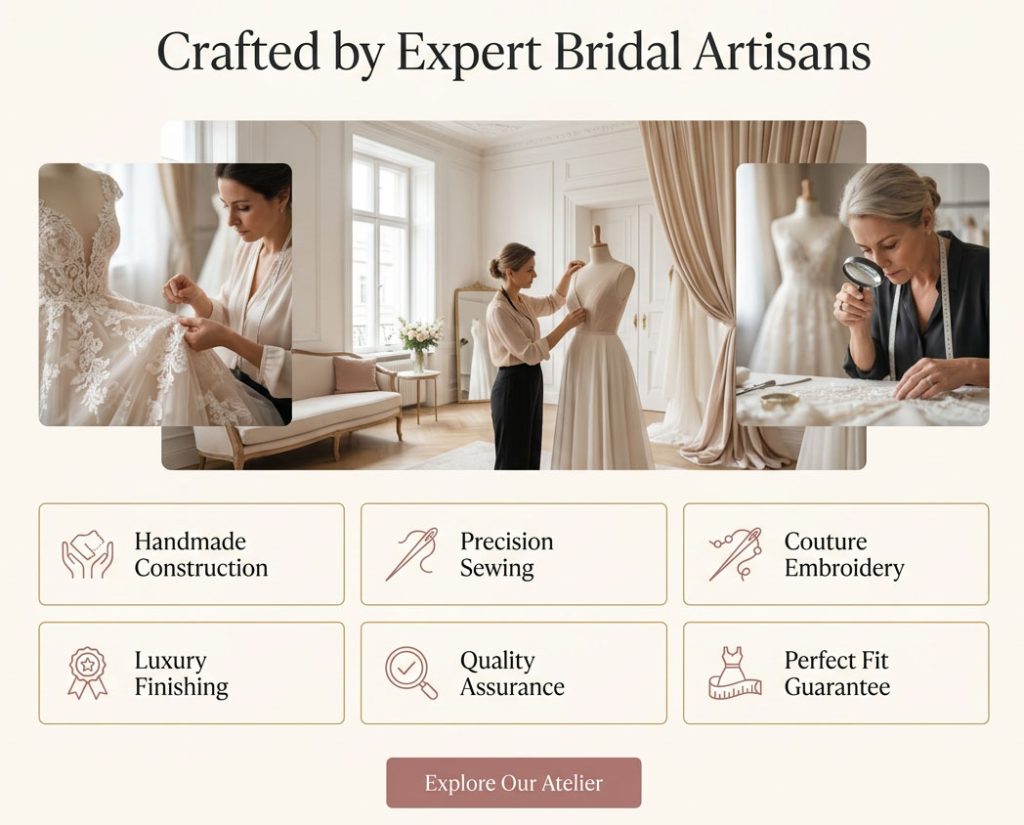
A professional custom wedding dress is not assembled from generic patterns. The process begins with a detailed measurement set (bust, waist, hips, hollow-to-hem, arm circumference, and posture notes). Designers translate the client’s mood board—Pinterest boards, venue photos, colour palette—into technical sketches. Pattern makers draft a unique block, then cut and baste a toile or muslin prototype when complexity warrants it.
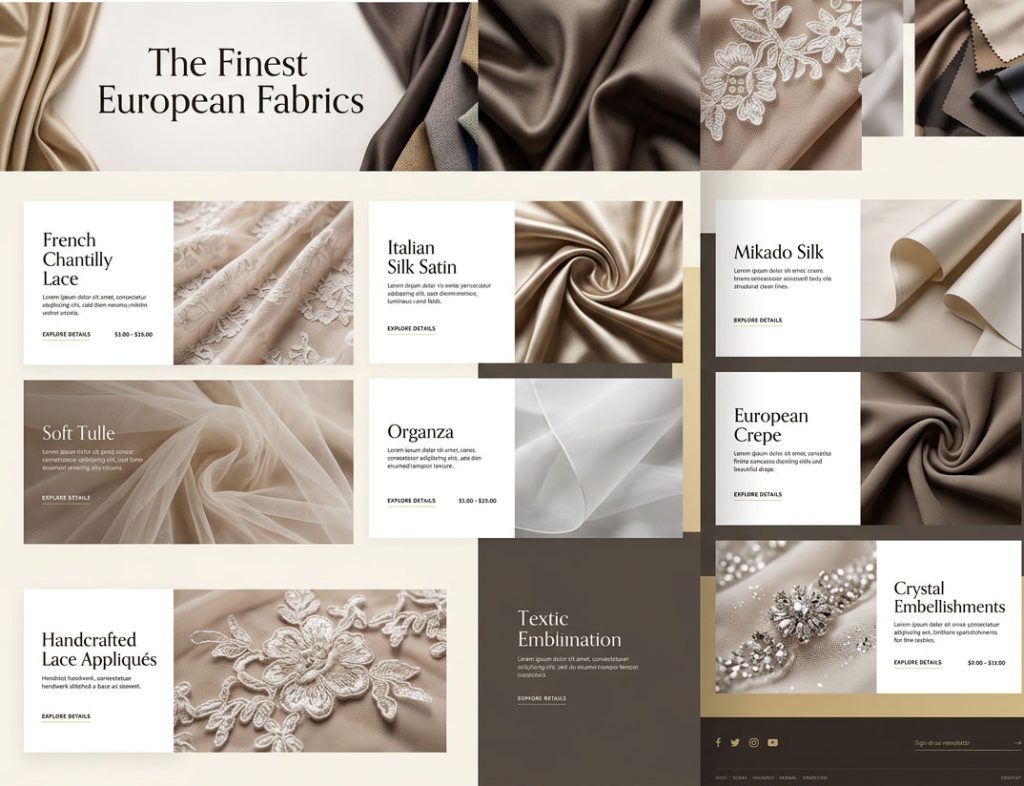
Fabrics are selected from European mills or high-grade Turkish sources: silk mikado for structure and photo sheen, Chantilly or Alençon lace for delicate overlays, lightweight organza and chiffon for summer fluidity, and stretch crepe for comfort during long celebrations. Hand embroidery, beading, and 3D floral applications are applied after the base structure is complete. Final construction includes internal corsetry or soft boning calibrated to the bride’s preference for support versus flexibility, plus careful finishing of seams and hems so the dress survives dancing, outdoor ceremonies, and later cleaning.
Metropol’s scale (workshop capacity and experienced team) allows both small custom runs and consistent quality control. Clients receive staged updates rather than a finished surprise.
Cost Structure That Makes Sense in Germany
Average German wedding-dress spend sits roughly between €1,000 and €2,500, with many brides landing near €1,600–€1,800. Custom online production frequently falls inside or below this range while delivering superior fit and uniqueness.
Typical cost drivers:
- Base silhouette and fabric grade
- Amount of handwork (lace application, beading density)
- Complexity of construction (built-in structure, multiple layers, detachable pieces)
- Shipping, insurance, and any final local alterations
Because production occurs outside high-cost European retail structures, the same level of fabric and labour often costs less than a comparable boutique sample that still needs alterations. Hidden expenses of traditional retail—sample wear, multiple fittings, and mark-ups—are largely eliminated.
Illustrative comparison (approximate 2025–2026 ranges)
| Approach | Typical Price Range | Fit Accuracy | Design Control | Lead Time | Hidden Costs |
|---|---|---|---|---|---|
| Boutique ready-to-wear + alterations | €1,200–€3,500 | Good after work | Limited | 4–8 months | Alterations €150–€500 |
| Local German atelier full custom | €2,000–€5,000+ | Excellent | High | 6–12 months | Higher labour rates |
| Specialist online custom (e.g. Metropol) | €300–€2,000 | Excellent | Full | 6–12 weeks | Shipping/insurance modest |
| Fast-fashion online | €100–€400 | Variable | Low | 2–6 weeks | Quality and longevity risk |
Practical Buying Sequence for Online Custom
- Define non-negotiables early: season and venue (outdoor garden vs. formal church), mobility needs, photography priorities, and budget ceiling.
- Gather accurate measurements using a soft tape and a helper; many ateliers supply printable guides and video instructions.
- Share inspiration images and note preferred fabrics and colours (ivory, soft champagne, or subtle blush remain popular in Germany).
- Request fabric samples or detailed material descriptions if possible.
- Confirm production timeline, revision policy, and shipping method (tracked, insured).
- Schedule any local final hem or bustle adjustment after arrival—most German cities have skilled bridal seamstresses who charge €50–€300 for minor work.
- Plan storage and steaming carefully; custom gowns travel best when properly packed.
Cultural and Seasonal Considerations
German weddings frequently include both a civil ceremony at the Standesamt and a later celebration. Dresses that offer modular options—removable sleeves, overskirts, or jackets—prove practical. Summer garden or lakeside events favour breathable layers; cooler-season or evening church weddings allow richer mikado and structured bodices.
Regional traditions still influence choices. In Bavaria a bride may incorporate refined Trachten elements or choose a clean white Dirndl-inspired silhouette for part of the day. Elsewhere, minimalism with one strong detail (deep back, architectural sleeve, or dramatic yet wearable train) dominates current preference. Colour remains mostly soft neutrals, though soft blush, champagne, and even discreet metallic accents appear more often.
Common Pitfalls and How to Avoid Them
- Ordering too late: eight months minimum is safer for custom.
- Inaccurate measurements: always re-measure and photograph the process.
- Ignoring undergarments and shoes during design: specify intended foundation garments and heel height.
- Overlooking shipping logistics and customs: reputable ateliers handle documentation and provide tracking.
- Skipping communication: regular updates prevent surprises.
Real-World Scenarios
A Berlin bride planning a modern Standesamt followed by a warehouse reception chose a clean column silhouette in heavy silk crepe with a detachable organza overskirt. Production took nine weeks; final local hem adjustment took one afternoon. Comfort during the evening’s dancing was repeatedly mentioned as the unexpected benefit.
A Bavarian couple wanted subtle regional reference without full Trachten. The atelier created an A-line gown with soft volume, delicate embroidery on the bodice, and an optional short jacket. The dress worked for both the church ceremony and the outdoor reception.
An international couple marrying in Germany ordered from abroad while living overseas. Clear measurement protocols, progress photos, and insured shipping delivered the gown in perfect condition three weeks before the event.
Maintenance and Longevity
Quality custom construction lasts. After the wedding, professional cleaning and proper storage (acid-free tissue, breathable garment bag, cool dark space) preserve the dress for future generations or creative re-use (re-cut into christening outfits, keepsakes, or even modern evening pieces). Many German brides value this continuity.
Expert Perspective on Value
Purchasing managers and experienced bridal consultants note that the highest long-term satisfaction comes from dresses that fit perfectly from the first wear and require minimal ongoing adjustment. Online custom specialists that combine transparent processes with specialised production capacity consistently deliver that outcome at accessible price points. The result is not merely a dress but a garment engineered for the specific physical and emotional demands of a German wedding day.
FAQ – Custom Wedding Dresses for the German Market
1. How long does a custom wedding dress from an online specialist typically take? Most ateliers require 6–12 weeks of production plus shipping. Ordering 8–10 months ahead is the safest window for German wedding timelines.
2. Can I order a custom dress if I live outside major cities? Yes. Virtual consultations, detailed measurement guides, and tracked shipping make the process accessible from anywhere in Germany or abroad.
3. What measurements are essential? Bust, waist, hips, hollow-to-hem length, arm circumference, shoulder width, and posture notes. Many providers supply illustrated guides.
4. Are fabric samples available? Many ateliers send physical swatches or high-resolution close-up videos and descriptions of hand-feel and drape.
5. How do prices for Turkish or specialist online custom compare with German boutique prices? Custom online often lands in the €300–€2,000 range while delivering comparable or superior materials and fit, because retail mark-ups and sample costs are reduced.
6. Will the dress arrive ready to wear? It arrives made to your measurements. A local seamstress can perform final hem or bustle adjustments if desired—usually modest cost.
7. Can I incorporate Bavarian or regional elements? Yes. Subtle embroidery, softer volume, or modular pieces that reference Dirndl proportions are common custom requests.
8. What about sustainability? Ask specifically about fabric certifications, low-waste cutting, and ethical production. Many modern ateliers prioritise these factors.
9. How is shipping and customs handled for Germany? Reputable producers manage documentation, provide tracking, and insure the shipment. Duties, if any, are clarified in advance.
10. What if my weight or measurements change slightly? Communicate early. Modest adjustments can often be accommodated during production; larger changes may require a revision fee or local alterations.
11. Are plus-size or petite custom options available? Specialist ateliers routinely work across size ranges because the pattern is drafted for the individual.
12. Can the dress be designed for both Standesamt and later celebration? Modular designs with detachable sleeves, overskirts, or jackets are popular solutions.
13. What undergarments work best with custom construction? Discuss intended shapewear or corsetry with the designer so internal structure matches.
14. How much train is practical for German venues? Many brides choose medium or detachable trains for dance floors and outdoor movement. Bustles are standard.
15. Is ivory or pure white preferred in Germany? Soft ivory, champagne, and off-white dominate for skin-tone versatility and photography; pure white remains available.
16. Can I add pockets or other functional details? Yes—discreet pockets, comfortable lining, and practical closures are frequently requested.
17. What happens if the dress is damaged in transit? Insured shipping plus clear packaging standards protect the garment. Ateliers typically stand behind delivery condition.
18. How do I clean and store the dress after the wedding? Professional bridal cleaning followed by acid-free storage in a cool, dry place preserves the gown for years.
19. Are coloured accents or non-traditional hues possible? Soft blush, champagne, and subtle metallics are increasingly accepted; bolder colours can be executed on request.
20. Can the same atelier produce bridesmaid or mother-of-the-bride pieces? Many offer coordinating options or referrals for cohesive wedding-party looks.
21. What is the revision policy during design? Most providers allow sketch and fabric adjustments before cutting begins. Clarify the number of included revisions.
22. How do I verify the quality of an online atelier? Review production photos, client testimonials, fabric descriptions, and communication responsiveness. Long-established workshops with transparent processes rank highest.
23. Is a toile or muslin fitting included? For complex designs some ateliers produce a toile; others work from precise measurements and experience. Ask specifically.
24. Can I wear the dress for a multi-day celebration or second-look event? Detachable elements make this practical and popular.
25. What about winter weddings or outdoor ceremonies in cooler weather? Heavier silks, mikado, and optional jackets or capes provide warmth without bulk.
26. How important is the internal structure? Very. Proper boning or soft support ensures the dress stays in place during long German receptions that include dancing and traditional games.
27. Can I request specific lace or embroidery motifs? Yes—provide reference images; skilled ateliers can interpret or adapt motifs.
28. What is typical turnaround after final payment? Production begins after deposit and measurement confirmation; remaining balance is usually due before shipping.
29. Are there options for sustainable or recycled materials? Growing numbers of ateliers offer certified or lower-impact fabrics—request details early.
30. How does custom online compare with buying second-hand or vintage? Custom guarantees perfect current fit and condition; vintage can require significant restoration and may not match modern expectations of comfort.
31. Can international brides marrying in Germany order successfully? Yes—clear communication, measurements, and shipping protocols make it routine.
32. What if I need the dress faster than standard production? Some ateliers offer rush options at additional cost; plan early whenever possible.
33. How do I choose between A-line, mermaid, ballgown, or column? Consider venue, personal movement style, and photography goals. Virtual consultations help visualise proportions.
34. Are veils, belts, or other accessories available from the same source? Many ateliers offer coordinating pieces or can recommend complementary suppliers.
35. What documentation should I keep? Order confirmation, measurement records, design sketches, and shipping details for any future reference or insurance.
36. Can the dress be altered later for a different occasion? High-quality construction often allows thoughtful re-purposing or modernisation years later.
37. How do German tax or VAT rules affect the purchase? Clarify with the atelier whether prices are inclusive and how any import formalities are handled.
38. What is the single most important success factor? Accurate measurements combined with open, timely communication throughout the process.
39. Are there size-inclusive or adaptive design options? Individual pattern drafting inherently supports a wide range of body shapes and mobility needs.
40. Why do so many German brides choose specialist online custom now? It delivers personal design control, superior fit, realistic pricing, and quality materials without the constraints of limited boutique stock—exactly matching the practical yet individualistic expectations of contemporary German weddings.
Five Distinct CTAs
- (Direct & practical) Request your personalised design consultation and measurement guide today—start the process while timelines are still comfortable.
- (Reassuring) Browse real production examples and fabric details, then message the atelier with your venue photos and inspiration. Clarity begins the conversation.
- (Value-focused) Compare the true cost of a dress made exactly to your measurements against boutique samples that still need alterations—many brides discover the smarter route is custom.
- (Inspirational) Your wedding day deserves a gown that moves with you, photographs beautifully, and feels like it was always meant for you. Begin the design discussion now.
- (Action-oriented for planners) Save this page, gather your measurements and mood board, and contact Metropol Wedding Dress or a comparable specialist atelier this week—secure your production slot before the season fills.
This content is written for a landing-page experience: informative, trustworthy, and oriented toward the practical decisions German brides and their partners actually make when selecting a custom wedding dress online.
German wedding-dress designers have carved a distinct identity defined by understated elegance, precise construction, modern silhouettes, and a strong preference for quality materials produced under controlled European conditions. Labels such as Kaviar Gauche, Kisui, Ritual Unions and smaller atelier makers in Berlin, Munich and Hamburg prioritise individuality over theatrical volume. For brides seeking that same design language with full customisation and realistic timelines, specialist production partners like Metropol Wedding Dress translate German aesthetic priorities into made-to-measure gowns—bridging local design sensibility with specialised manufacturing capacity
“You may also want to take a look at this article.” Custom Wedding Dresses UK
German bridal design operates on a different frequency from the high-drama couture of certain international houses. Where some markets reward extreme trains, dense crystal work or theatrical volume, German designers tend to favour clean lines, intelligent construction, wearable drama and fabrics that photograph with quiet authority. The result is clothing that feels intentional rather than ornamental—an approach that matches the practical, understated character of many German wedding celebrations.
The Signature of Contemporary German Bridal Design
Berlin has become the most visible centre. Kaviar Gauche, founded by Alexandra Roehler and Johanna Kühl, exemplifies the prevailing aesthetic: modern glamour achieved through flowing fabrics, delicate lace, contrasting elements and silhouettes that move easily from Standesamt to evening reception. Their work is produced in Germany and sits in a price band that begins around €1,490 for made-to-measure pieces, reflecting both material quality and domestic labour costs.
Kisui, also Berlin-based, emphasises youthful, clear lines and high-grade silks and laces with a “Made in Germany” focus. Ritual Unions takes a bolder, more avant-garde route—slow-fashion, handmade-to-order pieces that prioritise individuality and sustainability. Smaller ateliers such as Felicita Design and La Robe Marie in Munich continue the tradition of intimate, fully custom work where the designer remains closely involved throughout the process.
Across these practices several shared principles emerge:
- Preference for structure that supports long wear without constant adjustment
- Modular or convertible elements (detachable overskirts, sleeves, jackets) suited to multi-part German wedding days
- Restraint in embellishment so that fabric quality and cut remain the primary statements
- Growing attention to lower-impact materials and local or near-local production
Technical and Material Priorities
German designers typically work with silk mikado, crepe, fine lace (often Chantilly or Alençon), organza and high-quality tulle. The emphasis lies on drape, opacity control and internal architecture—soft boning, careful seaming and linings chosen for comfort during ceremonies that may include outdoor elements or traditional activities. Colour stays largely within the soft spectrum: ivory, champagne, soft blush and occasional metallic accents rather than pure stark white or strong pastels.
Construction standards are high. Seams are finished to survive professional cleaning and long-term storage. Trains are frequently designed with practical bustles. Necklines and backs are engineered for both photographic impact and movement.
Where Specialist Production Complements Local Design
Not every bride can or wishes to commission directly from a Berlin or Munich atelier. Lead times, price points and geographic access create natural demand for production partners capable of executing the same design language at scale or at more accessible cost. Metropol Wedding Dress, operating from a substantial workshop in Turkey with more than twenty years of bridal focus, functions in this space. The atelier accepts both fully original custom briefs and requests to realise silhouettes, fabric combinations and detailing that align with current German preferences—clean A-lines, modern columns, soft volume, refined lace application and modular construction.
This model allows German boutiques and independent designers to expand capacity without diluting their aesthetic, while direct clients gain access to made-to-measure execution that respects the cultural preference for quality and wearability. Prices for such custom work typically fall in a range that remains competitive with mid-to-upper German retail after alterations are factored in.
Comparative Landscape
| Aspect | Typical German Designer Atelier | Specialist Production Partner (e.g. Metropol) | International Luxury House |
|---|---|---|---|
| Design Origin | In-house, German aesthetic | Client- or boutique-driven, German-informed | House signature, global |
| Production Location | Primarily Germany | Specialised workshop, Turkey | Various European/Asian facilities |
| Lead Time | Often 6–12+ months | Commonly 6–12 weeks | Variable, often long |
| Price Band (custom) | Higher domestic labour costs | More accessible entry | Frequently premium |
| Customisation Depth | High, designer-led | High, measurement- and brief-led | High within house codes |
| Accessibility | City-based appointments | Online + shipping nationwide | Selective stockists |
Real Scenarios from the German Market
A Berlin couple planning a modern civil ceremony followed by a warehouse reception wanted a column silhouette in heavy silk crepe with a detachable organza overskirt. The design language echoed current German minimalism. Production was handled by a specialist partner; final local hem adjustment completed the process. Comfort during extended dancing was repeatedly cited as the decisive advantage.
In Bavaria a bride sought soft volume and subtle embroidery that nodded to regional proportions without becoming costume. The resulting A-line gown with optional short jacket worked for both church and outdoor segments of the day.
A boutique owner in northern Germany expanded her offering by commissioning a small capsule of clean, modular designs from a production specialist. The pieces retained the restrained aesthetic her clients expected while improving margin and delivery reliability.
Evaluation Checklist for Brides and Boutiques
- Clarify the dominant aesthetic: pure minimalism, soft romanticism, or controlled drama
- Confirm fabric sources and any sustainability claims
- Request clear communication of internal construction and support levels
- Establish realistic timelines including shipping and possible local finishing
- Verify measurement protocols and revision policy
- Assess aftercare guidance (cleaning, storage, potential future alterations)
- Compare total cost of ownership (dress + alterations + time) rather than sticker price alone
Common Decision Errors
Selecting solely on Instagram imagery without examining construction quality. Underestimating the value of modular design for German multi-stage celebrations. Ordering too close to the wedding date. Ignoring posture and movement notes during the measurement stage. Treating custom production as identical to ready-to-wear shopping.
Maintenance and Longevity Perspective
German designers and quality production partners share an expectation that a wedding dress should survive the day, professional cleaning and long-term storage. Proper hanging, acid-free tissue, and cool dark conditions preserve both structure and fabric. Many brides later re-purpose elements for family occasions or keep the gown as a tangible archive of the day.
Industry Outlook
Demand continues to shift toward personalisation and reduced waste. German designers who combine strong design identity with flexible production partnerships are well positioned. Brides increasingly evaluate not only the finished aesthetic but the entire process—transparency, communication, fit accuracy and environmental footprint. Specialist manufacturers that can reliably translate those priorities expand the practical options available across Germany.
The most successful outcomes arise when design vision and production capability remain aligned. Whether the starting point is a Berlin atelier or a carefully briefed specialist workshop, the goal remains the same: a gown that feels inevitable on the day it is worn.
FAQ – German Wedding Dress Designers and Custom Execution
1. What distinguishes German bridal designers from many international houses? A preference for understated elegance, precise construction, wearable silhouettes and high material quality over extreme theatrical volume.
2. Who are the most visible German bridal labels right now? Kaviar Gauche, Kisui, Ritual Unions and a number of smaller city ateliers in Berlin, Munich and Hamburg.
3. Are most German designer dresses made in Germany? Many flagship pieces are produced domestically or under close European control, which influences both price and lead times.
4. How do prices for German designer custom work typically compare with specialist production partners? Domestic designer ateliers often sit higher due to labour costs; specialised partners can deliver comparable design language at more accessible price points.
5. Can a specialist producer accurately interpret a German design aesthetic? Yes—when the brief includes clear references to silhouette, fabric behaviour, construction priorities and regional preferences.
6. What silhouettes currently dominate among German designers? Clean A-lines, modern columns, soft volume and modular designs that adapt to different parts of the wedding day.
7. How important is modularity in German bridal design? Highly valued because many celebrations combine civil, religious and reception elements that benefit from adaptable pieces.
8. What fabrics do German designers favour? Silk mikado, crepe, fine lace, organza and quality tulle chosen for drape, opacity and longevity.
9. Are sustainable materials a priority? Increasingly yes—lower-impact fabrics and controlled production methods are frequently requested.
10. How long should a bride allow when working with a German designer atelier? Often 8–12 months or more for full custom work.
11. Can production partners offer shorter timelines? Many can complete custom gowns in 6–12 weeks plus shipping when the design brief is clear.
12. Do German designers offer plus-size or petite custom options? Individual pattern drafting is common, so size inclusivity is generally strong within the custom segment.
13. What role do local alterations still play? Even with precise measurements, a final local hem or bustle adjustment is frequently recommended after arrival.
14. How do Berlin and Munich design scenes differ? Berlin leans more experimental and modern; Munich often retains a slightly more classical or regionally nuanced refinement.
15. Can a bride commission a design inspired by a German label but executed elsewhere? Yes—provided intellectual property and originality are respected and the production partner can match the technical standard.
16. What measurement details matter most for German-style construction? Accurate bust, waist, hips, hollow-to-hem, posture notes and intended undergarments.
17. Are coloured accents accepted in current German design? Soft blush, champagne and subtle metallics appear more often; strong colour remains less common.
18. How do designers handle trains for practical German venues? Medium or detachable trains with reliable bustles are preferred for dance floors and outdoor movement.
19. Is a toile or muslin fitting standard? More common in pure designer ateliers; some production partners work primarily from precise measurements and experience.
20. What questions should a boutique ask a production partner? Capacity, fabric sourcing transparency, quality control process, communication cadence and previous experience with German aesthetic briefs.
21. Can the same production partner support both private clients and wholesale? Many do, allowing boutiques to expand offerings while private clients access custom work.
22. How is communication typically handled across distance? Detailed sketches, fabric references, progress photography and scheduled virtual reviews.
23. What aftercare guidance is standard? Professional cleaning recommendations and storage protocols that protect structure and fabric for decades.
24. Are veils and accessories usually designed in parallel? Some German labels offer coordinated pieces; others focus solely on the gown and recommend partners.
25. How does the Standesamt-to-reception format influence design? It encourages convertible elements so the same base gown can shift formality levels.
26. What is the typical revision policy during design development? Clarify the number of included sketch and fabric adjustments before cutting begins.
27. Can regional Bavarian references be incorporated without becoming costume? Yes—subtle volume, refined embroidery or optional short jackets achieve the balance.
28. How important is internal support structure? Critical for comfort during long celebrations that may include dancing and traditional activities.
29. Do German designers work with international clients marrying in Germany? Yes—virtual processes and clear measurement protocols make this routine.
30. What is the single strongest predictor of a successful custom outcome? Clear, early communication of aesthetic priorities, measurements and practical constraints.
31. Are second-look or after-party options commonly designed together? Modular systems make coordinated second looks straightforward.
32. How do production partners handle shipping and insurance to Germany? Tracked, insured methods with documentation managed by the atelier are standard among established specialists.
33. Can existing family lace or heirloom elements be incorporated? Many custom processes allow integration when the material is suitable.
34. What is a realistic expectation for fit accuracy? With precise measurements and experienced pattern makers, the gown should require only minor local finishing.
35. How do designers and production partners differ in creative leadership? Designers typically lead the aesthetic vision; production partners execute a defined brief with technical excellence.
36. Is “Made in Germany” a decisive factor for many brides? For some yes; others prioritise the finished quality, fit and design integrity regardless of production location.
37. What emerging trends are visible among German designers? Continued minimalism with one strong detail, soft volume, convertible construction and greater material transparency.
38. How should a bride prepare for the first design conversation? Venue photos, movement requirements, colour preferences, inspiration images and a realistic budget range.
39. Can a production specialist replicate the construction quality of a German atelier? When the workshop maintains high standards of pattern cutting, sewing and finishing, the technical result can be equivalent.
40. Why do some German brides combine local design consultation with specialised production? It maximises aesthetic alignment with practical advantages in timeline, cost and capacity.
Five Distinct CTAs
- (Analytical) Map your preferred German design signatures against production capabilities and timelines—request a detailed capability brief from a specialist atelier this week.
- (Process-oriented) Gather your measurements, venue notes and three reference images, then open a design dialogue with a partner experienced in the German aesthetic.
- (Value comparison) Calculate the full cost of a domestic designer commission versus a carefully briefed specialist production route; many brides find the latter delivers equivalent design language with greater flexibility.
- (Creative invitation) Define the single strongest visual or practical requirement of your wedding day, then explore how current German design principles and specialised execution can realise it.
- (Direct for decision-makers) Contact Metropol Wedding Dress or a comparable production specialist with your brief—secure both design fidelity and production capacity while schedules remain open.
This content is structured for a landing-page environment: substantive, decision-oriented and focused on the actual intersection of German bridal design culture and custom production reality.
“You may also want to take a look at this article.” Custom Wedding Dresses Australia
Custom Wedding Dresses Germany
Wedding dresses in Germany exist inside a layered ecosystem of local boutiques, independent designers, international brands, second-hand markets and specialised custom producers. Brides navigate practical constraints—budget, timeline, venue type, regional customs and the need for a garment that performs across Standesamt, church and reception—while valuing quality construction and understated elegance. Custom production from specialised ateliers such as Metropol Wedding Dress occupies a clear position within this system: it delivers precise fit, design control and accessible pricing by combining experienced pattern-making with efficient workshop capacity, serving both private clients and German bridal retailers.
Detailed Article
The German bridal market does not operate as a single retail channel. It functions as an interconnected supply network in which design intent, fabric sourcing, production location, distribution logistics and final fitting all influence the finished experience. Understanding that network allows brides and boutique buyers to make clearer decisions rather than defaulting to the nearest high-street sample.
Market Structure and Decision Layers
At the top layer sit pure designer ateliers concentrated in Berlin, Munich and Hamburg. These houses control both aesthetic direction and domestic or near-domestic production, resulting in higher price points and longer lead times. The middle layer consists of multi-brand bridal houses and concept stores that stock international collections alongside selected German labels. The lower and increasingly active layer comprises online custom specialists and wholesale manufacturers who execute made-to-measure work from detailed client or retailer briefs.
A fourth, quieter layer—pre-owned and sample sales—remains relevant for budget-conscious or environmentally motivated couples, though fit and condition introduce additional variables. Metropol Wedding Dress operates primarily in the specialised-production layer, supplying both direct custom orders and wholesale partners across Germany. Its workshop model prioritises measurement-driven pattern cutting, controlled fabric use and staged communication rather than inventory-driven retail.
Cost Architecture Inside the German Context
Average spend on a wedding dress in Germany currently clusters between roughly €1,000 and €2,500, with many brides landing near €1,600–€1,800 once alterations are included. The final figure is rarely the listed price of a sample. It is the sum of base garment, fabric upgrades, construction complexity, shipping or import formalities, and local finishing work.
Illustrative cost composition (approximate ranges)
| Cost Component | Boutique Sample + Alterations | Domestic Designer Custom | Specialist Online Custom |
|---|---|---|---|
| Base garment | €800–€2,500 | €2,000–€5,000+ | €300–€2,000 |
| Alterations / finishing | €150–€500 | Often included or modest | €50–€300 local |
| Shipping / logistics | Minimal | Minimal | €50–€150 insured |
| Design / pattern premium | Embedded | High | Moderate |
| Total typical range | €1,200–€3,500 | €2,200–€6,000 | €400–€2,400 |
Specialist production frequently delivers a lower total cost of ownership because the pattern is cut for the individual from the outset, reducing the need for extensive post-purchase surgery.
Material and Construction Realities
German preferences lean toward fabrics that balance visual impact with wearability: silk mikado for structure and light reflection, crepe for fluid movement, fine lace for controlled embellishment, and lightweight organza or chiffon for warmer-season fluidity. Opacity, breathability and resistance to creasing during long receptions matter more than pure decorative density.
Internal architecture receives equal attention. Soft or structured boning, carefully graded linings and practical bustle systems are expected. A dress that looks perfect in a static fitting but shifts during the traditional tree-trunk sawing or extended dancing fails the functional test that many German brides apply.
Production Pathways and Timeline Logic
Three principal routes exist:
- Local atelier: design and production under one roof, longest lead time, highest control.
- Multi-brand boutique: selection from existing collections, medium lead time, variable alteration load.
- Specialised custom manufacturer: brief and measurements transmitted digitally, production in a dedicated workshop, shipping to Germany, optional local finishing.
Metropol’s process follows the third route. Clients or retailers supply measurements, silhouette preferences, fabric direction and reference imagery. Pattern makers draft a unique block, fabric is cut only after confirmation, construction proceeds with progress documentation, and the finished gown travels under tracked, insured conditions. Typical production windows of 6–12 weeks fit the eight-to-ten-month planning horizon recommended by most German bridal consultants.
Regional and Cultural Filters
Northern and urban brides often favour clean modern lines and convertible elements suitable for warehouse or loft venues. Southern and Bavarian clients may request softer volume or discreet embroidery that acknowledges regional dress traditions without becoming literal Trachten. Outdoor garden or lakeside ceremonies in summer prioritise breathable layers; cooler-season church weddings allow richer structures.
The legal necessity of a civil ceremony at the Standesamt followed by optional religious or celebratory events further encourages modular design—detachable sleeves, overskirts or jackets that adjust formality levels throughout the day.
Decision Framework for Brides
Step 1 – Non-negotiables List venue type, season, mobility requirements, photography priorities and absolute budget ceiling.
Step 2 – Aesthetic calibration Collect 8–12 images that capture silhouette, fabric behaviour and detailing intensity. Discard pure fantasy shots that ignore practical wear.
Step 3 – Pathway selection Match the list above against available lead times, total cost and required level of customisation.
Step 4 – Measurement discipline Use a soft tape, a helper and the producer’s illustrated guide. Re-measure once. Photograph the process if requested.
Step 5 – Communication protocol Agree on revision limits, progress photo frequency and final shipping method before deposit.
Step 6 – Local finishing buffer Reserve time and budget for a skilled local seamstress to set the final hem and bustle after the gown arrives.
Common Friction Points and Prevention
- Ordering inside a four-month window when custom construction is required.
- Relying solely on size charts without posture and undergarment notes.
- Underestimating the cumulative cost of multiple boutique alterations.
- Selecting heavy embellishment that photographs well but restricts movement.
- Ignoring storage and cleaning protocols after the event.
Scenario Snapshots
A couple in Hamburg planned a civil ceremony followed by a harbour-side reception. They chose a clean column in silk crepe with a detachable organza overskirt executed by a specialised producer. Local hem adjustment took ninety minutes. The dress remained comfortable through an evening of dancing and outdoor photographs.
A Munich boutique expanded its mid-price offering by commissioning a small modular collection from a production partner. The pieces retained the restrained aesthetic expected by local clients while improving margin and reducing sample inventory risk.
An international pair marrying in Berlin ordered while still living abroad. Precise measurement protocols, staged photography and insured shipping delivered the gown three weeks before the event in perfect condition.
Longevity and Aftercare Perspective
Quality construction is designed to survive the day, professional cleaning and long-term archival storage. Acid-free tissue, a breathable garment bag and a cool, dark environment preserve both structure and fabric. Many German brides later re-purpose elements for family occasions or keep the gown as a physical record of the day—an outcome more likely when materials and seams are chosen for durability rather than single-use drama.
Sector Outlook
Personalisation continues to gain share against pure ready-to-wear. Simultaneously, cost transparency and environmental accountability influence purchasing. Producers and retailers who can demonstrate clear measurement-to-delivery processes, material provenance and realistic pricing occupy a durable position. Specialised workshops that serve both direct clients and German bridal retailers form a practical bridge between design ambition and operational reality.
The most reliable outcomes arise when the chosen pathway matches the actual constraints of the wedding rather than an idealised image. Whether the starting point is a Berlin designer, a multi-brand house or a specialised custom manufacturer, the decisive factors remain fit accuracy, functional construction and total cost of ownership.
FAQ – Wedding Dresses in the German Market
1. What is the typical price range for a wedding dress in Germany today? Most brides spend between €1,000 and €2,500 once alterations are included; the median cluster sits near €1,600–€1,800.
2. How early should planning begin for a custom gown? Eight to ten months before the wedding provides comfortable production and shipping buffers.
3. Are pure white dresses still the default? Soft ivory, champagne and off-white dominate for versatility and photography; pure white remains available but less frequent.
4. Do most German brides still buy from physical boutiques? Boutiques remain important for try-on experience, yet online custom and specialist production have grown steadily.
5. What is the role of the Standesamt in dress choice? The civil ceremony often calls for a more restrained first look, encouraging modular designs that can elevate for the later celebration.
6. How important is comfort for long German receptions? Critical—dancing, outdoor elements and traditional activities demand stable internal structure and breathable layers.
7. Can a custom producer match the aesthetic of German designer labels? Yes, when the brief supplies clear silhouette, fabric and detailing references.
8. What measurements matter most? Bust, waist, hips, hollow-to-hem, posture notes and intended undergarments.
9. Are plus-size and petite options widely available? Custom pattern drafting inherently supports a broad range of body shapes.
10. How much should be budgeted for local finishing? Typically €50–€300 for hem and bustle work after the gown arrives.
11. Do regional differences affect style preferences? Urban and northern clients lean modern and clean; southern clients sometimes incorporate softer volume or subtle regional references.
12. Is sustainability a deciding factor? For a growing segment yes—fabric provenance and low-waste cutting are increasingly requested.
13. What is a realistic production window for specialist custom work? Six to twelve weeks plus shipping is common among established workshops.
14. How is shipping to Germany usually handled? Tracked and insured methods with documentation managed by the producer.
15. Can existing lace or family fabric be incorporated? Many custom processes allow it when the material is suitable for bridal construction.
16. What undergarments should be decided early? Shapewear or corsetry choices influence internal structure and should be specified at the measurement stage.
17. Are detachable elements popular? Yes—overskirts, sleeves and jackets support the multi-stage nature of many German weddings.
18. How do second-hand options compare? They can reduce cost and environmental impact but introduce fit and condition variables that custom production avoids.
19. What is the most common timeline mistake? Ordering inside a four-month window when custom construction is required.
20. Do German brides still expect veils? Many do for church ceremonies; others omit them for modern civil or outdoor events.
21. How transparent are production partners about progress? Reputable specialists provide staged photography and clear communication milestones.
22. Can a boutique use a specialist producer for private-label collections? Yes—this model expands assortment without heavy sample inventory.
23. What fabric properties matter most for outdoor ceremonies? Breathability, controlled opacity and resistance to creasing.
24. Is a toile always necessary? Not for every design; experienced pattern makers can work from precise measurements, though complex structures benefit from a toile.
25. How should the finished gown be stored after the wedding? Professional cleaning followed by acid-free tissue in a cool, dark, breathable garment bag.
26. Are coloured accents accepted? Soft blush, champagne and subtle metallics appear more frequently than strong colour.
27. What is the practical train length for most German venues? Medium or detachable trains with reliable bustles balance impact and mobility.
28. How do import formalities affect pricing? Established producers manage documentation; any duties are clarified in advance.
29. Can international couples marrying in Germany order successfully? Yes—clear measurement protocols and insured shipping make the process routine.
30. What single factor most improves outcome probability? Accurate measurements combined with early, precise communication of non-negotiables.
31. Do producers offer matching or coordinating pieces for the bridal party? Some do; others focus solely on the bride’s gown and can recommend partners.
32. How is quality control typically managed in a specialist workshop? Pattern approval, fabric inspection, staged construction checks and final photography before shipping.
33. What happens if measurements change slightly during production? Early communication allows modest adjustments; larger changes may require revision or local work.
34. Are pockets or practical closures available? Discreet functional details are frequently requested and accommodated.
35. How does the total cost of custom compare with boutique sample plus alterations? Specialist custom often lands at a comparable or lower total once alterations and uniqueness are factored in.
36. What role does photography play in design decisions? Strong influence—fabrics and silhouettes are chosen partly for how they record under natural and artificial light.
37. Can a dress be designed for both formal ceremony and later dancing? Modular construction is the standard solution.
38. How important is the producer’s experience with European sizing and posture? High—pattern blocks must accommodate typical European body proportions and posture variations.
39. What documentation should be retained? Order confirmation, measurement records, design sketches and shipping details.
40. Why do some German brides choose specialised custom production over pure local designer routes? It balances design control, fit accuracy, realistic timelines and total cost within the practical constraints of the German wedding calendar.
Five Distinct CTAs
- (Diagnostic) List your non-negotiables—venue, season, budget ceiling and mobility needs—then match them against the three primary supply pathways available in Germany.
- (Operational) Prepare accurate measurements and three reference images, then open a production dialogue with a specialist atelier experienced in the German market.
- (Comparative) Calculate the full landed cost of a boutique sample plus alterations versus a measurement-driven custom order; the difference often surprises.
- (Strategic for retailers) Explore wholesale or private-label capacity with a specialised producer to expand assortment without increasing sample inventory risk.
- (Direct) Contact Metropol Wedding Dress with your brief or wholesale inquiry—align design intent with production capacity while planning windows remain open.
This content is built for a landing-page environment: decision-oriented, transparent about market structure, and focused on the practical realities that shape wedding-dress choices inside Germany.