
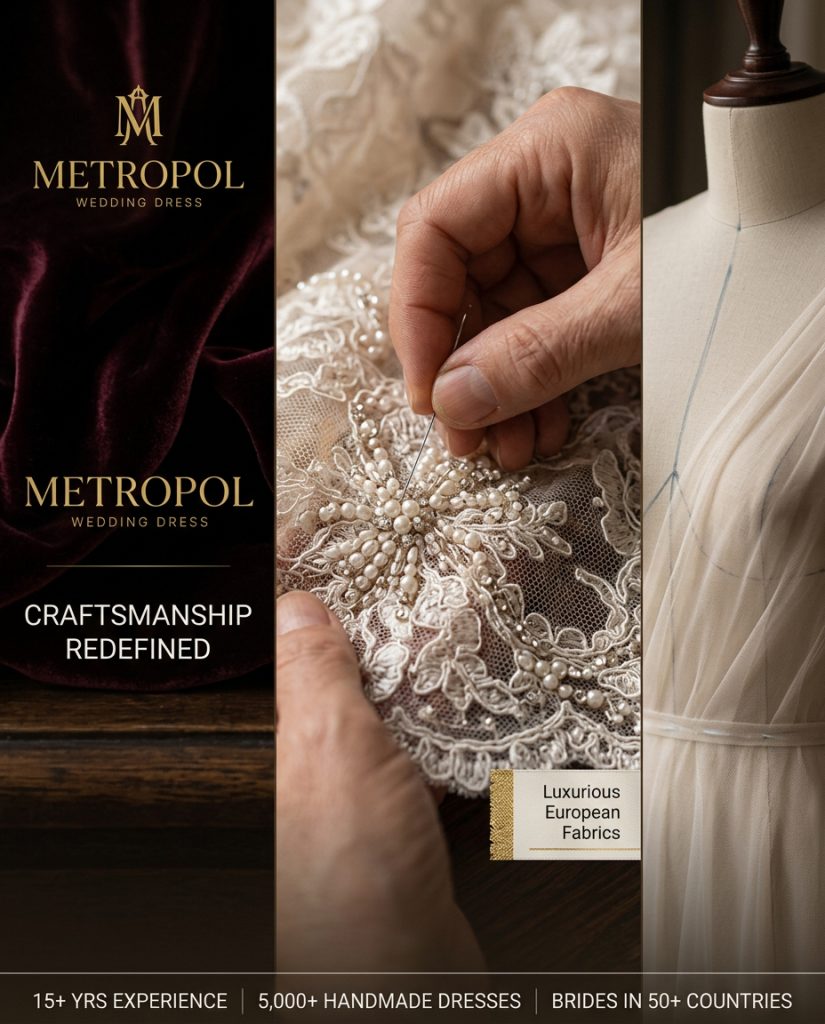
Couture Wedding Dress Paris has a unique position in global bridal fashion. It represents more than a destination for romantic weddings: Paris is deeply connected with couture, atelier craftsmanship, fashion innovation, personalization and the tradition of creating garments around an individual client. The Fédération de la Haute Couture et de la Mode describes personalization, craftsmanship and atelier know-how as central characteristics of the couture ecosystem, while the legally controlled French designation “Haute Couture” is reserved for approved houses.
For a bride, this means that searching for a couture wedding dress Paris experience should not begin with the question, “Which dress looks most beautiful?” It should begin with a more useful question:
Which production partner can translate a personal bridal vision into a technically sound, beautifully finished gown?
That distinction becomes even more important for bridal boutiques, designers, retailers, wedding planners and international buyers.
A successful couture bridal project depends on several interconnected elements:
- design interpretation;
- fabric and trim selection;
- pattern development;
- body measurement;
- construction engineering;
- hand finishing;
- fitting and alteration capability;
- production consistency;
- quality control;
- packaging;
- delivery;
- customization;
- communication;
- and the ability to reproduce a successful design without destroying its character.
The strongest sourcing model is therefore not simply about buying a wedding dress. It is about creating a controlled product-development process.
This is where Metropol Wedding Dress can be positioned as a partner for buyers looking for custom, made-to-order, bespoke, OEM, private-label and wholesale bridal production.
The company can be presented around different commercial requirements: a boutique may need limited quantities, a bridal shop may need repeatable core silhouettes, a fashion label may require private-label manufacturing, while an established distributor may need scalable wholesale custom wedding dresses.
The key is to match the manufacturing model to the buyer’s business model.
Couture Wedding Dress Paris: Why the Word “Couture” Matters
Paris has never been simply another fashion city.
Its influence comes from the relationship between creative direction and technical execution. The Fédération de la Haute Couture et de la Mode traces the history of the couture organization back to 1868 and explains that the French designation “Haute Couture” became legally controlled in 1945. It also identifies personalization and models created and adapted to clients’ measurements as defining characteristics of the couture tradition.
That history explains why the phrase couture wedding dress Paris carries such strong commercial meaning.
But there is an important distinction.
A dress can be:
- couture-inspired;
- custom-made;
- bespoke;
- made to measure;
- handcrafted;
- luxury bridal;
- designer;
- private label;
- or produced through an OEM model;
without necessarily being an officially accredited French Haute Couture creation.
For buyers, this distinction is not merely academic.
It affects how a product should be described, marketed and positioned.
The practical interpretation
Imagine three customers.
Customer A: The private bride
She has saved photographs from Paris fashion shows, vintage couture references and editorial bridal campaigns. She wants a gown designed specifically around her proportions.
Her priority is personalization.
Customer B: The bridal boutique
The boutique wants ten distinctive gowns under its own brand identity. It needs reliable production, consistent sizing, premium fabrics and the ability to modify necklines, sleeves, trains and embellishment.
Its priority is controlled customization.
Customer C: The fashion entrepreneur
The entrepreneur has developed a bridal collection and wants another company to manufacture the gowns under the entrepreneur’s own label.
Its priority is private-label production, confidentiality, quality control and repeatability.
All three may search for a couture wedding dress Paris.
Yet their manufacturing requirements are completely different.
That is why the right landing page must go beyond fashion vocabulary.
It needs to explain how the garment becomes a commercial product.
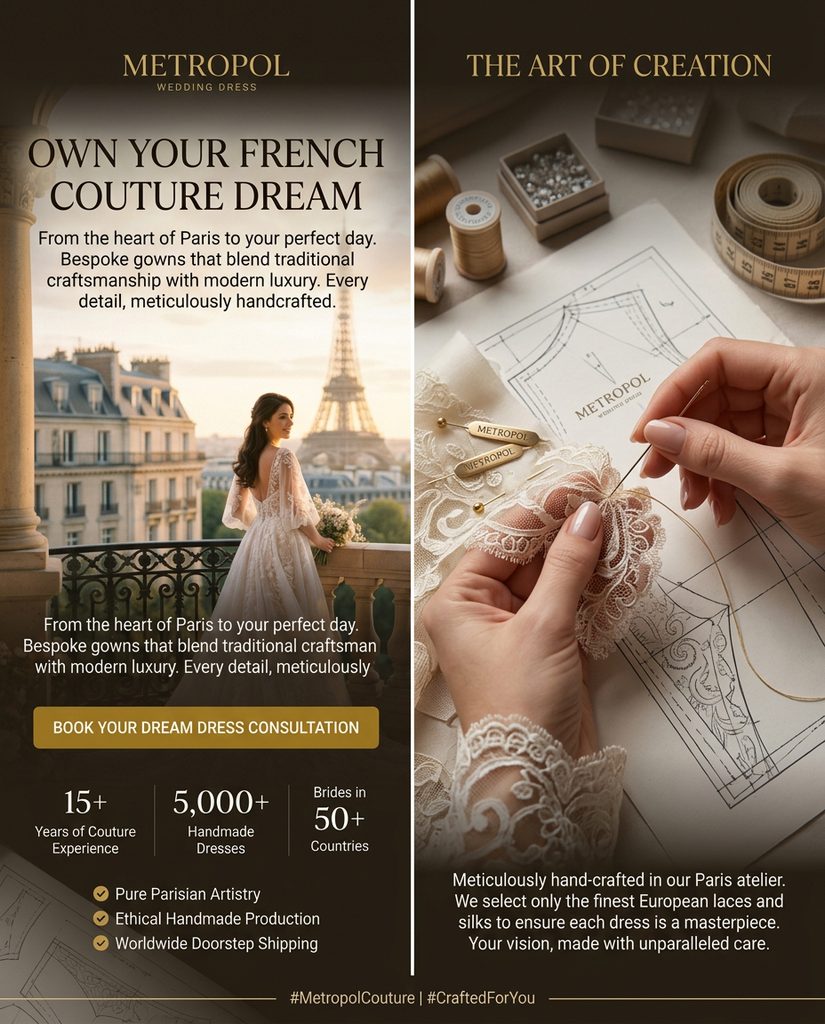
The Paris Couture Mindset: A Dress Is a Product System
A luxury wedding gown may appear to be one object.
From a manufacturing perspective, it is an interconnected system.
A finished gown can contain:
| Component | Commercial importance | Manufacturing consideration |
|---|---|---|
| Main fabric | Creates the visual identity | Weight, drape, recovery and availability |
| Lining | Determines comfort and internal appearance | Skin feel, breathability and construction |
| Corsetry | Controls silhouette | Boning, structure, support and fitting |
| Lace | Adds texture and identity | Pattern matching and placement |
| Beading | Creates luxury perception | Handwork hours and attachment security |
| Embroidery | Adds exclusivity | Artwork, density and production time |
| Train | Influences drama | Floor clearance, weight and reinforcement |
| Closure | Affects fit and appearance | Zipper, buttons, corset or concealed closure |
| Cups/support | Influences comfort | Size variation and placement |
| Interfacing | Supports structure | Compatibility with outer fabric |
| Waist construction | Determines silhouette | Seam accuracy and stress management |
| Veil/accessories | Completes the look | Matching lace, trims and color |
A buyer who evaluates only the exterior appearance is evaluating perhaps half the product.
The interior matters.
The seam finishing matters.
The distribution of weight matters.
The relationship between fabric and boning matters.
The way the train folds matters.
The way the gown behaves when the bride sits, walks, dances and photographs matters.
That is why couture-level bridal manufacturing requires more than sewing capability.
It requires product engineering for the human body.
What Makes a Wedding Dress Feel Couture?
There is no single fabric, silhouette or embellishment that automatically makes a wedding dress couture.
Couture is better understood as a combination of decisions.
1. Personalization
The gown should respond to the wearer rather than forcing the wearer into an arbitrary standard.
That can involve:
- measurements;
- proportions;
- posture;
- bust position;
- shoulder shape;
- preferred neckline;
- waist placement;
- train length;
- sleeve length;
- heel height;
- mobility requirements;
- and personal aesthetic.
2. Construction
A dramatic exterior must be supported by an intelligent internal structure.
A strapless gown, for example, may require carefully engineered corsetry.
A fitted mermaid silhouette may require controlled seam placement and stretch management.
A heavily beaded gown may need internal reinforcement because embellishment can add significant weight.
3. Hand finishing
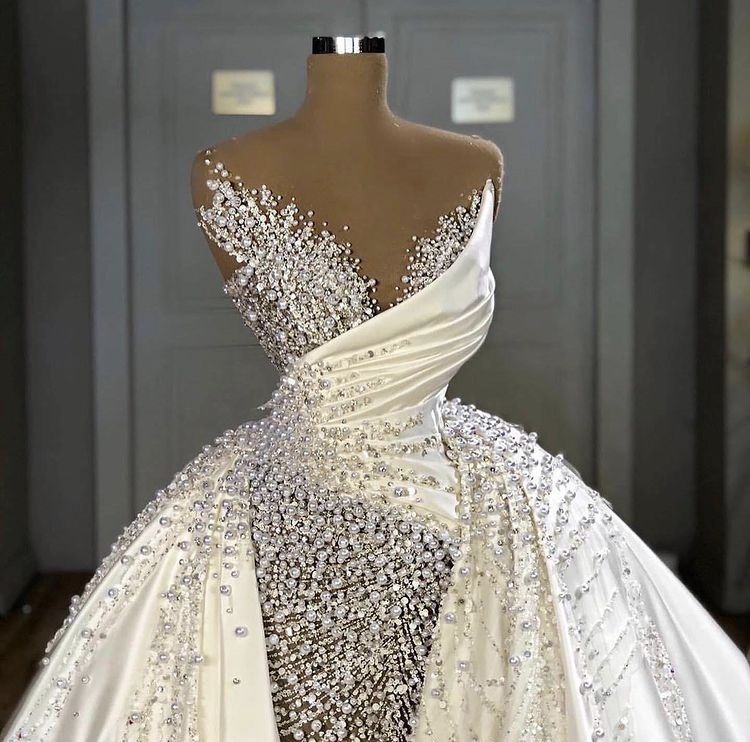
Handwork can create visual depth that is difficult to reproduce through purely industrial processes.
This may include:
- hand-applied lace;
- hand embroidery;
- bead placement;
- crystal work;
- floral appliqué;
- pearl detailing;
- three-dimensional flowers;
- hand finishing around necklines;
- and individually positioned motifs.
Current couture coverage continues to highlight the importance of craftsmanship and bridal influence within couture collections. Vogue’s coverage of the 2026 couture season, for example, noted the strong presence of wedding-ready looks and the influence of bridal clients on couture collections.
4. Controlled individuality
True differentiation does not necessarily mean making every gown completely different.
For a commercial collection, the smarter approach can be:
recognizable design language + controlled customization.
That allows a boutique to maintain its identity while giving customers meaningful choices.
From Paris Inspiration to Manufacturing Specification
One of the biggest problems in bridal sourcing is the gap between creative language and production language.
A buyer might say:
“I want something elegant, romantic and very Parisian.”
A manufacturer needs something more precise.
The production team needs to know:
- What silhouette?
- What fabric?
- What lining?
- What color?
- What neckline?
- What train?
- What sleeve construction?
- What embroidery density?
- What bead placement?
- What closure?
- What measurements?
- What grade?
- What quantity?
- What acceptable tolerance?
- What delivery schedule?
This is why a professional Custom Wedding Dress Manufacturer should be able to convert visual references into technical production information.
A photograph can inspire a garment.
It cannot, by itself, define a manufacturing specification.
The Anatomy of a Bespoke Bridal Project
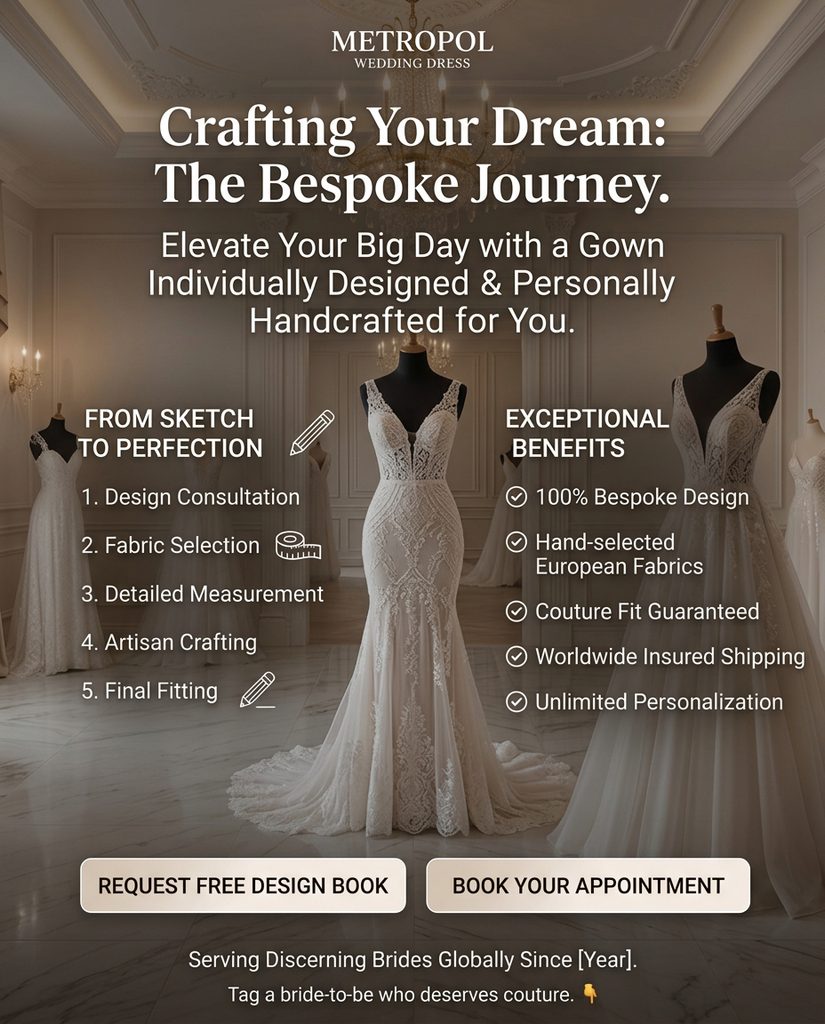
A successful project usually progresses through stages rather than jumping directly from photograph to finished gown.
Stage 1 — Creative briefing
The buyer explains:
- target customer;
- price positioning;
- desired aesthetic;
- occasion;
- market;
- reference images;
- expected quantity;
- customization requirements.
Stage 2 — Design interpretation
The manufacturer analyzes:
- silhouette;
- fabric;
- construction;
- trims;
- embellishment;
- pattern complexity;
- internal structure.
Stage 3 — Technical development
The design becomes:
- patterns;
- measurements;
- construction instructions;
- material requirements;
- embellishment maps;
- quality checkpoints.
Stage 4 — Sampling
A prototype is created.
The purpose is not simply to make a miniature version of the final product.
The sample reveals whether the design actually works.
Stage 5 — Fitting
Measurements and proportions are reviewed.
Stage 6 — Revision
The pattern and construction may be adjusted.
Stage 7 — Production
Approved specifications are transferred into production.
Stage 8 — Quality control
The finished gowns are checked before packing.
Stage 9 — Export preparation
The garments are prepared for international shipment according to the buyer’s requirements.
This staged approach dramatically reduces the risk of discovering a design problem after a large production run.
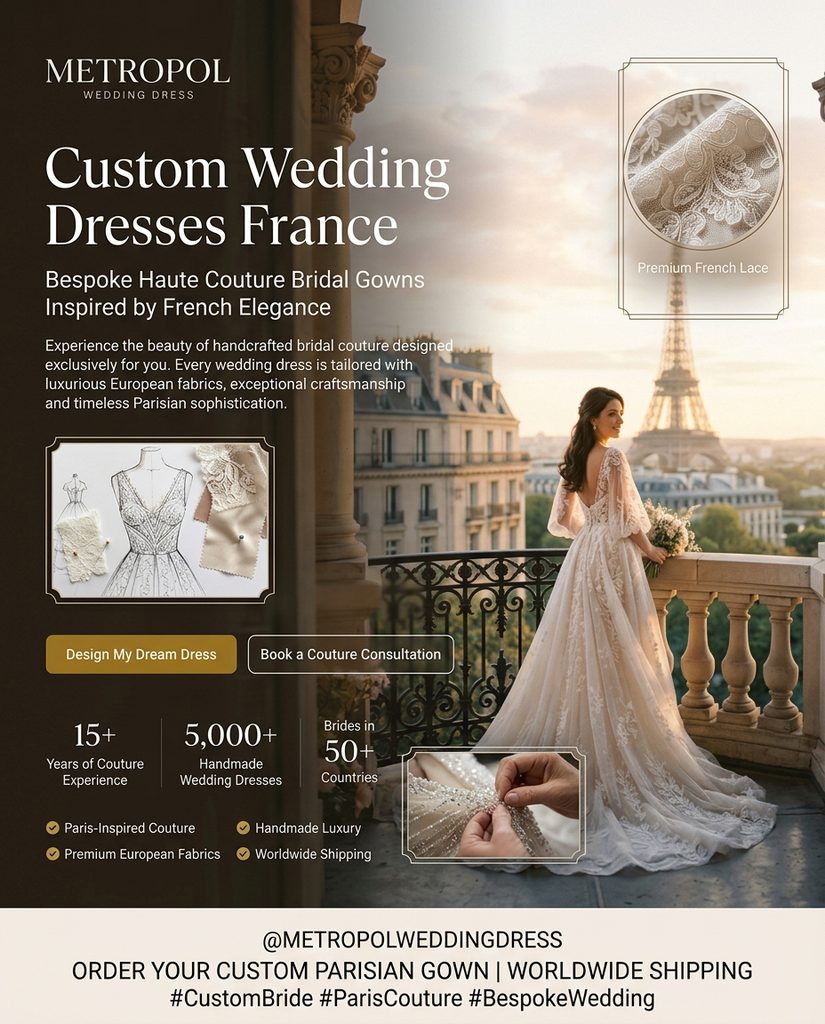
What Should a Buyer Ask a Couture Wedding Dress Manufacturer?
A serious buyer should never evaluate a manufacturer from photographs alone.
The better question is:
Can this manufacturer repeatedly produce the quality represented by its samples?
Ask for evidence of capability in areas such as:
- sample development;
- custom patterns;
- fabric sourcing;
- lace application;
- hand embroidery;
- beading;
- corsetry;
- structural construction;
- made-to-measure production;
- private labeling;
- packaging;
- international shipment;
- quality inspection;
- and production communication.
A Custom Bridal Gown Manufacturer should be able to discuss construction rather than simply quote a price.
That conversation reveals a lot.
If a manufacturer immediately gives a low price without asking about fabric, construction, measurements, embellishment or quantity, the quotation may not represent the same product you have in mind.
Bespoke, Made-to-Measure, Made-to-Order and Custom: What Is the Difference?
These terms are often used interchangeably in bridal marketing.
They should not be.
| Model | Core concept | Best for |
|---|---|---|
| Bespoke | Design and garment developed around an individual client | High-end private clients |
| Made-to-measure | Existing design adapted to specific measurements | Boutiques and personalized retail |
| Made-to-order | Garment produced after an order | Lower inventory models |
| Custom | Design or specifications modified according to buyer requirements | Retailers and designers |
| Private label | Product manufactured under buyer’s brand | Fashion businesses |
| OEM | Manufacturer produces according to client’s specifications | Established brands |
| Wholesale | Products supplied commercially in quantity | Retailers/distributors |
A Bespoke Wedding Dress Manufacturer is therefore relevant when the buyer needs deeper individualization.
A Bespoke Bridal Gown Manufacturer may work with designers or boutiques that want unique garments rather than generic stock.
A Made to Measure Wedding Dress Manufacturer is particularly useful for businesses offering customers personalized sizing.
Meanwhile, a Made to Order Wedding Dress Manufacturer can support a business model where finished inventory is minimized and production begins after customer confirmation.
Why Made-to-Order Can Be Attractive for Bridal Retailers
Wedding dresses are unusually challenging inventory products.
A boutique may need:
- multiple sizes;
- multiple silhouettes;
- multiple colors;
- seasonal designs;
- different trains;
- different neckline options;
- and different customer preferences.
Holding every possible variation in stock is expensive.
A made-to-order model can shift part of that complexity from inventory into production.
Instead of keeping ten variations of one gown physically available, a retailer may display one approved sample and offer controlled customization.
The commercial model becomes:
sample → consultation → order → specification → production → inspection → delivery → fitting.
This is particularly powerful when the manufacturer has a strong production workflow.
A Better Way to Think About Customization
Customization does not mean allowing the customer to change everything.
Unlimited choices can create operational chaos.
The smarter approach is modular customization.
For example, a bridal collection might allow:
Bodice options
- sweetheart;
- straight;
- square;
- bateau;
- off-shoulder;
- high neck.
Sleeve options
- sleeveless;
- cap sleeve;
- long sleeve;
- detachable sleeve;
- sheer sleeve.
Skirt options
- A-line;
- ball gown;
- fit-and-flare;
- mermaid;
- sheath.
Train options
- chapel;
- cathedral;
- sweep;
- detachable;
- extended dramatic train.
Surface options
- clean;
- lace;
- floral appliqué;
- crystal;
- pearl;
- embroidery.
This gives customers a feeling of personalization without turning every order into a completely new engineering project.
The Material Decision: Why Fabric Changes Everything
A wedding gown’s appearance can change dramatically depending on fabric selection.
Two gowns may have the same pattern but look completely different because of material.
Silk and silk-like fabrics
These can provide:
- fluid movement;
- elegant drape;
- subtle luminosity;
- sophisticated texture.
Satin
Satin can produce:
- structured volume;
- reflective surfaces;
- clean architectural silhouettes.
But the weight and finish of satin matter greatly.
Tulle
Tulle can be:
- soft;
- structured;
- illusion-like;
- layered;
- airy;
- voluminous.
Lace
Lace is one of the most important materials in luxury bridalwear because it can function as both decoration and identity.
Its motif scale matters.
A large botanical lace produces a different visual language from delicate floral lace.
Organza
Organza can provide crisp volume without the visual density of heavier materials.
Mikado
Mikado-type fabrics can be useful for structured contemporary silhouettes.
Beaded textiles
These can create immediate luxury impact, but their weight, flexibility and production complexity must be considered.
A professional Personalized Wedding Dress Manufacturer should therefore discuss materials as part of the design process rather than treating fabric as an afterthought.
The Hidden Engineering of a Luxury Bridal Gown
Luxury bridalwear looks soft.
It is often highly engineered.
Consider a strapless ball gown.
The visible design might seem simple:
neckline + bodice + skirt.
Internally, however, the garment may require:
- structured bodice panels;
- boning;
- waist stabilization;
- lining;
- internal support;
- precise seam positioning;
- bust support;
- closure reinforcement;
- skirt attachment;
- multiple layers;
- hem management.
The objective is not simply to make the dress beautiful.
It is to make the dress stay beautiful while being worn.
This distinction is essential.
A gown that photographs beautifully on a mannequin but shifts during movement is not a successful bridal product.
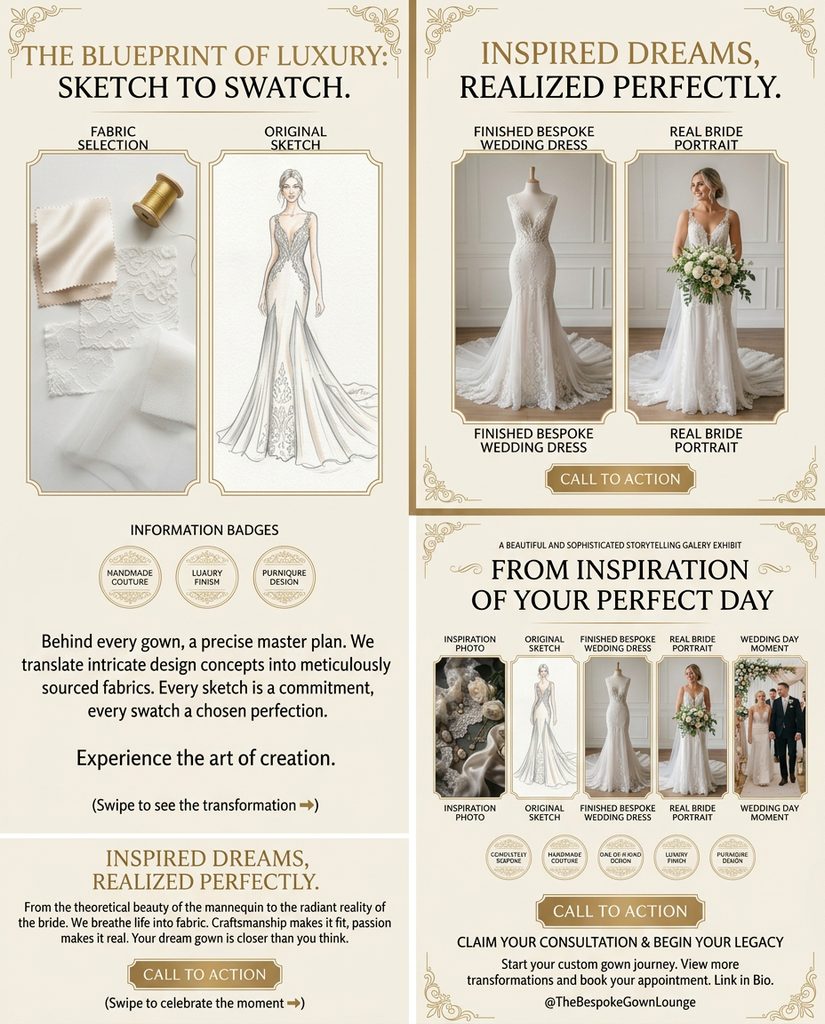
Couture Bridal Manufacturing for Boutiques
For a boutique, manufacturing quality has a direct relationship with customer satisfaction.
The retailer is usually the visible point of responsibility.
If a dress arrives:
- too long;
- incorrectly embellished;
- poorly pressed;
- with weak closures;
- with inconsistent lace placement;
- with inaccurate measurements;
- or with damaged packaging,
the boutique absorbs the commercial consequences.
That is why a Customized Bridal Gown Manufacturer should be evaluated as part of the retailer’s customer-experience system.
The manufacturer is not invisible.
The manufacturer is part of the brand.
What Makes a Good Wedding Dress Manufacturer for Boutiques?
A Wedding Dress Manufacturer for Boutiques should ideally understand that boutiques need more than production capacity.
They need:
Consistency
The second gown should resemble the approved sample in all important characteristics.
Flexibility
The manufacturer should be able to handle reasonable modifications.
Communication
Design questions should be clarified before production.
Quality control
Problems should be identified before shipment.
Packaging
Luxury garments need appropriate protection.
Commercial awareness
A manufacturer should understand that retailers have customer deadlines.
This is especially important for destination weddings, where delays can create disproportionate stress.
Bridal Shops Need Different Support
A Bridal Gown Manufacturer for Bridal Shops should understand the retail fitting process.
A bridal shop may need:
- standard sample sizes;
- special orders;
- measurement-based production;
- length adjustments;
- sleeve modifications;
- neckline modifications;
- fabric changes;
- color variations;
- and rush communication.
The manufacturer’s role therefore becomes an extension of the shop’s operational infrastructure.
The best relationship is not simply:
buyer → supplier.
It becomes:
designer/retailer → product-development partner → production → customer.
Private Label Bridalwear: Building a Brand Without Building a Factory
Many fashion entrepreneurs want to establish their own bridal label.
They may have:
- brand identity;
- customer research;
- social media presence;
- designers;
- marketing expertise;
- retail relationships;
but no manufacturing facility.
A Private Label Wedding Dress Manufacturer allows the business to focus on its brand while outsourcing physical production.
However, private label is more demanding than simply adding a logo.
A serious private-label program should consider:
- label placement;
- care labels;
- packaging;
- SKU system;
- technical specifications;
- approved materials;
- brand standards;
- sample approval;
- quality standards;
- confidentiality;
- repeat ordering;
- and production documentation.
Your manufacturer becomes part of the invisible infrastructure behind the brand.
OEM Wedding Dress Manufacturing: When Specifications Matter
An OEM Wedding Dress Manufacturer works from the buyer’s product requirements.
The buyer may provide:
- sketches;
- technical drawings;
- reference samples;
- measurements;
- material specifications;
- embellishment concepts;
- construction instructions.
The manufacturer’s responsibility is to transform these specifications into physical garments.
OEM is particularly relevant when the buyer already understands its target customer and has developed its own design language.
The challenge is maintaining the original design intent during manufacturing.
A small change in:
- lace density;
- seam position;
- neckline depth;
- fabric weight;
- boning placement;
- or bead arrangement
can change the character of the entire gown.
Why Couture Manufacturing Requires a Different Quality-Control Mindset
Mass production often focuses on speed, repeatability and standardized measurements.
Couture-oriented bridal production adds another layer:
visual consistency.
For example, a gown can technically meet measurements but still look wrong because:
- the lace motif is slightly misaligned;
- embroidery density varies;
- the hem is uneven;
- bead distribution is inconsistent;
- the train does not fall symmetrically;
- or the fabric tension changes across panels.
A Couture Wedding Dress Manufacturer therefore needs quality-control procedures that evaluate both technical construction and visual appearance.
The Difference Between Luxury Appearance and Luxury Construction
This is one of the most important lessons for buyers.
A gown can look luxurious because it contains:
- glitter;
- crystals;
- lace;
- pearls;
- dramatic volume.
But luxury construction often appears in quieter details.
Look inside the gown.
Check:
- seams;
- lining;
- internal support;
- closure finishing;
- hem;
- boning;
- thread management;
- lace transitions;
- reinforcement;
- pressing;
- and structural balance.
The exterior attracts the customer.
The construction determines whether the product deserves to remain in a premium collection.
Handmade vs. Handcrafted: Why the Terms Need Precision
A Handmade Wedding Dress Manufacturer may emphasize the role of manual craftsmanship in production.
A Handcrafted Bridal Gown Manufacturer may focus on hand-applied details such as:
- embroidery;
- appliqué;
- beading;
- floral construction;
- lace placement;
- finishing.
But “handmade” should not be interpreted as meaning every stitch must be performed manually.
Luxury manufacturing can combine:
precision machinery + hand craftsmanship + technical patternmaking + quality control.
That combination can actually produce better consistency than attempting to make every component manually.
Tailor-Made Bridalwear and the Human Body
A Tailor Made Wedding Dress Manufacturer needs to understand that bodies are three-dimensional.
Measurements alone do not tell the entire story.
Two brides can share:
- bust measurement;
- waist measurement;
- hip measurement;
yet have different:
- shoulder slopes;
- torso lengths;
- bust positions;
- posture;
- back curvature;
- or waist placement.
This is why a tailor-made garment should be evaluated through fit logic rather than numbers alone.
A Tailor Made Bridal Gown Manufacturer should therefore treat measurements as a starting point for pattern interpretation, not merely a list of numbers.
One-of-a-Kind Bridalwear: When Exclusivity Becomes the Product
For certain luxury clients, uniqueness is more important than trend alignment.
A One of a Kind Wedding Dress Manufacturer can support projects where the gown is developed as a singular design.
This might involve:
- unique lace placement;
- custom embroidery;
- unusual silhouette;
- sculptural construction;
- personalized motifs;
- family-inspired details;
- detachable elements;
- or an entirely original pattern.
The commercial value comes from scarcity.
The dress is not merely expensive.
It is difficult to replace.
Exclusive Bridal Gowns for Luxury Retail
An Exclusive Bridal Gown Manufacturer can help a retailer differentiate its collection.
Exclusivity can be structured in different ways.
For example:
Design exclusivity
A particular design is reserved for one buyer.
Geographic exclusivity
A collection is restricted to a particular market.
Collection exclusivity
The manufacturer produces a defined capsule exclusively for one retailer.
Customization exclusivity
A special fabric or embellishment configuration is created for a particular customer.
The precise commercial terms should always be agreed contractually.
Direct Manufacturing: Why Buyers Sometimes Prefer It
A Direct Wedding Dress Manufacturer can potentially simplify the supply chain by reducing unnecessary intermediaries.
The advantages can include:
- direct communication;
- clearer product specifications;
- faster feedback;
- more control;
- easier customization;
- improved production visibility.
The buyer should nevertheless evaluate the manufacturer’s actual capabilities rather than assuming that “direct” automatically means “better.”
The important question remains:
Who is responsible for the quality of the final gown?
Direct Bridal Gown Production for International Buyers
A Direct Bridal Gown Manufacturer can be particularly useful for international buyers that need a closer relationship with production.
This can help when the buyer wants to:
- develop new styles;
- test samples;
- modify existing designs;
- build a collection;
- manage recurring wholesale orders;
- or develop private-label products.
The ideal relationship is transparent enough that the buyer understands what is being produced and why.
Wholesale Custom Wedding Dresses: A Different Commercial Equation
Custom Wedding Dress Wholesale is not simply ordinary wholesale with a higher price.
Customization increases complexity.
The buyer must consider:
- minimum order quantities;
- sample costs;
- customization fees;
- pattern-development charges;
- embellishment labor;
- material availability;
- repeatability;
- lead time;
- shipping;
- and alteration requirements.
For a boutique, the most profitable gown is not necessarily the gown with the lowest factory price.
It is the gown that balances:
landed cost + retail price + sell-through + customer satisfaction + alteration cost + delivery reliability.
Custom Bridal Gown Wholesale and Margin Protection
A bridal retailer should calculate more than purchase price.
Consider this simplified model:
| Cost category | Example consideration |
|---|---|
| Product cost | Manufacturer’s quoted price |
| Sampling | Development and prototype |
| Freight | International transportation |
| Duties/taxes | Market-dependent |
| Packaging | Protection and presentation |
| Alterations | Local fitting adjustments |
| Marketing | Photography and promotion |
| Inventory | Capital tied up in stock |
| Returns/risk | Commercial contingency |
| Customer service | Staff time |
This produces a more realistic concept:
True landed cost
Product price + logistics + import costs + handling + expected operational costs
That number should be compared with expected retail revenue.
Wholesale Custom Wedding Dresses vs. Ready-Made Stock
| Factor | Ready-made stock | Wholesale custom |
|---|---|---|
| Initial availability | High | Lower |
| Customization | Limited | High |
| Inventory flexibility | Lower | Higher |
| Development effort | Low | Higher |
| Brand differentiation | Moderate | High |
| Production planning | Simple | More structured |
| Fit personalization | Limited | Strong |
| Collection uniqueness | Variable | Potentially high |
| Risk of generic designs | Higher | Lower |
The right model depends on the retailer.
A high-volume discount retailer may prioritize ready-made stock.
A premium boutique may benefit more from controlled customization.
Custom Bridal Wear for Modern Retail
A Custom Bridal Wear Manufacturer can produce more than the ceremony gown.
Modern bridal wardrobes increasingly include:
- rehearsal dinner looks;
- civil ceremony dresses;
- second dresses;
- reception gowns;
- detachable overskirts;
- capes;
- bridal separates;
- after-party dresses;
- coordinated veils;
- gloves;
- jackets;
- and accessories.
Recent couture coverage reflects this broader approach: Vogue has highlighted wedding-ready couture pieces for ceremonies, rehearsal dinners and after-parties rather than treating bridalwear as a single dress category.
This opens a significant opportunity for boutiques.
Instead of selling one gown, the retailer can build a bridal wardrobe.
Bespoke Bridal Wear Manufacturer for Multi-Look Weddings
A Bespoke Bridal Wear Manufacturer can develop coordinated looks around one wedding.
For example:
Look 1 — Ceremony
Structured gown with long train.
Look 2 — Reception
Detachable train removed.
Look 3 — Dinner
Lighter silhouette.
Look 4 — After-party
Shorter or more mobile design.
This creates additional revenue opportunities without requiring four completely unrelated products.
The design language remains consistent.
Bridal Couture Manufacturer: Designing for Emotion
A Bridal Couture Manufacturer is not only producing clothing.
It is manufacturing an emotional object.
The bride may associate the garment with:
- family;
- heritage;
- photographs;
- vows;
- cultural traditions;
- personal identity;
- and one of the most important days of her life.
That creates a different quality threshold.
A small defect that might be acceptable in ordinary apparel can become extremely significant in bridalwear.
The manufacturer’s job is therefore partly technical and partly emotional.
Premium Wedding Dress Manufacturing
A Premium Wedding Dress Manufacturer should understand the difference between adding cost and adding value.
More expensive materials do not automatically create a more desirable gown.
Value may come from:
- better fit;
- better drape;
- better construction;
- cleaner finishing;
- more thoughtful customization;
- stronger design;
- better comfort;
- superior presentation;
- or more reliable service.
Premium manufacturing is therefore about controlled value creation.
Premium Bridal Gown Production and the Boutique Experience
A Premium Bridal Gown Manufacturer can help a boutique create a consistent premium experience from sample room to final customer.
The product should communicate quality before the bride puts it on.
Then it should reinforce that impression when worn.
Finally, it should maintain that impression in:
- photography;
- packaging;
- fitting;
- alterations;
- and long-term preservation.
How Paris Influences Bridal Design Without Dictating It
Paris is influential because it allows designers to think beyond conventional bridal formulas.
The couture calendar continues to act as a major source of inspiration. The FHCM currently coordinates Paris Fashion Week and Haute Couture Week, while contemporary couture collections continue to incorporate wedding-ready designs and bridal references.
But “Parisian” should not automatically mean:
- ivory;
- lace;
- minimalist;
- vintage;
- or romantic.
Paris can also mean:
- architectural;
- experimental;
- sculptural;
- artistic;
- minimalist;
- theatrical;
- or technically innovative.
The most compelling couture wedding dress Paris concept may therefore combine Parisian design thinking with the buyer’s own cultural and commercial identity.
A Paris-Inspired Design Matrix
| Design direction | Typical visual language | Suitable customer |
|---|---|---|
| Parisian Romantic | Lace, softness, floral details | Traditional luxury bride |
| Modern Atelier | Clean structure, controlled volume | Contemporary bride |
| Sculptural Couture | Architectural shapes | Fashion-forward bride |
| Quiet Luxury | Minimal surface decoration | Sophisticated minimalist |
| Vintage Paris | Historical references | Heritage-focused customer |
| Botanical Couture | Floral appliqué and embroidery | Romantic destination weddings |
| Editorial Bridal | Dramatic proportions | Fashion-led clients |
| Convertible Couture | Detachable components | Multi-event weddings |
The opportunity is not to copy Paris.
It is to interpret Paris.
The 2026 Bridal Design Conversation: Craftsmanship Meets Individuality
Current fashion coverage suggests that bridalwear is increasingly comfortable crossing the boundaries between traditional wedding clothing and broader fashion expression.
Vogue’s 2026 bridal coverage has highlighted handcrafted techniques, unconventional bridal looks and couture collections with strong wedding relevance. Crochet, for example, has been described as a notable 2026 bridal direction connected with handcrafted romanticism and contemporary craftsmanship.
At the same time, unconventional Paris-based bridal projects show that modern brides can treat bridalwear as a form of storytelling rather than a fixed category.
For manufacturers, this means one thing:
the customer is becoming more specific.
The modern bride may want tradition, but she wants it interpreted personally.
International Wedding Dress Manufacturing
An International Wedding Dress Manufacturer must solve problems that do not exist in local-only production.
International buyers may operate across:
- Europe;
- North America;
- the Middle East;
- Asia;
- Australia;
- Africa;
- and other regional markets.
Each market can have different:
- customer expectations;
- sizing systems;
- seasonal requirements;
- delivery patterns;
- customs procedures;
- labeling requirements;
- retail structures;
- and wedding traditions.
Manufacturing for international customers therefore requires flexibility.
Wedding Dress Exporter: What Buyers Should Evaluate
A Wedding Dress Exporter should not be evaluated only by whether it can put a box on a plane.
International export performance depends on:
- correct documentation;
- appropriate packaging;
- accurate commercial information;
- product protection;
- shipment coordination;
- communication;
- and delivery planning.
For expensive bridal garments, packaging deserves particular attention.
A dress can leave the factory perfectly finished and arrive compromised if:
- moisture enters the package;
- the garment is excessively compressed;
- embellishments are exposed to abrasion;
- or the internal protection is inadequate.
Bridal Gown Exporter and Destination Weddings
A Bridal Gown Exporter serves a market where deadlines are unusually important.
Destination weddings create fixed dates.
The wedding cannot simply be postponed because a shipment is late.
That means buyers should plan backwards from the wedding date.
A useful planning sequence is:
Wedding date → required fitting date → delivery date → shipping buffer → production completion → final inspection → production start → sample approval → design approval.
The earlier the critical dates are defined, the more controllable the project becomes.
A Buyer’s Timeline for a Custom Bridal Project
A practical project can be organized around milestones rather than vague promises.
Milestone A
Creative brief approved.
Milestone B
Materials confirmed.
Milestone C
Technical design approved.
Milestone D
Sample completed.
Milestone E
Sample fitting reviewed.
Milestone F
Corrections approved.
Milestone G
Production authorized.
Milestone H
Quality inspection completed.
Milestone I
Shipment released.
Milestone J
Final fitting performed locally.
The exact time required will vary by complexity, quantity, materials and customization.
The important principle is milestone control.
Common Sourcing Mistakes
Mistake 1: Choosing from photographs alone
Photography can hide:
- poor construction;
- cheap fabric;
- weak lining;
- uneven hems;
- poor internal support.
Better approach
Request technical and construction information.
Mistake 2: Comparing quotations without comparing specifications
A $500 gown and a $900 gown are meaningless comparisons if the materials and workmanship differ.
Better approach
Compare like-for-like specifications.
Mistake 3: Treating customization as free
Customization requires:
- design time;
- pattern work;
- material management;
- communication;
- sample development;
- additional labor.
Better approach
Define what customization includes before ordering.
Mistake 4: Approving samples casually
A sample is not merely a photograph opportunity.
It is the physical reference for production.
Better approach
Approve it systematically.
Mistake 5: Ignoring alteration costs
A low-cost gown requiring significant local alteration may become more expensive than a better-fitting gown.
Better approach
Calculate total landed and service cost.
Mistake 6: Ordering too close to the wedding date
International shipping creates uncertainty.
Better approach
Build contingency time.
The Sample Approval Checklist
Before approving a bridal sample, evaluate:
Fit
- Is the bust positioned correctly?
- Is the waist where expected?
- Does the back sit correctly?
- Is the neckline stable?
Construction
- Are seams clean?
- Is the lining comfortable?
- Are closures secure?
- Is internal support adequate?
Appearance
- Is lace positioned correctly?
- Is embellishment consistent?
- Is the color correct?
- Does the fabric match the approved reference?
Movement
- Can the bride walk?
- Can she sit?
- Can she dance?
- Does the train move properly?
Photography
- Does the gown maintain its intended shape?
- Do details photograph clearly?
- Does the fabric reflect light appropriately?
Packaging
- Can the finished gown be transported safely?
Only after these questions have been answered should the sample become the production benchmark.
A Manufacturer’s Ability to Say “No” Can Be Valuable
This may sound counterintuitive.
But experienced manufacturing partners should sometimes challenge a design.
Suppose a buyer requests:
- extremely heavy embellishment;
- unsupported fabric;
- an ultra-low back with complex structure;
- a very long train;
- fragile appliqué;
- and a tight deadline.
A responsible manufacturer should explain the technical consequences.
The objective is not to reject creativity.
It is to make creativity manufacturable.
That is the difference between a supplier who simply accepts orders and a production partner who understands bridal engineering.
Cost Analysis: Where the Price of a Couture Gown Actually Comes From
The price of a luxury wedding dress can be influenced by many variables.
A simplified model is:
Garment cost = materials + labor + craftsmanship + pattern development + sampling + overhead + quality control + packaging + commercial margin
For highly customized work, labor can become a major component.
Consider hand embellishment.
If one gown requires substantially more handwork than another, the two products cannot logically share the same production cost.
Likewise, fabric prices can vary enormously.
But cost should never be analyzed in isolation.
A buyer should ask:
What value does the additional cost create?
A Practical Cost-Value Framework
| Investment | Potential value |
|---|---|
| Better fabric | Improved drape and appearance |
| Better pattern | Better fit |
| More handwork | Greater visual uniqueness |
| Better corsetry | Improved structure |
| Better lining | Comfort |
| Better quality control | Lower defect risk |
| Better packaging | Reduced transport damage |
| Better sampling | Lower production risk |
| Better communication | Fewer misunderstandings |
The cheapest supplier may therefore be the most expensive option if the buyer experiences:
- rejected goods;
- delays;
- alterations;
- customer complaints;
- or unsold inventory.
How a Boutique Can Build a Couture Capsule Collection
Instead of ordering an enormous collection, a boutique can start with a carefully engineered capsule.
For example:
The Signature Gown
A recognizable hero design.
The Minimal Gown
Clean and contemporary.
The Romantic Gown
Lace and soft texture.
The Statement Gown
Dramatic couture proportions.
The Convertible Gown
Detachable elements for multiple looks.
The Civil Dress
Shorter or simpler for city ceremonies.
This structure gives the retailer range without excessive SKU complexity.
Building a Private-Label Bridal Collection Step by Step
A fashion business can approach private-label production through a controlled sequence.
1. Define the customer.
Who is the collection for?
2. Define the price architecture.
What is the intended retail range?
3. Define the visual identity.
What makes the brand recognizable?
4. Select core silhouettes.
Avoid excessive variation at the beginning.
5. Develop materials.
Choose fabrics and trims strategically.
6. Develop samples.
Test the designs physically.
7. Conduct fittings.
Correct construction problems.
8. Build technical specifications.
Create repeatable production references.
9. Approve quality standards.
Define what constitutes an acceptable gown.
10. Launch production.
Start with controlled quantities.
11. Review sales data.
Identify winners.
12. Expand selectively.
Develop additional designs based on customer response.
This is how a bridal collection becomes a business rather than simply a beautiful mood board.
What a Strong Manufacturer-Buyer Relationship Looks Like
A good relationship has three characteristics.
Clarity
Everyone understands what is being made.
Accountability
Everyone understands who is responsible for each stage.
Repeatability
Successful results can be reproduced.
The manufacturer should not need to rediscover the same solution every time a buyer places a repeat order.
Documentation matters.
Samples matter.
Measurements matter.
Material references matter.
Photographic references matter.
Production notes matter.
Together, they create institutional knowledge.
Information That Should Be Included in a Bridal Product Specification
For each gown, a buyer can document:
Product code
Collection name
Silhouette
Main fabric
Lining
Color
Neckline
Sleeve
Closure
Train
Embellishment
Lace
Appliqué
Corsetry
Measurement chart
Tolerance
Labeling
Packaging
Special instructions
Approved sample reference
Quality-control points
This document becomes the bridge between design and manufacturing.
Why Technical Documentation Protects Both Sides
Without documentation, disagreements often sound like this:
Buyer: “This isn’t what we approved.”
Manufacturer: “We made what we understood from the photos.”
Neither side necessarily acted in bad faith.
The problem was ambiguity.
Technical documentation reduces ambiguity.
It converts subjective expectations into measurable specifications.
That is especially important for OEM, private-label and wholesale production.
Five Expert Principles for Buying Couture-Style Bridalwear
Principle 1 — Buy construction, not decoration
A beautiful surface cannot compensate for poor engineering.
Principle 2 — Sample before scaling
Never assume a design works because it looks good in a drawing.
Principle 3 — Define customization
Specify exactly what can be modified.
Principle 4 — Calculate total cost
Look beyond factory price.
Principle 5 — Protect the calendar
Wedding deadlines are unforgiving.
Realistic Buyer Scenarios
Scenario A: The Paris bridal boutique
A boutique wants a collection inspired by Parisian couture.
It does not need 500 identical gowns.
It needs a small collection with:
- recognizable identity;
- premium materials;
- customization options;
- manageable quantities;
- and reliable replenishment.
The best model may be custom wholesale with controlled customization.
Scenario B: The online luxury bridal label
The brand wants to sell made-to-order gowns without holding large amounts of finished inventory.
Its priority is:
- digital customer consultation;
- size collection;
- production accuracy;
- packaging;
- delivery;
- and customer support.
A made-to-order manufacturing relationship may be appropriate.
Scenario C: The established fashion brand
The brand has its own designs and wants another company to manufacture them.
Its priorities may include:
- technical specifications;
- confidentiality;
- pattern development;
- repeatability;
- labeling;
- and quality consistency.
An OEM model may be more appropriate.
Scenario D: The bridal distributor
The distributor needs multiple styles and predictable wholesale production.
Its key considerations are:
- production capacity;
- pricing;
- repeat orders;
- packaging;
- export;
- logistics;
- and consistent quality.
A direct manufacturing relationship may be appropriate.
Country and Market Considerations
A bridal gown is not sold in a cultural vacuum.
A gown designed for Paris may need adaptation for:
- Dubai;
- London;
- New York;
- Milan;
- Istanbul;
- Doha;
- Los Angeles;
- Singapore;
- or Sydney.
Differences may include:
- modesty expectations;
- climate;
- ceremony traditions;
- body proportions;
- preferred silhouettes;
- sleeve requirements;
- color preferences;
- wedding venue;
- and cultural symbolism.
A manufacturer serving international customers should therefore be comfortable with adaptation.
Paris vs. Other Bridal Aesthetics
| Aesthetic | Main characteristic |
|---|---|
| Parisian couture | Refined creativity and atelier influence |
| Italian glamour | Dramatic elegance and luxurious surface |
| Minimalist Scandinavian | Clean structure and simplicity |
| Romantic European | Lace, softness and femininity |
| Modern American bridal | Versatility and commercial wearability |
| Middle Eastern luxury | Rich embellishment and statement silhouettes |
| Contemporary Asian bridal | Strong blend of tradition and innovation |
These categories are not rules.
They are design starting points.
A successful international collection can combine them intelligently.
The Role of Technology in Couture Manufacturing
Technology does not have to compete with craftsmanship.
It can support it.
Modern production may use:
- digital pattern development;
- digital measurement systems;
- computerized cutting;
- embroidery technology;
- precision machinery;
- digital product documentation;
- photography-based approvals;
- and structured quality-control records.
The FHCM itself describes contemporary couture as a bridge between traditional know-how and modern manufacturing techniques, including cutting-edge innovation.
The future is therefore not necessarily:
handmade versus technology.
It can be:
technology for precision + human craftsmanship for individuality.
Why This Matters for the Future of Bridalwear
Customers increasingly expect products to feel personal.
They want:
- their proportions;
- their story;
- their aesthetic;
- their cultural identity;
- their comfort;
- their photographs;
- and their preferences
reflected in the final product.
That creates a strong opportunity for manufacturers capable of controlled customization.
The winning manufacturer may not be the one with the largest catalog.
It may be the one capable of producing the right gown for the right customer with the right amount of customization.
Metropol Wedding Dress: A Manufacturing Partner for Custom Bridal Concepts
For buyers considering Metropol Wedding Dress, the most useful way to approach the relationship is not as a simple catalog purchase.
Think in terms of product development.
A buyer can begin with:
- a sketch;
- a photograph;
- a mood board;
- a sample;
- a collection concept;
- or a technical specification.
From there, the project can be developed into a production-ready bridal garment.
Depending on the commercial requirement, the relationship can support different models.
For a designer seeking a unique collection, the focus may be bespoke development.
For a boutique, the focus may be custom wholesale.
For a fashion label, the focus may be OEM or private label.
For a retailer, the focus may be made-to-order or made-to-measure production.
For a distributor, the focus may be repeatable wholesale manufacturing and export coordination.
The correct model should be determined by the buyer’s actual business needs rather than by terminology alone.
Choosing the Right Manufacturing Model
| Your priority | Potential model |
|---|---|
| Individual bride | Bespoke |
| Personalized fit | Made to measure |
| Low finished inventory | Made to order |
| Original collection | Custom manufacturing |
| Own brand | Private label |
| Existing technical designs | OEM |
| Retail inventory | Wholesale |
| Unique luxury capsule | Couture-oriented custom |
| Repeatable boutique collection | Custom wholesale |
| International distribution | Export-focused manufacturing |
The important thing is to select the model before production begins.
The Ultimate Buyer Checklist
Before selecting a bridal manufacturer, ask:
Product
- Does the manufacturer understand my aesthetic?
- Can it work with my preferred fabrics?
- Can it handle structured gowns?
- Can it manage lace and embellishment?
- Can it develop samples?
Customization
- Can necklines be modified?
- Can sleeves be changed?
- Can train lengths be adjusted?
- Can measurements be customized?
- Can fabrics be substituted?
Production
- What is the sample process?
- How are revisions handled?
- How is repeat production controlled?
- How is quality inspected?
Commercial
- What are the minimum quantities?
- What affects the unit cost?
- Are samples charged separately?
- What happens with repeat orders?
Branding
- Is private labeling available?
- Can branded packaging be used?
- Can product specifications remain confidential?
International
- Can the manufacturer support export?
- How is packaging handled?
- How are shipments coordinated?
- What information does the buyer receive before dispatch?
Quality
- What happens if a garment does not meet specifications?
- How are defects documented?
- What is the approval process?
If these questions can be answered clearly, the buyer has a much stronger foundation for a successful partnership.
Five Ways to Make a Couture Wedding Dress Commercially Stronger
1. Design for photography
A bridal gown must work in:
- daylight;
- indoor lighting;
- flash;
- video;
- close-up photography;
- full-body photography.
2. Design for movement
A wedding dress is not sculpture.
It has to move.
3. Design for alteration
Even a made-to-measure gown may require final adjustments.
4. Design for transport
International bridalwear must survive logistics.
5. Design for memory
The gown will exist in photographs for decades.
This means visual longevity can be more valuable than short-term trendiness.
The Most Expensive Bridal Mistake Is Often Not the Fabric
It is the wrong specification.
If a buyer chooses an unsuitable manufacturer and discovers the problem after production, the consequences can include:
- rework;
- delayed launch;
- emergency shipping;
- customer dissatisfaction;
- lost sales;
- reputational damage;
- and wasted materials.
A strong specification and sample approval process can prevent many of these problems.
That is why experienced purchasing teams evaluate suppliers before evaluating prices.
What “Quality” Should Mean in Bridal Manufacturing
Quality should be defined before production.
For example:
Visual quality
The gown must match the approved design.
Dimensional quality
Measurements must remain within agreed tolerances.
Construction quality
Seams, closures and structural components must meet the agreed standard.
Material quality
Materials must match approved specifications.
Embellishment quality
Decoration must be secure and consistently positioned.
Packaging quality
The garment must be adequately protected.
Delivery quality
The product must reach the buyer according to the agreed schedule.
Once quality is defined this way, it becomes manageable.
A Practical Pre-Order Audit
Before placing a significant order, buyers can conduct a simple audit.
Step 1
Review samples.
Step 2
Review construction.
Step 3
Review communication.
Step 4
Review customization capability.
Step 5
Review production documentation.
Step 6
Review packaging.
Step 7
Review export capability.
Step 8
Place a controlled order.
Step 9
Inspect the production.
Step 10
Scale only after the first cycle performs well.
This is a purchasing strategy rather than a fashion decision.
Five Different Calls to Action
CTA 1 — For Boutique Buyers
Building a bridal collection that needs to look distinctive rather than mass-produced? Start with your strongest silhouettes, preferred materials and target customer. Share the concept with Metropol Wedding Dress and explore a custom manufacturing route designed around your boutique.
CTA 2 — For Fashion Brands
Your brand should not have to compromise its design language to find a manufacturing partner. Discuss your sketches, specifications, sampling requirements and private-label objectives with Metropol Wedding Dress to determine whether the project is suitable for custom or OEM production.
CTA 3 — For Bridal Retailers
Turn one successful sample into a repeatable retail product. If you need made-to-measure, made-to-order or customized bridal production, build the process around clear specifications, approved samples and controlled quality standards.
CTA 4 — For Distributors
Looking beyond generic wholesale bridal stock? Develop a collection with stronger differentiation, controlled customization and a manufacturing process designed for international business.
CTA 5 — For Designers
Start with the idea, not the factory catalog. Whether your starting point is a sketch, fabric, reference image or complete collection, explore how a couture-inspired concept can be transformed into a production-ready wedding gown.
Conclusion: The Best Couture Wedding Dress Is More Than a Beautiful Dress
The search for a couture wedding dress Paris often begins with aesthetics.
It should end with confidence.
Paris represents an extraordinary tradition of fashion, craftsmanship, personalization and creative experimentation. The FHCM’s own history describes couture as a combination of handmade expertise, personalization and contemporary innovation, while today’s couture collections continue to demonstrate how bridalwear can extend beyond conventional wedding-dress formulas.
But for a buyer, inspiration is only the beginning.
The real question is what happens after the inspiration.
Can the design be engineered?
Can the fabric support it?
Can the pattern produce the intended silhouette?
Can the embellishment be repeated?
Can the garment be fitted?
Can quality be controlled?
Can the product be manufactured consistently?
Can it be delivered internationally?
Can the boutique make a healthy margin?
Can the customer receive a gown that feels as special as the original promise?
That is where manufacturing becomes strategic.
Metropol Wedding Dress can be positioned for buyers who need more than ready-made bridal inventory: custom development, bespoke concepts, made-to-measure production, made-to-order models, private-label collections, OEM manufacturing and wholesale bridal supply.
The strongest partnership is not based on buying the cheapest gown.
It is based on building the right product.
And in luxury bridalwear, the right product is one that brings together design, fit, craftsmanship, individuality, commercial practicality and reliable production.
Frequently Asked Questions — Couture Wedding Dress Paris
1. What should I look for when searching for a couture wedding dress Paris supplier?
Look beyond photographs. Evaluate customization capability, pattern development, materials, construction, hand finishing, sample quality, fitting support, quality control, communication and international logistics.
2. Does a couture wedding dress have to be made in Paris?
No. Paris is a major source of couture inspiration and has a historic couture ecosystem, but a luxury, bespoke or couture-inspired wedding dress can be manufactured elsewhere. The specific French term “Haute Couture” has a legally controlled status, so commercial descriptions should be accurate.
3. What is the difference between couture and bespoke bridalwear?
Bespoke generally emphasizes individual creation and fitting for a particular client. Couture is a broader design and craftsmanship tradition, and “Haute Couture” has a specific protected meaning in France.
4. Can a Custom Wedding Dress Manufacturer produce designs from my sketches?
Yes, depending on technical capability. A professional development process can translate sketches or references into patterns, samples and production specifications.
5. Why is sampling important for a custom bridal gown?
A sample reveals whether the intended silhouette, materials, construction and fit work physically. It allows problems to be corrected before larger production.
6. Can a Custom Bridal Gown Manufacturer modify an existing design?
Often, yes. Possible modifications may include neckline, sleeves, fabric, train, embellishment, color or measurements. The scope should be agreed before production.
7. What does a Bespoke Wedding Dress Manufacturer actually do?
A bespoke manufacturer helps translate an individualized design concept into a physically constructed garment, including pattern development, material selection, construction and finishing.
8. Is a Bespoke Bridal Gown Manufacturer suitable for bridal boutiques?
Yes, particularly when a boutique wants distinctive designs or controlled customization rather than generic stock.
9. What does made-to-measure mean in wedding dress production?
A Made to Measure Wedding Dress Manufacturer adapts production to the customer’s measurements rather than relying exclusively on standard-size garments.
10. Why would a retailer use a Made to Order Wedding Dress Manufacturer?
Made-to-order production can reduce the need to hold every variation in finished inventory. Production begins after the customer places an order.
11. What is a Personalized Wedding Dress Manufacturer?
A Personalized Wedding Dress Manufacturer produces gowns with customer-specific modifications such as measurements, fabrics, sleeves, necklines, trains or embellishment.
12. What is the difference between custom and private label?
Custom describes how the product is developed or modified. Private label describes the branding relationship: the finished product is sold under the buyer’s brand.
13. What does an OEM Wedding Dress Manufacturer provide?
An OEM manufacturer typically produces according to the buyer’s specifications, designs, samples or technical requirements.
14. Can a Customized Bridal Gown Manufacturer produce small collections?
That depends on its production model and minimum quantities. Buyers should discuss sample requirements, minimum order quantities and repeat-order policies before committing.
15. What is the advantage of a Private Label Wedding Dress Manufacturer?
Private-label manufacturing allows a fashion or bridal business to build its own branded collection without necessarily operating its own manufacturing facility.
16. What should I expect from a Couture Wedding Dress Manufacturer?
Expect a stronger focus on craftsmanship, customization, construction, sample development, material quality and detailed finishing. However, buyers should verify actual capabilities rather than relying on the word “couture.”
17. What is a Luxury Bridal Gown Manufacturer?
It is a manufacturer focused on premium bridal products, usually involving higher-quality materials, stronger construction, more detailed finishing and greater customization.
18. How can I evaluate a Custom Wedding Dress Factory?
Review physical samples, production capability, construction quality, customization processes, quality control, communication and international shipping experience.
19. Is a Custom Bridal Gown Factory different from a normal garment factory?
It can be. Bridal production often requires specialized construction, embellishment, corsetry, lace placement, fitting and finishing that may not be typical of ordinary apparel production.
20. What should boutiques ask a Wedding Dress Manufacturer for Boutiques?
Ask about minimum quantities, samples, customization, repeat orders, size options, private labeling, packaging, quality control and lead-time planning.
21. Why would a Bridal Gown Manufacturer for Bridal Shops need to understand alterations?
Bridal retailers frequently perform final fitting and alterations. Understanding how a gown is constructed can make customization and alteration planning much easier.
22. Can I order Custom Wedding Dress Wholesale products under my own brand?
Potentially, through an appropriate private-label or OEM arrangement. Branding, labeling, packaging and commercial terms should be agreed before production.
23. What should I consider when buying Custom Bridal Gown Wholesale?
Consider unit cost, customization costs, sampling, minimum quantities, material availability, shipping, duties, quality control, alterations and expected retail margin.
24. What are Wholesale Custom Wedding Dresses?
They are wedding dresses manufactured for commercial buyers in wholesale quantities while allowing some degree of design or specification customization.
25. Are Wholesale Custom Bridal Gowns suitable for premium boutiques?
They can be, particularly when the boutique needs differentiated designs, controlled customization and repeatable production.
26. What is the advantage of a Custom Bridal Wear Manufacturer?
The manufacturer can support a broader bridal product strategy, potentially including ceremony gowns, second looks, reception dresses, detachable pieces and accessories.
27. When should I use a Bespoke Bridal Wear Manufacturer?
Bespoke manufacturing is particularly relevant when individual design development and personalization are central to the project.
28. What does a Bridal Couture Manufacturer focus on?
The focus is generally on high-level bridal design, craftsmanship, detailed finishing, customization and sophisticated construction.
29. Are handmade wedding dresses always better?
Not necessarily. Quality depends on design, materials, construction and finishing. Handwork can create exceptional detail, but precision machinery can also contribute to consistency.
30. What is a Handmade Wedding Dress Manufacturer?
It is a manufacturer that incorporates significant manual craftsmanship into wedding-dress production. Buyers should ask which parts are actually handmade.
31. What does a Handcrafted Bridal Gown Manufacturer mean?
The term generally emphasizes manually executed details such as embroidery, appliqué, lace placement or beadwork. The exact production method should be clarified with the supplier.
32. What is a Tailor Made Wedding Dress Manufacturer?
A Tailor Made Wedding Dress Manufacturer produces garments adapted to individual body measurements and specific fit requirements.
33. Why does fit matter so much in couture bridalwear?
A wedding gown must maintain its silhouette while the bride moves, sits, walks and dances. Poor fit can affect both appearance and comfort.
34. What is a One of a Kind Wedding Dress Manufacturer?
It is a manufacturing partner capable of producing a uniquely developed garment rather than simply repeating a standard catalog design.
35. How can an Exclusive Bridal Gown Manufacturer help a boutique differentiate itself?
An exclusive production arrangement may allow a boutique to offer designs, materials or collection concepts that are not widely available through competitors, subject to agreed contractual terms.
36. What does a Direct Wedding Dress Manufacturer mean?
It generally means the buyer works directly with the manufacturing company rather than purchasing through an unnecessary intermediary. The buyer should still verify the manufacturer’s actual production capability.
37. What is a Direct Bridal Gown Manufacturer useful for?
Direct manufacturing can simplify communication around custom designs, sampling, repeat orders, private labeling and production specifications.
38. What should I ask a Wedding Dress OEM Supplier?
Ask about sample development, pattern ownership, technical specifications, confidentiality, minimum quantities, materials, quality control, labeling and repeat production.
39. Can a Bridal Gown OEM Supplier manufacture my existing design?
If the design and specifications can be technically developed, an OEM relationship may be suitable. A sample and technical documentation can help establish the correct production standard.
40. What is a Custom Bridal Collection Manufacturer?
A Custom Bridal Collection Manufacturer develops multiple wedding-dress styles around a specific buyer’s collection concept, rather than supplying unrelated generic products.
41. Can a Custom Bridal Dress Manufacturer work from reference images?
Reference images can be useful during the design-development stage. They should be supplemented with technical details before production.
42. What does a Premium Wedding Dress Manufacturer offer that a low-cost supplier may not?
Potential differences can include material quality, construction, craftsmanship, customization, sampling, quality control and communication. Buyers should compare actual specifications rather than assumptions.
43. What should I look for in a Premium Bridal Gown Manufacturer?
Evaluate fabric quality, pattern accuracy, internal construction, embellishment, finishing, fitting capability, sampling and quality-control systems.
44. What does an International Wedding Dress Manufacturer need to understand?
International production requires awareness of different markets, sizing systems, customer expectations, delivery schedules, packaging and export logistics.
45. What does a Wedding Dress Exporter do?
A Wedding Dress Exporter coordinates the commercial and logistical process of sending bridal products to international buyers. Export documentation and shipment procedures should be confirmed for each market.
46. Why is a Bridal Gown Exporter important for destination weddings?
Destination weddings have fixed dates, so international shipping and delivery planning become especially important. Buyers should build sufficient time for production, inspection and transportation.
47. Can Metropol Wedding Dress support private-label bridal collections?
Metropol Wedding Dress can be approached as a potential manufacturing partner for private-label bridal projects, with exact capabilities, quantities, specifications and commercial terms confirmed during project discussions.
48. Can Metropol Wedding Dress manufacture bespoke or customized wedding dresses?
Customized production can be discussed according to the design, materials, measurements, construction requirements and production quantity involved.
49. Is a couture-inspired wedding dress suitable for wholesale?
Yes. Couture-inspired design can be translated into a controlled wholesale collection when the manufacturer and buyer establish repeatable specifications and an appropriate customization structure.
50. What is the most important question to ask a wedding dress manufacturer?
Ask:
“Can you reproduce the approved design and quality consistently at the quantity, timing and specification my business requires?”
That question moves the conversation from marketing language to manufacturing reality.
Final Buyer Takeaway
A search for couture wedding dress Paris may begin with romance, fashion and inspiration.
A successful purchase, however, is built on something more practical:
design clarity + technical capability + craftsmanship + customization + quality control + commercial discipline.
For a bride, that combination can turn a beautiful idea into a meaningful gown.
For a boutique, it can become a differentiated collection.
For a fashion label, it can become a private-label business.
For a distributor, it can become a scalable wholesale product line.
And for an international buyer, the right manufacturing relationship can transform a Paris-inspired bridal concept into a product that is ready for real customers, real fittings and real markets.
Metropol Wedding Dress can therefore be considered not simply as a source of wedding dresses, but as a potential partner for buyers seeking a more structured route from bridal concept to finished product.
Related Topics
28.09.2026
Was kostet ein maßgeschneidertes Brautkleid ab 1.000 Euro in Deutschland Ein maßgeschneidertes Brautkleid ab 1.000 Euro in Deutschland – so planen, entscheiden und kaufen Sie richtig Viele Bräute starten mit der Frage: „Was kostet ein...

19.04.2023
Wedding gowns wholesale suppliers play a crucial role in the bridal industry, providing retailers with a diverse range of wedding dresses to meet the demands of brides and ensure a thriving market. These suppliers source,...
04.06.2025
Sima Couture Wedding Dresses Sima Couture’s story begins in the vibrant city of Istanbul, a cultural crossroads bridging East and West, history and modernity. Founded by visionary designer Sima, the brand was created with the...
29.04.2025
Princess Cut Wedding Dresses Turkey known for its timeless elegance and flattering silhouette, has become a popular choice among brides worldwide. Characterized by a fitted bodice that seamlessly flows into a voluminous, A-line skirt, this...
24.08.2025
Bridal Showroom Online have transformed the wedding dress shopping experience, offering brides worldwide access to a vast selection of gowns without the need to visit physical stores. Turkey’s online bridal showrooms, in particular, are renowned...

17.12.2023
İzmir Ucuz Gelinlik En İyi 5 Firma Balık model gelinlikler, belirli bir vücut tipine daha fazla uyum sağlayabilir, ancak genellikle birkaç özellik taşıyan kişilere daha fazla hitap edebilir. İşte balık model gelinlikleri tercih etmek isteyen...
Comments