
Bespoke vs Made-to-Measure Wedding Dresses Choosing a wedding dress is not just a question of style. It is a decision about design freedom, fit, craftsmanship, production time, budget and the level of involvement a bride wants throughout the process.
For a bridal boutique, the same decision has another dimension: which production model can satisfy customers consistently while protecting margins, managing inventory and maintaining reliable delivery schedules?
The terms bespoke and made to measure are frequently used interchangeably in the bridal industry. However, they can describe substantially different services. One may involve developing a pattern around an original design, while the other may involve adapting an established pattern to a customer’s measurements. Some manufacturers offer a hybrid service that combines an existing silhouette with extensive design modifications.
Understanding these distinctions helps prevent a common purchasing mistake: paying for a service under the assumption that it includes a level of customization that has never been agreed upon.
Imagine two brides who both want a fitted wedding dress with a long train.
The first bride has a very specific vision: an architectural neckline, an unusual corset structure, carefully positioned lace motifs, a detachable overskirt and a train designed to transform the proportions of the entire silhouette. Her design may require extensive pattern development, multiple fittings and several rounds of technical refinement.
The second bride finds an established gown that she loves. She wants the same silhouette but needs the bodice adjusted, the hem shortened and the sleeves changed from long to three-quarter length. If the design can accommodate those modifications, made-to-measure production may be the more efficient option.
Both brides want something personal. They simply need different production solutions.
For Metropol Wedding Dress, this distinction creates an opportunity to approach bridal customization as a structured design and manufacturing process rather than a choice between two marketing labels.
The important questions are straightforward:
- Is the dress being designed from an original brief or adapted from an existing model?
- Which components will be customized?
- How will the pattern and fit be validated?
- What level of approval will the customer receive before production?
- How will changes affect cost, timing and construction?
- What happens if the finished gown does not match the agreed specification?
These questions are relevant whether you are ordering a single wedding dress or evaluating a supplier for an international bridal retail business.
2. The Essential Difference: What Is Actually Being Made?
The clearest way to distinguish bespoke from made-to-measure wedding dresses is to examine the starting point of production.
Bespoke wedding dresses
A bespoke wedding dress begins with an individual design brief. Depending on the atelier’s process, the designer and pattern maker may develop a new pattern, create a toile or mock-up, engineer the internal structure and refine the garment through fittings.
The process may include:
- Original silhouette development.
- Individual pattern drafting or substantial pattern adaptation.
- Personalized corsetry and internal support.
- Custom neckline, sleeve and back construction.
- Specific lace placement and embroidery planning.
- Bespoke train proportions and detachable elements.
- Fabric and trim selection tailored to the design.
- Multiple fitting and refinement stages.
Bespoke does not necessarily mean that every stitch is unique or that every component is manufactured from raw materials. Standard zips, boning, fastenings and other components may still be used where appropriate.
The defining characteristic is the extent to which the design and construction are developed for the individual client.
Made-to-measure wedding dresses
A made-to-measure wedding dress generally begins with an existing style, design specification or base pattern. The manufacturer takes the customer’s measurements and adjusts the pattern or garment according to the agreed service.
Depending on the supplier, adjustments may include:
- Bodice length and circumference.
- Waist and hip measurements.
- Bust shaping.
- Sleeve length.
- Skirt length.
- Train length.
- Selected neckline or back variations.
- Fabric or colour choices from an approved range.
The available changes are not universal. A supplier may allow substantial design modifications, while another may limit the service to measurements and a small number of options.
A made-to-measure gown can still require skilled pattern work, detailed construction and extensive quality control. The distinction does not automatically determine craftsmanship.
A third category: customized standard designs
Many bridal businesses also offer customization that sits between standard-size and made-to-measure production.
A bride might select a sample gown and request a different fabric, a detachable sleeve, a changed back closure or additional lace. The manufacturer modifies selected elements without necessarily creating a completely new pattern.
This model can be described as customized, personalized or modified production, depending on the supplier’s terminology.
It is useful to distinguish this category because customization does not automatically mean that a gown is bespoke or made to measure.
Comparison at a glance
| Factor | Bespoke | Made to measure |
|---|---|---|
| Starting point | Individual design brief | Existing design or base pattern |
| Pattern development | Often new or extensively developed | Usually adapted from an established pattern |
| Design freedom | Potentially extensive | Defined by available options |
| Fit development | Individual pattern and fitting process | Measurements applied to an existing design |
| Material selection | May include individually sourced materials | Often selected from approved ranges |
| Construction complexity | Can be highly specialized | Depends on the design and modifications |
| Number of fittings | Often several, depending on the process | May require fewer, depending on the service |
| Production planning | More individual development work | More repeatable when the style is established |
| Cost structure | Often reflects design and development time | Often reflects the base design and specified adjustments |
| Best suited to | Distinctive designs and extensive personalization | Existing styles that need a personalized fit |
Important: These are general industry distinctions, not universal guarantees. Some made-to-measure services offer extensive pattern engineering, and some bespoke services rely on existing blocks or proven construction methods. Always confirm the supplier’s actual process.
3. Why Two Dresses With Identical Measurements Can Fit Differently
Measurements are essential, but they do not tell the entire story of fit.
Two brides can have the same bust, waist and hip measurements and still require different pattern adjustments. Their shoulder slopes, torso lengths, bust positions, posture and preferred level of support may differ.
This is particularly important in wedding dresses because many designs rely on precise proportions. A fitted bodice, structured corset, off-the-shoulder neckline or low-back gown may be sensitive to small changes in body shape and garment balance.
The difference between measurement and fit engineering
A measurement records a dimension. Pattern engineering determines how that dimension should be translated into a garment.
For example, a waist measurement alone does not establish:
- The vertical position of the waist seam.
- The relationship between the bodice and skirt.
- The distribution of shaping across front and back panels.
- The amount of ease needed for movement.
- The position of the bust apex.
- The level of support required from the internal structure.
A dress can match the recorded measurements and still pull across the back, sit too low at the bust or create unwanted folds around the waist.
This is why a reliable made-to-measure service needs more than a measurement chart. It needs a clear understanding of the base pattern, the permitted adjustments and the construction characteristics of the chosen design.
Bespoke production can provide more freedom to address these relationships, but only when the design and fitting process is managed competently.
Fit is also a question of movement
Wedding dresses are not static display garments. Brides sit, walk, dance, climb stairs, embrace guests and move throughout the day.
A gown that looks perfect while standing may become uncomfortable when seated. A narrow skirt may restrict walking. A heavily structured bodice may require careful consideration of breathing, support and fastening placement.
The intended use should therefore influence design decisions.
A bride planning an outdoor ceremony may need to consider the weight of the skirt, the practicality of the train and the behavior of the fabric in changing conditions. A bride choosing a fitted reception gown may prioritize mobility and the ability to dance.
A fit assessment should evaluate the garment in motion as well as in front of a mirror.
4. The Manufacturing Journey: From Design Brief to Finished Gown
The production process reveals more about the value of each service than the label alone.
Step 1: Define the brief
The process begins with a conversation about the wedding, the desired silhouette, budget, date, preferred materials and practical requirements.
For bespoke production, this brief may need to be particularly detailed. Reference images can communicate a general direction, but they rarely explain construction requirements, internal support, seam placement or the exact proportions of a finished design.
For made-to-measure production, the brief should identify the base style and specify which alterations are included.
The outcome should be a documented design direction rather than an informal collection of inspiration images.
Step 2: Translate the design into a specification
The design needs to be converted into instructions that can guide production.
Depending on the gown, the specification may include:
- Front, back and side design references.
- Neckline and back dimensions.
- Bodice length.
- Skirt shape and intended volume.
- Train length and fastening arrangements.
- Sleeve shape and attachment method.
- Fabric composition or approved fabric reference.
- Lace placement and embroidery details.
- Lining, support and closure requirements.
- Required detachable components.
- Measurement tolerances and inspection criteria.
For wholesale and boutique orders, this stage becomes especially important because several departments may handle the same order.
A clear specification reduces the risk of a design being interpreted differently by the sales team, pattern maker, cutting department and sewing team.
Step 3: Develop or adapt the pattern
In bespoke production, a pattern maker may draft a new pattern or significantly modify an existing block to achieve the intended silhouette and proportions.
In made-to-measure production, the existing pattern is adjusted according to the customer’s measurements and the supplier’s established alteration rules.
The complexity depends on the garment.
Adjusting the hem of a simple A-line skirt is generally different from changing the proportions of a structured corset. Modifying a sleeve may affect the armhole, shoulder balance and bodice construction. Changing the neckline can affect support and how the gown sits on the body.
This is why some design changes require more than a simple measurement adjustment.
Step 4: Select and test materials
Material selection should account for appearance, structure, weight, drape and compatibility with the design.
A fabric that looks attractive in a photograph may behave differently when gathered, pleated, embroidered or layered. A soft outer fabric may need a more structured underlayer. Heavy lace may require additional support, while a delicate fabric may demand more careful handling.
Where the design is complex, sampling or a test construction can help identify potential problems before the final garment is completed.
Step 5: Construct the gown
Production may involve cutting, stabilizing, sewing, applying lace, constructing internal support, attaching closures and finishing the hem.
The order of operations matters. For instance, the placement of lace motifs may need to be planned around seams and shaping. A detachable overskirt may need secure attachment points that remain comfortable and visually discreet.
The level of handwork depends on the design and the production method. Neither bespoke nor made-to-measure automatically means entirely handmade.
Step 6: Inspect and fit
The gown should be checked against the approved specification.
Inspection may cover symmetry, seam quality, closures, lining, lace placement, hem finish, train construction and visible defects.
Where fittings are included, feedback should be documented and translated into specific corrections. Statements such as “the bodice feels wrong” need to be translated into actionable observations about position, pressure, support or proportion.
Step 7: Complete the final quality review
Before dispatch or collection, the finished dress should be reviewed for appearance, functionality and completeness.
For international orders, packaging, protection of delicate details and the condition of detachable components also matter.
A production process is only as reliable as the communication between the design brief and the final inspection.
5. The Cost Question: What Are You Paying For?
Bespoke wedding dresses are often more expensive than comparable made-to-measure gowns, but this is not an absolute rule. The final price depends on design complexity, materials, labor, fitting requirements and the business model of the supplier.
The most useful approach is to understand the cost drivers rather than relying on the service name.
The main cost components
| Cost driver | Why it matters |
|---|---|
| Design development | Original concepts and technical refinement require time |
| Pattern work | New or complex patterns may require additional expertise |
| Materials | Fabric quality, lace, embroidery and specialist trims affect cost |
| Construction labor | Corsetry, layered skirts and detailed finishing can be labor-intensive |
| Fittings | Additional appointments and alterations increase service requirements |
| Sampling | Prototypes and test constructions may add development costs |
| Design changes | Revisions after approval may require rework |
| Urgency | Compressed production schedules may require additional resources |
| Logistics | Packaging, shipping, duties and taxes may affect the delivered cost |
How to compare quotations properly
A quotation should be evaluated according to what it includes.
For example, two suppliers may quote different prices for gowns that appear similar in photographs. One quotation may include a custom pattern, two fittings, a specified fabric and a detachable overskirt. The other may cover a standard base design with measurement adjustments only.
The lower price is not necessarily the better value, and the higher price is not automatically evidence of superior quality.
Ask each supplier to specify:
- The exact gown design and included components.
- The fabric and trim specifications.
- The permitted customization.
- The fitting and alteration arrangements.
- The number of revisions included.
- The expected production timeline.
- The delivery terms and applicable charges.
- The process for handling defects or deviations from the approved design.
This makes the comparison commercially meaningful.
Cost per successful order
For bridal boutiques, the initial purchase price is only one part of the financial calculation.
A more useful assessment considers the total cost of delivering a satisfactory gown to the customer.
That can include the purchase price, shipping, duties, alterations, customer service, returns where applicable and any losses caused by delays or specification errors.
A slightly more expensive product may provide better commercial value if it reduces corrective work and customer dissatisfaction. Conversely, extensive bespoke development may be commercially unsuitable for a store whose customers primarily want proven designs with limited adjustments.
The right production model is the one that aligns quality, service expectations and total cost.
6. Materials and Construction: What Actually Changes Between the Two?
The difference between bespoke and made-to-measure production is not determined by fabric alone. Either model can use high-quality satin, crepe, tulle, organza, lace or other bridal materials.
The important question is how the selected materials work with the design and how consistently the manufacturer can deliver the intended result.
Satin and structured silhouettes
Satin is valued for its surface appearance and the way it reflects light. Depending on its fiber composition and construction, it may drape softly or provide a more substantial structure.
A fitted satin gown can reveal irregularities in seam placement, pressing and surface tension. Pattern balance and careful finishing are therefore important.
A bespoke design may allow the structure to be developed around an unusual silhouette. A made-to-measure design may be equally effective when the base pattern has already been tested and the requested fit adjustments fall within its capabilities.
Lace and embroidery
Lace introduces visual complexity, but its appearance depends on more than the motif itself.
The design needs to account for motif direction, transparency, placement across seams, the relationship between lace and lining, and how the pattern appears across the bodice and skirt.
A bride requesting a specific lace composition may benefit from a bespoke approach, particularly when the motif must follow an unusual neckline or be positioned asymmetrically.
However, a made-to-measure gown with a proven lace layout can produce an equally refined result when the requested changes do not disrupt that layout.
Tulle, organza and layered skirts
Lightweight fabrics can create volume without the visual weight of denser materials. Their behavior depends on layering, gathering, stiffness and the shape of the underlying skirt.
A large skirt may require careful consideration of how the layers distribute volume and how the gown moves when walking.
If a customer wants to change an established skirt from a soft A-line into a dramatically structured ball gown, the modification may require more extensive pattern and construction work than a standard made-to-measure service includes.
Internal structure and support
Corsetry, boning, cups, waist stays, interfacing and other internal elements can affect both fit and comfort.
These components should be selected according to the intended silhouette, fabric and support requirements.
A complex design may require the internal structure to be developed alongside the outer appearance. Nevertheless, made-to-measure production can also incorporate carefully engineered support where the base design and service allow it.
The practical rule: evaluate the construction specification, not the marketing description. Ask what materials are used, how the gown is supported and which details will be checked before delivery.
7. Customization Boundaries: Which Changes Are Simple, and Which Require Reengineering?
Not every design change has the same production impact.
A useful way to assess customization is to distinguish between adjustments that preserve the established construction and changes that alter the underlying structure.
Usually straightforward, subject to the supplier’s rules
- Adjusting skirt length.
- Changing a standard fastening option.
- Selecting an available fabric colour.
- Making certain circumference adjustments.
- Choosing an approved train length.
- Selecting from established sleeve or neckline options.
Potentially more complex
- Changing the neckline of a structured bodice.
- Converting a fitted silhouette into a substantially different shape.
- Adding sleeves that require a new armhole configuration.
- Repositioning heavy lace across major seams.
- Changing a low back into a highly supportive back construction.
- Adding a detachable overskirt with a new attachment system.
- Reworking a corset to accommodate a different support requirement.
- Combining elements from several unrelated designs.
These categories are illustrative rather than universal. A manufacturer with an established modular design system may handle some complex changes efficiently, while another may need extensive redevelopment for a seemingly small modification.
A practical decision test
Before approving a change, ask three questions:
Does it alter the measurements, the pattern or the construction?
A hem adjustment may affect only length. A neckline change may alter the pattern and the structural support.
Can the supplier demonstrate a proven method?
An established option with a tested pattern is generally easier to quote and schedule than an untested combination of design features.
Has the change been included in the quotation and delivery plan?
A verbal agreement is not a substitute for a documented specification.
For brides, this prevents misunderstandings about what the service includes. For retailers, it creates a repeatable method for evaluating custom requests before accepting an order.
8. Choosing the Right Production Model for Your Business
A bridal boutique needs a product strategy, not simply a preference for one type of gown.
The correct balance depends on customer expectations, price positioning, sales volume, fitting facilities and the manufacturer’s production capacity.
Independent bridal boutiques
A boutique serving customers who want established silhouettes with personalized fit adjustments may benefit from a made-to-measure offering.
The store can present a curated collection, help customers select suitable designs and explain which modifications are available. The customer receives a more individualized garment without requiring every order to begin with a completely new design.
Bespoke services may be more appropriate for premium clients seeking unusual silhouettes, distinctive detailing or a highly involved design experience.
The challenge is to set clear expectations. Sales staff should know which modifications are standard, which require technical approval and which fall outside the supplier’s capabilities.
Premium bridal retailers
A premium retailer may benefit from offering both options.
Made-to-measure gowns can serve customers who want a proven design with personalized fit. Bespoke projects can address more complex requests and provide a differentiated service for customers who value extensive design involvement.
This creates two distinct service pathways rather than forcing every customer into the same production process.
The business should avoid promising bespoke-level design freedom at a made-to-measure price. Clear service definitions protect both the customer relationship and the commercial model.
Wholesale buyers and distributors
Wholesale purchasing introduces additional considerations.
The buyer needs to understand minimum order quantities, sample availability, size ranges, customization limits, repeat-order consistency, lead times and production capacity.
Made-to-measure services can be relevant to individual customer orders, but they do not automatically provide the same efficiencies as standard-size wholesale production. Each customized order may still require individual pattern adjustments and additional coordination.
For a wholesale business, it is helpful to separate three questions:
- Can the manufacturer produce the requested design?
- Can the manufacturer reproduce it consistently at the required volume?
- Can the manufacturer deliver the agreed quantity within the required schedule?
These are different capabilities.
A supplier may excel at one-off design development but have limited capacity for repeated high-volume production. Another may be highly efficient at established designs but offer fewer options for extensive individual customization.
Neither model is inherently superior. The appropriate choice depends on the purchasing objective.
A sample evaluation scorecard
A buyer can compare potential suppliers using a simple weighted framework.
| Evaluation criterion | Suggested weighting |
|---|---|
| Product quality and construction | 25% |
| Fit and customization capability | 20% |
| Delivery reliability | 15% |
| Price and total cost | 15% |
| Communication and specification control | 10% |
| Repeat-order consistency | 10% |
| Packaging and export readiness | 5% |
| Total | 100% |
These weights are an example, not an industry benchmark. A design-led boutique may give greater importance to customization, while a volume-oriented retailer may prioritize repeatability and delivery performance.
The key is to use the same criteria when evaluating each supplier.
9. The International Purchasing Perspective
For international bridal buyers, a gown is not finished commercially when it leaves the sewing department. It must also be correctly documented, packaged, shipped and delivered according to the agreed terms.
Bespoke and made-to-measure orders can create different coordination requirements.
A bespoke order may involve additional approvals, material confirmations and design revisions. A made-to-measure order may involve detailed measurement records and more frequent coordination around individual customer specifications.
Both require clear documentation.
What should be confirmed before placing an export order?
Product specification
The approved design, material references, colour, size or measurement information, components and finishing requirements should be documented.
Commercial terms
The quotation should identify the currency, payment schedule, included services, order quantity and any costs associated with revisions.
Delivery arrangements
Confirm the production lead time, dispatch target, shipping method, responsibility for transport costs and applicable delivery terms.
Import requirements
The buyer should verify the relevant customs classification, duties, taxes, import documentation and destination-country requirements with qualified local sources. These requirements depend on the product and destination.
Packaging
Bridal gowns may include delicate lace, structured bodices, long trains and detachable pieces. Packaging should protect the garment and make it easy to identify and inspect upon arrival.
Inspection and claims
Agree on how the buyer will report damage, defects, missing components or deviations from the approved specification. Establish the evidence required and the applicable notification deadlines.
Why documentation is especially important for customized orders
A standard style may be identified by a model number and size. A customized style often requires additional information to distinguish one order from another.
A practical order reference might include:
- Base style number.
- Customer or purchase order reference.
- Approved measurement record.
- Customization list.
- Fabric and colour references.
- Required accessories.
- Production approval date.
- Dispatch deadline.
- Inspection status.
This structure helps prevent confusion when multiple customized gowns are in production simultaneously.
For a retailer, the objective is not to create unnecessary administration. It is to make every order traceable from approval to delivery.
10. Lead Times and Production Planning
Bespoke wedding dresses often require more development time than made-to-measure gowns, but the difference depends on the design and the supplier’s workflow.
A complex made-to-measure gown may require substantial pattern engineering. A bespoke gown based on an established block and available materials may progress more efficiently than expected.
Consequently, it is risky to assume that a particular service always takes a fixed number of weeks.
A reliable timeline should be based on the actual order.
The stages that affect the schedule
- Design discussion and specification approval.
- Material availability and sourcing.
- Pattern development or adjustment.
- Sampling or prototype review, if required.
- Main construction.
- Fitting and approved corrections.
- Final inspection.
- Packaging and dispatch.
- International transit, where applicable.
- Final fitting or local alterations.
Not every order requires every stage, and some activities can overlap.
However, delays at the approval stage can affect the entire schedule. Late fabric selection, incomplete measurements or repeated design changes may push production beyond the original target.
Build the schedule backward from the wedding date
For an individual bride, begin with the date by which the finished gown must be available, then allow time for delivery, inspection, fitting and any necessary alterations.
For a retailer, work backward from the customer commitment while considering the supplier’s confirmed production schedule and the time needed to resolve potential issues.
Do not use the wedding date as the dispatch date. These are different milestones.
A practical schedule should include a buffer appropriate to the design complexity, transport method and consequences of delay.
The supplier should also explain which changes are possible after production begins and which would require a revised delivery commitment.
11. Quality Control: How to Assess a Finished Wedding Dress
A wedding dress can look impressive in a photograph and still have problems that become apparent during fitting or wear.
Quality control should therefore evaluate both visual appearance and functional performance.
Construction and appearance
Check:
- Seam alignment and consistency.
- Clean finishing at the neckline and armholes.
- Symmetry where the design requires it.
- Secure attachment of closures and detachable components.
- Consistent hem finishing.
- Appropriate lining coverage.
- Lace placement against the approved design.
- Visible marks, snags, loose threads or other defects.
Fit and balance
Evaluate whether the gown sits as intended at the shoulders, bust, waist and hips.
Look for unexpected pulling, twisting, gaping or folds that may indicate a fit or balance issue.
Check whether the waistline, neckline and hem appear level where intended. For structured gowns, verify that the internal support is positioned correctly and that the closure functions as expected.
Movement and wearability
Ask the wearer to walk, sit, turn and raise her arms where the design permits.
Check whether the skirt allows the intended movement and whether detachable elements remain secure.
A dress designed for a long formal ceremony may have different practical requirements from a lightweight reception gown. Quality should be evaluated against the intended use rather than a single generic standard.
Measurement tolerances
Measurements should be checked against the agreed specification and the supplier’s documented tolerances.
There is no single universal tolerance that applies to every bridal design, material or measurement point. The relevant acceptance criteria should be agreed in advance, particularly for wholesale or repeated orders.
For a buyer, this is more useful than relying on a general promise that every gown is made to a high standard.
12. Common Purchasing Mistakes and How to Avoid Them
Mistake 1: Assuming made to measure means a perfect fit
Measurements are only one input into fit. Measurement accuracy, pattern design, construction and fitting procedures all matter.
Better approach: ask how measurements are collected, which measurements are required, how the pattern is adjusted and what happens if the finished gown needs correction.
Mistake 2: Assuming bespoke means unlimited changes
Even a bespoke project has practical boundaries. Materials may be unavailable, construction changes may affect support, and certain designs may require additional development time.
Better approach: document the approved design, the included revisions, the materials and the conditions under which changes may affect the price or schedule.
Mistake 3: Comparing quotations by price alone
A low quotation may exclude important components or services. A high quotation may include development work that the customer does not need.
Better approach: compare equivalent specifications and calculate the total cost of the finished, delivered gown.
Mistake 4: Making major changes after approval
Changing a neckline, fabric or silhouette after pattern development has begun can require rework.
Better approach: confirm the design through reference images, written specifications and any necessary sample review before authorizing production.
Mistake 5: Providing incomplete measurements
A measurement record may be missing a critical dimension or may have been collected using inconsistent methods.
Better approach: use a standardized measurement guide, confirm who is responsible for measurements and request clarification when the data appears inconsistent.
Mistake 6: Ignoring the final fitting
A gown that matches the original measurements may still need adjustment because of posture, support preferences or changes in the wearer’s body.
Better approach: schedule the final fitting with sufficient time for corrections before the wedding.
Mistake 7: Treating photographs as a complete specification
Images can communicate aesthetic preferences, but they rarely establish every construction detail.
Better approach: supplement photographs with measurements, written notes, material references and explicit descriptions of the required features.
13. Which Option Should You Choose? A Practical Decision Framework
The decision becomes easier when you start with the customer’s actual requirements instead of the service label.
Choose bespoke when:
- The gown requires an original or substantially reworked design.
- Several design elements must work together in a specific way.
- The silhouette falls outside the supplier’s established options.
- The bride wants significant involvement in design development.
- A distinctive construction detail is central to the finished appearance.
- The project justifies the additional development, communication and fitting requirements.
Choose made to measure when:
- An existing design already meets the customer’s aesthetic requirements.
- The main priority is adapting the fit to individual measurements.
- The desired modifications are supported by the manufacturer’s process.
- The customer wants a more predictable route from selection to production.
- The budget or schedule does not justify extensive design development.
- The retailer wants a structured service built around established styles.
Consider a hybrid service when:
- The bride loves an existing silhouette but wants selected structural changes.
- The bodice requires more extensive adjustment than a standard service permits.
- A particular fabric, sleeve, neckline or train needs to be customized.
- The design requires some new pattern work but does not justify creating every component from scratch.
A hybrid approach can be particularly useful when the manufacturer has proven base patterns and the technical capability to modify them.
The important point is to agree on the actual work rather than assume that the term custom explains it.
14. A Buyer’s Pre-Order Checklist
Before committing to a wedding dress, use this checklist to confirm that the service matches the intended outcome.
Design and specification
- The base design or bespoke brief is clearly identified.
- Front, back and relevant detail references are available.
- All requested changes are listed.
- Fabric, colour, lace and trim choices are confirmed.
- Detachable pieces and accessories are specified.
- The approved design is documented.
Fit and production
- Required measurements have been collected correctly.
- The supplier has confirmed which adjustments are possible.
- Pattern development requirements are understood.
- Fittings and alteration responsibilities are agreed.
- Quality criteria and measurement tolerances are documented.
- The final inspection process is clear.
Commercial arrangements
- The quotation includes all agreed components.
- Additional charges and revision costs are explained.
- The production schedule is confirmed.
- The delivery deadline includes adequate contingency.
- Payment terms and cancellation conditions are understood.
- Shipping, taxes and import responsibilities are clarified where applicable.
Final acceptance
- The finished gown matches the approved specification.
- Seams, closures, lining and finishing have been inspected.
- The dress has been checked for movement and comfort.
- All detachable components are present.
- The gown is packaged appropriately for delivery.
- Any outstanding correction is documented before acceptance.
15. How Metropol Wedding Dress Can Fit Into Your Bridal Sourcing Strategy
Selecting a wedding dress supplier should begin with the product and service requirements of the intended customer.
For an individual bride, the priority may be achieving a specific silhouette, fit and overall appearance. For a bridal boutique, the priority may include the ability to offer consistent designs, coordinate personalized orders and communicate delivery expectations. For an international buyer, documentation, production capacity, commercial terms and shipping arrangements may also be decisive.
Metropol Wedding Dress can be considered as part of that supplier evaluation process. The appropriate starting point is to establish which styles and customization services are available, what the production process includes and how individual requirements are reviewed.
Rather than assuming that every design can be produced through every service, buyers should confirm the scope of work for the specific gown.
A useful supplier discussion covers five areas:
Product range: Which silhouettes, fabrics, construction methods and design options are available?
Customization: Can the supplier adjust an established design, develop a new pattern or combine elements from different styles?
Fit process: What measurements are required, how are fit adjustments handled and which fitting stages are included?
Production management: How are specifications approved, changes documented and finished gowns inspected?
Commercial requirements: What are the applicable prices, minimum order quantities, production schedules, payment arrangements and delivery conditions?
The answers provide a clearer basis for purchasing decisions than a general promise of personalization.
For wholesale buyers, the same discussion should establish whether the supplier’s capabilities align with the intended order volume and repeat-order requirements.
For individual brides, it should clarify the level of design freedom and support available for the selected gown.
The objective is a transparent relationship in which expectations are established before production begins.
16. Final Verdict: Bespoke or Made to Measure?
Bespoke and made-to-measure wedding dresses serve different needs, and neither is automatically the better choice.
Bespoke production is most compelling when the design itself needs to be developed around the bride’s vision. It provides the potential for greater creative freedom and individualized construction, although the result depends on the expertise of the designer, pattern maker and production team.
Made-to-measure production is often the practical choice when a proven design already meets the bride’s aesthetic preferences and the main requirement is a personalized fit. It can offer a more structured production route without sacrificing quality or elegance.
A customized standard design may be sufficient when only a few approved details need to change. A hybrid service may provide the right balance when a familiar silhouette requires more extensive modifications.
For bridal retailers and international buyers, the decision should also reflect the economics of the business. Customization must be evaluated alongside production capacity, repeatability, delivery reliability, service costs and customer expectations.
The most important question is not simply, “Which type of wedding dress is better?”
It is:
Which production process can deliver the required design, fit, quality and service within the available budget and timeline?
When the design brief, customization limits, measurements, quotation and acceptance criteria are clear, both bespoke and made-to-measure production can become effective ways to create a wedding dress that feels personal.
For brides considering Metropol Wedding Dress, the best first step is to identify the silhouette and features that matter most, then discuss the available production and customization options against those requirements.
For boutiques and B2B buyers, the same principle applies at a larger scale: select a supplier whose documented capabilities match the product promise you intend to make to your customers.
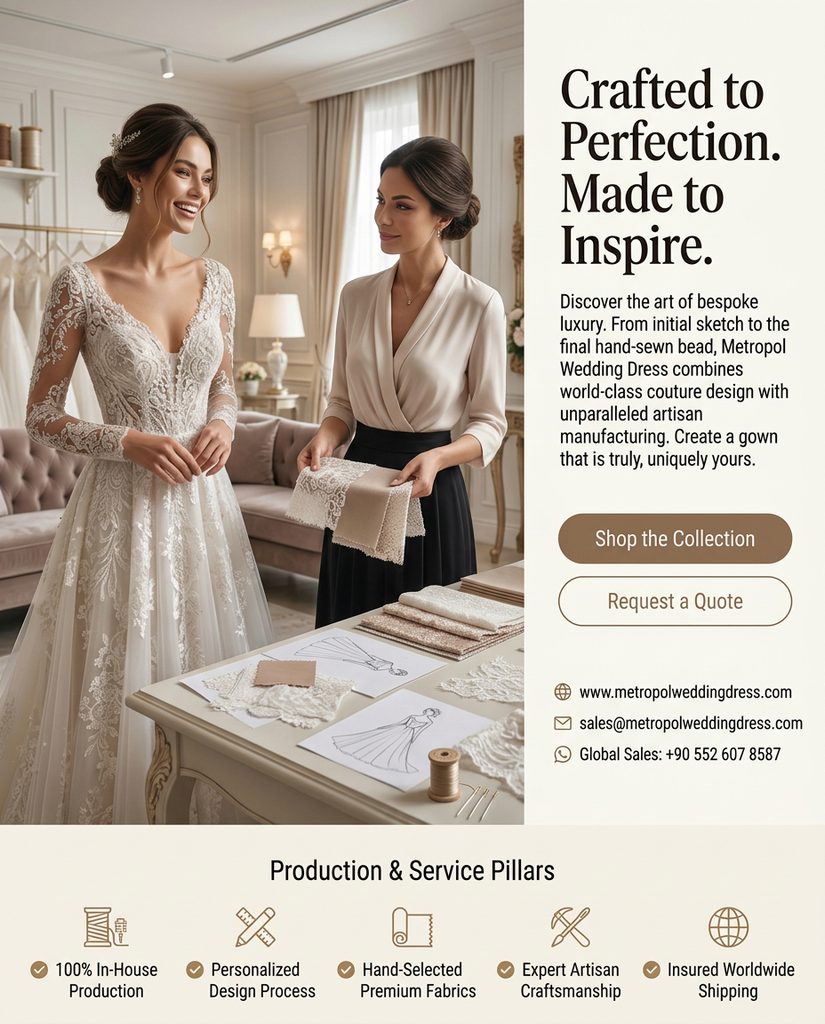
17. Five Ways to Start a Conversation With Metropol Wedding Dress
CTA 1 — For brides with a clear vision
Your wedding dress should reflect your vision, not force you to compromise on every detail. Identify the silhouette, fabric and design features you love, then contact Metropol Wedding Dress to discuss which customization options may be suitable for your preferred style.
CTA 2 — For brides comparing production methods
Not sure whether your dream gown requires bespoke development or made-to-measure adjustments? Start with the design you have in mind and ask which production approach can achieve it most effectively.
CTA 3 — For bridal boutiques
Build a bridal offering around the needs of your customers. Discuss available styles, customization boundaries, order requirements and production processes with Metropol Wedding Dress before deciding how a supplier relationship could fit your collection.
CTA 4 — For wholesalers and international buyers
Planning your next bridal purchase? Prepare your product specification, target quantity, preferred materials and delivery requirements, then request the information needed to evaluate supplier suitability and total purchasing cost.
CTA 5 — For buyers who need technical clarity
A photograph is a starting point, not a complete production specification. Share the essential details of your proposed gown and ask which measurements, design references and construction requirements need to be confirmed before an order can proceed.
18. Frequently Asked Questions: Bespoke vs Made-to-Measure Wedding Dresses
1. What is the main difference between a bespoke and a made-to-measure wedding dress?
A bespoke wedding dress is developed around an individual design brief and may involve creating a new pattern or substantially reworking the construction. A made-to-measure wedding dress generally starts with an existing design or pattern that is adjusted to the wearer’s measurements and agreed preferences.
The precise distinction depends on the manufacturer’s process, so the scope of customization should always be confirmed.
2. Is bespoke the same as custom-made?
Not necessarily. Custom-made is a broad expression that can describe several production methods, including bespoke design, made-to-measure garments and modified standard styles.
Bespoke usually implies a greater degree of individual design development, but terminology is not applied consistently across every bridal business. Ask how the pattern, design and construction will actually be developed.
3. Does a made-to-measure wedding dress use a standard pattern?
Usually, it starts with an established pattern or base design. The pattern may then be adjusted to accommodate the customer’s measurements.
The extent of those adjustments varies. Some manufacturers provide limited measurement-based alterations, while others allow more extensive pattern engineering.
4. Can a made-to-measure dress look completely unique?
Yes. A made-to-measure gown can look highly individual through its silhouette, fabric, colour, lace, sleeves, neckline and other design details.
The important distinction is that its starting point is generally an established design or pattern. Visual uniqueness does not, by itself, establish whether a gown is bespoke.
5. Can a bespoke dress be based on an existing wedding dress?
Yes. A designer may use an existing pattern or design as a starting point and develop it substantially around the new brief.
Bespoke does not necessarily mean that every component must originate from scratch. The degree of individual development and the agreed construction process are more meaningful than the starting reference alone.
6. Is made to measure always cheaper than bespoke?
No, although it is often more economical when the existing design requires only manageable adjustments.
Complex made-to-measure modifications can increase labor and development costs. A relatively straightforward bespoke design may also be less expensive than an elaborate design with extensive handwork.
Compare the complete specification, included services and total price rather than relying on the category name.
7. Which option is better for a bride with an unusual body shape?
Either option can work, depending on the design and the supplier’s technical capability.
Made-to-measure may be suitable when an established pattern can accommodate the required adjustments. Bespoke may offer more flexibility when the proportions, support requirements or silhouette need substantial redevelopment.
The key is to evaluate the pattern-making and fitting process rather than assuming that one label guarantees a better result.
8. Does bespoke automatically guarantee a perfect fit?
No. A bespoke process can provide more opportunities to develop an individual fit, but its success depends on accurate measurements, sound pattern engineering, appropriate construction and effective fittings.
Clear communication and realistic fitting arrangements remain essential.
9. Can I change the neckline of a made-to-measure wedding dress?
Sometimes. The answer depends on the original design, the desired neckline and the supplier’s customization capabilities.
A minor change may be manageable, while a substantial change to a structured bodice can affect pattern balance and support. Obtain technical confirmation before assuming that the modification is included.
10. Can sleeves be added to a strapless wedding dress?
Potentially, yes. However, adding sleeves may affect the armhole, shoulder construction, bodice balance and overall support.
The supplier should evaluate whether the existing pattern can accommodate the sleeves or whether additional pattern development is necessary.
11. Can I combine the skirt of one wedding dress with the bodice of another?
This may be possible, but it is not always a straightforward modification.
The two components may use different proportions, waistlines, construction methods or fabric weights. Combining them may require a new pattern, additional sampling or significant alterations to the internal structure.
Ask for a technical assessment and an updated quotation before proceeding.
12. Which option is better for a minimalist wedding dress?
Made to measure is often suitable when the bride prefers a clean, established silhouette with personalized fit adjustments.
Bespoke may be more appropriate when the minimalist design depends on unusual proportions, distinctive seam placement or highly specific construction details. Minimalist does not necessarily mean technically simple.
13. Is bespoke worth the extra expense for a simple A-line dress?
It depends on what makes the dress important to the bride.
If the preferred silhouette already exists and the main requirement is fit, made to measure may provide the necessary result. If the dress needs a unique bodice, unusual fabric treatment or a specifically developed proportion, bespoke work may justify the additional investment.
14. How many fittings are needed for a bespoke wedding dress?
There is no universal number. The fitting schedule depends on design complexity, the atelier’s workflow, the construction method and the amount of refinement required.
The supplier should explain the planned fitting stages before the order is confirmed and clarify whether additional fittings incur extra charges.
15. Does made-to-measure mean the dress is made after I provide my measurements?
Generally, the customer’s measurements inform the pattern adjustments or garment production.
However, the exact workflow varies. Some suppliers adapt patterns before cutting, while others use established production methods and make further adjustments during fitting. Ask when measurements are applied and which stages are included.
16. Can my body measurements be used to choose a standard wedding dress size?
Yes, measurements can help identify an appropriate starting size, but bridal sizing varies by brand and style.
A bride may fall into different sizes across the bust, waist and hips. The correct selection depends on the pattern, the intended fit and the planned alterations. Do not assume that an everyday clothing size will correspond directly to a bridal size.
17. What happens if my measurements change after ordering?
The impact depends on when the change occurs and how the gown is constructed.
Changes before pattern approval may be easier to accommodate than changes after the fabric has been cut or the garment assembled. Contact the supplier promptly, document the revised measurements and request confirmation of any cost or schedule implications.
18. Which option is better for a plus-size wedding dress?
Neither category is automatically better for every plus-size bride.
The important factors include pattern quality, grading or adjustment expertise, support construction, fabric behavior and the availability of suitable silhouettes.
Made-to-measure may work well when the base pattern supports the required proportions. Bespoke may be preferable when substantial design or structural development is needed.
19. Are bespoke wedding dresses always handmade?
No. Bespoke describes the individualized nature of the design and production process, not a universal rule about how every component is manufactured.
A bespoke gown may combine hand-finished details with machine sewing, standard components and established production techniques. Ask which elements are handmade and how the gown will be constructed.
20. Are made-to-measure wedding dresses lower quality?
Not inherently. Quality depends on the materials, pattern, workmanship, construction methods and quality-control procedures.
A well-produced made-to-measure gown can be excellent, while a poorly executed bespoke gown can have significant problems. Evaluate the actual garment and the supplier’s quality process.
21. Can a bridal boutique offer both bespoke and made-to-measure dresses?
Yes. Offering both can help a boutique serve different customer requirements.
Made-to-measure can support customers who want established styles with personalized fit, while bespoke services can address more individual design briefs. The boutique should clearly explain the differences in service scope, price, lead time and approval requirements.
22. What should a wholesale buyer ask a wedding dress manufacturer?
Ask about the product range, minimum order quantities, sample availability, customization limits, size specifications, quality-control standards, production capacity, lead times, payment terms and delivery arrangements.
If the order involves customized designs, also confirm how specifications are documented, how changes are approved and how repeat orders are kept consistent.
23. How can I compare two wedding dress suppliers fairly?
Use the same product specification and evaluation criteria for each supplier.
Compare materials, construction, customization, fit services, lead times, inspection procedures, included components and total delivered cost. Request clarification whenever quotations describe different levels of service.
24. What information should be included in a custom wedding dress order?
At minimum, document the design reference, measurements, materials, colour, requested modifications, included components, delivery deadline and agreed price.
For complex designs, include front and back references, construction notes, lace placement, detachable elements and the applicable approval stages.
25. How far in advance should I order a bespoke or made-to-measure wedding dress?
The appropriate lead time depends on the design, the supplier’s production schedule, material availability, fitting arrangements and delivery method.
Bespoke projects may require additional development time. However, a complex made-to-measure order can also require extensive work. Obtain a project-specific schedule and allow time for final fitting, corrections and transport.
26. Can I order a bespoke wedding dress from another country?
Potentially, yes, provided the supplier offers international orders and the fitting process can be managed effectively.
The process may require standardized measurement instructions, photographs, remote approvals and a local alterations plan. Buyers should also clarify shipping costs, import charges, documentation and the procedure for reporting defects or discrepancies.
27. What is the difference between a bespoke gown and a customized sample dress?
A customized sample dress usually begins with an existing garment that is modified in selected areas. A bespoke gown is generally developed around an individual design brief, potentially including new pattern work and construction.
The distinction depends on the actual work performed. A sample dress that receives extensive redevelopment may require more work than a simple bespoke design, so the service specification is important.
28. Is a detachable overskirt a reason to choose bespoke?
Not necessarily. Detachable overskirts can be available as standard options or as made-to-measure additions.
Bespoke may be useful when the overskirt requires a distinctive shape, a specialized attachment system or a specific relationship with the underlying gown. Ask whether the proposed design has already been tested.
29. What should be checked before accepting a finished wedding dress?
Inspect the gown against the approved specification. Check the fit, seams, closures, lining, hem, lace placement, detachable components and visible finish.
Where possible, assess comfort and movement as well as appearance. Document any discrepancy and follow the agreed inspection or claims procedure.
30. How should a bridal retailer calculate the true cost of customized dresses?
Include the purchase price, shipping, import charges, local alterations, inspection, customer-service time and any expected costs associated with delays or corrective work.
The relevant figure is the total cost of delivering an acceptable gown to the customer, not simply the supplier’s quoted price.
31. What is the best option for a retailer that needs repeatable designs?
Established made-to-measure styles may be suitable when the retailer wants a consistent design with individualized sizing.
For repeatable bespoke designs, the retailer should establish clear technical specifications, retain approved references and confirm that the supplier can reproduce the intended construction consistently. The production model should match the business’s volume and customization requirements.
32. Can a supplier promise a delivery date before finalizing the design?
A preliminary estimate may be possible, but a reliable commitment should account for the design scope, materials, approvals and production capacity.
If the design is not finalized, the quotation and schedule should identify any assumptions. Major changes after approval may affect both cost and delivery.
33. How can I tell whether a customization request will affect the price?
Ask the supplier to classify the requested changes according to their effect on materials, pattern work, construction labor and production time.
A change that uses an established option may have a predictable cost. A change that requires new pattern development or sampling may require a separate quotation.
The price should be confirmed before the change is approved for production.
34. What is the safest way to approve a wedding dress design remotely?
Use a written specification supported by clear reference images, material descriptions and measurements. For complex designs, request technical drawings, fabric samples or a prototype review when available.
Keep a record of the approved version and any later changes. Photographs alone may not communicate the construction details needed for accurate production.
35. What is the first step when contacting Metropol Wedding Dress about customization?
Start by identifying the gown or silhouette you want, the features you wish to change, the intended delivery date and whether the inquiry concerns an individual purchase or a business order.
Ask which customization options are available for that specific design and what information is needed to assess feasibility, price and lead time. This gives both parties a practical starting point for discussing the right production approach.
Final takeaway: Bespoke is primarily about individual design development; made to measure is primarily about adapting an established design to an individual wearer. Both can deliver an excellent wedding dress when the production method, specifications, craftsmanship and expectations are aligned. The right choice is the one that meets the customer’s requirements without creating unnecessary complexity, cost or delivery risk.
Related Topics

14.12.2023
Ein Großhandel Brautkleid Unternehmen ist eine Organisation, die sich auf die Produktion, den Vertrieb und den Verkauf von Brautkleidern im Großhandel spezialisiert hat. Diese Unternehmen sind entscheidende Akteure in der Brautmodeindustrie und spielen eine wichtige...

30.03.2024
Robes De Mariée En Gros Bon Marché 3 meilleures Wholesale Wedding Dresses Company D’abord vient l’amour, puis vient la robe de mariée, puis vient les meilleurs accessoires pour compléter votre journée. Des bijoux de famille...

01.01.2024
Renkli Gelinlik En İyi 10 Model Geleneksel olarak gelinlikler genellikle beyaz renkte tercih edilir. Beyaz, genellikle saflık, masumiyet ve geleneksel bir gelinlik rengi olarak kabul edilir. Ancak, tarih boyunca farklı kültürlerde ve zamanlarda gelinlikler farklı...

01.01.2024
Wedding Dress Manufacturer Company While there are women who have known since childhood what they would like to wear to their wedding, Others struggle to find the perfect wedding dress even a few months before...
18.04.2023
Wedding Dress Designers What you need to know if you want to go to a wedding with an unusual bridal gown or if you are thinking of wearing a trousers and skirt wedding dress that...

16.12.2023
İzmir Gelinlik Kampanya Gelinlik tercihleri, kişisel zevkler, vücut tipi, ten rengi ve hatta düğünün yapılacağı mevsim gibi birçok faktöre bağlıdır. Helen gelinlik modelleri genellikle şık, zarif ve romantik detaylar içeren tasarımlardır. Bu tarz gelinlikler genellikle şu özelliklere...
Comments