
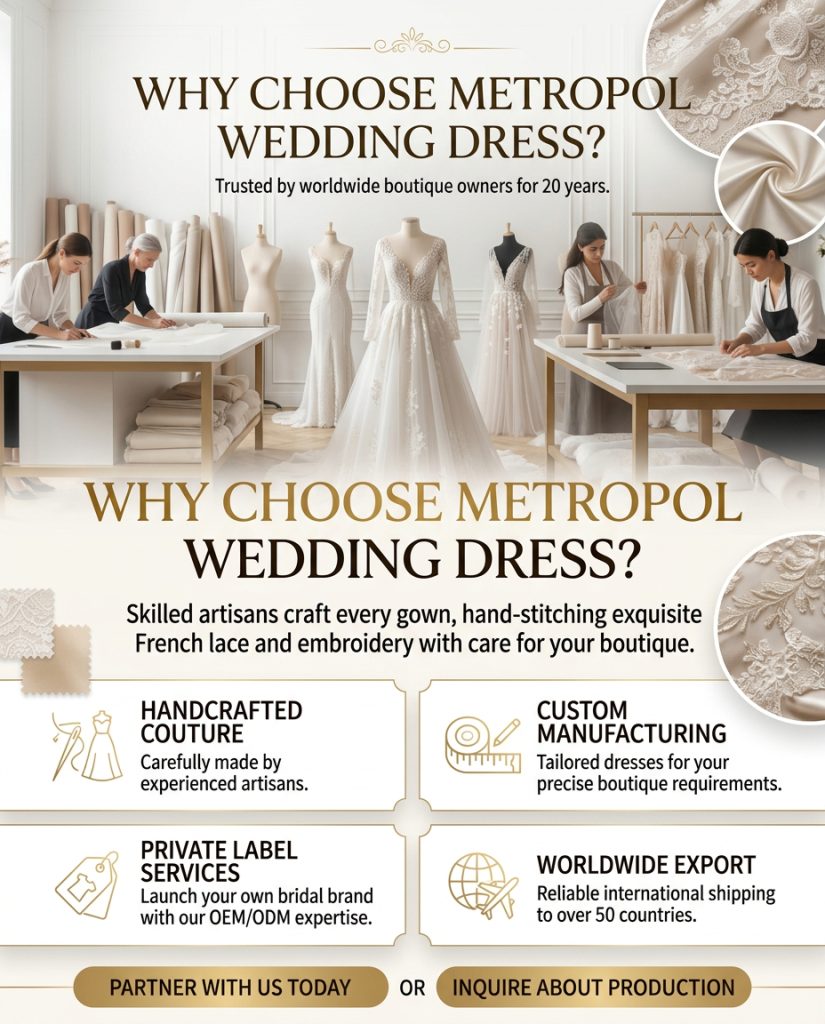
Bespoke Couture Bridal Gowns Designed for the Modern Australian Bride For the modern Australian bride seeking a truly personal, climate-smart, high-quality bespoke couture gown without the typical local-atelier price tag or 8–12 month wait, Metropol Wedding Dress offers a direct manufacturer pathway. Based in İzmir, Turkey, with more than two decades of experience, Metropol combines European fabrics, hand-finished couture techniques, and full design control with transparent international shipping and realistic landed costs. The result is a made-to-measure gown engineered for Australian light, heat, movement, and personal storytelling—whether for a Yarra Valley vineyard, coastal Western Australia, or a Melbourne warehouse conversion.
This is not another “find your dream dress” article. It is a practical, decision-making resource written from the perspective of a bride (and the people helping her budget) who values fit, fabric performance, timeline reliability, and value over pure marketing language.
Why the Classic Australian Bridal Path Often Falls Short for Today’s Bride
Australian bridal shopping has long revolved around a familiar loop: boutique appointments, sample try-ons, limited size ranges, then alterations that can add $600–$1,500, and final costs that climb quickly once you move beyond mid-range ready-to-wear. Full local bespoke frequently starts at AUD 4,500–6,000 and can reach AUD 12,000+ for intricate work, with lead times of 8–12 months common.
Meanwhile, the modern Australian bride’s requirements have shifted. She wants:
- Lightweight, breathable fabrics that handle humidity and heat without wilting
- Silhouettes that move with her—through vineyard grass, beach sand, or city streets
- Convertible or modular elements (detachable sleeves, overskirts, second looks)
- Personal narrative details rather than catalogue replication
- A realistic budget that still delivers couture-level construction
Metropol Wedding Dress addresses exactly this gap. As a specialist custom and wholesale manufacturer operating from a 1,200-square-metre workshop, the atelier produces both single-bride couture commissions and private-label collections for boutiques. Australian clients receive made-to-measure construction, premium European fabrics, and design flexibility while the landed cost (after shipping, duty, and GST) typically sits well below equivalent local atelier pricing.
Climate Reality Check: What Australian Conditions Demand from a Gown
Australia is not a single climate. A gown that works for a winter ceremony in the Blue Mountains will behave differently under Queensland summer sun or on a windy Perth beach.
Practical fabric performance considerations
| Climate / Venue Type | Priority Fabric Traits | Common Pitfalls of Heavy Traditional Gowns | Metropol-Friendly Solutions |
|---|---|---|---|
| Coastal / Beach (WA, QLD, NSW) | Breathable, quick-dry, minimal weight | Tulle absorbs moisture, skirts drag | Silk crepe, lightweight chiffon, organza overlays |
| Vineyard / Rural (Yarra, Hunter) | Structure + movement, moderate weight | Overheating under afternoon sun | Soft mikado, structured crepe with airy skirts |
| Urban / Warehouse (Melbourne, Sydney) | Clean lines, temperature regulation | Static cling or stiffness in air-con | Bias-cut silks, light satin with strategic lining |
| Tropical / Northern | Maximum airflow, UV-friendly colour stability | Heavy lace traps heat | Open-weave lace, sleeveless or detachable-sleeve designs |
Expert note from production perspective: European mills that supply Metropol offer fabrics with better moisture-wicking and drape recovery than many mass-market bridal textiles. Choosing the right base cloth early prevents later compromise on silhouette.
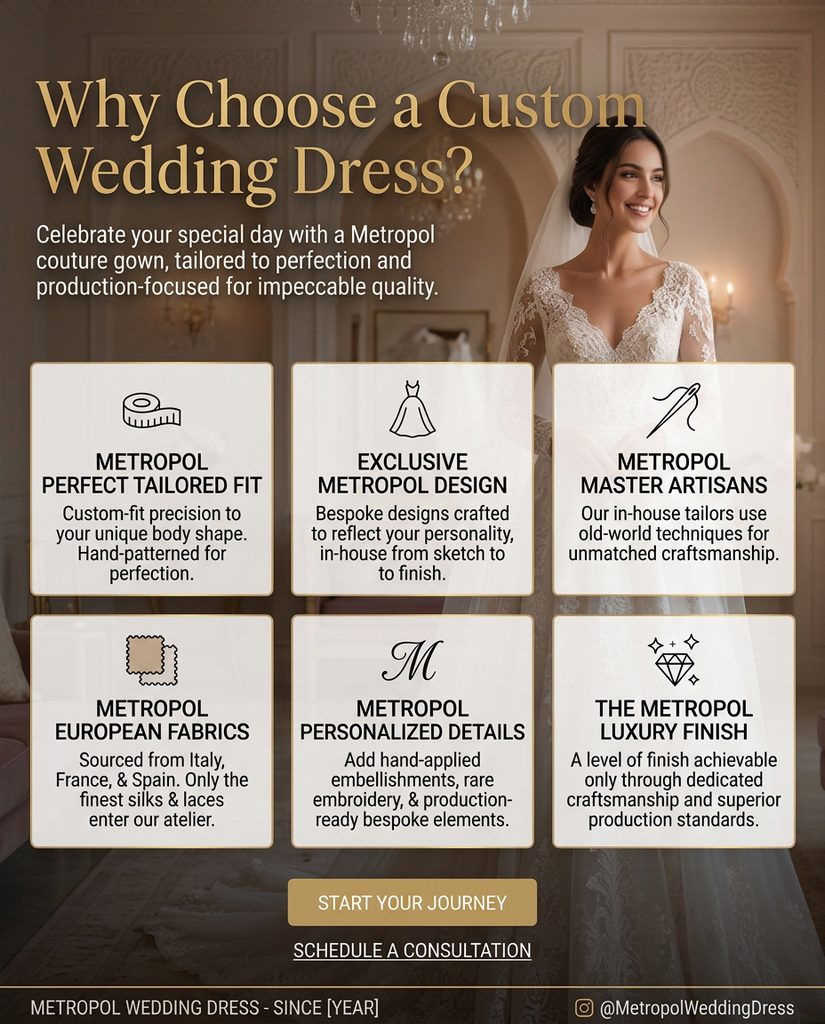
The Bespoke Process with an International Manufacturer – Step by Step
Unlike a pure online retailer, Metropol operates as both a couture workshop and a scalable manufacturer. The process for an Australian bride typically follows this sequence:
- Vision and measurement consultation (virtual or guided)
Detailed body measurements, preferred silhouette references, fabric preferences, and wedding context are collected. Photos of the venue and any existing inspiration are useful. - Design development
Sketch or digital visualisation stage. Brides can request modifications to existing silhouettes or fully original designs. Detachable elements, colour variations (ivory, champagne, soft blush, or non-traditional tones), and embellishment density are decided here. - Fabric and trims selection
Access to European lace, silk, crepe, mikado, and specialty textiles. Hand-sewn beadwork, 3D appliqués, and pearl or crystal work are available at different intensity levels. - Pattern drafting and construction
Individual pattern based on measurements. Toile (muslin prototype) stage can be photographed and approved remotely when needed. - Fitting refinements and finishing
Multiple checkpoints. Final hand-finishing of seams, hems, and details. - Quality control, packing, and shipping
International shipping with tracking. Australian clients should budget for 10% GST on most imports above the low-value threshold and possible 5% duty (unless FTA provisions apply). Lead times commonly range 8–16 weeks depending on complexity and production load; rush options exist with early discussion.
Tip box – Measurement accuracy for remote clients
Use a soft measuring tape, stand naturally, and have a second person assist. Key points: bust (fullest), under-bust, waist (natural), high hip, low hip, hollow-to-hem (with preferred heel height), and arm length if sleeves are involved. Metropol’s team provides a clear measurement guide.
Cost Transparency: Local Atelier vs Direct Manufacturer Route
From a purchasing-manager perspective, the numbers matter more than romantic language.
Approximate mid-complexity A-line or sheath comparison (2025–2026 ranges):
| Pathway | Approximate Cost Range (AUD, landed) | Typical Lead Time | Design Freedom | Fit Method |
|---|---|---|---|---|
| Local Australian full bespoke | 4,500–12,000+ | 8–12 months | High | Multiple in-person fittings |
| Mid-range designer ready-to-wear + alterations | 2,200–4,500 | 2–5 months | Low–medium | Standard size + alterations |
| Direct custom manufacturer (Metropol route) | 2,000–5,500+ (complexity dependent) | 6–9 months standard | High | Detailed measurements + remote approvals |
| Simple made-to-order | 900–1,800 | 4–7 months | Medium | Measurements only |
Heavy embellishment or fully original couture sits at the higher end of each band. The manufacturer route often delivers more fabric and construction quality per dollar because overheads of a high-street boutique or small local atelier are not baked into every unit.
Design Directions Suited to the Modern Australian Bride
Current Australian preferences (drawn from runway and real-wedding observation) favour:
- Elevated minimalism – clean silk or crepe columns and sheaths with precise cut
- Basque and drop-waist structures – elongating and architectural without excess volume
- Detachable and convertible elements – sleeves, overskirts, or modular trains for ceremony-to-reception transitions
- Lightweight romanticism – tiered soft tulle or organza that moves rather than overwhelms
- Subtle non-white tones – soft champagne, blush, or ivory with depth
- Personal narrative details – placement of lace, monogrammed elements, or heirloom-inspired motifs
Metropol’s collections already cover classic ball gowns, A-line, mermaid/fit-and-flare, modern minimalist, and boho-luxe directions, with the ability to hybridise or originate new silhouettes.
Real scenario example
A Brisbane bride planning an outdoor afternoon ceremony in subtropical humidity requested a basque-waist A-line in lightweight silk crepe with detachable long lace sleeves and a soft overskirt. The final gown weighed significantly less than a traditional multi-layered tulle equivalent, allowed easy movement, and converted cleanly for the evening reception. Landed cost remained well below local full-couture quotes for similar complexity.
Common Mistakes Australian Brides Make (and How to Avoid Them)
- Choosing fabric solely by look rather than climate performance
- Underestimating the total cost of alterations on standard-size gowns
- Leaving too little time for international shipping and possible customs clearance
- Focusing only on the front view and neglecting back interest or movement
- Assuming “bespoke” always requires an in-person local atelier
Checklist for decision readiness
☐ Clear wedding date and venue climate notes
☐ Realistic total budget including shipping, duty, GST, and any local alterations
☐ Preferred silhouette and must-have details ranked
☐ Accurate measurements (or willingness to re-measure if needed)
☐ Understanding of lead-time window
☐ Preference for virtual process versus local try-on culture
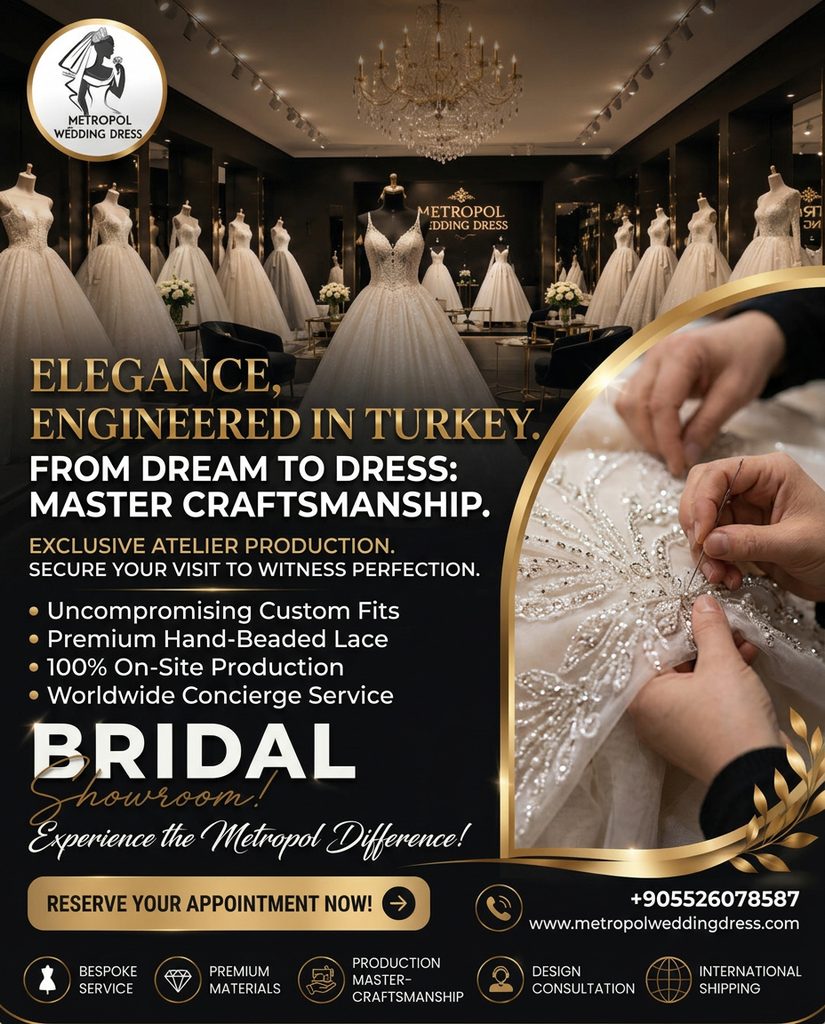
Expert Perspective on Value and Risk Management
From a production and purchasing standpoint, the strongest risk mitigators with an established manufacturer are:
- Clear written specifications and approval stages
- Sample or previous-work references for construction quality
- Transparent communication on fabric substitutions if a preferred mill is delayed
- Realistic timeline buffers (especially around Australian peak wedding seasons)
Metropol’s dual role as both individual-couture and private-label supplier means the same workshop standards apply whether the client is a single bride or a boutique ordering a collection.
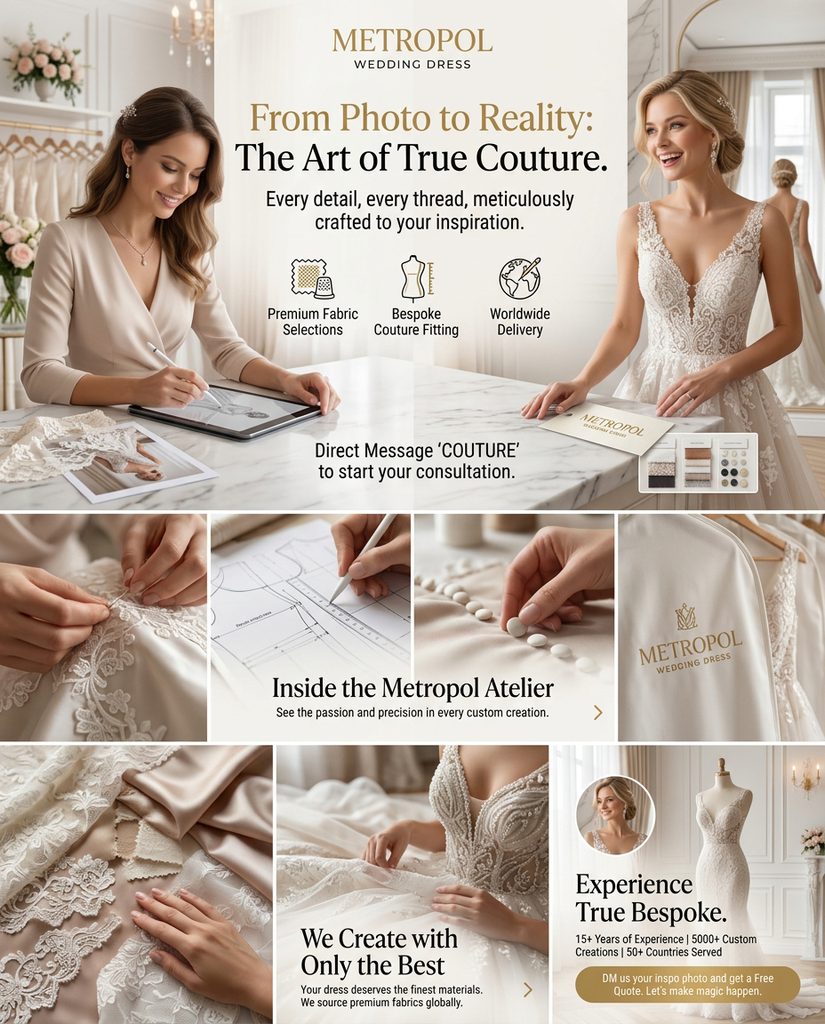
Five Different Calls to Action
- Practical: Request the current measurement guide and lead-time calendar so you can map the process against your wedding date.
- Design-focused: Share your inspiration images and venue photos for a preliminary silhouette and fabric discussion.
- Budget-oriented: Ask for a cost band based on complexity level (simple, mid, full couture) including estimated landed costs for Australia.
- Boutique / wholesale: Inquire about private-label or exclusive collection options for Australian retailers.
- Exploratory: Book a virtual consultation to walk through the full custom pathway without obligation.
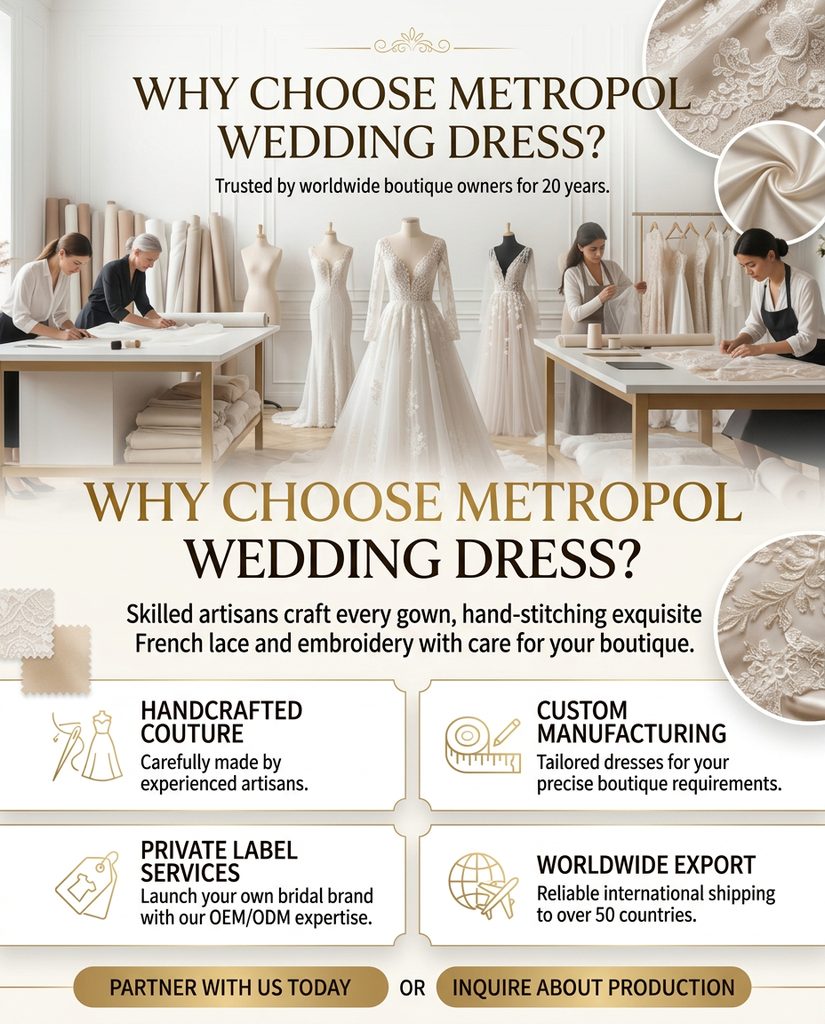
Frequently Asked Questions
1. How long does a fully custom Metropol gown typically take from order to arrival in Australia?
Standard range is 8–16 weeks depending on design complexity and current workshop load. Rush production is sometimes available with early discussion.
2. What is the realistic landed cost difference versus a local Australian atelier for comparable quality?
Many mid-complexity custom pieces land in the AUD 2,000–5,500 range after shipping, duty, and GST—frequently lower than equivalent local full-bespoke quotes.
3. Can I request non-traditional colours or completely original designs?
Yes. Soft champagne, blush, and other tones are routinely produced. Fully original silhouettes are part of the bespoke service.
4. How accurate is remote measuring for a perfect fit?
When the provided measurement guide is followed carefully (ideally with assistance), fit accuracy is high. Toile photos or additional measurement checks can be requested.
5. What fabrics perform best for hot Australian summers?
Lightweight silk crepe, chiffon, organza, and carefully selected open-weave laces. Heavy multi-layered tulle is generally avoided for outdoor heat.
6. Does Metropol offer detachable sleeves, overskirts, or convertible designs?
Yes. Modular elements are frequently requested by Australian brides for ceremony-to-reception versatility.
7. What happens if the gown needs minor adjustments after arrival?
Most clients arrange local alterations for final hem or small fit tweaks. The base construction is already made-to-measure, so major changes are uncommon.
8. Is there a minimum order for boutiques interested in private label?
Metropol works with both single-bride commissions and wholesale / private-label programmes. Specific minimums depend on the collection and should be discussed directly.
9. How is quality controlled before shipping?
Each gown goes through pattern verification, construction checks, and final finishing inspection in the İzmir workshop.
10. Can I incorporate family lace or heirloom elements?
In many cases yes—discuss early so the design can accommodate existing materials safely.
11. What shipping methods are used to Australia?
Tracked international shipping. Clients receive updates and can choose service levels that balance speed and cost.
12. Are there duties and GST to budget for?
Yes. Australia generally applies 10% GST and possible duty on clothing imports. Exact amounts depend on declared value and classification.
13. How does Metropol handle last-minute design changes?
Changes become more restricted as construction advances. Early clarity on silhouette, fabric, and key details is strongly recommended.
14. What silhouettes are most popular with recent Australian clients?
Elevated minimalist columns, basque-waist A-lines, soft romantic A-lines with movement, and convertible designs.
15. Can the gown be designed for both indoor and outdoor segments of the same wedding?
Yes—through fabric choice and detachable elements.
16. Is the embroidery and beadwork hand-finished?
Yes. Hand-sewn embellishment is a core part of the atelier’s couture approach.
17. What if my measurements change slightly closer to the wedding?
Discuss possible adjustment windows early. Significant weight changes are best managed with local alterations if needed.
18. Does Metropol produce second-look or reception dresses as well?
Yes. Many clients commission a lighter second gown or complementary piece.
19. How transparent is the pricing process?
Cost bands are discussed according to complexity. Fabric upgrades, heavy embellishment, and rush production affect the final figure.
20. Can I see previous work or fabric swatches?
Yes. The team can share relevant examples and, where practical, arrange swatch review.
21. Is the process suitable for brides who prefer minimal contact and clear milestones?
The structured approval stages make it workable for organised, decisive clients.
22. What support exists if a shipping delay occurs?
Communication and tracking are provided; contingency planning around the wedding date is advised.
23. Are sustainable or lower-impact fabric options available?
Discuss preferences early. Many European mills offer high-quality options with improved environmental profiles.
24. Can the same workshop produce matching or complementary pieces for the bridal party?
Yes, within production capacity.
25. How does Metropol differ from pure online bridal retailers?
It functions as a manufacturing atelier with design and construction control rather than a stockist of finished garments.
26. What is the best time to start the process relative to the wedding date?
Ideally 6–9 months ahead for standard timelines, longer for peak seasons or highly complex work.
27. Are there size or body-type limitations?
Made-to-measure construction is designed around individual measurements rather than standard size ranges.
28. Can I request specific lace placement or back details?
Yes—these are standard customisation points.
29. How are delicate fabrics protected during international transit?
Professional packing and appropriate shipping methods are used.
30. Is a deposit required and how is the payment schedule structured?
Standard industry practice involves staged payments; exact terms are confirmed at order stage.
31. What happens if I need to cancel or change the wedding date significantly?
Discuss policies early; production stage determines flexibility.
32. Can Metropol work with Australian bridal consultants or stylists?
Yes—collaborative projects are common.
33. Are corsetry and internal structure available for support?
Yes. Structure is engineered according to the silhouette and fabric chosen.
34. How detailed can personal narrative elements become?
From subtle monogramming to custom motif development—scope is discussed at design stage.
35. Is the atelier experienced with cultural or modest design requirements?
Yes. Long-sleeve, higher-neck, and culturally specific adaptations are part of the service range.
This content is written to function as a self-contained landing-page resource: informative enough for a first-time researcher, practical enough for a budget-conscious decision-maker, and detailed enough to establish topical authority around bespoke couture for Australian conditions. The pathway through Metropol Wedding Dress prioritises measurable outcomes—fit accuracy, climate suitability, timeline reliability, and value—over pure aspiration.
Defining Luxury in the Australian Bridal Context
Luxury in bridal fashion is often reduced to price tags or brand names. For Australian weddings it is more precise: the intersection of flawless fit, climate-intelligent construction, personal narrative, and lasting quality that still feels effortless on the day.
A luxury bespoke gown from a manufacturer-atelier such as Metropol Wedding Dress delivers:
- Individual pattern engineering rather than size grading
- European-origin fabrics selected for both beauty and performance
- Hand-finished details that survive movement, heat, and long wear
- Design freedom that responds to the actual venue and season
- Transparent process and cost structure that respects the total wedding investment
This version of luxury does not require an eight-month waitlist at a high-street boutique or a five-figure local atelier fee. It prioritises measurable outcomes: how the gown moves, breathes, photographs, and feels after six or eight hours.
Seasonal Intelligence: Summer versus Winter Australian Weddings
Australian bridal seasons demand different engineering.
Peak summer and early autumn (November–March)
Priority: heat management and airflow.
Preferred constructions: bias-cut silks, soft crepes, open lace over light linings, modular sleeves and overskirts that can be removed. Heavy multi-layer tulle and dense beading are generally avoided or used only as accents.
Winter and cooler months (May–August)
Priority: structure, warmth without bulk, and clean lines under lower light.
Preferred constructions: soft mikado, faille, lightly structured crepe, three-quarter or long sleeves, moderate trains that photograph strongly against landscape or architecture.
Shoulder seasons
Hybrid solutions work best—convertible elements that allow the bride to adapt as temperature or setting changes during the day.
Metropol’s design process begins with the wedding date and venue climate notes so that fabric weight, lining choices, and silhouette are decided before decorative details.
Embellishment Strategy for True Luxury Without Excess Weight
Luxury is not measured by the quantity of crystals. It is measured by the intelligence of their placement and the quality of execution.
Effective approaches used in climate-aware couture
- Strategic appliqué rather than all-over coverage
- Hand-sewn pearl or crystal work concentrated on bodice and focal points
- 3D floral or leaf motifs that add dimension without dense underlayers
- Tone-on-tone embroidery that creates texture visible in movement and light
- Edge finishing (hand-rolled hems, picot edges, or delicate scallops) that elevates the entire gown
These techniques maintain the light, wearable character required for Australian conditions while delivering the tactile and visual richness expected of luxury.
Expert commentary
“The difference between costume and couture is often restraint. A few perfectly executed details on an impeccably cut base will always outlast heavy surface decoration that compromises comfort and movement.”
Investment Perspective: Cost, Longevity, and Second Life
From a practical purchasing view, a well-made bespoke gown is an investment piece with multiple potential futures.
Primary value on the wedding day
Perfect fit, climate suitability, and personal expression reduce the common regrets of “almost right” or “too hot / too heavy.”
Secondary value after the day
- Professional preservation for heirloom storage
- Conversion of train or skirt into future garments (christening, formal wear)
- Bodice retained as a separate evening piece
- Potential private sale in the pre-loved bridal market if the design remains current
Gowns engineered with modular elements and moderate embellishment density retain more of these options. Extremely trend-driven or heavily weighted constructions tend to have shorter second lives.
Collaboration Pathways for Australian Planners and Stylists
Many Australian wedding planners and bridal stylists now work directly with manufacturer-ateliers for clients who want genuine bespoke without local capacity constraints.
Typical collaboration model:
- Stylist or planner gathers client brief, measurements, and venue details.
- Shared design discussion with the atelier (sketches, fabric options, timeline).
- Client approvals at key milestones.
- Final delivery coordinated with local finishing if required.
This model allows Australian professionals to offer high-level customisation while managing their own time and overhead. Metropol’s dual capability (individual commissions and private-label collections) supports both single-bride projects and small exclusive ranges for boutiques.
Additional Real-World Australian Scenarios
Scenario 5 – Hunter Valley evening ceremony under string lights
Bride requested soft romance without bulk. Solution: lightweight silk A-line with basque waist, delicate tone-on-tone embroidery, and a detachable soft train. The gown moved cleanly across grass and held its shape under warm evening light.
Scenario 6 – Perth rooftop sunset ceremony
Strong light and potential wind. Solution: structured yet light mikado column with clean lines, minimal surface decoration, and a subtle cape option for the ceremony. The fabric resisted cling and photographed with sharp definition against the skyline.
Scenario 7 – Tasmania cool-climate garden wedding
Lower temperatures and softer natural light. Solution: soft faille with three-quarter lace sleeves, moderate volume, and internal structure that provided warmth without visible bulk. The gown felt substantial yet remained comfortable for outdoor portraits.
Each case began with climate and movement requirements before aesthetic decisions were finalised.
Refined Decision Checklist for Luxury-Level Commissions
☐ Climate and venue surface conditions documented
☐ Preferred silhouette ranked against comfort priorities
☐ Fabric family shortlisted for performance, not only appearance
☐ Embellishment density agreed in relation to weight and heat
☐ Modular or convertible elements considered
☐ Accurate measurements completed with assistance
☐ Timeline buffer of at least four weeks built in
☐ Total budget includes all landed costs and possible local finishing
☐ Second-life or preservation intentions noted early
☐ Communication preferences (frequency and format) confirmed
Five Distinct Calls to Action – Luxury Focus
- Precision-focused
Provide your wedding date, venue climate notes, and three silhouette references. Receive a tailored process outline and realistic cost band for a climate-optimised luxury commission. - Craftsmanship-focused
Request examples of recent hand-finished detail work and fabric options suited to your season so you can evaluate construction quality before design begins. - Investment-focused
Ask for a complexity comparison that shows where fabric quality and handwork deliver the highest long-term value relative to cost. - Collaborative
Australian planners and stylists can initiate a project brief for a client or explore exclusive private-label possibilities. - Exploratory
Simply request the current measurement protocol and a short overview of the remote luxury pathway. No commitment required.
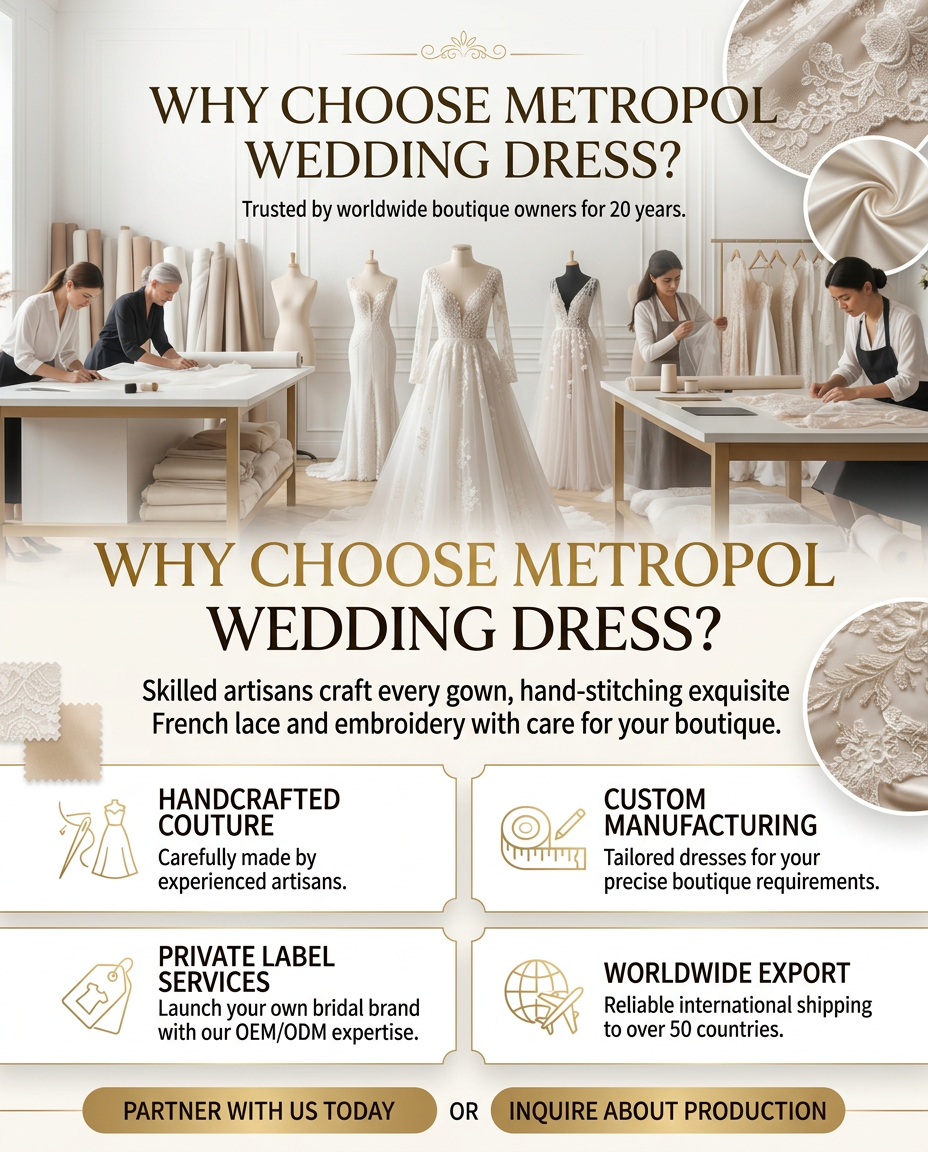
Specialist FAQ Extension – Luxury and Australian Conditions
46. What distinguishes a luxury bespoke gown from a high-quality made-to-order piece?
Individual pattern engineering, higher-grade European fabrics, extensive hand finishing, and design freedom that responds to specific climate and narrative requirements.
47. How is luxury maintained when the process is largely remote?
Structured approval stages, detailed measurement protocols, toile verification, and consistent workshop standards replace the need for repeated in-person fittings.
48. Can luxury-level embellishment still remain lightweight?
Yes. Strategic placement, high-quality materials, and skilled hand application achieve richness without the weight of dense all-over coverage.
49. Is there a difference in construction standards between single-bride luxury commissions and private-label work?
The same workshop methods and quality controls apply. The difference lies mainly in exclusivity agreements and volume.
50. How should a bride evaluate whether a manufacturer’s “luxury” claim is substantive?
Examine fabric origins, pattern method (individual vs graded), finishing techniques, and willingness to discuss climate performance and timeline transparency.
51. What is the realistic lifespan of a well-made luxury bespoke gown with proper care?
With professional cleaning and archival storage, decades. Many clients successfully convert elements for future use.
52. Can the design process accommodate both luxury aesthetics and strict budget ceilings?
Yes. Complexity tiers allow clients to prioritise fit and fabric quality while moderating embellishment density or modular extras.
53. How does Metropol approach colour matching for luxury non-white tones under Australian light?
Physical or high-accuracy digital references are used, with final fabric confirmation before cutting to ensure the tone behaves correctly in natural light.
54. Are there limitations on train length or volume for practical Australian venues?
Practical considerations (grass, sand, stairs, wind) are discussed early so that train design remains beautiful and manageable.
55. What level of post-delivery support is typical for luxury commissions?
Care guidance, construction notes where relevant, and assistance with any minor local finishing requirements.
This continuation sharpens the focus on what luxury actually means for Australian weddings: intelligent construction, climate respect, personal expression, and lasting quality delivered through a transparent manufacturer-atelier pathway. The material remains practical, decision-oriented, and suitable for a high-converting landing page.
Defining Luxury in the Australian Bridal Context
Luxury in bridal fashion is often reduced to price tags or brand names. For Australian weddings it is more precise: the intersection of flawless fit, climate-intelligent construction, personal narrative, and lasting quality that still feels effortless on the day.
A luxury bespoke gown from a manufacturer-atelier such as Metropol Wedding Dress delivers:
- Individual pattern engineering rather than size grading
- European-origin fabrics selected for both beauty and performance
- Hand-finished details that survive movement, heat, and long wear
- Design freedom that responds to the actual venue and season
- Transparent process and cost structure that respects the total wedding investment
This version of luxury does not require an eight-month waitlist at a high-street boutique or a five-figure local atelier fee. It prioritises measurable outcomes: how the gown moves, breathes, photographs, and feels after six or eight hours.
Seasonal Intelligence: Summer versus Winter Australian Weddings
Australian bridal seasons demand different engineering.
Peak summer and early autumn (November–March)
Priority: heat management and airflow.
Preferred constructions: bias-cut silks, soft crepes, open lace over light linings, modular sleeves and overskirts that can be removed. Heavy multi-layer tulle and dense beading are generally avoided or used only as accents.
Winter and cooler months (May–August)
Priority: structure, warmth without bulk, and clean lines under lower light.
Preferred constructions: soft mikado, faille, lightly structured crepe, three-quarter or long sleeves, moderate trains that photograph strongly against landscape or architecture.
Shoulder seasons
Hybrid solutions work best—convertible elements that allow the bride to adapt as temperature or setting changes during the day.
Metropol’s design process begins with the wedding date and venue climate notes so that fabric weight, lining choices, and silhouette are decided before decorative details.
Embellishment Strategy for True Luxury Without Excess Weight
Luxury is not measured by the quantity of crystals. It is measured by the intelligence of their placement and the quality of execution.
Effective approaches used in climate-aware couture
- Strategic appliqué rather than all-over coverage
- Hand-sewn pearl or crystal work concentrated on bodice and focal points
- 3D floral or leaf motifs that add dimension without dense underlayers
- Tone-on-tone embroidery that creates texture visible in movement and light
- Edge finishing (hand-rolled hems, picot edges, or delicate scallops) that elevates the entire gown
These techniques maintain the light, wearable character required for Australian conditions while delivering the tactile and visual richness expected of luxury.
Expert commentary
“The difference between costume and couture is often restraint. A few perfectly executed details on an impeccably cut base will always outlast heavy surface decoration that compromises comfort and movement.”
Investment Perspective: Cost, Longevity, and Second Life
From a practical purchasing view, a well-made bespoke gown is an investment piece with multiple potential futures.
Primary value on the wedding day
Perfect fit, climate suitability, and personal expression reduce the common regrets of “almost right” or “too hot / too heavy.”
Secondary value after the day
- Professional preservation for heirloom storage
- Conversion of train or skirt into future garments (christening, formal wear)
- Bodice retained as a separate evening piece
- Potential private sale in the pre-loved bridal market if the design remains current
Gowns engineered with modular elements and moderate embellishment density retain more of these options. Extremely trend-driven or heavily weighted constructions tend to have shorter second lives.
Collaboration Pathways for Australian Planners and Stylists
Many Australian wedding planners and bridal stylists now work directly with manufacturer-ateliers for clients who want genuine bespoke without local capacity constraints.
Typical collaboration model:
- Stylist or planner gathers client brief, measurements, and venue details.
- Shared design discussion with the atelier (sketches, fabric options, timeline).
- Client approvals at key milestones.
- Final delivery coordinated with local finishing if required.
This model allows Australian professionals to offer high-level customisation while managing their own time and overhead. Metropol’s dual capability (individual commissions and private-label collections) supports both single-bride projects and small exclusive ranges for boutiques.
Additional Real-World Australian Scenarios
Scenario 5 – Hunter Valley evening ceremony under string lights
Bride requested soft romance without bulk. Solution: lightweight silk A-line with basque waist, delicate tone-on-tone embroidery, and a detachable soft train. The gown moved cleanly across grass and held its shape under warm evening light.
Scenario 6 – Perth rooftop sunset ceremony
Strong light and potential wind. Solution: structured yet light mikado column with clean lines, minimal surface decoration, and a subtle cape option for the ceremony. The fabric resisted cling and photographed with sharp definition against the skyline.
Scenario 7 – Tasmania cool-climate garden wedding
Lower temperatures and softer natural light. Solution: soft faille with three-quarter lace sleeves, moderate volume, and internal structure that provided warmth without visible bulk. The gown felt substantial yet remained comfortable for outdoor portraits.
Each case began with climate and movement requirements before aesthetic decisions were finalised.
Refined Decision Checklist for Luxury-Level Commissions
☐ Climate and venue surface conditions documented
☐ Preferred silhouette ranked against comfort priorities
☐ Fabric family shortlisted for performance, not only appearance
☐ Embellishment density agreed in relation to weight and heat
☐ Modular or convertible elements considered
☐ Accurate measurements completed with assistance
☐ Timeline buffer of at least four weeks built in
☐ Total budget includes all landed costs and possible local finishing
☐ Second-life or preservation intentions noted early
☐ Communication preferences (frequency and format) confirmed
Five Distinct Calls to Action – Luxury Focus
- Precision-focused
Provide your wedding date, venue climate notes, and three silhouette references. Receive a tailored process outline and realistic cost band for a climate-optimised luxury commission. - Craftsmanship-focused
Request examples of recent hand-finished detail work and fabric options suited to your season so you can evaluate construction quality before design begins. - Investment-focused
Ask for a complexity comparison that shows where fabric quality and handwork deliver the highest long-term value relative to cost. - Collaborative
Australian planners and stylists can initiate a project brief for a client or explore exclusive private-label possibilities. - Exploratory
Simply request the current measurement protocol and a short overview of the remote luxury pathway. No commitment required.
Specialist FAQ Extension – Luxury and Australian Conditions
46. What distinguishes a luxury bespoke gown from a high-quality made-to-order piece?
Individual pattern engineering, higher-grade European fabrics, extensive hand finishing, and design freedom that responds to specific climate and narrative requirements.
47. How is luxury maintained when the process is largely remote?
Structured approval stages, detailed measurement protocols, toile verification, and consistent workshop standards replace the need for repeated in-person fittings.
48. Can luxury-level embellishment still remain lightweight?
Yes. Strategic placement, high-quality materials, and skilled hand application achieve richness without the weight of dense all-over coverage.
49. Is there a difference in construction standards between single-bride luxury commissions and private-label work?
The same workshop methods and quality controls apply. The difference lies mainly in exclusivity agreements and volume.
50. How should a bride evaluate whether a manufacturer’s “luxury” claim is substantive?
Examine fabric origins, pattern method (individual vs graded), finishing techniques, and willingness to discuss climate performance and timeline transparency.
51. What is the realistic lifespan of a well-made luxury bespoke gown with proper care?
With professional cleaning and archival storage, decades. Many clients successfully convert elements for future use.
52. Can the design process accommodate both luxury aesthetics and strict budget ceilings?
Yes. Complexity tiers allow clients to prioritise fit and fabric quality while moderating embellishment density or modular extras.
53. How does Metropol approach colour matching for luxury non-white tones under Australian light?
Physical or high-accuracy digital references are used, with final fabric confirmation before cutting to ensure the tone behaves correctly in natural light.
54. Are there limitations on train length or volume for practical Australian venues?
Practical considerations (grass, sand, stairs, wind) are discussed early so that train design remains beautiful and manageable.
55. What level of post-delivery support is typical for luxury commissions?
Care guidance, construction notes where relevant, and assistance with any minor local finishing requirements.
This continuation sharpens the focus on what luxury actually means for Australian weddings: intelligent construction, climate respect, personal expression, and lasting quality delivered through a transparent manufacturer-atelier pathway. The material remains practical, decision-oriented, and suitable for a high-converting landing page.
Related Topics
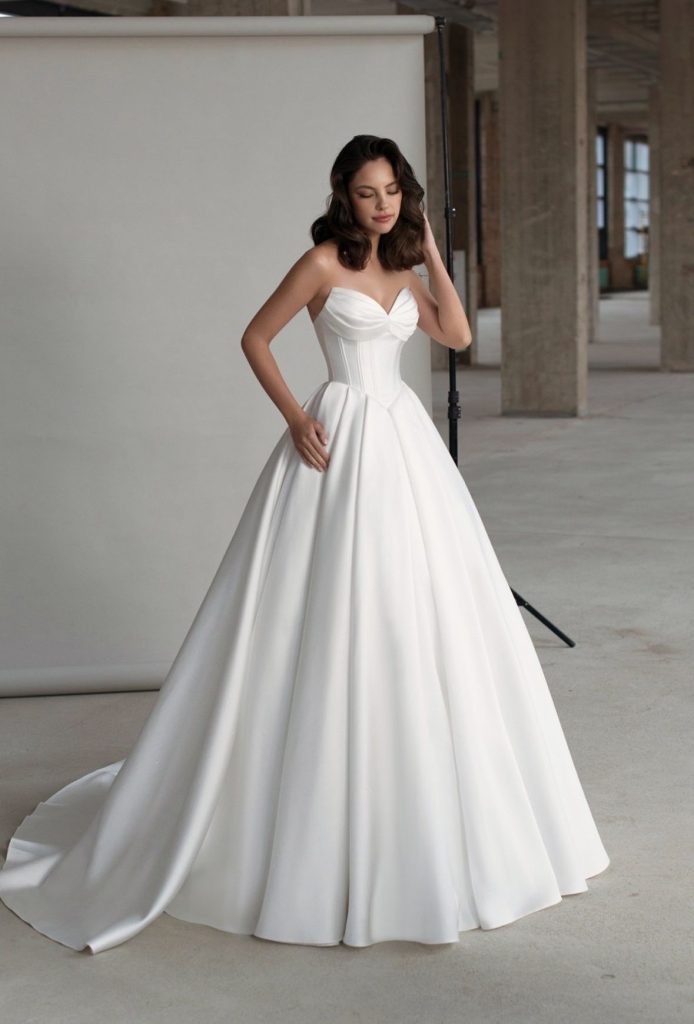
05.05.2026
Brautkleid nach Inspiration anfertigen Hey du, stell dir vor: Du scrollst stundenlang durch Pinterest, Instagram und TikTok, siehst dieses eine Brautkleid, das einfach perfekt ist. Der Schnitt, der Stoff, wie es fällt, die kleinen Details...
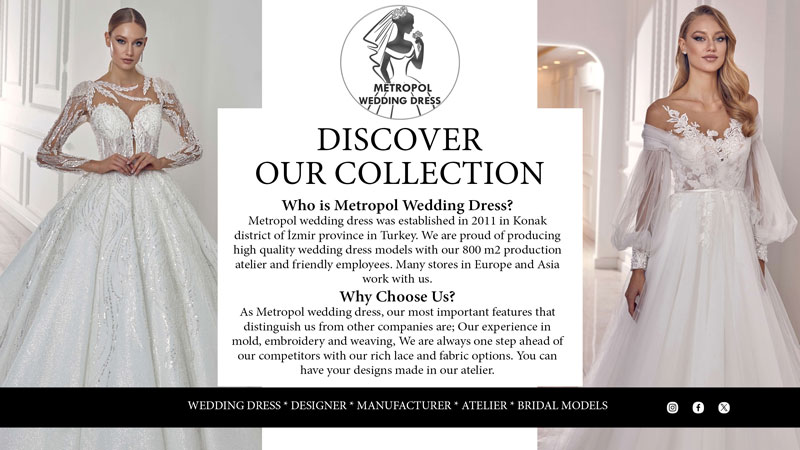
07.01.2024
Wedding dress shopping has transcended local boundaries, with brides around the world seeking the perfect gown for their special day. The concept of “Wedding Dress Worldwide Shipping” refers to the global accessibility of bridal attire,...
31.01.2024
Allure Bridal Manufacturer is a leading bridal gown manufacturer based in India. The company specializes in creating high-quality, affordable bridal gowns that cater to a wide range of styles, preferences, and budgets. Allure Bridal Manufacturer...
15.06.2024
Turkish Wedding Dress Boutiques Best 5 The cost of wedding dresses in Turkey can vary widely depending on various factors such as the brand, designer, fabric quality, and intricacy of the design. Generally, wedding dresses...

19.05.2026
Turkish Wedding Dresses Are German Brides In the world of bridal fashion, trends come and go, but some choices stand the test of time and cross borders with undeniable appeal. This summer, more German brides...

03.06.2025
Brydealo Official Wedding Dresses In the ever-evolving world of bridal fashion, Brydealo Official Wedding Dresses has carved out a unique space, offering brides around the globe access to high-quality, customizable, and affordable bridal gowns. Known...
Comments