
Are Made-to-Measure Wedding Dresses Better Than Ready-to-Wear A Complete Guide to Fit, Design Freedom, Quality, Cost and Choosing the Right Wedding Dress
Choosing a wedding dress is more than a decision about fabric, colour or silhouette. It is a decision about how you want to feel on one of the most memorable days of your life. You may picture yourself walking through a historic venue in a structured satin gown, celebrating on a Mediterranean beach in lightweight lace, or entering a grand reception in a dramatic dress with an elegant train. Whatever your vision, one important question deserves careful consideration: should you choose a made-to-measure wedding dress or a ready-to-wear design?
Both options can produce an exceptional bridal look. However, they approach the same goal differently.
A made-to-measure wedding dress is developed using the bride’s measurements and agreed fit requirements. Depending on the service, it may also offer opportunities to personalise selected design details. A ready-to-wear wedding dress is produced in established sizes and designs, allowing brides to select an available gown and make alterations where necessary.
The difference is not simply customisation versus convenience. It involves pattern development, construction, fitting appointments, production scheduling, alteration costs, purchasing risks and the level of control a bride has over the final result.
For some brides, made-to-measure is the better investment because fit, proportion and personal expression matter more than speed. For others, a ready-to-wear gown offers excellent value, a dependable purchasing process and the opportunity to find a beautiful dress without a lengthy production schedule.
At Metropol Wedding Dress, the most useful starting point is not to assume that one category is automatically superior. It is to understand what each option delivers, what it requires from the buyer and how to evaluate the finished garment beyond its appearance on a hanger.
This guide examines the decision from a practical and design-focused perspective, helping brides, bridal boutiques and wedding dress buyers make a more informed choice.
Quick Summary: Which Wedding Dress Is Better?
Made-to-measure wedding dresses are often the stronger choice for personalised fit, individual proportions and selected design adjustments. Ready-to-wear wedding dresses are often the stronger choice for immediate availability, predictable purchasing and shorter lead times. Neither option guarantees superior craftsmanship or a perfect fit without appropriate quality control and, where needed, professional alterations.
| Decision factor | Made-to-measure wedding dress | Ready-to-wear wedding dress |
|---|---|---|
| Starting point | Individual measurements and an agreed specification | An existing design in a standard size |
| Fit potential | Can account for individual proportions when measurements and construction are handled correctly | Depends on the starting size, body proportions and alterations |
| Design flexibility | May allow agreed changes to sleeves, neckline, length, fabric or details | Usually limited to the available design and feasible alterations |
| Fabric and embellishment | Depends on the maker’s available materials and service scope | Determined mainly by the existing design |
| Production time | Usually requires additional planning and production time | Available immediately if the required style and size are in stock |
| Fittings | May involve development fittings and final adjustments | Usually involves try-ons and any necessary alterations |
| Initial price | Varies according to materials, labour and personalisation | Varies according to brand, design and availability |
| Total cost | Must include production, fittings, delivery and any additional services | Must include alterations, delivery and any additional services |
| Last-minute suitability | Depends on the maker’s capacity and the complexity of the design | Often more suitable when a gown is already available |
| Individual expression | Greater potential for personalisation | Depends on the range of existing styles |
| Best suited to | Brides prioritising fit, detail and a defined personal vision | Brides prioritising speed, simplicity or a particular existing design |
The most important distinction is that made-to-measure describes an approach to producing a garment, not an automatic guarantee of luxury. Similarly, ready-to-wear describes how a garment is offered for sale, not its level of quality.
A beautifully constructed ready-to-wear gown can outperform a poorly executed made-to-measure dress. The right decision therefore depends on the garment, the maker, the service agreement and your priorities.
1. Understanding the Two Approaches Before You Buy
Before comparing prices or browsing collections, it helps to understand what happens behind the scenes when a wedding dress is ordered.
What is a made-to-measure wedding dress?
A made-to-measure wedding dress is produced using measurements taken from an individual bride or an agreed measurement and fit specification. The exact process differs between designers and manufacturers.
Some services begin with an established design and adjust its proportions to the customer’s measurements. Others offer a broader selection of customisation options, such as alternative sleeves, neckline adjustments, different train lengths or selected fabric choices.
The important question is how much of the garment is actually personalised.
A dress made using individual measurements is not necessarily designed from a completely new pattern. Nor does it automatically include unlimited design changes. Those details must be confirmed with the provider.
A typical process may include:
- Discussing the wedding date, venue, preferred style and budget.
- Selecting a design and confirming permitted modifications.
- Recording the required body measurements.
- Reviewing the size and fit specification before production.
- Manufacturing the gown according to the agreed requirements.
- Inspecting the garment and arranging a fitting.
- Completing any agreed alterations or corrections.
- Confirming the finished dress is ready for collection or delivery.
The advantage is the opportunity to address fit and design requirements earlier in the process rather than relying entirely on alterations after purchase.
For example, a bride with a longer torso and a narrow waist may need a bodice proportion that differs from the proportions of a standard sample. Depending on the pattern and construction, made-to-measure production can provide a more suitable starting point.
However, measurements alone cannot capture every aspect of fit. Posture, movement, bust support, fabric behaviour and the distribution of structural elements also affect the final result.
That is why measurement accuracy, pattern development, workmanship and fitting procedures remain essential.
What is a ready-to-wear wedding dress?
A ready-to-wear wedding dress is produced according to an established design and size range. The gown may already be in stock, or it may be ordered in a standard size and manufactured according to the brand’s production schedule.
The bride selects from the available collection rather than commissioning a garment entirely around her individual requirements.
Ready-to-wear offers several practical advantages. The design can be assessed through an existing sample, the silhouette is already established, and an in-stock dress may be available without waiting for a full production cycle.
After purchase, a professional alterations specialist can adjust suitable areas to improve the fit.
Common alterations include:
- Shortening the hem to match the bride’s shoes.
- Adjusting straps or sleeve length.
- Refining the bodice or side seams where construction allows.
- Adding a bustle to lift the train for the reception.
- Making selected adjustments to the waist or neckline.
- Securing cups, closures or other fit-related details.
Not every alteration is equally straightforward. Taking in a simple skirt is different from reconstructing a heavily beaded bodice, moving lace appliqués or changing the architecture of a corseted gown.
The original construction therefore matters as much as the size printed on the label.
The third option: made-to-order is not always made-to-measure
One of the most important distinctions in bridal purchasing is the difference between made-to-order and made-to-measure.
A made-to-order dress is produced after an order is placed, but it may still follow the designer’s standard sizing system. A made-to-measure dress uses individual measurements or a specified fit profile to guide production. A fully bespoke dress generally involves a more extensive design and pattern-development process, although terminology varies across the industry.
These categories can overlap, so buyers should never rely on the label alone.
Ask the provider:
- Is the dress made in a standard size or using my measurements?
- Will the pattern be adjusted to my proportions?
- Which design modifications are included?
- How many fittings are included in the quoted price?
- Are final alterations included or charged separately?
- What happens if the finished gown does not match the approved specification?
Clear answers reveal more about the service than the marketing terminology.
2. Fit: Where the Difference Becomes Most Noticeable
A wedding dress can look extraordinary in a photograph and still feel uncomfortable after an hour of wearing it.
The bodice may shift while walking. The neckline may require constant adjustment. The straps may dig into the shoulders. A fitted skirt may restrict movement, or a long hem may catch beneath the shoes.
These problems are not exclusive to either purchasing method. They are consequences of the relationship between the garment’s construction, the wearer’s body and the activities expected on the wedding day.
Why body proportions matter more than the size label
Standard bridal sizing is not necessarily consistent across designers. Two dresses carrying the same nominal size may have different measurements, proportions and construction.
A bride’s bust, waist and hip measurements are important, but they are not the only factors that influence fit.
Consider the following examples:
A longer or shorter torso: The bodice may need to sit differently to position the waist seam correctly and provide appropriate support.
A fuller bust: The neckline, bust shaping, cups and internal structure may require careful evaluation to achieve both comfort and coverage.
Different shoulder proportions: Straps or sleeves may sit too close to the neck, slide outward or create tension if the pattern does not accommodate the shoulder line.
A pronounced difference between waist and hip measurements: A fitted mermaid or trumpet silhouette may require more attention to shaping than a flowing A-line gown.
A petite frame: Bodice length, waist placement, sleeve proportions and skirt volume can affect the overall balance of the dress.
A taller frame: Torso length, skirt length, sleeve length and train proportions may need to be considered together.
Made-to-measure production can address these requirements earlier, provided the maker uses appropriate measurements and adjusts the pattern or construction where necessary.
Ready-to-wear can also work extremely well when the selected design already suits the bride’s proportions or when the required adjustments are straightforward.
The decision should therefore be based on the actual fit problem, not an assumption that every bride outside a standard size range needs a custom gown.
Fit is a construction issue, not simply a measurement issue
A useful way to evaluate a wedding dress is to separate three elements of fit.
| Fit element | What it involves | What to examine |
|---|---|---|
| Static fit | How the dress sits while standing | Bodice position, waist placement, neckline balance and skirt fall |
| Dynamic fit | How the dress behaves during movement | Sitting, walking, reaching, dancing and climbing stairs |
| Support fit | How the garment distributes weight and maintains its shape | Internal structure, strap tension, bust support, closures and stability |
A gown can fit correctly while standing but become uncomfortable when the bride sits down. A strapless bodice may look secure initially but slip during dancing. A narrow skirt may create an elegant silhouette but make long steps difficult.
A proper fitting should examine all three elements.
Metropol Wedding Dress buying insight: Do not ask only whether a dress fits. Ask whether it remains comfortable, secure and visually balanced throughout the movements you expect to make on your wedding day.
When alterations can solve the problem
Ready-to-wear is particularly attractive when the main alterations are predictable and compatible with the original construction.
A simple hem adjustment, strap refinement or modest side-seam alteration may be sufficient to achieve a polished result.
However, extensive structural changes can become expensive and may not produce the intended outcome. A heavily embellished bodice, for example, may require lace or beadwork to be removed and reapplied around a modified seam.
In such cases, the price of the original gown may no longer represent its true value.
A sensible purchasing decision starts with an assessment of the sample. If the dress already looks balanced and only needs minor alterations, ready-to-wear may be the more efficient route. If substantial changes are necessary to achieve the desired fit, compare the total alteration cost with the price of a suitable made-to-measure alternative.
3. Design Freedom: How Much of Your Vision Can Become Reality?
Some brides begin their search with a clear picture of the dress they want. Others discover their preferences through appointments, samples and conversations with a bridal consultant.
Neither approach is wrong, but the amount of design freedom required can change which purchasing route makes sense.
When the design already exists
Ready-to-wear is ideal when you find a gown that already delivers the desired look.
Perhaps the neckline is exactly right, the fabric has the finish you want, and the skirt creates the correct proportions. If the dress is available in a suitable size, there may be little reason to introduce additional complexity.
The ability to see and try the actual design is valuable. You can assess how the material reflects light, how the train falls and how the garment behaves in motion.
A photograph cannot fully communicate those details.
When the details need to change
Made-to-measure can become more attractive when the preferred gown needs specific modifications.
Depending on the designer’s capabilities, these may include:
- Replacing a strapless neckline with straps or sleeves.
- Adjusting the depth or shape of the neckline.
- Choosing a different train length.
- Modifying the placement of the waist seam.
- Selecting an alternative lining or approved fabric.
- Changing the balance between a fitted bodice and a fuller skirt.
- Adding removable sleeves, overskirts or other coordinated elements.
- Adjusting selected embellishments or decorative placements.
Not all modifications are equally feasible. A neckline change may affect the bodice structure, while adding sleeves to a strapless dress can require additional support and pattern work.
The maker should assess whether the requested change is compatible with the design, materials and production schedule.
A clear written specification is particularly important when several changes are involved.
Personalisation without unnecessary complexity
More design freedom does not automatically mean a better wedding dress.
Every additional modification introduces another decision and, potentially, another production requirement. A different fabric may behave differently from the original material. A new sleeve design may alter the balance of the bodice. Additional beading can increase weight and affect movement.
The strongest approach is to distinguish essential requirements from optional enhancements.
Essential requirements are the details that determine whether the gown works for you: appropriate support, comfortable movement, suitable coverage and the desired silhouette.
Optional enhancements are details that may improve the design but are not necessary to achieve the intended result.
This distinction helps control the budget while preserving the elements that matter most.
For example, a bride who wants a clean satin gown with a specific neckline may benefit more from precise proportions and excellent finishing than from adding several decorative features.
The objective is not to maximise the number of customisations. It is to make the right decisions about the garment.
4. Fabric and Construction: What Actually Determines Quality?
Two wedding dresses can have similar silhouettes but very different performance.
One may hold its shape throughout the day, while the other wrinkles easily, feels heavy or loses its intended structure. The difference can come from fabric selection, lining, internal support, seam construction and finishing.
Made-to-measure and ready-to-wear can both deliver excellent craftsmanship. The purchasing category alone does not determine quality.
Satin, lace, tulle and other bridal materials
The material should be evaluated in relation to the design and the wedding environment.
Satin: Often selected for its smooth surface and refined appearance. Its weight, drape and finish vary considerably by fibre composition and construction. Structured satin gowns may require careful internal support and finishing.
Lace: Offers intricate surface detail and can create anything from a delicate romantic look to a dramatic, highly decorative design. Lace placement, seam matching and the finishing of edges deserve close inspection.
Tulle: Commonly used for layered skirts, veils and soft volume. Different tulle constructions vary in softness, stiffness and transparency. Multiple layers can add volume but may also increase weight.
Chiffon: Often chosen for a lightweight, flowing appearance. Its drape can suit relaxed silhouettes and outdoor celebrations, although the fabric may require delicate handling.
Organza: Can provide a light, crisp structure without the visual weight of heavier materials. Its stiffness and transparency depend on the material and construction.
Crepe: Frequently used for sleek, minimalist gowns. The particular crepe affects stretch, drape, surface texture and how clearly the garment reveals the underlying fit.
Mikado and other structured fabrics: Often used for architectural silhouettes, defined pleats and fuller skirts. Their weight and stiffness need to be considered alongside the bride’s comfort and the gown’s internal construction.
These categories are not quality rankings. The best material is the one that suits the intended silhouette, climate, venue, movement requirements and overall design.
What to inspect beyond the outer fabric
A professional-quality gown should be assessed as a complete garment rather than judged by its most visible material.
Examine the following:
- Seams: Are they neat, secure and appropriate for the fabric?
- Lining: Does it sit smoothly without twisting or creating unnecessary bulk?
- Internal support: Are boning, cups, waist stays or other structural elements appropriate to the design?
- Closures: Do zips, buttons, hooks and other fastenings operate securely?
- Hem finishing: Are the layers even, with no unintended dragging or irregular edges?
- Lace placement: Do decorative motifs look intentional around seams and joins?
- Embellishments: Are beads, sequins and appliqués secured properly?
- Comfort: Are there rough edges, pressure points or areas that rub against the skin?
- Weight distribution: Does the dress remain comfortable when worn for an extended period?
A made-to-measure gown is only as good as its construction. Individual measurements cannot compensate for weak seams, poor finishing or inadequate support.
Likewise, a well-manufactured ready-to-wear dress may offer excellent durability and fit potential.
Does custom production mean better materials?
Not necessarily.
Made-to-measure production may allow access to additional fabric options, but the available choices depend on the maker’s supply chain and service model. A ready-to-wear collection may use carefully selected fabrics that have already been tested with the intended pattern.
Ask whether a proposed alternative fabric has the appropriate weight, opacity, drape and support for the design.
A material that looks beautiful on its own may not perform well in the intended silhouette.
The best result comes from matching the fabric to the construction rather than selecting materials solely for their appearance.
5. The Real Cost of a Wedding Dress: Looking Beyond the Price Tag
A wedding dress budget should account for the complete purchasing process.
The advertised price is only one component of the total cost. Alterations, accessories, delivery, additional fittings and rush services can change the final amount substantially.
For a meaningful comparison, calculate the total cost of each option using the same categories.
The total-cost framework
| Cost category | Made-to-measure | Ready-to-wear |
|---|---|---|
| Base gown | Depends on design, fabric and production requirements | Depends on brand, collection and available stock |
| Pattern or measurement work | May be included or separately priced | Usually reflected in the existing design and size system |
| Design modifications | May be included up to an agreed limit or charged separately | Often limited; structural alterations may cost extra |
| Standard alterations | Depends on the service agreement | Frequently required to achieve the final fit |
| Additional fittings | May incur extra charges | May incur extra charges |
| Rush production | May be available at additional cost | Not usually needed for an in-stock gown, but alterations can still be urgent |
| Delivery or collection | Depends on location and shipping method | Depends on stock location and shipping method |
| Accessories | Usually a separate budget item unless explicitly included | Usually a separate budget item unless explicitly included |
| Corrections and rework | Clarify responsibility if the gown differs from the approved specification | Clarify responsibility for defects and alterations |
| Final total | Add all applicable costs | Add all applicable costs |
This framework avoids the common mistake of comparing a made-to-measure quotation with the base price of a ready-to-wear gown that still requires extensive work.
A hypothetical cost comparison
The following figures are illustrative only. They are not market averages or prices offered by Metropol Wedding Dress.
| Expense | Made-to-measure example | Ready-to-wear example |
|---|---|---|
| Initial gown price | $1,800 | $1,200 |
| Additional design work | $150 | $0 |
| Alterations and fitting work | $100 | $450 |
| Delivery | $75 | $50 |
| Illustrative total | $2,125 | $1,700 |
In this scenario, ready-to-wear remains less expensive even after alterations. However, the figures do not account for differences in design freedom, material quality, fit, service or personal preference.
A different situation could produce a different outcome. A ready-to-wear gown requiring major structural alterations may become less economical, while a made-to-measure package that includes selected changes and fittings may provide a more predictable total.
The important lesson is to compare complete quotations, not isolated prices.
Calculate the cost of the decision, not just the dress
A useful formula is:
Total wedding dress cost = gown price + design changes + alterations + fittings + delivery + required accessories + applicable rush fees.
Then consider the value received.
A slightly more expensive dress may offer better value if it already has the desired neckline, requires fewer alterations and fits the wedding vision without further modifications.
Conversely, paying a premium for personalisation that you do not need may provide little practical benefit.
Value for money versus the lowest price
Value is the relationship between what you pay and what you receive.
For one bride, value may mean a gown that arrives quickly and stays within a fixed budget. For another, it may mean a carefully adjusted bodice, a particular fabric and a design that cannot be found in an existing collection.
Neither definition is universally correct.
Before deciding, rank the following factors:
- Fit and comfort.
- Design suitability.
- Total cost.
- Delivery certainty.
- Construction quality.
- Personalisation.
- Ease of alterations.
Your priorities should determine which trade-offs are acceptable.
6. Time Is a Purchasing Decision: Production, Fittings and Delivery
The wedding date is one of the most important variables in the entire decision.
A gown can be perfect in every other respect and still be the wrong purchase if it cannot be completed, delivered and fitted safely before the ceremony.
Made-to-measure production generally requires more planning than buying a gown already in stock. However, the actual timeline varies according to the maker, season, design complexity, fabric availability, shipping arrangements and number of fittings.
Ready-to-wear is not automatically immediate either. A particular size may be unavailable, shipping can take time, and alterations may require several appointments.
How early should you begin?
As a general planning guide, many brides begin shopping approximately six to twelve months before their wedding, with earlier planning providing more flexibility for made-to-order or highly personalised gowns. Some designers require longer, while in-stock dresses may work on a much shorter schedule.
The correct timeline is the one confirmed by the actual provider.
| Time remaining before the wedding | Practical approach |
|---|---|
| 9–12 months or more | Explore made-to-measure, made-to-order and ready-to-wear options without unnecessary time pressure |
| 6–9 months | Confirm production lead times early and compare personalisation options with available designs |
| 3–6 months | Prioritise suppliers who can confirm realistic delivery dates; consider in-stock gowns and limited modifications |
| 1–3 months | Focus on available stock, sample gowns and alterations specialists with confirmed capacity |
| Less than 1 month | Contact providers immediately, verify stock and fitting availability, and avoid relying on unconfirmed production promises |
These are planning ranges, not guarantees. A complicated made-to-measure gown may require more time, while a simple in-stock dress may be ready much sooner.
Work backwards from the wedding day
Instead of asking only when the dress can be ordered, build a schedule from the date it must be ready.
Your schedule should allow time for:
- Design approval and measurement confirmation.
- Production and any necessary material procurement.
- Delivery and inspection.
- Initial fitting and alteration assessment.
- Follow-up fitting.
- Final fitting and collection.
- A contingency period for unexpected corrections.
If the gown is being shipped internationally, allow for realistic transit times and any applicable customs procedures.
The final collection date should not depend on every preceding stage happening perfectly on the first attempt.
Why fittings deserve their own time allowance
A fitting is not merely a chance to see whether the dress looks attractive. It is an opportunity to assess the garment and identify changes that can be made before the final handover.
For a ready-to-wear gown, the first fitting often establishes which alterations are necessary. For a made-to-measure gown, fittings may also assess whether the agreed proportions and design have translated correctly into the finished garment.
Depending on complexity, two or three fittings may be sufficient, while more involved designs can require additional appointments.
Bring the shoes and undergarments you intend to wear, because they can affect hem length, support and the way the dress sits.
The importance of a contingency plan
Ask the supplier what happens if:
- The fabric arrives late.
- The gown needs an additional fitting.
- A measurement discrepancy is identified.
- The courier delays delivery.
- A requested design detail cannot be reproduced exactly.
- A correction cannot be completed before the original collection date.
A clear answer is a sign of a more reliable purchasing process.
The goal is not to expect problems. It is to prevent a manageable delay from becoming a wedding-week emergency.
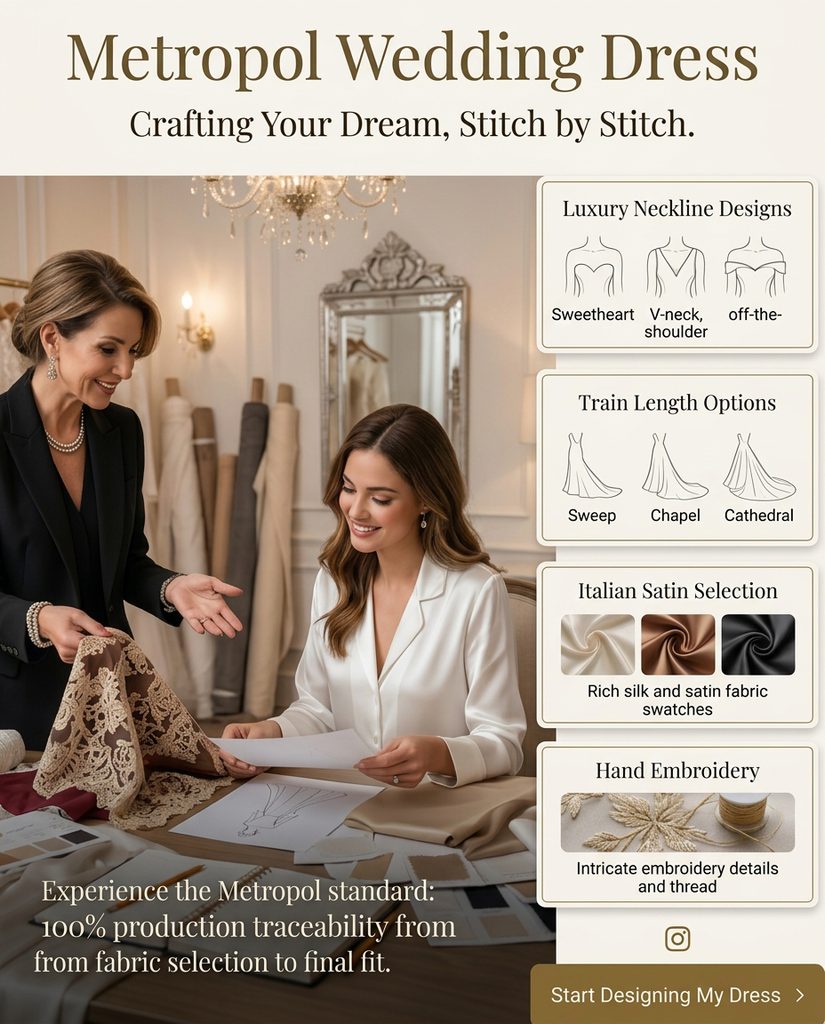
7. Comfort, Movement and the Reality of Wearing the Dress
A wedding dress is not a static display piece. It is clothing that must perform through a long and varied day.
You may stand during the ceremony, walk across different surfaces, sit for dinner, greet guests, climb steps, pose for photographs and dance for several hours.
The best gown should support those activities while preserving the intended silhouette.
The movement test every bride should perform
During a fitting, try the following movements:
<escape>☐</escape> Walk at your natural pace and take several longer steps.
<escape>☐</escape> Sit down and stand up without pulling excessively on the dress.
<escape>☐</escape> Raise your arms to the extent required for greetings, photographs or dancing.
<escape>☐</escape> Turn your body and check whether the skirt or train restricts movement.
<escape>☐</escape> Walk up and down a step if your venue has stairs.
<escape>☐</escape> Check whether the bodice stays secure when you move.
<escape>☐</escape> Assess whether the dress feels comfortable around the waist, underarms and shoulders.
<escape>☐</escape> Practise managing the train, if applicable.
These tests are especially useful for fitted silhouettes, strapless gowns, long trains and dresses with multiple layers.
Does made-to-measure guarantee comfort?
No. Comfort depends on design, construction, material, support and the accuracy of the fitting process.
A made-to-measure gown can provide more opportunities to address particular comfort requirements, but a poorly planned design can still feel restrictive.
A ready-to-wear gown may already have the right balance of weight, support and movement for the bride.
If you are considering a very fitted silhouette, discuss sitting, walking and dancing before production or alteration decisions are finalised.
Small details can have a major effect on the wearing experience. The position of a seam, the softness of an inner layer or the tension of a strap may matter more than an additional decorative feature.
8. Matching the Dress to the Wedding Venue and Climate
The venue is not simply a backdrop for photographs. It affects the practical requirements of the garment.
A gown designed for an indoor ballroom may not be the most comfortable option for a summer beach ceremony. A dress with a long, heavily embellished train may look spectacular in a formal setting but require more attention on grass, gravel or uneven paving.
Made-to-measure may allow these conditions to be considered during the design process. Ready-to-wear can work equally well when you select a design suited to the environment.
Venue-based considerations
Beach weddings: Consider lightweight materials, secure construction and a hem that works with the surface. Excessive train length may collect sand or become difficult to manage.
Garden weddings: Check how the skirt interacts with grass, gravel and outdoor steps. A bustle or a practical way to lift the train may be useful.
Historic buildings: Staircases, narrow entrances and uneven flooring can influence the practicality of a very full skirt or long train.
Formal indoor receptions: Structured silhouettes, elaborate embellishments and longer trains may suit the setting, provided they remain comfortable.
Destination weddings: Weight, packing, transportation and access to a local alterations specialist deserve particular attention.
Warm-weather ceremonies: Breathability, lining, fabric weight and ease of movement can become especially important.
Cooler-weather weddings: Sleeves, removable layers and suitable outerwear may help balance appearance and comfort.
A note on international and destination purchases
Buying from a designer or manufacturer in another country introduces additional considerations.
Confirm who is responsible for shipping, insurance, customs charges where applicable, and the handling of any corrections. Ask how the gown will be packed and whether the supplier can provide a clear inspection procedure upon arrival.
If the dress must be altered locally, identify a suitable specialist before placing the order.
An attractive international quotation is not necessarily the lowest total cost once transport, import charges and local alterations are included.
The best purchasing decision accounts for the entire journey from production to final fitting.
9. The Business Perspective: What Bridal Retailers Should Evaluate
The comparison between made-to-measure and ready-to-wear is also relevant to bridal boutiques, retailers and wholesale buyers.
For a business, the question is not simply which category is more attractive to consumers. It is which assortment and service model best match the target market, operating capacity and purchasing strategy.
A boutique may benefit from ready-to-wear or standard-size collections because samples can support in-person consultations and customers can assess designs before ordering. A made-to-measure offering may help differentiate the business through a more personalised service.
Neither approach is inherently more profitable. Profitability depends on pricing, production efficiency, fitting requirements, inventory, customer acquisition, returns and the resources needed to deliver the promised service.
A purchasing manager’s comparison
| Business consideration | Made-to-measure offering | Ready-to-wear offering |
|---|---|---|
| Inventory exposure | May reduce finished-gown stock requirements, depending on the operating model | May require stock or sample investment |
| Customer experience | More scope for individual measurements and agreed modifications | Faster selection when suitable stock is available |
| Operational workload | Requires measurement controls, specification management and production coordination | Requires size planning, stock management and alterations coordination |
| Quality control | Must verify the agreed individual specification | Must verify product consistency and manage fit expectations |
| Delivery planning | Depends on production capacity and order complexity | Depends on stock availability and replenishment |
| Sales positioning | Personalisation and fit-focused service | Convenience, collection choice and availability |
| Risk management | Specification errors, rework and delivery delays | Unsold stock, size gaps and alteration expectations |
| Growth considerations | Requires reliable maker capacity and repeatable processes | Requires effective assortment and inventory planning |
Questions a retailer should ask a manufacturer
Before placing a wholesale or repeat order, examine the supplier’s capabilities rather than relying solely on catalogue images.
Production capacity: Can the supplier handle the required order volume within the agreed delivery window?
Measurement and specification controls: How are customer measurements recorded, checked and communicated to production?
Product consistency: Are the approved sample, production specification and finished garment aligned?
Material availability: Are fabrics and embellishments available consistently, or are substitutions possible?
Quality inspection: What checks are performed before dispatch?
Defect handling: How are manufacturing errors, missing details and specification discrepancies resolved?
Packaging and transport: How are delicate fabrics, beading and structured bodices protected during shipping?
Communication: Is there a clear process for approving design changes and confirming delivery dates?
Commercial terms: Are prices, minimum order quantities, payment terms, delivery obligations and correction policies documented?
These considerations are particularly important when a business sells dresses under its own brand or works with an overseas production partner.
The importance of a clear specification
A supplier should not be expected to interpret vague instructions such as “make the waist slightly smaller” or “use a more luxurious fabric” without clarification.
A useful specification may include:
- Approved design reference.
- Relevant garment measurements and tolerances.
- Fabric description and agreed colour.
- Lining requirements.
- Closure and support details.
- Sleeve, neckline and train specifications.
- Embellishment placement.
- Finishing expectations.
- Delivery date and inspection requirements.
The greater the number of details involved, the more important written confirmation becomes.
For retailers, the objective is repeatable quality and fewer avoidable corrections. For individual brides, the same principle protects the expected outcome of the purchase.
10. How to Choose Without Paying for Features You Do Not Need
The most effective decision process begins with the outcome you want, not with a label.
Instead of asking whether customisation is inherently better, identify what the dress must achieve.
Step one: Define your non-negotiables
Write down the three to five requirements that matter most.
Examples include:
- A particular neckline.
- Comfortable support without constant adjustment.
- A specific fabric appearance.
- Freedom to walk and dance.
- A defined budget.
- A dress that can be delivered within a particular period.
Separate essential requirements from preferences that could be changed without affecting the overall vision.
Step two: Evaluate the actual dress
If you are considering ready-to-wear, try the gown on and identify the changes needed.
If you are considering made-to-measure, ask how the proposed production process will address your requirements.
In both cases, look beyond the initial impression. Check the fit, construction, comfort, material and finishing.
Step three: Compare the complete cost
Request an itemised quotation that distinguishes the gown price from additional services.
Clarify which alterations are included, whether design changes incur additional charges, and what happens if extra work becomes necessary.
Do not assume that a higher price includes more fittings or a stronger correction policy.
Step four: Verify the delivery schedule
Confirm the production time, dispatch date, delivery method and final fitting arrangements.
If the dress is being made to order, ask when the final fabric and design details must be approved.
If it is ready-to-wear, verify that the required size is physically available rather than merely listed in a catalogue.
Step five: Evaluate the service behind the product
A reliable supplier should be able to explain the process clearly, provide realistic expectations and identify limitations before payment.
Look for clear communication about measurements, materials, alterations, delivery and after-sales support.
A transparent process is valuable regardless of which dress category you choose.
Step six: Decide which trade-offs you can accept
Made-to-measure may require more time and additional coordination in exchange for a greater opportunity to personalise fit and selected details.
Ready-to-wear may offer a faster and simpler route, but it can involve compromises in design choice or additional alteration work.
Your preferred option should be the one that delivers the most important benefits without introducing unacceptable costs or risks.
11. Common Purchasing Mistakes and How to Avoid Them
Even an experienced shopper can overlook details when faced with an emotional purchase and a fixed wedding date.
The following mistakes are particularly worth avoiding.
Mistake 1: Assuming made-to-measure means fully bespoke
A gown produced using individual measurements may still follow an existing pattern and offer only limited design changes.
Better approach: Ask precisely which parts of the garment are customised and which follow the original design.
Mistake 2: Buying according to the size label
Bridal size labels vary, and a nominal size does not guarantee a particular fit.
Better approach: Compare the manufacturer’s measurement chart with your measurements and discuss the fit of the actual design.
Mistake 3: Comparing only the initial prices
A lower-priced gown may need extensive alterations, while a higher-priced gown may include more of the services you require.
Better approach: Compare the complete cost of each option.
Mistake 4: Leaving too little time for corrections
Production and delivery schedules do not always proceed exactly as planned.
Better approach: Build a realistic buffer into the schedule and confirm the final fitting date.
Mistake 5: Making too many design changes
Multiple modifications can increase cost and create additional technical challenges.
Better approach: Prioritise essential changes and ask the maker to explain the consequences of each one.
Mistake 6: Ignoring the lining and internal construction
The exterior may look beautiful while the inner layers cause discomfort or fail to support the garment properly.
Better approach: Inspect the inside of the gown and test it during movement.
Mistake 7: Assuming alterations can fix every problem
Some changes are technically difficult, expensive or incompatible with the original design.
Better approach: Have an experienced alterations specialist assess the gown before purchase when substantial modifications are anticipated.
Mistake 8: Ordering without written specifications
Unclear agreements can create disagreements about fabric, design details, measurements and delivery.
Better approach: Confirm the final specification, total price, schedule and correction arrangements in writing.
Mistake 9: Forgetting the wedding environment
A gown that works beautifully indoors may be impractical on sand, grass or uneven terrain.
Better approach: Consider the venue, climate, transport and expected activities before finalising the design.
Mistake 10: Treating the decision as a competition between two categories
The most suitable dress may be a ready-to-wear design with excellent alterations, or a made-to-measure gown based on an existing style.
Better approach: Judge the garment by the result it can deliver, not by the prestige associated with its category.
12. Practical Decision Scenarios: Which Route Makes More Sense?
The following examples illustrate how different priorities can lead to different decisions.
Scenario A: The bride who values personal proportions
A bride finds that standard samples consistently sit too low at the waist and create tension around the bodice. She has several months available and wants a specific silhouette.
Made-to-measure may offer a useful advantage because the production process can address the required proportions from the beginning. However, the maker must confirm that the pattern and construction can be adjusted appropriately.
A ready-to-wear alternative should not be dismissed if an existing design already accommodates her proportions.
Priority: Fit and proportion.
Best next step: Compare the cost and feasibility of pattern adjustments with the cost of altering suitable existing gowns.
Scenario B: The bride with a short engagement
A bride has ten weeks before her wedding and has found a silhouette she loves.
An in-stock ready-to-wear gown may be the most practical choice because it allows her to begin alterations immediately. A made-to-measure option remains possible only if a supplier can confirm a realistic production and fitting schedule.
Priority: Delivery certainty.
Best next step: Verify physical stock, alteration capacity and the final collection date before paying.
Scenario C: The bride who wants a distinctive neckline
A bride has found a dress she likes but wants a different neckline and sleeves.
The correct answer depends on the structural changes required. A ready-to-wear gown may accommodate a simple modification, but a major neckline change can affect the bodice’s support.
A made-to-measure design based on the preferred silhouette may provide a more controlled route if the maker can produce the requested construction.
Priority: Design personalisation.
Best next step: Obtain a technical assessment and itemised quotation for both routes.
Scenario D: The bride with a strict budget
A bride has a fixed total budget and wants to avoid unexpected costs.
A ready-to-wear dress with a good initial fit may be the strongest choice because the design is already established and the remaining work can be assessed before purchase.
Made-to-measure may still offer good value if the price includes the necessary modifications and fittings.
Priority: Cost predictability.
Best next step: Compare written total-cost quotations, including alterations and delivery.
Scenario E: The bride planning a destination wedding
A bride will travel internationally for her ceremony and may not have easy access to her original supplier after arrival.
Either route can work, but transportation, packaging and local alterations require additional attention.
Priority: Logistics and contingency planning.
Best next step: Confirm the dress’s travel requirements, delivery arrangements and local support before finalising the purchase.
Scenario F: The bride who has already found the perfect dress
A bride tries on a ready-to-wear gown and finds that the silhouette, fabric and neckline are exactly right. Only a hem adjustment and minor strap refinement are needed.
There is little reason to choose made-to-measure simply because it offers more potential customisation.
Priority: A suitable finished design with minimal changes.
Best next step: Confirm the alterations plan and total price, then proceed with the option that meets the requirements.
13. Quality Assurance: What Should Happen Before the Dress Is Accepted?
The final inspection is an important part of the purchasing process, whether the gown was made to measure or purchased ready-to-wear.
A structured inspection helps identify problems while there is still time to resolve them.
The final acceptance checklist
Appearance and specification
- The dress matches the approved design.
- The fabric and colour are consistent with the order.
- The neckline, sleeves and train reflect the agreed specification.
- Decorative details are placed as expected.
Construction and finishing
- Seams and closures are secure.
- The lining is smooth and properly attached.
- Beading and appliqués are secured.
- The hem is appropriate for the agreed shoes.
- There are no unexplained marks, tears or visible defects.
Fit and movement
- The bodice remains secure.
- The waist and neckline sit correctly.
- The dress allows the expected range of movement.
- The hem does not create an avoidable trip hazard.
- The train can be managed appropriately.
Documentation and handover
- Outstanding corrections are documented.
- The collection or delivery date is confirmed.
- Care and storage instructions are provided where applicable.
- The buyer understands any remaining alteration requirements.
- Relevant receipts, specifications and service agreements are retained.
For made-to-measure purchases, compare the finished gown with the approved specification rather than relying only on a general impression of fit.
For ready-to-wear purchases, verify that all promised alterations have been completed and that the final result matches the agreed work.
A dress should not be considered fully ready simply because the production stage is complete. It must also meet the agreed requirements for appearance, fit and usability.
14. Frequently Overlooked Details That Can Change the Result
Some purchasing considerations receive less attention than silhouette and price but can have a significant impact on the final experience.
Weight and balance
A heavily embellished bodice or multilayered skirt may place more weight on the waist, shoulders or internal support structure. A fitting should establish whether the garment remains comfortable during extended wear.
Closure design
A zip, button row, corset-style closure or combination of fastenings affects both appearance and ease of dressing. Ask how the closure works and whether assistance will be needed on the wedding day.
Train management
A long train may be part of the desired look, but its practical handling should be planned. Ask whether the gown can accommodate a bustle and whether the intended arrangement suits the train’s weight and construction.
Undergarments and support
The selected bra, shapewear or other foundation garments can change how the dress sits. Bring the intended items to fittings rather than assuming a later substitution will produce the same result.
Future alterations
If you expect your measurements to change before the wedding, discuss that possibility with the provider. The ability to alter the finished gown depends on seam allowances, construction, fabric and the direction of the change.
Do not assume that a dress can be adjusted equally easily in or out.
Storage and transport
Delicate fabrics, structured bodices and embellishments may require careful packing and storage. International shipping, destination weddings and long journeys deserve particular planning.
These details are not reasons to avoid either purchasing route. They are reasons to evaluate the complete garment and service.
15. The Metropol Wedding Dress Perspective: Choose the Process That Delivers the Right Result
At Metropol Wedding Dress, the made-to-measure versus ready-to-wear question is best approached as a decision about fit, design requirements, time and total value.
The strongest purchasing process starts by understanding the bride’s needs and matching them with the capabilities of the selected gown and supplier.
A made-to-measure option deserves serious consideration when the bride requires particular proportions, wants approved design adjustments or values a more individual approach to garment development.
A ready-to-wear option deserves equal consideration when an existing design already meets the brief, the size is available and the required alterations are straightforward.
Neither option should be selected solely because of its name, perceived status or advertised price.
The real measure of success is whether the finished gown meets the agreed requirements, feels comfortable, suits the occasion and arrives within the available time and budget.
Five questions to ask before placing your order
- Does the existing design already meet my requirements? If so, extensive customisation may not be necessary.
- What exactly will be adjusted? Distinguish measurements, pattern changes and decorative modifications.
- What is the complete cost? Include all required services and foreseeable additional charges.
- Can the supplier meet my deadline? Confirm production, delivery and fitting dates.
- How will the final result be checked? Establish the inspection, correction and handover process.
Answering these questions creates a stronger basis for comparison than simply deciding that made-to-measure must be better or ready-to-wear must be cheaper.
Final Verdict: Are Made-to-Measure Wedding Dresses Better Than Ready-to-Wear?
Made-to-measure wedding dresses can be better for brides who value individual fit, specific proportions and a greater degree of personalisation. They can reduce reliance on extensive alterations when the measurements, pattern and construction are handled correctly.
Ready-to-wear wedding dresses can be better for brides who prioritise availability, an established design, shorter lead times and a straightforward purchasing process. When the initial fit is suitable, professional alterations can produce an excellent result without the need for a more involved production route.
The answer is therefore conditional, not universal.
Choose made-to-measure when the benefits of personalised development justify the additional planning and cost. Choose ready-to-wear when an existing gown delivers the desired look and can be fitted appropriately within your timeline.
Above all, evaluate the dress as a complete product: fabric, construction, support, movement, finishing, service and delivery.
Your wedding dress should not simply look right in a photograph. It should feel right when you wear it, work for the day you have planned and represent a purchase you can feel confident about.
Metropol Wedding Dress invites you to approach your bridal search with a clear vision, informed questions and a focus on the details that matter most.
Explore Your Wedding Dress Options with Metropol Wedding Dress
CTA 1 — For brides beginning their search
Discover the silhouette, fabric and fit requirements that reflect your vision. Start by defining what matters most, then explore the wedding dress options that match your priorities.
CTA 2 — For brides who want a personalised fit
Have a specific fit requirement or design idea in mind? Discuss your preferred proportions and essential details with the bridal supplier you are considering, and confirm which adjustments are feasible before ordering.
CTA 3 — For brides working to a deadline
Your wedding date should guide your decision. Confirm availability, production lead times and fitting arrangements before committing to a gown.
CTA 4 — For value-conscious buyers
Compare the complete cost, not just the initial price. Review the gown, alterations, fittings and delivery together to make a decision that respects your budget.
CTA 5 — For bridal retailers and professional buyers
Build a more reliable bridal purchasing process by evaluating specifications, production capacity, quality checks and delivery commitments. Choose suppliers whose capabilities align with your customers’ expectations.
Frequently Asked Questions: Made-to-Measure vs Ready-to-Wear Wedding Dresses
1. Are made-to-measure wedding dresses always better fitting than ready-to-wear dresses?
No. Made-to-measure can accommodate individual proportions when the measurements, pattern and construction are handled correctly. However, a ready-to-wear gown that already suits the bride’s proportions may fit extremely well after minor alterations. The quality of the garment and the fitting process matters more than the category alone.
2. What is the difference between made-to-measure and made-to-order wedding dresses?
Made-to-measure uses individual measurements or a specified fit profile to guide production. Made-to-order generally means a garment is produced after the customer places an order, but it may still follow standard sizing. Always ask whether the pattern itself will be adjusted to your measurements.
3. Is made-to-measure the same as bespoke bridal couture?
Not necessarily. Made-to-measure usually adapts a garment to individual measurements or fit requirements. Bespoke services generally involve a more extensive process of individual design and pattern development. Terminology varies between designers, so confirm the exact service rather than relying on the label.
4. Can a ready-to-wear wedding dress look as good as a custom dress?
Absolutely. A well-designed ready-to-wear gown can offer excellent fabric, construction and fit. If the design suits your proportions and requires only straightforward alterations, there may be no practical reason to choose a more customised alternative.
5. Which option is better for a bride whose measurements fall between standard sizes?
Made-to-measure may provide more control over individual proportions, but being between sizes does not automatically make it necessary. A suitable ready-to-wear design may be adjusted successfully. Compare the specific fit issues and alteration costs before deciding.
6. How much time should I allow for a made-to-measure wedding dress?
The appropriate lead time depends on the maker, production schedule, materials, design complexity and fitting requirements. Starting six to twelve months before the wedding is a useful planning framework for many brides, but some providers require longer. Obtain a confirmed schedule from the supplier.
7. Can I buy a ready-to-wear wedding dress just a few weeks before my wedding?
Potentially, yes, if the required gown is physically available and a qualified alterations specialist has enough time to complete the necessary work. Confirm stock, fitting availability and the collection date before making a payment. Complex alterations may not be realistic on a short schedule.
8. Are alterations always necessary for ready-to-wear wedding dresses?
No, but many gowns need at least some adjustment. Common examples include shortening the hem, refining straps and fitting the bodice. The actual requirements depend on the gown and the bride’s proportions. A professional fitting can establish whether any work is needed.
9. Does a made-to-measure wedding dress eliminate the need for alterations?
No. Measurements provide a starting point, but final fit can still be affected by posture, fabric behaviour, construction and measurement tolerances. A fitting may identify changes that should be completed before the dress is worn.
10. Which option is more affordable overall?
It depends on the complete cost. Ready-to-wear may have a lower initial price but require additional alterations. Made-to-measure may cost more initially while including selected adjustments. Compare the gown, design changes, fittings, alterations, delivery and applicable rush fees before choosing.
11. Can I customise the neckline of a ready-to-wear wedding dress?
Sometimes. The feasibility depends on the original pattern, internal support, fabric and extent of the change. A minor adjustment may be straightforward, while a substantial neckline redesign can require structural work. Ask an experienced alterations specialist to assess the actual dress before purchasing it.
12. Is made-to-measure better for petite brides?
It can be helpful when standard proportions create problems with bodice length, waist placement, sleeve length or skirt balance. However, some ready-to-wear gowns are naturally suitable for petite proportions, and others can be altered successfully. Evaluate the design rather than relying solely on height.
13. Is made-to-measure better for taller brides?
It may offer advantages when additional length or different proportions are required. However, the correct option depends on the available design, the manufacturer’s size range and the amount of adjustment possible. Check skirt length, torso proportions, sleeve length and train requirements together.
14. Which wedding dress option is better for a fuller bust?
Neither category is automatically superior. The key considerations are bust shaping, neckline stability, internal support, cup placement and comfort. Made-to-measure may offer additional opportunities to address individual requirements, while a well-constructed ready-to-wear gown may already provide suitable support.
15. Can I change the fabric of a made-to-measure wedding dress?
Possibly, depending on the designer’s available materials and the construction requirements. An alternative fabric may change the weight, drape, opacity and structure of the gown. Confirm that the proposed material is suitable for the intended design and whether it changes the price or delivery schedule.
16. Is a custom wedding dress better for a beach wedding?
Not automatically. A beach wedding often benefits from practical considerations such as comfortable movement, suitable fabric weight and manageable skirt length. Made-to-measure may allow those requirements to be considered during development, but a suitable ready-to-wear gown can achieve the same objective.
17. How many fittings should I expect?
The number depends on the design, the starting fit and the work required. Some gowns need only a small number of appointments, while complex designs may need more. Ask which fittings are included in the price and what happens if additional work is necessary.
18. What should I bring to my wedding dress fitting?
Bring your intended wedding shoes and the undergarments or foundation garments you plan to wear. Depending on the appointment, you may also want your veil, accessories and reference images. Using the same shoes and undergarments throughout the fitting process helps maintain consistent fit and hem measurements.
19. Can a ready-to-wear dress be converted into a completely different design?
Sometimes, but extensive reconstruction may be expensive or impractical. Changes to a bodice, neckline, sleeves or embellishments can affect structural support and require substantial labour. Obtain an assessment and written quotation before purchasing a gown with the intention of redesigning it.
20. Is a more expensive wedding dress necessarily better quality?
No. Price can reflect design, brand positioning, materials, labour, distribution and service, but it does not guarantee better construction or fit. Examine seams, lining, closures, support, finishing and comfort. Compare the actual garment and the services included.
21. What happens if my measurements change before the wedding?
The options depend on the direction and extent of the change, the gown’s construction and the time remaining. Some dresses can be taken in or let out within practical limits; others have limited alteration allowances. Discuss possible changes with the supplier and avoid assuming that any adjustment will be straightforward.
22. Can I order a made-to-measure wedding dress online?
Yes, some providers offer made-to-measure services remotely. However, remote ordering places greater importance on measurement instructions, communication, written specifications and a clear correction policy. Confirm shipping arrangements, the delivery date and access to local alterations before ordering.
23. What should international buyers check before ordering a wedding dress?
Confirm the total price, production lead time, shipping method, delivery address, insurance arrangements and applicable import charges. Ask how the dress should be inspected upon arrival and who is responsible for correcting discrepancies. If local alterations are needed, identify a suitable specialist in advance.
24. Does made-to-measure mean I can choose every design detail?
No. The extent of personalisation varies by provider. Some offer a selection of approved adjustments, while others provide a broader design service. Ask which fabrics, sleeves, necklines, train lengths and embellishments are available and whether each change incurs an additional charge.
25. Which option is better for a bride who wants a minimalist wedding dress?
Either can work well. Minimalist designs often place particular emphasis on proportion, fabric quality, seam placement and finishing. Made-to-measure may help address specific fit requirements, while ready-to-wear can be ideal when an existing design already achieves the intended silhouette.
26. Are made-to-measure dresses more comfortable for all-day wear?
They can be designed around particular comfort requirements, but comfort still depends on fabric, weight, support, construction and fitting. A ready-to-wear dress with suitable proportions and professional alterations can also be comfortable throughout the day. Test sitting, walking and dancing before final acceptance.
27. Can I add sleeves to a strapless ready-to-wear wedding dress?
Possibly, but the change may affect the bodice’s support and the distribution of tension. Some sleeve designs are relatively straightforward, while others require more substantial reconstruction. Have the dress assessed before purchase and confirm whether the proposed design is technically feasible.
28. What is the most important question to ask a wedding dress supplier?
Ask what exactly is included in the quoted price and how the finished gown will be checked against your requirements. A reliable supplier should explain the design specification, production schedule, fitting arrangements, additional charges and process for resolving discrepancies.
29. Is made-to-measure a good option for bridal boutiques and wholesale buyers?
It can be useful for businesses serving customers who value individual fit or selected design changes. However, it requires reliable measurement controls, production coordination and quality assurance. Retailers should assess supplier capacity, lead times, commercial terms and correction procedures before building made-to-measure into their offering.
30. How can I compare two wedding dress suppliers fairly?
Use the same evaluation criteria for both: design suitability, construction quality, fit potential, total cost, production time, delivery arrangements, fitting services and after-sales support. Request written quotations and specifications wherever possible. This approach makes differences easier to evaluate without relying on broad marketing claims.
31. Should I choose a wedding dress before finalising my shoes?
You can select the gown first, but you should confirm the intended shoe height before the hem is finalised. Changes in heel height can affect how the skirt falls and how much fabric touches the floor. Bring the actual wedding shoes to the relevant fitting.
32. Can made-to-measure reduce the risk of last-minute alterations?
It may reduce certain fit-related changes when the measurements and pattern are accurate, but it cannot eliminate all last-minute adjustments. Material behaviour, construction, measurement changes and production issues can still affect the result. A realistic schedule and final fitting remain important.
33. What is the best wedding dress option for a fixed budget and wedding date?
Start by confirming the deadline and maximum total spend. Then identify gowns that are physically available or can be produced within a verified schedule. Compare the full cost, including alterations and delivery, and avoid committing to an option that depends on unconfirmed timing or costs.
34. How do I know whether a wedding dress is worth the price?
Evaluate the garment against your requirements. Consider the fit, fabric, construction, comfort, finishing, design suitability and services included. A dress represents good value when its benefits justify its total cost for your specific needs, not simply because it belongs to a particular price category.
35. What is the final rule for choosing between made-to-measure and ready-to-wear?
Choose the route that delivers the right combination of fit, design, quality, comfort, cost and timing. Made-to-measure is valuable when individual development solves a meaningful problem. Ready-to-wear is valuable when an existing design already meets your needs. The finished result, rather than the label, should determine the decision.
Related Topics
14.09.2025
Designer Bridal Gown Shop USA With Sleeves In the world of wedding planning, finding the perfect bridal gown is a momentous journey, and for many brides, a designer bridal gown shop USA with sleeves offers...
01.01.2024
Top Wedding Dress Manufacturing Companies However, I can provide you with a condensed guide that covers various aspects of top Wedding dress manufacturing companies. If you need more information or have specific preferences, feel free...
13.01.2024
Bridal wholesale Models Every Woman is the Princess of Her Own Story. Almost all girls dream of being a princess since they were little. They want to reflect this with the wedding dress they wore on...
06.03.2024
Maßgeschneiderte Brautjungfernkleider Hersteller maßgeschneiderter Brautjungfernkleider: In den letzten Jahren hat der Trend maßgeschneiderter Brautjungfernkleider bei Bräuten und ihren Brautpartys enorm an Popularität gewonnen. Maßgeschneiderte Kleider verleihen dem Hochzeitstag eine einzigartige und persönliche Note, sodass sich...

19.12.2025
Wholesale Bridal Gowns The wedding fashion landscape has changed dramatically in the last decade, and in 2025 the shift is stronger than ever. Brides are more informed, more budget-conscious, and more stylistically diverse than previous...
01.02.2026
High End Wedding Dresses Crafted in Turkey for the US Bridal Market The global bridal fashion industry has undergone a significant transformation over the past decade. Brides in the United States—once almost exclusively focused on...
Comments