
A strategic sourcing guide for bridal boutique owners, purchasing managers, designers, and private-label brands
Choosing a wedding dress manufacturer is not simply a question of finding the lowest factory price.
For a U.S. bridal boutique, the real question is much more complicated:
Which manufacturing country can give my boutique the right combination of design, craftsmanship, production consistency, minimum order quantities, communication, delivery reliability, customization, compliance, and landed cost?
That is a very different question.
A gown that costs less at the factory may become more expensive after freight, duties, sampling, alterations, quality-control failures, delayed deliveries, remakes, communication problems, and excess inventory are included.
Likewise, the manufacturer with the most beautiful catalog is not automatically the best partner. Bridal retail operates differently from ordinary fashion retail. A wedding dress is emotionally important, technically complicated, often fitted after purchase, and frequently sold months before the wedding date.
One late shipment can therefore create a customer-service problem that is worth far more than the original purchase order.
For U.S. bridal boutiques, manufacturing-country selection should be treated as a business-model decision, not merely a sourcing decision.
And this is where the global bridal manufacturing map becomes interesting.
China can offer enormous production capacity and broad supplier choice. India can be particularly strong for handwork and ornate embellishment. Italy and France offer extraordinary fashion heritage but may not fit every boutique’s wholesale economics. Portugal and other European production centers can appeal to buyers prioritizing proximity and premium manufacturing.
Turkey occupies a particularly interesting position between these models.
Its bridal manufacturing ecosystem combines European fashion influence, textile production, skilled garment labor, strong embellishment capabilities and geographic access to European supply chains. İzmir, in particular, has developed into a significant bridal and evening-wear production center. The organizers of IF Wedding Fashion İzmir describe the city as one of Türkiye’s leading bridal and evening-wear production centers; the 2026 edition brought together more than 200 brands and professional buyers.
For a U.S. boutique, however, the important question is not whether one country is universally “best.”
It is:
Which country is best for the type of bridal business you are actually building?
That distinction changes everything.
Quick Answer: Which Country Is Best for a U.S. Bridal Boutique?
There is no single winner for every boutique.
Instead, different manufacturing countries tend to make sense for different purchasing strategies.
| Manufacturing country | Strongest strategic advantage | Particularly interesting for | Potential challenge |
|---|---|---|---|
| Turkey | Balance of craftsmanship, customization, European design influence and flexible production | Independent boutiques, private labels, custom collections | Landed cost must be evaluated carefully for each product |
| China | Massive manufacturing ecosystem and broad supplier choice | High-volume programs, broad catalogs, price-sensitive sourcing | Supplier selection and QC require discipline |
| India | Hand embroidery, embellishment and artisanal detailing | Highly embellished and couture-inspired gowns | Lead-time and production consistency can vary by supplier |
| Italy | Luxury positioning and fashion heritage | Premium designer-led boutiques | Higher manufacturing costs |
| France | Couture heritage and luxury brand positioning | High-end fashion houses and luxury bridal concepts | Cost and minimum commercial flexibility |
| Portugal / Southern Europe | European production and proximity to EU fashion networks | Premium European sourcing strategies | Scale and pricing may not suit every U.S. boutique |
| United States | Proximity and direct domestic control | Very small runs, local production, rapid communication | Generally higher production costs |
But there is another way to look at the same table.
Instead of asking:
“Where can I buy the cheapest wedding dress?”
ask:
“Where can I build the most profitable and defensible bridal assortment?”
That question leads to a much better sourcing strategy.
The Bridal Manufacturing Decision Is Really a Six-Part Equation
A bridal buyer should evaluate a supplier through at least six dimensions:
- Factory price
- Product quality
- Production reliability
- Customization capability
- Landed cost
- Business risk
A useful conceptual formula is:
True Cost of a Wedding Dress = Factory Price + Logistics + Duties/Taxes + QC + Alteration Risk + Delay Risk + Inventory Risk
This is not an accounting formula required by customs. It is a purchasing framework.
It forces the buyer to stop comparing suppliers using only the quotation on a PDF.
For example, imagine two suppliers:
Supplier A
- Lower unit price
- Large MOQ
- Long lead time
- Limited customization
- Difficult communication
- Higher alteration rate
Supplier B
- Higher unit price
- Smaller production batches
- Better communication
- More customization
- Faster sampling
- More consistent finishing
Supplier A may appear cheaper.
Supplier B may actually produce the better retail margin.
That is why experienced bridal buyers evaluate landed economics and operational reliability, not only wholesale price.
Why Wedding Dress Manufacturing Is Different From Ordinary Apparel
A T-shirt can be standardized.
A wedding dress often cannot.
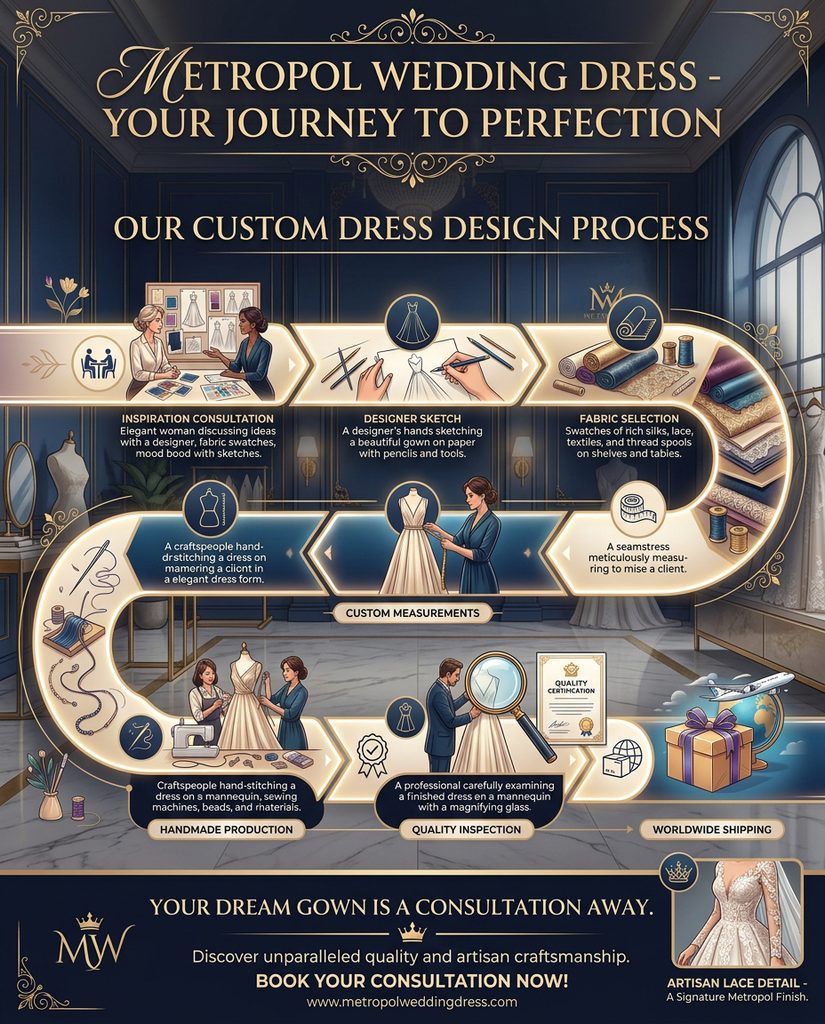
A bridal gown can contain:
- multiple layers
- boning
- lining
- cups
- corsetry
- lace appliqué
- beading
- sequins
- embroidery
- horsehair
- crinoline
- detachable components
- trains
- buttons
- zippers
- hand finishing
- complex seam construction
- structural support
And the garment must not only look beautiful.
It has to fit a three-dimensional human body while maintaining its intended silhouette.
That makes manufacturing expertise particularly important.
A supplier that is excellent at producing simple dresses may not necessarily be excellent at producing a structured bridal gown.
This is one reason U.S. bridal boutiques should ask manufacturers questions about:
- pattern development
- grading
- fitting
- corsetry
- structural construction
- lace placement
- embroidery
- hand finishing
- sample development
- size consistency
- quality-control procedures
A beautiful photograph is not proof of manufacturing competence.
Country #1: Turkey — The Strategic Middle Ground
Turkey deserves special attention because it does not fit neatly into the traditional “cheap manufacturing versus luxury European manufacturing” narrative.
Its advantage is often the combination.
Turkey has a large textile and apparel ecosystem, strong manufacturing infrastructure and a mature bridal production culture.
Within Turkey, İzmir is particularly relevant to wedding dress sourcing.
IF Wedding Fashion İzmir describes İzmir as one of Türkiye’s leading bridal and evening-wear production centers and highlights the city’s export capacity and international buyer network. The 2026 event attracted professional visitors from a broad international market.
The significance for a U.S. boutique is practical.
You are not necessarily sourcing from a general apparel factory that happens to accept bridal orders.
You can source from a manufacturing ecosystem where wedding dresses are an established category.
That distinction matters.
Why U.S. Boutiques Consider Turkey
Turkey can be attractive when a boutique wants:
- European-inspired bridal design
- intricate lace
- embroidery
- detailed embellishment
- custom development
- private label production
- smaller or flexible collections
- direct manufacturer communication
- a balance between premium appearance and wholesale economics
The country’s location also makes it deeply integrated into European fashion and textile networks.
But geography should not be misunderstood.
Turkey is geographically closer to Europe than to the United States.
That does not automatically mean shipping a wedding dress from Turkey to New York or Los Angeles is inexpensive.
The correct question remains:
What is the total landed cost for my exact order?
Why İzmir Matters
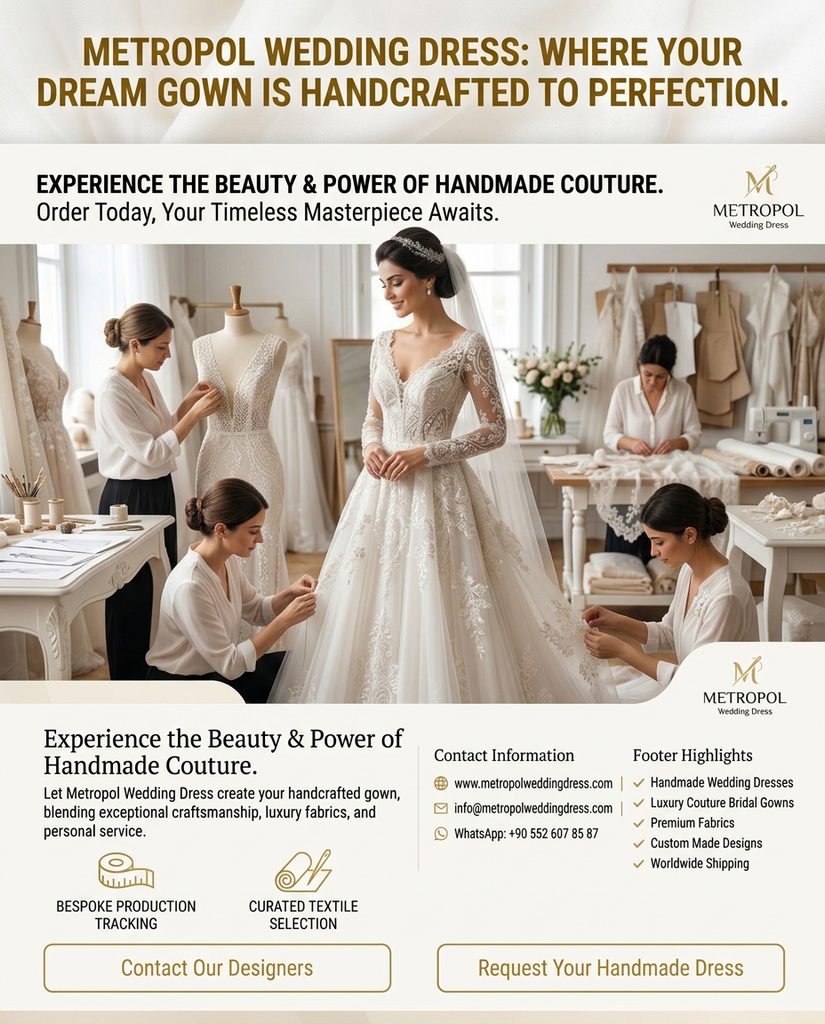
İzmir has become one of the most recognizable locations in Turkey for bridal and evening-wear production.
The city’s IF Wedding Fashion event has become an important meeting point between manufacturers and international buyers. The 2026 edition was announced with more than 200 brands and professional buyers, while organizers highlighted the city’s production and export infrastructure.
For a purchasing manager, an established industry cluster creates several potential advantages.
1. Specialized labor
A manufacturing ecosystem creates access to people familiar with:
- bridal patternmaking
- lace
- embroidery
- draping
- structured gowns
- finishing
- alterations
- embellishment
2. Supplier density
A cluster can make it easier to source supporting materials and specialized services.
3. Industry knowledge
Manufacturers working repeatedly with bridal buyers are more likely to understand the difference between:
“make this dress”
and
“make this dress consistently at wholesale scale.”
4. International buyer experience
A manufacturer accustomed to international wholesale orders is more likely to understand documentation, packaging, labeling and export workflows.
That does not eliminate due diligence.
It simply makes the sourcing environment more interesting.
Turkey’s Biggest Advantage: Customization
For many U.S. bridal boutiques, differentiation is becoming more important than sheer inventory volume.
A boutique does not necessarily want the exact same gown sold by hundreds of competitors.
It may want:
- a modified neckline
- different lace
- a new sleeve
- alternative fabric
- changed train length
- revised back construction
- customized beading
- exclusive color
- modified silhouette
- private-label branding
This is where manufacturer flexibility becomes commercially valuable.
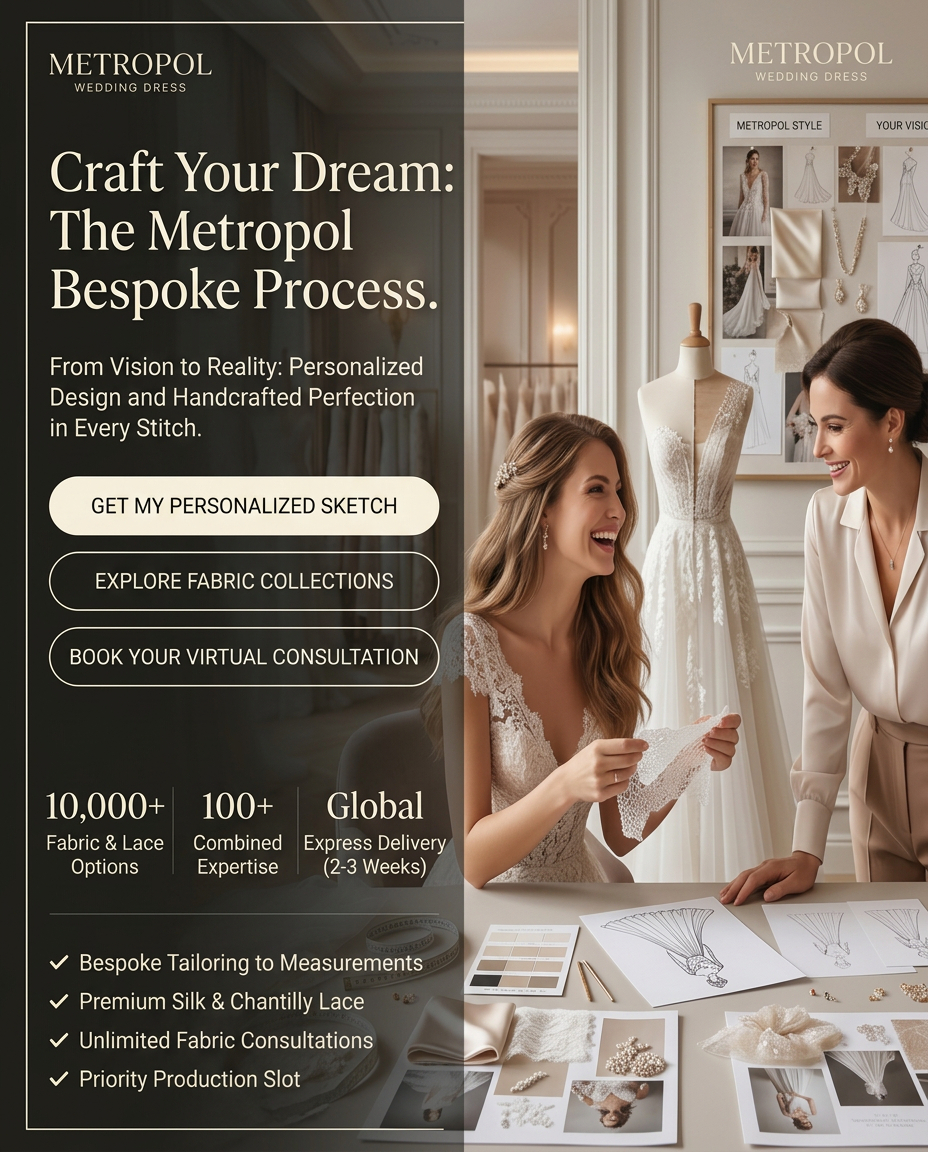
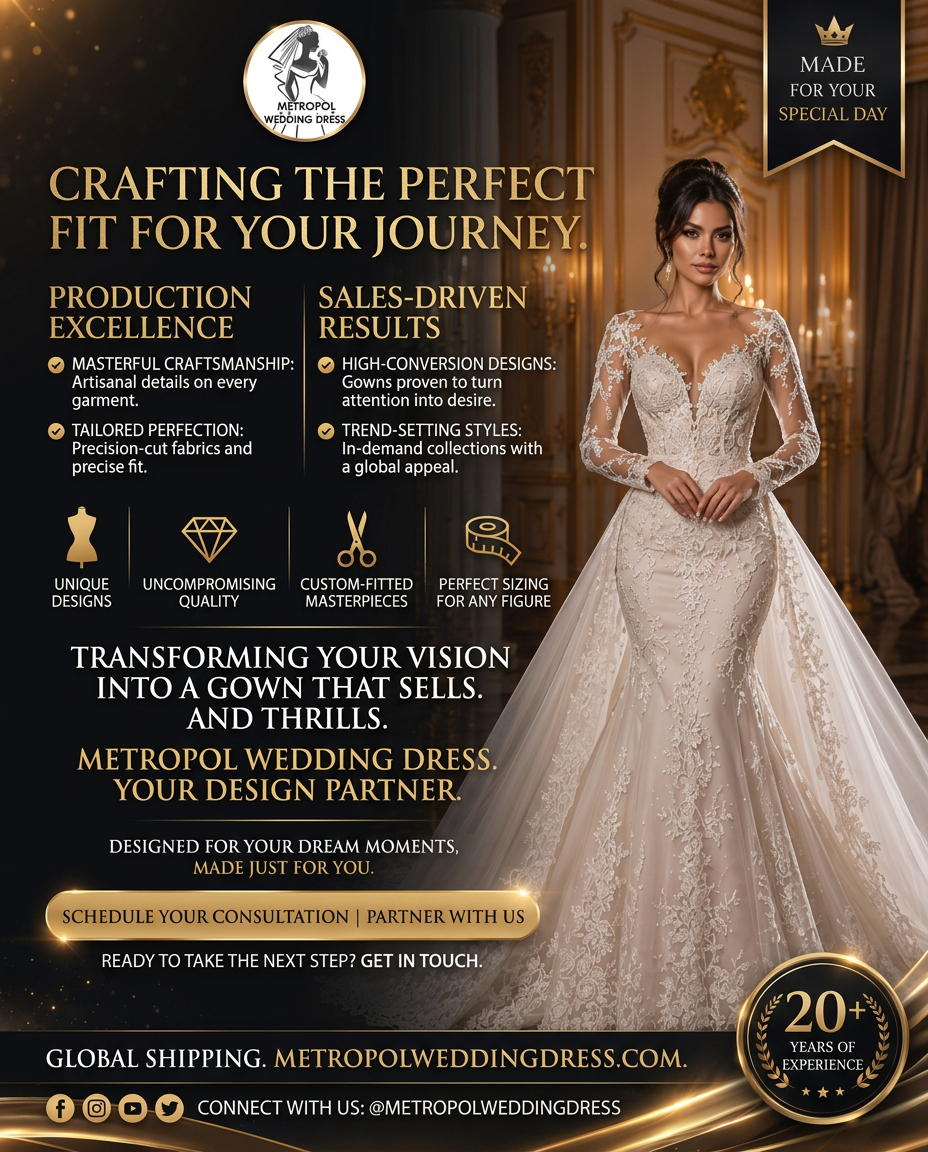
Metropol Wedding Dress, based in İzmir, positions itself as a wholesale wedding dress manufacturer and also offers custom-made wedding dress production for boutiques and retailers internationally.
Its own manufacturing information emphasizes custom development, wholesale production and direct manufacturer relationships.
For a boutique, the strategic benefit is not simply “custom dresses.”
It is the ability to create an assortment that competitors cannot easily duplicate.
A Better Question for the Factory
Do not ask only:
“Can you make custom wedding dresses?”
Almost every supplier will say yes.
Ask instead:
“What exactly can be customized without creating a completely new development program?”
Then divide customization into four levels.
Level 1 — Cosmetic customization
Usually the easiest:
- color
- buttons
- minor embellishment
- detachable accessories
Level 2 — Design customization
More significant:
- neckline
- sleeve
- back
- lace
- train
Level 3 — Pattern customization
More technical:
- silhouette
- proportions
- construction
- support
- fit
Level 4 — Original development
The highest level:
- sketch
- technical development
- pattern
- prototype
- fitting
- revisions
- grading
- production
A serious private-label program should establish exactly where a manufacturer operates within this hierarchy.
Country #2: China — The Scale Champion
China remains one of the world’s most important apparel manufacturing ecosystems.
Its primary attraction is not simply low pricing.
It is scale.
A U.S. bridal business looking for:
- large production volumes
- extensive supplier choice
- broad material sourcing
- mature logistics
- large manufacturing infrastructure
may find China highly competitive.
For businesses with predictable high-volume demand, scale can be extremely powerful.
But scale creates a paradox.
The bigger the supply ecosystem, the more important supplier selection becomes.
A buyer can encounter enormous variation between factories.
Therefore, “China” is not a supplier.
It is an entire manufacturing universe.
One factory may specialize in:
- mass-market gowns
while another specializes in:
- couture-level handwork.
Another may be optimized for:
- high-volume standardized production.
And another may be built around:
- OEM/private-label development.
The country alone tells you surprisingly little about the actual supplier.
When China May Be the Better Choice
China may be especially interesting for a U.S. bridal business that has:
- predictable volume
- price-sensitive customers
- large collections
- standardized designs
- strong internal QC
- experienced import management
- enough purchasing volume to negotiate effectively
It may be less attractive for a boutique whose competitive advantage depends on:
- tiny collections
- frequent design changes
- intensive customization
- highly personal supplier communication
Again, these are not absolute rules.
The manufacturer matters more than the flag on the factory gate.
Country #3: India — The Embellishment Specialist
India has a different competitive identity.
Its greatest attraction for bridal sourcing can be the depth of craftsmanship available for:
- embroidery
- beadwork
- sequins
- hand embellishment
- ornate surface design
- decorative bridal construction
If your boutique sells dramatic, heavily embellished gowns, India deserves serious consideration.
The purchasing question becomes:
How much of the gown’s value comes from labor-intensive handwork?
If the answer is “a lot,” India may become much more attractive.
But there is an important operational issue.
Hand craftsmanship can make production more difficult to standardize.
A buyer must establish:
- bead placement standards
- thread color standards
- acceptable variation
- weight tolerances
- sample approval procedures
- production inspection
- packaging requirements
The more artisanal the gown, the more important the approved sample becomes.
Country #4: Italy — Premium Positioning
Italy is an obvious reference point for luxury fashion.
For a premium bridal boutique, Italian manufacturing can contribute to a luxury narrative that goes beyond the garment itself.
But the purchasing equation changes.
You are not necessarily trying to minimize manufacturing cost.
You are buying:
- craftsmanship
- design heritage
- luxury perception
- brand storytelling
- exclusivity
This can work extremely well for boutiques whose retail strategy is based on high-ticket gowns.
However, a boutique targeting mid-market brides may find that the additional manufacturing premium is difficult to translate into enough retail margin.
The right question is not:
“Is Italy better?”
It is:
“Will my customer pay enough for the Italian manufacturing proposition to justify my cost structure?”
Country #5: France — Couture First
France belongs in a similar category, but with an even stronger association with couture and luxury fashion.
For a boutique building a fashion-led, editorial bridal identity, French production can be strategically powerful.
For a volume-driven retailer, however, the economics may be less attractive.
French manufacturing is often best evaluated as a brand positioning investment, rather than simply a production-cost strategy.
Country #6: Portugal and Other European Production Centers
Portugal and other European manufacturing locations can be attractive for buyers seeking:
- European production
- quality-focused manufacturing
- shorter European supply routes
- fashion-industry integration
- premium positioning
For a U.S. boutique, however, the relevant comparison should again be made using landed cost.
The fact that a factory is geographically closer to Europe does not automatically make the final U.S. price better.
The Country Ranking Changes When You Change the Buyer
Consider five fictional U.S. boutiques.
Boutique A — The High-Volume Chain
Needs:
- 2,000+ units
- standardized designs
- predictable demand
- aggressive cost targets
Likely shortlist: China, selected large-scale suppliers in other manufacturing hubs.
Boutique B — The Independent Luxury Boutique
Needs:
- 50–150 styles
- high craftsmanship
- customization
- strong storytelling
Likely shortlist: Turkey, Italy, France, selected premium manufacturers elsewhere.
Boutique C — The Couture-Inspired Store
Needs:
- heavy embroidery
- beadwork
- hand finishing
Likely shortlist: India, Turkey, Italy, France.
Boutique D — The Private-Label Startup
Needs:
- low initial risk
- flexible development
- manageable MOQs
- custom branding
Likely shortlist: Turkey and flexible OEM/private-label manufacturers in several countries.
Boutique E — The Fast-Moving Digital Bridal Brand
Needs:
- quick development
- frequent launches
- small collections
- rapid testing
Likely shortlist: suppliers selected for development speed and communication rather than country alone.
This illustrates the central principle:
The best manufacturing country is a function of your business model.
The Most Important Comparison: Factory Price vs. Landed Cost
One of the biggest mistakes in international bridal sourcing is comparing factory quotations as though they were retail-ready costs.
Imagine:
Factory A: $400
Factory B: $470
At first glance, A wins.
But suppose A has:
- higher freight
- more defects
- higher alteration rates
- slower delivery
- more expensive sampling
- larger MOQ
while B has:
- better packaging
- lower defect rate
- predictable production
- flexible ordering
- better communication
The apparent $70 saving can disappear.
This is why purchasing managers should create a landed-cost worksheet before approving a supplier.
A Practical Landed-Cost Worksheet
For each gown, record:
| Cost component | Supplier A | Supplier B | Supplier C |
|---|---|---|---|
| Unit price | $ | $ | $ |
| Sampling allocation | $ | $ | $ |
| Packaging | $ | $ | $ |
| Freight | $ | $ | $ |
| Insurance | $ | $ | $ |
| Duties/tariffs | $ | $ | $ |
| Customs/brokerage | $ | $ | $ |
| QC | $ | $ | $ |
| Expected alteration cost | $ | $ | $ |
| Expected defect allowance | $ | $ | $ |
| Total estimated landed cost | $ | $ | $ |
Do not fill in a generic tariff percentage without checking the actual classification and current U.S. import rules.
Wedding gowns can involve complex classification questions, and duty treatment should be confirmed with the appropriate customs professional before placing a major order.
U.S. Compliance: The Part Boutique Owners Should Not Ignore
A beautiful gown cannot be treated as a compliance-free fashion product.
The U.S. Federal Trade Commission states that most textile and wool products require labeling covering information such as fiber content, country of origin and the identity of the manufacturer or another responsible business.
Care labeling is also regulated.
The FTC’s Care Labeling Rule requires manufacturers and importers covered by the rule to provide care instructions, and the instructions must be available in the required manner when garments are offered to consumers.
Country-of-origin labeling is particularly important for imported bridal gowns.
The FTC explains that imported textile products must identify the country where they were processed or manufactured, while Customs requirements may also apply.
This means a U.S. boutique should establish its labeling requirements before production, not after the shipment arrives.
The Private-Label Question
Private label is one of the most attractive opportunities for independent bridal boutiques.
Instead of selling a gown under the manufacturer’s identity, the boutique can potentially develop a collection under its own brand.
That creates several advantages.
Brand differentiation
Customers remember the boutique’s collection rather than a generic supplier catalog.
Better exclusivity
A custom design may be less directly comparable with competing stores.
Higher perceived value
A strong private-label identity can support premium retail pricing.
Long-term brand equity
The boutique builds an asset beyond its physical inventory.
But private label also introduces additional responsibilities.
The buyer should clarify:
- Who owns the pattern?
- Who owns the original design?
- Can the manufacturer sell the same design to another customer?
- Is the design exclusive by country?
- Is exclusivity limited by territory?
- Is exclusivity limited by time?
- Who supplies labels?
- Who supplies hangtags?
- Who approves packaging?
- Who controls photography?
- Who owns the technical files?
These questions should be answered in writing.
The Hidden Value of a Flexible Manufacturer
A rigid manufacturer can become expensive even when its unit price is low.
Why?
Because bridal collections evolve.
Suppose your first order includes 20 styles.
After six months, you discover:
- Style 3 sells exceptionally well.
- Style 7 needs a larger size range.
- Style 11 should have detachable sleeves.
- Style 15 should be produced in another lace.
- Style 18 needs a shorter train.
A flexible manufacturer can turn those observations into product development.
A rigid supplier may force you to:
- accept minimum quantities
- restart development
- wait for a new season
- pay large sample costs
- abandon the design
Flexibility therefore has a measurable commercial value.
The Sample Is Not Decoration — It Is the Contract Between Design and Production
A bridal buyer should never approve a major production order from photographs alone.
The sample should be treated as a technical reference.
Evaluate:
Silhouette
Does the finished gown match the intended visual architecture?
Bust structure
Is the bodice supportive?
Waist
Does the waist sit where the pattern intends?
Shoulder
Are straps and sleeves correctly balanced?
Skirt
Does the skirt fall evenly?
Train
Is the train symmetrical?
Lace
Is placement consistent?
Embroidery
Is the density correct?
Beading
Are beads securely attached?
Lining
Does the lining sit correctly?
Closure
Does the zipper or button system operate smoothly?
Pressing
Does the finished garment arrive clean and professionally pressed?
Packaging
Does the dress survive international transportation?
These are not cosmetic details.
They are retail-quality controls.
The Bridal QC System a U.S. Boutique Should Request
A useful production quality system can contain five checkpoints.
Checkpoint 1 — Raw Material Approval
Confirm:
- fabric
- lace
- color
- lining
- accessories
- buttons
- zipper
- embellishment
Checkpoint 2 — Pre-Production Sample
The factory produces an approved reference.
Checkpoint 3 — First Production Inspection
The first production pieces are compared against the approved sample.
Checkpoint 4 — Final Inspection
Before shipment:
- measurements
- stains
- loose threads
- missing beads
- damaged lace
- zipper operation
- symmetry
- packaging
Checkpoint 5 — Arrival Inspection
The boutique inspects random units after delivery.
This final step matters because damage can occur during transport.
Size Grading Is a Strategic Issue, Not a Technical Footnote
A bridal boutique can lose customers through poor size consistency.
If a manufacturer grades patterns badly, the boutique may face:
- more alterations
- customer dissatisfaction
- fitting delays
- remake requests
- additional labor
- damaged reputation
Ask suppliers:
- What size chart do you use?
- Can we provide our own size chart?
- How are sizes graded?
- Are bust, waist and hip increments standardized?
- Can we develop petite and plus-size versions?
- Are larger sizes structurally reinforced where necessary?
- Can the manufacturer produce made-to-measure gowns?
The answers reveal much more about the manufacturer’s technical maturity than a beautiful Instagram feed.
MOQ: The Number That Can Quietly Destroy a New Bridal Brand
MOQ means minimum order quantity.
For a large retailer, MOQ may be irrelevant.
For a small boutique, it can determine whether international manufacturing is viable.
Imagine a supplier requires 20 units per style.
If you want 25 styles:
25 × 20 = 500 gowns
That could be far more inventory than the boutique can sell.
A supplier offering lower quantities may therefore create more economic value even at a higher unit price.
This is why small-batch production deserves its own evaluation.
The Better Strategy: Build a Test-and-Scale Collection
Instead of ordering 30 styles immediately, a boutique can consider a staged approach.
Phase 1 — Test
Select:
- 6–10 core styles
Phase 2 — Measure
Track:
- appointments
- try-ons
- conversions
- customer feedback
- alterations
- deposits
- cancellations
Phase 3 — Reorder
Increase production of proven winners.
Phase 4 — Develop
Create variations around successful silhouettes.
This converts manufacturing from a speculative inventory decision into a data-driven merchandising process.
A Bridal Boutique Should Measure More Than Sales
A gown can sell well and still be operationally bad.
Track:
Sell-through rate
How quickly does the gown sell?
Gross margin
How much revenue remains after product cost?
Alteration burden
How much labor is required?
Defect rate
How often does the garment arrive below standard?
Lead time
How long does replenishment take?
Reorder rate
How often do you reorder the same model?
Return/remake rate
How frequently does the gown create post-sale problems?
Customer satisfaction
Does the bride recommend the boutique?
The most valuable supplier is often the one that improves several of these metrics simultaneously.
Communication Is a Manufacturing Specification
This is especially important when sourcing internationally.
A factory can be technically excellent and still be commercially difficult to work with.
The purchasing manager should evaluate:
- response time
- English communication
- technical understanding
- willingness to document changes
- ability to confirm measurements
- transparency about production delays
- sample revision process
- photo/video reporting
- order tracking
A good supplier should be able to communicate:
what is being made, how it is being made, when it will be completed, and whether anything has changed.
Time Zones Are Not the Real Problem
A common concern is:
“Turkey is far away.”
“China is far away.”
“India is far away.”
But distance itself is rarely the biggest problem.
Unpredictability is.
A supplier that responds consistently and gives accurate production dates can be easier to manage than a nearby supplier that changes deadlines repeatedly.
The real metric is:
Communication reliability × production reliability.
Lead Time Should Be Measured in Stages
Do not ask:
“How long does production take?”
Ask:
- How long until the first response?
- How long until quotation?
- How long until sample?
- How long for sample revisions?
- How long after approval until production?
- How long until QC?
- How long until shipment?
- How long is transit?
- How long does customs clearance normally take?
- What happens if production is delayed?
This produces a much more realistic supply-chain calendar.
The Wedding Season Changes the Meaning of “Fast”
A normal fashion retailer may tolerate a delayed shipment.
A bridal boutique often cannot.
A bride may have:
- venue bookings
- photography
- fittings
- alterations
- travel
- rehearsal events
- wedding-week appointments
A gown arriving two weeks late can therefore create disproportionate damage.
For this reason, boutiques should build calendar buffers into purchasing decisions.
Never build your entire bridal supply chain around the factory’s best-case production estimate.
Which Country Wins on Lead Time?
There is no universal ranking.
Lead time depends on:
- design complexity
- production volume
- fabric availability
- embellishment
- sample approval
- factory workload
- shipping method
- customs
- season
A simple dress from a distant country may arrive faster than a heavily customized dress from a nearby supplier.
Therefore:
Country lead time ≠ supplier lead time.
Always evaluate the actual manufacturer.
The Five Questions That Reveal a Serious Manufacturer
Before requesting a price list, ask:
1. Do you manufacture in-house?
If yes, which processes?
2. Do you offer private label?
If yes, what are the minimums?
3. Can you develop from sketches?
This separates catalog sellers from genuine development partners.
4. What is your sample approval process?
You want a defined workflow.
5. How do you control production quality?
Look for a specific answer, not:
“Don’t worry, we have good quality.”
Questions to Ask About Production Capacity
Do not ask only:
“How many dresses can you make?”
Ask:
- What is normal monthly production?
- What is peak-season production?
- How many sewing lines are dedicated to bridal?
- How many workers specialize in embellishment?
- What percentage is outsourced?
- Which processes are performed internally?
- What is the typical order size?
- How many active wholesale clients do you serve?
- What happens when capacity is full?
Capacity is useful only when it is available when you need it.
A Note About Metropol Wedding Dress
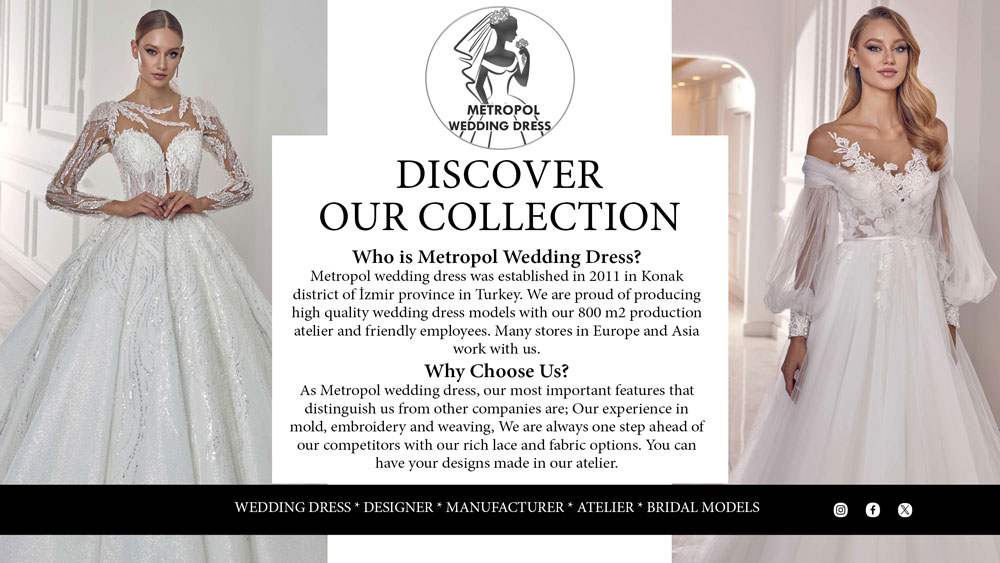
Metropol Wedding Dress identifies itself as a wholesale wedding dress manufacturer based in İzmir, Turkey, with custom-made production capabilities for boutiques and retailers.
The company states that it operates from İzmir and provides wholesale and custom wedding dress solutions. Its published material also describes private-label and custom development as part of its wholesale offering.
For a U.S. bridal boutique evaluating Turkey, this type of manufacturer can be relevant when the sourcing strategy prioritizes:
- direct manufacturer communication
- custom development
- wholesale production
- boutique-oriented collections
- private-label possibilities
- Turkish bridal craftsmanship
The important point for a buyer is still due diligence.
A manufacturer’s marketing claims should be converted into measurable purchasing terms:
MOQ → written
sample timeline → written
production timeline → written
quality standard → approved sample
private-label terms → written
payment terms → written
shipping responsibility → written
defect policy → written
That is how a sourcing relationship becomes a business relationship.
What Makes Turkey Particularly Interesting for Private-Label Bridal?
Private-label bridal requires more than sewing.
The manufacturer has to understand a brand.
Suppose your boutique is:
Romantic + European + minimalist.
You don’t want 30 unrelated dresses.
You want a collection with:
- consistent lace language
- consistent neckline philosophy
- recognizable silhouettes
- coordinated fabrics
- compatible price points
- coherent photography
A capable manufacturing partner should help turn that concept into a repeatable product system.
That is more valuable than simply supplying individual gowns.
The Collection Architecture Matters
Instead of buying dresses one by one, build collections around customer needs.
For example:
The Romantic Collection
- A-line
- soft lace
- illusion details
- floral appliqué
- light train
The Modern Collection
- clean satin
- architectural neckline
- minimalist construction
- sculptural silhouette
The Glamour Collection
- crystal embellishment
- fitted silhouette
- dramatic train
- structured bodice
The Destination Collection
- lightweight fabrics
- reduced structure
- easy movement
- travel-friendly packaging
This approach helps a boutique merchandise the collection rather than merely stock dresses.
The “Hero Gown” Strategy
A boutique does not necessarily need 50 equally important dresses.
It may need:
- 3 hero gowns
- 7 commercial gowns
- 10 supporting gowns
- several accessories
The hero gown attracts attention.
The commercial gowns drive sales.
The supporting gowns complete the assortment.
This reduces unnecessary inventory risk.
A Simple Inventory Allocation Model
Imagine a boutique has a $50,000 seasonal purchasing budget.
Instead of distributing it evenly:
| Category | Suggested strategic role |
|---|---|
| Hero styles | Visibility and differentiation |
| Core commercial styles | Revenue |
| Trend styles | Market testing |
| Custom/private-label | Brand identity |
| Accessories | Margin and upselling |
| Reorder reserve | Demand response |
The exact percentages should be based on the boutique’s sales data.
The principle is more important:
Don’t spend the entire budget before learning what your customers actually want.
What U.S. Buyers Should Look for in a Turkish Wedding Dress Factory
A strong candidate should ideally be able to demonstrate:
Product development
Can they turn a sketch into a finished sample?
Pattern expertise
Can they build and modify patterns?
Fabric knowledge
Can they recommend appropriate fabrics?
Embellishment
Can they reproduce detailed work consistently?
Grading
Can they scale patterns accurately?
Quality control
Do they inspect before shipment?
Export capability
Can they handle international documentation?
Communication
Can they communicate clearly in English?
Flexibility
Can they work with a boutique’s actual purchasing model?
These criteria are more important than the phrase:
“Best wedding dress manufacturer.”
Red Flags: When a Supplier Should Leave Your Shortlist
Be cautious when a supplier:
- refuses to provide a physical sample
- cannot explain production stages
- changes pricing repeatedly
- cannot specify MOQ
- avoids written specifications
- refuses quality-control discussion
- cannot explain fabric composition
- gives unrealistic delivery promises
- sends inconsistent product photographs
- has no clear defect policy
- cannot explain private-label ownership
- insists on large orders before proving quality
A professional manufacturer does not need to promise perfection.
It needs to demonstrate process control.
Red Flag #1: “We Can Make Anything”
This sounds attractive.
It can also mean nothing.
Ask for examples.
What have you actually produced?
Can the manufacturer show:
- structured gowns?
- lace gowns?
- beaded gowns?
- plus-size gowns?
- custom patterns?
- private-label collections?
Past production is stronger evidence than general claims.
Red Flag #2: Beautiful Photos, Weak Technical Information
Instagram can show you aesthetics.
It cannot show:
- seam strength
- inside construction
- pattern accuracy
- grading quality
- fabric composition
- production consistency
Ask to see the inside of the gown.
A professional buyer should be interested in what happens under the lace.
Red Flag #3: Unrealistic Prices
A very low price can be attractive.
But ask what has been removed to reach it.
Potential trade-offs may include:
- lower-quality fabric
- less lining
- simplified construction
- machine-made embellishment
- weaker closures
- less QC
- fewer labor hours
The right question is:
“What specifications are included in this price?”
Red Flag #4: No Sample Revision Process
Bridal development almost always requires refinement.
A sample may need:
- neckline adjustment
- sleeve adjustment
- waist correction
- lace repositioning
- train modification
- support modification
If the manufacturer treats the first sample as final, the development process may be difficult.
A Practical Supplier Scorecard
Score each manufacturer from 1 to 10.
| Criterion | Weight |
|---|---|
| Product quality | 20% |
| Communication | 10% |
| Customization | 15% |
| Lead time | 10% |
| MOQ flexibility | 10% |
| Price | 15% |
| QC system | 10% |
| Private-label capability | 5% |
| Export experience | 5% |
Multiply the score by the weight.
This prevents one seductive factor—usually price—from dominating the entire decision.
Example: Turkey vs. China vs. India
Imagine a U.S. boutique that prioritizes customization and craftsmanship.
A conceptual score might look like:
| Criterion | Turkey | China | India |
|---|---|---|---|
| Customization | 9 | 8 | 8 |
| Embellishment | 9 | 8 | 10 |
| Large-scale production | 7 | 10 | 7 |
| Small-batch flexibility | 8 | 7 | 7 |
| Communication | 8 | 7 | 7 |
| Price competitiveness | 8 | 10 | 8 |
| Private label | 9 | 9 | 8 |
These are illustrative procurement scores, not industry-wide factual ratings.
The point is to demonstrate the decision framework.
A different boutique could produce a completely different ranking.
The Most Important Procurement Lesson
Never ask:
“Which country has the best wedding dress manufacturers?”
Ask:
“Which manufacturing ecosystem best matches our volume, positioning, customer, quality standard and cash-flow model?”
That is the professional sourcing question.
A U.S. Boutique’s Ideal Supplier Profile
For many independent bridal stores, an ideal supplier might look like this:
Location: internationally competitive manufacturing market
MOQ: flexible enough for boutique-scale purchasing
Production: specialized bridal capability
Customization: strong
Communication: direct
Sampling: structured
QC: documented
Private label: available
Sizing: flexible
Design: contemporary and commercially proven
Shipping: export experienced
Payment: transparent
Reordering: predictable
Exclusivity: negotiable
Notice what is missing.
“Cheapest.”
Why the Cheapest Wedding Dress Can Be the Most Expensive
Consider a hypothetical example.
A gown costs:
$300 factory price
But after:
- freight
- duty
- customs
- packaging
- alteration
- defect replacement
- delayed delivery
- additional customer-service labor
its effective cost becomes:
$430
Another gown costs:
$360 factory price
but its effective cost is:
$400
The second supplier wins.
This is why procurement should measure cost-to-sell, not simply cost-to-buy.
Bridal Alterations Are Part of the Sourcing Equation
A wedding gown often requires alterations.
That is normal.
But excessive alterations indicate a potential manufacturing problem.
Track:
- average alteration hours
- common adjustment points
- sleeve modifications
- bust corrections
- waist corrections
- hem corrections
- structural corrections
If one supplier consistently requires more alteration work, the apparent factory-price advantage may be misleading.
The Fit Feedback Loop
An advanced boutique can use alterations as product-development data.
Suppose 70% of brides wearing a particular style require the same bust correction.
That suggests:
The pattern may need adjustment.
Instead of repeatedly paying for alterations, send the data back to the manufacturer.
This creates a feedback loop:
Customer → fitting → data → manufacturer → revised pattern → better future production
That is how a boutique becomes a smarter buyer over time.
Packaging Is More Important Than It Looks
Wedding dresses are not ordinary garments.
A gown may travel thousands of miles before reaching the boutique.
Packaging should protect against:
- crushing
- moisture
- dust
- staining
- abrasion
- lace damage
- bead damage
Ask:
- How is the train folded?
- Is tissue paper used?
- Are embellished areas protected?
- Is the garment bag suitable?
- Is the carton strong enough?
- Are moisture protections used when appropriate?
The dress should arrive ready for professional inspection.
Logistics: FOB, EXW and Other Terms
U.S. buyers should understand the commercial term included in a quotation.
For example, a quoted price may be:
- EXW
- FOB
- CIF
- DAP
- another agreed Incoterm
These terms affect who is responsible for:
- inland transportation
- export handling
- freight
- insurance
- customs
- delivery
Do not compare two quotations until you know that both quotations are being compared on an equivalent basis.
A $400 FOB price and a $400 EXW price are not necessarily economically identical.
Customs Should Be Part of Product Planning
Import classification can depend on the exact product and applicable rules.
Therefore, before placing a significant order, a U.S. importer should verify:
- correct HTS classification
- applicable duty
- country of origin
- documentation
- marking requirements
- textile labeling
- importer responsibilities
Do not rely on a supplier’s casual statement such as:
“Duty is approximately X%.”
Verify the actual classification.
Labeling: A Small Detail With a Big Consequence
For U.S. textile apparel, labeling requirements can involve:
- fiber content
- country of origin
- responsible business/manufacturer identification
- care instructions
The FTC specifically states that most covered textile and wool products require fiber-content, country-of-origin and responsible-party information, while care instructions are governed separately under the Care Labeling Rule.
For imported garments, country-of-origin requirements also interact with Customs rules.
A bridal boutique should therefore discuss labeling during development.
Not after the container has shipped.
The Private Label Checklist
Before signing a private-label agreement, clarify:
- Brand labels
- Size labels
- Care labels
- Country-of-origin label
- Hangtags
- Packaging
- Garment bags
- Boxes
- Product photography
- SKU system
- Style numbers
- Barcode requirements
- Design ownership
- Pattern ownership
- Exclusivity
- Territory
- Minimum orders
- Reorder minimums
This turns a vague “private-label partnership” into a real commercial program.
How to Build a First Order
A new U.S. boutique should resist the temptation to order everything at once.
A smarter first order might contain:
30% commercial styles
Safe, broadly appealing silhouettes.
25% signature styles
Distinctive gowns that define the boutique.
20% trend styles
Fashion-forward pieces.
15% premium styles
Higher-ticket designs.
10% experimental styles
New silhouettes or unusual details.
The actual allocation should depend on your customer base.
But the principle is sound:
Balance revenue certainty with differentiation.
The Three-Layer Bridal Assortment
A powerful merchandising structure is:
Layer 1 — Traffic
Dresses that attract attention.
Layer 2 — Conversion
Dresses that fit the majority of customers.
Layer 3 — Margin
Dresses with higher perceived value and stronger pricing potential.
A manufacturing partner should help you develop all three.
What “Quality” Really Means
Quality is often used as a vague marketing word.
For procurement, define it.
Structural quality
- seams
- corsetry
- support
- closures
Material quality
- fabric
- lace
- lining
- embellishments
Visual quality
- symmetry
- placement
- finishing
Fit quality
- grading
- measurements
- construction
Durability
- bead attachment
- zipper performance
- seam strength
Packaging quality
- transportation protection
If you cannot define quality, you cannot inspect it.
The Golden Rule of Sample Approval
Never approve:
“approximately like the photo.”
Approve:
“exactly according to the approved sample and written specification.”
The approved sample becomes the visual benchmark.
If you need:
- 7 cm train extension
- ivory lining
- specific lace
- specific cup construction
- specific bead density
write it down.
Memory is not a quality-control system.
A Better Way to Compare Supplier Quotes
Create a one-page procurement brief.
Product
Wedding gown
Style
WG-001
Fabric
Specified
Lace
Specified
Color
Specified
Sizes
Specified
Construction
Specified
Embellishment
Specified
Label
Private label
Packaging
Specified
Quantity
Specified
Delivery
Specified
Incoterm
Specified
Payment
Specified
QC
Specified
Then ask every shortlisted supplier to quote the same specification.
This creates a genuine apples-to-apples comparison.
The 30-Day Supplier Qualification Method
For a boutique that has never sourced internationally, a structured 30-day process can work well.
Week 1 — Research
Shortlist:
- 5–10 manufacturers
Week 2 — Qualification
Request:
- catalogs
- price ranges
- MOQ
- sample terms
- private-label terms
- production information
Week 3 — Sampling
Order samples from the strongest candidates.
Week 4 — Evaluation
Score:
- fit
- quality
- communication
- packaging
- lead time
- price
- customization
Then choose.
The objective is not to find 50 suppliers.
It is to identify one or two suppliers capable of becoming long-term production partners.
What an Experienced Buyer Notices in a Factory Visit
If you can visit the manufacturer, don’t spend the entire visit looking at the showroom.
Look at the production floor.
Observe:
- work organization
- material storage
- sample area
- cutting
- sewing
- embellishment
- finishing
- inspection
- packaging
Ask:
“Can I see a gown currently in production?”
Then compare it with the showroom sample.
This reveals the difference between marketing and manufacturing.
Factory Visit Questions
Ask:
- Where is cutting performed?
- Where is sewing performed?
- Which processes are outsourced?
- Who performs embellishment?
- How are patterns stored?
- How are size grades controlled?
- How is the approved sample identified?
- How are production changes documented?
- Where is final inspection performed?
- How are finished gowns packed?
The answers can tell you whether the operation is controlled or improvised.
Supplier Relationships Should Become Better Over Time
The first order is not the final objective.
The goal is to create a learning system.
After each production cycle:
What sold?
What did not sell?
What needed alteration?
What did brides dislike?
What did stylists love?
Which fabrics performed well?
Which sizes moved?
Which styles should be repeated?
Feed those insights back into product development.
That is how sourcing becomes a competitive advantage.
The Data a Manufacturer Can Learn From Your Boutique
A strong manufacturer can become more valuable when you share:
- sales data
- customer preferences
- best-selling silhouettes
- price sensitivity
- fit problems
- seasonal demand
- regional preferences
Over time, the factory can help you anticipate what to develop next.
The relationship changes from:
buyer → seller
to:
retailer → product-development partner
That is much harder for competitors to replicate.
The Future of Bridal Manufacturing
The bridal industry is moving toward greater customization.
Customers increasingly expect:
- individuality
- personalization
- inclusive sizing
- unique details
- social-media-worthy designs
- faster product development
For boutiques, that creates an opportunity.
Instead of competing on:
“We have 500 dresses.”
you can compete on:
“We have dresses you cannot find everywhere else.”
Manufacturing flexibility becomes a strategic asset.
AI Does Not Replace Physical Manufacturing
Artificial intelligence can help with:
- trend analysis
- product ideation
- demand forecasting
- customer segmentation
- assortment planning
But AI cannot physically:
- sew the gown
- attach the lace
- check every seam
- correct every fit
- package the dress
The future is therefore likely to be:
better digital product development + stronger physical craftsmanship.
Boutiques that combine the two can move faster without sacrificing product quality.
The Information Advantage
A modern bridal boutique should know more than:
“This gown is beautiful.”
It should know:
- who buys it
- at what price
- what size sells
- how long it takes to sell
- how many alterations it needs
- how much margin it generates
- how often it can be reordered
- how quickly the factory can reproduce it
That is the difference between fashion buying and strategic merchandising.
The 12-Point Country Selection Framework
Before choosing a manufacturing country, score it against:
- Bridal specialization
- Craftsmanship
- Design capability
- MOQ flexibility
- Private-label capability
- Production capacity
- Lead-time reliability
- Logistics
- Communication
- Compliance readiness
- Landed cost
- Scalability
A country that scores well on all 12 dimensions may be more valuable than a country that wins only on unit price.
Final Country Comparison
| Business objective | Country worth investigating |
|---|---|
| Lowest-cost high-volume sourcing | China |
| Flexible boutique manufacturing | Turkey |
| Intricate hand embellishment | India |
| Luxury fashion positioning | Italy |
| Couture positioning | France |
| European manufacturing story | Portugal / European producers |
| Maximum domestic control | United States |
| Private-label bridal development | Turkey + selected OEM suppliers |
| Small-batch testing | Flexible manufacturers, especially specialized bridal factories |
| Large-scale standardized production | Large Chinese / global production partners |
This is not a universal league table.
It is a strategic starting point.
Why Turkey Deserves a Place on the U.S. Boutique Shortlist
Turkey’s strongest argument is not:
“Turkey is cheaper.”
That claim is too simplistic.
Its stronger argument is:
Turkey can offer a compelling intersection of bridal specialization, European design influence, craftsmanship, customization and export-oriented manufacturing.
İzmir’s established bridal manufacturing ecosystem makes the city particularly relevant. Industry organizers identify the city as a major bridal and evening-wear production center, while international trade activity around IF Wedding Fashion İzmir demonstrates the connection between local manufacturers and professional buyers.
For a boutique looking for a supplier rather than merely a commodity vendor, that ecosystem is worth investigating.
Why Metropol Wedding Dress Can Be Relevant to This Strategy
Metropol Wedding Dress is based in İzmir and positions itself as a wholesale wedding dress manufacturer serving boutiques and retailers, with custom-made wedding dress capabilities.
The company’s published wholesale material emphasizes:
- wholesale wedding dresses
- custom bridal gowns
- private-label possibilities
- direct manufacturer relationships
- international boutique supply
For a U.S. boutique, the relevant next step should not be to accept those claims blindly.
It should be to test them.
Request:
A sample.
Then request:
A specification.
Then request:
A production quotation.
Then request:
A written delivery schedule.
Then inspect:
The actual gown.
That is how professional sourcing works.
The Buyer’s Final Due-Diligence Checklist
Before placing a meaningful order, confirm:
Manufacturer
- Actual factory identified
- Production capabilities verified
- Bridal experience verified
- References or market evidence reviewed
Product
- Sample approved
- Fabric approved
- Lace approved
- Color approved
- Construction approved
- Size chart approved
Commercial
- MOQ confirmed
- Unit price confirmed
- Sample cost confirmed
- Payment terms confirmed
- Reorder terms confirmed
Logistics
- Incoterm confirmed
- Shipping method confirmed
- Packaging confirmed
- Export documents confirmed
Compliance
- Fiber information confirmed
- Country-of-origin labeling confirmed
- Care labeling confirmed
- U.S. importer requirements reviewed
The FTC’s published guidance should be used as part of the compliance review for applicable textile apparel products.
Private Label
- Brand label
- Hangtag
- Packaging
- SKU
- Design ownership
- Exclusivity
- Territory
Quality
- QC process documented
- Defect policy documented
- Pre-shipment inspection agreed
- Arrival inspection planned
The Five Most Expensive Mistakes a U.S. Bridal Buyer Can Make
1. Choosing on price alone
The cheapest quotation is not necessarily the cheapest product.
2. Ordering too much too early
Inventory can consume cash before demand is proven.
3. Skipping physical samples
Photos cannot reveal everything.
4. Ignoring labeling and import requirements
Compliance should be designed into the product.
5. Failing to document specifications
If it is not written down, production can drift.
A Smarter First Conversation With a Manufacturer
Instead of writing:
“Hello, please send wholesale prices.”
send a structured inquiry.
Tell the manufacturer:
- your boutique type
- customer profile
- expected quantity
- target retail range
- preferred silhouettes
- quality expectations
- private-label requirements
- target launch date
- size range
- customization needs
This gives the manufacturer enough information to determine whether the relationship is commercially realistic.
It also signals that you are a serious buyer.
The Ideal RFQ Structure
Subject: U.S. Bridal Boutique – Wholesale / Private Label Wedding Dress Inquiry
Include:
Business type: Bridal boutique
Market: United States
Collection: Wedding dresses
Quantity: Estimated number per style / season
Target price: Wholesale range
Retail positioning: Mid-market / premium / luxury
Customization: Yes / No
Private label: Yes / No
Size range: Specify
Sample requirement: Specify
Delivery target: Specify
Packaging: Specify
Labeling: U.S.-market requirements
This creates a professional starting point.
A Supplier Should Be Able to Answer These Questions
- What is your MOQ?
- What is your sample lead time?
- What is your production lead time after sample approval?
- Do you manufacture in-house?
- Do you offer private label?
- Can you develop from sketches?
- Can you modify existing styles?
- What fabrics do you commonly use?
- How do you control quality?
- What size ranges can you produce?
- What are your payment terms?
- Which shipping terms do you quote?
- How do you handle defective goods?
- Can you provide production photos?
- Can you support repeat orders?
A serious supplier should answer clearly.
The Best Manufacturer Is the One You Can Scale With
A supplier should not only be able to produce your first 20 gowns.
It should be capable of supporting your next stage.
Ask:
What happens if we grow from 20 dresses to 200?
And:
What happens if we need 10 new styles next season?
And:
What happens if one design suddenly goes viral?
The manufacturer must be able to grow with your demand without sacrificing quality.
Final Verdict
There is no universal “best country” for wedding dress manufacturing.
For U.S. bridal boutiques, the decision should be based on fit between manufacturing capability and retail strategy.
China can be powerful for scale.
India can be compelling for ornate craftsmanship.
Italy and France can support luxury positioning.
Portugal and other European manufacturing markets can offer European production advantages.
The United States offers proximity and control.
But for boutiques searching for a balance between:
craftsmanship + customization + bridal specialization + private label + international manufacturing + European design influence,
Turkey deserves serious consideration.
And within Turkey, İzmir is one of the most relevant cities to investigate for bridal manufacturing and wholesale sourcing. Industry sources describe İzmir as a major bridal and evening-wear production center with a strong international trade presence.
For a U.S. boutique, the opportunity is not simply to import dresses.
It is to build a better product system.
That means:
fewer random styles,
more intentional collections,
better supplier communication,
controlled quality,
smarter inventory,
clear private-label terms,
accurate landed-cost calculations,
and ultimately:
a bridal assortment that customers cannot easily find somewhere else.
That is the real advantage of choosing the right manufacturing partner.
FAQ: Wedding Dress Manufacturing for U.S. Bridal Boutiques
1. What is the best country for manufacturing wedding dresses for U.S. bridal boutiques?
There is no universally best country. Turkey, China, India, Italy, France, Portugal and the United States can each be appropriate depending on volume, price position, craftsmanship, customization and brand strategy.
For independent boutiques seeking flexible production and private-label possibilities, Turkey is particularly worth investigating.
2. Is Turkey a good country for wedding dress manufacturing?
Yes. Turkey has a mature textile and apparel manufacturing sector, while İzmir has a significant bridal and evening-wear production ecosystem. IF Wedding Fashion İzmir is an established international industry event connecting manufacturers with professional buyers.
3. Why is İzmir important for wedding dress production?
İzmir has developed a specialized bridal and evening-wear manufacturing cluster. Industry organizers identify the city as one of Türkiye’s leading centers for bridal production and export.
4. Is Turkey cheaper than China for wedding dresses?
Not necessarily.
A direct factory-price comparison is insufficient. Freight, duties, MOQ, quality, customization, defects and lead time all influence landed cost.
The correct comparison is the total cost of acquiring and selling the gown.
5. Is China better than Turkey for large wholesale orders?
China can be highly competitive for large-scale standardized production because of its enormous manufacturing ecosystem.
However, a boutique requiring customization, smaller batches or strong direct communication may find another manufacturing partner more suitable.
6. Is India good for bridal gown manufacturing?
India can be particularly attractive for heavily embellished wedding dresses because of its strong embroidery and handwork capabilities.
Buyers should pay close attention to production consistency and quality-control specifications.
7. Should a U.S. bridal boutique buy directly from a factory?
Direct factory sourcing can eliminate intermediary layers and potentially improve communication and customization.
However, the buyer should verify the manufacturer’s actual production capabilities before placing a significant order.
8. What is the minimum order quantity for wedding dresses?
MOQ varies significantly by manufacturer, style and customization level.
Never assume that an entire country has one MOQ.
Ask each factory for:
- MOQ per style
- MOQ per size
- MOQ for custom designs
- MOQ for private label
- reorder MOQ
9. Can U.S. boutiques order small quantities from Turkish wedding dress manufacturers?
Some Turkish manufacturers offer flexible wholesale production, but terms vary by supplier.
The boutique should ask specifically about:
- sample orders
- small initial orders
- mixed-style orders
- repeat orders
10. Can a Turkish manufacturer make private-label wedding dresses?
Yes, some Turkish manufacturers offer private-label and custom development.
Metropol Wedding Dress, for example, publicly positions itself as a wholesale manufacturer offering custom wedding dress solutions to boutiques and retailers.
The specific terms should be negotiated in writing.
11. Can a manufacturer make a wedding dress from my sketch?
Some manufacturers can develop gowns from sketches or technical concepts.
However, ask whether the service includes:
- pattern development
- sample development
- revisions
- grading
- production
A manufacturer saying “yes” does not necessarily mean all of these services are included.
12. Can I put my own brand label inside the dress?
Private-label manufacturers may support branded labels, but the exact labeling configuration must be agreed upon.
For U.S. sales, applicable fiber-content, country-of-origin, responsible-party and care-label requirements must also be considered.
13. What information must appear on a wedding dress label in the United States?
Applicable U.S. textile requirements can include fiber content, country of origin and manufacturer/dealer or responsible-business identification. Care instructions are also subject to FTC requirements.
14. Does a wedding dress imported into the U.S. need country-of-origin information?
Covered imported textile apparel generally has country-of-origin requirements, and Customs requirements must also be considered.
The FTC explains that imported textile products must identify the country where they were processed or manufactured, subject to applicable rules.
15. Should I inspect a sample before ordering wholesale wedding dresses?
Absolutely.
The sample should be used to evaluate:
- fit
- construction
- fabric
- lace
- embellishment
- symmetry
- finishing
- packaging
A catalog photograph is not sufficient quality control.
16. What should I inspect inside a wedding gown?
Look at:
- seams
- lining
- boning
- cups
- closures
- waist construction
- finishing
- thread ends
- lace attachment
- internal support
The inside of the gown often reveals manufacturing quality more clearly than the outside.
17. How should I compare wedding dress manufacturers?
Use a weighted scorecard.
Evaluate:
- quality
- price
- customization
- communication
- MOQ
- lead time
- private label
- QC
- export experience
- landed cost
This produces a more reliable decision than choosing based on price alone.
18. What is the biggest mistake when sourcing wedding dresses internationally?
Buying based only on factory price.
The actual business cost includes freight, duties, customs, quality-control costs, alterations, defects, delays and inventory risk.
19. Should a new bridal boutique order a large collection immediately?
Usually, a test-and-scale strategy is safer.
Start with a manageable assortment, measure customer demand, then reorder successful styles.
This reduces inventory risk.
20. How many wedding dress styles should a new boutique order?
There is no universal number.
The appropriate assortment depends on:
- store size
- customer demographics
- purchasing budget
- price positioning
- appointment volume
- supplier MOQ
A smaller curated collection can be stronger than a large, unfocused inventory.
21. What is more important: price or quality?
Neither should be considered independently.
The objective is value.
A $300 gown that creates extensive alteration work may be less profitable than a $360 gown that consistently fits and sells.
22. How important is communication with an overseas manufacturer?
Extremely important.
Poor communication can cause:
- incorrect measurements
- wrong fabrics
- incorrect embellishments
- missed deadlines
- production misunderstandings
A responsive supplier can significantly reduce these risks.
23. How can I know whether a manufacturer actually produces its own dresses?
Ask:
- where cutting occurs
- where sewing occurs
- which processes are outsourced
- how many workers are involved
- where samples are developed
- where final inspection occurs
If possible, conduct a factory visit or third-party verification.
24. Should I negotiate only the wedding dress price?
No.
Negotiate the complete commercial package.
Consider:
- MOQ
- sampling
- customization
- packaging
- payment
- shipping terms
- reorder terms
- defect policy
- private-label services
A slightly higher unit price can be acceptable if the overall commercial package is better.
25. What is the difference between OEM and private label?
OEM generally refers to manufacturing according to a buyer’s specifications, while private label usually means producing goods that are sold under the buyer’s brand.
The exact commercial meaning can vary by supplier, so define the services contractually.
26. Can a manufacturer provide exclusive wedding dress designs?
Some manufacturers may offer exclusivity.
But exclusivity must be clearly defined.
Ask:
- exclusive to whom?
- exclusive where?
- exclusive for how long?
- exclusive for which style?
- does exclusivity cover modifications?
- is there a minimum purchase requirement?
27. Should I sign an exclusivity agreement?
Only if the economics make sense.
Exclusivity can be valuable, but it may also require:
- higher MOQ
- higher pricing
- annual purchase commitments
- territory restrictions
Evaluate the commercial value before accepting the obligation.
28. How can I reduce wedding dress inventory risk?
Use:
- smaller initial orders
- test collections
- reorder data
- sales tracking
- supplier flexibility
- seasonal planning
- demand forecasting
Do not commit all your capital before understanding your customers.
29. What makes a wedding dress manufacturer a good long-term partner?
A strong long-term partner should combine:
consistent quality + reliable communication + realistic lead times + flexible development + transparent pricing + scalable production.
One exceptional sample is not enough.
Consistency is the real test.
30. Is Metropol Wedding Dress a manufacturer or only a wholesaler?
Metropol Wedding Dress publicly identifies itself as a wholesale wedding dress manufacturer based in İzmir and also promotes custom-made wedding dress solutions.
A prospective buyer should still conduct its own commercial and quality due diligence before placing an order.
31. Where is Metropol Wedding Dress located?
Metropol Wedding Dress identifies its company center in Karşıyaka, İzmir, Türkiye, and publishes its contact information on its website.
32. Can U.S. bridal boutiques work directly with Turkish manufacturers?
Yes. Many Turkish manufacturers operate internationally, but each supplier’s export experience, payment terms, shipping arrangements and documentation capabilities should be verified individually.
33. What should I send a Turkish manufacturer when requesting a quotation?
Send:
- reference images
- quantities
- desired fabrics
- colors
- sizes
- measurements
- customization requirements
- label requirements
- target delivery date
- packaging expectations
The more precise the specification, the more useful the quotation.
34. Should I choose a wedding dress manufacturer based on Instagram?
No.
Social media is useful for discovering manufacturers and evaluating aesthetic direction.
It is not sufficient for evaluating:
- patternmaking
- production consistency
- QC
- sizing
- delivery reliability
- commercial terms
Use social media as the beginning of research, not the end.
35. What is the single best question to ask a wedding dress manufacturer?
Ask:
“Can you show me how you would take one of my designs from concept to approved sample to repeat production?”
The answer can reveal:
- technical competence
- communication quality
- development process
- production control
- willingness to collaborate
It is far more revealing than simply asking for a catalog.
Closing Thought for U.S. Bridal Boutique Buyers
The global wedding dress market gives U.S. boutiques more sourcing options than ever.
But more options do not automatically create better purchasing decisions.
The strongest bridal businesses will not necessarily be the ones buying the cheapest gowns.
They will be the ones that understand why a gown sells, how it is manufactured, what it costs after importation, how consistently it can be reproduced, and whether the manufacturer can evolve with the boutique.
That is why country selection should be the beginning of the sourcing process—not the end.
For boutiques searching for a combination of bridal craftsmanship, customization, private-label potential and an established manufacturing ecosystem, Turkey—particularly İzmir—deserves a serious place on the shortlist.
And for a boutique evaluating a Turkish manufacturer such as Metropol Wedding Dress, the smartest next step is not simply asking for the cheapest quotation.
It is asking for the right quotation for the right product, with the right specifications, quality controls and commercial terms.
That is how an imported wedding dress becomes more than inventory.
It becomes a profitable part of a bridal brand.
Related Topics

09.01.2026
Hochpreisige Luxus Brautkleider mit Handgefertigten Details Die Welt der Brautmode ist ein Reich der Träume, Emotionen und feinster Handwerkskunst. Besonders Hochpreisige Luxus-Brautkleider mit Handgefertigten Details stehen für Exklusivität, Individualität und zeitlose Eleganz. Sie sind weit...

18.09.2025
Abiti da Sposa per Taglie Forti Opzioni Italiane alla Moda L’obiettivo è fornire contenuti unici, basati su ricerche approfondite sulle collezioni 2025, per ispirare spose di tutte le forme. Che siate alla ricerca di un...
14.04.2023
Atelier wedding dresses are renowned for their exquisite craftsmanship, attention to detail, and timeless elegance. The term “atelier” is of French origin, translating to “workshop” or “studio,” and it signifies a space where skilled artisans...
22.11.2025
Où acheter une robe de mariée turque depuis la France Guide complet Le jour de votre mariage est l’un des moments les plus précieux de votre vie, et la robe que vous porterez ce jour-là...
28.09.2026
Was kostet ein maßgeschneidertes Brautkleid ab 1.000 Euro in Deutschland Ein maßgeschneidertes Brautkleid ab 1.000 Euro in Deutschland – so planen, entscheiden und kaufen Sie richtig Viele Bräute starten mit der Frage: „Was kostet ein...

12.07.2025
Paris, the city of love and fashion, is a dream destination for brides seeking the perfect wedding dress. Known for its haute couture and romantic charm, Paris is also home to a surprising array of...
Comments