
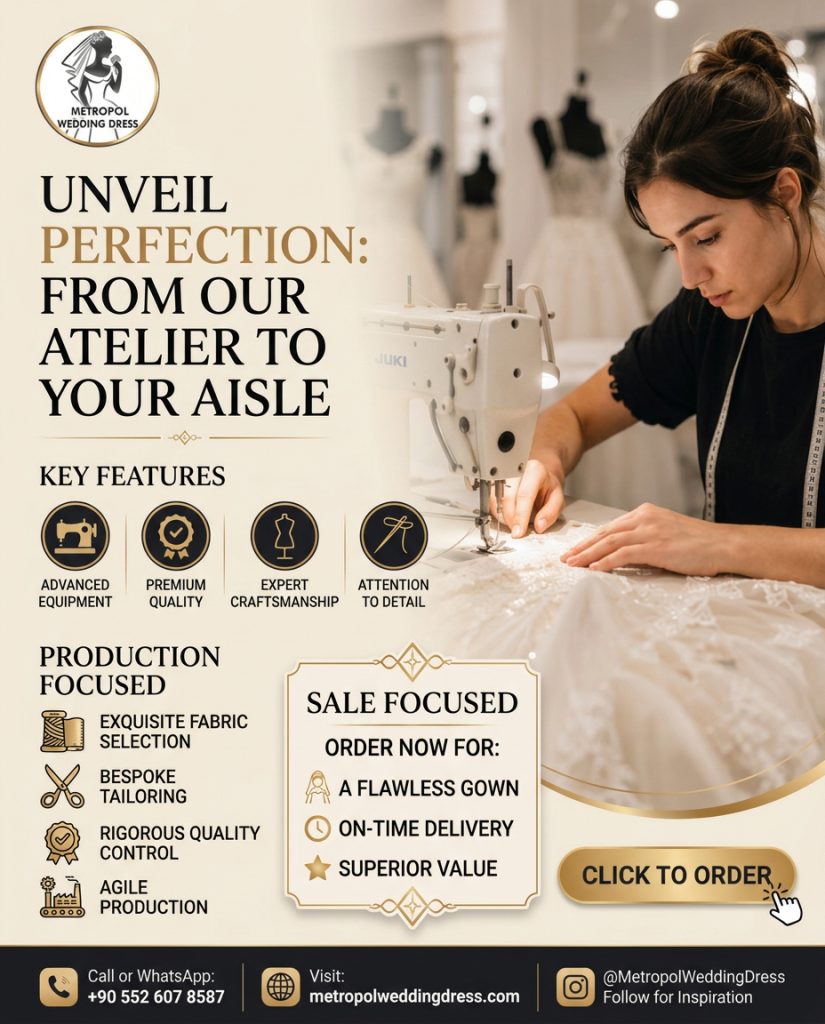
Exclusive Bespoke Wedding Dresses by Metropol Wedding Dress An exclusive bespoke wedding dress is not a product you select from a rack. It is a garment engineered around one body, one story, and one day. Metropol Wedding Dress, a Turkish atelier with more than two decades of experience, builds these gowns from the first sketch through hand-finished construction using European luxury fabrics. The process prioritizes precise measurements, collaborative design, premium materials (silk, French lace, duchess satin, mikado), and couture-level handwork. Brides receive a one-of-a-kind silhouette that fits without compromise, often at a more accessible investment than equivalent Western haute couture houses, with virtual consultations and worldwide delivery. This guide examines the materials science, production workflow, cost drivers, decision framework, common pitfalls, and practical realities of commissioning such a dress—so you can evaluate whether full bespoke is the right choice and how to execute it successfully with Metropol.
A wedding dress that exists nowhere else begins with a different set of questions. Instead of “Does this sample come in my size?” the conversation becomes “What does this silhouette need to do for this specific body in this specific venue under these specific lighting and movement conditions?” That shift is the core of exclusive bespoke work at Metropol Wedding Dress.
Metropol operates as both a private atelier for individual brides and a manufacturer for boutiques seeking distinctive collections. Their production footprint (historically referenced around 1,200 square meters) and monthly capacity support consistent quality at scale while still treating each commission as a unique build. The brand’s location in Turkey provides access to skilled hand embroidery and pattern-making traditions alongside modern European textile sources. The result is a hybrid: atelier intimacy with manufacturing discipline.
The Purpose of a True Bespoke Gown
Mass-produced and even many “made-to-order” dresses start from graded patterns. A full bespoke piece starts from the bride’s measurements and vision. The pattern is drafted or draped specifically for those proportions. Fabric is selected for how it will behave on that body and in that setting. Embellishment density, support structure, and train weight are calculated rather than adapted after the fact.
This approach solves three persistent problems:
- Standard sizing that requires extensive (and sometimes damaging) alterations.
- Design compromise when the exact neckline, sleeve, or lace placement does not exist in a collection.
- Emotional disconnect when the dress feels generic rather than personal.
For destination weddings, climate-sensitive events, or brides with non-standard proportions, the engineering advantage is measurable. A lightweight layered silk organza build for a coastal ceremony behaves differently from a structured mikado ball gown for a formal indoor hall. Bespoke allows those variables to be designed in from the beginning.
Materials That Define Exclusivity
Fabric choice is the single largest determinant of drape, structure, photography performance, longevity, and cost. Metropol sources premium European textiles. Key categories include:
Structured silks and satins
Duchess satin and silk mikado hold architectural shapes—clean columns, Basque waists, dramatic volume—without collapsing. They photograph with a luminous surface that ages well.
Lace families
French Chantilly, Alençon, and Guipure offer different densities and edge characteristics. Chantilly provides delicate transparency; Guipure delivers heavier, more dimensional motifs that can be applied as three-dimensional florals. Hand placement of motifs at seams and hemlines is a hallmark of higher-end work.
Sheer and volume layers
Silk organza, fine tulle, and chiffon create airiness and movement. Multiple layers can produce soft volume without excessive weight, useful for outdoor or warm-climate ceremonies.
Embellishment substrates
Pearls (gradient scattering for organic texture), crystals, and hand-beaded elements add light refraction. In 2025–2026 trends, three-dimensional floral appliqués and subtle pearl work appear more frequently than dense overall beading, balancing visual interest with comfort and wearability.
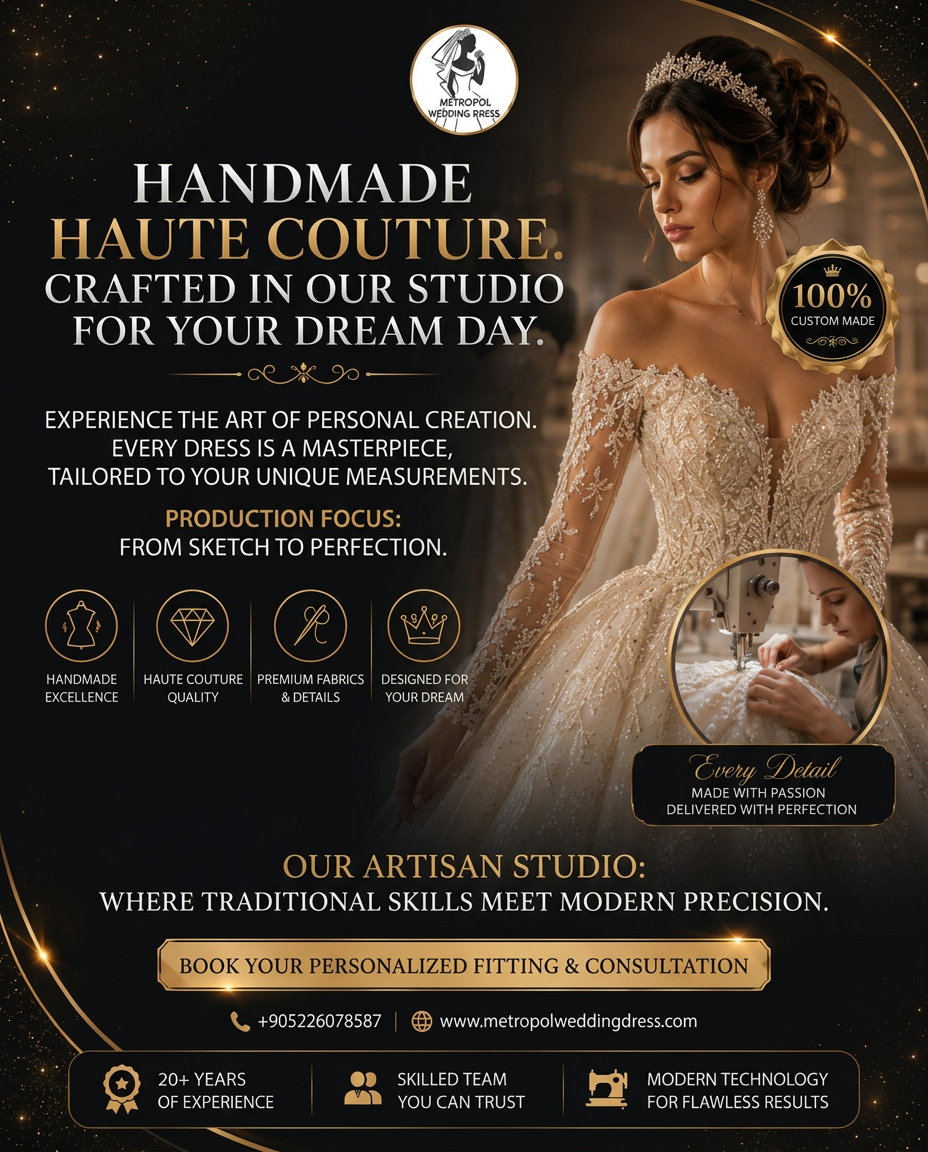
Expert note on performance
A fabric that looks identical in a swatch can behave differently once cut on the bias or layered. Metropol’s process includes fabric trials relative to the chosen silhouette so the final garment moves correctly during walking, dancing, and sitting.
The Production Process: From Vision to Finished Gown
A transparent, staged workflow reduces risk and keeps the bride informed. Typical stages at a professional atelier such as Metropol include:
- Consultation and design brief
Style references, venue details, body measurements (often 20–30 precise points), cultural or personal motifs, and budget parameters. Virtual sessions are standard for international clients. - Sketch development and fabric curation
Designers translate the brief into technical sketches. Fabric options are proposed with notes on weight, drape, and suitability. - Pattern drafting and toile (muslin prototype)
A custom pattern is created. A toile is fitted (in person or via detailed remote measurement protocols and photos) to refine fit and proportion before any final fabric is cut. - Construction and handwork
Cutting, assembly of structural elements (boning, corsetry, understructure), application of lace and embellishment, and finishing. Hand stitching remains central for seams, appliqué, and beading that must endure movement and cleaning. - Progress reviews and final refinements
Photos or additional fittings allow adjustments. Delivery is timed with buffer for any local steam or minor finishing.
Lead times commonly range from several months for moderately complex pieces to longer for heavily embroidered or multi-layer constructions. Early engagement (ideally 6–9 months before the wedding for full couture-level work) protects both quality and calm.
Comparison table: Purchase pathways
| Aspect | Ready-to-Wear + Alterations | Made-to-Order (standard design) | Full Bespoke (Metropol approach) |
|---|---|---|---|
| Pattern origin | Graded stock | Adapted stock | Drafted from measurements |
| Design freedom | Low | Moderate | High |
| Fit philosophy | Alter after purchase | Built to measurements | Engineered from the start |
| Uniqueness | Limited | High | One-of-a-kind |
| Typical timeline | 3–6 months + alterations | 8–16 weeks | 4–9+ months |
| Best suited for | Simple needs, fast timeline | Specific style, good fit | Complex vision, perfect fit, personal story |
Cost Drivers and Realistic Investment Framing
Price is driven primarily by labor hours, fabric cost, and design complexity rather than brand markup alone. Hand embroidery, dense beading, custom lace placement, and multi-layer construction multiply hours. A simple clean silhouette in quality crepe or satin costs less than a heavily three-dimensional floral or cathedral-train piece with extensive handwork.
Turkish atelier production can deliver couture-level results at more competitive price points than equivalent Western houses because of skilled labor availability and manufacturing scale, while still using European fabrics. Transparent quotes that break out fabric, labor, and any rush fees protect both parties. Always confirm what is included (measurements protocol, number of revisions, shipping, duties) and what triggers additional charges.
Tip box – Budget allocation priorities
- Fit and structure first (pattern + toile quality).
- Fabric performance second (drape, weight, climate suitability).
- Embellishment third (place detail where it creates the most visual and emotional impact).
- Timeline buffer last (rush fees erode value).
Real Scenarios and Decision Framework
Scenario 1 – Destination outdoor wedding
A bride planning a coastal ceremony needs breathable layers, minimal weight, and a silhouette that photographs against bright light and wind. Lightweight organza or tulle with strategic lace placement and a shorter or detachable train solves practical movement issues while remaining formal.
Scenario 2 – Formal indoor ballroom
Structured mikado or duchess satin with Basque waist and controlled volume creates presence under controlled lighting. Internal support is engineered so the gown holds shape through hours of standing and dancing.
Scenario 3 – Non-standard proportions or cultural requirements
Custom pattern drafting accommodates specific coverage needs, sleeve lengths, or proportions that standard sizing cannot address cleanly. The result is a gown that feels intentional rather than altered.
Checklist – Is full bespoke the right path?
- Do you have a clear (or evolving) design vision that does not exist in current collections?
- Are standard sizes consistently problematic for your proportions?
- Is the wedding date far enough out for proper construction and review?
- Do you value uniqueness and perfect fit more than the prestige of a well-known ready-to-wear label?
- Are you comfortable with a collaborative, multi-stage process rather than a single try-on experience?
If most answers are yes, Metropol’s model aligns well.
Common Pitfalls and How to Avoid Them
- Starting too late and accepting rushed construction.
- Focusing on surface decoration before confirming silhouette and fabric behavior.
- Providing incomplete or inaccurate measurements.
- Changing core design elements after fabric has been cut.
- Underestimating shipping, duties, or final local finishing needs for international orders.
- Comparing pure price without accounting for included labor and material quality.
Professional ateliers mitigate these through staged approvals, clear change-order policies, and documented measurement protocols.
Expert Perspective on Value
From a purchasing and long-term ownership standpoint, a well-executed bespoke gown often retains more emotional and practical value than a heavily altered designer sample. It fits without stress on seams, photographs as intended, and can be preserved as a true personal artifact. The craftsmanship—hand-finished seams, carefully placed motifs, internal structure that supports without restricting—distinguishes it from garments optimized for volume production.
Metropol’s dual capability (private commissions and wholesale) means the same technical standards apply whether the client is an individual bride or a boutique building an exclusive collection. That consistency is rare and useful.
Practical Next Steps for Working with Metropol Wedding Dress
Begin with a consultation that covers inspiration images, venue, climate, body measurements, and non-negotiable elements. Request fabric recommendations tied to the silhouette. Confirm the full timeline, payment schedule, revision policy, and shipping method. Maintain a shared visual record of decisions so nothing is lost between virtual meetings.
The finished gown should feel inevitable—as if no other dress could have been right for that body and that day. That is the practical definition of exclusive bespoke work.
Frequently Asked Questions
1. What exactly makes a wedding dress “exclusive bespoke” rather than simply custom or made-to-order?
Full bespoke starts with an original pattern drafted or draped from the individual bride’s measurements and design brief. Made-to-order usually adapts an existing design to measurements. Exclusive means the resulting gown is not replicated for other clients.
2. How long does the full process typically take at Metropol?
Complex hand-finished pieces often require several months from confirmed design and deposit through delivery. Early booking (6–9 months preferred for intricate work) allows proper toile stages and refinements.
3. Can international brides work with Metropol effectively?
Yes. Virtual consultations, detailed measurement guides, progress photography, and international shipping are standard. Many brides coordinate remotely from Europe, North America, the Middle East, Australia, and beyond.
4. What fabrics does Metropol primarily use?
Premium European materials including duchess satin, silk mikado, French Chantilly and Alençon laces, organza, tulle, and related high-end textiles selected for the specific design and climate needs.
5. How are measurements handled for remote clients?
A comprehensive measurement protocol (often 20–30 points) is provided, frequently supplemented by photos or video. A toile stage further refines fit before final fabric is cut.
6. What is the difference between hand-beading and machine embellishment in terms of quality and longevity?
Hand application allows precise placement, better durability under movement, and higher visual refinement. It also increases labor hours and cost.
7. Can cultural or religious coverage requirements be fully integrated into a bespoke design?
Yes. Necklines, sleeves, hemlines, and layering are designed from the start rather than modified afterward, ensuring both aesthetic coherence and practical comfort.
8. How does climate affect fabric and silhouette recommendations?
Warm or outdoor settings favor lighter layered sheers and breathable construction. Formal indoor or cooler settings allow heavier structured satins and more volume.
9. What happens if body measurements change between order and wedding?
Early communication is essential. Moderate changes can often be accommodated during construction; significant changes may require pattern adjustments and additional cost or time.
10. Are there options for detachable elements (trains, sleeves, overskirts)?
Yes. Convertible or transformer details are commonly engineered into bespoke designs for ceremony-to-reception versatility.
11. How is pricing typically structured?
Quotes reflect fabric cost, design complexity, hand labor hours, and any special techniques. Transparent proposals that separate these elements are preferable.
12. What level of design input does the bride have?
High. The process is collaborative: inspiration is translated into sketches, fabric is selected together, and refinements occur at key stages.
13. Can Metropol recreate or adapt elements from inspiration photos without copying protected designs?
Designers work from inspiration to create original interpretations that respect intellectual property while achieving the desired aesthetic effect.
14. What internal construction details matter most for comfort and longevity?
Proper boning or soft structure, quality lining, reinforced stress points, and balanced weight distribution. These are invisible but determine how the gown feels after hours of wear.
15. How should a bride prepare for the initial consultation?
Gather clear inspiration images, venue and climate details, known body measurements, must-have and must-avoid features, and realistic timeline and budget parameters.
16. Is a toile always necessary?
For true bespoke work, a prototype stage dramatically reduces risk of costly mistakes in final fabric. It is standard best practice.
17. What shipping and customs considerations apply for international delivery?
Professional packaging, tracked shipping, and clear documentation of value for customs. Duties and taxes are typically the recipient’s responsibility unless otherwise arranged.
18. How does Metropol handle wholesale or private-label needs for boutiques?
The same technical standards apply, with capacity for collection development, consistent quality across sizes, and reliable production timelines.
19. What current silhouette and detail trends influence 2025–2026 commissions?
Basque and drop waists, three-dimensional florals, pearl embellishment, textured layering, clean architectural lines in mikado or crepe, and convertible designs remain prominent.
20. How can a bride evaluate craftsmanship when reviewing progress photos or a finished gown?
Examine seam finishing, lace motif matching at seams, evenness of beading or appliqué, quality of internal structure, hem treatment, and overall balance of the silhouette.
21. What is the typical revision policy during the design and construction phases?
Reputable ateliers define the number of included design revisions and fitting adjustments in the agreement. Major changes after fabric cutting usually incur additional charges.
22. Can sustainability considerations be incorporated?
Fabric selection can prioritize quality and longevity (so the gown is worn and preserved rather than discarded). Specific eco-certified materials can be discussed where available and suitable for the design.
23. How does a bespoke gown from an atelier like Metropol compare in value to a high-end designer ready-to-wear piece?
It often delivers superior personalization and fit at a competitive total investment once alteration costs and uniqueness are factored in, while using comparable or superior materials and handwork.
24. What should be done with the gown after the wedding?
Professional cleaning and proper preservation storage protect the investment. Many brides keep the dress as a family heirloom precisely because it was made uniquely for them.
25. How does Metropol ensure consistency when producing both individual bespoke pieces and larger wholesale orders?
Shared technical standards, experienced artisans, and controlled production processes maintain quality across both channels.
26. Is it possible to include meaningful personal symbols or motifs?
Yes. Custom embroidery or appliqué can incorporate subtle personal references when planned from the design stage.
27. What is the most common reason brides later regret not choosing full bespoke?
Settling for a near-match that required heavy alterations or never quite felt like “the one,” especially when a collaborative process could have produced an exact match.
28. How early should a bride contact Metropol for a 2027 wedding?
As soon as the date and broad vision are clear. Early engagement secures timeline capacity and allows unhurried design development.
29. What role do progress photos and virtual check-ins play?
They maintain transparency, allow timely feedback, and reduce the risk of surprises at delivery, especially for remote clients.
30. Ultimately, what should a bride feel when she puts on the finished Metropol gown for the first time?
That the dress was made for her body and her day—not adapted to them. Fit without compromise, design that tells her story, and construction that supports her through every moment of the celebration.
Five Distinct Calls to Action
- Direct and practical: Schedule a virtual consultation with Metropol Wedding Dress to review your measurements, inspiration, and timeline. Begin the conversation that turns a vision into a finished gown.
- Story-driven: Your wedding day will have only one dress that is truly yours. Start the collaborative design process with Metropol and create it.
- Value-focused: Compare the total investment, fit precision, and uniqueness of a Metropol bespoke gown against standard designer options. Request a transparent proposal today.
- Urgency with care: Capacity for detailed handwork is limited. Secure your production window now so every stage can proceed without rush.
- Exploratory: Explore fabric and silhouette possibilities with Metropol’s design team. Even an initial discussion often clarifies what is possible and what is ideal for your specific celebration.
An exclusive bespoke wedding dress from Metropol Wedding Dress is the outcome of measured craft, material intelligence, and sustained collaboration. When executed well, it becomes the quiet centerpiece of the day—one that fits, moves, photographs, and endures exactly as intended.
Australian brides in 2026 face a unique set of practical demands: intense summer heat and humidity, outdoor and coastal venues, multi-hour celebrations that move from ceremony to dance floor, and a growing preference for personal storytelling over catalogue perfection. Exclusive bespoke wedding dresses from Metropol Wedding Dress answer these needs with climate-appropriate fabrics, fully custom patterns, convertible design options, and transparent international logistics. Working directly with a specialist Turkish atelier gives Australian clients high design freedom and premium European materials at a landed cost that frequently undercuts local full-bespoke pricing—while still delivering one-of-a-kind fit and construction. This guide covers Australian climate realities, 2026 trends adapted for local conditions, the complete remote-ordering process, realistic cost breakdowns including duty and GST, and a practical checklist so you can commission with confidence.
Australian weddings rarely happen in controlled, air-conditioned ballrooms alone. Hunter Valley verandahs, Gold Coast hinterland estates, Perth coastal sites, Melbourne warehouse conversions, and Queensland beach ceremonies all impose real performance requirements on a gown. Heat, humidity, wind, sand, and long wear times turn fabric choice and internal structure into technical decisions rather than pure aesthetics.
Metropol Wedding Dress approaches these conditions as engineering problems solved at the design stage. Lightweight silk crepe, soft matte satin, fine organza, carefully selected French lace, and breathable linings replace heavy multi-layer tulle builds for most warm-weather commissions. Soft internal structure supports the silhouette without the rigidity that becomes uncomfortable after several hours in 30 °C+ temperatures. Detachable overskirts, sleeves, and trains allow a formal ceremony look to transform for the reception without sacrificing presence.
Climate-Driven Fabric Intelligence for Australian Conditions
| Climate / Venue Type | Preferred Fabrics | Why It Works | Silhouette Notes |
|---|---|---|---|
| Sydney / Brisbane summer humidity | Lightweight silk crepe, soft organza, fine tulle | Breathability + reduced heat retention | Soft A-line, pencil, ankle-grazing |
| Gold Coast / coastal wind & sand | Mid-weight crepe, structured organza | Holds shape against breeze, resists billowing | Basque waist + detachable overskirt |
| Perth dry heat | Matte silk satin, open-weave lace overlays | Airflow while maintaining polished surface | Clean columns, controlled volume |
| Melbourne cooler / indoor formal | Duchess satin, mikado, denser lace | Architectural presence under controlled lighting | Structured ball or fit-and-flare |
| Multi-day or elopement | Packable silk, convertible layers | Easy transport and versatile looks | Modular pieces |
Texture remains important in 2026, but Australian designers and brides increasingly favour tactile surfaces that still allow movement—subtle micro-pleats, light Chantilly, and three-dimensional botanical appliqués (hibiscus, frangipani-inspired motifs for coastal settings) rather than dense overall beading that adds weight and heat.
Non-traditional colour is also rising. Bone, champagne, oyster, soft blush, and bespoke tonal shades appear frequently. These tones photograph beautifully in Australian light and feel more personal than pure white for many brides.
The Remote Bespoke Process Tailored for Australian Clients
- Initial consultation
Virtual meeting covering venue climate, ceremony-to-reception flow, body measurements, inspiration images, and non-negotiables (coverage, mobility, sustainability preferences). - Design development
Sketches and fabric recommendations specifically matched to Australian conditions. Convertible elements are discussed early if the schedule involves long outdoor periods. - Measurement protocol and toile stage
Detailed measurement guide (20–30 points) plus photo/video support. A toile or detailed construction photos allow remote fit refinement before final fabric is cut. - Construction and progress reviews
Hand construction in the Izmir atelier with staged photo updates. Changes are managed through clear revision points. - Shipping, customs, and local finishing
Express courier (typically 5–10 business days once the gown leaves the workshop). Australian Border Force clearance follows standard apparel rules. Build a 3–4 week buffer before the wedding for any local steaming or minor adjustments.
Import cost realities (2026)
Clothing generally attracts 5 % customs duty. GST at 10 % is calculated on the customs value + duty + international freight and insurance. Shipments valued over AUD 1,000 require a formal import declaration. A transparent commercial invoice from the supplier simplifies clearance. Always request a full landed-cost estimate that includes these elements rather than comparing the gown price alone.
Cost Landscape: Local Atelier vs Specialist Manufacturer Route
| Category | Typical Range (AUD) | What You Usually Receive | Common Additional Costs |
|---|---|---|---|
| Off-the-rack / sample | 800–1,800 | Standard size, limited alteration potential | 400–1,200 alterations |
| Mid-range designer ready-to-wear | 1,800–3,500 | Better fabric, still graded sizing | 600–1,500 alterations + shipping |
| Local Australian bespoke atelier | 4,500–12,000+ | Full custom, multiple in-person fittings | Higher if timeline is tight |
| Metropol bespoke (landed estimate) | 2,000–5,500+ (simple to mid-complexity) | True made-to-measure, design freedom, European fabrics | Duty + GST + shipping (transparent quote) |
Average Australian wedding-dress spend sits near AUD 2,500–2,600, but that figure includes many simpler purchases. Full local bespoke routinely starts higher. The manufacturer route often delivers comparable or superior material quality and personalisation at a more accessible total investment once alterations are factored out.
Practical Checklist for Australian Brides Commissioning Bespoke
- Confirm wedding date, venue type, and expected temperature range.
- Gather clear inspiration that reflects both aesthetic and practical needs (movement, heat, wind).
- Decide early whether convertible or modular elements will be useful.
- Request a written timeline that includes production, shipping, and customs buffer.
- Obtain a full landed-cost estimate (gown + shipping + estimated duty + GST).
- Prepare accurate measurements following the supplied protocol; schedule a professional local measurement if preferred.
- Agree revision points and change-order policy in writing.
- Plan local pressing and any final micro-adjustments 2–3 weeks before the wedding.
- Confirm care labelling and preservation advice for Australian conditions.
Real Australian Scenarios
Hunter Valley outdoor summer ceremony
Lightweight layered organza or crepe A-line with soft internal structure and a detachable train. Breathable, photographs cleanly against vineyard light, easy to move in during long reception hours.
Gold Coast hinterland or beach
Mid-weight crepe or structured organza with Basque waist and optional overskirt. Holds shape in breeze, botanical 3D appliqués echo the setting, convertible for barefoot or formal moments.
Melbourne formal indoor
Mikado or duchess satin with clean architectural lines. Structure and presence under controlled lighting; still engineered for comfort during extended wear.
Elopement or multi-day celebration
Packable silk pieces with modular layers. One core gown that adapts across locations without requiring multiple full dresses.
Expert Perspective
Australian conditions reward technical thinking. A gown that looks perfect in a Sydney boutique may become uncomfortable by midday on a humid outdoor site. Bespoke construction allows the fabric, weight distribution, and support system to be chosen for the actual day rather than adapted afterward. Metropol’s combination of European textile access, handcraft capacity, and established international shipping makes that level of customisation available without the full local-atelier price premium.
The emotional outcome remains the same as any true bespoke commission: a dress that feels inevitable for that body, that story, and that Australian light.
Frequently Asked Questions – Australian Brides
1. How long does a full bespoke order take from Australia?
Plan 6–9 months from confirmed design and deposit to delivery for most custom pieces. Complex handwork or peak periods may require longer. Early contact secures capacity.
2. Will I pay Australian GST and duty?
Yes. Clothing typically attracts 5 % duty. GST at 10 % is applied to the customs value plus duty and international freight. Request a transparent estimate that includes these figures.
3. Can the design account for high humidity and heat?
Absolutely. Fabric selection, lining choices, and internal structure are adjusted specifically for warm Australian conditions.
4. How accurate is remote measuring?
A detailed protocol plus supporting photos/video produces reliable results. Many brides also use a local professional fitter for the measurement session. A toile stage further refines fit.
5. What if I need minor adjustments after the gown arrives?
Most brides arrange local steaming and any micro-adjustments with an experienced bridal tailor. Build 2–4 weeks buffer for this.
6. Are non-white and tonal colours available?
Yes. Bone, champagne, oyster, soft blush, and custom shades are routinely produced.
7. Can I include sustainable fabric options?
Where suitable materials that meet performance requirements are available, they can be discussed and incorporated.
8. How does shipping work and how long does it take once the gown is finished?
Express courier typically 5–10 business days after dispatch, plus customs clearance time. Tracking is provided.
9. Is the process suitable for destination weddings held in Australia by overseas couples?
Yes. The same remote workflow serves both Australian residents and international couples marrying in Australia.
10. What is the realistic price difference versus a local Australian atelier for comparable quality?
Many mid-complexity bespoke commissions land in Australia at a noticeably lower total than equivalent local full-bespoke pricing, even after duty, GST, and shipping.
11. Can boutiques in Australia order private-label collections?
Yes. Metropol supports wholesale and private-label production for Australian bridal retailers seeking exclusive designs.
12. How are progress updates handled across time zones?
Scheduled photo reviews and clear communication points keep the process transparent regardless of time difference.
13. What happens if body measurements change closer to the wedding?
Early notification allows adjustments during construction. Significant changes after fabric cutting may incur additional cost and time.
14. Are detachable trains and sleeves practical for Australian outdoor settings?
Highly practical. They allow formal ceremony presence and lighter reception movement without compromising the overall design.
15. How should I store and preserve the gown in Australia’s climate?
Professional cleaning followed by proper archival storage away from humidity and direct light. Specific advice is provided with the finished gown.
16. Can cultural or religious coverage requirements be fully integrated?
Yes. These elements are designed into the pattern from the start rather than added later.
17. What documentation is needed for Australian customs?
A clear commercial invoice stating description, materials, and value. The supplier prepares this; the recipient (or a broker if used) handles the import declaration when required.
18. Is a toile always part of the Australian remote process?
For true bespoke work it is strongly recommended and routinely included to protect fit accuracy.
19. How do 2026 Australian trends (Basque waist, texture, lighter volumes) translate into Metropol commissions?
These preferences are readily accommodated and often enhanced by climate-smart fabric choices.
20. What is the single most important step an Australian bride should take first?
Book an initial consultation that covers both aesthetic vision and the specific climate/venue realities of the wedding day. Everything else builds from accurate information.
Calls to Action for Australian Brides
- Book a virtual consultation focused on your venue climate and timeline.
- Request a full landed-cost estimate that includes duty, GST, and shipping.
- Share your inspiration images and measurement protocol today—design development can begin immediately.
- Explore convertible and climate-smart options tailored for Australian outdoor and summer celebrations.
- Secure your production window now; detailed handwork capacity fills months ahead.
An exclusive bespoke wedding dress created for Australian conditions does more than look beautiful in photographs. It performs—from the first outdoor ceremony light through the final dance—while remaining completely personal. Metropol Wedding Dress makes that combination of technical performance and individual storytelling accessible from anywhere in Australia.
A handcrafted wedding dress is built stitch by stitch rather than assembled on a production line. At Metropol Wedding Dress, every exclusive gown for Australian brides begins with hand-cut fabric, continues through hand-placed lace and embroidery, and finishes with hand-finished seams and internal structure. This approach delivers superior fit accuracy, breathability suited to Australian heat and humidity, lasting structural integrity, and a level of individuality impossible in mass-produced or heavily machine-reliant garments. Combined with climate-aware fabric selection and transparent international logistics, handcrafted construction gives Australian brides a gown that performs through outdoor ceremonies, long receptions, and coastal conditions while remaining a true personal heirloom. This guide examines the specific hand techniques used, why they matter in Australian climates, realistic timelines and costs, and a practical decision framework.
Handcrafted does not simply mean “made by people.” It means the critical decisions of cut, placement, tension, and finish are made by experienced hands rather than automated processes. In bridal construction this distinction shows itself most clearly in three areas: how the fabric is cut and shaped, how lace and embellishment are applied, and how the internal architecture is built to support the body for many hours of movement in variable temperatures.
Metropol Wedding Dress operates as a true atelier workshop. Pattern pieces for bespoke commissions are hand-cut. Lace motifs are positioned and stitched by hand so that seams disappear into the design rather than interrupting it. Beading and three-dimensional floral work are applied with controlled density that considers both visual impact and weight. Internal boning channels, soft structure, and linings are sewn with the same attention given to the exterior. The result is a garment that moves with the bride instead of fighting her, and that retains its shape and finish after cleaning and long-term storage.
Why Handcraft Matters in Australian Conditions
Australian weddings frequently combine heat, humidity, wind, and extended wear. A machine-assembled gown with dense, uniform beading or rigid corsetry can become heavy and restrictive by mid-afternoon. Handcrafted construction allows the maker to:
- Adjust fabric tension and seam placement for better airflow
- Distribute embellishment weight so it does not pull or dig
- Engineer soft internal support that holds silhouette without trapping heat
- Create convertible elements (detachable trains, sleeves, overskirts) that function reliably
These adjustments are difficult to achieve at scale on industrial equipment. They are standard practice when every gown is treated as a single commission.
Comparison: Handcrafted vs Industrial Bridal Construction
| Element | Handcrafted Approach (Metropol) | Typical Industrial / High-Volume Approach | Practical Difference for Australian Brides |
|---|---|---|---|
| Fabric cutting | Hand-cut from custom pattern | Laser or die-cut from graded patterns | Superior grain alignment and drape |
| Lace application | Motifs placed and stitched by hand | Machine-applied panels or pre-made lace | Seamless joins, controlled density |
| Embellishment | Hand-beaded or hand-applied 3D florals | Machine embroidery or heat-transfer | Lighter weight, better movement |
| Internal structure | Soft, body-mapped support | Standardised boning packages | Comfort in heat, less restriction |
| Seam finishing | Hand-finished where visible or stressed | Overlocked or bound | Longevity and clean appearance |
| Fit philosophy | Pattern drafted or refined for one body | Graded sizes + later alterations | Minimal post-arrival adjustment needed |
Core Hand Techniques Used at Metropol
Hand cutting and grain control
Every major piece is cut by hand after the pattern has been finalised. This preserves the fabric’s natural grain and allows subtle adjustments for the bride’s posture and proportions.
Hand-placed lace and appliqué
French Chantilly, Alençon, and Guipure motifs are positioned so that design lines continue across seams. Three-dimensional botanical elements (popular for Gold Coast and hinterland settings) are built petal by petal rather than stamped.
Controlled hand beading and pearl work
Density is varied deliberately. Heavier clusters appear where visual impact is needed; lighter scattering maintains breathability and reduces overall weight—critical for summer outdoor ceremonies.
Hand-finished internal architecture
Soft structure and lining are constructed to support the silhouette while allowing air circulation. Convertible features are engineered with secure but discreet fastenings that survive movement and wind.
Final hand finishing
Hems, closures, and any visible edges receive the last careful stitches. This stage is where the gown transitions from well-made to heirloom quality.
Climate-Smart Handcraft for Australian Venues
| Venue Type | Handcraft Priority | Recommended Construction Notes |
|---|---|---|
| Coastal / beach (Gold Coast, Perth, NSW) | Weight control + wind resistance | Mid-weight crepe or organza, hand-placed motifs that do not catch wind excessively |
| Hinterland / vineyard outdoor | Breathability + texture | Soft structure, 3D botanical appliqué, convertible overskirt |
| Urban formal (Melbourne, Sydney CBD) | Clean architectural lines | Hand-cut mikado or duchess satin with precise internal support |
| Multi-day or elopement | Packability + modular design | Hand-engineered detachable elements that fold cleanly |
Hand construction also supports the growing Australian preference for tonal colours (bone, champagne, oyster) and lighter surface decoration. Subtle texture created by hand looks intentional rather than sparse.
Timeline and Process for Australian Clients
- Consultation – climate, venue flow, measurements, and design vision.
- Sketch and fabric selection – materials chosen for both aesthetic and performance.
- Custom pattern and toile stage – remote fit refinement.
- Hand construction with progress photography.
- Final hand finishing, quality check, and express shipping.
- Australian customs clearance and local pressing buffer (recommend 3–4 weeks before the wedding).
Lead times for fully handcrafted pieces typically range from several months for moderately complex gowns to longer for extensive hand embroidery or multi-layer work. Early booking protects both quality and schedule.
Realistic Cost Perspective
Hand labour is the primary cost driver. A clean, lightly embellished silhouette requires fewer hours than a heavily three-dimensional botanical or cathedral-train piece. Because Metropol combines atelier techniques with manufacturing discipline, the landed cost in Australia (gown + shipping + duty + GST) often remains competitive with mid-to-high local bespoke pricing while delivering true handcraft and design freedom.
Always request a breakdown that separates fabric, hand labour, shipping, and estimated Australian charges. Comparing only the gown price creates an incomplete picture.
Decision Checklist – Is Handcrafted Right for You?
- Do you value a gown that feels unique in both appearance and construction?
- Will the wedding involve outdoor or warm conditions where weight and breathability matter?
- Do you prefer minimal post-arrival alterations?
- Are you willing to engage in a collaborative multi-stage process rather than a single boutique try-on?
- Do you want the finished piece to age as an heirloom rather than a seasonal garment?
If most answers are yes, a handcrafted commission from Metropol aligns well with Australian realities.
Common Pitfalls Specific to Handcrafted Orders
- Underestimating the time required for genuine handwork.
- Changing core design elements after fabric has been cut and hand placement has begun.
- Focusing only on surface decoration without confirming internal structure and climate suitability.
- Neglecting the Australian import buffer for duty, GST, and local finishing.
Professional ateliers manage these risks through clear stage gates and written agreements.
Expert Note on Longevity
A well-executed handcrafted gown, properly cleaned and stored, retains both structural integrity and aesthetic value far longer than most machine-dependent pieces. Australian climate can be demanding on textiles; careful hand construction and quality materials provide a stronger starting point for long-term preservation.
Frequently Asked Questions – Handcrafted Wedding Dresses for Australian Brides
1. What does “handcrafted” specifically mean at Metropol?
Critical stages—cutting, lace placement, embellishment application, internal structure, and final finishing—are performed by skilled artisans rather than automated machinery.
2. How does handcraft improve comfort in Australian heat and humidity?
Weight is controlled, airflow is considered in seam and lining construction, and soft support replaces rigid industrial corsetry packages.
3. Is every part of the gown sewn by hand?
Primary construction and all visible or high-stress details are hand-finished. Some internal seams may use specialised machinery for strength, but the defining aesthetic and fit work remains hand-executed.
4. Can handcrafted techniques accommodate convertible designs?
Yes. Detachable trains, sleeves, and overskirts are engineered by hand so fastenings remain secure yet discreet under movement and wind.
5. How long does genuine handwork add to the production timeline?
It depends on complexity. Extensive hand embroidery or three-dimensional floral work requires additional weeks compared with clean silhouettes. Early booking is essential.
6. Are sustainable or lower-impact materials compatible with handcrafted construction?
Where suitable high-performance fabrics exist, they can be incorporated. Hand techniques themselves often generate less waste than high-volume cutting.
7. How accurate is fit when the gown is built by hand for a remote Australian client?
A detailed measurement protocol, supporting photography, and a toile stage produce excellent results. Many brides also use a local professional for the measurement session.
8. What is the realistic landed cost range for a handcrafted Metropol gown in Australia?
Simple to mid-complexity pieces frequently land between AUD 2,000–5,500+ after shipping, duty, and GST. Heavily embroidered or multi-layer commissions sit higher. Request a full estimate.
9. Does hand beading add significant weight?
Controlled hand application allows density to be varied. Australian commissions prioritise lighter distribution for outdoor comfort.
10. Can cultural or religious coverage requirements be fully handcrafted into the design?
Yes. These elements are designed and constructed from the pattern stage onward.
11. How should a handcrafted gown be cared for after an Australian outdoor wedding?
Professional cleaning as soon as practical, followed by proper archival storage away from humidity and direct light. Specific advice is supplied with the finished piece.
12. Is handcrafted construction more durable than machine-made?
When executed at high standard, yes—particularly in seam strength, embellishment attachment, and long-term shape retention.
13. Can Australian bridal boutiques commission handcrafted private-label collections?
Yes. Metropol supports both individual bespoke commissions and wholesale/private-label production using the same handcraft standards.
14. What happens if measurements change during the long construction period?
Early communication allows adjustments while the gown is still in handwork stages. Significant late changes may require additional time and cost.
15. How are progress updates handled across Australian time zones?
Scheduled photo reviews at key construction milestones keep the process transparent.
16. Are tonal and non-white colours fully compatible with handcrafted lace and embroidery?
Yes. Hand placement adapts readily to bone, champagne, oyster, and custom shades.
17. What is the single biggest advantage of handcraft for coastal or hinterland weddings?
The ability to control weight, airflow, and wind behaviour while still achieving refined visual detail.
18. How does Metropol ensure consistency of handcraft quality across commissions?
Experienced artisans, controlled processes, and staged quality checks at every major phase.
19. Is a toile still necessary when the gown is fully handcrafted?
Yes. It remains the most reliable way to refine fit and proportion before final fabric and handwork begin.
20. What should an Australian bride prioritise when comparing handcrafted options?
Climate performance, true hand techniques (not marketing language), transparent timeline, and a complete landed-cost picture.
Calls to Action
- Begin with a climate-focused consultation so handcraft decisions can be matched to your actual wedding conditions.
- Request a detailed breakdown of hand-labour stages and a full Australian landed-cost estimate.
- Share your inspiration and measurement protocol—design development for handcrafted construction can start immediately.
- Explore convertible and lightweight hand-applied detail options suited to outdoor Australian celebrations.
- Secure your handcraft production window early; genuine artisan capacity is limited and books months ahead.
A handcrafted wedding dress created for an Australian bride is not only beautiful in photographs. It is engineered to move, breathe, and endure under real local conditions while remaining completely individual. Metropol Wedding Dress makes that combination of artisan skill and practical performance available from anywhere in Australia.
Related Topics
10.10.2025
Del Boceto al Altar El Proceso Creativo de un Vestido de Novia Hecho a Medida En el mundo de la moda nupcial Turquía España, donde la elegancia se fusiona con la tradición y la innovación,...
23.09.2026
Affordable Custom Wedding Dresses in Australia Handmade Bridal Gowns Australian bridal boutiques and importers face rising pressure to deliver distinctive, perfectly fitted handmade gowns at accessible price points while protecting margins. Average spend sits near...
02.01.2026
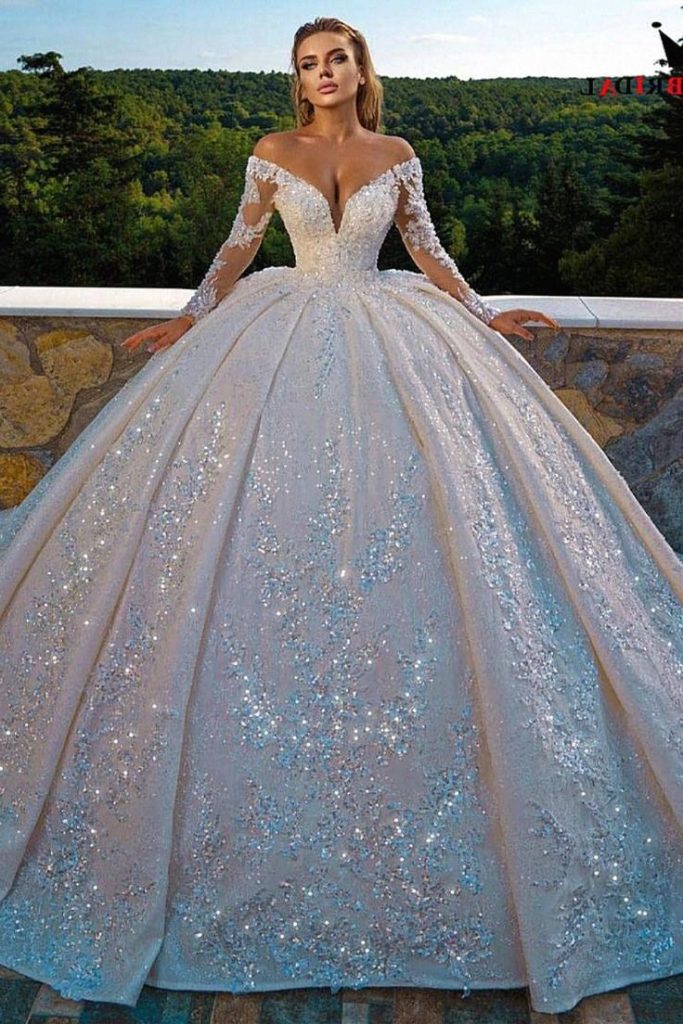
Switzerland is a country synonymous with precision, refinement, and understated luxury. From its breathtaking Alpine landscapes to its world-renowned craftsmanship in watchmaking and fashion, Swiss culture values quality above all else. It is no surprise...

16.06.2025
Piraye Wedding Dresses The wedding dress industry is a cornerstone of bridal fashion, blending tradition, artistry, and personal expression. Among the notable names in this space, Piraye Wedding Dresses has emerged as a brand synonymous...
30.12.2025
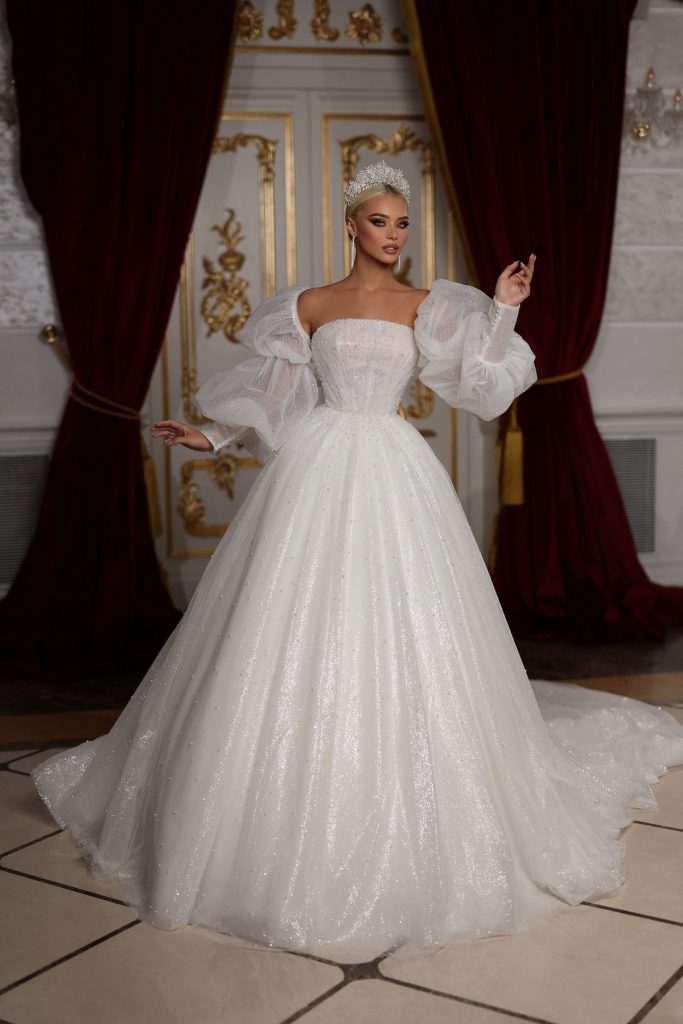
Custom Bridal Gowns for Switzerland Switzerland has long been associated with precision, luxury, and refined taste. From its immaculate landscapes to its world-class craftsmanship, the country represents a standard of excellence that naturally extends into...

12.07.2025
Cheap Bridal Gowns Wholesale Online in Turkey has emerged as a global hub for bridal fashion, renowned for its exquisite craftsmanship, diverse designs, and competitive pricing. For boutique owners, retailers, and international distributors, sourcing cheap...
Comments