
Luxury Bespoke Bridal Gowns Made in Turkey for Australian Brides Australian bridal fashion sits at an interesting crossroads. Local designers deliver beautiful, locally made pieces with strong brand prestige, yet fully custom work frequently starts in the high thousands and climbs quickly once fabric upgrades, extensive beading, or multiple fittings enter the picture. Ready-to-wear and sample sales offer speed but limited uniqueness. Meanwhile, destination or outdoor weddings — beach, vineyard, garden, or regional — demand lighter constructions, breathable fabrics, and silhouettes that move comfortably in heat or wind. Against this backdrop, a growing number of brides and purchasing managers have turned to specialised Turkish manufacturers who already produce for European and Middle Eastern markets and who understand export logistics into Australia.
Metropol Wedding Dress, operating from İzmir, Turkey, sits squarely in this space. Established in the early 2000s, the company functions as a custom wedding dress manufacturer, bespoke bridal gown manufacturer, made-to-measure specialist, private-label partner, and wholesale supplier. Their model is collaborative rather than catalogue-driven: brides or boutiques supply inspiration, measurements, and preferences; the atelier develops patterns, sources fabrics, constructs, provides progress documentation, and ships. The process works across time zones and does not require the bride to travel to Turkey.
Why Turkey Became a Serious Option for Australian Clients
Turkey’s textile and apparel industry has deep roots in lace, embroidery, and formalwear. Clusters in İzmir and Istanbul combine access to European mills (French and Italian lace, Italian silks and mikados) with skilled local labour that still performs significant hand work. Production capacity is higher than most independent Australian ateliers, which shortens lead times relative to many local couture houses while preserving the ability to execute complex detailing. Export experience means packaging, documentation, and courier relationships are already tuned for high-value garments heading to Australia, the UK, Europe, and beyond.
For Australian buyers the practical advantages appear in three areas:
- Design freedom without the usual “designer premium” for deviations from a base style.
- Access to the same fabric families used by European houses at manufacturing rather than retail markup.
- Transparent cost structure that remains competitive even after shipping, insurance, Australian GST, and any applicable duty.
The Bespoke Process for Australian Brides and Boutiques
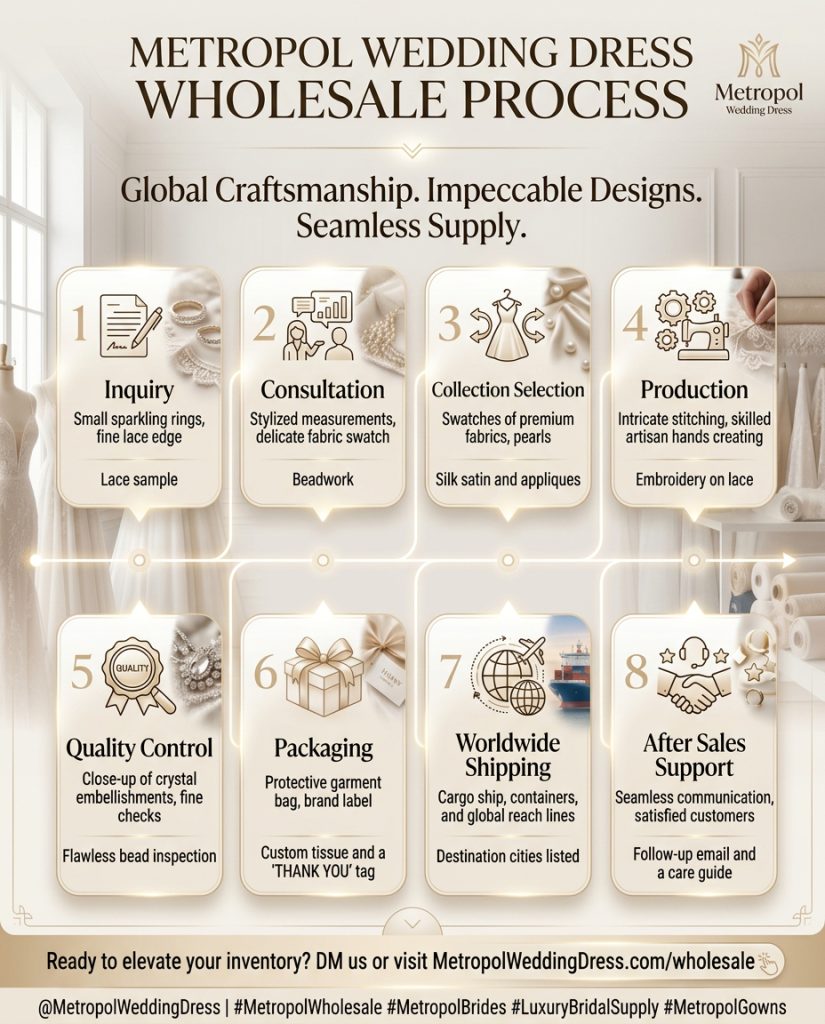
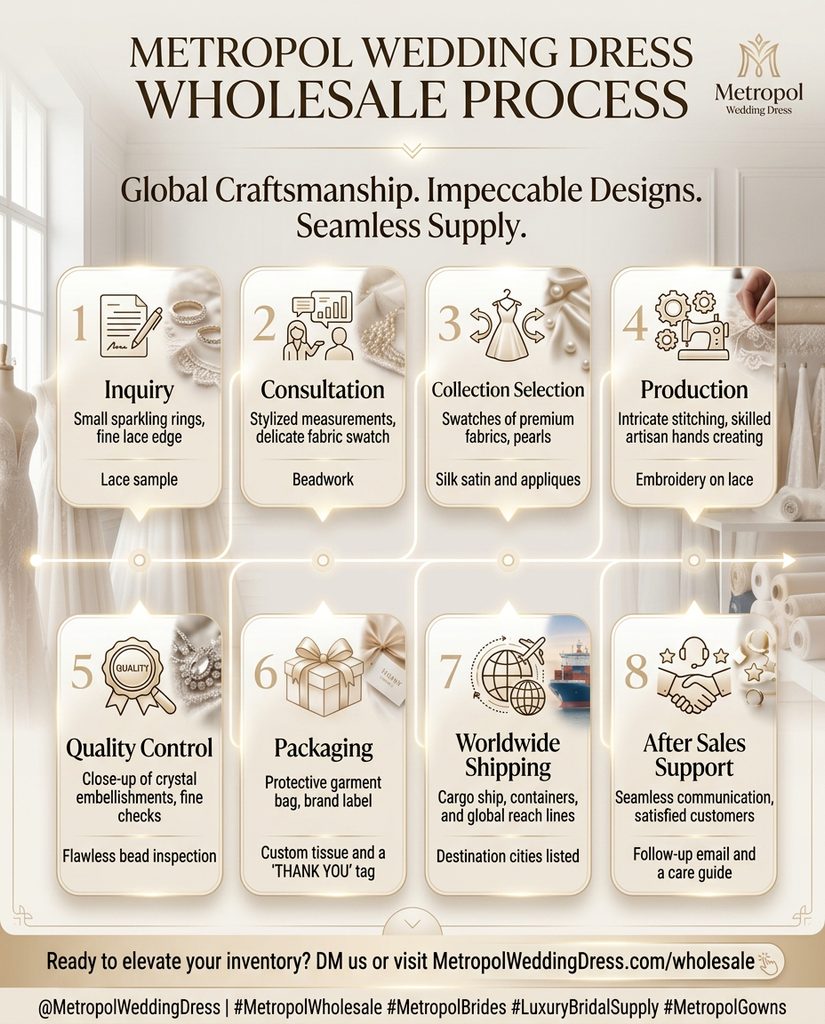
The journey typically unfolds in clear stages.
1. Vision and Brief
Share mood boards, photographs of preferred silhouettes (A-line, mermaid, ballgown, sheath, soft columns), neckline ideas, train length, sleeve preferences, and any must-have details such as detachable overskirts, illusion backs, or modest coverage. Australian clients often request lighter layers for warmer climates or structured bodices that support without excessive bulk. Metropol’s team responds with design sketches or digital concepts and fabric suggestions.
2. Measurements and Fit Planning
A detailed measurement guide is supplied. Accurate circumference and length measurements, plus notes on posture, bust support preferences, and planned undergarments or shapewear, form the foundation. Remote process works because the pattern is drafted to the individual rather than graded from a standard size. Half-sizes, petite proportions, and fuller figures are routinely accommodated.
3. Fabric and Embellishment Selection
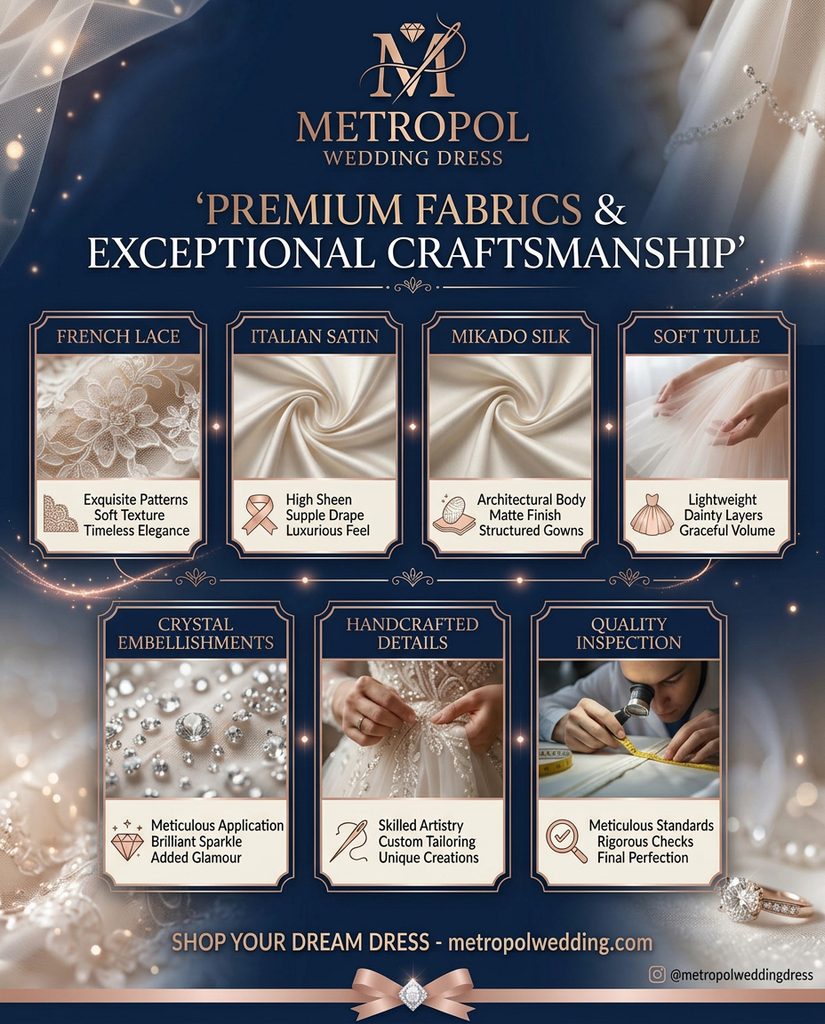
Options commonly include French or Italian Chantilly and Alençon lace, Italian silk mikado or duchess satin, silk or high-quality synthetic chiffons and tulles, and hand-applied beads or crystals. Turkish ateliers frequently source the same base materials as European couture houses; the difference lies in the manufacturing model rather than the raw materials themselves. Swatches can be discussed or, in some cases, provided.
4. Pattern, Toile, and Construction
A custom pattern is cut. Depending on complexity and the client’s preference, a muslin toile may be developed for remote review via photographs or video. Construction then proceeds with understructure (boning, cups, or soft support as needed), main fabric layers, lace application, and hand-finishing of seams, hems, and embellishments. Progress photographs and videos are shared so the client can approve at key checkpoints.
5. Quality Control and Shipping
Final inspection covers measurement verification, seam integrity, embellishment security, and overall finish. The gown is carefully packed (often with garment bag and protective supports) and shipped via reliable international couriers. Tracking is provided. Australian clients should allow buffer time after arrival for steaming, minor local adjustments if desired, and any final pressing.
Typical production windows for fully custom pieces range from several weeks for simpler styles to a few months for heavily embellished couture-level work. Rush options exist when timelines are tight, subject to capacity.
Cost Realities for Australian Clients
Local Australian full bespoke frequently begins in the AUD 4,000–6,000 range and moves well into five figures for complex lace and beading. Average wedding dress spend in Australia sits lower because many brides choose ready-to-wear or samples, yet those seeking true one-of-a-kind pieces encounter higher numbers.
Working directly with a manufacturer such as Metropol shifts the cost structure. Base construction, premium fabrics, and hand work are priced at manufacturing rather than retail-atelier levels. After adding international shipping and insurance, Australian import GST (10 %), and any duty (commonly low single-digit percentages on apparel, subject to current tariff schedules and correct HS classification), the landed cost for many styles remains substantially more accessible than equivalent local couture while delivering comparable or superior material quality and personalisation.
A simplified comparison for a mid-to-high complexity lace A-line or soft mermaid might look like this:
| Pathway | Approximate Landed Range (AUD) | Customisation Depth | Typical Lead Time | Inventory / Fit Risk |
|---|---|---|---|---|
| Local Australian full bespoke atelier | 6,000–15,000+ | Very high | 6–12 months | Low |
| Imported designer ready-to-wear / sample | 1,500–4,000+ | Low–medium | 1–5 months | Medium–high |
| Direct custom from specialist Turkish manufacturer (e.g. Metropol) | Often competitive mid-range after all landed costs | High | Weeks to several months depending on complexity | Low–medium (remote fit protocols mitigate) |
| Mass wholesale generic import | Lower | Minimal | Shorter | Higher |
Exact figures depend on fabric choices, embellishment density, and shipping method. Transparent suppliers provide commercial invoices that accurately describe the garment for smooth Australian Border Force clearance. GST-registered boutiques can usually claim input tax credits on the GST component.
Materials and Construction That Matter for Australian Conditions
Australian weddings often involve outdoor elements, variable temperatures, and long days of wear. Fabric weight, breathability, and movement therefore carry extra weight.
- Lightweight silk or quality chiffon and tulle layers reduce heat build-up.
- Structured yet flexible bodices provide support without rigidity that becomes uncomfortable in humidity.
- Secure hand-applied lace and beading withstand movement better than loosely attached machine work.
- Detachable trains or overskirts allow transition from ceremony to reception without a full outfit change.
Metropol’s production model supports these practical requirements because the gown is built to the specific brief rather than adapted from an existing sample.
For Bridal Boutiques and Purchasing Managers
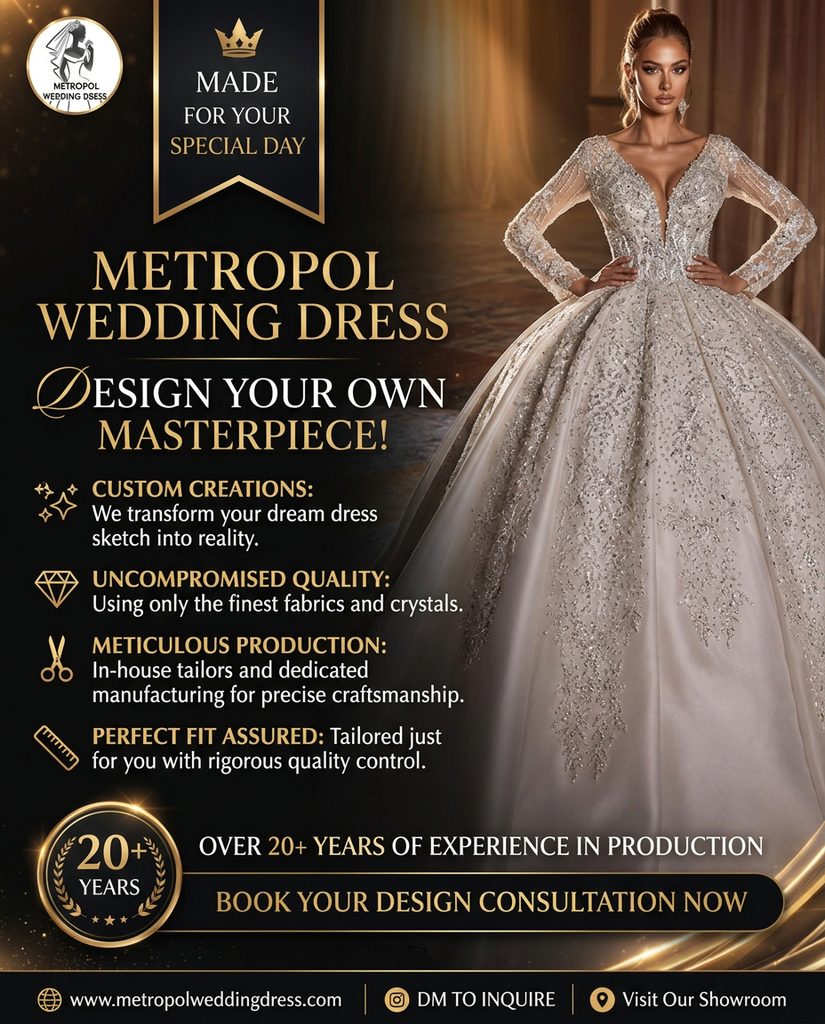
Beyond individual brides, Metropol operates as a private-label and wholesale partner. Boutiques can develop exclusive collections, request modifications to base styles, or order made-to-measure pieces for specific clients without carrying heavy inventory risk. Minimum order quantities and production scheduling are discussed case by case. The commercial logic is straightforward: offer genuine customisation and premium finishes at retail price points that remain competitive while protecting margin.
Key evaluation points for a purchasing manager include:
- Consistency of quality across multiple units
- Reliability of lead times and communication
- Clarity of commercial invoices and shipping documentation
- Ability to handle size ranges relevant to the local market
- After-sales support for any issues that arise post-delivery
Practical Considerations Specific to Australia
Customs and Import
Personal-use bridal gowns are subject to GST (usually collected by the courier) and potentially low duty rates. Commercial shipments require correct classification, valuation, and an ABN where relevant. Working with an experienced exporter reduces friction because documentation is prepared correctly from the outset. Always build a buffer of several weeks between planned arrival and the wedding for any local steaming or minor alterations.
Fit Assurance Across Distance
Success rests on accurate measurements and clear communication. Many clients report excellent results when they follow the measurement protocol carefully, supply photos in similar undergarments, and review progress images. Local alterations remain an option for final fine-tuning if desired, just as with any gown purchased overseas or interstate.
Timeline Planning
Start conversations 6–12 months ahead for complex pieces when possible. Simpler designs or available capacity can compress the window. Confirm production and shipping estimates early and add contingency.
Care and Longevity
Once the gown arrives, professional steaming (avoiding direct heat on beads or delicate lace), proper storage, and post-wedding cleaning according to fabric type preserve the piece. Many brides later have the gown preserved or altered for future wear or family keepsake purposes.
Expert Perspective: What Purchasing Managers and Experienced Brides Notice
From a commercial viewpoint, the strongest value appears when the manufacturer combines genuine hand-finishing capability with export-ready systems. From a bride’s viewpoint, the strongest value appears when the gown feels personal, moves comfortably, photographs beautifully, and arrives without last-minute drama. Metropol’s model aims at both.
Common pitfalls to avoid include under-estimating the importance of precise measurements, choosing the lowest quoted price without verifying fabric and construction quality, or leaving insufficient buffer for shipping and customs. Transparent communication and realistic timelines prevent most issues.
Checklist for Australian Clients Considering a Turkish Bespoke Gown
- Clarify silhouette, neckline, train, and any climate or cultural requirements early.
- Gather accurate measurements using the supplied guide; consider professional measurement if possible.
- Request fabric details, construction methods, and progress update protocols.
- Obtain a clear quote that separates garment cost, shipping, and estimated duties/GST where possible.
- Confirm production timeline and add buffer before the wedding date.
- Review commercial invoice accuracy for smooth clearance.
- Plan for arrival inspection, steaming, and any minor local adjustments.
- Keep all communication and documentation organised.
Real-World Application Scenarios
A Brisbane bride planning a late-afternoon garden wedding in warm weather prioritises a soft A-line with lightweight lace overlay, illusion sleeves for sun protection, and a moderate train that can be bustled. Measurements and inspiration are shared remotely; progress photos confirm lace placement and bodice fit; the gown arrives with time for professional steaming. Landed cost remains well below local full-couture equivalents while delivering the exact design.
A Melbourne boutique seeks a private-label capsule of modern columns and soft mermaids with clean lines and selective lace. They work with Metropol on exclusive variations, order in a range of sizes or made-to-measure for key clients, and maintain healthy margins while differentiating from pure ready-to-wear competitors.
A regional Australian client with limited local boutique access uses the remote process to achieve a fully custom gown that would otherwise require multiple city trips and higher local pricing.
Closing Perspective
Luxury bespoke bridal gowns no longer require exclusive reliance on high-cost local ateliers or compromise on uniqueness. Specialised Turkish manufacturers such as Metropol Wedding Dress offer Australian brides and boutiques a practical, high-quality alternative grounded in skilled production, premium materials, collaborative design, and established export pathways. When the process is approached with clear communication, accurate measurements, and realistic timelines, the outcome is a gown that feels personal, performs well on the day, and delivers strong value relative to the alternatives.
The decision ultimately rests on priorities: maximum local presence, absolute lowest price, or the combination of customisation, material quality, and accessible landed cost. For many Australian clients, the Turkish specialist model now occupies a compelling middle and upper ground.
Frequently Asked Questions
1. How does ordering a fully custom bridal gown from Metropol Wedding Dress in Turkey actually work for someone in Australia?
You share inspiration, detailed measurements, and preferences via email or online consultation. The team develops concepts, sources fabrics, constructs the gown with progress updates, and ships via tracked international courier. No travel to Turkey is required.
2. What is a realistic timeline from first contact to gown arrival in Australia?
Simpler styles can move faster; complex lace and beading typically need several weeks to a few months of production plus shipping and any customs processing. Start early and build buffer time before the wedding.
3. Can Turkish manufacturers accommodate Australian body proportions and preferred modern silhouettes?
Yes. Custom pattern drafting to individual measurements is standard. Soft columns, clean A-lines, lightweight constructions, and climate-appropriate fabrics are routinely requested by Australian clients.
4. What fabrics and embellishments are typically used?
Premium options include French and Italian lace varieties, Italian silk mikado or satin, high-quality tulles and chiffons, and hand-applied beads or crystals. Choices are discussed according to the design brief.
5. How accurate is remote fitting compared with in-person atelier fittings?
Accuracy depends on precise measurements and clear communication. Progress photos and videos allow review of key stages. Many clients achieve excellent results; minor local adjustments remain possible after arrival if desired.
6. What are the typical cost components once the gown reaches Australia?
Garment price + international shipping and insurance + Australian GST (10 %) + any applicable duty (often low for apparel). Transparent invoices help calculate the full landed cost.
7. Is GST payable on a personal bridal gown imported from Turkey?
Yes, GST at 10 % generally applies and is often collected by the courier. Duty rates are separate and usually modest; confirm current rules with Australian Border Force or a customs broker.
8. How is the gown packed and protected for long-distance shipping?
Professional packing with garment bag, protective supports, and sturdy outer packaging is standard for high-value bridal pieces. Insurance and tracking are recommended and usually available.
9. What happens if minor adjustments are needed after arrival?
Local seamstresses or alteration specialists can handle hemming, bustling, or fine-tuning, just as with many gowns purchased interstate or online. Build time for this into the overall schedule.
10. Can Metropol create modest or culturally specific design elements?
Yes. High necklines, long sleeves, coverage options, and other requirements can be incorporated into the bespoke design.
11. Are plus-size or petite proportions supported?
Custom drafting accommodates a wide range of sizes and proportions when accurate measurements are provided.
12. What level of design originality is possible?
High. Clients can request original combinations, specific lace placements, detachable elements, or reinterpretations of inspiration images rather than strict replicas of existing commercial styles.
13. How does communication work across time zones?
Email and scheduled video calls are common. Clear written records of decisions help maintain alignment.
14. Can bridal boutiques order private-label or wholesale collections?
Yes. Metropol works with retailers on exclusive or modified collections and made-to-order pieces for individual clients.
15. What quality-control steps occur before shipping?
Measurement verification, seam and construction checks, embellishment security, and overall finish inspection are standard before packing.
16. Is rush production available?
Subject to current workshop capacity and complexity, accelerated timelines can sometimes be arranged, often with an additional fee.
17. How should the gown be cared for after it arrives?
Professional steaming (avoiding direct heat on delicate elements), proper hanging or storage, and post-wedding cleaning appropriate to the fabrics preserve the piece.
18. What documentation is needed for smooth Australian customs clearance?
A clear commercial invoice describing the garment and value is essential. The exporter prepares this; the importer (bride or boutique) may need to provide additional information if requested by authorities.
19. Can fabric swatches be reviewed before committing?
Discussion of fabric options and, where practical, physical or digital references form part of the process.
20. How does the value compare with local Australian full-bespoke ateliers?
Many clients find that after all landed costs the Turkish specialist route delivers comparable material quality and higher customisation depth at a more accessible total price than local full couture, while still offering genuine made-to-measure construction.
21. What if the wedding date is relatively soon?
Discuss available capacity and simpler constructions early. Buffer for shipping and any local finishing remains important.
22. Are there sustainability or material origin considerations?
Discuss specific fabric preferences (including any certified or preferred-origin materials) during the design phase; availability depends on current supply.
23. How are payments typically structured?
Deposits secure the order and materials; balances are usually due at defined production stages or before shipping. Confirm exact terms with the manufacturer.
24. Can the gown include practical features such as pockets or bustle systems?
Yes, these functional details can be engineered into the design when requested.
25. What makes İzmir-based production relevant for Australian clients?
İzmir combines manufacturing scale, access to quality fabrics, and established export logistics, supporting both individual bespoke work and boutique-volume needs.
26. How detailed should the initial inspiration brief be?
The clearer the brief (silhouette preferences, preferred details, climate or venue notes, must-haves and absolute avoidances), the more efficiently the design phase progresses.
27. Is it possible to replicate the look of a high-end designer gown without the brand price?
Many clients request reinterpretations inspired by specific aesthetics using comparable fabric families and construction techniques. Exact brand copies are not the goal; personalised versions are.
28. What support is available if an issue arises after delivery?
Reputable manufacturers address legitimate construction or shipping concerns according to their policies. Document everything promptly.
29. How does this option suit destination weddings within Australia or nearby?
Lighter, packable constructions and precise fit reduce travel-related stress. Plan arrival with extra time for pressing at the destination if needed.
30. Why choose a specialist bridal manufacturer rather than a general apparel factory?
Bridal construction involves specific understructures, lace handling, hand-finishing, and fit considerations that general factories rarely prioritise at the same level.
For Australian brides and boutiques ready to explore a fully personalised luxury gown with strong value and clear process, direct collaboration with a manufacturer such as Metropol Wedding Dress offers a practical and rewarding path. Begin with a clear brief and accurate measurements, maintain open communication, and allow realistic timelines — the result is a gown built specifically for the wearer and the day.
Australian bridal fashion in 2025–2026 continues to favour refined minimalism blended with subtle structure, lighter constructions suited to outdoor and destination settings, and personalised details that feel intentional rather than overloaded. Basque-waist silhouettes that gently elongate the torso, clean silk or crepe columns, soft A-lines with movement, detachable overskirts or sleeves, and delicate textural lace rather than heavy all-over beading appear frequently. Climate remains a practical driver: many ceremonies take place in gardens, vineyards, coastal locations or regional outdoor venues where breathability, ease of movement and the ability to transition from formal vows to relaxed reception matter.
Metropol Wedding Dress in İzmir is well positioned for these preferences. As a specialist custom and made-to-measure bridal manufacturer with more than two decades of experience and a substantial workshop, the atelier routinely produces gowns that balance European fabric quality with the practical needs of Australian clients. The collaborative remote process allows brides and boutiques to incorporate current Australian trends while retaining full control over fit, fabric weight and finishing.
Aligning Turkish Craftsmanship with Current Australian Bridal Preferences
Silhouette Focus
- Soft structured A-lines and columns that photograph cleanly in natural light.
- Basque or gently dropped waistlines for an elongated, modern-historical feel without restrictive rigidity.
- Mermaid or fit-and-flare shapes executed in lighter fabrics so they remain wearable through long receptions.
- Modular elements: detachable trains, overskirts, sleeves or capes that transform the look between ceremony and celebration.
Fabric and Texture Priorities for Australian Conditions
Lightweight silk crepe, fine chiffon, soft mikado and carefully selected lace overlays reduce heat retention. Illusion panels and strategic lace placement add interest without bulk. Hand-applied motifs (rather than dense all-over coverage) create dimension that catches light in outdoor photography while remaining comfortable.
Colour and Finish Nuances
Beyond pure white, many Australian brides request soft ivory, bone, champagne, oyster or subtle warm undertones that flatter a range of skin tones under strong Australian sunlight. Matte finishes and low-sheen satins often outperform high-gloss options in outdoor settings.
Metropol’s design team works from client mood boards and reference images, translating these preferences into technical patterns and fabric recommendations. Progress photographs allow review of lace placement, bodice structure and overall proportion before final construction.
Inside the Production Process: From Pattern to Hand Finishing
A typical bespoke order moves through defined technical stages.
Pattern Development
Individual measurements generate a unique block. Adjustments for posture, preferred bust support, hip-to-waist ratio and desired ease are incorporated at this stage. For Australian clients who plan outdoor movement or multi-hour wear, slight extra ease in the bodice and skirt can be engineered without compromising the silhouette.
Toile or Intermediate Review
Where complexity warrants, a muslin or base-fabric toile is constructed and documented via photos or video. Clients approve proportions, neckline height, sleeve fit and train length remotely.
Fabric Cutting and Assembly
Premium base fabrics (Italian silks and mikados, quality tulles and chiffons) and lace (French or Italian Chantilly, Alençon or guipure styles commonly used) are cut to the approved pattern. Understructure — flexible boning, soft cups or supportive linings — is built according to the brief.
Lace Application and Embellishment
Lace motifs are often cut and hand-applied for precise placement and a three-dimensional effect. Hand beading or crystal work follows, secured so that the gown withstands movement and packing. Traditional Turkish embroidery techniques (including fine needlework and selective metal-thread accents where requested) can be integrated for unique texture, though modern bridal work prioritises delicacy suited to contemporary Australian aesthetics.
Final Construction, Pressing and Quality Control
Seams are finished cleanly, hems are set with the planned shoe height in mind, and bustle systems or modular attachments are tested. Multiple checkpoints verify measurements, symmetry and security of embellishments before packing.
This structured approach reduces the risk of last-minute surprises and supports the remote nature of the collaboration.
Expanded Cost Scenarios for Australian Clients
Landed cost calculations remain central for both individual brides and boutique buyers. A transparent supplier provides a commercial invoice that accurately reflects the garment value, enabling correct assessment of Australian import charges.
Typical components
- Garment price (construction + fabrics + embellishment)
- International express shipping and insurance
- Australian customs duty (commonly around 5 % for many apparel classifications)
- GST at 10 % calculated on the relevant value (customs value + duty + certain transport costs)
- Any courier handling or brokerage fees
Illustrative mid-complexity example (soft lace A-line or lightweight column, made-to-measure):
Base garment in the competitive manufacturing range + shipping + estimated duty + GST often results in a total significantly below equivalent full local Australian bespoke pricing, while delivering comparable material quality and higher personalisation depth.
Boutiques ordering private-label or small-run collections benefit from volume efficiencies and the ability to retail at accessible luxury price points while maintaining margin. GST-registered businesses can generally claim the import GST as an input tax credit.
Always confirm current tariff classifications and rates with Australian Border Force resources or a licensed customs broker, as exact treatment depends on precise HS coding and documentation.
Practical Error-Prevention Guide
Common issues and how to avoid them:
- Inaccurate measurements → Follow the supplied guide carefully; measure twice, preferably with a second person; include notes on planned undergarments and shoes.
- Insufficient timeline buffer → Factor production + shipping + customs + local steaming/alterations; aim for arrival at least three to four weeks before the wedding.
- Unclear design brief → Supply multiple reference images, note must-haves and absolute avoidances, and confirm climate or venue constraints early.
- Under-estimating fabric weight or movement needs → Discuss outdoor or multi-hour wear requirements so construction and lining choices support comfort.
- Incomplete documentation → Ensure the commercial invoice is detailed and accurate for smooth clearance.
Treating measurement approval and intermediate photo reviews as non-negotiable gates dramatically improves outcomes.
Care, Arrival and Long-Term Value
Upon arrival, inspect the gown carefully in a clean space. Professional steaming (avoiding direct iron contact with beads or delicate lace) restores the intended drape. Local minor adjustments, if needed, can be handled by experienced seamstresses familiar with bridal construction.
Post-wedding, professional cleaning appropriate to the fabrics and proper preservation protect the investment. Many brides later have the gown altered for anniversary wear, family use or sentimental display. The combination of quality materials and individual fit often gives these pieces greater longevity than mass-produced alternatives.
Additional Considerations for Boutiques and Purchasing Managers
Metropol’s dual capability — individual bespoke and private-label/wholesale — supports Australian retailers seeking differentiation. Exclusive design variations, size-range flexibility and consistent quality across units allow boutiques to offer genuine customisation without the capital tie-up of large sample inventories. Lead-time reliability and clear communication are particularly valuable for shops managing client timelines across multiple seasons.
Five Distinct Calls to Action
- For the detail-oriented bride: Gather your measurements and three to five inspiration images, then open a conversation with Metropol Wedding Dress to explore fabric options and timeline.
- For the climate-conscious outdoor bride: Request constructions prioritising breathability and movement — lightweight layers and modular elements can be engineered specifically for Australian conditions.
- For the boutique buyer: Enquire about private-label possibilities and sample development to expand your custom offering with controlled risk.
- For the timeline-sensitive client: Contact early to discuss capacity and any available acceleration options while still protecting quality.
- For the value-focused decision maker: Request a detailed quote that separates garment, shipping and estimated landed costs so you can compare total ownership cost against local alternatives with full transparency.
Extended FAQ – Additional Australia-Specific Questions
31. How do current Australian trends such as the Basque waist or modular gowns translate into Turkish production?
These elements are routinely incorporated. Pattern drafting accommodates the elongated Basque line, and detachable components are engineered with secure, practical fastening systems.
32. What shipping carriers are typically used to Australia and how long does transit take?
Express services such as DHL or equivalent are standard for high-value bridal pieces. Once the gown leaves the workshop, express transit is often 5–10 business days, plus any customs processing time.
33. Can heirloom lace or fabric be incorporated?
Yes, provided the material is assessed for condition and suitability. The design is adapted to integrate it securely.
34. How are changes in body measurements during the production period handled?
Notify the manufacturer promptly. Adjustments are more straightforward before final fabric cutting.
35. Is wedding insurance affected by ordering from an overseas manufacturer?
Most policies cover the gown once it is in the bride’s possession. Retain all documentation and confirm specifics with your insurer.
36. Can matching veils, capes or accessories be produced?
Many requests for coordinated pieces can be accommodated when raised early so materials match.
37. What is the usual deposit and payment structure?
A deposit (commonly 30–50 %) secures the order and materials; the balance is typically due at defined stages or before shipping. Confirm the schedule in writing.
38. How detailed should progress photo updates be?
Expect documentation of key stages: pattern or toile, lace application, construction progress and final appearance. Request specific angles if needed for approval.
39. Are sustainable or preferred-origin fabric options available?
Discuss specific preferences during the design phase; availability depends on current mill supply and the design requirements.
40. What single action most reduces risk for an Australian client?
Treat accurate measurements and intermediate visual approvals as mandatory project gates rather than optional steps.
The combination of skilled Turkish production capacity, access to premium European fabrics, collaborative remote processes and established export pathways continues to make specialised manufacturers such as Metropol Wedding Dress a compelling option for Australian brides and boutiques. When approached with clear communication, realistic timelines and attention to measurement detail, the outcome is a gown that feels personal, performs comfortably in Australian conditions, and delivers strong value relative to purely local full-bespoke alternatives.
For those ready to move from research to action, the next practical step is a detailed brief and measurement set directed to the manufacturer. The resulting conversation typically clarifies feasibility, timeline and total landed cost within a short period, allowing confident decision-making.
Exclusivity in bridal fashion is no longer defined solely by a famous Parisian or New York label. For a growing number of Australian brides and selective boutiques, true exclusivity means a gown that exists in only one version — cut, constructed and finished specifically for the wearer, using premium materials and couture-level techniques, without the inflated retail markup that often accompanies big-name branding. Turkish ateliers with genuine couture capacity, particularly specialists such as Metropol Wedding Dress in İzmir, have become a practical route to this level of singularity.
Metropol operates as both a couture wedding dress manufacturer for individual clients and a private-label partner for boutiques seeking exclusive collections. The workshop model supports fully original designs, significant deviations from any existing base style, and limited-run private-label pieces that never appear in another Australian shop. The result is a gown that cannot be accidentally matched on the day and that carries the tangible quality of careful hand finishing.
What “Exclusive Couture” Actually Means in a Turkish Production Context
Couture is not a marketing label; it is a set of construction standards and processes:
- Individual pattern drafted from the client’s measurements rather than graded from a standard size block.
- Multiple stages of fitting review (remote via detailed photography and video where physical presence is impossible).
- Hand application of lace motifs, selective hand beading or crystal work, and refined seam finishing.
- Flexible understructure engineered for the specific silhouette and the bride’s comfort requirements.
- Final quality control that verifies every measurement, symmetry and security of embellishment before packing.
When these standards are applied to an original design brief rather than a catalogue style, the gown becomes genuinely exclusive. Metropol’s scale — a substantial workshop with experienced pattern makers, cutters and finishers — allows this level of work without the extreme lead times or price points of traditional Western couture houses.
Designing for Australian Exclusivity: Climate, Venue and Personal Narrative
Australian weddings frequently take place outdoors or in mixed indoor-outdoor settings. An exclusive couture gown must therefore solve practical problems while remaining singular.
Climate-responsive construction
Lightweight yet structured fabrics, strategic use of illusion panels, and linings that allow airflow prevent the common complaint of overheating. Modular elements (detachable overskirts, sleeves or trains) let the bride move from formal ceremony to relaxed reception without a second full dress — a detail many Australian clients specifically request.
Venue-specific proportion
A garden or vineyard ceremony often benefits from softer volume and movement. A coastal or cliff-top setting may call for cleaner lines that hold shape in breeze. A city or heritage venue can support more architectural structure. Because the pattern is unique, these considerations are built in from the first draft rather than adapted later.
Personal narrative details
Subtle incorporation of meaningful elements — a lace motif scaled from a family textile, a specific neckline height requested for cultural or comfort reasons, or a colour undertone chosen to flatter under Australian sunlight — elevates the gown beyond generic luxury. These details are documented and executed only for that order.
The Exclusive Couture Process with Metropol Wedding Dress
Stage 1 – Confidential Brief
Clients supply private mood boards, measurement sets and any non-negotiable requirements. Discussions remain one-to-one; designs developed for one bride are not recycled for another.
Stage 2 – Original Pattern and Concept
A unique block is created. Digital or hand sketches refine proportions. Fabric recommendations are made with Australian conditions in mind (weight, drape, sheen under strong light).
Stage 3 – Intermediate Approval
Progress documentation allows the client to approve lace placement, bodice structure, train length and modular attachments before irreversible stages.
Stage 4 – Hand Construction and Finishing
Lace is cut and applied by hand where the design requires precision. Beading and crystal work are secured for durability. Seams are finished to couture standards. Final pressing and inspection complete the process.
Stage 5 – Secure Delivery and Aftercare Guidance
Professional packing, insured express shipping and clear documentation support smooth Australian customs clearance. Arrival guidance covers steaming and any recommended local fine-tuning.
This sequence produces a gown that is exclusive by definition: one pattern, one set of materials, one finished piece.
Cost Structure for Exclusive Couture-Level Work
Exclusivity does not automatically equal the highest possible price. Because production occurs at manufacturing rather than retail-atelier level, the landed cost for a fully original, hand-finished gown often remains competitive with mid-to-high Australian local bespoke while delivering greater design freedom.
Typical landed components for an exclusive piece:
- Base construction and pattern development
- Premium fabric and lace
- Hand embellishment hours
- International shipping and insurance
- Australian duty (commonly around 5 % for apparel classifications) + 10 % GST
Boutiques commissioning private-label exclusive collections gain the additional commercial advantage of controlled distribution: the designs appear only in their store or for their nominated clients.
Comparison Table – Pathways to an Exclusive Gown
| Aspect | Local Australian Full Couture Atelier | Imported Designer Sample / Ready-to-Wear | Exclusive Couture via Metropol (Turkey) |
|---|---|---|---|
| Design originality | High | Low–medium | High (original pattern) |
| Made-to-measure | Yes | Limited | Yes |
| Hand finishing level | High | Variable | High |
| Climate-responsive engineering | Possible | Rarely | Built into brief |
| Typical landed cost range | Highest | Mid | Competitive mid-to-upper |
| Lead time flexibility | Often long | Moderate | Weeks to several months |
| Risk of “wedding twin” | Low | Higher | Extremely low |
| Private-label option for shops | Rare | Limited | Available |
Real Scenario Examples
The coastal exclusive
A bride planning a late-afternoon beachside ceremony requests a soft column in lightweight silk crepe with hand-placed lace motifs along one shoulder and a detachable train. The pattern is drafted to her exact proportions; the train detaches via discreet, secure fastenings. The finished gown arrives with time for professional steaming and photographs uniquely against the Australian coastline.
The vineyard modular couture
A regional client wants a structured Basque-waist bodice for the ceremony and a lighter silhouette for the reception. Metropol engineers a detachable overskirt in matching fabric and lace. The result is two distinct looks from one exclusive construction.
The boutique private-label capsule
An independent Australian bridal shop commissions a small exclusive collection of clean modern columns and soft A-lines with selective lace. The designs are never offered to competing retailers. Clients of the boutique receive made-to-measure versions of these exclusive styles.
Expert Notes on Maintaining Exclusivity
- Request written confirmation that the design developed for you will not be reproduced for other clients.
- Keep communication and approvals documented.
- If ordering through a boutique, clarify whether the design is exclusive to that retailer or available more widely.
- For heirloom or highly personal elements, discuss technical feasibility early so the exclusivity is both emotional and practical.
Extended Checklist for Commissioning Exclusive Couture
- Define the non-negotiable elements of exclusivity (one-of-a-kind pattern, specific personal details, private-label status if relevant).
- Supply accurate measurements and clear venue/climate notes.
- Approve intermediate stages visually.
- Confirm commercial invoice details for Australian import.
- Plan buffer time after arrival.
- Document the final design for personal records or insurance.
Additional Calls to Action
- For the bride who wants absolute singularity: Begin with a confidential brief and measurement set; request confirmation that the resulting pattern remains unique to you.
- For the outdoor or destination bride: Specify climate and movement requirements so exclusivity includes practical performance.
- For the boutique seeking differentiation: Enquire about private-label exclusive collections that appear only under your label.
- For the detail-driven client: Ask for documentation of hand-finishing stages and lace application methods.
- For the value-conscious exclusivity seeker: Request a full landed-cost projection so you can evaluate true ownership cost against local alternatives.
Further FAQ – Exclusive Couture Focus
41. How is exclusivity contractually protected?
Reputable manufacturers confirm in writing that the specific design and pattern developed for a client will not be reproduced for others. Request this clarity at the outset.
42. Can a fully original design be created rather than a modification of an existing style?
Yes. Metropol functions as a couture-level manufacturer capable of original pattern development from a blank brief.
43. Is private-label exclusivity available for Australian boutiques?
Yes. Collections or individual styles can be developed for exclusive distribution through a single retailer or nominated group.
44. How does hand finishing contribute to exclusivity?
Hand-applied lace and secure hand beading produce results that cannot be exactly duplicated by machine-only production, reinforcing the one-of-a-kind character of the gown.
45. What happens if two brides request very similar inspiration images?
Each order receives its own pattern and construction. Proportions, fabric choices and finishing details remain individual even when inspiration sources overlap.
46. Can cultural or family elements be integrated while keeping the gown exclusive?
Yes. Heirloom lace, specific motifs or meaningful colour undertones can be incorporated into a unique design.
47. How does exclusive couture from Turkey compare in longevity to local high-end pieces?
Quality of materials and construction is the determining factor. When premium fabrics and secure hand finishing are used, the gown typically offers comparable or superior durability.
48. Is there a minimum spend or complexity threshold for exclusive original work?
Discuss the scope early. Fully original couture-level pieces are feasible across a range of budgets once the design parameters are clear.
49. How are modular exclusive elements (detachable trains, sleeves) secured for reliability?
Practical engineering — tested fastenings and reinforced attachment points — is part of the construction process when modular features are requested.
50. What is the best first step toward an exclusive couture gown?
Prepare a private brief with measurements, venue notes and the elements that make the gown personally meaningful, then open a direct conversation with the manufacturer.
Exclusive couture wedding gowns from Turkey, executed by specialists such as Metropol Wedding Dress, give Australian brides and boutiques access to genuine singularity without the traditional barriers of geography or extreme pricing. The combination of individual pattern work, hand finishing, climate-aware engineering and reliable export logistics produces gowns that are both exclusive and practical for Australian conditions.
When the process is approached with clear communication and documented approvals, the outcome is a piece that exists only for the wearer — a definition of exclusivity that feels increasingly relevant in a world of shared inspiration images and limited local stock. The next practical action remains the same: a detailed, confidential brief directed to the atelier. From that point the conversation moves quickly from possibility to concrete design, timeline and landed cost.
Related Topics
17.07.2025
Cheap Mermaid Wedding Dress 2025 The allure of a mermaid wedding dress lies in its ability to accentuate curves, exude elegance, and create a show-stopping silhouette. For brides planning their 2025 wedding, finding a cheap...

15.09.2025
Abiti da Sposa con Strascico Lungo Eleganza Italiana per il Grande Giorno L’abito da sposa con strascico lungo rappresenta l’epitome dell’eleganza e della raffinatezza, un simbolo intramontabile della tradizione nuziale italiana. Questo capo, che incarna...
01.02.2026
Exclusive Wedding Dresses Designed for Upscale Bridal Stores in the USA The luxury bridal market in the United States has evolved into a highly sophisticated and competitive landscape, where discerning brides seek not just a...
15.06.2024
Turkish Wedding Dress With Hijab Best 5 What does a Muslim bride wear A Muslim bride typically wears a wedding dress that adheres to the principles of Islamic modesty, known as “hijab” or “jilbab”. The...
30.10.2025
Boutique Fashion Custom Made Dress Trends In the ever-evolving world of fashion, where mass-produced garments dominate retail shelves, boutique fashion: custom made dress trends emerge as a beacon of individuality and artistry. This niche sector...

27.12.2025
Pourquoi la robe de mariée sur mesure séduit de plus en plus les mariées françaises ? Cette question s’impose naturellement dans un contexte où le mariage devient un projet profondément personnel, presque introspectif. En France,...
Comments