
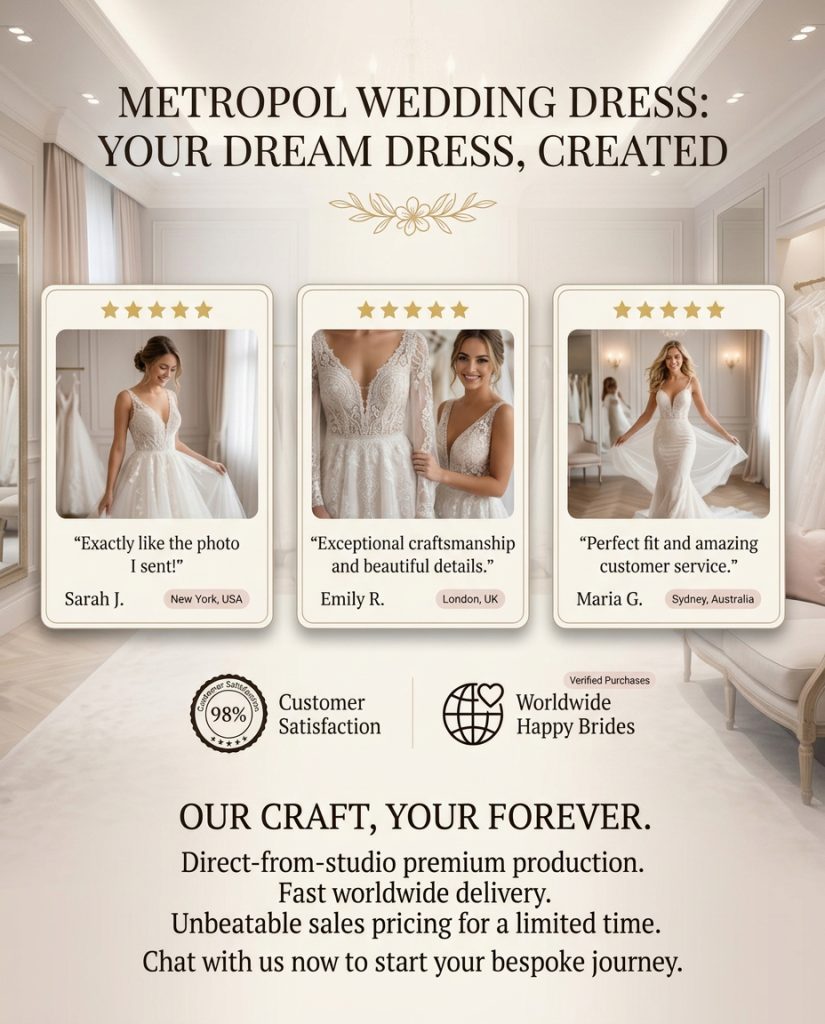
Elegant Custom Satin Wedding Dresses for Modern Brides A wedding dress is more than an outfit. It is a reflection of personality, emotion, confidence and individual style. For modern brides, finding the perfect gown means discovering a design that feels authentic, fits beautifully and remains unforgettable long after the wedding day.
Elegant custom satin wedding dresses offer a unique combination of sophistication, versatility and timeless beauty. With their smooth surfaces, graceful draping and naturally refined appearance, satin gowns create an elegant bridal silhouette without relying on excessive embellishment.
At Metropol Wedding Dress, the world of custom bridal design is centred around the idea that every bride deserves a dress that reflects her own vision. From minimalist satin wedding gowns and sculptural silhouettes to romantic off-the-shoulder designs, dramatic trains and contemporary statement details, personalised bridal styling opens the door to countless possibilities.
Whether you dream of a sleek ceremony dress, an elegant reception gown or a completely individual bridal creation, a custom satin wedding dress offers the opportunity to bring your ideas together in one carefully considered design.
Your wedding dress should not simply follow a trend. It should express who you are.
Elegant Custom Satin Wedding Dresses for Modern Brides
There is something remarkably captivating about a satin wedding dress.
It does not necessarily need crystals, layers of lace or elaborate embroidery to make an impression. Sometimes, the most beautiful bridal statement comes from the way a fabric catches the light, follows the natural movement of the body and creates a beautifully balanced silhouette.
Satin has long been associated with elegance, refinement and special occasions. However, its appeal in contemporary bridal fashion goes far beyond traditional luxury.
Today’s brides are increasingly interested in dresses that combine visual simplicity with thoughtful construction. They want designs that photograph beautifully, feel comfortable throughout the celebration and express their personal aesthetic rather than simply reproduce a popular bridal trend.
This is where custom satin wedding dresses become particularly interesting.
Instead of choosing a standard design and adapting your expectations to its limitations, a custom approach allows the dress to be considered from the beginning as a complete expression of your style.
The neckline, waist position, sleeve design, skirt volume, back detail, train length and overall proportions can all contribute to the final appearance.
The result is not simply a satin wedding dress.
It is a bridal design created around a particular woman, a particular celebration and a particular vision of elegance.
1. WHAT MAKES A SATIN WEDDING DRESS DIFFERENT?
Satin is often described as a fabric, but technically, satin refers to a weaving structure that produces a smooth surface and characteristic lustre.
This distinction matters when selecting a wedding gown because satin can be produced using different fibres, weights and finishing techniques.
Depending on its composition and construction, satin may feel fluid and lightweight, structured and substantial, or somewhere between these two characteristics.
For bridal designers, this versatility creates significant opportunities.
A lightweight satin can produce soft movement and flowing skirts, while a heavier satin may offer more structure for architectural bodices, defined waistlines and sculptural silhouettes.
The fabric can also create different visual effects depending on lighting conditions.
Under soft natural daylight, satin may appear subtle and understated. Under evening lighting or professional photography, its surface can produce a more pronounced luminous effect.
This makes satin especially attractive to brides who appreciate understated luxury.
The visual language of satin
A satin wedding dress communicates elegance through several design characteristics:
- Smoothness: A refined surface creates a clean and sophisticated appearance.
- Natural lustre: The fabric reflects light in a distinctive way.
- Drape: Depending on its weight and construction, satin can follow the body’s movement gracefully.
- Structure: Heavier satin varieties can support defined shapes and architectural details.
- Versatility: Satin works beautifully with minimalist, romantic, contemporary and classic bridal aesthetics.
The most important consideration is choosing the appropriate satin for the intended design.
A fabric that works beautifully for a fluid bias-cut gown may not provide the structure required for a dramatic ball gown.
For this reason, fabric selection should always be connected to the silhouette rather than treated as an independent decision.
2. THE MODERN BRIDE: ELEGANCE WITHOUT COMPROMISE
Modern bridal fashion has moved beyond the idea that every wedding dress must look traditionally elaborate.
Some brides imagine themselves in a dramatic princess gown with a full skirt and an impressive train. Others prefer a minimalist column dress with a sculpted neckline and almost no decoration.
Neither approach is more correct.
The beauty of contemporary bridal design is that personal expression has become an essential part of the process.
A modern satin wedding dress can be:
- Minimalist and architectural.
- Romantic and softly draped.
- Glamorous and dramatic.
- Classic and sophisticated.
- Contemporary and unconventional.
- Feminine and delicately detailed.
The defining characteristic is not the amount of decoration. It is the relationship between the design, the wearer and the occasion.
A well-considered gown should feel visually balanced from every angle.
The front may create an elegant neckline, the side profile may emphasise the waist and hips, while the back may introduce an unexpected detail or a beautifully extended train.
This is why customisation is so valuable.
Rather than selecting a dress based on one attractive photograph, brides can consider how each design element contributes to the complete look.
3. CUSTOM SATIN WEDDING DRESS DESIGNS: FIND YOUR SIGNATURE SILHOUETTE
The silhouette is one of the most important decisions in bridal design.
It determines the overall visual proportions of the gown, influences movement and helps establish the personality of the entire outfit.
A satin fabric can look completely different depending on how it is cut and constructed.
Here are some of the most distinctive possibilities.
A-Line Satin Wedding Dresses: Effortless and Timeless
An A-line wedding dress is characterised by a fitted upper section and a skirt that gradually widens towards the hem.
It creates a balanced appearance and offers considerable freedom in styling.
In satin, the A-line silhouette can look particularly refined because the fabric provides a smooth transition from the bodice to the skirt.
A bride may choose:
- A clean strapless bodice.
- A delicate V-neckline.
- Long fitted sleeves.
- A square neckline.
- A defined waist.
- A flowing satin skirt.
- A subtle or dramatic train.
A-line satin wedding dresses are especially appealing to brides who want a classic bridal shape with a contemporary finish.
The silhouette can also be adapted to different levels of formality, making it suitable for traditional ceremonies, garden weddings and elegant hotel celebrations.
Mermaid Satin Wedding Dresses: Sculptural Sophistication
For brides who appreciate a more dramatic silhouette, the mermaid wedding dress creates a distinctive visual statement.
The design follows the body’s contours through the bodice, waist and hips before opening into a flared skirt.
Satin gives this silhouette a particularly polished appearance.
Its smooth surface allows the overall construction to remain the focus, while carefully positioned seams and panels help establish the intended shape.
Custom design is especially useful for this style because fit, movement and comfort are closely connected.
Important considerations include:
- The placement of the fitted section.
- The position where the skirt begins to flare.
- The amount of movement required for walking.
- The construction of the bodice.
- The placement and weight of the train.
- The balance between visual definition and comfort.
A mermaid gown should not only look impressive while standing still. It should also allow the bride to move confidently throughout the celebration.
Minimalist Satin Wedding Dresses: The Beauty of Simplicity
Minimalist bridal fashion is not about having fewer design possibilities.
It is about making every design decision count.
A minimalist satin wedding dress may feature a clean neckline, a beautifully constructed bodice, a precise waistline and a flowing skirt.
Because there may be little decorative embellishment, the quality of the pattern, fabric selection and construction becomes particularly noticeable.
Small details make a significant difference.
For example, a slightly curved neckline, a carefully positioned seam or an elegant back opening can completely change the personality of a seemingly simple dress.
This style is ideal for brides who appreciate modern architecture, refined fashion and understated luxury.
Satin Ball Gowns: Contemporary Royal Elegance
A satin ball gown creates a dramatic bridal presence through its fitted bodice and voluminous skirt.
It is a particularly attractive choice for formal celebrations, grand venues and brides who want a memorable entrance.
However, volume alone does not create elegance.
The proportions of the bodice, the waistline, the skirt structure and the length of the train must work together.
Customisation makes it possible to explore different interpretations:
- Structured corset-inspired bodices.
- Off-the-shoulder necklines.
- Sculptural draped details.
- Deep back designs.
- Layered satin skirts.
- Hidden structural support.
- Extended cathedral trains.
A contemporary satin ball gown can therefore combine traditional bridal drama with a cleaner, more modern aesthetic.
Off-the-Shoulder Satin Wedding Dresses
An off-the-shoulder neckline introduces softness and sophistication without necessarily requiring additional embellishment.
It draws attention towards the shoulders and neckline while creating a romantic frame for the upper body.
Depending on the design, the neckline may be paired with:
- A fitted corset-style bodice.
- A flowing A-line skirt.
- A mermaid silhouette.
- Long draped sleeves.
- Detachable sleeve details.
- A structured satin train.
The most successful designs balance the neckline with the rest of the gown.
For example, a dramatic off-the-shoulder bodice may work particularly well with a relatively clean skirt, allowing the neckline to remain the central design feature.
One-Shoulder Satin Wedding Dresses
For brides seeking a more contemporary look, an asymmetrical neckline offers a distinctive alternative.
A one-shoulder satin wedding dress introduces movement and visual interest through an intentionally unbalanced design.
It can be styled with a fitted silhouette, a flowing skirt or a more architectural shape.
The result is a modern bridal look that feels sophisticated without appearing overly conventional.
Long-Sleeve Satin Wedding Dresses
Long sleeves can create a refined, elegant and occasionally dramatic appearance.
They are particularly effective when the rest of the gown maintains a clean silhouette.
Depending on the desired aesthetic, sleeves may be:
- Closely fitted.
- Slightly flared.
- Structured at the shoulder.
- Designed with covered buttons.
- Combined with an open back.
- Finished with subtle draping.
Sleeve construction should be considered alongside the bodice and arm movement.
The correct pattern and fabric weight are essential for achieving a comfortable fit.
4. THE FABRIC DECISION: NOT ALL SATIN IS THE SAME
One of the most overlooked aspects of buying a satin wedding dress is the assumption that all satin fabrics look and behave alike.
They do not.
A wedding dress described as satin may be made using different fibre compositions, weaving constructions and finishing processes.
These differences influence appearance, weight, drape, durability and price.
For a bride investing in a custom gown, understanding the basic distinctions can make the selection process considerably easier.
Common satin fabric options
| Satin type | General characteristics | Potential bridal applications |
|---|---|---|
| Duchess satin | Often heavier and more structured | Ball gowns, fitted bodices and architectural skirts |
| Silk satin | Luxurious hand feel with natural fibre characteristics | Refined minimalist gowns and fluid designs |
| Stretch satin | Includes elastane or another stretch component | Selected fitted silhouettes |
| Crepe-back satin | Different surface characteristics on each side | Versatile contemporary designs |
| Charmeuse satin | Lightweight and fluid | Draped gowns and softer silhouettes |
| Polyester satin | Available in many weights and finishes | Different bridal designs depending on quality and construction |
The exact characteristics depend on the manufacturer, fibre composition, density and finishing.
A fabric name alone is not enough to determine whether it is appropriate for a particular gown.
Why fabric weight matters
Fabric weight affects how a wedding dress falls and moves.
A lighter satin may create a fluid appearance, but it may require additional consideration regarding opacity, lining and support.
A heavier satin may offer a more defined shape, although it can increase the overall weight of the gown.
The correct choice depends on the intended silhouette.
For example:
A structured ball gown may benefit from a more substantial satin, whereas a softly draped design may require a lighter material.
The aim is not to choose the heaviest or most expensive fabric.
The aim is to select a fabric whose technical properties support the design.
Silk satin versus polyester satin
Silk and polyester are not interchangeable materials.
Silk is a natural protein fibre with its own distinctive surface characteristics, hand feel and care requirements.
Polyester is a synthetic fibre that can be engineered into a wide range of satin constructions.
Neither category automatically guarantees superior quality.
A well-manufactured polyester satin may be more suitable for a particular design than an unsuitable silk satin.
The important questions are:
- What is the exact fibre composition?
- How does the fabric behave when draped?
- Is the material sufficiently opaque?
- Does it retain the intended shape?
- How does it respond to pressing and handling?
- What are the care requirements?
- Is the fabric suitable for the planned construction?
Professional insight: When comparing two satin wedding dresses, do not evaluate fabric quality using shine alone. Examine the surface, weight, drape, opacity, construction and finishing together.
5. THE DETAILS THAT TRANSFORM A BEAUTIFUL DRESS INTO YOUR DRESS
The difference between a standard bridal design and a memorable custom creation often lies in the details.
A bride may begin with a simple idea: a satin gown with a fitted waist and a flowing skirt.
However, once the design process begins, the possibilities become much more interesting.
Neckline customisation
The neckline influences the visual identity of the entire gown.
Popular options include:
- Sweetheart neckline.
- Straight neckline.
- Square neckline.
- Deep V-neckline.
- High neckline.
- Asymmetrical neckline.
- Off-the-shoulder neckline.
- Draped cowl neckline.
Each option creates a different relationship between the bodice, shoulders and overall silhouette.
Back design
The back of a wedding dress deserves as much attention as the front.
It is visible during the ceremony, in photographs and throughout many parts of the celebration.
Custom satin gowns may incorporate:
- Low open backs.
- Button details.
- Lace-up closures.
- Covered buttons.
- Structured back panels.
- Draped fabric details.
- Illusion inserts where appropriate.
A carefully designed back can create an elegant surprise without changing the overall simplicity of the dress.
Train options
The train is another important design decision.
| Train style | Visual effect | Suitable setting |
|---|---|---|
| Sweep train | Subtle and practical | Intimate ceremonies |
| Chapel train | Elegant and noticeable | Traditional and formal weddings |
| Cathedral train | Dramatic and impressive | Grand venues and formal ceremonies |
| Detachable train | Versatile and adaptable | Brides wanting two visual looks |
The longer the train, the more attention should be given to its weight, attachment, movement and storage.
A detachable train can be particularly useful when a bride wants a dramatic ceremony appearance and greater freedom during the reception.
Sleeve and accessory options
Sleeves can be designed as permanent elements or detachable accessories.
This creates opportunities for a bride to change the appearance of her dress without changing the main gown.
A long-sleeve ceremony look, for example, may become a sleeveless reception look through detachable components.
Other possible additions include:
- Satin gloves.
- Removable overskirts.
- Bridal belts.
- Decorative bows.
- Fabric-covered buttons.
- Matching veils.
- Structured shoulder details.
The most successful custom designs use these details intentionally rather than adding every possible feature.
6. HOW A CUSTOM SATIN WEDDING DRESS TAKES SHAPE
Creating a custom wedding dress involves more than choosing a beautiful photograph and reproducing it.
The design must be translated into a workable garment.
That means considering proportions, fabric behaviour, pattern construction, internal support, finishing and the practical needs of the bride.
Understanding the process helps customers ask better questions and make more confident decisions.
Stage 1: Establishing the Bridal Vision
The process begins with understanding the desired result.
A bride may have several reference images, but those images may represent different design elements.
One may show an ideal neckline, another a preferred skirt shape and another a beautiful back detail.
These references should be evaluated together.
A useful design brief identifies:
- Preferred silhouette.
- Fabric appearance.
- Neckline.
- Sleeve requirements.
- Waistline.
- Back design.
- Skirt volume.
- Train length.
- Level of embellishment.
- Ceremony and reception requirements.
The objective is to develop a coherent design rather than combine unrelated details.
Stage 2: Selecting the Fabric
Once the design direction is clear, the fabric can be evaluated.
The choice should reflect the required structure and movement.
At this stage, it is useful to ask about fabric composition, weight, colour availability and lining requirements.
If a physical sample is available, examining it under different lighting conditions can help reveal its actual appearance.
Stage 3: Measurements and Fit Planning
Measurements are essential to custom bridal construction.
However, taking measurements is only one part of achieving a good fit.
The pattern must interpret those measurements correctly.
Important considerations may include:
- Bust circumference.
- Waist circumference.
- Hip circumference.
- Shoulder width.
- Back width.
- Bodice length.
- Desired dress length.
- Height and footwear.
- Sleeve measurements.
- Relevant posture and proportion considerations.
Measurement instructions should be clear and consistent.
For remote orders, customers should understand whether measurements must be taken by a professional tailor or can be supplied using an approved measurement guide.
The final fit also depends on the selected pattern, internal construction and intended ease.
Stage 4: Pattern Development
The design is translated into pattern pieces.
This is where technical decisions become particularly important.
A mermaid gown, for example, requires a different pattern approach from a flowing A-line dress.
The bodice may need internal support, while the skirt may require carefully positioned seams to achieve the desired drape.
The pattern must account for the selected fabric and the intended movement of the gown.
Stage 5: Construction and Finishing
The dress is assembled according to the approved design.
Construction quality can influence the final appearance as much as fabric selection.
Important areas include:
- Seam alignment.
- Waistline accuracy.
- Bodice stability.
- Lining attachment.
- Closure placement.
- Hem finishing.
- Train construction.
- Edge finishing.
- Pressing and presentation.
A smooth satin surface can make construction inconsistencies more visible than some textured fabrics.
For this reason, finishing deserves particular attention.
Stage 6: Final Review
Before a custom gown is approved for delivery, the final result should be checked against the agreed design.
The review should consider both appearance and functionality.
Does the neckline sit correctly? Is the waistline positioned as intended? Does the skirt move naturally? Is the closure secure? Does the train fall correctly?
These questions help distinguish a visually attractive dress from a well-executed bridal garment.
7. THE BUYER’S DECISION: CUSTOM DESIGN OR READY-TO-WEAR?
For many brides, the decision is not simply between two dresses.
It is between two different purchasing experiences.
Ready-to-wear offers convenience and the opportunity to see an existing garment before purchase.
Custom design offers greater scope for individual decisions but may involve a more detailed consultation, measurement and production process.
Neither approach is universally better.
The right option depends on the bride’s priorities.
| Decision factor | Ready-to-wear | Custom satin wedding dress |
|---|---|---|
| Design selection | Existing collections | Individual design possibilities |
| Measurements | Standard sizing | Individual measurement requirements |
| Personalisation | Depends on the seller | Potentially broader |
| Production timeline | May be immediately available | Depends on production schedule |
| Fit adjustments | Often require alterations | Can be considered during design |
| Fabric choices | Limited to available models | May offer more selection |
| Budget planning | Easier to compare listed prices | Depends on specifications |
| Design uniqueness | Depends on collection | Greater opportunity for individuality |
When custom design makes sense
A custom gown may be particularly suitable when:
- A bride has a specific design in mind.
- Standard sizing does not meet her requirements.
- She wants a particular neckline or back design.
- She needs a specific train length.
- She wants detachable elements.
- She prefers a particular satin weight.
- She wants to coordinate the gown with a specific wedding concept.
When ready-to-wear may be more practical
Ready-to-wear may be preferable when:
- The wedding date is approaching quickly.
- A suitable design is already available.
- The bride wants to try the actual garment before purchasing.
- Minimal changes are required.
- The budget is fixed and the available options meet expectations.
The important buying principle: Never choose customisation simply because it sounds more luxurious. Choose it when the additional design flexibility creates a meaningful benefit.
8. WHAT DETERMINES THE PRICE OF A CUSTOM SATIN WEDDING DRESS?
The price of a custom satin wedding dress is influenced by several interconnected factors.
Two dresses that appear similar in photographs may have significantly different production requirements.
The final price should therefore be evaluated according to specifications rather than appearance alone.
Main cost components
1. Fabric selection
Fibre composition, fabric quality, weight, supplier and availability can all influence material costs.
2. Pattern complexity
A simple A-line design may require a different level of pattern development from a structured mermaid gown or architectural ball gown.
3. Internal construction
Corsetry, boning, lining, support structures and specialised finishing can increase production requirements.
4. Decorative details
Hand-applied elements, covered buttons, special draping and complex sleeve designs may require additional labour.
5. Train and skirt volume
A larger skirt or longer train may require more fabric and additional construction time.
6. Custom measurements
Individual pattern adjustments and additional fitting requirements may influence the overall production cost.
7. Delivery and packaging
International shipping, protective packaging, insurance and customs-related charges may affect the total amount paid.
How to compare quotations properly
When comparing suppliers, request a written specification.
A useful quotation should identify:
- Exact design or reference.
- Fabric composition.
- Fabric colour.
- Included lining.
- Bodice construction.
- Sleeve details.
- Train length.
- Closure type.
- Included accessories.
- Measurement requirements.
- Production timeline.
- Quality inspection process.
- Packaging arrangements.
- Shipping terms.
- Alteration and after-sales conditions.
A lower quotation is not automatically a better commercial decision.
The correct comparison is between products with equivalent specifications.
9. A SATIN WEDDING DRESS FOR EVERY WEDDING SETTING
The wedding environment can influence the ideal design.
A gown that works beautifully in a grand indoor venue may not be the most practical option for a beach ceremony.
Considering the location early helps prevent design decisions that look attractive in isolation but become inconvenient during the event.
Destination weddings
Destination weddings often require careful attention to transport, packing and fabric behaviour.
A relatively lightweight satin gown may be easier to handle than a very heavy design, although the final choice depends on the silhouette.
Consider:
- Travel-friendly packaging.
- Wrinkle management.
- Suitable footwear.
- Train practicality.
- Venue conditions.
- Climate.
- Availability of professional pressing.
Beach weddings
Beach ceremonies often benefit from simpler silhouettes and designs that allow easy movement.
A flowing satin gown can create a beautiful effect in natural light.
However, long trains and delicate hems may require additional attention on sand.
A shorter train or detachable train may be a practical alternative.
Garden weddings
Outdoor garden celebrations can combine romantic surroundings with contemporary bridal styling.
A satin A-line gown, a softly draped design or a minimalist silhouette may complement this setting.
The choice should account for walking surfaces, weather conditions and the possibility of outdoor photography.
Luxury hotel weddings
Formal indoor venues provide an opportunity for more structured and dramatic designs.
A satin ball gown, fitted mermaid silhouette or long cathedral train can create a strong visual presence.
Lighting also becomes an important consideration.
A highly reflective satin may produce a different appearance under chandeliers, spotlights and flash photography.
Civil ceremonies
For civil weddings, many brides prefer clean and sophisticated silhouettes.
A minimalist satin dress, a tailored gown or a contemporary midi design can offer a polished alternative to a traditional full-length bridal look.
Some brides also choose a second satin gown for the reception or civil celebration.
10. INTERNATIONAL BRIDAL BUYING: WHAT SHOULD CUSTOMERS CONSIDER?
A custom wedding dress may be purchased locally or from an international supplier.
International sourcing can create access to a wider range of designers, manufacturers and production options.
However, buying across borders requires more careful planning.
The customer should evaluate the supplier not only as a fashion business but also as a commercial partner responsible for specifications, communication and delivery.
Questions international customers should ask
Product specification
Is the exact fabric composition documented?
Are the neckline, train, sleeves and closure clearly described?
Are the design references approved before production?
Measurements
Are measurement instructions provided?
Who is responsible for verifying the measurements?
What happens if the final fit differs from the approved specification?
Production
Is the expected completion date documented?
Are design changes allowed after approval?
Can the customer receive progress photographs or updates?
Shipping
Which courier or shipping method will be used?
Is tracking available?
How is the garment protected during transport?
Are import duties and local taxes included or excluded?
Commercial terms
What payment arrangements apply?
Are cancellation conditions clear?
What is the policy for manufacturing defects?
Is there an agreed procedure for resolving disputes?
These questions are especially important when the wedding date is fixed.
A wedding dress is not an ordinary online purchase. Delivery delays can have significant consequences.
Turkey as a bridal sourcing destination
Turkey has an established textile and apparel industry, with manufacturing activity across different fabric, garment and fashion categories.
For international bridal buyers, Turkish suppliers may be worth evaluating when searching for custom production, bridal collections or potential wholesale relationships.
However, country of origin alone does not establish product quality.
The buyer should assess the individual supplier’s capabilities, sample quality, production standards, communication and commercial terms.
Metropol Wedding Dress can be positioned within this wider bridal market conversation as a brand for customers exploring elegant bridal designs and individual satin wedding dress possibilities.
For international enquiries, clearly documenting the desired design, measurements, specifications and delivery requirements is an important starting point.
11. HOW TO PREPARE FOR YOUR CUSTOM BRIDAL CONSULTATION
A successful consultation begins before the first design discussion.
The more clearly a bride communicates her priorities, the easier it becomes to evaluate whether a proposed design is appropriate.
You do not need to know every technical detail.
You simply need to understand what matters most.
Create a visual reference collection
Collect photographs showing:
- Your preferred silhouette.
- Neckline ideas.
- Back details.
- Sleeve preferences.
- Satin finishes.
- Train styles.
- Skirt volume.
- Overall bridal atmosphere.
Avoid collecting too many unrelated designs.
Instead, identify the features you consistently like.
Separate essential details from optional details
This is one of the most useful steps.
For example:
Essential
- Ivory satin.
- A-line silhouette.
- Structured bodice.
- Chapel train.
Optional
- Detachable sleeves.
- Decorative bow.
- Covered buttons.
- Additional draping.
This distinction helps maintain the original design direction while allowing flexibility.
Think about the complete wedding experience
Consider how long you will wear the dress, whether you plan to dance, whether the ceremony is indoors or outdoors and whether you want a second look.
A dress should be beautiful in photographs, but it should also work during the actual celebration.
Prepare your timeline
Include time for:
- Design consultation.
- Specification approval.
- Measurements.
- Production.
- Quality review.
- Shipping.
- Possible alterations.
- Final preparation.
Do not assume that production time and total delivery time are the same.
12. COMMON MISTAKES WHEN ORDERING A CUSTOM SATIN WEDDING DRESS
A beautiful design can still become a disappointing purchase if important decisions are overlooked.
The following mistakes are worth avoiding.
Mistake 1: Choosing satin based only on shine
A highly reflective surface does not automatically indicate superior material quality.
Better approach: Evaluate fibre composition, weight, surface consistency and drape.
Mistake 2: Selecting a silhouette without considering movement
A fitted gown may look excellent in a photograph but feel restrictive during the celebration.
Better approach: Discuss walking, sitting, dancing and reaching movements.
Mistake 3: Providing incomplete measurements
Missing or inconsistent measurements can affect the fit.
Better approach: Follow the supplier’s measurement instructions and use a professional where appropriate.
Mistake 4: Combining too many reference designs
A neckline from one gown, skirt from another and back design from a third may not create a coherent garment.
Better approach: Establish a primary design direction and identify only the details that genuinely complement it.
Mistake 5: Ignoring the train
A dramatic train may look impressive but can become inconvenient in certain venues.
Better approach: Match train length to the wedding setting and consider detachable options.
Mistake 6: Waiting too long to order
Custom production, alterations and international shipping all require time.
Better approach: Establish the full schedule before confirming an order.
Mistake 7: Comparing prices without comparing specifications
Different fabrics, construction methods and included details can make quotations incomparable.
Better approach: Request itemised specifications and evaluate equivalent products.
Mistake 8: Assuming the colour will look identical everywhere
Satin can appear different under daylight, warm indoor lighting and photography flash.
Better approach: Request colour references or fabric samples where possible.
13. HOW TO CARE FOR A SATIN WEDDING DRESS
A satin wedding dress deserves careful handling before and after the celebration.
Its smooth surface can be vulnerable to certain types of staining, friction and pressure marks.
Care requirements depend on fibre composition, construction and any additional materials used.
Before the wedding
Keep the gown in a clean, dry environment.
Avoid placing heavy objects on top of the dress.
Use suitable garment protection and follow the supplier’s storage instructions.
If steaming or pressing is required, confirm the correct method for the specific fabric.
Excessive heat can damage some synthetic fibres and may affect the finish of delicate materials.
During the celebration
Be mindful of:
- Makeup transfer.
- Food and drink spills.
- Jewellery catching on the fabric.
- Rough surfaces.
- Outdoor dirt.
- Excessive friction.
- Train contact with the ground.
If the dress has a long train, ask someone to help manage it when necessary.
After the wedding
Do not automatically use a home washing machine.
The correct cleaning method depends on the fabric composition, lining, embellishments and construction.
Consult a professional cleaner experienced in bridal garments.
Before storing the gown long-term, ensure that it has been cleaned appropriately and protected from moisture, direct sunlight and unsuitable storage conditions.
14. WHY THE DETAILS OF CONSTRUCTION MATTER MORE THAN YOU THINK
Bridal customers naturally focus on the appearance of a dress.
However, a professional purchasing decision should also consider what happens beneath the visible surface.
The internal construction determines how the garment supports the body, maintains its shape and responds to movement.
This is especially important with satin because its smooth surface can reveal irregularities in the underlying construction.
Bodice engineering
A bodice may incorporate different structural elements depending on the design.
These may include:
- Interfacing.
- Lining.
- Boning.
- Internal waist support.
- Cups where appropriate.
- Stabilising tapes.
- Structured seams.
Not every satin wedding dress requires all these elements.
The construction should be selected according to the neckline, fit and intended support.
Seam placement
Seam placement influences both appearance and functionality.
A well-planned seam can support the silhouette and distribute tension.
An unsuitable seam position may create unwanted pulling or distort the fabric.
Closure systems
Common closure options include:
- Concealed zippers.
- Hooks and eyes.
- Fabric-covered buttons.
- Lace-up constructions.
- Combinations of different fastening methods.
The choice should be based on design, fit and ease of dressing.
Hem and train finishing
The hem is one of the most exposed areas of a wedding dress.
It may come into contact with floors, steps and outdoor surfaces.
Careful finishing helps preserve the intended appearance.
A train should also be designed with its weight and attachment method in mind.
These technical decisions may not be immediately visible in a product photograph, but they are important to the overall quality of the garment.
15. A DIFFERENT WAY TO THINK ABOUT BRIDAL LUXURY
Luxury is often associated with expensive embellishments, famous labels or dramatic decoration.
But bridal luxury can also be understood differently.
It can mean finding a dress that feels right without needing to explain why.
It can mean choosing a fabric because of the way it moves.
It can mean having the neckline designed according to your preferences.
It can mean wearing a gown that feels balanced, comfortable and authentic.
A custom satin wedding dress can express this quieter interpretation of luxury.
It allows the design to focus on proportion, material, craftsmanship and individual preference.
This is particularly meaningful for brides who do not want their wedding dress to look like every other gown in a collection.
They want something recognisably elegant, but personally significant.
At Metropol Wedding Dress, this is the design philosophy that can guide the conversation: bridal elegance should begin with the woman wearing the dress.
16. METROPOL WEDDING DRESS: BRIDAL DESIGN WITH A PERSONAL PERSPECTIVE
Choosing a wedding dress is a deeply personal decision.
The design should reflect the bride’s taste, the character of the celebration and the feeling she wants to experience when she walks into the room.
Metropol Wedding Dress presents an opportunity to explore the world of elegant bridal styling, with particular attention to the timeless appeal of satin wedding dresses.
From clean contemporary lines to more dramatic bridal silhouettes, the custom design concept offers a way to consider individual preferences as part of the overall gown.
Whether your inspiration comes from minimalist fashion, classic couture, romantic details or modern architectural design, the starting point should always be a clear understanding of your vision.
What makes a design worth considering?
A beautiful bridal gown should achieve several things simultaneously.
Visual harmony: The neckline, bodice, waist and skirt should work together.
Appropriate fabric: The satin should support the design rather than compromise it.
Thoughtful construction: Internal structure and finishing should contribute to the intended silhouette.
Personal relevance: The design should reflect the bride’s preferences.
Practical functionality: The gown should work for the ceremony, photographs and celebration.
These principles provide a useful framework for evaluating any bridal design.
Your vision, translated into a bridal design
Perhaps you imagine a strapless ivory satin gown with a sculptural neckline.
Perhaps you prefer a fitted mermaid silhouette with a long train.
Maybe your ideal dress is a minimalist A-line gown with delicate draping and a beautifully finished back.
Whatever your preference, the most important step is to communicate the design clearly.
Share your reference photographs, preferred details, measurements and wedding timeline with the Metropol Wedding Dress team to discuss the possibilities and applicable production arrangements.
The aim is not simply to choose a beautiful dress.
It is to discover the design that makes you feel unmistakably yourself.
17. YOUR CUSTOM SATIN WEDDING DRESS BUYING CHECKLIST
Before confirming your bridal order, review the following points.
Design approval
- The silhouette is clearly defined.
- The neckline is confirmed.
- The back design is approved.
- Sleeve requirements are documented.
- Train length is specified.
- Decorative elements are identified.
- The final design reference is agreed.
Material selection
- Fabric composition is known.
- Satin weight is suitable for the design.
- Colour is confirmed.
- Lining requirements are understood.
- Fabric appearance has been reviewed.
Measurements and construction
- Measurement instructions are clear.
- Measurements have been checked.
- Bodice construction is discussed.
- Closure type is agreed.
- Skirt structure is understood.
- Alteration arrangements are clarified.
Commercial arrangements
- Price and payment terms are documented.
- Production schedule is confirmed.
- Delivery date is realistic.
- Shipping responsibilities are clear.
- Import costs have been considered.
- Cancellation conditions are understood.
- Defect and alteration policies are documented.
Final preparation
- The dress has been reviewed before dispatch.
- Packaging is appropriate.
- Shipping information is available.
- Cleaning and storage instructions are provided.
- There is sufficient time for final adjustments.
18. THE FUTURE OF CUSTOM SATIN BRIDAL FASHION
Bridal fashion continues to evolve, but certain design principles remain relevant.
Beautiful proportions, quality materials and thoughtful construction are unlikely to lose their importance.
What is changing is the way brides approach the selection process.
Customers increasingly research designs online, compare different silhouettes, examine fabric options and expect more detailed information before making a purchase.
This creates opportunities for bridal brands to provide a more transparent and informative buying experience.
Several developments are particularly relevant.
Personalisation beyond standard sizing
Personalisation is increasingly about more than measurements.
Brides may want to adjust neckline depth, train length, sleeve design, skirt volume or detachable elements.
The opportunity lies in treating these preferences as connected design decisions.
Two-look bridal styling
Detachable sleeves, overskirts and trains allow one main gown to support different looks.
This can be attractive for brides who want a more formal ceremony appearance and a lighter reception style.
Minimalism with technical sophistication
Minimalist gowns place greater attention on the quality of fabric, fit and construction.
The absence of heavy decoration makes the underlying design decisions more visible.
More informed fabric purchasing
Brides are becoming more interested in material composition, care requirements and the practical differences between fabric options.
This makes accurate product information increasingly valuable.
Digital design communication
Reference images, measurement guides, video consultations and detailed specification documents can make remote bridal purchasing more manageable.
However, digital communication should complement clear production processes rather than replace them.
The future of custom bridal fashion will not be defined by personalisation alone.
It will depend on how effectively brands translate individual preferences into well-considered garments.
19. FIVE REASONS TO CONSIDER A CUSTOM SATIN WEDDING DRESS
1. A more individual design
You can explore combinations of silhouette, neckline, back detail and train length that better reflect your preferences.
2. Greater control over design details
Customisation creates opportunities to consider specific features rather than accepting every detail of an existing model.
3. A fabric selected for the intended silhouette
The appropriate satin can be chosen according to the desired structure, movement and appearance.
4. A more considered fit
Individual measurements can inform pattern development and fitting decisions.
5. A gown that reflects your personal style
Your wedding dress becomes an expression of your own bridal vision rather than simply a reflection of current fashion trends.
The value of custom design is ultimately measured by how successfully it brings together appearance, fit, practicality and personal meaning.
20. THE DRESS YOU REMEMBER SHOULD FEEL LIKE YOURS
Years after the wedding, you may not remember every decorative detail of the celebration.
But you are likely to remember how you felt when you first saw yourself in your wedding dress.
The confidence. The excitement. The feeling that the design was exactly what you had imagined.
That is the reason a thoughtful bridal decision matters.
A satin wedding dress has a distinctive ability to communicate elegance without unnecessary complexity. Its smooth surface, refined appearance and versatility make it a compelling choice for brides who appreciate both classic beauty and contemporary design.
A custom approach takes that appeal one step further.
It makes room for individual silhouettes, personal details, carefully selected materials and design decisions that reflect the person wearing the gown.
At Metropol Wedding Dress, the journey towards an elegant bridal look begins with your vision.
Explore the possibilities, define the details that matter to you and discover how a custom satin wedding dress can become part of your wedding story.
Because the most beautiful wedding dress is not simply the one that looks extraordinary. It is the one that feels extraordinary when you wear it.
READY TO EXPLORE YOUR CUSTOM SATIN WEDDING DRESS?
Your ideal bridal look starts with an idea.
Whether you prefer a minimalist satin gown, a romantic A-line silhouette, a sculptural mermaid dress or a dramatic ball gown, Metropol Wedding Dress invites you to explore the possibilities of personalised bridal styling.
Share your preferred design, inspiration photographs, measurements and wedding date to begin a conversation about your bridal requirements.
Metropol Wedding Dress – Elegant Bridal Design. Personal Style. Timeless Satin Beauty.
FIVE DIFFERENT CALLS TO ACTION
CTA 1 – Premium and Emotional
Your wedding day deserves a dress that tells your story.
Discover the possibilities of elegant custom satin bridal design with Metropol Wedding Dress.
CTA 2 – Direct Enquiry
Have a satin wedding dress design in mind?
Send us your inspiration photographs and requirements to discuss your preferred bridal style.
CTA 3 – Design Consultation
Let’s turn your bridal vision into a design.
Explore silhouettes, satin options, necklines and personalised details with the Metropol Wedding Dress team.
CTA 4 – International Customer Focus
Looking for an elegant bridal design beyond standard collections?
Contact Metropol Wedding Dress to discuss your requirements, customisation possibilities and international order arrangements.
CTA 5 – Conversion-Focused
Your dream satin wedding dress starts with one conversation.
Get in touch with Metropol Wedding Dress and take the first step towards your personalised bridal look.
FREQUENTLY ASKED QUESTIONS ABOUT CUSTOM SATIN WEDDING DRESSES
1. What makes a custom satin wedding dress different from a standard satin wedding dress?
A custom satin wedding dress offers opportunities to personalise design elements such as the neckline, silhouette, sleeve style, waistline, train and measurements. A standard dress is generally selected from an existing design and available size range. The exact customisation options depend on the supplier.
2. Is satin a good choice for a modern minimalist wedding dress?
Yes. Satin is particularly suitable for minimalist bridal designs because its smooth surface and natural lustre can create an elegant appearance without requiring extensive embellishment. The correct satin weight and construction are important for achieving the intended silhouette.
3. Which satin is best for a structured wedding dress?
Heavier satin varieties, including many duchess satin constructions, are commonly considered for structured bridal designs. However, the ideal choice depends on the required shape, fibre composition, internal support and pattern construction.
4. Can a satin wedding dress be designed with a detachable train?
Yes. A detachable train can be incorporated into a suitable bridal design. It allows the bride to enjoy a more dramatic appearance during the ceremony and a lighter silhouette during the reception. The attachment method and additional weight should be considered during construction.
5. Are custom satin wedding dresses suitable for destination weddings?
They can be. The most appropriate design depends on the destination, climate, travel arrangements and venue. Brides should consider fabric weight, packing requirements, train length, wrinkle management and the availability of professional garment care.
6. Can I combine a minimalist satin bodice with a dramatic skirt?
Yes. Combining a clean, minimalist bodice with a voluminous satin skirt is a popular way to balance contemporary design with traditional bridal drama. The proportions and construction should be carefully planned.
7. Does satin always have a shiny appearance?
No. Satin can have different levels of lustre depending on its fibre composition, weaving structure and finishing. Some varieties have a pronounced sheen, while others create a more subtle and understated appearance.
8. Is a satin wedding dress suitable for a summer wedding?
Yes, depending on the fabric weight and construction. Lightweight satin options may be more appropriate for warm conditions than heavier structured materials. The lining, silhouette and venue conditions should also be considered.
9. Can I request a specific neckline for my custom satin wedding dress?
Potentially, yes. Common custom neckline options include sweetheart, square, straight, V-neck, cowl, asymmetrical and off-the-shoulder designs. Available options depend on the supplier’s design and production capabilities.
10. How do I choose between a satin mermaid dress and an A-line dress?
Consider your preferred silhouette, desired movement, wedding setting and overall bridal aesthetic. A mermaid dress creates a more fitted and dramatic shape, while an A-line dress offers a more gradually flowing silhouette. Trying similar shapes, where possible, can help you decide.
11. Can satin wedding dresses include lace details?
Yes. Satin can be combined with lace in selected areas, such as sleeves, bodice panels, back details or decorative overlays. The combination should be carefully balanced to preserve the intended visual character of the dress.
12. What is the difference between silk satin and polyester satin?
Silk satin uses natural silk fibres, while polyester satin uses synthetic polyester fibres. They can differ in hand feel, drape, appearance, care requirements and price. The quality of each material depends on its manufacturing and finishing characteristics.
13. Can a satin wedding dress be made with long sleeves?
Yes. Long sleeves can be incorporated into many satin bridal silhouettes. Sleeve design may include fitted, flared, draped or structured variations, depending on the overall gown design.
14. Is a satin wedding dress suitable for a beach ceremony?
Yes, but practical details should be considered. A lighter design, manageable train and suitable hem length may make the dress more convenient for sand and outdoor movement.
15. What information should I provide when requesting a custom wedding dress?
Ideally, provide your preferred silhouette, reference photographs, neckline, sleeve preferences, back design, train length, colour, measurements and wedding date. You should also communicate your budget expectations and delivery location.
16. Why is fabric weight important when ordering a satin bridal gown?
Fabric weight influences the way the dress falls, moves and maintains its shape. A lighter satin may create softer draping, while a heavier satin may provide more structure. Choosing the wrong weight can affect the final appearance and comfort.
17. Can a custom satin wedding dress be made in ivory instead of pure white?
Ivory is a common bridal colour option, although availability depends on the selected material and supplier. Other possible shades may include champagne, soft white and selected warm neutral tones. Colour samples are useful because satin can look different under different lighting conditions.
18. How can I avoid choosing the wrong satin wedding dress?
Start by identifying your preferred silhouette and wedding setting. Then evaluate fabric characteristics, fit requirements, movement, construction and budget. Avoid choosing a dress based solely on a photograph or surface shine.
19. Are satin wedding dresses suitable for formal evening weddings?
Absolutely. Satin is often associated with formal eveningwear because of its refined surface and elegant appearance. A structured ball gown, fitted mermaid dress or minimalist column gown can all work beautifully for an evening celebration.
20. Can I request a wedding dress based on multiple inspiration photographs?
You can discuss multiple references with a custom bridal supplier. It is helpful to identify exactly which feature you like in each image. This allows the designer to understand your preferences and determine whether the elements can be combined into a coherent design.
21. What should I know about the construction of a satin wedding dress?
Important construction elements include the bodice structure, lining, seams, closures, hem and train finishing. Depending on the design, internal support such as interfacing or boning may also be required. These details influence the fit, appearance and durability of the gown.
22. Can a satin wedding dress be designed with an open back?
Yes. Open-back designs can create a striking contrast with the smooth, structured appearance of satin. The design may incorporate a low back, decorative buttons, a concealed closure or additional support where necessary.
23. How do I know whether a custom wedding dress quotation is reasonable?
Compare quotations using equivalent specifications. Consider fabric composition, construction, customisation, included accessories, measurements, production time, packaging, shipping and after-sales conditions. A low price should not be evaluated without understanding what is included.
24. Can international customers order custom satin wedding dresses?
International ordering may be possible depending on the supplier’s service arrangements. Before confirming an order, discuss measurement procedures, production time, payment terms, shipping methods, customs responsibilities and policies for alterations or manufacturing defects.
25. What should I consider when selecting a wedding dress train?
Consider the venue, ceremony style, walking requirements, skirt weight and desired visual impact. A sweep train offers a relatively subtle finish, while a chapel or cathedral train creates a more dramatic appearance. Detachable options may offer additional versatility.
26. Do minimalist satin wedding dresses require high-quality construction?
Yes. Minimalist designs often make construction details more visible because there are fewer decorative elements to distract from the fabric and silhouette. Seam alignment, fit, pressing, lining and finishing are therefore particularly important.
27. Can I wear the same satin wedding dress for the ceremony and reception?
Yes. A single gown can be suitable for both parts of the celebration. Brides who want to change their appearance may consider detachable sleeves, removable overskirts or a detachable train.
28. How should a satin wedding dress be stored before the wedding?
The dress should be kept in a clean, dry and suitable garment-protection environment. Avoid excessive pressure, direct sunlight and moisture. Follow the supplier’s specific instructions regarding hanging, folding and pressing.
29. Can a satin wedding dress be altered after production?
Many satin wedding dresses can be altered by an experienced bridal tailor, but the possibilities depend on the original construction and the required adjustment. It is important to discuss alteration allowances and responsibilities before placing an order.
30. What makes a custom satin wedding dress a worthwhile investment?
Its value comes from the combination of personal design, suitable materials, construction, fit and practical functionality. When these elements reflect the bride’s priorities, customisation can create a more meaningful alternative to choosing an existing design without modification.
31. Is satin suitable for a wedding dress with a high neckline?
Yes. Satin can create a sophisticated high-neck bridal design, particularly when combined with a carefully structured bodice and balanced skirt. Sleeve length and back design can further influence the overall appearance.
32. Can a satin wedding dress have pockets?
Depending on the silhouette and skirt construction, functional pockets may be incorporated into some satin wedding dresses. Their placement should be considered carefully to avoid unwanted pulling or distortion.
33. What is the most important consideration when buying a satin wedding dress online?
The most important consideration is clarity. The buyer should understand the exact product specifications, fabric composition, measurements, production schedule, shipping arrangements and applicable after-sales conditions before making a commitment.
34. Can satin wedding dresses be suitable for different body proportions?
Yes. Satin is available in different weights and constructions, allowing designers to explore many silhouettes. The best design depends on individual preferences, pattern development and fit rather than following a universal body-shape rule.
35. Why choose Metropol Wedding Dress when exploring custom satin bridal designs?
Metropol Wedding Dress is a brand to consider when exploring elegant bridal styling and the possibilities of personalised satin wedding dress design. Prospective customers should contact the team directly to confirm available models, customisation options, fabric specifications, production arrangements and international ordering conditions.
FINAL THOUGHT
A wedding dress becomes memorable when design and personal identity come together.
Satin offers a beautiful foundation for this expression: smooth, sophisticated, versatile and timeless.
Whether your ideal gown is a dramatic mermaid dress, a romantic A-line creation or an effortlessly minimalist silhouette, the right design should reflect your preferences and make you feel confident throughout your celebration.
Metropol Wedding Dress – Where Personal Bridal Style Meets Timeless Elegance.
Related Topics

30.08.2022
Wedding Dress Wholesalers Wedding dress wholesalers typically have partnerships with various manufacturers and designers to ensure a steady supply of high-quality wedding dresses at competitive prices. In recent years, the wedding dress industry has undergone...
13.06.2024
Dropship Wedding Dresses Best 5 Absolutely! Chiffon dresses can be a fantastic choice for wedding attire, especially for more formal or semi-formal occasions. Chiffon is lightweight, flowy, and often has an elegant drape, making it...

16.06.2025
Vitali Sposa Wedding Dress The wedding dress is more than just a garment; it is a symbol of love, tradition, and personal expression. In the world of bridal fashion, Italy stands as a beacon of...
11.02.2026
Haute couture mariage découvrez nos robes de mariée artisanales et luxueuses Le mariage est bien plus qu’un simple événement. C’est une célébration d’amour, un moment suspendu dans le temps, une promesse d’éternité. Au cœur de...
20.07.2025
Cheap Wedding Dress Designer Finding the perfect wedding dress is a dream for every bride, but it doesn’t have to come with a luxury price tag. Cheap wedding dress designers offer stunning, high-quality gowns that...

26.09.2025
Brautkleid Kauf in Deutschland Worauf sollte man achten Der erste Schritt beim Brautkleid-Kauf ist die Festlegung eines realistischen Budgets. Brautkleider in Deutschland können zwischen 500 und mehreren Tausend Euro kosten. Es ist wichtig, nicht nur...
Comments