
Made-to-Measure Wedding Dresses vs Custom Wedding Dresses Explained Choosing a wedding dress is not simply a matter of finding a beautiful design. It is about finding the right balance between personal style, body measurements, fabric quality, construction, comfort, budget, and the time available before the wedding.
For brides who want something more personal than a standard off-the-rack gown, two options often stand out: made-to-measure wedding dresses and custom wedding dresses. Although these terms are sometimes used interchangeably, they can describe different approaches to designing, fitting, and producing a bridal gown.
Understanding the difference helps brides make more confident decisions. It also helps bridal boutiques, wedding dress retailers, and international buyers select products that meet their customers’ expectations.
At Metropol Wedding Dress, the distinction matters because the right bridal solution should reflect not only how a gown looks, but also how it fits, how it is constructed, and how well it serves the bride’s needs.
This guide explains both options from a practical, design-focused, and purchasing perspective. Whether you are a bride planning your wedding, a bridal boutique sourcing new collections, or a retailer evaluating production partners, you will discover what separates made-to-measure from custom wedding dresses and how to choose the right approach.
Quick Summary: Made-to-Measure vs Custom Wedding Dresses
Made-to-measure wedding dresses are generally created using an existing design or established pattern that is adjusted to a bride’s individual measurements. Custom wedding dresses typically involve a greater degree of design personalization, potentially including a new silhouette, original pattern development, bespoke detailing, and individually selected materials.
However, terminology varies between bridal designers and manufacturers. A made-to-measure gown may include extensive design modifications, while a custom gown may be based on an existing pattern. The most reliable way to distinguish the two is to examine exactly what the provider includes.
| Comparison point | Made-to-measure wedding dress | Custom wedding dress |
|---|---|---|
| Starting point | Existing design, pattern, or collection model | Individual brief, existing design, or a combination |
| Measurements | Adjusted to the bride’s measurements | Taken into account during individualized development |
| Design freedom | Usually follows the original design, with agreed modifications | Can offer broader freedom to change or develop the design |
| Pattern development | Often uses an existing pattern with adjustments | May involve substantial pattern changes or a new pattern |
| Fabric and embellishments | Depends on the available collection and options | May allow more extensive material and detail selection |
| Fittings | May require a fitting or final alterations | May involve several development and fitting stages |
| Production complexity | Often more standardized | Can require more individual technical work |
| Pricing | Often more predictable | Depends heavily on design complexity and development |
| Lead time | May be easier to estimate | Can be longer when design development is extensive |
| Best suited to | Brides who love an existing design and want a personalized fit | Brides seeking a more individually developed design |
The essential difference: made-to-measure primarily personalizes how an established design fits, while custom design can personalize both the fit and the design itself.
Neither option automatically guarantees better quality. Fabric selection, pattern accuracy, construction methods, workmanship, communication, and quality control determine the actual result.
1. What Is a Made-to-Measure Wedding Dress?
A made-to-measure wedding dress is produced using a design or pattern that already exists, with adjustments made to accommodate a bride’s measurements and agreed preferences.
Instead of choosing a standard-size gown and relying entirely on post-purchase alterations, the bride provides measurements that help the maker determine how the dress should be proportioned and constructed.
The goal is to create a gown that follows the intended design while providing a more personalized fit.
For example, a bride may fall in love with an A-line wedding dress featuring a structured bodice, lace appliqués, and a flowing skirt. The design is already established, but the dress can be produced using her measurements rather than simply selecting a standard size.
Depending on the designer’s process, adjustments may include bodice length, waist placement, skirt length, sleeve dimensions, neckline proportions, and other fit-related details.
Some providers also allow limited design modifications. These may include changing the sleeve length, adjusting a train, selecting another available fabric, or modifying the back closure.
It is important to confirm which changes are included. A made-to-measure service does not automatically mean that every design element can be changed.
How the process works
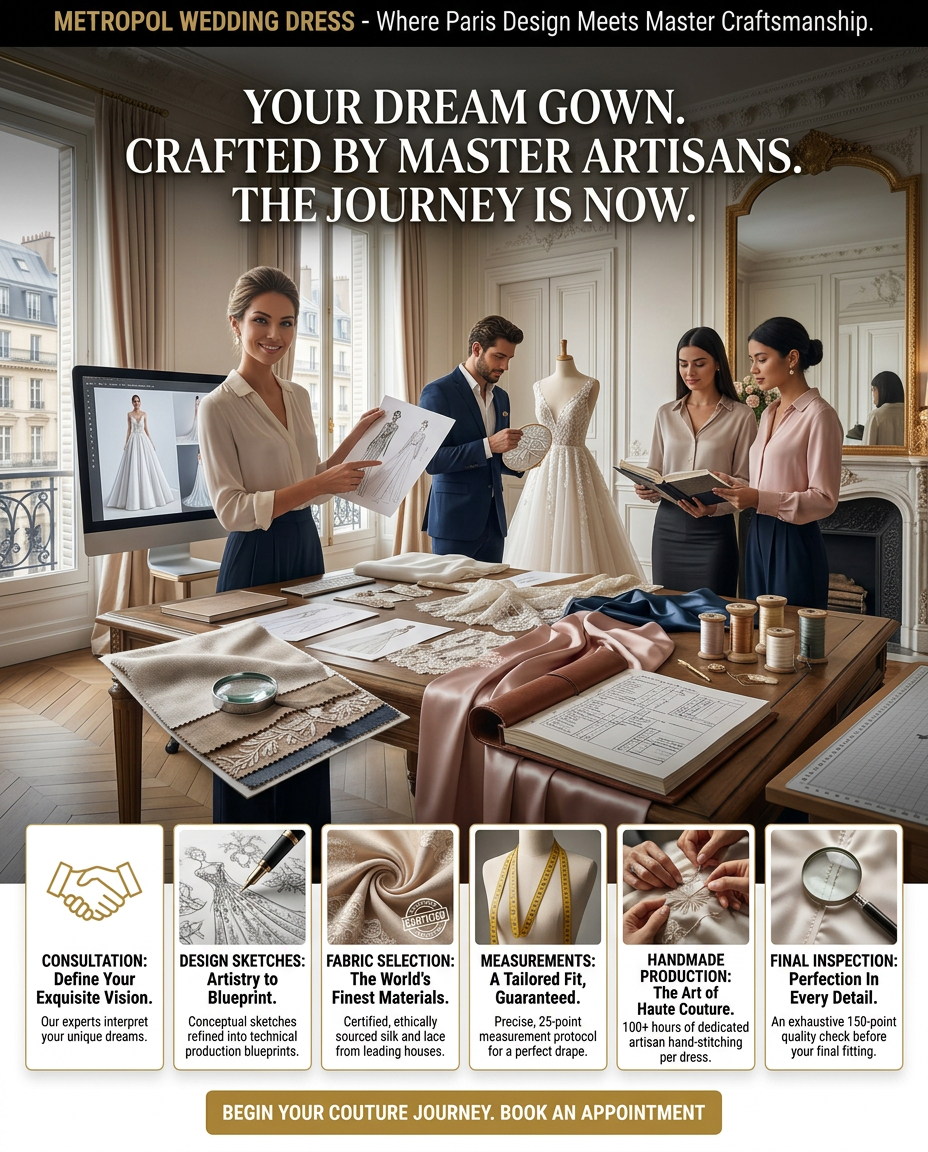
A typical made-to-measure process follows several stages:
- Design selection: The bride chooses an existing gown from a collection, catalogue, or design portfolio.
- Measurement collection: The required body measurements are recorded according to the provider’s instructions.
- Design confirmation: The silhouette, fabric, color, neckline, and available modifications are agreed upon.
- Pattern adjustment: The existing pattern is adapted where necessary to accommodate the bride’s proportions.
- Production: The gown is cut, sewn, assembled, and finished.
- Quality inspection: The dress is checked against the confirmed specifications.
- Fitting and alterations: If included in the service, the bride attends a fitting or arranges final adjustments.
The exact sequence differs between manufacturers. Some create the gown after receiving measurements and ship it directly to the customer. Others incorporate one or more in-person fittings.
Who benefits most from made-to-measure?
Made-to-measure is particularly suitable for brides who:
- Have found a design they love and do not want to change substantially.
- Need proportions that differ from standard sizing.
- Want a more personalized fit without commissioning an entirely new design.
- Prefer a clearer production specification and a relatively predictable process.
- Have a defined wedding date and need to plan around a confirmed delivery schedule.
- Want to choose from established designs with documented construction options.
It can also suit bridal boutiques that want to offer a more personalized service without developing every gown from the beginning.
Made-to-Measure Wedding Dresses vs Custom Wedding Dresses Explained
Imagine a bride who finds a wedding dress with the perfect neckline and skirt, but the standard sample has a bodice that is too long for her torso.
A made-to-measure approach may allow the bodice length and other relevant proportions to be adjusted while preserving the overall appearance of the original gown.
This can be a more efficient solution than developing a completely new dress when the existing design already meets the bride’s aesthetic requirements.
The key is that fit adjustments must be technically appropriate. Simply shortening or lengthening one section can affect the placement of seams, lace, waistlines, and structural support.
2. What Is a Custom Wedding Dress?
A custom wedding dress is developed around a bride’s specific design requirements. The process can begin with a sketch, reference photographs, a mood board, an existing gown, or a detailed discussion about the desired appearance.
Rather than limiting the project to the proportions of an established design, custom work can allow the bride and designer to make broader decisions about the gown’s silhouette, materials, construction, and finishing details.
For example, a bride might want the structured bodice of one dress, the sleeves of another, and a skirt inspired by a vintage gown. She may also want a specific neckline, an unusual back design, or embroidery that reflects a personal story.
A custom design process can bring these elements together into a coordinated garment.
However, custom does not necessarily mean that every part of the gown is invented from scratch. An experienced designer may adapt an existing pattern, combine established construction techniques, or modify a previous design to meet the brief.
What matters is the degree of individual design development and the scope agreed upon before production begins.
What can be personalized?
Depending on the provider, a custom wedding dress may allow decisions about:
- Silhouette and overall proportions.
- Neckline, back design, and sleeve construction.
- Bodice structure and internal support.
- Skirt volume, layers, and train length.
- Fabric, lining, and color combinations.
- Lace placement, embroidery, beadwork, and appliqués.
- Buttons, closures, and decorative finishing.
- Modesty panels or coverage requirements.
- Functional features such as detachable sleeves or overskirts.
- Design details intended to complement the wedding venue or theme.
Not every manufacturer can execute every design. Complex construction, unusual materials, specialized embroidery, and extensive handwork require appropriate technical capabilities.
A responsible provider will explain what is feasible, what requires additional development, and which requests could affect the price or delivery date.
The custom design process
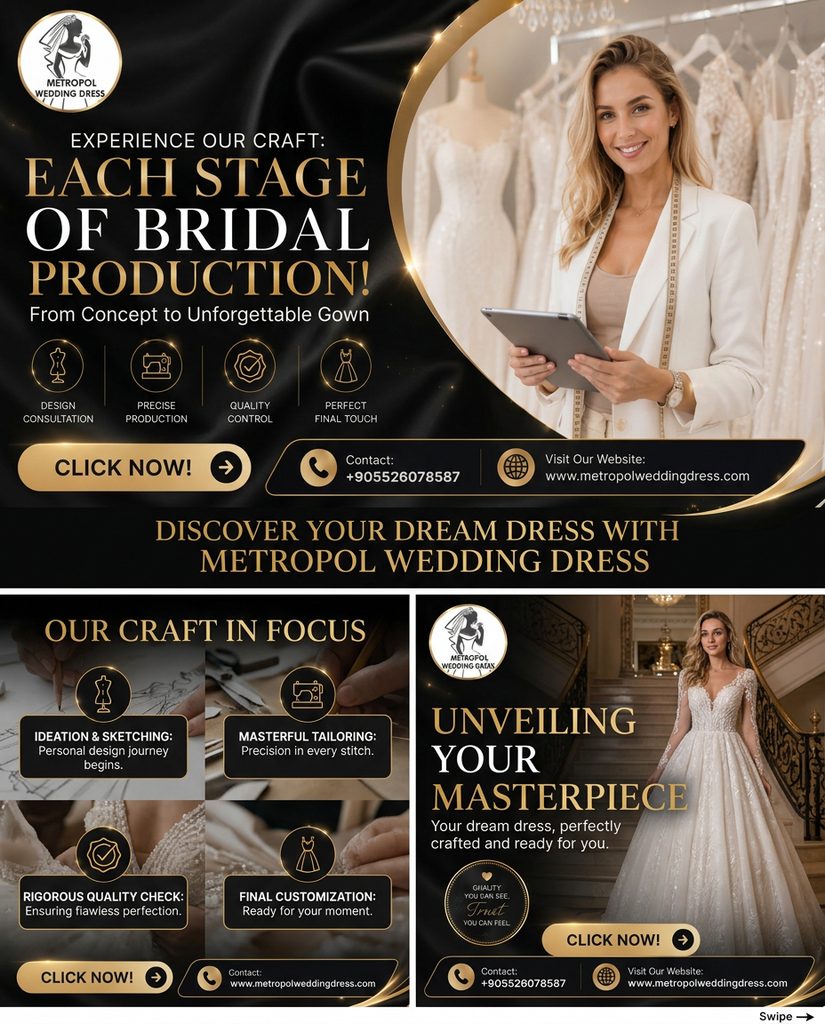
A comprehensive custom project may include the following stages.
Stage 1: Consultation and design brief
The bride describes her vision, preferences, practical requirements, budget, and wedding date. Reference images help communicate the desired aesthetic, but they do not always reveal the underlying construction.
Stage 2: Design development
The designer establishes the silhouette, proportions, materials, decorative elements, and major construction decisions. Sketches, samples, or digital visualizations may be used where available.
Stage 3: Technical assessment
The proposed design is evaluated for fit, support, fabric behavior, seam placement, movement, weight, and production feasibility.
Stage 4: Material confirmation
Fabrics, linings, lace, trims, closures, and embellishments are selected and confirmed. Substitutions should be documented before production.
Stage 5: Pattern development
A new pattern may be created, or an existing pattern may be modified extensively to achieve the intended design.
Stage 6: Sample or fitting development
Depending on the project, the designer may create a toile, muslin mock-up, sample bodice, or preliminary garment to evaluate proportions and construction before using the final materials.
Stage 7: Production and finishing
The approved design is manufactured, including the necessary structural work and decorative detailing.
Stage 8: Final inspection and fitting
The finished gown is checked against the agreed specification. Any included fitting adjustments are completed according to the service agreement.
Not every custom service includes all these stages. Brides should ask which steps are actually provided, especially when working remotely or ordering from an international manufacturer.
Who should consider custom?
Custom wedding dresses are particularly attractive to brides who:
- Have a clear vision that existing collections cannot fully satisfy.
- Want to combine several design references.
- Need unusual proportions or specialized construction.
- Prefer particular fabrics, lace placements, or decorative details.
- Want a gown designed around a distinctive wedding concept.
- Are comfortable participating in a more detailed design and approval process.
Custom work may also be appropriate for boutiques developing exclusive bridal products or businesses seeking a differentiated collection.
The additional creative freedom comes with a responsibility: the more individualized the project, the more important clear communication and written approval become.
3. The Real Difference: Fit Personalization vs Design Personalization
The distinction between made-to-measure and custom wedding dresses becomes clearer when the process is divided into two questions:
- How much is the existing design being adapted to the bride?
- How much is the design itself being developed or changed?
These are separate dimensions. A gown can be highly personalized in fit without being extensively redesigned. Conversely, a custom design can be visually distinctive but still require careful fitting and final alterations.
A practical comparison
| Design or service requirement | Made-to-measure | Custom |
|---|---|---|
| Adjust an established waist position to the bride’s proportions | Commonly possible | Possible |
| Adjust an established sleeve length | Commonly possible | Possible |
| Choose from available fabric options | Often possible | Often possible |
| Replace the original neckline with a substantially different design | Provider-dependent | Often within scope |
| Combine multiple design references | Limited or provider-dependent | Often possible |
| Develop a new silhouette | Usually outside the standard service | Potentially included |
| Create a unique embroidery layout | Depends on available options | May be included |
| Develop a new pattern for a substantially different design | Not usually required | May be required |
| Request several design revisions | Depends on the service | Must be agreed upon |
| Guarantee a perfect fit without a fitting | No | No |
These distinctions are typical rather than universal. Providers use terminology differently, so a detailed specification is more reliable than the service label alone.
Why measurements do not automatically guarantee fit
Taking measurements is only one part of making a wedding dress fit properly.
Two brides can have similar bust, waist, and hip measurements but different body proportions, posture, shoulder angles, torso lengths, or preferences for how closely the gown should fit.
A structured bodice also behaves differently from a soft, flowing dress. A strapless gown may need carefully positioned internal support, while a lightweight chiffon design depends on different construction considerations.
For this reason, a measurement chart cannot replace every element of professional patternmaking and fitting.
A good production process considers the relationship between the measurements, the chosen silhouette, the fabric, and the garment’s construction.
Expert insight: The quality of a personalized wedding dress is determined not by the number of measurements collected, but by how accurately those measurements are translated into a workable pattern and finished garment.

4. Choosing Between the Two: Start With Your Wedding Requirements
Before deciding which service to use, define what the dress needs to accomplish.
The most effective purchasing decision begins with requirements rather than a label.
A bride who wants a classic satin A-line dress with a more precise bodice fit may not need extensive custom design. A bride who wants a dramatic detachable overskirt, unusual sleeves, and a distinctive back may benefit from a custom development process.
The decision framework
| Your priority | Approach worth considering | Reason |
|---|---|---|
| You love an existing design | Made-to-measure | Keeps the established aesthetic while adapting fit |
| Your main concern is proportions | Made-to-measure, with fitting support | Focuses effort on fit and construction |
| You want to combine several designs | Custom | Allows broader design coordination |
| You need a distinctive neckline or back | Custom or an approved design modification | Depends on how much pattern and construction work is needed |
| You want a relatively straightforward ordering process | Made-to-measure | Often involves fewer design decisions |
| You need an exclusive boutique design | Custom development | Can support product differentiation |
| You have a tight wedding schedule | Compare confirmed production plans | Neither label guarantees faster delivery |
| You have a strict budget | Compare itemized quotations | Scope, materials, and alterations drive the actual cost |
A useful rule
Choose made-to-measure when the design is already right and the fit needs attention.
Choose custom when the design itself needs meaningful development.
If both the design and the fit require substantial changes, request a detailed proposal that explains the development stages, fitting arrangements, production schedule, and costs.
5. Wedding Dress Fabrics: Why Material Choice Changes the Result
Fabric is not simply a decorative choice. It affects the appearance, movement, weight, support, drape, and construction requirements of a wedding dress.
The same silhouette can look dramatically different in different materials. A fitted gown made from a structured fabric may create a clean, sculpted appearance, while a soft fabric may produce a more fluid effect.
Fabric selection is particularly important for custom projects because design choices can introduce construction challenges that are not obvious in photographs.
Common bridal fabrics
| Fabric | Typical appearance and behavior | Considerations |
|---|---|---|
| Satin | Smooth surface with a polished or lustrous finish, depending on construction | Shows seam quality, pressing marks, and handling imperfections |
| Crepe | Clean, flowing or sculpted appearance, depending on weight | Requires attention to stretch, recovery, and drape |
| Chiffon | Lightweight, airy, and fluid | Delicate handling and suitable seam finishing are important |
| Tulle | Sheer, lightweight, and useful for volume or layering | Different types vary in softness, stiffness, and feel |
| Organza | Lightweight with more structure than many soft sheers | Can create volume while maintaining shape |
| Lace | Decorative texture with varied patterns and transparency | Placement, joining, and edge finishing affect the final appearance |
| Mikado | Often associated with a structured, substantial bridal look | Weight and stiffness influence the silhouette |
| Silk fabrics | Can provide distinctive drape, texture, and surface character | Fiber content, weave, care, and cost vary considerably |
| Beaded or embroidered fabrics | Add surface detail and visual richness | Weight, snagging, attachment strength, and handling require attention |
Fabric names alone do not establish quality. Satin, for example, describes a weave structure rather than one specific fiber. A satin gown can be made from different fibers and blends, each with different characteristics.
Likewise, two lace fabrics can look similar in photographs but differ in softness, pattern repeat, durability, and the complexity of their application.
How fabric influences made-to-measure production
When the original design is established, the manufacturer may already have experience working with the selected fabric.
That can make material selection and construction planning more predictable, provided the fabric and specifications remain consistent.
However, changing from a lightweight material to a heavier or more structured fabric can alter the way a pattern behaves. A change that appears purely aesthetic may require adjustments to support, seam construction, lining, or skirt volume.
How fabric influences custom production
Custom development can provide more flexibility, but it also introduces more decisions.
For example, a bride requesting a soft, draped skirt with substantial embroidery needs to consider how the weight of the embellishment affects the fabric’s movement.
Similarly, a fitted crepe gown with a long train may require careful attention to stretch, seam placement, and the way the garment moves when walking.
A practical fabric review should consider:
- Fiber content and fabric construction.
- Weight and drape.
- Opacity and lining requirements.
- Stretch and recovery.
- Color and surface finish.
- Embellishment compatibility.
- Comfort against the skin.
- Care requirements.
- Availability and replacement options.
Buyer tip
When appearance is critical, request a physical swatch or representative sample where possible. Photographs can help assess color and texture, but lighting, screens, photography, and fabric finishing can change how a material appears.
For international purchases, confirm whether the approved swatch represents the actual production material and whether substitutions require your written approval.
6. The Construction Details That Matter More Than the Label
A wedding dress may look simple from the outside while requiring substantial technical work inside.
The quality of a gown is influenced by pattern accuracy, seam execution, internal support, lining, finishing, and how the components work together.
These details matter for both made-to-measure and custom garments.
Bodice structure and support
A structured bodice may include interlining, boning, cups, waist stays, or other support elements, depending on the design.
The correct construction depends on the silhouette, fabric, intended fit, and the amount of support required.
A strapless gown, for example, needs to remain secure while the bride stands, sits, walks, and dances. A gown that relies on the correct bust and waist proportions may not perform well if the pattern is adjusted without considering the supporting structure.
Seam placement and pattern accuracy
Seams help shape the garment and determine how it follows the body.
If the pattern does not account for the bride’s proportions, pulling, twisting, or unwanted folds may appear even when the dress uses high-quality fabric.
A technically sound adjustment considers the entire garment rather than treating each measurement as an isolated number.
Lining and internal finishing
Lining affects comfort, opacity, structure, and the way a dress sits against the body.
Quality checks should examine whether linings are smooth, whether seams are finished appropriately, and whether internal components remain comfortable during movement.
Lace application and embellishments
Lace placement can be particularly important around the neckline, bodice seams, waist, sleeves, and back.
Hand-applied lace, machine embroidery, beadwork, and appliqués involve different levels of labor and technical skill.
For custom designs, the placement of embellishments should be agreed upon before production. Words such as “more lace” or “extra sparkle” can mean different things to different people.
Reference images, placement sketches, and approved samples reduce ambiguity.
The train and hem
The hem should work with the gown’s fabric, skirt construction, and intended footwear.
A long train can look impressive but may require a bustle, fastening system, or assistance during parts of the wedding.
If the bride expects to move between a ceremony, photographs, dinner, and dancing, train management should be part of the design discussion.
The practical lesson: A beautiful photograph shows the exterior of a wedding dress. A meaningful quality assessment also considers its structure, finishing, movement, and function.
7. Pricing Explained: What Are You Actually Paying For?
The price of a made-to-measure or custom wedding dress cannot be determined reliably from the label alone.
Two made-to-measure dresses may have very different prices because of fabric, construction, embellishment, and design complexity. Two custom gowns may also differ substantially in cost depending on the amount of development and handwork involved.
A useful quotation separates the main cost drivers instead of presenting personalization as a single unexplained premium.
Main cost components
1. Materials
The fabric, lining, lace, closures, thread, structural components, and embellishments all contribute to the cost.
Material selection can also influence waste, cutting complexity, and the availability of matching replacements.
2. Patternmaking and design development
An established pattern may require relatively limited adaptation. A new design may involve sketches, pattern development, prototypes, and revisions.
3. Cutting and sewing
The time required depends on the silhouette, fabric behavior, number of components, construction method, and precision required.
4. Embellishment and finishing
Hand-applied lace, beadwork, embroidery, decorative buttons, and intricate finishing can require significant labor.
5. Fittings and alterations
The quotation should clarify how many fittings or adjustment rounds are included and what happens if the finished garment needs further work.
6. Quality control
Inspection time, measurement verification, finishing checks, and packaging contribute to a dependable production process.
7. Delivery and logistics
Shipping, insurance, packaging, import duties, taxes, and possible local alteration costs may affect the final expenditure.
Total cost of ownership
For a bride, the relevant figure is not necessarily the quoted dress price. It is the total cost of receiving a gown that meets the agreed requirements and is ready for the wedding.
A simple comparison is:
| Cost category | Questions to ask |
|---|---|
| Base garment | What exactly is included? |
| Design changes | Which modifications incur additional charges? |
| Fabric | Is the selected material included in the quotation? |
| Embellishments | Are placement, quantity, and application specified? |
| Fittings | How many sessions or adjustment rounds are included? |
| Alterations | Who pays if changes are needed after delivery? |
| Shipping | Is delivery included, and what service is used? |
| Import charges | Who is responsible for applicable duties and taxes? |
| Packaging | Is the garment packaged for international transport? |
| Deadline management | Are expedited services available, and at what cost? |
This approach is especially useful when comparing suppliers in different countries.
A hypothetical purchasing example
Consider two quotations for wedding dresses with similar visual appeal.
Supplier A offers a made-to-measure gown at a lower initial price, but alterations, shipping, and certain design changes are charged separately.
Supplier B offers a more comprehensive package that includes specified modifications, a defined quality inspection, and a clear delivery arrangement.
Supplier B may have the higher initial quotation but the lower overall cost once all required services are considered.
The reverse can also be true. A supplier with a higher quotation is not automatically better.
The correct comparison is based on equivalent specifications, confirmed inclusions, realistic delivery costs, and the risks associated with each offer.
A note on deposits and payment schedules
For custom work, ask when the deposit becomes non-refundable, what happens if the design changes, and how payments correspond to production milestones.
For both service types, review cancellation terms, revision limits, and the process for addressing defects or specification mismatches before placing the order.
8. Production Timelines: How to Protect Your Wedding Date
Wedding dress production involves more than the time required to sew the garment.
The full schedule may include consultation, measurement collection, design approval, material procurement, patternmaking, production, quality inspection, shipping, and final alterations.
The timeline depends on the supplier’s workflow, workload, material availability, location, and the complexity of the order.
A made-to-measure dress can sometimes follow a more predictable process because the design and pattern are established. A custom dress may require additional time for design development and approval.
However, neither category is automatically faster. A simple custom design can be straightforward, while a heavily embellished made-to-measure gown may require extensive work.
Build the schedule backward from the wedding
Start with the date on which the dress must be ready to wear.
Then work backward to establish deadlines for:
- Final fitting and any necessary alterations.
- Delivery to the bride or boutique.
- Production completion.
- Material and design approval.
- Measurement submission.
- Initial consultation and ordering.
Add a contingency period appropriate to the route, supplier, and complexity of the order.
For international deliveries, consider customs processing, carrier delays, public holidays, and the availability of a local alteration professional.
Timeline questions worth asking
- Is the quoted timeline a production estimate or a guaranteed delivery commitment?
- When does the production clock begin?
- Does the timeline include material procurement?
- Are fitting appointments included?
- What happens if an approved material becomes unavailable?
- How are delays communicated?
- Is expedited production possible?
- Can the supplier provide progress updates or milestone confirmations?
- How much time should be reserved for local alterations?
- What remedy is available if the agreed delivery deadline is missed?
A written schedule with clear milestones is more useful than a general promise that the dress will be completed “in time.”
For brides with a fixed wedding date, delivery risk should be treated as a purchasing criterion, not an afterthought.
9. Measurements and Fittings: How to Avoid Preventable Problems
Accurate measurements are essential, but the measurement process must be appropriate to the gown and the provider’s patternmaking method.
Different designers may request different measurements. A structured gown, a fitted sheath, and a flowing empire-waist dress do not necessarily require identical measurement sets.
The bride should always follow the manufacturer’s instructions rather than relying on a generic chart.
Common measurement considerations
Depending on the design, the supplier may request:
- Bust circumference.
- Waist circumference.
- Hip circumference.
- Shoulder width.
- Shoulder-to-waist length.
- Front and back bodice lengths.
- Hollow-to-hem or another specified length measurement.
- Sleeve length and upper-arm circumference.
- Height and intended heel height.
- Additional measurements relevant to the neckline, back, or silhouette.
These are examples, not a universal measurement checklist.
Why posture matters
Measurement accuracy is affected by posture, undergarments, footwear, tape placement, and the way the body is positioned.
For a strapless or structured gown, measurements taken with inappropriate posture or without following the requested instructions may create avoidable fit problems.
If a bride is measuring herself remotely, a second person may help. For complex designs, professional measurement assistance is worth considering.
When fittings are available
A fitting allows the bride and dressmaker to assess more than circumference measurements.
They can evaluate how the gown hangs, where the waistline sits, whether the bodice remains secure, how the skirt moves, and whether the design matches the approved brief.
Fitting is also the opportunity to assess functional requirements such as walking, sitting, raising the arms, and managing a train.
When fittings are not available
Remote orders require a more structured process.
The bride should confirm:
- Which measurements are mandatory.
- Whether photographs or video consultations are required.
- Whether the provider can review measurements before cutting.
- Whether a mock-up or sample is available for complex work.
- How the provider handles fit concerns after delivery.
- Whether local alterations are expected and who pays for them.
A remote service can work well, but it should not be presented as a guarantee that no alterations will ever be necessary.
10. Buying a Wedding Dress From an International Manufacturer
For international brides, bridal boutiques, and wholesale buyers, the purchasing process involves additional considerations beyond the design itself.
A supplier may offer attractive designs and competitive pricing, but the buyer still needs clarity about specifications, communication, production, shipping, and responsibility for any problems.
This is especially important when the buyer cannot visit the production facility or attend an in-person fitting.
Evaluate the supplier, not just the sample
A finished sample provides useful information about a particular garment. It does not, by itself, establish the consistency of future production or the supplier’s ability to meet every specification.
Ask how the manufacturer documents orders, approves materials, checks measurements, inspects finished gowns, and handles discrepancies.
For repeat orders, inquire about whether approved patterns and specifications can be retained for future production, and under what conditions.
Request a written specification
A practical specification should identify the selected design and document the relevant details.
Depending on the order, it may include:
- Design or model reference.
- Approved measurements and sizing method.
- Fabric and lining specifications.
- Color and finish.
- Neckline, sleeves, and back design.
- Skirt shape and train length.
- Lace, embroidery, and embellishment placement.
- Closure and support details.
- Agreed modifications.
- Quality inspection requirements.
- Packaging and shipping arrangements.
- Required delivery date.
For custom designs, sketches and reference images should be accompanied by written notes explaining the intended changes.
This reduces the risk of a supplier interpreting a photograph differently from the buyer.
Clarify commercial responsibilities
Before payment, establish the responsibilities of both parties.
Ask who is responsible for:
- Material substitutions.
- Approval of design revisions.
- Measurement errors.
- Manufacturing defects.
- Shipping insurance.
- Import duties and taxes.
- Customs documentation.
- Delivery delays.
- Returns, repairs, or replacement arrangements.
For international shipments, clarify the delivery term and the allocation of transport costs and risk. If Incoterms are used, specify the applicable rule and named place rather than relying on a vague statement such as “shipping included.”
Import requirements vary by destination. Buyers should verify the relevant customs, tax, and product documentation requirements with qualified local sources.
Questions for wholesale buyers
Retailers and bridal boutiques should also consider:
- Minimum order quantities.
- Sample-order policies.
- Available size ranges.
- Repeat-order consistency.
- Lead times for collection replenishment.
- Packaging and labeling options.
- Exclusive design arrangements.
- Defect reporting procedures.
- Payment terms.
- Production capacity during peak periods.
A supplier relationship should be evaluated across the entire order cycle, from the first sample to repeat production and after-sales communication.
11. Made-to-Measure and Custom Wedding Dresses for Bridal Boutiques
For a bridal boutique, the choice between made-to-measure and custom production is also a business-model decision.
Made-to-measure can help a retailer serve customers who want a more personalized fit without commissioning a new design for every order.
Custom development can help the boutique differentiate its offering, establish a recognizable aesthetic, or introduce exclusive designs.
The appropriate model depends on customer demand, operational capacity, margins, inventory strategy, and the supplier’s capabilities.
Made-to-measure as a retail service
A boutique may offer a curated collection of established designs and allow customers to order selected gowns according to their measurements.
Potential advantages include:
- A clear collection identity.
- More consistent product specifications.
- Reduced dependence on carrying every standard size as finished inventory.
- A structured consultation process.
- Opportunities to serve customers who need non-standard proportions.
However, the retailer still needs to manage measurement accuracy, customer expectations, delivery promises, and the possibility of alterations.
Custom design as a differentiation strategy
Custom development may allow a boutique to create designs that are less directly comparable with mass-market products.
This can support a distinctive customer experience, but it requires stronger coordination between sales, design, production, and quality control.
The boutique must also account for development costs, sample creation, approval time, and the possibility that a design may not perform commercially.
A practical assortment strategy
Rather than choosing one model exclusively, a retailer may consider three levels of service:
| Service level | Customer proposition | Operational focus |
|---|---|---|
| Established collection | Recognizable designs with defined specifications | Product selection, fit, and delivery |
| Made-to-measure | Established designs adapted to individual measurements | Measurement accuracy and controlled modifications |
| Custom development | More individualized design and construction | Design briefing, approvals, technical development, and project management |
This structure helps customers understand the difference between available services without assuming that one is universally superior.
It also helps sales teams explain why a request may require a different production route or quotation.
12. The Purchasing Manager’s Checklist: How to Compare Suppliers Fairly
When comparing wedding dress suppliers, purchasing managers should avoid evaluating quotations solely by price or catalogue appearance.
A useful evaluation considers product suitability, production reliability, quality controls, communication, and the full cost of receiving the agreed product.
The following checklist can be used for both individual custom orders and commercial sourcing.
Supplier evaluation checklist
Product and design
- Is the design reference clearly identified?
- Are fabric and trim specifications documented?
- Are measurements and fit expectations defined?
- Are permitted modifications listed?
- Are photographs, sketches, and samples consistent with the written brief?
Production capability
- Can the supplier explain its patternmaking and construction process?
- Does it have experience with the requested silhouette and materials?
- Are design changes assessed for technical feasibility?
- Are material substitutions subject to approval?
- Are production milestones documented?
Quality assurance
- Is there a defined final inspection process?
- Are measurement tolerances specified where relevant?
- Are seams, lining, closures, embellishments, and hems inspected?
- Is the finished gown checked against the approved order?
- Is there a documented process for defects or discrepancies?
Commercial terms
- Is the quotation itemized?
- Are deposits and payment milestones clear?
- Are revisions and alterations included or charged separately?
- Are shipping costs and responsibilities documented?
- Are cancellation and dispute procedures explained?
Delivery and communication
- Is the delivery date confirmed in writing?
- Does the schedule include inspection and packaging?
- Is there a contingency plan for material or transport delays?
- Is there a clear point of contact?
- Are progress updates available?
For a wholesale relationship, also evaluate repeat-order consistency, production capacity, minimum order quantities, and the supplier’s ability to maintain specifications across multiple units.
How to make the final decision
Assign importance to the criteria that matter most for the order.
For a bride with a fixed wedding date, delivery reliability and fit support may be more important than a minor difference in price.
For a boutique, repeatability, commercial terms, and product differentiation may carry more weight.
For a highly individualized custom gown, design communication and technical feasibility may be decisive.
The best supplier is the one whose verified capabilities match the project’s requirements—not necessarily the one with the lowest price or the most impressive photographs.
13. Common Mistakes When Ordering a Made-to-Measure or Custom Wedding Dress
Many avoidable problems begin before production starts.
The most effective way to reduce risk is to identify assumptions early and replace them with written agreements.
Mistake 1: Assuming made-to-measure means no alterations
Made-to-measure production is intended to personalize fit, but body measurements, fabric behavior, posture, construction, and fitting conditions can still create a need for adjustments.
Better approach: Ask whether fittings and post-delivery alterations are included, and establish who is responsible for additional work.
Mistake 2: Assuming custom means unlimited design freedom
A custom service may have restrictions relating to materials, production techniques, budget, or delivery time.
Better approach: Obtain confirmation that the proposed design is technically feasible before approving the order.
Mistake 3: Choosing a fabric from a photograph alone
Photographs cannot reliably communicate every aspect of texture, weight, drape, transparency, or surface finish.
Better approach: Request swatches or representative samples when these properties materially affect the decision.
Mistake 4: Changing design details after approval
Late changes may affect patternmaking, material use, construction, cost, and delivery.
Better approach: Finalize the main design decisions before production and require a revised quotation and schedule for later changes.
Mistake 5: Providing measurements without following instructions
Measurements collected using inconsistent methods can lead to an inaccurate pattern.
Better approach: Use the supplier’s measurement guide, confirm the required footwear and undergarments, and ask for clarification whenever a measurement is uncertain.
Mistake 6: Comparing quotations with different scopes
One quote may include a veil, train modifications, or shipping, while another may cover only the gown.
Better approach: Compare equivalent specifications and calculate the total expected cost.
Mistake 7: Ignoring the final fitting window
A dress arriving shortly before the wedding may leave insufficient time for alterations or resolving an unexpected issue.
Better approach: Plan around the date the gown must be ready to wear, not merely the expected production completion date.
Mistake 8: Treating sample quality as proof of every production capability
A sample can demonstrate a particular result, but broader claims about capacity and consistency require additional evidence.
Better approach: Review production procedures, sample-to-order controls, inspection methods, and references where available.
Mistake 9: Leaving lace placement or embellishments undefined
Terms such as “more detailed” or “similar to the reference” are open to interpretation.
Better approach: Use annotated images, sketches, sample approval, and written descriptions.
Mistake 10: Forgetting international delivery and import costs
The purchase price may not include insurance, customs charges, local alterations, or other expenses.
Better approach: Calculate the full landed and ready-to-wear cost before committing.
14. Realistic Buying Scenarios: Which Approach Makes Sense?
The following examples illustrate how the decision changes according to the bride’s priorities. They are hypothetical scenarios, not claims about individual customers or guaranteed production outcomes.
Scenario A: The bride who has already found her dream dress
A bride loves an established design with a fitted bodice and a flowing skirt. Her main concerns are bodice proportions and sleeve length.
Likely starting point: Made-to-measure.
The design already satisfies her aesthetic requirements, so the focus can remain on fit and approved adjustments.
A custom redesign may be unnecessary unless the requested changes substantially alter the original pattern or construction.
Scenario B: The bride combining several references
A bride wants the neckline from one dress, the back from another, and a skirt with a different structure.
Likely starting point: Custom development or a specifically scoped design modification.
The designer needs to assess how the requested components work together. The combination may affect patternmaking, support, seam placement, and material selection.
The important question is not whether the dress is called custom, but whether the proposed service covers all the required changes.
Scenario C: The bride with a fixed wedding date
A bride has a wedding approaching and wants a personalized gown.
Best approach: Compare confirmed production schedules rather than relying on category labels.
An established design may involve fewer development stages, but actual lead times depend on workload, materials, and fitting arrangements.
The bride should confirm the delivery date, contingency period, and alteration plan before ordering.
Scenario D: The boutique developing an exclusive bridal collection
A retailer wants to introduce gowns that reflect its brand identity while maintaining a manageable production process.
Potential approach: Combine established made-to-measure designs with a smaller number of custom-developed styles.
This can balance collection consistency with differentiation. The retailer should assess sample costs, production repeatability, expected demand, and supplier capacity before expanding the assortment.
Scenario E: The international buyer evaluating two manufacturers
One supplier offers a lower base price, while another provides more detailed specifications and inspection documentation.
Best approach: Compare total cost, risk, and contractual scope.
A lower price may be attractive, but the buyer should verify material specifications, production standards, shipping arrangements, and the remedy available for discrepancies.
Documentation does not automatically prove quality, but clear procedures make expectations easier to manage and verify.
15. How Metropol Wedding Dress Can Support a More Informed Bridal Purchase
Selecting a wedding dress should be an informed process rather than a decision based solely on a photograph.
For brides, that means identifying the design they want, understanding their fit requirements, and clarifying what the chosen service includes.
For bridal boutiques and trade buyers, it means evaluating specifications, manufacturing capability, delivery commitments, and commercial terms.
Metropol Wedding Dress can be positioned around this practical approach to bridal selection: helping customers understand the relationship between design, fit, materials, and production requirements.
When discussing a specific gown or order, the most useful starting point is a clear brief covering:
- The preferred design or silhouette.
- The measurements and fit requirements.
- The materials and decorative details.
- The requested modifications.
- The wedding or delivery date.
- The budget and service expectations.
From there, the appropriate production route can be evaluated according to the actual requirements.
For brides who love an existing design, a made-to-measure approach may provide the personalization they need. For brides seeking more extensive creative freedom, a custom development process may be more appropriate.
The right solution is the one that brings the desired design, realistic production requirements, and confirmed service scope into alignment.
16. Five Ways to Start Your Wedding Dress Journey With Metropol Wedding Dress
The following calls to action serve different visitor needs and can be placed at appropriate points throughout a landing page. Use only the services, guarantees, and contact options that Metropol Wedding Dress actually provides.
CTA 1: For brides who want a personalized fit
Your Wedding Dress Should Feel Like Yours
Found a design you love? Explore the available personalization options and clarify which measurements and fit adjustments can be accommodated.
Next step: Discuss your preferred design and fit requirements with Metropol Wedding Dress.
CTA 2: For brides with a unique design in mind
Bring Your Bridal Vision Into Focus
From silhouette and neckline to fabric and finishing details, a clear design brief is the first step toward a gown that reflects your personal style.
Next step: Prepare your reference images and design preferences for a consultation.
CTA 3: For buyers who value informed decisions
Compare Your Options Before You Commit
Understand the differences between made-to-measure and custom production, including design flexibility, fittings, costs, and lead times.
Next step: Request a specification-based discussion of your requirements.
CTA 4: For bridal boutiques and retailers
Build a Bridal Assortment Around Your Customers
Evaluate established designs, personalization opportunities, and custom development according to your target market and purchasing needs.
Next step: Contact Metropol Wedding Dress to discuss your collection requirements and commercial objectives.
CTA 5: For international buyers
Plan Your Next Bridal Order With Clarity
A successful international purchase begins with clear specifications, confirmed production milestones, and an agreed delivery arrangement.
Next step: Prepare your product brief, quantities, destination, and target dates before requesting a quotation.
Conclusion: Which Wedding Dress Option Is Right for You?
Made-to-measure and custom wedding dresses both offer alternatives to selecting a gown exclusively from standard ready-to-wear sizing. Their main difference lies in the extent to which the established design is retained or individually developed.
A made-to-measure wedding dress is often the practical choice when the bride loves an existing design and wants it adapted to her proportions. A custom wedding dress is worth considering when the design itself requires more substantial personalization.
Neither option guarantees superior craftsmanship, lower cost, faster delivery, or a perfect fit. Those outcomes depend on the provider’s capabilities, materials, construction methods, measurement process, quality controls, and agreed service scope.
Before ordering, establish what is included, which decisions remain open, how fitting and alterations are handled, and when the gown will be ready.
For brides, this creates a clearer path toward a dress that reflects their style and practical needs. For bridal boutiques and international buyers, it supports better product selection, supplier evaluation, and purchasing decisions.
The best wedding dress is not necessarily the most customized or the most expensive. It is the one whose design, fit, craftsmanship, and delivery arrangements meet your requirements.
With a well-defined brief and realistic expectations, Metropol Wedding Dress can be part of a more informed approach to choosing or sourcing a wedding dress.
Frequently Asked Questions (FAQ)
1. What is the main difference between a made-to-measure and a custom wedding dress?
A made-to-measure dress generally starts with an existing design or pattern that is adapted to the bride’s measurements. A custom wedding dress may involve broader design development, including changes to the silhouette, neckline, materials, and construction. The precise distinction depends on the provider’s service definition.
2. Is a custom wedding dress always better than a made-to-measure dress?
No. Custom design offers greater potential flexibility, but it does not automatically mean better materials, construction, or fit. A well-made made-to-measure gown can be the better choice when an established design already meets the bride’s needs.
3. Can I change the neckline of a made-to-measure wedding dress?
Sometimes. Minor modifications may be available, but a substantial neckline change can affect patternmaking, support, and construction. Ask the designer whether the requested modification is included and whether it changes the quotation or production schedule.
4. Does a made-to-measure wedding dress require a fitting?
Not always, but fitting arrangements vary. Some services include in-person fittings, while others produce the gown using submitted measurements. Even when a fitting is not included, final alterations may be advisable depending on the design and result.
5. Can a custom wedding dress be based on an existing design?
Yes. Custom work can begin with an existing gown, sketch, photograph, or pattern. The degree of personalization depends on the agreed brief and the technical changes required.
6. Which option is better for a bride with non-standard proportions?
Made-to-measure can be a good starting point when the existing design suits the bride but standard proportions do not. Custom development may be more appropriate when the body proportions, design requirements, and structural changes need to be addressed together.
7. Are made-to-measure wedding dresses cheaper than custom gowns?
They can be, particularly when an established pattern reduces development work. However, material selection, embellishments, construction complexity, fittings, and alterations can change the total cost. Compare itemized quotations rather than relying on the category name.
8. Why can two custom wedding dresses have very different prices?
Their costs may reflect differences in fabric, pattern development, construction, handwork, embellishments, fittings, and revisions. A simple custom gown may require less development than a heavily embroidered gown with complex internal structure.
9. Can I choose my own fabric for a made-to-measure dress?
That depends on the provider. Some offer a defined selection of materials, while others may accept additional requests. Changing the fabric can affect drape, fit, support, production methods, and price.
10. What should I provide when requesting a custom wedding dress?
Prepare reference images, a description of your preferred silhouette, fabric preferences, measurements where requested, your wedding date, budget, and any functional requirements. Clearly identify which details are essential and which are flexible.
11. How do I know whether a reference photograph can be reproduced?
A photograph communicates appearance but may not reveal the original construction, fabric composition, or pattern. Ask the designer to assess feasibility and explain which elements can be reproduced, adapted, or substituted.
12. Can a custom wedding dress combine several different designs?
Yes, subject to technical feasibility. The designer must evaluate how the selected elements work together, particularly around the bodice, neckline, sleeves, seams, and skirt. Combining references may require additional development and revisions.
13. Does made-to-measure mean the dress will fit perfectly on delivery?
No. Measurements improve personalization, but fit also depends on pattern accuracy, posture, fabric behavior, construction, and the intended fit. Clarify the fitting and alteration arrangements before ordering.
14. Which wedding dress option is faster to produce?
Neither is always faster. Made-to-measure may require fewer design-development stages, while custom work may involve additional approvals and pattern changes. Actual lead time depends on the supplier, design complexity, materials, workload, and shipping.
15. When should I order my wedding dress?
Begin planning as early as practical, particularly if the design is complex or the dress must travel internationally. Work backward from the date the gown must be ready to wear, allowing time for production, delivery, fitting, and alterations. Confirm the schedule with the provider.
16. Can I request changes after approving the design?
You can ask, but changes may affect cost, materials, production, and delivery. The provider should explain how revisions are handled and whether the original quotation remains valid.
17. Which fabrics work best for custom wedding dresses?
There is no single best fabric. Satin, crepe, chiffon, tulle, organza, lace, and other materials serve different design purposes. Selection should consider the desired silhouette, drape, structure, comfort, embellishments, and budget.
18. Is a fabric swatch necessary when ordering internationally?
It is strongly worth considering when color, texture, weight, or surface finish is important. A swatch can provide a more useful reference than a photograph, although it should still be confirmed as representative of the intended production material.
19. What should I check in the construction of a wedding dress?
Review seam quality, lining, internal support, closures, embellishment attachment, hem finishing, and overall symmetry. For structured gowns, assess whether the bodice remains secure and whether the dress allows the required movement.
20. How can I reduce the risk of receiving a dress that differs from the approved design?
Use a written specification, approved fabric references, annotated images, clear measurement instructions, and documented design changes. Confirm whether the finished garment is inspected against the approved requirements before dispatch.
21. Can I order a custom wedding dress remotely?
Yes, depending on the provider’s process. Remote orders require clear communication, accurate measurements, material confirmation, and an agreed procedure for fitting concerns or post-delivery alterations.
22. Who should pay for alterations after delivery?
Responsibility depends on the agreement and the reason for the alteration. Normal fit adjustments, customer-requested changes, measurement errors, and manufacturing defects may be treated differently. Confirm these terms before placing the order.
23. What is a toile or muslin fitting?
A toile or muslin is a preliminary garment or sample used to assess aspects of the pattern, shape, and fit before the final fabric is used. It can be particularly useful for complex designs, although not every custom service includes one.
24. Can a made-to-measure dress include hand-applied lace or beadwork?
Yes, if the provider offers those options. Made-to-measure describes the relationship between the design and the bride’s measurements; it does not necessarily limit the level of embellishment or craftsmanship.
25. What is the difference between made-to-measure and bespoke?
Usage varies by designer and market. Made-to-measure generally refers to adapting an established design to individual measurements. Bespoke often suggests a highly individualized process, potentially involving a new pattern and multiple fittings. Always confirm what the service actually includes.
26. What should a bridal boutique ask a wedding dress manufacturer?
A boutique should clarify product specifications, sample policies, production capacity, minimum order quantities, pricing, lead times, quality controls, repeat-order consistency, packaging, and defect procedures. Commercial terms should be documented before placing an order.
27. Can international buyers request exclusive wedding dress designs?
Potentially, depending on the manufacturer’s capabilities and commercial policies. Buyers should establish ownership or permitted use of the design, exclusivity scope, territory, duration, production arrangements, and any additional development costs in writing.
28. What additional costs should international wedding dress buyers consider?
Potential costs include shipping, insurance, import duties, taxes, customs handling, payment fees, local alterations, and special packaging. The exact charges depend on the destination and agreed delivery terms.
29. How should I compare two wedding dress quotations?
Compare equivalent designs and specifications, including fabric, lining, embellishments, modifications, fittings, delivery, and after-sales arrangements. Calculate the expected total cost and evaluate the evidence supporting each supplier’s quality and delivery commitments.
30. What happens if the selected fabric becomes unavailable during production?
The supplier should communicate the issue and explain the available alternatives. Confirm whether substitutions require your approval, whether the alternative changes the cost or appearance, and how the revised decision affects delivery.
31. Can I request a detachable train or sleeves?
Often, but feasibility depends on the design and construction. Detachable components need appropriate attachment points and must work with the gown’s weight, balance, and intended movement. Confirm whether the feature is included in the original scope.
32. What is the most important consideration when choosing between the two options?
Start by identifying whether the existing design already meets your needs. If it does and the main priority is fit, made-to-measure may be appropriate. If the design requires substantial individual development, consider custom work. In either case, confirm quality, price, fitting arrangements, and delivery in writing.
33. Can made-to-measure wedding dresses be ordered for wholesale?
Some manufacturers offer made-to-measure services to trade customers, while others focus on individual orders or standardized collections. Retailers should confirm minimum quantities, ordering procedures, measurement requirements, production capacity, and commercial terms directly with the supplier.
34. Does custom production guarantee exclusivity?
No. Customization does not automatically grant intellectual property rights or prevent a design from being sold to others. If exclusivity matters, specify the permitted use, ownership, territory, duration, and restrictions in a written agreement.
35. How can I decide whether a design change is worth the additional cost?
Evaluate the change according to its visual importance, functional benefit, construction requirements, and impact on the overall budget and timeline. Prioritize the details that materially improve the gown rather than adding modifications simply because they are available.
36. What information should be confirmed before a wedding dress is shipped?
Confirm the final design specification, agreed measurements, material and color references, inspection status, packaging, shipping method, delivery address, tracking arrangements, and responsibility for applicable import charges. Also establish whom to contact if the delivered garment does not match the agreement.
37. Is the most expensive wedding dress necessarily the highest quality?
No. Price can reflect material costs, design development, labor, embellishments, and commercial positioning. Quality should be evaluated through construction, finishing, material suitability, fit, inspection procedures, and the provider’s ability to meet the agreed specification.
38. How can Metropol Wedding Dress help me choose the right option?
Start by identifying your preferred design, fit requirements, material preferences, delivery date, and budget. These details help establish whether an existing design with personalized measurements or a more extensively developed custom design is the more suitable route. Confirm the available services and exact inclusions directly with Metropol Wedding Dress.
Final takeaway: Made-to-measure is primarily about adapting an established design to the bride. Custom wedding dress production can go further by developing the design itself. A clear brief, realistic timeline, suitable materials, and written production specifications are the foundations of a successful purchase.
SEO publishing note: Before publishing, add verified Metropol Wedding Dress contact details, relevant product or collection links, original gown photography, and only those service claims that the brand can substantiate. This will make the landing page more useful to prospective customers and strengthen its credibility.
Related Topics

20.01.2026
Luxury Custom Wedding Dresses Offered by High End Bridal Boutiques Where Luxury Meets Personal Expression A wedding dress is far more than fabric stitched into a beautiful silhouette. It is a deeply personal statement, a...

17.01.2026
Exporting High End Wedding Dresses to the USA has become one of the most attractive opportunities in the global bridal fashion industry. The United States represents the largest wedding market in the world, driven by...

18.08.2025
Bridal Gown Supplier Online the ever-evolving world of wedding planning, one element remains timeless: the bridal gown. For brides-to-be, selecting the perfect dress is not just about style—it’s about capturing the essence of their personality,...
18.04.2025
Turkish bridal fashion online The world of Turkish bridal fashion is a mesmerizing blend of tradition, craftsmanship, and modern elegance. With the rise of online platforms, accessing stunning Turkish bridal designs has never been easier....

24.04.2025
Shop Turkish Wedding Gowns What to Consider When Buying a Ready-Made Wedding DressWhat to Consider When Buying a Ready-Made Wedding Dress Here are a few important points to consider when buying a ready-made wedding dress:...

17.04.2025
Affordable Wholesale Bridal Dresses Shop Now Save More Bridal dresses are the centerpiece of any wedding, embodying elegance, romance, and personal style. However, the cost of wedding gowns can be daunting, often stretching budgets to...
Comments