
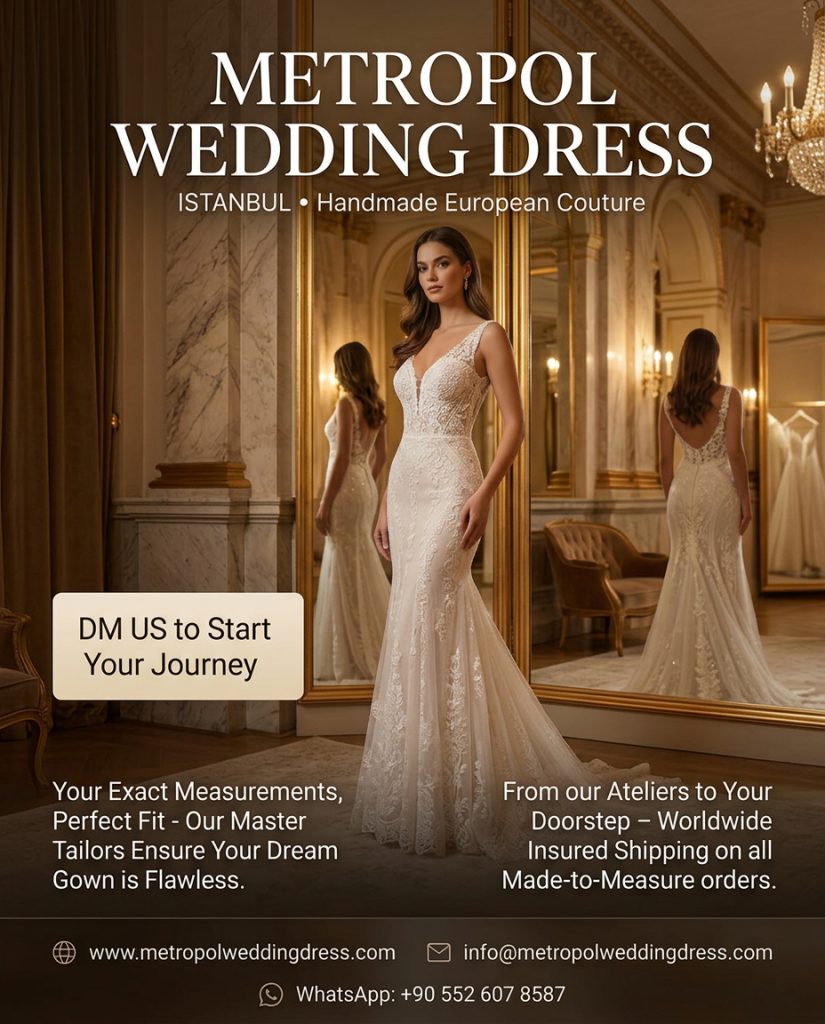
Made to Measure Long Sleeve Wedding Dresses for Every Season Made-to-measure long sleeve wedding dresses combine individual fit, refined craftsmanship, and season-conscious design to help brides find a gown that feels as exceptional as it looks. From lightweight lace dresses for spring ceremonies to breathable satin designs for summer celebrations, structured autumn gowns, and luxurious winter bridal creations, the right combination of fabric, sleeve construction, lining, and silhouette can transform the entire wedding-day experience.
At Metropol Wedding Dress, the made-to-measure approach offers an opportunity to explore bridal designs around personal measurements, preferred styling, ceremony setting, and seasonal requirements. Whether a bride imagines delicate lace sleeves, an elegant high neckline, a minimalist crepe silhouette, or an intricately detailed couture-inspired gown, thoughtful customization can help bring that vision to life.
This guide explains how to choose a long sleeve wedding dress for every season, what to consider when selecting fabrics and sleeve styles, how to plan fittings, and which questions to ask before placing an order. It is designed for brides seeking a more considered alternative to choosing a standard-size dress and for bridal retailers and purchasing professionals evaluating made-to-measure collections.
Detailed Guide: Designing the Right Long Sleeve Wedding Dress for Your Wedding Season
1. A Wedding Dress Should Be Designed Around the Day You Will Wear It
A wedding dress is often selected by looking at photographs, comparing silhouettes, and imagining how a particular design will appear in the mirror. Yet the most successful bridal choice involves a broader set of considerations. How long will the ceremony last? Will the bride move between indoor and outdoor settings? Is the wedding taking place in a warm coastal climate, a cool autumn garden, or a historic venue in winter? Will the dress need to accommodate dancing, travel, or a long photography session?
These questions become particularly important when choosing a long sleeve wedding dress.
Long sleeves introduce a distinctive visual balance to bridalwear. They can frame the shoulders, create an uninterrupted line from neckline to wrist, add intricate lace detailing, or bring structure to a minimalist silhouette. They also influence how a dress feels throughout the day. Sleeve fabric, lining, armhole placement, cuff construction, and the amount of movement allowed at the elbow can make a significant difference to comfort.
A made-to-measure wedding dress allows these details to be considered together rather than treated as separate decisions.
Instead of choosing a dress first and attempting to adapt yourself to its proportions, you can explore a design with your measurements and intended wearing conditions in mind.
For Metropol Wedding Dress, this approach provides a useful starting point for brides who want to balance appearance, practicality, and personal expression.
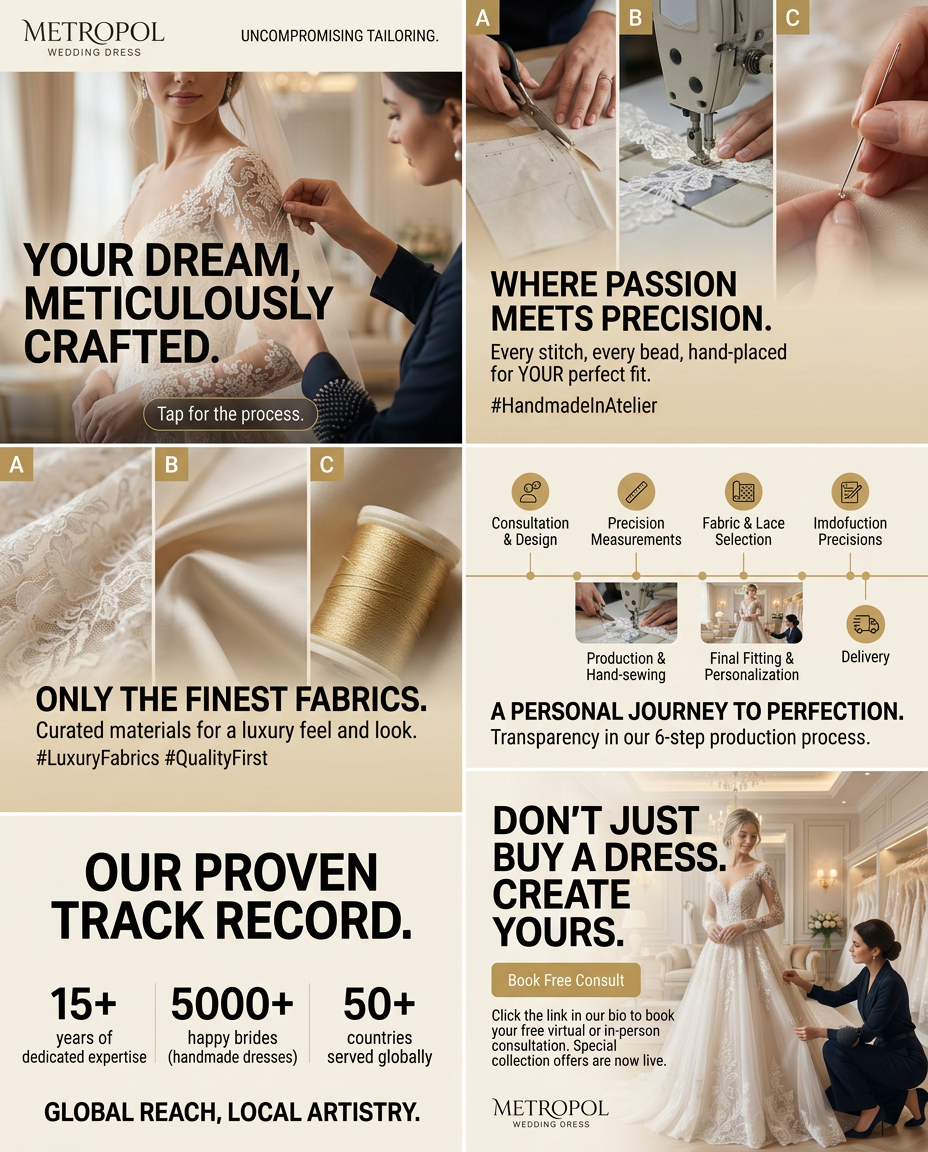
What makes a made-to-measure long sleeve gown different?
Made-to-measure bridalwear begins with the measurements of the intended wearer and uses them to guide the garment’s dimensions. Depending on the service and production process, customization may also include sleeve length, neckline, skirt proportions, fabric selection, and other design details.
It is important to distinguish made-to-measure from fully bespoke couture. Made-to-measure often adapts an existing design or established pattern to an individual’s measurements. Bespoke couture typically involves a more extensive design-development process, which may include a pattern created specifically for the client. The exact scope varies by manufacturer.
Neither term automatically guarantees a perfect fit. Pattern development, measurement accuracy, construction quality, fittings, and alteration policies all matter.
The real value lies in understanding what can be adjusted, what remains fixed, and how the finished dress will be evaluated before delivery.
2. Four Seasons, Four Different Approaches to Long Sleeve Bridalwear
Spring: Lightness, Texture, and Movement
Spring weddings often combine mild temperatures with unpredictable weather. Lightweight lace, fine tulle, and breathable linings can create an airy appearance without sacrificing the elegance of a full-length sleeve.
Consider floral lace, softly fitted sleeves, illusion mesh, and skirts that move naturally in outdoor settings. A removable wrap can provide an additional layer when the temperature drops.
Summer: Breathability Before Heaviness
A long sleeve wedding dress can work beautifully in summer, particularly when its sleeves are made from lightweight lace, fine net, or another suitable breathable material.
Look for limited bulk, appropriate lining, and enough room for arm movement. A dress with an open back or carefully designed neckline may create a lighter overall impression, provided it suits the ceremony and the bride’s preferences.
Autumn: Structure and Rich Detail
Autumn is well suited to gowns with defined silhouettes, textured lace, crepe, satin, and carefully placed embroidery.
Three-quarter sleeves or full-length sleeves with a more substantial finish can complement the season. For outdoor ceremonies, a coordinated bridal coat or cape offers flexibility without requiring an excessively heavy dress.
Winter: Layering, Coverage, and Elegance
Winter designs can feature higher necklines, lined sleeves, substantial satin, embroidered lace, or sculptural silhouettes.
However, a long sleeve gown is not automatically warm. Airy lace and illusion mesh provide little insulation. A removable cape, tailored coat, or warm underlayer designed to work with the dress may be more effective for travel between venues.
The principle behind seasonal design
The season should influence the construction of the dress, not dictate its entire appearance.
A bride can wear a lightweight gown in winter with appropriate outerwear or choose long sleeves for a summer wedding by prioritizing airflow and reducing unnecessary layers. The goal is to understand the environmental conditions and make informed decisions about the materials and garment structure.
This is especially useful for destination weddings, where a single day may include changing temperatures, strong sunshine, air-conditioned interiors, and outdoor photography.
3. Understanding Sleeve Design Beyond Appearance
Sleeves are among the most defining elements of a long sleeve wedding dress. Two gowns with the same silhouette and fabric can look entirely different depending on sleeve constructi
Fitted sleeves
Fitted sleeves follow the shape of the arm and can create a clean, tailored line. They often work well with crepe, stretch lace, and carefully structured bridal fabrics.
Their success depends on adequate movement allowance. A sleeve that looks smooth when the arm is straight may pull across the elbow or upper arm when the bride sits, embraces someone, or raises her hands.
During a fitting, test the sleeve in several positions instead of judging it solely while standing still.
Illusion sleeves
Illusion sleeves use transparent or semi-transparent materials, often fine tulle or mesh, to create the appearance of lace or embroidery resting directly on the skin.
They can introduce decorative detail without the visual weight of a fully opaque sleeve. They are particularly suitable for floral lace, delicate appliqué, and intricate cuff designs.
Because the underlying mesh is visible, its shade and texture should be considered alongside the lace. The best choice depends on the desired effect, the material’s stretch characteristics, and how the finished garment will be photographed.
Bishop sleeves
Bishop sleeves are fuller through the arm and gathered or shaped toward the wrist. They create soft movement and a romantic silhouette.
They can work well with flowing skirts, lightweight fabrics, and dresses inspired by vintage or bohemian bridal fashion. Their volume requires careful coordination with the bodice so that the overall design does not become visually unbalanced.
Cuff width and closure are also important. A cuff that is too restrictive can make an otherwise comfortable sleeve difficult to wear.
Three-quarter sleeves
Three-quarter sleeves end between the elbow and wrist. They provide a distinctive alternative to full-length sleeves and can be suitable for transitional weather or brides who prefer less wrist coverage.
Their visual effect depends on the sleeve’s shape and the dress’s proportions. They may look particularly effective with a defined waist, a clean neckline, or detailed lacework.
Detachable sleeves
Detachable sleeves offer two styling possibilities within one bridal look. A bride might wear full sleeves for the ceremony and remove them for the reception.
This option requires more than an attractive attachment mechanism. The connection should remain secure during movement, and the bodice should look intentional when the sleeves are removed. Hidden fastenings, seam placement, and the weight of the sleeve all influence the result.
Design insight: The most practical sleeve is not necessarily the simplest one. A well-constructed lace sleeve with appropriate ease may be more comfortable than a smooth, closely fitted sleeve that restricts movement.
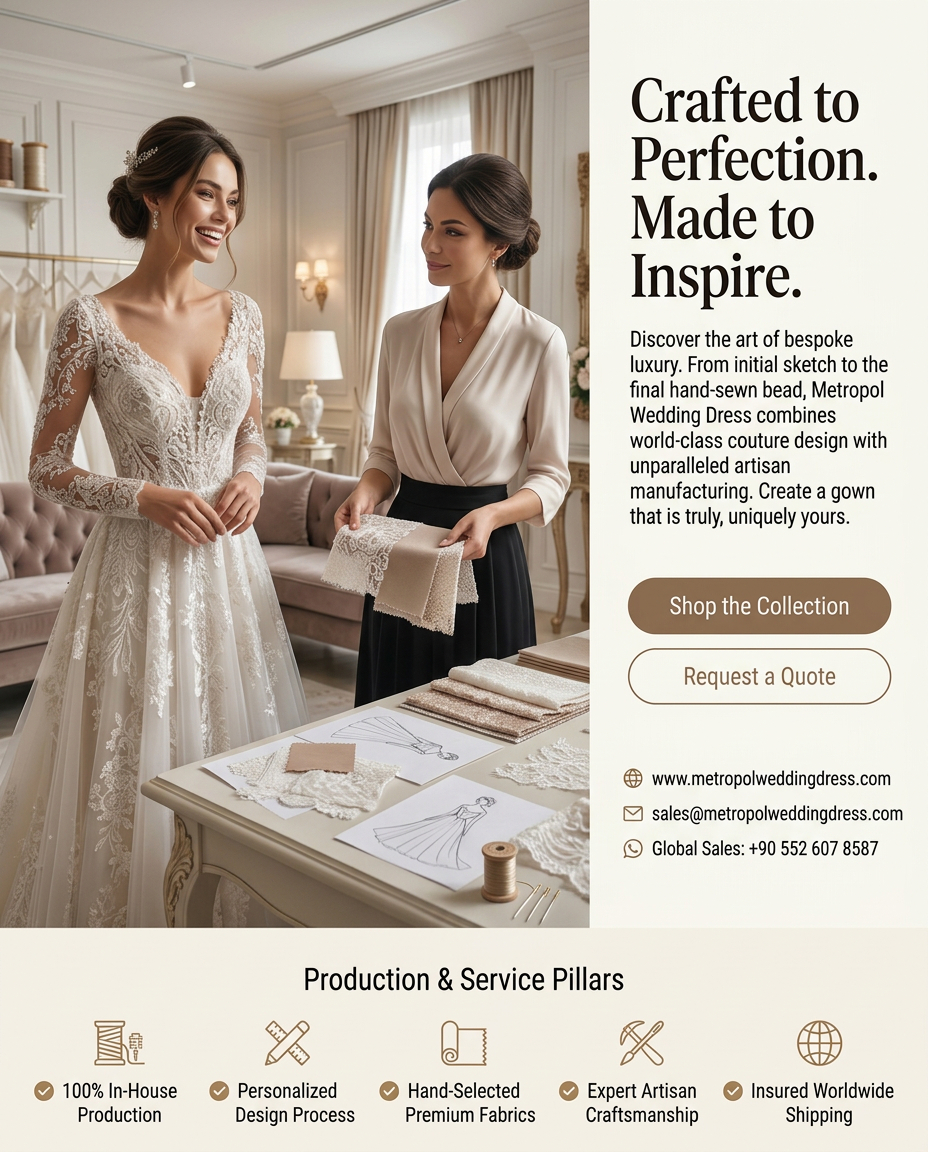
4. Fabric Selection: How to Evaluate Materials for Real Wedding Conditions
Fabric influences appearance, drape, opacity, temperature management, maintenance, and the way a dress responds to movement.
When comparing made-to-measure long sleeve wedding dresses, avoid selecting a fabric by its name alone. Satin, lace, crepe, and tulle each describe broad material categories with different weights, fibers, finishes, and construction characteristics.
The same fabric family can produce very different results depending on the supplier and specification.
| Fabric family | Visual character | Seasonal considerations | Points to check |
|---|---|---|---|
| Lace | Decorative, romantic, textured | Suitable across seasons depending on weight and lining | Scratchiness, pattern placement, snag resistance |
| Tulle | Airy, layered, translucent | Often useful for warm-weather sleeves and overlays | Mesh softness, stability, and abrasion |
| Crepe | Clean, understated, softly structured | Can work year-round depending on fiber and weight | Wrinkling, stretch, recovery, and opacity |
| Satin | Smooth, luminous, polished | Weight and lining determine suitability | Surface marks, drape, shine, and seam appearance |
| Organza | Crisp, light, and sculptural | Often effective for structured overlays | Stiffness, transparency, and crease behavior |
| Chiffon | Soft, fluid, and lightweight | Useful for flowing details and lighter layers | Transparency, snagging, and seam finishing |
| Mikado-style fabric | Structured, substantial, and architectural | Often appealing for cooler-season silhouettes | Weight, stiffness, and ease of movement |
Lace: detail without unnecessary bulk
Lace is a natural choice for long sleeve bridalwear because it can provide coverage while preserving a delicate appearance.
Different lace constructions create different effects. Floral motifs may appear romantic and organic, while geometric patterns can look contemporary. Dense lace provides a stronger visual presence, whereas widely spaced motifs can create a lighter effect.
For custom production, the important question is how the lace will be positioned on the sleeve and bodice.
Ask whether the motifs will align at the seams, whether the sleeve will require additional lining, and how the design will transition into the cuff. Pattern placement can influence both appearance and material consumption.
Crepe: the appeal of a clean silhouette
Crepe is often associated with modern, minimalist bridalwear. Depending on its composition and weight, it can create a smooth silhouette with restrained texture.
It can be especially effective when the design relies on precise proportions rather than extensive ornamentation. Sleeve fit and seam finishing become more visible in such designs, making accurate pattern work essential.
A swatch should be evaluated for opacity, drape, crease behavior, and recovery after stretching if the fabric contains elastane.
Satin: controlled shine and structure
Satin is characterized by its weave and surface appearance, not by a single fiber composition. Silk, polyester, and other fibers can be used in satin-woven fabrics.
A glossy surface can emphasize elegant lines, but it may also make pressing marks, creases, or irregular seams more noticeable. The fabric’s weight affects how the skirt hangs and how much structure the bodice requires.
Brides comparing satin options should examine samples under natural and indoor lighting rather than relying exclusively on online photographs.
Tulle and illusion mesh: transparency requires planning
Fine mesh can create delicate sleeves, but transparency should be assessed in context.
The visual effect depends on the mesh shade, its density, the color underneath, and the placement of appliqué. A fabric that appears nearly invisible in a studio image may look different under direct sunlight or flash photography.
For comfort, examine the texture against the inner arm and consider how the material will interact with perspiration, movement, and any embroidery.
The fabric sample rule
Before approving a material for production, request a sample that represents the intended fabric as closely as possible.
Where practical, examine it in daylight, warm indoor lighting, and flash photography. Gently bend and drape the swatch to understand its behavior. For a lined garment, evaluate the combination of outer fabric and lining rather than the outer layer alone.
This small step can reduce the risk of choosing a material whose real-world appearance differs substantially from expectations.
5. What Made-to-Measure Actually Means in Production
The phrase made to measure can describe different production arrangements. For buyers, retailers, and brides, understanding the process is more valuable than relying on the label alone.
A typical made-to-measure workflow may include the following stages, although the precise sequence depends on the manufacturer’s service model.
From design idea to finished gown
- Design briefThe bride identifies the desired silhouette, sleeve style, neckline, fabric preferences, wedding date, and practical requirements.
- Measurement collectionRelevant body measurements are recorded using the manufacturer’s specified method. Reference photographs or an existing size profile may help clarify proportions.
- Pattern selection and adjustmentThe manufacturer selects or develops a pattern and adjusts it according to the agreed customization scope.
- Material allocation and cuttingFabric, lining, lace, closures, and decorative elements are prepared. Motif placement and fabric direction may affect consumption.
- Garment constructionThe bodice, sleeves, skirt, closures, and finishing details are assembled according to the approved specifications.
- Quality inspectionThe gown is checked against the order, including measurements, workmanship, closures, and visible design details.
- Delivery and final fittingThe bride or receiving retailer checks the garment promptly and arranges any agreed alterations or corrections.
Measurement accuracy: the foundation of a good fit
A measurement chart is not simply a list of numbers. Each measurement needs a defined reference point and method.
For example, bust circumference alone does not fully describe bust shape, posture, or the relationship between the torso and shoulders. Sleeve fit depends on several dimensions, including upper-arm circumference, arm length, elbow position, and the shape of the armhole.
A dress may match the recorded measurements and still require adjustments because body proportions, posture, fabric behavior, and construction methods vary.
This is why measurement instructions should be clear and consistent.
For international orders, determine whether measurements must be taken by a professional tailor, by the bride using a supplied guide, or by a bridal retailer. Also confirm whether measurements are recorded in centimeters or inches and who is responsible for checking them before production.
A useful measurement checklist
The exact requirements depend on the pattern, but a long sleeve wedding dress may require:
- Bust, underbust, waist, and hip measurements.
- Shoulder width and shoulder-to-waist length.
- Front and back bodice lengths.
- Upper-arm, elbow, and wrist circumferences.
- Sleeve length measured from the specified shoulder or armhole reference.
- Hollow-to-hem or another defined dress-length measurement.
- Heel height and intended footwear.
- Additional posture or proportion notes where relevant.
Do not assume every manufacturer uses the same measurement definitions. Follow the supplier’s own instructions rather than combining measurements from unrelated charts.
6. Fit Engineering: Why Long Sleeves Need Special Attention
A long sleeve introduces a technical challenge that is easy to overlook when shopping: the sleeve must look elegant in a static pose while accommodating movement.
A bride uses her arms throughout the wedding day. She may hold a bouquet, greet guests, embrace family members, lift a glass, sign documents, or dance. Each activity changes the position of the shoulder and elbow.
A sleeve that is too narrow can pull the bodice out of alignment. A poorly positioned armhole can restrict movement even when the sleeve circumference appears sufficient.
The relationship between sleeve and bodice
The armhole, sleeve cap, shoulder seam, and bodice work as a connected system. Adjusting one area can influence the others.
For example, increasing upper-arm width without reviewing sleeve shape may create unwanted folds. Raising an armhole can improve certain aspects of movement but may also require pattern adjustments elsewhere. The best solution depends on the pattern and fabric.
These are reasons to assess the garment as a complete structure rather than treating sleeve width as an isolated measurement.

Movement tests for a fitting
The five-movement fitting test
Use this checklist during a sample fitting or final garment inspection.Raise both arms comfortably to shoulder height.Bring the hands forward as if holding a bouquet.Bend each elbow and bring the hand toward the shoulder.Sit down and stand up without excessive pulling at the bodice.Reach forward and gently rotate the upper body.
0 of 5 checks completed
Also inspect the wrists. Cuffs should sit comfortably without sliding excessively or cutting into the skin. If the dress includes buttons or a narrow opening, confirm that the closure is easy to use.
A successful fitting should evaluate comfort, visual alignment, and the garment’s behavior during movement.
7. Choosing a Silhouette That Works With Long Sleeves
The sleeve does not exist in isolation. It contributes to the balance between the upper body, waist, and skirt.
A-line wedding dresses
An A-line skirt gradually widens from the waist, creating a versatile silhouette that can complement fitted or softly voluminous sleeves. It is often a practical choice for brides who want room for movement without the fullness of a ball gown.
Mermaid and fit-and-flare dresses
These silhouettes emphasize the body’s contours and can look striking with fitted lace or smooth crepe sleeves. The fit around the hips, knees, and flare should be evaluated carefully for sitting, walking, and dancing.
Ball gowns
A fuller skirt creates a formal, dramatic appearance. Balanced sleeve proportions are important: structured sleeves may reinforce the silhouette, while fine lace can soften it.
Sheath and column dresses
These designs follow a relatively narrow line from the bodice toward the hem. They often suit minimalist styling, architectural necklines, and understated sleeve details.
Matching proportions without following rigid rules
There is no single silhouette that every bride should choose based on height, body shape, or personal style.
Instead, consider the overall effect you want. A fitted sleeve with a clean bodice creates a different impression from a bishop sleeve paired with a flowing skirt. A high neckline may reinforce a formal aesthetic, while an open neckline can introduce contrast.
The most useful fitting question is not whether a design follows a universal rule. It is whether the proportions, movement, and visual character meet the bride’s preferences.
8. Necklines, Cuffs, and Back Details: The Finishing Decisions
Once the main silhouette and sleeve type have been selected, smaller design decisions can determine whether the gown feels cohesive.
Necklines
A high neckline can create a refined, traditional, or contemporary appearance depending on the fabric and cut. A bateau neckline emphasizes a horizontal line across the shoulders. A V-neck introduces a vertical element, while a square neckline can produce a more architectural effect.
With long sleeves, the neckline also affects the balance between coverage and visual openness.
Consider how the neckline interacts with the sleeve attachment, undergarments, jewelry, hairstyle, and intended level of formality.
Cuffs
Cuffs are functional as well as decorative. They may feature buttons, covered fastenings, elasticized construction, or a shaped finish.
A row of small buttons can add a classic bridal detail, while a clean cuff supports a minimalist design. Lace cuffs may require careful alignment with the sleeve motif.
Check whether the cuff can pass comfortably over the hand, especially if it closes with buttons rather than a wider opening.
Back design
Long sleeve dresses can incorporate open backs, keyhole details, illusion panels, covered buttons, or a fully closed back.
The construction must support the chosen design. A dramatic open back may require particular attention to bodice stability and undergarment compatibility.
If a dress is being adapted from a standard design, confirm that the requested back modification will not compromise the intended fit or require additional structural work.
Embellishment placement
Embroidery, beads, appliqué, and lace motifs should be positioned deliberately.
Excessive embellishment around a joint can affect comfort, while dense decoration may change the sleeve’s weight and drape. Beads and raised details should also be assessed for snagging against hair, veils, or other garments.
A well-planned design uses embellishment to support the silhouette rather than adding detail without purpose.
9. A Seasonal Planning Matrix for Brides and Bridal Buyers
Seasonal dress selection becomes easier when environmental conditions are translated into practical garment requirements.
| Wedding conditions | Recommended design direction | Construction priorities | Potential challenge |
|---|---|---|---|
| Mild spring weather | Lace sleeves, light overlays, A-line skirt | Comfortable lining and flexible sleeve construction | Sudden temperature changes |
| Hot summer ceremony | Fine mesh or lightweight lace sleeves | Low bulk, appropriate lining, easy movement | Heat retention and perspiration |
| Cool autumn evening | Crepe, satin, textured lace | Sleeve ease, suitable outerwear compatibility | Chilly outdoor photography |
| Winter church ceremony | Lined sleeves, structured bodice, high neckline | Layering, secure closures, sufficient movement | Cold during travel between venues |
| Beach destination wedding | Light fabrics and restrained embellishment | Wind-aware skirt design and secure closures | Wind, sand, and humidity |
| Formal indoor ballroom | Satin, structured silhouettes, decorative lace | Pressing quality and balanced proportions | Long periods of standing and dancing |
| Garden wedding | Floral lace, flowing sleeves, lighter skirts | Hem clearance and snag resistance | Grass, uneven ground, and moisture |
| Multi-location wedding day | Versatile base gown with optional accessories | Reliable fastenings and removable layers | Changing temperatures and transport |
These recommendations are starting points rather than fixed rules. A summer wedding in a cool climate may require different choices from a summer wedding in a humid coastal destination.
The venue, forecast, time of day, and amount of outdoor exposure should be considered together.
A practical example: the destination wedding
Imagine a bride planning a ceremony in a Mediterranean coastal town. The ceremony will take place outdoors in the afternoon, followed by dinner in an air-conditioned venue.
A fully lined, heavy satin sleeve might feel uncomfortable during the outdoor ceremony, while a fine illusion sleeve could offer the desired visual effect with less material bulk. A lightweight wrap could provide additional comfort indoors if the air conditioning feels cold.
The bride could also choose detachable sleeves, provided the attachment and the strapless or sleeveless configuration are engineered appropriately.
This example illustrates a broader principle: a gown can be designed around the actual sequence of the wedding day rather than the season alone.
10. Wedding Dress Customization: What Should Be Flexible and What Should Be Fixed?
Not every design feature should be treated as freely interchangeable. Some changes are relatively straightforward, while others affect the underlying pattern or structure.
For a buyer, understanding this distinction helps set realistic expectations and supports more accurate quotations.
| Customization request | Relative complexity | Why it matters |
|---|---|---|
| Adjusting sleeve length | Often low to moderate | Depends on cuff placement and sleeve proportions |
| Changing cuff buttons | Often low | May still affect closure construction |
| Adjusting dress length | Often low to moderate | Depends on hem design, lace border, and skirt layers |
| Changing neckline depth | Moderate to high | May require bodice pattern and support adjustments |
| Converting short sleeves to long sleeves | Moderate to high | Requires compatible armhole and sleeve construction |
| Adding a fully lined sleeve | Moderate | Changes opacity, bulk, and material consumption |
| Repositioning major lace motifs | Moderate to high | Depends on motif size, layout, and available fabric |
| Changing from a fitted skirt to a ball gown | High | Alters the silhouette, pattern, construction, and material needs |
| Redesigning an open back | Moderate to high | Can affect bodice stability and closure placement |
These are indicative categories, not universal production standards. A change that is straightforward for one pattern may require extensive redevelopment for another.
The hidden cost of a seemingly small change
Consider a request to change an illusion sleeve into an opaque sleeve. The visible difference may seem minor, but the change can affect:
- Fabric and lining consumption.
- Sleeve circumference and flexibility.
- Seam allowances and finishing methods.
- Embellishment attachment.
- The visual balance between the sleeve and bodice.
- Production time and the quoted price.
For this reason, customization should be specified before the order is finalized whenever possible.
A clear design brief is generally more useful than a sequence of loosely defined requests after production has begun.
11. Buying Made-to-Measure Wedding Dresses: A Procurement Perspective
For individual brides, the purchasing decision is emotional and personal. For bridal boutiques, distributors, and wholesale buyers, it also involves supplier reliability, product consistency, lead times, and commercial risk.
The same principles of specification and verification can help both groups make better decisions.
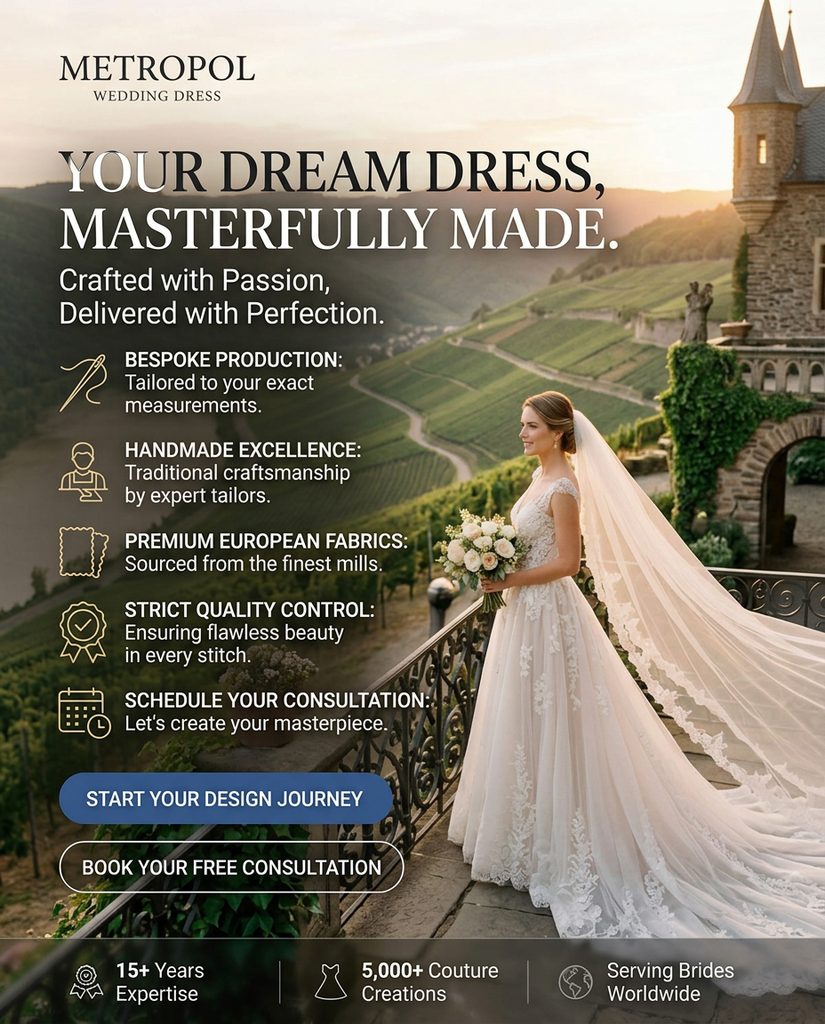
What an individual bride should confirm
Before ordering, establish:
- The exact design and customization scope.
- The fabric composition or agreed material specification.
- Which measurements are required and who must take them.
- The estimated production and shipping schedule.
- The number and timing of fittings, where applicable.
- The policy for corrections, alterations, and returns.
- Whether accessories are included in the quoted price.
- How the finished garment will be inspected before dispatch.
A product photograph alone is not a complete specification. Details such as lining, sleeve transparency, closure type, train length, and lace placement should be confirmed when they materially affect the intended result.
What a bridal retailer should evaluate
A retailer sourcing long sleeve wedding dresses should examine the supplier’s ability to translate design specifications into repeatable production outcomes.
Useful questions include:
- Can the supplier explain its made-to-measure process?
- Are measurement instructions documented and consistent?
- Can fabric and lace alternatives be identified precisely?
- Are customization requests confirmed in writing?
- Is there a defined process for handling production discrepancies?
- Can the supplier explain packaging and shipment preparation?
- Are sample orders or prototype reviews available?
- Are minimum order quantities, payment terms, and lead times clearly stated?
A supplier’s attractiveness should be evaluated against the retailer’s actual assortment strategy. A business selling highly customized gowns may need a different workflow from one offering standardized collections with limited alterations.
Supplier scorecard
The following framework can be adapted when comparing manufacturers.
| Evaluation area | Suggested weight | Evidence to request |
|---|---|---|
| Workmanship and sample quality | 25% | Physical sample, construction details, inspection criteria |
| Measurement and customization process | 20% | Measurement guide, specification confirmation |
| Delivery reliability | 20% | Lead-time policy and order-tracking process |
| Commercial clarity | 15% | Quotation, payment terms, customization charges |
| Communication and problem resolution | 10% | Named contact and documented escalation process |
| Packaging and shipping readiness | 10% | Packing specification and shipping responsibilities |
| Total | 100% |
These weights are an example, not an independently validated industry benchmark. A retailer can adjust them according to the risks most important to the business.
For instance, a boutique with a seasonal launch deadline may give delivery reliability greater weight, while a specialist store emphasizing intricate lacework may prioritize sample quality and customization.
12. Understanding the Cost of a Made-to-Measure Long Sleeve Wedding Dress
There is no single price for a made-to-measure long sleeve wedding dress. The final quotation depends on the design, fabric, construction, labor, embellishment, customization scope, order volume, and delivery arrangements.
A meaningful cost comparison should distinguish between the advertised dress price and the total amount required to receive, fit, prepare, and wear the garment.
The main cost drivers
Fabric and lining
Material choice influences the unit cost, weight, cutting requirements, and finishing time. Premium fibers, specialty lace, and multiple layers can increase material expenditure.
Pattern work and customization
Changes to sleeve shape, neckline, bodice construction, or silhouette may require additional pattern development and technical review.
Embellishment and finishing
Hand-applied lace, beading, embroidery, and intricate closures can add significant labor. The amount of decorative work is often as important as the material itself.
Delivery and final alterations
Shipping, import charges where applicable, local tailoring, pressing, and accessories may not be included in the initial quotation.
Calculate the full acquisition cost
For an individual bride, a useful planning equation is:
\[ \text{Total Cost} = \text{Dress Price} + \text{Alterations} + \text{Shipping} + \text{Applicable Taxes} + \text{Accessories} \]
This equation is a planning tool rather than a quotation. Some expenses may already be included, so they should not be counted twice.
For a bridal retailer, the calculation needs additional commercial components:
\[ \begin{aligned} \text{Landed Cost} ={}& \text{Purchase Price}\\ &+ \text{Freight and Insurance}\\ &+ \text{Import Duties and Fees}\\ &+ \text{Inbound Handling} \end{aligned} \]
The exact treatment of taxes depends on the jurisdiction and the buyer’s tax status. Recoverable VAT, for example, should be treated differently from a nonrecoverable cost when analyzing business profitability.
A worked example for a retailer
Suppose a retailer evaluates a hypothetical batch of 20 dresses.
| Cost component | Illustrative batch cost |
|---|---|
| Purchase price: 20 dresses at $250 | $5,000 |
| Freight and insurance | $400 |
| Import duty and nonrecoverable charges | $300 |
| Inbound handling | $100 |
| Illustrative total landed cost | $5,800 |
| Landed cost per dress | $290 |
The numbers are illustrative only. They are not Metropol Wedding Dress prices, an actual shipping quote, or a statement of any country’s applicable import duty.
If a retailer later adds local alterations, warehousing, marketing, and payment-processing costs, the commercial cost per sale will be higher than the landed cost alone.
Margin is not the same as markup
Suppose a dress has a landed cost of $290 and a hypothetical retail price of $500, excluding any taxes collected on behalf of the government.
The gross profit before other operating expenses is:
These percentages describe different calculations. Confusing them can lead to pricing decisions that appear profitable but do not adequately cover overheads.
For a wholesale buyer, the useful question is not simply whether a supplier offers a low unit price. It is whether the finished product can be acquired, sold, and supported at a sustainable total cost.
13. Ordering From an International Bridal Manufacturer
International sourcing can expand fabric choices, design possibilities, and supplier options. It also introduces additional responsibilities concerning specifications, shipping, customs, communication, and delivery timing.
Brides ordering from abroad and businesses importing bridalwear should treat the order as a documented transaction rather than relying exclusively on informal messages.
Before payment
Confirm the following details in writing:
- Product reference and approved design.
- Agreed measurements and customization details.
- Material descriptions and color expectations.
- Price, currency, payment milestones, and included services.
- Production lead time and the event or delivery deadline.
- Shipping method, delivery terms, and responsibility for import charges.
- Inspection, correction, cancellation, and return conditions.
Where a color is particularly important, request a physical swatch or another mutually agreed reference. Screen displays can vary, and photographs do not always reproduce fabric colors accurately.
Before dispatch
A documented inspection should compare the finished gown against the order.
Depending on the product, the review may include:
- Correct style and color.
- Measurements against the agreed specification.
- Sleeve length and cuff construction.
- Bodice and skirt alignment.
- Lace motif placement.
- Closure operation.
- Visible stitching and finishing.
- Accessories and packaging.
- Photographic evidence of any discrepancies.
For wholesale orders, a retailer may also want a sample-based inspection plan or a defined quality-control process for the full batch.
Allow for more than manufacturing time
The production period is only one part of the delivery schedule.
A useful planning model is:
\[ \begin{aligned} \text{Required Lead Time} ={}& \text{Approval Time}\\ &+ \text{Production Time}\\ &+ \text{Inspection Time}\\ &+ \text{Transit Time}\\ &+ \text{Contingency} \end{aligned} \]
The individual components depend on the order and route. They should be confirmed with the supplier and logistics provider rather than estimated from a generic online guideline.
A wedding date is a fixed event. A dress order should therefore be planned backward from the date the gown must be ready to wear, with time reserved for local fitting and any necessary correction.
14. Care, Storage, and After-Wedding Preservation
A long sleeve wedding dress may include delicate lace, transparent mesh, structured bodice panels, buttons, beadwork, or multiple skirt layers. Care instructions should reflect the actual construction and fiber content.
Before the wedding
Keep the dress in a clean, dry environment away from direct sunlight, moisture, and sources of heat. Follow the manufacturer’s storage and hanging recommendations, especially for heavier gowns that may stretch under their own weight.
Do not assume every dress should be stored in the same type of bag or hung in the same way. Heavy embellishment, delicate shoulder seams, and soft fabrics can require different handling.
If the dress has a train, detachable sleeves, or additional accessories, check that all pieces are stored together and can be identified easily.
After the wedding
Arrange professional cleaning when appropriate, especially if the gown has visible stains or delicate decorative elements. Explain the material composition and construction to the cleaner.
Avoid aggressive spot cleaning without confirming that the treatment is compatible with the fabric and embellishment. Some stains become more difficult to remove if treated incorrectly.
For long-term preservation, seek advice on suitable packaging and environmental conditions. Acid-free materials may be appropriate in a preservation system, but the correct approach depends on the garment and storage method.
Care is not merely an afterthought. A dress intended to be kept as a family heirloom may benefit from different handling decisions than one intended for resale or a future redesign.
15. Quality Control: How to Inspect a Long Sleeve Wedding Dress
A quality inspection should assess the finished garment against an agreed specification, not against an undefined expectation of perfection.
Different materials have different characteristics. Natural fibers, fine mesh, embroidered lace, and glossy satin may show different surface variations. The relevant question is whether the garment meets the agreed standard and whether any defect affects appearance, durability, fit, or use.
A practical inspection framework
| Inspection point | What to examine | Why it matters |
|---|---|---|
| Measurements | Compare critical dimensions with the approved specification | Identifies fit-related discrepancies |
| Sleeve construction | Check symmetry, movement, seams, and cuff comfort | Long sleeves are highly visible and movement-sensitive |
| Bodice | Review alignment, closure operation, and support | Influences fit and stability |
| Lace and embellishment | Check motif placement, loose threads, and attachment | Affects appearance and snag resistance |
| Fabric surface | Look for stains, pulls, holes, and unacceptable marks | Protects presentation quality |
| Hem and train | Inspect finishing and length against the order | Important for movement and venue suitability |
| Packaging | Confirm cleanliness, protection, and included items | Reduces avoidable transit-related problems |
| Documentation | Match the garment to the order reference | Prevents mix-ups and supports claims |
What should happen when a discrepancy is found?
Document the issue with clear photographs, measurements, and a description of the difference between the agreed specification and the delivered garment.
Contact the supplier within the applicable inspection or claims period. Ask what corrective options are available and confirm the agreed resolution in writing.
Do not assume that every difference qualifies for a refund or free alteration. The result depends on the order terms, the nature of the discrepancy, applicable consumer law, and the supplier’s policies.
For retailers, a consistent inspection process also creates a record of recurring issues, which can support better supplier evaluation over time.
16. Common Mistakes That Can Undermine a Made-to-Measure Order
Even a beautiful design can disappoint when important details are overlooked.
Choosing a sleeve based only on a photograph
A sleeve may look elegant while the model is standing still but feel restrictive during movement. Evaluate construction and movement, not appearance alone.
Assuming all lace feels the same
Lace varies in texture, stiffness, density, and construction. Ask about the actual material rather than relying on a general description.
Submitting measurements without checking the method
A measurement taken from the wrong reference point can cause avoidable fit problems. Use the supplier’s instructions and confirm the units.
Treating made-to-measure as a guarantee of zero alterations
Body proportions, posture, fabric behavior, and measurement methods vary. Confirm the fitting and correction policy before ordering.
Ordering too close to the wedding date
Manufacturing, transport, inspection, and local tailoring can all require time. Work backward from the date the dress must be ready.
Comparing quotations without comparing specifications
Two apparently similar prices may cover different fabrics, linings, accessories, customization work, or delivery terms.
The most useful prevention strategy
Before approving an order, create a single written specification that identifies the design, measurements, materials, construction details, and commercial terms.
Use the same specification when reviewing the quotation, confirming production, and inspecting the finished garment.
This simple discipline reduces ambiguity and makes disagreements easier to resolve.
17. Building a Distinctive Bridal Look Without Overdesigning It
Customization provides opportunities to make a dress personal, but more customization does not automatically produce a better result.
The strongest designs often have a clear visual priority. That priority might be the sleeve, the neckline, the fabric, the skirt silhouette, or a distinctive back detail.
When too many elements compete for attention, the overall design can become difficult to read.
Three design directions worth exploring
The timeless romantic gown
Fine floral lace, a balanced neckline, and a flowing skirt create a look that emphasizes texture and craftsmanship. Restrained embellishment can help the lace remain the central feature.
The contemporary minimalist gown
Clean crepe, a carefully shaped bodice, and simple fitted sleeves create an understated appearance. Accurate construction becomes especially important when decorative details are limited.
The statement bridal gown
Dramatic sleeves, dimensional lace, a structured skirt, or a distinctive train can create a memorable effect. The key is to coordinate the weight, proportions, and movement of each element.
Personalization that has a practical purpose
A custom design can incorporate details that are meaningful without being visually excessive.
Examples include adapting the sleeve length to personal preference, selecting a neckline that works with a chosen necklace, adjusting the train to suit the venue, or creating detachable elements for different parts of the celebration.
The best design decisions serve both the bride’s vision and the practical demands of wearing the gown.
18. Why Metropol Wedding Dress Is Relevant to the Made-to-Measure Journey
Choosing a wedding dress involves trust as well as design. Brides need clarity about what they are ordering, how their preferences will be translated into a garment, and which details must be confirmed before production.
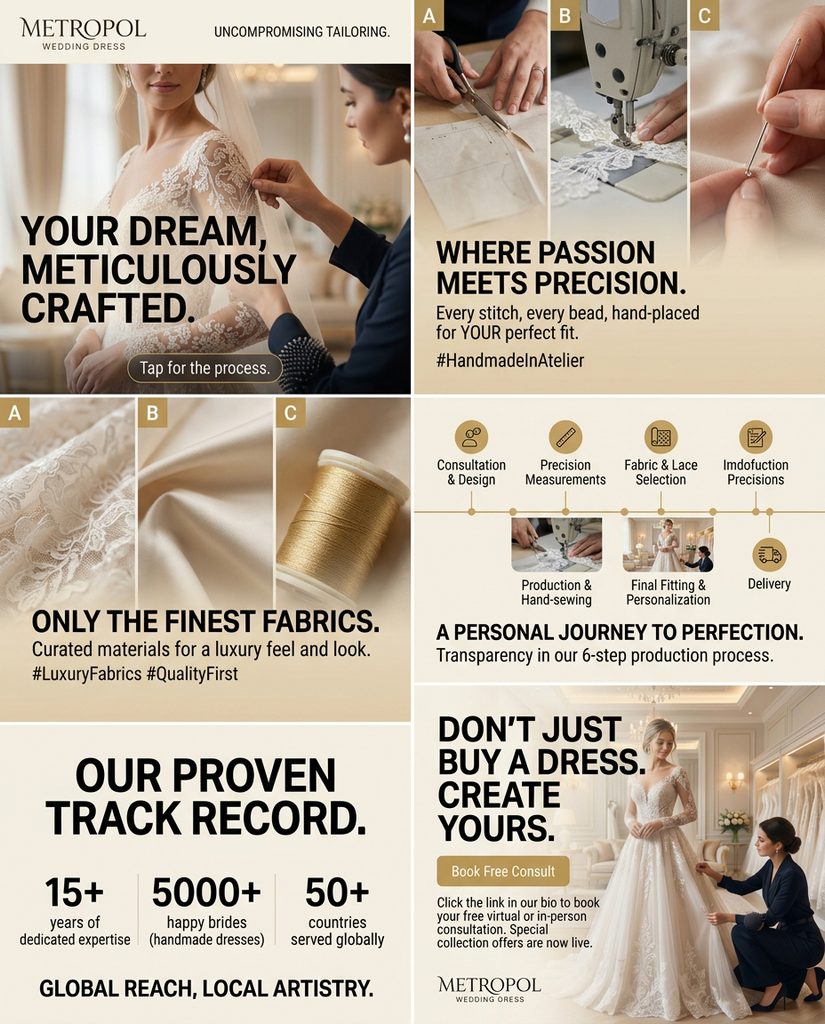
Metropol Wedding Dress can be positioned around this customer need: helping brides explore long sleeve bridal designs with attention to fit, material, silhouette, seasonal suitability, and individual style.
For a landing page, the most persuasive brand message is one that connects aesthetic ambition with the information a buyer needs to make a confident decision.
Rather than relying on unsupported claims about craftsmanship, production capacity, delivery speed, or customer satisfaction, a brand should communicate the details it can demonstrate.
Useful information to present to prospective customers includes:
- Available long sleeve dress designs and silhouette options.
- The actual scope of made-to-measure customization.
- Fabric and lining choices offered for each design.
- Measurement instructions and fitting arrangements.
- Available options for lace, cuffs, necklines, and sleeve construction.
- Production timelines and delivery arrangements.
- Pricing inclusions and exclusions.
- Alteration, correction, and after-sales policies.
These details help customers understand the service before they commit.
They are also valuable to search engines and AI-assisted discovery systems because they answer specific questions about the product, the purchasing process, and the differences between design options.
A more useful way to evaluate the brand experience
A strong bridal shopping experience should make it easy to answer three questions.
Can this design match my vision? The customer should be able to compare silhouettes, sleeve styles, fabric characteristics, and customization options.
Can I understand what I am purchasing? Product descriptions, measurement requirements, delivery expectations, and pricing conditions should be clear.
Can I plan confidently around my wedding date? The ordering process should explain the steps, the information needed from the bride, and the time required for production and fitting.
For Metropol Wedding Dress, presenting these details clearly can help transform a product page into a more useful decision-making resource.
19. Frequently Overlooked Details for International Brides and Retailers
International orders often involve different measurement conventions, terminology, expectations, and logistics arrangements. These issues can be managed through careful documentation.
Centimeters versus inches
Always confirm the unit used in the measurement chart. A number without a unit is incomplete information.
When converting measurements, retain adequate precision and confirm the final recorded value before approving production. Avoid independently rounding several measurements in ways that may accumulate into meaningful discrepancies.
Bridal sizing versus everyday clothing sizes
Bridal sizing is not universally standardized. A size number used by one brand may not correspond directly to the same number used by another.
For a made-to-measure order, the supplier’s measurement process and the approved specification are generally more useful than selecting a size based on everyday clothing alone.
Color naming and fabric references
Terms such as ivory, off-white, champagne, and white can refer to different shades depending on the supplier and material.
Where the precise shade matters, agree on a reference sample or clearly documented color specification. If multiple garments must match, confirm that the material references and production requirements are consistent.
Import and delivery responsibilities
A retailer importing dresses should determine who handles export documentation, customs clearance, duties, taxes, and final delivery. These responsibilities depend on the transaction terms and destination country.
For commercial orders, verify the applicable rules with the relevant customs authority or a qualified customs professional. Do not assume that a supplier’s shipping quotation includes every charge payable at destination.
Documentation is part of product quality
A technically well-made dress can still create an unsatisfactory customer experience if the order details are unclear or delivery expectations are misunderstood.
The purchase order, approved measurements, fabric references, customization notes, and agreed delivery conditions should be easy to locate and consistent with one another.
For wholesale buyers, this documentation can also support repeat orders and reduce the risk of inconsistent specifications across a collection.
20. The Final Decision: Choose the Dress That Works as a Complete Garment
A made-to-measure long sleeve wedding dress should be evaluated as a complete system.
The sleeve influences the bodice. The fabric influences movement and temperature management. The neckline affects visual balance. The skirt influences walking and sitting. The wedding location influences the choice of layers and materials. The production process determines how reliably the design can be delivered.
Considering these factors together leads to a more informed choice than selecting a dress based on a single photograph or trend.
For brides, the most valuable customization is the customization that improves the relationship between personal style, fit, comfort, and the actual wedding-day environment.
For bridal retailers and purchasing professionals, the same principle applies commercially: a good supplier relationship depends on clear specifications, realistic timelines, consistent quality checks, and transparent pricing.
Metropol Wedding Dress can use these considerations to guide prospective customers toward a design that reflects their preferences while helping them understand the practical steps involved in ordering a made-to-measure gown.
The result should not simply be a dress with long sleeves. It should be a carefully considered bridal garment, selected and specified for the person who will wear it, the occasion it will serve, and the experience it is intended to create.
21. Five Calls to Action for Different Customer Intentions
The following CTA options serve different stages of the bridal buying journey. Select the ones that match the actions your website actually supports.
CTA 1 — For brides ready to explore designs
Tone: Elegant and aspirational
Explore the Metropol Wedding Dress collection of long sleeve wedding dresses and discover the silhouette, fabric, and details that reflect your personal bridal style.Explore the Collection Copy
CTA 2 — For brides who need guidance
Tone: Reassuring and consultative
Not sure which sleeve or fabric will suit your wedding season? Start with your venue, expected weather, and preferred silhouette, then explore the options that fit your plans.Plan Your Bridal Consultation
CTA 3 — For customers prioritizing fit
Tone: Practical and confident
A beautiful silhouette begins with clear specifications. Review the measurement requirements and customization options before deciding on your long sleeve bridal design.Prepare Your Measurements
CTA 4 — For wholesale and retail buyers
Tone: Professional and commercial
Building a bridal assortment? Evaluate long sleeve wedding dresses by design versatility, customization scope, material specifications, lead times, and landed cost.Prepare a Wholesale Inquiry
CTA 5 — For customers with a clear design vision
Tone: Personal and design-led
Bring your inspiration together. Identify the neckline, sleeve finish, fabric, and silhouette you love, then confirm which details can be customized for your gown.Develop Your Dress Brief
These are content and planning CTAs. Replace them with the appropriate live collection, consultation, measurement, or inquiry links when implementing the landing page.
Recommended internal linking structure
Link this landing page naturally to relevant supporting pages, if they exist:
- Long sleeve lace wedding dresses.
- Satin and crepe wedding dresses.
- A-line and mermaid wedding dresses.
- Wedding dress measurement guide.
- Bridal customization services.
- Wholesale wedding dress collections.
- Shipping, delivery, and ordering information.
- Wedding dress care and preservation.
Use descriptive anchor text that explains the destination rather than repeating the same exact keyword in every link.
For SEO quality, publish only claims that reflect the actual services and products available from Metropol Wedding Dress. Add original product photographs, genuine construction details, clear contact information, and verified business information where available. Structured data should reflect the actual page and business; do not add unsupported review ratings, prices, or product availability.
23. Frequently Asked Questions About Made-to-Measure Long Sleeve Wedding Dresses
1. What is a made-to-measure long sleeve wedding dress?
A made-to-measure long sleeve wedding dress is a bridal gown produced using the wearer’s measurements to guide its dimensions. Depending on the supplier, selected design elements such as sleeve length, neckline, fabric, or skirt proportions may also be customizable. The precise scope should be confirmed before ordering.
2. How is made-to-measure different from bespoke wedding dress design?
Made-to-measure typically adapts an existing design or pattern to an individual’s measurements. Bespoke design generally involves a more extensive process in which the garment is developed specifically for the client. Terminology varies between manufacturers, so ask what pattern development, fittings, and design changes are included.
3. Can I wear a long sleeve wedding dress in summer?
Yes. Lightweight lace, fine mesh, breathable construction, and carefully selected lining can make long sleeves suitable for summer weddings. The best design depends on humidity, temperature, time spent outdoors, and the dress’s overall construction.
4. Which long sleeve wedding dress fabrics are suitable for winter?
Structured satin, heavier crepe, lined lace, and other suitable substantial fabrics can work well for winter bridalwear. However, fabric weight alone does not guarantee warmth. A bridal coat, cape, or coordinated outer layer may provide more effective insulation.
5. Are lace sleeves comfortable for an entire wedding day?
They can be, provided the lace is sufficiently soft, the sleeve is correctly fitted, and the seams and cuffs are comfortable. Test the material against the skin and move your arms during a fitting to identify rubbing, stiffness, or restrictions.
6. Can a long sleeve wedding dress be customized to my body measurements?
Depending on the manufacturer’s service, customization may include selected bodice, sleeve, waist, hip, and length measurements. Accurate measurements are essential, but the exact fit also depends on pattern construction, posture, fabric behavior, and the agreed alteration process.
7. What measurements are important for a long sleeve bridal gown?
Common measurements include bust, waist, hips, shoulder width, bodice length, upper-arm circumference, elbow circumference, wrist circumference, sleeve length, and dress length. The required measurements and their reference points vary by design, so use the manufacturer’s measurement guide.
8. How can I make sure the sleeves will not feel tight?
Choose a suitable sleeve pattern and ensure the upper arm, elbow, and wrist have appropriate ease. During fitting, raise your arms, bend your elbows, reach forward, and sit down. If the sleeve pulls the bodice or restricts movement, discuss the pattern and fit with the maker.
9. Can I choose a different neckline for a made-to-measure wedding dress?
Some manufacturers offer neckline customization, but not every change is straightforward. Altering the neckline can affect bodice support, armhole geometry, and closure placement. Confirm whether the requested change is available and whether it affects the price or production schedule.
10. Are detachable sleeves a good option for a wedding and reception?
Detachable sleeves can provide different looks for different parts of the celebration. Their suitability depends on the attachment method, the stability of the bodice, and how the dress looks with the sleeves removed. Confirm that both configurations have been designed intentionally.
11. Can I order a long sleeve wedding dress with an open back?
Yes, if the design and manufacturer support that combination. An open back may require additional attention to bodice stability, closure placement, and undergarment compatibility. Discuss these requirements before approving the final design.
12. Which silhouette works best with long sleeves?
A-line, ball gown, mermaid, fit-and-flare, and sheath silhouettes can all work with long sleeves. The best choice depends on personal preference, movement requirements, fabric, and the overall proportions of the design rather than a universal body-shape rule.
13. Is a long sleeve wedding dress suitable for an outdoor ceremony?
Yes. Consider the temperature, terrain, wind, and expected duration outdoors. Lightweight sleeves may suit warm garden or beach ceremonies, while a coordinated cape or coat can help with cooler conditions. Hem length and train management are also worth reviewing.
14. What should I consider when choosing a long sleeve wedding dress for a destination wedding?
Evaluate the local climate, humidity, venue requirements, transport arrangements, and opportunities for final alterations. Check whether the dress can be packed and transported safely, and allow sufficient time for inspection and steaming or pressing after arrival.
15. Can I change the sleeve fabric without changing the whole dress?
Sometimes. A sleeve material can occasionally be changed while retaining the main silhouette, but compatibility with the armhole, lining, embellishments, and bodice must be checked. Ask for a revised specification and quotation before production begins.
16. How far in advance should I order a made-to-measure wedding dress?
Order early enough to accommodate design approval, measurement collection, production, shipping, inspection, and final alterations. There is no single lead time suitable for every supplier or destination. Obtain a written schedule and plan backward from the date the dress must be ready to wear.
17. Will a made-to-measure wedding dress always fit perfectly without alterations?
No. Made-to-measure construction can help align a garment with individual measurements, but it does not guarantee a flawless final fit. Pattern differences, posture, measurement errors, fabric behavior, and personal preferences may still require adjustments.
18. How should I compare two quotations for similar wedding dresses?
Compare the full specification, including fabric, lining, lace quality, customization, sleeve construction, accessories, production time, shipping, and correction policies. A lower initial price may not represent a lower total cost if important services or materials are excluded.
19. What affects the price of a made-to-measure long sleeve wedding dress?
Key factors include fabric composition, pattern adjustments, sleeve construction, lining, lace placement, embellishment, labor, and the amount of customization. Shipping, local alterations, and taxes may also contribute to the total cost.
20. What is the difference between satin and crepe wedding dresses?
Satin describes a weave associated with a smooth surface and characteristic sheen, while crepe refers to a family of fabrics with a distinctive textured appearance. Their drape, weight, and comfort depend on fiber composition and construction. Satin often creates a luminous effect, while crepe is frequently chosen for a more understated finish.
21. Is illusion mesh suitable for long sleeve bridalwear?
Yes. Illusion mesh can create transparent sleeves that support lace appliqué or embroidery without the appearance of a fully opaque sleeve. Mesh shade, softness, transparency, and durability should be evaluated under the lighting conditions expected at the wedding.
22. How can I prevent a long sleeve wedding dress from looking too heavy?
Consider lighter sleeve materials, restrained embellishment, balanced proportions, and a suitable neckline. A structured skirt can be paired with delicate sleeves, or a minimalist bodice can balance a more detailed sleeve. The objective is visual harmony rather than minimizing every design element.
23. Can a long sleeve wedding dress be appropriate for a formal religious ceremony?
Long sleeve gowns can suit many formal religious ceremonies, but dress requirements vary by venue, tradition, and officiant. Confirm the applicable rules concerning neckline, transparency, coverage, and accessories before selecting the final design.
24. How do I choose the right cuff style?
Consider comfort, ease of dressing, sleeve shape, and the desired visual effect. Buttoned cuffs can create a classic finish, while clean or lace-trimmed cuffs may suit minimalist or romantic designs. Ensure the cuff can pass over the hand and close comfortably.
25. What should a bridal retailer check before placing a wholesale order?
A retailer should review sample quality, customization capabilities, measurement procedures, material specifications, minimum order quantities, lead times, payment terms, packaging, and discrepancy-resolution policies. A written purchase specification helps ensure that the delivered garments match the approved designs.
26. How should an international buyer calculate the cost of imported wedding dresses?
Include the purchase price, freight, insurance, applicable duties, nonrecoverable taxes, customs-related fees, and inbound handling. Add warehousing, alterations, and other relevant costs when calculating the commercial cost of selling the dresses. Confirm the actual charges for the destination and transaction.
27. What should I check when the dress arrives?
Compare the dress with the approved order and inspect its measurements, sleeve construction, closures, seams, fabric surface, embellishments, hem, and included accessories. Photograph discrepancies and contact the supplier within the agreed inspection or claims period.
28. How should I store a long sleeve wedding dress before the ceremony?
Keep the gown clean, dry, and protected from direct sunlight and moisture. Follow the manufacturer’s hanging or storage instructions, particularly if the dress is heavy or includes delicate lace and embellishment. Arrange professional pressing or steaming if recommended for the specific fabric.
29. Can long sleeve wedding dresses work for minimalist bridal styles?
Absolutely. Clean crepe, simple satin, carefully shaped sleeves, and understated necklines can create a contemporary minimalist look. In designs with limited decoration, precise fit, seam quality, and fabric behavior become especially noticeable.
30. What information should I send when requesting a customized wedding dress?
Provide your preferred design or reference images, wedding date, intended venue, silhouette, sleeve style, neckline, fabric preferences, color reference, and required measurements. Ask which elements can be customized, what the price includes, and how production, delivery, fitting, and corrections are handled.
Final Thoughts
A made-to-measure long sleeve wedding dress is an opportunity to make design decisions with intention. The most successful gown brings together the right silhouette, comfortable sleeves, suitable fabric, accurate measurements, and a construction process that reflects the bride’s requirements.
Whether the wedding takes place in spring sunshine, a warm summer garden, an autumn venue, or a winter ballroom, seasonal planning can help create a dress that feels appropriate without limiting personal style.
For Metropol Wedding Dress, a strong landing page should combine inspiring bridal imagery with practical product information, transparent customization details, and clear next steps. This approach helps prospective customers move from visual inspiration to an informed purchasing decision.
The goal is simple: a wedding dress that reflects your vision, supports your movement, and feels right for the day you have planned.
Related Topics

26.08.2025
Backless Wedding Gowns with Train is more than just a dress—it’s a statement of confidence, romance, and drama. The open-back design accentuates the bride’s silhouette, while the train adds a touch of regal elegance. Here’s...
24.08.2025
Bridal Showroom is a specialized retail space—physical or online—dedicated to wedding dresses, bridal accessories, and sometimes groom attire. These showrooms offer a curated selection of gowns, ranging from classic A-line designs to modern minimalist styles,...
09.04.2025
Güzelbahçe Gelinlik Trendleri 2025 Gelinlik, bir kadının hayatındaki en özel günlerden birinde, genellikle “en güzel” olmak istediği kıyafettir. Hem kültürel hem de kişisel anlam taşıyan bu giyim parçası, zaman içinde büyük bir evrim geçirmiş ve...

20.02.2026
Individuelle Luxus Hochzeitskleider für internationale Hochzeiten in Deutschland Internationale Hochzeiten in Deutschland werden immer beliebter. Paare aus verschiedenen Kulturen entscheiden sich bewusst für eine Feier zwischen Tradition und Moderne – oft in historischen Schlössern, luxuriösen...

17.02.2026
Exklusive Luxus Brautkleider nach Maß für Ihre Traumhochzeit Eine Hochzeit ist weit mehr als ein Fest – sie ist ein einzigartiger Moment voller Emotionen, Erinnerungen und unvergesslicher Augenblicke. Im Mittelpunkt dieses besonderen Tages steht die...

15.11.2025
Warum Bräute aus Deutschland massgeschneiderte Brautkleider aus der Türkei lieben In einer Welt, in der Hochzeiten nicht nur ein Versprechen der Liebe darstellen, sondern auch ein Ausdruck von Individualität und Eleganz, suchen Bräute weltweit nach...
Comments