
Made to Measure Vintage Wedding Dresses with a Modern Touch A wedding dress is more than a garment worn for a single day. It becomes part of a personal story, appearing in photographs, family memories, and moments that remain meaningful long after the celebration. For brides who appreciate the romance of earlier fashion eras but want the ease and sophistication of contemporary bridalwear, a made-to-measure vintage wedding dress offers an especially appealing possibility.
Instead of choosing between a historical aesthetic and a modern silhouette, brides can explore both. The softness of vintage lace, the elegance of a defined waist, the movement of a flowing skirt, or the architectural beauty of a high neckline can be reinterpreted through contemporary proportions, carefully selected materials, and an individualized approach to fit.
At Metropol Wedding Dress, the concept of vintage-inspired bridalwear can be understood as a balance between inspiration and personal expression. The objective is not necessarily to reproduce an old dress exactly. It is to identify the elements that make vintage fashion compelling and adapt them to the bride, the ceremony, and the practical realities of wearing a wedding gown.
This distinction matters. A dress may look beautiful on a mannequin yet feel restrictive during a long ceremony. A delicate lace design may photograph wonderfully but require careful consideration of lining, support, and finishing. A dramatic historical silhouette may be visually striking but need thoughtful adjustments to work in a modern venue.
Made-to-measure design gives these decisions greater importance from the beginning. Instead of treating fit as a problem to solve after purchase, the process places the bride’s proportions, preferred silhouette, design priorities, and intended use at the center of the conversation.
For bridal boutiques, meanwhile, vintage-inspired made-to-measure gowns can offer a way to serve customers looking for a distinctive alternative to standardized collections. For professional buyers, the category also creates opportunities to develop a coherent assortment around recognizable design themes, subject to production capabilities, commercial terms, and quality requirements.
The following guide explores how to create a vintage wedding look that feels authentic without becoming a costume, how to assess the details that influence comfort and quality, and how to plan a purchase with confidence.
1. The New Meaning of Vintage Bridal Style
Vintage bridal fashion is often associated with nostalgia, but nostalgia alone does not explain its continuing appeal. Brides are frequently drawn to the individuality of earlier design traditions: the texture of lace, the character of a carefully shaped bodice, the elegance of covered buttons, or the understated beauty of a simple, well-proportioned silhouette.
Contemporary vintage bridalwear takes these qualities and interprets them for present-day celebrations.
A modern bride may admire the romance of a 1930s-inspired gown but prefer a lighter construction. She may love the high neckline of an Edwardian dress but want a more comfortable fit through the shoulders. She may be attracted to the sculptural shape of mid-century bridal fashion while preferring a less restrictive skirt.
These preferences are not contradictions. They are precisely what make personalization valuable.
Vintage inspiration versus historical reproduction
The first decision is whether the desired gown should resemble a particular historical period or simply incorporate selected vintage details.
A historically faithful reproduction generally attempts to follow a defined period’s silhouette, detailing, and visual conventions. Depending on the design, it may also require specialist research into period-specific fabrics, construction, closures, and undergarments.
A vintage-inspired contemporary gown uses historical references more selectively. It might combine a romantic lace bodice with a modern A-line skirt, introduce contemporary lining beneath a traditional lace pattern, or reinterpret a classic long-sleeved silhouette using a lighter fabric.
| Design approach | Main objective | Best suited to |
|---|---|---|
| Historically inspired reproduction | Reflect the visual language of a particular period | Themed weddings, historical venues, period-fashion enthusiasts |
| Vintage-inspired contemporary gown | Combine recognizable vintage details with modern wearability | Brides who want nostalgia without strict historical rules |
| Minimalist retro bridalwear | Use clean shapes and restrained period references | Modern ceremonies, understated styling, architectural venues |
| Romantic vintage fusion | Combine lace, texture, softness, and contemporary proportions | Garden weddings, destination celebrations, intimate ceremonies |
| Statement vintage glamour | Emphasize dramatic silhouettes, surface detail, or luxurious finishes | Formal celebrations and visually distinctive bridal looks |
The best choice depends on the bride’s priorities rather than the age of the design reference.
A useful principle: choose the feeling first, the historical references second, and the construction details third. This helps prevent a beautiful idea from becoming an impractical garment.
Why a modern touch makes the difference
Modern bridal design can improve the way a vintage-inspired gown fits into everyday wedding logistics.
Contemporary pattern development may help refine shoulder balance, waist placement, bust shaping, and skirt volume. Thoughtful fabric selection can influence breathability, weight, opacity, and movement. Modern closures, lining arrangements, and internal support may also be considered where appropriate for the chosen design.
None of these elements automatically guarantees a better dress. Their value depends on the design, the materials, the workmanship, and how well they suit the individual wearer.
The goal is to preserve the character that attracted the bride to vintage fashion while avoiding unnecessary discomfort or complexity.
2. Choose the Era That Tells Your Story
Different historical periods suggest different moods. Understanding these visual languages makes it easier to communicate a design brief and decide which details deserve priority.
The following references are broad style inspirations, not strict definitions. Fashion evolved differently across countries, social settings, and decades, and modern designers frequently combine elements from several periods.
The 1920s: Art Deco elegance
The 1920s offer a distinctive direction for brides who prefer decorative sophistication and a less conventional silhouette.
Potential design references include geometric embellishment, elongated lines, beaded surfaces, dropped-waist influences, and the visual rhythm associated with Art Deco design.
For a contemporary interpretation, the dress might use selective geometric lace, restrained beadwork, a clean neckline, or an elongated silhouette rather than reproducing every characteristic of a historical evening gown.
This direction can work particularly well for formal celebrations, historic hotels, glamorous city venues, and brides who enjoy statement accessories.
Design consideration: elaborate embellishment can add weight and increase the complexity of maintenance. Ask how decorative elements are attached, whether they could snag delicate accessories, and how the dress should be transported.
The 1930s: Fluid romance
The 1930s are often associated with graceful lines, soft draping, elongated silhouettes, and understated glamour.
A contemporary bridal interpretation may feature a gently shaped waist, fluid skirt, soft cowl neckline, delicate sleeves, or a smooth fabric that follows the body without excessive ornamentation.
This aesthetic can suit brides who want vintage character without a heavily decorated gown. It can also be a useful starting point for destination weddings, provided the chosen fabric and construction are appropriate for the climate and venue.
Design consideration: fluid fabrics reveal how a garment hangs and moves. The selection of lining, seam placement, and fabric weight should therefore be considered alongside measurements.
The 1940s: Refined structure
The 1940s offer inspiration for structured bodices, practical elegance, defined waists, and restrained detailing.
A modern version may feature a clean fitted bodice, a modest neckline, shaped sleeves, or a skirt with controlled volume. Small details, such as covered buttons or a carefully proportioned collar, can create character without overwhelming the design.
This approach is especially appealing to brides who value a polished, tailored appearance.
Design consideration: a structured bodice depends on balance and support, not simply tightness. The intended undergarments, closure, and ease of movement should be discussed before the pattern is finalized.
The 1950s: A classic bridal silhouette
The 1950s remain a recognizable source of inspiration for romantic wedding dresses, particularly those featuring defined waists and full skirts.
Modern adaptations may use an A-line or fuller skirt, a fitted bodice, delicate lace sleeves, a boat neckline, or a combination of satin and tulle.
The silhouette can be adapted to different levels of formality. A softly structured skirt may suit a garden wedding, while a fuller design with more elaborate detailing can create a dramatic entrance at a grand venue.
Design consideration: skirt volume affects not only appearance but also storage, movement, seating, transport, and the space required on the dance floor.
The 1960s: Clean lines and modern simplicity
For brides who prefer a restrained aesthetic, the 1960s offer references such as clean shapes, graphic necklines, simpler surface decoration, and elegant proportions.
A contemporary gown may use a streamlined sheath silhouette, a refined short sleeve, a minimalist high neckline, or carefully placed lace panels.
This direction can be particularly effective when the venue itself provides visual interest. The dress does not need excessive ornamentation if its proportions, fabric, and finishing are well considered.
Design consideration: minimalist gowns depend heavily on construction quality. Uneven seams, poor pressing, visible tension lines, or an unsuitable lining may be more noticeable when the design contains little decoration.
How to combine eras without losing coherence
Combining references can create a distinctive dress, but successful fusion requires a clear visual hierarchy.
Imagine a bride who likes the sleeves of a 1940s dress, the waist definition of a 1950s silhouette, and the delicate lace associated with Edwardian bridalwear. These elements may work together if they share a consistent level of formality and support the same overall shape.
The result becomes less convincing when every historical reference competes for attention.
A practical design brief can identify:
- One primary era or aesthetic direction.
- One or two secondary references.
- The preferred silhouette.
- The details that must remain.
- The details that can be simplified.
- The practical requirements that the dress must satisfy.
The strongest vintage-inspired designs are not necessarily the most historically elaborate. They are the ones in which every element appears intentional.
3. What Does Made-to-Measure Actually Mean?
The phrase made to measure is often used alongside custom, bespoke, personalized, and tailored. These terms may overlap in marketing, but they should not automatically be treated as interchangeable.
For a buyer, understanding the distinction helps set realistic expectations about fit, design freedom, cost, and production time.
Made-to-measure
A made-to-measure garment is generally developed using an established design or pattern framework that is adjusted to the customer’s measurements and agreed specifications.
The extent of personalization depends on the supplier. Some programs allow changes to sleeve length, skirt length, neckline, or selected design details. Others may offer more extensive adjustments to proportions and construction.
The key question is not simply whether a dress is described as made to measure. It is which elements can actually be changed.
Bespoke design
A bespoke process generally involves a more individualized pattern-development process and a greater degree of design creation around the client.
Depending on the service, this may include detailed consultations, toile or prototype fittings, multiple fitting stages, and a broader range of design decisions.
Bespoke does not automatically mean superior workmanship, and terminology can vary between suppliers. Buyers should confirm the process rather than relying on the label alone.
Standard sizing with alterations
A standard-size gown is produced according to a predefined size chart. It may then be altered to improve the fit.
Alterations can be an excellent solution when the original garment is close to the wearer’s measurements and the desired changes are structurally feasible.
However, substantial changes to a standard-size dress may be more complicated than anticipated, especially when they involve lace placement, complex seams, sleeves, beaded panels, or the overall balance of the silhouette.
A practical comparison
| Factor | Standard size | Made to measure | Bespoke |
|---|---|---|---|
| Starting point | Existing size chart | Existing design or pattern framework | Individual design brief and pattern development |
| Fit adjustments | Usually after purchase or during ordering | Defined measurement-based adjustments | Potentially extensive, depending on the service |
| Design freedom | Usually limited | Varies by program | Often broader |
| Development process | Standardized production | Specification-led adjustments | More individualized development |
| Fitting requirements | Depends on alterations | Depends on supplier and design | May involve several fitting stages |
| Price structure | Often more predictable | Depends on options and production method | Highly dependent on complexity and labor |
| Best question to ask | What alterations may be needed? | Which measurements and details can be changed? | What development and fitting stages are included? |
These categories describe common approaches rather than universal industry standards.
Why measurements alone do not guarantee fit
A measurement chart provides important information, but a well-fitting gown also depends on how the pattern distributes volume and supports the body.
Two people with the same bust, waist, and hip measurements may have different shoulder slopes, torso lengths, bust positions, posture, or preferred levels of ease.
A vintage-inspired gown can make these differences especially important when it features a fitted bodice, long sleeves, a defined waist, or a neckline that must sit accurately.
For example, adjusting the circumference of a bodice does not necessarily correct a shoulder that pulls forward. Shortening a sleeve does not automatically improve the way it bends at the elbow. Changing skirt length does not correct an imbalanced waist position.
Measurements should therefore be interpreted within the context of the garment.
The buyer’s questions before placing an order
Before purchasing a made-to-measure gown, clarify the following:
- Is the pattern adjusted to the supplied measurements, or is a standard size selected first?
- Which measurements are required?
- Who takes the measurements, and what guidance is provided?
- Are design changes included or charged separately?
- Is the dress checked against the agreed specification?
- Are fittings included, and where do they take place?
- What happens if the garment does not match the approved measurements?
- Which alterations remain the customer’s responsibility?
- What is the procedure if the customer changes measurements after production begins?
- What are the delivery, revision, and cancellation terms?
These questions are not intended to make purchasing complicated. They help both sides establish a shared understanding before valuable time and materials are committed.
4. The Anatomy of a Vintage-Inspired Wedding Dress
A wedding gown is a system of connected design decisions. The neckline influences the bodice, the bodice influences the waistline, and the waistline influences how the skirt hangs. Fabric, lining, closures, and support also affect the final result.
Looking at the dress as a complete garment makes it easier to identify which details matter most.
The bodice: where fit becomes visible
The bodice establishes the visual relationship between the shoulders, bust, waist, and neckline.
For a vintage-inspired dress, common options include a fitted bodice with a defined waist, a softly shaped bodice with draping, a structured torso, or a lace overlay that creates the impression of greater detail without excessive embellishment.
The choice should reflect both the desired aesthetic and the wearer’s comfort.
A very fitted bodice may create a defined silhouette but require careful attention to movement and internal support. A softer bodice may feel more relaxed but need suitable shaping to maintain the intended lines.
Questions worth discussing include:
- Does the neckline remain in place when the wearer moves?
- Can the wearer sit comfortably?
- Is the closure appropriate for the fabric and design?
- Is the bodice intended to be worn with a particular type of undergarment?
- Will the lining provide the required opacity?
- Can the chosen lace pattern be positioned attractively across seams and darts?
These details are more useful than judging a bodice solely by how it looks in a static photograph.
Sleeves: a small detail with a major effect
Sleeves can transform the character of a wedding dress.
Long lace sleeves may suggest historical romance. Short puff sleeves can create a softer, more playful mood. Fitted sleeves may look refined and architectural, while sheer sleeves can introduce delicacy without creating the visual weight of a fully opaque fabric.
Sleeve design also affects practical wearability.
A sleeve must accommodate arm movement, shoulder position, and the intended level of ease. If the fabric has little stretch, the pattern must provide sufficient movement without creating unwanted folds or tension.
A bride planning to dance, lift her arms, carry a bouquet, or participate in a long ceremony should consider these movements during fitting.
Design tip: evaluate sleeve comfort with the arms lowered, raised, crossed, and extended. A sleeve that looks perfect with the arms at the sides may behave differently during a real wedding day.
Necklines: defining the mood
Necklines influence how a dress frames the face and shoulders.
A high neckline can create an elegant, historical impression. A square neckline can feel structured and architectural. A bateau neckline offers a restrained, classic appearance, while a sweetheart neckline introduces a softer romantic shape.
The right choice depends on proportions, comfort, the intended support, and personal preference.
A lace neckline may also require special attention to transparency and finishing. The transition between lined and unlined areas should appear deliberate, and the neckline should remain stable during movement.
The waistline: proportion rather than trend
The waistline can change the entire impression of a gown.
A natural waist may create a familiar and balanced silhouette. A raised waistline can introduce an elongated effect, while a dropped waist can create a more period-specific visual reference. A design without a sharply defined waist may appear more fluid or minimalist.
The best position depends on the pattern, the wearer’s proportions, and the intended silhouette.
When discussing waist placement, it helps to distinguish between the body’s natural waist and the visual waistline created by the dress. They do not always need to coincide.
The skirt: volume, movement, and venue
The skirt determines how the dress moves and how much space it occupies.
An A-line skirt generally provides a balanced shape with moderate volume. A full skirt creates a more dramatic profile. A sheath or slim skirt emphasizes a narrower line, while a softly draped skirt prioritizes movement.
Each option has practical consequences.
A full skirt may require more fabric, more storage space, and more attention when sitting. A narrow skirt may limit stride length if the pattern does not provide sufficient movement. A flowing skirt can work beautifully in outdoor photographs but may require planning around wind, uneven ground, and transportation.
A useful fitting exercise is to walk several steps, turn, sit, stand, and climb a short flight of stairs where appropriate. The aim is to discover whether the silhouette supports the planned activities.
Closures and finishing
Buttons, zippers, hooks, lacing, and other closures affect both appearance and function.
Covered buttons can reinforce a vintage aesthetic, particularly when used along the back of a gown or at the wrist. A concealed zipper may offer a cleaner finish. Lace-up construction can allow some adjustment, although the amount of useful adjustment depends on the design.
The closure must work with the fabric, lining, and construction. Decorative buttons do not necessarily carry the functional load of fastening the dress.
Finishing details also deserve attention. Seam consistency, clean internal construction, secure attachment of embellishments, and tidy edges contribute to the overall quality of a gown.
A beautiful exterior should not distract from the importance of the inside of the garment.
5. Fabric Selection: How to Match Appearance with Performance
Fabric is one of the most consequential decisions in a made-to-measure wedding dress. It affects the silhouette, movement, visual texture, opacity, weight, maintenance requirements, and sometimes the complexity of production.
There is no universally best fabric for vintage-inspired bridalwear. The correct choice depends on the intended design.
Lace: character and visual depth
Lace is frequently associated with vintage bridal fashion because it can introduce texture, pattern, and a sense of craftsmanship.
Different lace constructions create different visual effects. Some have delicate floral motifs, while others feature more defined patterns or geometric structures. Some are comparatively soft and flexible; others have a firmer hand.
When evaluating lace, consider:
- Motif scale in relation to the body and dress silhouette.
- Pattern continuity across seams.
- The relationship between the lace and its backing fabric.
- Transparency at the neckline, sleeves, bodice, and skirt.
- The stability of edges and embroidered details.
- Whether the lace feels comfortable against the skin.
- How the pattern will appear in photographs at different distances.
A lace that looks attractive in a close-up may feel visually busy across a full skirt. Conversely, a large motif may create a striking effect when used selectively.
The objective is not to use the most elaborate lace available. It is to choose lace that supports the design.
Satin: controlled structure and understated luxury
Satin is valued for its smooth surface and characteristic sheen. Depending on the fiber, weave, and finish, satin fabrics can vary significantly in weight, drape, and reflectivity.
A satin-inspired vintage gown may emphasize clean lines, defined shaping, or a contrast between smooth fabric and textured lace.
The main considerations are surface appearance, crease behavior, opacity, drape, and how the material responds to pressing and handling.
Glossy surfaces can reflect light strongly, which may be desirable for a formal gown but less suitable for a bride who prefers a softer visual effect. Matte or lower-sheen alternatives may create a more understated appearance.
Tulle: softness and volume
Tulle is commonly used for veils, layered skirts, sleeves, and decorative overlays.
Its suitability depends on its stiffness, softness, transparency, and the number of layers required. A soft tulle may create an airy skirt, while a firmer version can help maintain volume.
Layer count matters. More layers can change the dress’s weight, opacity, and movement. They may also increase the amount of material required and affect the way the skirt packs for transport.
A well-planned tulle skirt should support the desired silhouette without making the gown unnecessarily difficult to wear.
Chiffon: fluidity and movement
Chiffon can create a light, flowing appearance and may be appropriate for softly draped vintage-inspired gowns.
Its transparency and drape make lining decisions especially important. The material can also require careful handling during cutting, sewing, and pressing.
For an outdoor or destination wedding, consider how the fabric behaves in wind and whether the design includes enough structure to maintain the intended shape.
Organza: lightness with shape
Organza can provide a crisp, lightweight structure and may be used in sleeves, overlays, skirts, or decorative elements.
Compared with softer flowing fabrics, organza often maintains a more defined shape. This can help create volume without relying entirely on heavy layers.
Its crispness may not suit every design, particularly when a very fluid drape is the priority.
Fabric decision matrix
| Fabric | Visual character | Typical design role | Main consideration |
|---|---|---|---|
| Lace | Textured, decorative, romantic | Bodice, sleeves, overlays, all-over designs | Motif placement, comfort, lining |
| Satin | Smooth, structured or fluid depending on construction | Bodice, skirt, minimalist designs | Sheen, creasing, drape |
| Tulle | Airy, transparent, soft or structured | Veils, layered skirts, overlays | Layer count, snagging, volume |
| Chiffon | Light, flowing, soft | Draped skirts, sleeves, overlays | Transparency, movement, handling |
| Organza | Crisp, light, shape-retaining | Voluminous skirts, sleeves, overlays | Texture, stiffness, pressing |
| Crepe | Often smooth with a restrained surface | Clean silhouettes, fitted designs | Drape, stretch characteristics, seam appearance |
These descriptions are general. Actual performance depends on fiber content, construction, finishing, and the specific material supplied.
A note on fiber content and sustainability
Fabric names do not reveal everything a buyer needs to know.
Two fabrics marketed under the same general name can differ in fiber composition, manufacturing method, durability, and care requirements. When these factors matter, request the actual fiber composition and available technical information.
Brides who prioritize sustainability can ask about fabric sourcing, deadstock availability, recycled content, traceability, and waste-reduction practices. However, these claims should be supported by specific evidence rather than inferred from the appearance of the garment.
A vintage-inspired aesthetic does not automatically make a dress sustainable. Longevity, responsible sourcing, construction quality, repairability, and actual wear frequency are more meaningful considerations.
6. Color: Beyond Traditional Bridal White
Vintage-inspired wedding dresses can explore a wider range of colors while remaining recognizably bridal.
Ivory, soft champagne, warm white, and subtle off-white shades can create different effects depending on the fabric and lighting. A colored lining beneath lace may change the appearance of the entire pattern, even when the lace itself remains unchanged.
The challenge is that color is rarely experienced in isolation.
A lace that appears creamy on one backing may look cooler or warmer on another. Satin can reflect surrounding colors, while sheer layers may change their appearance under indoor lighting or direct sunlight.
Choosing a color with intention
Begin by identifying the desired overall impression.
- Soft ivory: often chosen for a warm, classic appearance.
- Warm white: may suit a clean, understated bridal aesthetic.
- Champagne-inspired tones: can introduce a vintage mood and greater visual warmth.
- Blush undertones: can create a gentle, romantic effect.
- Two-tone combinations: may add depth by pairing lace with a contrasting lining.
- Muted, nontraditional shades: can support a more individual interpretation of vintage fashion.
These are visual starting points, not universal rules about which colors suit particular skin tones.
Whenever possible, assess fabric samples in more than one lighting condition. Natural daylight, warm indoor lighting, and flash photography can reveal differences that are not obvious on a screen.
Why samples matter
A digital photograph is useful for identifying a preferred direction, but it cannot fully communicate fabric texture, thickness, transparency, or the exact interaction between layers.
For a highly personalized dress, confirm the material and color before making decisions that depend on precise matching.
If a physical sample is unavailable, ask for clear confirmation of the selected material, color reference, and any limitations in reproducing the appearance shown in photographs.
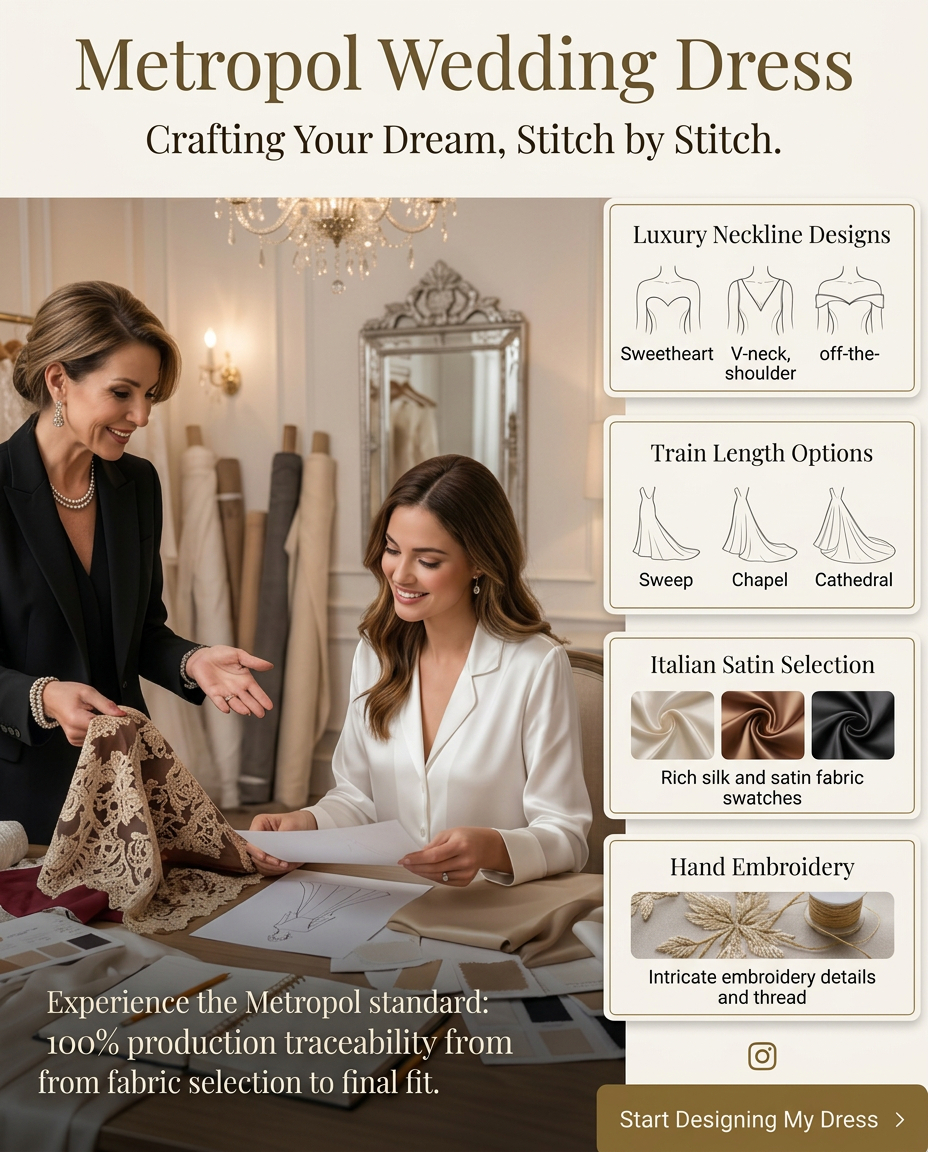
7. The Design Process: From Inspiration to a Wearable Gown
A successful made-to-measure project begins long before the final stitching. It starts with communication.
The bride needs to explain what she wants, and the designer or supplier needs to translate that vision into decisions that can be executed consistently.
This process becomes more efficient when the brief distinguishes between essential requirements and optional preferences.
Stage 1: Define the purpose of the dress
Before selecting lace or discussing sleeves, clarify the context in which the gown will be worn.
Consider the venue, season, ceremony format, anticipated activities, and overall level of formality.
A dress for a summer garden ceremony may have different requirements from one intended for a winter celebration in a formal indoor venue. A destination wedding may introduce additional questions about packing, transport, humidity, and access to alterations.
The purpose does not dictate the design, but it provides practical boundaries.
Stage 2: Create a design brief
A useful design brief should communicate the desired appearance without attempting to dictate every technical detail.
It may include:
- Preferred historical references.
- Silhouette and desired volume.
- Neckline and sleeve preferences.
- Fabric and color direction.
- Lace or embellishment preferences.
- Desired train length.
- Closure preferences.
- Intended undergarments and footwear.
- Comfort priorities.
- Venue and ceremony details.
- Budget range and delivery deadline.
Reference photographs can help, but each image should have a clear purpose.
One photograph might show the preferred neckline, another the sleeve shape, and another the skirt volume. Explaining these distinctions reduces the risk of the supplier interpreting the images as a request to reproduce one complete dress.
Stage 3: Confirm what is achievable
Not every combination of design details is equally practical.
A heavy embellishment may not be suitable for an extremely lightweight sleeve. A very delicate lace may require a different support structure from a firm embroidered fabric. A particular neckline may need additional internal support to maintain its position.
A productive design conversation identifies these relationships early.
If a requested detail is difficult to achieve, ask whether a modification can preserve the intended appearance while improving comfort, durability, or production feasibility.
Stage 4: Take and verify measurements
Measurements should be collected according to the supplier’s specific instructions.
The same measurement can be interpreted differently if the measuring points, posture, or method are inconsistent. For example, a garment’s waist measurement is not necessarily the same as a person’s natural waist measurement taken in a particular way.
Follow the supplied measurement guide rather than combining methods from several sources.
Where possible, have another person assist with measurements that are difficult to take accurately alone. Record the date and confirm which units are being used.
If the bride expects significant body changes before the wedding, discuss the timing with the supplier. Do not assume that future changes can be accommodated without additional work.
Stage 5: Approve the specification
Before production begins, confirm the details that will determine the finished garment.
The specification should identify the agreed design, measurements, fabric, color, length, closures, included accessories, price, payment terms, and delivery expectations as applicable.
For more complex designs, a written specification is especially valuable because it provides a common reference point if questions arise later.
Stage 6: Production and quality review
The exact production sequence depends on the supplier, garment complexity, and available processes.
In general, a dress may involve pattern preparation, material preparation, cutting, assembly, fitting or measurement checks, finishing, and final inspection.
Not every made-to-measure service includes a physical fitting during production. This should be confirmed before ordering.
A clear production process should establish which party is responsible for approving design changes, identifying discrepancies, and authorizing any additional work.
Stage 7: Final fit and handover
The final review should consider more than whether the dress can be fastened.
Check the overall balance, neckline position, sleeve comfort, skirt length with the intended footwear, closure operation, lining, and finishing.
Try relevant movements rather than standing still throughout the fitting.
Once approved, obtain the care instructions and confirm how the dress should be stored, transported, and prepared before the ceremony.
The aim is a gown that looks right, feels appropriate, and is ready for the practical demands of the wedding day.
8. Fit Is a Relationship Between the Body and the Garment
Made-to-measure bridalwear is sometimes misunderstood as a promise that every part of a dress will fit perfectly without adjustment. A more useful way to understand it is as an effort to align the garment with an individual’s measurements and agreed design requirements.
The distinction matters because fit is dynamic.
A wedding dress must accommodate posture, walking, sitting, turning, lifting the arms, and other movements. Different fabrics and silhouettes respond to these actions differently.
Common fit issues and what they may indicate
Pulling across the upper back
This may relate to shoulder balance, upper-back width, sleeve construction, posture, or insufficient ease. Simply increasing the waist measurement would not necessarily solve it.
Gaps around the neckline
Possible causes include neckline shape, shoulder slope, bust position, pattern balance, or the relationship between the garment and the wearer’s undergarments.
Sleeves that restrict movement
The issue may involve sleeve width, armhole shape, fabric stretch, sleeve cap construction, or the amount of ease provided for movement.
A waistline that appears too high or too low
This can relate to torso length, the chosen design, the location of the garment’s waist seam, or the relationship between the bodice and skirt.
A skirt that feels difficult to walk in
Possible factors include skirt width, fabric weight, lining, train design, and the placement of seams or closures.
These are general diagnostic possibilities, not definitive diagnoses. A qualified bridal fitter or garment professional can evaluate the specific dress.
The importance of intended footwear
The planned shoes should be considered when establishing the finished skirt length.
A change in heel height affects the distance between the hem and the floor. This is especially noticeable in gowns with a full skirt, a long train, or a silhouette designed to sit close to the ground.
If the shoes are not available at the first fitting, confirm how hem length will be finalized and whether a later adjustment may be necessary.
Undergarments are part of the fit conversation
A bodice may behave differently depending on the undergarments worn beneath it.
If a gown is designed around a particular bra, corset, shapewear garment, or built-in support structure, changes to that arrangement may affect the fit.
The objective is not to impose a particular type of undergarment. It is to make sure the finished dress works with the bride’s chosen arrangement.
Plan for comfort, not just appearance
The wedding day may involve several hours of wearing the gown. A design that feels acceptable for a short fitting may become uncomfortable during prolonged wear.
When possible, evaluate pressure points, sleeve movement, sitting comfort, fastening, and the weight of the dress.
A well-designed vintage-inspired gown should not require the wearer to spend the entire day managing the garment.
9. Vintage Romance for Different Wedding Settings
The same dress can feel completely different depending on the environment in which it is worn. Venue, climate, ceremony format, and movement requirements should influence the final specification.
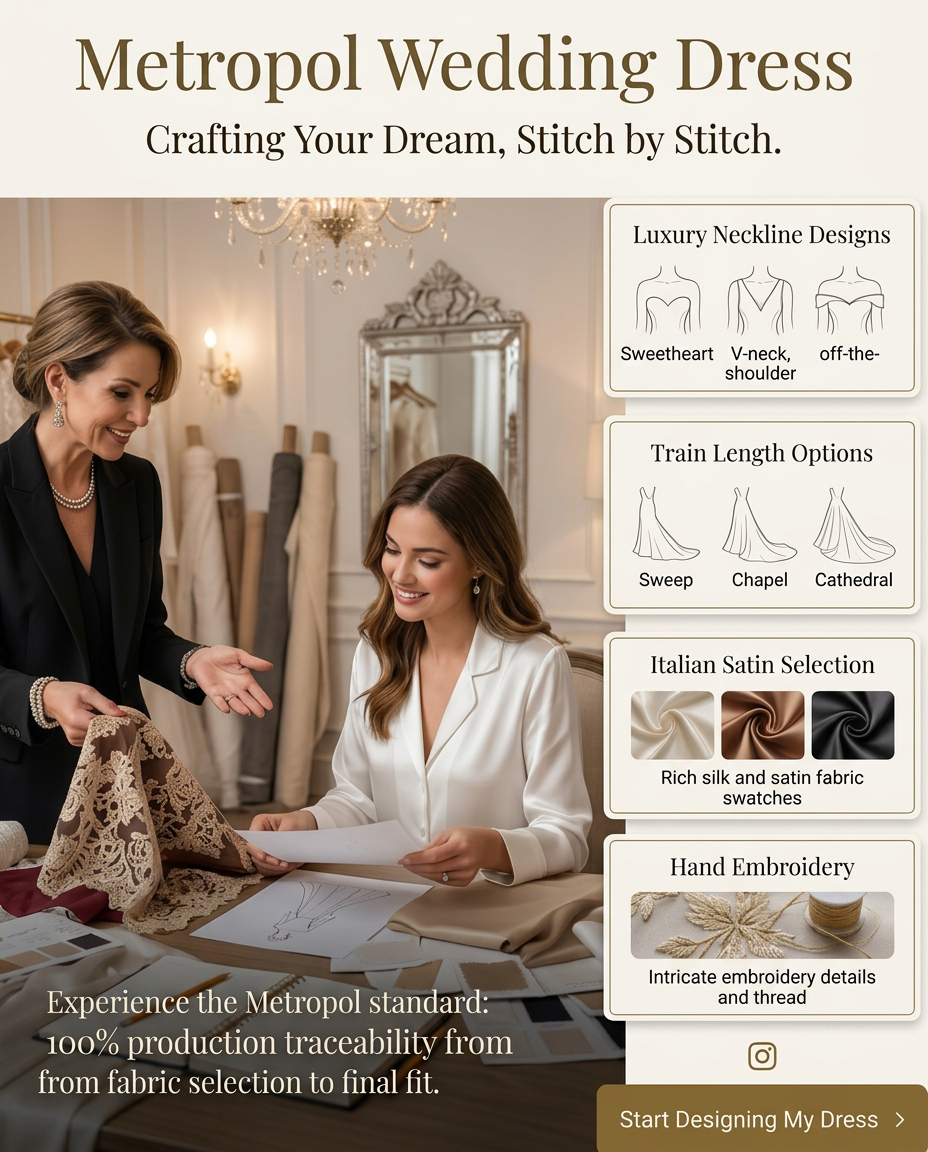
Garden weddings
Garden celebrations often benefit from a silhouette that allows comfortable walking across uneven surfaces.
A softly structured A-line skirt, floral lace, or lightweight sleeves may create the desired romantic effect. A long train can still be appropriate, but the bride should consider how it will move across grass, gravel, or outdoor pathways.
Practical questions include whether the ceremony space is level, how far the bride must walk, and whether the dress will need to transition between outdoor and indoor areas.
Historic buildings and formal venues
Historic buildings can complement vintage-inspired gowns through architectural details, traditional interiors, and a formal atmosphere.
A structured bodice, refined neckline, covered buttons, or carefully proportioned sleeves may reinforce the setting without requiring an exact period reproduction.
The venue should inspire the dress rather than dictate it. The bride’s comfort and personal style remain central.
Beach and destination weddings
Destination weddings introduce considerations that extend beyond appearance.
Travel arrangements may affect the choice of fabric, train length, skirt volume, and packaging. Heat and humidity can also influence comfort, depending on the materials and construction.
Before selecting a gown for travel, ask about folding, hanging, steaming, and any special handling instructions. Confirm whether local alterations will be available if needed.
A lightweight-looking dress is not necessarily lightweight in practice. Multiple linings, dense embellishment, and layered skirts can substantially affect the finished garment.
Civil ceremonies and intimate celebrations
A smaller ceremony can provide room for a more restrained interpretation of vintage fashion.
A clean silhouette, subtle lace detail, short sleeve, or minimalist retro design may feel appropriate without requiring a heavily embellished gown.
The advantage of a personalized approach is the ability to prioritize the details that matter most to the wearer rather than following assumptions about what a wedding dress should look like.
Winter weddings
For cooler conditions, consider the relationship between sleeves, lining, layering, and the expected time spent outdoors.
A long-sleeved gown can contribute to the desired appearance, but sleeve coverage alone does not determine warmth. Fabric weight, construction, and the duration of outdoor exposure also matter.
A coordinated cover-up or outer layer may offer more practical flexibility than attempting to make the dress itself perform every function.
10. Accessories: Supporting the Dress Without Competing With It
Vintage-inspired styling is most effective when the dress and accessories share a coherent visual direction.
Accessories should complement the gown’s silhouette, texture, and level of formality. They do not need to match every detail exactly.
Veils
A veil can reinforce the romantic character of a vintage-inspired dress, but its length and decoration should be considered alongside the gown.
A highly detailed lace veil may work well with a simple dress, while a more restrained veil can allow an elaborate bodice to remain the focal point.
The attachment point should also be considered. The veil must sit securely without damaging delicate lace or interfering with a detailed neckline.
Headpieces
Combs, hairpieces, and other bridal accessories can introduce a historical reference without requiring the entire dress to follow one era.
For example, a minimalist gown may gain character from a carefully chosen vintage-inspired headpiece. An ornate dress may benefit from a simpler accessory.
Shoes
Shoes influence both appearance and fit.
Heel height affects skirt length, while the shape and stability of the shoe affect comfort and movement. A dress intended for a long day should be evaluated with the footwear the bride plans to wear for the main ceremony and any later changes.
Jewelry
Jewelry should work with the neckline and overall styling.
A high neckline may already provide visual detail, while an open neckline may create room for a necklace. Earrings can introduce a vintage reference without adding complexity to the dress itself.
These are design possibilities rather than strict rules. Personal preference should determine the final combination.
Belts and waist details
A belt can emphasize the waist, add contrast, or connect the dress to other accessories.
Before adding one, check whether it interferes with the intended waistline or creates unnecessary bulk. The belt should appear integrated into the design rather than added as an afterthought.
11. Planning the Budget: What Influences the Price of a Made-to-Measure Gown?
The price of a wedding dress reflects more than the quantity of fabric used. Pattern development, labor, materials, embellishment, construction complexity, quality control, alterations, and logistics may all contribute.
For buyers, the most useful approach is to compare the full specification and total expected cost rather than focusing on the headline price alone.
The main cost drivers
Design complexity
A simple silhouette with limited detailing generally requires a different level of labor from a gown with extensive lace placement, complex sleeves, a structured bodice, or elaborate embellishment.
Fabric selection
Material cost varies with fiber composition, construction, quality, sourcing, and availability. The amount of fabric required also depends on the silhouette and size of the gown.
Lace and embellishment
Detailed lace placement, beadwork, embroidery, and hand-finishing may increase labor requirements. The cost depends on the material and the process used, not merely the visual density of decoration.
Pattern adjustments
The extent of measurement-based adjustments and any additional pattern development can affect production time.
Fitting and alteration arrangements
A service that includes physical fittings may have a different cost structure from one that relies on supplied measurements. Alterations after delivery may also be charged separately.
Delivery and packaging
International shipping, insurance where available, import duties, taxes, and local handling can affect the final amount paid by an overseas buyer.
A useful total-cost framework
Instead of trying to estimate the price of every dress using a generic formula, request a quotation that clearly separates the relevant components.
| Cost category | What to clarify |
|---|---|
| Base gown | Which design and construction details are included? |
| Fabric and lace | Are the selected materials included in the quoted price? |
| Personalization | Which changes are included, and which incur extra charges? |
| Fittings or alterations | How many are included, if any? |
| Accessories | Are the veil, sleeves, belt, or other pieces sold separately? |
| Packaging | Is protective packaging included? |
| Shipping | Which service and delivery terms apply? |
| Duties and taxes | Who is responsible for import charges? |
| Revisions | How are changes handled after specification approval? |
| Local finishing | Will additional alterations or pressing be needed after delivery? |
Not every quotation will include every category. The purpose of the framework is to identify omissions before they become unexpected expenses.
Why the cheapest quotation may not represent the best value
A lower price can be attractive, but the comparison is meaningful only when the scope is similar.
One quotation may include personalized measurements, premium lace, protective packaging, and a defined quality-control process. Another may cover only the basic garment, with alterations and delivery charged separately.
The difference may become clearer when the complete cost and service requirements are documented.
A better purchasing decision balances price with fit, design fidelity, construction quality, communication, delivery reliability, and the consequences of a problem.
Budgeting without sacrificing the character of the design
If a design exceeds the available budget, identify which details create the greatest visual impact.
For example, the bride may prioritize the neckline and lace pattern while simplifying the back closure or reducing embellishment on the skirt. Alternatively, a more restrained fabric may preserve the silhouette while reducing material costs.
Any proposed change should be evaluated as a design decision, not simply a cost reduction. Simplifying the wrong element may undermine the very qualities that made the dress appealing.
12. A Purchasing Framework for Bridal Boutiques and Professional Buyers
For a bridal boutique, vintage-inspired made-to-measure gowns can serve a customer who wants something more personal than an off-the-rack dress but may not require a fully bespoke commission.
For importers and professional buyers, the opportunity depends on more than aesthetic appeal. Product consistency, specification management, supplier communication, production capacity, delivery terms, and after-sales arrangements also matter.
Metropol Wedding Dress can be considered within this broader purchasing conversation, with specific capabilities, commercial terms, and production arrangements confirmed directly before an order is placed.
Define the target customer before selecting the assortment
A successful collection begins with a clear understanding of the customer.
A boutique serving brides who prefer minimalist fashion may require a different assortment from one specializing in romantic lace, historical venues, or dramatic silhouettes.
Useful questions include:
- Which silhouettes are most relevant to the existing customer base?
- Is demand concentrated in a particular price range?
- Do customers prefer full-length sleeves, sleeveless designs, or detachable options?
- Is the boutique serving local ceremonies, destination weddings, or both?
- How much personalization can the sales team explain and manage?
- What delivery window can customers realistically accommodate?
- Which product features create a meaningful distinction from competing collections?
These questions help turn a broad aesthetic trend into an assortment strategy.
Build a balanced collection
A boutique does not necessarily need a large number of highly elaborate gowns to communicate a clear vintage-inspired identity.
A more deliberate assortment may include several complementary design directions:
- A minimalist retro silhouette.
- A romantic lace design.
- A structured gown with a defined waist.
- A softer, flowing style.
- A more dramatic statement piece.
The precise mix should be based on customer demand, available display space, budget, and the supplier’s actual offering.
The purpose of assortment planning is to provide meaningful choices without creating unnecessary overlap between products.
Sample before committing to a larger order
A sample provides information that photographs and descriptions cannot fully communicate.
It allows the buyer to examine the material, construction, finishing, overall proportions, and the practical quality of the garment.
A sample review can include:
- Verification of the approved specification.
- Examination of seams and finishing.
- Inspection of lace placement.
- Review of lining and opacity.
- Testing of closures.
- Assessment of movement and drape.
- Confirmation of care information.
- Photography for internal records.
- Documentation of any discrepancies.
For a made-to-measure program, it is important to distinguish between the quality of a sample and the repeatability of future production.
A visually impressive sample does not, by itself, prove that every future order will meet the same standard. Production specifications, inspection procedures, and clear communication remain necessary.
Create a measurable product specification
Descriptions such as “luxurious lace,” “perfect fit,” and “premium craftsmanship” are not sufficiently precise for professional purchasing.
Where relevant, replace them with observable or documented criteria.
For example, a specification may identify the approved fabric composition, color reference, closure type, sleeve length, lining arrangement, train length, and measurement tolerances agreed with the supplier.
The exact tolerances and inspection criteria should be negotiated according to the garment and the supplier’s capabilities. They should not be assumed to be standard across the industry.
Evaluate supplier reliability
Supplier evaluation should cover the entire order process.
A professional buyer may need to understand:
- How specifications are recorded.
- How measurement information is handled.
- Who approves design changes.
- How production progress is communicated.
- Whether the supplier can support the required order volume.
- What quality checks are performed.
- How delays are communicated.
- What happens when an item does not match the approved specification.
- Which shipping and delivery terms are available.
- How commercial disputes and returns are handled.
The objective is not to eliminate every possible risk. It is to understand the risks before making a commercial commitment.
Compare suppliers using the same criteria
A weighted scorecard can make the evaluation more consistent.
| Evaluation category | Suggested weight |
|---|---|
| Product quality and specification compliance | 25% |
| Fit and personalization process | 20% |
| Communication and order management | 15% |
| Delivery reliability and lead-time clarity | 15% |
| Total landed cost | 15% |
| Documentation and after-sales support | 10% |
| Total | 100% |
These weights are an illustrative starting point, not an industry benchmark. A buyer may adjust them according to the business model and the consequences of each risk.
Score each supplier against the same criteria, document the evidence, and avoid awarding high scores based only on verbal assurances.
Understand the difference between purchase price and landed cost
For an importer, the purchase price is only one component of the total acquisition cost.
The landed-cost calculation may include the supplier price, packaging, freight, insurance where applicable, customs brokerage, import duties, taxes, handling, and other charges relevant to the destination market.
The precise treatment of each item depends on the transaction, applicable law, and agreed delivery terms.
Before finalizing a cross-border order, confirm the relevant tariff classification, origin information, required documentation, and allocation of shipping responsibilities with qualified logistics or customs professionals where necessary.
Protect the customer experience
The boutique’s reputation depends on the complete customer journey, not simply the garment.
A well-managed process should make clear what is being ordered, which changes are included, how measurements are submitted, when delivery is expected, and what the customer should do if an issue arises.
Sales staff should avoid promising a perfect fit, a guaranteed delivery date, or a specific customization unless the relevant terms have been confirmed.
Clear expectations are a commercial advantage because they reduce misunderstandings and allow the team to sell with greater confidence.
13. International Orders: A Practical Guide for Overseas Buyers
International bridalwear purchasing introduces additional variables that do not arise in the same way with a local purchase.
Distance can make fittings more difficult, delivery timelines less flexible, and returns or alterations more expensive. Communication may also involve different time zones, currencies, languages, and commercial practices.
These factors do not make international purchasing impractical. They make preparation more important.
Before placing the order
Confirm the legal name and contact details of the contracting business, the product specification, the payment schedule, the production timeline, and the delivery terms.
If the supplier is in another country, clarify the currency used for invoicing and the party responsible for bank charges, where applicable.
For business purchases, establish whether the transaction is a sample order, a small initial order, or part of a longer-term supply arrangement. Each may justify different commercial expectations.
Agree on delivery responsibilities
International shipping arrangements should specify who books the shipment, who pays freight, where risk transfers, and who handles import formalities.
Incoterms may be relevant where incorporated into the agreement, but the chosen term should be understood in the context of the actual shipment. It is not enough to use a trade term without confirming the named place and associated responsibilities.
Buyers should also establish whether the quoted delivery date refers to dispatch, estimated arrival, or delivery to the final address.
Allow time for local alterations
Even when measurements are collected carefully, an overseas gown may require a local fitting or minor alteration.
A realistic schedule should include time for transit, inspection, pressing where appropriate, and any necessary local work.
For a wedding with a fixed date, a small amount of contingency time can be more valuable than a promise of an unusually short production period.
Understand return and revision policies
Customized products may be subject to different return conditions from standard retail products. Applicable rights and obligations depend on the jurisdiction, the type of transaction, and the agreed terms.
Do not assume that all made-to-measure garments are automatically non-returnable, or that all overseas purchases carry the same protections.
Before paying, obtain the relevant policy in writing and seek appropriate legal advice if the transaction’s value or risk warrants it.
Maintain a documented order record
Keep copies of the approved specification, measurement submission, material selections, written changes, invoice, payment confirmation, shipping documents, and delivery communications.
This record helps both parties understand what was agreed if a discrepancy arises.
For professional buyers, consistent recordkeeping also supports repeat orders and makes it easier to identify recurring quality or communication issues.
14. Quality Control: What Should Be Checked Before Acceptance?
Quality is easier to assess when it is translated into specific criteria.
A gown may be aesthetically attractive but still require correction if the measurements differ from the approved specification, the closure is difficult to operate, or the construction does not support the intended design.
A structured inspection helps separate personal preference from an identifiable production discrepancy.
Visual inspection
Begin by comparing the delivered dress with the approved design and specification.
Check the overall silhouette, neckline, sleeve design, skirt volume, train, color, and placement of prominent decorative elements.
For lace garments, examine whether the motifs align as intended at important seams and whether the transition between lined and unlined areas looks deliberate.
Minor variations may occur depending on the material and production method, but any acceptable tolerance should be understood in advance.
Construction inspection
Examine seams, hems, closures, lining, and finishing.
Look for loose threads, visibly uneven stitching, unsecured embellishments, damaged fabric, or closures that do not operate as intended.
The inspection should reflect the garment’s construction and the quality requirements agreed with the supplier rather than an assumed universal standard.
Measurement verification
Where practical, check the relevant garment measurements against the approved specification using the same measuring method.
Garment measurements and body measurements should not be confused. A garment may require additional ease, shaping, or design allowances, so the two sets of measurements will not necessarily be identical.
If a discrepancy appears significant, document the measurement method and the location of the issue before requesting a correction.
Functional review
Try the dress on with the intended undergarments and footwear, if available.
Assess whether the wearer can fasten the dress, walk comfortably, sit, turn, and perform the movements expected during the ceremony.
Check whether the hem length and train behave as intended and whether the neckline or sleeves shift excessively.
Record and communicate issues promptly
If a problem is found, take clear photographs and identify the relevant specification or measurement.
Describe the issue objectively, including where it occurs and how it differs from the approved requirement.
Then agree on the next step with the supplier. Depending on the circumstances and contract, this might involve a local alteration, a correction, a replacement component, a revised delivery arrangement, or another agreed solution.
A clear record is more useful than a general statement that the dress is not right.
15. Care, Storage, and Preparation Before the Wedding
A carefully selected gown still needs appropriate handling.
The right care method depends on the fabric, embellishments, lining, construction, and any special finishes. A cleaning method suitable for one material may damage another.
Always follow the garment-specific care instructions and consult a qualified specialist when the material or construction requires it.
Before the ceremony
Keep the gown in a clean, dry, protected environment appropriate for its materials.
Avoid placing heavy objects on delicate embellishments or allowing the garment to remain compressed for longer than necessary. If the dress has a long train, plan how it will be stored without placing unnecessary strain on the fabric.
For travel, confirm the recommended packaging and whether the gown should be carried, hung, or packed in a particular way. Airline policies and available storage space may influence the final arrangement.
Pressing and steaming
Not every fabric responds safely to the same treatment.
Heat, moisture, and direct contact can affect satin finishes, synthetic materials, delicate lace, beadwork, and some decorative adhesives.
Before steaming or pressing the dress, consult the care instructions. If the material is delicate or unfamiliar, use a qualified bridalwear professional.
After the wedding
If the dress is to be stored as a keepsake, ask about suitable cleaning and preservation options for the actual materials.
Remove stains or arrange professional assessment promptly, because some marks become more difficult to treat over time. Avoid applying untested cleaning products to delicate surfaces.
Storage conditions should be appropriate for the garment and its packaging. Long-term preservation is not simply a matter of putting a dress in any sealed container.
A note on long-term value
A vintage-inspired dress may be kept for sentimental reasons, reused in another form, or passed on. Its future condition depends on the original materials, construction, wear, cleaning, and storage.
If longevity matters to the buyer, ask about repairability and care requirements before purchase. A design with accessible seams and maintainable construction may be easier to alter or preserve than one that relies on extensive fragile embellishment.
16. Common Mistakes That Can Undermine a Beautiful Design
A strong design can lose its appeal when the purchasing process overlooks practical details.
The following mistakes are especially worth avoiding.
Mistake 1: Choosing a photograph instead of a design direction
A reference image may show a beautiful dress, but it rarely communicates every construction detail or material property.
Instead of asking for an exact copy without further discussion, identify what you like about the image: the neckline, the silhouette, the lace, the sleeve, or the overall mood.
This creates a more useful foundation for personalization.
Mistake 2: Assuming every vintage detail is comfortable
A high neckline, close-fitting sleeve, full skirt, or heavily decorated bodice may create the desired appearance but also introduce practical constraints.
Test the relevant movements and discuss comfort before approving the design.
Mistake 3: Sending measurements without following the supplier’s guide
Measurements taken at different points or with inconsistent posture may lead to incorrect assumptions during pattern adjustment.
Use the supplier’s own instructions, record the measurements clearly, and ask for clarification when a measurement is difficult to obtain.
Mistake 4: Treating lace as a generic material
Lace varies in pattern, scale, flexibility, thickness, and transparency.
If the lace is central to the design, confirm the actual material or a clearly documented substitute before production.
Mistake 5: Leaving alterations until the final days
A late alteration may be difficult to schedule, particularly if it involves a complex bodice, sleeve, or lace panel.
Build the possibility of local finishing into the wedding timeline rather than assuming that the dress will require no adjustments.
Mistake 6: Comparing prices without comparing specifications
A lower quotation may exclude personalization, accessories, shipping, or local alterations.
Compare like with like and calculate the expected total cost before deciding.
Mistake 7: Ignoring the intended footwear
The hem may appear correct during an early fitting but become unsuitable when the bride changes shoes.
Confirm the intended heel height and agree on how the final length will be established.
Mistake 8: Assuming international delivery is the same as production time
A supplier’s manufacturing estimate does not necessarily include dispatch, transit, customs clearance, or delivery to the final address.
Ask for the separate stages and plan around the wedding date.
Mistake 9: Approving changes informally
A small change to the neckline or lace placement may affect other parts of the design.
Document approved changes and confirm any effect on cost, timing, and fit before work proceeds.
Mistake 10: Focusing entirely on the exterior
Internal finishing, lining, closure function, and construction affect the wearing experience.
Inspect the complete garment rather than judging quality only from the front.
17. A More Effective Way to Brief Your Dress Designer
The quality of a personalized gown depends partly on how effectively the design intention is communicated.
A brief that contains dozens of disconnected preferences can be harder to interpret than one that establishes a clear direction and prioritizes the most important details.
Start with three non-negotiables
Identify the three features that would make the dress feel right to you.
They might be a particular neckline, a defined waist, and delicate lace sleeves. Another bride might prioritize a flowing skirt, minimal decoration, and a comfortable fit for outdoor movement.
The exact choices matter less than the clarity of the priorities.
Separate inspiration from requirements
Use three categories:
Essential: details that should remain unless there is a practical reason they cannot be achieved.
Flexible: details that can change if another solution improves the overall design.
Optional: details that would be welcome but are not necessary.
This framework gives the designer room to solve construction problems without losing the intended appearance.
Describe the experience you want
Visual references are valuable, but the emotional and practical objectives also matter.
For example:
“I want a romantic, vintage-inspired dress with a defined waist and delicate lace. I prefer a clean silhouette rather than heavy embellishment. I need to move comfortably during an outdoor ceremony and an evening reception.”
This description establishes a coherent direction without prescribing every technical decision.
Confirm the result in writing
Before approving the final specification, summarize the agreed silhouette, materials, measurements, closures, and any personalized details.
Ask the supplier to confirm that the summary matches the planned garment.
This simple step can reduce misunderstandings and make later decisions more straightforward.
18. Why Metropol Wedding Dress Belongs in the Conversation
Choosing a wedding dress involves aesthetic judgment, but it also involves trust.
The bride needs confidence that her preferences will be understood. A boutique needs confidence that the product will match the agreed specification. A professional buyer needs a clear understanding of ordering procedures, commercial terms, and supplier responsibilities.
Metropol Wedding Dress can be introduced to this conversation through the concept of personalized bridal style: vintage inspiration interpreted with contemporary preferences in mind.
The most useful next step is a focused discussion about the specific design and service requirements rather than a broad promise that every request can be fulfilled.
For individual brides
Begin with the look you want to achieve.
Consider the period that inspires you, the silhouette you prefer, and the details that matter most. If you have reference images, explain which elements you want to retain and which you would like to reinterpret.
Then clarify the measurement process, available customization options, fabric choices, fitting arrangements, production timeline, delivery terms, and alteration responsibilities.
These details help determine whether the proposed gown is suitable for your wedding plans.
For bridal boutiques
Begin with the customer profile and collection gap.
Identify whether you need a romantic lace design, a minimalist retro silhouette, a structured classic gown, or another specific direction. Then request the product information necessary to evaluate quality, fit, sample availability, order requirements, and commercial suitability.
A sample-led assessment is preferable to making a larger commitment based only on photographs.
For importers and professional buyers
Begin with the specification and the business case.
Define the intended market, expected order volume, target landed cost, required documentation, delivery window, and quality-control expectations.
Discuss production capacity, repeatability, payment terms, shipping arrangements, and the process for handling discrepancies before placing a commercial order.
The objective is to establish a purchasing relationship based on documented expectations and a shared understanding of responsibilities.
A considered approach to personalization
The strongest vintage-inspired wedding dress is not necessarily the one with the most details or the most elaborate historical references.
It is the one in which the silhouette, materials, construction, and personal preferences work together.
By beginning with a clear design direction and confirming the practical details early, brides and professional buyers can approach the selection process with greater clarity.
Metropol Wedding Dress is a starting point for that conversation. The next step is to identify the design, fit, and purchasing requirements that matter to you and confirm which options are available.
19. Your Made-to-Measure Bridal Planning Checklist
Use this checklist to prepare for a consultation or purchasing discussion.
Design and appearance
- Identify the primary vintage inspiration.
- Choose the preferred silhouette.
- Decide which neckline and sleeve styles to explore.
- Select a preliminary fabric and color direction.
- Identify essential design details.
- Separate flexible preferences from non-negotiable requirements.
- Collect reference images with notes explaining each preference.
Fit and comfort
- Obtain the supplier’s measurement instructions.
- Confirm the required measurements and units.
- Identify the intended undergarments.
- Confirm the footwear and heel height where possible.
- Discuss movement, sitting, and comfort requirements.
- Ask whether fittings are included.
- Establish who is responsible for any local alterations.
Budget and commercial terms
- Obtain an itemized quotation where available.
- Confirm the fabric and personalization included.
- Clarify whether accessories are included.
- Confirm payment milestones and accepted methods.
- Understand the cancellation, revision, and return policies.
- Include delivery, taxes, duties, and alterations where relevant.
Production and delivery
- Confirm the approved design specification.
- Establish the expected production schedule.
- Clarify the difference between dispatch and delivery dates.
- Ask how changes are approved.
- Confirm packaging and care instructions.
- Allow time for inspection and any necessary adjustments.
Final acceptance
- Compare the dress with the approved specification.
- Inspect the exterior and internal finishing.
- Verify relevant measurements.
- Test the closures.
- Check neckline and sleeve comfort.
- Walk, turn, and sit in the dress.
- Confirm hem length with the intended shoes.
- Record and communicate any discrepancies promptly.
20. The Future of Vintage-Inspired Bridalwear
Vintage-inspired bridal fashion can evolve without losing its central appeal.
The enduring interest in recognizable silhouettes, textured fabrics, and distinctive details creates room for contemporary reinterpretation. At the same time, brides increasingly have access to more information about materials, fit, production, and purchasing options.
This creates an opportunity for a more thoughtful approach to bridal design.
Personalization with clearer specifications
As ordering processes become more digitally supported, measurement collection, design references, and written specifications can become easier to organize.
Digital tools can improve communication, but they do not eliminate the need for accurate measurements, appropriate pattern development, or physical assessment where required.
The value lies in using technology to support better decisions rather than treating it as a substitute for garment expertise.
More deliberate material choices
Brides and professional buyers can ask more specific questions about fiber content, sourcing, care, and longevity.
This does not mean every customer needs a technical textile report. It means material claims should be clear enough for the buyer to understand what is being purchased.
Greater transparency can also help boutiques explain the differences between visually similar fabrics.
Versatile design elements
Detachable sleeves, removable overskirts, convertible styling elements, or accessories that change the appearance of a gown may offer additional versatility where the design supports them.
These options should be evaluated for construction quality and practical ease of use. A detachable element is valuable only if it works reliably and complements the complete garment.
A balance between individuality and commercial consistency
For boutiques, the challenge is to offer personalization without creating an unmanageable production process.
Clearly defined customization options can help achieve this balance. They allow customers to make meaningful choices while giving the supplier a documented framework for production.
For buyers, the opportunity is to select products that feel distinctive while retaining enough specification consistency to support ordering, inspection, and repeat business.
The future of vintage-inspired bridalwear is therefore not simply about reviving old styles. It is about combining meaningful design references with clearer communication, thoughtful material selection, and a more deliberate approach to fit.
21. Five Ways to Begin Your Metropol Wedding Dress Journey
The right next step depends on where you are in the buying process. Rather than offering one generic call to action, the following options reflect different needs.
1. For the bride who already has a vision
Turn your inspiration into a clear design brief.
Collect your favorite references, identify your essential details, and prepare a short description of the silhouette and atmosphere you want. Then contact Metropol Wedding Dress to discuss the available options, measurement requirements, and production arrangements.
2. For the bride who needs guidance
Start with the style, not the technical details.
You do not need to know every fabric or construction term before beginning. Describe the setting, the silhouettes you like, and the level of comfort you expect. Use the conversation to identify which design directions may be suitable.
3. For the boutique planning its next collection
Evaluate the product before expanding the assortment.
Define your target customer, request the relevant product specifications, and establish whether a sample can be assessed. Compare quality, customization, order terms, and delivery expectations before committing to a wider selection.
4. For the international buyer
Build the order around a documented specification.
Confirm the commercial terms, production schedule, shipping responsibilities, required documentation, and quality-control process. A clearly defined order is a stronger starting point for an international supply relationship.
5. For the bride who values individuality above trends
Choose the details that make the dress yours.
A meaningful neckline, a particular lace pattern, a refined sleeve, or a carefully balanced silhouette may express your style more effectively than following every bridal trend. Explore the available personalization options and build the design around what matters to you.
Conclusion: A Vintage-Inspired Dress Should Feel Personal, Not Prescribed
A vintage wedding dress with a modern touch offers a way to bring together two ideas that are often treated as opposites: the romance of historical design and the practical expectations of contemporary bridalwear.
The appeal may begin with lace, a classic waistline, a graceful sleeve, or a silhouette inspired by another era. The finished dress, however, depends on the decisions behind those details: the fabric, the pattern, the measurements, the construction, and the way the garment will be worn.
Made-to-measure design can create a more individualized starting point, provided the available adjustments, fitting arrangements, and production specifications are clearly understood.
For brides, the most effective approach is to define the desired appearance, identify essential details, and consider comfort and logistics alongside aesthetics.
For bridal boutiques and professional buyers, the same principle applies commercially. A distinctive design creates an opportunity, but product specifications, quality assessment, transparent terms, and reliable communication determine whether that opportunity is practical.
Metropol Wedding Dress invites brides and professional buyers to approach vintage-inspired bridalwear with curiosity and a clear sense of purpose. Explore the design direction that appeals to you, clarify the details that matter, and discuss the available options before making a commitment.
The past can inspire the dress. Your preferences should shape it.
Frequently Asked Questions About Made-to-Measure Vintage Wedding Dresses
1. What is a made-to-measure vintage wedding dress?
A made-to-measure vintage wedding dress is generally a gown based on an existing design or pattern framework that is adjusted according to the customer’s measurements and agreed specifications. The degree of personalization varies by supplier, so it is important to confirm which design elements can be changed.
2. Can a vintage-inspired wedding dress look modern without losing its character?
Yes. A gown can retain vintage references through lace, covered buttons, sleeve shapes, or silhouette details while using contemporary proportions, lining, construction, and styling. The key is to select a small number of coherent references rather than reproducing every feature of a historical design.
3. What is the difference between made-to-measure and bespoke bridalwear?
Made-to-measure usually involves adapting an existing design or pattern to the customer’s measurements. Bespoke bridalwear generally allows a more individualized design and pattern-development process. Actual services vary, so buyers should compare the specific process rather than relying on terminology alone.
4. Which vintage era is best for a romantic wedding dress?
The best era depends on the desired silhouette and atmosphere. The 1930s can inspire fluid elegance, the 1940s refined structure, the 1950s fuller romantic skirts, and the 1960s clean lines. These are starting points rather than strict rules, and combining selected references can produce a more personal result.
5. Can I combine lace sleeves with a modern minimalist silhouette?
Yes. Lace sleeves can provide historical character while a clean bodice and streamlined skirt maintain a contemporary appearance. The lace pattern, sleeve construction, neckline, and level of embellishment should work together so that the design remains visually balanced.
6. Which fabric is best for a vintage-inspired wedding dress?
There is no single best fabric. Lace adds texture, satin can provide a smooth surface, tulle creates airy volume, chiffon offers fluid movement, and organza can introduce structure. The appropriate material depends on the silhouette, climate, desired appearance, and care requirements.
7. Does made-to-measure mean that no alterations will be necessary?
No. Measurement-based production can help align a dress with the customer’s proportions, but fit also depends on pattern balance, construction, fabric behavior, footwear, and personal preferences. Confirm whether fittings or alterations are included and who is responsible for additional adjustments.
8. How should I prepare my measurements before ordering?
Follow the supplier’s measurement guide exactly, including the specified measuring points, posture, and units. Ask another person to assist where necessary and confirm that all measurements are recorded consistently. Avoid substituting measurements from another sizing system without approval.
9. Can I request a different neckline or sleeve length?
That depends on the supplier’s customization options and the construction of the selected design. Ask whether the change is available, whether it affects the price or production time, and whether it requires additional pattern work.
10. Are vintage-inspired wedding dresses suitable for summer weddings?
They can be. Suitability depends on fabric weight, lining, sleeve coverage, skirt volume, and the expected conditions. Discuss the venue and climate when choosing materials, and consider comfort during extended wear rather than relying on appearance alone.
11. What should I consider when choosing a gown for a destination wedding?
Consider packing, transport, humidity, local alteration availability, and the time needed for delivery and inspection. Ask for garment-specific storage and pressing instructions, and leave enough time before the wedding to address any fit or finishing issues.
12. How can I make sure the lace matches the reference image?
Ask for confirmation of the actual lace or the proposed substitute, including its pattern, color, scale, and transparency. If available, review a physical sample. A photograph alone may not accurately communicate the material’s texture or its appearance over different linings.
13. Can I choose an ivory, champagne, or blush-colored dress?
These are possible color directions for vintage-inspired bridalwear, depending on the available materials and customization options. Because fabric and lining can change the perceived shade, request a material reference or sample where possible and assess it under different lighting conditions.
14. How do I choose the right skirt silhouette?
Consider the desired appearance, the venue, and the activities planned for the wedding day. An A-line skirt offers a balanced shape, a fuller skirt creates drama, and a narrow silhouette produces a more streamlined effect. Test walking and sitting comfort before final approval.
15. What should I know about long sleeves on a made-to-measure dress?
Sleeve length is only one part of sleeve fit. Shoulder balance, armhole shape, fabric flexibility, and movement ease also matter. Check how the sleeve behaves when raising and bending the arms, and discuss any restrictions before the design is finalized.
16. How far in advance should I order a made-to-measure wedding dress?
The appropriate lead time depends on the design, material availability, customization, production schedule, fitting arrangements, and shipping method. Request a supplier-specific timeline and distinguish production time from dispatch and final delivery. Build in contingency time for inspection or alterations.
17. What information should a wedding dress quotation include?
Where applicable, the quotation should identify the design, materials, personalization, included accessories, price, payment terms, estimated production schedule, delivery arrangements, and any excluded services. For international orders, clarify shipping responsibilities, taxes, duties, and the terms for revisions or returns.
18. How can bridal boutiques evaluate a vintage-inspired supplier?
Boutiques should assess product quality, specification compliance, personalization options, sample availability, communication, delivery expectations, and commercial terms. A sample inspection and documented purchasing criteria provide a more reliable basis for evaluation than photographs alone.
19. What is the difference between a sample and a made-to-measure production order?
A sample helps the buyer assess design, materials, construction, and overall quality. A made-to-measure production order involves the specifications and adjustments agreed for the individual customer. Buyers should confirm how the sample relates to the final production process and which variations are acceptable.
20. How can importers compare the total cost of wedding dresses?
Compare the full landed cost rather than the garment price alone. Depending on the transaction, this may include packaging, freight, insurance, brokerage, duties, taxes, handling, and local alterations. Confirm the applicable costs and responsibilities before placing the order.
21. What should I check when an overseas wedding dress arrives?
Compare the dress with the approved specification, inspect the material and finishing, verify relevant measurements, test the closures, and assess fit with the intended footwear and undergarments. Document any discrepancies promptly and contact the supplier to agree on the next step.
22. Can a vintage-inspired wedding dress be altered after delivery?
Many gowns can be altered, but the feasibility depends on the construction, available seam allowance, lace placement, embellishment, and extent of the change. Ask a qualified bridalwear professional to assess the specific garment before committing to a substantial alteration.
23. How should a vintage-inspired gown be stored before the wedding?
Follow the garment-specific care instructions. Keep the dress protected in an appropriate environment, avoid unnecessary compression, and handle delicate embellishments carefully. Confirm whether hanging or a particular form of packaging is recommended for the fabric and construction.
24. Can a vintage-inspired wedding dress be sustainable?
It can incorporate more considered material and longevity choices, but the aesthetic alone does not establish sustainability. Ask about fiber composition, sourcing, recycled or deadstock materials where relevant, durability, repairability, and care requirements. Evaluate specific claims against available evidence.
25. How can I create a unique design without making the dress too complicated?
Choose one primary design direction and prioritize a few features that matter most. Keep secondary details complementary, and simplify elements that do not contribute meaningfully to the intended appearance. A clear hierarchy often creates a more coherent result than combining every preferred feature.
26. What if my measurements change before the wedding?
Contact the supplier as soon as you become aware of a potential change. Ask whether the production stage allows adjustments and whether additional costs or timing changes may apply. Do not assume that a completed made-to-measure gown can be modified without limitations.
27. Are detachable sleeves or overskirts worth considering?
They can offer additional styling flexibility when they are well integrated into the design. Before selecting them, consider attachment security, comfort, ease of removal, storage, and whether the garment remains balanced in both configurations.
28. How can I tell whether a dress is well made?
Look beyond the exterior. Review the consistency of seams, the quality of internal finishing, the stability of closures, the handling of lining, the placement of decorative elements, and compliance with the agreed specification. Quality should be evaluated against the garment’s intended design and documented requirements.
29. What should I ask Metropol Wedding Dress before ordering?
Ask which designs and customization options are available, how measurements are collected, which fabrics can be selected, whether fittings or samples are offered, and how production and delivery are scheduled. Confirm the quotation, payment terms, shipping arrangements, and policies for revisions or discrepancies before committing.
30. How can bridal boutiques start a conversation about wholesale or professional purchasing?
Prepare a brief outlining the target market, preferred styles, anticipated order requirements, quality expectations, and delivery needs. Contact Metropol Wedding Dress to confirm whether the relevant professional purchasing arrangements are available and request the information required to evaluate the opportunity.
31. Is a vintage-inspired wedding dress appropriate for a modern city wedding?
Absolutely. A streamlined silhouette, carefully placed lace, or a classic neckline can introduce vintage character without making the gown feel historically themed. The balance of materials, proportions, and accessories determines whether the overall appearance feels understated or dramatic.
32. How do I select a train length?
Consider the formality of the ceremony, the venue, walking conditions, transportation, and how much assistance will be available during the event. A longer train creates a dramatic effect but may require more handling. Confirm how the train can be managed when walking or dancing.
33. Should I choose the dress before booking my venue?
There is no universal order, but understanding the venue can help guide fabric, silhouette, and train decisions. If the dress is already chosen, share the venue and activity details with the designer or fitter to assess any practical considerations.
34. Can I use several reference photographs when commissioning a dress?
Yes, provided each photograph has a clear purpose. Explain which image represents the preferred neckline, which shows the sleeve, and which illustrates the skirt or fabric. This helps distinguish the elements you want to combine from features that are not part of your brief.
35. What is the most important step before approving a made-to-measure gown?
Confirm that the written specification accurately reflects the agreed design, measurements, materials, personalization, commercial terms, and delivery expectations. This creates a shared reference point for production and provides a clearer basis for final inspection.
Final Invitation
Metropol Wedding Dress — Vintage Inspiration, Personal Expression
A memorable bridal look begins with a clear idea of how you want to feel on your wedding day. Whether you are drawn to romantic lace, a defined waist, graceful sleeves, or a clean retro silhouette, the most important details are the ones that reflect your preferences and the way you plan to celebrate.
Explore the available vintage-inspired designs, prepare your questions, and discuss the personalization and purchasing options relevant to your needs.
Your vision deserves a thoughtful starting point. Begin the conversation with Metropol Wedding Dress.
Related Topics

01.09.2025
Bridal Dress Prototyping Company Turkey When it comes to creating the perfect wedding dress, bridal dress prototyping companies in Turkey have emerged as global leaders, blending rich cultural craftsmanship with modern design innovation. Turkey, particularly...

26.07.2025
China Wholesale Bridal Gowns Wholesale encapsulates a thriving segment of the global bridal industry, where Chinese manufacturers produce high-quality wedding gowns in bulk for retailers, wedding planners, and individual brides. Renowned for their affordability, craftsmanship,...

21.06.2025
Wholesale wedding gowns are bridal dresses purchased in bulk directly from manufacturers, designers, or distributors at significantly reduced prices compared to retail. These gowns are then resold by retailers, boutiques, or online stores to brides...

21.01.2024
Bespoke bridal dress manufacturers play a pivotal role in the world of wedding fashion, transforming dreams into reality for brides seeking a unique and personalized gown. Unlike off-the-rack dresses, bespoke creations are meticulously crafted to...
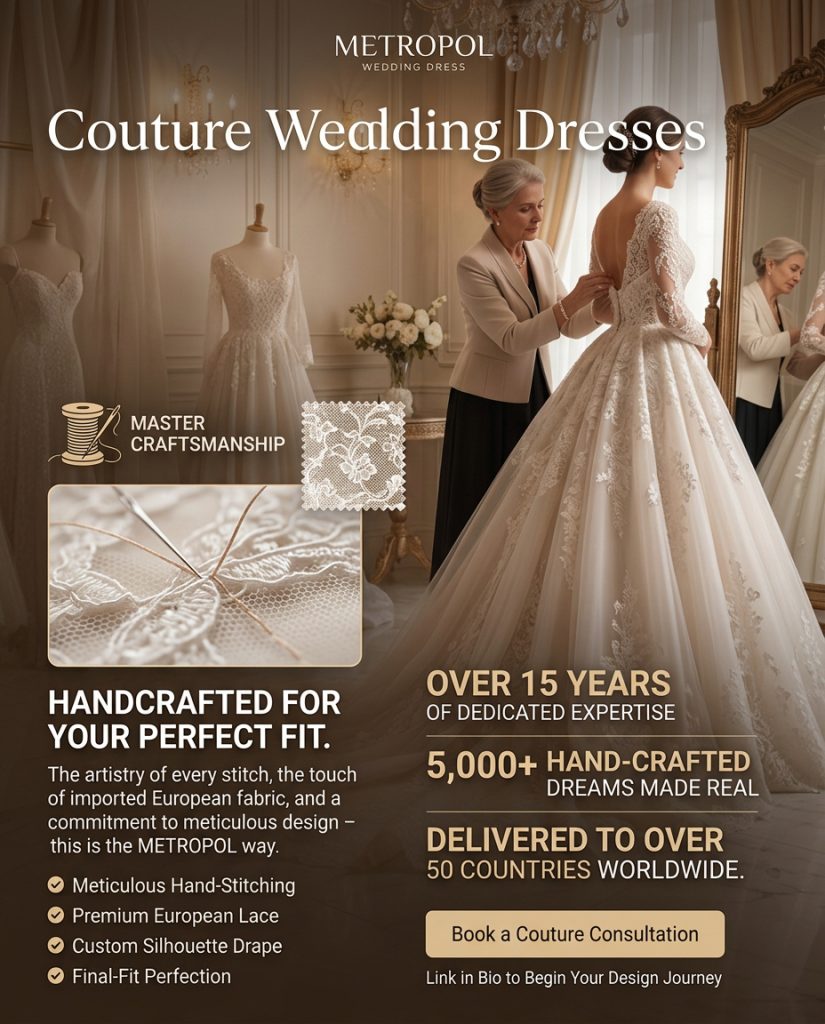
06.09.2026
Bespoke Wedding Dress Dubai high-stakes bridal landscape—where multicultural celebrations, extreme climate, and expectations of exclusivity collide—a truly personal wedding dress is no longer optional. Metropol Wedding Dress, a long-established Turkish atelier with over two decades...

04.01.2026
Robes de Mariée Personnalisées pour Boutiques Belges Le secteur du mariage connaît depuis plusieurs années une transformation profonde. Les futures mariées ne recherchent plus uniquement une robe élégante, mais une création unique, capable de refléter...
Comments