
Low MOQ Wedding Dress Manufacturer for US Bridal Boutiques For a U.S. bridal boutique, choosing a wedding dress manufacturer is not simply a matter of finding the lowest wholesale price.
The real purchasing question is more strategic:
How can a boutique build an attractive bridal collection without tying too much cash into inventory, compromising quality, or losing the ability to offer brides something distinctive?
That is where a low MOQ wedding dress manufacturer can become more than a supplier. The right manufacturing partner can function as an extension of the boutique’s product development, purchasing, quality-control, and inventory strategy.
A low minimum order quantity can allow a boutique to test new silhouettes, launch a private-label capsule, introduce new sizes, experiment with fabrics, respond to local customer preferences, and replenish proven styles without committing to hundreds of gowns.
For U.S. bridal boutiques, this matters because a wedding gown is an unusually high-value inventory item. One slow-moving style does not behave like an inexpensive fashion accessory. It occupies showroom space, requires maintenance, may need alterations, ties up working capital, and can eventually become a markdown problem.
The better strategy is often controlled variety rather than maximum inventory.
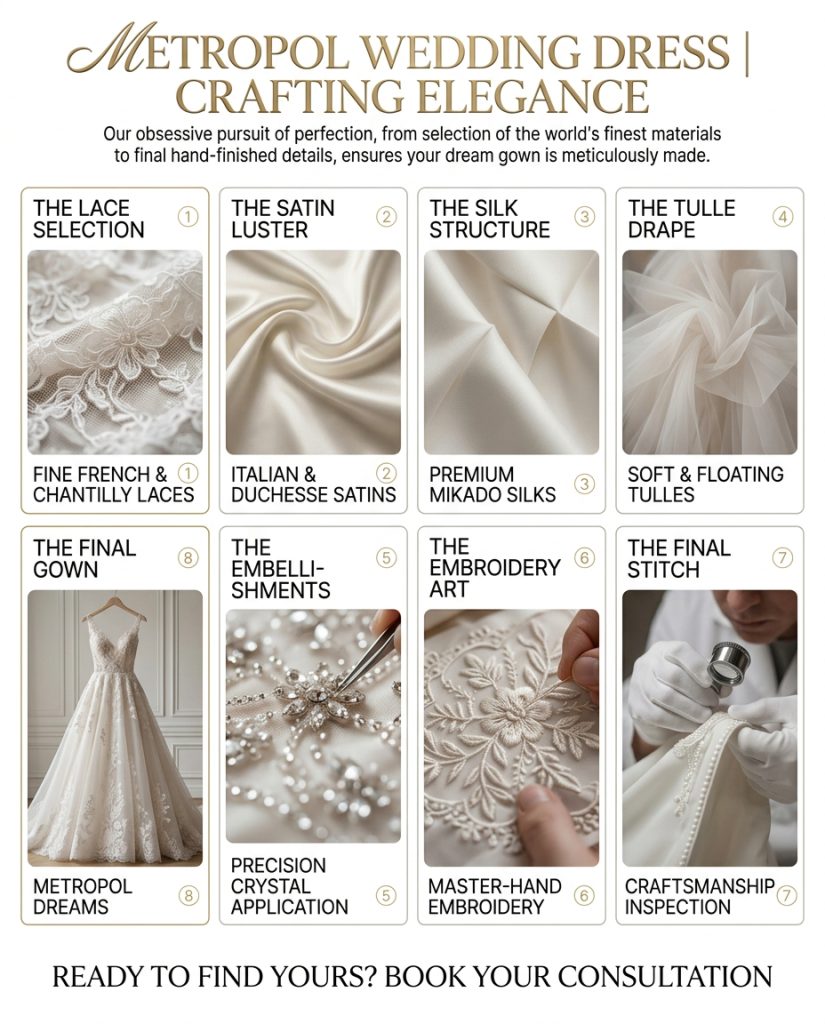
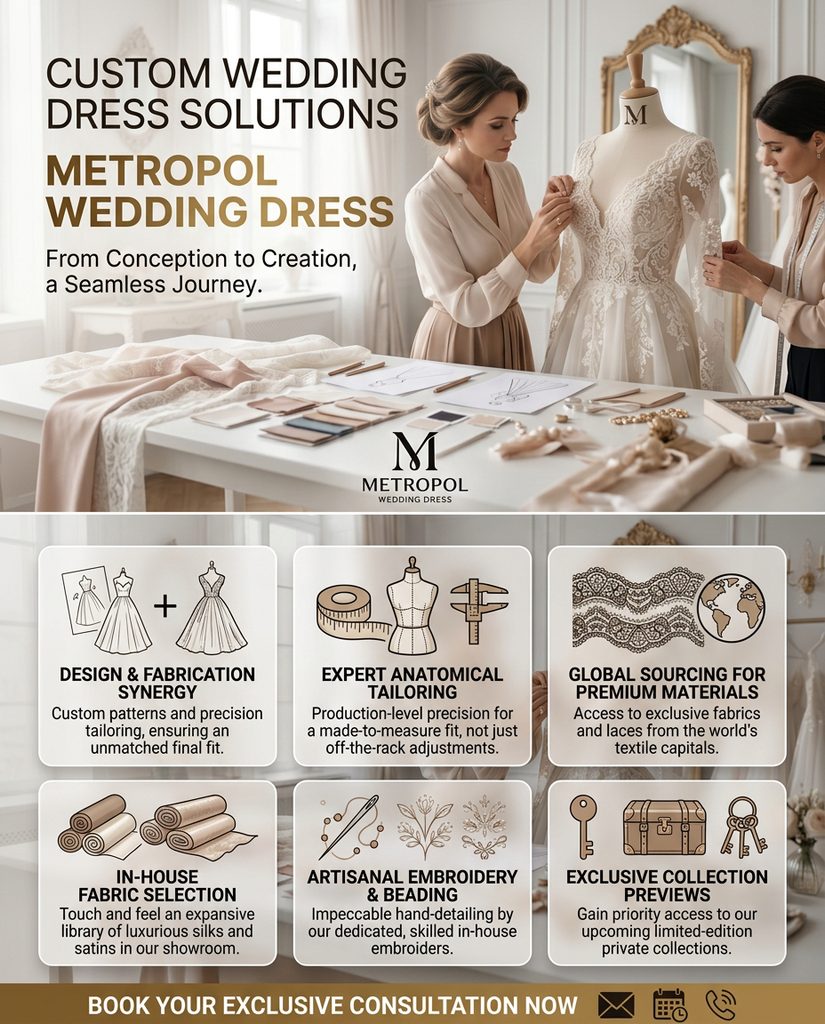
Metropol Wedding Dress, based in İzmir, Türkiye, positions itself as a wholesale and custom wedding dress manufacturer serving boutiques, retailers, and private-label clients internationally. Its published manufacturing model emphasizes custom production, OEM/ODM development, flexible MOQ structures, pattern making, handwork, and factory-direct wholesale sourcing.
For a U.S. bridal boutique considering an international supplier, the opportunity is particularly interesting when the manufacturer can combine:
- Low MOQ purchasing
- Sample-first development
- Private-label production
- Custom sizing
- Design modifications
- Consistent pattern development
- Quality-control checkpoints
- Export documentation
- Reliable production planning
- Direct manufacturer communication
- A scalable relationship as the boutique grows
This guide explains how to evaluate that model intelligently.
The Problem Is Not MOQ. It Is Inventory Risk.
A traditional wholesale mindset asks:
“How many dresses can I buy for the lowest price?”
A modern bridal purchasing strategy asks:
“How much inventory do I actually need to create enough choice for my brides while keeping my capital productive?”
Those are very different questions.
A boutique owner may be offered an attractive price on 50 or 100 gowns per style. On paper, the unit economics can look impressive.
But imagine that only six dresses sell quickly.
The remaining inventory is not simply “stock.”
It becomes:
- showroom space,
- capital tied up in product,
- steaming and storage requirements,
- potential alteration work,
- insurance exposure,
- seasonal risk,
- style-aging risk,
- and eventually a potential markdown.
This is why MOQ should be viewed as a financial variable, not merely a supplier requirement.
A low MOQ manufacturer changes the purchasing equation.
Instead of saying:
“We need to commit to a collection before we know what our brides want.”
the boutique can operate closer to:
“We will test a controlled assortment, measure demand, then deepen inventory around the winners.”
That distinction is particularly important for independent bridal boutiques competing against larger chains and digitally visible bridal brands.
What Does “Low MOQ” Actually Mean in Bridal Manufacturing?
MOQ means Minimum Order Quantity.
But bridal manufacturers do not always define it in the same way.
One manufacturer might mean:
Minimum five gowns per design.
Another may mean:
Minimum five total gowns, but sizes can be mixed.
Another may mean:
One sample is possible, but production requires ten pieces.
Another may allow:
One gown per style for wholesale, followed by made-to-order replenishment.
These models are commercially very different.
A useful way to compare MOQ
| Supplier Model | Typical Buyer | Inventory Risk | Customization Potential |
|---|---|---|---|
| High-MOQ factory | Large distributor | High | Low–Medium |
| Medium-MOQ manufacturer | Established retailer | Medium | Medium |
| Low-MOQ manufacturer | Boutique / emerging label | Low | Medium–High |
| Sample-first manufacturer | New brand | Very Low | High |
| Made-to-order manufacturer | Premium boutique | Very Low | Very High |
| Private-label OEM | Established brand | Variable | Very High |
The key is not simply to ask:
“What is your MOQ?”
Ask:
“What does your MOQ apply to?”
Is it:
- per style?
- per color?
- per size?
- per fabric?
- per collection?
- per order?
- per production run?
And perhaps most importantly:
Can a boutique mix sizes within the MOQ?
That one detail can materially change the economics of a bridal order.
Why Low MOQ Can Be a Competitive Advantage for a U.S. Bridal Boutique
Imagine two boutiques.
Boutique A
Orders 100 gowns because the manufacturer requires a large minimum.
The boutique gets a lower unit price.
But:
- 20 styles may sell well.
- 30 may sell slowly.
- 20 may require alterations.
- 15 may remain in inventory longer than expected.
- 15 may eventually need promotional pricing.
Boutique B
Orders 20 carefully selected gowns.
The boutique pays slightly more per piece.
But it has the ability to:
- test silhouettes,
- evaluate customer reactions,
- photograph its own collection,
- identify best sellers,
- collect fitting feedback,
- reorder proven designs,
- discontinue weak styles,
- and develop exclusive versions.
Boutique B may have a higher nominal unit cost.
But its inventory efficiency can be superior.
This is the fundamental reason low MOQ should be analyzed alongside sell-through, gross margin, lead time, and reorder flexibility.
The Bridal Buyer’s Real Formula
A useful internal purchasing model is:
True Cost of a Gown = Purchase Price + Freight + Duties/Fees + Alteration Exposure + Storage + Capital Cost + Markdown Risk + Quality Failure Cost
The cheapest quotation does not necessarily produce the lowest true cost.
A manufacturer that charges $50 more but delivers:
- fewer defects,
- better measurements,
- more consistent sizing,
- cleaner finishing,
- clearer documentation,
- faster communication,
- and lower inventory requirements
may ultimately be the more economical supplier.
This is especially relevant to bridal because the customer does not buy a basic garment.
She buys a highly emotional, highly visible, highly fitted product.
A small construction problem can become a major customer-service problem.
Why İzmir, Türkiye Is Relevant to Bridal Sourcing
Türkiye has a substantial textile and apparel manufacturing ecosystem, while İzmir has an established position as a textile and fashion production center.
For a U.S. bridal buyer, geographical location matters less than manufacturing capability—but location can influence the supplier ecosystem surrounding a factory.
A bridal manufacturer operating within a developed textile environment may have easier access to:
- lace,
- tulle,
- satin,
- lining,
- embellishment,
- embroidery,
- pattern development,
- garment finishing,
- packaging,
- logistics providers,
- and skilled sewing labor.
Metropol Wedding Dress identifies İzmir as its manufacturing base and presents its operation as an atelier-scale producer serving wholesale, custom, and private-label clients internationally.
For a boutique, the important point is not simply that a supplier is “from Türkiye.”
The important question is:
Can that manufacturer repeatedly translate a design concept into a consistent finished bridal gown?
That requires much more than sewing capacity.
The Five Capabilities a Serious Bridal Manufacturer Must Control
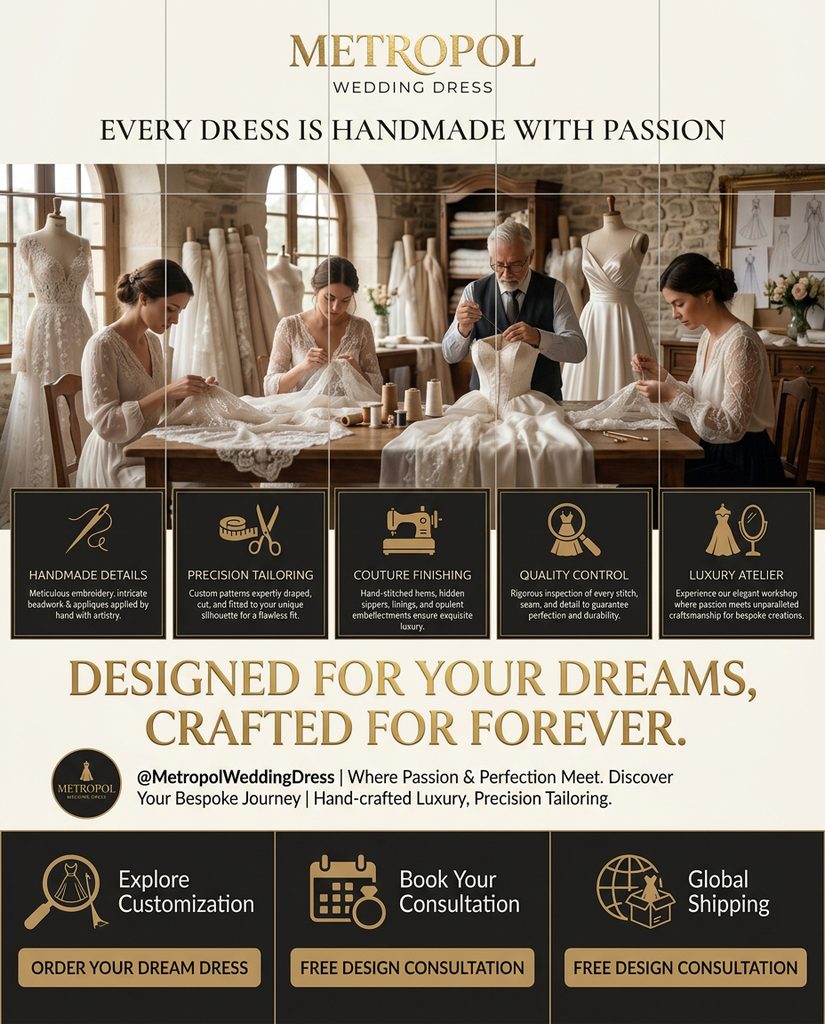
A reliable wedding dress manufacturer should be evaluated across five connected systems.
1. Product Development
Can the factory work from:
- an existing style,
- a sketch,
- a technical package,
- reference photographs,
- an existing pattern,
- or a design concept?
2. Pattern Engineering
Can the manufacturer translate a visual design into a pattern that produces:
- correct proportions,
- predictable fit,
- appropriate balance,
- consistent grading,
- and repeatable production?
3. Material Management
Can the manufacturer control:
- fabric quality,
- lace placement,
- lining,
- trims,
- beading,
- embroidery,
- crystals,
- closures,
- and color consistency?
4. Production
Can it reproduce the approved sample without significant construction drift?
5. Quality Control
Can it identify problems before the gown leaves the factory?
These five systems determine whether a manufacturer is genuinely useful to a boutique.
The Sample Is Not Decoration. It Is the Contract.
One of the most important concepts in international bridal sourcing is the approved sample.
A sample should not merely demonstrate that the manufacturer can make something attractive.
It should become a reference point.
The buyer should evaluate:
Silhouette
Does the finished gown actually reproduce the intended shape?
Bust Construction
Does the bodice support the bride appropriately?
Waist Placement
Is the waist where the design intends it to be?
Skirt Volume
Is the amount of tulle, organza, satin, or other material sufficient?
Train
Does the train length correspond with the approved specification?
Lace
Is lace positioned consistently?
Embroidery
Is embroidery symmetrical where it needs to be?
Beading
Are stones, pearls, sequins, and decorative elements securely attached?
Closure
Does the zipper, corset, button system, or combination operate correctly?
Hem
Is the hem clean and even?
Lining
Does the lining support comfort and opacity?
Finishing
Does the inside of the gown look as professional as the outside?
This is why buyers should avoid approving a supplier based exclusively on catalog photographs.
A Buyer’s “Golden Sample” Protocol
Before production, create a simple approval process.
Gate 1 — Design Approval
Confirm:
- silhouette,
- neckline,
- sleeves,
- train,
- embellishment,
- fabric,
- color.
Gate 2 — Fit Approval
Confirm:
- bust,
- waist,
- hip,
- torso,
- armhole,
- sleeve,
- skirt balance.
Gate 3 — Material Approval
Confirm:
- lace,
- tulle,
- satin,
- lining,
- trim,
- crystals,
- buttons,
- zipper.
Gate 4 — Production Approval
Confirm:
- seam construction,
- finishing,
- embroidery placement,
- bead density,
- hem,
- pressing.
Gate 5 — Pre-Shipment Inspection
Confirm:
- measurements,
- visual appearance,
- damage,
- stains,
- missing embellishments,
- packaging,
- labels,
- quantity.
This turns an emotional product into a controlled procurement process.
What U.S. Bridal Boutiques Should Look for in a Low MOQ Manufacturer
A strong supplier relationship should answer more questions than “How much?”
Use the following purchasing scorecard.
| Evaluation Area | Question |
|---|---|
| MOQ | What is the minimum per style? |
| Size Mix | Can sizes be mixed? |
| Sampling | Can I order a sample first? |
| Lead Time | What is standard production time? |
| Rush Orders | Are urgent orders possible? |
| Customization | Can neckline, sleeve, train or fabric change? |
| Private Label | Can my brand label be applied? |
| Pattern | Who owns the developed pattern? |
| Exclusivity | Can another retailer receive the same design? |
| QC | What happens before shipment? |
| Packaging | How are gowns protected? |
| Documentation | What export documents are provided? |
| Shipping | Which Incoterm is quoted? |
| Claims | What happens if a gown arrives damaged? |
| Reorders | Can best sellers be replenished quickly? |
A supplier that cannot answer these questions clearly should not automatically be rejected.
But it should be treated as a higher-risk supplier.
Private Label: The Step Beyond Wholesale
Wholesale allows a boutique to sell someone else’s collection.
Private label changes the relationship.
The manufacturer produces the gown while the boutique presents the product under its own brand.
That can give a retailer greater control over:
- brand identity,
- customer experience,
- pricing,
- packaging,
- product naming,
- merchandising,
- photography,
- and collection positioning.
For a boutique trying to move away from price comparison, private label can be strategically powerful.
The customer is no longer choosing between:
Brand A vs. Brand B
She is choosing:
Your boutique’s signature collection vs. everything else she has seen.
Private Label Does Not Automatically Mean Exclusive
This distinction is crucial.
A manufacturer may offer private-label services while using the same base design for multiple customers.
Therefore, a buyer should distinguish between:
White Label
Existing design + your label.
Private Label
Existing or adapted design + your brand identity.
OEM
Your specification manufactured by the factory.
ODM
Manufacturer develops the product based on an agreed concept.
Exclusive Development
A design or pattern is reserved for one buyer under agreed commercial terms.
If exclusivity matters, put it in writing.
Ask:
- Is the style exclusive?
- For which territory?
- For how long?
- Is the pattern exclusive?
- Can the manufacturer show the style in its catalog?
- Can another U.S. boutique order it?
- Does exclusivity apply to the entire design or only modifications?
Do not assume.
A Better Private-Label Development Workflow
A boutique can structure development in eight stages:
Concept → Tech Pack → Material Approval → Sample → Fit Approval → Production Approval → Bulk Manufacturing → Branded Packaging
This workflow creates a clear chain of accountability.
A manufacturer such as Metropol can be evaluated against this process because its published wholesale and private-label material describes custom development, pattern making, production, and related manufacturing services.
The more customized the gown, the more important this workflow becomes.
Designing a Low-Risk Bridal Collection
A boutique does not need 100 completely different gowns to create the perception of variety.
Instead, think in terms of design families.
For example:
Family A — Clean Modern
- minimalist A-line
- structured satin
- square neckline
- simple strap
- architectural bodice
Family B — Romantic Lace
- floral lace
- soft tulle
- sweetheart neckline
- illusion sleeve
- cathedral train
Family C — Modern Corsetry
- structured bodice
- visible boning
- detachable sleeves
- clean skirt
- optional overskirt
Family D — Bohemian
- lightweight fabric
- botanical lace
- relaxed silhouette
- soft movement
Family E — Statement Bridal
- dramatic train
- three-dimensional floral work
- sculptural neckline
- high-impact embellishment
Instead of purchasing huge quantities of every style, the boutique can test representative pieces from each family.
This creates merchandising breadth without excessive inventory depth.
The “Hero + Core + Test” Inventory Model
One of the most useful purchasing structures for a small bridal boutique is a three-layer assortment.
Hero Styles
These are the gowns that attract attention.
Characteristics:
- dramatic,
- photograph well,
- distinctive,
- memorable,
- high emotional impact.
Buy fewer, but make them visually strong.
Core Styles
These are the dependable sellers.
Characteristics:
- wearable,
- flattering,
- commercially proven,
- broadly appealing.
These deserve deeper inventory.
Test Styles
These are experiments.
Characteristics:
- new neckline,
- unusual fabric,
- emerging silhouette,
- fashion-forward detail,
- new size offering,
- new price point.
Low MOQ is particularly valuable here.
If a test style performs poorly, the financial damage is limited.
If it performs well, it can become a core style.
Why Made-to-Order Can Be More Important Than Low MOQ
Low MOQ reduces the initial commitment.
Made-to-order reduces the ongoing inventory requirement.
These are not identical.
A boutique might purchase:
- one sample,
- several showroom sizes,
- then place customer-specific production orders.
This can create a hybrid model:
Showroom Sample + Customer-Specific Manufacturing
That model can be especially useful for gowns involving:
- unusual sizes,
- custom measurements,
- special sleeve requirements,
- train modifications,
- fabric changes,
- or private-label designs.
The business becomes less dependent on guessing exactly which sizes every bride will need.
The U.S. Sizing Question
A manufacturer may have excellent craftsmanship and still be a poor fit for a U.S. boutique if its sizing system is unclear.
Before ordering, establish:
- size chart,
- bust measurement,
- waist measurement,
- hip measurement,
- hollow-to-waist,
- shoulder,
- arm circumference,
- sleeve length,
- standard grade rules,
- plus-size block,
- petite options,
- custom measurement process.
Never assume that:
“Size 10” means exactly the same thing everywhere.
A boutique should maintain its own approved measurement chart.
Plus-Size Bridal Requires Engineering, Not Just More Fabric
One of the most common purchasing mistakes is assuming that a larger size is simply a scaled-up smaller pattern.
It is not.
A successful plus-size bridal gown may require changes to:
- bust support,
- boning placement,
- neckline stability,
- armhole shape,
- shoulder balance,
- waist shaping,
- skirt distribution,
- closure construction,
- internal support,
- and fabric behavior.
The buyer should therefore ask:
“Do you grade from a standard block, or do you develop size-specific construction?”
That answer tells you a great deal about the manufacturer’s technical capability.
Modest Bridal and Regional Customer Preferences
U.S. bridal boutiques are not homogeneous.
A boutique serving a metropolitan market may want:
- minimalist gowns,
- editorial silhouettes,
- modern corsetry.
Another may serve customers who prioritize:
- sleeves,
- higher necklines,
- full coverage,
- detachable elements,
- modest construction.
Another may have a strong cultural customer base.
A manufacturer capable of modifying:
- sleeves,
- neckline,
- lining,
- back coverage,
- train,
- embroidery,
- or fabric
can therefore be more valuable than a supplier with a larger but inflexible catalog.
Metropol describes its manufacturing proposition as supporting design flexibility, including modest and plus-size requirements.
Materials: What Should a Buyer Actually Evaluate?
“Premium fabric” is not enough.
Ask for the exact material composition whenever possible.
Satin
Evaluate:
- weight,
- drape,
- surface finish,
- crease behavior,
- opacity,
- recovery,
- seam performance.
Tulle
Evaluate:
- softness,
- stiffness,
- width,
- transparency,
- tear resistance,
- layering behavior.
Lace
Evaluate:
- composition,
- motif scale,
- border design,
- stretch,
- backing,
- dye consistency,
- repeat availability.
Lining
Evaluate:
- skin feel,
- opacity,
- weight,
- static behavior,
- color,
- compatibility with outer fabric.
Embroidery
Evaluate:
- thread quality,
- density,
- symmetry,
- backing,
- dimensionality,
- attachment.
Beading
Evaluate:
- stone quality,
- attachment method,
- density,
- abrasion,
- missing-stone rate.
A wedding dress can look exceptional in a photograph and still disappoint in the fitting room.
The buyer’s job is to evaluate what the camera does not show.
The Inside of the Dress Is Part of the Product
A useful quality-control principle is:
Turn the gown inside out.
Inspect:
- seam finishing,
- lining,
- boning,
- internal tape,
- thread ends,
- zipper attachment,
- waist construction,
- bust support,
- hem finishing.
Luxury is not only what the bride sees in the mirror.
It is also what the seamstress sees when the gown arrives.
A boutique that repeatedly receives poorly finished gowns pays twice:
- once to the manufacturer,
- again in local labor.
That second cost is often invisible during initial sourcing.
The Hidden Cost of Poor Quality Control
Suppose a gown arrives with:
- uneven hem,
- loose beads,
- incorrect measurement,
- damaged lace,
- missing buttons,
- distorted zipper,
- or incorrect lining.
The boutique may need to:
- inspect the gown,
- contact the supplier,
- photograph the problem,
- negotiate a solution,
- send it to a local seamstress,
- delay a fitting,
- reschedule the bride,
- or replace the garment.
The financial cost is obvious.
The reputational cost can be larger.
Bridal customers have deadlines.
A wedding date cannot be postponed because a supplier missed a quality-control issue.
A Practical Quality-Control Checklist
Before accepting an international shipment, inspect:
Measurements
- Bust
- Waist
- Hip
- Length
- Train
- Sleeve
- Shoulder
- Bodice length
Construction
- Seams
- Zippers
- Buttons
- Corsetry
- Boning
- Lining
- Hem
Decoration
- Lace
- Embroidery
- Beads
- Crystals
- Appliqués
- Sequins
Appearance
- Stains
- Color differences
- Pressing
- Wrinkles
- Fabric damage
- Odor
Packaging
- Garment bag
- Moisture protection
- Folding method
- Box condition
- Labels
- Packing list
This checklist should become part of the boutique’s receiving process.
U.S. Import Compliance: The Part Buyers Should Not Ignore
International bridal sourcing is not simply:
Choose gown → pay supplier → receive box.
A U.S. importer has responsibilities.
For textile apparel, U.S. requirements can include:
- fiber-content identification,
- country-of-origin marking,
- manufacturer/importer identification,
- care instructions,
- and applicable flammability requirements.
The Federal Trade Commission states that textile labels generally need to identify fiber content, country of origin, and the manufacturer, importer, or other responsible entity; care instructions are also required under the FTC Care Labeling Rule for covered apparel.
CBP likewise notes that imported textiles and apparel require attention to country-of-origin marking, labeling, care instructions, and applicable CPSC flammability requirements.
This is one reason a professional importer should not rely on a supplier saying:
“We export to America, so everything is compliant.”
Compliance is ultimately a buyer/importer responsibility.
Country of Origin Matters
A bridal gown may contain fabrics sourced from multiple countries.
That does not automatically mean the garment can be described however the buyer wants.
Country-of-origin rules can be complex, particularly where materials and manufacturing processes involve different countries.
CBP specifically warns that determining origin for mixed textile products can be complicated.
For this reason, a U.S. importer should establish the origin marking requirements before commercial shipments rather than trying to correct labels after arrival.
Customs Classification: Do Not Guess the HTS Code
Wedding gowns are apparel.
But the exact tariff classification can depend on factors including:
- fabric composition,
- construction,
- whether the garment is knitted or woven,
- fiber type,
- garment category,
- and other classification details.
The Harmonized Tariff Schedule contains multiple apparel classifications and rates can differ significantly between classifications.
Therefore:
Do not build your landed-cost model around a guessed HTS classification.
Ask your customs broker or qualified import specialist to verify the applicable classification.
The U.S. government explicitly notes that importers remain responsible for compliance even when using a customs broker.
Duties Are Only One Part of Landed Cost
A buyer should calculate:
Landed Cost = Product Cost + International Freight + Insurance + Duty + Customs Fees + Brokerage + Other Applicable Charges
Depending on the shipment, additional fees may apply.
CBP explains that imported goods can be subject to user fees, including the Merchandise Processing Fee, with amounts depending on entry type and transportation method.
This is why a manufacturer quote should not be compared directly with a domestic wholesale price without normalization.
FOB, CIF, DAP, DDP: Why Incoterms Matter
Two suppliers can quote the same gown at:
$500
and still produce radically different final costs.
Ask:
What exactly does the quoted price include?
For example:
EXW
The buyer carries much of the logistics burden from the manufacturer’s premises.
FOB
The seller’s responsibility typically extends to the agreed point of shipment under the applicable Incoterm.
CIF
The seller includes cost, insurance, and freight to the named destination port, subject to the exact term.
DAP
The seller delivers to the named place, while import clearance and certain import costs remain with the buyer.
DDP
The seller assumes substantially more responsibility, including import-related obligations, where legally and practically available.
The exact commercial responsibilities depend on the named Incoterm and contract.
Never compare supplier prices until the delivery terms are normalized.
A Simple Landed-Cost Example
Imagine:
Gown price: $420
Freight allocation: $35
Insurance/handling: $10
Brokerage/customs-related charges: $25
Duty and other applicable import charges: $60
Then:
Estimated landed cost = $550
If the boutique evaluates the gown only at $420, its margin calculation is misleading.
And if the boutique spends another $50 on local corrections, the true economic cost becomes higher again.
The lesson is simple:
Buyers should manage landed economics, not factory price.
The Margin Conversation
A manufacturer should understand that the boutique also needs room for:
- showroom rent,
- staff,
- marketing,
- fitting appointments,
- alterations,
- steaming,
- photography,
- insurance,
- software,
- payment processing,
- returns or exchanges where applicable,
- and unsold inventory.
Therefore, wholesale pricing must support the complete retail ecosystem.
A healthy purchasing conversation is not:
“Can you make this cheaper?”
It is:
“What manufacturing configuration gives us the best balance between quality, landed cost, reorder flexibility, and retail positioning?”
That is a much more productive discussion.
Why the Lowest Price Can Be the Most Expensive Choice
Consider three suppliers.
| Factor | Supplier A | Supplier B | Supplier C |
|---|---|---|---|
| Unit price | Low | Medium | Higher |
| MOQ | High | Low | Low |
| Customization | Low | Medium | High |
| QC | Basic | Strong | Strong |
| Reorder flexibility | Low | High | High |
| Sample development | Limited | Yes | Yes |
| Private label | Limited | Yes | Yes |
| Inventory risk | High | Low | Low |
| Potential alteration cost | High | Medium | Low |
Supplier A wins the quotation.
Supplier C may win the business.
Why?
Because the purchasing decision is about total commercial performance.
A Better Way to Measure Supplier Value
Create a weighted score.
For example:
| Criterion | Weight |
|---|---|
| Product quality | 25% |
| Fit consistency | 15% |
| MOQ flexibility | 15% |
| Lead time | 10% |
| Customization | 10% |
| Communication | 10% |
| Landed cost | 10% |
| Documentation | 5% |
Then score every manufacturer from 1–10.
This prevents the lowest price from dominating the decision.
When Low MOQ Is Especially Valuable
Low MOQ is particularly useful for:
New Boutiques
You do not yet know your best-selling silhouettes.
New Bridal Labels
You want to validate the collection before scaling.
Regional Boutiques
Your market may have specific preferences.
Private-Label Launches
You need to test brand-market fit.
Seasonal Capsules
You want limited collections without excess inventory.
Social-Media-Led Brands
A design can become popular quickly but may have a short demand window.
Custom Bridal Studios
You want samples without buying deep stock.
Plus-Size-Focused Retailers
You need to test fit blocks and customer response.
When High MOQ Might Still Make Sense
Low MOQ is not automatically superior.
A larger buyer may benefit from high-volume manufacturing when:
- demand is predictable,
- best sellers are proven,
- production is standardized,
- the retailer has strong inventory turnover,
- the price reduction is meaningful,
- and warehouse capacity is sufficient.
A national distributor may prefer a different model from a two-location boutique.
The right MOQ is therefore:
the MOQ that matches the buyer’s demand certainty.
The Purchasing Manager’s Question: “What Do We Know?”
Every inventory decision has a confidence level.
High Confidence
The style has already sold repeatedly.
Order deeper.
Medium Confidence
The silhouette is commercially established but new to your store.
Order moderately.
Low Confidence
The design is experimental.
Order one sample or a very small quantity.
This creates a simple rule:
Inventory depth should increase with demand confidence.
Low MOQ manufacturing makes this rule practical.
Building a Collection Around Data
Boutiques should track:
- try-ons,
- appointments,
- conversion rates,
- styles requested,
- styles rejected,
- neckline preferences,
- fabric preferences,
- price objections,
- size requests,
- alteration frequency,
- and actual sales.
For example:
If 40 brides try a mermaid silhouette and 12 purchase, that is meaningful.
If 25 try a specific neckline and none purchase, that is also meaningful.
The manufacturer becomes more valuable when the boutique can feed this information back into product development.
Turning Customer Feedback Into Manufacturing Instructions
Instead of telling the manufacturer:
“Our brides don’t like this dress.”
say:
“The neckline is generating strong interest, but six out of eight fitting clients requested more bust coverage. We want to retain the neckline architecture while raising the center front by approximately X and adding internal support.”
That is actionable.
Manufacturing partnerships become stronger when feedback is translated into specifications.
The Ideal Manufacturer Is a Feedback Loop
The relationship should look like this:
Bride Feedback
↓
Boutique Sales Data
↓
Buyer Analysis
↓
Manufacturer Development
↓
Sample
↓
Fit Approval
↓
Production
↓
Retail Performance
↓
New Feedback
That is more valuable than simply ordering catalog products.
Real Scenario: The New Boutique
Imagine a new bridal boutique opening in Texas.
The owner has a limited initial purchasing budget.
She wants:
- 15–25 showroom gowns,
- multiple silhouettes,
- modern styling,
- plus-size options,
- and a recognizable boutique identity.
A high-MOQ manufacturer is immediately problematic.
Instead, she could structure the launch around:
- 5 hero gowns,
- 10 core silhouettes,
- 5 experimental styles,
- and made-to-order availability for additional configurations.
The objective is not to make the showroom look empty.
It is to make every gown earn its space.
Real Scenario: The Established Boutique
Now consider a boutique with several years of sales history.
It already knows that:
- A-line sells strongly,
- minimalist satin is growing,
- dramatic ball gowns have lower turnover,
- plus-size demand is increasing,
- and brides frequently request detachable sleeves.
The purchasing strategy changes.
The boutique can ask the manufacturer to:
- reproduce proven core styles,
- develop two new satin silhouettes,
- modify three gowns with detachable sleeves,
- produce a small plus-size test,
- and develop one exclusive private-label style.
That is a much more sophisticated sourcing program than simply buying a catalog.
Real Scenario: The Private-Label Launch
A boutique wants to launch a signature collection under its own name.
The biggest mistake would be to immediately order dozens of designs.
A better sequence is:
Stage 1
Develop 5–8 concepts.
Stage 2
Choose the strongest 3–5.
Stage 3
Create samples.
Stage 4
Conduct fittings.
Stage 5
Photograph the collection.
Stage 6
Launch through appointments and social media.
Stage 7
Measure demand.
Stage 8
Scale only proven styles.
This reduces financial exposure while preserving the perception of exclusivity.
What Should Be in a Bridal Manufacturer Tech Pack?
A serious tech pack may include:
- style number,
- front sketch,
- back sketch,
- measurements,
- grading,
- fabric specification,
- lining,
- lace,
- embroidery,
- bead placement,
- zipper,
- buttons,
- closure,
- seam requirements,
- hem,
- train length,
- sleeve construction,
- color,
- label placement,
- packaging,
- and quality tolerances.
The more complex the design, the more valuable a detailed technical specification becomes.
Why Photos Alone Are Not Enough
A photograph can show:
- shape,
- color,
- overall styling.
It cannot reliably communicate:
- seam allowance,
- internal support,
- exact fabric composition,
- grading,
- construction tolerance,
- zipper quality,
- lining,
- or production repeatability.
That is why an experienced buyer moves from:
Image → Sample → Specification → Approved Production Standard
rather than:
Image → Bulk Order
Communication: The Underestimated Supplier Metric
A manufacturer can produce beautiful gowns and still be difficult to work with.
Warning signs include:
- slow replies,
- vague timelines,
- inconsistent quotations,
- unclear specifications,
- undocumented changes,
- reluctance to provide samples,
- unwillingness to discuss defects,
- or pressure to place large orders immediately.
A reliable supplier should be able to communicate:
What?
When?
How much?
According to which specification?
Approved by whom?
This is procurement discipline.
Questions to Ask Before the First Order
Send a manufacturer a structured inquiry.
Company
- Where is production performed?
- Is manufacturing in-house?
- Are subcontractors used?
- How long has the factory produced bridal gowns?
Product
- What silhouettes are available?
- What fabrics are available?
- What sizes are standard?
- Can custom measurements be produced?
MOQ
- What is the minimum per style?
- Can sizes be mixed?
- Can styles be mixed?
- Are samples counted toward MOQ?
Customization
- Can neckline change?
- Can sleeve change?
- Can train change?
- Can fabric change?
- Can color change?
- Can embellishment change?
Private Label
- Can my labels be applied?
- Can branded packaging be produced?
- Can designs be exclusive?
Production
- What is the standard lead time?
- What happens during peak season?
- What is the rush-order policy?
Quality
- Is each gown inspected?
- Can inspection photos be supplied?
- What is the defect policy?
Export
- Which shipping methods are available?
- Which Incoterms are offered?
- What documentation accompanies the shipment?
A professional supplier should welcome these questions.
Five Supplier Red Flags
Red Flag 1: “Lowest Price Guaranteed”
Price without specification is meaningless.
Red Flag 2: No Sample
If a supplier wants a significant bulk order without providing an appropriate approval process, risk increases.
Red Flag 3: Unclear MOQ
“Low MOQ” should have a precise definition.
Red Flag 4: No Written Specifications
Verbal agreements are dangerous in international production.
Red Flag 5: No Defect Procedure
Every manufacturer can experience defects.
The question is:
What happens when one occurs?
A supplier that has a clear corrective process may actually be safer than one that simply claims:
“We never have defects.”
A Strong Purchase Order Should Define More Than Quantity
A bridal purchase order should ideally identify:
- style number,
- size,
- color,
- fabric,
- customization,
- quantity,
- unit price,
- total price,
- delivery term,
- shipping method,
- requested ship date,
- labeling requirements,
- packaging,
- approved sample reference,
- and defect/claim process.
The goal is not bureaucracy.
The goal is shared understanding.
Lead Time: Ask for a Calendar, Not a Promise
“Fast production” is not a useful metric.
Ask:
“What is the production lead time from which event?”
Possible starting points include:
- deposit received,
- materials approved,
- sample approved,
- measurements confirmed,
- purchase order confirmed.
Those are not the same.
For custom bridal production, material sourcing and sample approval can influence the actual schedule.
Therefore, the buyer should define:
Day 0 = confirmed order + approved specifications + required deposit/material confirmation.
Then calculate production time from there.
Bridal Season Changes the Equation
A supplier may perform perfectly during a quiet month and struggle during peak season.
Ask:
- What months are busiest?
- Does production capacity change?
- Are holiday closures relevant?
- What happens to rush orders?
- How far ahead should peak-season orders be placed?
A boutique should build its sourcing calendar backward from wedding dates and showroom launch dates.
The Reorder Test
A manufacturer’s true value often becomes visible after the first order.
Ask:
“If this style sells out, how quickly can you reproduce it?”
This is one of the most important questions in bridal sourcing.
A supplier with a 10-day sample process but a 12-week reorder process may not be useful for fast-moving styles.
Conversely, a supplier that can reproduce a proven pattern quickly can become a valuable strategic partner.
Inventory Should Have a Replenishment Logic
Consider a simple system:
Green
Fast seller.
→ Reorder.
Yellow
Moderate seller.
→ Monitor.
Red
Low conversion.
→ Stop replenishment.
Blue
High-interest custom request.
→ Consider made-to-order.
This makes low MOQ particularly powerful because the boutique can move inventory decisions closer to actual demand.
Why Exclusive Capsules Can Beat Huge Collections
A boutique does not necessarily need to say:
“We have 300 gowns.”
It may be more powerful to say:
“We carry a curated collection selected for our brides, including exclusive styles unavailable through competing stores.”
Exclusivity can become part of the sales experience.
A small collection can feel premium when it is carefully curated.
Low MOQ and Brand Positioning
There is another benefit that is easy to overlook.
Low MOQ can support brand experimentation.
Suppose a boutique wants to test:
- champagne lining,
- detachable overskirts,
- statement sleeves,
- sculptural bows,
- floral appliqué,
- modest backs,
- or modern corsetry.
Large minimums discourage experimentation.
Low MOQ makes experimentation economically possible.
That means manufacturing flexibility can influence the brand’s creative identity.
The Buyer Should Negotiate Flexibility, Not Just Price
Instead of negotiating only:
“Can you lower the price by $20?”
consider negotiating:
- lower MOQ,
- mixed sizes,
- sample credit,
- reorder pricing,
- free minor customization,
- improved packaging,
- inspection photos,
- faster reorder production,
- or private-label support.
A $20 reduction may save less than eliminating five unwanted gowns.
The Sample-Credit Strategy
One useful commercial structure is:
Sample cost credited against a qualifying production order.
This can reduce the buyer’s perceived development risk.
It also aligns incentives.
The boutique is encouraged to move from sample to production if the sample succeeds.
Whether a supplier offers this depends on its commercial policy, but it is a reasonable question to ask.
Private Label and Intellectual Property
If a boutique supplies its own design, it should clarify:
- Who owns the design?
- Who owns the pattern?
- Can the manufacturer reproduce it?
- Can the manufacturer display it?
- Can it be sold to other customers?
- Can the buyer prohibit reproduction?
- What happens to files after production?
Do not assume ownership simply because the buyer paid for development.
For important proprietary designs, have the commercial and legal terms reviewed appropriately.
What “Factory Direct” Should Mean
The phrase sounds attractive.
But ask what it actually means.
A factory-direct supplier should be able to explain:
- where production occurs,
- who manufactures the gown,
- who performs quality control,
- who manages the order,
- and who handles export documentation.
The fewer unnecessary intermediaries between buyer and manufacturer, the easier it can be to communicate changes.
But direct communication does not automatically guarantee quality.
The manufacturing process still needs verification.
Metropol Wedding Dress: What Makes the Model Relevant to This Search?
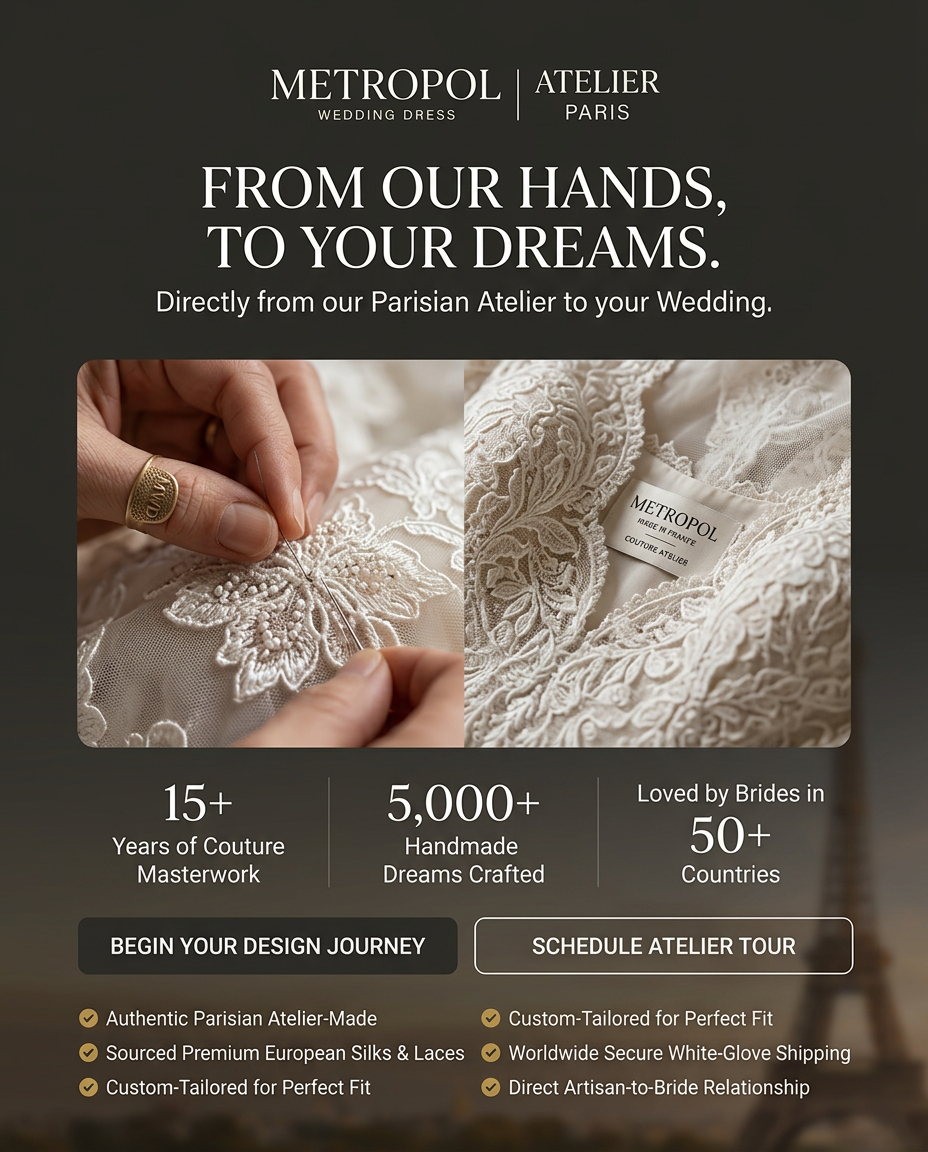
Metropol Wedding Dress presents itself as an İzmir-based wholesale wedding dress manufacturer working with boutiques, retailers, and private-label clients. Its published material emphasizes custom manufacturing, low-MOQ/flexible ordering, OEM/ODM development, and factory-direct wholesale sourcing.
For a U.S. bridal buyer, the most relevant part of that proposition is not simply the location.
It is the combination of:
manufacturing + customization + wholesale + private label + flexible order quantities.
The company also publishes information about working with U.S. bridal businesses and describes its ability to support custom and private-label production for international clients.
As with any international supplier, buyers should still confirm the exact current MOQ, price, lead time, shipping terms, customization scope, and compliance requirements for their specific order before committing.
That is good procurement practice regardless of the manufacturer.
Why a Boutique Should Consider Türkiye Instead of Looking Only at Domestic Production
Domestic U.S. production has obvious advantages:
- easier communication,
- shorter domestic logistics,
- simpler returns in some cases,
- local relationships,
- potential “Made in USA” positioning.
But domestic production can also carry higher labor and manufacturing costs.
International production can offer:
- broader manufacturing ecosystems,
- specialized handwork,
- established textile supply chains,
- potentially competitive wholesale pricing,
- and greater production flexibility.
The right strategy does not have to be:
USA OR international.
It can be:
USA + international.
For example:
- U.S. atelier for highly bespoke gowns,
- Turkish manufacturer for private-label core collection,
- local seamstress for final alterations,
- international manufacturer for replenishment.
This hybrid model can diversify operational risk.
A Two-Supplier Strategy
For larger boutiques, consider maintaining:
Primary Manufacturer
Handles:
- core collection,
- proven styles,
- private label,
- standard replenishment.
Secondary Manufacturer
Handles:
- overflow,
- new experiments,
- special materials,
- contingency orders.
This reduces dependency.
However, a second supplier should not be added simply for the sake of having one.
Both suppliers need qualification.
The “One Supplier for Everything” Trap
A single manufacturer may be excellent at:
- couture embellishment
but weak at:
- high-volume standardized production.
Another may be excellent at:
- simple satin gowns
but weak at:
- intricate lace placement.
Another may be strong in:
- private label
but not in:
- custom measurement.
Supplier specialization matters.
How to Audit a New Manufacturer Without Flying Overseas
An in-person factory visit is valuable, but not always practical.
A remote evaluation can include:
Request 1
Factory/atelier video tour.
Request 2
Live video call with production personnel.
Request 3
Sample from current production.
Request 4
Close-up images of inside construction.
Request 5
Measurement sheet.
Request 6
Quality-control procedure.
Request 7
Packaging example.
Request 8
Export documentation example with sensitive commercial information appropriately redacted.
Request 9
References where commercially appropriate.
Request 10
Clear production timeline.
The goal is evidence.
The Buyer’s Video Inspection
During a video call, ask the manufacturer to show:
- cutting area,
- sewing area,
- embellishment,
- pressing,
- finished-goods inspection,
- packaging.
Ask them to turn a finished gown inside out.
Ask to see:
- zipper attachment,
- corsetry,
- lining,
- seams,
- hem.
This can reveal more than a polished marketing video.
What Should a Bridal Boutique Photograph Before Shipment?
For important orders, request:
- front photograph,
- back photograph,
- label photograph,
- measurement photograph,
- detail photographs,
- packaging photograph.
For customized gowns, document the unique modifications.
This creates a visual record against which the received product can be compared.
The Importance of a Defect-Tolerance Agreement
Not every manufacturing variation is commercially significant.
For example:
- tiny visual variation in handmade bead placement,
- minor fabric texture differences,
- or unavoidable characteristics of natural materials
may be acceptable.
But:
- incorrect size,
- broken zipper,
- major staining,
- missing lace,
- structural damage,
- or incorrect color
may not be.
The buyer and manufacturer should therefore establish what counts as a material defect.
Bridal Manufacturing Is Part Engineering, Part Craft
This is why choosing a manufacturer based purely on machine capacity is a mistake.
A wedding gown may involve:
- pattern engineering,
- fabric behavior,
- structural support,
- hand embroidery,
- lace placement,
- pressing,
- fitting,
- finishing.
The best manufacturing environment is one that can control both repeatability and craftsmanship.
What Makes a Gown “Boutique Ready”?
A boutique-ready gown should arrive:
- correctly labeled,
- clean,
- protected,
- professionally pressed or appropriately packed,
- free from obvious construction defects,
- accurately measured,
- visually consistent with the approved sample,
- and ready for showroom preparation.
The boutique should not have to “finish” the manufacturer’s job.
Minor retail preparation is normal.
Manufacturing correction is not.
The 30-Second Receiving Test
When a gown arrives, ask:
Would I confidently place this directly on a bride after standard showroom preparation?
If the answer is no, identify why.
This simple test can expose recurring supplier problems.
A Procurement Dashboard for Bridal Buyers
Track each manufacturer monthly.
| KPI | Target Direction |
|---|---|
| On-time delivery | Higher |
| Defect rate | Lower |
| Measurement accuracy | Higher |
| Alteration hours | Lower |
| Reorder lead time | Lower |
| Customer complaints | Lower |
| Sample approval rate | Higher |
| MOQ flexibility | Higher |
| Communication response time | Lower |
| Best-seller availability | Higher |
This transforms supplier management from intuition into measurable performance.
The Manufacturer Should Be Evaluated on Your Business Results
A supplier can say:
“We have excellent quality.”
The buyer should ask:
What happened to my inventory?
A useful supplier is one that helps improve:
- sell-through,
- margin,
- fitting success,
- customer satisfaction,
- reorder speed,
- and inventory efficiency.
Common Mistakes U.S. Boutique Buyers Make
Mistake 1: Choosing Based on Instagram
Beautiful photography does not prove manufacturing consistency.
Mistake 2: Comparing Factory Price Only
Landed cost matters.
Mistake 3: Ordering Too Deep
A low unit price does not justify excessive inventory.
Mistake 4: Skipping Sample Approval
Never make a large commitment based only on catalog imagery.
Mistake 5: Ignoring Sizing
A beautiful gown with inconsistent measurements becomes a fitting problem.
Mistake 6: No Written Customization Specification
Verbal modifications can be forgotten.
Mistake 7: Ignoring Peak Season
Production schedules change.
Mistake 8: Assuming Private Label Means Exclusivity
It does not necessarily.
Mistake 9: Ignoring U.S. Labeling
Import compliance is part of the purchasing process.
Mistake 10: Failing to Track Reorders
The best supplier is not always the cheapest first-order supplier.
The Low-MOQ Buying Checklist
Before placing your first order, confirm:
Manufacturer
☐ Production location verified
☐ In-house or subcontracting clarified
☐ Bridal specialization confirmed
☐ Sample available
MOQ
☐ MOQ per style confirmed
☐ Mixed sizes confirmed
☐ Mixed styles confirmed
☐ Sample counted or excluded clarified
Product
☐ Fabric specified
☐ Color specified
☐ Size chart approved
☐ Customization documented
☐ Embellishment specified
Private Label
☐ Label requirements confirmed
☐ Packaging confirmed
☐ Design ownership discussed
☐ Exclusivity discussed
Production
☐ Lead time documented
☐ Rush policy documented
☐ Reorder lead time discussed
☐ Peak-season planning discussed
Quality
☐ Approved sample exists
☐ QC process understood
☐ Inspection procedure agreed
☐ Defect procedure documented
Logistics
☐ Incoterm confirmed
☐ Shipping method confirmed
☐ Insurance clarified
☐ Export documentation confirmed
☐ U.S. customs responsibilities assigned
Compliance
☐ Fiber content information available
☐ Country of origin marking addressed
☐ Care labeling addressed
☐ Applicable safety requirements reviewed
☐ HTS classification verified with appropriate professional support
A 90-Day Supplier Launch Plan
Days 1–15: Research
Shortlist manufacturers based on:
- product quality,
- MOQ,
- customization,
- lead time,
- communication,
- and export capability.
Days 16–30: Samples
Order representative samples.
Do not choose only the easiest gown.
Choose:
- one structured gown,
- one lace gown,
- one simple gown,
- one embellished gown.
This tests different production capabilities.
Days 31–45: Inspection
Evaluate:
- fit,
- fabric,
- construction,
- embellishment,
- packaging.
Days 46–60: Commercial Negotiation
Discuss:
- MOQ,
- pricing,
- private label,
- reorders,
- delivery,
- customization.
Days 61–75: First Controlled Order
Place a limited order.
Days 76–90: Review
Measure:
- defects,
- delivery,
- customer reaction,
- fitting performance,
- sales,
- and reorder potential.
Then decide whether to scale.
The Best First Order Is Not Necessarily the Biggest
Your first order should answer questions.
You are testing:
- product,
- factory,
- communication,
- logistics,
- quality,
- and customer response.
Think of the first order as a commercial pilot.
The purpose is not simply to make money.
The purpose is to learn whether the relationship deserves to become larger.
A Strategic Partnership Can Grow in Four Stages
Stage 1 — Testing
Small order.
Stage 2 — Replenishment
Best sellers reordered.
Stage 3 — Customization
Boutique-specific modifications.
Stage 4 — Private Label
Exclusive collection under the boutique’s brand.
This progression is less risky than starting with a large private-label commitment.
What a Long-Term Manufacturer Relationship Should Eventually Provide
A mature supplier relationship can include:
- seasonal collection planning,
- shared sales insights,
- exclusive designs,
- predictable production slots,
- reserved materials,
- faster replenishment,
- custom development,
- private labeling,
- and structured quality control.
At this point, the supplier is no longer simply a factory.
It is part of the boutique’s product strategy.
Expert Perspective: Think Like a Buyer, Not a Shopper
A shopper asks:
“Is this gown beautiful?”
A buyer asks:
“Will this gown create profitable, repeatable, low-risk sales?”
Both questions matter.
But the second one determines whether the business survives.
The buyer must evaluate the entire chain:
Design → Manufacturing → Import → Inventory → Fitting → Alteration → Sale → Customer Satisfaction → Reorder
Every weak point creates cost.
Expert Perspective: Low MOQ Is a Risk-Control Tool
The biggest misconception about low MOQ is that it is simply a convenience.
It is more powerful than that.
Low MOQ can function as:
Demand Testing
Cash-Flow Protection
Collection Experimentation
Private-Label Validation
Regional Market Testing
Size-Range Testing
Trend Testing
Supplier Qualification
In other words:
Low MOQ is a form of commercial optionality.
It lets the buyer postpone a large commitment until more information becomes available.
Expert Perspective: The Supplier With the Best Price May Not Have the Best Economics
Imagine:
Supplier A:
$350 gown
MOQ 50
Supplier B:
$425 gown
MOQ 5
If the boutique needs only 10 units initially, Supplier A requires a much larger capital commitment.
Even if Supplier A has a lower unit price, Supplier B may provide better:
- cash-flow control,
- assortment flexibility,
- testing capability,
- and inventory turnover.
Therefore:
Price should be optimized after risk is controlled—not before.
Expert Perspective: Bridal Retail Is an Inventory Business With a Luxury Customer
This combination makes bridal unusual.
The retailer needs:
Luxury-level presentation
with:
Disciplined inventory economics.
That is why the manufacturer relationship matters so much.
A gown must feel special to the bride while remaining commercially rational to the buyer.
The Information Advantage of a Direct Manufacturer
Working directly with a manufacturer can give the buyer more visibility into:
- material choices,
- production timing,
- customization possibilities,
- manufacturing constraints,
- and development costs.
This can help the boutique make better decisions.
For example, a buyer may discover that:
Changing the lace is inexpensive, but changing the internal corset requires a new pattern.
That information allows better product decisions.
Designing Customization Around Cost
Not every customization has the same cost.
Lower-Complexity Changes
Potentially easier:
- minor train adjustment,
- sleeve variation,
- small neckline adjustment,
- color change where material is available.
Medium-Complexity Changes
Potentially more involved:
- fabric replacement,
- major embellishment change,
- closure change,
- lining redesign.
High-Complexity Changes
Potentially substantial:
- new silhouette,
- new pattern,
- major structural change,
- completely new bodice,
- new grading system.
Ask the manufacturer to separate:
Design development cost
from
production cost.
Building a Boutique-Specific Collection
A powerful private-label strategy is to take a manufacturer’s existing technical capability and create a boutique-specific language.
For example:
Your Brand DNA
- clean corsetry,
- botanical lace,
- detachable sleeves,
- sculptural bows,
- soft ivory palette.
Then develop five gowns that share those characteristics.
The result is a collection.
Not merely five unrelated dresses.
Collection Architecture
A boutique collection can be organized as:
Entry
Simple, elegant gown.
Core
Signature silhouette.
Premium
More detailed construction.
Statement
High-impact couture-style piece.
Convertible
Multiple looks through detachable elements.
This gives the sales consultant a clear customer journey.
The Sales Consultant Benefits Too
A coherent collection makes selling easier.
Instead of saying:
“We have hundreds of dresses.”
the consultant can say:
“Our collection is built around four signature bridal looks, and I want to identify which direction feels most like you.”
This changes the appointment from browsing to guided discovery.
Manufacturing strategy therefore influences retail UX.
SEO Meets Buyer Intent: What the Searcher Really Wants
Someone searching:
“low MOQ wedding dress manufacturer for US bridal boutiques”
is rarely looking for generic wedding inspiration.
The searcher is likely closer to:
- sourcing,
- supplier evaluation,
- private label,
- wholesale purchasing,
- inventory planning,
- or opening a boutique.
Therefore, useful content must answer commercial questions.
Not just:
“What is a wedding dress?”
The real questions are:
- How low is the MOQ?
- Can I test before buying?
- Can I use my own label?
- Can I customize?
- How long does production take?
- How do I import?
- What does the landed cost look like?
- Can I reorder?
- What happens if there is a defect?
- Can the manufacturer work with U.S. sizing?
- Can I build an exclusive collection?
Those are the questions that matter to the buyer.
The Ultimate Manufacturer Comparison Framework
Before choosing a supplier, score each candidate.
| Category | Weight | Supplier Score |
|---|---|---|
| Bridal Quality | 20 | /10 |
| MOQ Flexibility | 15 | /10 |
| Fit & Sizing | 10 | /10 |
| Customization | 10 | /10 |
| Private Label | 10 | /10 |
| Lead Time | 10 | /10 |
| Quality Control | 10 | /10 |
| Communication | 5 | /10 |
| Logistics | 5 | /10 |
| Documentation | 5 | /10 |
Then calculate the weighted result.
The winner is not necessarily the manufacturer with the lowest quotation.
It is the manufacturer with the strongest overall business fit.
When Should a Boutique Walk Away?
Walk away if the supplier:
- refuses reasonable sample evaluation,
- changes prices without explanation,
- cannot provide basic specifications,
- repeatedly misses agreed deadlines,
- refuses to address quality problems,
- cannot explain labeling/export responsibilities,
- pressures you into unrealistic quantities,
- or avoids written confirmation.
A low price does not compensate for a dysfunctional supplier relationship.
The Ultimate Buyer Rule
Before placing a purchase order, ask:
“What could go wrong with this order, and what have we done to prevent it?”
Then document the answers.
This simple question is one of the most valuable habits in international purchasing.
Why Metropol Wedding Dress Can Be Considered for a Low-MOQ Strategy
Metropol Wedding Dress’s published manufacturing proposition is particularly aligned with boutiques looking for a combination of wholesale production, custom bridal manufacturing, flexible ordering, and private-label capability. The company identifies its base as İzmir and describes services including custom wedding dress production, wholesale, OEM/ODM, and private-label manufacturing.
Its published material also discusses flexible ordering and low/no-MOQ approaches for boutique customers. However, because MOQ policies can vary by design, customization, material, and production program, a buyer should obtain the current written MOQ and commercial terms for the exact styles being considered rather than relying on a generic website statement.
That distinction is important.
A serious buyer does not purchase based on marketing language.
A serious buyer converts marketing claims into written specifications.
Five Different Ways to Start a Conversation With a Manufacturer
Option 1 — The Buyer Approach
“We are a U.S. bridal boutique looking for a manufacturing partner capable of low-MOQ wholesale production. We would like to evaluate samples first and then develop a controlled initial collection.”
Option 2 — The Private-Label Approach
“We are developing a boutique-owned bridal label and are looking for a manufacturer that can support sampling, customization, private labeling, and small initial production quantities.”
Option 3 — The Inventory Approach
“Our priority is reducing inventory risk while maintaining collection variety. Please explain your minimums, mixed-size ordering options, reorder lead times, and made-to-order capabilities.”
Option 4 — The Product-Development Approach
“We are interested in developing several original bridal silhouettes. Please outline your process for pattern development, sampling, fitting approval, production, and private-label packaging.”
Option 5 — The Long-Term Partnership Approach
“We are looking for a long-term manufacturing partner rather than a one-time supplier. Our initial order will be limited, but successful styles may move into recurring replenishment and private-label development.”
FAQ — 30 Questions U.S. Bridal Buyers Should Ask Before Choosing a Low MOQ Manufacturer
1. What is a low MOQ wedding dress manufacturer?
A low MOQ wedding dress manufacturer is a bridal producer willing to manufacture relatively small quantities per design or order compared with traditional high-volume factory requirements. The exact definition varies by supplier, so buyers should ask whether MOQ applies per style, color, size, order, or collection.
2. Why is low MOQ important for a bridal boutique?
It reduces the amount of inventory a boutique must purchase before knowing which styles will sell. This can protect cash flow and make collection testing easier.
3. Is low MOQ always cheaper?
Not necessarily. A manufacturer may charge a higher unit price for smaller production quantities. The correct comparison is total landed cost plus inventory risk.
4. Can I order one wedding dress from a wholesale manufacturer?
Some manufacturers allow sample or single-gown orders, while others require a minimum. Ask specifically whether a sample counts toward a future production order.
5. Can I mix sizes within an MOQ?
Sometimes. This is one of the most important MOQ questions for bridal buyers because mixed-size ordering can make a small order substantially more useful.
6. Can I mix different styles?
Some manufacturers permit mixed-style orders while others define MOQ per design. Never assume that “MOQ 5” means five different gowns are allowed.
7. Can a Turkish wedding dress manufacturer supply U.S. boutiques?
Yes, international manufacturers can supply U.S. buyers, but the importer must properly address customs, labeling, documentation, duties, and applicable U.S. requirements.
8. Why consider a Turkish wedding dress manufacturer?
Türkiye has a developed textile and apparel manufacturing ecosystem and a long tradition of garment production. For bridal buyers, the relevant question is not nationality alone but the manufacturer’s actual quality, production, customization, and export capabilities.
9. Can I create my own wedding dress brand with a manufacturer?
Yes. Many manufacturers offer private-label services. Buyers should distinguish between private labeling and true design exclusivity.
10. Does private label mean the design is exclusive?
No. A private-label agreement may simply mean the gown carries your brand. Exclusivity must be negotiated and documented separately.
11. Can I provide my own wedding dress designs?
Many OEM/ODM manufacturers can work from sketches, technical drawings, reference garments, or technical packages. Confirm design-development capabilities before beginning.
12. Can the manufacturer create the pattern?
A capable bridal manufacturer may provide pattern development. Ask whether pattern development is included in sampling or charged separately.
13. Can I change the neckline?
Often yes, but the technical complexity and cost depend on the original construction.
14. Can I change sleeves?
Many bridal manufacturers can modify sleeve construction, but the modification may affect the bodice, armhole, lining, and pattern.
15. Can I change the train?
Potentially, yes. However, train length can influence skirt balance, fabric requirements, support, and finishing.
16. Can I request custom measurements?
Many custom bridal manufacturers offer made-to-measure production. Confirm the measurement process, tolerance, and whether custom measurements affect price or lead time.
17. Does a low MOQ manufacturer support plus sizes?
Some do. Do not assume that standard grading automatically produces a good plus-size fit. Ask how the manufacturer handles plus-size pattern development.
18. How should I evaluate a bridal manufacturer before placing a large order?
Start with samples. Evaluate fit, construction, fabric, finishing, embellishment, communication, packaging, and delivery performance before scaling.
19. What should I inspect on a wedding dress sample?
Inspect the silhouette, bust construction, waist, seams, zipper, lining, hem, lace placement, embroidery, beading, pressing, and internal construction.
20. What documents should a U.S. importer discuss with the manufacturer?
Depending on the transaction, buyers may need commercial invoices, packing information, origin information, shipping documentation, and labeling information. Exact requirements should be confirmed for the shipment.
21. Do wedding dresses require care labels in the United States?
Covered textile apparel generally requires appropriate care instructions under the FTC Care Labeling Rule. The manufacturer and importer should ensure that the final garment meets applicable requirements.
22. Does a wedding dress need a country-of-origin label?
Imported textile apparel generally requires country-of-origin marking, subject to the applicable rules. CBP and FTC guidance should be reviewed for the specific product.
23. Who is responsible for U.S. import compliance?
The importer remains responsible for complying with applicable U.S. requirements even when a customs broker is used.
24. Should I use a customs broker?
A broker is not legally mandatory in every circumstance, but many importers use one to handle customs processes and reduce administrative complexity.
25. How do I calculate the real cost of an imported wedding dress?
Calculate the product price, freight, insurance, duty, customs-related fees, brokerage, and other applicable costs. Then include local alteration and inventory costs for a more realistic business calculation.
26. Should I choose the manufacturer with the lowest wholesale price?
Not automatically. Quality consistency, MOQ, lead time, reorder capability, customization, and defect rates can materially change the real economics.
27. How many samples should a new boutique order?
There is no universal number, but samples should represent different construction challenges. Testing only the easiest gown does not adequately evaluate a manufacturer.
28. How can I reduce wedding dress inventory risk?
Use a combination of low MOQ, sample testing, made-to-order production, proven-style replenishment, and demand-based purchasing.
29. What is the most important question to ask a manufacturer?
One of the most useful questions is:
“What happens if the delivered gown does not match the approved sample or specification?”
The answer reveals the manufacturer’s approach to quality and accountability.
30. What makes a manufacturer a good long-term partner?
The strongest partners combine consistent quality, realistic lead times, responsive communication, flexible production, clear documentation, transparent commercial terms, and the ability to grow with the buyer.
Final Takeaway: Buy Less, Learn Faster, Scale What Works
The future of bridal sourcing is not necessarily about owning the largest collection.
It is about owning the right collection.
For a U.S. bridal boutique, a low MOQ wedding dress manufacturer can provide something more valuable than a low minimum:
the ability to make smaller decisions.
You can test a silhouette before committing heavily.
You can introduce a private-label capsule without purchasing hundreds of gowns.
You can experiment with sizing.
You can respond to customer feedback.
You can develop exclusive designs.
You can replenish proven sellers instead of guessing months in advance.
And you can protect working capital while still presenting a compelling showroom.
That is the real strategic value of low MOQ.
A successful bridal manufacturing relationship should therefore be evaluated through five questions:
1. Can the manufacturer make the gown correctly?
Quality comes first.
2. Can the manufacturer make it consistently?
Repeatability protects the brand.
3. Can the manufacturer adapt?
Customization and flexibility create differentiation.
4. Can the manufacturer scale with demand?
Reorders matter as much as first orders.
5. Can the entire supply chain support profitable retail?
Landed cost, inventory, compliance, fitting, and customer experience all matter.
Metropol Wedding Dress presents itself as an İzmir-based manufacturer offering wholesale, custom, OEM/ODM, and private-label bridal production for international buyers.
For a U.S. bridal boutique evaluating Metropol or any other manufacturer, the smartest next step is not to begin with a large order.
Begin with a controlled commercial test.
Select a small group of representative gowns.
Evaluate the samples.
Confirm measurements.
Verify materials.
Review production standards.
Clarify MOQ.
Confirm private-label possibilities.
Establish shipping and import responsibilities.
Document the quality-control process.
Then place the first limited order.
If the manufacturer performs, increase the relationship.
If a style sells, reorder it.
If a design performs exceptionally well, develop it further.
If customers repeatedly ask for a modification, turn that request into a new product specification.
This creates a manufacturing system that responds to the market instead of forcing the market to accept whatever inventory was purchased months earlier.
For an independent bridal boutique, that flexibility can be a meaningful competitive advantage.
5 Ways to Begin Your Next Step With Metropol Wedding Dress
1. Start With Samples
Select several different bridal silhouettes and evaluate construction, fit, fabric, and finishing before making a significant inventory commitment.
2. Request a Low-MOQ Wholesale Plan
Share your target number of styles, approximate quantities, preferred sizes, and retail positioning and ask for a written production proposal.
3. Develop Your Own Private-Label Capsule
Bring your mood board, sketches, preferred fabrics, and brand direction to the manufacturer and explore a small signature collection.
4. Build a Made-to-Order Program
Use showroom samples to generate appointments while manufacturing customer-specific gowns after the sale, subject to the manufacturer’s available production model.
5. Create a Long-Term Manufacturing Partnership
If the first order performs well, move beyond transactional purchasing and develop a recurring program based on best sellers, exclusive styles, seasonal launches, and controlled replenishment.
The Bottom Line
The best wedding dress manufacturer for a U.S. bridal boutique is not necessarily the factory offering the lowest price or the largest catalog.
It is the manufacturer that can give the boutique the right combination of:
quality + low MOQ + fit consistency + customization + private label + reliable production + responsible export support + scalable replenishment.
For boutiques that want to grow without allowing inventory to consume their cash flow, that combination can turn manufacturing from a purchasing necessity into a genuine competitive advantage.
And that is why the most important question is not:
“How many wedding dresses can we buy?”
It is:
“How intelligently can we build, test, sell, and replenish our collection?”
That is the question a modern bridal buyer should ask before signing the next purchase order.
Related Topics

22.05.2025
Lulus Bridal Wedding Dress When planning a wedding, one of the most thrilling — and sometimes daunting — tasks is choosing the perfect wedding gown. For many brides-to-be, the dream dress seems either too expensive,...
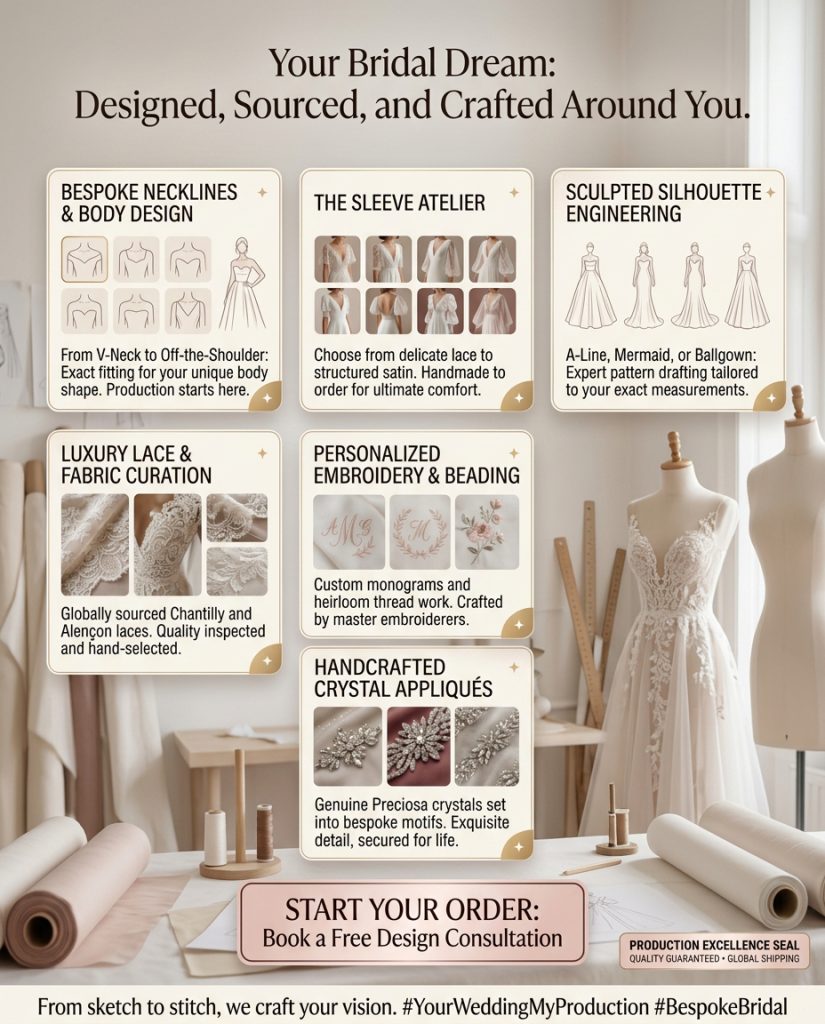
24.09.2026
Personalised wedding dresses in Australia have shifted from one-size-fits-most tradition to hyper-individual expression. In 2026, Australian brides prioritise gowns that honour climate, body, story and values—lightweight, breathable, convertible, often non-white, and built for real movement...

01.09.2025
Bridal Dress Fair Sale Turkey is set to be a landmark event for brides-to-be, boutique owners, and fashion enthusiasts seeking the finest wedding gowns at competitive prices. Turkey, renowned for its rich textile heritage and...
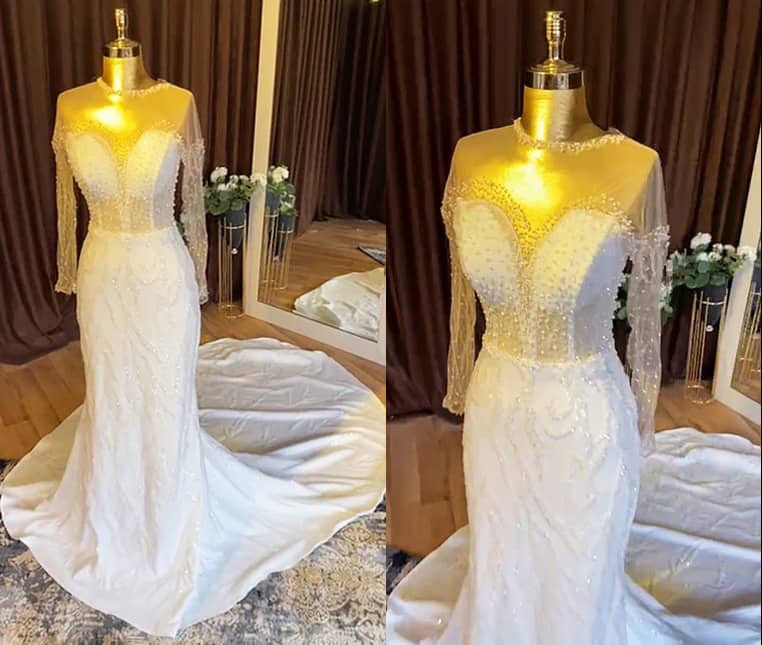
13.06.2024
Wholesale Fancy Dresses Best 5 A crepe wedding dress refers to a wedding gown made from crepe fabric. Crepe is a lightweight fabric with a slightly crinkled or textured surface, often made from silk, wool,...
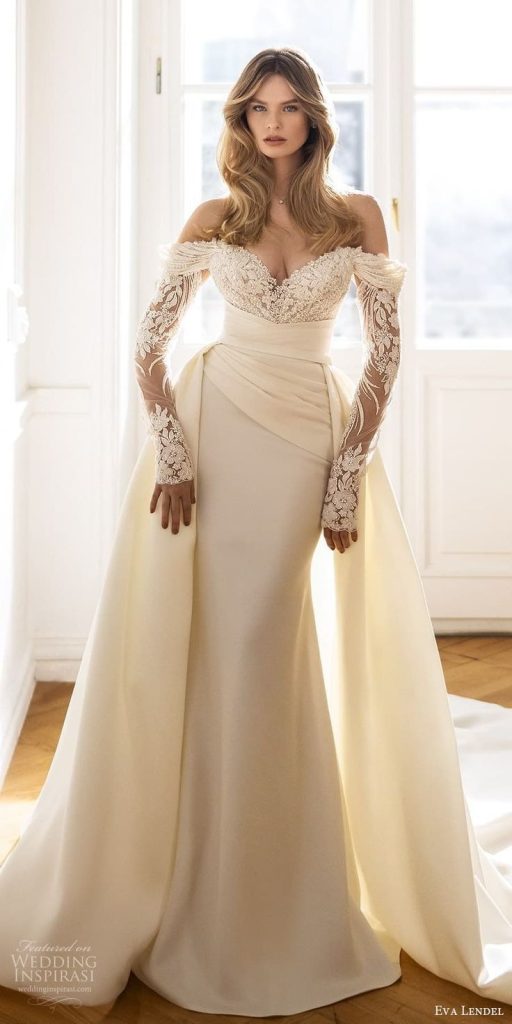
07.08.2025
Bridal gown alterations wholesale in the UK represent a vital service for bridal boutiques, retailers, and designers seeking cost-effective, high-quality customization for wedding dresses in bulk. The UK’s bridal industry, with its rich heritage and...
02.03.2024
Studien zu den Maßen von Hochzeitskleidern Maßstudien für Hochzeitskleider sind ein wesentlicher Aspekt der Modebranche. Die Maße eines Hochzeitskleides sind entscheidend, da sie die Passform des Kleides an der Braut bestimmen. Ein Hochzeitskleid ist eines der...
Comments