
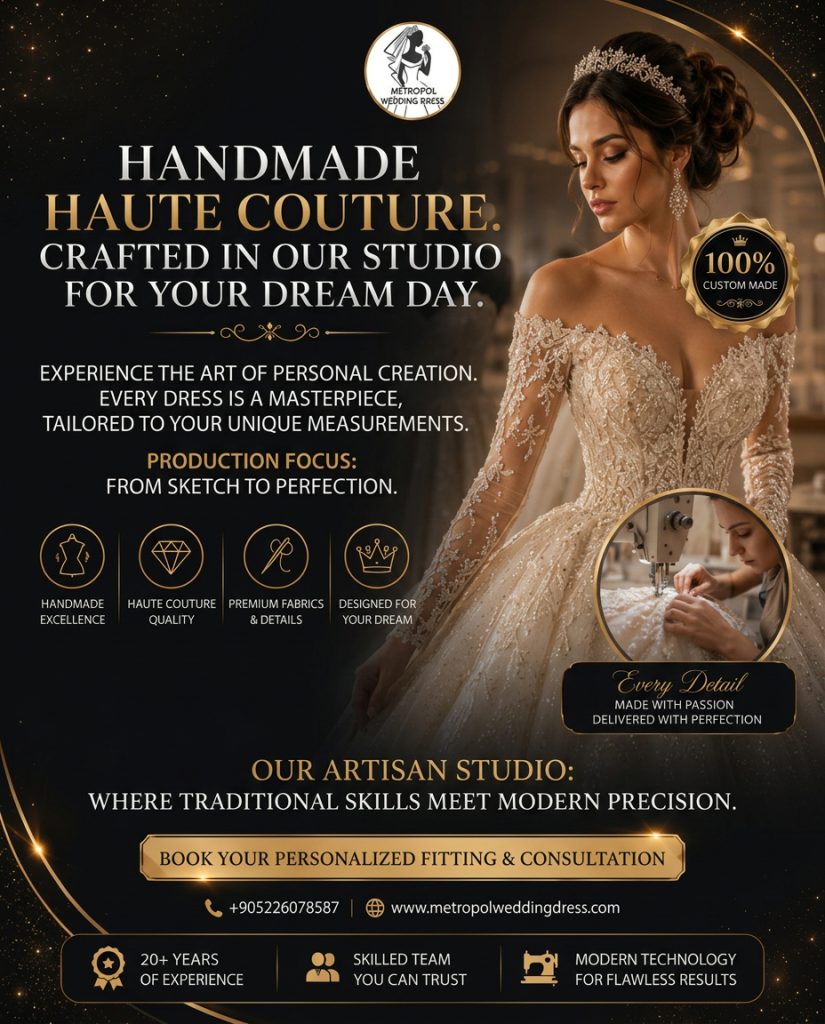
Bespoke Luxury Bridal Designer from Turkey for Australian Brides Australian wedding days are rarely generic. A Byron Bay beach ceremony under soft afternoon light demands movement and breathability. A Yarra Valley vineyard evening needs structure that holds in cooler air and looks refined under fairy lights. A Melbourne rooftop or Sydney harbour formal calls for drama without overwhelming the city skyline. An outback or regional celebration often requires practical elegance that survives heat, dust, and long hours of dancing. Local bridal shopping frequently forces compromises: limited sample sizes, high prices for true custom work, long lead times, or designs that look stunning on the hanger but feel restrictive once the real day arrives.
Metropol Wedding Dress, based in the Konak / Çankaya area of İzmir, Turkey, has spent more than two decades solving exactly this problem for brides and boutiques worldwide. What began as a retail-focused operation grew into a full atelier and wholesale manufacturer producing an average of around 100 dresses per month from a substantial workshop. The company combines traditional Turkish textile craftsmanship with modern pattern engineering and European-sourced materials to create fully custom gowns. For Australian clients the value proposition is practical rather than exotic: superior control over fit and design, competitive landed costs, and a collaborative process that works across continents.
Why Turkish Atelier Production Resonates with Australian Realities
Turkish bridal manufacturing sits at a useful intersection. İzmir and Istanbul have long traditions of skilled sewing, lace application, and embroidery, while the industry has scaled to serve European, Middle Eastern, and increasingly Asian and Oceanian markets. Metropol’s workshop is equipped for both single bespoke commissions and larger private-label runs. This dual capability matters for Australian brides who want a unique dress and for boutique owners who want exclusive collections without locking capital into large local inventory.
Australian climate and lifestyle create specific technical demands that off-the-rack or lightly customised local gowns often miss. Lightweight yet structured fabrics that breathe in humidity, bodices that support without restricting movement during long receptions, trains that can be bustled or detached for dancing, and finishes that photograph cleanly under harsh sunlight or soft golden-hour light are all achievable when the manufacturer controls the entire process from pattern to final hand-finishing. Metropol routinely works with French and Italian lace, duchess satin, mikado, soft tulle, organza, and stretch-blend linings chosen for drape, durability, and comfort.
Inclusive sizing is another practical advantage. Australian body diversity is wide; standard sample sizes in many boutiques leave plus-size, petite, or athletic figures negotiating compromises. A true made-to-measure process starts with the client’s measurements rather than forcing the body into an existing pattern.
The Collaborative Design Journey – How It Actually Works Across Time Zones
The process is structured yet flexible, designed for remote collaboration.
- Vision and brief
Share mood boards, venue photos, preferred silhouettes (A-line, mermaid, ballgown, column, tea-length, or hybrid), neckline ideas, fabric preferences, and non-negotiables. Cultural or family elements—heirloom lace, specific embroidery motifs, modest coverage, or modern cut-outs—are welcomed. Metropol’s design team responds with technical notes and fabric suggestions. - Precise measurements
A detailed measurement guide is supplied. Many Australian clients use a trusted local tailor or experienced friend; video guidance is available. For complex designs a calico toile (mock-up) can be produced and fitted remotely or with local help before final fabric cutting. - Sketch and material confirmation
Refined sketches (hand-drawn or digital) are approved. Fabric swatches can be sent. Pricing for upgrades (premium lace, extra beading, longer trains, detachable sleeves or overs skirts) is transparent. - Production with progress documentation
Pattern making, cutting, sewing, embroidery, and embellishment occur in stages. Photo and video updates keep the client informed without requiring travel to Turkey. - Final review and shipping
Minor refinements are possible before dispatch. Gowns are carefully packed for long-haul air freight. Express courier options typically reach major Australian cities in several business days once the dress leaves the workshop, subject to customs clearance.
Realistic overall timelines from confirmed order to arrival in Australia commonly fall in the 8–16 week range for standard custom work, with buffers recommended for peak seasons and any local steaming or minor alterations. Rush capacity exists but should be discussed early.
Material and Construction Realities for Australian Conditions
Not every “luxury” fabric performs equally under Australian light, heat, or humidity. Metropol’s approach prioritises both aesthetics and wearability.
| Fabric / Construction Element | Strengths for Australian Weddings | Practical Notes |
|---|---|---|
| French / Chantilly lace | Breathable, romantic texture, excellent in natural light | Handle carefully; pair with soft lining |
| Italian silk / duchess satin | Beautiful drape, temperature regulation, clean lines | Professional cleaning recommended |
| Soft tulle & organza layers | Volume without heavy weight, ideal for beach or outdoor | Multiple layers for opacity |
| Mikado / faille | Holds architectural shape, good for formal evening | Less forgiving if measurements shift |
| Stretch-blend linings & modern boning | All-day comfort, movement for dancing | Maintains silhouette without bulk |
| Hand-sewn embroidery & crystal work | Light-catching detail without excessive weight | Applied after fit is confirmed |
The workshop’s expertise in mould-making, embroidery, and finishing allows combinations that balance structure and comfort—critical when a bride may move from outdoor ceremony to indoor reception in the same day.
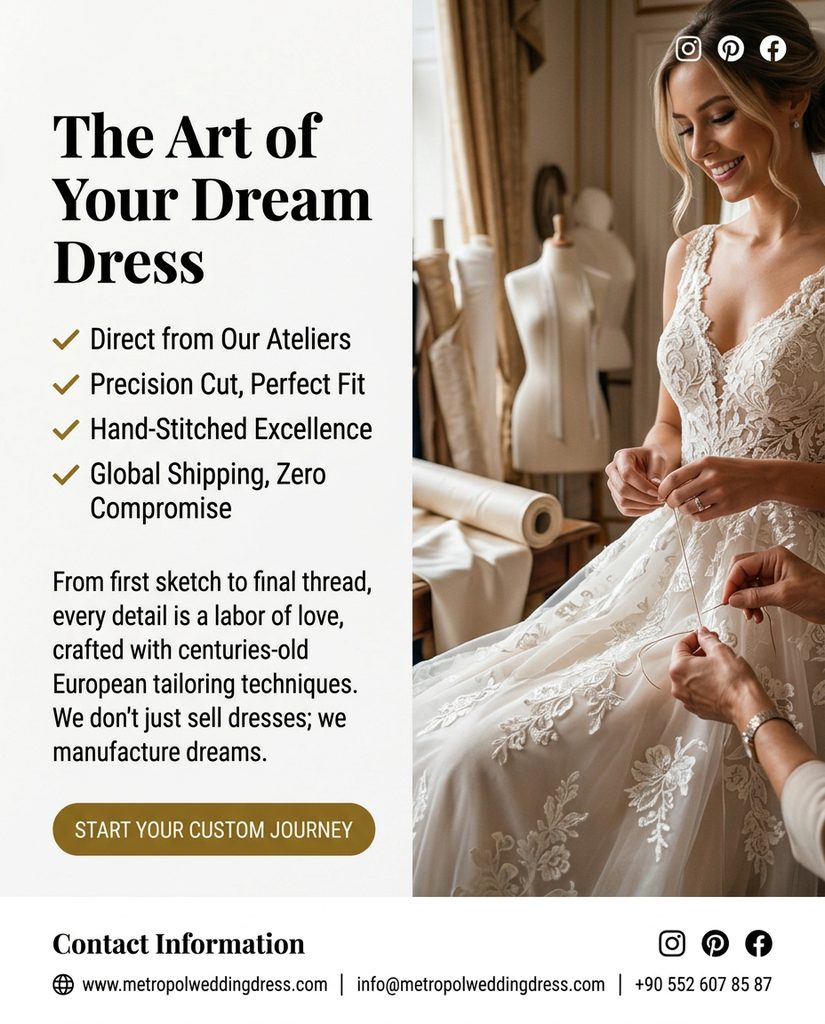
Cost Reality Check – What Australian Clients Actually Pay
Local Australian true couture frequently begins at AUD 6,000–15,000 and climbs higher for intricate work. Metropol’s pricing for many styles has historically ranged from roughly €300 to €2,000+, with more elaborate couture pieces higher. Even after international shipping, insurance, Australian GST (10 %), and any applicable duty (commonly around 5 % on many apparel categories depending on exact classification and origin documentation), the landed cost often remains substantially lower than equivalent local bespoke while delivering comparable or superior material quality and fit precision.
Typical cost components for an individual Australian bride:
- Base gown construction and pattern
- Fabric and embellishment choices
- International express shipping + insurance
- Australian GST calculated on the relevant value
- Possible duty
- Optional local alterations or pressing
Boutiques ordering wholesale or private-label collections benefit from volume pricing and can maintain healthy margins while offering exclusive designs unavailable elsewhere in Australia.
Hidden costs to avoid: under-estimating lead time (rush work can compromise quality), selecting the cheapest fabric then regretting the photographic result, omitting shipping insurance on a high-value item, and assuming zero local adjustments will ever be needed if body measurements change slightly.
Import and Logistics Specifics for Australia
Australia’s rules for personal and commercial apparel imports are clear. For individual brides, GST is typically collected by the courier or at the border. Commercial shipments require an ABN and correct HS classification. Biosecurity issues are rare for new, clean garments provided packaging is free of soil or plant material. Preferred carriers (DHL, FedEx, or specialised apparel forwarders) provide tracking and signature-on-delivery. Metropol’s experience shipping worldwide means documentation and packing standards are already aligned with international requirements.
Build a buffer of several weeks between planned arrival and the wedding date for customs clearance, local steaming, and any final tweaks.
Real Australian Scenarios Metropol Solves
Beach or coastal wedding (Byron, Whitsundays, Perth, etc.)
Soft movement, minimal bulk, lace that catches ocean light, optional detachable train or sleeves for ceremony versus reception. Lightweight silk-blend bases with carefully engineered support.
Vineyard, formal garden, or city rooftop
Structured bodice, refined train, richer fabrics that hold shape under evening lighting. Mikado or heavy satin with precise internal construction and hand-beaded accents.
Plus-size, petite, or athletic figure
Full made-to-measure from the first pattern rather than altering a standard sample. Inclusive silhouette adaptation that flatters without compromise.
Boutique building an exclusive collection
Private-label or OEM collaboration producing 8–15 unique styles (or more) that no other Australian shop carries, with optional exclusive colourways or signature embroidery details.
Cultural or multi-heritage elements
Incorporation of specific motifs, modest coverage options, or family heirloom pieces into a modern silhouette.
Expert Practical Advice from the Production Side
- Lock silhouette and neckline early—these drive pattern complexity more than colour or embellishment density.
- Request fabric swatches and, if possible, view them under Australian daylight.
- Document current accurate measurements and re-check closer to production if significant weight or posture changes are possible.
- Maintain clear, written communication channels (WhatsApp is frequently preferred for speed and photo sharing).
- Photograph the gown thoroughly on arrival in good natural light before any final steaming.
- Keep the original measurement sheet and design notes; they become valuable if family members later want related pieces.
Pre-Commitment Checklist for Australian Clients
- Mood board and non-negotiables clearly listed
- Accurate current measurements taken (and plan for possible re-check)
- Full budget including gown + shipping + GST/duty + buffer calculated
- Preferred silhouette, fabric shortlist, and complexity level defined
- Realistic timeline from order to wedding with contingency weeks
- Communication method and response expectations agreed
- Understanding of included revision rounds versus extra-cost changes
- Shipping insurance and tracking confirmed
- Local seamstress or pressing plan if desired
The Deeper Value Proposition
A Metropol gown is not merely cheaper couture. It is a dress engineered once, for one body and one vision, using materials and construction methods refined through thousands of international commissions. The emotional difference is noticeable: the knowledge that no other bride has worn this exact combination of pattern, fabric, and detail, and that every measurement was taken with the final wearer in mind rather than adapted from a sample.
For Australian brides the combination of Turkish atelier craftsmanship, European fabrics, transparent remote collaboration, and realistic landed costs creates a practical middle path between expensive local couture and mass-produced imports. The dress becomes a physical expression of a specific love story, climate, venue, and body—designed deliberately rather than accepted as the closest available option.
Next Steps
The most useful first action is a detailed conversation covering measurements, preferred fabrics, timeline, and budget range. From there the collaborative process begins with sketches, material options, and a clear production plan. Metropol Wedding Dress has already demonstrated the ability to serve clients across Europe, the Middle East, North America, and Australia with consistent quality and communication.
Whether you are an individual bride seeking a one-of-a-kind gown or a boutique owner looking for exclusive, high-quality stock, the atelier in İzmir is structured to deliver. The result is a dress that feels personal, photographs exceptionally, and performs under the real conditions of an Australian wedding day.
Frequently Asked Questions (20+ targeted questions)
1. How does Metropol handle Australian time-zone differences for consultations?
Video calls and WhatsApp messaging are scheduled for mutual convenience. Many progress updates occur asynchronously with clear photo and video documentation so decisions do not require real-time meetings.
2. What is a realistic total lead time from deposit to arrival in Australia?
Typically 8–16 weeks for standard custom work depending on complexity, current workshop load, and shipping method. Peak bridal seasons and highly intricate embellishment can extend this. Always build buffer weeks.
3. Will I pay Australian GST and duty on a gown from Turkey?
Yes, 10 % GST applies to most imports. Clothing often attracts around 5 % duty depending on exact tariff classification and documentation. The commercial invoice provided by Metropol enables accurate calculation. Total landed cost should always be modelled before ordering.
4. Can Metropol create truly unique designs or only modify existing styles?
Both. Fully original designs from client sketches or mood boards are standard, as are customisations of existing silhouettes. Private-label collections for boutiques are also available.
5. How accurate is the fit when measurements are taken remotely?
Very accurate when the supplied measurement protocol is followed carefully, preferably with a local tailor. A toile stage is available for complex designs. Minor local adjustments remain wise if body changes occur.
6. What fabrics perform best for humid Australian coastal weddings?
Lightweight silk blends, soft tulle, breathable lace over comfortable linings, and carefully engineered internal structure that supports without trapping heat.
7. Are plus-size and petite brides properly accommodated?
Yes. Full made-to-measure from the first pattern is the standard approach rather than grading from limited sample sizes.
8. Can cultural or modest design elements be incorporated?
Yes. Specific coverage requirements, family motifs, or cultural embroidery are routinely integrated into modern or traditional silhouettes.
9. What shipping methods and protection are used?
Careful packing for long-haul air freight via reputable express couriers with tracking and insurance options. Signature-on-delivery is recommended.
10. How many revision rounds are typically included?
Core design approval and progress reviews are part of the process. Significant late-stage changes after fabric cutting may incur additional cost and time; this is clarified upfront.
11. Can I request a fabric swatch before committing?
Yes. Swatches help confirm colour, texture, and hand-feel under local lighting conditions.
12. What happens if my measurements change after the order is placed?
Notify the atelier as early as possible. Adjustments are easiest before final fabric cutting. Significant changes after that stage may require additional work.
13. Is Metropol suitable for boutique private-label or wholesale orders?
Yes. The workshop supports both single bespoke gowns and larger wholesale or private-label collections with consistent quality control.
14. How does pricing compare to Australian designers for equivalent quality?
Landed costs from Metropol frequently undercut local true couture while matching or exceeding material quality and customisation depth, after accounting for shipping, GST, and duty.
15. What documentation is needed for Australian customs?
A detailed commercial invoice, packing list, and airway bill. Metropol’s export experience means these are prepared to international standards.
16. Can detachable elements (trains, sleeves, overs skirts) be included?
Yes. Transformer or modular features are popular for Australian multi-part wedding days.
17. How is quality controlled across remote production?
Stage-by-stage photo and video documentation, experienced pattern-makers, and final hand-finishing before packing.
18. What is the typical price range for a mid-complexity custom gown?
Historically many styles fall in the €300–€2,000+ range before shipping and Australian taxes; highly elaborate couture is higher. Always request a specific quote based on design complexity.
19. Can I combine heirloom lace or family fabric into a new gown?
In many cases yes, subject to technical assessment of the existing material’s condition and compatibility.
20. What should I do immediately after the gown arrives in Australia?
Inspect carefully in good light, photograph thoroughly, arrange professional steaming if needed, and schedule any minor local adjustments well before the wedding.
21. Are rush orders possible for shorter timelines?
Limited capacity exists but must be discussed early; quality remains the priority.
22. How does Metropol support Australian boutiques wanting exclusive ranges?
Through private-label design collaboration, exclusive colourways or details, and reliable production volumes without the client needing to hold large local stock.
23. What communication tools work best?
WhatsApp for rapid photo sharing and updates, supplemented by email for formal documentation and video calls for detailed discussions.
24. Is insurance recommended during shipping?
Yes. High-value bridal gowns should be fully insured for the transit period.
25. Can the same process be used for bridesmaid or mother-of-the-bride dresses?
Metropol’s capabilities extend to related formal wear; discuss specific requirements for consistency of fabric and style.
Five Distinct Calls to Action
- Practical next step
Share your measurements, preferred silhouette, and wedding date for a tailored feasibility and pricing outline. - Design exploration
Send a mood board or sketches and receive initial technical feedback plus fabric suggestions within a short turnaround. - Boutique partnership
Request wholesale or private-label collection information if you operate an Australian bridal shop seeking exclusive, high-quality stock. - Timeline check
Confirm your wedding date and current production capacity to see whether a fully custom gown is realistically achievable. - Full conversation
Begin a detailed WhatsApp or email dialogue covering every aspect of design, cost, and logistics so you can decide with complete information.
Metropol Wedding Dress continues to serve Australian brides and retailers who refuse to choose between compromise and excessive cost. The combination of Turkish atelier skill, European materials, remote collaboration tools, and transparent landed-cost realities makes a genuinely personal luxury gown more accessible than ever. The dress that results is not simply worn—it is the deliberate expression of one specific wedding day.
The first part of this guide established the foundation—why Australian brides are increasingly choosing a Turkish atelier for true bespoke luxury, how the remote collaboration process works, realistic costs including GST and duty, fabric performance under Australian conditions, and a solid set of practical FAQs.
What follows expands the picture with more granular detail, real-world decision frameworks, production transparency, long-term value considerations, and additional tools that turn research into confident action. This section is written for the bride (or boutique buyer) who has already decided that “good enough” is no longer acceptable and wants to understand every practical layer before placing a deposit.
The Emotional and Practical Difference Between “Customised” and True Bespoke
Many Australian bridal salons advertise “custom” or “made-to-order.” In practice this often means selecting from existing patterns, choosing from a limited fabric menu, and adjusting the size. True bespoke, as practised at Metropol Wedding Dress, starts with a blank pattern that is drafted for one specific body and one specific design brief.
The difference appears in three places:
- The internal architecture (boning placement, bust support, waist definition, and hip ease) is engineered for the individual rather than graded from a standard size.
- Embellishment density and placement can be adjusted so that beading or lace follows the body’s natural lines instead of fighting them.
- Proportions (train length, sleeve volume, skirt fullness) are scaled to the bride’s height, posture, and the visual demands of the venue and photography style.
Australian brides frequently report that the first time they put on a true made-to-measure gown they experience a quiet shock of recognition: the dress simply sits correctly. No tugging, no constant adjusting, no awareness of construction. That freedom is the practical outcome of starting from the body rather than the sample rack.
Production Transparency – What Happens Inside the İzmir Workshop
Metropol operates a substantial production space (reported between 800 m² and 1,200 m² depending on the source) staffed by experienced pattern-makers, cutters, sewers, and embroiderers. The typical sequence for a fully custom order looks like this:
- Technical pattern drafting – measurements are translated into a paper or digital pattern. Complex designs receive a toile (calico mock-up) stage.
- Fabric cutting – once the pattern is approved, the chosen fabrics are cut with precision. Premium lace is often matched for motif continuity.
- Construction of the base structure – inner corsetry, lining, and structural seams are completed first.
- Outer shell and lace application – the fashion fabric and lace layers are applied.
- Hand embellishment – beading, crystals, pearl work, or three-dimensional floral elements are added by hand.
- Final finishing – hems, closures, bustle systems, and quality checks.
- Photographic documentation – progress images and final studio shots are sent before packing.
Because the entire process stays inside one workshop, communication remains direct. Clients receive stage-by-stage visual updates rather than waiting until the finished gown arrives.
Decision Framework: Choosing Silhouette and Structure for Australian Venues
Australian wedding locations create distinct technical requirements. The following comparison helps match silhouette to environment:
| Venue Type | Recommended Silhouette Strengths | Key Technical Priorities | Common Metropol Adaptations |
|---|---|---|---|
| Beach / Coastal | Soft A-line, lightweight mermaid, column with movement | Breathability, low bulk, easy walking on sand | Soft tulle layers, detachable train, stretch lining |
| Vineyard / Garden | Structured A-line or soft ballgown | Fabric that holds shape in breeze, moderate train | Mikado or heavy satin with internal structure |
| City Rooftop / Formal | Clean column, architectural mermaid, or dramatic ballgown | Clean lines under evening light, strong posture support | Precise boning, longer train options, refined beading |
| Outback / Regional | Practical A-line or tea-length with movement | Heat management, durability, easy movement | Lightweight fabrics, optional shorter options, robust closures |
| Multi-location day | Modular or transformer designs | Ability to change volume or coverage | Detachable sleeves, overs skirts, or trains |
This table is not prescriptive. Many brides successfully mix elements (for example a structured bodice with a soft, flowing skirt). The point is that the atelier can engineer the internal construction to match the real demands of the day rather than forcing a standard design into an unsuitable environment.
Cost Modelling Tool – Building Your Personal Landed-Cost Estimate
A transparent quote is only useful if you can project the final figure in Australian dollars. Use this simple structure:
Step 1 – Gown base price (quoted in EUR or USD by Metropol)
Step 2 – Fabric and embellishment upgrades
Step 3 – Express shipping + insurance
Step 4 – Estimated Australian duty (commonly ~5 % on many apparel categories)
Step 5 – GST (10 % applied to the relevant taxable value)
Step 6 – Optional local alterations or professional pressing
Example (illustrative mid-range custom gown):
- Gown + upgrades: €1,200
- Shipping & insurance: €150
- Approximate duty: €60–70
- GST: roughly €140–160
- Local pressing/alterations buffer: AUD 150–300
Converted and totalled, many clients find the complete landed cost still sits well below equivalent Australian true couture while delivering higher customisation depth. Always request a current quote; exchange rates and exact duty classification can shift the final number.
Expert Commentary: Fit Longevity and Future Value
A well-made bespoke gown has a longer practical life than most people expect. Because the pattern was drafted for one body, the dress often remains wearable for formal events years later with minimal alteration. Several Australian clients have reported using the same gown (with minor updates) for anniversary celebrations or formal family events.
From a pure investment perspective, the combination of high-quality European fabrics, hand finishing, and individual pattern means the garment retains both emotional and potential secondary-market value better than mass-produced alternatives. Some brides later sell or pass the dress within family networks; a documented bespoke origin and original measurements increase its desirability.
Expanded Checklist for the Serious Buyer
Use this extended list once you are ready to move from research to action:
Design clarity
- Final mood board with ranked priorities
- Clear decision on silhouette, neckline, sleeve style, and train length
- Written list of non-negotiables versus flexible elements
Technical readiness
- Accurate current measurements taken by a competent person
- Plan for possible re-measurement closer to production
- Understanding of toile stage (if required)
Financial readiness
- Full landed-cost model completed
- Budget buffer for currency movement and unexpected local needs
- Payment schedule and deposit terms confirmed
Logistics readiness
- Preferred shipping method and insurance level chosen
- Realistic timeline with buffer weeks agreed
- Local seamstress or pressing contact identified
Communication readiness
- Primary contact channel confirmed (WhatsApp is common)
- Expected response times understood
- Designated decision-maker on the Australian side if multiple people are involved
Additional Scenario Deep-Dives
The multi-cultural wedding
Many Australian couples blend cultural traditions. Metropol regularly incorporates specific coverage requirements, colour accents, or motif work while keeping a contemporary overall silhouette. The atelier’s experience with diverse international clients makes these hybrid requests routine rather than exceptional.
The second-marriage or intimate celebration
Not every bride wants maximum volume. Clean, architectural, or lightly romantic designs in luxurious fabrics are fully supported. The same made-to-measure process applies, often with shorter production times because of reduced complexity.
The boutique owner building differentiation
Australian bridal retailers face intense competition. Offering exclusive Metropol-designed or private-label pieces that no other shop in the country carries creates a genuine point of difference. Volume pricing and consistent quality control make this commercially viable.
Voice-Search and Practical Question Clusters
Brides often ask questions in conversational form. Here are direct answers to frequent voice-style queries:
- “Can I get a custom wedding dress from Turkey delivered to Australia in time for my wedding?”
Yes, provided you start with realistic lead times (commonly 8–16 weeks plus buffer) and confirm capacity early. - “How much does a real bespoke Turkish wedding dress cost after shipping and tax in Australia?”
Many mid-complexity designs land between the mid-range and upper-mid range of Australian salon pricing while offering deeper customisation. Request a specific quote. - “Is the quality actually as good as local Australian designers?”
Clients consistently report that fabric quality, construction, and fit precision match or exceed expectations when the design brief is clear and communication is maintained. - “What if I need changes after the dress arrives?”
Minor local alterations are normal. Significant redesign after arrival is difficult; the remote process is designed to finalise decisions before shipping.
Closing Perspective for the Decision Stage
The choice is no longer between expensive local couture and compromised imported ready-to-wear. A specialist Turkish atelier such as Metropol Wedding Dress offers a third path: genuine individual pattern-making, premium materials, collaborative remote process, and transparent economics that work for Australian conditions and budgets.
The gown that results is not an approximation of a dream. It is the physical record of deliberate decisions—about body, venue, light, movement, and personal style—executed by experienced hands in a dedicated workshop.
If the earlier sections answered the “why” and “how,” this continuation has focused on the “exactly how much,” “exactly what happens,” and “exactly what I need to prepare.”
The next practical move is a conversation that turns the research into a concrete design brief, measurement set, and timeline. From that point the atelier process begins, and the dress moves from concept to reality.
When you are ready, share your measurements, preferred silhouette, wedding date, and any non-negotiable details. The collaborative work can start immediately.
Custom Made Turkish Wedding Dresses for Australian Brides – Continuing the Complete Practical Guide
The previous sections covered the core advantages of working with a Turkish atelier such as Metropol Wedding Dress, the remote collaboration process, fabric performance under Australian conditions, cost modelling including GST and duty, venue-matched silhouettes, and an extensive set of decision tools.
This continuation goes deeper into the day-to-day realities of ordering a fully custom-made Turkish wedding dress from Australia. It focuses on measurement precision, common pitfalls that delay or compromise results, seasonal production considerations, body-type engineering, post-arrival care, and an expanded set of scenario-based recommendations. The goal remains the same: give Australian brides and boutique buyers enough concrete information to move from research to a confident, well-prepared order.
Measurement Precision – The Single Most Important Factor for Remote Custom Work
Because the pattern is drafted from the measurements you supply, accuracy at this stage determines almost everything that follows. Metropol provides a detailed measurement guide, but the quality of the numbers depends on how carefully they are taken.
Recommended measurement protocol for Australian clients
- Use a soft measuring tape and wear the undergarments (or similar shapewear) you plan to wear on the wedding day.
- Have a second person take the measurements; self-measurement almost always introduces error.
- Measure at the same time of day, preferably morning, and stand in a natural posture.
- Record each measurement twice and average the results if there is any discrepancy.
- Include height, weight, and a simple description of posture (for example “slight forward shoulder” or “prominent lower back curve”).
- Photograph the measurement session from front, side, and back in form-fitting clothing for additional reference.
Key measurements typically requested include bust (fullest point and under-bust), waist (natural and preferred dress waist), high hip, low hip, hollow-to-hem or desired finished length, shoulder width, arm circumference, and back length. For complex designs additional points such as apex-to-apex distance or preferred neckline depth are added.
If significant weight change, pregnancy, or posture shifts are possible between ordering and the wedding, schedule a re-measurement window with the atelier before final fabric cutting. Most workshops can accommodate reasonable adjustments if notified early.
Common Mistakes Australian Brides Make (and How to Avoid Them)
Experience with international clients has highlighted recurring issues that are easy to prevent:
- Starting too late
Even with efficient Turkish production, a realistic timeline from confirmed measurements to arrival in Australia is usually 8–16 weeks plus buffer. Peak seasons (Australian spring–summer weddings) increase demand. Begin conversations 6–9 months out whenever possible. - Vague design briefs
“Something romantic with lace” is not enough. Rank your priorities (silhouette first, then neckline, then fabric, then embellishment density). Visual references from Pinterest or Instagram help enormously. - Ignoring fabric behaviour under Australian light and climate
Heavy beading that looks stunning in a cool European showroom can feel restrictive or overheat in a Queensland summer. Discuss venue and season explicitly. - Underestimating the value of a toile stage
For highly structured or unusual designs, a calico mock-up fitted (even remotely with photos) prevents costly surprises later. - Assuming zero local work will be needed
Even perfect remote measurements can benefit from a professional steam and minor hem or bustle adjustment once the gown is in Australia. Budget time and a small amount of money for this. - Choosing the cheapest shipping option on a high-value item
Express tracked and insured shipping is standard for bridal. The cost difference is minor compared with the risk.
Seasonal Production Realities for Australian Wedding Dates
Australian wedding peaks (September–April) overlap with high demand periods in the global bridal calendar. Metropol’s workshop maintains steady capacity, but the following practical notes apply:
- Orders placed in the Australian winter (June–August) often enjoy slightly more flexible scheduling.
- Spring and early summer weddings require earlier commitment to secure preferred production slots.
- Christmas and New Year periods in Turkey can affect communication speed; plan accordingly.
- Rush capacity exists but is limited and should be requested at the first conversation rather than mid-process.
If your date is fixed and relatively soon, open the discussion with a clear statement of the deadline so the atelier can assess feasibility immediately.
Body-Type Engineering – How True Custom Differs from Size Grading
Australian body diversity is wide. Standard sample sizes in many salons leave gaps for petite frames, fuller figures, athletic builds, or asymmetrical proportions. A true custom process addresses this at the pattern stage:
- Petite – proportions are scaled rather than simply shortened; neckline, waist, and train length are adjusted together.
- Plus-size / fuller figure – support structure, fabric weight distribution, and ease allowances are engineered for comfort and visual balance.
- Athletic or rectangular – subtle shaping can be built into the pattern without relying solely on external shapewear.
- Asymmetrical or posture-related needs – slight differences between left and right sides or forward-shoulder adjustments can be drafted in from the beginning.
The result is a dress that feels secure and looks balanced without constant adjustment throughout the day.
Post-Arrival Care and Local Finishing in Australia
Once the gown clears customs and reaches you:
- Inspect it thoroughly in good natural light within 48 hours. Photograph any concerns immediately.
- Hang the dress on a sturdy padded hanger in a clean, dry space away from direct sunlight.
- Arrange professional steaming rather than ironing; most Australian bridal specialists know how to handle imported couture fabrics.
- Schedule a final fit check with a trusted local seamstress 4–6 weeks before the wedding if possible.
- Test the bustle system and any detachable elements in advance.
- Store the gown in a breathable garment bag until the wedding day.
Most clients find that only minor local work is required when measurements were accurate and communication was clear throughout production.
Scenario-Based Recommendations – Expanding the Earlier Examples
The multi-day or destination wedding within Australia
Consider modular design: a structured ceremony look that converts to a lighter reception version via detachable train, sleeves, or overskirt. Turkish ateliers are experienced with these transformer features.
The formal evening wedding in a cooler climate (Tasmania, southern Victoria, or alpine regions)
Richer fabrics such as mikado or heavier satin, longer sleeves or dramatic trains, and internal structure that maintains shape in cooler evening air perform well.
The intimate or elopement-style celebration
Clean architectural lines or lightly romantic designs in luxurious fabrics can be produced with slightly shorter lead times because of reduced complexity, while still remaining fully custom.
The bride with specific mobility or comfort needs
Discuss walking requirements, dancing expectations, and any physical considerations early. Pattern adjustments and fabric choices can prioritise ease of movement without sacrificing appearance.
Extended Practical Checklist Before Deposit
- Design priorities ranked and visual references prepared
- Accurate measurements taken according to the atelier guide
- Wedding date and preferred arrival window confirmed
- Full landed-cost estimate (gown + shipping + GST + duty + local buffer) completed
- Communication channel and response expectations agreed
- Understanding of revision policy and extra-cost triggers clear
- Shipping method and insurance level selected
- Local seamstress or pressing contact identified
- Contingency plan for possible body changes noted
Additional Frequently Asked Questions
26. How detailed should my initial design brief be?
The more specific the better. Rank silhouette, neckline, fabric preference, and embellishment level. Include photos of what you like and what you definitely do not want.
27. Can Metropol work with Australian-sourced heirloom lace or fabric?
In many cases yes. Send clear photos and a description of the material; the atelier will assess technical compatibility.
28. What happens if customs clearance takes longer than expected?
Build buffer time into the schedule. Express couriers and complete documentation usually keep delays minimal, but a few extra weeks of margin is wise.
29. Are fabric swatches sent to Australia?
Yes, upon request. This is particularly useful for confirming colour and hand-feel under local lighting.
30. Can I request a specific internal construction (for example stronger bust support or lighter boning)?
Absolutely. These preferences should be stated early so they can be engineered into the pattern.
31. How are colour variations handled (ivory, champagne, soft blush, etc.)?
Swatches and digital colour references are used. Final approval of the fabric dye lot is recommended for non-standard shades.
32. Is it possible to order matching or complementary pieces (veil, cape, or reception dress) at the same time?
Yes. Discuss these elements during the initial design phase for fabric and style continuity.
33. What level of English communication can I expect?
The team routinely works with international clients in English. Clear written communication and visual documentation are standard.
34. Can production photos include close-ups of construction details?
Yes. Clients regularly receive progress images showing seams, embroidery, and finishing quality.
35. How should I prepare for the final remote approval before shipping?
Review all progress photos carefully, confirm measurements have not changed significantly, and ask any remaining questions while adjustments are still possible.
Final Practical Perspective
Ordering a custom-made Turkish wedding dress from Australia is no longer an experimental choice. When the process is approached with accurate measurements, a clear design brief, realistic timelines, and transparent cost modelling, the outcome is a gown that fits the individual body, the specific wedding environment, and the bride’s personal vision more closely than most local ready-to-wear or lightly customised options.
Metropol Wedding Dress has refined this remote bespoke model through years of international commissions. The combination of skilled pattern-making, premium European fabrics, hand finishing, and consistent communication makes the geographical distance largely irrelevant.
The remaining step is practical: gather your measurements, clarify your design priorities, and open a detailed conversation that includes your wedding date and budget range. From that point the atelier process moves from concept to a finished gown that arrives ready for the final local touches and the wedding day itself.
When you are ready to proceed, share the essential details—measurements, silhouette preference, date, and any non-negotiables—and the collaborative work can begin.
Related Topics
16.06.2025
Victorin Wedding Dresses hold a special place in the world of fashion, symbolizing love, commitment, and personal style. Among the myriad of bridal designers, Victorin Wedding Dresses have emerged as a notable name, celebrated for...

15.01.2024
Wholesale wedding dresses near me refer to a type of wedding dress that is sold in bulk to retailers or bridal shops at a discounted price. These dresses are typically purchased by bridal shops or...
29.03.2026
Comment commander une robe de mariée sur mesure depuis la Turquie vers la France Dans le monde fascinant des préparatifs de mariage, la robe de mariée occupe une place centrale, symbole d’élégance, d’amour et de...

16.12.2023
Hochzeitskleider Macher Kleider machen Bräute sind erfahrene Designer und Kunsthandwerker, die maßgeschneiderte Brautkleider für zukünftige Bräute herstellen. Ihre Arbeit umfasst das Entwerfen und Anfertigen einzigartiger, einzigartiger Kleider, die den individuellen Stil, die Persönlichkeit und das...
28.01.2026
Robes de Mariée de Luxe Personnalisées pour Mariées Exigeantes Dans l’univers du mariage, la robe de mariée occupe une place absolument centrale. Elle n’est pas seulement un vêtement : elle est l’incarnation d’un rêve, d’une...

05.02.2026
Robe de mariée sur mesure vs semi mesure quelles différences Le choix de la robe de mariée est l’un des moments les plus intenses et symboliques de la préparation d’un mariage. Pour beaucoup de futures...
Comments