
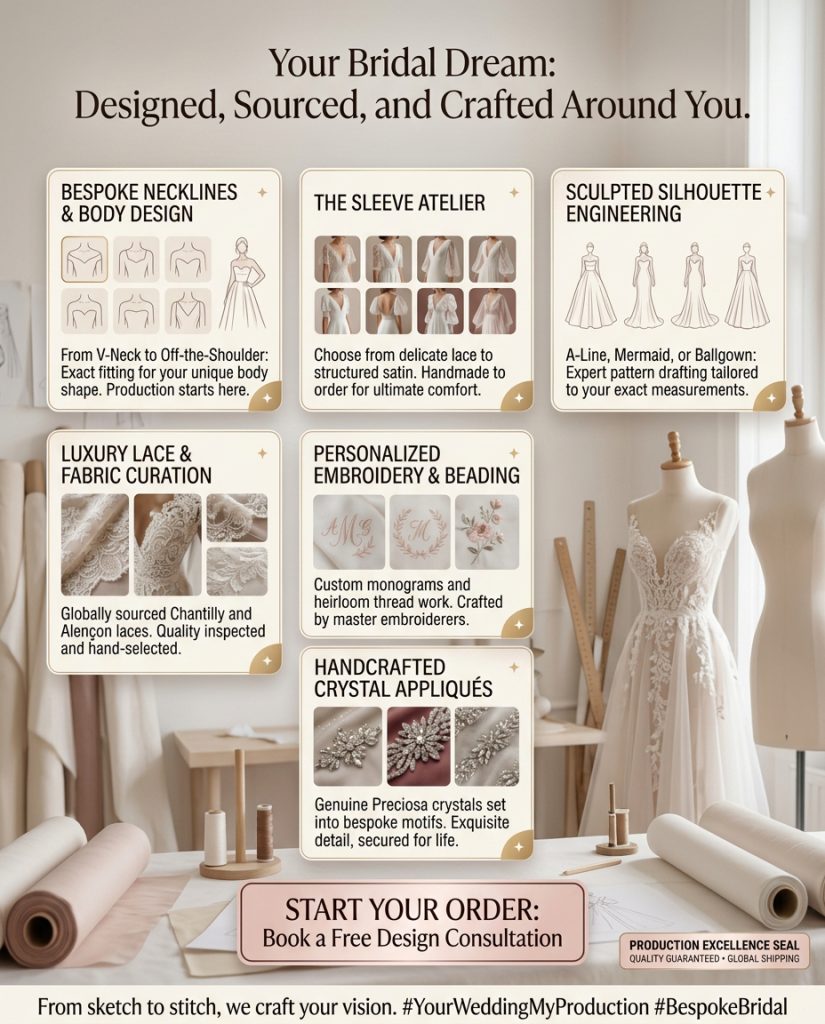
Luxury Bridal Suppliers Most bridal shops start with ready-made wholesale collections. That model works until every competitor carries similar silhouettes, fabric quality becomes inconsistent, and brides start asking for something “not available elsewhere.” At that point the conversation shifts to Custom Wedding Dress Wholesale, Wholesale Custom Bridal Gowns, Private Label Wedding Dress Manufacturer, and OEM Wedding Dress Manufacturer relationships.
A capable partner functions as both a Custom Bridal Gown Factory and a Bridal Gown Manufacturer for Bridal Shops. They can take your sketches or mood boards, develop patterns, source lace and fabrics, execute hand-beading or embroidery, and deliver finished gowns under your label or as exclusive styles for your store. The best ones also act as a Direct Wedding Dress Manufacturer and Wedding Dress OEM Supplier, removing intermediary mark-ups and giving you clearer visibility into production.
Metropol Wedding Dress fits this profile as an International Wedding Dress Manufacturer and Bridal Gown Exporter that already supplies boutiques across Europe and beyond. Their model supports Made to Measure Wedding Dress Manufacturer and Made to Order Wedding Dress Manufacturer work alongside private-label programs.
The Real Production Process Behind a Luxury Bridal Gown
Understanding the sequence helps you set realistic timelines and quality expectations.
- Design briefing and technical pack
You supply sketches, reference photos, fabric preferences, silhouette direction, and size range. A strong Couture Wedding Dress Manufacturer or Bridal Couture Manufacturer will return flat sketches, construction notes, and a preliminary fabric list. - Pattern development and sample
Pattern makers create the base, grade it across sizes, and produce a first sample (often in a more affordable fabric). This stage is where a Bespoke Wedding Dress Manufacturer or Tailor Made Wedding Dress Manufacturer proves its value. Fit, balance, and seam placement are corrected before expensive lace and beading begin. - Material sourcing
Premium European or high-grade Turkish lace, silk or silk-blend mikado, crepe, tulle, and organza are selected. Embellishments (beads, crystals, pearls, 3D florals) are chosen for durability and visual impact. A reliable Premium Bridal Gown Manufacturer maintains relationships with mills so fabric quality stays consistent batch to batch. - Cutting and construction
Layers are cut, interlinings and boning are set, and the gown is assembled. Complex ball gowns or heavily structured mermaid styles can require 40–80+ hours of skilled labor. Handwork distinguishes a true Handmade Wedding Dress Manufacturer and Handcrafted Bridal Gown Manufacturer from purely machine-driven production. - Embellishment and finishing
Beading, appliqué, and embroidery are applied. Final pressing, steaming, and quality checks follow. Packaging for international shipping completes the process.
Lead times for a well-run Custom Bridal Collection Manufacturer typically range from 6–12 weeks for semi-custom or private-label styles once samples are approved, longer for fully one-off couture pieces. Clear communication of peak-season capacity is essential.
Material Analysis: What Actually Drives Cost and Perceived Quality
Fabric and labor dominate the cost structure of a luxury gown.
- Lace: French or high-grade Chantilly, Alençon, or Guipure can cost several times more than basic machine lace. Placement, density, and hand-application affect both price and the “couture” feel.
- Base fabrics: Silk or silk-blend mikado, crepe, and satin deliver drape and structure that polyester cannot match. Volume requirements for full skirts multiply the impact.
- Lining and structure: Quality lining, boning, and understructures improve fit and longevity but add measurable cost.
- Embellishments: Hand-sewn beads and crystals are time-intensive. Machine alternatives reduce cost but usually reduce perceived value.
A transparent Custom Wedding Dress Factory or Direct Bridal Gown Manufacturer will break these elements out so you can decide where to invest for your target retail price points. Turkish production often offers a favorable balance of skilled handwork and competitive labor relative to Western Europe or the United States, which is one reason many boutiques evaluate Wedding Dress Manufacturer for Boutiques located in Turkey.
Cost and Margin Reality for Boutique Buyers
From a purchasing manager’s viewpoint the key numbers are:
- Landed cost per gown (factory price + shipping + duties + insurance)
- Target retail price that feels credible in your market
- Realistic gross margin after alterations, fittings, and occasional returns or remakes
Many shops aim for 2.5×–4× markup on landed cost depending on positioning. A Premium Wedding Dress Manufacturer that delivers consistent quality allows higher retail without excessive complaints. Lower-priced options that force heavy alterations or generate fit issues erode the margin quickly.
Request itemized quotes. Compare fabric origin, construction method (hand vs. machine beading), size range support, and whether private-label packaging and labels are included. Metropol and similar Custom Bridal Wear Manufacturer partners typically support flexible order quantities that suit independent boutiques better than high-MOQ mass producers.
OEM, Private Label, and Bespoke Options Compared
| Approach | Best For | Typical MOQ | Control Level | Time to Market | Brand Differentiation |
|---|---|---|---|---|---|
| Private Label / OEM | Building your own collection under your label | Low to moderate | High (your designs or co-developed) | Medium | Strong |
| Semi-custom / Made-to-Order | Offering exclusive styles with limited modifications | Very low or single piece | Medium-High | Medium | Good |
| Fully Bespoke / One-of-a-Kind | High-end brides wanting unique gowns | 1 | Maximum | Longer | Highest |
| Standard Wholesale | Quick inventory fill | Variable | Low | Fast | Weak |
A capable partner such as a Private Label Wedding Dress Manufacturer or OEM Wedding Dress Manufacturer can operate across several of these models. Bespoke Bridal Wear Manufacturer and One of a Kind Wedding Dress Manufacturer capabilities matter if your clientele includes brides who want something no other shop can offer. Exclusive Bridal Gown Manufacturer arrangements (limited distribution of certain styles) protect your local market.
Practical Import and Logistics Considerations
When sourcing from a Wedding Dress Exporter or Bridal Gown Exporter in Turkey:
- Confirm Incoterms (FOB, CIF, DDP) so responsibility for freight and duties is clear.
- Understand current duty rates for your country and any preferential trade agreements.
- Plan for size grading that matches your market (US, EU, UK, etc.).
- Require photo or video updates at key production stages for larger orders.
- Factor in peak bridal season capacity; factories book up months ahead.
A responsive International Wedding Dress Manufacturer provides clear production calendars and realistic shipping estimates. Direct factory relationships reduce the risk of middleman delays or quality dilution.
Common Mistakes Purchasing Managers Make
- Choosing solely on the lowest unit price and discovering fabric or construction shortcuts later.
- Skipping physical or high-quality sample evaluation.
- Failing to lock in intellectual-property protection for exclusive designs.
- Ignoring size-range capabilities (many brides need inclusive sizing).
- Underestimating lead times during spring and summer peaks.
- Not clarifying who owns the patterns and technical files.
A structured vetting process with a Custom Bridal Dress Manufacturer or Tailor Made Bridal Gown Manufacturer prevents most of these issues.
Decision Checklist for Selecting a Luxury Bridal Partner
- Owns or tightly controls production facilities (not purely a trading company)
- Can demonstrate consistent quality across multiple samples
- Supports private label, OEM, and made-to-measure workflows
- Provides transparent costing and realistic timelines
- Handles international shipping and documentation reliably
- Offers size grading appropriate to your market
- Communicates in a language and timeframe that works for your team
- Protects exclusive designs under clear agreements
- Has capacity for both small boutique orders and growing volume
- Aligns with your desired price-to-quality positioning
Metropol Wedding Dress meets many of these criteria as a long-established Turkish Custom Wedding Dress Manufacturer, Couture Wedding Dress Manufacturer, and Bridal Gown Manufacturer for Bridal Shops.
Building a Differentiated Collection
Start with a core set of silhouettes that sell well in your region, then layer exclusivity through fabric choices, embellishment density, or signature details developed with your Custom Bridal Collection Manufacturer. Rotate a portion of the assortment each season while keeping proven bestsellers. Offer made-to-measure options on selected styles to capture brides who will not settle for off-the-rack sizing.
Over time this approach turns your boutique from a reseller of widely available gowns into a destination for distinctive, high-quality bridal wear.
Five Distinct Calls to Action
- Practical next step: Request a current collection overview and fabric swatch set from Metropol Wedding Dress so you can evaluate construction and materials against your current suppliers.
- Margin-focused: Calculate your target landed cost and retail price points, then ask for a sample quote on three styles that match your best-selling silhouettes.
- Private-label exploration: Share a simple mood board or existing design direction and request a development timeline and MOQ discussion for an exclusive capsule.
- Quality verification: Order one or two samples in your most common size range and put them through the same fit and wear tests you apply to any new brand.
- Long-term partnership: Schedule a video call with the production or sales team to review capacity, communication protocols, and how they handle peak-season demand.
Frequently Asked Questions
1. What distinguishes a true Custom Wedding Dress Manufacturer from a wholesaler that offers limited modifications?
A genuine manufacturer controls pattern making, cutting, sewing, and finishing in-house or under close supervision, allowing full design changes, private labeling, and consistent quality control rather than surface-level alterations on existing stock.
2. How does a Bespoke Wedding Dress Manufacturer typically handle one-of-a-kind orders for boutique clients?
The process begins with detailed measurements and design approval, moves through pattern and sample stages, then proceeds to full production with progress photos. Lead times are longer than standard wholesale but the result is a unique gown.
3. What should a boutique expect from a Made to Measure Wedding Dress Manufacturer?
Accurate size grading based on client measurements, careful attention to proportion and balance, and the ability to adjust length, neckline, or sleeve details while keeping the overall design integrity.
4. Is a Private Label Wedding Dress Manufacturer suitable for smaller independent shops?
Yes, provided the manufacturer offers flexible or low minimums. Many Turkish and specialized factories support boutique-scale private-label programs so shops can build brand identity without large inventory commitments.
5. How does an OEM Wedding Dress Manufacturer protect a boutique’s exclusive designs?
Through written agreements that restrict the design to the client, control of pattern files, and clear policies against selling the same style to other retailers in the same market.
6. What production advantages does a Custom Bridal Gown Factory in Turkey often provide?
Skilled handwork at competitive labor costs, proximity to European markets for faster shipping than Far East options, and experience serving international bridal boutiques.
7. How important is it that a Luxury Bridal Gown Manufacturer owns its production facilities?
Ownership or tight control improves consistency, communication speed, and accountability. Trading companies that fully outsource introduce additional variables.
8. What fabric information should a Premium Wedding Dress Manufacturer supply?
Origin or quality grade of lace and base fabrics, composition, recommended care, and whether the same materials will be available for reorders.
9. Can a Wedding Dress Manufacturer for Boutiques support inclusive sizing?
Strong manufacturers grade across a wide size range and understand the construction adjustments needed for different body types so fit quality remains high.
10. What is a realistic lead time when working with a Made to Order Wedding Dress Manufacturer?
After sample approval, 6–12 weeks is common for most styles; complex couture or heavily embellished pieces may require longer. Peak season capacity should be confirmed early.
11. How does a Bridal Couture Manufacturer differ from a standard production factory?
Greater emphasis on hand techniques, finer materials, more intensive quality checks, and the ability to execute intricate design details that mass production cannot match economically.
12. What documentation should a Bridal Gown Exporter provide for international shipments?
Commercial invoice, packing list, certificate of origin if required, and any preferential trade documents that reduce duties.
13. How can a boutique evaluate the handwork quality of a Handcrafted Bridal Gown Manufacturer?
Examine samples under good light for even beading density, secure attachment, clean finishing on the reverse side, and overall durability of embellishments.
14. What role does a Direct Wedding Dress Manufacturer play in margin improvement?
Eliminating intermediate mark-ups and giving clearer visibility into true production costs allows better control over landed cost and retail pricing.
15. Is a Custom Bridal Wear Manufacturer able to develop an entire seasonal collection?
Yes. Many act as full development partners, translating mood boards into graded patterns, samples, and production-ready styles under the boutique’s label.
16. How should a purchasing manager approach cost negotiations with a Customized Bridal Gown Manufacturer?
Focus on total landed cost, quality consistency, and reliability rather than unit price alone. Volume commitments, payment terms, and fabric choices all influence the final number.
17. What happens if a sample from a Tailor Made Bridal Gown Manufacturer needs adjustments?
Clear communication of required changes, a revised sample if necessary, and written confirmation before bulk production begins.
18. Can a One of a Kind Wedding Dress Manufacturer also support wholesale volume?
Some do both. They maintain atelier-level capability for unique pieces while running efficient production lines for larger or private-label orders.
19. Why choose an Exclusive Bridal Gown Manufacturer relationship?
It limits distribution of specific styles, protecting the boutique’s differentiation in its local market.
20. What quality-control steps should a Wedding Dress OEM Supplier demonstrate?
In-process checks, final inspection against approved samples, photo documentation, and a clear process for handling any defects before shipment.
21. How does a Personalized Wedding Dress Manufacturer incorporate bride-specific details when working through a boutique?
The boutique collects measurements and preferences; the manufacturer executes them accurately while the boutique manages the client relationship and fittings.
22. What shipping options does a typical Bridal Gown Exporter offer?
Express courier for samples and smaller orders, consolidated air or sea freight for larger shipments, with tracking and insurance available.
23. How important is communication speed with an International Wedding Dress Manufacturer?
Critical. Delays in answering technical questions or providing updates can cascade into missed delivery windows for bridal clients.
24. Can a Custom Bridal Dress Manufacturer work from a boutique’s existing sketches or photos of discontinued styles?
Most experienced manufacturers can reverse-engineer or interpret references, subject to intellectual-property considerations and technical feasibility.
25. What size of production facility indicates seriousness for a Custom Wedding Dress Factory?
A dedicated workshop of several hundred to over a thousand square meters with specialized bridal equipment and skilled staff signals capacity beyond small atelier work.
26. How does a Bespoke Bridal Gown Manufacturer handle rush orders?
Capacity permitting, they may accommodate limited rush work at a premium. Peak-season rush capacity is usually limited and should be discussed early.
27. What after-sales support should a Premium Bridal Gown Manufacturer provide?
Guidance on care, handling of legitimate quality issues, and willingness to discuss future developments based on sell-through feedback.
28. Is it realistic for a boutique to start with small quantities from a Wholesale Custom Wedding Dresses supplier?
Many specialized manufacturers accept lower initial quantities precisely to allow boutiques to test the relationship and market response.
29. How does a Handmade Wedding Dress Manufacturer balance artisanal quality with commercial timelines?
By combining skilled handwork on critical elements with efficient process organization and experienced pattern teams so quality does not come at the expense of every deadline.
30. What long-term advantage does partnering with a proven Custom Wedding Dress Manufacturer like Metropol Wedding Dress offer?
Stable quality, growing exclusive product, improved margins, reduced reliance on widely distributed wholesale lines, and a supplier who understands the operational realities of bridal boutiques.
This content is designed as a practical resource for purchasing managers and boutique owners evaluating luxury bridal supply partners. It emphasizes real operational considerations over generic promotional language so you can make informed decisions that strengthen both product offering and profitability. For specific current capabilities, collections, and commercial terms, direct contact with Metropol Wedding Dress is the appropriate next step.
High-end wedding boutiques operate in a market where exclusivity, consistent quality, and healthy margins determine survival. National designer lines often arrive with strict MAP pricing, limited differentiation, and competition from every other salon carrying the same labels. This is why progressive purchasing managers increasingly treat a capable Custom Wedding Dress Manufacturer, Private Label Wedding Dress Manufacturer, or OEM Wedding Dress Manufacturer as a strategic asset rather than a simple vendor.
Metropol Wedding Dress, operating from its substantial İzmir workshop as a Luxury Bridal Gown Manufacturer, Custom Bridal Gown Factory, and International Wedding Dress Manufacturer, already supports boutiques seeking this level of partnership. The following sections expand the operational playbook with 2026 market realities, comparative sourcing analysis, risk controls, and practical implementation frameworks.
2026 Bridal Trends That High-End Boutiques Must Source Correctly
Current demand among luxury brides favors a blend of structured romance and wearable modernity. Key directions that a strong Couture Wedding Dress Manufacturer or Bridal Couture Manufacturer must execute well include:
- Basque and drop-waist silhouettes that elongate the torso while allowing fuller skirts.
- Exposed or architectural corsetry treated as design rather than pure structure.
- 3D floral appliqué and sculptural volume achieved with lighter fabrics.
- Transformer elements — detachable trains, overskirts, or sleeves — that deliver ceremony-to-reception versatility.
- Quiet luxury minimalism executed in high-quality mikado, crepe, or silk blends.
- Inclusive sizing with thoughtful internal structure so fit remains elegant across a wide range.
- Growing interest in more sustainable or traceable materials without sacrificing the hand-finished appearance expected at premium price points.
A Premium Bridal Gown Manufacturer and Handmade Wedding Dress Manufacturer that can translate these directions into reliable production gives boutiques a clear competitive edge. Metropol’s combination of traditional craftsmanship and modern production capacity positions it well for these requirements as both a Custom Bridal Collection Manufacturer and Bespoke Bridal Wear Manufacturer.
Turkey Versus Other Sourcing Hubs for Luxury Bridal
Tariffs, lead times, and quality consistency have shifted the calculus for many Western boutiques. China remains dominant in pure volume, yet rising duties and occasional variability in hand-finishing have pushed more high-end retailers toward alternative partners. Turkey offers several practical advantages for a Wedding Dress Manufacturer for Boutiques or Bridal Gown Manufacturer for Bridal Shops:
- Geographic proximity to European markets shortens transit times compared with East Asia.
- Strong tradition of lace application, embroidery, and structured construction.
- Greater willingness among specialized factories to work with lower or flexible minimums suitable for independent boutiques.
- EU-aligned compliance practices that simplify certain import scenarios.
- Competitive balance of skilled labor cost and quality output relative to Western European or North American ateliers.
A Direct Wedding Dress Manufacturer and Wedding Dress Exporter based in Turkey can therefore serve as both a margin protector and a differentiation tool. Metropol functions in this space as a Bridal Gown Exporter and Custom Wedding Dress Wholesale partner capable of supporting private-label and made-to-order programs.
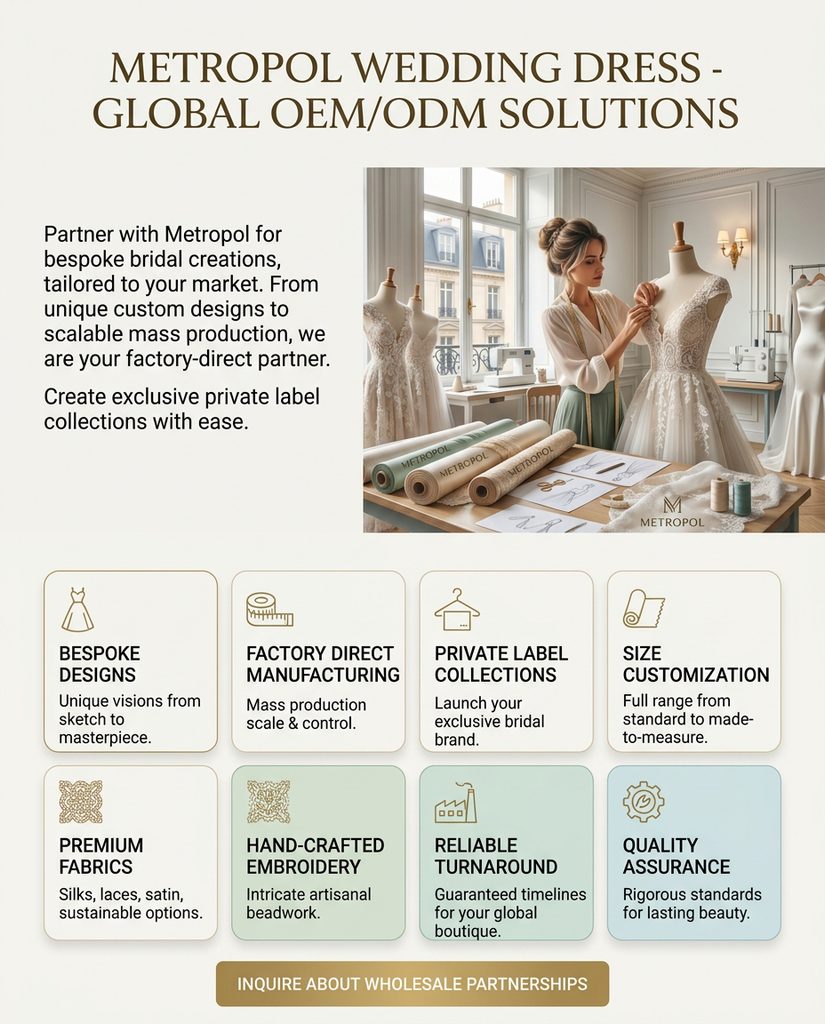
Building a Private-Label Program That Actually Protects Margins
The financial case is straightforward. National brands typically deliver 2–2.5× markup under MAP constraints. A well-executed private-label or OEM arrangement with a Private Label Wedding Dress Manufacturer or OEM Wedding Dress Manufacturer frequently supports 3.5–5× or higher when quality is consistent and exclusivity is real.
Implementation steps that successful high-end boutiques follow:
- Define a clear brand aesthetic and price architecture before contacting manufacturers.
- Select 4–8 core silhouettes that cover the majority of client requests in your market.
- Develop technical packs or detailed mood boards rather than vague inspiration images.
- Approve physical samples for construction, fabric hand, and embellishment durability.
- Negotiate exclusivity language for key styles within your geographic territory.
- Establish a reorder and seasonal refresh cadence so bestsellers stay in stock without over-committing capital.
A responsive Customized Bridal Gown Manufacturer and Made to Order Wedding Dress Manufacturer will treat these steps as standard collaboration rather than special requests. Metropol’s experience as a Custom Bridal Dress Manufacturer and Tailor Made Wedding Dress Manufacturer supports this workflow for boutiques that want exclusive inventory under their own label.
Risk Mitigation Checklist for Luxury Bridal Sourcing
High-end inventory carries higher unit cost and higher client expectations. Purchasing managers reduce exposure by applying these controls:
- Require itemized quotes separating fabric, labor, embellishment, and packaging.
- Insist on physical or high-resolution progressive photos at cutting, construction, and finishing stages for larger orders.
- Confirm size-grading standards match your local market (US, EU, UK, etc.).
- Clarify intellectual-property ownership of patterns and technical files.
- Test communication speed and technical English proficiency before placing significant volume.
- Start with a controlled pilot order rather than a full seasonal buy.
- Document defect tolerance and remake or credit procedures in writing.
- Factor total landed cost (including duties, freight, insurance, and potential alterations) into every margin calculation.
These practices distinguish professional relationships with a Premium Wedding Dress Manufacturer or Handcrafted Bridal Gown Manufacturer from opportunistic wholesale buying.
Real-World Application Scenarios
Scenario 1 – Mid-size European boutique seeking differentiation
A salon carrying three national lines faced price comparison and declining uniqueness. They partnered with a Turkish Custom Wedding Dress Factory to develop a private-label capsule of six styles focused on structured A-line and modern mermaid silhouettes with controlled embellishment. After sample approval, initial production of 40 pieces generated stronger average selling prices and reduced reliance on heavily distributed labels.
Scenario 2 – High-end North American shop expanding size range
An upscale boutique needed better coverage beyond sample sizes. Working with a Made to Measure Wedding Dress Manufacturer and One of a Kind Wedding Dress Manufacturer capable of accurate grading and structural support allowed them to offer true made-to-measure options on selected exclusive styles, capturing clients who previously left empty-handed.
Scenario 3 – Boutique balancing speed and exclusivity
Seasonal pressure required faster replenishment of proven silhouettes while still protecting uniqueness. A hybrid approach with a Wholesale Custom Bridal Gowns and Bridal Gown OEM Supplier partner delivered semi-custom versions of bestsellers on shorter cycles alongside fully exclusive pieces developed for longer lead times.
In each case the common success factors were clear technical communication, realistic timeline alignment, and a manufacturer that functions as a true Direct Bridal Gown Manufacturer rather than a pure trading intermediary.
Advanced Cost and Margin Framework
Beyond simple unit price, sophisticated buyers model:
- Fabric yield efficiency on complex skirts and trains.
- Labor hours for hand-beading versus machine alternatives and the resulting retail perception difference.
- Currency and freight volatility buffers.
- Alteration and fit-related costs that erode margin after the gown reaches the client.
- Opportunity cost of capital tied up in slow-moving inventory.
A transparent Custom Bridal Wear Manufacturer and Bespoke Wedding Dress Manufacturer will discuss these variables openly. The goal is not the lowest possible factory price but the highest sustainable contribution margin after all real costs.
Implementation Roadmap for the Next 90 Days
Days 1–15
Audit current assortment for over-exposure to widely distributed labels. Identify 3–5 silhouette gaps or price-point opportunities.
Days 16–30
Shortlist two or three potential partners including established Turkish options such as Metropol Wedding Dress. Request current capabilities summaries, sample policies, and indicative pricing for private-label or OEM work.
Days 31–60
Order and evaluate samples. Conduct video production-floor reviews where possible. Clarify exclusivity, lead times, and communication protocols.
Days 61–90
Place a controlled pilot order. Document the full process from deposit to delivery. Measure quality against client expectations and calculate actual landed margin.
This disciplined sequence converts the theoretical advantages of working with a Luxury Bridal Gown Manufacturer, Exclusive Bridal Gown Manufacturer, or Personalized Wedding Dress Manufacturer into measurable business results.
Expanded Calls to Action
- Request a private-label capability overview and current fabric library from Metropol Wedding Dress to assess fit with your brand positioning.
- Share three of your best-selling silhouettes and ask for development quotes on exclusive versions under your label.
- Schedule a technical discussion focused on size grading, embellishment durability, and peak-season capacity.
- Compare total landed cost and exclusivity potential of a Turkish Wedding Dress OEM Supplier against your existing Far East or domestic sources.
- Begin with a single capsule collection rather than a full seasonal buy so you can validate quality and client response with controlled risk.
High-end bridal retail rewards those who control product uniqueness and margin structure. Partnering with a proven Custom Wedding Dress Manufacturer, Couture Wedding Dress Manufacturer, Private Label Wedding Dress Manufacturer, and Bridal Gown Exporter such as Metropol Wedding Dress is one of the most direct routes to achieving both. The boutiques that treat manufacturing relationships as strategic rather than transactional will be best positioned for the next cycle of bridal demand.
Wholesale Luxury Bridal Accessories Suppliers for High-End Wedding Boutiques
High-end bridal boutiques know that the gown is only the beginning. The right accessories — veils, headpieces, belts, jewelry, gloves, and wraps — close the sale, elevate average transaction value, and create the cohesive, memorable look that luxury brides expect. Yet many salons still source accessories reactively or from the same widely distributed catalogs that every competitor carries. Strategic wholesale relationships with specialized luxury bridal accessories suppliers change that equation.
This guide is written for purchasing managers and boutique owners who treat accessories as a high-margin, high-impact category rather than an afterthought. It covers category strategy, 2026 trends, sourcing realities, private-label opportunities, quality controls, and practical implementation steps.
Why Accessories Deserve Dedicated Sourcing Attention
In a typical high-end bridal appointment, the dress generates emotion. Accessories generate the final “yes.” A cathedral veil transforms a clean silhouette into a ceremony moment. A refined crystal belt defines the waist on a minimalist gown. Statement earrings or a sculptural headpiece personalize the look without altering the dress itself.
From a commercial standpoint, accessories often deliver higher gross margins than gowns, require less inventory capital, and turn faster. They also create natural up-sell opportunities during fittings and allow boutiques to offer coordinated “complete the look” packages under their own styling expertise.
The most successful high-end shops therefore maintain deliberate wholesale relationships with suppliers who can deliver consistent quality, relevant trend direction, and, increasingly, private-label or exclusive options.
Core Categories and What Luxury Boutiques Actually Need
Veils
Still the highest-impact accessory. Demand in 2026 continues to favor longer lengths (chapel and cathedral), refined edges (satin, delicate lace, or pearl), and options with subtle personalization or layered volume. Mantilla and fold-over circular styles also perform well with certain clienteles. Quality differentiators include fabric hand (soft tulle vs. stiff), edge finishing, and how cleanly the veil attaches and drapes.
Headpieces
This category has expanded beyond classic tiaras. Current demand includes lower-profile pearl and crystal bands, floral or vine combs, sculptural pieces, feather accents, and even structured bonnet or hooded interpretations for editorial clients. Versatility (pieces that work with multiple hairstyles) and comfort for all-day wear matter as much as visual impact.
Belts and Sashes
Thin, refined styles with subtle beading, pearls, or tonal embroidery continue to outperform wide or heavily floral options. Detachable elements that allow the bride to change the look between ceremony and reception add practical value.
Jewelry
Classic pearl and crystal sets remain reliable. Statement earrings and layered or architectural necklaces perform strongly with cleaner gowns. Metal finishes (gold, silver, rose gold, mixed) must coordinate with the boutique’s overall aesthetic and the jewelry the bride already owns.
Additional High-Value Categories
Gloves (especially lace or embroidered), lightweight wraps and shawls for cooler venues or cultural needs, and carefully selected hairpins or scatter pieces complete the offering without over-complicating inventory.
2026 Trends Shaping Luxury Accessory Buying
- Dramatic yet refined veils — longer lengths with clean or lightly embellished edges.
- Statement and sculptural headpieces that function as true design elements rather than afterthoughts.
- Quiet-luxury belts that enhance silhouette without competing with the gown.
- Pearl-forward and Old Hollywood jewelry directions.
- Multifunctional or transformable pieces (detachable elements, dual-use designs).
- Growing interest in higher-quality materials and more considered craftsmanship, even in accessories.
Suppliers who stay ahead of these shifts and can execute them at consistent quality levels become preferred partners for high-end boutiques.
Sourcing Landscape: Where Luxury Accessories Come From
China remains the volume leader for many crystal, rhinestone, and mid-tier jewelry and headpiece items, with competitive pricing and fast sampling on certain styles. Specialized factories in Guangdong and Yiwu offer extensive catalogs and OEM capabilities.
Turkey provides strong options for lace-edged veils, hand-finished details, and European-influenced aesthetics, often with more flexible minimums and closer alignment to high-end European taste. Proximity advantages for European boutiques are meaningful.
European and North American artisanal makers excel in true luxury, limited-edition, and highly specialized pieces (hand-embroidered veils, fine jewelry-level headpieces), though at higher cost and often lower volume capacity.
India continues to offer exceptional handwork capabilities for certain embroidery and traditional-inspired pieces.
The optimal approach for most high-end boutiques is a tiered supplier mix: one or two reliable volume partners for core bestsellers, plus one or two specialized or artisanal sources for exclusive or statement pieces.
Private Label and Exclusive Opportunities in Accessories
Just as private-label gowns create differentiation, private-label or exclusive accessories protect margins and brand identity. Many manufacturers offer:
- Custom branding on packaging and labels
- Minor design modifications (edge treatments, metal finishes, bead density)
- Fully custom development for signature pieces
- Territory or style exclusivity agreements
Starting with a small capsule of exclusive veils or headpieces under the boutique’s name is often the lowest-risk way to test this model. Success here frequently leads to expanded exclusive programs.
Quality and Operational Controls Specific to Accessories
Accessories present different risks than gowns. Key controls include:
- Material authenticity and durability (crystal quality, plating longevity, fabric hand and opacity for veils)
- Comfort and wearability testing (weight of headpieces, security of combs and pins)
- Packaging that protects delicate items during shipping and storage
- Color consistency across dye lots, especially for ivory and soft whites
- Clear return or defect policies for small, high-volume items
- Accurate size and length grading for veils and belts
Request physical samples before any significant commitment. Evaluate how pieces photograph and how they pair with the gowns already in your collection.
Practical Buying Framework for High-End Boutiques
- Audit current accessory sell-through and identify gaps relative to your gown assortment.
- Define a clear aesthetic direction and price architecture for the category.
- Shortlist suppliers by category strength (veil specialists, headpiece/jewelry specialists, etc.).
- Order samples of both bestselling and trend-forward styles.
- Negotiate terms that include sampling, reorder flexibility, and any exclusivity language.
- Integrate accessories into appointment flow and visual merchandising so they feel essential rather than optional.
- Track attachment rate and average accessory revenue per gown sale.
Boutiques that treat accessories with the same strategic rigor they apply to gown sourcing consistently outperform those that treat the category as secondary.
Connecting Gown and Accessory Strategy
A strong relationship with a Custom Wedding Dress Manufacturer or Luxury Bridal Gown Manufacturer such as Metropol Wedding Dress creates natural synergy. Coordinated lace, tulle, and embellishment directions between gowns and veils or belts produce more polished results and higher attachment rates. Many boutiques use their primary gown partner’s aesthetic as the reference point when selecting complementary accessory suppliers, ensuring visual coherence across the entire offering.
Implementation Checklist
- Map current accessory inventory against top-selling gown silhouettes
- Identify 3–5 priority accessory styles that would most improve conversion or average order value
- Request samples from at least two specialized wholesale suppliers
- Evaluate private-label or exclusivity potential on key items
- Establish clear quality standards for veils, headpieces, and jewelry
- Train sales teams on accessory pairing and storytelling
- Set quarterly review cadence for sell-through and trend alignment
Closing Perspective
Luxury bridal retail is increasingly about curated, complete experiences. Gowns remain the foundation, but accessories provide the finishing authority that distinguishes a high-end boutique. By building deliberate wholesale relationships with capable luxury bridal accessories suppliers — and by applying the same purchasing discipline used for custom and private-label gowns — boutiques protect margins, strengthen differentiation, and deliver the polished result that discerning brides expect.
Whether expanding core inventory or developing exclusive pieces, the suppliers who combine consistent quality, relevant design direction, and responsive partnership become long-term assets rather than interchangeable vendors.
Related Topics
21.06.2025
Ball gown bridal dresses have long been the epitome of fairy-tale elegance, captivating brides with their dramatic silhouettes and luxurious designs. These iconic gowns, characterized by fitted bodices and voluminous skirts, create a regal and...
28.01.2024
Discounted bridal dress manufacturers are companies or factories that produce wedding dresses at a reduced price compared to traditional retail prices. They often offer their products at wholesale prices or offer discounts on bulk orders....
03.06.2025
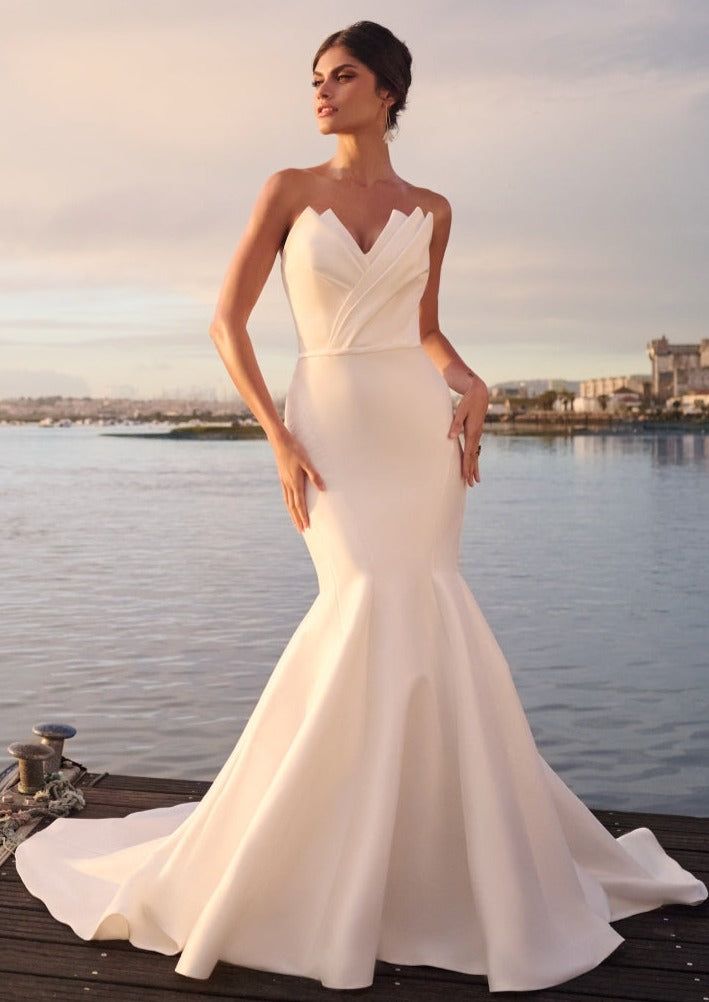
Sisters Wedding Dresses Weddings are emotional milestones, but when two sisters are involved—either as the bride and maid of honor, or even two brides—something extraordinary happens. The phrase “Sisters Wedding Dresses” conjures images not only...
09.04.2026
Luxus Brautkleider nach Mass In einer Welt, in der Hochzeiten immer persönlicher und einzigartiger werden, steht das Luxus Brautkleid nach Maß im Mittelpunkt des großen Tages. Kein fertiges Kleid von der Stange kann die Individualität...
07.05.2023
Wholesale bridal gowns play a pivotal role in the wedding fashion ecosystem, serving as a bridge between manufacturers and retailers. This comprehensive exploration delves into the world of wholesale bridal gowns, covering the manufacturing process,...

03.03.2026
VIP Brautkleid Beratung Persönlicher Service für deutsche Kundinnen Die Wahl des perfekten Brautkleides ist ein einmaliges Erlebnis im Leben jeder Frau. Besonders für deutsche Kundinnen, die Wert auf Qualität, Stil und einen persönlichen Service legen,...
Comments